
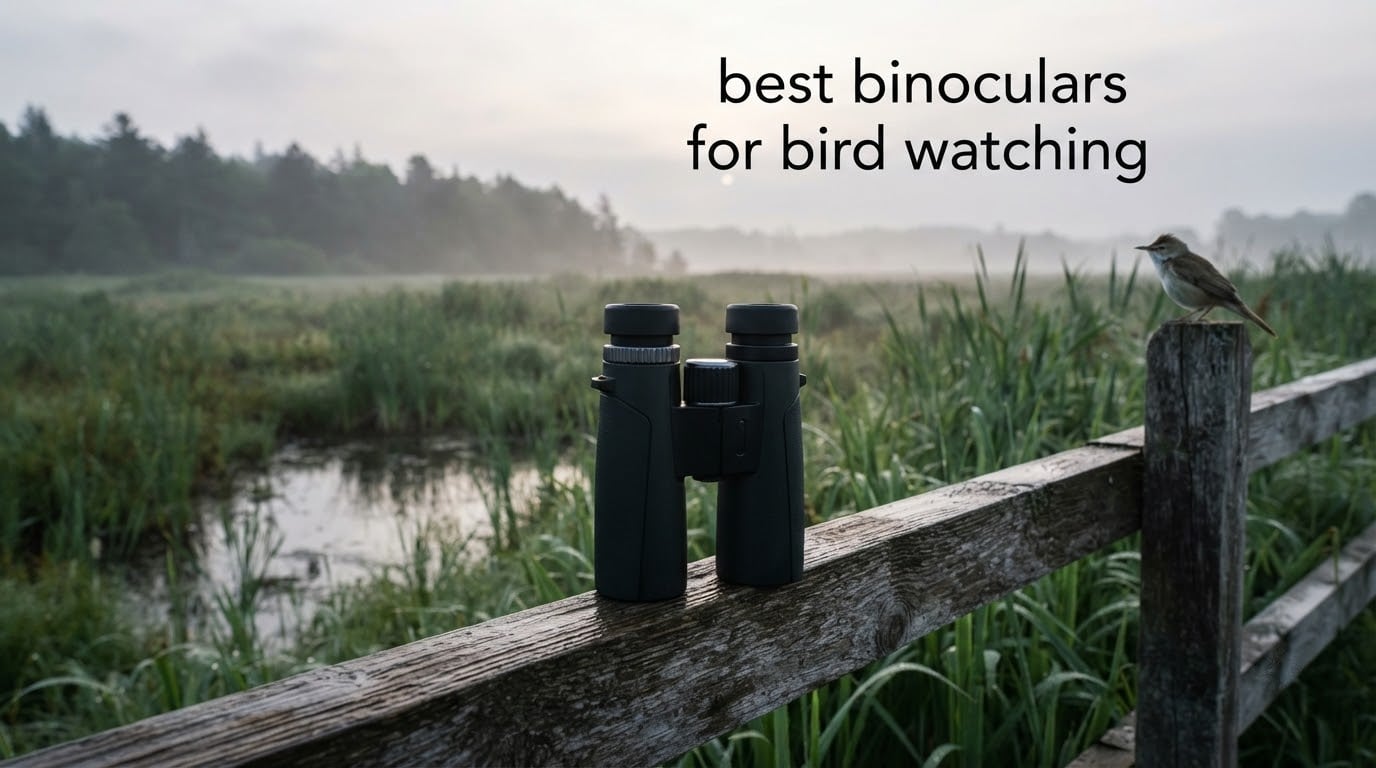
An 8×42 binocular is the sweet spot for bird watching: it balances a bright image, a wide field of view for finding moving birds, and enough magnification to identify a species at distance.
That one sentence answers the search question most people are actually asking. Almost every serious birding guide, from the Cornell Lab’s All About Birds project to the forum regulars on r/birding, lands on the same format, and the reason is not marketing. Eight power is enough magnification to read a warbler’s field marks without shaking the whole view apart, and 42mm of objective lens gathers enough light to keep working at dawn and dusk when most birds are actually active.
This roundup covers ten pairs of birding binoculars, from a pocket-sized compact that fits a jacket pocket to full-size 8×42 roof-prism models with ED glass, phase-coated prisms and lifetime warranties. We spent weeks comparing the spec sheets, the owner feedback and the field-of-view figures across all ten, and we have ranked them by what each pair is genuinely good at rather than by brand name or badge.
One thing to say early: the jump from a very cheap pair to a very expensive pair buys you much less than the price difference suggests. Most of the optical gain arrives at the first step up. What you are paying for above that is edge-to-edge sharpness, colour accuracy under backlight, and a warranty that still means something in ten years.
Table of Contents
Top 3 Picks for Bird Watching (October 2026)
If you want the short version, these are the three that fit the most people. The Celestron Nature DX 8×42 is the one we would hand to almost anyone. The Vortex Crossfire HD 10×42 carries the strongest rating in the group and gives you extra reach. The Vortex Diamondback HD 8×42 is the step up we recommend to anyone who quickly gets hooked.

Celestron Nature DX 8×42
- 388 ft field of view
- 17.5mm eye relief
- BaK-4 phase-coated prisms
- Limited lifetime warranty

Vortex Crossfire HD 10×42
- 10x magnification
- 325 ft field of view
- Center focus with diopter
- VIP lifetime warranty

Vortex Diamondback HD 8×42
- 393 ft field of view
- Fully multi-coated HD optics
- Argon purged and o-ring sealed
- GlassPak harness included
Quick Comparison of All 10 Picks in 2026
Here is every binocular in this roundup with the three or four specs that actually decide whether it suits birding. Field of view is quoted in feet at 1,000 yards, and eye relief in millimetres, because those two numbers answer most buying questions faster than anything else on the list.
| Product | Specs | Action |
|---|---|---|
| Celestron Nature DX 8×42 |
|
Check Latest Price |
| Vortex Crossfire HD 10×42 |
|
Check Latest Price |
 Vortex Triumph HD 10×42 Vortex Triumph HD 10×42 |
|
Check Latest Price |
| Vortex Diamondback HD 8×42 |
|
Check Latest Price |
 Nikon PROSTAFF P3 8×42 Nikon PROSTAFF P3 8×42 |
|
Check Latest Price |
 Celestron Nature DX ED 8×42 Celestron Nature DX ED 8×42 |
|
Check Latest Price |
 Nikon Monarch M5 8×42 Nikon Monarch M5 8×42 |
|
Check Latest Price |
 Vanguard Endeavor ED 8×42 Vanguard Endeavor ED 8×42 |
|
Check Latest Price |
 Nikon PROSTAFF P7 8×42 Nikon PROSTAFF P7 8×42 |
|
Check Latest Price |
 Hontry 10×25 Compact Hontry 10×25 Compact |
|
Check Latest Price |
1. Celestron Nature DX 8×42 – Best All-Rounder for Casual Birders
Celestron Nature DX 8×42 Waterproof Binoculars for Bird Watching & Outdoors
8x magnification
42mm objective
388 ft FOV
17.5mm eye relief
1.8 lb
Roof prism, phase coated
Pros
- Consensus 8x42 format for finding birds quickly
- Phase-coated BaK-4 prisms keep contrast high
- Waterproof and nitrogen purged with rubber armor
- Built-in tripod adapter socket
- Limited lifetime warranty
Cons
- Dimmer and less detailed in low light than ED glass models
- Some chromatic aberration at high magnification
- Loose eyecups reported after heavy daily use
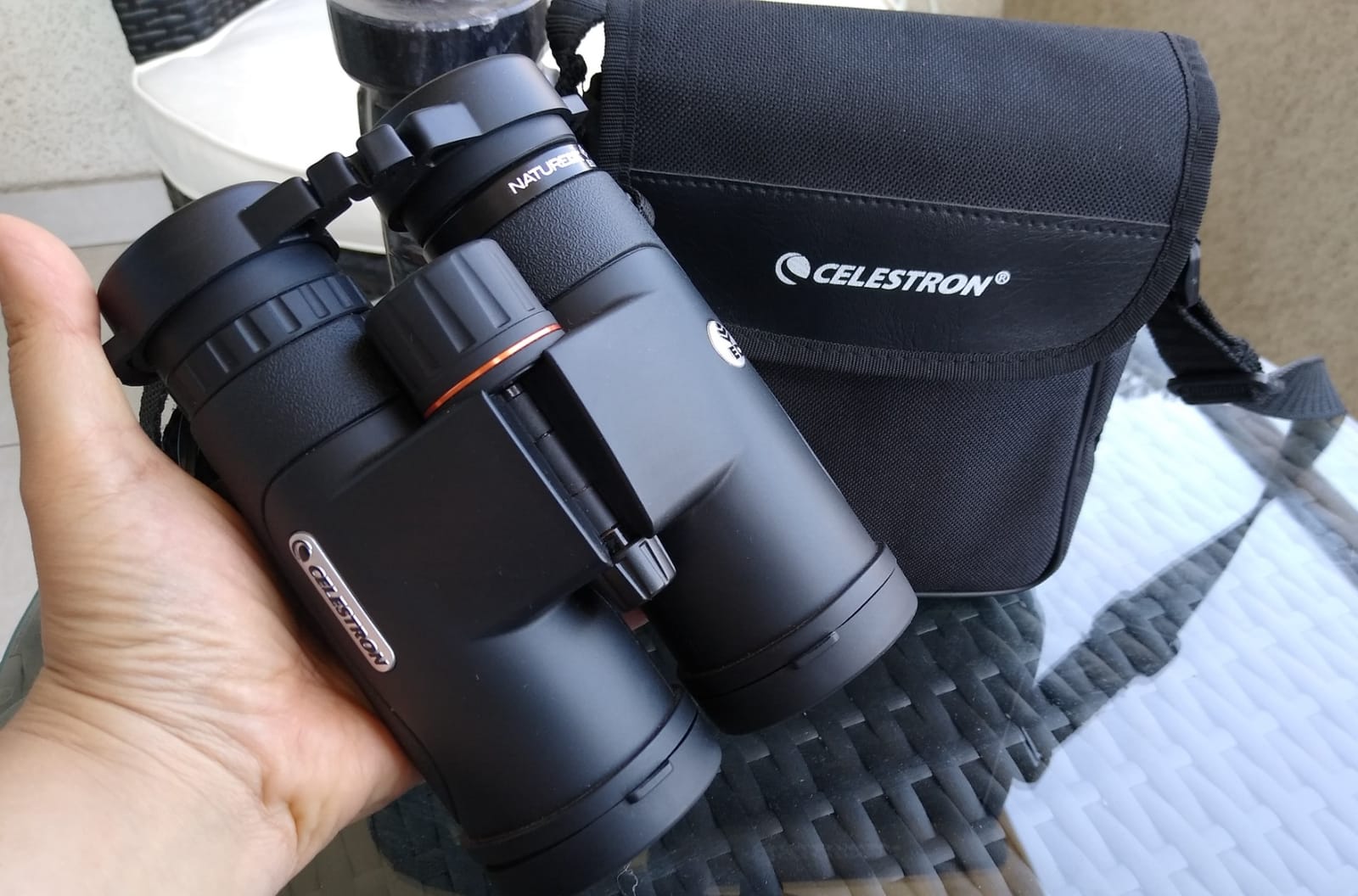
The Celestron Nature DX 8×42 is the pair we recommend to someone buying their first real birding binoculars, and it is our top pick overall for good reason. The 388-foot field of view at 1,000 yards is wide enough to find a warbler in a hawthorn hedge rather than only finding it after a long search. Phase-coated BaK-4 prisms hold contrast well, which matters more than raw resolution when a bird is backlit against a bright sky.
It also handles the boring realities of regular use. The body is rubber-armored polycarbonate, waterproof and nitrogen-purged, and there is a built-in tripod adapter socket in the hinge for the times you want to sit on a hide wall at dawn and let the glass do the work. The included kit covers the essentials: a carrying case, neck strap, objective cap, rainguard and lens cloth.
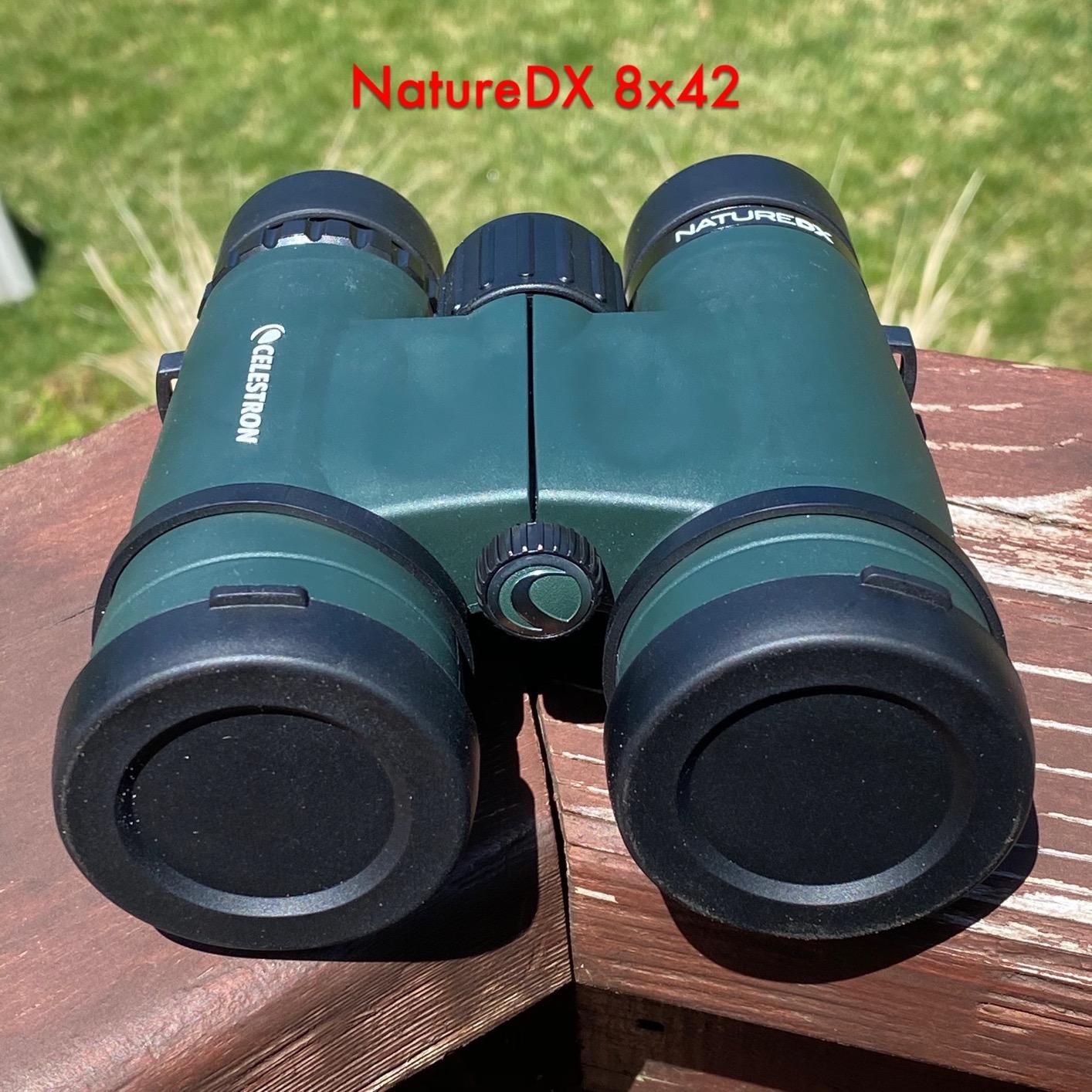
Where it stops short is light. This is not ED glass, and in the last twenty minutes before sunrise the image gets noticeably greyer and softer than it does in daylight. Reviewers report seeing colour fringing along high-contrast edges when zoomed in on distant branches. Neither issue stops you identifying a bird, and both are the first things you notice when you compare it side by side with an ED pair.
What the field of view and focus actually give you
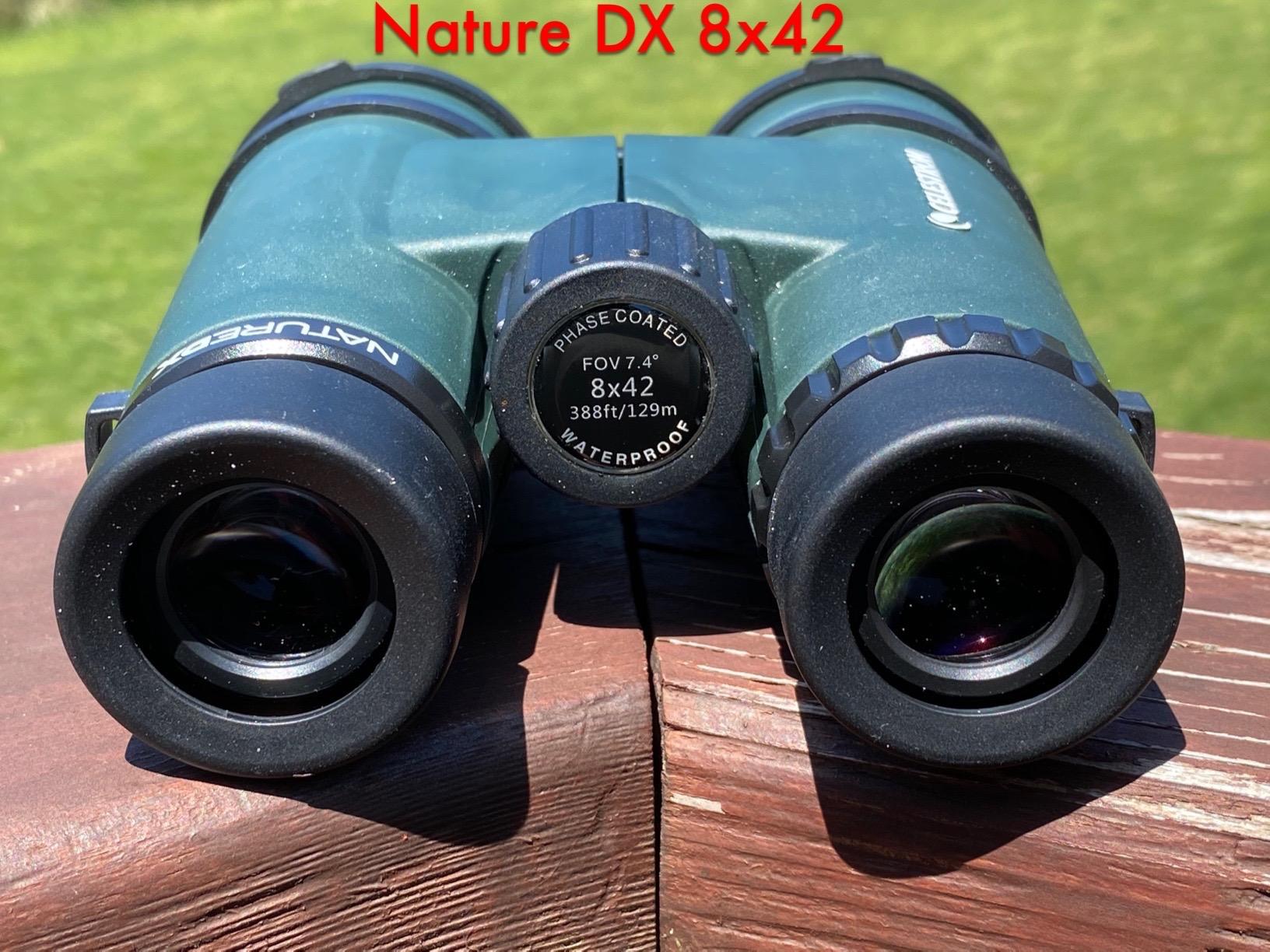
At 388 feet, the field of view sits comfortably in the middle of the group, wide enough for scanning a treeline without constant panning. The exit pupil of 5.25mm is larger than most 10×42 models, which is exactly why this format reads brighter in shade and under canopy. Individual focus on each barrel is an older design choice and slightly slower to adjust than a centre wheel, but it is dependable.
When to skip it and buy something else
Skip this one if your birding happens almost entirely at dawn or dusk, or if you wear glasses with thick frames that need more than 17.5mm of eye relief. For a first pair, a small amount of light loss is an easy trade. For someone birding an hour before sunrise in November, it is the wrong trade, and an ED model is worth the step up.
2. Vortex Crossfire HD 10×42 – Best Rated Step-Up Pair
Vortex Crossfire HD 10×42 Binoculars
10x magnification
42mm objective
325 ft FOV
15mm eye relief
1.4 lb
Roof prism, fully multi-coated
Pros
- Highest owner rating in this roundup
- HD elements cut chromatic aberration
- Center focus wheel with right-eye diopter
- Adjustable twist-up eyecups
- Aluminum body
- VIP lifetime warranty
Cons
- 15mm eye relief is tight for eyeglass wearers
- 325 ft field of view is the narrowest full-size model here
- Not ED glass so some fringing remains
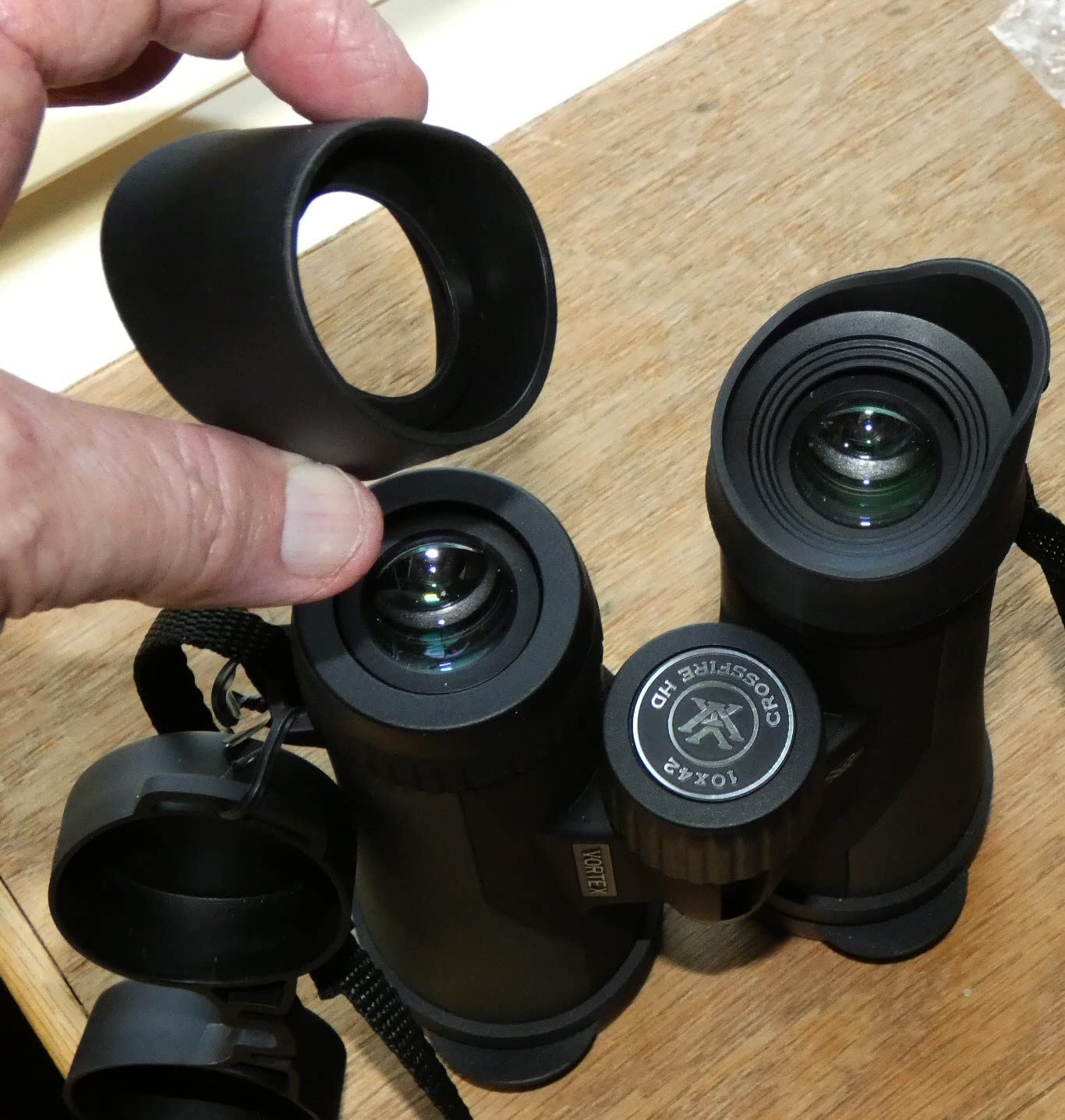
The Vortex Crossfire HD 10×42 has the highest owner rating of any binocular in this roundup, sitting at 4.8 across more than four thousand reviews, and the consistency of that rating is the interesting part. It is a 10-power model, so it gives you more detail on a distant heron or a hen harrier quartering over a marsh, and the 325-foot field of view is still wide enough to locate birds before you zoom in on them.
Mechanically it is the most conventional design here. An aluminum chassis, a central focus wheel that turns both barrels together, a diopter ring on the right eyepiece, and twist-up eyecups you can leave down over glasses. The box includes a GlassPak case, a rainguard eyepiece cover, a tethered objective cap, a comfort strap and a cloth.
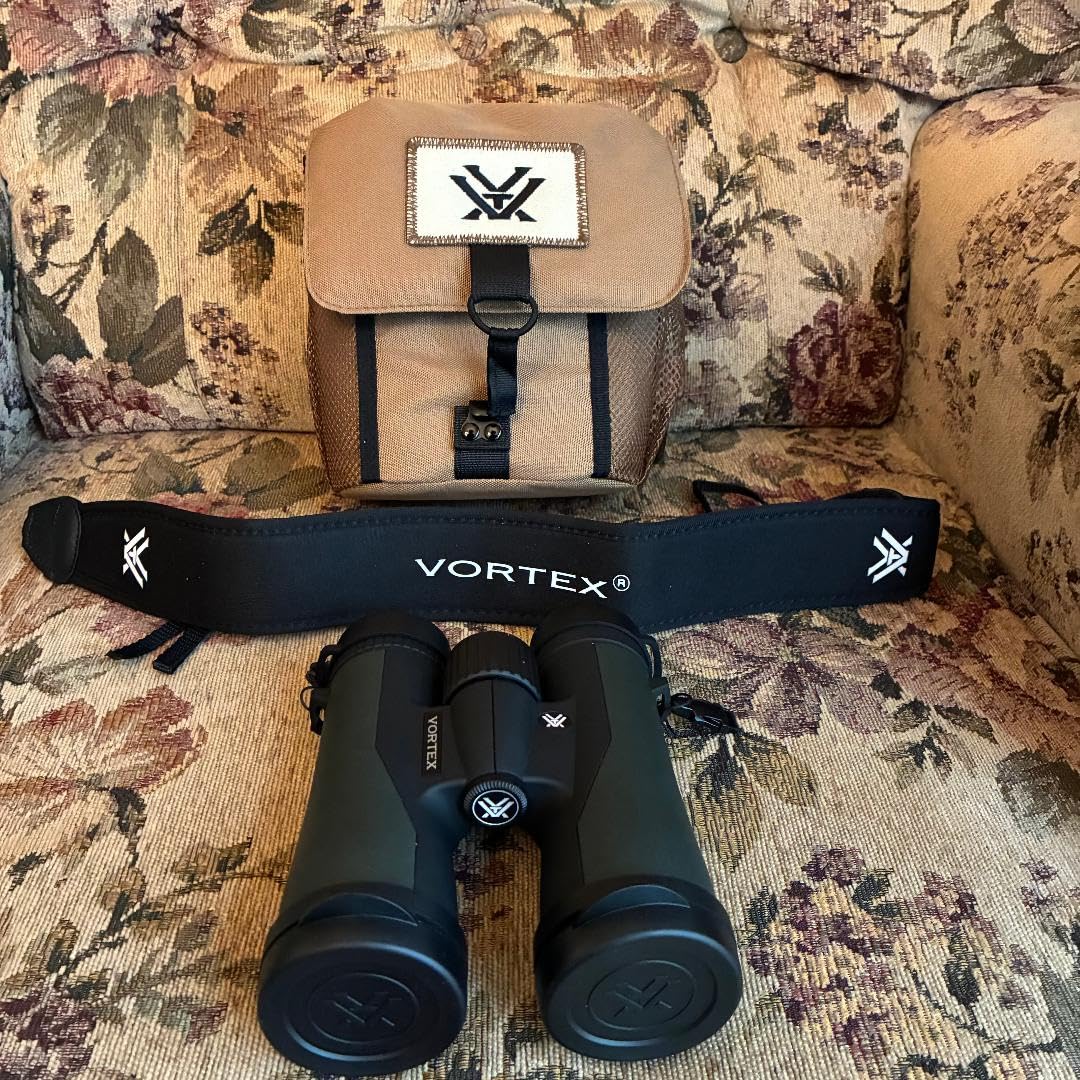
The tradeoff is field of view and eye relief. At 325 feet it is the narrowest full-size binocular in the group, which means more panning work when something moves in the canopy, and 15mm of eye relief is the tightest figure among the full-size models we tested. The 4.2mm exit pupil also means you need decent light before the view reaches its best.
Where 10 power genuinely earns its place
Ten power is the right choice when your birding is across open ground or water: a seafront, a reservoir edge, a big field where birds are 300 metres out and against a flat background. The extra two powers show you a wing pattern that an 8×42 renders as a grey smudge. The forum consensus we found matches this, with birders pointing to 10×42 for open long-range work and 8×42 for close woodland.
When to skip it and buy something else
Skip it if you wear glasses. Fifteen millimetres of eye relief is the number that decides whether you see a full circular field or a black ring at the edges, and this is not the pair to gamble on. Skip it too if your birding is dense woodland or reedbed, where a wide field of view matters more than the extra reach.
3. Vortex Triumph HD 10×42 – Best Full-Size Starter Binocular
Vortex Triumph HD 10×42 Binoculars
10x magnification
42mm objective
17mm eye relief
2.3 lb
Fully multi-coated roof prism
Pros
- Full-size 42mm objectives in an entry body
- Nitrogen purged and fully multi-coated
- Comfortable with adjustable eyecups and diopter
- Includes a GlassPak harness and case
- VIP lifetime warranty
Cons
- Heaviest body in the roundup at 2.3 lb
- Listed field of view is lower than the category norm
- Less light gathering than higher-tier HD models
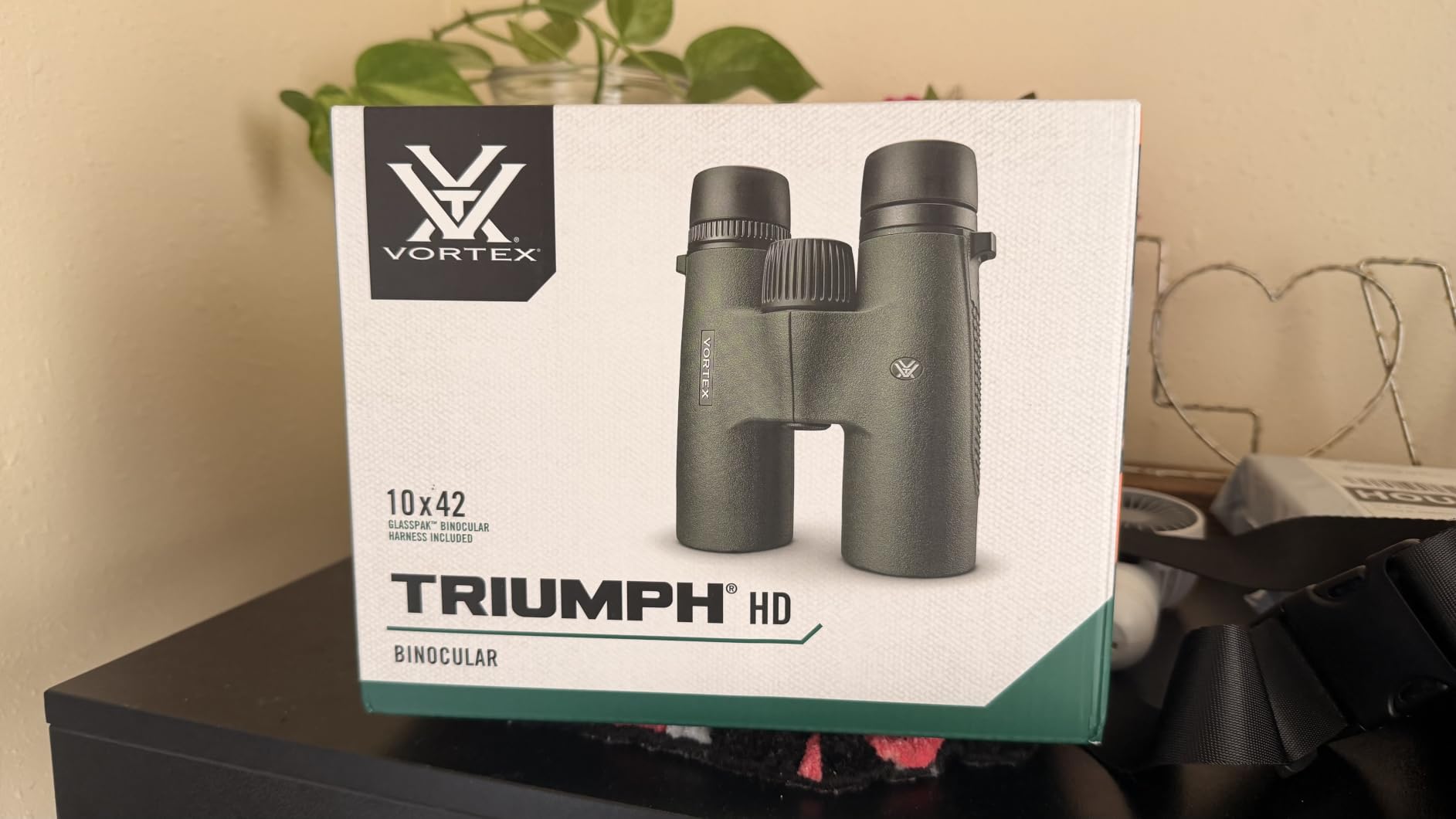
The Vortex Triumph HD 10×42 is a full-size binocular, not a compact, and that distinction is the whole point. Many entry pairs use 25mm objectives to stay small, which saves weight but costs you brightness. The Triumph keeps the 42mm lenses, so the light-gathering is there, and pairs them with a fully multi-coated HD optical system.
It also arrives with better carry gear than most rivals at this level. The kit includes a GlassPak harness and case, a neck strap, tethered objective lens covers, eyepiece caps and a cloth. For someone who wants a proper full-size pair without paying for premium glass, that is a well-judged package.
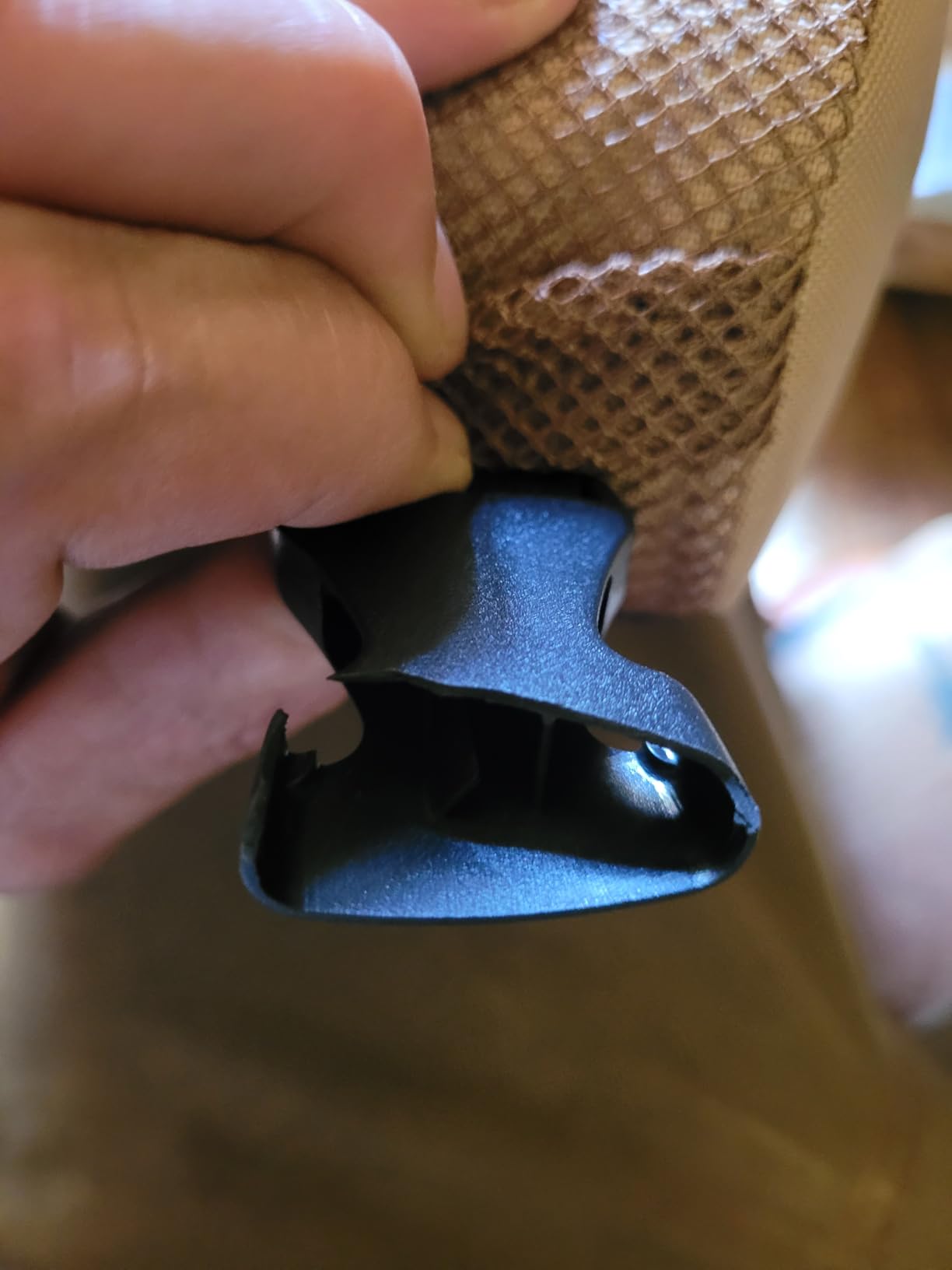
Two things keep this out of the top tier. It weighs 2.3 pounds, which is the heaviest body here, and over a six-hour walk in a hide that becomes obvious. The listed field of view figure is also lower than the 325 to 393 feet range that the other full-size 10×42 and 8×42 models report, and owners repeatedly mention the view feeling narrower than the specification sheet implies.
What the harness and case actually change
A harness moves the weight from your neck to your shoulders and, more usefully, stops binoculars bouncing against your sternum when you stoop under a branch to follow a warbler. If your birding involves a lot of low vegetation work, that is worth more than any specification on this list. The rubber armor also gives a noticeably more positive grip in wet hands than a smooth plastic shell.
When to skip it and buy something else
Skip it if you walk a lot with your binoculars on a neck strap all day, because the weight is the issue, not the optics. Most experienced birders on the forums end up in the 8×42 format eventually for exactly this reason. If you plan to sit at one hide for hours, the weight matters far less and this becomes a strong choice.
4. Vortex Diamondback HD 8×42 – Best Upgrade for Serious Birders
Vortex Diamondback HD 8×42 Binoculars
8x magnification
42mm objective
393 ft FOV
17mm eye relief
Roof prism, fully multi-coated
Pros
- Widest field of view in the roundup at 393 ft
- HD elements cut chromatic aberration
- Argon purged and o-ring sealed for fogproofing
- Precise center focus with diopter
- GlassPak harness and case included
- VIP lifetime warranty
Cons
- 17mm eye relief is adequate rather than generous
- Some residual colour fringing in bright light
- Occasional reports of arriving with damaged parts
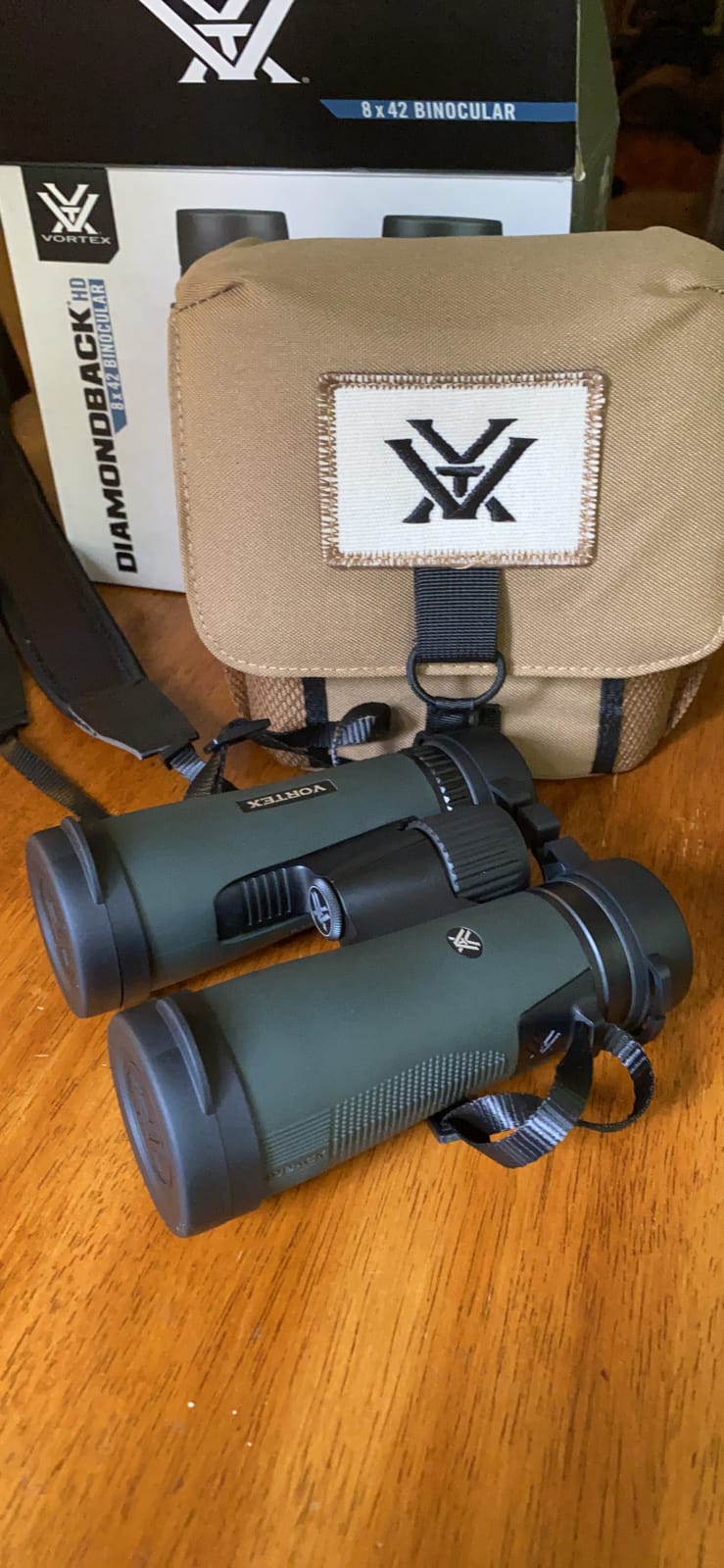
The Vortex Diamondback HD 8×42 is the model most often named in birding forums as the sensible step up, and at 393 feet it has the widest field of view of any binocular here. When you are scanning a hedgerow or a flooded meadow and a pipit flushes two hundred metres to your left, that extra width is the difference between finding the bird and missing it entirely.
The optical system is fully multi-coated with a dielectric prism coating and an Armortek exterior coating on the lenses, and the housing is argon purged and o-ring sealed rather than nitrogen filled. In practice the difference between argon and nitrogen is small, but the sealing is what matters: this pair stays usable in rain and in the condensation-heavy hours around first light.
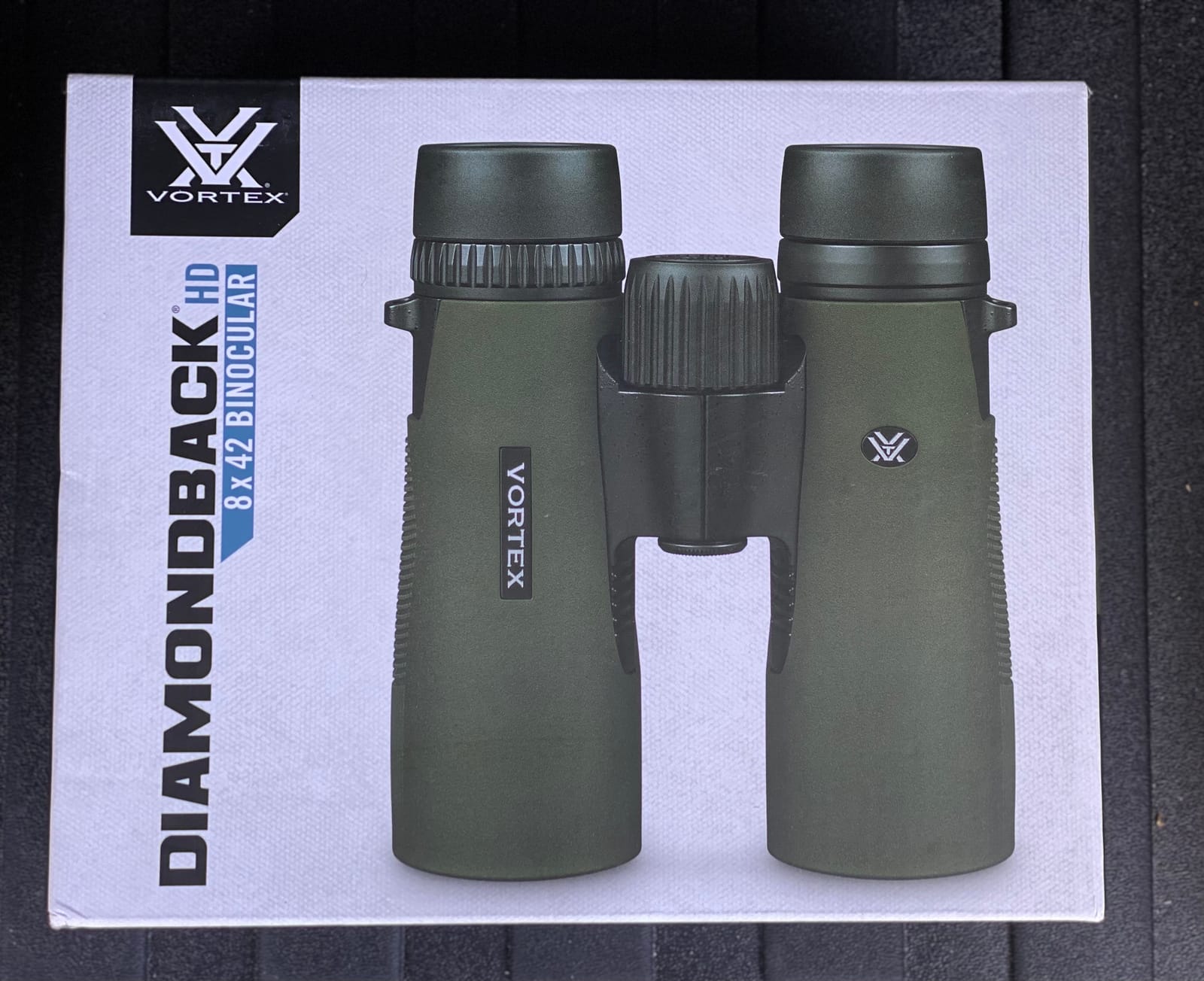
Owners on r/birding describe it as delivering near-premium clarity at a mid-tier cost, and the recurring minor complaints are consistent. Some colour fringing survives in bright light at higher magnification. Eye relief of 17mm works with most glasses but leaves less margin than the Nikon models in this list. A few owners report lens or cover pieces arriving damaged out of the box.
What the width of the view changes in practice
Field of view is the specification people underestimate. A 393-foot view at 1,000 yards covers roughly a 12-metre-wide strip of hedgerow, and birds move constantly within it. A narrower view forces a constant cycle of find, centre, zoom, refocus. Widening the view removes the cycle, and on a long morning in cover that difference adds up to far fewer missed birds.
When to skip it and buy something else
Skip it if you spend most of your time at more than 300 metres over water or open scrub, where the extra reach of a 10×42 pays for itself. Skip it if your glasses have deep frames that need more than 17mm of eye relief, and look instead at the PROSTAFF models further down. Otherwise it is very hard to argue against.
5. Nikon PROSTAFF P3 8×42 – Best for Beginners
Nikon PROSTAFF P3 8×42 Binocular | Waterproof, fogproof, rubber-armored Full-Size Binocular, wide field of view & long eye relief | Official Nikon USA Model
8x magnification
42mm objective
377 ft FOV
20.2mm eye relief
1.3 lb
Roof prism, multilayer coated
Pros
- Long 20.2mm eye relief works with almost any frame
- Lightest full-size model here at 1.3 lb
- Waterproof and nitrogen filled
- Lead- and arsenic-free Eco-Glass
- Large central focus knob
Cons
- Diopter ring is stiff and takes effort to turn
- Some chromatic aberration when viewing open sky
- Included strap has no fixed loop
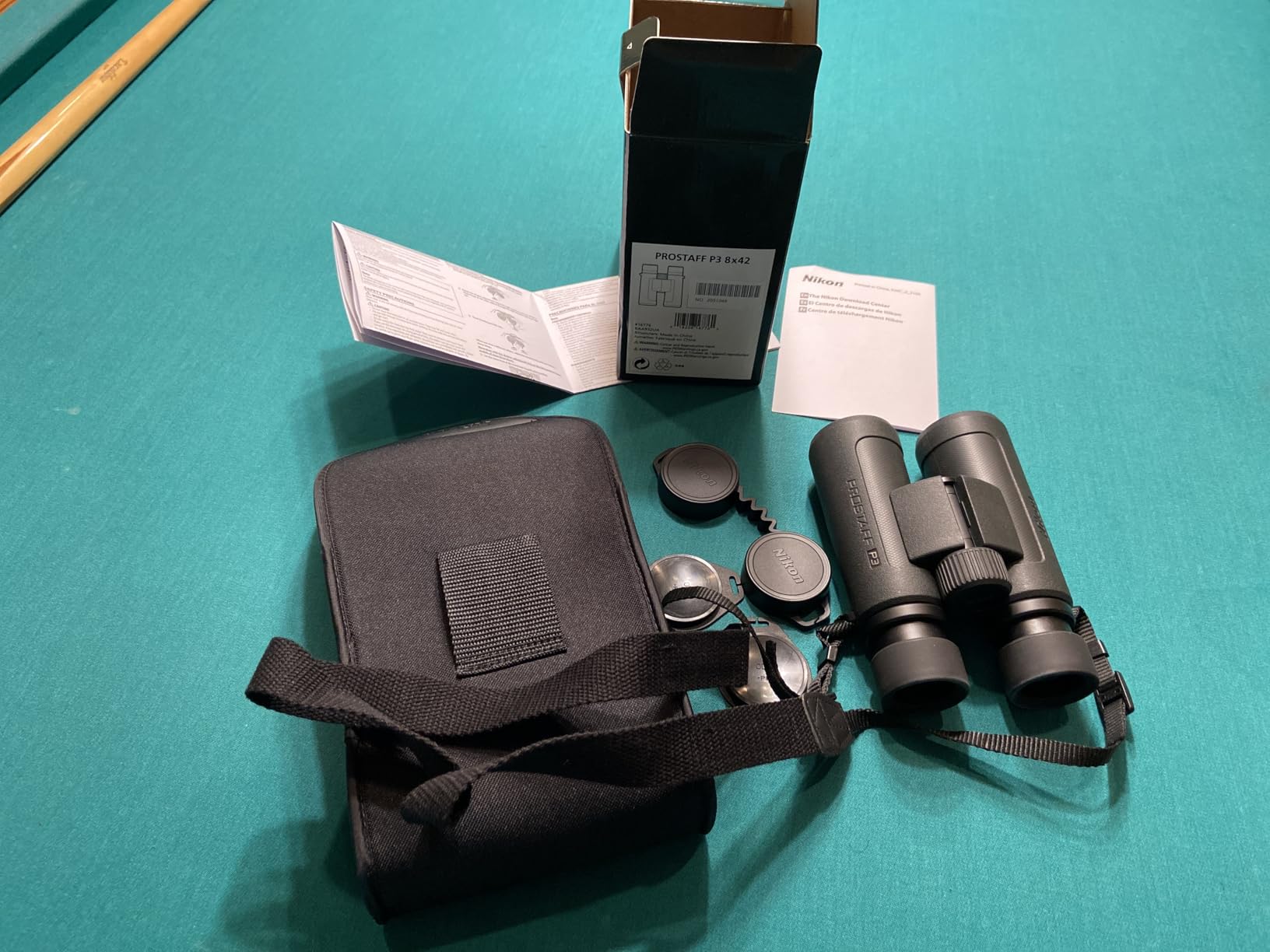
The Nikon PROSTAFF P3 8×42 is the pair we suggest to anyone who has never held birding binoculars before, largely because of one number: 20.2mm of eye relief. That is the most generous figure in this roundup alongside the PROSTAFF P7, and it means the eyecups clear almost any pair of glasses without you having to guess whether the view is going to be vignetted.
It is also light. At 1.3 pounds it is the easiest full-size pair here to carry on a walk, and the fiberglass-reinforced polycarbonate body with rubber armor survives being dropped in a bag. O-ring seals and a nitrogen fill keep it fogproof through temperature swings, and the large central focus knob is easy to find without looking away from the bird.
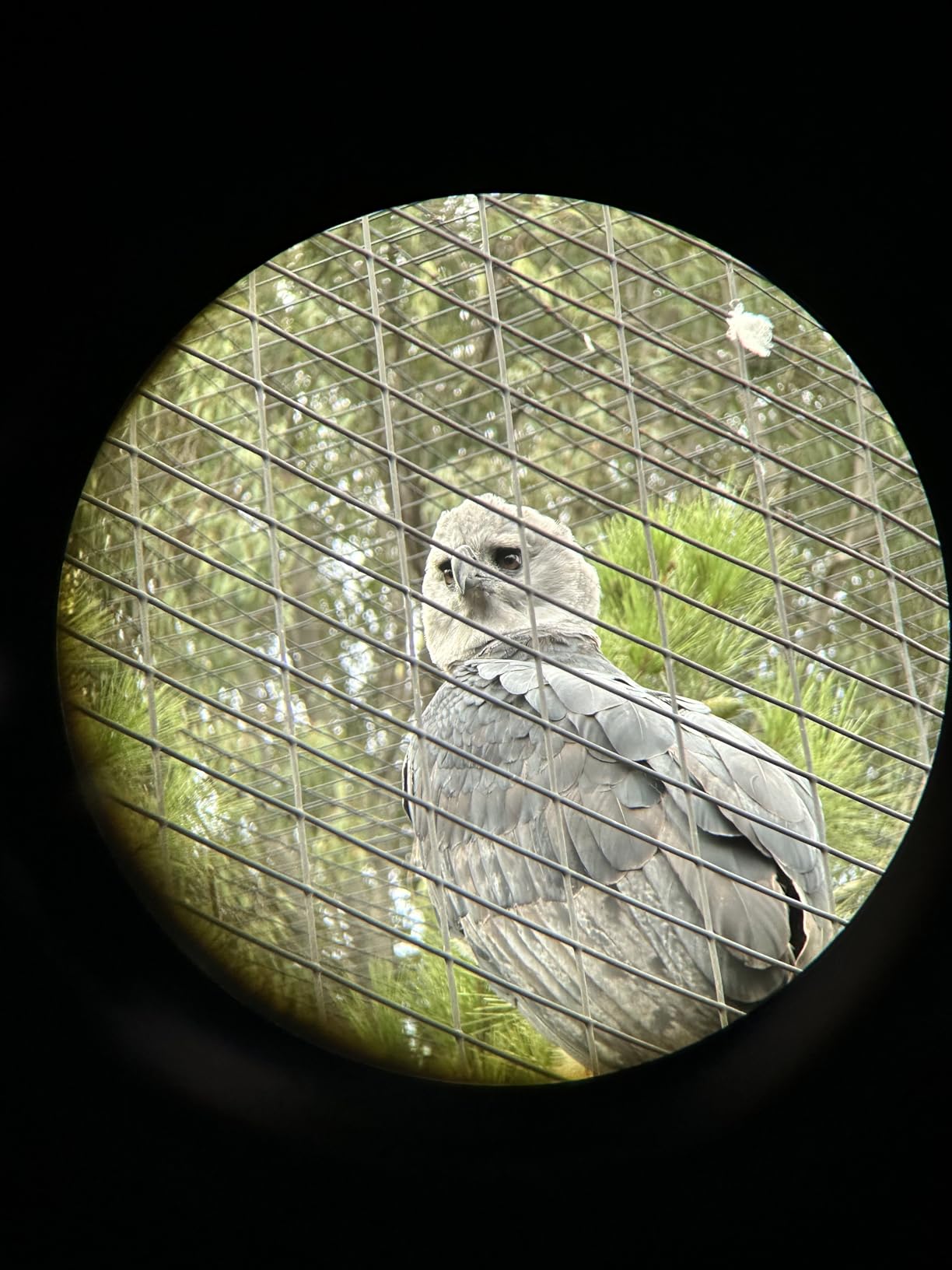
Birders on r/birding repeatedly describe the P3 as the value pick, and the field of view of 377 feet is a sensible compromise between the very wide models and the narrow 10-power options. The compromises are mechanical rather than optical: the diopter ring is stiff, and the supplied strap has no fixed loop, so the slack end swings around while you walk.
Why eye relief matters more than magnification
Eye relief is the distance between your eye and the eyepiece lens, and anything above about 15mm lets you remove your glasses or keep them on without losing the edge of the field. Birders who wear glasses report blackouts around the image as the single most common reason they return a pair, and this model avoids that problem entirely. The 5mm exit pupil also gives a bright view in shade.
When to skip it and buy something else
Skip it if you bird at dawn or dusk as your main activity and want the crispest possible image, because the multilayer coating does not control colour fringing the way ED glass does. Otherwise, for a first pair that will be handed down or shared in a family, the limited lifetime warranty makes it a low-risk place to start.
6. Celestron Nature DX ED 8×42 – Best Budget Route to ED Glass
Celestron Nature DX ED 8×42 Premium Waterproof Birding Binoculars
8x magnification
42mm objective
17.8mm eye relief
6.5 ft close focus
950 g
Fully multi-coated roof prism
Pros
- ED objective lenses remove most colour fringing
- Phase-coated BaK-4 prisms for brightness
- Close focus around 6.5 ft for small wildlife
- Waterproof and nitrogen purged
- Limited lifetime warranty
Cons
- Eye cups are flimsy and can detach
- Shallower depth of field means more refocusing
- Slight pincushion distortion at the field edge
The Celestron Nature DX ED 8×42 exists because of one question: where is the cheapest way to get ED glass into a birding binocular. This is that answer. Extra-low dispersion glass is what removes the purple and green fringing you otherwise see along the high-contrast edges of a backlit branch, and once you have used it, going back to conventional glass is noticeable.
Light-gathering comes from the 42mm objectives and phase-coated BaK-4 prisms, and the close focus of roughly 6.5 feet is a genuine bonus for anyone who watches butterflies, or a robin feeding on a lawn. The body is rubber-armored polycarbonate, waterproof and nitrogen-purged, with tripod threads in the hinge.
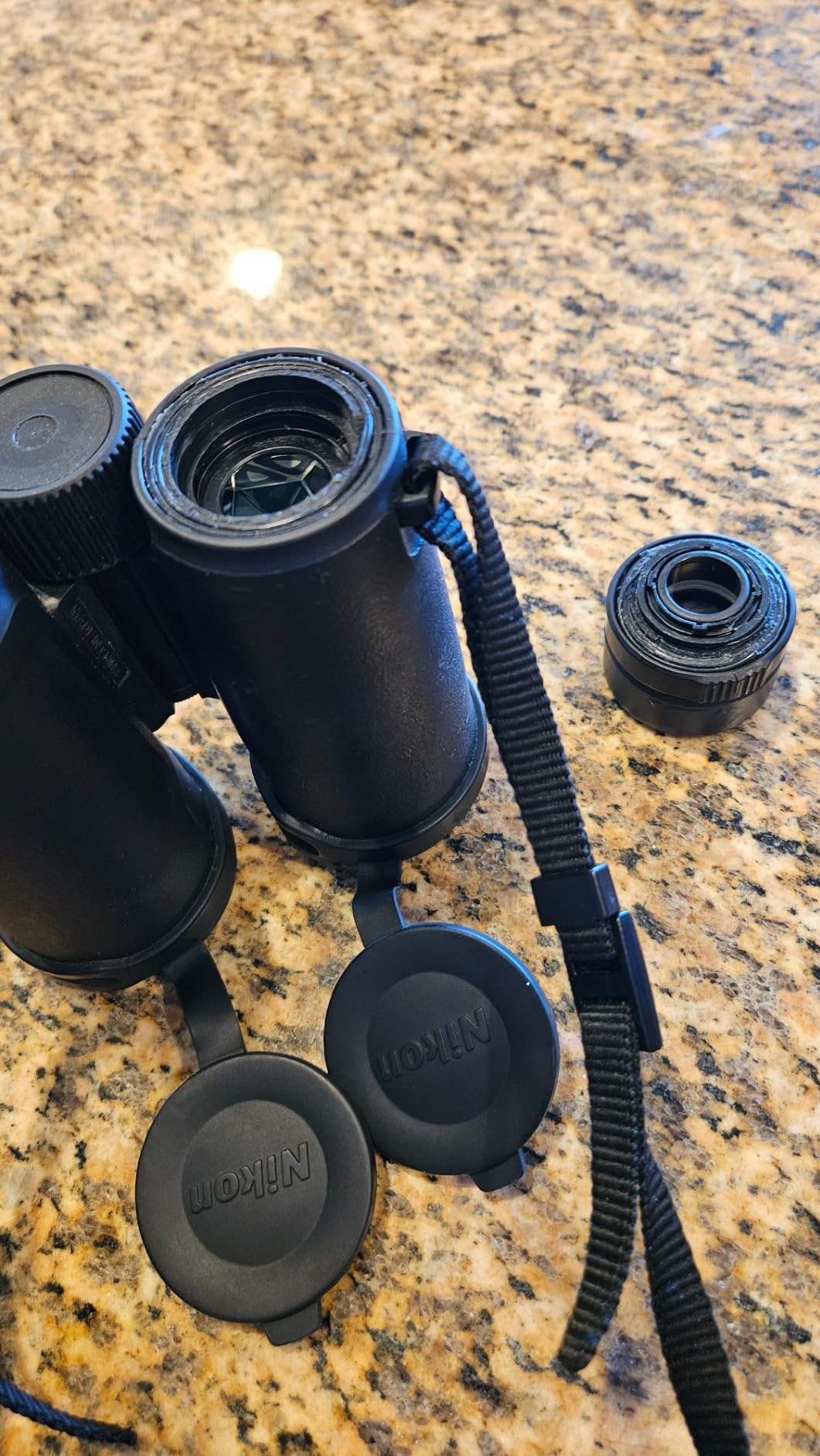
The eyecups are the weak point and the most common complaint. Owners report them loosening, cracking or coming away entirely after ordinary use, which matters a great deal if you rely on the eye relief figure to make glasses work. A replacement eyecup is a small, easy part to fit, but it is a part you will need.
What ED glass fixes and what it does not
ED glass addresses colour fringing, which is a sharpness problem, not a brightness problem. It will not make a dark image brighter, and it will not widen your field of view. What it does is keep a bird’s plumage colour honest against a bright sky and stop a high-contrast outline from breaking into coloured edges, which is exactly what you need to separate a Spotted Flycatcher from a Pied Flycatcher at range.
When to skip it and buy something else
Skip it if you share binoculars with someone wearing thick glasses, because the eyecup issue is more likely to frustrate you. Consider the Vanguard Endeavor ED further down if you need a longer eye relief with the same ED treatment. For everyone else, this is a genuinely useful step up from a non-ED pair at modest extra cost.
7. Nikon Monarch M5 8×42 – Best Balanced ED Pair from Nikon
NIKON Monarch M5 Binoculars | Waterproof Fogproof ED Glass Optics with Dielectric Prism Coating | Bright High-Resolution Outdoor Binoculars for Birdwatching, Hiking & Wildlife, 8×42
8x magnification
42mm objective
335 ft FOV
19.5mm eye relief
1.4 lb
ED glass, close focus 8.2 ft
Pros
- ED glass with dielectric prism coating
- 19.5mm eye relief suits eyeglass wearers
- Reliable close focus down to 8.2 ft
- Waterproof and fogproof with O-ring seals
- Limited lifetime warranty
Cons
- Heavier and bulkier than the PROSTAFF models
- Field of view is the narrowest of the 8x42s here
- Some fringing can remain at the very edge
The Nikon Monarch M5 8×42 is the pair most often recommended on birding forums when someone asks for ED glass and long eye relief in the same package. The 19.5mm eye relief is second only to the PROSTAFF models here, and the ED glass with a dielectric high-reflective multilayer prism coating keeps the image bright and colour-accurate at the times of day when you most want it.
The controls are the ones you want on a long session: a large, smooth central focus wheel and a close focus of 8.2 feet, plus twist-up click-stop eyecups. It is nitrogen filled, sealed with O-rings, and wrapped in shock-resistant rubber armor.
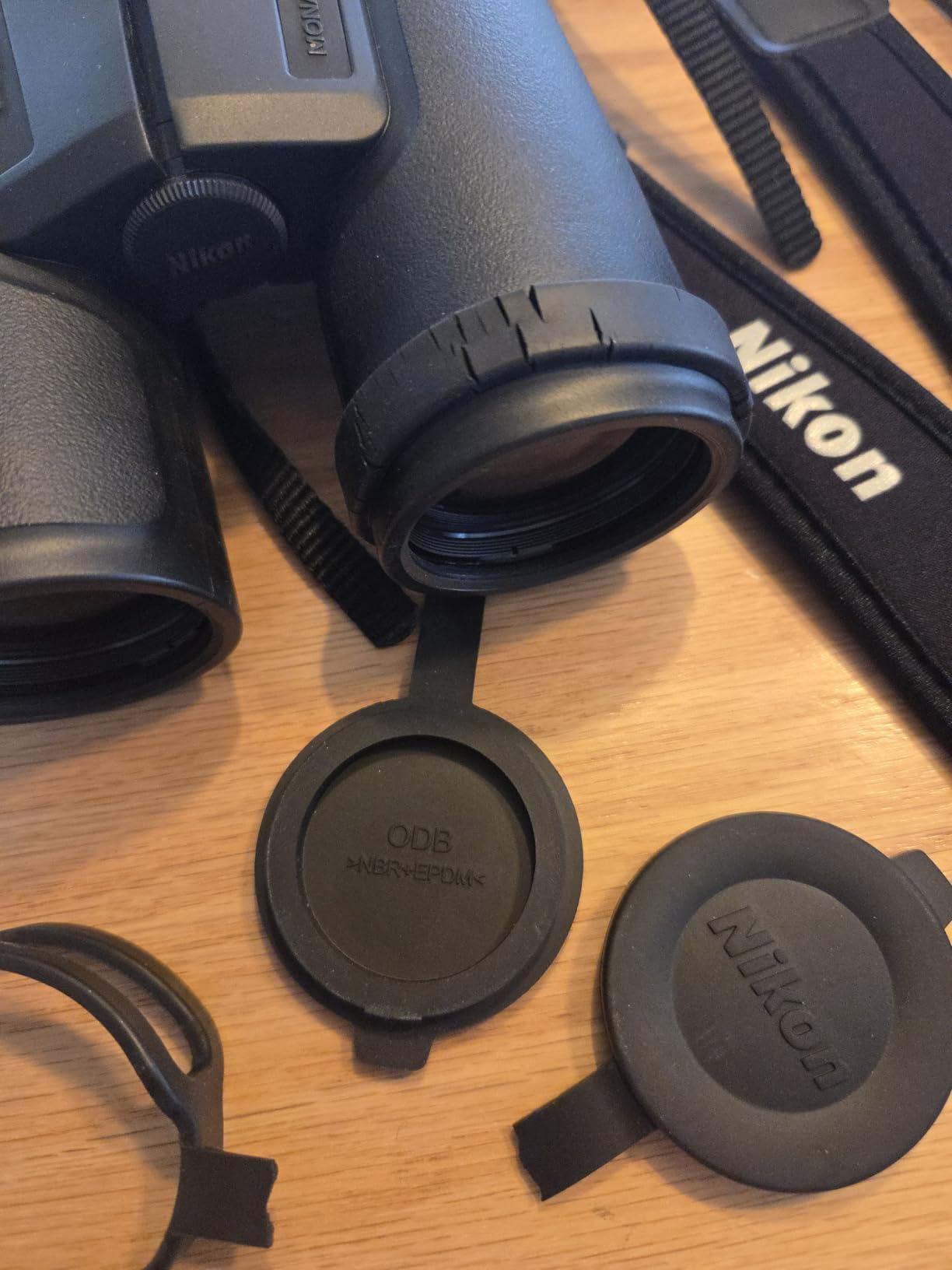
The honest drawback is bulk. Owners who also own a PROSTAFF consistently note that the Monarch M5 is heavier and larger for the same 8×42 format, and that the cost approaches premium compact models without matching their weight savings. The 335-foot field of view is also the narrowest of the 8×42 models in this roundup, so scanning wide areas takes more panning.
What the 19.5mm eye relief buys you
Nineteen and a half millimetres is enough eye relief to keep glasses on and still see the full field, including the corners, without repositioning the eyecups for every user. That also means the binoculars work as a shared pair in a household, which is a practical argument the spec sheet never makes. The 5.3mm exit pupil is the largest in the roundup alongside the Nature DX, and that is why the view holds up well under canopy.
When to skip it and buy something else
Skip it if you are a dedicated walker who carries binoculars all day and prefers the lightest body available, or if you mostly scan open horizons where a wider field of view would help. Birders who want both wide view and ED glass generally end up in a 393-foot model instead, and those exist further down this list.
8. Vanguard Endeavor ED 8×42 – Best for Dusk and Shaded Woodlands
Vanguard Endeavor ED 8420 8×42 ED Glass Binoculars – Fully Multi-Coated Optics, Phase-Coated BaK4 Prism, Waterproof/Fogproof
8x magnification
42mm objective
367 ft FOV
19mm eye relief
Near focus 6.6 ft
Magnesium body, ED glass
Pros
- Very bright view in dusk and overcast light
- ED glass with phase-coated BaK4 prisms
- Locking diopter ring holds its setting
- Textured magnesium grip feels secure
- Close focus around 6.6 feet
Cons
- Heaviest 8x42 here at 25.8 oz
- Edge softening and slight fringing at the periphery
- Objective caps can swing shut and detach
The Vanguard Endeavor ED 8×42 is the brightest pair in this roundup in the conditions that matter most, which is low light. Long-term owners rate it as flagship-level performance at a mid-range cost and often compare it favourably to far more expensive glass. The magnesium body with rubber armor also feels more substantial in the hand than the plastic shells here, and the textured grip stays secure in cold, wet fingers.
Mechanically it is the most considered design in the group. The centre focus has no slack, the diopter ring locks so it holds its setting between users, and multi-stage twist-out eyecups handle glasses well. The field of view of 367 feet and close focus of around 6.6 feet make it a genuinely all-purpose birding tool.
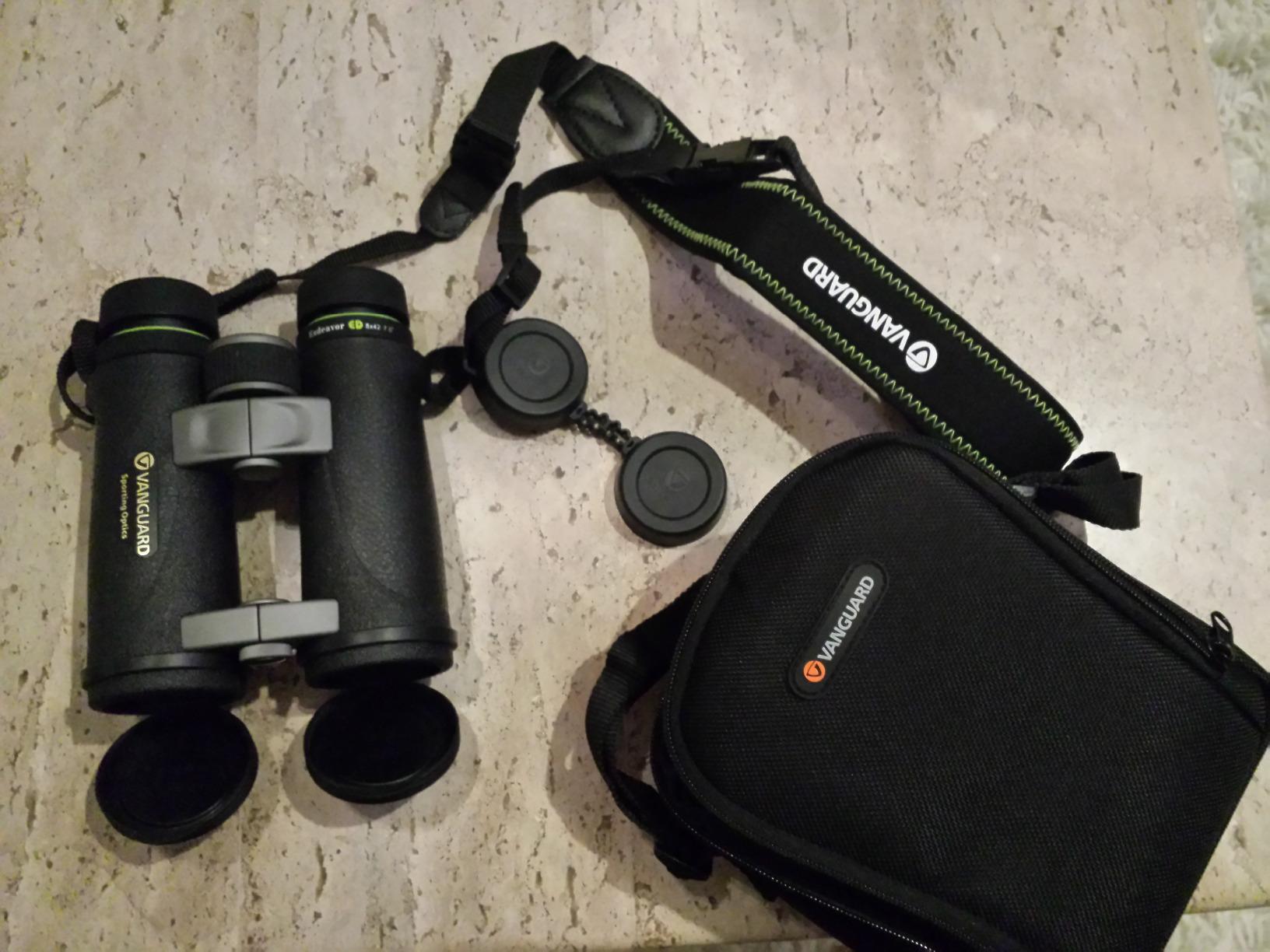
At 25.8 ounces it is the heaviest 8×42 here, and on a long walk that registers after a few hours. Reviewers also note slight softening at the extreme edge of the field and some colour fringing at the periphery against dark subjects in very bright light. The attached objective caps are a small irritation because they can swing inward and pop off.
Why brightness beats the last bit of resolution
A sharp image you cannot see is worth nothing at 6am in November, and this model is built around that reality. The ED glass plus phase-coated BaK-4 prisms and fully multi-coated lenses keep the view usable well past the point where lighter compact binoculars turn to mush. For owl, nightjar and winter ducking sessions, that reliability is the feature you are really paying for.
When to skip it and buy something else
Skip it if your birding is mostly on foot with a long walk, since the weight is a real consideration, or if you want the widest field of view you can get. The Vanguard is a quality-over-coverage choice: it is not trying to scan the widest strip of hedgerow, it is trying to give you a clean, bright, colour-true view of whatever you have already found.
9. Nikon PROSTAFF P7 8×42 – Best for Eyeglass Wearers
Nikon PROSTAFF P7 8×42 Binocular | Waterproof, fogproof, rubber-armored Full-Size Binocular, oil & water repellent coating & locking diopter | Official Nikon USA Model
8x magnification
42mm objective
377 ft FOV
20.2mm eye relief
1.3 lb
Locking diopter ring
Pros
- 20.2mm eye relief gives a full view with glasses on
- Locking diopter keeps settings between users
- Oil- and water-repellent coatings clean quickly
- Lightweight 1.3 lb fiberglass-reinforced body
- Limited lifetime warranty
Cons
- Eyecups and strap feel flimsy
- Eyecup position shifts slightly while viewing
- Some buyers see little gain over the P3
The Nikon PROSTAFF P7 8×42 shares the same 377-foot field of view and 20.2mm eye relief as the P3, and those two numbers make it the safest choice here for anyone who wears glasses. Birders who wear glasses describe it as the pair that shows a full, unobstructed view with no black circles around the edge, which is the problem that sends people back to the shop.
The step up from the P3 is in the coatings and the mechanics. Fully multi-coated lenses with phase-correction coated roof prisms and a dielectric high-reflective multilayer coating improve light transmission, and the oil- and water-repellent lens coatings mean fingerprints and rain beads wipe off rather than smearing.
The locking diopter ring is the small feature that gets praised most in practice. Once set, it holds, so the binoculars work identically for you and for the person you hand them to, and they stay put rattling around in a car boot on the way to a site.
What the 20.2mm eye relief changes for a glasses wearer
Eye relief is measured from the eyepiece lens to your eye, and the eyecup has to clear the frame before the field of view is unobstructed. At 20.2mm you can wear most frames, including thicker rectangular ones, without the view being clipped at the top or the sides. The 5.3mm exit pupil also gives a brighter image for the same reason the wider binocular formats do: more light reaching your eye.
When to skip it and buy something else
Skip it if you are already very happy with the P3, because owners who own both frequently conclude the P3 gives a similar image for less money. The extra spend is best justified by the coating quality and the locking diopter, not by magnification. The eyecups and strap are the flimsiest parts on this pair, and if that bothers you, spend the difference on a harness instead.
10. Hontry 10×25 Compact – Best for Kids, Pocket and Travel
Hontry 10×25 Compact Binoculars for Adults and Kids
10x magnification
25mm objective
362 ft FOV
10mm eye relief
9.6 oz
Porro prism, BaK-4
Pros
- Fits a pocket and weighs less than a pound
- BaK-4 prisms give bright 3D images
- Interpupillary range suits children and adults
- Simple center focus and diopter
- Includes a nylon bag and strap
Cons
- 25mm objectives are dim at dawn and dusk
- 10mm eye relief gives glasses wearers a narrowed view
- Thin strap with little padding
- Only a 3-year warranty
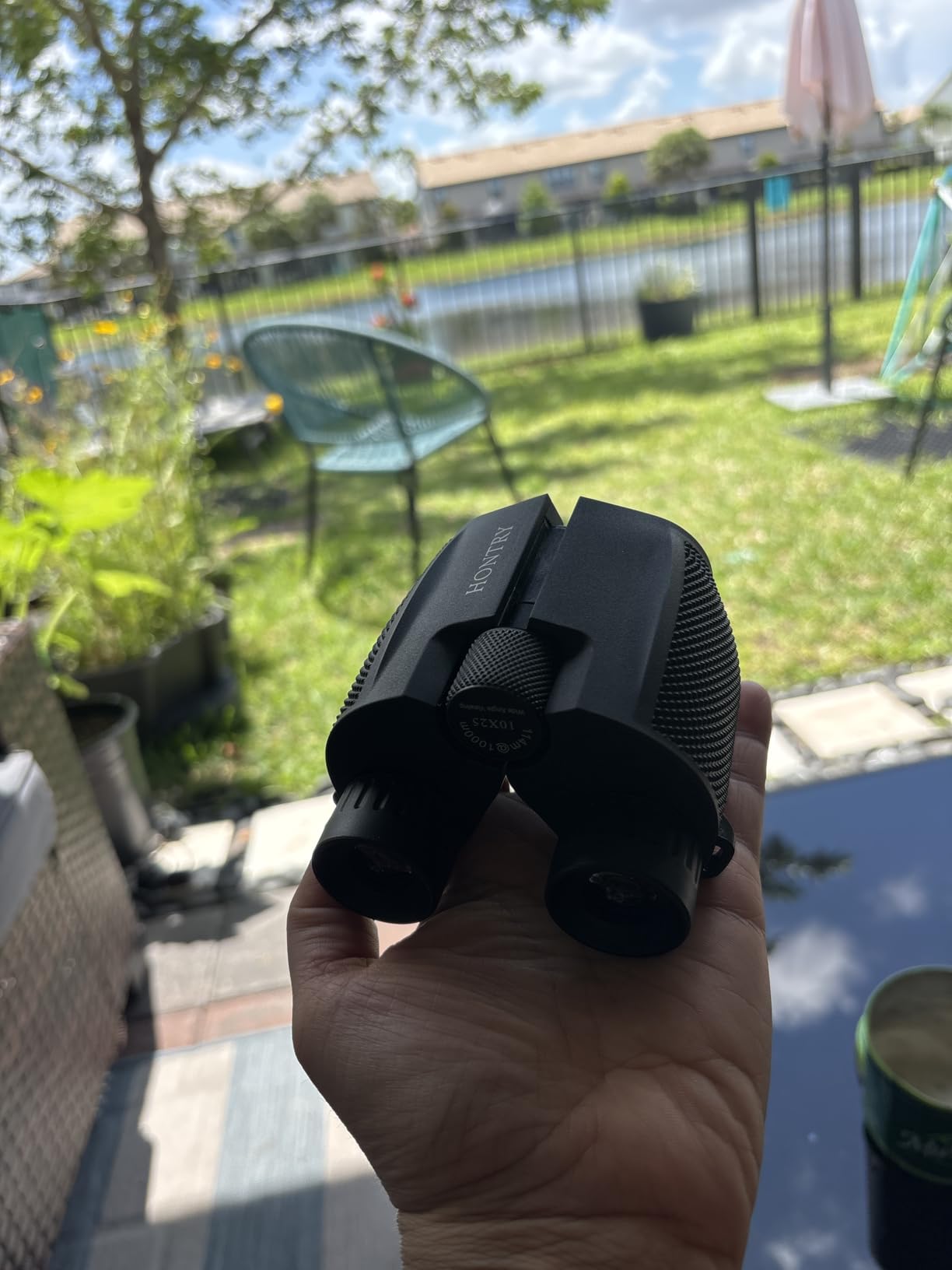
The Hontry 10×25 is the only genuinely pocket-sized pair here, at 9.6 ounces and roughly the size of a palm, and for a child, a travel day pack or a first pair to leave in a car, that portability is the entire argument. It carries a wide 60 to 75mm interpupillary adjustment, so one pair fits a whole family, and BaK-4 prisms produce a bright image with real depth for its size.
Mechanically it is simple in a good way. A central focus wheel, an easy diopter adjustment, rubber armor for grip and shock resistance, and a nylon carry bag and strap in the box. There is no dialling in, no prism to align, nothing to set up before a child can use it.
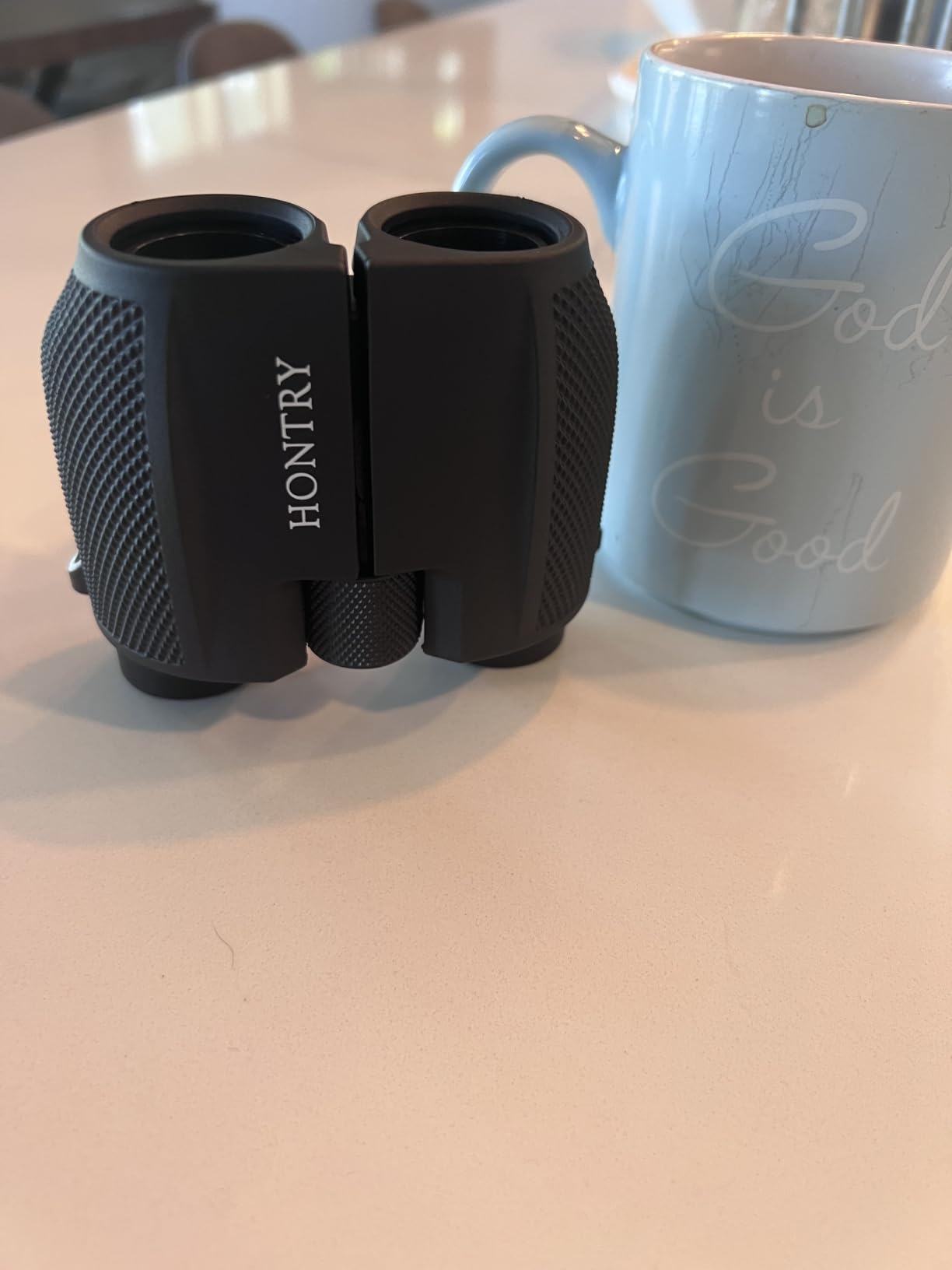
The limits are optical and physical. Twenty-five millimetre objectives gather a fraction of the light a 42mm lens does, so at dawn, at dusk or under heavy canopy the view goes dim and detail drops away fast. Eye relief of 10mm is tight, and glasses wearers see a noticeably narrowed image. Buyers are candid about all of this in their feedback.
When a compact is the correct tool, not a compromise
There are situations where a full-size binocular is simply wrong. A 17-year-old’s first pair, a school trip, a packed day where every gram counts, or a holiday where the binoculars live in a jacket pocket between hotel rooms. For casual backyard viewing of robins and tits in daylight, the image is more than good enough, and the risk of carrying a full-size pair is that you stop taking it out at all.
When to skip it and buy something else
Skip it if your birding is at dawn or dusk, or if you wear glasses, or if you want to identify a warbler forty metres away through a hedge. The 3-year warranty is also the shortest in this roundup, so it is a pair to grow out of rather than keep. Treat it as a starter or a travel backup and it is excellent value.
How to Choose Binoculars for Bird Watching in 2026
8x vs 10x vs 12x: pick the magnification for your terrain
Choose 8x for cover and woodland, 10x for open ground and water, and treat anything above 10x as a specialist tool. The reason is hand shake. Amplification multiplies every movement of your hands and arms, and the longer you hold the glass, the more the image moves. At 8x, a bird stays put in the field of view long enough to focus and identify. At 12x, the same bird drifts out of frame while you correct.
The forum consensus we found while researching this roundup runs the same way. Birders describe 7×42 as a specialist choice for dense foliage, where a very wide field and long eye relief matter more than detail, and describe 10×42 as the sensible pick when scanning long open distances. One rule of thumb worth adopting: if you are regularly finding a bird too small to identify at 8x, move up to 10x, not to 12x.
Field of view decides whether you find birds at all
Field of view is quoted in feet at 1,000 yards and it tells you how wide a strip of landscape you can see at once. A 300-foot view covers a strip about 9 metres wide, a 400-foot view about 12 metres. Anything above 300 feet is a genuine wide-angle birding binocular, and that width is the difference between spotting a bird as it moves and spotting it after it has moved.
This is the number most beginners misjudge, because it is invisible in a shop. If you can, borrow a wide pair and a narrow pair and sweep the same hedge with each. The narrow pair will feel more impressive on a stationary, distant subject and less effective on anything that moves, which is most birds.
ED glass controls colour fringing on backlit birds
Extra-low dispersion glass is glass that bends different colours of light by very slightly different amounts, minimising the coloured edges you would otherwise see around a high-contrast subject. Look at a bird against bright sky, or at bare branches against a bright background, and conventional glass will show purple or green fringes along the edges. ED glass largely removes them.
It is a real improvement, but a narrow one in absolute terms. Owners upgrading from a non-ED pair usually describe it as noticeably cleaner rather than transformative. Marketing muddies this further: HD, ED, HD ED and phase-coated are not the same claim, and phase coating refers to the prism rather than the lens. When in doubt, treat ED as the meaningful one.
Eye relief is the number eyeglass wearers should check first
Eye relief is the distance in millimetres between the eyepiece lens and your eye, and anything above about 15mm lets most people keep their glasses on without losing the edge of the field. In this roundup the figures run from 10mm on the compact pair to 20.2mm on the two Nikons. If you wear glasses, sort the shortlist by this number first, before any other specification.
Twist-up or turn-and-slide eyecups matter too, because they let you adjust the eyepiece height to match your frame. Binoculars that are shared in a household should have a locking diopter, so the focus setting does not change every time they are handed over.
Exit pupil explains dawn and dusk performance
The exit pupil is the diameter of the beam of light leaving the eyepiece, and you divide the objective diameter by the magnification to get it. The bigger the exit pupil, the brighter the image and the more usable the binoculars are in poor light. A 4.2mm exit pupil needs a decent amount of ambient light to look its best, while anything above 5mm keeps working well into dawn.
This is why compact 25mm binoculars feel dim next to full-size 42mm models even when both are well coated. It is physics rather than a manufacturing quality gap, and no coating technology closes it.
Waterproofing, O-rings and nitrogen purging protect your mornings
Sealed binoculars are described as O-ring sealed and purged with dry nitrogen or argon. The purge matters because a sealed body full of dry gas does not develop internal condensation when you move from a warm car into a cold dawn, which is the single most common way a good binocular gets written off. Every pair in this roundup is waterproof and fogproof.
The build quality still varies more than the specification suggests. Rubber armor over a magnesium or polycarbonate chassis survives knocks better than a bare plastic shell, and the practical difference shows up on the third dropped-in-a-stream morning rather than the first.
Close focus and tripod adaptability are the quiet features
Close focus, quoted in feet, tells you how near you can focus. Six and a half feet is fine for a garden robin; a couple of feet is what you want for butterflies and insects. Most birding binoculars cluster between 6 and 10 feet, so treat any very short figure as a bonus rather than a reason to buy.
A tripod adapter socket, usually a thread in the hinge, is more important than most buyers expect. Above 10x, or for a perched bird at dawn, a tripod removes the shake that no amount of stabilization in the glass can fix. Some pairs in this roundup include a socket; the adapter itself is normally sold separately.
How to Actually Glass Birds With Your New Binoculars
Most beginners underuse their binoculars in the first month, and the habit is usually technique rather than equipment. Six steps fix most of it.
Set the diopter first. Look at a distant object through one barrel, adjust the diopter ring until it is sharp, then refocus the centre wheel. Do this before you leave the house, not in the field.
Scan below the horizon, not up in the canopy. Birds move down more often than up. Sweeping the trunk line, the fence line and the ground beneath cover finds far more than staring into the treetops.
Keep both eyes open. One eye on the glass and one scanning free is the single biggest improvement to how much you find. It feels awkward for a day and then it does not.
Start wide, then find, then narrow. Use the wide field of view to locate the movement, bring the bird to the centre, and only then lean on magnification.
Brace, do not squeeze. Rest your elbows on your chest or on a fence post, or tuck your elbows into your ribs. Tension in your hands is what creates shake.
Move in small steps. Walk toward a perched bird rather than raising magnification until it shakes. Approach distance is worth more than zoom.
Above 10x, add a tripod to that list, or find a fence post to rest on. A phone adapter for digiscoping also works on any pair with a threaded eyepiece, and it is the cheapest way to start keeping a record of what you see.
Binocular Care: A Four-Step Routine That Protects Your Glass
Optical glass is more durable than most people assume, and most damage comes from three avoidable mistakes: wiping grit, storing damp, and twisting the wrong part of the body. Four habits handle it.
Keep the lens caps on in a bag. The single most common cause of a scratched objective is a cap rattling against the lens with sand in the pocket. Tethered caps exist for this reason.
Clean with the supplied cloth and nothing else. Breathe on the lens to add moisture, then wipe gently. Paper towel and household cleaner will strip coatings permanently, and dry-wiping grit does the damage.
Never rotate the eyecups or the centre focus to bring it closer. It looks like it should work and it will strip the threads. Bring binoculars to your eye by lifting them.
Store it dry and loose. After a wet session, leave it open in a ventilated place overnight rather than sealing it in a damp case. A silica gel packet in the case helps in humid climates.
If you are buying used, the checks are simple: focus through to the far distance and look for haze or veiling glare, sweep the field of view and look for a shadow arc, check that both barrels focus at the same point, and hold it up to a light to look for internal fungus. Fungus in a sealed body is expensive to fix, and a body with it is not worth the asking price.
Frequently Asked Questions
Is 10×42 or 8×42 better for birding?
8×42 is better for most people, because 8 power gives you a wider field of view, which is what actually finds birds, and produces far less hand shake over a long session. 10×42 is better when you are scanning long open distances or water and want more detail on a distant bird. In this roundup, the Celestron Nature DX 8×42 covers 388 feet at 1,000 yards against 325 feet for the Vortex Crossfire HD 10×42.
What magnification binoculars are best for bird watching?
Between 8x and 10x for almost everyone. 8x is the best general choice for woodland, hedgerows and any handheld birding because it shows a wider view and stays steady. 10x is the right choice for open distance and water. Above 10x you really need a tripod or a support, and 7x is a specialist format used in dense cover where a very wide field matters more than magnification.
What kind of binoculars are best for bird watching?
A full-size 8×42 roof-prism binocular with ED glass, nitrogen purging and O-ring seals is the format most birders end up with. Look for a field of view above 300 feet at 1,000 yards, at least 15mm of eye relief if you wear glasses, and close focus under 10 feet. That combination covers finding birds, identifying them and using them before sunrise and after sunset.
What are the best binoculars for beginners?
For a beginner we would start with either the Celestron Nature DX 8×42, which is the widest-viewing all-rounder here at 388 feet, or the Nikon PROSTAFF P3 8×42, which offers 20.2mm of eye relief and weighs 1.3 pounds. Both have limited lifetime warranties, which matters on a first purchase. A compact pair such as the Hontry 10×25 also works well for children and travel, but it goes dim at dawn.
What are the best binoculars for someone who wears glasses?
Sort the shortlist by eye relief first. Anything above 15mm clears most frames, and the two Nikons in this roundup lead the way: the PROSTAFF P3 and PROSTAFF P7 both offer 20.2mm of eye relief, with the Nikon Monarch M5 close behind at 19.5mm and the Vanguard Endeavor ED at 19mm. Also check that the eyecups twist up and down, and carry a pair you can hand to someone else without refocusing.
Are expensive binoculars worth it?
Partly, and the step is smaller than the price gap suggests. Most of the optical gain arrives in the first jump from a very cheap pair to a good 8×42 with fully multi-coated lenses. Above that you are paying for ED glass, better colour accuracy under backlight, edge-to-edge sharpness, better sealing and a warranty that holds up. Those are worth having if you bird many hours a week, and less so if you bird occasionally.
How do I clean my binoculars?
Keep the lens caps on while the binoculars are in a bag so grit cannot reach the glass. To clean, breathe on the lens to add moisture, then wipe gently with the supplied microfibre cloth using light pressure. Do not use household cleaner, paper towel or dry-wiping, and do not twist the eyecups to bring the binoculars closer, because that strips the threads. After wet weather, air them before storing them in a closed case.
Which binoculars should I buy with one pair in mind?
Buy the Celestron Nature DX 8×42. It uses the consensus 8×42 format, shows a wide 388-foot field of view, weighs 1.8 pounds, is waterproof and nitrogen purged, and carries a limited lifetime warranty. If you wear glasses, take the Nikon PROSTAFF P7 8×42 instead for its 20.2mm of eye relief, and if you scan open water at long range, take the Vortex Crossfire HD 10×42.
The Best Binoculars for Bird Watching in 2026: Final Verdict
For most people reading this, the best binoculars for bird watching are a full-size 8×42 with a wide field of view and at least 15mm of eye relief, and our pick is the Celestron Nature DX 8×42. It shows a 388-foot view, weighs 1.8 pounds, seals against rain and fog, and carries a limited lifetime warranty, which is the right balance for a first pair and a second pair.
Choose differently only for a clear reason. Wear glasses and take the Nikon PROSTAFF P7 8×42 for 20.2mm of eye relief. Scan open water at long range and take the Vortex Crossfire HD 10×42 for the reach. Want the widest view and the sharpest step up from budget glass, and take the Vortex Diamondback HD 8×42 at 393 feet. Bird at dawn and dusk in low light, and take the Vanguard Endeavor ED 8×42 for brightness.
Whatever you choose, set the diopter at home before you leave, keep both eyes open in the field, and remember that the widest view is the one that finds birds. That is the whole game, and the glass is just the tool.