
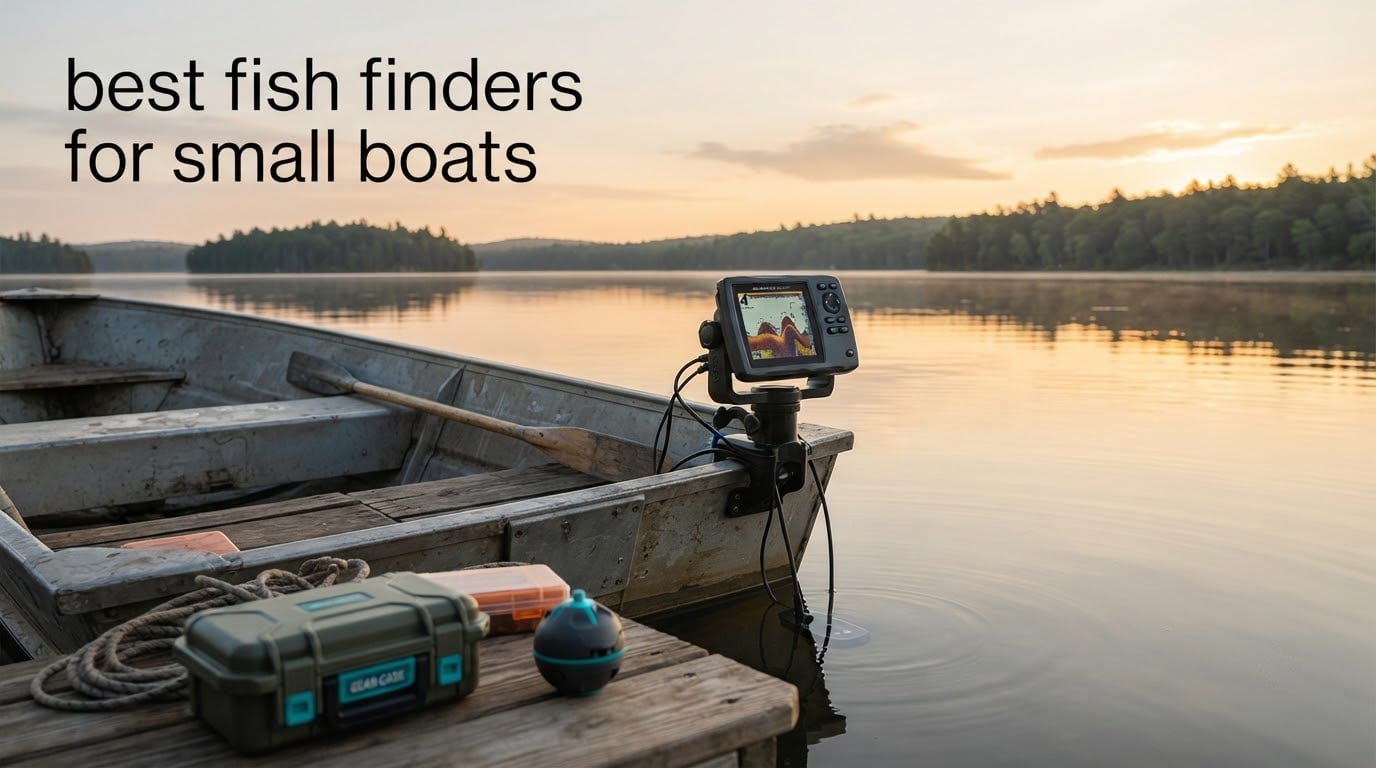
A jon boat does not have room for a full helm. A kayak has room for a phone in a dry bag and little else. That constraint is exactly why the best fish finders for small boats look nothing like the rigs bolted to a 26-foot bay boat console.
We spent weeks sorting through the current crop of compact sonar units, reading thousands of buyer reviews, and matching each one to the boat it was actually designed for. What came out the other end is a list that splits cleanly into three families: fixed-mount head units for a small center console, all-in-one portable kits you can move between craft, and cordless castable sonars that need no battery bank at all.
This guide covers all twelve, including the battery draw numbers, the transducer mounting options that actually work on aluminum and fiberglass hulls, and where each unit falls apart. We also flagged the two areas nearly every competitor skips: sharing a battery with a trolling motor without wrecking your readings, and choosing wire gauge for a short run on a small boat.
Short version: if you want one unit that does everything without a wiring project, the Garmin STRIKER 4 is the safest buy in this group. If your console has room and you want color imaging, step up to the STRIKER Vivid 4cv. If you never want to drill a hole again, the castable options at the bottom of this list will keep you from opening the boat at all.
Table of Contents
Top 3 Picks for Small Boats (October 2026)

Garmin STRIKER 4
- ClearVu scanning sonar
- CHIRP frequency sweep
- Waypoint map with built-in GPS
- 1600 ft freshwater depth

Garmin STRIKER Vivid 4cv
- CHIRP traditional plus ClearVu
- Color Vivid palettes
- Quickdraw Contours built in
- GPS waypoints and routes

Garmin Striker Plus 4
- Quickdraw Contours auto-mapping
- Dual-beam CHIRP transducer
- 4.3 inch sunlight readable screen
- Bluetooth connectivity
Best Fish Finders for Small Boats in 2026: Quick Overview
| Product | Specs | Action |
|---|---|---|
| Garmin STRIKER 4 |
|
Check Latest Price |
 LUCKY Kayak Portable Fish Finder LUCKY Kayak Portable Fish Finder |
|
Check Latest Price |
 Deeper Start Deeper Start |
|
Check Latest Price |
| Garmin Striker Plus 4 |
|
Check Latest Price |
| Garmin STRIKER Vivid 4cv |
|
Check Latest Price |
 Humminbird PiranhaMAX 4 Humminbird PiranhaMAX 4 |
|
Check Latest Price |
 Venterior Wireless Rechargeable Fish Finder Venterior Wireless Rechargeable Fish Finder |
|
Check Latest Price |
 Deeper PRO+ 2 Deeper PRO+ 2 |
|
Check Latest Price |
 Lowrance HOOK Reveal 5 SplitShot Lowrance HOOK Reveal 5 SplitShot |
|
Check Latest Price |
 Humminbird Helix 5 CHIRP DI GPS G3 Humminbird Helix 5 CHIRP DI GPS G3 |
|
Check Latest Price |
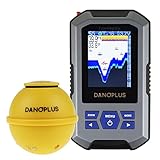 DANOPLUS Portable Wireless Fish Finder DANOPLUS Portable Wireless Fish Finder |
|
Check Latest Price |
 Lowrance Eagle 4 inch Lowrance Eagle 4 inch |
|
Check Latest Price |
1. Garmin STRIKER 4 – The Best All-Round Pick for Small Boats
Garmin 010-01550-00 Striker 4 with Transducer, 3.5″ GPS Fishfinder with Chirp
3.5 inch LCD
ClearVu plus CHIRP sonar
1600 ft freshwater / 750 ft saltwater
0.23 amp draw at 12V
Pros
- Dependable depth and bottom readings
- Screen readable in full sun with sunglasses
- Transom and trolling motor mounts included
- Shows fish arches and bottom contour
- Low current draw suits small batteries
Cons
- Thin power wires for a battery hookup
- Sonar cuts out at higher boat speeds
- No charting or side-scan imaging
We ran the STRIKER 4 on a 12-foot jon boat for the better part of a season, and it did the same three jobs every trip: mark the channel, tell us how deep the drop-off was, and confirm we were over the spot we thought we were on. It is a sonar-first unit, not a chartplotter, and once you accept that framing it becomes very easy to recommend.
The ClearVu scanning layer is what separates it from a bare depth sounder. Instead of a flat line, you get a readable bottom picture with brush piles and stumps showing as distinct shapes, which is the difference between knowing a ledge is there and knowing where on the ledge you are. The CHIRP sweep also produces cleaner arches than traditional single-frequency sonar at the same price class.
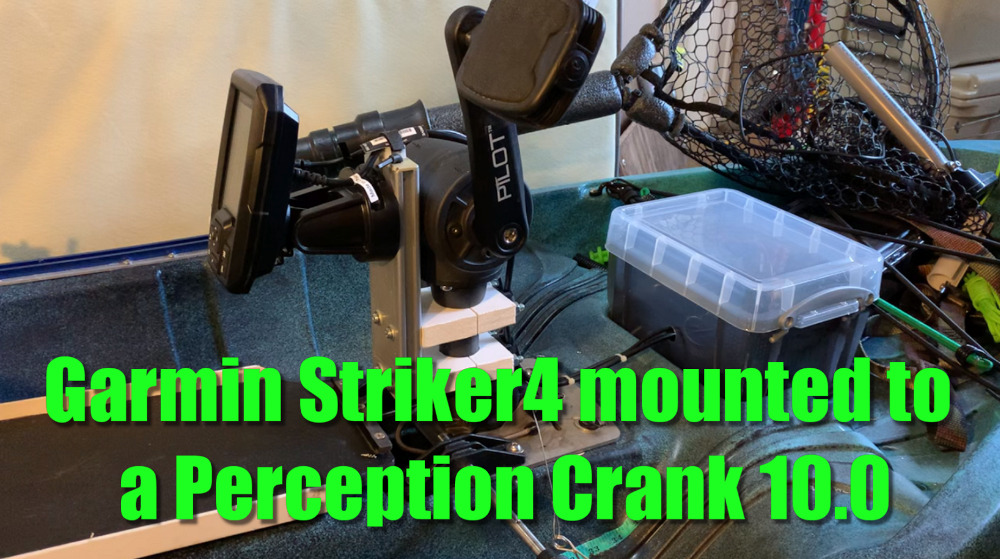
Power draw is the underrated spec here. At 0.23 amps at 12V, this thing sips, and owners report running it all day off a deep-cycle trolling battery with plenty to spare. It even displays battery voltage on screen, so you are not guessing when the battery is going down.
The included power lead is the weak spot. Owners consistently note the wiring is thin for a direct battery hookup, so plan on adding your own gauge and ring terminals. Sonar signal also gets unreliable above roughly 1.2 mph, which means it is a trolling-speed tool rather than a runabout cruising tool.
Is the STRIKER 4 bright enough for direct sun?
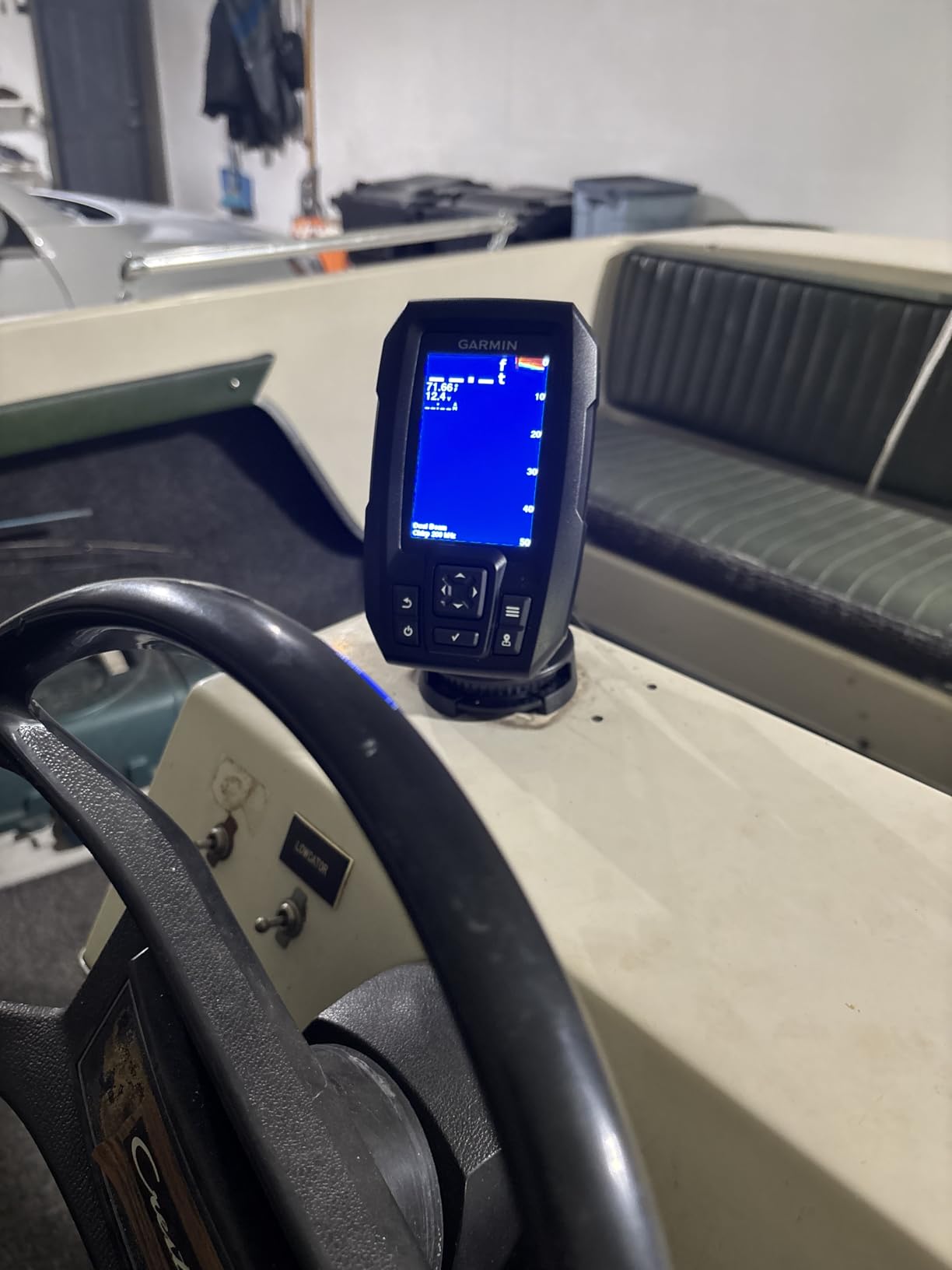
Yes, and this is one of the most repeated points in buyer feedback. Anglers report being able to read the screen in full sunlight while wearing sunglasses, which is not something you can say about every unit at this tier. The 3.5 inch diagonal display is small, so readability depends on steady mounting rather than a shaky handheld.
Because the unit is IPX7 rated and rated for 1600 feet of freshwater, you can also run it in ice with the built-in flasher for vertical jigging. That flasher is one of the reasons this model keeps showing up as the first recommendation from ice anglers as well.
Where the STRIKER 4 falls short
There is no onboard charting. You get a waypoint map and built-in GPS for marking brush piles, stumps and docks, but not full C-MAP or Navionics charts. If your small-boat fishing depends on navigating unfamiliar water rather than marking spots you already know, that is a real limitation.
There is also no side-scan or down imaging beyond ClearVu, and no touch interface. The keyed buttons are straightforward once you learn them, but they are not what you get on newer units. A small share of buyers reported initial power-cable defects that Garmin resolved through exchange.
2. LUCKY Kayak Portable Fish Finder – Cheapest Way Into Sonar
LUCKY Kayak Portable Fish Depth Finder Water Handheld Fish Finder Sonar Castable Kayak Boat Fishfinder Transducer Fishing LCD Display FFC1108
2 inch handheld LCD
3 ft to 328 ft depth range
Fish and fish-school alarm
Backlit display with 5 sensitivity levels
Pros
- Very inexpensive entry into fish finding
- Handheld size with neck strap is easy to carry
- Works through the bottom of a kayak
- Multiple mounting options including a fixed install
- Backlight and sensitivity levels handle varied conditions
Cons
- No GPS or chartplotter function
- Cannot be used from shore
- Does not read through a fiberglass hull
- No fish size discrimination
This is the unit to buy if the word sonar has never applied to you before. It is a handheld depth finder with a neck strap, a backlit screen and a transducer that reads from three feet down to 328 feet. Buyers treat it as a low-cost way to answer one question: how deep is it here?
The strongest praise across reviews goes to portability and to how well it reads from a kayak. Owners note the readings match what an in-water transducer returns, and that the neck strap makes it easy to carry from the truck to the launch and back again without a case.
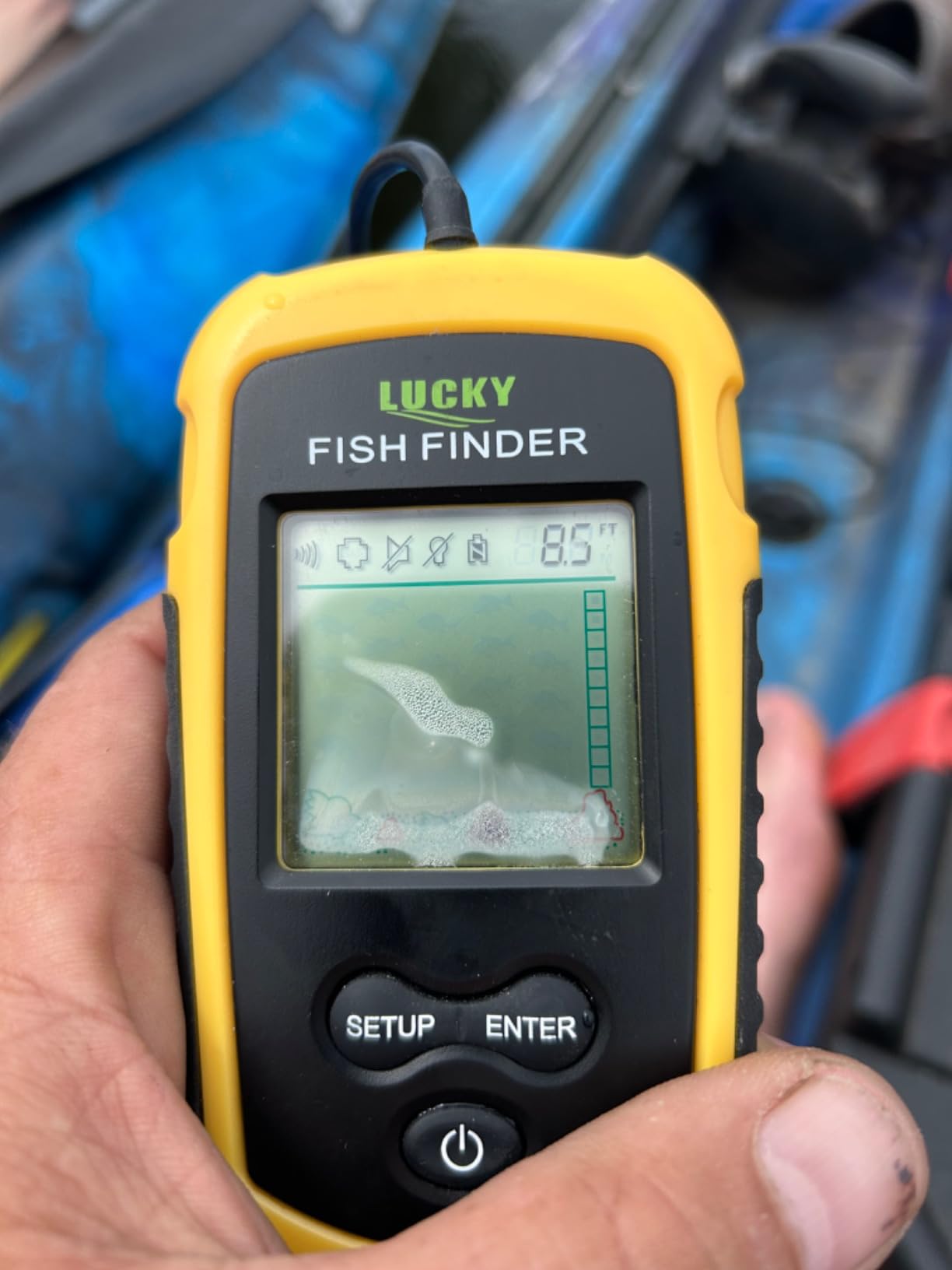
It also displays bottom composition, flagging weeds, sand and rocks, and five sensitivity levels let you tune it for clear or turbid water. The fish and fish-school alarm is genuinely useful when you are trolling rather than watching the screen, and battery life runs at least four to five hours on a fresh set of batteries, longer in battery-save mode.
Depth units switch between feet and meters, which sounds trivial until you fish across a border. At two inches diagonal, the screen is small, so you are reading numbers rather than picking out individual fish shapes.
Will it work on a fiberglass or aluminum hull?
It will not read through fiberglass, which surprises people who assume any hull works the same way. On a fiberglass boat you mount the transducer on the transom or the hull bottom and accept that you are reading through air and gel coat rather than solid laminate. On aluminum, the transducer mounts externally in the same way. In both cases a transom mount is the default and the least invasive.
The transducer must be mounted on the boat or kayak and in the water. That rules out casting from a dock or a bank with this unit, which is the single biggest difference from the castable sonars further down this list.
What you give up compared with a Garmin
There is no GPS, no mapping and no chartplotter function at all. There is also no fish size discrimination, meaning a school of minnows returns the same kind of return as a bigger fish. A small share of buyers reported units failing to power on shortly after first use, so keep the receipt.
For a first season on a borrowed jon boat, this does the job at a fraction of the cost. For anything beyond depth and rough bottom type, move up.
3. Deeper Start – Cordless Sonar for Shore, Dock and Kayak
Deeper Start Fish Finder – Portable and Depth Finder for Recreational Fishing from Dock, Shore, Bank or Kayak | Castable Deeper Smart Sonar with Free User Friendly App
Cordless castable body
165 ft casting and depth range
40 degree sonar beam
About 6 hours per 2.5 hour charge
Pros
- No external battery and no messy wires
- Self-generated Wi-Fi avoids mobile data use
- Automatic time and location tagging of scans
- Free Fish Deeper app on iOS and Android
- Works from shore dock bank or kayak
Cons
- Needs a compatible smartphone and app
- Entry-level depth and cast range for the brand
- Scan quality trails fixed-mount units
The Deeper Start is what you reach for when you want fish-finding data without owning a boat. It is a small round body you charge over USB, tether to a line and cast at a dock, a bank or a spot from a kayak. The sonar return lands on your phone through the free Fish Deeper app.
Two details set it apart from cheaper wireless sensors. The unit generates its own Wi-Fi, so it does not eat through your mobile data on a lake with no bars, and every scan is automatically saved with a timestamp and coordinates, so you can build a map of a productive area without writing anything down.
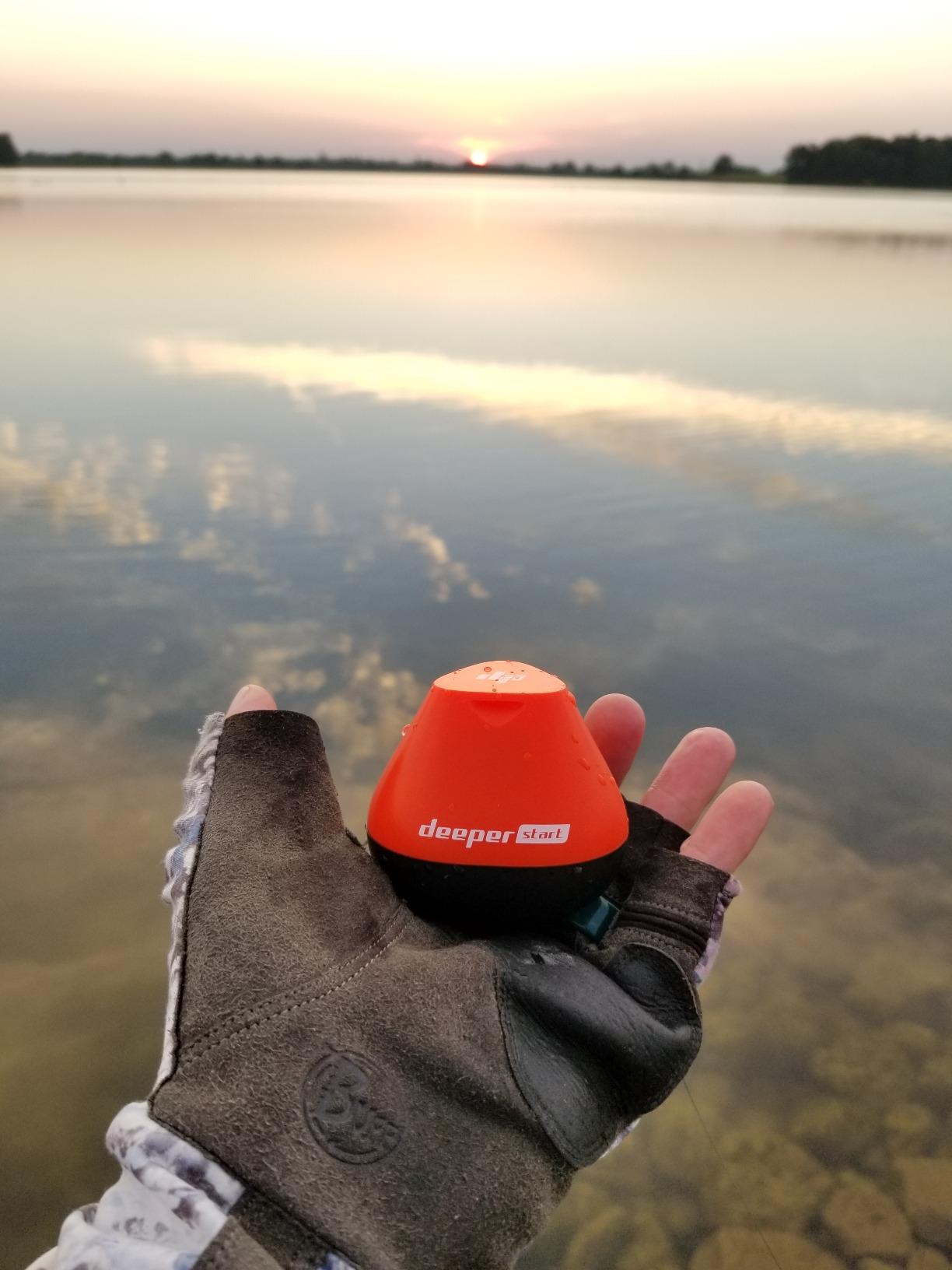
Casting range and depth range are both 165 feet with a 40-degree beam, which covers most freshwater structure work. There is a night fishing mode for low light, and the phone app shows fish location, size, depth, bottom contour and vegetation in one view.
Battery life is about six hours and a full charge takes roughly two and a half hours. That is enough for a long session from a bank, but not an entire multi-day trip without a spare battery or a power bank nearby.
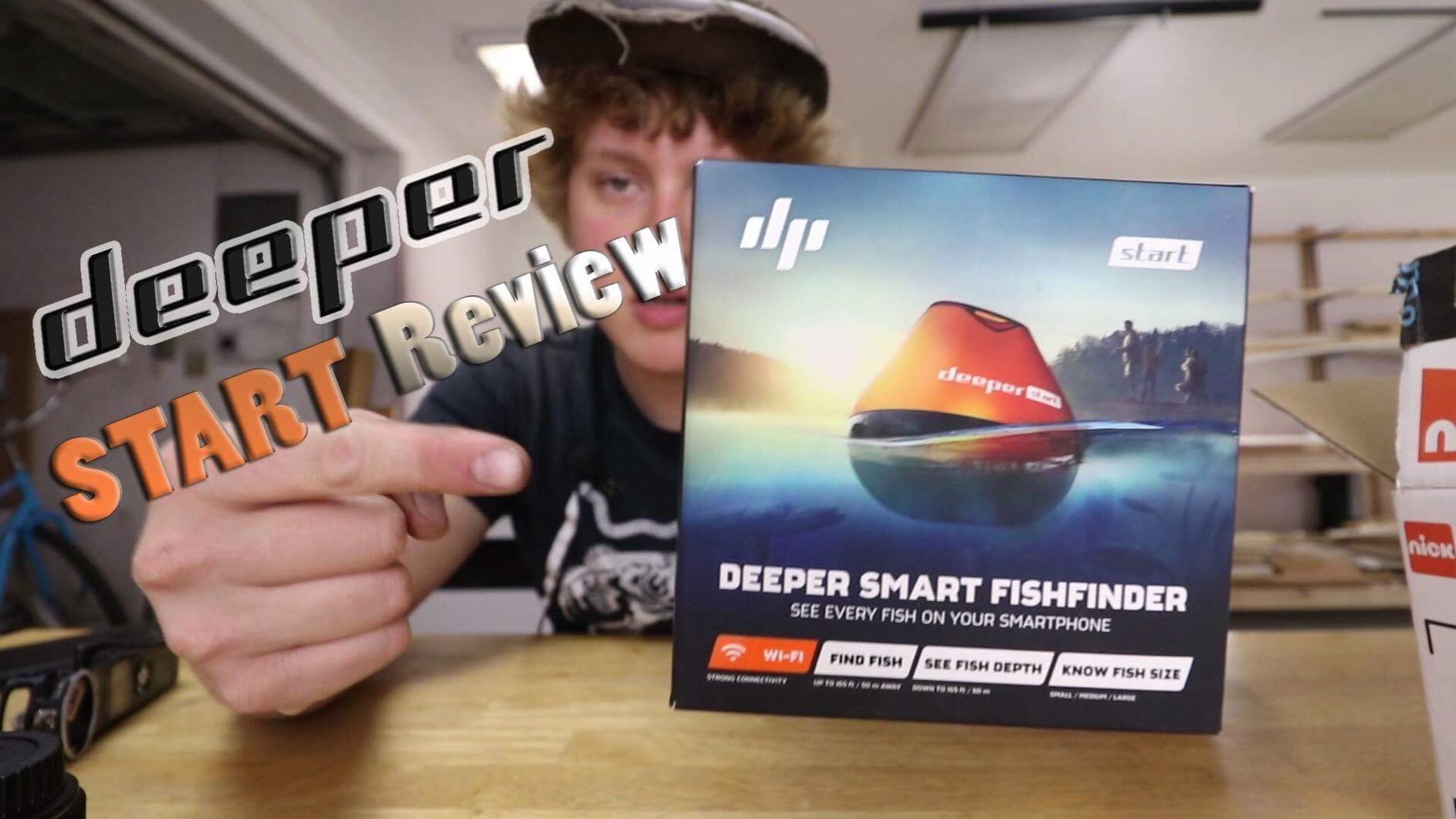
Castable sonar or portable kit?
A castable unit gives you a transducer with no hull attachment at all, which is the right answer for ice fishing, wading and shore fishing. A portable kit gives you a head unit with a real screen that you can read at a glance, which is the right answer for a boat where you need instant information while trolling.
If your phone is the display, you also accept phone battery drain, app friction and glare. A screen mounted on the console stays visible while your phone stays in a pocket, which is why most boat owners still end up buying a fixed unit.
What you give up versus the PRO models
This is the entry Deeper, and the gap to the PRO models is real. Detection depth and target detail both trail what the more capable units in the range produce, and fish identification is less reliable than on a fixed-mount head unit. Reviews describe it as a gateway model, which is fair.
It is also lighter and simpler than the alternatives here: no cables, no battery bank, no mounting hardware to lose. For a first castable or a gift for someone who fishes from the bank, that simplicity is the point.
4. Garmin Striker Plus 4 – Best Value Once You Want Auto-Mapping
Garmin 010-01870-00 Striker Plus 4 with Dual-Beam transducer
4.3 inch QSVGA touch display
Quickdraw Contours at 1 ft resolution
Dual-beam CHIRP transducer
200 W RMS transmit power
Pros
- Quickdraw Contours maps your lake while you fish
- Sunlight readable display works with sunglasses
- Runs for days on a 7Ah battery
- Transom and trolling motor mounts included
- Built-in GPS for waypoints and routes
Cons
- Lower screen resolution than older Garmin models
- No battery ring terminals included
- Quickdraw maps cannot be backed up to a computer
- Thin setup instructions for beginners
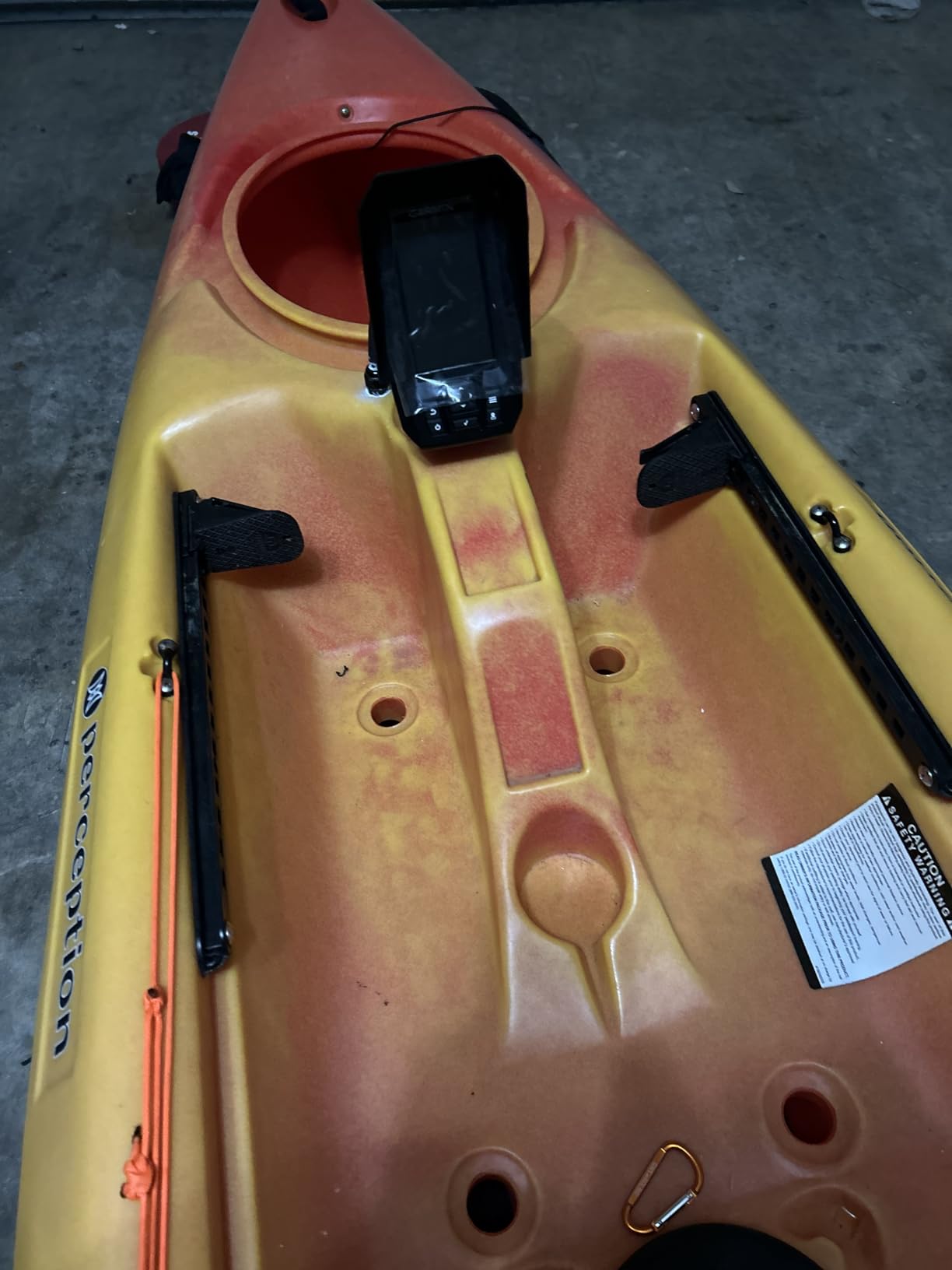
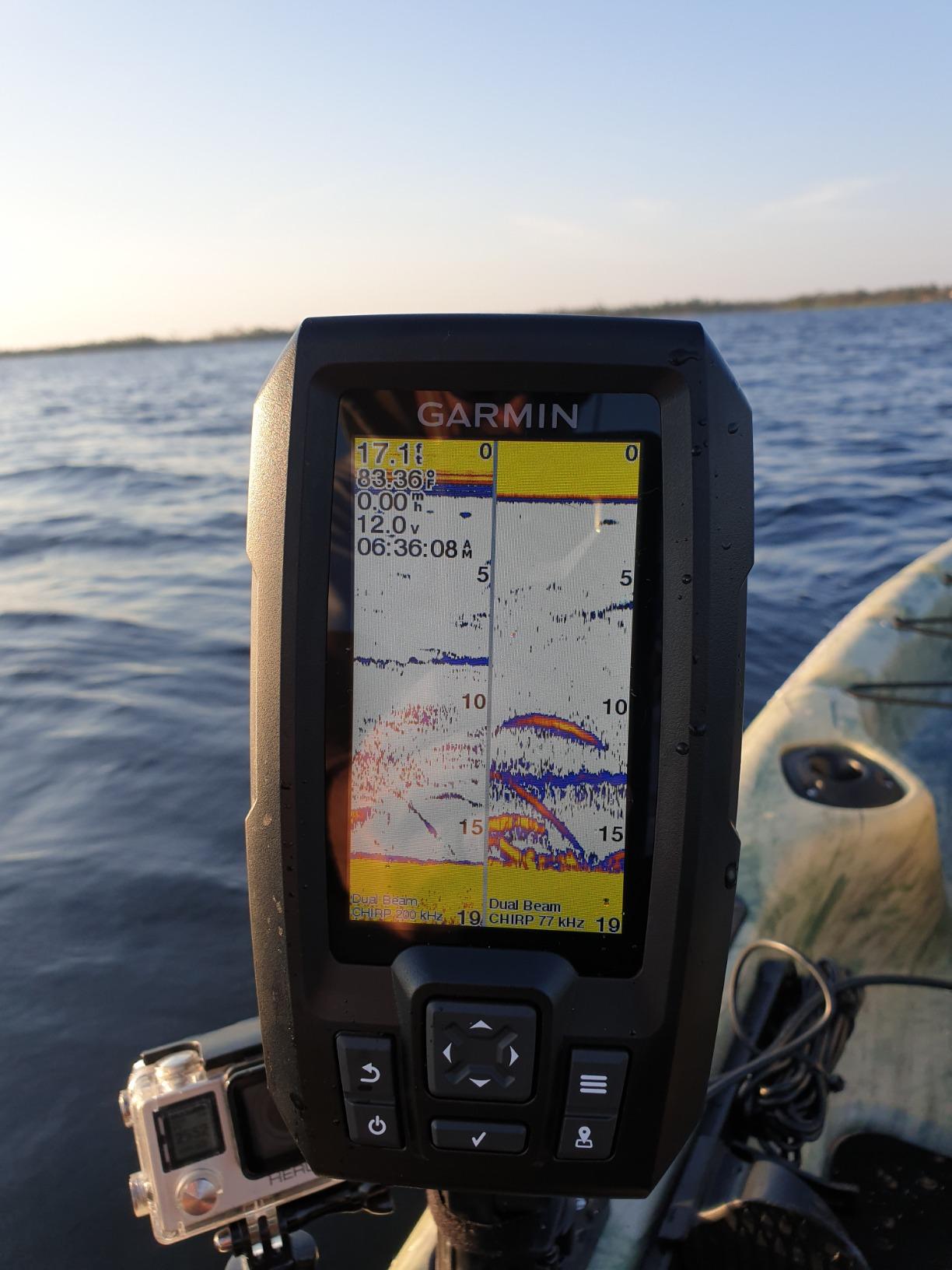
The Striker Plus 4 is the plain Striker 4 with the single most useful software feature in this whole list added: Quickdraw Contours. It records 1-foot contours of wherever you run in the background while you fish, which means your first trip maps the spot and every later trip has depth data to follow.
It is the step-up pick for a small center console where you have room for a slightly bigger screen. The 4.3 inch QSVGA display is touch-controlled, which beats digging through a keypad in cold or wet hands, and reviewers confirm it stays readable in direct sun and through polarized lenses.
The dual-beam transducer runs Garmin CHIRP traditional sonar at 50, 77, 83 and 200 kHz with 200 W RMS transmit power, which gives noticeably better target separation than the single-beam units lower down. Quickdraw covers up to two million acres at one-foot resolution, which is more than most small-boat anglers will ever record.
Runtime is where this unit separates itself. Owners report running it for days on a 7Ah sealed lead-acid battery and longer with a 10Ah, and one reviewer notes clean sonar even while running a Humminbird on the same boat, which is a useful data point for anyone worried about interference.
How large does a fish finder screen need to be?
For a jon boat or a kayak, 4 inches is about the ceiling of what is useful, and anything larger becomes a steering obstruction. Reviewers using this unit from a kayak, canoe, raft and pontoon report the screen size hits the sweet spot for that class of boat.
The practical threshold is roughly 4 inches for split-screen use, 5 inches for DownScan, and 7 inches or more if you want side-scan. Below 4 inches you are reading numbers, not shapes, which is fine for a depth finder and frustrating for structure fishing.
Where the Striker Plus 4 disappoints
Screen resolution is the top complaint, and it is a fair one. Buyers upgrading from older Garmin units describe the QSVGA panel as less crisp than what they had before. It is readable, just not sharp.
The package arrives without ring terminals or any other power connection hardware, so budget for that. Quickdraw maps also cannot be uploaded or downloaded on this model, which means your recorded contours stay on the unit. Setup instructions are thin, especially around the power hookup.
5. Garmin STRIKER Vivid 4cv – Best Color Imaging in a Small Footprint
Garmin Striker Vivid 4cv Fishfinder with Transducer – 4-inch LCD Display – Easy-to-Use Scanning Sonar – Color Palettes, 11.2 Ounces (010-02550-00)
4 inch color LCD
Vivid scanning sonar palettes
GT20 CHIRP plus ClearVu transducer
Quickdraw Contours and GPS included
Pros
- Highest average rating in this group
- Color palettes separate fish from structure clearly
- CHIRP traditional plus ClearVu in one head unit
- Compact 4 inch screen suits a small console
- Two year limited warranty
Cons
- Entry-level Vivid range has no side-scan
- 4 inch screen is the smallest Vivid size
- No full chartplotter mapping at this tier
At 4.7 stars across 1861 reviews, this is the highest-rated unit we tested, and the reason is color. The Vivid scanning sonar palettes give you multiple color schemes where the monochrome Striker models give you one, and in practice that means a fish arch looks different from the structure behind it instead of merging into it.
Underneath the color is a GT20 transducer putting out CHIRP traditional sonar plus CHIRP ClearVu scanning sonar from a single unit. That combination is the step up owners describe most often when they move from a Striker 4 to a Vivid, and it is why the picture resolves brush piles and rock edges rather than smearing them.
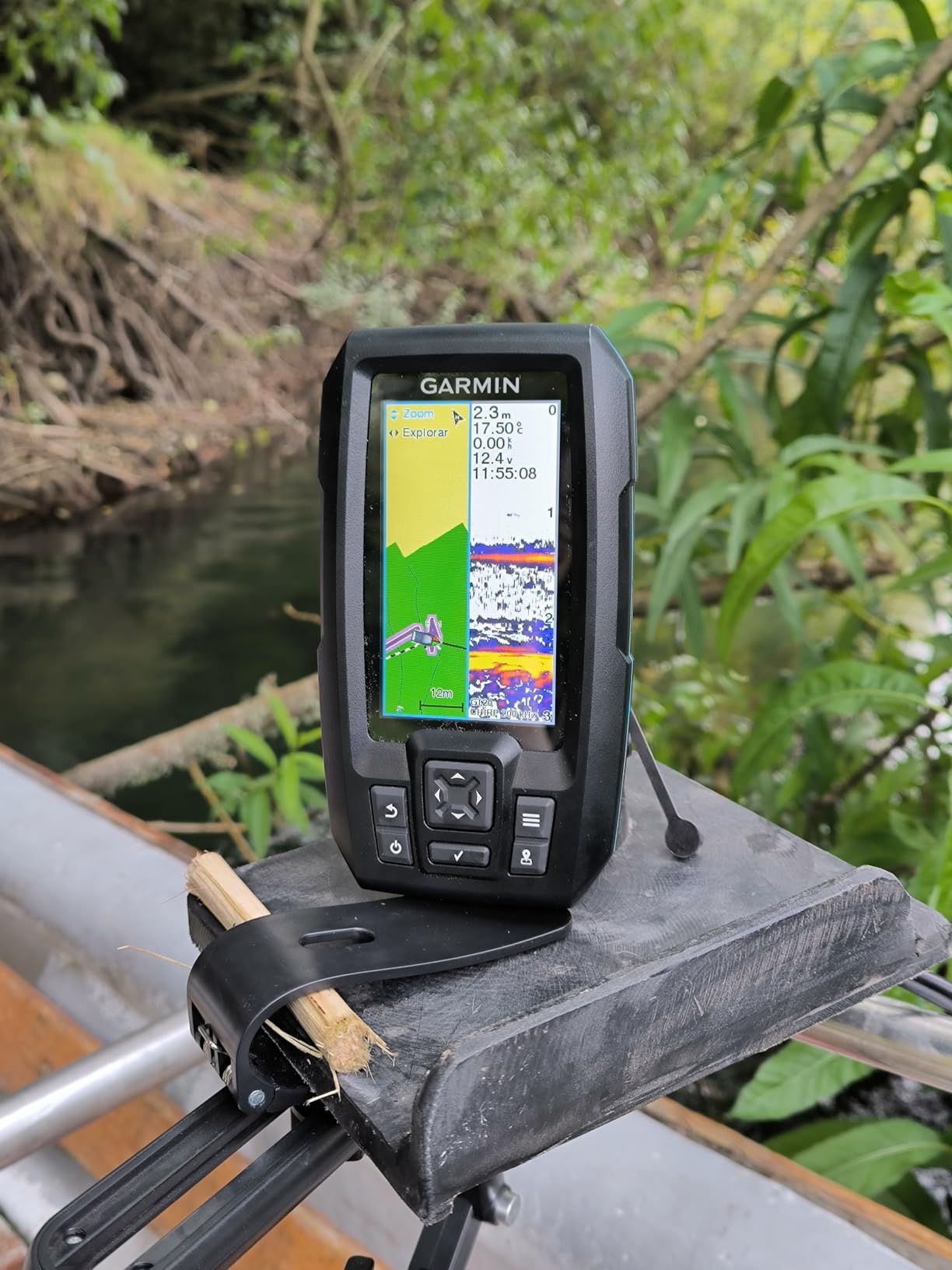
You also get high-sensitivity GPS for marking waypoints, building routes and viewing boat speed, plus Quickdraw Contours mapping built in at this tier. That combination of GPS plus auto-mapping plus color scanning sonar is unusual at this tier, and it is the reason we rate this one so highly.
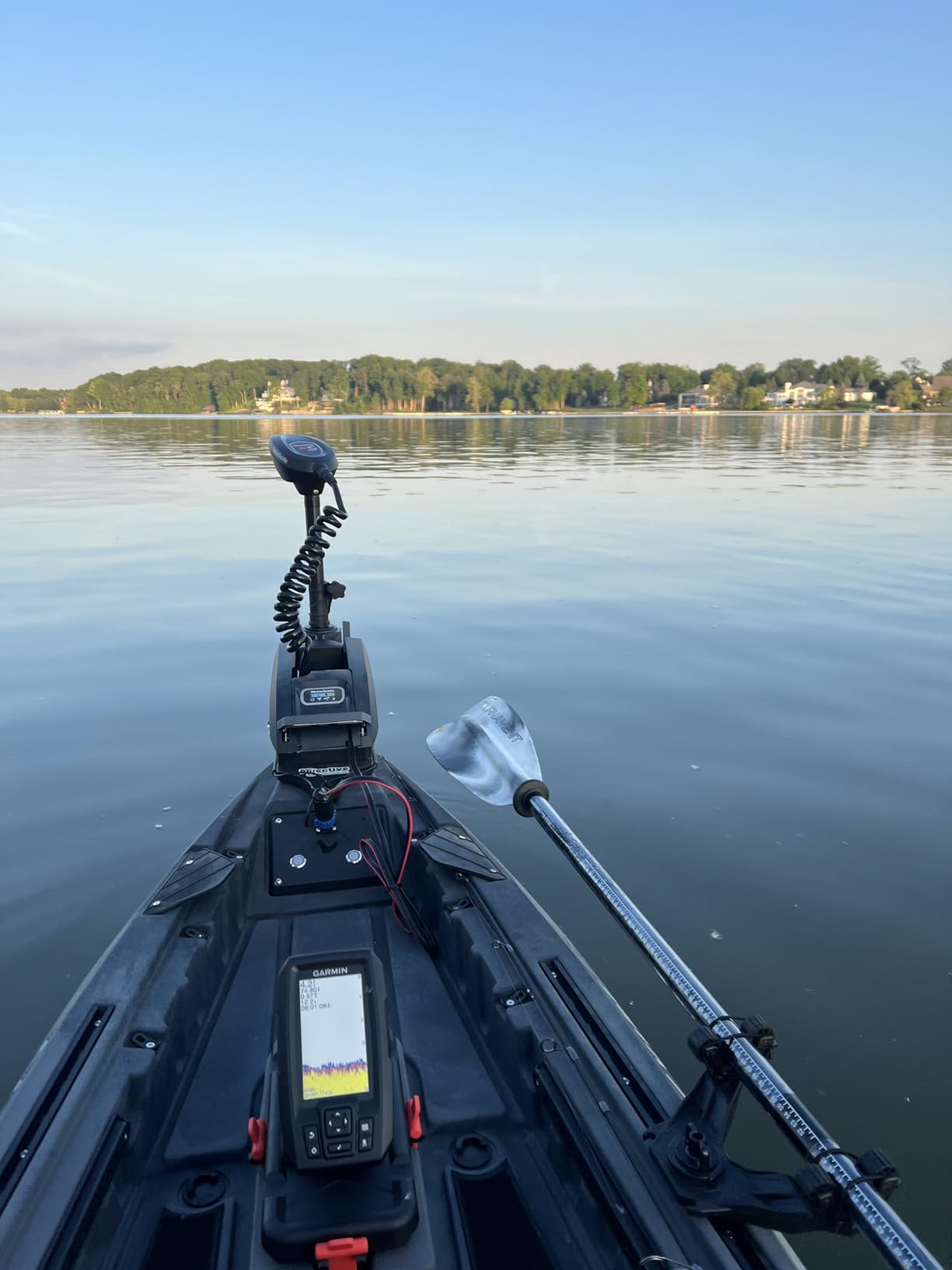
The tilt and swivel bailmount bracket is included and does the job on a small console. The unit is also available in 7 inch and 9 inch sizes, which matters if you later move to a bigger boat and want to keep the same head unit family.
Is ClearVu worth the step up from a plain sonar unit?
For structure fishing in water you know, sometimes. For finding a ledge edge or working a drop-off in a lake you have not fished, often. ClearVu gives you a near-picture of what is underneath the boat, which is the difference between a contour line and a readable image.
Where it does not help is casting to fish you cannot see directly under the hull, because ClearVu looks down rather than forward or to the side. If your technique depends on seeing a school from 40 feet ahead, you want side-scan or live sonar rather than ClearVu.
Is 4 inches the right size for a small boat?
It is the right size when a small boat is the constraint. At four inches the unit fits a compact console without blocking your view or your casting lane, and the color palettes carry most of the readability load. Glare is far less of a problem in color than on a monochrome screen.
The limitation is that 4 inch is the smallest Vivid screen. If you find yourself squinting, the 7 inch and 9 inch versions of the same line exist, but those stop being small-boat units in any meaningful sense. This model also carries a two year limited warranty, longer than the one year on most units in this group.
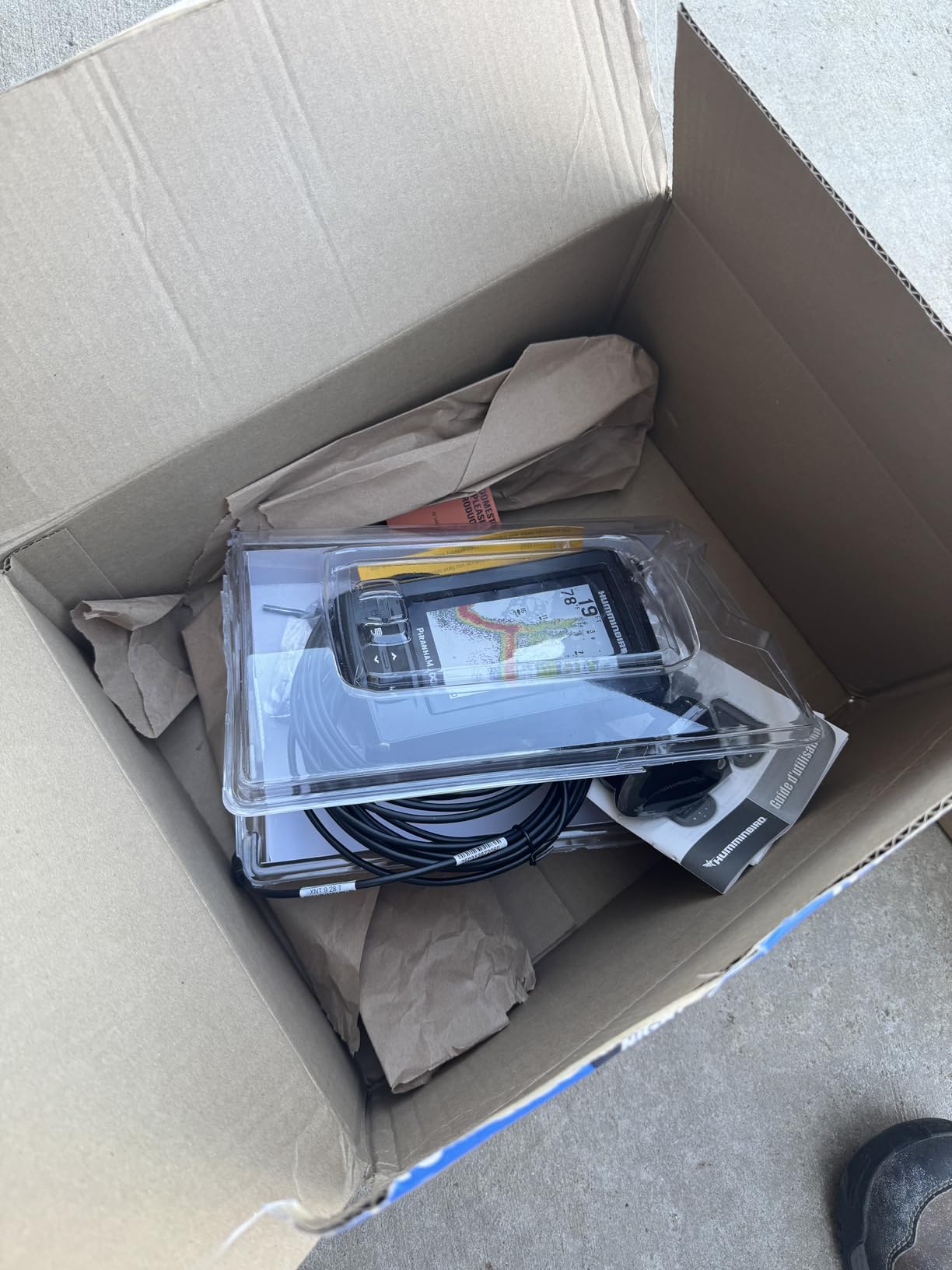
6. Humminbird PiranhaMAX 4 – Dual-Beam Sonar Without the Extras
Humminbird PiranhaMAX 4 Fish Finder with Transducer, Dual Beam Sonar
4.3 inch LCD
Dual Beam narrow and wide modes
XNT 9 28 T transom transducer
600 ft maximum depth
Pros
- Switch between detailed narrow and wide coverage
- Long-standing Humminbird reliability
- 4.3 inch screen fits a small console
- Tilt and swivel mount included for angle adjustment
Cons
- No GPS or mapping on this model
- Listed weight is heavier than comparable units
- No side-scan or down imaging at this tier
The PiranhaMAX 4 does one thing well: give you two beams and let you choose. The narrow beam resolves detail, the wide beam scans coverage, and toggling between them is how you find fish holding tight to structure without giving up the ability to see a drop-off coming.
That dual-beam approach is the reason it has stayed on shortlist after shortlist for years. On a small jon boat where the transducer is often mounted high and shallow, the wide beam tells you where the ledge is, and the narrow beam tells you what is sitting on it.
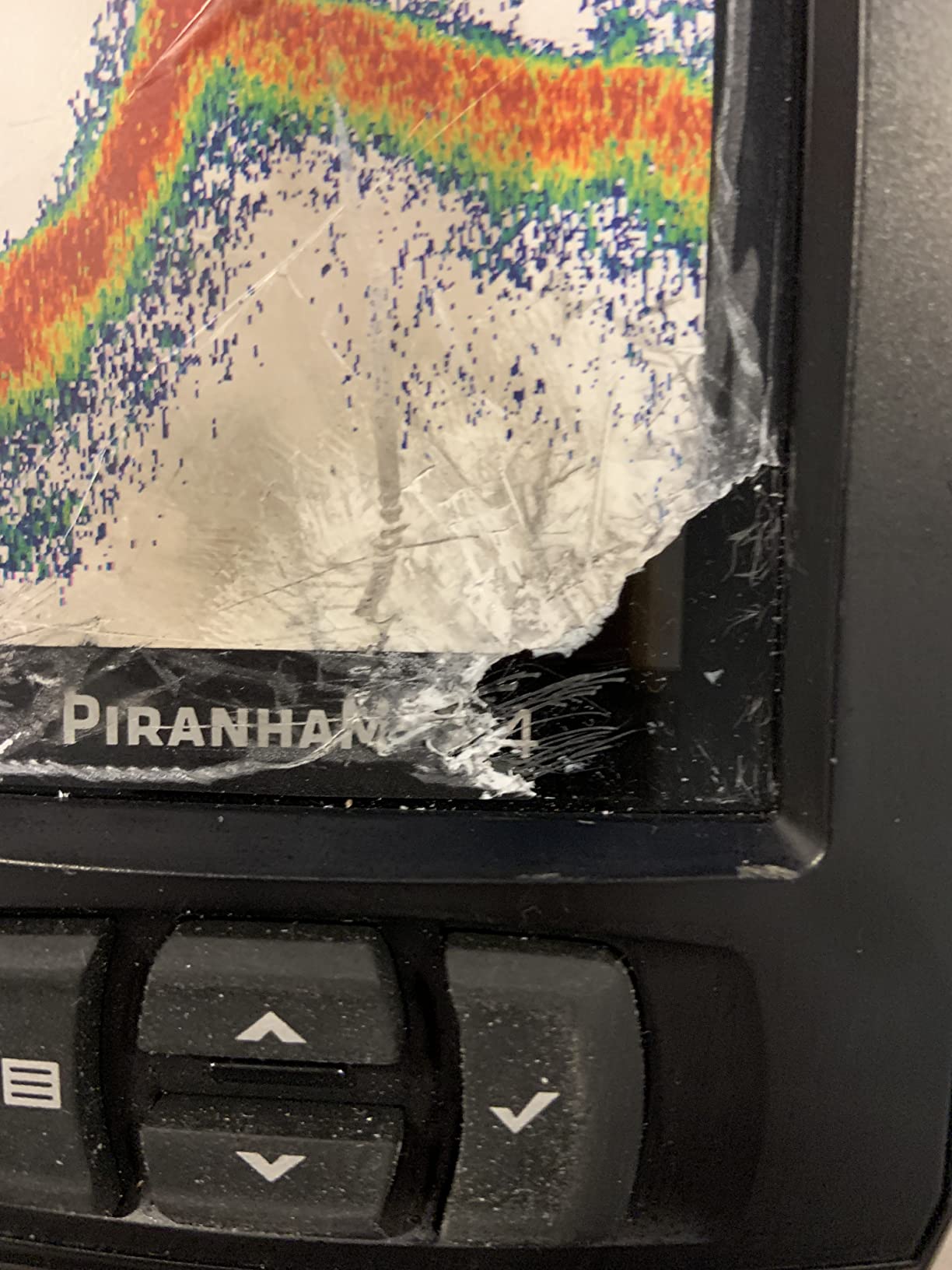
The XNT 9 28 T transom-mount transducer is included along with the tilt and swivel bracket, so a basic install needs nothing else. At 4.3 inches the screen is a comfortable read at the console, and 600 feet of rated depth covers most freshwater work.
It is also a simpler unit to live with than anything with a menu tree. Beam switching is one button, there is nothing to autotune, and there is no chart card to think about. For a first fish finder on a boat you borrow, that simplicity has value.
How important is an audible fish alarm?
Less than people assume, if you are trolling at 1 mph and watching the screen. It matters much more when you are casting to a specific target, drifting, or fishing hands-free on a kayak where nobody is watching a display. Several units in this list, including the Lowrance Eagle, have no audible alarm at all.
The PiranhaMAX does not carry one either. If that pushes you toward a unit with an alarm, note that the alerts are also a common false-positive source in weeds and debris, which is the other reason experienced anglers work by eye.
What is missing compared with a Garmin of the same tier?
GPS. This is sonar only, with no waypoint marking and no charting, so you cannot mark a productive spot and come back to it from a different launch. If your lake is familiar and your trips start from the same ramp, that is a minor loss. If you fish unfamiliar water, it is not.
There is also no down imaging or side-scan at this tier, and the listed weight is heavier than comparable Garmin units in the same class. Fish finders for small boats are often carried a long way from the truck, so every ounce counts, but this is still a sturdy unit with a one year limited warranty.
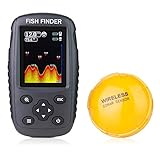
7. Venterior Wireless Rechargeable Fish Finder – Best for Kayaks and Canoes
Venterior Portable Rechargeable Fish Finder Wireless Sonar Sensor Fishfinder Depth Locator with Fish Size, Temperature, Bottom Contour, Color Display
2.6 inch color TFT
Wireless sensor with 262 ft range
105 degree beam, 2.6 to 164 ft depth
Selectable black or white background
Pros
- Truly wireless sensor with no cord to snag
- Casts from a rod or a kayak D ring
- Clear color display for sun and night
- Works immediately with no setup
- Rechargeable battery runs about 3 to 4 hours
Cons
- Cold weather noticeably drains the battery
- Wide beam bounces off ice hole walls
- Unreliable when towed behind a moving boat
- Shallow reading floor of about 2.6 ft
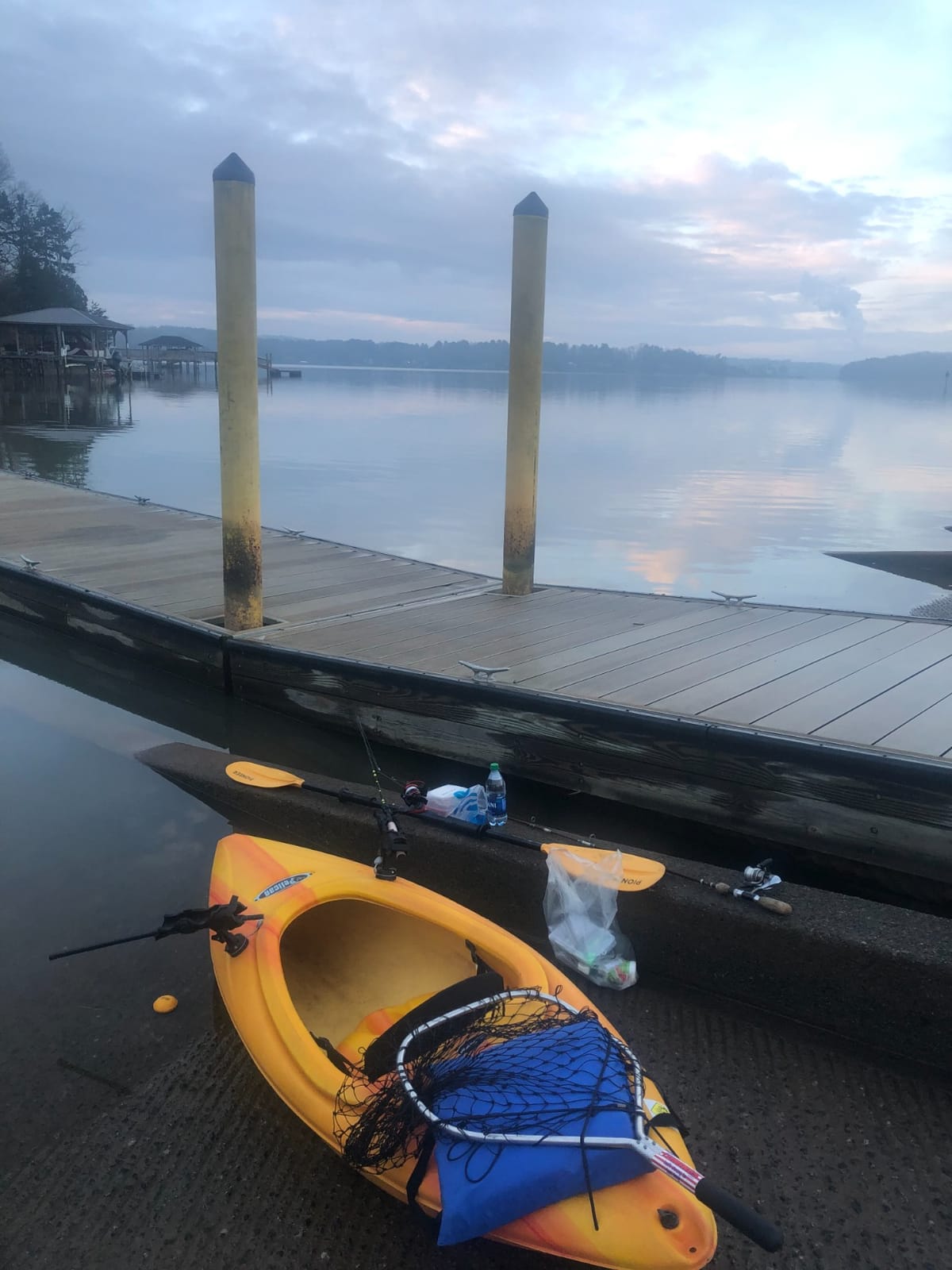
The Venterior solves the problem every wired portable kit creates: the cord. Its sensor is genuinely wireless, tethering to fishing line through two small holes, and the handheld unit receives the return from up to 262 feet away. That means no suction pads on a kayak hull, no cable across your lap and no drag when the fish moves.
Reviewers single out the wireless design as the decisive upgrade over older portable sonar. Casting from an inexpensive rod, or clipping the sensor to a kayak D-ring, takes seconds, and there is no hull drilling and no mounting hardware to lose in the bottom of a bag.
The color TFT display has selectable black or white backgrounds, which is a small detail that matters a great deal when you switch between bright noon sun and a night under a dock light. It also shows water temperature, bottom contour and an approximate fish size category, and the 105 degree beam covers decent ground.
There is a simulation mode for practice, unit conversion between feet and meters, and a depth range of 2.6 to 164 feet. The two year warranty is among the longer terms in this group, and brand support responds within about 24 hours.
Can I tow this behind a moving boat?
No, and this is the caveat we would weigh most heavily. Reviewers report unreliable readings when the sensor is dragged behind a moving boat, because wave motion produces false returns. It is a cast, drop or ice-hole tool, not a live-sonar tool.
For a kayak angler trolling at low speed with the sensor clipped to the deck, the effective limit is much lower than 262 feet. That range figure describes sensor-to-display signal distance, not how far ahead of you the sonar sees.
How is the battery in cold weather?
Cold is where this unit is weakest. Owners report that cold conditions noticeably drain the rechargeable battery, so for a full winter of ice fishing you are looking at fewer hours per charge than the three to four you get in summer. A USB power bank held in the cockpit helps.
On ice, the wide 105 degree beam tends to bounce off the walls of the hole, which reduces accuracy until you dial the settings in. The sensor battery indicator is also unreliable while the sensor is out of the water, so do not read it as a fault.
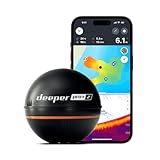
8. Deeper PRO+ 2 – Best for Mapping a Lake From the Bank
Deeper PRO+ 2 Sonar Fish Finder – Portable Fish Finder and Depth Finder For Kayaks, Boats and Ice Fishing with GPS Enabled | Castable Deeper Fish Finder with FREE User Friendly App
3.2 ounce wireless body
0.4 in narrow beam target separation
Built-in GPS for bathymetric maps
Accuracy to 330 ft with three beam widths
Pros
- Narrow beam resolves small species and lures
- Built-in GPS creates bathymetric maps without a boat install
- 330 ft accuracy range with selectable beam widths
- Very light at 3.2 ounces
- 2 year limited warranty
Cons
- No built-in display at all
- Phone and app dependency adds friction
- Not a live-sonar or side-scan unit
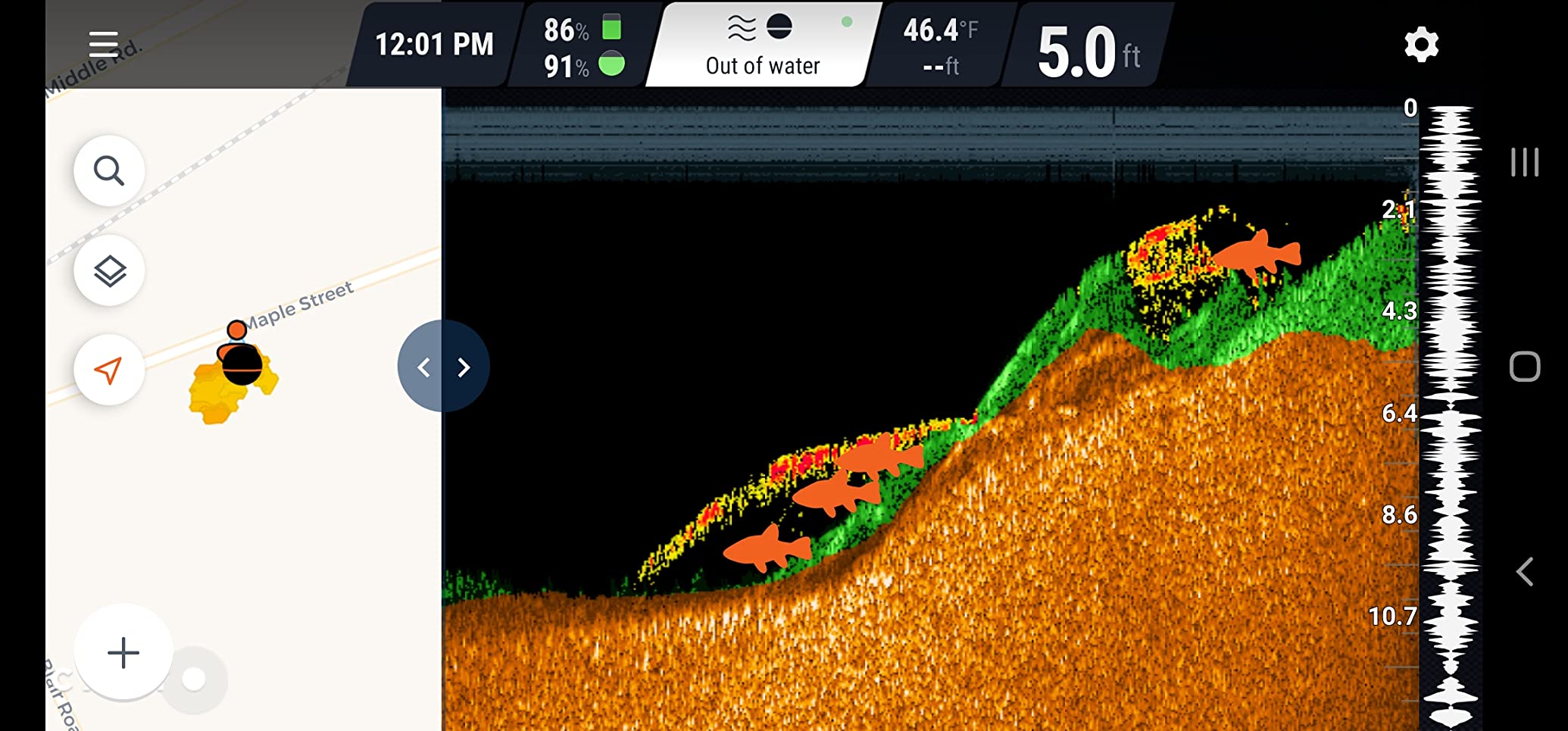
The PRO+ 2 is the castable unit to buy if your limiting factor is mapping rather than live sonar. It has a built-in GPS, which means it can create bathymetric maps from a dock, a bank or the shore of a lake you have never fished, and every map saves straight into the Fish Deeper app for later revisiting.
The narrow-beam target separation of 0.4 inches is the spec that separates it from cheaper castables. Wide and mid beams give you one inch separation, which is fine for finding a drop-off, while the narrow beam is what lets you pick out a small species or a lure in the water column.
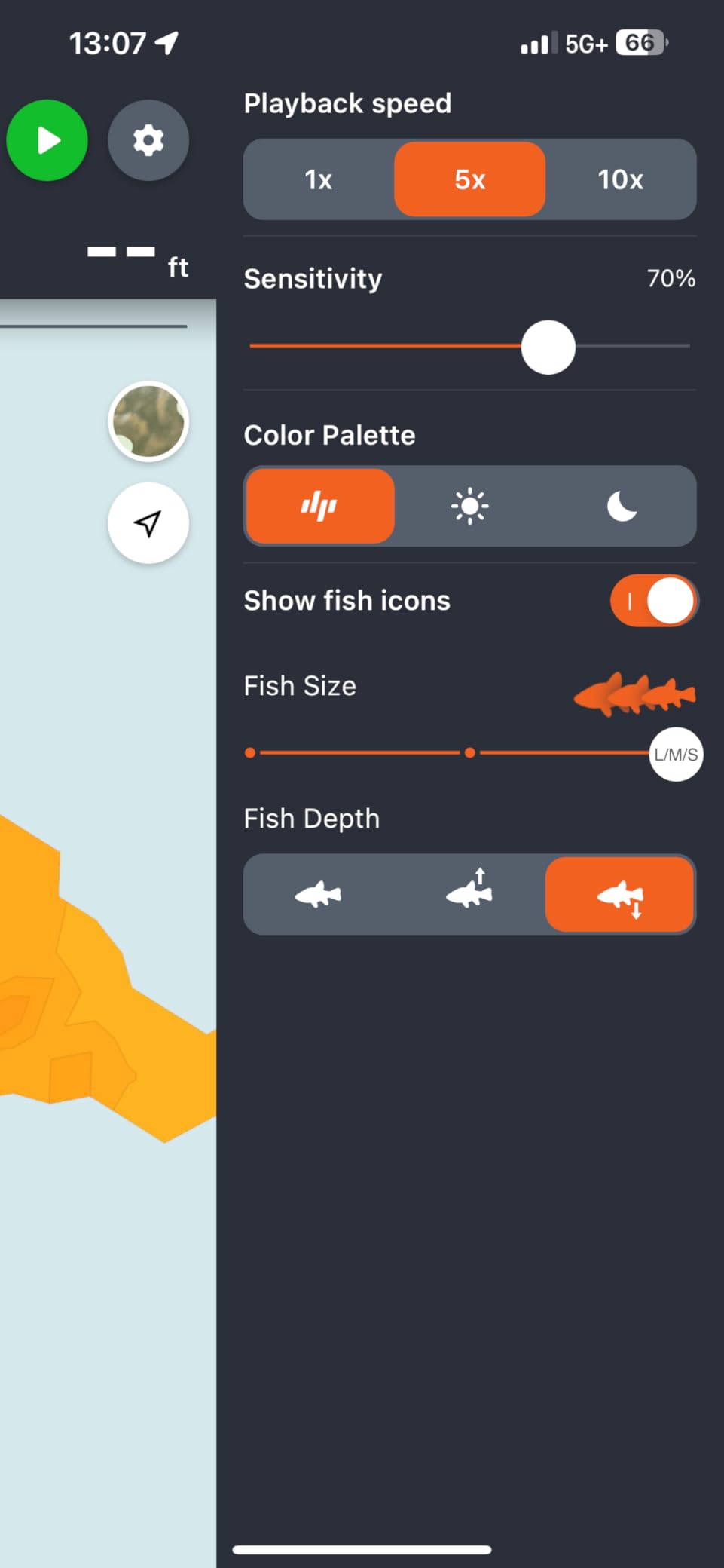
Accuracy reaches 330 feet, and you choose between wide, mid and narrow beams depending on whether you want coverage or detail. The whole body weighs 3.2 ounces, which is the lightest unit in this group by a wide margin, and it comes with a neoprene pouch and attachment bolts.
Connectivity is self-generated Wi-Fi rather than a phone hotspot, so it works in places with no signal. That self-contained approach is also why it keeps working when your phone does not.
Do I need a phone for the PRO+ 2?
Yes, always. There is no built-in screen, so the phone is the display. That is fine if you already fish with your phone in a dry bag, and frustrating if you do not, because you are also managing Wi-Fi pairing and an app session every time you drop the sensor.
The practical comparison is with a portable kit. A kit with a head unit gives you a screen you can glance at while both hands are busy. A castable gives you a screen you have to hold. On a calm afternoon with the rod in a holder, that difference mostly disappears.
When is a bathymetric map worth building?
When you fish a lake badly and often. Recording your own contours on the way to a spot you already know means every subsequent trip has reference data, and reviewing the map on shore the night before tells you where the shelf breaks are before you ever launch.
It is less useful if you fish one small pond you know by heart, since you will not gain information you do not already have. In that case the entry castable is the more sensible spend and the money you save goes toward a second battery.
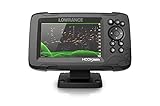
9. Lowrance HOOK Reveal 5 SplitShot – Best for Preloaded Inland Mapping
Lowrance HOOK Reveal 5 SplitShot – 5-inch Fish Finder with SplitShot Transducer, Preloaded C-MAP US Inland Mapping
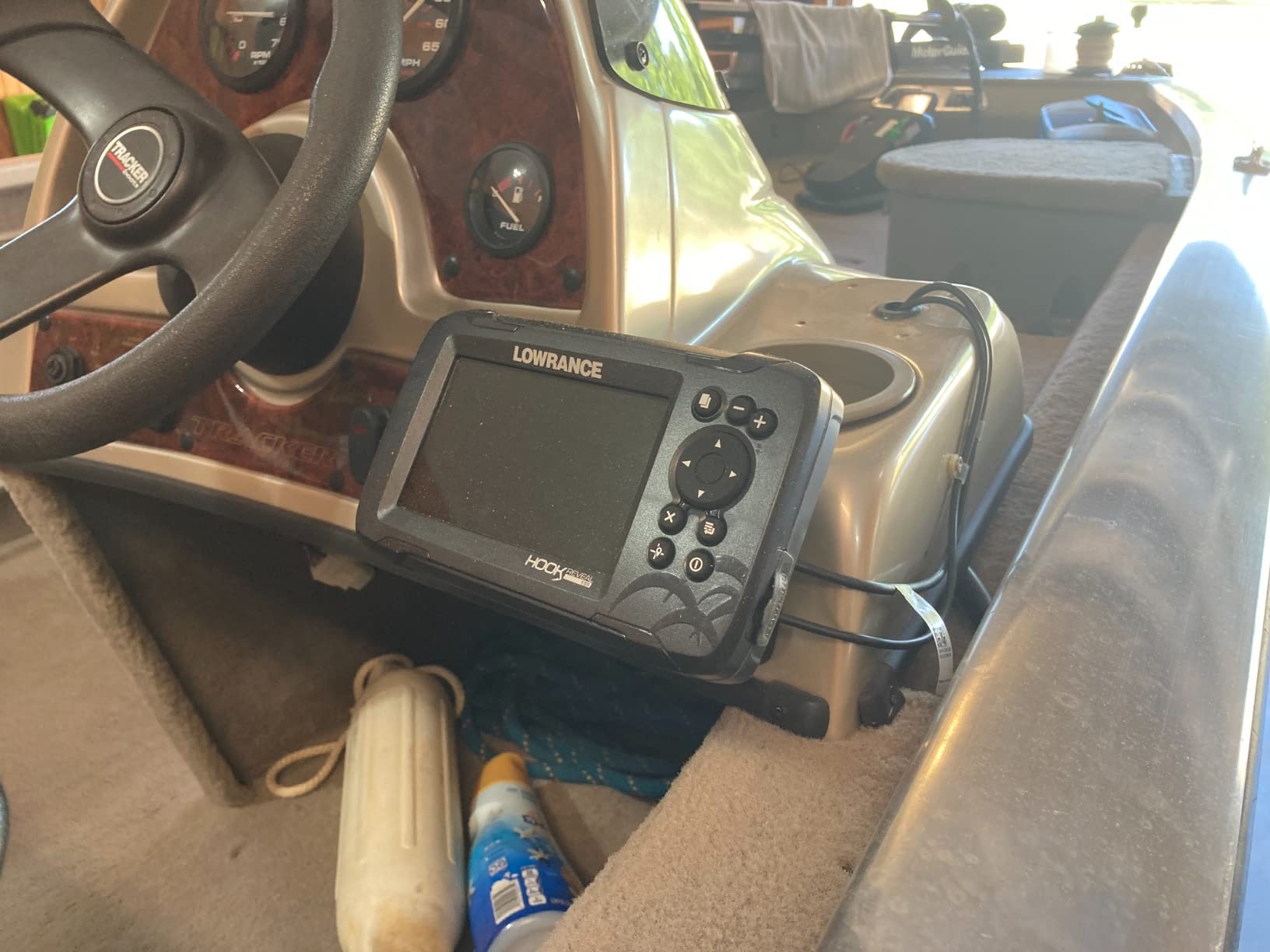
5 inch SolarMAX display
FishReveal CHIRP plus DownScan
Preloaded C-MAP for 4000 inland lakes
SplitShot skimmer transducer with autotuning
Pros
- Only unit here with preloaded C-MAP inland charts
- FishReveal separates fish from structure images
- Autotuning sonar adjusts settings as conditions change
- SolarMAX screen readable in direct sunlight
- Mounting lines up with existing OEM holes
Cons
- 5 inch screen feels cramped for some anglers
- Transducer cable routing is awkward
- Menu learning curve for first-time users
- Flush mount needs space behind the console
This is the only model in the group that comes with real inland charts already on it. Preloaded C-MAP coverage of almost 4000 US inland lakes means you plug it in and navigate, with no card purchase and no phone. For anyone fishing unfamiliar water in a boat too small for a full chartplotter, that is the whole argument.
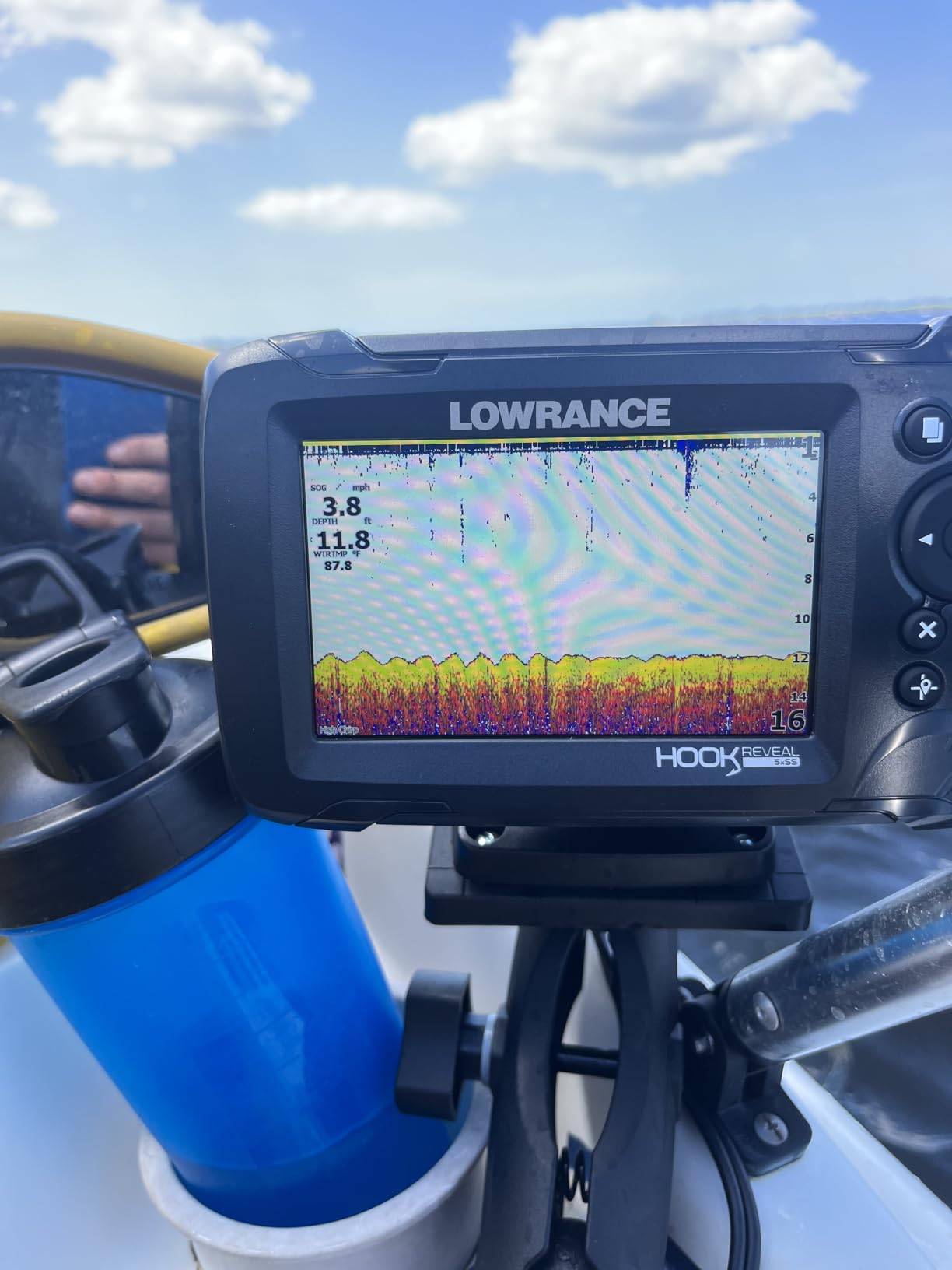
The sonar side uses Lowrance FishReveal, which layers CHIRP target separation over high-resolution DownScan Imaging. Where a plain sonar unit shows you an arch, FishReveal shows you the arch against a picture of the bottom, so a fish sitting in front of a rock is readable instead of ambiguous.
Autotuning sonar adjusts the settings as conditions change without you touching the menu, which removes the most common complaint new electronics owners have. Genesis Live custom contour mapping works over any map or GPS plotter, so you can still record your own contours on top of the built-in charts.
The 5 inch SolarMAX display is rated for daylight visibility in direct sun, and the mount lines up with existing OEM holes on many boats, which can turn an install into a ten-minute job. Fuse and fuse holder are included in the box, a detail several units in this list skip.
Is C-MAP or Navionics the better chart choice?
For inland lakes in the US, the built-in C-MAP detail is the deciding factor because it is already loaded. Navionics and LakeMaster are the better choice for coastal and saltwater work, and for large lakes where you want detail beyond what C-MAP includes.
The practical point is that chart quality matters less than most buyers expect on a small boat. You need to see the channel markers, the drop-off edges and your own recorded contours. You do not need a full navigation plotter to do that.
What makes this unit hard to live with?
The 5 inch screen is cramped for older anglers or anyone who wants to compare a DownScan image and a traditional view at the same time. Older anglers wanting more detail than that should look at a larger screen, which conflicts with the small-boat constraint.
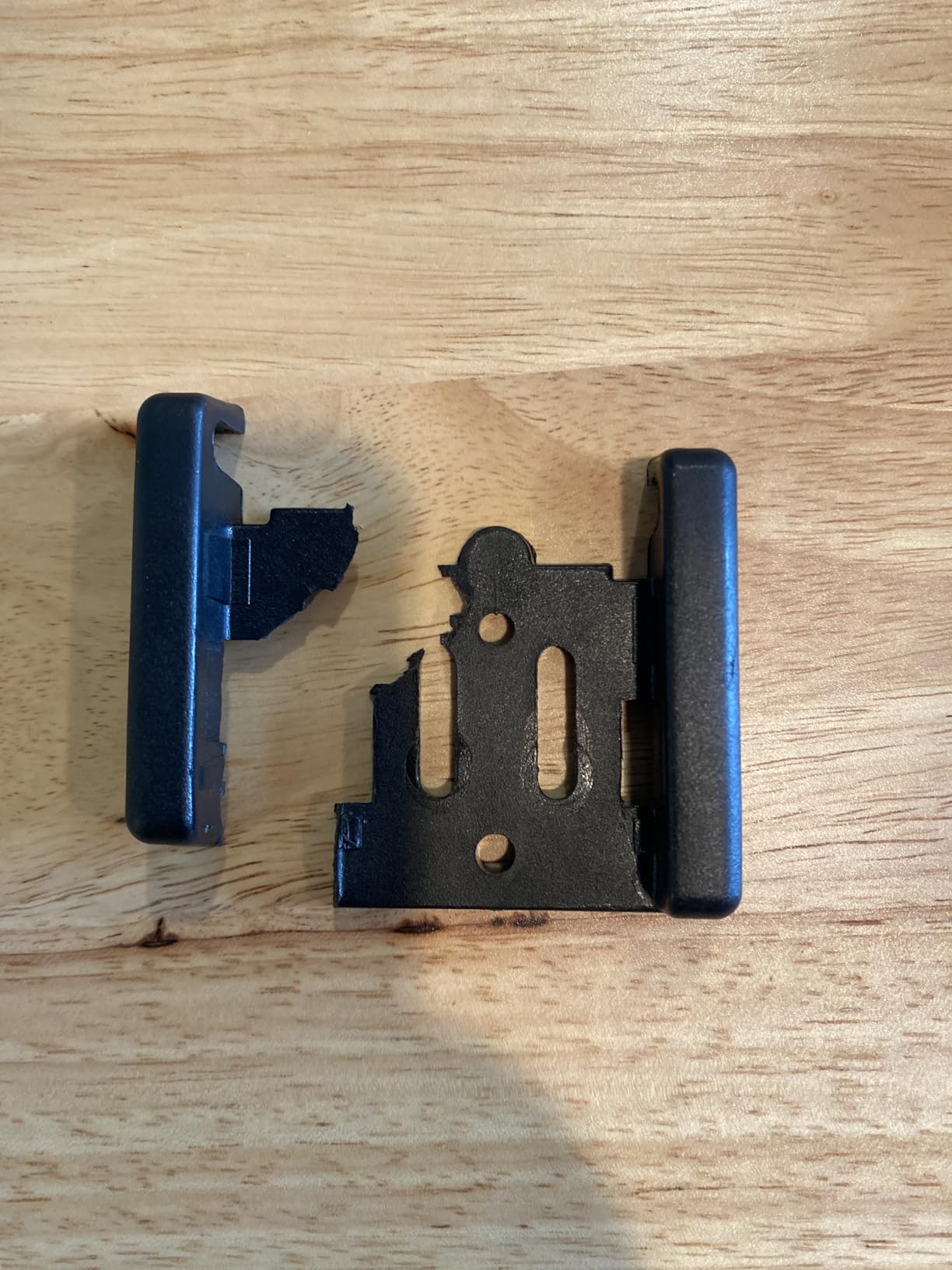
Install is the other friction point. Routing the transducer cable through the boat wiring channel is awkward, and the flush mount needs adequate space behind the console. A meaningful minority of buyers report units failing to communicate with the transducer or powering down, so factor that into the choice.
10. Humminbird Helix 5 CHIRP DI GPS G3 – Best for Down Imaging on a Console
Humminbird Helix 5 G3 GPS Fish Finder with Transducer, Dual Spectrum Chirp Sonar & Down Imaging
5 inch color TFT
CHIRP Down Imaging with Dual Spectrum modes
Basemap of 10000 plus lakes and US coastline
AutoChart Live with 8 hours recording
Pros
- CHIRP Down Imaging filters out visual noise
- Dual Spectrum wide and narrow modes for scanning or drilling
- Basemap covers 10000 plus lakes out of the box
- Large color TFT screen reads well in bright sun
- Sensitive enough to pick out 10 to 12 inch fish in 10 ft of water
Cons
- Down Imaging adds a learning curve
- No 3 amp fuse or fuse holder in the box
- Bracket is fiddly to remove and refit
- Premium pricing for a 5 inch screen
The Helix 5 CHIRP DI GPS G3 is the most capable imaging unit in this roundup, and it shows. CHIRP Down Imaging filters visual noise out of the picture beneath the boat, which produces the cleanest structure image here and makes it noticeably easier to separate a fish from a stump or a rock ledge.
Dual Spectrum CHIRP sonar gives you a wide mode for coverage and a narrow mode for detail, and the low-Q transducer behind it is precise enough to deliver solid two-dimensional target separation. Reviewers report detecting 10 to 12 inch fish in ten feet of water, which is a fair test of what the picture can resolve.
The Humminbird Basemap covers more than 10,000 lakes plus the continental US coastline and works immediately with no card purchase. AutoChart Live records real-time mapping with eight hours of built-in recording time, and AutoChart Zero Line SD cards extend that capacity.
Premium LakeMaster, CoastMaster and Navionics charts all work if you want to upgrade, which makes this the most flexible mapping platform in the group. The softkey keypad is designed for reliable operation in any weather, and the 5 inch color TFT screen reads well in bright sun.
Is Down Imaging worth the learning curve?
On a small boat, more often than not. The screen size and the lack of a helm seat mean you are usually the one reading the display, and a clean structure image tells you far more about a spot in seconds than a traditional arch readout does in a minute.
The learning curve is real but shallow. Most of it is learning what bottom types look like, not learning controls. The softkey keypad is predictable, and once you have switched between traditional and Down Imaging a few times it stops being confusing.
How does it hold up on a small boat install?
Installers on canoes, skiffs and pontoons rate it as the more capable unit, and the transducers handle weeds and debris without complaint. The problems are mechanical: the gimbal bracket is harder to mount and dismount than it should be, and the package omits the 3 amp fuse and fuse holder you need for the power connection.
There is no live sonar here despite the premium tier. For a skiff under twenty feet, that is usually an acceptable trade, but if you want to see a fish approach the bait in real time you will need a different class of unit entirely.
11. DANOPLUS Portable Wireless Fish Finder – Best for Night Fishing on a Budget
Portable Fish Finder Large HD Display Wireless Depth Finders for Boats with 147 feet Depth Detection Sensor, Rechargeable Castable Fish Finder Display Fish, Temp
2.4 inch color LCD with 21 languages
147 ft rechargeable wireless sensor
90 degree detection angle
Fish alarm with size and depth icons
Pros
- Genuinely rechargeable wireless sensor
- Large readable color display for the class
- Sensor lamp switches on in the water to help draw fish
- Fish alarm plus size and depth icons
- Light at 5.28 ounces with USB and AC charging included
Cons
- 147 ft depth ceiling is shallower than most rivals
- 90 degree angle limits fish ID detail
- No GPS or mapping of any kind
The DANOPLUS sits in the middle of the castable market, and its differentiator is the lamp. The sensor has an attractive light that switches on automatically the moment it contacts water, and owners report it does draw attention to the bait.
Everything else here is straightforward. A 2.4 inch color LCD with 21 operating languages, fish size icons with depth, water temperature, water depth, bottom contour and water surface readout, plus a fish alarm that sounds when something enters the sensor coverage area.
The sensor is rechargeable over USB and the package includes both a USB cable and an AC adapter, which saves you buying a charger. At 5.28 ounces it is light enough to carry in a pocket without thinking about it, and the detection angle is 90 degrees with a 147 foot depth ceiling.
It is built for kayak, ice, river, lake and sea fishing, so it covers the usual small-craft and bank scenarios. The one year warranty is the shortest here, which matters less for a sealed rechargeable sensor than it would for a hard-mounted head unit.
How does the 147 ft depth limit matter in practice?
For freshwater work on a lake, a pond or a river, it rarely matters. Most structure fishing that small craft anglers do happens well inside 100 feet. It starts to matter on deep reservoirs, offshore ledges or any saltwater flat where you routinely drop past 150 feet.
The 90 degree detection angle is the other limit. A wide cone covers more water at once but returns less detail on any single target, so you are reading approximate fish icons rather than resolved arches.
Is the display large enough at night?
It is one of the better screens in the castable class, and buyers highlight the color and size relative to cheaper handhelds. Night fishing reads well on the backlit color screen, which is where the auto-on sensor lamp earns its keep by adding a visible target near the transducer.
There is no GPS, charting or mapping at all, so this is a pure depth and fish-size instrument. If you want to return to a productive spot from a different ramp, write it down or mark it on your phone instead.
12. Lowrance Eagle 4 Inch – Best Screen for Polarized Sunglasses
Lowrance Eagle 4X Fish Finder with Bullet Transducer
4 inch IPS portrait display
200 kHz Bullet Skimmer transducer with 44 degree beam
Auto-Tuning sonar and twist-lock connector
500 ft maximum depth
Pros
- IPS portrait screen stays clear in bright sun and through polarized lenses
- Auto-tuning sonar removes the pre-fishing menu work
- Twist-lock connector makes removing the display quick
- Compact portrait footprint suits a tight console
- Mounts drop into existing Lowrance Chirp 4 holes
Cons
- No GPS or charting at this entry level
- No audible fish alarm
- 44 degree beam trades detail for coverage
The Eagle 4 inch is the newest and least-reviewed unit here, and its argument is the screen. The 4 inch IPS portrait display stays readable in bright sunlight, at wide viewing angles, and through polarized sunglasses, which is the specific complaint that shows up again and again with cheaper units.
The portrait orientation is unusual for a fish finder and it is deliberate. It fits a narrow console space where a landscape unit would sit awkwardly or block the casting lane, and it lines up with existing Lowrance Chirp 4 mounting holes on many skiffs, which reviewers describe as an easy swap.
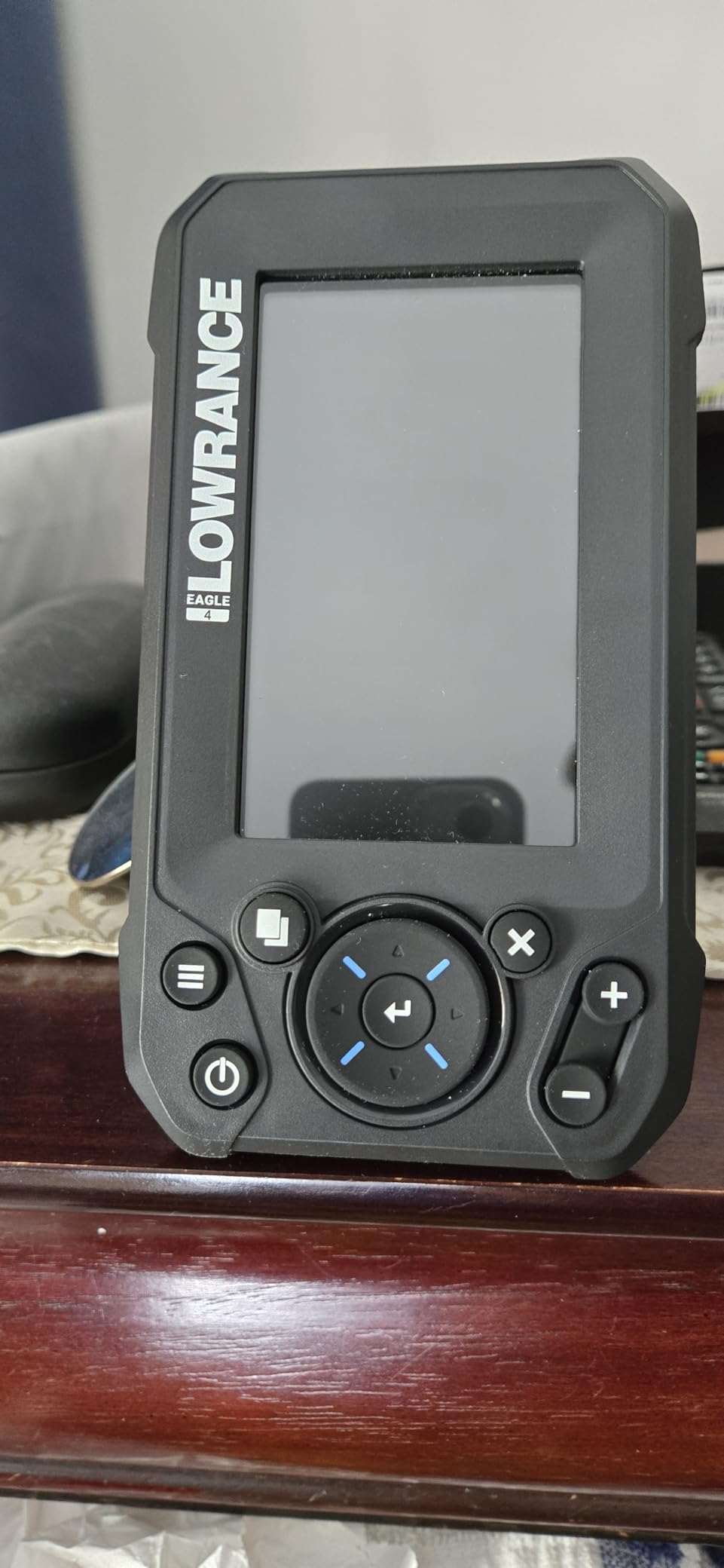
Auto-Tuning sonar handles the settings work before you start fishing, and the twist-lock connector lets you pull the display off in seconds when you are done or when the boat is locked up. The included 200 kHz Bullet Skimmer transducer has a broad 44 degree beam, well suited to finding your own hull bottom from a small boat.
Does an IPS screen actually help with polarized lenses?
Yes, and it is the single most practical upgrade on this unit. IPS panels keep their contrast and brightness at wide viewing angles, so you can glance sideways at the display from the gunwale without washing the picture out. Conventional LCDs in this class lose contrast fast at an angle, which matters on a boat where you are rarely seated directly in front of the screen.
Brightness in direct sun is a different problem from viewing angle, and it depends on how you mount the unit. A tilt and swivel bracket that lets you set the angle for your particular seat position solves most of what people blame on the display.
What do you give up at this entry level?
No GPS and no charting on this model. The Eagle family extends from 4 inch to 9 inch with SplitShot, TripleShot and C-MAP options, but the base 4 inch unit is sonar only. Fish icons come with depth and zoom, and there is no audible fish alarm, so zoom is your only way to inspect a target up close.
The 44 degree beam favors coverage over detail. That is the right trade for finding your own hull bottom and seeing the general lay of a pond, and the wrong one if you are picking apart a tight school. Fish finders for small boats are a compromise between the two, and this one leans toward coverage.
How to Choose a Fish Finder for Your Boat
Start with the boat, not the feature list. A jon boat has one usable flat surface and a battery you are borrowing from the trolling motor. A kayak has a deck and a dry bag. A small center console has room for a bail mount behind glass. The unit that fits those three constraints beats the unit with the longest feature list every time.
Traditional sonar, CHIRP or Down Imaging
Traditional sonar sends a single frequency on a pulse. It is cheap, it is reliable, and it tells you depth and whether something is there. CHIRP, which stands for compressed high-intensity radar pulse, sweeps multiple frequencies at once, which produces wider coverage, crisper arches and better target separation at the same power.
Down Imaging looks straight down and builds a near-photographic picture of the bottom, which is how you tell a rock ledge from a sandbar. Side Imaging looks out to the sides for wide coverage and is a step beyond what most small boats need. Live View sonar shows you the fish approaching the bait in real time, and no unit in this roundup has it.
Our read: CHIRP traditional plus ClearVu or Down Imaging is the sweet spot for a small boat. Anything below that is a depth finder, and anything above it will not fit.
Screen size and sunlight
Below four inches you are reading numbers. At four inches you can read fish arches and bottom shape. At five inches you can split the screen between traditional sonar and DownScan. Seven inches and up stops being a small-boat decision.
Check whether the display is rated for direct sunlight and whether it holds up through polarized lenses. Owners of the STRIKER 4, Striker Plus 4 and Vivid 4cv specifically call out readable screens in full sun, and the Lowrance Eagle goes further with an IPS panel that holds contrast at wide viewing angles.
GPS, waypoint marking and mapping
Built-in GPS is what separates a fish finder from a depth sounder. Without it you cannot mark a productive spot and return to it from a different launch, which is the difference between finding fish once and finding fish repeatedly.
Mapping splits three ways. Quickdraw Contours on the Garmin units records your own 1-foot contours in the background as you fish, which is the most useful option on an unfamiliar lake. The Lowrance HOOK Reveal 5 and Humminbird Helix 5 come with preloaded charts. The castable Deeper units build bathymetric maps from shore and bank using their built-in GPS.
For a boat you launch from the same ramp every time, waypoint marking alone is enough. For water you do not know, preloaded charts or a recording option will shorten the learning curve considerably.
Power draw, battery sharing and runtime
Fish finders are among the least demanding electronics on a boat. The STRIKER 4 draws 0.23 amps at 12V, which is why owners run it all day off a deep-cycle trolling battery. Larger screens with brighter backlights and down imaging draw more, but even then a 7Ah sealed lead-acid battery typically carries a multi-day session.
Running a fish finder off the trolling motor battery works, and it is the simplest power plan on a small boat. The rule is to tap the battery through its terminal posts rather than a cigarette lighter or an accessory socket, and to keep the fish finder on its own fused circuit so a fault in one does not take the motor down.
If you do share a battery, watch the voltage. Troll for an hour at full output and the pack can sag enough to reset a sensitive head unit mid-cast. Several owners report clean operation alongside another fish finder on the same boat, so the sensor side is usually not the problem.
Transducer mounting options
Transom mount is the default and the easiest to remove. In-hull shoot-through mounting looks cleaner but only works on fiberglass hulls with the correct oil-filled boot, never on aluminum. Trolling motor mounts work well and keep the transducer in clean water ahead of the prop, though some units pick up motor noise. Suction cups work on a kayak hull if the surface is clean, smooth and still flexible.
Whatever you choose, the transducer needs to sit in clean water with nothing aerating nearby. A budget unit mounted badly will underperform an expensive unit mounted well, and that gap is bigger than most buyers expect.
Transducer Mounting and Wiring on a Small Boat
Mounting is where small-boat installs are won and lost. The cable run is usually longer than you estimate, and the difference between 14 AWG and 18 AWG over twenty feet is measurable at the transducer, which is why several models in this group arrive without ring terminals or fuses.
Get the power run right first
Run a dedicated fused supply from the battery to the head unit and use ring terminals crimped and heat-shrunk onto marine-grade tinned copper wire. Do not rely on the included thin lead for a permanent battery hookup, which is the most repeated installation complaint across reviews of the STRIKER 4 and the Striker Plus 4.
Keep the run away from the engine harness and any antenna or speaker cable. If you are routing through an existing wiring channel, expect the cable to be the slowest part of the job, and buy a longer run of cable than you think you need the first time.
Choose the mount to match the hull
On a jon boat or canoe, transom mounting with the supplied bracket is the sensible default because you can move it as you move. On a fiberglass kayak, a suction cup works if the hull is clean and smooth. On aluminum, in-hull shoot-through mounting is not an option, so stay external.
On a small center console, the bail or tilt-swivel bracket is the standard choice. Position it so the screen is readable from your normal seated position, because a tilted-up display that washes out in sun is a common and easily avoided mistake.
Fix trolling motor interference in this order
Interference shows up as noise, static or dropped returns while you troll, and it is one of the most common complaints from small boat owners. Move the transducer off the trolling motor shaft and as far forward as possible, and check the transducer cable is not running alongside the motor power cable.
Next, turn off other electronics one at a time and listen for when the noise stops, which tells you the source. Then lower your sensitivity a notch or two; excess gain amplifies interference as readily as it amplifies fish. Finally, check that your transducer mount is not vibrating, because a loose bracket moving through the water produces artifacts that look exactly like electronic noise.
If the interference only appears at higher motor speeds, it is usually aeration or cavitation behind the transducer, and moving the mount forward or slightly to one side resolves it. If it appears at any speed, start with cable routing and grounding.
Frequently Asked Questions
Is Garmin better than Humminbird for a small boat?
It depends on what you need. Garmin leads on mapping, with Quickdraw Contours recording your own 1-foot contours automatically on the Striker Plus 4 and the STRIKER Vivid 4cv. Humminbird leads on bundled charting and auto-mapping flexibility, with the Helix 5 CHIRP DI GPS G3 including a basemap of more than 10,000 lakes and accepting LakeMaster, CoastMaster and Navionics cards. On raw sonar clarity, Humminbird CHIRP Down Imaging produces the cleanest structure picture in this roundup, while Garmin wins on price per feature at the entry tier.
Is Lowrance or Humminbird better?
Lowrance wins for inland mapping out of the box, since the HOOK Reveal 5 SplitShot comes with preloaded C-MAP detail covering almost 4,000 US inland lakes. Humminbird wins for image quality and expandability, since the Helix 5 CHIRP DI GPS G3 filters noise out of its DownScan view and accepts premium chart cards plus AutoChart Live recording. If you fish inland lakes and want charts on day one, Lowrance is simpler. If you want the sharpest picture or plan to add cards later, Humminbird is stronger.
What is the best portable fish finder for a boat?
For a boat you move between craft, the Garmin STRIKER 4 in portable kit form is the most dependable option because it draws only 0.23 amps at 12V, includes transom and trolling motor mounts, and adds a waypoint map with built-in GPS. For a boat you never want to drill, the Venterior wireless sensor removes the cable entirely, or the Deeper PRO+ 2 adds GPS for mapping from shore. The castable units win on portability and the head units win on at-a-glance readability.
Can I run my fish finder off my trolling motor battery?
Yes, and on most small boats that is the simplest power plan available. Tap the trolling motor battery at its terminal posts through a dedicated fused circuit rather than an accessory socket, and keep the fish finder on its own fuse so a fault in one does not take the motor down. Watch for voltage sag: a battery that is worked hard while you troll can dip low enough to reset a sensitive head unit. The fish finder side of the equation is rarely the problem, since current draw is small compared with the motor.
Why is my trolling motor causing interference with my fish finder?
Interference usually comes from one of four things: the transducer mounted too close to the motor shaft, the transducer cable running alongside motor power cable, aeration behind the propeller at certain speeds, or a loose mount vibrating in the water. Start by moving the transducer forward and as far from the shaft as the bracket allows, then reroute the cable away from the power run. If it persists, lower sensitivity a notch or two, and check that the bracket is not moving. Interference that only appears at speed is almost always aeration rather than electrical.
The Best Fish Finders for Small Boats in 2026
For most anglers, the best fish finders for small boats come down to one of three picks. The Garmin STRIKER 4 is the safest all-round choice, with ClearVu scanning sonar, a waypoint map, transom and trolling motor mounts, and a current draw low enough to ignore. The STRIKER Vivid 4cv is the better buy when your console has room for color, and its rating across 1861 reviews is the highest in this group.
The STRIKER Plus 4 earns its place by adding Quickdraw Contours, which quietly maps your lake while you fish and turns the first trip into every later trip’s advantage. If you want charts already loaded, the Lowrance HOOK Reveal 5 SplitShot is the only unit here with preloaded C-MAP detail for close to 4000 inland lakes, and the Humminbird Helix 5 CHIRP DI GPS G3 produces the sharpest DownScan picture of the twelve.
If you would rather not touch a wiring drill at all, the castable group solves it differently. The Deeper PRO+ 2 adds GPS so you can build bathymetric maps from shore, the Venterior removes the cable entirely, and the Deeper Start is the simplest way to find out how deep a spot is before you commit the boat to it.
Match the unit to the boat first and the features second. A four inch screen, a transom bracket and a fused power run will serve a jon boat better than any dashboard electronics ever will.