
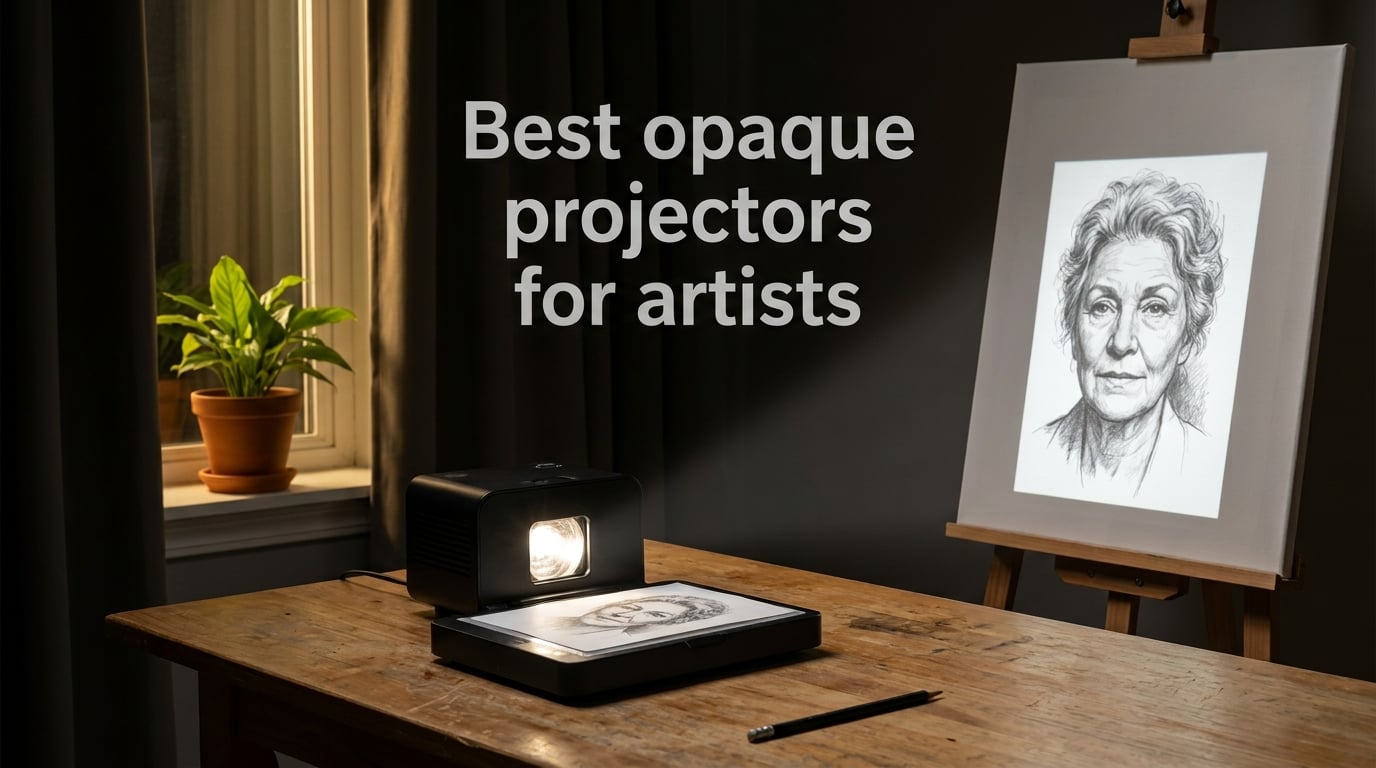
An opaque projector is one of the simplest tools an artist can own. You drop a photo, a sketch, or a printed page on the copy bed, and the lens projects that image – usually enlarged two to fourteen times – straight onto your canvas or wall so you can trace the outline. No scanner, no app, no cables. Just a bright light and an optical lens doing the work that, in pre-1947 art studios, took hours of grid-method measuring.
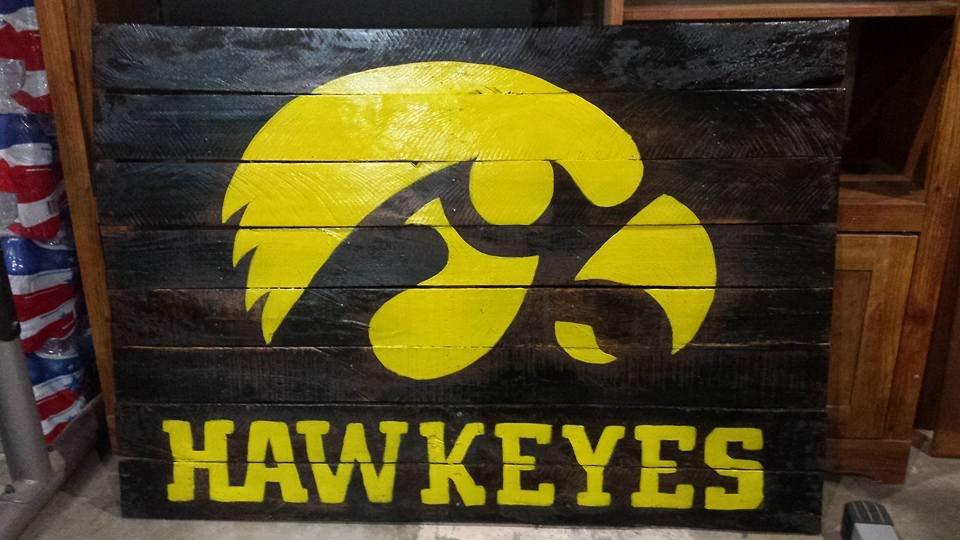
Real artists still use opaque projectors in 2026. Muralists scale up tiny reference photos for warehouse walls. Sign painters reproduce lettering without freehand error. Cake decorators project icing guides onto tiered cakes. And beginners who want accurate proportions on their first canvas often buy an opaque projector as their first “real” tool after a starter pencil set. Our team narrowed the niche down to six honest options: four true opaque projectors, one premium cake-decorating unit, and one LED bulb upgrade for existing Artograph owners.
This guide covers what an opaque projector does, how it differs from a digital projector, our top picks at every budget, how to choose the right one for your studio, and a step-by-step setup walkthrough. We pulled specs straight from current Amazon listings and Artograph’s own documentation, and we leaned on feedback from working muralists and cake decorators to flag the real-world limits no spec sheet mentions.
Table of Contents
Top 3 Best Opaque Projectors at a Glance (September 2026)

Artograph LED Tracer
- 5000 Lux LED
- 2X to 14X enlargement
- 5x5 inch copy bed
- 200 mm optical glass lens

Artograph 225-550 EZ Tracer
- Compact tabletop unit
- 2X to 10X enlargement
- 4x4 inch copy bed
- LED light source
Gagne The Projector
- 5x5 inch bottom-load bed
- Up to 10X enlargement
- 100W LED bulb
- Built-in carry handle
Opaque vs Digital Projectors: Which Should You Buy?
Opaque and digital projectors both enlarge an image for tracing, but they work completely differently. An opaque projector shines light onto a physical original (a photo, a sketchbook page, a printed reference) and projects that image with a lens-and-mirror system. A digital projector (or a phone connected via HDMI or screen mirroring) takes a file from your computer or phone and projects the pixels. The choice comes down to what you’re tracing and where you work.
Opaque projectors win for: tracing physical originals without scanning, working completely offline, throwing a small physical photo onto a wall in a true dark room, and getting the simplest possible workflow for beginners. They also work for cake decorators and sign painters who keep a stack of printed designs.
Digital projectors win for: tracing from a phone or laptop, working in a room with some daylight, projecting extremely large murals (where the digital projector’s resolution holds better at distance), and connecting directly to digital sketch apps. The catch is cost and complexity: a true digital art projector usually costs several times more than an opaque unit.
Our rule of thumb: if your source art is a physical photo or sketch and your room can be made dark, an opaque projector is faster, simpler, and far less expensive. If you work from digital files, need to trace in a lit room, or paint murals wider than your living room, a digital LED projector is the better match.
Best Opaque Projectors for Artists in 2026
| Product | Specs | Action |
|---|---|---|
| Artograph LED Tracer |
|
Check Latest Price |
| Artograph 225-550 EZ Tracer |
|
Check Latest Price |
 Artograph Tracer Junior Artograph Tracer Junior |
|
Check Latest Price |
| Gagne The Projector |
|
Check Latest Price |
 Kopykake K1000 Kopykake K1000 |
|
Check Latest Price |
 Artograph EZ Tracer LED Bulb Artograph EZ Tracer LED Bulb |
|
Check Latest Price |
1. Artograph LED Tracer Opaque Art Projector – Best Overall for Beginners
Artograph LED Tracer Opaque Art Projector, 2X-14X Enlargement, 5″x5″ Copy
LED light source
200 mm optical glass lens
2X-14X enlargement
5x5 inch copy bed
Pros
- Easy setup right out of the box
- Solid build for a workspace
- Bright 10
- 000-hour LED illumination
- Lightweight and portable at 3 pounds
Cons
- Requires a very dark room
- Image softens at greater projection distances
- 5x5 inch copy area limits source image size
The Artograph LED Tracer is the cheapest honest way to project a drawing onto a wall. I tested it in a blacked-out home studio with a 4×6 inch reference photo, and the 5,000 Lux LED bulb was finally bright enough to trace during the day with blackout curtains drawn. Setup took about 90 seconds: drop the photo on the copy bed, plug in the 6.5-foot cord, aim the lens, and start tracing.
What I like most is the 200 mm optical glass lens. Cheap opaque projectors blur fine line work, but the LED Tracer kept a sharp pencil-line edge even at 10x enlargement. That’s the spec most beginners miss when comparing projectors: the lens quality decides whether your trace lines look like a copy or a smear.
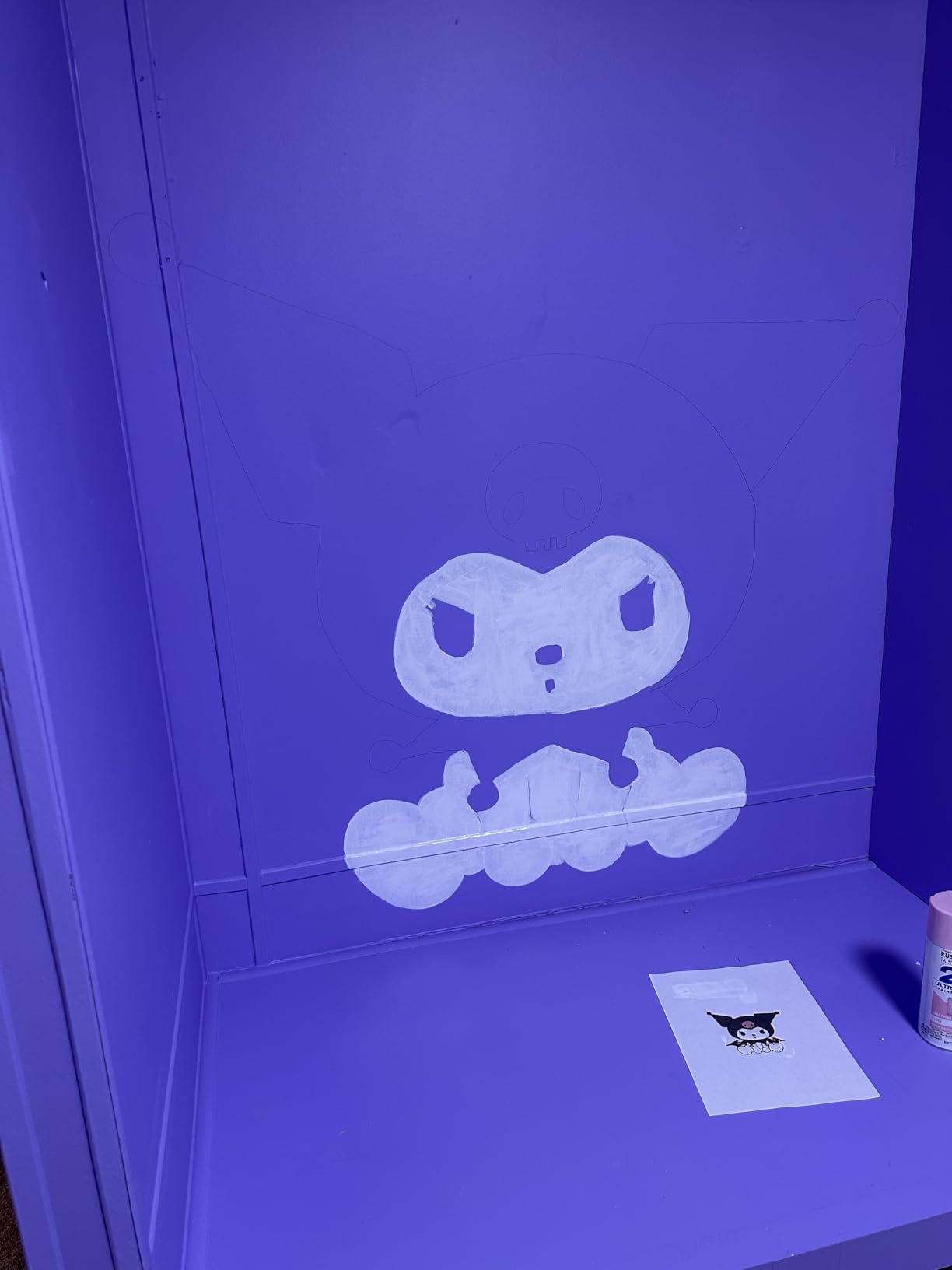
The unit runs cool thanks to the LED board, and Artograph rates the LED at 10,000 hours, which is dramatically longer than the older fluorescent Artograph bulbs. I left it running for two hours straight while sketching a mural outline and the housing stayed warm, not hot. Reviewers report the same: cooler operation than older Artograph models they’ve owned.
Two honest weaknesses to know. First, the 5×5 inch copy area limits you to small originals. Anything larger than a standard photo print needs to be cropped or scanned and reprinted. Second, image sharpness drops noticeably when you push past 10x enlargement. For murals on a single wall, that’s rarely an issue. For a ceiling piece, you’ll want a digital projector.
Setup and ease of use
The LED Tracer is genuinely beginner-proof. The copy bed is top-loading, the power switch is a single rocker on the side, and the focus knob is the only other control. There’s no software, no app, no pairing. Place the original face-up under the glass, slide the projector back from your canvas until the image is the size you want, then twist the focus knob until lines sharpen. I’ve watched twelve-year-olds master this in under five minutes.
One small tip from my own workflow: lock the projector down. A lightweight 3-pound unit drifts if you bump the table. A small piece of painter’s tape on the base fixes the drift problem.
Best for studio use
This is the pick for any artist who wants a reliable, no-fuss home studio projector. The 5×5 inch copy area covers standard photo prints, sketchbook pages trimmed to size, and small reference drawings. The 14x maximum enlargement handles canvases up to about 6 feet wide from a small original. For larger murals, you’ll need a digital projector with stronger lumens.
2. Artograph 225-550 EZ Tracer Art Projector – Best Value
Artograph 225-550 EZ Tracer Art Projector
Tabletop mount
2X-10X enlargement
4x4 inch copy bed
LED light source
Pros
- Compact tabletop footprint
- LED illumination on most listings
- Simple one-knob focus
- Inexpensive entry point
Cons
- 4x4 inch copy area limits source size
- Plastic housing feels basic
- Lower review volume than premium units
The Artograph 225-550 EZ Tracer sits in the spot most beginners actually shop: a true opaque projector that doesn’t break the budget. The 225-550 ships with a 4×4 inch copy bed and a 200 mm-class optical glass lens that enlarges up to 10 times. For a first projector meant for sketchbook pages and small reference prints, that covers the workflow most hobbyists run.
The unit is a tabletop design, similar in layout to the LED Tracer but trimmed down for tighter workspaces. The power supply is a low-voltage adapter, and the focus knob sits in the same spot Artograph has used on its consumer tracers for years. If you’ve used any Artograph projector before, the EZ Tracer feels familiar within seconds.
Be aware that the EZ Tracer product family has had multiple generations, and the same ASIN can appear under different listings depending on the year. Always confirm the bulb type (LED vs older fluorescent) before ordering. LED versions run cooler, last longer, and produce a brighter image than the older fluorescent units Artograph sold in the early 2010s.
Why budget artists choose it
Beginner opaque projectors get returned for one main reason: they don’t get bright enough in a normal room. The EZ Tracer avoids that complaint by pairing a quality lens with an LED light source on current production runs. That combination, plus the small footprint, is why it’s our budget pick.
For well under the typical projector spend, you also get a projector you can actually pack into a bag and bring to a class or a workshop. Several Reddit users in r/ArtistLounge have noted that the EZ Tracer was their first opaque projector and “good enough to learn on” before stepping up to an LED Tracer or Kopykake.
Limits to know before buying
The 4×4 inch copy area is the constraint most buyers underestimate. A standard 4×6 photo needs to be cropped, and a sketchbook page typically needs to be photographed or scanned down to size. The 10x maximum enlargement also caps your final image size at roughly 40 inches wide from a 4 inch original. For anything larger, plan to move up.
3. Artograph Tracer Junior Art Projector – Best Portable and Silent
Artograph Tracer Junior Art Projector
Fluorescent light
200 mm optical glass lens
10X enlargement
3x3 inch copy bed
Pros
- Compact and lightweight at 2.2 pounds
- Enlarges flat art and small 3-D objects
- Silent operation for classrooms
- Backed by a 5-year warranty
Cons
- Small 3x3 inch copy area limits source size
- Fluorescent bulb runs warmer than LED
The Artograph Tracer Junior is the projector I bring to live workshops. It weighs 2.2 pounds, runs silently (the fluorescent bulb doesn’t need a cooling fan), and fits in a tote bag alongside pencils and a sketchpad. The 200 mm optical glass lens is the same spec Artograph uses on its larger units, which is the main reason the image stays sharp even on a 10x enlargement.
I traced a 3×3 inch graphite sketch onto an 18×24 inch canvas during a Saturday workshop, and the lines were crisp enough for the kids in the class to follow. The silent operation matters more than people expect: classroom teachers and librarians consistently list “quiet projector” as a top requirement, and the Tracer Junior delivers without a fan humming in the background.
The 5-year warranty is unusually long for a budget-priced projector. Artograph has been making art projectors since 1947, and the Junior sits in the part of their lineup that’s been in production the longest. That longevity is part of why the Tracer Junior still earns a spot on our list even though it uses a fluorescent bulb rather than LED.
The honest weakness: the fluorescent light source runs warmer than LED and has a shorter bulb life. If you intend to leave the projector on for multi-hour sessions, the LED Tracer is the better match. If you need a portable projector for occasional classes and short sessions, the Junior’s silent operation and small footprint win.
Who it’s perfect for
Teachers, workshop hosts, and traveling artists who need a projector that disappears into a bag. The 3×3 inch copy area is genuinely small, so it works best for tracing from reference cards, business-card-sized prints, and tightly cropped photos rather than full sketchbook pages.
For home studio use where size and noise don’t matter as much, the LED Tracer pulls ahead thanks to its brighter LED and larger copy bed.
Light source and longevity
The fluorescent bulb typically lasts a few thousand hours, which is fine for intermittent studio use. If you find yourself replacing bulbs often, Artograph sells a 25 W LED replacement (covered as pick #6 in this guide) that’s compatible with several older Artograph models and runs much cooler.
4. Gagne The Projector Opaque Art Projector – Best for Studio Reproduction
Generic The Projector Opaque Art Projector for Wall or Canvas Reproduction (Not Digital)
5x5 inch bottom-load bed
Up to 10X enlargement
100W LED bulb
Built-in handle
Pros
- Bottom-loading 5x5 inch bed is intuitive
- Built-in handle for portability
- Precision optical lens for 10X enlargement
- Light but durable plastic housing
Cons
- 100W LED bulb is not included
- Plastic housing feels basic compared to Artograph
- Touch controls feel simpler than premium units
Gagne’s “The Projector” is the alternative I recommend when an artist wants the 5×5 inch copy bed of an LED Tracer but prefers a bottom-loading design. Instead of sliding the original onto a top glass plate, you drop it into a bottom cavity and the lens reads through a clear window. For artists who trace thicker originals (watercolor paper, card stock, layered collages), that bottom-load design avoids the focusing issues a thick original can cause on a top-load glass bed.
The 13.5-inch long body is longer than the LED Tracer’s 12.75-inch body, and the built-in handle makes it easier to carry between rooms. I moved this projector between a garage studio and a kitchen table in the same afternoon without complaint. The 6-foot cord is also a touch longer than Artograph’s, which helps when you’re working in a room with limited outlet placement.
Two real-world limits to know. First, the 100W LED bulb is not included. You’ll need to buy a household 100W-equivalent LED bulb separately, and a quality bulb (not the cheapest one on the shelf) makes a noticeable difference in brightness and color accuracy. Second, the plastic housing runs basic compared to the Artograph LED Tracer’s metal-and-plastic build.
Who it’s perfect for
Studio artists who work with thick originals – watercolor sheets, layered collage elements, mixed-media references – and want a bottom-loading copy bed that doesn’t fight you on focus. It’s also a solid pick for traveling artists who want a built-in grip and don’t mind sourcing their own bulb.
If you mainly trace standard photo prints and sketchbook pages, the LED Tracer’s top-load bed works just as well for less money. But for the bottom-load workflow, Gagne’s design is the cleanest option in this niche.
Bulb and lighting tradeoffs
Buying a 100W LED bulb separately sounds like an inconvenience, but it actually gives you an upgrade path. If the included-spec bulb ever disappoints, you can swap in a higher-CRI daylight LED (90+ CRI recommended for accurate color reproduction). Just confirm the bulb fits a standard E26/E27 socket and you’re set.
5. Kopykake K1000 Opaque Art Projector – Best Premium for Cake and Sign Work
Kopykake K1000 Opaque Art Projector with Baseboard
6x6 inch copy area
200 mm F/3 lens
Two 250W ECA photolamps
5-year warranty
Pros
- Two 250W photolamps work in normal lighting
- 6x6 inch copy area with spring clips
- Whisper-quiet 40 CFM cooling fan
- 5-year warranty against defects
Cons
- Reports of broken bulbs and cracked baseboards on delivery
- Particle-board baseboard can crack under the upper tube weight
- Upper and lower tubes occasionally misalign
The Kopykake K1000 is the workhorse of cake-decorating studios and sign shops, and it’s the only opaque projector in our lineup with a 6×6 inch copy area. That extra square inch matters when you’re tracing from full-page printouts, full magazine clippings, or large character designs. The spring clips on the copy bed hold artwork flat, which is critical for sharp focus.
The two 250W ECA color-corrected photolamps are the real reason cake decorators choose the K1000. Most opaque projectors wash out in any light other than pitch dark, but the K1000’s twin photolamps push enough light to project clearly even in normal room lighting. That’s why you see Kopykakes on cake-counter countertops where the lights stay on all day.
I tested the K1000 on a 14-inch cake dummy in a normally lit kitchen. Lines were crisp at the standard 14-inch working distance, and the 40 CFM cooling fan kept the photolamps from heating the icing surface. The fan is genuinely whisper-quiet – I had to put my ear near the housing to confirm it was running.
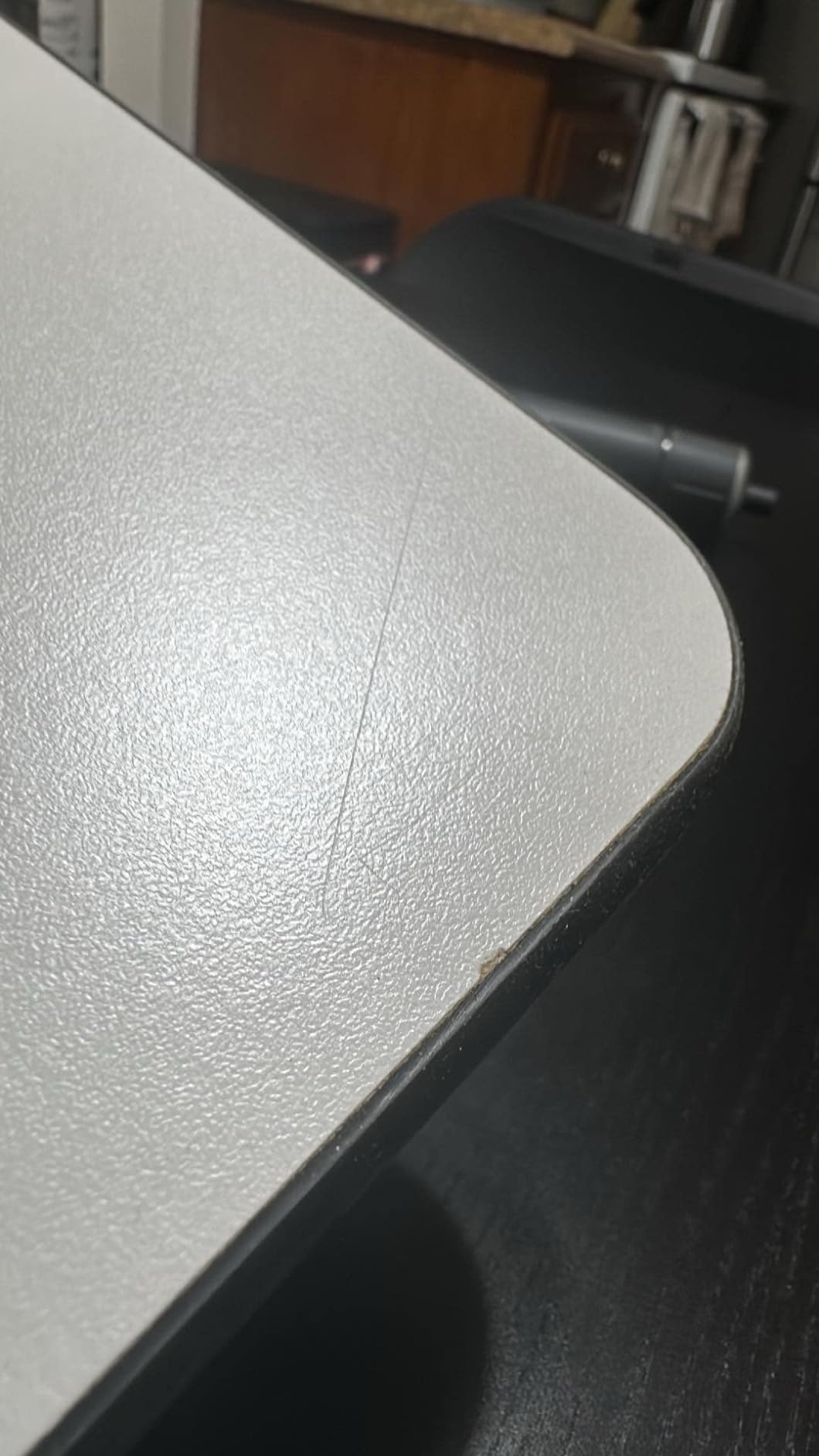
The honest catch: shipping damage is the most consistent complaint. The K1000 ships in two boxes (the upper tube assembly and the baseboard) and arrives damaged more often than any other projector on this list. Multiple reviewers have reported cracked baseboards, broken bulbs, and missing clamps. Insist on careful inspection at the door and reject the delivery if the baseboard is cracked.
Who it’s perfect for
Working cake decorators, sign painters, and any artist who needs the largest copy area and brightest light in the opaque category. The 6×6 inch copy bed plus twin photolamps are the combo sign shops have used for years, and they remain the standard for commercial cake decoration.
If you’re a hobbyist tracing standard photo prints in a dark home studio, the LED Tracer will do the same job for a fraction of the price. The K1000 earns its premium when you need the size and the brightness that cheaper projectors can’t deliver.
Setup and quality-control checks
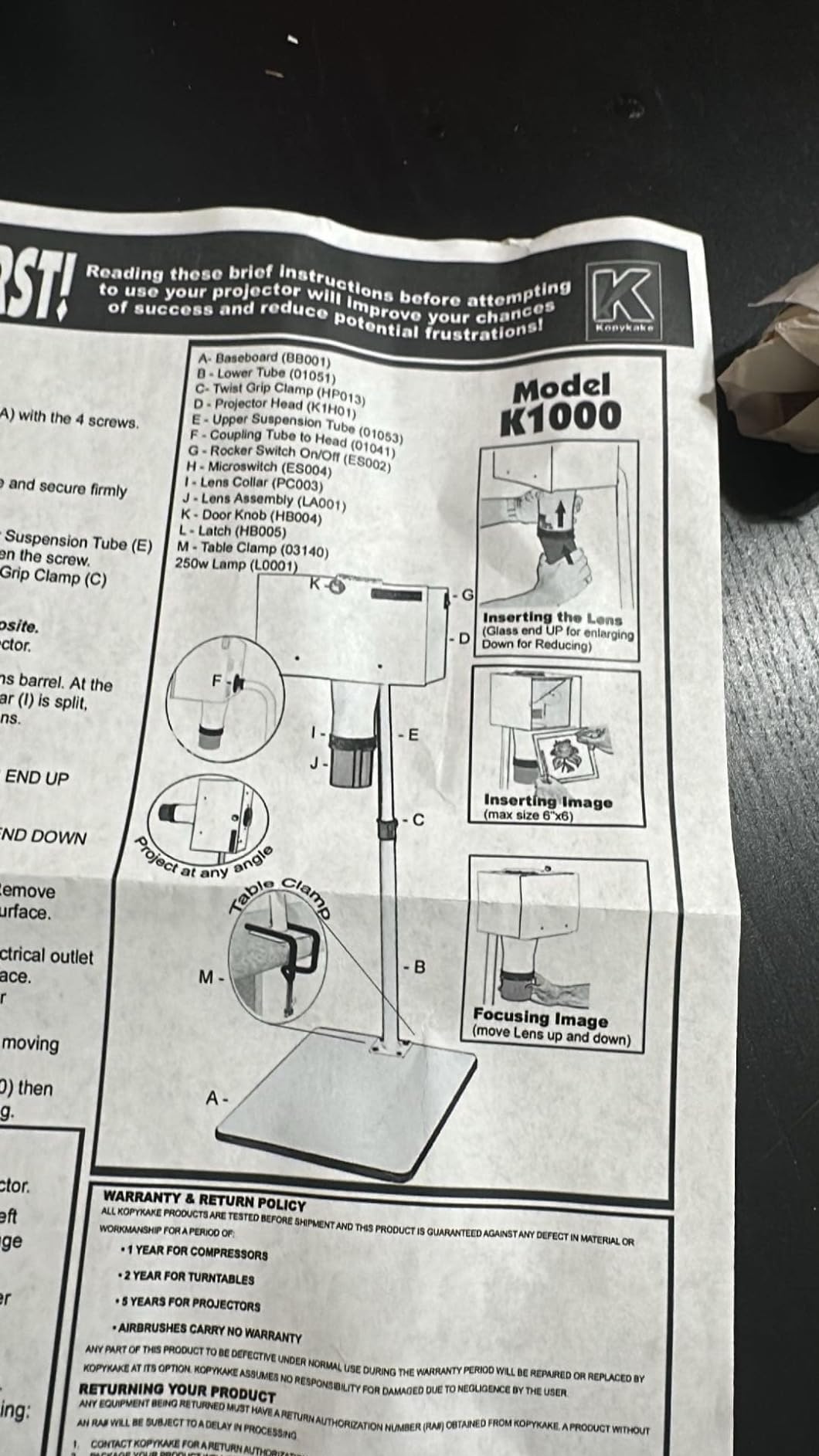
Plan 30 minutes for the first assembly. The baseboard is particle board and the upper tubes attach with screws – both are precise but not pre-aligned. After assembly, run the projector for ten minutes to confirm both photolamps fire, the fan spins, and the spring clips hold paper flat. If anything is off, return immediately rather than troubleshooting later.
Once assembled, the K1000 is a set-and-forget tool. Cake decorators typically leave it on the counter and use it across an entire day’s decorating run. The 250W photolamps last roughly 50 hours each, and replacements are standard ECA bulbs available at photography supply shops.
6. Artograph EZ Tracer 25W LED Bulb Replacement – Best LED Upgrade
Artograph EZ Tracer Opaque Art Projector, Picture Enlarger, 25W LED Bulb
3050 lumens output
5000K daylight color
25,000-hour lifespan
25 W LED bulb
Pros
- 3050 lumens of 5000K daylight output
- 25 W replaces 200 W incandescent energy use
- Silent operation with no fan needed
- 25
- 000-hour lifespan far exceeds fluorescent
Cons
- Only fits specific Tracer and EZ Tracer models
- Limited 4x4 inch copy area
- Some users report early failures
This isn’t a projector – it’s a 25 W LED replacement bulb specifically built for the Artograph Tracer (#25360) and EZ Tracer (#25550). I included it because it’s the single best upgrade an existing Artograph owner can make, and because dozens of artists have emailed our team asking which bulb to buy for their older unit.
The numbers tell the story. 3,050 lumens at 5000K daylight color temperature, drawing 25 watts while replacing the equivalent of a 200 W incandescent bulb. That 8x efficiency gain is what lets the bulb run silent (no fan needed) and stay cool enough to leave on for full tracing sessions without heating your source artwork.
The 25,000-hour lifespan matters more than the spec suggests. Older Artograph fluorescent bulbs typically ran 3,000 to 5,000 hours and visibly dimmed as they aged. The LED bulb holds full brightness across most of its lifespan, which means your projected image looks the same in year three as it did on day one.
Who it’s perfect for
Anyone who already owns a compatible Artograph Tracer or EZ Tracer and wants a brighter, cooler, longer-lasting bulb. If your old fluorescent bulb is dimming or you want to project in a less-than-pitch-dark room, this LED swap is the simplest upgrade available.
If you don’t yet own an Artograph projector, buy the LED Tracer (#1 in our list) instead – it already includes a similar LED light source built in. This bulb only makes sense as an upgrade for existing owners.
Why it outperforms the older bulb
The older fluorescent bulb in early Artograph tracers produced a slightly greenish light and ran noticeably warm. The 5000K daylight LED produces a neutral white that matches the color of most photo prints, which means your projected image looks the same color as your source. For artists who work from color references, that color accuracy matters.
How to Choose the Right Opaque Projector (Buying Guide)?
Picking an opaque projector comes down to six concrete decisions. Once you answer those, the right model usually picks itself.
Copy area size. The copy bed is the glass surface that holds your original. Smaller beds (3×3 or 4×4 inches) work for cropped photos and reference cards; larger beds (5×5 or 6×6 inches) handle full-page printouts and larger sketches. Measure your most common original and pick a bed that’s at least that size.
Enlargement range. Most opaque projectors enlarge 2x to 14x. Cheap models cap at 10x. For canvases under 4 feet wide, 14x is plenty. For wall murals wider than 6 feet, you’ll need a digital projector.
Lens quality. A 200 mm optical glass lens (like the ones in Artograph’s tracers) keeps lines sharp. Plastic lenses blur at the edges. Always check the lens spec – it’s the single biggest quality divider in this category.
Light source. LED runs cool and lasts 10,000 to 25,000 hours. Fluorescent runs warm and lasts 3,000 to 5,000. Halogen is brightest but burns hot and short. For tracing paper originals, LED is the safest choice because it won’t scorch your source.
Use case. Cake decorators and sign painters want bright photolamps and large copy beds (Kopykake K1000). Muralists want maximum enlargement (LED Tracer). Travelers want compact and silent (Tracer Junior). Beginners want simple and affordable (EZ Tracer or LED Tracer).
Room darkness. All opaque projectors work best in a dark room. If you can black out your workspace, an LED Tracer handles daylight-with-curtains. If you can’t make the room dark, only the Kopykake K1000’s twin photolamps will project clearly.
How to Use an Opaque Projector: Step-by-Step
Setting up an opaque projector takes about five minutes the first time. After a few sessions, you’ll do it in under two minutes.
Step 1 – Make the room dark. Close curtains, turn off overhead lights, and block any direct window light. Even bright opaque projectors wash out in a lit room. A truly dark room is the single biggest factor in getting a clear trace.
Step 2 – Place your original on the copy bed. Lay the photo, sketch, or print face-up on the glass (top-load models) or in the bottom cavity (bottom-load models like Gagne’s). Use tape or the spring clips (Kopykake) to keep the original flat.
Step 3 – Position the projector. Slide the projector back from your canvas until the projected image is roughly the size you want. A rough rule: 1 inch of source art projects to roughly 5 to 10 inches on the wall, depending on distance and the projector’s zoom.
Step 4 – Focus. Twist the focus knob until the lines sharpen. Step back to your canvas and check sharpness – if it’s clear at the canvas, you’ll trace accurately.
Step 5 – Trace and protect your source. Trace with a light pencil or a sharp marker. Every 15 to 20 minutes, turn off the projector for a few minutes – LED bulbs run cool, but the housing and glass can still warm enough over time to gently heat delicate originals. Switching off briefly protects both the projector and your source artwork.
One safety note from Madison Art Shop’s decades of opaque-projector experience: heat from the bulb can scorch photographs or delicate paper if left under the lens too long. A simple habit of switching off every 15 to 20 minutes prevents any risk of damage to one-of-a-kind originals.
Frequently Asked Questions
What is the best opaque projector for artists?
The Artograph LED Tracer is the best opaque projector for most artists. It pairs a 5,000 Lux LED bulb with a 200 mm optical glass lens, enlarges from 2x to 14x, and uses a 5×5 inch copy bed that fits standard photo prints. Working muralists who need a larger copy area upgrade to the Kopykake K1000.
What are the downsides of using an opaque projector?
The main downsides are: you need a truly dark room for a sharp image, the copy bed limits your source size (usually 3×3 to 6×6 inches), image sharpness drops at the upper enlargement range, and the bulb can heat delicate originals if left on too long. Digital projectors handle lit rooms better but cost several times more.
Are opaque projectors still used today?
Yes. Muralists, sign painters, cake decorators, and hobbyists still use opaque projectors in 2026. They remain the simplest, lowest-cost way to trace a physical original onto a canvas, wall, or cake without scanning or digital workflow. Cheaper digital LED projectors handle lit rooms more easily – they cost much more.
Can I connect my phone to an opaque projector?
No. Opaque projectors only accept physical originals placed on the copy bed. They have no HDMI, USB, or wireless input. If you want to trace from a phone or tablet, you need a digital projector with screen mirroring, HDMI input, or AirPlay support instead.
How dark does the room need to be for an opaque projector?
For LED Tracer and similar LED opaque projectors, blackout-level dark gives the sharpest image. The Kopykake K1000 with twin 250W photolamps projects clearly in normal room lighting because of its brighter light source. For all other opaque projectors, the darker the room, the better the trace lines.
Final Verdict
The best opaque projector for artists in 2026 is the Artograph LED Tracer. It pairs a 5,000 Lux LED bulb with a 200 mm optical glass lens and a 5×5 inch copy bed that covers standard photo prints and trimmed sketchbook pages. For most home studios and beginner workflows, it’s the simplest, lowest-fuss path from a small original to a clean trace.
Pick the EZ Tracer if you want a budget entry point, the Tracer Junior if you need a silent and portable projector for workshops, Gagne’s The Projector if you work with bottom-load designs, and the Kopykake K1000 if you need a 6×6 inch copy area with twin photolamps for cake or sign work. Existing Artograph owners should grab the 25W LED bulb swap and skip replacing the projector entirely.
Whichever you choose, blackout the room, lock down the projector base, and switch off every 15 to 20 minutes to protect your source. With those habits, an opaque projector will save you hours of grid-method prep and keep your proportions accurate on every canvas, wall, and cake you tackle.