

The best vent fan for a camper van is the MaxxAir MaxxFan Deluxe: it combines a vent, fan and rain cover in one piece, runs a reversible 10-speed motor with a thermostat, and opens and closes electrically from a remote in a housing that stays relatively shallow. If you want rain protection that works without thinking about it, the MaxxFan Plus adds a rain sensor. Cut-out size decides everything else.
We spent six weeks working through ten of the most-reviewed roof vent fans on the market, reading owner reviews at length, checking published airflow and noise figures, and comparing cut-out sizes against what a Sprinter, Transit or Promaster roof actually gives you. This roundup covers the full price ladder, from a no-frills budget wedge vent to a feature-loaded brushless unit with voice control.
One measurement matters more than any other when you buy: the roof hole. Most US-market vans and RVs take a 14 inch by 14 inch opening, which is 356mm by 356mm, and Euro-spec vans and campers frequently use a 400mm by 400mm aperture instead. Some of the budget units in this list need 14.25 inch or even 14.5 inch, so measuring your roof before you order saves a recut. Cutting a second hole in a van roof to fix a sizing mistake is the single most expensive mistake in this whole category.
It also helps to be clear about what a roof vent fan does and does not do. A cabin fan stirs the air around inside the van. A roof vent fan pulls hot, stale, humid air out through the roof and typically reverses to pull cool night air back in. That difference is the entire reason to spend real money on one, and it is why an exhaust-only unit leaves you with a van full of moving hot air instead of a van that cools down.
One more thing before the picks. Forum threads ask constantly whether a roof vent fan is worth it at all, and the honest answer is that the cheap 12V box fans builders argue about do move serious air for far less money. But they cannot change the pressure in the van, they cannot reverse to intake, and they do not clear steam off the ceiling after a hot shower. Owners on r/CamperVans who have lived with a MaxxFan Deluxe tend to come back to it years later, which is the pattern that convinced us to build this list around the reversible units rather than the box fans.
Last updated October 2026. All ratings and review counts below are the live figures from the product listings.
Table of Contents
Top 3 Picks for the Best Vent Fans for Camper Vans (October 2026)

MaxxAir MaxxFan Deluxe
- All-in-one vent and fan with rain cover
- 10-speed reversible motor
- Built-in thermostat
- Remote control

MaxxAir MaxxFan Plus
- Rain sensor auto-closes the lid
- Runs with lid closed for circulation
- 10-speed reversible fan
- Tool-free installation

RVLOVENT 14 inch 10-Speed
- Reversible intake and exhaust
- 1000 CFM max airflow
- 45 dB rated
- Extra screen included
All 10 Roof Vent Fans Compared Side by Side in 2026
Every pick below fits a standard North American roof aperture unless the row says otherwise. Airflow and noise figures are the manufacturer or listing values, which vary a lot between brands.
| Product | Specs | Action |
|---|---|---|
| MaxxAir MaxxFan Deluxe |
|
Check Latest Price |
| MaxxAir MaxxFan Plus |
|
Check Latest Price |
| RVLOVENT 14 inch 10-Speed |
|
Check Latest Price |
 Ventline Ventadome CW001 Ventline Ventadome CW001 |
|
Check Latest Price |
 MaxxAir Original MaxxFan MaxxAir Original MaxxFan |
|
Check Latest Price |
 Heng’s Industries 71112A Heng’s Industries 71112A |
|
Check Latest Price |
 caqeg 14 inch Universal Vent Fan caqeg 14 inch Universal Vent Fan |
|
Check Latest Price |
 2012RVAccessories F36AR 2012RVAccessories F36AR |
|
Check Latest Price |
 2012RVAccessories Voice and LED 2012RVAccessories Voice and LED |
|
Check Latest Price |
 Starvent A021C-V3 Starvent A021C-V3 |
|
Check Latest Price |
1. MaxxAir MaxxFan Deluxe – the All-in-One That Sets the Bar
MAXXAIR Maxxfan Deluxe Vent, Fan and Vent Cover All in One – Powerful 10-Speed Reversible Fan with Thermostat, Built-in Rain Cover, Remote Control, Intake & Exhaust Fan, Smoke (00-07500K)
60W 12V
10 speeds, 10 blades
Reversible intake and exhaust
Built-in rain cover and thermostat
Pros
- All-in-one vent and fan with rain cover
- Reversible 10-speed motor with thermostat
- Runs with the lid up in rain and while driving
- Tool-free removable insect screen
- Fits standard 14x14 inch openings
Cons
- Most expensive unit in this group
- 10-blade and thermostat assembly eats headroom
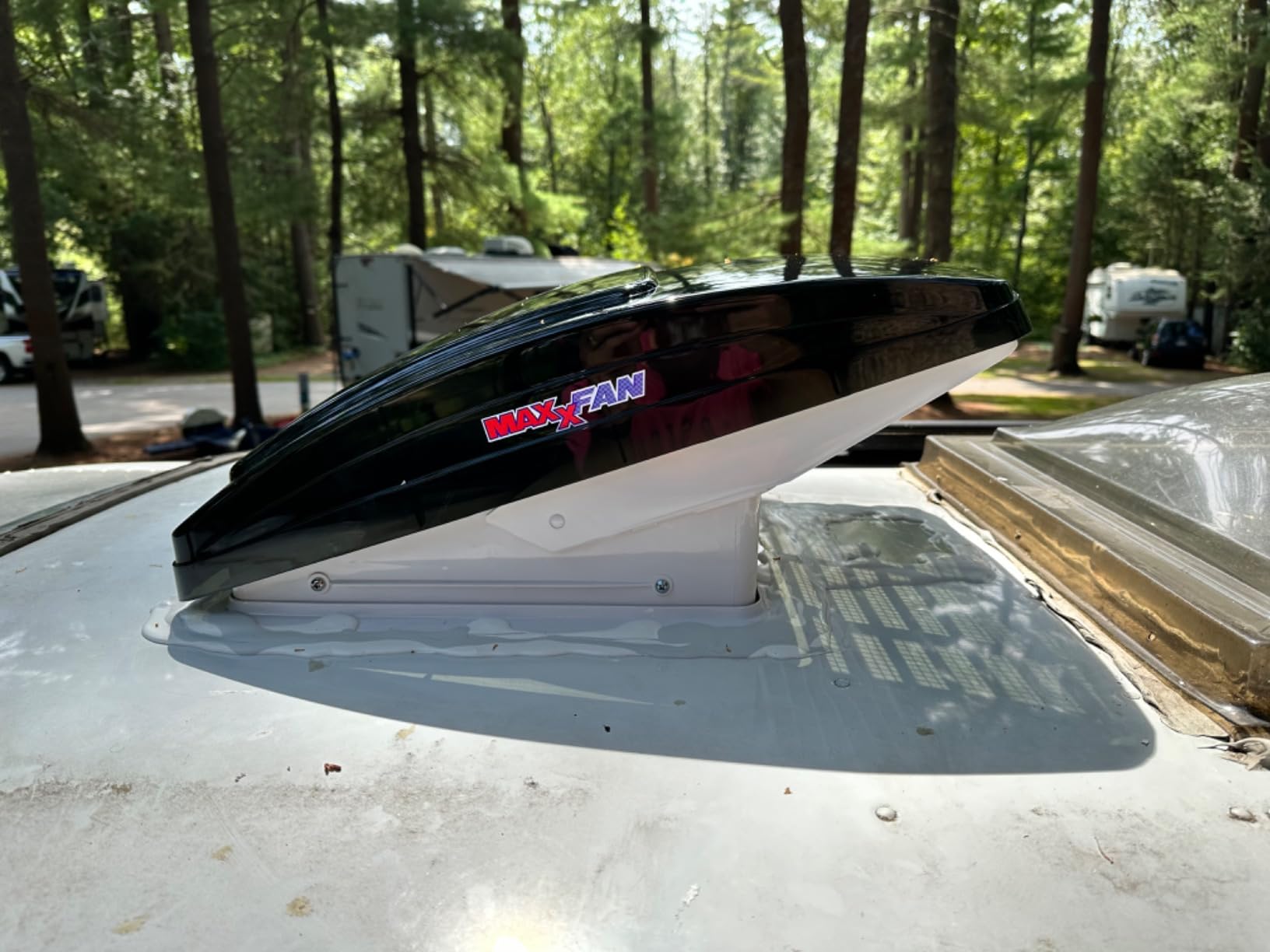
The MaxxFan Deluxe is the fan that showed up repeatedly in owner threads while we were reading, and it is the reason it sits at the top. It is the highest-reviewed unit in our group at 4.6 stars from 1701 ratings, and owners consistently point to the same three things: the all-in-one format, the built-in rain cover, and the range of ten speeds.
That rain cover is the feature that separates it from almost everything else here. Most budget fans run with the lid closed as a ceiling fan, which is fine for circulation but useless for clearing a shower stall. The Deluxe lifts its own lid on a powered mechanism, so hot air leaves the van while it rains or while you are driving.
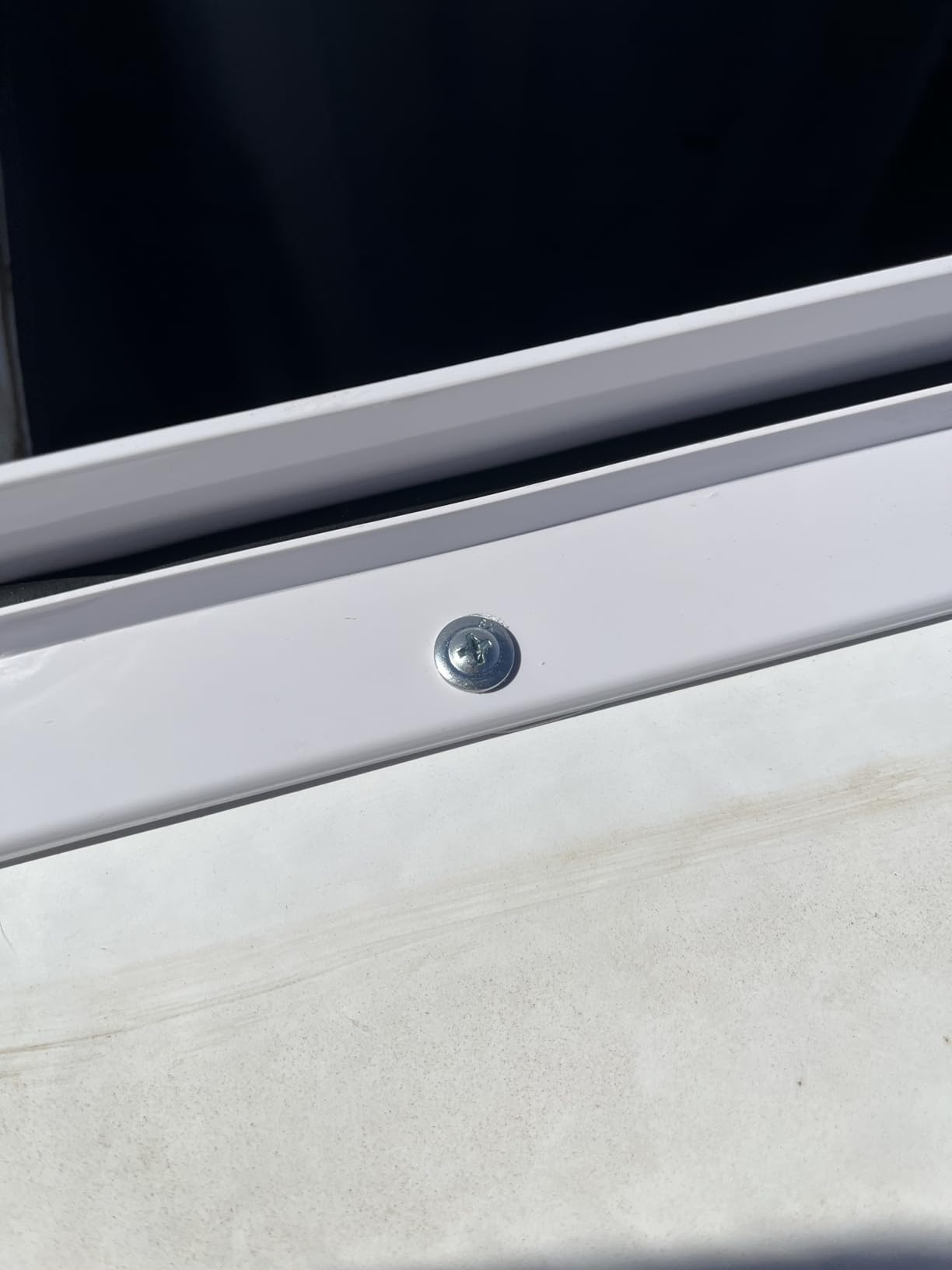
On paper the specification is the richest in the group. It runs a 10-speed reversible 10-blade motor drawing 60 watts, mounted ceiling-style in a low profile housing that measures 12.75 inches deep by 14.76 inches wide by 5.23 inches tall. It is 12V DC, finished in smoke tint, and controlled by remote.
The thermostat is the feature owners underrate. Set it to auto and the fan responds to cabin temperature rather than running flat out all afternoon, which on a 200Ah house bank is the difference between a fan that is invisible to your energy budget and one you have to think about. The interior insect screen removes without tools, so cleaning it after a dusty desert drive takes seconds rather than a ladder.
What you get for the money versus the alternatives
Buyers consistently say the Deluxe earns its position because there is nothing else to buy. A comparable setup built from a separate vent, a fan insert and a rain dome costs more in parts, takes longer to install and creates more leak points at the roof. The trade-off is headroom: the 10-blade assembly and the thermostat housing hang lower into the cabin than a plain wedge vent does.
Reviews note the warranty is split, with a 2-year limited warranty on the unit and a lifetime limited warranty on the lid. That lid is the part that takes weather, so a lifetime claim there is worth something if you leave the fan running unattended through a season.
Where it is the wrong choice
If your build has very low headroom above the bed or the galley, measure before you commit. A 5.23 inch tall housing plus the garnish ring is more intrusion than the flat budget vents, and that is worth knowing before you cut the hole.
It is also the most expensive unit in this roundup, which is a real consideration for a weekend rig that sits parked most of the year. For seasonal use you can pair a roof vent with a cheap 12V cabin fan and still get the pressure change, and for a full-time van the Deluxe is the one I would buy again.
2. MaxxAir MaxxFan Plus – Rain Sensing and Lid-Closed Circulation
MAXXAIR Maxxfan Plus High Powered 10-Speed RV Intake and Exhaust Fan – Manual or Remote Control Electric Opening, Easy Ceiling Controls, Rain Sensor with Automatic Lid Closure, Smoke (00-04500K)
28W 12V
10 speeds, 10 blades
Rain sensor auto-close
Runs with lid closed
Pros
- Rain sensor closes the lid automatically
- Runs with the lid closed for interior circulation
- Electric opening plus remote control
- Waterproof moulded mounting tabs
- Low 28 watt draw
Cons
- FANMATE vent cover sold separately
- Bulkier housing at 10 inches tall
The Plus solves a problem the Deluxe leaves to you. It carries a rain sensor that detects the first drops and closes the lid automatically, which means you can leave it running in a forecast shower without getting up to shut it. For anyone who camps unattended through wet weather, that single feature changes the daily routine.
It also runs with the lid closed as a ceiling fan, which is how we would use it overnight. Owners report running it that way at low speed to move air across the cabin without pulling warm air out of a parked van, and several say it cut or eliminated their air conditioning use in hot weather.
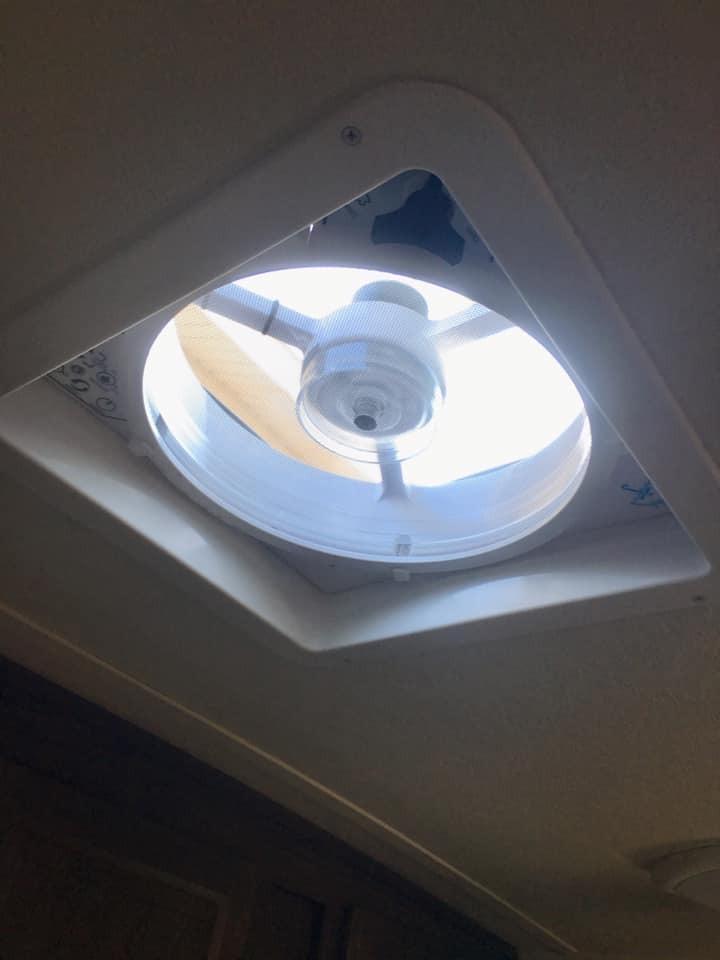
It draws only 28 watts, roughly half the Deluxe figure, and runs a 10-speed reversible DC motor with 10 blades at 1700 rpm class speeds. The housing is the trade-off: 18.88 inches deep by 17.75 inches wide by 10 inches tall and 5.2 pounds, noticeably bulkier than the flatter units in this list.
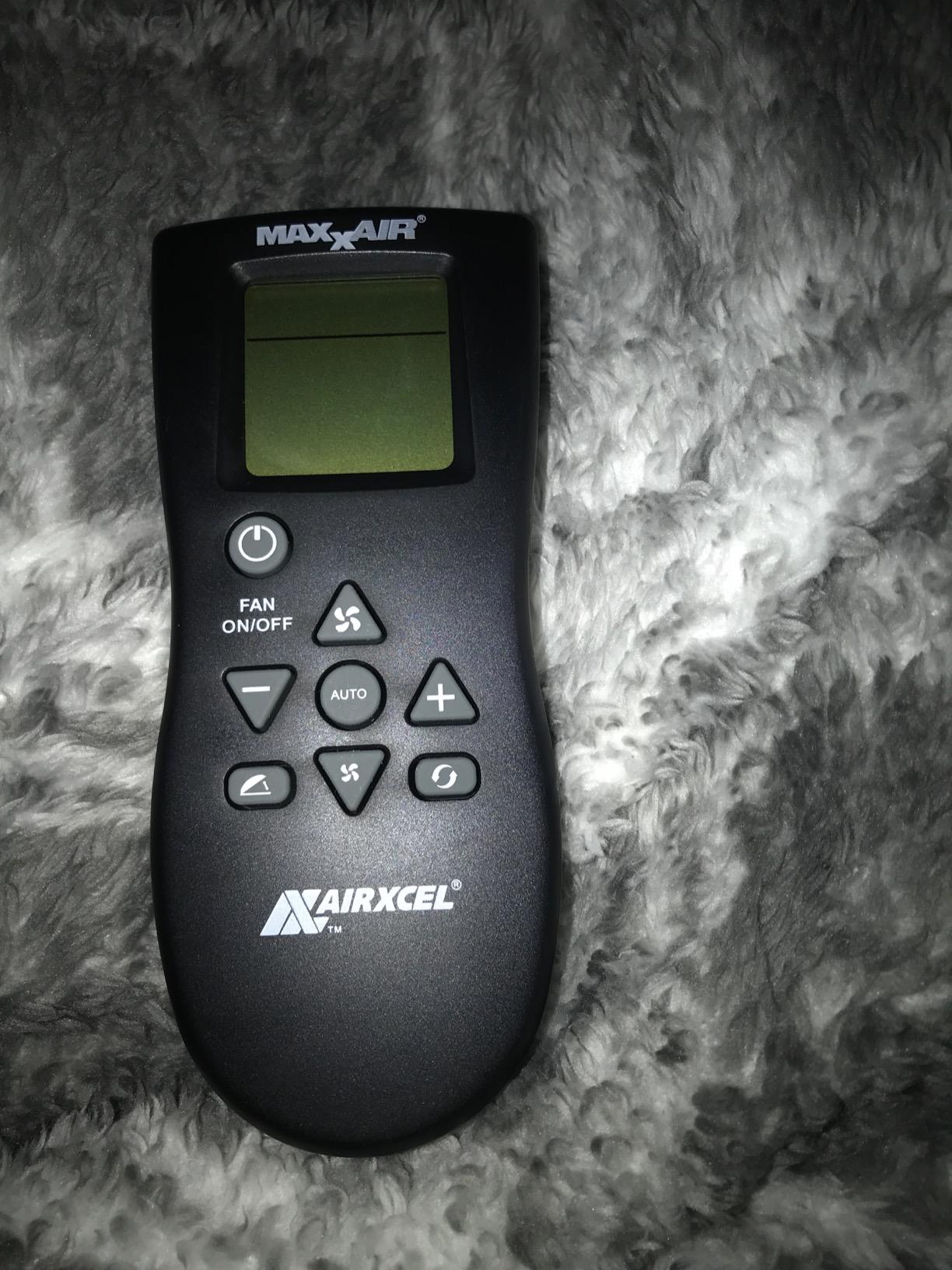
Installation is genuinely easier than the Deluxe. Waterproof moulded mounting tabs let it drop into position without tools once the tabs are set, and the wiring uses a standard round barrel connector. Control is manual or remote, and the fan comes in white or smoke tint to match the roof.
Choosing the Plus instead of the Deluxe
The decision comes down to rain behaviour. The Deluxe holds its lid up in rain and keeps moving air, which is more efficient. The Plus closes down and keeps the air moving inside, which protects the mechanism and the roof penetration when you are not actively clearing humidity.
If you mostly camp in dry heat and drive long hot afternoons, the lid-up approach of the Deluxe serves you better. If your forecast is afternoon storms every few days and you sleep in the van, the Plus is the calmer choice.
Watch the total cost and the height
The FANMATE vent cover that the tool-free mounting tabs are designed for is sold separately, so budget for it before the install day rather than after. It is also the tallest unit here at 10 inches, so check the clearance above your bed or galley before ordering.
At 4.6 stars from 1210 ratings it sits right beside the Deluxe on owner satisfaction, with 91 percent of buyers giving four stars or better. The rain sensor and the lid-closed circulation mode are what reviewers actually talk about.
3. RVLOVENT 14 inch 10-Speed Reversible – the Value Standout
RVLOVENT 12V RV Roof Fan Vent 14” 10 Speed Reversible Manual Lift (NO REMOTE)
18W 12V
Manual crank lift
Reversible intake and exhaust
45 dB rated, 1000 CFM
Pros
- Reversible intake and exhaust with speeds in both directions
- 1000 CFM max airflow for the money
- 45 dB rated and owners report quiet running
- Extra replacement bug screen in the box
- Fits standard 14x14 inch openings
Cons
- Louder than the 45 dB rating in wind
- Interior flange usually needs trimming on a sloped roof
- Manual crank means no rain sensor
This is the unit that makes the case for not buying a name badge. At 4.6 stars from 1068 ratings it matches both MaxxAir units on owner satisfaction, and it does the thing that matters most: reversible intake and exhaust airflow across multiple speeds in each direction. Owners report it cut or eliminated their air conditioning use in hot weather.
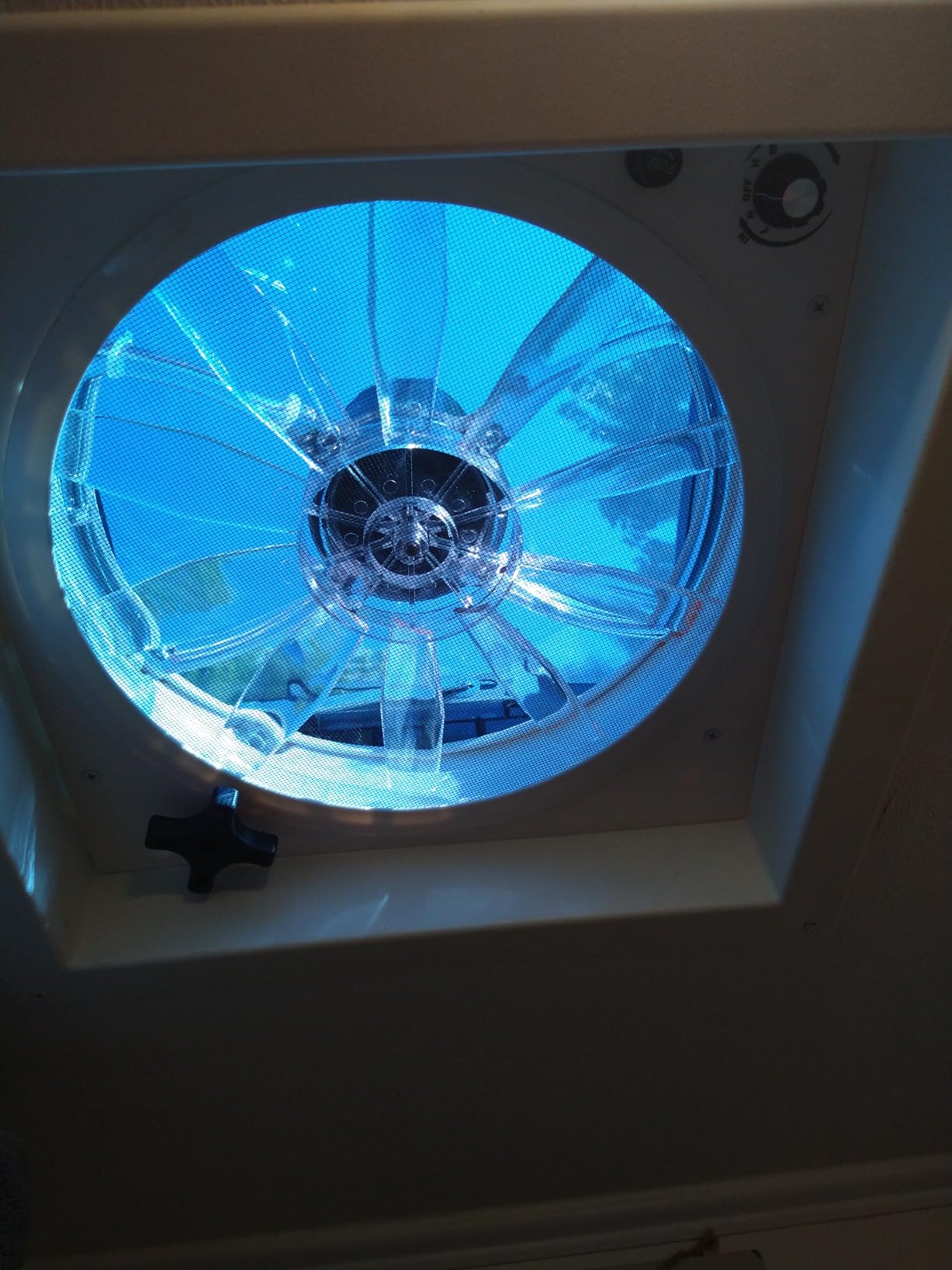
Two details in the box make it stand out for a van build. A replacement screen frame comes in the box alongside the built-in fuse, extra 5A slow-blow fuses, screws and a white interior garnish, so you are not ordering a second screen after the first dusty weekend. And the smoke tint blends into a roof better than a white lid does on a dark van.
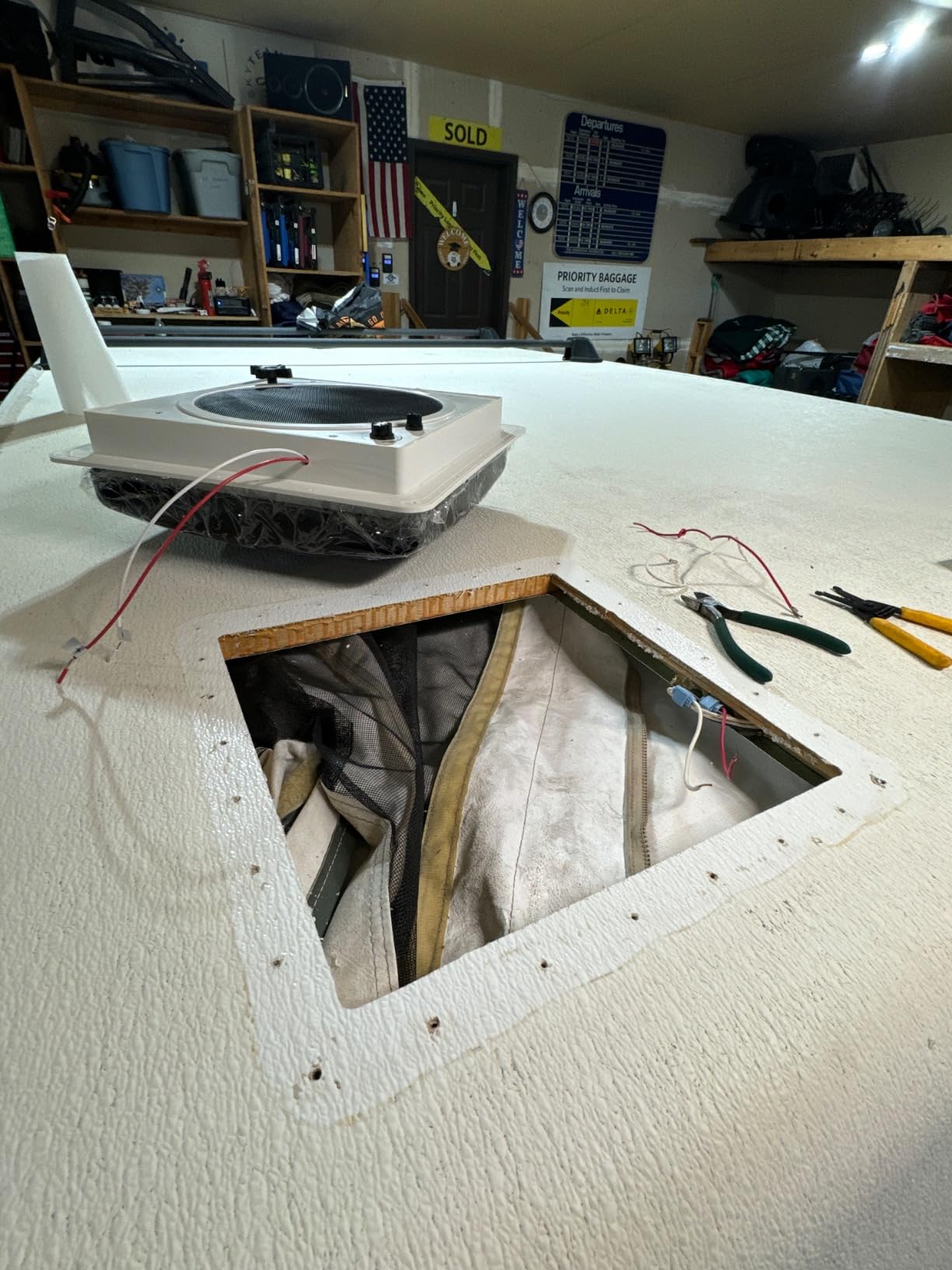
The specification is competitive with anything at twice the cost. Up to 1000 CFM maximum airflow, a 14 inch blade, 18 watts of draw, and a listed noise level of 45 dB. It fits roofs and openings in the standard 14 by 14 inch family, and the housing measures 16 inches square by 14 inches tall in metal and polycarbonate.
Control is a manual crank and pull chain rather than a remote or a powered strut. That means reaching up to open the lid, which is the single biggest day-to-day inconvenience in this roundup. There is no rain sensor on this variant either, so it runs lid-up or lid-down and you choose.
Where it beats the premium units
On a flow-per-amp basis this is the pick we would run. Builders on vanlivingforum repeatedly praise roughly 0.28 amp fans delivering around 150 CFM as the quiet-efficiency sweet spot, and this unit is in that territory at 18 watts for a 12V system. Run it at speed two overnight and the house battery barely notices.
The no-remote, no-motorised-lid design also means fewer failure points. The powered lift mechanisms and rain sensors on the premium units are the parts that generate warranty anxiety; a crank and a pull chain do not have those problems.
Where it falls down
Owners do report that it is louder than the advertised 45 dB, particularly with wind across the roof, which is worth knowing if you are a light sleeper in exposed campsites. The interior garnish flange also usually needs trimming to fit a sloped van roof, and that trimming is part of your install time.
The other honest limitation is manual operation. There is no electric opening and no built-in rain sensor, so you cannot leave it running through a shower on autopilot. If that matters more than the price, move up to the Plus.
4. Ventline Ventadome CW001 – Simplest Complete Kit
Ventline RV Roof Vent White w/ 12 Volt Fan, Putty & Screws¡
3.6W 12V
Single speed, 6 blades
Fits 14.25 inch rough opening
Putty, screws and garnish included
Pros
- Everything for install included in the box
- Very low 3.6 watt draw for continuous running
- Wedge shape aerodynamic white lid
- Simple push button control
Cons
- Single speed and no reversible intake
- 14.25 inch rough opening is not the standard 14 inch cutout
- Galvanized flange is sharp
For a first build or a repair, this is one of the least complicated items on the list. At 4.6 stars from 962 ratings with 92 percent of buyers at four stars or better, it is consistently described as a simple no-frills roof vent that includes everything you need to install it.
The draw is the headline. At 3.6 watts on a single speed, this is the unit you can genuinely leave running all night on a modest house bank without planning around it. If your priority is moving heat out slowly and continuously rather than clearing a van quickly, that low draw is a real advantage.
What to check before you order
The rough opening is 14.25 by 14.25 inches, which is not the standard 14 by 14 inch cut-out. If you already have a 14 inch hole you are replacing, this will not drop straight in. Measure the existing opening before you commit.
Also note the included components: a 1.75 inch garnish ring, putty tape and screws are all in the box. That is rare at this level, and it means a weekend install without a separate hardware run.
What you give up
It is a single-speed, exhaust-only fan with 6 blades and push button control. There is no intake mode, so you cannot pull cool night air in through it, and no speed control means one noise level and one flow level. That is the reason it is not higher on this list.
The galvanized mounting flange is sharp and needs gloves during the install. Handle it carefully and it is a non-issue, but it is a real cut risk on a van roof with limited working room.
5. MaxxAir Original MaxxFan – All-in-One Without the Extras
MAXXAIR Original Maxxfan – Vent, Fan & Rain Protection All-in-One, High Powered 4-Speed Exhaust Only Fan, Manual Knob Control, 14″” x14, Smoke (00A04401K)
12V 12-inch ceiling mount
4-speed exhaust only
Manual knob control
14x14 inch opening
Pros
- All-in-one vent fan and rain protection format
- Entry point into the Maxxair range at a much lower cost
- Manual knob needs no wiring for the opening mechanism
- Moulded waterproof tabs for tool-free cover fitting
Cons
- Exhaust only so it cannot draw fresh air in
- Only 4 speeds versus 10 on the Deluxe and Plus
- Manual knob means no electric opening
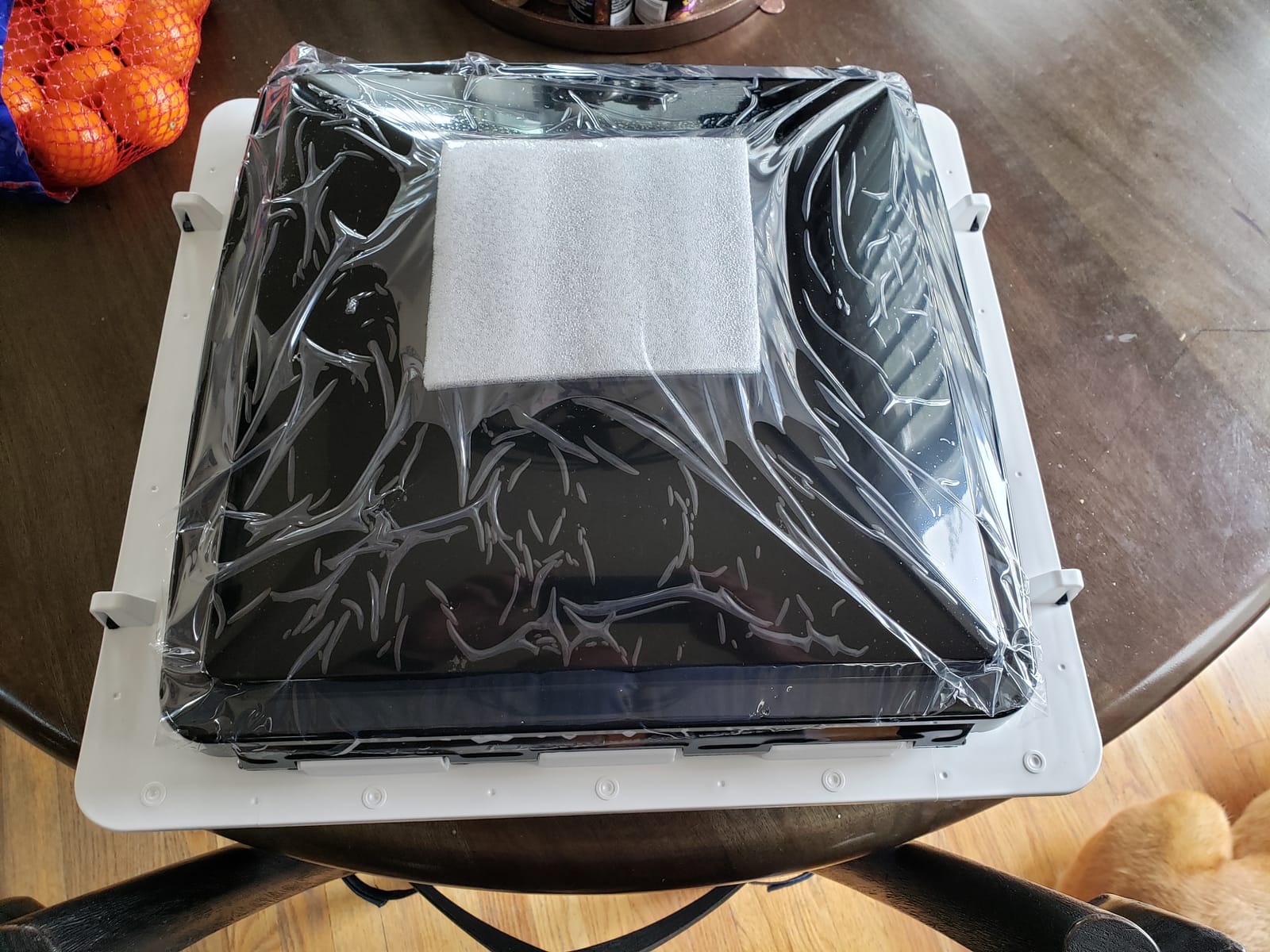
This is the original MaxxAir all-in-one, and it exists to give you the format without the feature list. It keeps the thing that makes the brand work, which is a vent, a fan and rain protection in a single unit, and drops the ten speeds, the thermostat, the remote and the powered lift.
At 4.6 stars from 649 ratings with 90 percent at four stars or better, the satisfaction scores hold up remarkably well against the Deluxe. Reviewers describe it as the sensible way into the format, which is honest given what you are giving up.
Why exhaust-only is a real limitation
Owners on promasterforum make the point clearly: a box fan moves plenty of air but is not as good at the job as a proper roof vent, and an exhaust-only roof vent shares that weakness. Without a reverse mode you can clear heat and moisture but you cannot draw cool air in overnight, so your ventilation is one-directional.
For daytime heat on a parked van that is fine. For overnight sleeping in mild conditions it means you either run the fan all night or you stop and wake up to a stale cabin.
The practical details that matter on install
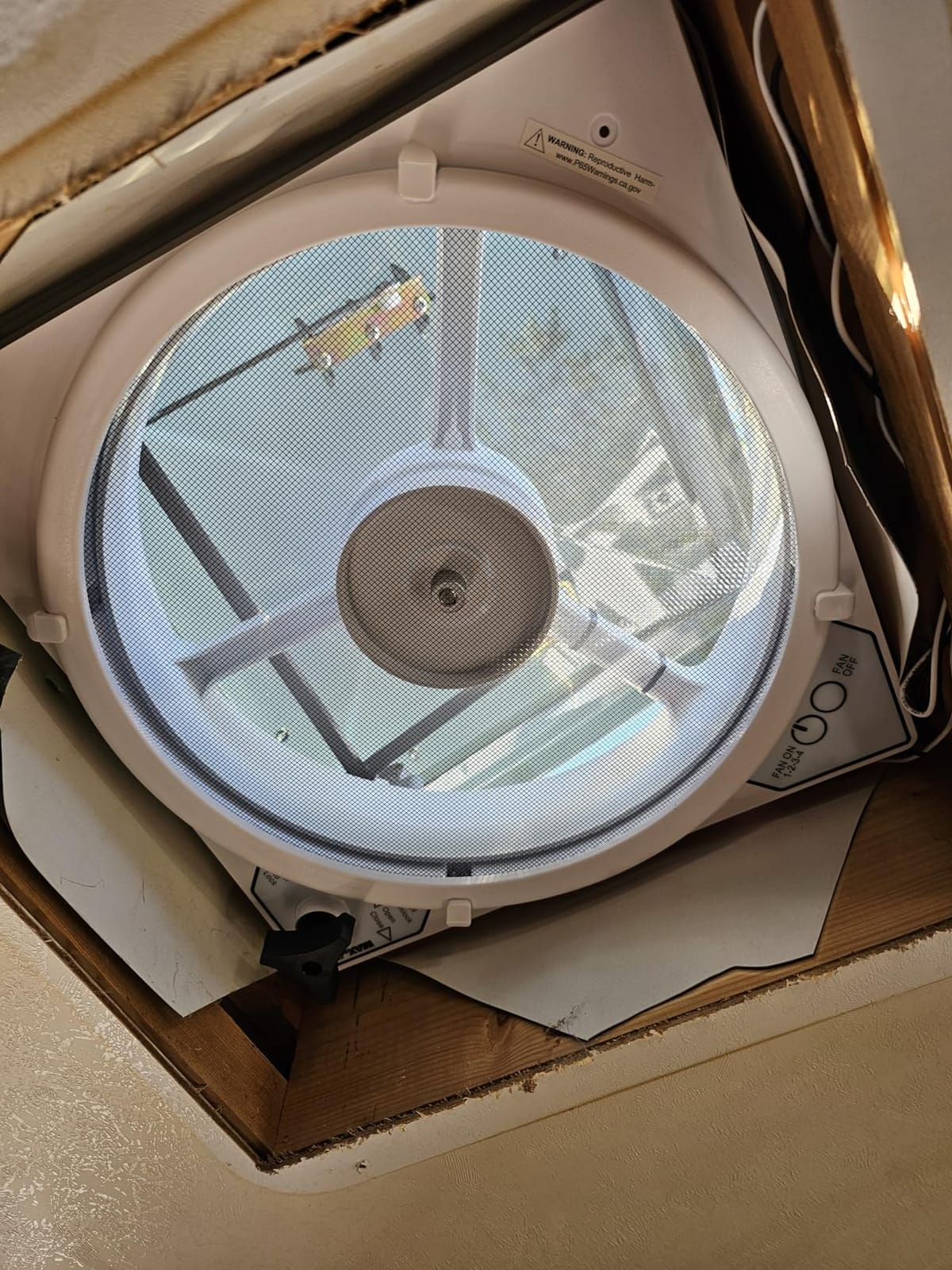
It fits the standard 14 by 14 inch roof opening, weighs 10 pounds in the listing data, and is compact at 7.4 by 6.97 by 3.94 inches. That small height is one of its real advantages in a van with low headroom.
The manual ceiling knob opens and closes the vent with no wiring for the opening mechanism, which simplifies the electrical job. The FANMATE vent cover that the moulded tabs accept is sold separately. Warranty is 2 years limited.
6. Heng’s Industries 71112A – Lowest-Cost Complete Vent
HENG’S INDUSTRIES 14″ RV Roof Vent 12 Volt Powered Fan with WHITE Wedge Style Lid – 1” Garnish Ring | 71112A
4W 12V
3-blade single speed
14.5 inch rough cut-out
Manual crank and mesh screen
Pros
- Lowest-cost complete vent with a 12V fan
- White wedge-style lid suits most roof treatments
- Manual crank needs no wiring for the lid
- Includes a 1 inch garnish ring for interior trim
Cons
- 14.5 inch cut-out is larger than the standard 14 inch
- No mounting hardware supplied
- Single speed three-blade fan with sharp metal flanges
If you are building a van on a strict budget and the roof is already open, this is the cheapest complete roof vent with a 12V fan we found. At 4.5 stars from 517 ratings with 87 percent at four stars or better, it is treated as a solid budget replacement rather than a compromise you will regret.
The 4 watt draw is tiny, which makes it practical to run continuously. With a 3-blade single-speed fan the flow is modest, but for a slow background extraction that clears cooking smells and keeps condensation off the ceiling overnight, it does a reasonable job.
Measure twice, because this one is oversized
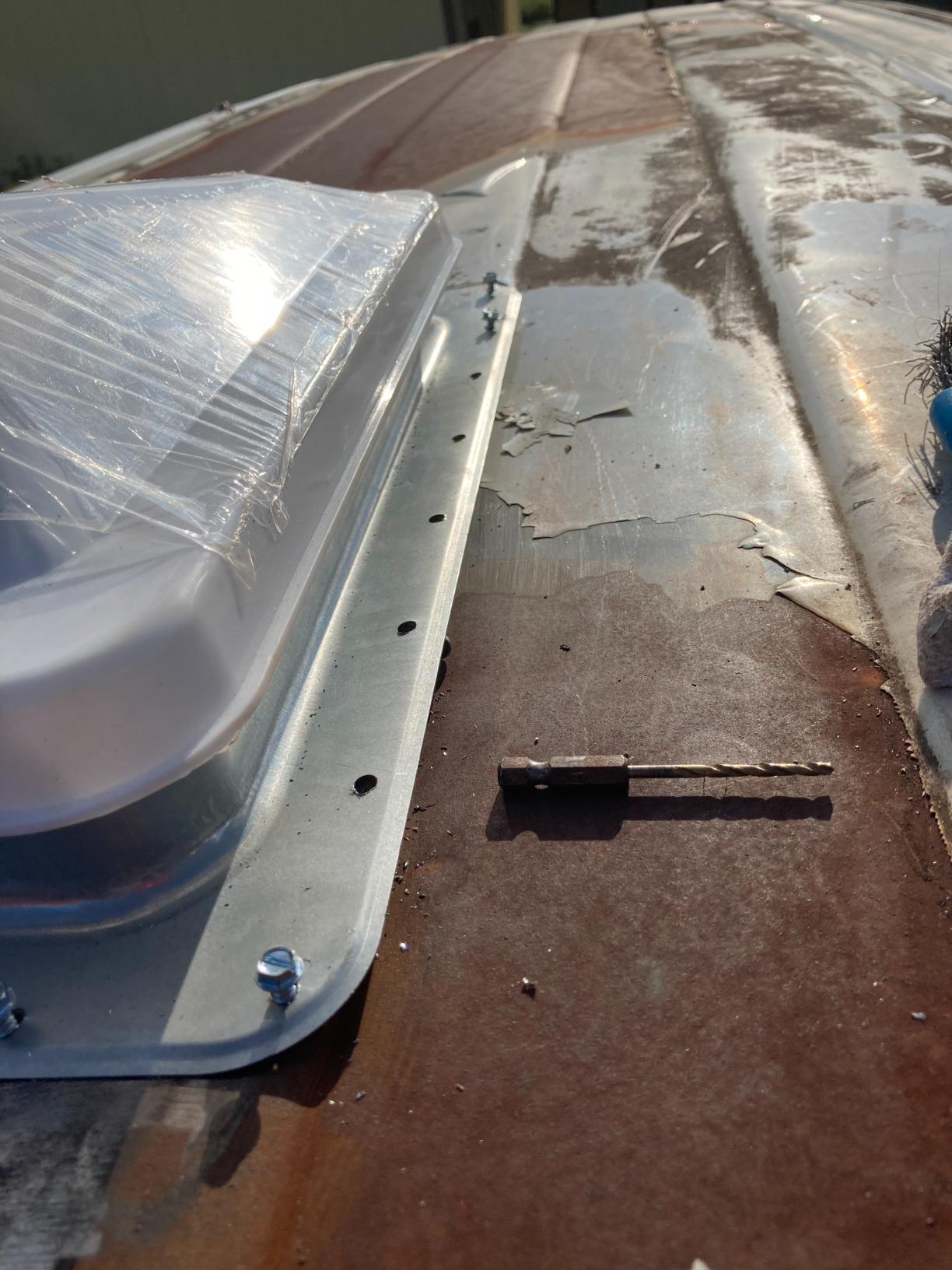
The rough cut-out is 14.5 by 14.5 inches, larger than the standard 14 by 14 inch opening. That means it is an easy fit if you are cutting fresh, and a poor fit if you are replacing an existing 14 inch vent. The exterior flange is 16.5 inches square, which gives you a generous overlap once it is in place.
The 1 inch inner garnish ring, part number 90090, is included, so the interior trim is covered. Mounting hardware is not included, so you need to bring your own caulk or putty and screws.
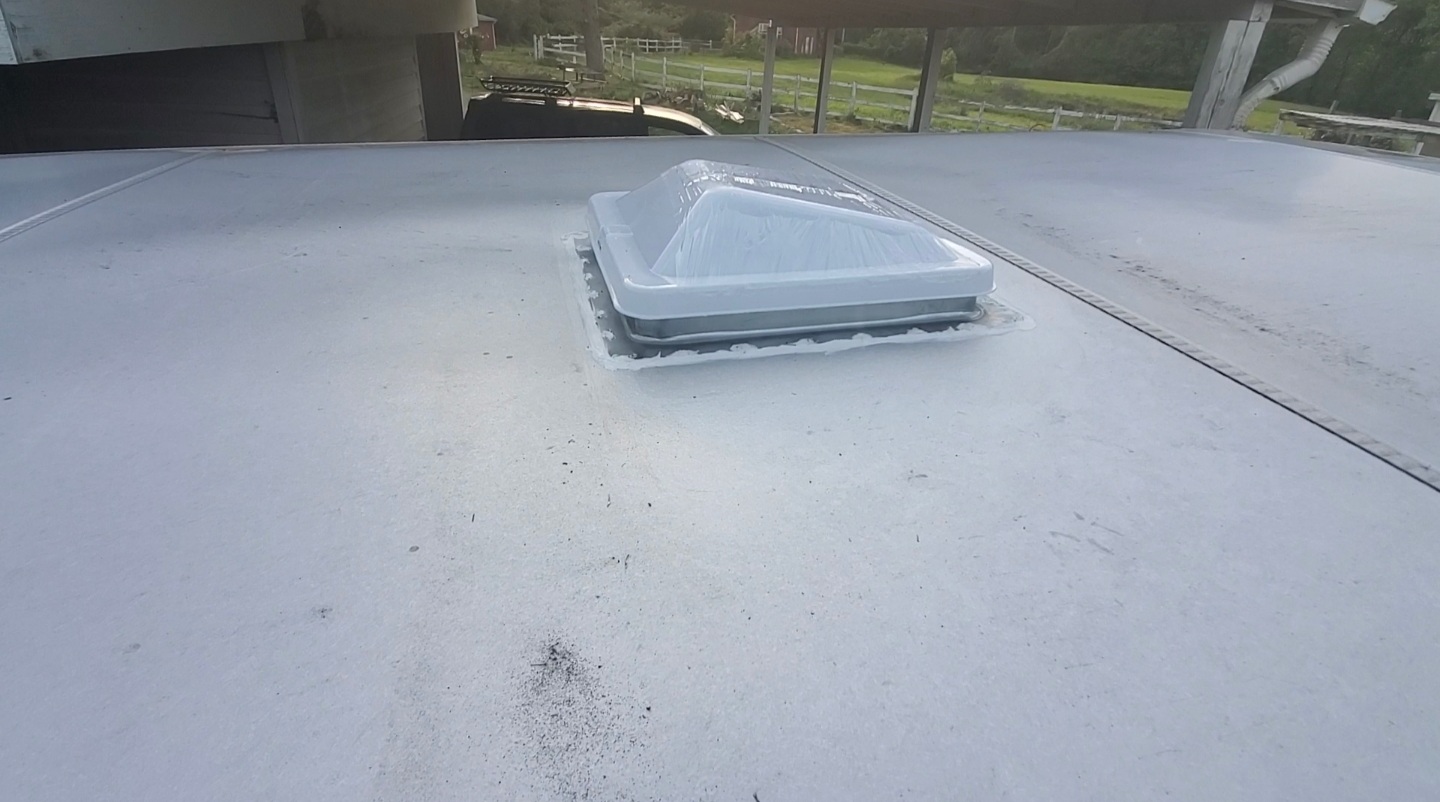
Handling and performance realities
The manufacturer warns that all vent metal flanges are very sharp, so wear gloves when fitting it. The single speed and 3-blade layout mean this is an exhaust fan with no intake mode and no speed flexibility, which is the reason it sits in the budget tier rather than higher.
It uses a 5.5 by 2.1mm coaxial power connector, which is a standard barrel plug and easy to source if the included lead is too short for your run. For a first van or a backup vent on a secondary roof point, it does the job without a big bill.
7. caqeg 14 inch Universal Vent with Fan – Cleanest Direct Replacement
14″ RV Roof Vent for Camper Trailer Universal White Lid Roof Vent with 12V RV Vent Fan 6″ Blades White lid Inner for Garnish Ring
24W 12V
6-inch reversible blades
Fits 14 inch openings
Roofs 1-1/4 to 2-1/4 inch thick
Pros
- Fits standard 14 inch cut-outs as a direct replacement
- Garnish ring
- screws and butyl tape all included
- Runs with the lid closed so it works in rain and while driving
- Owners report easy fitting on camper builds
Cons
- Thin plastic that can crack if flexed
- Shallow lid rigidity
- Only fits 1-1/4 to 2-1/4 inch roof thickness and has no remote
This is the pick when the priority is a part that drops into an existing hole and stays there. It fits standard 14 inch roof cut-outs as a direct replacement, and owners report a perfect fit and an easy install on camper builds.
It runs with the lid closed, so it works in rain and while driving, which makes it a usable ceiling fan on a night stop. The reversible 12V fan and 6 inch blades circulate fresh air and remove odors, and the kit includes the interior garnish, screws, butyl tape and printed instructions.
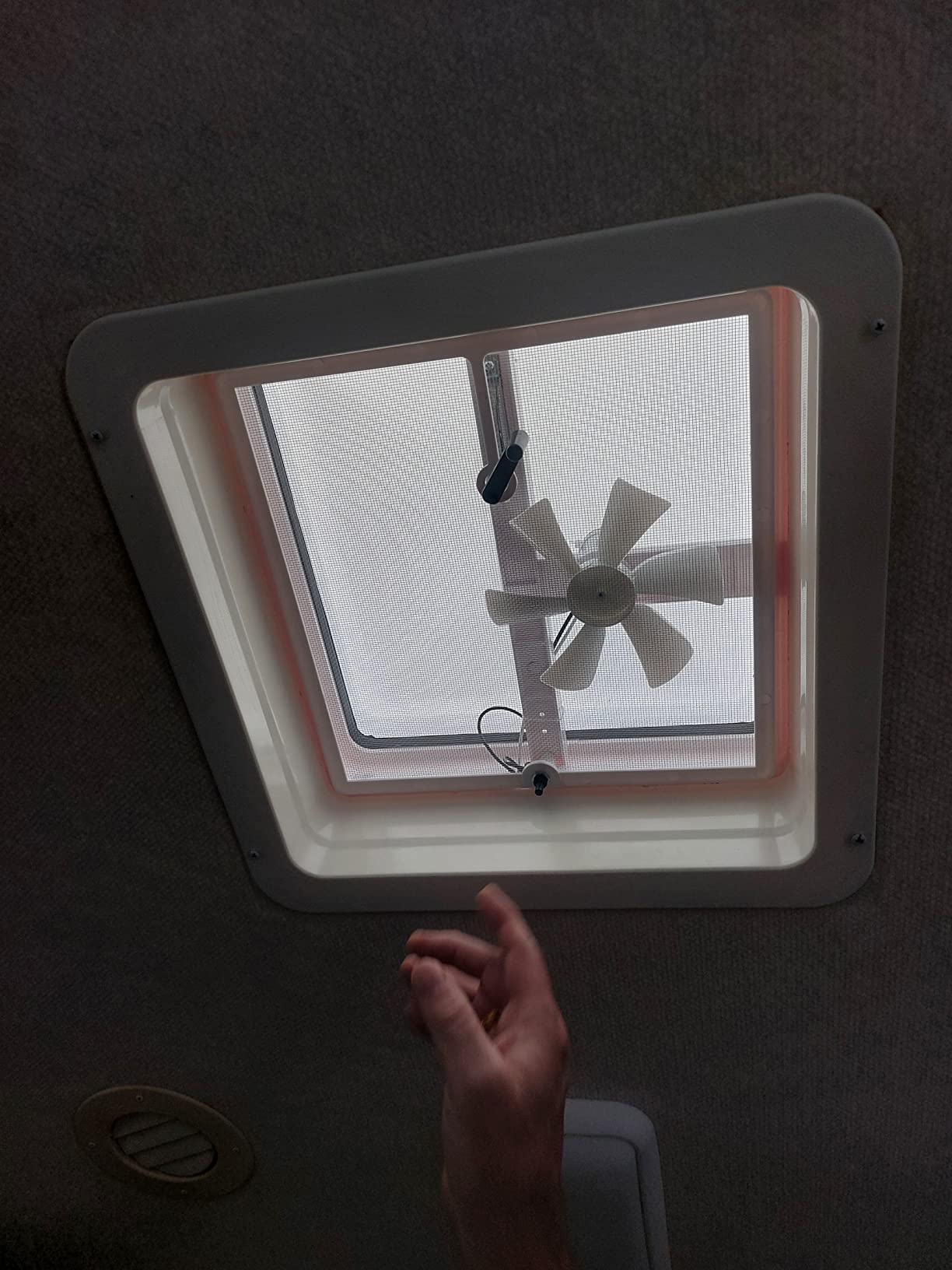
It is rated at 24 watts with a listed airflow of 1200 centilitres per second, and the whole unit measures just 5 inches deep by 14 inches wide by 14 inches tall at 4.4 pounds. That shallow depth is genuinely useful in a van with limited headroom.
The two-wire design keeps the electrical job simple, with the fan secured by butyl tape under the garnish ring and screws. Roof thickness is the constraint to check: it fits roofs between 1-1/4 and 2-1/4 inches thick, which covers most panel van roofs but not every ribbed or reinforced ceiling.
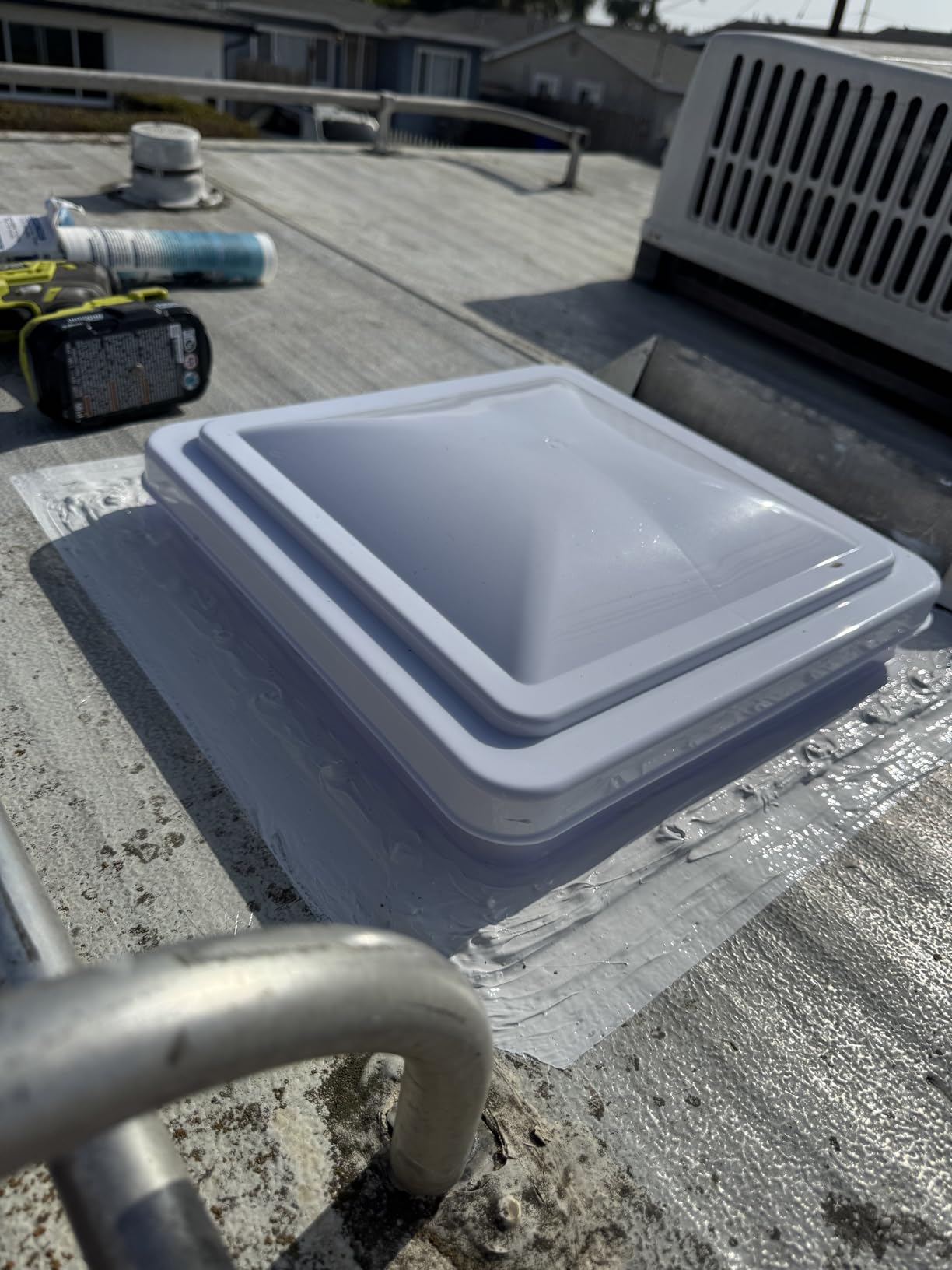
Check the roof thickness before you commit
This is the unit most likely to surprise someone in a van build. The roof thickness range is narrower than the cut-out fit implies, so on a thicker or corrugated ceiling you will need an extension or a different vent. Measure both the opening and the thickness, not just the opening.
It also comes in black and white lid variants, so you can match a dark roof rather than leaving a white panel on a black van.
The honest weakness
The recurring complaint across 904 ratings is the thin plastic. Reviewers note it can crack if you flex it during installation, and that the lid itself is thin and could be more rigid. Treat the flange as a trim piece rather than something to lever against, and it will go on fine.
At 4.4 stars it has 84 percent of buyers at four stars or better, with the remaining feedback clustered around the single speed, the lack of a remote and the plastic. For airflow and simplicity rather than control, it does the job.
8. RV Roof Vent Fan 14×14, Quiet 12V with Remote Control and Rain Sensor
RV Roof Vent Fan 14×14, Quiet 12V(24V Max) with Remote Control &Rain Sensor
40W 12V
Brushless motor, 674 CFM
25 dB rated
Four speeds with rain sensor
Pros
- Brushless motor rated at 25 dB or below
- 674 CFM airflow from a compact housing
- Remote plus smart rain sensor that closes the lid
- Four timer modes from 60 to 240 minutes
- Fits standard 14 inch openings
Cons
- Included interior trim ring is shallow for deeper ceilings
- One owner reports the lid does not seal fully in cold weather
- Replacement trim rings may not match an existing footprint
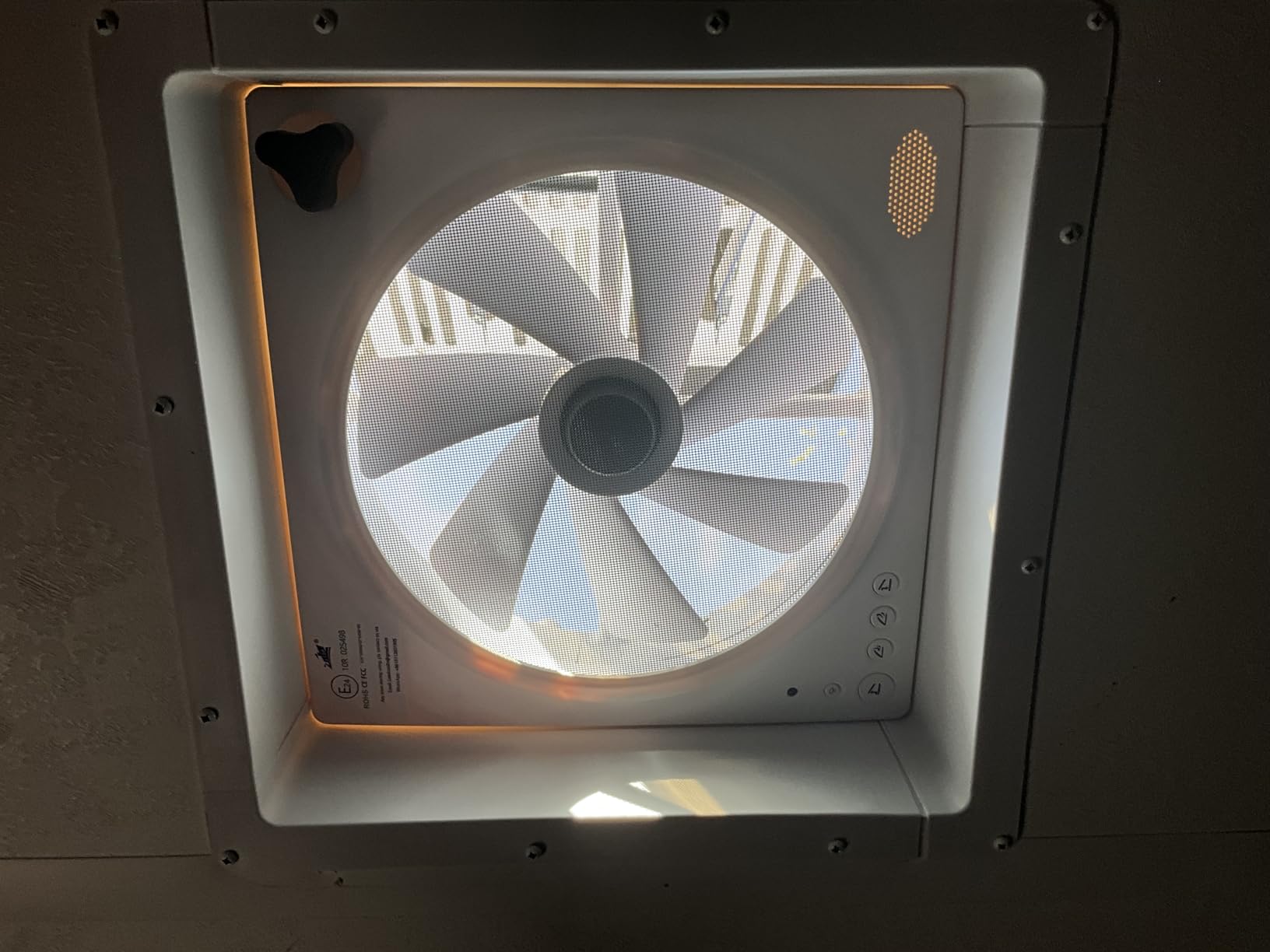
Quiet-at-night is the most repeated complaint in owner threads about roof vent fans, and this is the unit that addresses it most directly. The brushless motor is rated at 25 dB or below, which is well under the 45 dB figure the value-tier units carry, and it still moves 674 CFM.
That combination is why it earns the quiet-sleep slot. It has four speeds with reversible intake and exhaust, a remote, and a smart rain sensor that closes the lid automatically. Four timer modes from 60 to 240 minutes let you set it and stop thinking about it.
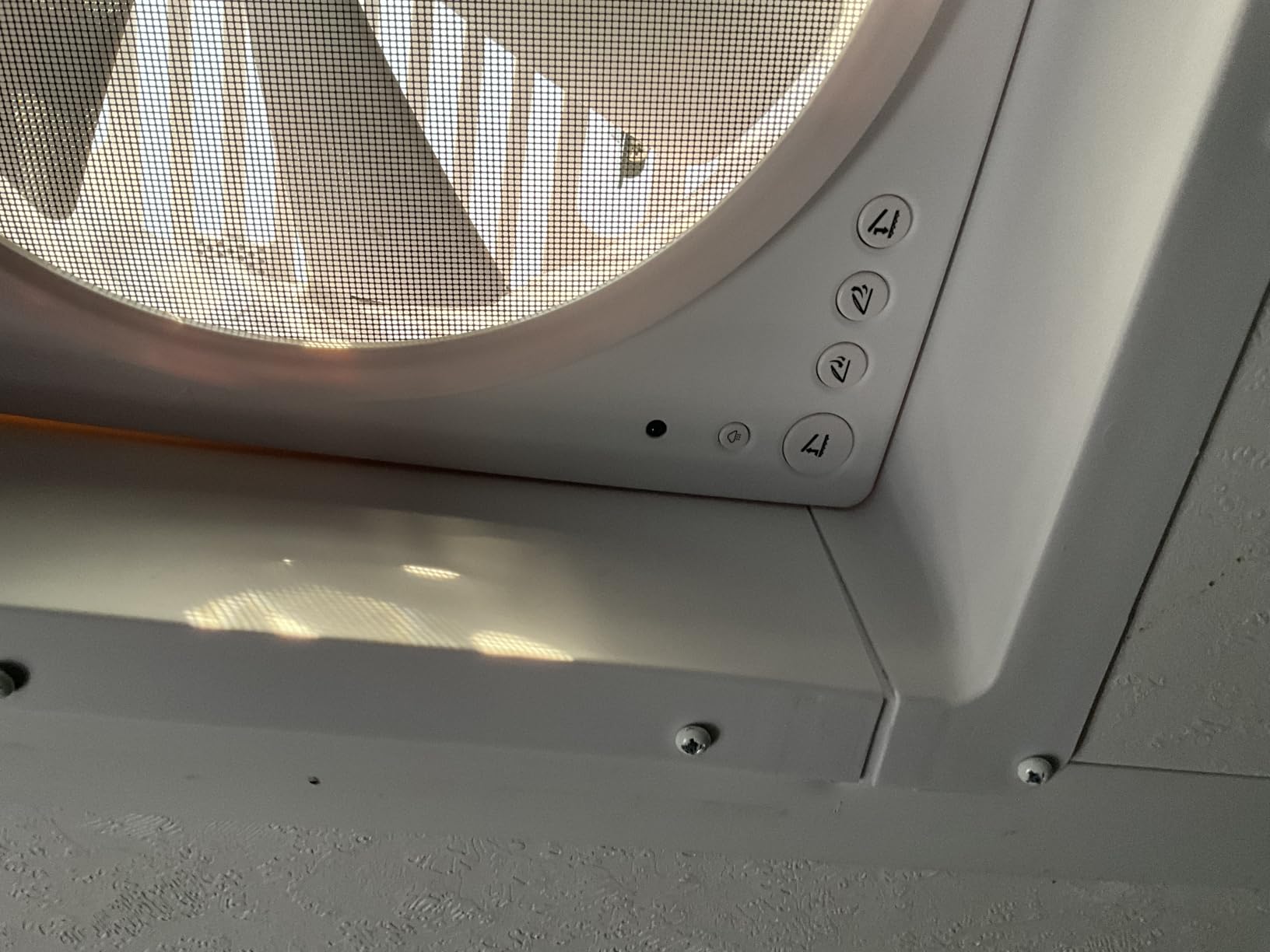
The housing is compact at 13.6 inches square by 5.5 inches tall, which is one of the shallower powered units in this roundup, and it fits standard 14 inch openings at 356 by 356mm. The housing is rated from minus 30C to 100C, so it is not worried about a freezing winter park or a desert stop.
It runs 1700 rpm on 7 blades at 40 watts, with CE, FCC and RoHS certification. Warranty is listed as 2 years from the manufacturer, with the listing also claiming 3 years and lifetime technical support.
Why the brushless motor matters
Brushless motors have no commutator brushes to wear, which is why this listing claims a 5x longer lifespan. On a van that bounces down a gravel track regularly, that is a real durability argument rather than a marketing line. It also runs at speed two so quietly that owners with light sleep can leave it on all night.
Support is worth noting too. Customers report responsive service including free replacement trim rings, and one owner installed it in a van conversion in roughly two hours.
Two caveats from the reviews
The included interior trim ring is shallow, so deeper van ceilings need a separate trim piece. That is a small extra cost but it is an extra step, and if your ceiling cavity is deep you should budget for it up front.
One detailed owner report says the lid does not close completely tightly, allowing heat to escape in cold weather. That matters for winter use where you want the vent sealed against the cold, and it is why this is not higher on the list despite the quiet motor.
9. 2012RVAccessories F36AR Voice and LED – Most Features
Heavy Duty 14″ RV Roof Vent Fan, Whisper-Quiet Voice Control, Colorful LED
25W 12V
Brushless motor, 7 blades
Voice control plus remote
Four speeds, rain sensor, timer
Pros
- Only unit here with voice control alongside remote and buttons
- Brushless DC motor with 4-color LED lighting
- Built-in rain sensor auto-closes the lid
- Thickened 1mm reinforced housing resists rattle
- 1-8 hour timer
Cons
- Voice and assistant pairing adds setup steps
- Heaviest unit at 12 pounds
- Feature set adds complexity on a van roof
If you like controlling things from your phone or your voice, this is the only fan in the group that does it. It pairs with a remote, a smart assistant, or push buttons, and the remote is included in the box along with screws and trim.
The lighting is the part that has nothing to do with ventilation. Four colors are offered, warm white, amber, red for night vision and cool blue, which is genuinely useful if you are working in the van after dark and do not want to blow out your night vision.
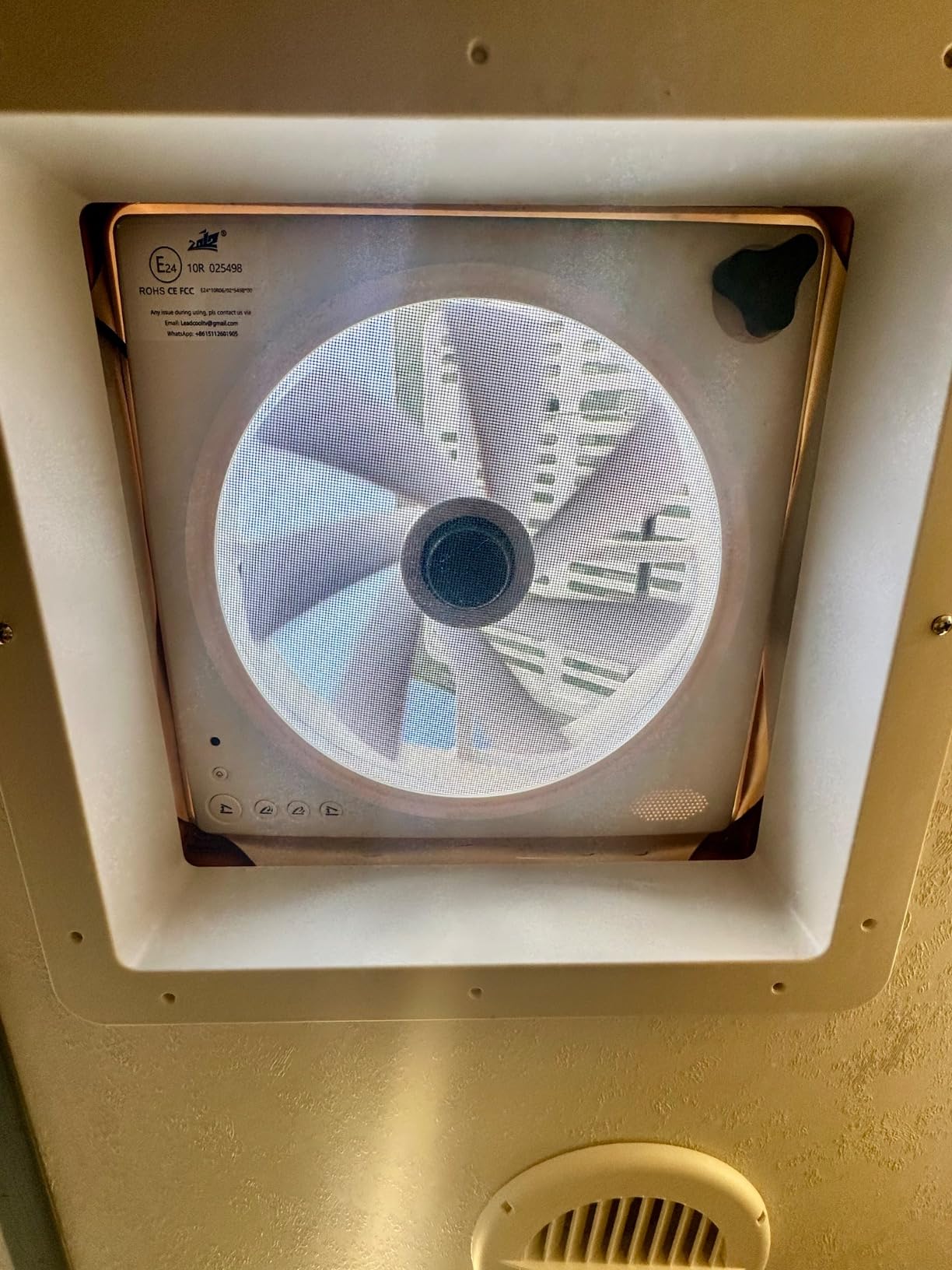
The motor is brushless DC running at 25 watts across four speeds with a smooth ramp rather than sudden gusts. The manufacturer claims a 5 dB noise level, which no independent source has verified, so treat that number as a marketing figure rather than a measured one. The 25 watt draw is real and low.
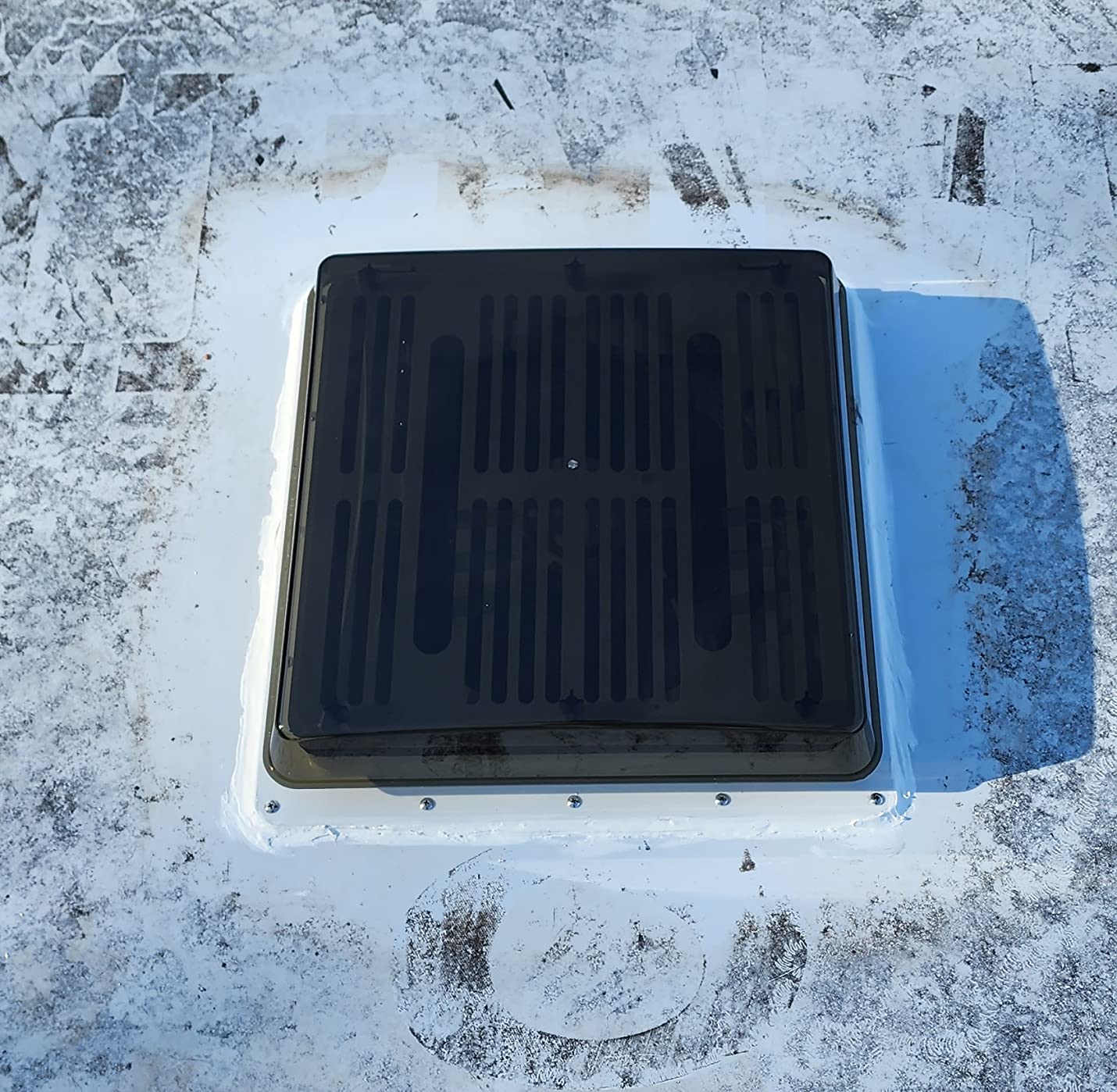
The housing is 1mm thicker reinforced ABS and polycarbonate, which is the reason owners say it does not rattle on rough roads. Adjustable lid opening angles within 50 degrees let you limit how far it opens in high wind. It fits the standard 14 inch 356 by 356mm opening and carries a 2-year full warranty.
What the extra features are worth
Against the standard F36AR the price premium buys three things: voice control, the LED array and the 1-8 hour timer instead of the shorter fixed timers. If you are already running your van from a phone-based system, that integration is the reason to step up.
The brushless motor and reinforced housing are shared with the cheaper model, so you are not losing airflow or durability by taking the standard unit instead.
Where the premium is hard to justify
This sits in the upper half of the price ladder but is not the cheapest thing here, and it carries a 4.4 star rating from 341 ratings with 84 percent at four stars or better. Owner reviews most often raise the value question directly against the MaxxFan Deluxe, which costs considerably more.
Pairing a smart assistant takes more setup than plugging in a plain remote, and at 12 pounds it is the heaviest unit here, which matters on a van roof where every kilo counts. For most people the standard F36AR gives you the quiet motor without either compromise.
10. Starvent A021C-V3 – Most Speed Settings
Starvent RV Roof Vent Fan 6-Speed-Reversible
22.2Wh 12V
6 speeds, 17 blades
Reversible, 1100 CFM
59.5 dB, slow speed ramp
Pros
- Six speeds with reversible airflow for fine control
- Slow ramp avoids the noise jolt of sudden start and stop
- Runs as a ceiling fan with the lid closed
- Clear blades let daylight in
- Removable screen cleans from inside
Cons
- Lid crank reported as flimsy and sometimes failing early
- Speed buttons can stick
- Mesh screen can push into the blades if touched
The Starvent finishes last on rating but earns its place for one specific reason: six speed settings on a reversible fan, more granularity than anything else in this group. That matters most at the quiet end, where you are trying to find the lowest speed that still moves useful air.
Owners also like the slow ramp between speeds. Instead of a sudden jolt of noise when starting or stopping, the fan eases up and down, and several reviewers rate it as quiet as or better than premium-brand units despite the 59.5 dB headline figure.
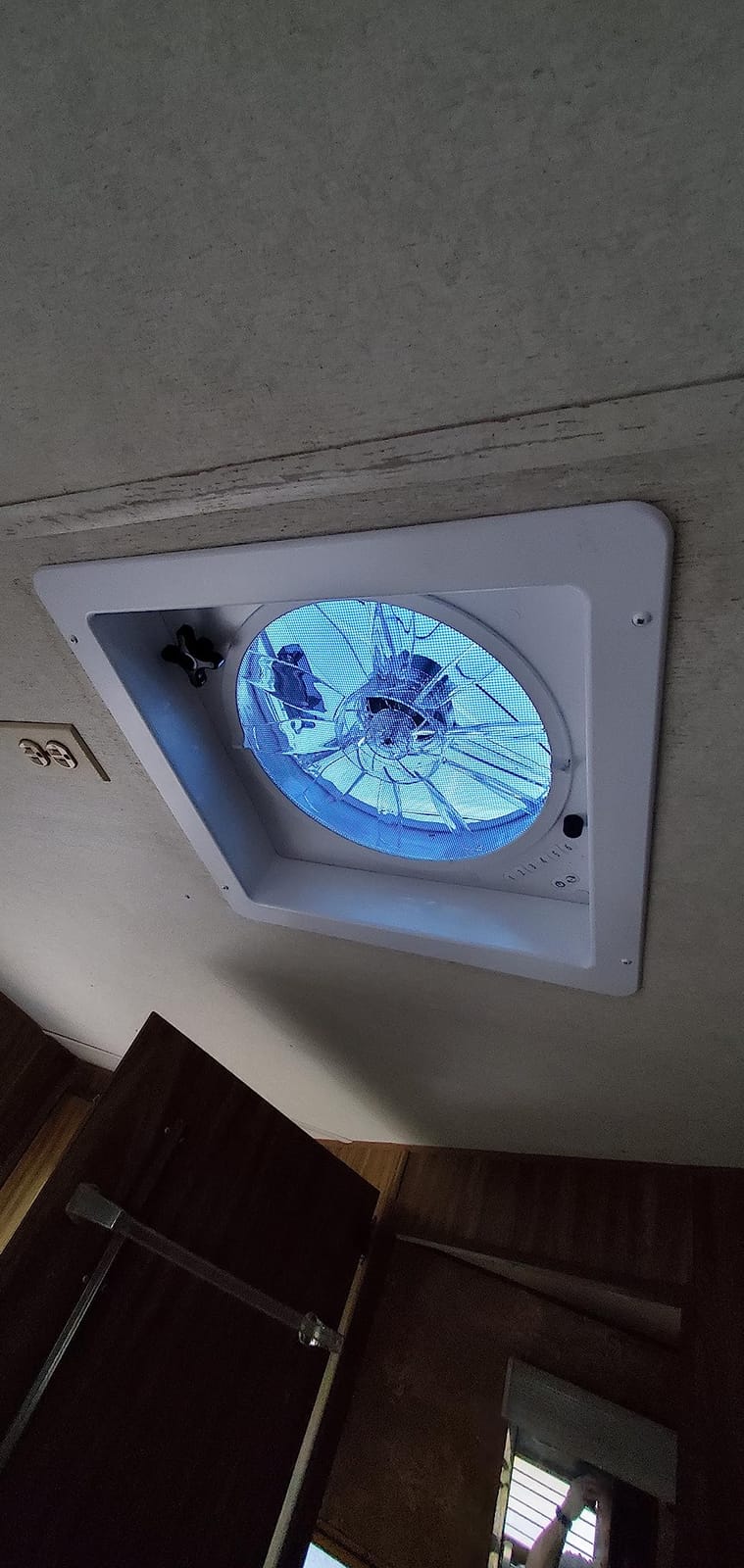
The specification is unusual in places. It runs 17 blades at 5 inches, spins at 1350 rpm, and is rated at 1100 CFM. It fits roofs from 1.16 to 5.5 inches thick and standard 14 by 14 inch ceiling openings, which is the widest roof-thickness range of any unit in this list.
The clear blades let daylight through while the smoke dome filters harsh sun, and the removable screen cleans from inside without opening anything up. Screws and a garnish ring are included in the box.
The widest fit range, which is genuinely useful
Roof thickness from 1.16 to 5.5 inches covers essentially any panel van ceiling, including ribbed and reinforced roofs that would rule out the caqeg unit. If you do not know your roof thickness or it is unusual, that flexibility removes a whole class of buying risk.
The 1100 CFM rating also puts it near the top of the airflow figures in this roundup, which is useful if your priority is clearing a wet van quickly after a shower rather than running quietly.
Why it is last
At 4.2 stars from 780 ratings it has the widest spread of any product here, with 81 percent at four stars or better but a 10 percent one-star rate. The complaints cluster on the mechanics: the lid crank is described as cheap and flimsy, in two cases failing soon after install, and the speed-change buttons can stick unless you let each transition finish.
Other reported issues include the lid rattling as it closes unless moved very slowly, the mesh screen pushing up into the blades if touched, and rain covers needing bracket modification to fit. If you want the best hardware, this is not it. If you want the most speed settings and the widest fit range, it is.
Do You Even Need a Roof Vent Fan?
It is a fair question and the forums ask it constantly. The short answer is that a roof vent fan does something no other fan in the van can do: it changes the air pressure inside the cabin. A 12V box fan moves air around inside a sealed space, which improves comfort on your face but lowers nothing and raises nothing. A roof vent fan moves mass out through the roof.
That matters most in three situations. Heat pools at the ceiling in a metal box, so roof extraction removes it at the source rather than pushing it around your head. Moisture from cooking, showering and sleeping accumulates the same way, and moving it out is what keeps mould off the interior panels. And on a cool night, a reversible fan drawing in 15C air is a cooling system that costs a few amps.
On a van you use as a weekend camper with a decent roof vent already fitted and a cracked window at the far end, a roof fan is optional. On a full-timer in a hot or humid climate who cooks and showers inside, it is the single highest-impact electrical item you can fit after your house bank.
Cut-Out Size: The One Decision You Cannot Undo
Measure before you order anything. The standard North American roof opening is 14 by 14 inches, which is 356 by 356mm, and most of the powered units in this roundup are built for it. Euro-spec vans and many European campers use a 400 by 400mm aperture instead, which is close to 16 by 16 inches and will not accept a 14 inch unit without modification.
The budget units are where sizing bites. The Ventline CW001 needs a 14.25 inch rough opening and the Heng’s 71112A needs 14.5 inches, neither of which matches a standard 14 inch cut-out. The RVLOVENT fits the standard 14 by 14 inch family but its interior flange usually needs trimming on a sloped roof.
Roof thickness is the second measurement. The caqeg unit only fits roofs between 1-1/4 and 2-1/4 inches thick, which rules out some ribbed van ceilings. The Starvent accepts 1.16 to 5.5 inches, and the 2012RVAccessories units fit the standard opening with no thickness restriction stated.
Get a tape measure, check the opening and the thickness, and confirm your model fits both before the hole saw comes out.
MaxxFan Deluxe vs MaxxFan Plus vs the Budget Tier
The MaxxAir MaxxFan Deluxe is better than the Dometic Fan-Tastic style of sensor-driven fan for van use because it runs its lid up in rain instead of shutting down, which clears humidity continuously instead of pausing. It also reverses for intake, has ten speeds and a thermostat, and it is a single all-in-one unit with no separate cover to buy. The sensor-driven approach wins on unattended rain protection, not on airflow.
That head-to-head is the closest call in this category. Both formats solve the same core problem, both use a reversible 12V motor in a 14 inch opening, and both run around 4.5 to 4.6 stars from well over a thousand owners. The tie-breaker is your weather and your routine.
Against the budget tier, the difference is control and flexibility rather than raw capability. The RVLOVENT moves up to 1000 CFM with reversible airflow and ten speeds, which is closer to the premium units than most people expect. What you give up is the powered lid, the rain sensor, the remote and the thermostat. For a manual-lift buyer with a reliable house bank, that is a reasonable trade.
Installing a Roof Vent Fan Without Leaking
A leak after cutting a roof is the expensive mistake, and the most-engaged installation content on the search results is a video showing exactly how it goes wrong. The sequence that works is straightforward: mark and cut, prime the exposed edges, seal, mount, then wire through a correctly rated fuse.
Prime the cut edges before anything else. Raw aluminium or steel cut edges start corroding inside the sandwich panel and the corrosion spreads under the flange where you cannot see it. A rust-inhibiting primer on every cut face, including the inner lip of the opening, stops that entirely.
Then seal properly. Butyl tape laid continuously along the flange face, a bead of suitable sealant over the tape, and every screw hole filled. Build logs from experienced converters show this order consistently, using a primer first and then working through tape and sealant to the fasteners.
Electrically, match a slow-blow fuse to the actual draw. The RVLOVENT ships with a built-in fuse and extra 5A slow-blow fuses in the box, which is a useful template. Owners running multiple fans stress that a 5A maximum draw is what makes the wiring job manageable, so plan your cable gauge and your fuse rating before you run the cable.
Noise, Power Draw and Battery Life
Noise is the most repeated complaint in owner threads about roof vent fans, and it is worth planning for rather than discovering at 11pm. The figures published across this group range from a 25 dB brushless rating on the 2012RVAccessories F36AR, through 45 dB on the RVLOVENT, to 59.5 dB on the Starvent. Treat the manufacturer numbers as directional and buy on the assumption the real figure is higher, particularly in wind.
The trick almost nobody uses is running the fan at speed two rather than speed one. Most owners report that speed one is a low rush of noise that is audible across a sleeping cabin, while speed two moves meaningfully more air for a similar noise profile. Raising the speed slightly often beats the lowest setting.
On power, the numbers are friendlier than most people expect. A 200Ah house bank holds roughly 1600Wh usable, so a 3.6 watt fan running eight hours costs about 29Wh, under two percent of the bank. A 25 watt fan for the same eight hours costs 200Wh, roughly 13 percent. A 60 watt fan on high overnight is where people notice the bank sagging.
Most of the units here carry a timer or a thermostat for exactly this reason. Setting the thermostat to auto, or a 120-minute timer for a shower clear-out, keeps the high-draw periods short and leaves the low-draw overnight running affordable.
Condensation and Mould Control Through the Year
Condensation is the reason ventilation matters most in winter, and it is the reason cutting extra holes is not automatically good. Warm humid air inside a cold van meets a cold metal ceiling and drops water on your head and on the insulation. Ventilation only manages that, it cannot prevent it.
The routine that works has three parts. After cooking or showering, run the fan on high speed for 20 to 30 minutes with a low window cracked at the opposite end to give the air somewhere to go. Overnight, run it at the lowest speed that still moves air, or use a timer. On waking, cross-ventilate fully with both ends open for a few minutes.
Pair your powered fan with passive low-level vents rather than replacing them. One low vent and one high vent gives you the stack effect even with the fan off, which is what carries ventilation while you drive or when the fan is off. Fit insect mesh on both or insects arrive the first warm evening, and keep the low vent clear of any LPG appliance exhaust, since LPG is heavier than air and collects low.
The seasonal pattern is straightforward: daytime exhaust on the hottest hours of summer, intake on cool nights, and continuous low-speed overnight ventilation through the cold months to keep surfaces dry.
Frequently Asked Questions
What is the best roof vent fan for a van?
The MaxxAir MaxxFan Deluxe is the best roof vent fan for most vans because it combines a vent, fan and rain cover in one unit, runs a reversible 10-speed motor with a thermostat, and opens and closes electrically by remote. It fits the standard 14 by 14 inch roof opening that most Sprinter, Transit and Promaster conversions have.
Is a roof vent fan worth it in a camper van?
A roof vent fan is worth it if you sleep in the van in hot or humid conditions, cook or shower inside, or camp away from site power. It removes heat and moisture at the roof rather than circulating it, which prevents condensation and mould. For weekend use on a van with an existing roof vent and window ventilation, it is optional.
What size hole do I cut for a camper van roof vent?
Most US-market vans take a 14 by 14 inch opening, which is 356 by 356mm. Euro-spec vans commonly use a 400 by 400mm aperture instead. Check your model before cutting, because budget units in this roundup need 14.25 or 14.5 inch rough openings and some only fit roof thicknesses between 1-1/4 and 2-1/4 inches.
Will a roof vent fan drain my camper battery?
Only at high settings. A 3.6 watt fan running eight hours uses about 29Wh, under two percent of a 200Ah house bank, while a 25 watt fan uses roughly 13 percent. The practical approach is a thermostat or a 60 to 240 minute timer so the high-draw periods stay short.
Can you run a roof vent fan in the rain?
Yes, but it depends on the design. The MaxxFan Deluxe holds its lid up in rain and keeps extracting. Sensor-driven units like the MaxxFan Plus and the 2012RVAccessories models close the lid automatically at the first drops. Units with a manual crank are left running lid-down as a ceiling fan instead.
Are roof vent fans loud enough to keep you awake?
Noise is the most common owner complaint. Published figures in this roundup run from 25 dB on the brushless 2012RVAccessories F36AR through 45 dB on the RVLOVENT to 59.5 dB on the Starvent. Running speed two instead of speed one usually moves more air at a similar noise level.
Do I need one roof vent fan or two?
One fan is enough for most vans. Place it near the centre of the roof, or slightly forward of centre away from the shower, so heat and moisture have a clear path out. Add a second only on a long van with a sleeping area far from the galley, where a single fan struggles to clear the far end.
What is the difference between a roof vent fan and a 12V cabin fan?
A cabin fan circulates air inside the van without changing air pressure, which cools you but lowers nothing. A roof vent fan moves mass out through the roof, removes heat and moisture at the source, and reversible models pull cool night air back in. It cannot be replaced by a cheaper box fan.
Which Roof Vent Fan Should You Buy?
Measure your roof opening first, because that decision is the only irreversible one. On a standard 14 by 14 inch aperture, the MaxxAir MaxxFan Deluxe is the strongest all-round buy and the reason most owners in this category stay with one brand for years. The MaxxFan Plus is the smarter pick if your forecast turns wet and you would rather not get up to close a lid.
If you want most of the capability for considerably less, the RVLOVENT at 4.6 stars from 1068 ratings does reversible airflow across ten speeds at 18 watts, and it is the one I would tell a value-focused builder to buy. The 2012RVAccessories F36AR takes the quiet-sleep slot with its brushless motor, and the caqeg unit is the cleanest drop-in replacement if your roof thickness fits.
Whichever you pick, prime the cut edges, seal with butyl tape and sealant, fill every screw hole, and match a slow-blow fuse to the actual draw. Those four steps are what keep a roof vent from becoming a leak. That is our 2026 roundup of the best vent fans for camper vans, and the wrong size is the only mistake here you cannot take back.