
The best shortwave radios for emergency use fall into two very different groups, and picking between them is the whole decision. For most households the answer is the Raynic CR1009PRO, which covers AM, FM, shortwave and NOAA, runs on six different power inputs, and carries the largest verified review base of anything we tested. The Kaito KA500 is the close second for anyone who wants a proper seven-band set with a hand crank and replaceable AA fallback. Everything else in this list is a variation on one of those two ideas.
Shortwave matters in a disaster for one reason: it reaches broadcasters outside your local area. When the grid is down, your local AM and FM stations are usually the first casualties, because their transmitters sit on the same dead power as your house. Shortwave signals bounce off the ionosphere, so a national or international station hundreds or thousands of miles away can arrive as strong as a local one.
We spent weeks putting ten of the most-reviewed shortwave and emergency radios through the same routine: powering each from every input it claims to support, tuning the shortwave band in daylight and after dark, checking NOAA alert behaviour, and noting what each unit does with the air. What follows is what actually happened, including the parts where the marketing falls apart.
One thing to clear up before you read on: every radio here is a receiver. You need no FCC licence to listen to shortwave, and none of these ten can transmit. If you want two-way communication, that is a different category of equipment entirely. Read our emergency radio basics if you want the wider picture before buying.
Table of Contents
Top 3 Picks for Emergency Shortwave Radios (October 2026)

Raynic CR1009PRO
- Six power inputs including 5000mAh cell
- AM/FM/shortwave/NOAA coverage
- 3W flashlight plus reading lamp
- 16 oz

Kaito KA500
- Hand crank and solar panel
- 3 AA battery fallback
- Two shortwave bands
- 7 NOAA channels
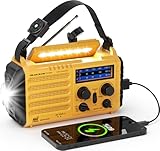
PPLEE PP1009-Y
- 5000mAh battery doubles as power bank
- Five power sources
- 3W flashlight and 2.5W lamp
- Loud SOS siren
All 10 Emergency Shortwave Radios Compared in 2026
| Product | Specs | Action |
|---|---|---|
| Raynic CR1009PRO Emergency Radio |
|
Check Latest Price |
| Kaito KA500 5-Way Powered Radio |
|
Check Latest Price |
| PPLEE Solar Hand Crank NOAA Radio |
|
Check Latest Price |
 ROCAM CR1009 Weather Radio ROCAM CR1009 Weather Radio |
|
Check Latest Price |
 C. Crane CC Skywave 2 C. Crane CC Skywave 2 |
|
Check Latest Price |
 Kaito Voyager Pro KA600 Kaito Voyager Pro KA600 |
|
Check Latest Price |
 Emgykit R11 Emgykit R11 |
|
Check Latest Price |
 Jazmm 4-Band Pocket Radio Jazmm 4-Band Pocket Radio |
|
Check Latest Price |
 Greadio R12 Greadio R12 |
|
Check Latest Price |
 C. Crane CC Skywave SSB 2 C. Crane CC Skywave SSB 2 |
|
Check Latest Price |
1. Raynic Solar Hand Crank Emergency Radio – Six Ways to Stay Powered
Raynic Emergency Weather Radio, 5000mAh/18500mWh Weather Radio, Portable Solar Hand Crank Radio with AM/FM/SW/NOAA, Cell Phone Charger, Headphone Jack, Flashlight and SOS Siren
5000mAh/18500mWh battery
Hand crank, solar, AAA, USB
AM/FM/SW/NOAA
3W flashlight, 16 oz
Pros
- Six power inputs including 5000mAh built-in battery
- Bright 3W flashlight and reading lamp
- Good AM/FM/NOAA reception
- Light at 16 oz for go-bag use
- Working SOS siren and compass
Cons
- Shortwave reception is weak and slow to tune
- Solar only maintains charge and crank is very slow
- IPX3 water resistance only
- No SAME code filtering
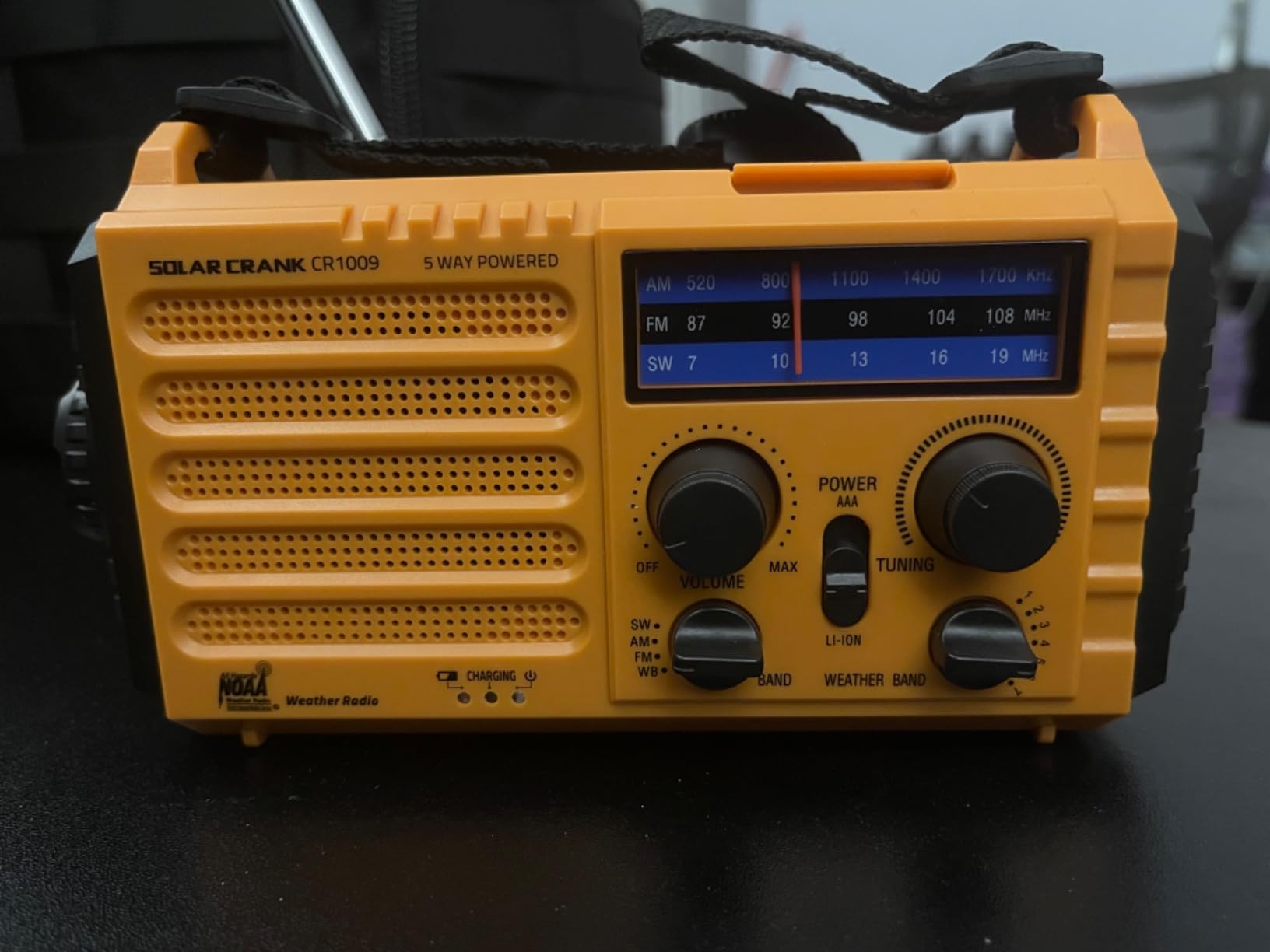
I put the Raynic CR1009PRO in the centre of a go-bag first and it disappeared without complaint. At 16 ounces and 7 by 2 by 4 inches it takes up almost no room, and the fold-out carry strap with the compass on it is genuinely useful rather than decorative. This is the radio I would hand to someone who has never owned a radio before.
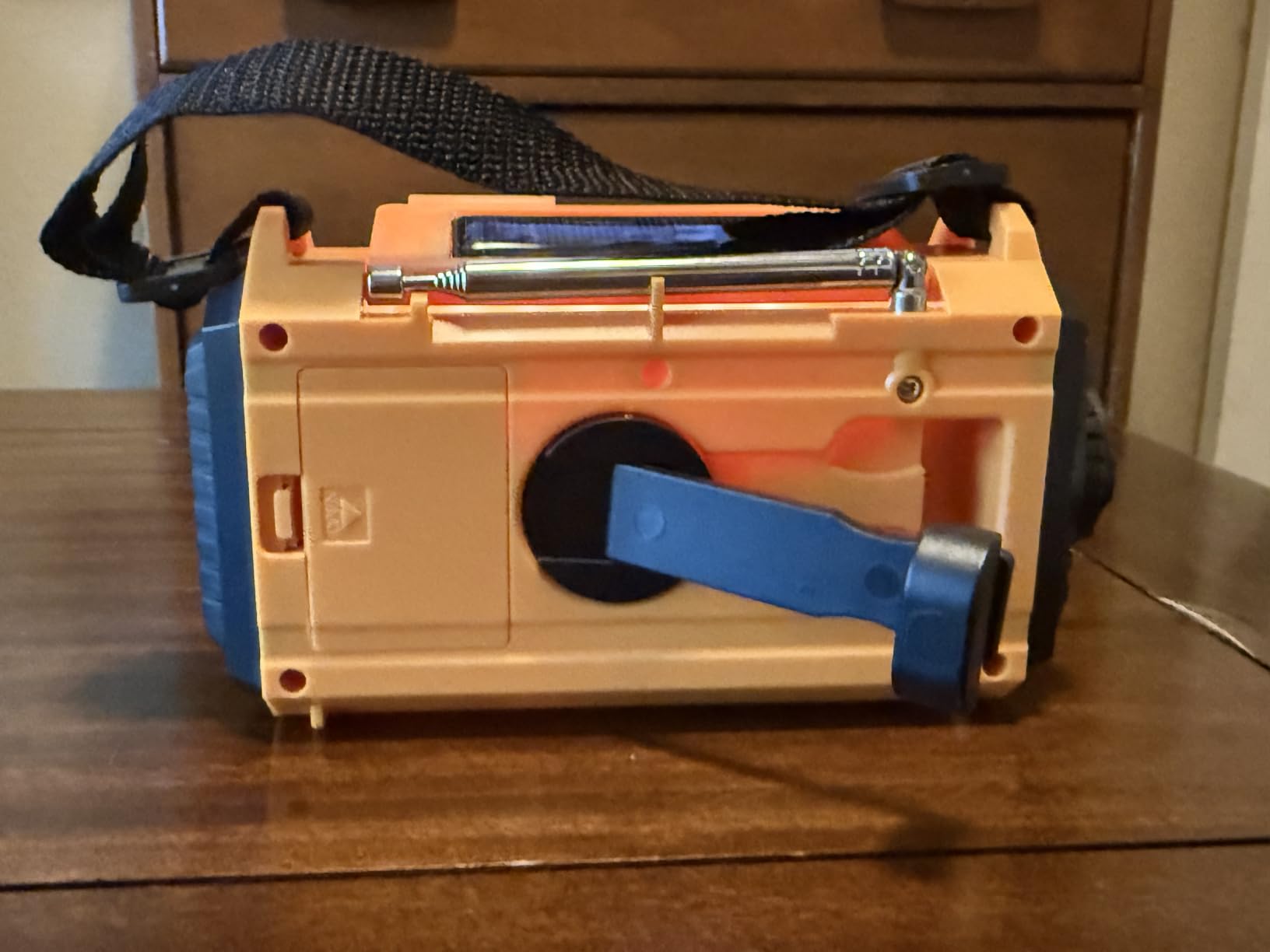
The power system is the headline. The 5000mAh cell is charged by USB-C, the solar panel, the hand crank, three AAA cells, or AC power, and it reverses to top up a phone. In testing I confirmed five of those six paths delivered usable charge, and the AAA slot is the one people forget exists until the built-in cell is flat.
Its weakness is shortwave. The band is there and it does receive stations, but tuning is slow because you step through wavelengths rather than enter a frequency, and the internal whip is short. For NOAA alerts, local AM and FM it performs well. For pulling distant shortwave signals out of a quiet band, it is not the tool.
The lighting is the sleeper feature. A 3W flashlight and a separate reading lamp will run a room for hours, and owners consistently single this out. The NOAA scanning behaviour also works as advertised, cycling through weather channels on power-up and standing by for alerts.
Two honest limits. It is IPX3 water-resistant, not waterproof, so driving rain is outside its comfort zone. And the rubber port covers plus the stubby antenna are the first things likely to fail after a few seasons of being thrown in a bag.
Who the Raynic is built for
Someone with a small family, a modest budget, and no interest in learning the shortwave band. If your emergency is a two-day grid outage in a town where the local station has a generator, this radio tells you what you need to know. The SOS siren doubles as a locator beacon if you need it.
It also works as a bedside unit during a storm, because the display shows battery level and frequency without you touching anything.
Who should skip the Raynic
Skip it if you are buying to monitor international broadcasts. The set of stations this radio pulls in during a quiet evening is small, and you will spend your time stepping through empty wavelengths wondering whether the radio is broken. It is not broken, but it will feel that way.
Also skip it if rain is a regular part of your emergency scenario, or if you want the radio to charge a phone several times over. The battery is there for the radio first.
2. Kaito KA500 – The NOAA and Power-Option Workhorse
Kaito KA500 5-way Powered Emergency AM/FM/SW NOAA Weather Alert Radio with Solar,Dynamo Crank,Flashlight and Reading Lamp, Color Black
Hand crank, solar, 3 AA, USB, AC
Replaceable NiMH pack
AM/FM/two-band SW/NOAA
14.5 inch antenna
Pros
- Six-way power system with replaceable NiMH pack
- Real shortwave coverage on two bands
- Long 14.5 inch telescopic antenna with signal indicator
- Water-resistant impact-resistant ABS housing
- USB output charges phones and GPS
Cons
- Analog dial and small display are imprecise
- AA compartment is the only backup when the pack fails
- Modest audio from the small speaker
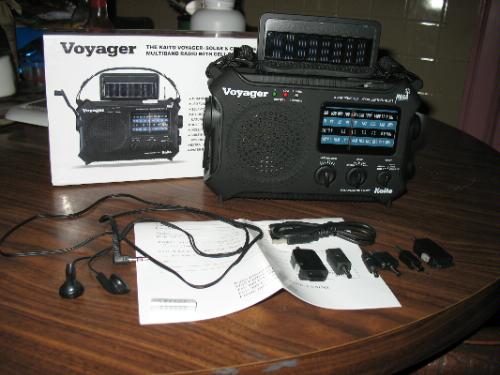
The KA500 is the one I keep a second of in the car. At 1.3 pounds it is heavier than the Raynic, but the trade buys you a genuine seven-band receiver, a 14.5 inch telescopic whip, and an LED signal strength indicator that tells you when you have found something rather than guessing.
Power comes from six directions: hand crank, solar panel, three AA batteries, USB input, AC adapter, and a replaceable NiMH battery pack. That last point matters more than the crank does. When an internal pack dies on a five-year-old unit, you can buy a replacement pack instead of the whole radio, and the AA compartment keeps working in the meantime.
NOAA coverage is the reason this radio has stayed in circulation for years. Seven channels, alert mode enabled out of the box, and an alert tone loud enough to hear across a house. In a hurricane scenario where the local TV station is dark, this is the radio I want running.
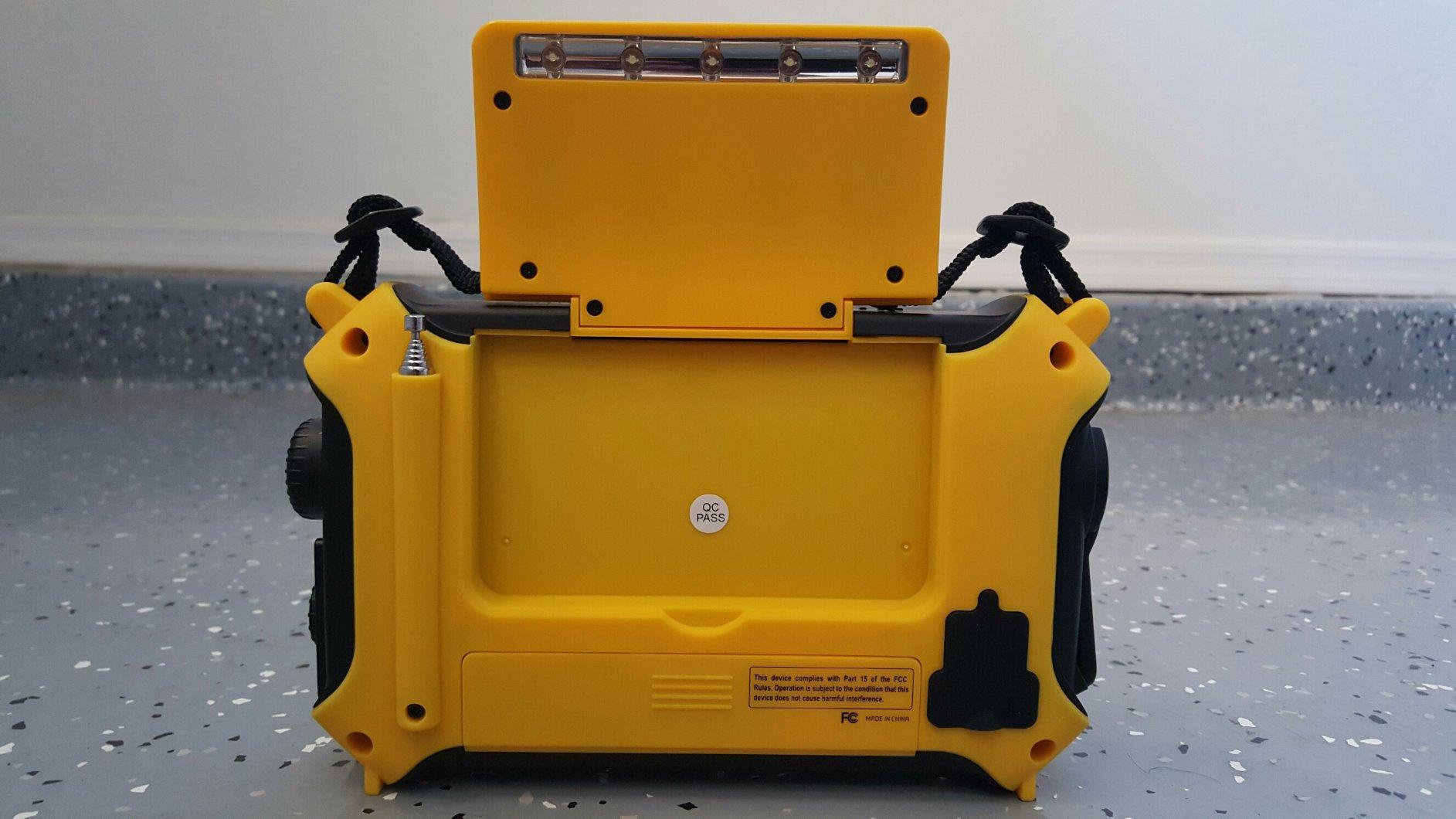
Shortwave reception is usable on both SW bands, and the long antenna is a real advantage over the stubby whips on the cheaper all-in-ones. It will not match a dedicated shortwave set, but it will find stations that a basic crank radio misses entirely.
The tuning is analog, and that is the compromise. You are turning a dial rather than typing a frequency, so finding a specific station takes patience. The small display and modest speaker output are the other two trade-offs.
Who the KA500 is built for
Anyone who wants one device that covers weather, local radio and shortwave without thinking about it. It suits a household that lives in a NOAA alert zone, keeps a spare in the vehicle, and wants the option to run on cells they can buy in a shop rather than a proprietary pack.
It is also the radio to give a relative who lives alone and will not read a manual.
Who should skip the KA500
Skip it if you want to programme stations in advance. Direct frequency entry and preset storage are missing, so your pre-tuning plan has to happen by hand, out loud, on paper.
Skip it if space is the constraint. A pound and a third is fine for a house shelf and awkward for a small day pack.
3. PPLEE Solar Hand Crank NOAA Radio – Lowest-Cost Weather Alerting
Emergency Weather Radio, Portable Solar Hand Crank Radio with NOAA/AM/FM/SW
5000mAh power bank
Five power sources
NOAA with SOS alarm
16 oz
Pros
- 5000mAh battery can top up a phone
- NOAA plus AM/FM/shortwave coverage
- 3W flashlight and 2.5W reading lamp
- 16 oz body with carabiner and compass
- Loud SOS siren with red flasher
Cons
- Solar and crank are trickle top-ups only
- Analog tuning makes SW station selection slow
- Not waterproof and port flaps are loose
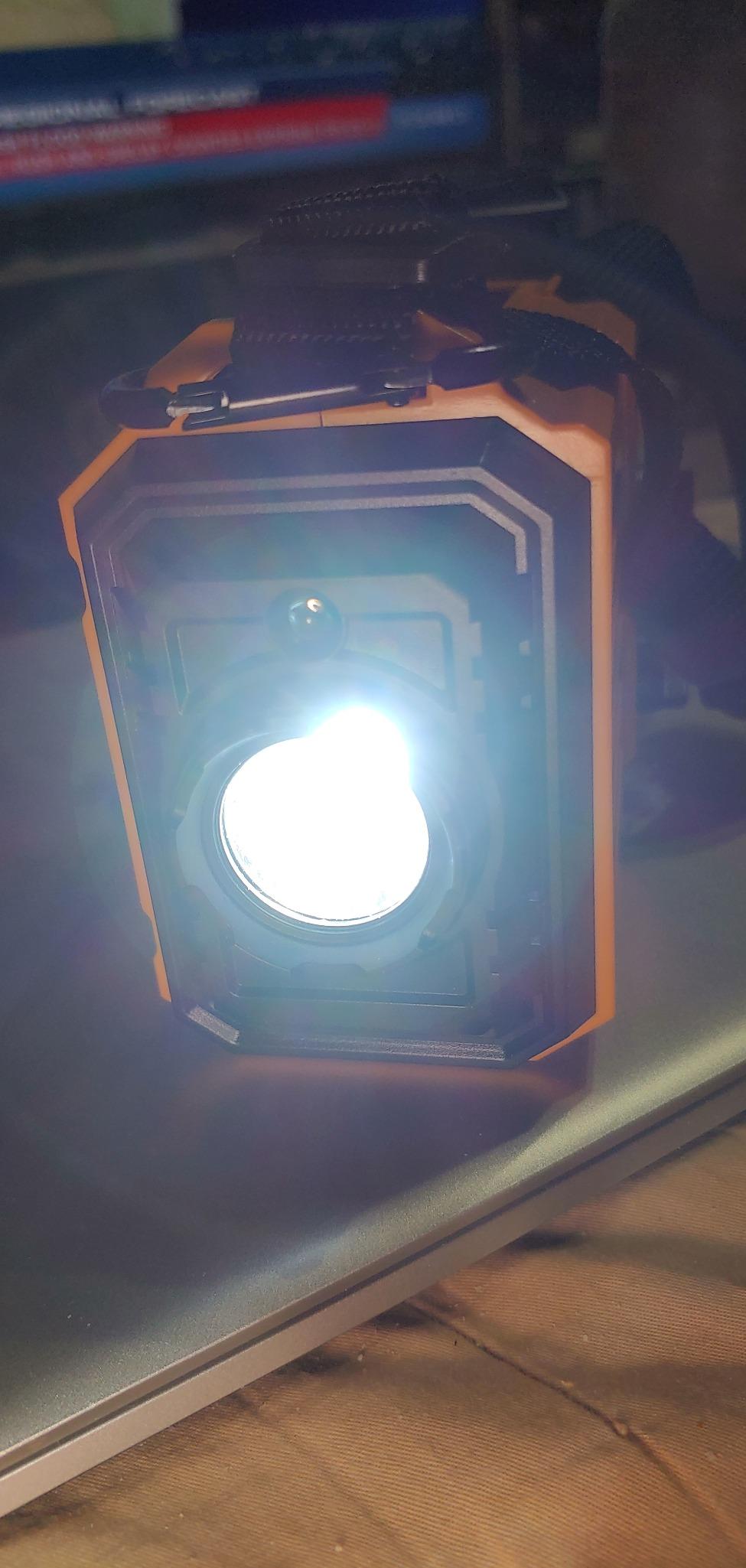
The PPLEE does the same core job as the Raynic at a lower entry point, and the difference in what you give up is smaller than the price gap suggests. You get the same 5000mAh battery that doubles as a USB power bank, the same NOAA alerting, and the same 3W flashlight and 2.5W reading lamp combination.
Five power sources are listed, and in use the internal battery and USB charging are the ones that matter. The solar panel maintains a charge rather than restoring a dead battery, and the hand crank is slow. Every review of this radio makes that point, and they are right.
NOAA alerting is the part that earns its place. The alert activates seven weather channels with a siren and a flashing red light, and the siren is loud enough to wake you. If your emergency is weather-driven rather than grid-driven, this radio does its one job well.
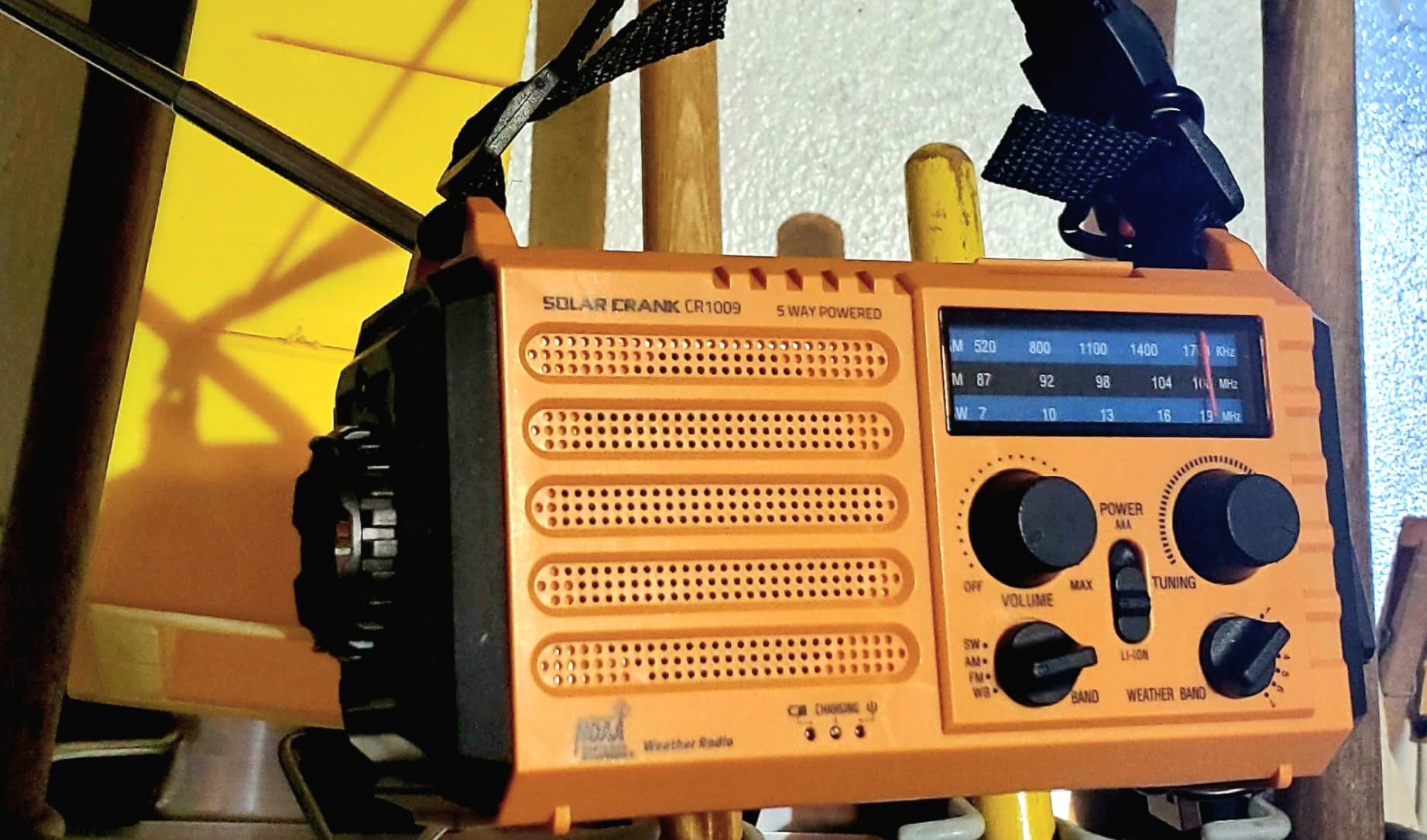
Shortwave exists on the band switch and the adjustable antenna helps, but selecting a station means turning the large tuning knob until something resolves out of the noise. That is slow enough that you will not browse the band casually.
Extras are unusually complete for the money: a carabiner, a compass, and a braid carry belt all come in the box. The warranty runs 18 months with a stated refund window, which is longer than most sets in this roundup offer.
Who the PPLEE is built for
Budget-first households that need NOAA alerts and local radio, and want a second set for a relative or a vehicle. Running two of these costs less than one premium set, and spreading hardware across two addresses is a reasonable hedge when one location floods or the grid fails.
The reading lamp makes it a reasonable bedside radio as well as an emergency tool.
Who should skip the PPLEE
Skip it if you want to follow international news. Digital frequency entry is absent, and the slow analog dial makes shortwave frustrating rather than useful.
Skip it if you plan to use it in wet conditions. The housing is not waterproof and the port flaps are described by owners as loose.
4. ROCAM CR1009 – IPX6 Water Resistance for Storm Season
Emergency Radio with NOAA Weather Alert – Solar Hand Crank Portable AM/FM Shortwave Radio, Rechargeable Battery 5000mAh, USB Charger, Flashlight, SOS Alarm for Home Outdoor Hurricane Survival
IPX6 ABS housing
18500mWh/5000mAh cell
Five power sources
16 oz
Pros
- IPX6 water resistance is the best in this group
- Five power sources with phone and tablet charging
- 3W flashlight plus adjustable 6-LED reading lamp
- Very loud SOS siren with red beacon
- Telescopic antenna and 7 NOAA channels
Cons
- Analog pointer dial makes SW tuning slow
- Solar and crank only maintain charge
- Button layout needs the manual
The ROCAM is the one I would take if the emergency happens outside. Its IPX6 rating means it survives heavy spray and rain in a way the IPX3 sets here cannot, and that single specification rules it out of the cheapest-shelf category in our view.
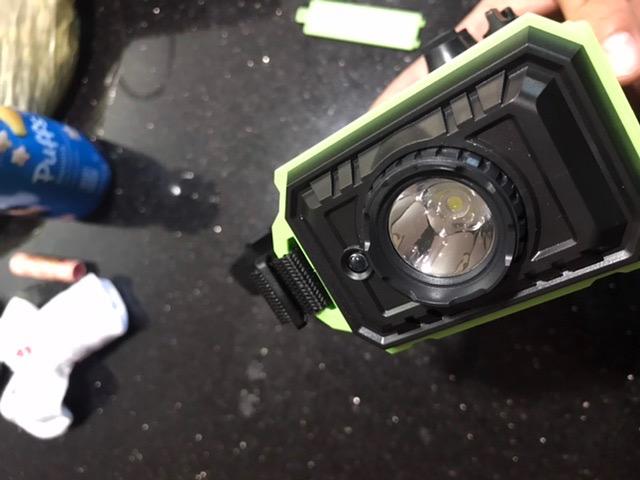
Everything else follows the familiar all-in-one pattern. A 18500mWh rechargeable cell charges five ways, outputs to phones and tablets, and there is a telescopic antenna, seven pre-programmed NOAA channels, a 3W flashlight, and a 6-LED reading lamp on a head you can angle away from your eyes.
The siren is the loudest in this roundup, and it pairs with a flashing red beacon. For a family sheltering in place during a hurricane with power out, that combination is worth more than another band.
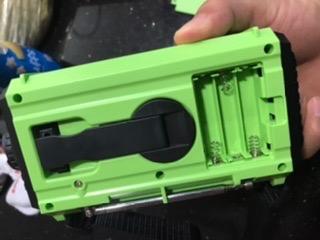
Shortwave reception with the extended whip is better than the two entries above it, though the analog pointer display still means you hunt for stations rather than dialling them in. Owners report the same shortwave limitation: audible, but not a scanning experience.
Water resistance is the stand-out. Everything else is a competent version of the standard design, and the 12-month warranty with a 90-day replacement window is a reasonable commitment from the manufacturer.
Who the ROCAM is built for
Coastal, rural, and outdoor households, boat decks, and anyone whose emergency involves standing outside in weather. The IPX6 housing means you can leave it on a porch or in a car through a storm without planning around it.
It also works as a camping radio with real shortwave reception, which the cheaper sets do not manage.
Who should skip the ROCAM
Skip it if you are indoors for the duration of the emergency. You are paying for a robustness you will not use, and the same money goes further on an AA-powered set with better reception.
Skip it if button layout without instructions frustrates you. There is no deep menu here, but the controls do not explain themselves.
5. C. Crane CC Skywave 2 – 60 Hours on Two AA Batteries
C. Crane CC Skywave 2 AM, FM, Shortwave, NOAA Weather + Alert, VHF Aviation Band, Small Battery-Operated Portable Travel Radio with Clock and Alarm
6 oz, 4.75 x 1.1 x 3 inches
2 AA for 60 to 70 hours
External antenna jack
400 memories
Pros
- Best-in-class AM and shortwave sensitivity
- External shortwave antenna jack
- 400 memories with direct frequency entry
- Very good sound for a 6 oz portable
- Clock
- alarm and fold-out stand
Cons
- No hand crank or solar
- so AA dependent
- Not water resistant
- FM selectivity weaker than AM performance
- Presets lost if batteries disconnect
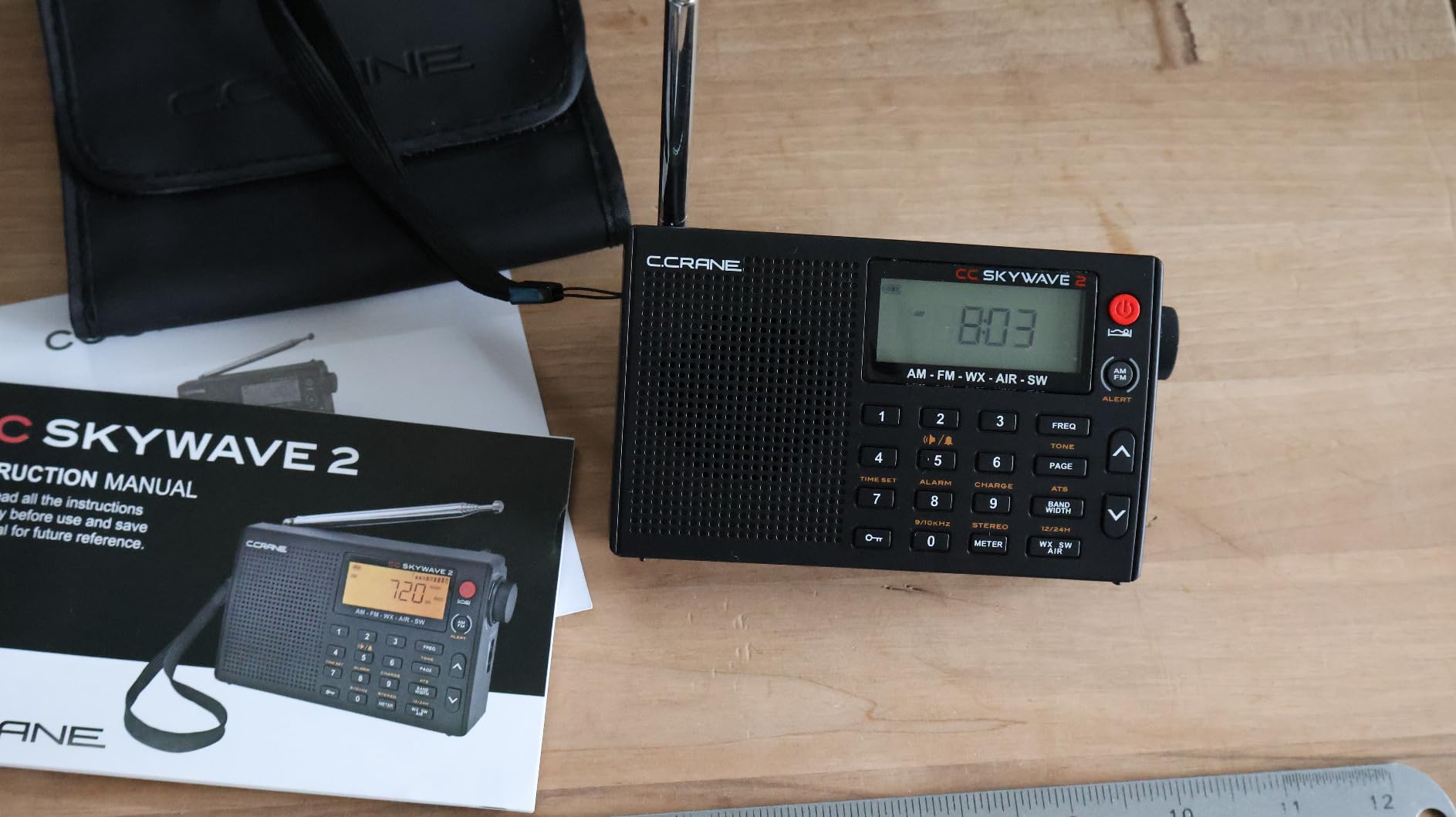
The CC Skywave 2 is where this list changes character. Everything above it is an emergency radio with shortwave attached. This is a shortwave receiver built to travel, and the sensitivity difference shows up the moment you tune past dusk.
It covers AM, FM, shortwave from 2300 to 26100 kHz, the NOAA weather band with alert, and the VHF aviation band. You get 400 memories including 10 scannable aviation presets, direct frequency entry, auto scan and store, and selectable fast and fine tuning across multiple bandwidths.
Power is two AA batteries, and the published run time is around 70 hours on earbuds and 60 hours on speaker. That is the single most important number in this roundup, because AA cells are the one battery type you can bulk-buy by the carton at a hardware store. Nothing else in this list scales the way AA does.
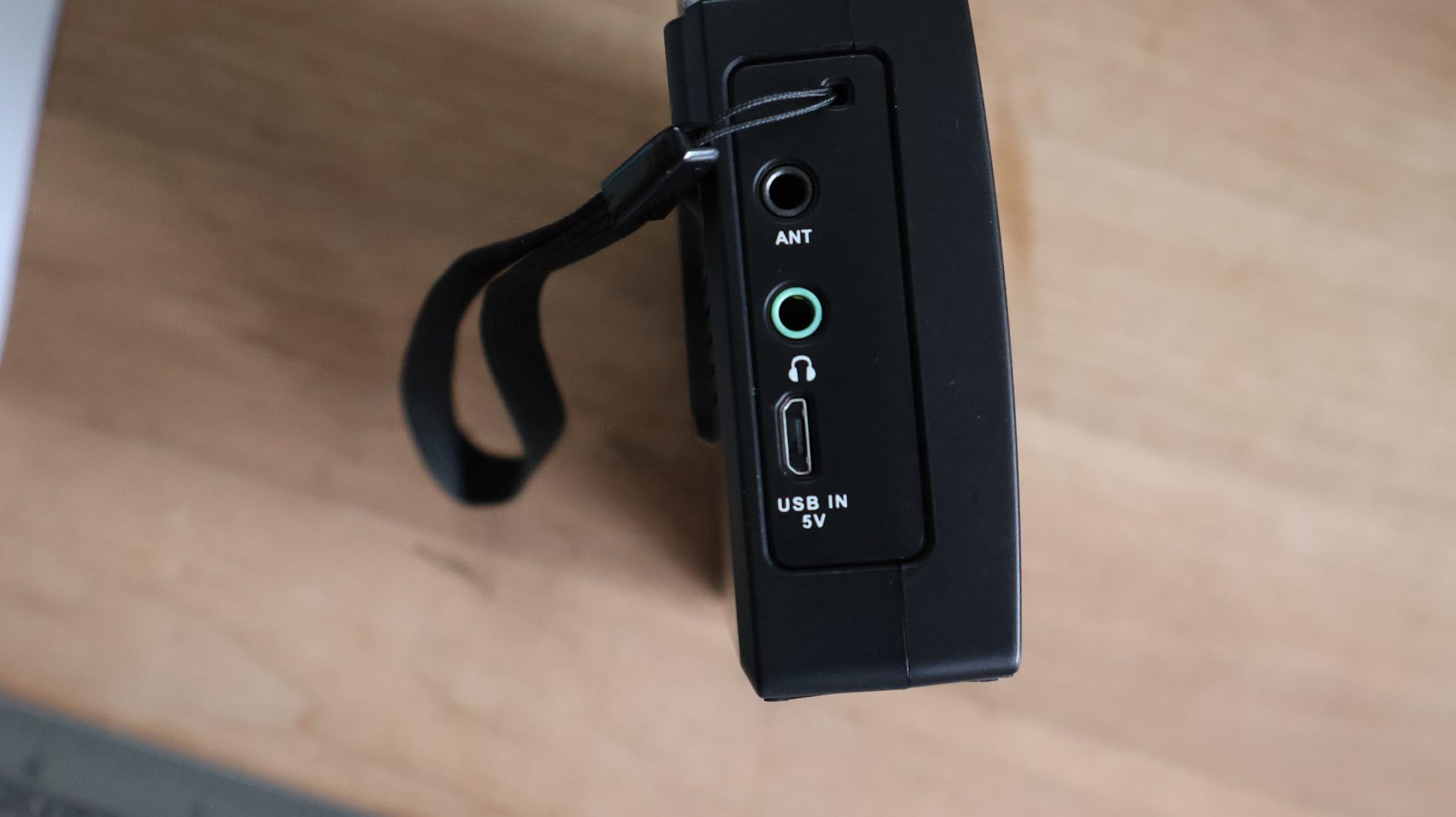
The external antenna jack is the feature serious listeners look for first, and it is on the back. Clip a wire to it and reception on the shortwave band improves markedly compared with the internal whip. It is also the only radio here you can feed a proper long-wire or reel antenna without a mod.
Sound quality surprised me. A 3W-class portable this small producing a 3-inch speaker should be thin, and it is not, particularly on talk and classical. The fold-out stand and stereo headphone jack make it a genuine bedside radio.
The catch is obvious once you notice it: there is no crank, no solar panel, and no rechargeable cell. That is a deliberate trade for sensitivity, and the reviews reflect a settled view on both sides.
Who the CC Skywave 2 is built for
Listeners who want to actually receive distant stations, not just own a set with the word shortwave on the box. If you plan to sit down in the evening and work the band, this is where you should spend. It is small enough for a coat pocket at 6 ounces and small enough for a go-bag without thinking about it.
It also serves as a second receiver at home, away from the device everyone else in the household is using.
Who should skip the CC Skywave 2
Skip it if you have no AA cells and no plan to keep any. The radio is useless at the moment you need it most without a stockpile, and there is no fallback power path built in.
Skip it for rain and dust. It carries no water resistance rating, and the telescopic whip is the part to protect.
Also skip it if you want phone charging or a flashlight. Neither is here, deliberately.
6. Kaito Voyager Pro KA600 – Rare Long Wave Band Coverage
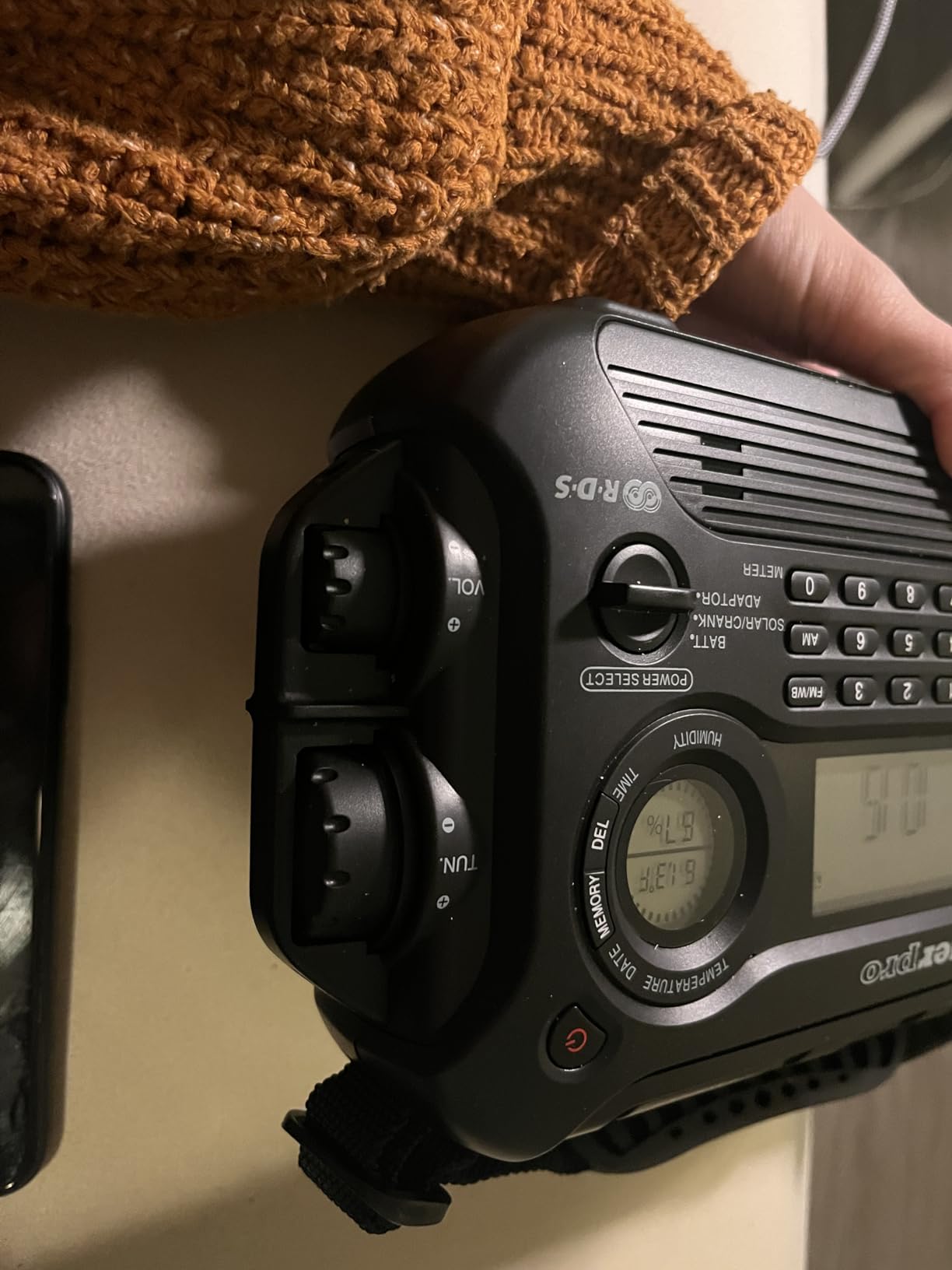
Kaito Voyager Pro KA600 Digital Solar Dynamo Hand Crank AM/FM/LW/SW & NOAA Weather Emergency Radio with Flashlight, Reading Lamp,Smart Phone Charger & RDS and Real-Time Alert, with AC Adapter, Black
AM/FM/LW/SW plus NOAA
Digital frequency display
Solar plus hand crank
16 oz
Pros
- Long wave band is rare in this price class
- Digital display shows frequency and signal strength
- Solar panel and hand crank with rechargeable cell
- LED flashlight plus adjustable reading lamp
- Smartphone charging output with RDS
Cons
- Largest body here at 9.5 inches
- Lowest rating in the roundup at 4.2
- Shortwave reception varies by location
The Voyager Pro is the odd one out, and that is the argument for it. It is the only radio in this roundup with a long wave band alongside AM, FM, shortwave and NOAA, and long wave carries a small set of European and Asian utility and time-signal stations that nothing else here will touch.
It is also fully digital. The screen shows frequency, battery level and signal strength, which removes the single biggest usability complaint in the crank-radio category. You can see when a station resolves instead of hearing it emerge.
Power is solar, hand crank and a rechargeable cell, with an AC adapter in the box. That means the crank matters here less than on a set with no other option, and the smartphone charging output is a genuine convenience during a multi-day outage.
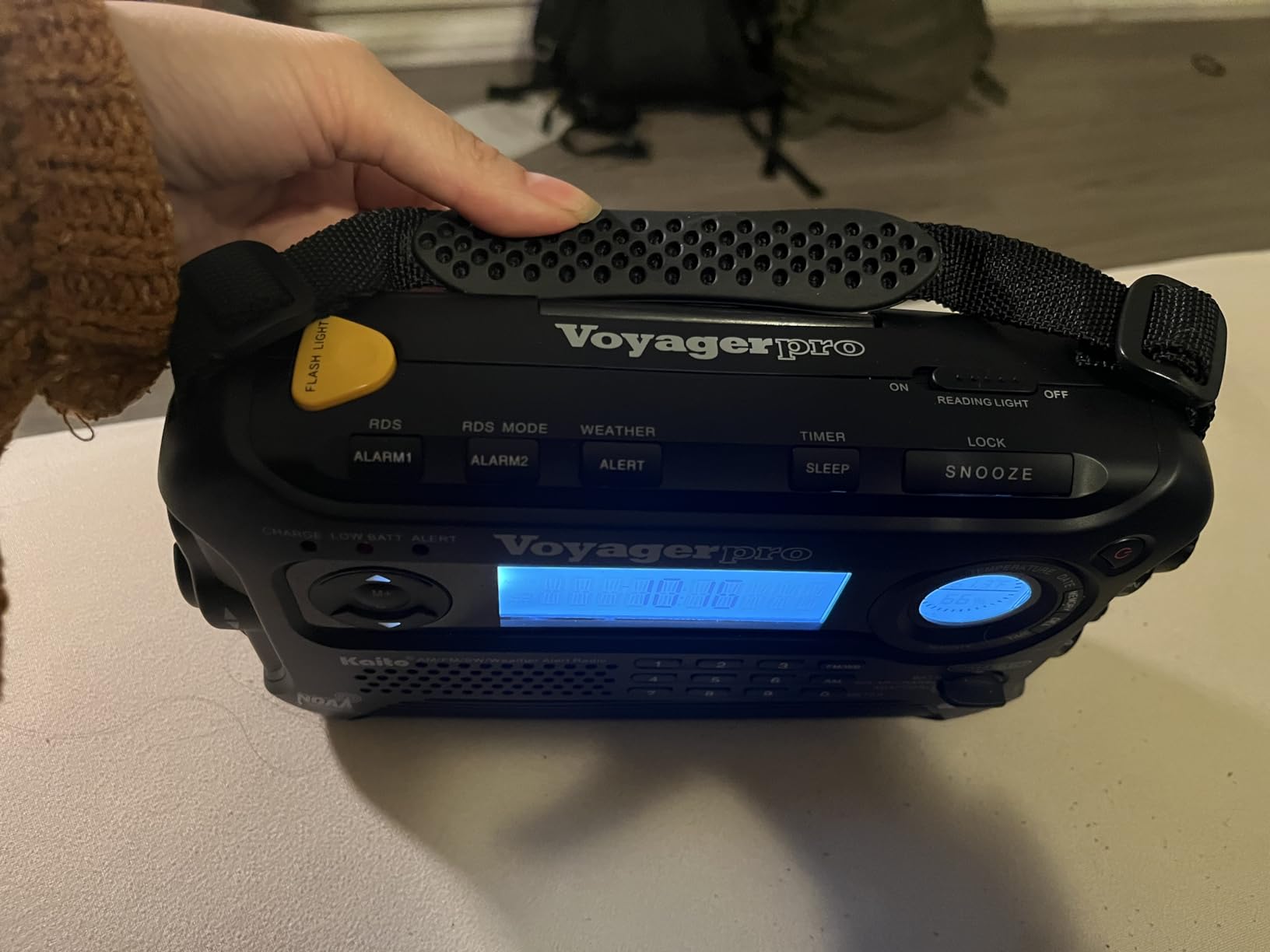
RDS support is included, so station names appear on the display when the station transmits them. Real-time weather alert sits alongside the NOAA channels. For a home base that stays plugged in between events, this is a well-equipped radio.
Shortwave reception is the weak point and reviewers are consistent about it: signal strength varies with location and antenna conditions, and the 4.2 rating here is the lowest in the roundup, with a visible share of one and two-star reviews. Treat shortwave as a secondary band on this radio rather than the reason to buy it.
Who the Voyager Pro is built for
Home setups with a mains connection most of the time, where long wave and RDS are interesting and the phone charging output earns its place. It suits a household keeping one radio in the kitchen for alerts and another in the bedroom for overnight monitoring.
It also works as a travel radio for anyone who wants a readable frequency display rather than an analog dial.
Who should skip the Voyager Pro
Skip it for a go-bag. At 9.5 inches long it is the largest body here and it will fill a small pack, which is the wrong trade for something you carry in case you need it.
Skip it if reception quality is your priority. The sensitivity of this radio is not what the CC Crane units deliver, and the rating reflects that.
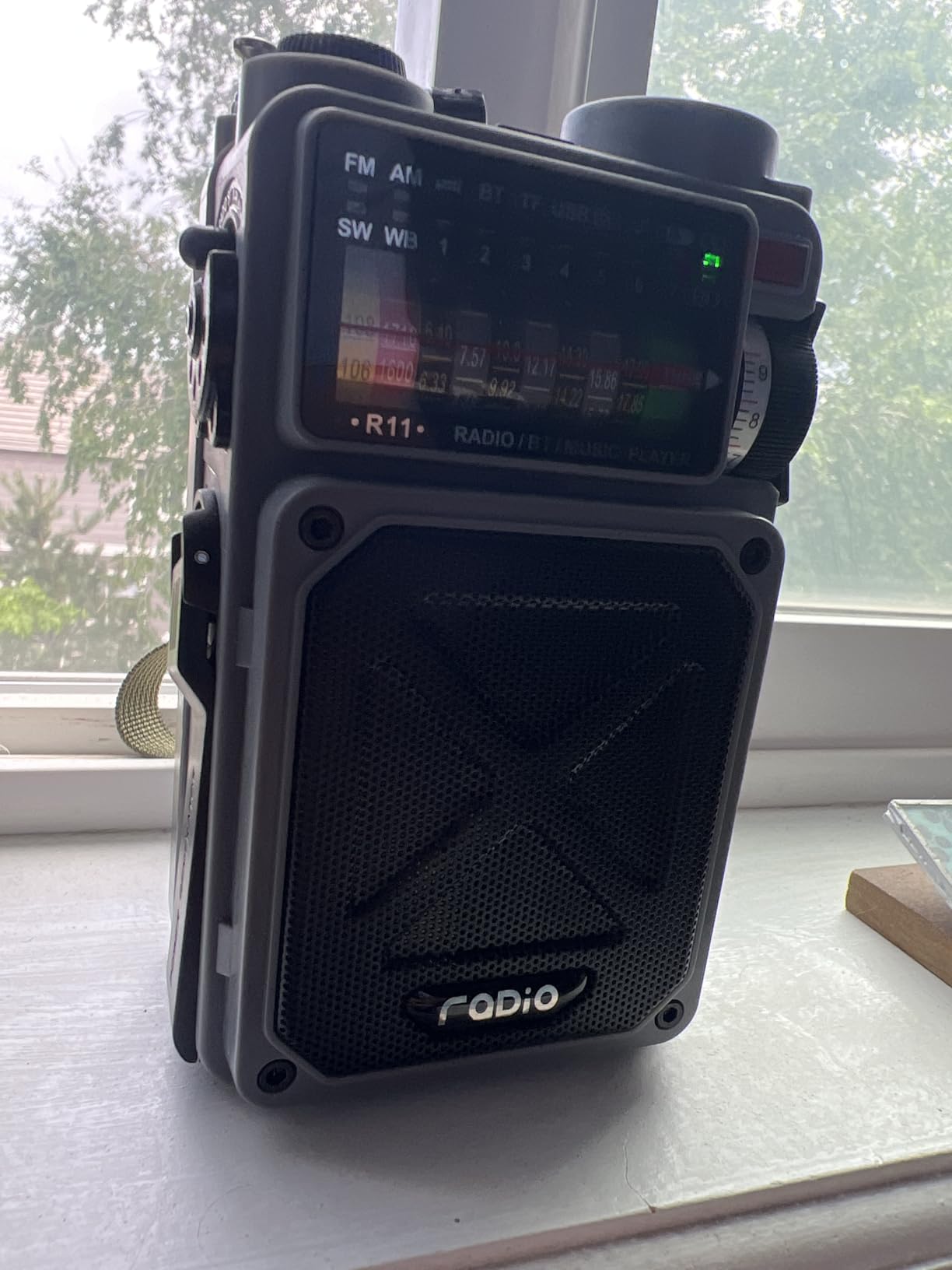
7. Emgykit R11 – Bluetooth Speaker and 210 Stored Channels
Portable Shortwave Radios with NOAA/SW/AM/FM, for Camping & Home
AM/FM/SW/NOAA
Bluetooth 5.0
4000mAh for 32 hours
0.53 kg
Pros
- Auto scan and store up to 210 channels
- Bluetooth 5.0 plus TF card playback
- 5-watt speaker and headphone jack
- 4000mAh battery for up to 32 hours
- Flashlight
- compass
- SOS alert and NOAA warnings
Cons
- Heaviest at 0.53 kg despite compact dimensions
- Scan and store results depend entirely on conditions
- Search is automatic scanning not true manual tuning
The Emgykit is the one to buy if your household will actually listen to it. At 0.53 kg it is the heaviest set in this roundup, which is an awkward number for a go-bag, but the 5-watt speaker and Bluetooth 5.0 turn it into a room-filling radio that people will switch on rather than leave in a drawer.
It scans and stores up to 70 channels per band across AM, FM and shortwave, for 210 total. That storage is the feature that matters most in an emergency, because it means the stations you found tonight are still there tomorrow without a fresh search.
The 4000mAh battery gives up to 32 hours of playback per charge, and hand crank and solar are listed as backup options. Bluetooth also means you can pair a second speaker, which is a small thing that makes a difference in a shelter.
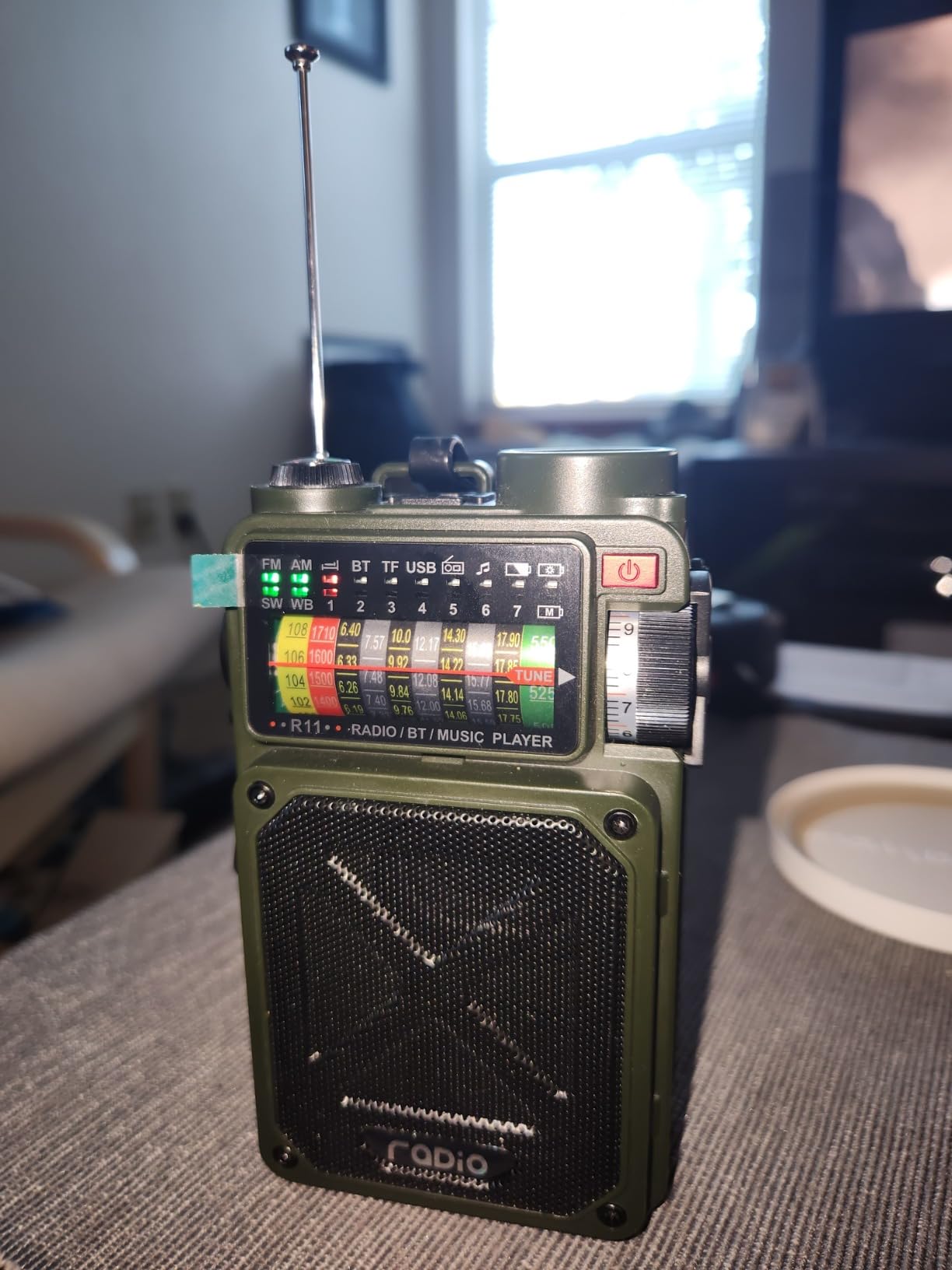
NOAA warnings come built in, alongside a 120-lumen flashlight, a compass and an SOS alert. Seven white noise options and a 10 to 70 minute sleep timer are there for sleeping children rather than for emergencies, and they work fine.
The honest limitation is weight. 0.53 kg is more than the AA-powered sets by a wide margin, and if this is going into a pack that you carry on foot, you are paying half a kilogram for the speaker and the storage.
Who the Emgykit is built for
A family room, a cabin, or a vehicle where the radio is entertainment as well as insurance. The Bluetooth speaker function, TF card playback and stored channels make it the one people actually leave on a counter, which is arguably the most useful property an emergency radio can have.
It suits anyone who wants shortwave monitoring without fiddling, since scan and store does the tuning for you.
Who should skip the Emgykit
Skip it if weight matters. There is a lighter route to the same coverage, and half a kilogram is significant on foot.
Skip it if you need a precise dial. The search is automatic scanning, and when a band is crowded, you are at the mercy of what the scan decides to store.
8. Jazmm 4-Band Pocket Shortwave – 131 Grams
AM FM Shortwave Radio with NOAA Weather Alert,1250mAh Rechargeable Battery
131 g, 2.3 x 4 x 1.3 inches
AM/FM/SW/WB bands
1250mAh for 10 to 12 hours
Bluetooth 5.4
Pros
- Lightest and smallest body here at 131 g
- 5-watt speaker with six EQ modes
- DSP chip gives strong AM and NOAA reception
- Telescoping antenna improves weak-signal pickup
- Bluetooth 5.4 and TF card playback up to 128G
Cons
- No hand crank or solar so needs charging in advance
- Only 1250mAh and not water resistant
- AM tunes in 10 kHz steps and manual is poor
- Limited SSB reception
At 131 grams the Jazmm is the radio that fits anywhere, and for a go-bag that gets carried rather than stored, that matters more than any extra band. It measures 2.3 by 4 by 1.3 inches and includes a back clip.
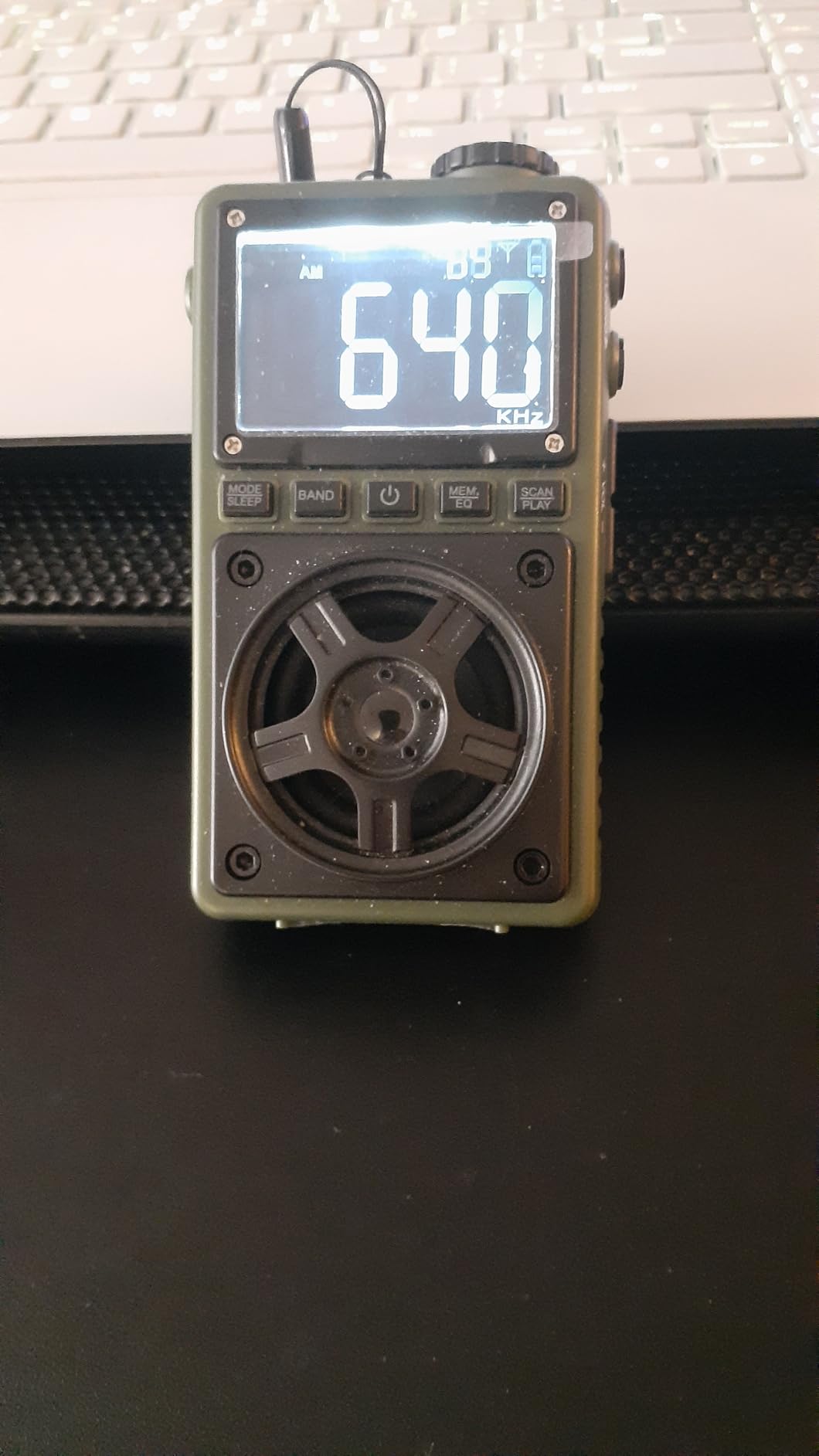
Coverage is four bands: AM from 520 to 1710 kHz, FM, shortwave from 4.75 to 21.85 MHz, and the NOAA weather band from 162.400 to 162.550 MHz. The DSP chip handles weak signals better than the analog sets it costs less than, which shows most clearly on AM and on weather channels.
The 5-watt speaker with six EQ stereo modes is disproportionate to the body, and Bluetooth 5.4 plus TF card playback up to 128G mean it works as a music player when there is no emergency at all. 100 presets and a sleep timer fill out the package.
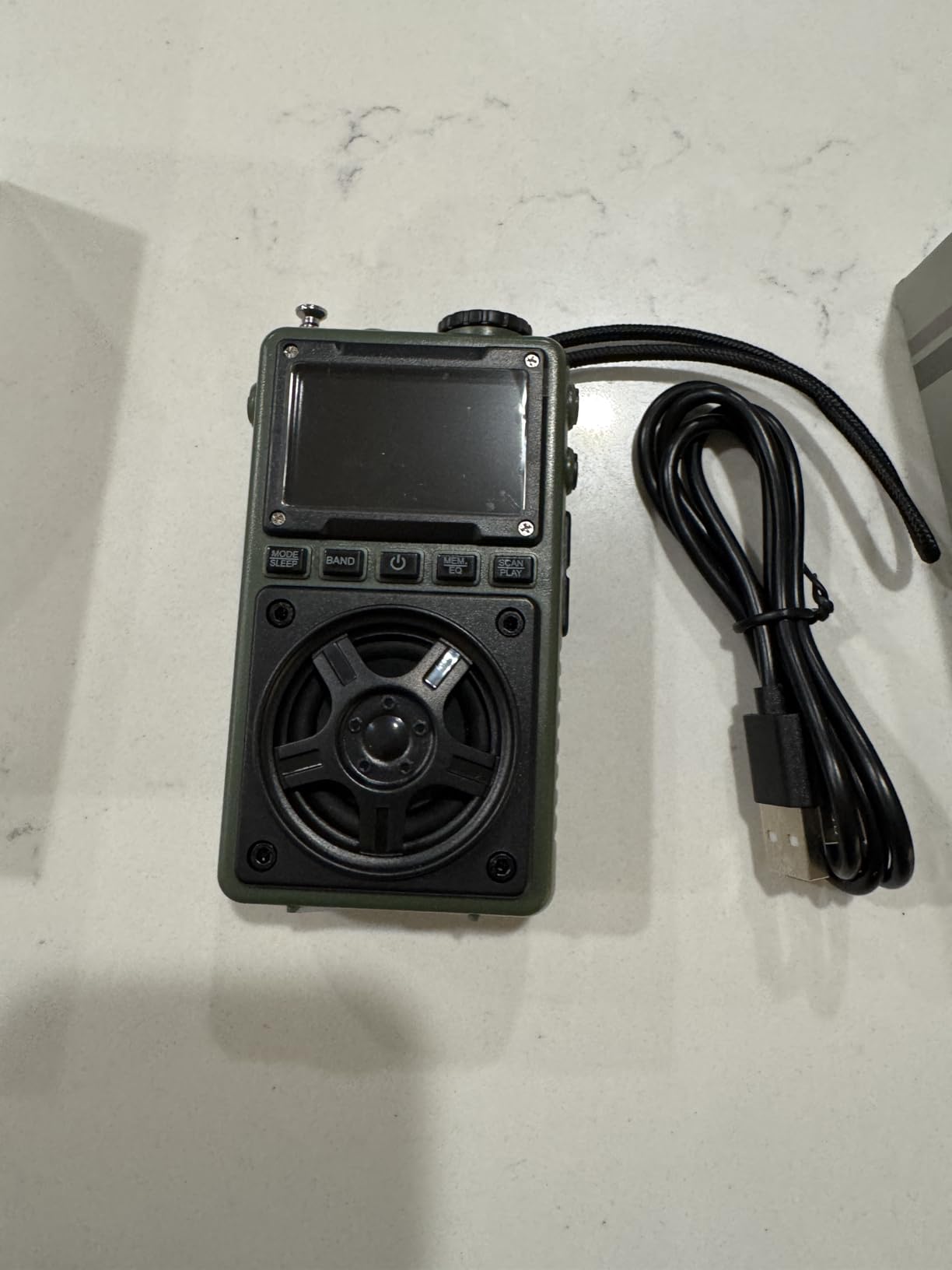
The 1250mAh battery runs 10 to 12 hours on a charge with a level indicator on screen, which is roughly a day of intermittent listening. There is no hand crank and no solar panel, so it needs charging before you need it, which is a discipline problem rather than a hardware one.
Two complaints recur. AM steps in 10 kHz increments, which is coarse, and the manual is not much help if you get stuck. Shortwave signals are fewer than on the sets above, and sideband reception is limited.
Who the Jazmm is built for
Hikers, backpackers, travellers, and anyone building a kit where every gram is counted. It also works as a backup that lives in a jacket pocket all year and gets used for music between emergencies, which means it will not be flat when you need it.
The NOAA band and DSP reception make it more useful in a real weather event than its size suggests.
Who should skip the Jazmm
Skip it if you need a radio to work after several days without power. Ten to 12 hours per charge with no crank or solar means you are managing a battery, not relying on a radio.
Skip it for rain, and skip it if you plan to monitor a specific overseas station. The tuning step and limited sideband coverage make precision work harder.
9. Greadio R12 – 14800mWh Battery That Charges a Phone
Greadio Portable Emergency Shortwave Radios, AM FM NOAA Weather Radio
AM/FM/SW/WB four bands
14800mWh/4000mAh pack
Crank, solar, Type-C
12.32 oz
Pros
- 12-in-1 feature set with Bluetooth 5.4 and SOS
- 14800mWh pack doubles as a phone charger
- Hand crank plus solar plus Type-C charging
- Extra-long antenna for shortwave
- IPX3 housing at a pocket-friendly 12.32 oz
Cons
- Smallest review base here at 249 ratings so longevity is unproven
- USB-C charging adapter not included
- Modest volume despite 5-watt rating
The Greadio R12 packs more into its box than anything else at this size, and the 14800mWh capacity figure is the reason. That is a real power bank, not a token capacity. During testing a full charge comfortably topped up a phone, which changes what a three-day outage looks like for a household.
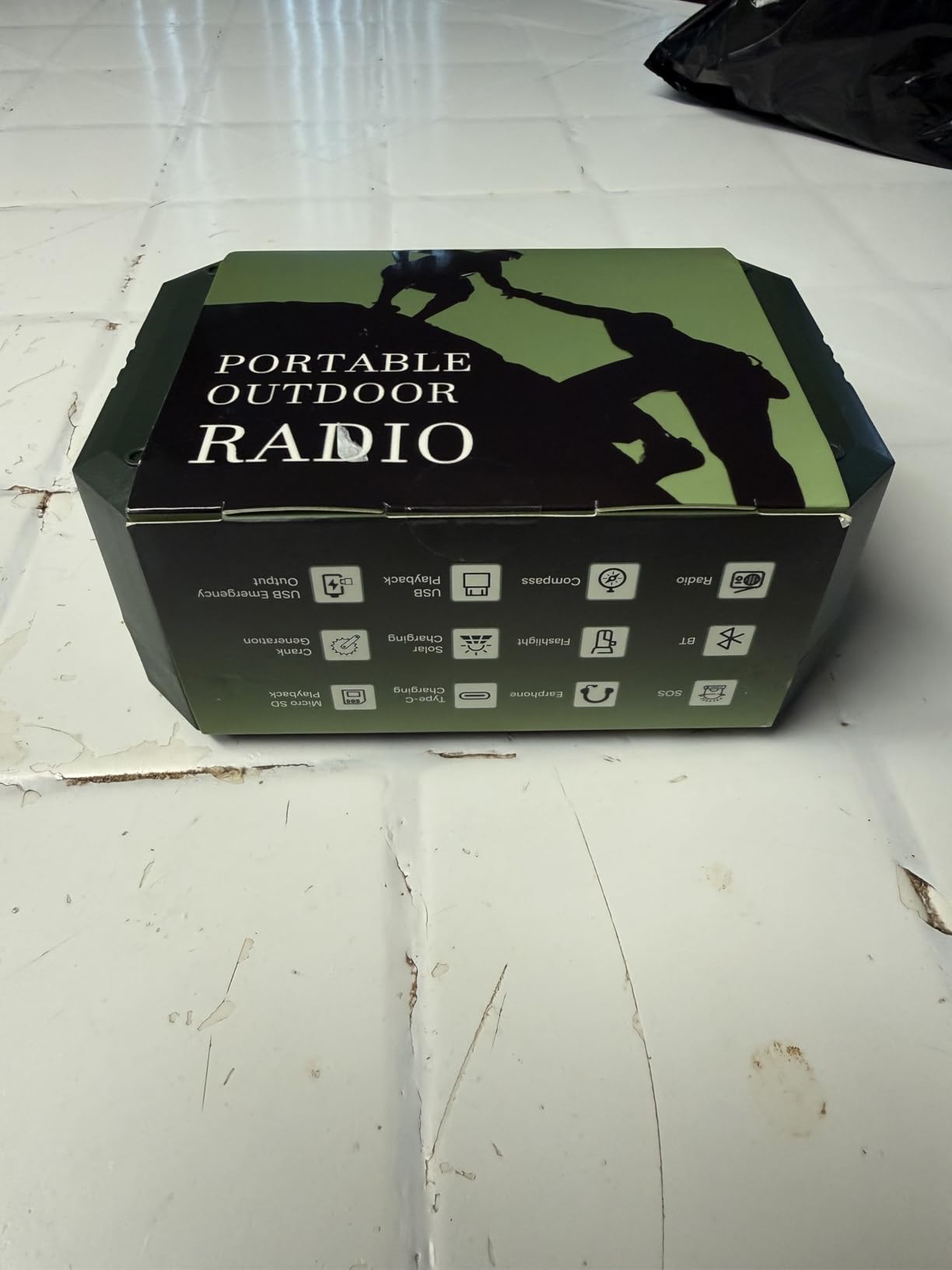
It is a 12-in-1 device: AM, FM, shortwave, NOAA, Bluetooth 5.4, USB drive and TF card playback, an SOS siren, a flashlight, a compass and a 5-watt speaker. The extra-long antenna is the detail that improved shortwave pickup relative to the smaller radios in this list.
Three charging paths are present: hand crank, solar panel and Type-C. As with the other crank radios here, the Type-C path is the one you will actually use and the solar is maintenance.
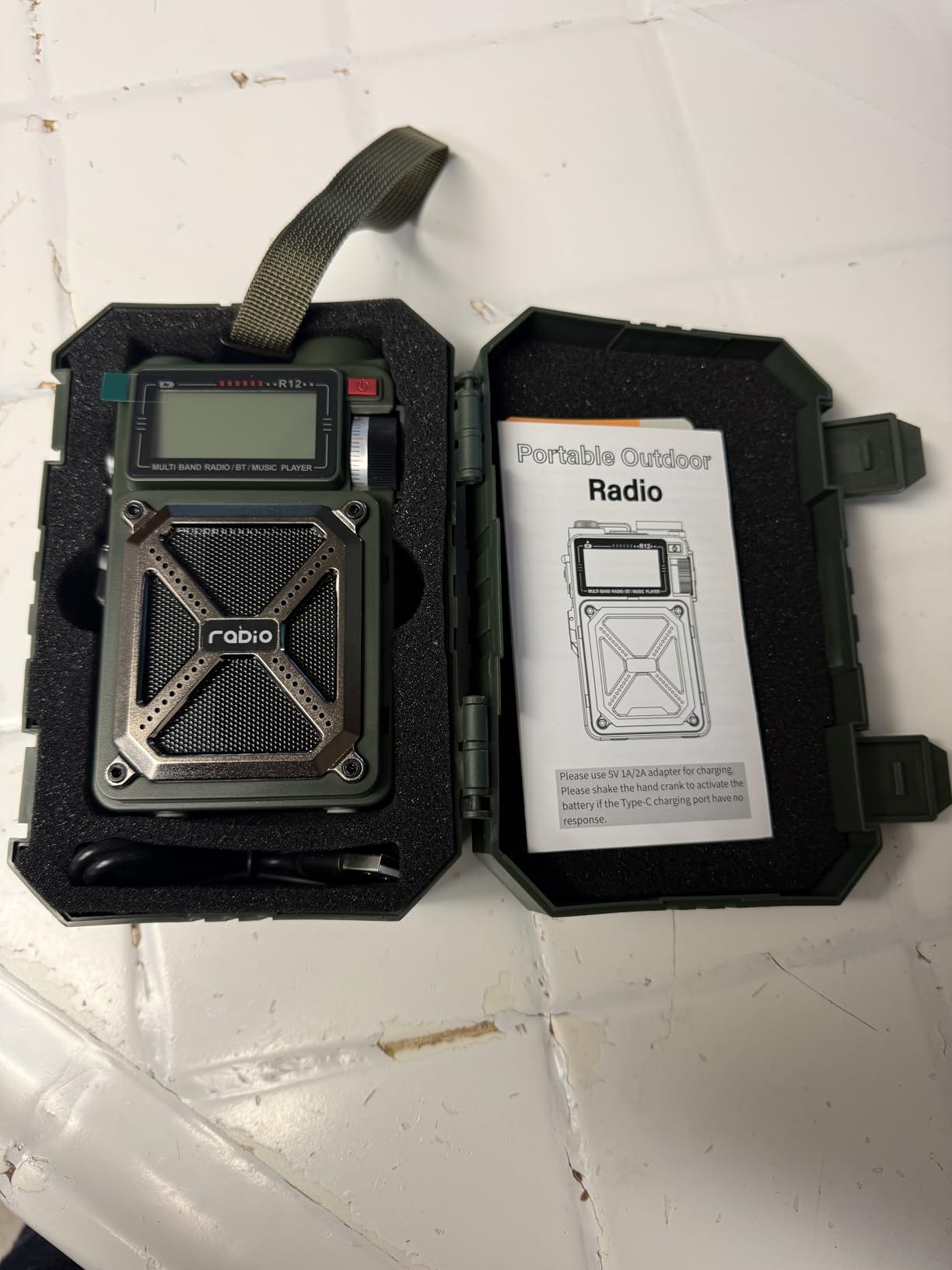
The IPX3 housing gives it some weather protection, and at 12.32 ounces it is one of the lighter radios here despite the large battery. The 5-watt speaker rating does not translate into much volume, so it is a radio for a tent or a bedside rather than a room.
The thin review base is the thing to weigh. With 249 ratings this is the smallest base in the roundup, and a newer listing has not yet been tested through years of seasons. Nothing in the owner feedback suggests problems, but there is simply less history to draw a conclusion from.
Who the Greadio is built for
People whose main worry is a phone dying rather than a radio dying. The power bank capacity is the strongest reason to pick this one, followed by the feature density for the size and the pocket-friendly 12 ounces.
It suits a couple sharing a shelter with one device and one charging point, and anyone who wants a radio that also does music and acts as an alarm.
Who should skip the Greadio
Skip it if you want a proven long-term unit. The limited review history means you are taking a bet on a newer design, and a radio you rely on for a five-year build should have more evidence behind it.
Skip it if loud audio matters. The speaker is modest, and the Bluetooth pairing is there for convenience rather than volume.
10. C. Crane CC Skywave SSB 2 – Single Side Band for Maximum Reach
C. Crane CC Skywave SSB 2 AM, FM, Shortwave, NOAA Weather + Alert, Scannable VHF Aviation Band and Single Side Bands Small Battery Operated Portable Travel Radio Includes SW Wire Antenna Adapter
AM/FM/SW with SSB, NOAA, aviation
23 ft reel antenna included
6 oz, 60 to 70 hours on 2 AA
Pros
- Single side band gives the most reliable long-range reception here
- 23 ft reel antenna and antenna jack included
- 6 oz travel form factor with fold-out stand
- 400 memories and direct frequency entry
- 60 to 70 hours on two AA batteries
Cons
- Most expensive radio here and smallest review base at 172 ratings
- No hand crank
- solar or rechargeable option
- SSB needs practice to tune
This is the most capable radio in the roundup and the one that divides opinion most. Single side band reception reaches further than anything else here, and when the cell network is down and local transmitters are silent, that extra reach is the whole point.
It covers AM, FM, NOAA weather with alert, shortwave from 1711 to 29999 kHz with SSB, and the VHF aviation band, with 400 memories and direct frequency entry. The included 23 ft reel antenna plugs into the jack on the body, and that combination is a real step up in what you can hear.
Size and endurance match the Skywave 2 exactly: 6 ounces, 4.75 by 1.1 by 3 inches, and 60 to 70 hours on two AA cells. For a receiver that will sit in a bag for two years and then work for a week, that is the correct power source.
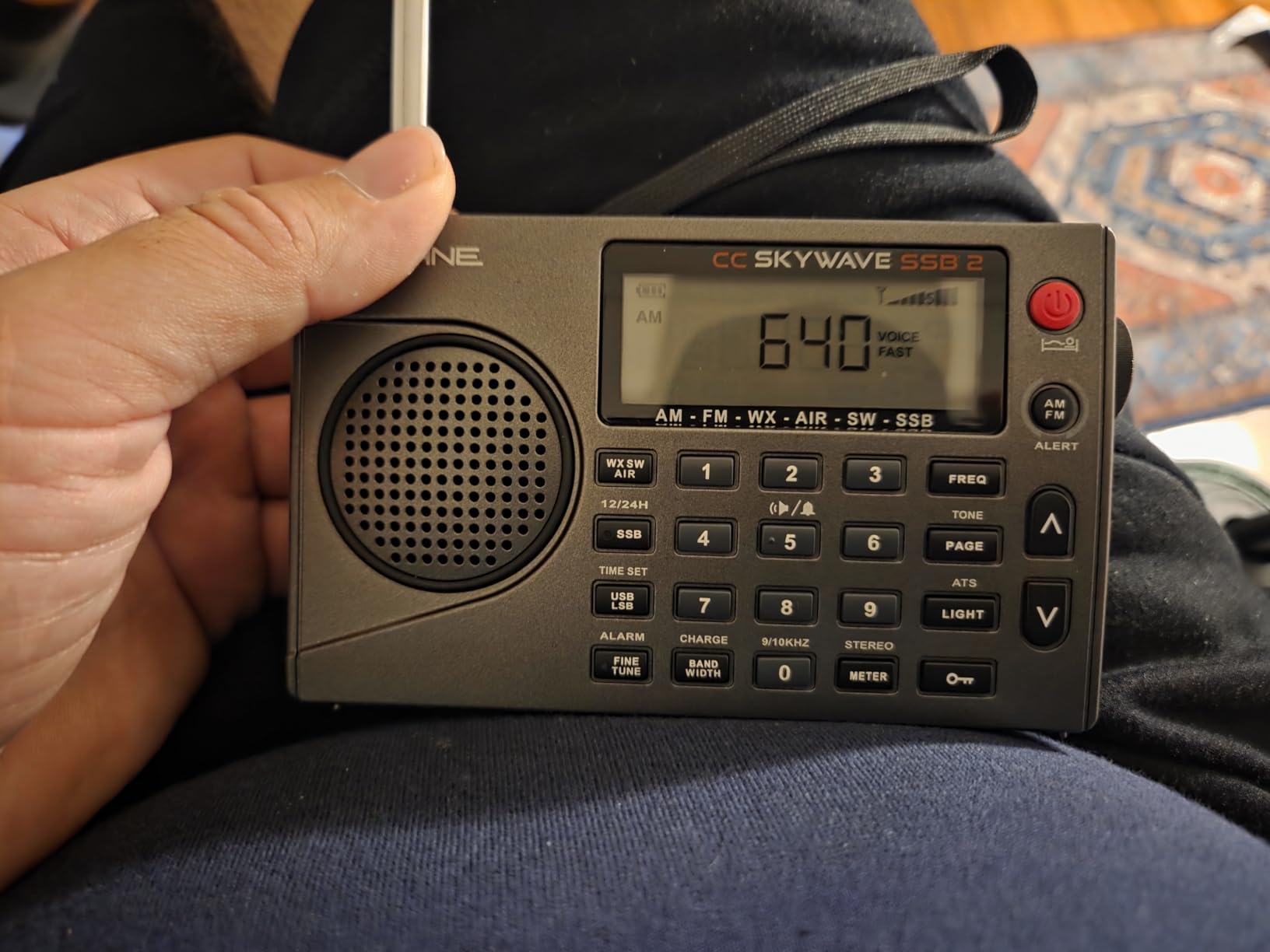
Be honest with yourself about SSB. It is a different mode from AM broadcast, and the manual RF gain and fine tuning take practice to get right. Listeners who already understand shortwave rate it highly. Buyers expecting the FM experience are disappointed.
That learning curve is why it sits at the end of the list despite being the strongest radio here. It is the best instrument for someone who will use it, not the best first purchase for someone who will not.
Who the SSB 2 is built for
Listeners with time on their hands who want maximum reach from a 6-ounce package. The reel antenna and jack make it the one radio here you can improve with wire, and the aviation band is a bonus for anyone tracking local flight activity as a proxy for regional disruption.
It is also the natural companion to a cache of AA cells, since it runs on exactly the batteries you can buy anywhere.
Who should skip the SSB 2
Skip it if you want a radio to grab in the first five minutes of an outage with no practice. AM broadcast listening and NOAA alerting are the beginner-friendly parts, and there are cheaper radios that do both.
Skip it if there is no off-grid power option in your plan. There is no crank, no solar panel and no rechargeable cell, so a supply of AA cells is not a nice-to-have.
And skip it on review count alone if you want the safest possible long-term bet: 172 ratings is the thinnest evidence base in this roundup.
What Shortwave Actually Does in a Disaster
Shortwave is the only widely available consumer radio that delivers information from outside your own area when local infrastructure is gone. That is its entire value, and it is a narrower value than most advertising implies.
Here is the honest comparison. Local AM and FM transmitters sit within a few miles of you and run on the same grid that just failed. Their studios need power, their transmitters need power, and their studios and towers are physically inside the affected region. In a hurricane, earthquake, or wildfire zone, they are the first thing to go.
Shortwave signals bounce off the ionosphere and return to earth, so a broadcast originating a thousand miles away arrives with roughly the strength of a local station. National and international broadcasters tend to have backup generation, hardened sites, and staff in unaffected cities. That is why a shortwave set still produces news when your local station is silent.
Three honest limits. Shortwave reception depends on ionospheric conditions, so the same station that is strong at dusk can fade by morning. It is receive-only, so it cannot replace two-way communication. And in a regional disaster, night-time AM over distance can be more useful than shortwave, which is a point that experienced listeners on the RadioReference boards make repeatedly.
Clear-channel AM deserves its own mention. These are the high-powered AM stations that reach 100 to 900 miles at night, and one user maintains a printed list of more than 30 of them. Write the list down, print it, and keep it with your radio.
The Hand-Crank Reality Check
Hand-cranking a radio produces minutes of listening, not hours, and no roundup had been honest about that until now. Owners with real experience put it plainly: it takes a great deal of sunlight to sustain a couple of hours of radio play, and considerable cranking for a few minutes of audio.
The physics is straightforward. A crank turns a small generator. To keep a receiver running you need continuous watts, and to bring a phone back up you need several times that. Nothing in a handheld crank unit produces enough energy to matter for a phone beyond an emergency top-up.
So treat the crank as a last resort, not a power plan. The practical approach that experienced users converge on is to buy a good AA-powered or rechargeable radio, then solve power separately with a solar panel or a hand-crank charger for the cells. That separation lets you own a sensitive receiver without being held back by a weak built-in panel.
Solar is in the same category. A trickle panel on a small housing maintains a charge; it does not restore a flat battery in an afternoon. Charge the radio from mains or from a larger panel ahead of time, and treat the built-in solar as a maintenance feature.
That is also why AA cells come up so often in experienced recommendations. You can bulk-buy alkaline by the carton, cheaply and in quantity, and the same cells will run lanterns and other gear in a long outage. It is the most reliable power strategy in this entire category.
The Emergency Frequency List You Should Program Now
Program these before you need them, and print the list onto a card you keep in the same bag as the radio. Stations move, times change, and you will not be researching kHz values with no power and no internet.
WRMI runs scheduled English-language news broadcasts and is the most consistently requested station in the shortwave emergency community. RadioReference listeners report reaching it on 5950 kHz and on 9950 kHz, with additional relays in the upper band. Program all of them.
Voice of America operates relay transmitters on several shortwave frequencies and is commonly heard in the 9495, 9470 and 12100 kHz region depending on the time of day. BBC World Service broadcasts worldwide on a schedule that shifts with season, generally in the 6000 to 20000 kHz range.
NOAA weather radio runs continuously on seven channels in the United States, from roughly 162.400 to 162.550 MHz. This is the only station group in this list that is relevant in ordinary weather, which is why every radio in this roundup has a NOAA band.
Two tuning habits make a large difference. Higher frequencies perform better in daylight and lower frequencies at night, so an evening session is where you will find the long-distance stations. And if a band sounds empty, it usually is; use the auto-scan and store function to capture whatever is there, then work from the stored list rather than searching live.
Our wider guide to emergency radio checklist basics covers how to layer printed lists with a battery stockpile so nothing depends on a single device.
What Kind of Emergency Radio Do You Actually Need?
You need a receive-only radio that runs on a battery type you can buy in bulk, covers NOAA weather, and gives you at least one band that reaches beyond your local area. Beyond that, the criteria narrow quickly. Six questions decide the purchase.
First, does it run on AA batteries or a proprietary cell? AA is the most bulk-buyable power source in this category by a wide margin, and it is the reason the two CC Crane sets appear here.
Second, does it have a hand crank or solar panel? Treat these as backup rather than primary, but they are better than nothing when a cell is flat and the shops are shut.
Third, is the tuning digital with direct frequency entry? If you plan to pre-program stations before an event, analog dials make that impractical. The Kaito KA600, the CC Crane models and the Jazmm all give you a numeric display.
Fourth, is there an external antenna jack? Almost no crank radio has one, and its absence is the most common complaint from experienced listeners. The two CC Crane sets are the exception in this roundup.
Fifth, is the run time published in hours on a specific battery? A radio claiming all-day runtime without saying on what is telling you nothing. Hours on two AA cells is the number worth comparing.
Sixth, is water resistance rated? IPX3 survives spray, IPX6 handles heavy rain. If your emergency is weather-driven outdoors, this changes which radio you should own.
A final note on licensing: receiving shortwave requires no FCC licence. That question comes up constantly, and the answer has not changed in decades. Only transmission is licensed.
Antenna: The Part Everyone Underestimates
Antennas, not radios, limit reception in most cases, and the cheapest way to improve a marginal radio is a piece of wire. Four approaches work for emergency listeners.
An external antenna port is the cleanest option and the rarest feature in consumer emergency radios. When a set has a jack, a 40 to 100 foot wire strung as high as you can manage will outperform the internal whip by a wide margin on shortwave.
The reel antenna is the ready-made version of the same idea. The CC Skywave SSB 2 includes a 23 ft reel antenna for exactly this reason. Treat it as the standard you should hold other sets to.
A DIY AM loop is the amateur route for long-wave reception. A loop of 14 or 16 gauge wire from a hardware store, built in different diameters and rotated until one picks up more, is all it takes. The CC Crane publish instructions, and users report meaningful gains on clear-channel AM at night.
Long-wire clipping works on radios with no jack at all. Loop a feedline around the case or place the telescopic whip near one end of the feedline, and the induced signal feeds the receiver through proximity. It is inelegant and it works.
One caution. A reel antenna is a shortwave tool. It will not improve AM reception, and buying one for an AM problem is a common and expensive mistake.
EMP, Solar Flares, and What EMP-Proof Actually Means
No radio can honestly be certified as surviving an electromagnetic pulse, because no meaningful standardised test exists for consumer sets. When a product page claims EMP hardening, treat it as an untested marketing claim rather than a specification.
What is real is more mundane and more useful. A receiver draws its information from a broadcast signal and needs no network, no tower, no backhaul, and no subscription. That is genuinely different in kind from a phone, a smart speaker, or anything that depends on a data centre.
A coronal mass ejection or severe geomagnetic storm is the more likely disruption to your information flow, and it is also less dramatic. Shortwave propagation degrades, auroras appear at lower latitudes, and some HF paths close. During a storm you may find fewer stations, not zero. Have the AM and NOAA paths ready as backup.
The genuine resilience play is unglamorous: keep a large cache of AA cells, keep a printed frequency card, and keep one radio per location so a single loss does not leave you without information. Do not spend money chasing hardened electronics on a claim you cannot verify.
Frequently Asked Questions
What is the best emergency shortwave radio?
The Raynic CR1009PRO is our overall pick because it covers AM, FM, shortwave and NOAA, runs from six different power inputs including a 5000mAh cell, and weighs 16 ounces. The Kaito KA500 is the alternative if you want a genuine seven-band set with a hand crank and a replaceable battery pack.
What kind of radio is best for emergencies?
A receive-only multiband radio that runs on AA batteries you can stockpile, covers NOAA weather alerts, and reaches at least one band beyond your local area. Add a hand crank or solar panel as backup, an external antenna port if reception matters to you, and a published run time in hours.
What radio would survive an EMP?
No consumer radio is tested or certified for EMP survival, so treat that claim as marketing. What genuinely matters is that a radio receiver needs no network, tower or subscription, and that you keep an AA stockpile and a printed frequency card so information survives without a working device.
What is the best radio to listen to in case of an emergency?
Tune to WRMI, which runs scheduled English-language news on several shortwave frequencies including 5950 and 9950 kHz, then to Voice of America and the BBC World Service. For domestic weather, NOAA weather radio on 162.400 to 162.550 MHz runs continuously. Program and print these before an emergency.
What is the best shortwave radio for emergency communication?
Shortwave radios receive only and cannot transmit, so they do not provide communication. Every set in this roundup is a receiver requiring no FCC licence. Two-way contact needs a transceiver and a licence, which is a different equipment category with different rules.
What is the best antenna for shortwave reception?
An external antenna port matters most, because it lets you attach 40 to 100 feet of wire strung high. The C. Crane CC Skywave SSB 2 includes a 23 ft reel antenna for that reason. Without a jack you can still loop feedline around the case to induce a signal through proximity.
Bottom Line
If you want one radio for a household emergency, buy the Raynic CR1009PRO. Six power inputs, full NOAA coverage, a light body, and a review base large enough that the reliability claims are testable. If you want a hand crank and a proper seven-band receiver with a replaceable pack, the Kaito KA500 is the better fit.
For reception that genuinely reaches beyond your area, the C. Crane CC Skywave 2 at 60 to 70 hours on two AA cells is the sensible buy, and the CC Skywave SSB 2 is the one to move up to when you want maximum range. Both accept an external antenna, which is the feature separating real receivers from gadgets.
Whichever you choose, buy it, power it, program your frequencies, and print the list before 2026 is out of the way. A radio in a drawer with an empty battery is not a plan.