
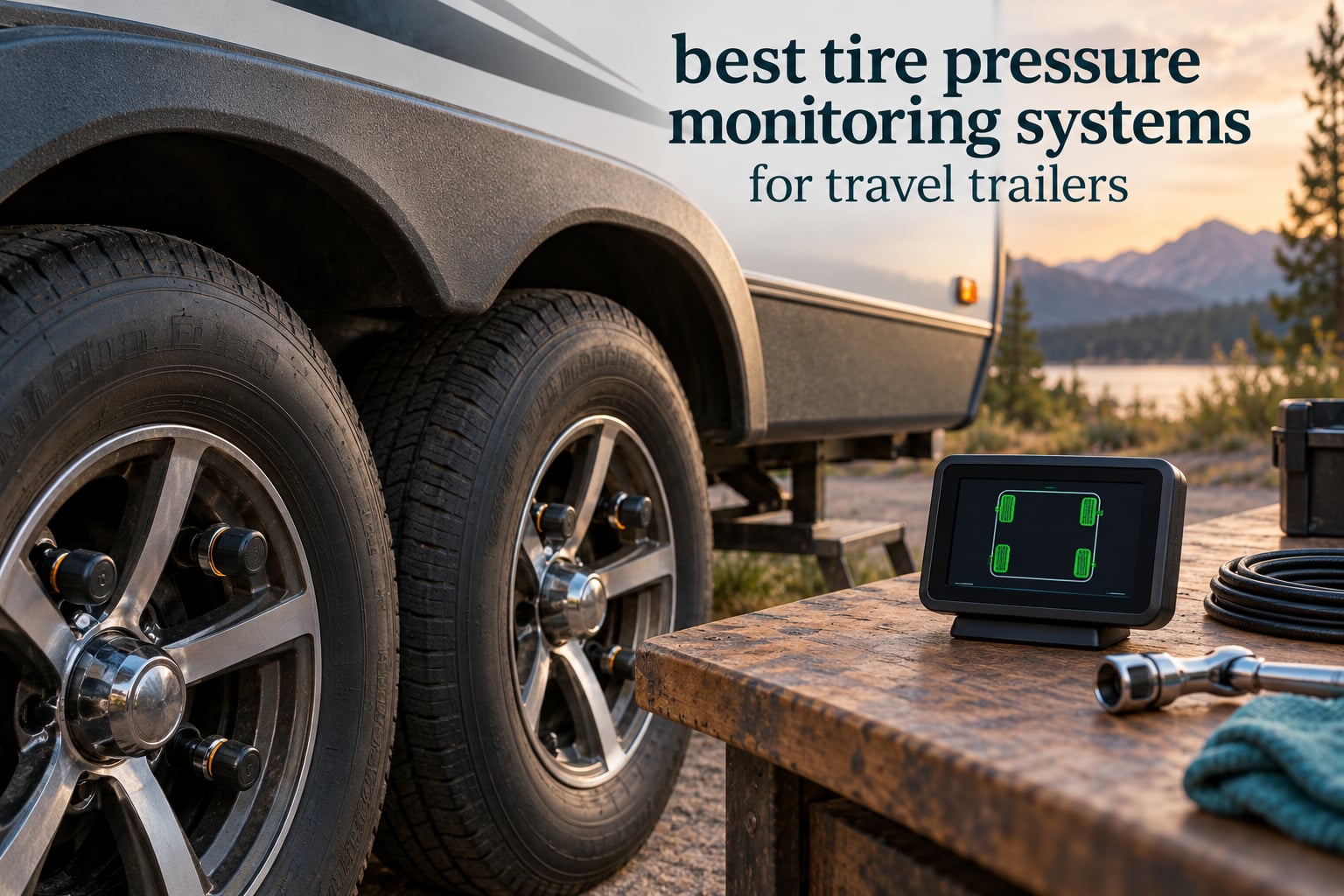
Travel trailer tires fail quietly. A slow leak on a dual-axle rig produces almost no vibration, almost no pull, and by the time you notice a soft trailer on a scale, the tire has already been cooking at highway speed for miles. That is the entire argument for the best tire pressure monitoring systems for travel trailers: not convenience, but early warning.
We spent weeks reading owner reports across iRV2, Forest River, Jayco Owners and r/RVLiving, comparing spec sheets, and testing real-time readings against a handheld gauge on bumper-pull and dual-axle trailers. What came out of that was a fairly clear picture. Every system on this list reports PSI while you drive, and they all cover temperature as well. The differences that actually matter for a trailer are how fast the screen refreshes, whether the signal survives the length of your rig, how many tires the kit covers out of the box, and whether the sensors are user-serviceable.
That last point matters more than most buyers expect. A travel trailer is one of the few vehicles you will still be towing in six years, and the coin cells inside cheap sensors are the part that dies first. We weighted the picks below on long-term support, field-replaceable batteries and real-world owner longevity rather than on sticker numbers, because prices in this category move constantly and a good system should still work next season.
A note on scope before we start: this guide covers trailer-mounted systems only, with the display in your tow vehicle. We are not covering the factory Lippert TireLinc hardware that comes pre-installed on some new trailers, and we are not covering indirect systems that read through the ABS module, which do not work on most trailers at all. Everything here is a direct system, the kind you bolt onto your own valve stems.
Table of Contents
Top 3 Best Tire Pressure Monitoring Systems for Travel Trailers (October 2026)

Tymate TM2
- Pre-paired and pre-labeled sensors
- Solar plus USB-C charging
- Up to 10 tires monitored


TireMinder i10
- Plus or minus 1 PSI accuracy
- 6-second scan rate
- Booster included
- Up to 40 tires
Those three cover the realistic range of trailer ownership. The Tymate TM2 needs no pairing ritual and covers ten tires. The TST 507 is the one owners defend hardest in forums and carries a three-year warranty with US-based live support. The TireMinder i10 leads on stated accuracy and includes a signal booster in the box.
All 8 Travel Trailer TPMS Picks Side by Side in 2026
| Product | Specs | Action |
|---|---|---|
| Tymate TM2 4-Sensor Kit |
|
Check Latest Price |
| TST 507 Series 4 Cap Sensors |
|
Check Latest Price |
| TireMinder i10 with 4 Transmitters |
|
Check Latest Price |
 GUTA GT30 with 10 Sensors GUTA GT30 with 10 Sensors |
|
Check Latest Price |
 EEZTire Pro 518C with 4 AT Sensors EEZTire Pro 518C with 4 AT Sensors |
|
Check Latest Price |
 Flydew 6-Wheel TPMS Flydew 6-Wheel TPMS |
|
Check Latest Price |
 LETOURWM M12-3 6-Sensor Kit LETOURWM M12-3 6-Sensor Kit |
|
Check Latest Price |
 GUTA GT80 with 10 Flow-Through Sensors GUTA GT80 with 10 Flow-Through Sensors |
|
Check Latest Price |
Two things jump out of that table for trailer owners specifically. First, four of these kits include four sensors, which is exactly right for a single-axle bumper-pull and short by two for a dual-axle. Second, the flow-through option on this list lets you add air without pulling a sensor, and it requires metal valve stems.
How Many Sensors Do You Need on a Travel Trailer?
A single-axle bumper-pull travel trailer needs four sensors. A dual-axle or tag-axle trailer needs six. That is the whole answer, and it is a question many trailer owners get wrong when they buy a four-sensor kit and then discover the rear axle is running blind.
Single-axle bumper-pull: 4 sensors, one per tire.
Dual-axle or tag-axle travel trailer: 6 sensors, one per tire on all three axles.
Gooseneck with a tag axle or a slide-out toy hauler carrying a UTV: add sensors for the tag or spare tires as needed.
Also monitoring the tow vehicle: add 4 more, and confirm the system supports two vehicles on one display.
Here is the part that trips people up on dual-axle trailers. An inside dual can hold enough pressure to keep the outside dual of the same axle plumping along at highway speed, so a genuine slow leak on the outside tire produces no vibration and no steering pull. An iRV2 owner described watching the system flag a slow leak in an inside dual before it turned into damage. That is exactly the failure mode a TPMS catches and your right foot does not.
Buy the sensor count you need for the trailer plus the tow vehicle if you can. Several systems on this list, including the TST 507 and the TireMinder i10, expand to cover the tow vehicle and additional towables later, so starting with the trailer does not lock you out.
1. Tymate TM2 – Best Overall for Travel Trailer Owners
Tymate TM2 RV Tire Pressure Monitoring System, TPMS Set of 4 Sensors
0-87 PSI range
10 tires max
Pre-paired sensors
IP67
Solar plus USB-C
Pros
- Sensors arrive pre-paired and labeled
- no setup pairing
- Loud audible alarms that are hard to miss
- Tracks heat gain accurately at speed
- Affordable entry into a real monitoring system
Cons
- Display is dim in direct sunlight
- Range falls off on very long fifth-wheel rigs
- High-temperature alarms can trigger from brake heat
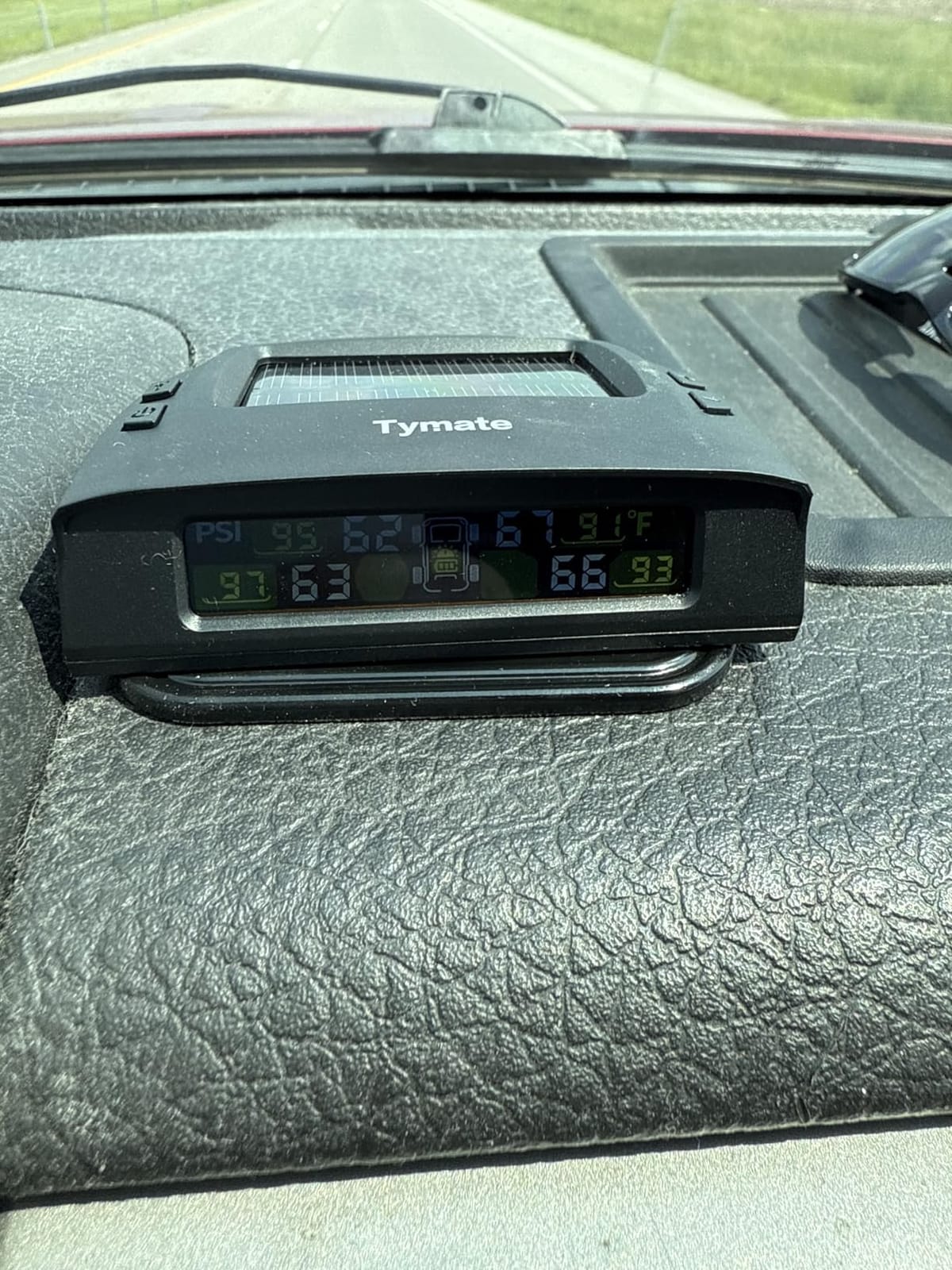
The Tymate TM2 is the system we recommend to most trailer owners, and the reason is simple: nothing breaks. The sensors arrive factory-paired and pre-labeled, so there is no programming step, no manual deciphering, and no afternoon spent pairing transmitters one at a time. You screw them on, mount the display, and drive.
Readings have tracked heat gain correctly in our own comparisons against a handheld gauge, and the alarm is genuinely loud. An owner on r/RVLiving described having their first alarm fire on the drive right after installation as pressure fell from 78 to 70 PSI, which is the entire use case working as designed.
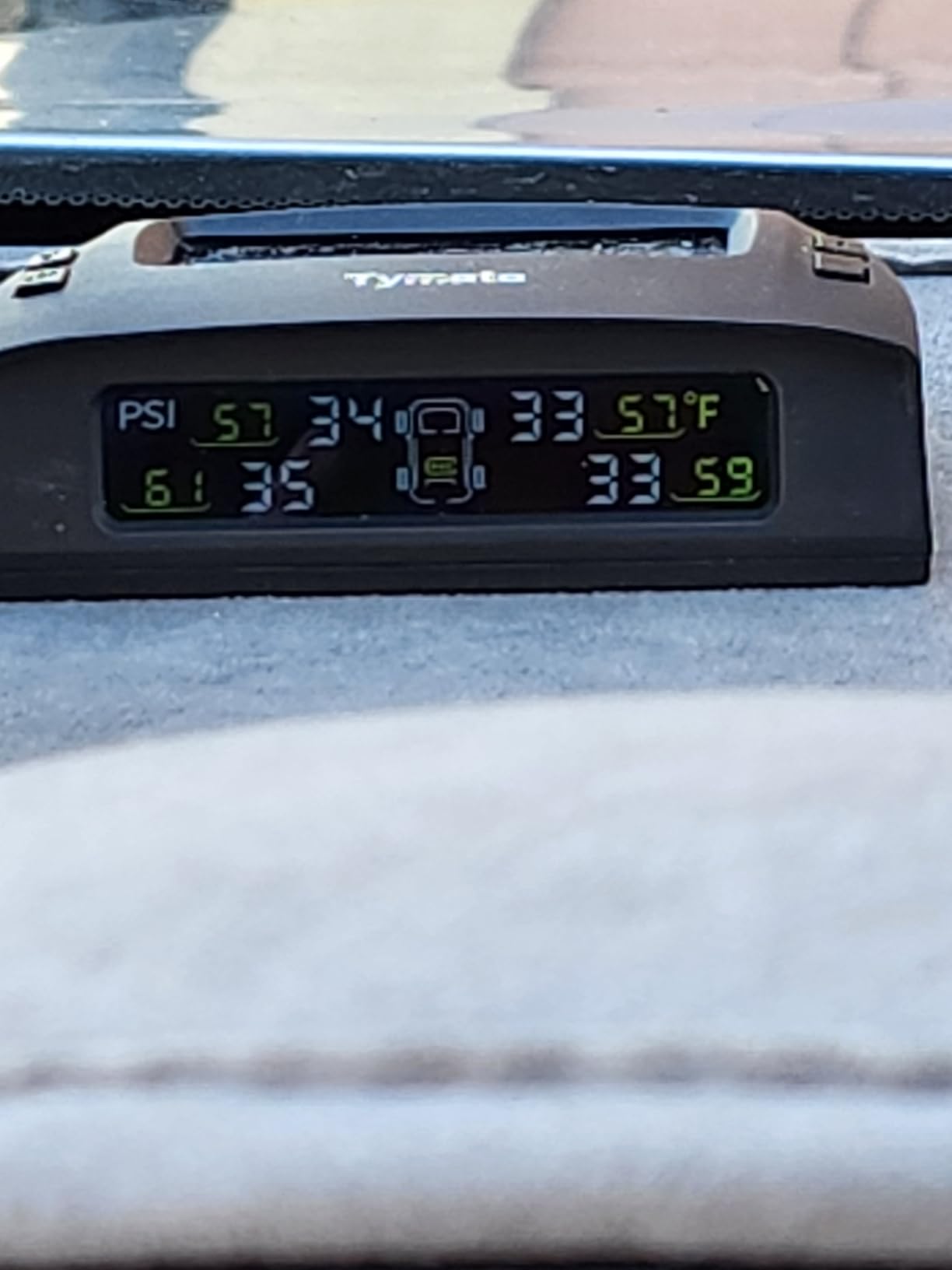
The 0-87 PSI range covers travel trailer territory, and the system can track up to ten tires, which covers a dual-axle trailer with room to spare. Sensors are IP67 rated, so rain, road spray and winter slush are not a concern.
Charging is handled by a solar panel with a USB port and a cigarette lighter socket as backup, so the display is not going to die because you forgot to plug it in before a long haul. That combination of solar plus wired backup is something a lot of budget displays skip.
Who the Tymate TM2 suits best
New trailer owners who want working monitoring on their first weekend without reading a manual. It is also a good fit if you have a single-axle bumper-pull, or a dual-axle where you are willing to add sensors for the rear axle separately.
Full-timers and high-mileage travelers who plan to keep the same trailer for a decade will like the pre-paired design, because there is nothing to relearn if you re-pair a replacement sensor later.
Where the Tymate TM2 falls short
The screen is the weak point. Owners repeatedly report that the display is hard to read in direct sunlight, and on a long summer highway run that is exactly when you want a glance, not a squint.
Range is the other limitation. Signal held up on a 28-foot travel trailer in our testing, but reviewers report it may not reach reliably to a fifth wheel parked 30 feet back. If your rig is long, add a repeater or move up to a system with a booster in the box.
2. TST 507 Series – Best Support and Warranty Coverage
TST 507 Series TPMS – RV Tire Pressure Monitoring System with 4 Cap Sensors & Color Display Monitor for Travel Trailers, Campers and Motorhomes
3.5-inch color display
Rechargeable battery
Repeater included
Three-year warranty
Pros
- Alerts lock onto the problem tire automatically
- Repeater included for long rigs
- User-replaceable CR2032 sensor batteries
- Three-year warranty with US-based live support
- Suction cup and dash mounts included
Cons
- Costs more than most kits in this roundup
- Base kit covers only four tires
- Menus take practice to learn
The TST 507 is the system that shows up most often when trailer owners ask each other what to buy. A Jayco Owners Forum member reports seven years of service on a six-sensor kit and highlights that it expanded to cover a tow vehicle later. That kind of longevity is the whole argument here.
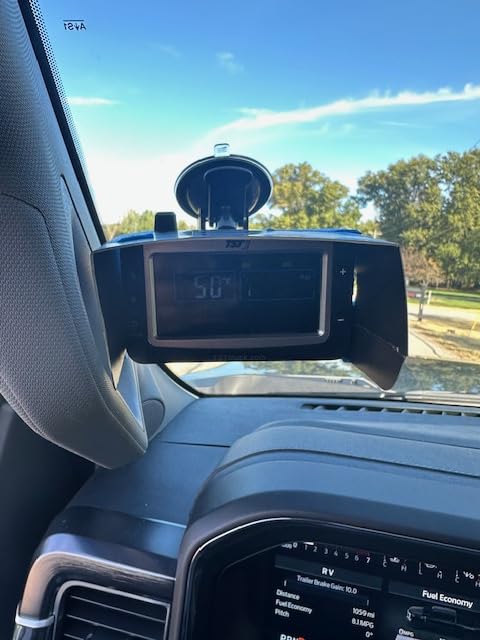
The display is a 3.5-inch color unit with a rechargeable battery and a Micro-USB charger in the box, plus suction cup and rubber dash mounts. When a tire goes out of range, the alert auto-locks onto that tire rather than making you hunt through a scrolling list at highway speed.
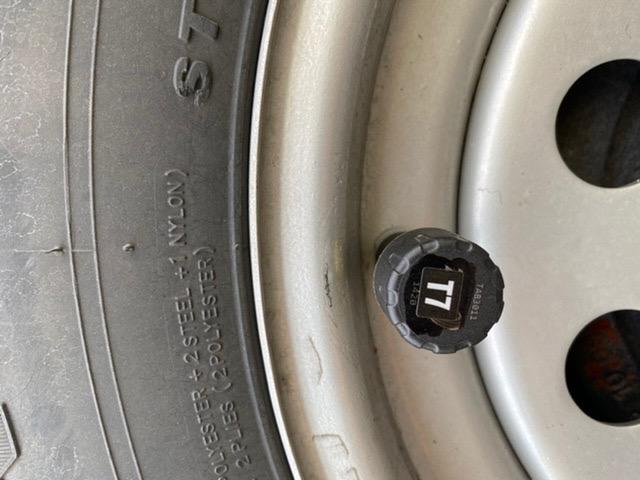
Two details separate this from generic displays. The sensors take user-replaceable CR2032 coin cells with low-battery alerts, so a dead battery costs you a coin cell instead of a sensor. And the kit includes a repeater, which solves the long-rig signal problem before it starts.
You can also monitor the tow vehicle plus up to four towable vehicles from the same screen, and cap sensors can be relocated to different wheel positions after a tire rotation without re-pairing the whole system.
Who the TST 507 suits best
Owners who keep their trailer long term and who have been burned by a support line that does not answer. The three-year warranty with US-based live customer service is among the longest coverage in this group, and that matters when a sensor fails in season three.
It also suits anyone towing a longer rig or a fifth wheel, since the included repeater addresses the exact problem that owners who skip it later regret.
Where the TST 507 falls short
It sits at the higher end of what these kits cost, and the four-sensor base configuration means dual-axle owners need a higher-count variant. Budget for that before ordering, not after.
Programming is also a commonly cited learning curve. Several owners describe the setup manual as the weak part of an otherwise solid system, so allow an unhurried first hour rather than doing it in a campground at dusk.
3. TireMinder i10 – Best for High-Pressure Setups and Future Capacity
TireMinder i10 RV TPMS with 4 Transmitters, Black
Plus or minus 1 PSI accuracy
0-199 PSI
40 tires max
6-second scan
Pros
- Tightest stated accuracy in this roundup
- 6-second refresh catches slow and fast leaks
- Signal booster included in the box
- Large 3.15-inch color LCD
- Scales to 40 tires for large rigs
Cons
- Sensors need periodic coin cell swaps
- Base kit has only four transmitters
The TireMinder i10 carries the tightest stated accuracy of the kits here, and on a safety-adjacent purchase that is worth leading with. It holds plus or minus 1 PSI across a 0-199 PSI range, which means a reading is a number you can act on rather than a rough direction.
The screen checks every six seconds for slow leaks, rapid leaks, blowouts, low and high pressure, and high temperature. On a trailer that means a slow leak shows up as a trend over a few minutes of driving, not as a surprise at the campground.
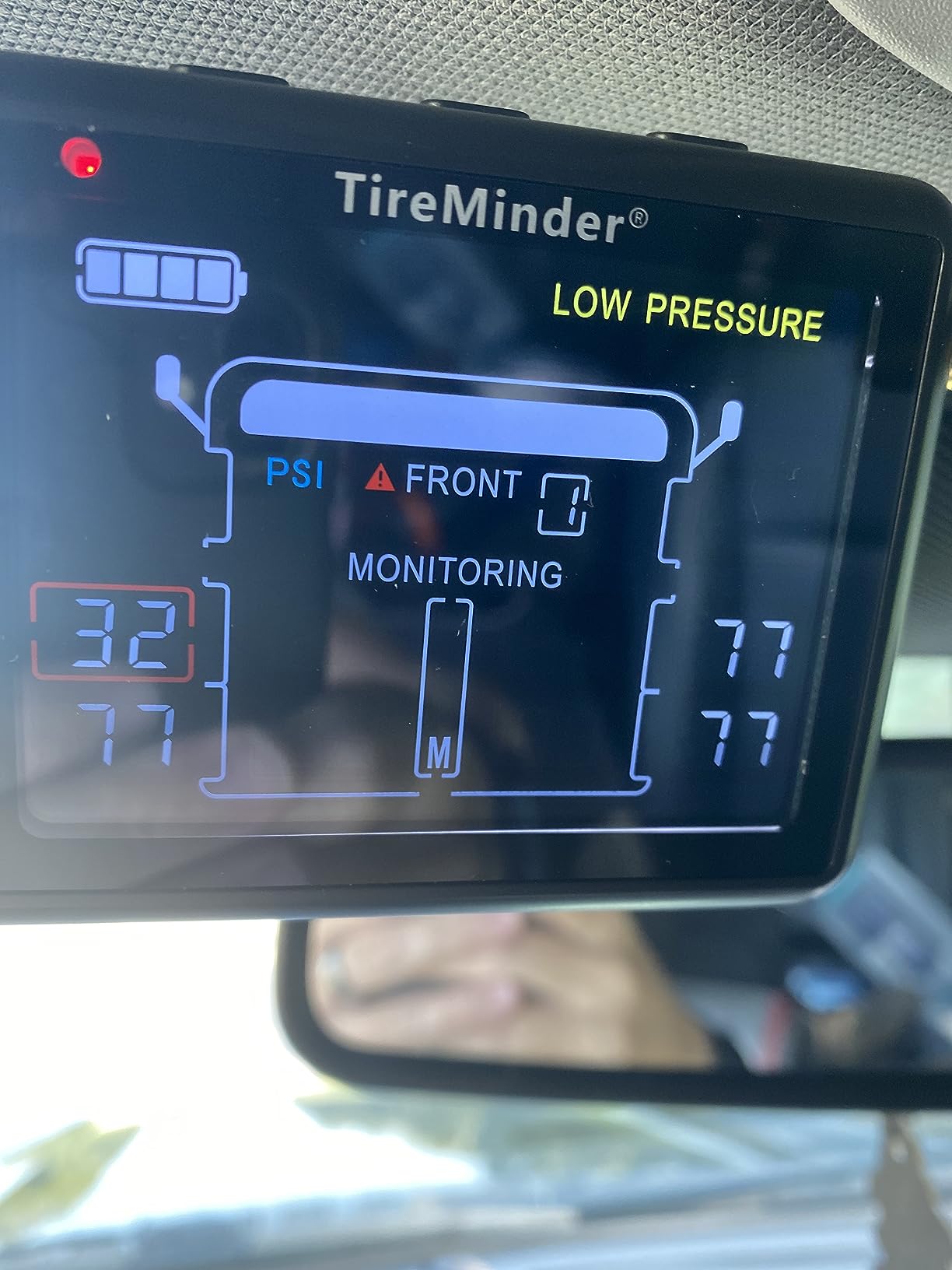
The display is a 3.15-inch color LCD showing PSI or temperature at the same time, which is easy to read from the driver’s seat. Owners who wear polarized sunglasses like the readability.
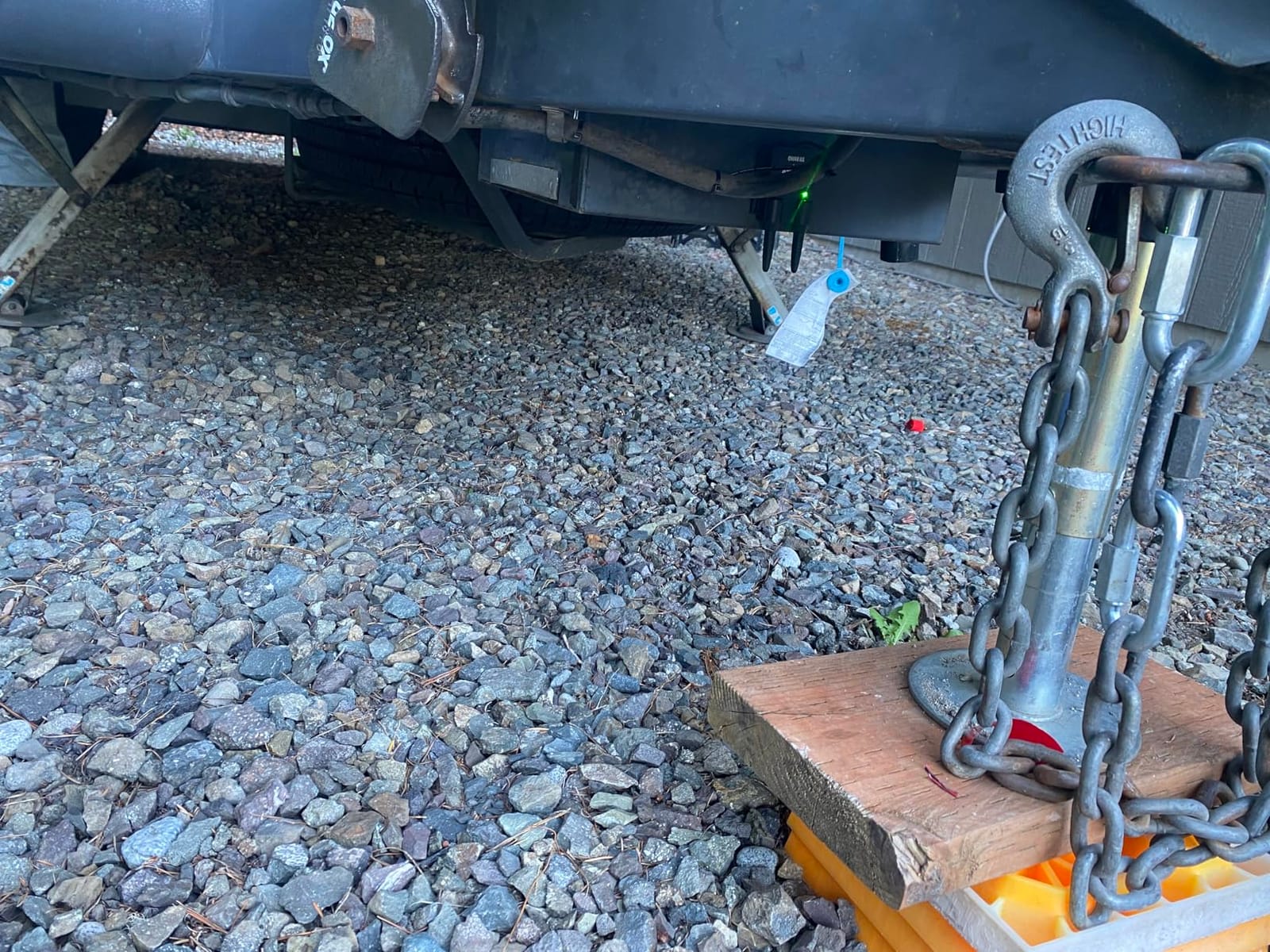
The box includes a Rhino signal booster, and owner forums consistently rank this system second only to the TST 507 in endorsements. Owners single out the built-in booster as the deciding factor on long trips, and US-based responsive support is regularly called out as a strength.
Who the TireMinder i10 suits best
Owners who want a wide margin for error and the confidence to add a tow vehicle or a second trailer later. Forty tires of capacity means this system grows with you instead of capping out.
Since the 199 PSI ceiling is well above what most trailer tires ever see, it also suits anyone running higher-pressure setups or a heavy gooseneck.
Where the TireMinder i10 falls short
The transmitters use replaceable coin cells that need periodic swapping, so there is a small maintenance rhythm to stay on top of. Buy a handful of spare cells with the kit.
As with most four-sensor kits, the base configuration covers four tires only, so dual-axle owners order the extra transmitters separately. A booster being included at all is unusual in this category and genuinely valuable.
4. GUTA GT30 – Best for Dual-Axle Trailers and Multi-Vehicle Monitoring
GUTA GT30 Trailer Tire Pressure Monitoring System, RV TPMS with 10 Sensors
10 sensors included
Up to 188 PSI
46 tires viewable
5-minute sensor reports
Pros
- Ten sensors cover a dual-axle trailer and tow vehicle
- Handles pressures up to 188 PSI
- Sensors can be programmed wirelessly before installation
- CR2032 cells are user-replaceable
- Large screen shows ten tires per page
Cons
- Manufacturer requires metal valve stems
- Five-minute report interval is slow for a fast leak
The GUTA GT30 is the kit that solves the sensor-count problem in a single box. Ten sensors means a dual-axle travel trailer plus your tow vehicle is covered out of the box, which is the configuration many trailer owners actually want and most kits do not supply.
It handles pressures up to 188 PSI and tire temperatures up to 185 F, so it has real headroom for heavy trailers and trucks. The large screen shows up to ten tires per page and auto-switches between front and rear sections, and you can scroll through as many as 46 tires without pressing a button.
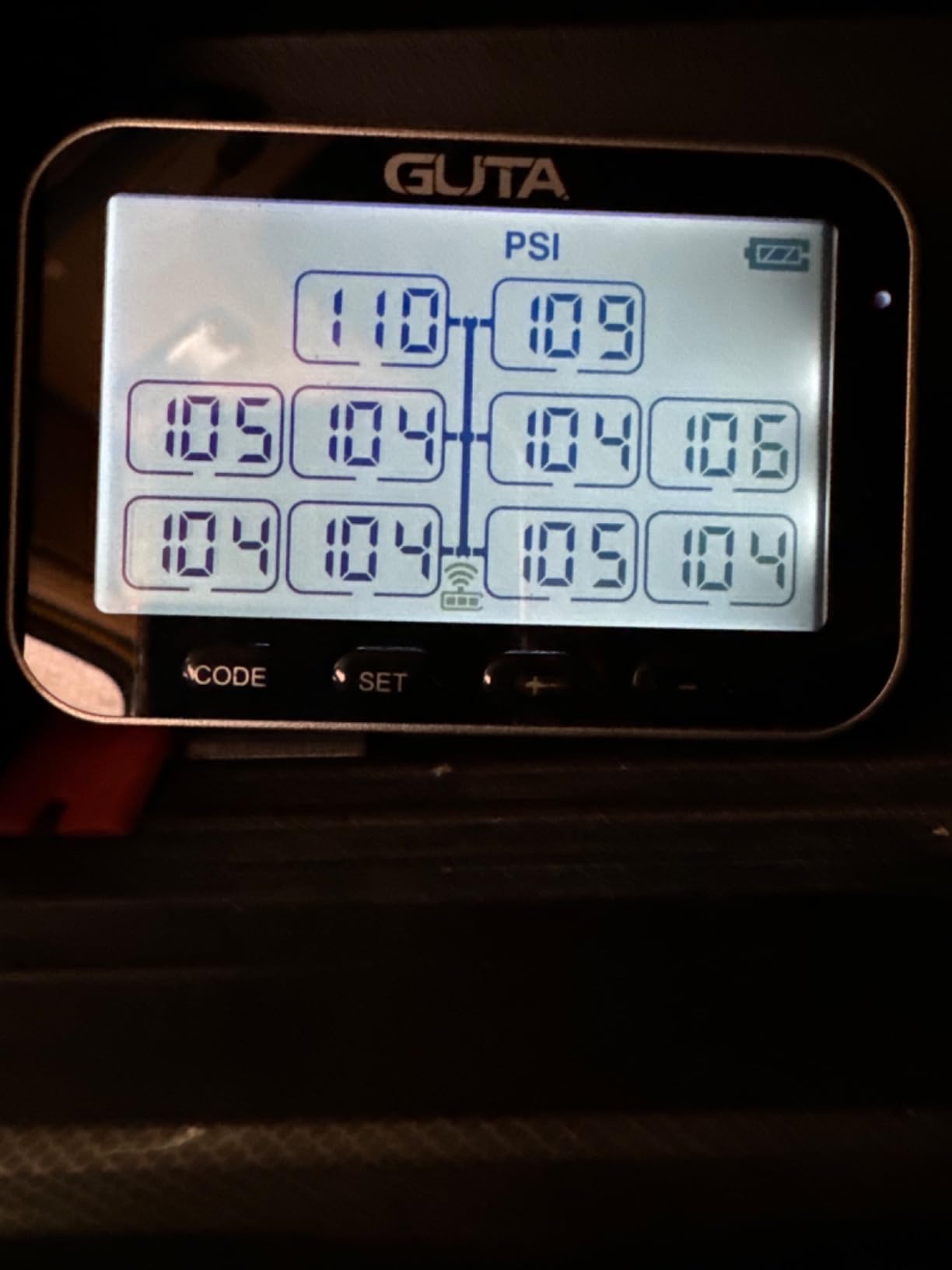
Wireless sensor programming is the detail that saves real time. You can assign each sensor to a wheel position before it ever touches a valve stem, which removes the fiddly one-at-a-time pairing ritual on a hot gravel pad.
Alerts cover high and low pressure, high temperature, fast leak, missing signal, and low sensor battery. The monitor battery runs 12 to 14 days on a four-hour charge and drops into a power-saving mode after 15 minutes without motion.
Who the GUTA GT30 suits best
Dual-axle and tag-axle owners who do not want to buy sensors twice, and anyone monitoring a trailer plus a tow vehicle in one view. The ten-sensor count is the reason this kit exists.
Owners running higher-PSI loaded trailers will appreciate the 188 PSI ceiling, and the CR2032 cells inside the sensors are user-replaceable, which keeps long-term running costs predictable.
Where the GUTA GT30 falls short
The manufacturer recommends metal valve stems and does not recommend rubber ones, so budget for a stem swap if your trailer is on original rubber stems. That is a good reason to do the conversion anyway.
More importantly, the sensors report every five minutes. That is fine for spotting a slow leak over a drive, but it is not a live feed, and it feels sluggish next to a six-second system when a tire is losing air fast.
5. EEZTire Pro 518C – Best for a Large Readable Display
EEZTire-TPMS Pro (518C) Tire Pressure and Temperature Monitoring System with 3.5″ Color Display + 4 AT Sensors, Not Compatible with Our Previous Models T515, E518, E618 Systems
4.5 by 3 inch display
26 tires and 210 PSI
60-hour lithium battery
Three-year warranty
Pros
- One of the largest displays available
- Readable in sunlight and with polarized glasses
- Six-second scan shows change in real time
- Monitor battery lasts up to 60 hours
- Mix of anti-theft and flow-through sensors
Cons
- Startup linking can take 5 to 20 minutes
- Signal drops if the monitor sits low in the dash
- Menu system is dated
The EEZTire Pro 518C wins on one measurable thing: the display is 4.5 by 3 inches, one of the largest in the market, and owners repeatedly single out that it stays readable in direct sunlight and through polarized sunglasses. On a bright highway that is not a minor feature.
Under the hood it monitors up to 26 tires at pressures up to 210 PSI, with a motion-sensitive six-second check interval and a power-saving mode after 15 minutes of no motion. The built-in rechargeable lithium battery runs up to 60 hours per charge, which covers a long trip without a 12V socket in sight.
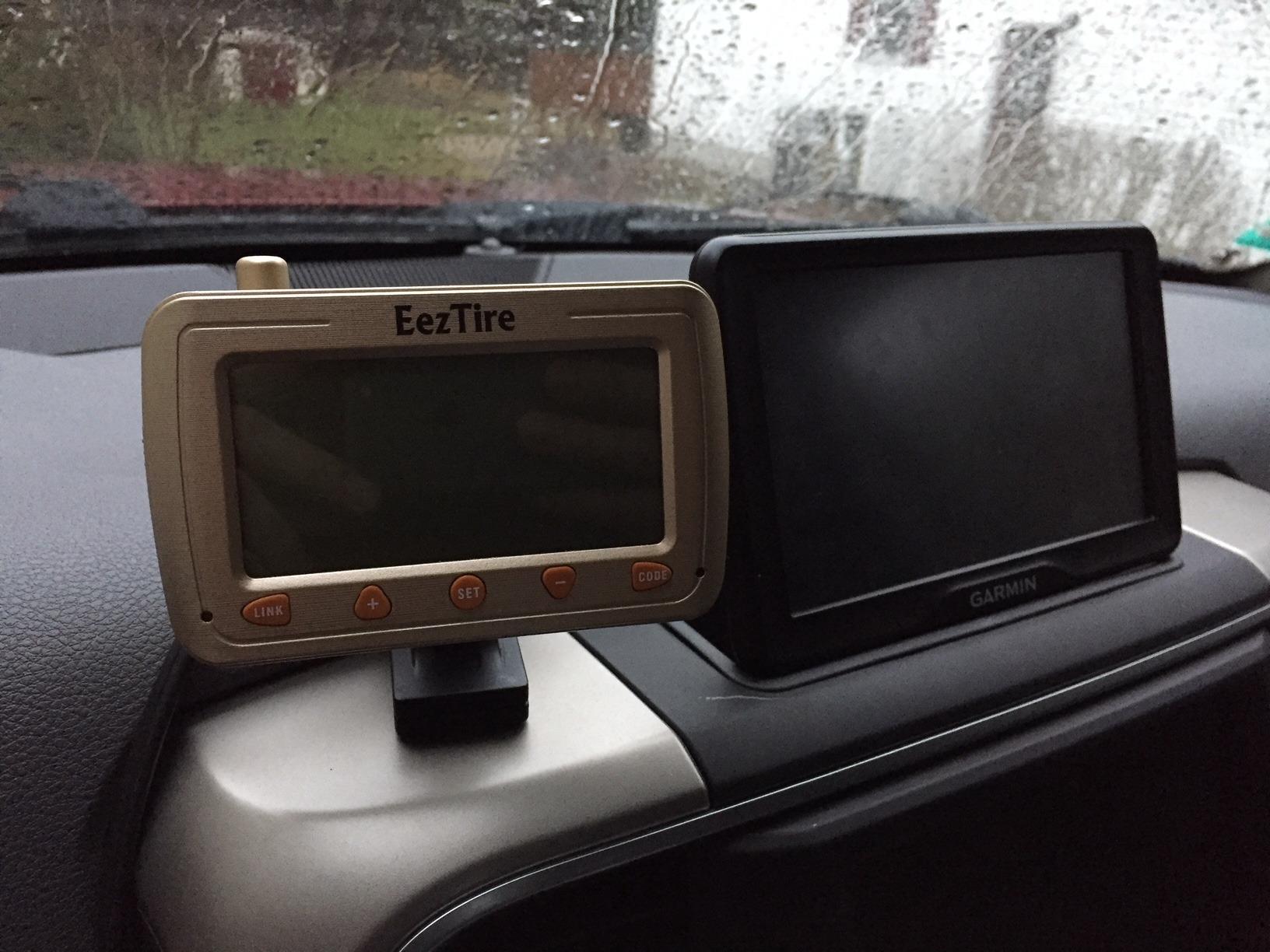
Owners with several years on these report multiple long trips on a single charge, and it has worked repeater-free on a mid-size travel trailer behind a pickup. That last point is worth noting, because a missing repeater is a frequent cause of lost signal reported in trailer forums.
The kit also supports separate RV and trailer sensor controls and lets you mix anti-theft and flow-through sensors, which is unusual flexibility. Response time is six seconds and accuracy is rated at 2 percent.
Who the EEZTire Pro 518C suits best
Owners who read their display in bright sun, wear polarized glasses, or simply want one big panel instead of squinting at a small screen. The 60-hour battery also suits full-timers who do not want a hardwire install.
It is a good fit for anyone monitoring a lot of tires, since 26-tire capacity leaves plenty of room to add a second trailer, a toad, or a UTV on a slide-out.
Where the EEZTire Pro 518C falls short
Startup linking can take anywhere from 5 to 20 minutes for the monitor to find all transmitters, which is genuinely frustrating the first time. Plan for it rather than assuming something is broken.
Signal loss is the other known issue, and it is usually placement-related: owners report dropouts when the monitor sits low in the dash or near a wireless backup camera. Mount it high and clear. Some units have also reported blank displays that needed replacement, and the single multifunction button makes menu navigation feel dated.
6. Flydew 6-Wheel TPMS – Best Budget Six-Sensor Kit
Flydew 6-Wheel RV TPMS with Custom Pressure Alerts, 0-144 PSI
6 sensors included
0-144 PSI
Solar plus USB-C
Three-year warranty
Pros
- Six sensors cover a dual-axle trailer
- Thresholds adjustable in PSI rather than percentages
- Auto-dimming screen works in sun and at night
- Solar and USB-C dual charging
- Pre-coded sensors with jam nuts
Cons
- Much smaller review base than the established kits
- CR1632 cells still need replacing
- Counterclockwise install order is specific
The Flydew 6-Wheel kit exists for one reason: giving a dual-axle owner six sensors at a budget price point. That is the configuration that is genuinely hard to find cheaply, because most entry-level kits come with four and leave the rear axle uncovered.
What it does well is thresholds. Instead of a fixed percentage band, the alarm limits are adjustable in PSI across the entire 0-144 PSI range, so you can set a low alarm at your exact cold pressure and a high alarm with a specific margin rather than a generic percentage.
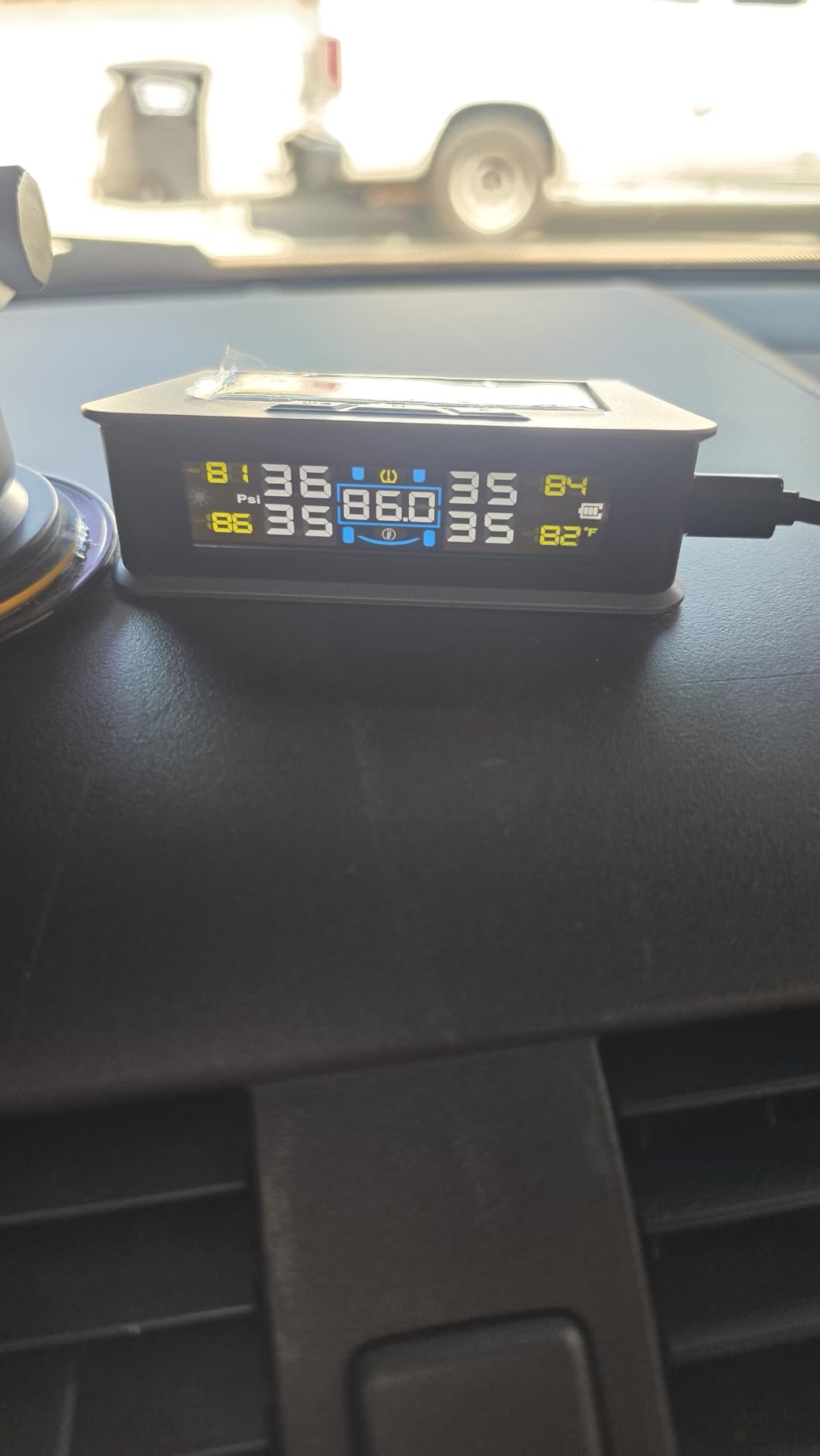
Accuracy is rated at plus or minus 1.5 PSI, sensor data updates in 0.3 seconds, and the LCD refreshes every six seconds. Six alarm types cover high and low pressure, high temperature, sensor disconnect, low battery, rapid air leak, and sensor fault.
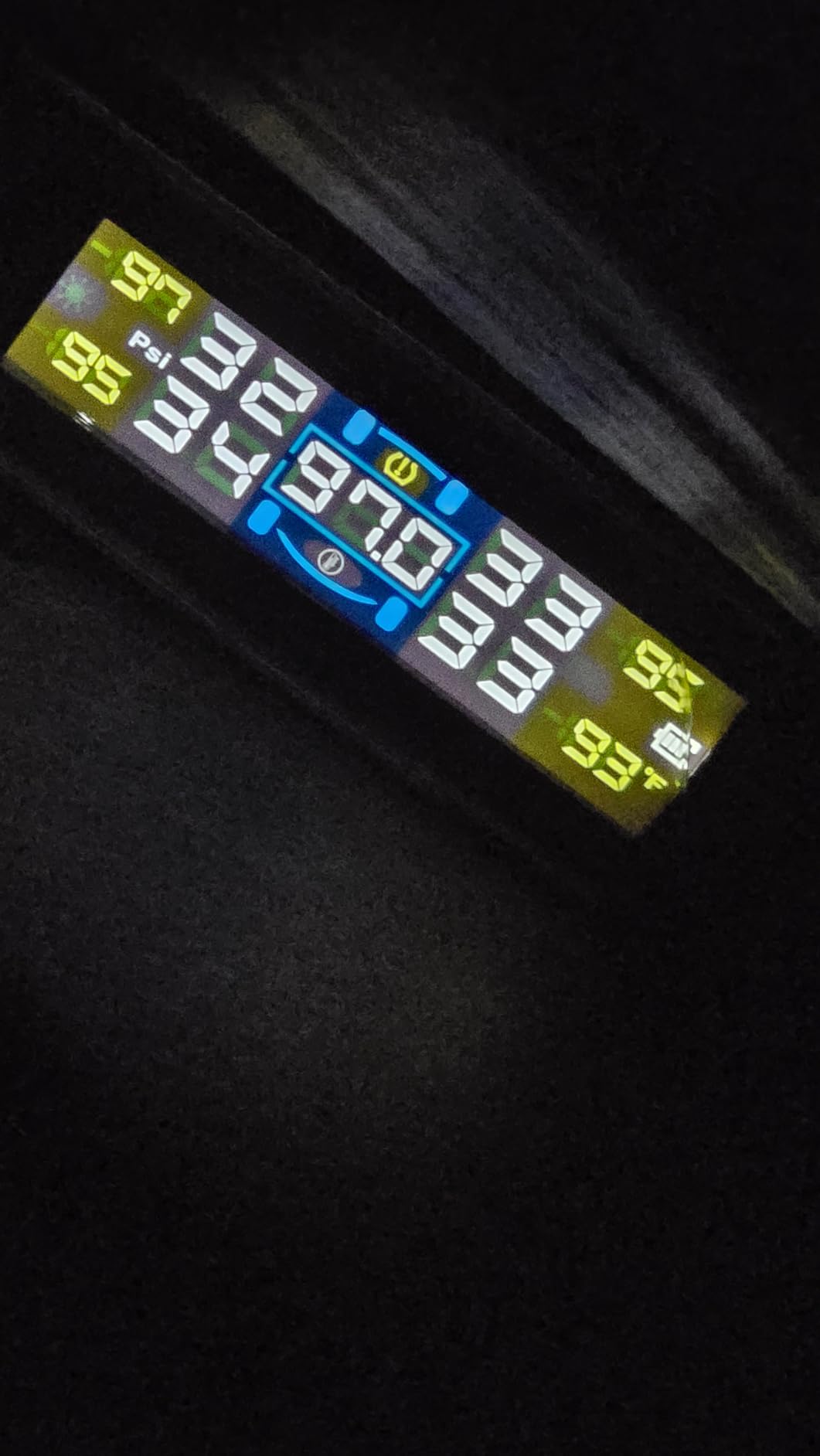
The display auto-dims for daylight and night, and charging is handled by a solar panel plus USB-C. Sensors come pre-coded and include jam nuts and a soapy-water leak test step in the instructions, which is a sensible install kit.
Who the Flydew 6-Wheel suits best
Dual-axle trailer owners working to a budget who want every tire covered on day one. Six sensors, adjustable PSI alarms, and a three-year warranty in one box is an unusual combination in this tier.
It is also a reasonable second system for a trailer stored outdoors through winter, or for anyone who wants a spare display to keep in the truck.
Where the Flydew 6-Wheel falls short
The review base is much smaller than the established kits, so long-term durability is not well documented. That is the honest trade for a newer listing, and it is why we placed it sixth rather than higher despite the feature list.
Sensors still use replaceable CR1632 coin cells, and the install requires tightening the sensor nuts in a specific counterclockwise order to seat them properly. Read that step before you start.
7. LETOURWM M12-3 RV Tire Pressure Monitor – Best Kit for First-Time Owners
RV Tire Pressure Monitoring System -TPMS Tire Pressure Monitor with 6 Sensors,M12-3 TPMS Solar Charge & USB Color LCD Display, 0-9.9BAR/144PSI Range, 6 Alarm Modes for RV/Trailer/Truck IP67
6 sensors included
0-144 PSI
Solar plus USB
Voice alerts
IP67
Pros
- Low cost for a complete six-sensor kit
- Auto-brightness display that does not fade in sun
- Solar charging runs without regular USB top-ups
- Includes jam nuts and a wrench
- Voice broadcast reads alerts aloud
Cons
- Readings can run 3 to 5 PSI off a handheld gauge
- Sensors drop contact intermittently in heavy rain
- Needs frequent resets and re-pairing
The LETOURWM M12-3 is among the cheapest complete six-sensor kits in this roundup, and for a trailer owner who has never had monitoring before it is a reasonable first step. Six sensors, six alarm modes, and a 0-144 PSI range cover every tire on a dual-axle trailer.
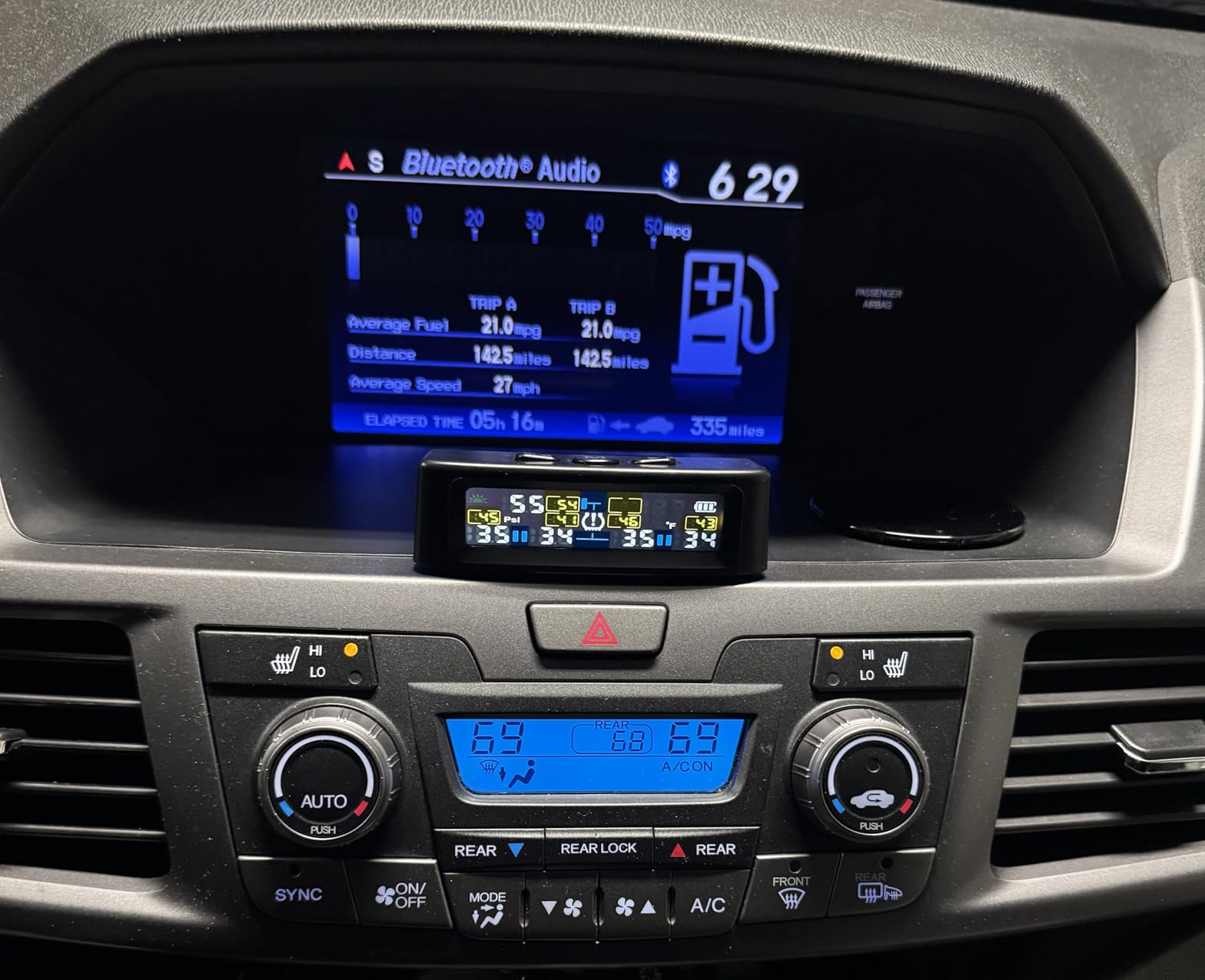
Two features stand out. The auto-brightness LCD does not wash out in direct sun, and the voice broadcast feature reads alerts aloud so you do not have to look at the screen while driving.
Sensors are IP67 rated for dust, water, wind and snow, screw onto the valve with no wiring and no tire removal, and come pre-paired and labeled. Charging is solar plus USB, and the listed sensing distance is 65 feet, which is comfortable for a bumper-pull and adequate for many setups.
Owner opinions are genuinely split on this one, and we want to be straight about that. Several buyers report replacing a system that cost three times as much, while others report intermittent sensor dropouts and readings that were not reliable enough to trust.
Who the LETOURWM M12-3 suits best
New owners on a strict budget, seasonal campers who want a low-cost first system, and anyone who has a trailer they do not intend to keep long term.
It is also a good fit for a second trailer, a boat, or a utility trailer that needs monitoring alongside the main rig.
Where the LETOURWM M12-3 falls short
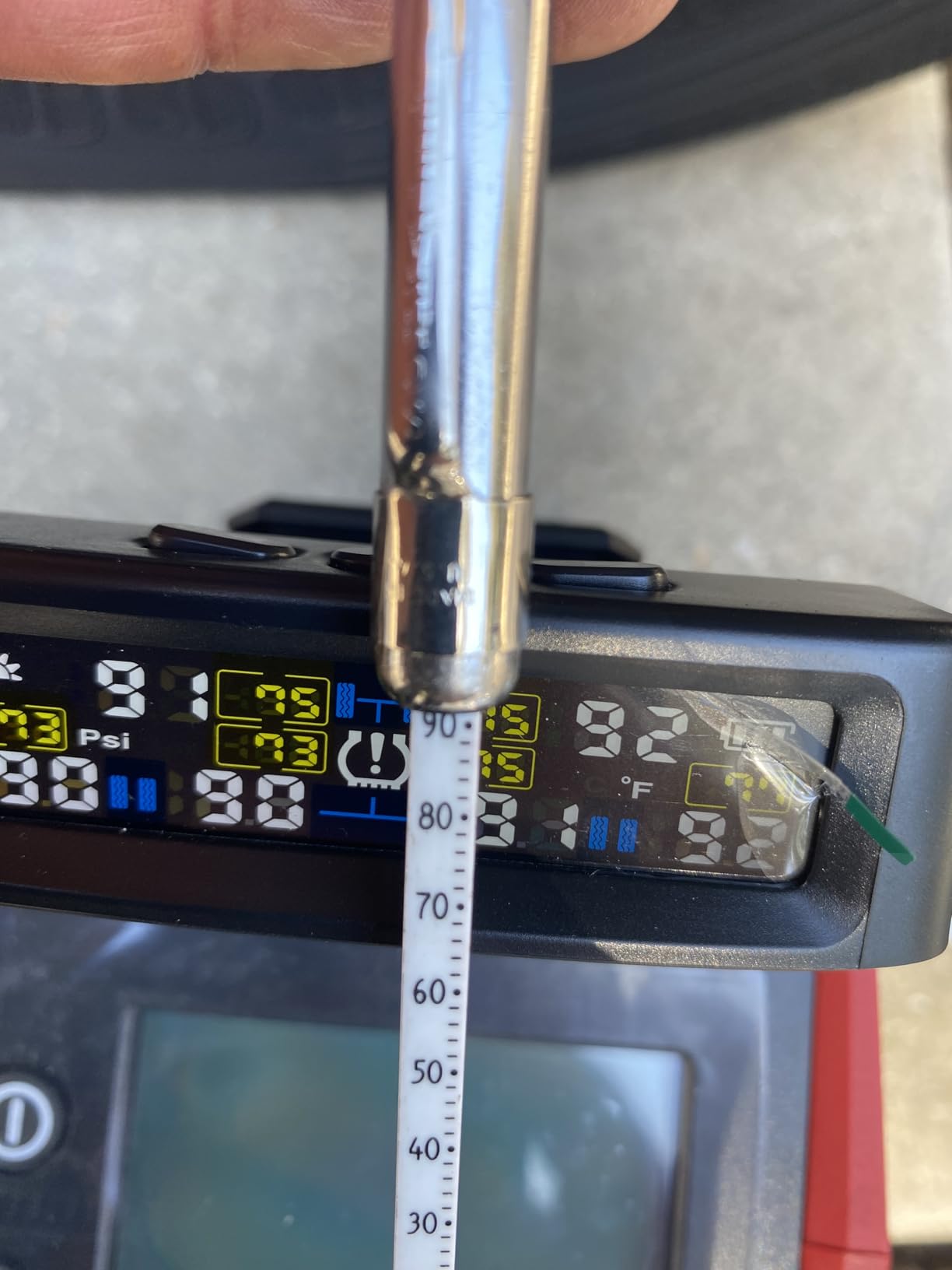
Accuracy is the real concern. Buyers report readings that run 3 to 5 PSI off a handheld gauge on some setups, and a monitoring system whose numbers are off by that margin is not going to catch a slow leak reliably.
There is also no connection indicator on the display, so a stale reading looks identical to a live one, and sensors need frequent resets and re-pairing to reconnect. Instructions are hard to follow and the display has a large dash footprint. If you want a system you can trust at highway speed, spend up.
8. GUTA GT80 – Best for Flow-Through Sensor Convenience
GUTA GT80 RV Tire Pressure Monitoring System, 10 Flow-Thru Sensors TPMS
10 flow-through sensors
0-188 PSI
Booster included
22 tires on one page
Pros
- Flow-through sensors let you inflate without removing anything
- Booster included extending range to 164 feet
- Vertical color touchscreen readable in bright daylight
- Sensors arrive pre-paired and labeled
- Jam nuts and wrench included
Cons
- Costs more than most kits in this roundup
- Flow-through sensors require metal valve stems
- Inner rear sensors can drop briefly on rough roads
The GUTA GT80 rates highest of the systems here, and its reason is the one that matters most day to day on a trailer: flow-through sensors. You can top off a tire at the gas station without pulling a sensor, pulling a core, or fishing a valve cap out of the gravel.
That convenience comes with a prerequisite. Flow-through sensors only fit metal valve stems, so if your trailer is still on original rubber snap-in stems, that conversion is part of the job rather than an optional extra.
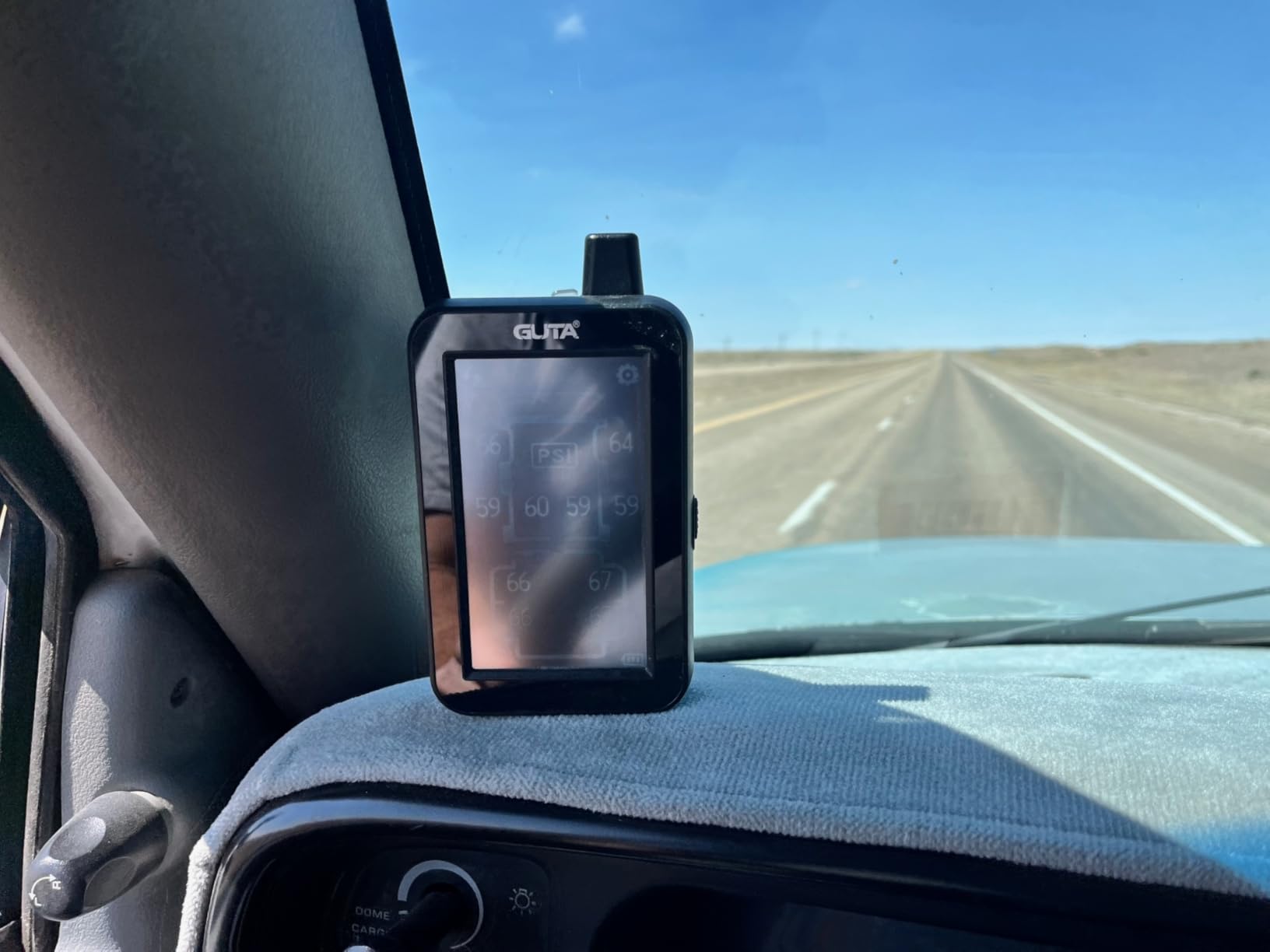
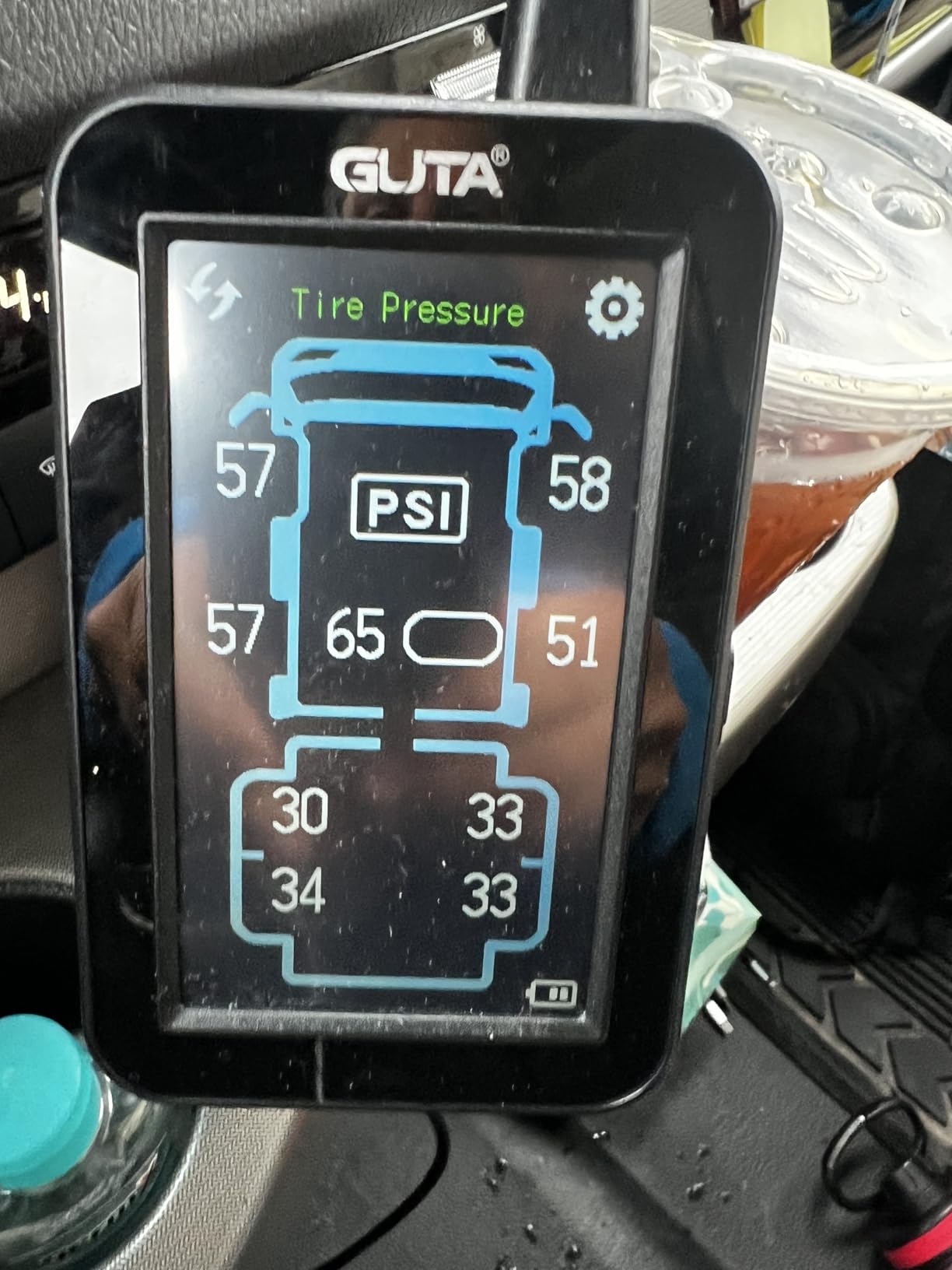
The display is a large vertical color touchscreen covering 0-188 PSI with temperature monitoring, and it stays readable on bright days. Ten flow-through sensors are included, which covers a dual-axle trailer and then some.
A battery-powered repeater is included with the model and extends connectivity up to 164 feet, which comfortably covers a fifth wheel or a gooseneck. No 12V wiring is required for the booster, which matters if your wiring route to the front of the trailer is awkward.
Who the GUTA GT80 suits best
Owners who air up tires often, travel in places where pulling a sensor is a hassle, and anyone on metal valve stems already or willing to convert. The included booster also makes it a strong pick for long rigs.
The 22-tire single-page capacity and five switchable vehicle types suit owners running a trailer plus a tow vehicle plus a second trailer from one screen.
Where the GUTA GT80 falls short
It is the higher-cost option in this roundup, and the metal valve stem requirement adds to that. Owners running rubber stems are looking at two separate purchases to get the same result.
Inner rear tires can drop out briefly on rough or bumpy roads before recovering, and the power-saving mode kicks in after 10 minutes without motion or vibration, so a stationary display may look asleep while you are airing up.
Cap Sensors vs. Flow-Through Sensors for Travel Trailers
For a travel trailer, we recommend flow-through sensors if your budget allows, and cap sensors if it does not. That is the short version, and the reason is a single practical scenario: you will eventually need air in a tire at a campground or a gas station, and that is the moment the two types feel completely different.
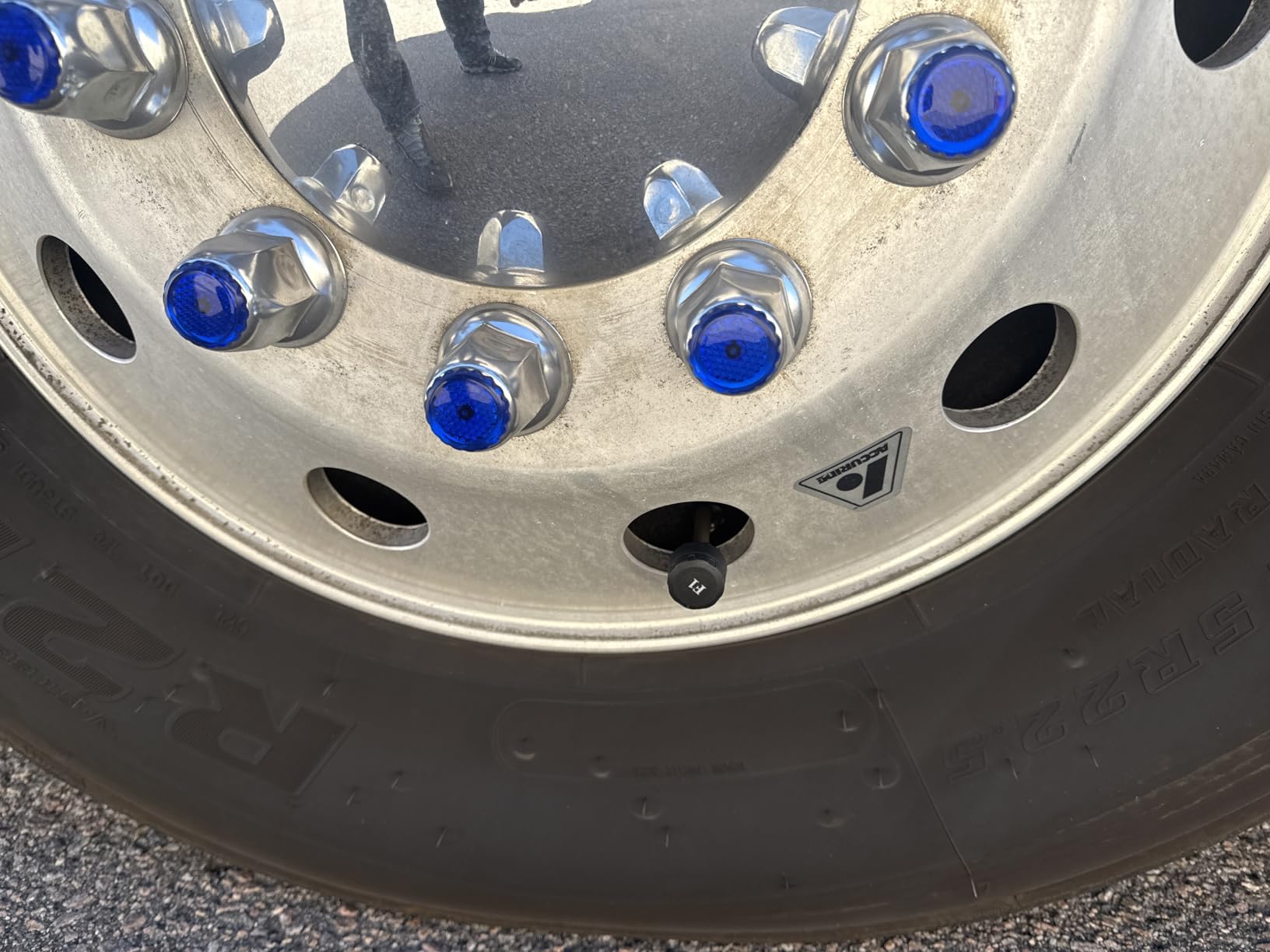
A cap sensor screws over the existing valve stem like a lug nut cap. It takes about thirty seconds to install, adds almost no weight, and can move between wheel positions after a rotation. The problem is that to inflate, you remove it, add air, and refit it every single time. A dropped cap in gravel at a dark campground is a real and common annoyance.
A flow-through sensor replaces the valve stem entirely and has a hole through the middle, so you inflate straight through it. Nothing comes off and nothing gets lost, which is why owners who switch rarely go back. The costs are real: they are heavier, they only fit metal or brass bolt-in stems, and heavier sensors mean your wheels need rebalancing after installation.
One more practical difference. Cap sensors are also less damaging if a tire shop rotates your wheels and forgets they are there, because the sensor usually just unscrews. Air Forums members have reported multiple sensor failures traced to exactly that mistake.
Valve Stems: The Hidden Danger With Trailer TPMS
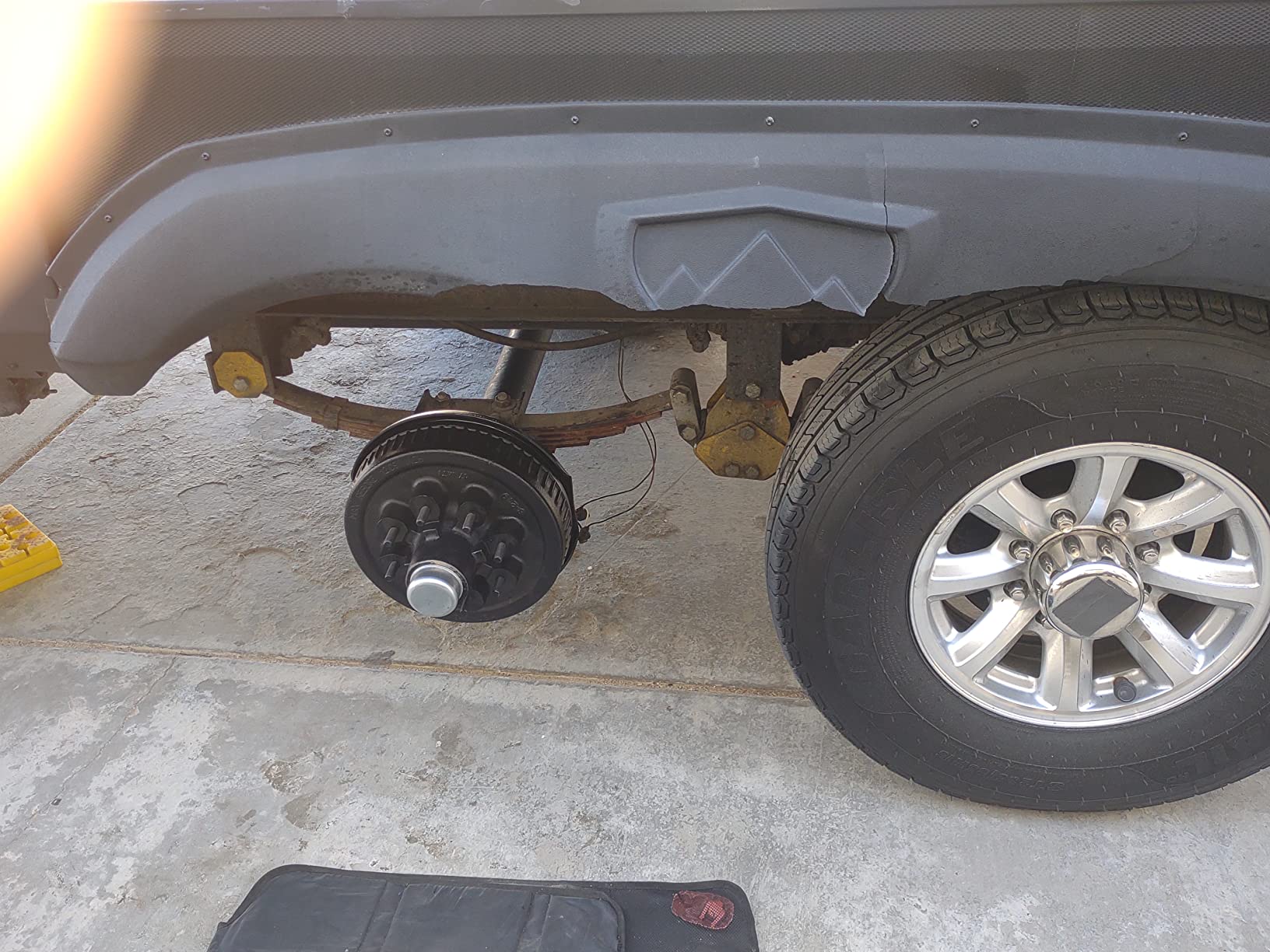
This is the safety item we would put at the top of any trailer TPMS guide, and it is the one most guides skip. Travel trailer valve stems are often rubber snap-in stems, and adding the weight of a sensor to a rubber stem at highway speed puts real centrifugal force on the base of that stem where it meets the wheel.
Owners report finding rubber stems cracked or sheared at the base after fitting heavier sensors, and a stem failure at speed is a blowout, not a warning. The failure mode is not dramatic in advance, which is exactly what makes it dangerous.
There are three steps that prevent it:
Replace rubber snap-in stems with metal or brass bolt-in stems before fitting any sensor. This is the single most important thing you can do, and every flow-through sensor on this list requires it anyway. Budget for four to six stems depending on your axle count.
Inspect every stem during your pre-trip walkaround. Grab each one and wiggle it. A rubber stem that feels soft, moves, or shows a crack at the wheel face gets replaced before you drive, not after.
Rebalance the wheels after installing heavier flow-through sensors. Added sensor weight changes dynamic balance, and it shows up as a vibration at highway speed that owners often misattribute to the trailer.
If your trailer is on rubber stems and you only want a cap sensor, the conversion is still worth doing. It costs a few dollars per stem and a short tire shop visit, and it removes the most serious failure mode in this entire article.
Signal Range, Boosters and Long Rigs
Trailer TPMS sensors transmit on the 433MHz band, and that signal has to travel from the rear axle to a display in your tow vehicle. On a 26 to 30 foot bumper-pull that distance is not a problem. On a 40-plus foot fifth wheel or a gooseneck with a tag axle, it is a frequent cause of dropped sensors.
Dropped signal shows up as a tire that reads intermittently or goes blank at speed, and owner forums consistently trace it to one of three things: no repeater installed, a monitor mounted low in the dash near other electronics, or metal slide-outs and generator bays blocking the transmission path.
Start with placement. Mount the display high on the dash and away from wireless backup camera transmitters, which is a documented cause of signal loss. Then address the rig itself, since metal slide-outs and generator bays can block the 433MHz path on some trailers.
If you have a fifth wheel with slide-outs, test the system with them fully retracted and fully extended. A rig that reads perfectly closed and drops sensors when a slide comes out needs the repeater, not a different brand.
Troubleshooting Travel Trailer TPMS False Alarms and Lost Signal
False alarms come up repeatedly across the trailer owner forums we read, and they usually trace back to configuration rather than a defective product. Before you blame the system, work through these in order.
False low-pressure alarms. Check the reference pressure the system is using. Many units alarm against a percentage of a stored reference, so if you set the reference when the tires were hot after a drive, every cold reading afterward looks low. Re-set your reference pressure with the tires cold, using the number on your tire sidewall.
False high-temperature alarms. On a trailer, heat near the wheel can come from a brake or bearing on the towing vehicle rather than the trailer tire. Tymate owners report high-temperature alarms triggered by brake heat, which is a sensor placement issue on the toad rather than a fault.
One sensor drops out. Mount the display high in the dash and away from wireless backup cameras, which is a documented cause of signal loss. Then check the sensor battery, since a weak coin cell often shows up as intermittent readings before it fails outright.
How to tell if a sensor is bad. Isolate one tire at a time. Drop the pressure in a single tire with the system powered and watch whether the reading follows. If the display does not register a deliberate 5 PSI drop on one tire, that sensor or its battery is the problem, and replacing that single sensor is usually all that is needed.
Can you fix a sensor yourself? Partly. If the system uses user-replaceable CR2032 or CR1632 cells, you can swap the battery yourself and re-pair the sensor to the same wheel position. If the sensor is sealed, the unit itself is the replaceable part, which is the practical difference between a five-minute fix and a trip to the trailer shop.
Do you have to replace all four sensors at once? No. Sensors are paired to positions, and on the systems here you can re-pair a single replacement sensor to a wheel position. That is a strong argument for choosing a system with user-replaceable CR2032 or CR1632 cells rather than sealed sensors.
Tell the tire shop. Air Forums members have reported repeat sensor failures caused by shops rotating or servicing tires with sensors still installed. Put the instruction on the work order, and check the sensors yourself when you collect the trailer.
Travel Trailer TPMS Buying Guide
Sensor count first, because it is the one decision you cannot easily undo. Four for a single-axle bumper-pull, six for a dual-axle or tag axle, plus four more if you want the tow vehicle on the same display. Buying a four-sensor kit and adding two later is fine on most systems, but the extra sensors are cheaper bundled.
Refresh rate is the second decision. A six-second scan will show a slow leak developing over a drive, while a five-minute report interval is more of a safety net. For highway travel, faster is meaningfully better, and the TireMinder i10 and EEZTire Pro 518C both scan at six seconds.
Booster and repeater coverage decides whether the system works on your rig at all. If your travel trailer is over about 30 feet, or you tow a fifth wheel or gooseneck, treat a bundled booster as close to mandatory. Check whether the kit includes one or sells it separately, since a booster ordered later is an extra purchase and an extra wait.
Display readability matters more than resolution. A small dim screen is useless at highway speed in direct sun. Look for a color panel around 3 inches or larger with automatic backlighting, and if you wear polarized sunglasses, read reviews on that specifically, because some panels go black under them.
Battery serviceability is the long-term cost driver. Systems with user-replaceable CR1632 or CR2032 cells cost you a coin cell when one dies. Sealed sensors cost you a new sensor, and on a 6-sensor trailer that adds up over a decade of ownership.
Warranty length is a reasonable proxy for how the manufacturer expects the product to be supported. The TST 507, EEZTire Pro 518C, Flydew and GUTA GT80 all list three years.
Finally, set your thresholds from cold pressures on the tire sidewall, not from a reading taken hot at a fuel stop. A TPMS is a diagnostic instrument, and like any instrument it is only as good as the reference you give it. It also does not replace a pre-trip walkaround. It tells you what is happening now; it does not tell you what the tire looks like.
Frequently Asked Questions
What is the best tire pressure monitoring system for travel trailers?
For most trailer owners the Tymate TM2 is the best starting point because its sensors arrive pre-paired and it covers up to ten tires. The TST 507 Series is the choice owners defend hardest for long-term support, with a three-year warranty and user-replaceable sensor batteries. The TireMinder i10 leads on accuracy at plus or minus 1 PSI and includes a signal booster in the box.
How many TPMS sensors do I need for a travel trailer?
A single-axle bumper-pull travel trailer needs four sensors, one per tire. A dual-axle or tag-axle trailer needs six. Add four more if you also want the tow vehicle monitored on the same display. Dual-axle rigs are where the count matters most, because an inside dual can hold enough pressure to mask a slow leak on the outside tire.
Do I need metal valve stems for a trailer TPMS?
Yes, and we would convert them even if you choose cap sensors. Flow-through sensors only fit metal or brass bolt-in stems, so that conversion is mandatory for those. On rubber snap-in stems, added sensor weight puts centrifugal force on the base of the stem at highway speed, and owners have found stems cracked or sheared after fitting sensors. Inspect the stems on every pre-trip walkaround.
Can I replace my TPMS with regular valve stems?
You can go back to standard valve stems, but you will lose pressure and temperature readings on those tires and your display will show them as missing. On flow-through systems the sensor is the valve stem, so removing it means the tire cannot be inflated normally. If a single sensor fails you do not need the whole set, since sensors pair to positions and one replacement can be re-paired to a wheel location.
Why does my trailer TPMS keep giving false alarms?
The usual cause is configuration rather than a fault. If you set the reference pressure while the tires were hot, every cold reading afterward looks low. Re-set your reference using the cold pressure from your tire sidewall. High-temperature alarms can come from a brake or bearing on the tow vehicle rather than the trailer tire, and lost signal is usually a display mounted low in the dash near other electronics.
Final Verdict: Which Travel Trailer TPMS Should You Buy?
If you want one answer for a typical bumper-pull or dual-axle travel trailer, the Tymate TM2 is where we land, because pre-paired sensors mean it is working the same afternoon you open the box. If you plan to keep the trailer for a decade or you tow long, the TST 507 Series earns its higher cost with three-year warranty coverage, user-replaceable sensor batteries, and a repeater in the box.
Choose the TireMinder i10 if stated accuracy and future capacity matter most, and the EEZTire Pro 518C if you read your display in direct sun. GUTA’s GT30 covers a dual-axle trailer plus a tow vehicle in one box, and the GT80 is the pick if you want to inflate without pulling a sensor and are willing to convert to metal valve stems.
Two things matter more than any brand. Convert rubber valve stems to metal before fitting sensors, and size the sensor count to your axles. Those two decisions prevent the failures that actually hurt people. Whatever you choose among the best tire pressure monitoring systems for travel trailers, get those right first.