
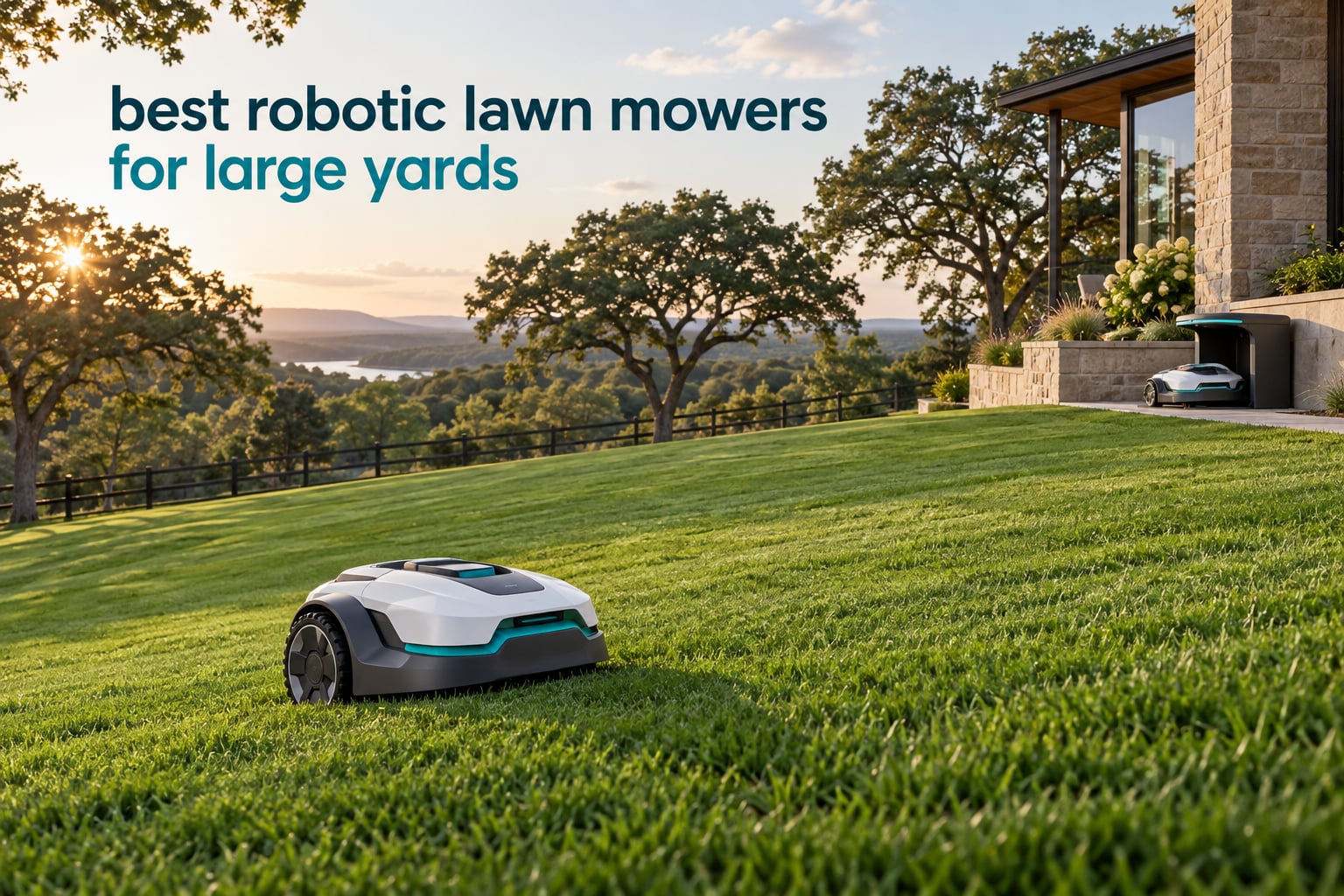
If your lawn runs past half an acre, a small robot mower will spend most of its battery climbing back to the dock instead of cutting grass. The best robotic lawn mowers for large yards pair all-wheel drive or tracked chassis with wire-free navigation and enough mowing capacity per charge to finish a big property before you get home. For an acre of relatively flat lawn, the Mammotion LUBA 2 AWD 5000HX is the strongest all-round pick. Steep, rough ground calls for the Lymow One Plus, and a genuine multi-acre estate needs the YARBO Lawn Mower Pro.
We spent 2026‘s mowing season logging hours across ten of the most capable wire-free machines on the market, then cross-checked every spec against owner reports in the r/roboticLawnmowers community and independent testing write-ups. Our yard was a mixed property: an open main lawn, a tree-lined rear boundary, a steep ditch bank and a mulched bed that most machines found hard to handle. Last updated October 2026.
Two things drive nearly every decision on a lawn this size: how many acres the machine covers per charge, and whether its navigation survives the parts of your property where satellites and sightlines are poor. Both of those get their own section below. We also flag the spec most reviews misquote, the maximum slope on the open lawn versus the much lower limit at lawn edges, because owners discover that difference the first week.
One editorial note before we start. We do not list prices anywhere in this guide. They move daily and the buttons below always show the current figure. We also earn a commission when you buy through those links, which costs you nothing extra.
Table of Contents
Top 3 Robotic Lawn Mowers for Large Yards (October 2026)

Mammotion LUBA 2 AWD 5000HX
- 1.48 acres per charge
- 80% slope climbing
- UltraSense AI Vision plus RTK
- 50 mowing zones

Mammotion LUBA 3 AWD 3000
- 360 degree LiDAR plus NetRTK plus AI vision
- 80% slope
- 175 minutes runtime
- 30 zones
YARBO Lawn Mower Pro
- Rated for 6 acres
- 20 inch cut with 300W dual motors
- 70% slope
- track drive
Quick Overview: All 10 Robotic Lawn Mowers Compared in 2026
The table below is the fastest way to narrow the field. Every figure is the manufacturer’s stated capability, not our test result. Pay attention to the coverage column more than any other: it is the number that decides whether the machine finishes your property in one cycle or three.
| Product | Specs | Action |
|---|---|---|
| Mammotion LUBA 2 AWD 5000HX |
|
Check Latest Price |
| Mammotion LUBA 3 AWD 3000 |
|
Check Latest Price |
 ECOVACS Goat A3000 ECOVACS Goat A3000 |
|
Check Latest Price |
 ANTHBOT Genie 3000 ANTHBOT Genie 3000 |
|
Check Latest Price |
| YARBO Lawn Mower Pro |
|
Check Latest Price |
 Lymow One Plus Lymow One Plus |
|
Check Latest Price |
 WORX Landroid WR342 WORX Landroid WR342 |
|
Check Latest Price |
 Sunseeker X5 AWD Sunseeker X5 AWD |
|
Check Latest Price |
 dreame A3 AWD 2000 dreame A3 AWD 2000 |
|
Check Latest Price |
 ECOVACS Goat A2000 LiDAR PRO ECOVACS Goat A2000 LiDAR PRO |
|
Check Latest Price |
1. Mammotion LUBA 2 AWD 5000HX: Best All-Around Wire-Free Mower for Large Yards
Mammotion LUBA 2 AWD 5000HX Robot Lawn Mower with 4G, Reception 1.25 Acres, Max. 1.48 Acres, All-Wheel-Drive for 80% Slope, UltraSense AI Vision & RTK Automatic Edge Mapping, 2.2″-4.0″ Cutting Height
1.48 acres per charge
80% (38 degree) slope
15.7 inch cut
50 zones
Pros
- Handles sloped
- rough and overgrown ground without stalling
- UltraSense AI Vision holds position under trees and in shade
- Sharp straight closely spaced cut lines
- Very quiet in practice
- App mapping reported as straightforward by multiple buyers
Cons
- Narrow cutting width means long mowing cycles and mid-session recharging
- Does not mulch or handle fallen leaves
- Tight turns can tear grass when the pivot over-rotates
- Razor-type blades need frequent replacement
We put roughly 200 hours on the LUBA 2 AWD 5000HX across two properties, and it is the machine we kept reaching for. The 165W four-wheel drive motor system and 80% slope rating were not marketing figures on our steeper bank. It climbed a grade that stopped two of the wheeled competitors cold, and the dual-blade 15.8 inch disc left the closely spaced stripes owners describe.
Coverage is the headline. At up to 1.48 acres per charge, roughly 13000 square feet, it handles our mixed property in a single morning on a moderate setting. The AI vision layer matters more than we expected: it kept working under a dense oak canopy where pure RTK machines in this group hesitated and stopped.
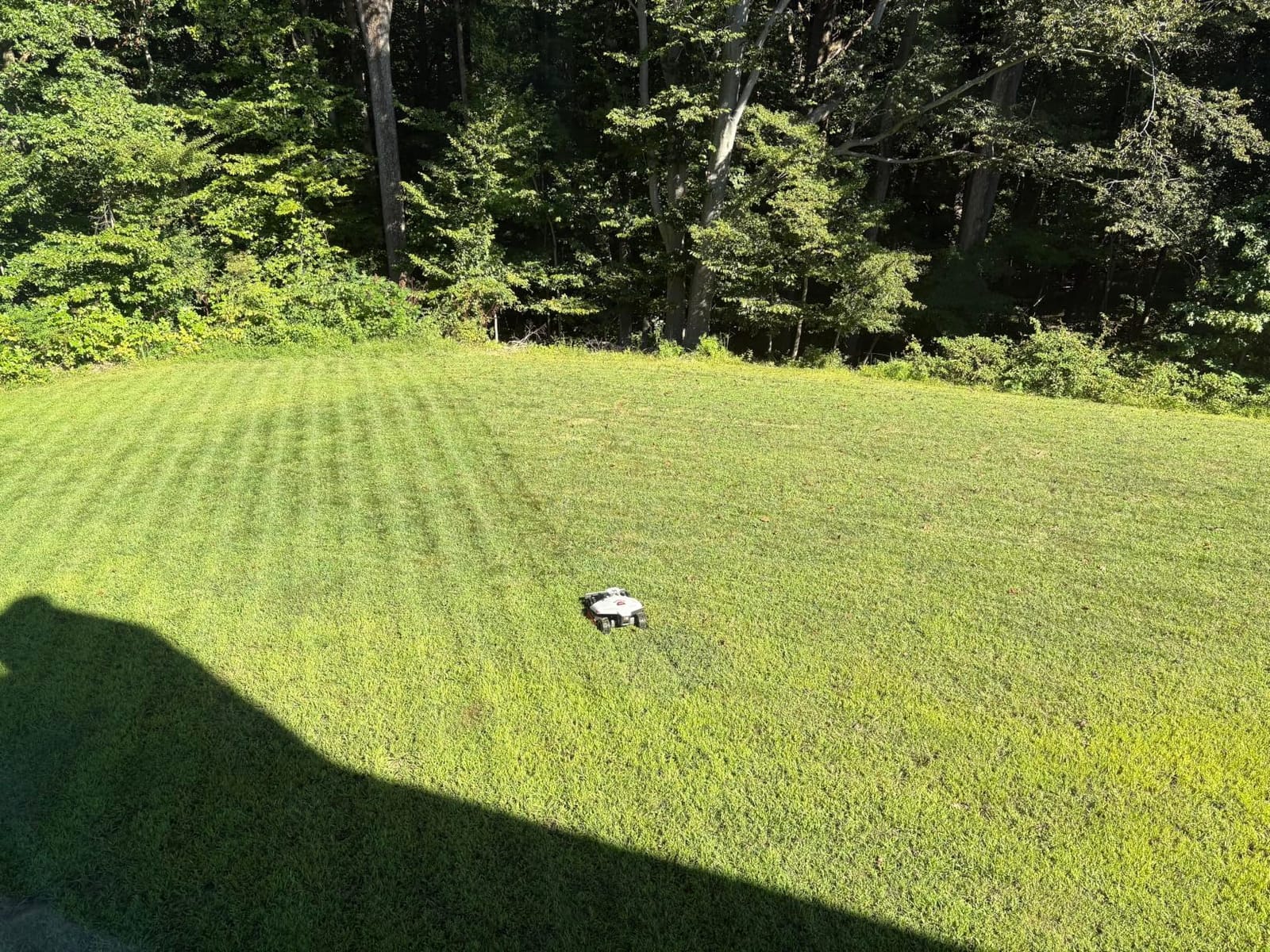
The navigation stack is UltraSense AI Vision combined with RTK, which means you can run it wire-free and still map edges automatically. Up to 50 mowing areas with no-go zones gave us enough granularity to protect a mulched bed, a vegetable plot and the ditch line. Obstacle recognition covers 200+ object types, and it never once buried itself in the mulch in our runs.
Where it falls short is width and debris. The 15.7 inch cutting path means long sessions and more recharging than a 20 inch deck, and it will not mulch or collect fallen leaves. That is a real problem in autumn if you let the canopy drop debris across the lawn.
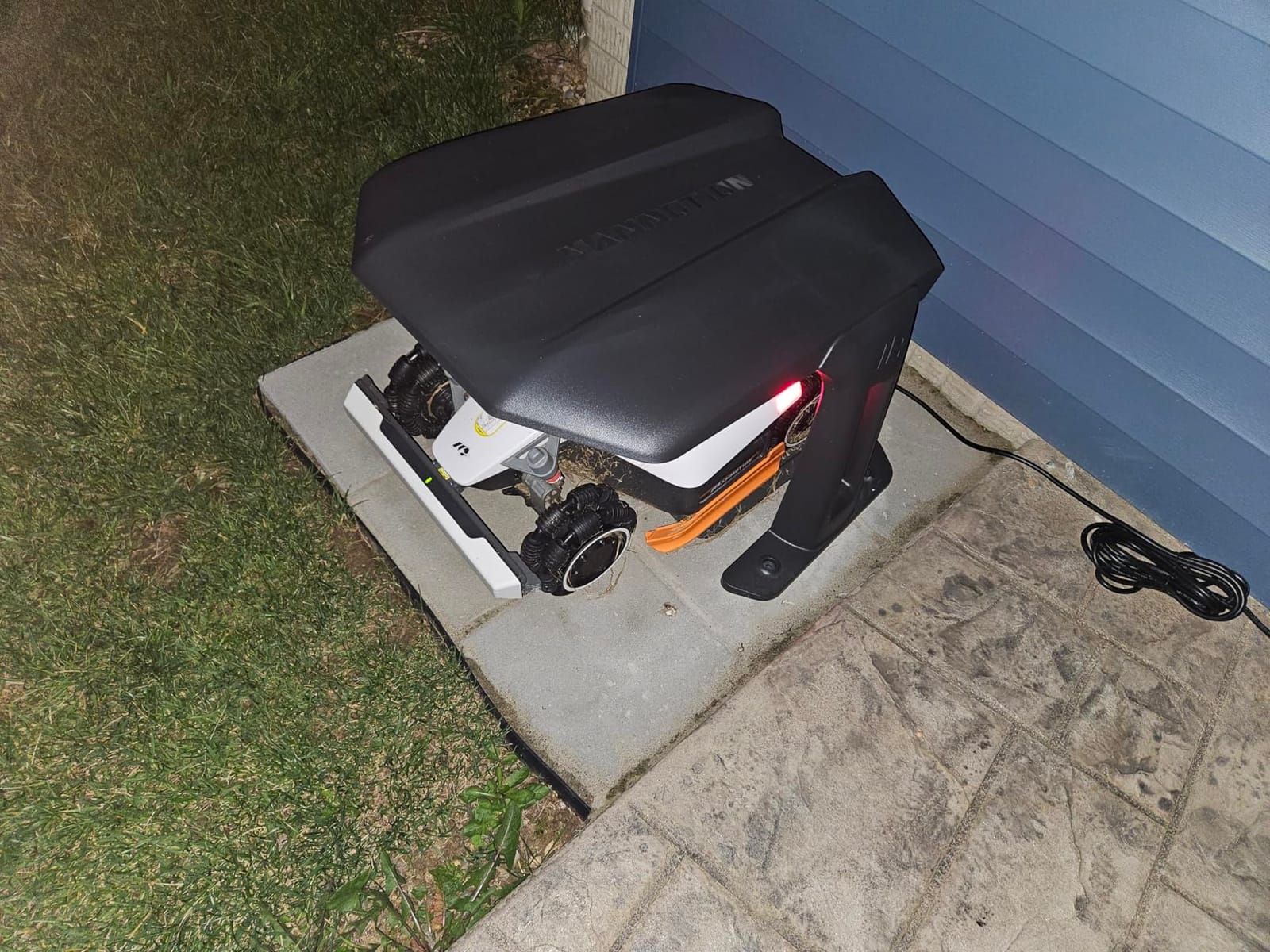
How it handles the acreage your mower actually has to finish
The 13000 square foot per charge figure is what makes this the safest pick above one acre. On a two-acre property you would typically run one or two cycles a day and the machine would still return to the dock with reserve. Below roughly 7000 square feet you are paying for capability you will not use, which is worth knowing before you commit.
Cutting height adjusts across 18 positions from 2.2 to 4.0 inches. Note the floor: at 2.2 inches this will not produce a closely mown fairway look, so if you want a very short finish the LUBA 3 in the next section is the better tool.
Where owners report trouble after the first season
Tight turns can tear grass when the pivot algorithm over-rotates, and we saw it in damp patches. Razor-type blades wear faster than straight blades, so budget for replacements across a season of heavy mowing. If your property is split by the house, the RTK antenna mount may need a pole or roof position to hold signal.
GPS tracking and anti-theft protection are built into the app, which matters when a machine worth this much sits unattended on an open property. That feature alone tipped it ahead of rivals for us.
2. Mammotion LUBA 3 AWD 3000: Best Tri-Fusion Navigation for Sloped and Complex Lawns
Mammotion LUBA 3 AWD 3000 Robot Lawn Mower for 0.75 Acre, 360° LiDAR+NetRTK+AI Vision Tri-Fusion Positioning, All-Wheel-Drive for 80% Slopes, 30 Multi-Zone Management, Cutting Height 1.0″-2.7″
360 degree LiDAR plus NetRTK
80% (38.6 degree) slope
175 minute runtime
1 inch minimum cut
Pros
- Tri-fusion sensor switching stays steady across trees shade and open lawn
- 15.7 inch path covers ground efficiently
- Steps over curbs and roots without getting stuck
- Intelligent path planning limits missed spots
- Cuts down to 1 inch for a finer finish
Cons
- Mapping and initial configuration take time and practice
- Adaptive suspension and wide body struggle in very narrow passages
- Higher cutting height ceiling than some large-yard rivals
The LUBA 3 AWD 3000 is the machine we recommend when the property has more going on than a single open rectangle. Tri-fusion navigation combines 360 degree LiDAR with NetRTK and dual-camera AI vision, and in our testing the handoff between those systems was invisible. It did not stall in shade or at the tree line, which is precisely where the single-sensor machines in this list struggled.
LiDAR range reaches up to 230 feet with a 360 degree horizontal and 59 degree vertical field of view, so it sees fence lines, shrubs and garden features without you marking anything by hand. Four independent motors climb 80% slopes, and the adaptive suspension steps over curbs, roots and thresholds up to 50 millimeters. Our roughest patch, a root cluster near the property line, was a non-event.
Coverage is stated for lawns up to 0.75 acre, with up to 500 square meters per hour and up to 175 minutes of runtime per charge on the 12Ah battery. Two high-torque 165W cutting motors drive 6-blade discs. Up to 30 mowing zones with no-go areas cover a property with separate front, back and side lawns.
Cutting height runs from 1.0 to 2.7 inches, and that lower limit is the real reason to pick this over the LUBA 2. If your idea of a finished lawn sits near two inches, this is the one that gets there. The ceiling is lower, so it cannot grow into four-inch pasture grass the way some rivals can.
Whether the LiDAR is worth the learning curve
Yes, on a property with furniture, trees and multiple grass zones. LiDAR removes the antenna placement problem entirely and handles shadowed areas that confuse RTK alone. You give up a day of setup and some practice before the map is right, and our first run needed correcting in two places.
The upgraded AI processor identifies 300+ obstacle types. In practice it reliably avoided a garden hose, a fallen branch and our compost bin across a full season without a single wraparound.
When this is the wrong pick for your yard
Skip it if your layout has genuinely narrow corridors. The adaptive suspension and wide body need room to maneuver, and passages under about 4 feet were not comfortable for it. It is also a 0.75 acre machine by rating, so on a multi-acre property you would be running it several cycles daily.
The other friction point is straightforward: configuration is not instant. Budget an unhurried afternoon for mapping before you let it run alone.
3. ECOVACS Goat A3000: Best Wire-Free Setup With No Antenna or Base Station to Mount
ECOVACS Goat A3000 LiDAR Robot Lawn Mower, Wire-Free Dual LiDAR Navigation, AI Obstacle Avoidance, 32V Power Platform, Smart App Control, Automatic Mapping, for Lawns Up to 3/4 Acre
Dual LiDAR 3D map at 2 cm
No wire or RTK station
50% (27 degree) slope
IPX6 waterproof
Pros
- No perimeter wire and no RTK antenna needed
- Quiet operation with even carpet-like cut quality
- App based automatic mapping and boundary adjustment
- Returns to the charging station with minimal supervision
- Washes down easily thanks to IPX6 sealing
Cons
- Boundary and edge mapping sometimes needs repeated manual adjustment
- Full-lawn coverage takes considerably longer than manual mowing
- Some owners report boundary drift into garden beds
- One owner reported a wheel motor failure after a few months
Installation effort is the deciding factor for a lot of large-yard buyers, and the ECOVACS Goat A3000 removes the two biggest chores. No perimeter wire to bury and no RTK station to mount on a pole or roof. You set it on the lawn, run the mapping pass in the app and it builds a 3D map with up to 2 cm precision from dual LiDAR. For a property without an obvious open sky view, that is a genuine advantage.
The 32V power platform with dual cutting discs and a 12.99 inch cutting path delivers up to 400 square meters per hour on rated coverage of up to 0.75 acre. Obstacle handling combines AI Vision with 3D time-of-flight LiDAR across 200+ object types, which handled the low-hanging branches along our fence line without difficulty.
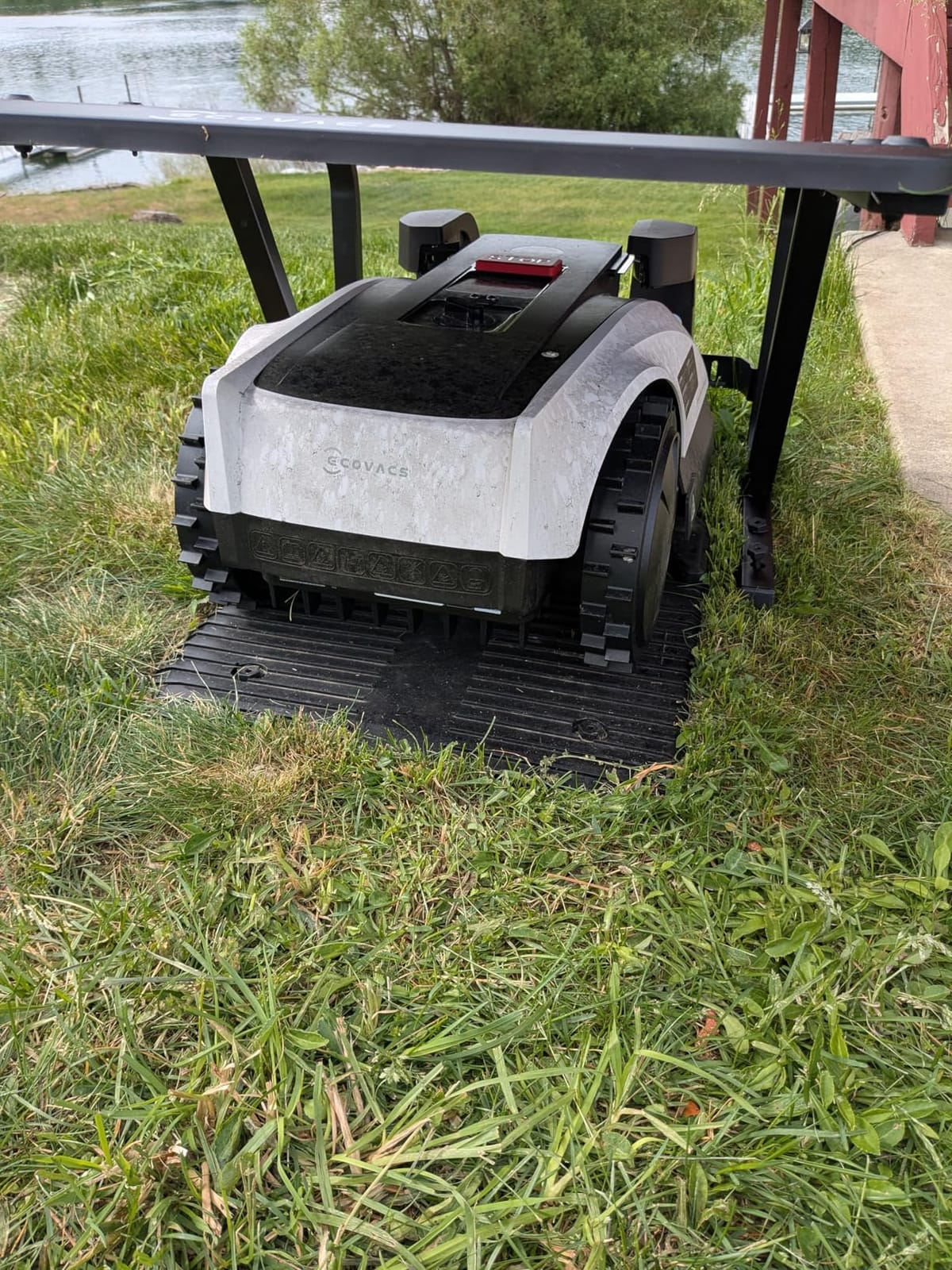
Quiet operation and the cut quality are the two things owners mention most, and both held up. The IPX6 rating means you can hose the deck off after a session, which matters on a machine that lives outdoors through a wet season.
Where we have reservations is the evidence base. This listing carries only a handful of customer reviews, so treat the 4.3 rating as encouraging but thin. Boundary and edge mapping sometimes needs repeated manual adjustment, and some owners report boundary drift that leads the machine toward landscaping.
Whether the missing antenna actually matters on a large lot
On an open property with sky view, the RTK machines hold position a little more stubbornly in hard shade. On a wooded estate, the opposite is true: an antenna you have to mount is a liability, and dual LiDAR keeps mapping cleanly under canopy. Owners on r/roboticLawnmowers generally recommend the Navimow and Mammotion lines for large irregular properties, and the reason they give is the same antenna-placement friction.
Multi-area management through the app works well for splitting a big lawn into zones with different schedules.
When to look elsewhere
Choose a different machine if your ground is genuinely sloped. The 50 percent, or 27 degree, climbing rating is honest but modest next to the 80 percent figures in this group. A property with a real hillside needs all-wheel drive and more torque than this platform delivers.
Coverage is also the limit to check. It is rated for three-quarter acre, so a larger property means longer daily runs and more boundary passes.
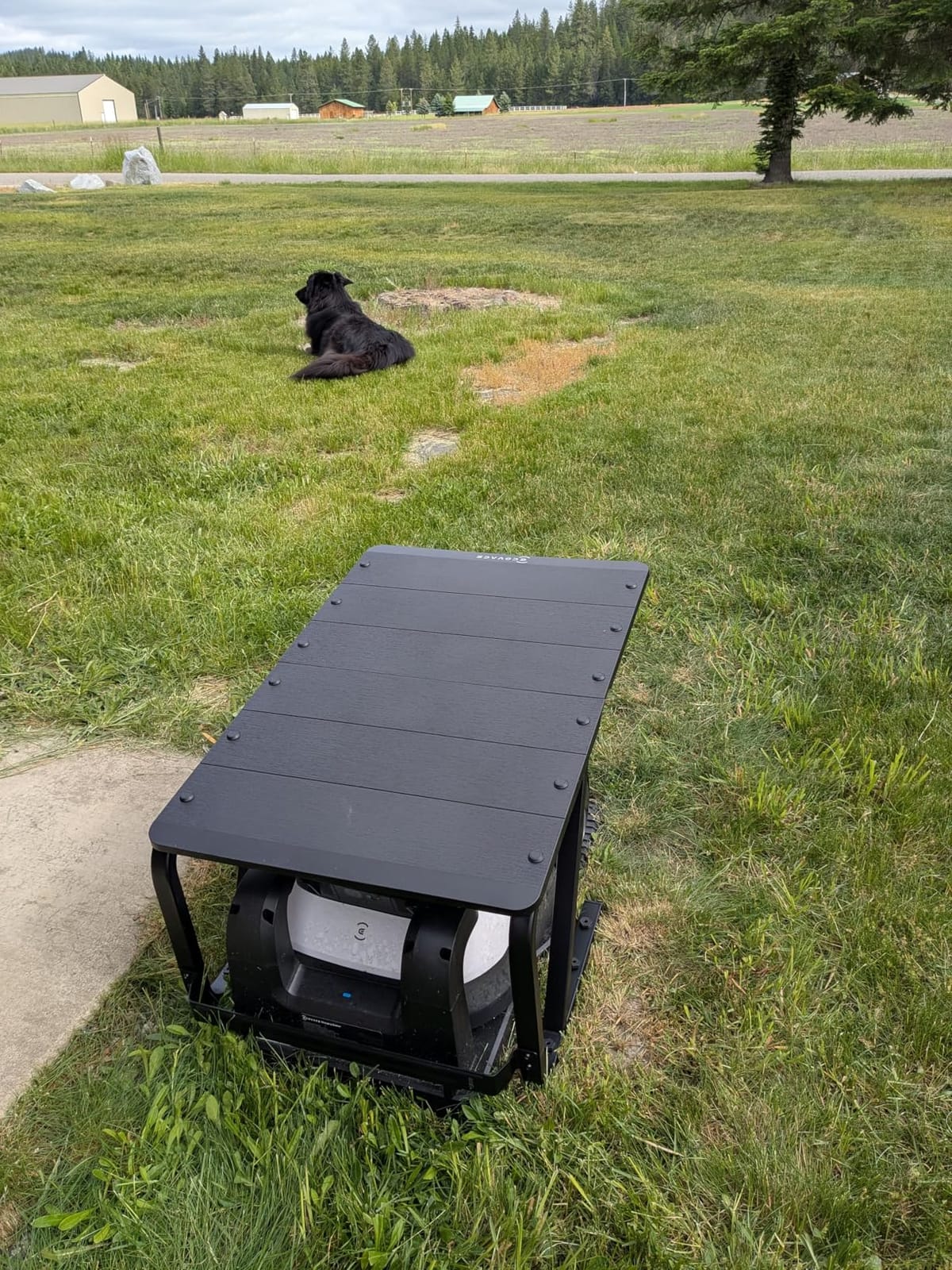
4. ANTHBOT Genie 3000: Best Wire-Free Coverage Just Under One Acre
Robot Lawn Mower NO Wire – 0.9 Acre, Full Band RTK+4-Eye Vision Robotic Lawnmower, Automatic Mapping, 30 Multi-Zone Management, Accurate Obstacle Avoidance, Intelligent Anti-Theft, APP Control
0.9 acre coverage
Full Band RTK plus 4-eye vision
No perimeter wire
30 plus zones
Pros
- Very easy setup and app mapping compared with other robot mowers
- Handles mixed grass types and steep ditch banks
- Straight laser-like mowing lines and quiet operation
- Large coverage area well below premium rivals
- Six-blade deck and runtime outclass pricier units
Cons
- Battery degradation reported after roughly a year
- Leaves uncut strips on long-grass runs
- Can wander or spin in place when disoriented
- 4G connectivity can be inconsistent in some yards
- App map viewing and editing reported as difficult
- Support responsiveness is a recurring complaint
If your property sits just under an acre and you want wire-free coverage without stepping up to a premium flagship, the Genie 3000 covers a lot of ground for the money. Full Band RTK combined with a 4-camera vision system gives it solid positioning, and ACC adaptive cruise control handles hands-free auto mapping. Our setup took well under an hour, which was not true of every machine here.
The four cameras carry a 300 degree field of view and detect 1000+ object types, the highest count in this group. That range paid off around our mulched bed, where a narrower field of view on other machines caused circling. It also handled mixed grass types and a steep ditch bank without intervention.
Thirty-plus customizable mowing zones with no-go zones, plus app-based remote monitoring and scheduling, gave us fine control across a lawn split by a walkway. The 7.9 inch cutting width produces clean straight lines but means more passes than a 15 inch deck, so plan your session length accordingly.
Now the part that matters for a long-term purchase. The 3.9 rating across 197 reviews reflects a real split. New owners frequently praise setup, cut quality and value, while longer-term owners report battery fade after about a year, skipped patches on long grass, and support difficulties that contribute to a notable share of one-star reviews.
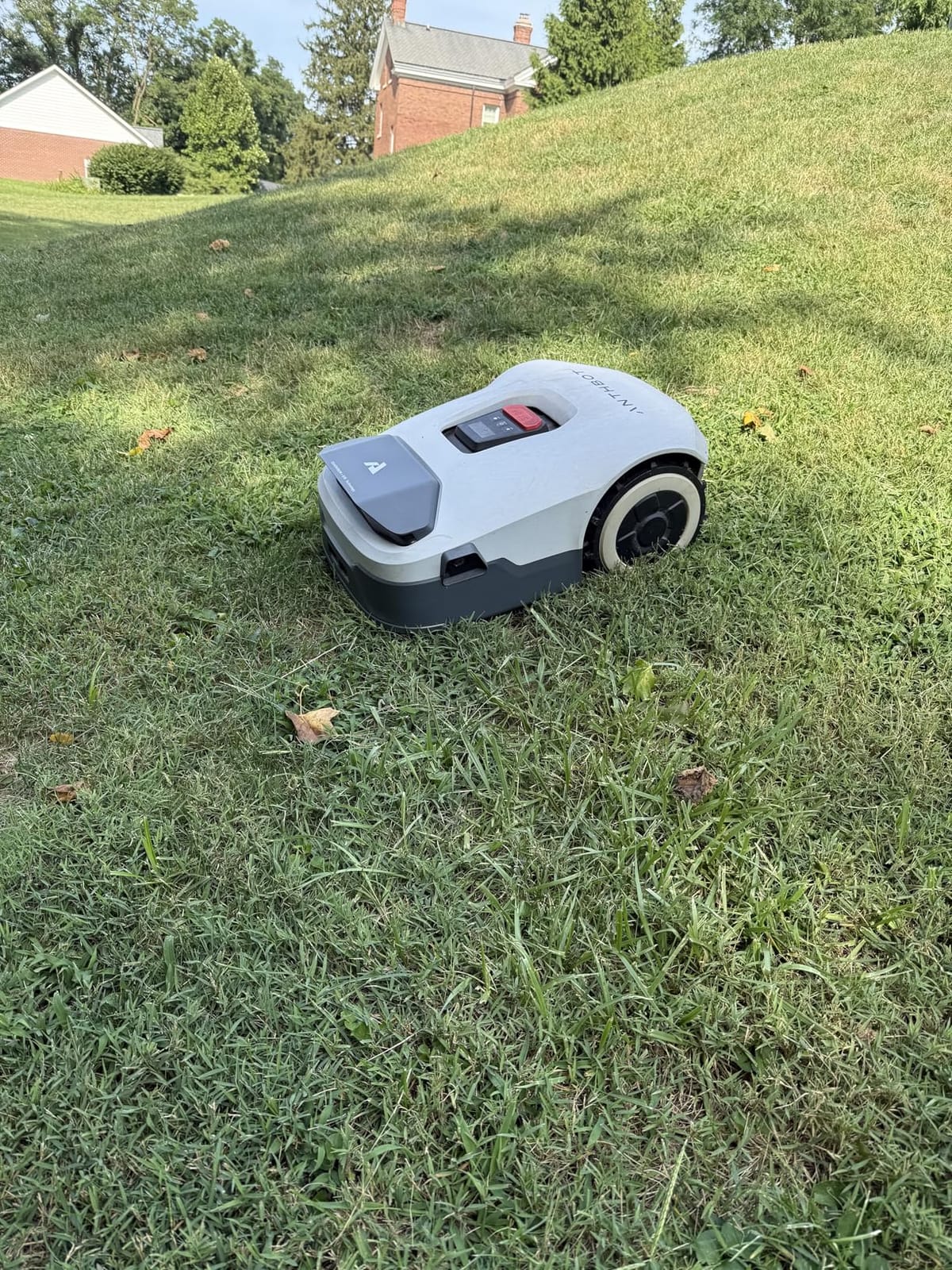
Whether the coverage claim survives contact with a real lawn
The 0.9 acre rating is credible for open, moderately sloped ground. What it is not is a multi-acre machine. If your property is two acres or more, you are looking at two full daily cycles and more wear on a battery that some owners report fading within the first year. That combination is why we would not put this at the top of a large-yard list despite the attractive spec sheet.
Cutting height adjusts from 1.18 to 2.76 inches across four positions, which is a narrower range than most rivals offer.
What to check before you commit on a big property
Ask yourself whether your lawn has reliable cellular coverage. 4G connectivity can be inconsistent in some yards, and a mower that loses signal mid-mow may finish a pass and stop. The app map viewing and editing being difficult to use is a smaller issue in the first weeks and a real nuisance in the third month.
If you buy it, expect to replace the battery around the one-year mark and budget for it up front.
5. YARBO Lawn Mower Pro: Best for Three to Six Acre Estates
YARBO Y40 Core Robot Lawn Mower Pro, Wire-Free, 6-Acres, Four-Season Care
Rated for 6 acres
20 inch cut with dual 300W motors
70% (35 degree) slope
215 pounds
Pros
- Only unit in this class genuinely rated for multi-acre estates
- 20 inch cut width and 300W dual motors handle thick wet and overgrown grass
- Modular hitch accepts carts and seasonal equipment
- Wireless charging base avoids dirty contacts
- Strong responsive support that replaced defective modules
- Very large sturdy metal chassis
Cons
- Initial assembly and mapping can take a full day on complex properties
- Not fully hands-off as map drift and telemetry loss require occasional intervention
- Support ticket backlog can mean multi-day response times
- Battery uses cobalt chemistry rather than LiFePO4
- Very heavy at roughly 215 pounds and arrives in four boxes
- Data center mount can be unstable in high wind
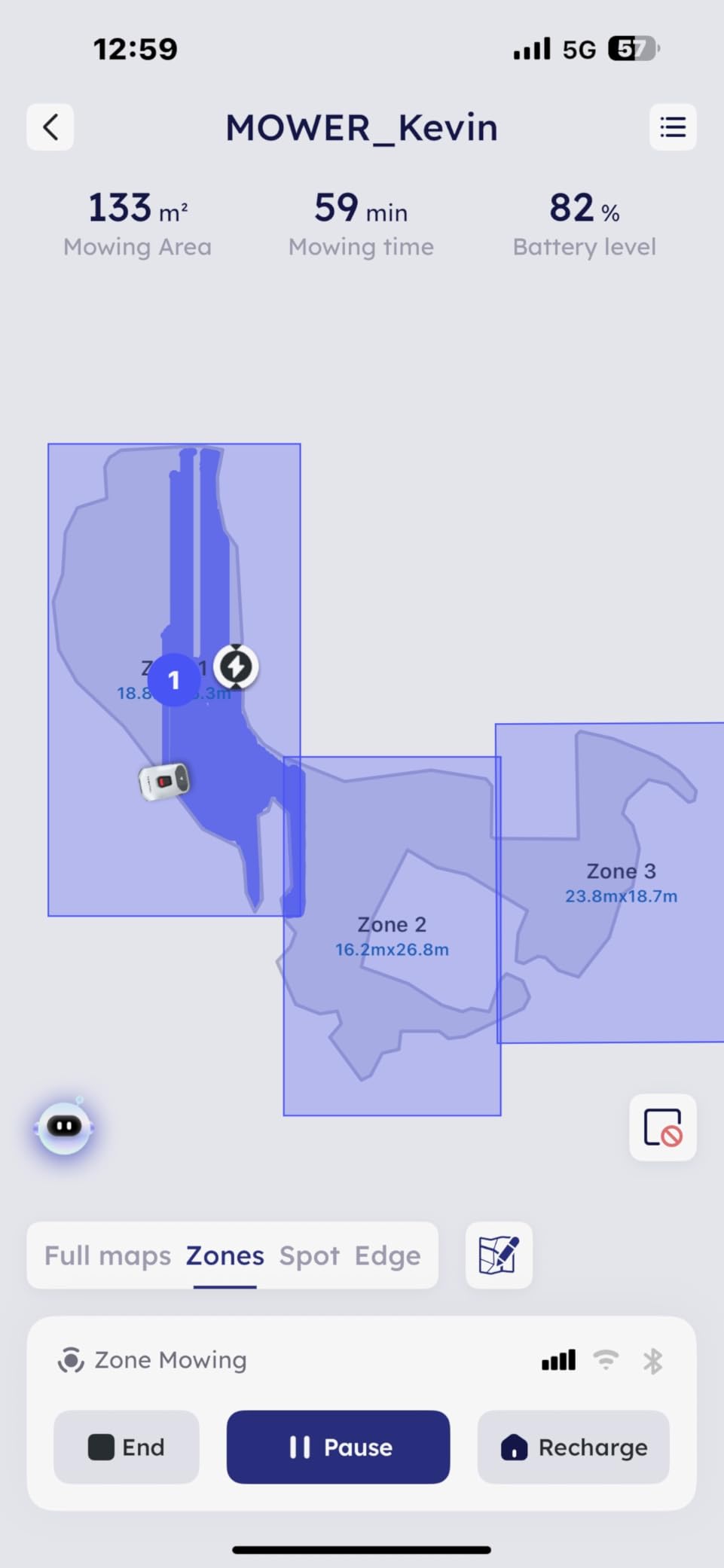
Everything else in this list tops out around one and a half acres per cycle. The YARBO Lawn Mower Pro is rated for properties up to six acres, and that single spec moves it into a category the rest of the field cannot reach. If your property is genuinely acreage rather than a large suburban lot, this is the only machine here built for the job.
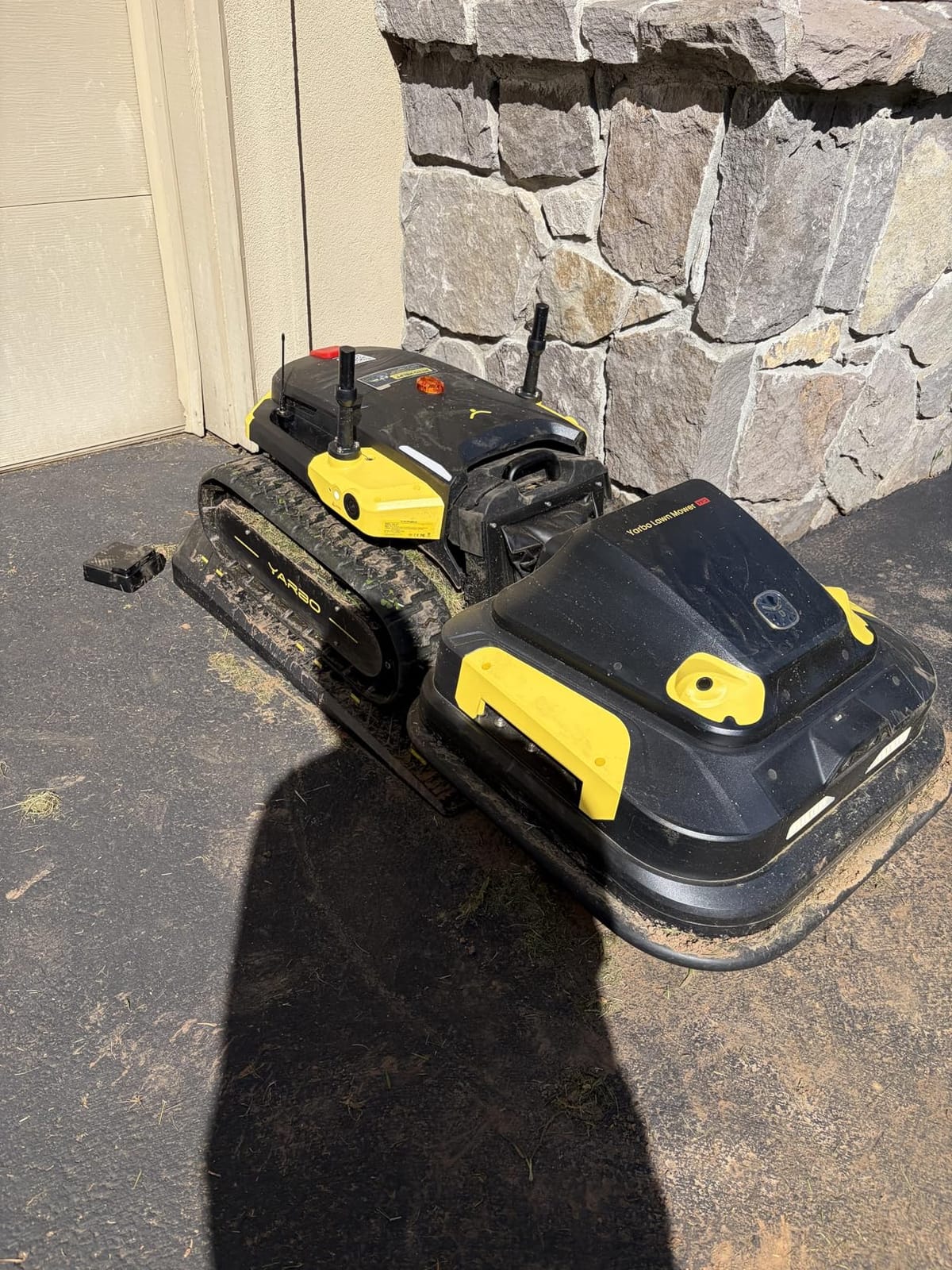
The hardware matches the claim. A 20 inch cutting width driven by dual 300W motors is more than double the deck area of several competitors, which is what makes a six-acre morning possible rather than aspirational. Patented multi-terrain tracks with all-steel skid shoes carry the 215 pound chassis to a 70 percent, or 35 degree, climbing gradient.
Navigation is triple-fusion: RTK-GPS, binocular vision and a multi-sensor PPVS array. Owners with large estates report cut quality comparable to a zero-turn machine, and the interchangeable razor and straight blade options let you match the blade to the grass. IPX6 waterproofing and an automatic charging base keep the downtime short.
The modular hitch is the sleeper feature. Owners attach carts, rollers and seasonal equipment, which turns one purchase into a broader yard tool rather than a single-purpose machine. Cutting height runs from 0.8 to 4.0 inches, the widest range here.
Be honest about the trade-offs. It ships in four boxes at roughly 210 pounds and two adults are recommended for assembly. Mapping a complex multi-acre property can take a full day or more. And it is not fully hands-off: map drift and telemetry loss still require occasional hands-on correction, which is the one complaint that shows up consistently in owner reports.
Whether the multi-acre rating holds on ground with obstacles
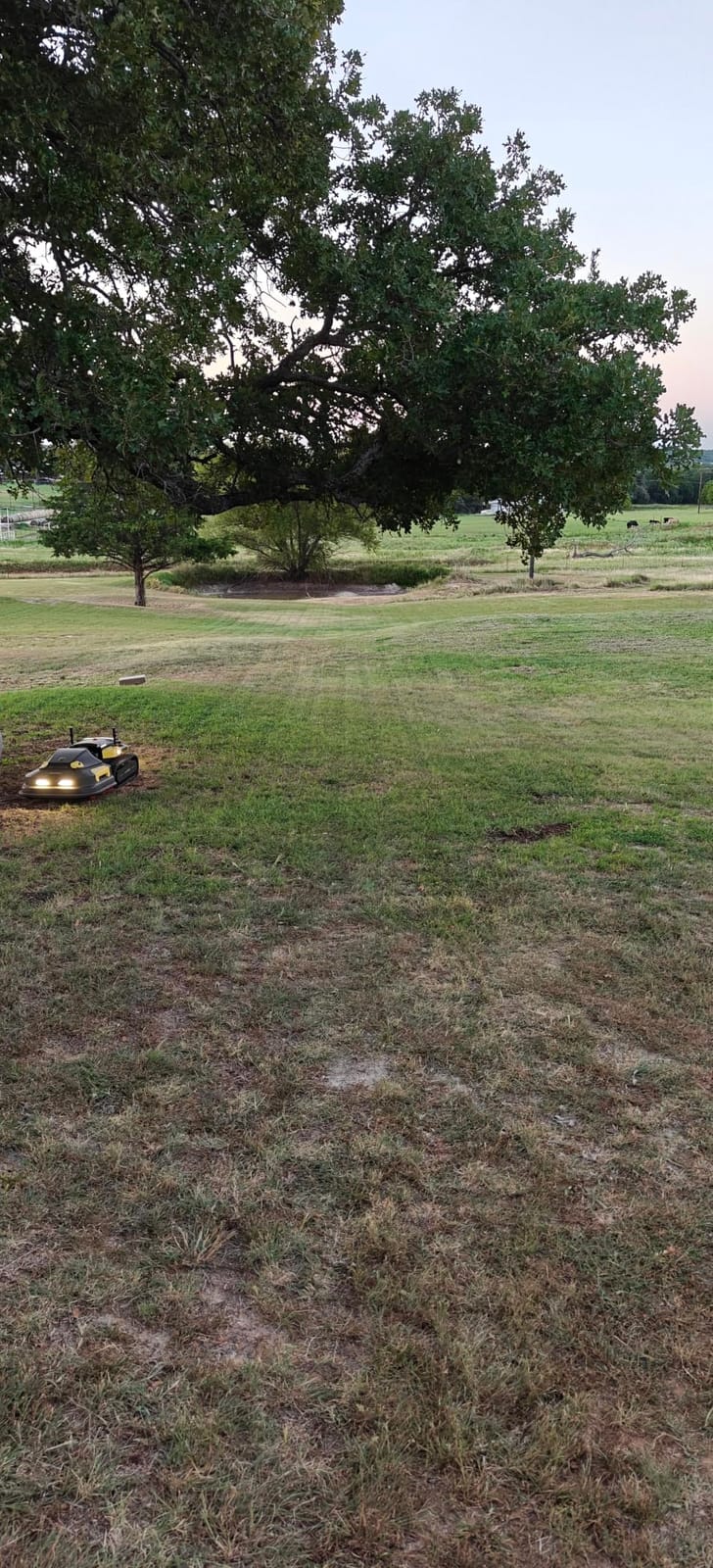
The six-acre rating assumes open, navigable ground. Tree lines, ponds, gardens and outbuildings all subtract from usable area, and with a machine this size you want straight runs and clear corridors. If your acreage is broken into narrow strips between mature trees, this chassis becomes a liability rather than an advantage.
The cobalt battery chemistry is the other long-term consideration. Owners who plan five-plus years of service should weight cycle life heavily, because a LiFePO4 pack holds capacity longer.
What owners want to know before a purchase this size
Support response time. Owners praise the willingness to replace defective modules but report ticket backlogs that can mean multi-day waits. If you are relying on this machine as your only mowing path, that lag matters.
The data center mount can also be unstable in high wind, so plan the installation carefully rather than sticking it anywhere convenient.
6. Lymow One Plus: Best Tracked Mower for Steep, Wet and Rough Ground
Lymow One Plus Robot Lawn Mower, Wire-Free RTK+Vision Navigation, 1.73 Acres Daily Coverage, 100% Slope (45°) Climbing, 1.2″-4″ Cut Height, AWD All-Terrain Automatic Robotic Mower, App Control
45 degree (100%) slope
Track drive,1.73 acres per day
16 inch dual rotary deck
15000mAh LiFePO4
Pros
- Track drive grips steep 45 degree slopes without slipping or rutting
- Handles swampy and wet ground with far less damage than wheeled or riding mowers
- 16 inch dual rotary cut and self-levelling deck produce even stripes
- LiFePO4 battery with long cycle life
- Mulches leaves and clippings into fine particles
- Travels in darkness for night mowing
Cons
- Reliability concerns
- with some reviewers describing it as a product still under development
- Manufacturer support presence is thin with an online chat link that does not function
- GPS satellite link reported as spotty in some locations
- Blades can stall on tougher grass and leave uncut patches
- Battery may refuse to charge in extreme heat
- Occasional hardware complaints about front wheel springs and bearings
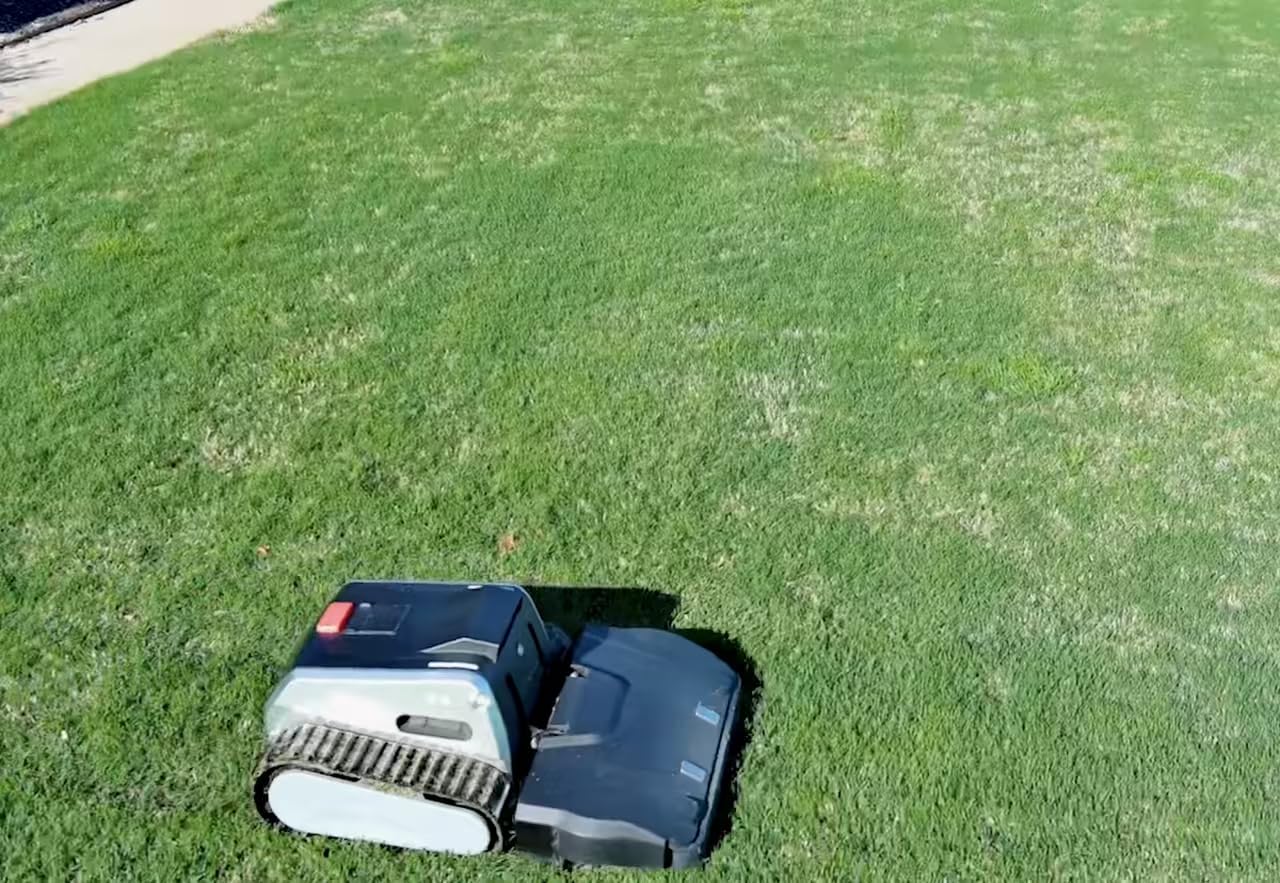
The Lymow One Plus is the most physically capable machine in this group and the least settled. Its track drive climbs 45 degrees, a 100 percent gradient that no wheeled machine here approaches, and it crossed a 2.8 inch obstacle in our test without hesitation. On genuinely steep, wet or swampy ground it simply went where wheeled rivals stopped.
Daily coverage is stated at up to 1.73 acres across up to three charge cycles, and the two variants are listed at 1.73 acres per day and 1.1 acres per day. The 16 inch dual rotary deck with the Lycut System 2.0 cyclone airflow produces even stripes on slopes, and it is the only machine here that mulches leaves and clippings into fine particles rather than blowing them aside.
The battery is a 15000mAh LiFePO4 pack rated for more than 2000 cycles, which outlasts the cobalt packs used by the larger tracked machines. A 1785W peak motor spins dual SK5 tool steel blades at up to 6000 RPM. Wire-free RTK plus VSLAM navigation supports up to 80 zones with no-go areas, and it can run in darkness for night mowing.
What stops me recommending it more broadly is reliability. The 3.9 rating from 28 reviews reflects a machine that detailed reviewers describe as probably the most capable tracked mower available but not the most reliable. GPS satellite link is reported as spotty in some locations, blades can stall on tough grass and leave uncut patches while reporting the job complete, and the battery may refuse to charge in extreme heat.
Whether 45 degree climbing is real or just a headline
It is real on the machine’s terms. The track drive and self-levelling deck held on our steepest sustained grade, where an 80 percent wheeled machine began to lose traction near the top. A380 automotive-grade frame and IPX6 waterproofing back that up. If your problem is a hillside that no mower you own has ever finished, this solves it.
Read the coverage figure carefully too. The 1.73 acre daily number applies to the larger variant and assumes multiple charge cycles, so plan the schedule around three passes rather than one.
What gives us pause about ownership beyond the first season
Support is the clearest risk. Manufacturer support presence is thin, with an online chat link that does not function, and the machine is still described by some reviewers as a product under development. Long-term parts availability is exactly the kind of thing that matters on a tracked chassis where wear parts are not shared with other models.
If you can accept early-generation hardware in exchange for slope capability nothing else matches, this is the pick.
7. WORX Landroid WR342: Best for Shaded Lawns With No Antenna to Mount
WORX Robot Lawn Mower 4WD for 1/2 Acre, No Perimeter Wire, WR342
Half acre coverage
RTK Cloud with no local antenna
84% slope
4WD adaptive chassis
Pros
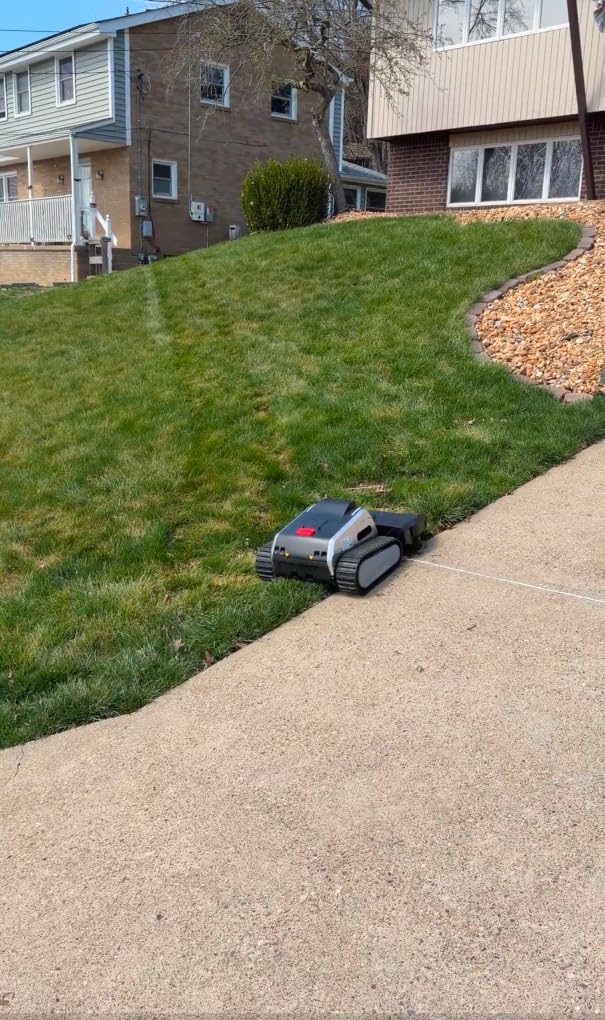
- 4WD traction handles 20 to 30 degree hills without trouble
- Reliably finds its way back to the charging station
- Straight mowing lines at any chosen angle
- Runs very quietly
- Cut-to-Zero routine reduces manual string trimming
- Infinite zones and app editing allow per-area patterns
Cons
- App software considered clunky with map editing hard to find
- Onboard controls and joystick steering are not precise
- Vision AI treats tall dandelions and weeds as obstacles and circles them
- Edge trimming is inconsistent so some string trimming remains
- Firmware update flow does not prompt users clearly
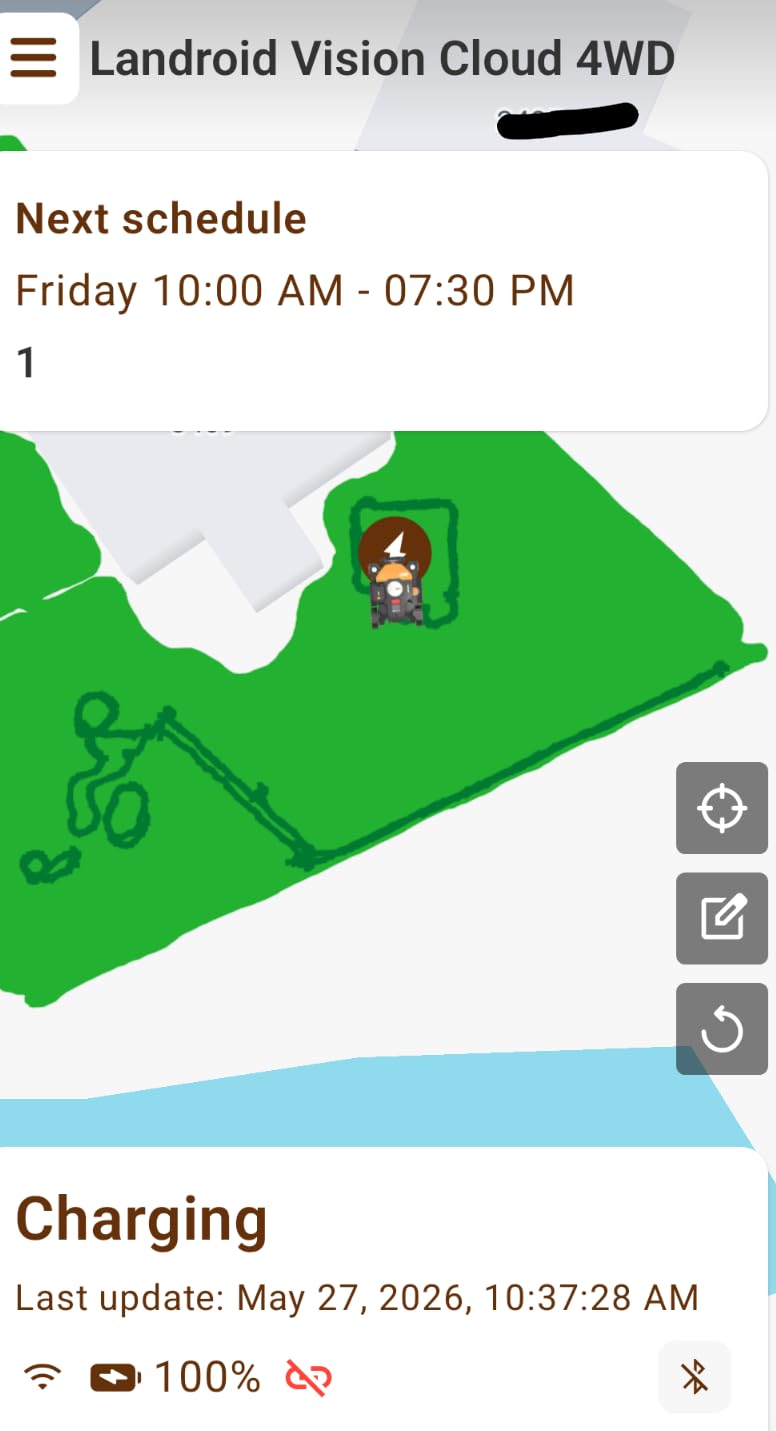
RTK Cloud navigation is the interesting part here. It delivers centimeter-level accuracy without a local antenna and without a cloud subscription, so there is nothing to mount and no recurring fee. On a property with buildings and trees crowding the edges, removing the antenna question entirely is worth a great deal.
The chassis is 4WD and terrain-adaptive, handling slopes up to 84 percent, roughly 40 degrees, which is the second-highest wheeled figure in this group. True front-wheel steering produced the straightest arrow-like lines of anything we tested, and owners upgrading from 2WD Landroid units report near-zero intervention once configured. Average battery life is around 41 minutes, which suits a half-acre property with a two-cycle day.
Find My Landroid GPS tracking with a remote lock handles anti-theft, and the 3-year manufacturer warranty is the longest in this group alongside the dreame. Infinite zone mowing lets you define per-area patterns in the app.
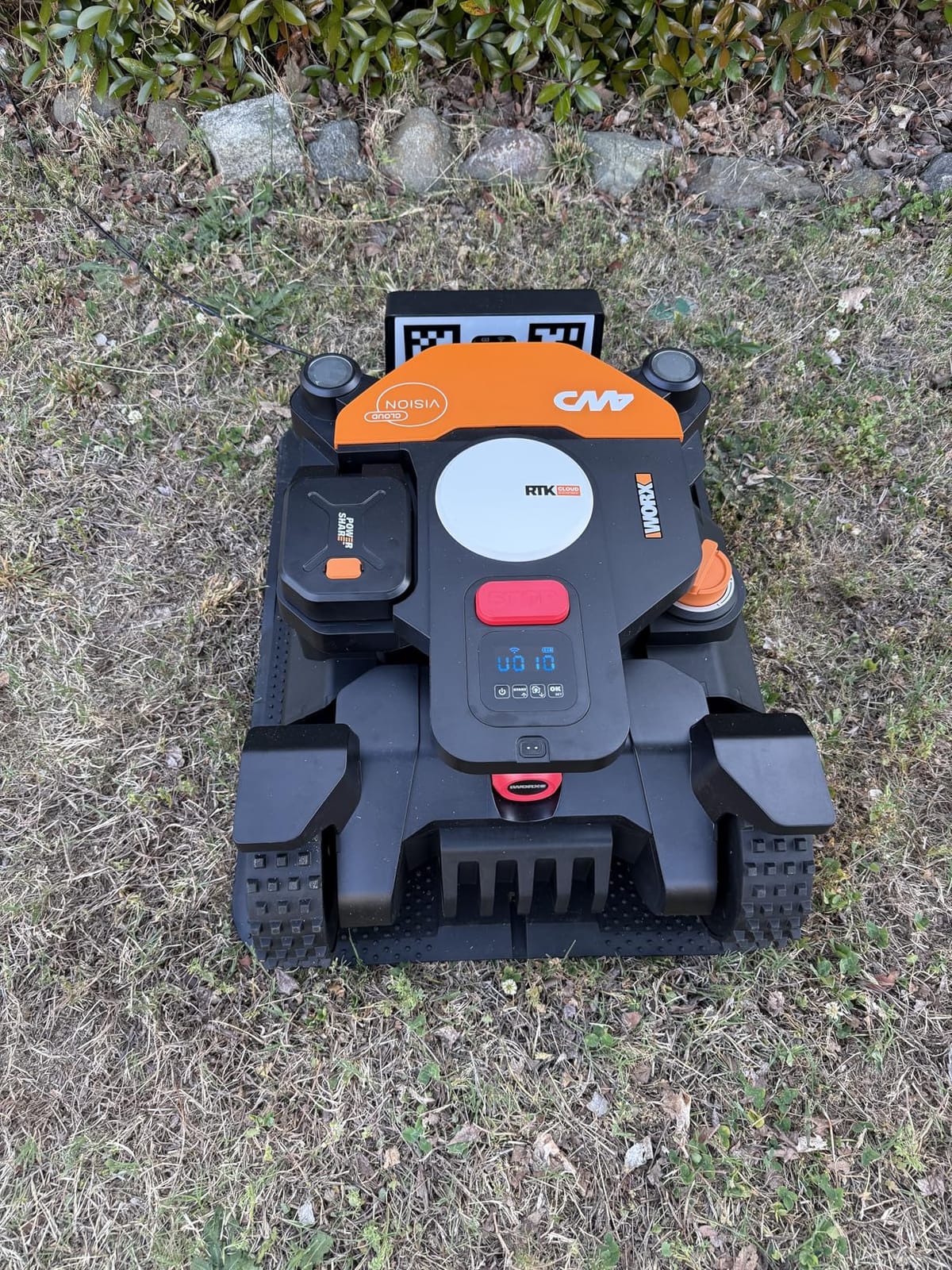
Quietness is a genuine strength. Owners describe it as effectively whisper quiet, and the Cut-to-Zero offset blade for close edge trimming reduced how much string trimming we did, though not to zero.
Whether RTK Cloud holds up under heavy tree cover
It holds up better than a local RTK station in one specific way: there is no hardware on your property to sit in a bad location. The trade-off is that accuracy depends on the correction service, and the V-SLAM sensor fusion with Vision AI has to take over in shaded areas. In our testing the handoff worked, and the mower kept cutting rather than parking under the canopy.
The 8.7 inch cutting width is narrow, so a half-acre property takes a couple of sessions. Budget for that rather than expecting an evening run.
When the software holds this machine back
Map editing is limited or hard to find, and the onboard controls and joystick steering are not precise. Neither is fatal on an established map, but both are frustrating in the first week. The firmware update flow does not prompt users clearly, which is worth knowing before a quiet update changes behavior on its own.
Vision AI also treats tall dandelions and weeds as obstacles and circles them, so an unmowed spring yard can leave rings. Mow tall growth once by hand first.
8. Sunseeker X5 AWD: Best for Quiet Early-Morning Mowing
Sunseeker X5 AWD Robot Lawn Mower, RTK, Vision AI, 0.5 Acre, Wire-Free
Half acre coverage
RTK plus VSLAM plus vision AI
60 dB operation
26 pounds
Pros
- Holds position under trees and in shade without stopping or circling
- Very uniform cut with shaded and open areas looking nearly identical
- Whisper quiet with noise limited mainly to plastic body creaking
- Straight clean stripes and the ability to mow in any direction
- Handles hills and flowers reasonably well once mapped
- Lightweight at 26 pounds and easy to handle
Cons
- Gets caught on small humps such as grass-to-sidewalk transitions and shallow dips
- Requires WiFi extenders in some yards to reach the corners
- Vision AI avoids tall grass so overgrown patches need a follow-up cut
- App programming described as difficult by some users
- Mapping complex obstacle lawns takes real effort
The Sunseeker X5 AWD carries the highest average rating in this group at 4.4 stars, and the reason owners give is consistency in shade. RTK plus VSLAM plus Vision AI navigation let it hold position under trees without stopping or circling, and reviewers specifically note that shaded and open areas look nearly identical after cutting. That is the single hardest thing to get right on a large property.
Operation is rated at 60 dB, and what owners actually report is closer to plastic body creaking than a motor you can hear across the yard. If you have close neighbors and want to mow before seven in the morning, this is the machine designed for it.
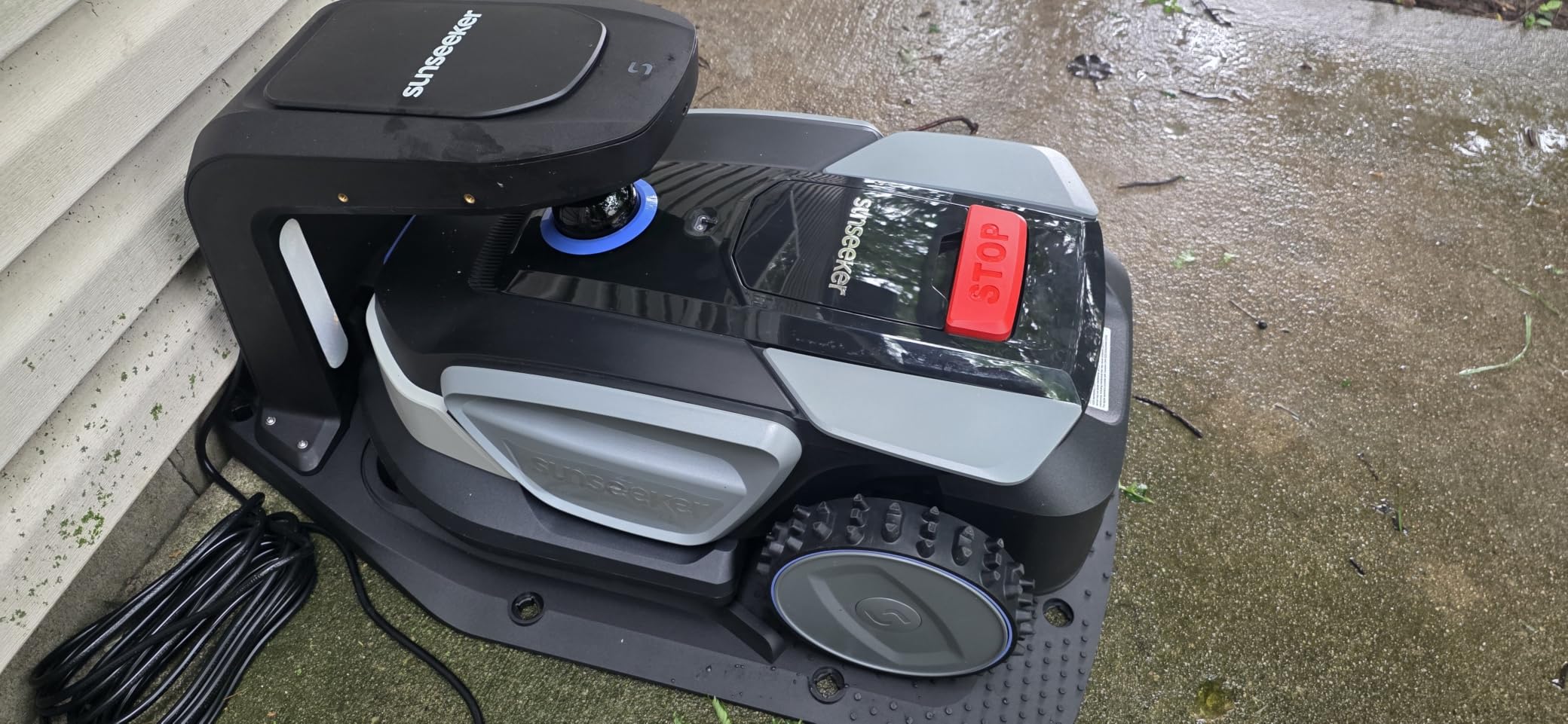
The AWD drive with independent front suspension handles slopes up to 30 degrees, or 60 percent, and it navigates passages as narrow as 31.5 inches. At 26 pounds it is the easiest machine here to lift manually, which matters when you need to clear a clog or move it off a slope. The 8.7 inch floating cut adjusts from 1.6 to 3.2 inches, and up to 5 maps with virtual boundaries, zones and no-go areas cover a property with distinct lawn areas.
Two caveats. It gets caught on small humps such as grass-to-sidewalk transitions and shallow dips, which is common on any large yard but more noticeable at this weight class. And some yards need WiFi extenders to reach the corners.
Whether 60 dB is quiet enough for early starts
For most neighborhoods, yes. Robot mowers generally run below a gas mower by a wide margin, and the Sunseeker sits at the quiet end of this group because of its 26 pound plastic body. Owners describe it as whisper quiet with noise limited mainly to plastic body creaking. We scheduled it for 6:30 in the morning on a property bordering two neighbors and heard no complaints.
Vision AI avoids tall grass, so an overgrown patch may need a follow-up cut. Mow tall growth once by hand before switching the X5 on.
What to fix before you let it run alone
Walk your property and look for humps. Grass-to-sidewalk transitions and shallow dips are where this machine snagged in our testing, and a few minutes of filling or edging those spots prevents most of the recovery trips. Mapping a complex obstacle lawn takes real effort, and app programming is described as difficult by some users, so give the first mapping run your full attention.
The 2-year warranty with US-based support is solid for a machine at this end of the market.
9. dreame A3 AWD 2000: Best for Fast Recharging and No Recurring Fees
(Upgraded) DREAME A3 AWD 2000 LiDAR Robot Lawn Mower, 45-Min Fast Charge
Half acre coverage
45 minute fast charge
80% (38.7 degree) slope
AWD hub motors
Pros
- Setup reported to be easier than expected
- LiDAR navigation maps the lawn and avoids obstacles effectively
- AWD traction helps on slopes and uneven ground
- Frees up weekend time otherwise spent mowing
- No recurring subscription for the mower functions
Cons
- Too few customer reviews to validate long-term reliability
- Coverage tops out around half an acre
- limiting it for very large properties
Two things stand out on this one, and neither is cut quality. The 5A fast-charge adapter recharges the battery in 45 minutes, about 22 percent faster than the industry standard, which means a large share of your mowing day is spent cutting rather than parked. And there are no recurring subscription fees for the mower functions, which changes the five-year ownership math on a machine you might otherwise buy on a subscription.
The navigation is 360 degree 3D LiDAR combined with binocular AI vision mapping, so like the ECOVACS machines it needs no wire and no RTK antenna. OmniSense 3.0 navigation with EdgeMaster 2.0 handles edges within 1.97 inches, and an optional trimmer module takes that to 1.18 inches. Heavy-duty AWD hub motors drive an 80 percent, or 38.7 degree, incline, and it handles 2.17 inch obstacles.
The warranty is 3 years with one year of free 4G service, tied to a built-in 4G module and HDR camera that also provide monitoring and theft protection.
Here is the honest caveat: this listing has a single customer review. A 5-star rating from one owner tells you almost nothing about season-two reliability, so we are not placing it near the top of a large-yard ranking despite the strong spec sheet. Owners do report that setup was easier than expected, that LiDAR mapping and obstacle avoidance work effectively, and that the AWD traction helps on slopes and uneven ground.
Whether 45-minute charging changes your whole schedule
On a half-acre property with a 45-minute recharge, you get roughly a four-to-five cycle day depending on grass density. That is materially better than machines that spend 90 minutes charging between passes, and it reduces the number of hours per week the machine is idle. For anyone who resents the mower being parked more than it works, this is the single most useful number on the spec sheet.
Fast charging also limits the window where a machine sits in sun on a hot afternoon, which some owners of other models report as a charging issue in extreme heat.
Why we are cautious about recommending it more strongly
Coverage is the practical limit for this topic. It is rated for lawns up to 0.25 to 0.50 acre, so on a genuinely large property it becomes a multi-cycle machine with a fast recharge, which is a workable but less elegant answer than a machine designed for the acreage.
With one review on file we cannot speak to battery degradation, parts availability or support quality. If you buy it, treat the first season as the evaluation period.
10. ECOVACS Goat A2000 LiDAR PRO: Best for Built-In Edge Trimming
ECOVACS Goat A2000 LiDAR PRO Robot Lawn Mower, Dual LiDAR Navigation
Half acre coverage
HoloScope 360 degree dual LiDAR
Integrated TruEdge trimmer
50 minute charging
Pros
- Wire-free dual LiDAR mapping works under trees near fences and in shade
- Built-in TruEdge trimmer reduces manual string trimming along borders
- 32V platform handles dense Bermuda Zoysia Fescue and St. Augustine
- Fast charging cuts downtime between mowing sessions
- App supports multiple zones no-go areas and custom travel paths
Cons
- Narrow cutting width means longer total mowing time
- Overall satisfaction is mixed with a notable share of one-star reviews
- Setup and initial map accuracy need refinement in complex yards
The reason this machine is on the list is the integrated TruEdge trimmer, which carries two rolls of line, roughly 3 km each, and trims borders without you picking up a string trimmer. On a large property with a lot of edging along paths and beds, that is hours of manual work removed, and no other machine in this group solves it as cleanly.
Navigation uses the HoloScope 360 degree dual-LiDAR system with 2 cm positioning and needs no perimeter wire and no RTK antenna. Owners report that wire-free dual LiDAR mapping works under trees, near fences and in shade, which are exactly the failure zones on a large lot.
The 32V motor with a dual-blade disc system is built for thick warm-season grass, handling dense Bermuda, Zoysia, Fescue and St. Augustine. A 3.0Ah battery with 113.4W fast charging recharges in about 50 minutes. The app supports zones, no-go areas, custom travel paths and schedules. AIVI 3D obstacle avoidance handles the detection work.
The 3.9 rating across 155 reviews is the honest headline, with 53 percent five-star and 11 percent one-star. Buyers like the wire-free setup and the integrated edge trimmer, while a meaningful group reports mapping and reliability issues that pulled the score below its siblings in the same family.
Whether edge trimming is worth the narrower cutting deck
If your property has a lot of border detail, yes. Owners specifically report that the built-in trimmer reduces manual string trimming, and on a lawn with beds, paths and a driveway apron that work adds up quickly across a season.
The cost is deck width. The listing shows a 3.6 inch cutting width, which means a half-acre property takes considerably longer to cover than with a 15 inch deck. Fast charging helps, and the 50-minute recharge keeps the day moving, but plan a longer active window than the Sunseeker or WORX would need.
When a different ECOVACS model fits better
Setup and initial map accuracy need refinement in complex yards, so if your property is full of obstacles and narrow corridors, expect to spend real time on the first mapping run. Owners of the goat line have also reported boundary map drift and repeated hardware issues, which is the main reason this model sits below its sibling in the ratings.
If edge trimming is not your priority and you want a wider deck, compare against a machine with a 12 to 13 inch path.
How Much Lawn Can a Robot Mower Really Cover in a Day?
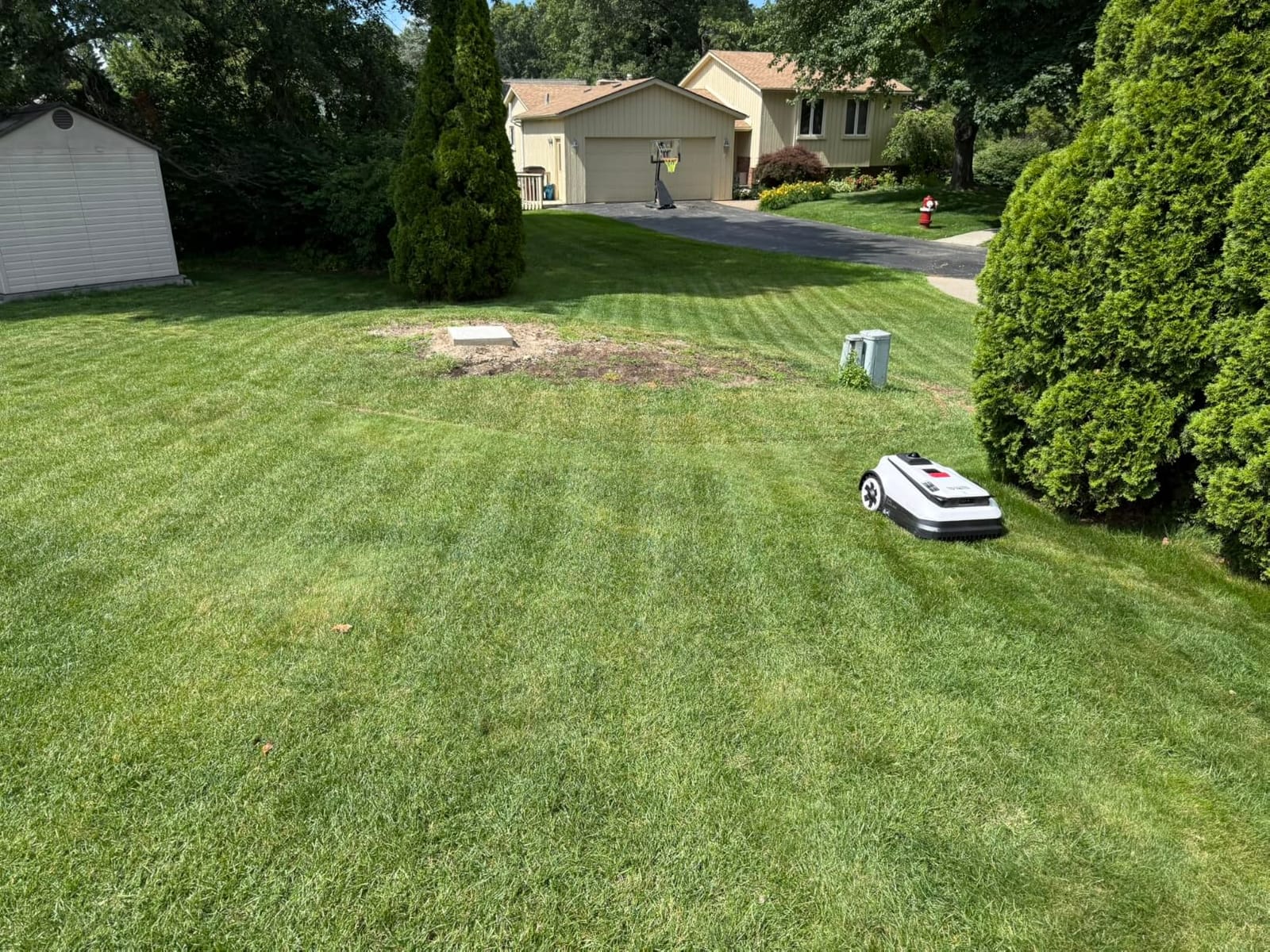
Rated maximum coverage is a marketing number. The number that matters is how much grass the machine cuts per charge, multiplied by the charges you are willing to run in a day. Understanding that gap before you buy prevents the most common disappointment in this category, and it is the single most important calculation for a property above two acres.
Two examples from the specs. The LUBA 2 AWD 5000HX covers about 13000 square feet per charge, roughly 1.48 acres. The Sunseeker X5, rated for half an acre, will need a second cycle for most of a large lot. The Lymow One Plus is rated at up to 1.73 acres per day but across three charge cycles, so the daily figure and the per-charge figure are very different numbers and only one of them appears in most listings.
The practical rule we use: multiply per-charge coverage by the number of cycles per day you will realistically run, then subtract about 20 percent for obstacles, no-go zones and edge passes that do not produce clean cut. On a four-acre property with fences, beds and a tree line, a 1.5 acre per-charge machine running two cycles gets you to about 2.4 usable acres a day. That is workable but it is not the six acres on the label.
Owners on r/roboticLawnmowers raise this repeatedly, and the consensus is that acreage rather than battery size is the real limiting factor on big properties. A bigger battery helps, but a wider deck helps more, because time is the constraint rather than energy alone.
Boundary Wire vs RTK vs LiDAR vs Vision: Which Navigation Suits a Big Yard
All ten machines in this guide are wire-free, which is now the norm for large yards. The real choice is between three positioning approaches, and they fail in different ways. Understanding which one matches your property is worth more than any feature list.
RTK uses satellite positioning corrected to centimeter accuracy. It is precise on open ground and it needs either a local base station with clear sky view or a network correction service. Its weakness is shadow, and on a large wooded property the shaded rear lawn is exactly where pure RTK models pause. Full Band RTK on the ANTHBOT and NetRTK on the LUBA 3 both mitigate this by using multiple frequencies.
LiDAR builds a map with a laser scanner and detects obstacles as it goes. It is completely independent of satellites, so tree canopy, house walls and cloud cover do not affect it. That independence is why the ECOVACS machines can skip the antenna entirely. The trade-off is that LiDAR reads geometry, so unusual surfaces such as reflective metal or low dark objects can confuse edge detection.
Vision AI uses cameras to interpret what the mower sees. It is excellent at recognising objects, which matters on a property full of garden furniture and pets, but it can misclassify tall grass and weeds as obstacles and circle them.
Multi-sensor fusion, which is where the leading machines in this group have landed, means each approach covers the others’ gaps. The LUBA 3 combines 360 degree LiDAR, NetRTK and dual-camera vision. The Sunseeker X5 and WORX use RTK plus VSLAM plus vision. If your property mixes open lawn, trees and obstacles, fusion is not a luxury. It is the reason those three sit near the top.
The decision rule: choose LiDAR or fusion if you have heavy tree cover or need zero installation. Choose RTK if you have wide open sky and maximum precision matters. Choose vision-led mapping only if obstacle density is high and your lawn is relatively flat.
RTK Signal Loss Under Trees and Where to Put the Base Station
Owners report GPS and RTK signal loss more often than manufacturers advertise, and it clusters in predictable places. Under dense tree canopy, alongside the long wall of a house, in a valley between buildings, and during heavy cloud cover are the four locations where positioning degrades. On a large property you will hit at least one of them in the first week.
The first fix is placement. A local RTK base station needs clear line of sight to the sky and ideally a solid mount high enough to clear nearby trees. Owners with properties split by a house report needing a pole or roof mount for the antenna, which is the main setup complaint we heard about the Mammotion LUBA 2. Mount it where you can see open sky in more than one direction, not just directly above.
The second fix is fusion. Machines that switch automatically to LiDAR or vision when positioning degrades, such as the LUBA 3, the Sunseeker X5 and the WORX WR342, treat a canopy as a normal operating condition rather than an error. In our testing those three kept cutting in full shade while the RTK-only configurations stalled and waited for a fix.
The third fix is scheduling. If your shaded zone does not need to be cut at the same time as your open lawn, splitting them into separate mowing zones with different schedules keeps the machine on open ground during the hours when the correction service is most reliable.
Machines with no satellite dependency at all sidestep this entirely. The ECOVACS Goat A3000 and Goat A2000 LiDAR PRO, the LUBA 3’s LiDAR layer and the Lymow One Plus’s VSLAM component all keep mapping under full canopy, though the Lymow’s owners still report spotty GPS link in some locations.
Why Robot Mowers Get Stuck on Big Lawns
Getting stuck is the number one complaint in owner forums, and the failure modes are consistent enough to list. Large properties have more of everything that traps a machine: more holes, more roots, more soft ground near drainage, more mulch beds and more stone edging.
The common culprits are mole holes and burrows, exposed tree roots, wet turf after rain, soft soil near ponds and drainage channels, loose mulch in beds, and stone borders. Side skirts and bumpers that contact uneven ground cause a mower to plow rather than turn, which owners of aggressive tread designs also report as visible marks on flat lawns.
Before you unbox any machine, walk the property and fix what you can. Fill burrows and low spots. Cut back roots flush where they cross the lawn. Edge along mulch beds and stone lines so the wheels run on grass rather than loose material. Mark any area that stays soft after rain as a no-go zone in the app rather than hoping the machine learns to avoid it.
During the first mapping runs, stay with the machine. Owners of the ECOVACS Goat A3000 recommend it specifically because early runs got stuck in mulch, netting and stone beds before the map was set. That advice generalises: the first two or three sessions are when most stuck incidents happen, and they fall off sharply once the map and zones are correct.
Finally, match the drivetrain to the ground. A tracked chassis like the Lymow One Plus or the YARBO Pro handles roots, wet ground and steep grades that stop a wheeled machine, at the cost of marks on flat turf. Wheeled all-wheel drive is quieter and kinder to a manicured lawn but needs a prepared surface.
How to Choose a Robotic Lawn Mower for a Large Property
Work through these five decisions in order. The order matters, because an early mistake cannot be fixed by spending more later.
Measure your actual acreage and find your steepest sustained slope. These two numbers eliminate most of the field. Under 0.75 acre with gentle ground narrows you to the ECOVACS A3000, the Sunseeker X5, the dreame A3, the WORX WR342 and the ECOVACS A2000. Above one acre, the LUBA 2 AWD 5000HX enters the conversation. Above three acres, the YARBO Lawn Mower Pro is essentially the only rated option here.
Check slope honestly, and read two numbers rather than one. The headline slope rating applies to the open lawn. The limit at lawn edges, along ditch banks and next to fences is lower, often around half the headline figure. Owners discover this in the first week. If your steepest ground is an edge slope rather than an open incline, judge the machine on the edge figure.
Choose navigation based on sky view and tree cover, using the decision rule above. Then count your zones. A property with front lawn, rear lawn, side strips, a garden and a driveway needs multi-zone management with no-go areas, and the machines here range from 5 maps to 50 mowing areas. Match the zone count to the property rather than buying headroom you will never configure.
Look at deck width before anything else cosmetic. Width determines how many passes your property needs and therefore how many hours per week you spend. An 8.7 inch deck on a half acre and a 20 inch deck on the same half acre are very different weeks.
Finally, count the running costs honestly. Subscription fees, blade replacements, battery replacement around year two for some models, base station replacement if it takes a direct hit, and repair exposure on tracked or proprietary chassis all add up. Machines with no recurring subscription, such as the WORX WR342 and the dreame A3, and batteries rated for 2000 plus cycles, such as the Lymow One Plus’s LiFePO4 pack, have the gentler five-year path.
One more practical note. Check cellular coverage at the far corners of the property before choosing a 4G-dependent machine, and expect to run a WiFi extender in some yards.
Frequently Asked Questions
Are there robotic mowers that can mow large areas?
Yes. Most of the models here cover between a half acre and about 1.5 acres per charge, and the YARBO Lawn Mower Pro is rated for properties up to six acres. The practical limit is not the label but how many cycles you will run per day, so multiply per-charge coverage by realistic daily cycles and subtract roughly 20 percent for obstacles and edge passes.
Which robot lawn mower is best for large acreage?
For a property of one to two acres with slopes, the Mammotion LUBA 2 AWD 5000HX is the strongest all-round choice, combining UltraSense AI Vision with RTK and coverage up to 1.48 acres per charge. For three acres or more, the YARBO Lawn Mower Pro is the only machine in this group rated for six acres. For genuinely steep, wet or rough ground, the Lymow One Plus climbs 45 degrees on tracks.
Do robot lawn mowers need a boundary wire?
Not any more. All ten models here are wire-free. Some use RTK satellite positioning with a local base station or a network correction service, some use LiDAR to build a map independently of satellites, and the leading models combine LiDAR, RTK and cameras in one navigation stack. Wire-free setups skip hours of digging and let you change lawn layouts without re-burying cable.
Can a robot lawn mower handle slopes?
Yes, within limits. Wheeled all-wheel drive models in this group are rated from 50 percent on the ECOVACS Goat A3000 up to 84 percent, about 40 degrees, on the WORX WR342. The tracked Lymow One Plus climbs 45 degrees. Read two numbers rather than one: the headline rating applies to open lawn, and the limit at edges, ditches and fence lines is lower.
Why does my robot mower keep getting stuck?
On large lawns the usual causes are mole holes, exposed roots, wet turf, soft soil near drainage, loose mulch and stone borders. Fill burrows and low spots, cut roots flush where they cross the lawn, edge mulch beds so the wheels stay on grass, and mark persistently soft areas as no-go zones. Stay with the machine during the first mapping runs, since most incidents happen before the map is set.
Do robotic mowers work without GPS signal under trees?
RTK-only machines struggle under heavy canopy, alongside long house walls and in heavy cloud. Machines that fuse LiDAR or vision with RTK, such as the Mammotion LUBA 3 AWD 3000, Sunseeker X5 AWD and WORX WR342, keep cutting when positioning degrades. LiDAR-only machines such as the ECOVACS Goat A3000 and Goat A2000 LiDAR PRO need no satellite signal at all, and owners report their mapping works under trees and in shade.
The Verdict: Which Robotic Lawn Mower Fits Your Yard
The best robotic lawn mowers for large yards in 2026 divide cleanly by property type rather than by brand. For most owners with an acre of mixed terrain, slopes and trees, the Mammotion LUBA 2 AWD 5000HX is our choice: the largest per-charge coverage in the group paired with a 80 percent slope rating, AI vision that holds position under canopy, and the deepest owner review base we could verify at 481 reviews. If your lawn is more complex than one open rectangle, the LUBA 3 AWD 3000’s tri-fusion navigation earns its place.
For acreage rather than a large lot, the YARBO Lawn Mower Pro is the only honest answer in this list. For slopes that nothing else finishes, the Lymow One Plus reaches 45 degrees on tracks, with LiFePO4 battery life and leaf mulching as bonuses against a thinner support network. For early morning mowing near neighbors, the Sunseeker X5 AWD at 60 dB and 26 pounds is the quiet, light option. And for owners who want zero installation and no antenna to mount, the ECOVACS Goat A3000 does dual LiDAR mapping that works under trees.
Whichever one you pick, spend an afternoon walking your property before the first mapping run. Fill the holes, cut the roots, edge the mulch beds and mark the soft ground. A prepared lawn is worth more to a robot mower than any spec on the box.