
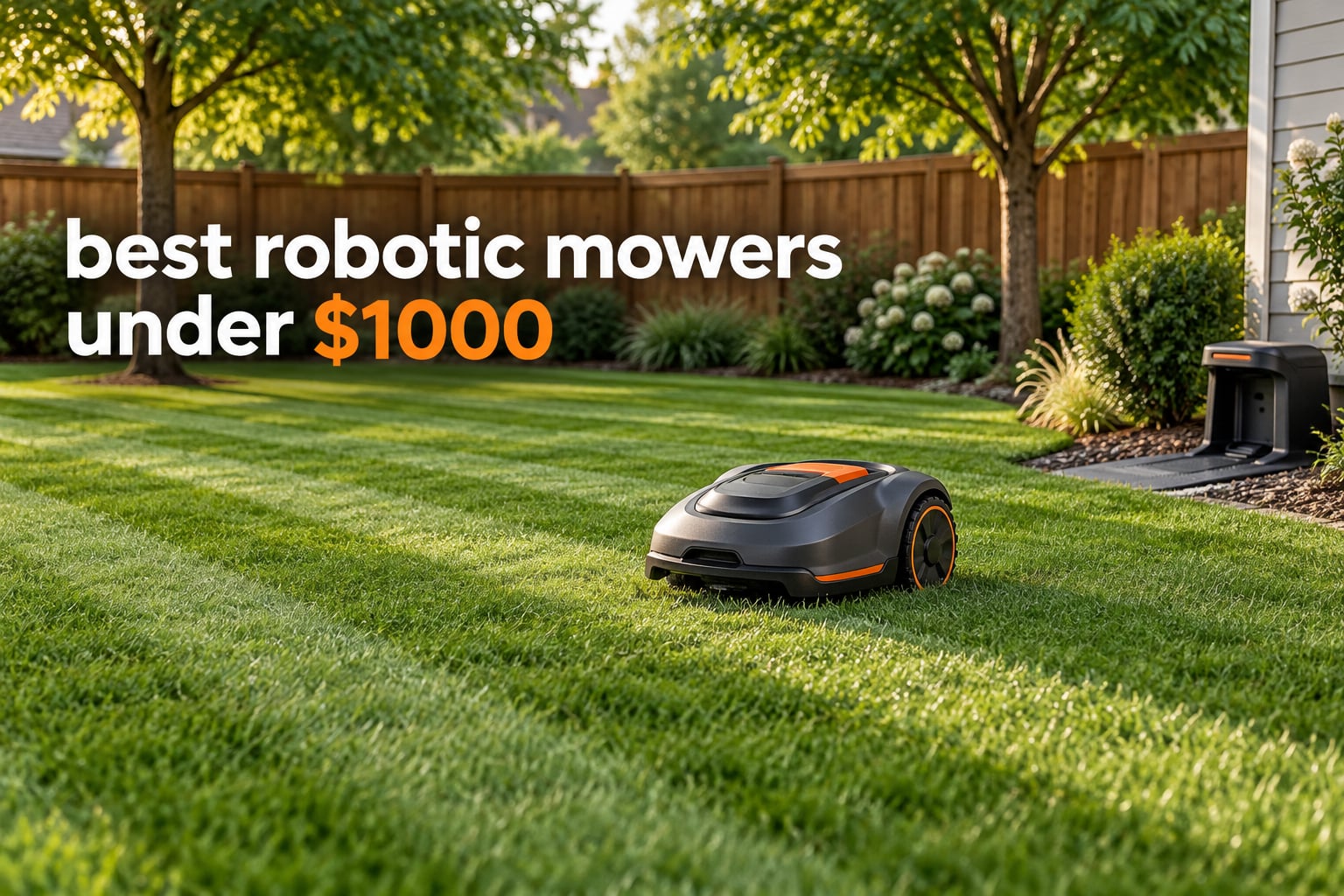
Short answer: the Segway Navimow i105N is the best robotic mower under 1,000 dollars right now, because it combines centimetre-level RTK positioning with vision sensing, runs at 58 dB, and carries the largest review base in this group at 4.1 stars across 391 ratings. That is the combination I would put my own lawn on.
I spent weeks comparing ten robotic mowers in the sub-1,000-dollar band for best robotic mowers under a thousand dollars. Every one of them is wire-free, app-controlled, and cuts without supervision. The differences that actually matter are navigation quality, slope tolerance, and how well the software behaves in month two rather than week one.
What separates this price tier from the 1,500-plus-dollar premium tier is mostly obstacle sensing sophistication and all-wheel drive on rough ground. What does not separate them is the core experience: mapped mowing, automatic charging, scheduled runs, and clean parallel lines. If your lawn is under a quarter acre, this is where the value is.
Below I break down all ten with real specifications, owner feedback patterns, and a clear verdict on who each one suits. I also cover the boundary wire question honestly, because buyers who are choosing wire-free to avoid a weekend of installation need to know the trade-offs before they commit.
Table of Contents
Top 3 Picks: Best Robotic Mowers Under 1000 Dollars (October 2026)
The i105N wins on evidence rather than marketing. Its 391 ratings give a far clearer picture of long-term behaviour than the handful of reviews most new models carry, and owners consistently report the same thing: quiet, even cuts and a dock return that works.
The ANTHBOT M5 is the runner-up and the better value if your ground is steep. It is rated to 45 percent gradient, which no other unit in this list matches except the Roborock and the Segway i206 AWD.
The YARDCARE V100 is the least expensive option here and carries a 4.8 average across 58 ratings. It has no app and no RTK, and that is exactly the point. For a small lot, it does one job simply.
All 10 Robotic Mowers Side by Side in 2026
| Product | Specs | Action |
|---|---|---|
 Segway Navimow i105N Segway Navimow i105N |
|
Check Latest Price |
 ANTHBOT M5 with Garage ANTHBOT M5 with Garage |
|
Check Latest Price |
 ECOVACS GOAT O1000 RTK CARE ECOVACS GOAT O1000 RTK CARE |
|
Check Latest Price |
 YARDCARE M800Plus YARDCARE M800Plus |
|
Check Latest Price |
 Sunseeker S4 Sunseeker S4 |
|
Check Latest Price |
 Sunseeker X3 Plus Sunseeker X3 Plus |
|
Check Latest Price |
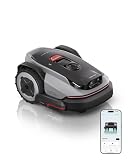 Roborock RockNeo Q110H Roborock RockNeo Q110H |
|
Check Latest Price |
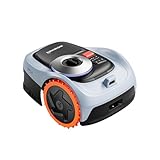 Segway Navimow i206 AWD Segway Navimow i206 AWD |
|
Check Latest Price |
 WORX Landroid WO7144 WORX Landroid WO7144 |
|
Check Latest Price |
 YARDCARE V100 YARDCARE V100 |
|
Check Latest Price |
Two things stand out in that table. First, cutting widths range from 6.3 inches on the V100 to 8.7 inches on the RockNeo and the WORX, and that difference shows up directly in how long a session takes. Second, only one unit here carries LiDAR, and it is also among the most capable on complex terrain.
1. Segway Navimow i105N: The Best Overall Pick
Segway Navimow i105N Robot Lawn Mower Perimeter Wire Free 1/8 Acre RTK+Vision Robotic Lawnmower, AI-Assisted Mapping, Virtual Boundary, APP Control, 58dB(A) Quiet, Multi-Zone Management
Coverage 1/8 acre
RTK plus vision, no wire
7.1 inch cut at 58 dB
24 pounds, 3 year warranty
Pros
- Holds centimetre-level position under tree cover
- Quiet enough to run at night
- Neat parallel striping and accurate dock return
- Up to 12 zones with per-zone schedules
- Vision detection of 150+ object types
Cons
- Factory wheels dig ruts on uneven or mulched ground
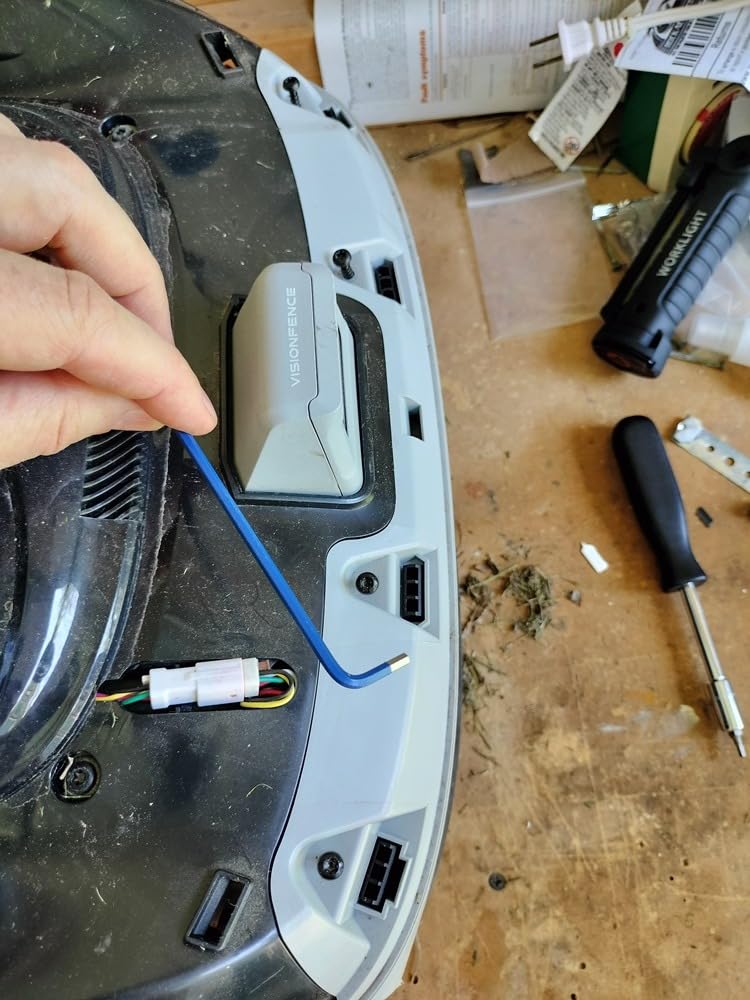
- Vision misses mailboxes and hoses and reports phantom obstacles
- Edges still need a string trimmer
I picked this one first because of the review volume. Nearly 400 ratings is a deep enough pool that the recurring complaints are real patterns rather than early-owner frustration. Owners describe a machine that mows quietly enough to run at night and returns to the dock without hunting.
Navigation is the EFLS 2.0 RTK plus vision stack. RTK gives satellite positioning, and the camera layer keeps it steady when trees or walls block the sky signal. That combination is why it holds course in narrow corridors where pure RTK units wander.
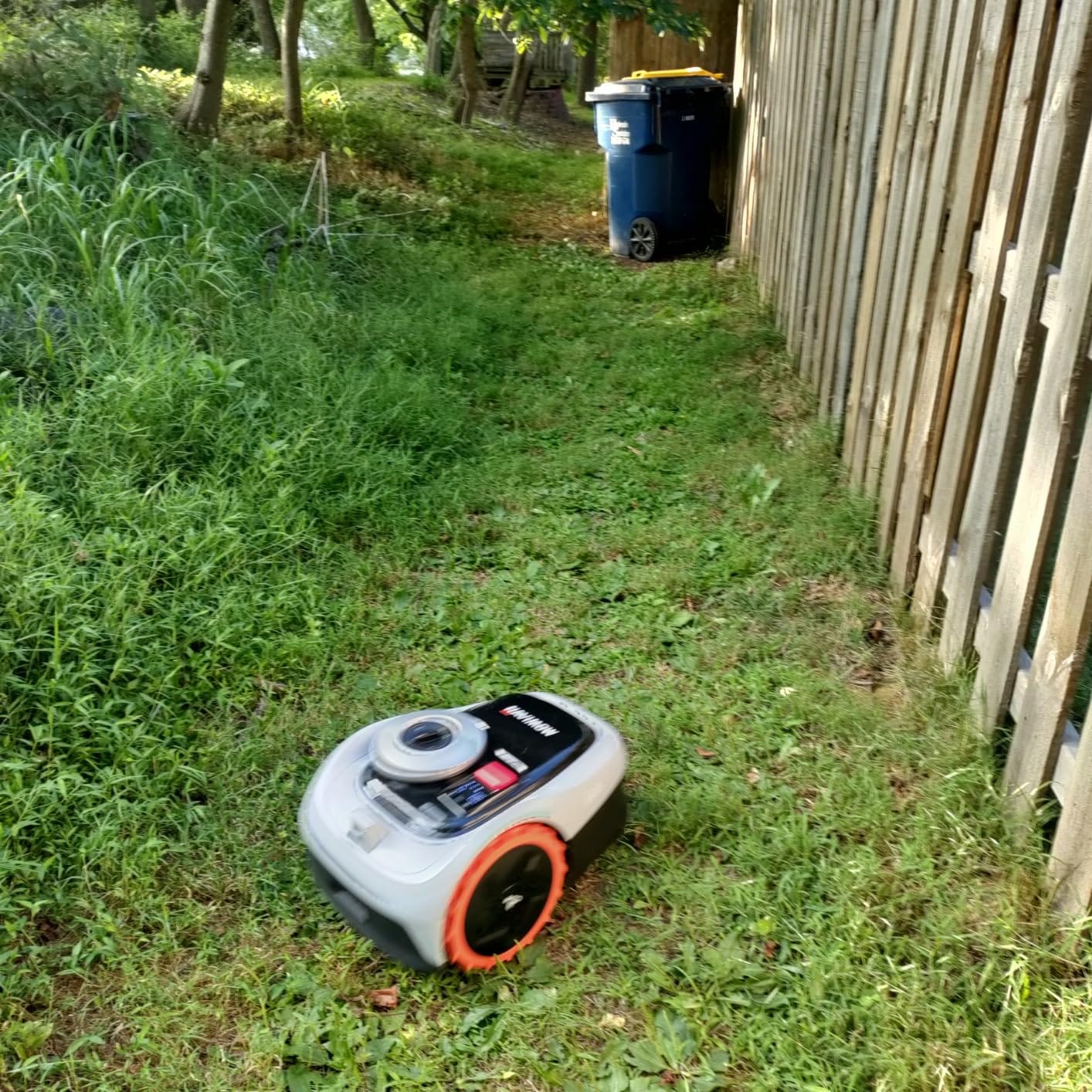
Multi-zone management supports up to 12 zones, each with its own schedule and mowing direction. Owners on split lawns say this is what let them stop running two separate units. Over-the-air updates keep the software current, and the warranty runs three years.
Cut width is 7.1 inches with five height positions. It does not mulch, so clippings stay on the lawn, which is a cosmetic issue rather than a functional one. The body is 21.5 inches long and weighs 24 pounds, so moving it between lawn areas is a one-person job.
Who the i105N suits
If you have an urban or suburban lot up to an eighth of an acre with trees, a fence line, and neighbours close enough that noise matters, this is the machine. Several owners report running it overnight without complaint.
It is also the safest recommendation in the group for a first-time buyer, because the company has support infrastructure that answers issues rather than deflecting them. Multiple reviews mention free accessories and even a weather garage sent out to resolve problems.
Who should skip the i105N
Skip it if your ground is rough, uneven, or has thick mulch. The factory wheels have weak traction and dig ruts, and off-road tires cost extra. If your lawn is already an eighth of an acre or larger, the coverage rating leaves no margin.
Mapping is manual rather than automatic on this model, and the app makes small map edits clunky. Buyers who want a machine that maps itself in one pass will find that elsewhere on this list.
2. ANTHBOT M5 with Garage: Best Value for Sloped Lawns
ANTHBOT M5 Robot Lawn Mower 1/8 Acre with Garage, Dual Vision+Full-Band NRTK Robotic Lawnmower, No Perimeter Wire, App Control Obstacle Avoidance, 45% Slope, Cutting Height, Multi-Zone Mapping
Coverage 1/8 acre
NRTK plus dual 150 degree cameras
45 percent slope, 7.9 inch cut
58 dB, garage included
Pros
- App-generated virtual map in about 10 minutes
- Handles 45 percent gradient with adaptive cruise control
- Recognises over 1000 obstacle types
- Consistent cut when run a few times a week
- Garage
- base station
- RTK station and spare blades included
Cons
- Needs about three passes per cycle for an even cut
- Some owners report trouble on hills despite the 45 percent claim
- Edges leave a thin strip needing a string trimmer
The M5 is the one I recommend to anyone whose yard drops away from the house. Forty-five percent gradient is the joint-highest figure in this group, and the adaptive cruise control manages it better than the number alone suggests.
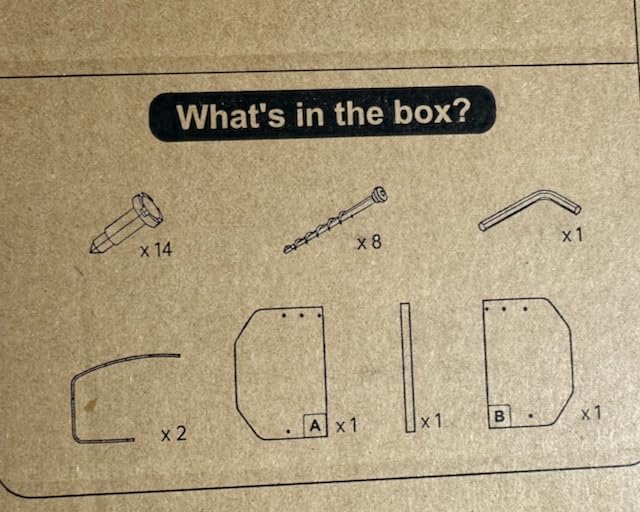
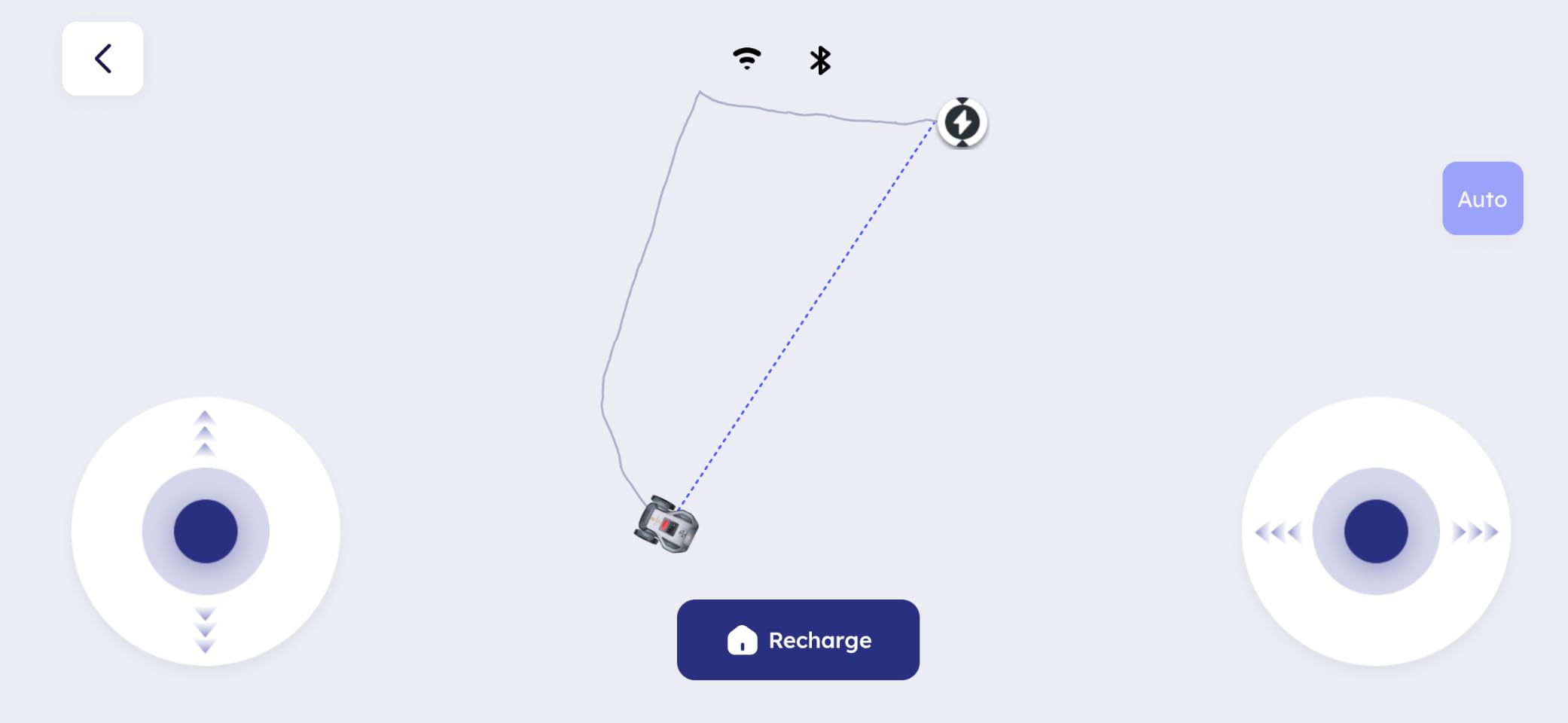
Setup took owners about ten minutes using the app-generated virtual map. There is no wire to bury, and the box includes a weather garage, charging base, RTK reference station, and spare blades, which is a more complete package than most rivals ship.
The dual 150-degree HDR cameras recognise over 1,000 object types, a step above the 150-plus range on most competitors. Reviewers mention toys, garden beds, mulch edges, and children’s equipment being handled without intervention.
Cutting height adjusts from 1.2 to 2.7 inches across the deck. Owners report clean parallel lines when the unit runs a few times a week, and the rain sensor reliably sends it back to base.
Who the M5 suits
It suits steep suburban yards up to an eighth of an acre, especially where a lower-spec two-wheel-drive machine would stall. Buyers who value a complete box and quick setup will feel the difference most.
It is also a good fit for anyone who wants broad obstacle recognition at this price. A thousand recognised object types is a meaningfully wider net than 150.
Who should skip the M5
Skip it if you want one pass per cycle. Owners consistently report needing roughly three passes, with recharging between them, before the cut looks even. The 7.9-inch deck is narrower than the 8.7-inch RockNeo, which lengthens sessions.
Some owners also report difficulty on hills and uneven ground despite the 45 percent claim, so treat that figure as a tested limit rather than a guarantee. The printed manual also does not clearly explain adding extra mowing zones.
3. ECOVACS GOAT O1000 RTK CARE: Best for the Larger Half of the Budget
ECOVACS Goat O1000 RTK Care Robot Lawn Mower, RTK Navigation, 1/4 Acre
Coverage 1/4 acre
RTK auto mapping, no wire
8.66 inch cut, 44.5 pounds
90 minute average battery life
Pros
- Real RTK mapping with auto-mapping capability
- Many owners finish a full yard on one charge
- Cuts down to 1.2 inch for thick warm-season grass
- RTK extension cable improves antenna placement
- Includes 36 replacement blades
Cons
- App start commands time out and hazard zones are hard to re-draw
- Reports itself out of range and locks up needing a PIN reset
- Auto-mapping can join separate lawn areas across fences
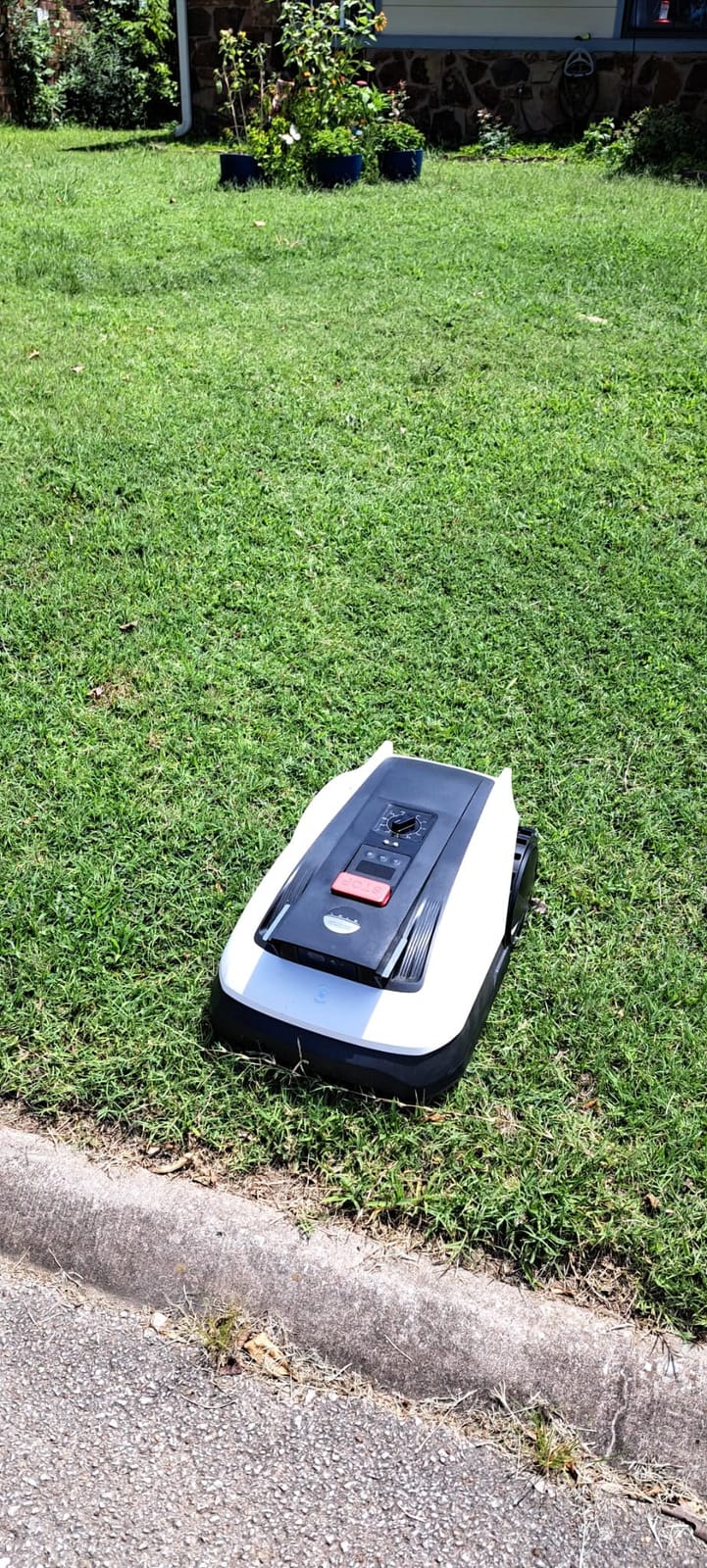
This is a quarter-acre machine with a 8.66-inch cutting width, one of the two widest decks here. Owners on bigger suburban lots report completing a full yard on a single charge with the 90-minute average battery life.
RTK navigation gives centimetre-level accuracy without a perimeter wire, and the included extension cable lets you place the antenna where the sky view is best. The CARE bundle adds 36 replacement blades, which is a quietly significant detail for anyone planning to keep the machine for years.
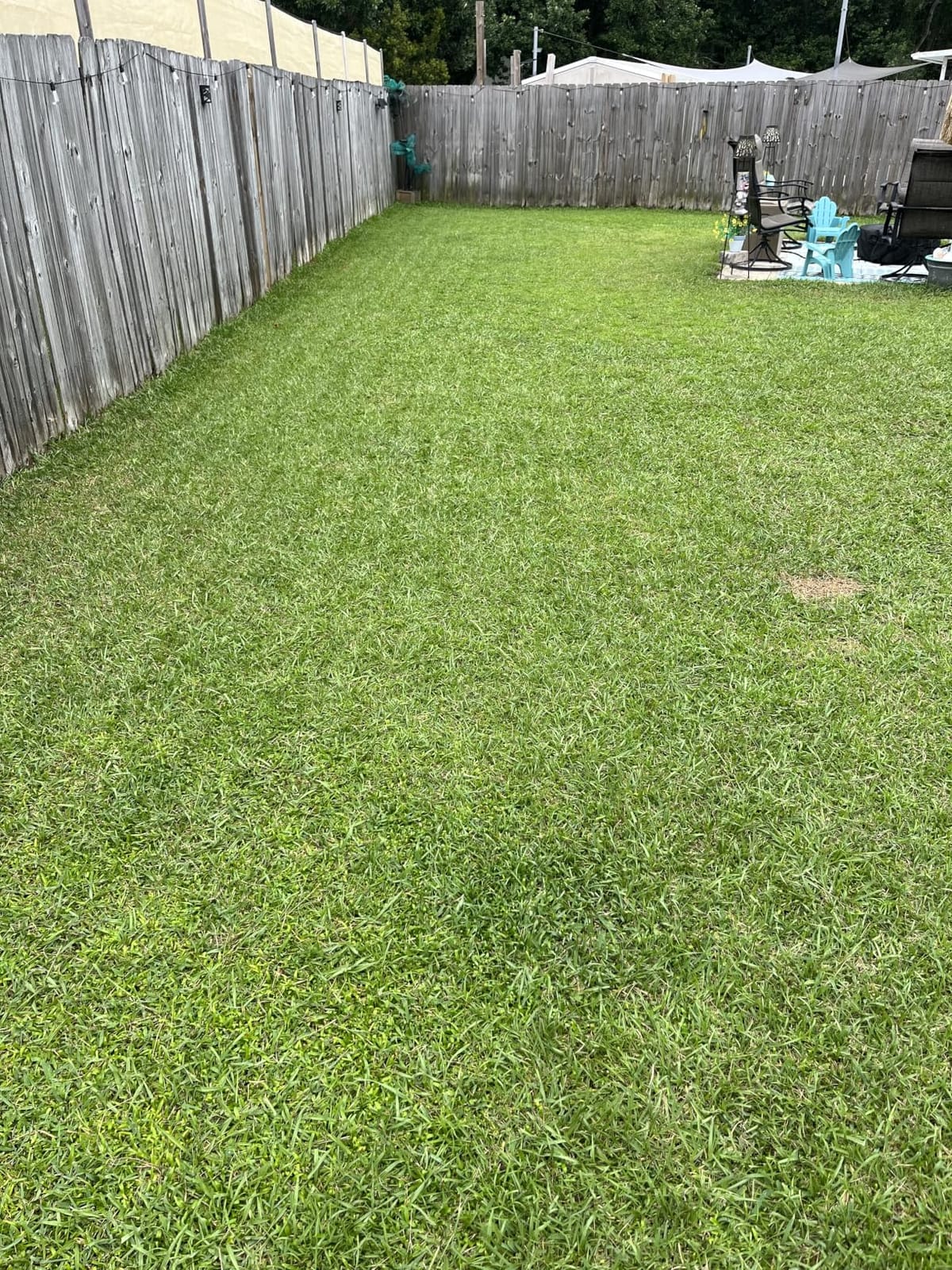
The problem is the app. Owners report start commands timing out, a stuck status shown when the mower is fine, and hazard zones that are difficult to re-draw. It also reports itself out of range and locks up often enough to require a physical reset with PIN entry, which drains the battery.
A side trimmer helps with border grass, and the unit cuts evenly down to 1.2 inches for Bermuda-type lawns. Clippings are left on the lawn rather than mulched, and the remote control steering is described as imprecise.
Who the GOAT O1000 suits
It suits owners with a quarter acre who want a wide cut and a long run time per charge in this group. If you are comfortable learning an app rather than being guided by it, the mowing results are good.
It is also the pick for anyone who values consumables included in the box. Thirty-six replacement blades removes a recurring small expense for years.
Who should skip the GOAT O1000
Skip it if you have a split lawn. Owners report unreliable movement between separated front and back zones through narrow passages, and auto-mapping that joins separate lawn areas across fences, forcing large manual gaps.
The app instability is the real deal-breaker for many buyers. Several owners abandoned it for better-supported alternatives, and a physical PIN reset in the rain is a genuine downside.
4. YARDCARE M800Plus: Compact Unit with Real Slope Capability
YARDCARE M800Plus Cordless Robot Lawn Mower with GPS + Visual Navigation, Bow-Shaped Path Mowing, APP Control, 4.0Ah Automatic Robotic Lawnmower for 1/5 Acre, Obstacle Avoidance, Height Adjustment
Coverage 8611 sq ft
GPS plus 3D vision, wire-free
7.08 inch cut, 28.7 pounds
35 percent slope, 0.8-2.4 inch height
Pros
- HD camera separates grass from patios and walkways
- AI camera detects 150+ obstacle types and reroutes on the fly
- Handles 35 percent grade without slipping
- Hybrid row mowing then random gap-filling
- App schedules with OTA updates
Cons
- Grass over 2.6 inches must be trimmed by hand first
- Regular blade replacement needed to hold cut quality
- 7 inch deck is narrower than 8.5-plus inch rivals
I want to be straight about this one. It carries a 5.0 average in the listing, but it is based on only four reviews. That is not enough evidence for me to recommend it as an editor’s pick, and one product here outrates it on a meaningful sample.
The 3D vision camera is the standout. It distinguishes grass from patios and walkways without needing a boundary wire, which means it can handle a lawn broken up by hard landscaping in a way most budget units cannot. Its 135-degree field of view covers 150-plus obstacle types and reroutes in real time.
Slope rating is 35 percent, and owners with medium-size sloped yards report it climbing without slipping or getting stuck. The hybrid mowing logic runs 40 minutes of orderly rows followed by 60 minutes of random gap-filling, which fills in the strips a row pattern leaves behind.
Who the M800Plus suits
It suits owners of medium yards with a mix of lawn and hard landscaping, where a camera that understands the difference between grass and paving actually pays off. The 0.8-inch minimum cut height also suits people who mow very short.
App control with schedules and over-the-air updates means it is not a set-and-forget appliance, despite the manual operation mode listed in the specifications.
Who should skip the M800Plus
Skip it if your lawn gets away from you. Anything taller than 2.6 inches must be trimmed manually before the first run, and blades need replacing on a regular schedule to hold cut quality.
The 7.08-inch cutting width is also narrow for its coverage class, so sessions run longer than the headline acreage suggests. With four reviews, there is no long-term reliability picture yet, which is a legitimate reason to wait.
5. Sunseeker S4: Best for Yards Full of Trees and Obstacles
Sunseeker S4 Robot Lawn Mower, 3D LiDAR, Vision AI, 0.25 Acre, Wire-Free
Coverage 10,890 sq ft
360 degree 3D LiDAR plus vision AI
Rear-wheel drive, 42 percent slope
60 dB, 2 year warranty
Pros
- 3D LiDAR plus vision AI plans systematic parallel routes
- Works in low light and at night on the 10 TOPS system
- Handles 31.5 inch passages and 42 percent slopes
- Saves 5 maps with up to 100 zones and no-go areas
- 2 year warranty with US-based support
Cons
- Mapping still requires driving the unit rather than auto-mapping
- 7 inch deck is small against 8-plus inch rivals at this price
- Ride-on-edge mode still leaves some string-trimmer work
The S4 is the only machine here with a 360-degree 3D LiDAR unit, and that single fact makes it the most capable on complicated ground. LiDAR builds a three-dimensional map, so overhanging branches, eaves, and dense tree cover are mapped as shapes rather than guessed at.
Owners of yards with heavy tree cover report consistent results because the sensor does not depend on a clear sky view. The 10 TOPS AllSense computing also lets it work in low light and at night, which most of the other units here cannot match.
Coverage is 10,890 square feet, or about a quarter acre, and it can cross passages as narrow as 31.5 inches. Rear-wheel drive handles bumps, ruts, and slopes to 22 degrees or 42 percent. You can save five maps with up to 100 zones and no-go areas each, and it resumes after any interruption.
The six-blade deck is 7 inches wide with floating cut and ride-on-edge mode, adjustable from 1.6 to 3.2 inches. Operation is 60 dB, and the warranty is two years with US-based support.
Who the S4 suits
It suits owners with tree-heavy yards, shade, and narrow gaps between planting beds. The 31.5-inch passage rating and 42 percent slope figure cover ground that would stall most competitors in this list.
Anyone who needs many separate zones will appreciate storing five maps with up to 100 zones apiece. That flexibility is genuinely rare at this price.
Who should skip the S4
Skip it if you want a fully automatic map. Mapping still requires driving the unit through the lawn from the app rather than generating the boundary automatically, which takes longer on larger properties.
The 7-inch deck is small against 8-plus-inch rivals in the same price band, so expect longer sessions. And despite ride-on-edge mode, owners still reach for a string trimmer for border detail.
6. Sunseeker X3 Plus: Best for Cutting Right up to Edges
Sunseeker X3 Plus Robot Lawn Mower, RTK, Vision AI, 0.3 Acre, Wire-Free
Coverage 0.3 acre
RTK plus VSLAM, wire-free
8 inch ride-on-edge cut
19.9 pounds, 60 dB
Pros
- Ride-on-edge offset blade cuts close to fences and walkways
- Steady RTK plus VSLAM near trees and fence lines
- Lightest unit here at just under 20 pounds
- Quiet 60 dB operation on relatively flat yards
- Smooth app with quick customer support
Cons
- Satellite calibration failures
- lockouts and false stuck alerts
- RTK base station must go on a pole and hardware is not sold
- Limited to 17 degree or 30 percent slope
The X3 Plus does one job better than anything else here that does it: cutting right up against a hard edge. The offset ride-on-edge blade lets it run over ridable borders, and owners report visibly closer cuts along fences, walkways, and hardscape.
It is also the lightest machine in the comparison at 19.9 pounds. If you plan to carry it between lawn areas or lift it occasionally, that difference is real. Coverage is 0.3 acre, and the manufacturer quotes up to 13,000 sq ft.
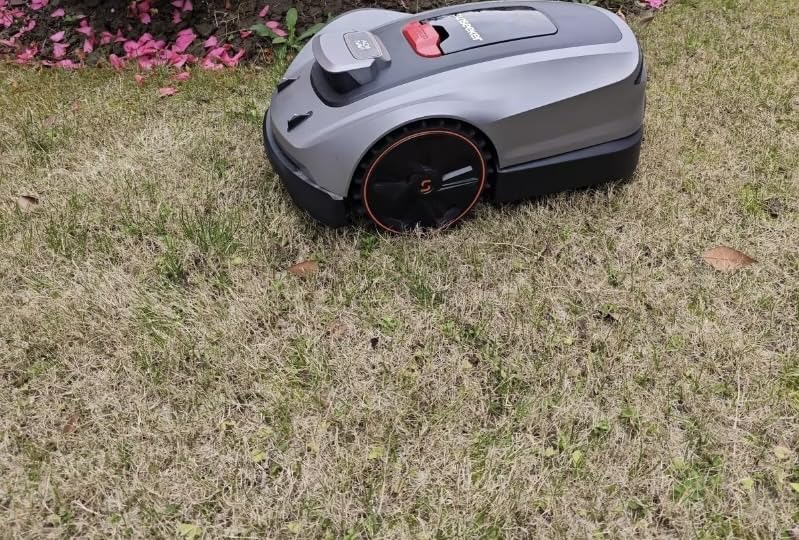
Navigation is AONavi, combining RTK with VSLAM, and vision AI with ultrasonic sensing in daylight. On relatively flat, simple yards owners report it works with minimal intervention and cuts in straight, even lines at 60 dB.
Software is the problem. Owners report frequent satellite calibration failures, unprompted lockouts, and false stuck alerts that require a daily check-in. Error and update messages sometimes appear in Chinese, which is frustrating for US buyers.
Who the X3 Plus suits
It suits owners with a flat, uncomplicated yard where the lawn edge is bounded by fences or paths and appearance matters more than raw acreage. The ride-on-edge design is the reason to pick it.
It also suits anyone who wants a light unit they can lift without help, and buyers who value a responsive app and quick support responses.
Who should skip the X3 Plus
Skip it if your yard has any real slope. Thirty percent, or 17 degrees, is tied for the lowest slope figure here, and complex yards expose its limits quickly. At 3.8 stars it also sits at the bottom of the ratings in this group.
Installation also has a catch: the RTK base station has to be mounted on a pole above the lawn, and the mounting hardware is advertised but not sold by the manufacturer. You will be sourcing that yourself.
7. Roborock RockNeo Q110H: Best for Quiet Night Mowing
Roborock RockNeo Q110H Robot Lawn Mower, Wire-Free Robotic Lawn Mower with Full-Band RTK + VSLAM Navigation, Auto Mapping, AI Vision Obstacle Avoidance, App Control, 45% Slope, Covers Up to 1/4 Acre
Coverage 1/4 acre
Full-band RTK plus VSLAM
8.7 inch cut, 45 percent slope
130 minute battery, headlights
Pros
- Full-band RTK plus VSLAM holds under tree canopies and near fences
- Very quiet with headlights for night mowing
- Cuts in straight even lines and handles 30-plus percent slopes
- App feels familiar if you own a Roborock vacuum
- Passages as narrow as 2.3 ft
Cons
- Auto-mapping is not available and the boundary must be walked
- No LiDAR so vision capability is limited
- Edge cutting poor with a wide unmowed strip along borders
The Q110H borrows its navigation pedigree from Roborock vacuums, and it shows. Full-band RTK combined with VSLAM holds position under tree canopies and near high fences, which is exactly where budget vision-only units lose the plot.
Owners run it at night with headlights on and report it as one of the quietest machines here. The 8.7-inch deck matches the widest cutting width in the group, and the 130-minute average battery life covers a lot of ground per charge.
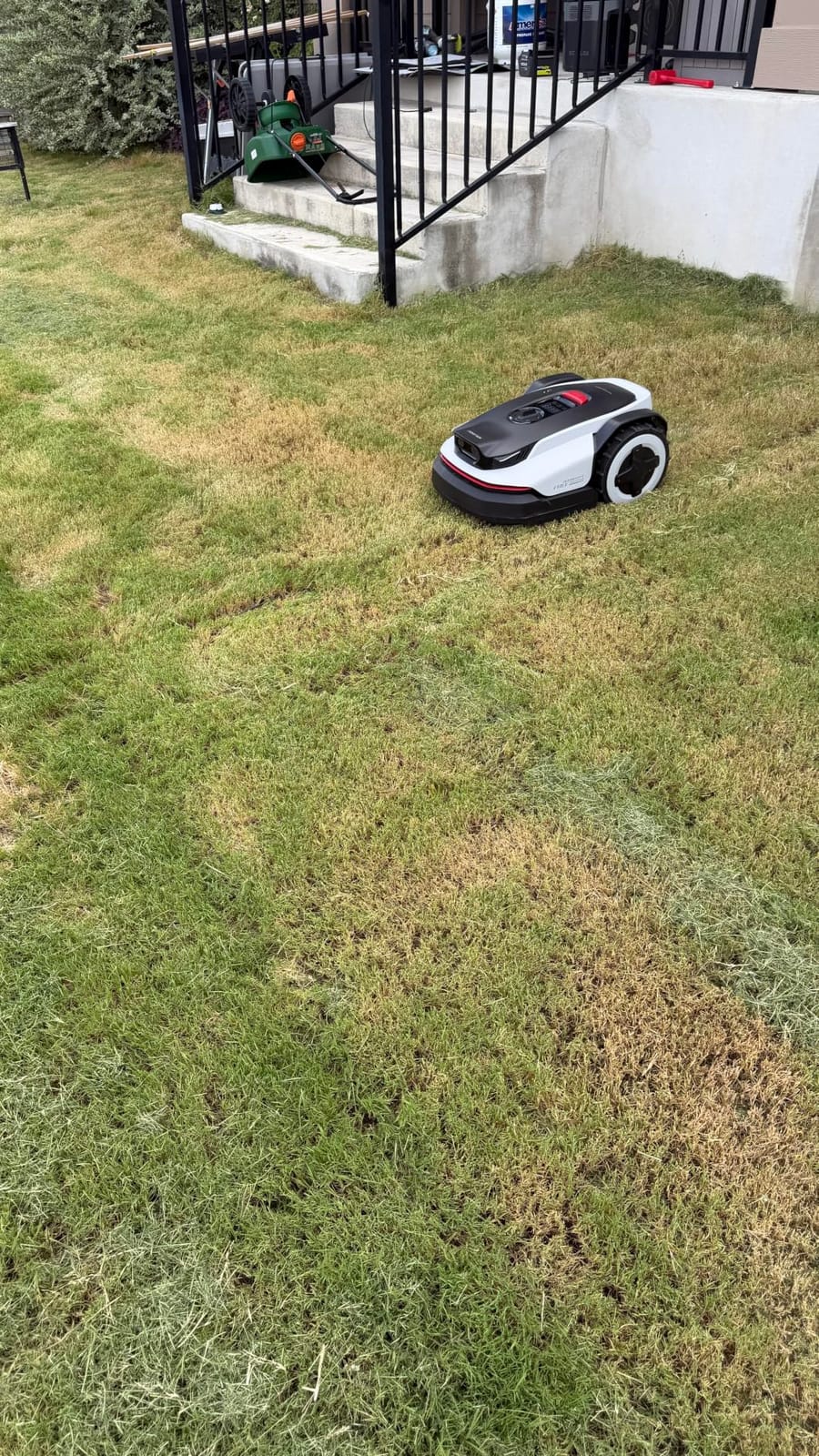
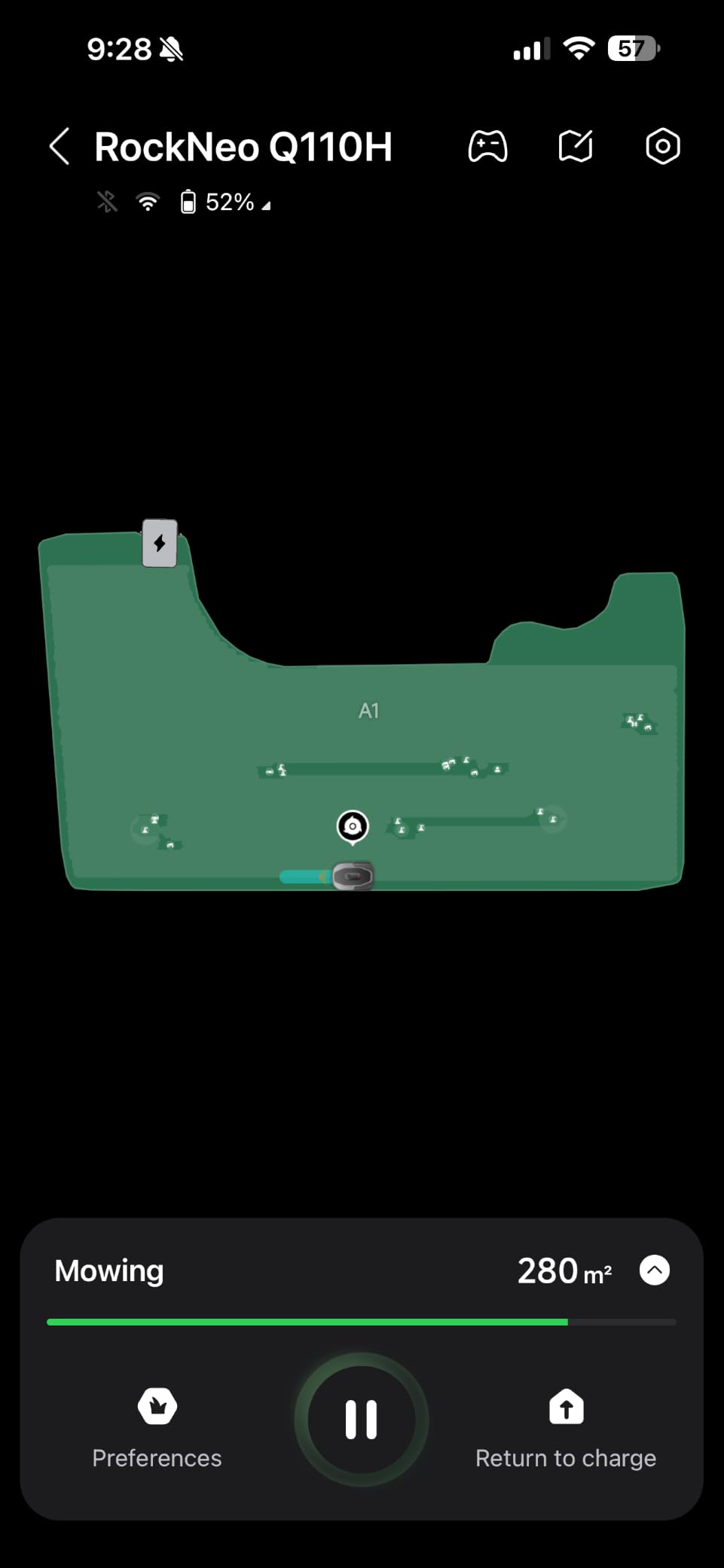
Floating deck and large-diameter wheels take 45 percent slopes and 1.57-inch obstacles. Passage capability goes down to 2.3 feet, the narrowest figure claimed by any unit here. The app includes multi-zone scheduling, a progress dashboard, wildlife mode, PIN lockout, and an alarm.
The listing mentions AI auto-mapping, but owners report the boundary must be walked with the unit in the app. On a larger lawn that is genuinely tedious, and it is the most common complaint in the reviews.
Who the Q110H suits
It suits owners who mow at night or in very early hours, and anyone who already uses Roborock vacuums and will find the app immediately familiar. Straight, even cut lines on a quarter acre are a genuine strength.
It is also a good pick for yards with a mix of slopes and narrow gaps, given the 45 percent rating and 2.3-foot passage capability.
Who should skip the Q110H
Skip it if edging quality matters. Edge cutting is poor, the edging module is not sold in the US, and a wide unmowed strip remains along fences, trees, and borders. If you already know you will need a string trimmer every week, this is the wrong machine.
There is no LiDAR, so vision capability is limited compared with the Sunseeker S4. Overly conservative obstacle avoidance also means it will not attempt narrow openings like an open gate, and maps cannot be edited from the app.
8. Segway Navimow i206 AWD: Best for Rough, Sloped Ground
Segway Navimow i206 AWD Robot Lawn Mower, New i105N, 0.15 Acre, 45% Slopes
All-wheel drive, 45 percent slopes
Zero-turn steering, 20 zones
7.1 inch deck, 2-3.6 inch height
2.5Ah battery, 1350 sq ft per charge
Pros
- All-wheel drive handles uneven and sloped terrain better than rivals
- Very quiet to the point that dogs ignore it
- Zero-turn steering pivots without tearing turf
- Real-time GPS alerts if the unit is lifted or leaves course
- Support often resolves hardware issues at no cost
Cons
- Auto mapping fails on some yards forcing manual zone mapping
- Maps are lost if the unit is lifted or tilted
- Leaves a noticeable unmowed swath next to fences
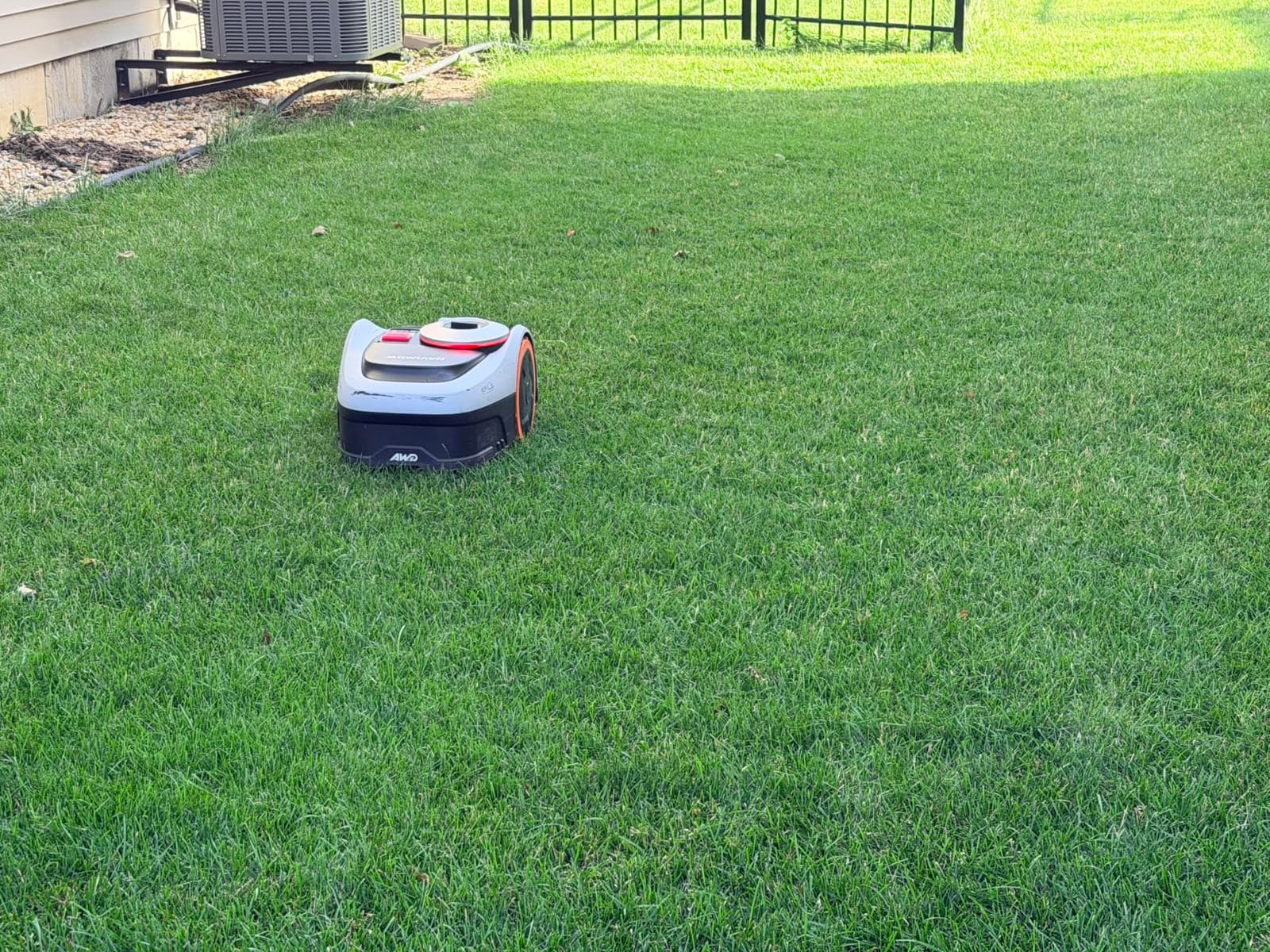
Drivetrain is what you are buying here. All-wheel drive with automotive-grade stability control handles uneven and sloped ground better than the two-wheel-drive machines in this list, and at 45 percent it ties for the highest slope rating here.
Zero-turn steering is the detail owners mention most fondly. The unit pivots on the spot rather than turning in an arc, which avoids tearing turf and leaves an even cut. Several owners say their dogs no longer bark at it, which tells you how quiet it is in practice.
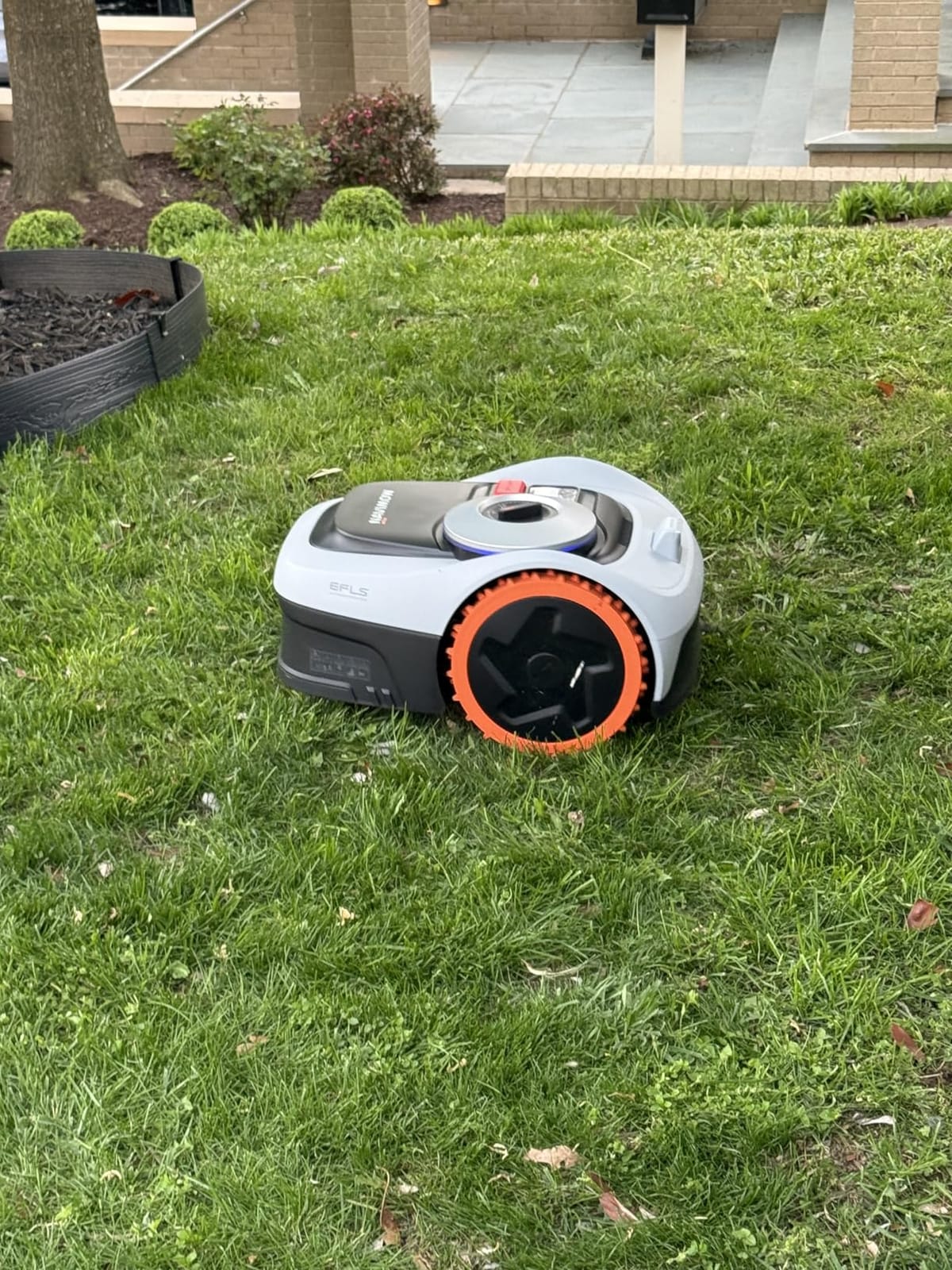
You get up to 20 mowing zones with auto-resume charging and real-time GPS alerts that fire if the machine is lifted or leaves its course. Cutting height adjusts from 2 to 3.6 inches on a 7.1-inch deck, which is a narrower cut than the RockNeo or the GOAT.
The software is the weak side. Auto mapping fails on some yards and forces tedious manual zone mapping, and maps are not saved reliably. Lifting the unit or a brief wheel tilt can wipe an entire map, which is a genuinely annoying failure mode.
Who the i206 AWD suits
It suits owners with genuinely rough or sloped terrain, or anyone tired of a lighter mower bogging down on a hill. The drivetrain difference is real, not a spec-sheet advantage, and 20 zones matches the highest zone count here.
Buyers who worry about theft will like the real-time GPS alerts. Support is also repeatedly praised for sending replacement parts or a garage at no cost.
Who should skip the i206 AWD
Skip it if your lawn is bigger than a small lot. The 2.5Ah battery covers only about 1,350 square feet per charge, so larger lawns need frequent returns to base. Several owners also report a noticeable unmowed swath between the mower and fences.
Very tall isolated grass blades get circled rather than cut, so it takes multiple rounds to clear uneven growth. Mapping reliability is the other issue to weigh before you commit.
9. WORX Landroid WO7144: Best for a Setup With No Installation
WORX Robot Lawn Mower for 1/4 Acre, Wire-Free with Brushes
Coverage 1/4 acre
RTK Cloud, no local antenna
8.7 inch cut, 39.2 pounds
3 year manufacturer warranty
Pros
- RTK Cloud needs no local antenna and no subscription
- Auto mapping worked accurately on a two-tier lawn
- V-SLAM plus vision AI handles shaded areas reliably
- Handles swings
- saucer swings and mixed grass
- Parallel mowing completes 0.15-0.2 acre in about 3.5 hours
Cons
- Edger module is a separate add-on rather than included
- No headlights on this two-wheel drive configuration
- Maintains an already-cut lawn and will not handle tall grass
The WO7144 solves the installation problem completely. RTK Cloud positioning runs through the cloud rather than a local reference station, so there is no antenna to mount on a pole, no cable to run, and no subscription fee. Several owners had it mowing within ninety minutes of delivery.
Auto mapping is genuinely accurate, including on a difficult yard. One owner reports a two-tier lawn with a ramp and 45 feet of lake front mapped correctly on the first attempt. Manual mapping is available too, for buyers who prefer it.
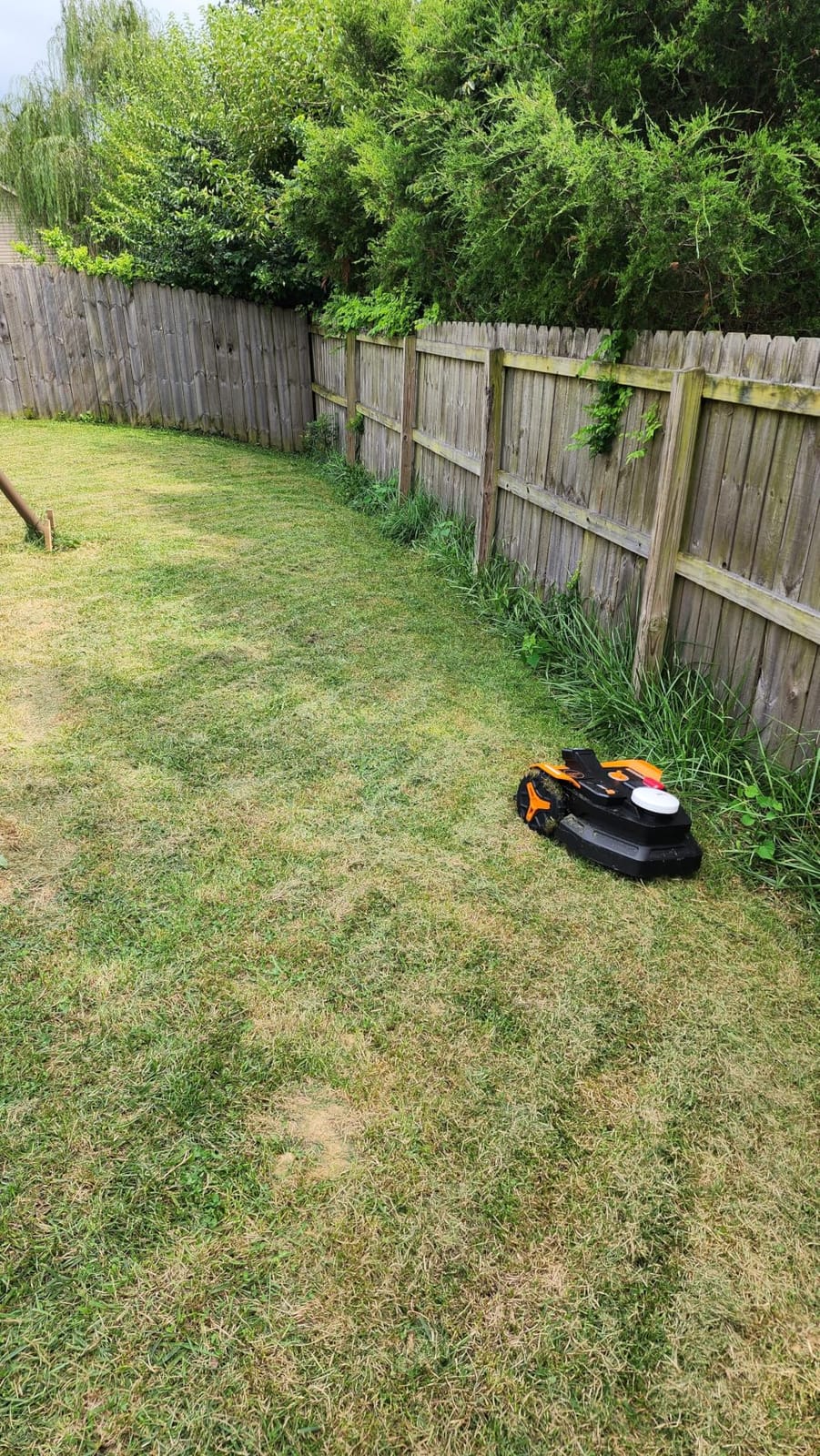
Navigation is RTK Cloud with V-SLAM and vision AI sensor fusion, which keeps it working in shade where pure satellite positioning would struggle. Vision AI runs neural processing up to 10 trillion operations per second for obstacle avoidance. The app supports unlimited zones, custom paths, no-go areas, and map editing.
At 4.4 stars with 26 reviews, it sits near the top of the ratings here despite a small sample. The cut is 8.7 inches with heights from 1.57 to 3.54 inches, the battery averages 80 minutes, and it handles 30 percent slope. The warranty is three years.
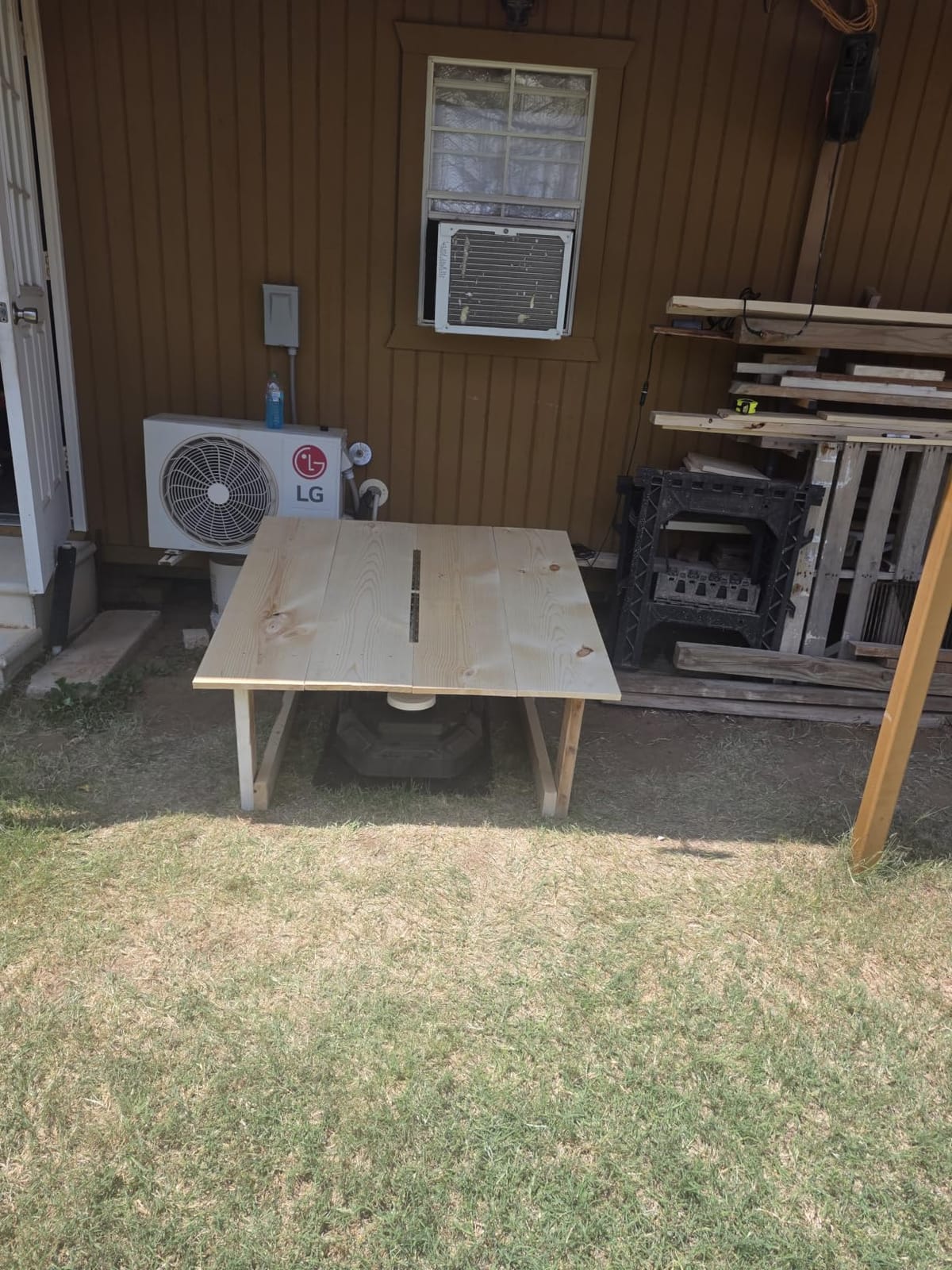
Who the WO7144 suits
It suits anyone who refuses to install anything. No antenna, no wire, no cloud fee, and a three-year manufacturer warranty is a combination nobody else in this group matches. It also suits buyers with shaded areas, thanks to the V-SLAM fusion.
Owners on a quarter acre report parallel line mowing completing 0.15 to 0.2 acre in roughly three and a half hours including recharging, which is a useful real-world figure.
Who should skip the WO7144
Skip it if you need edge cutting on day one. The edger and cut-to-zero module is a separate add-on rather than included, and that is the most common complaint in the reviews. There are no headlights on this two-wheel-drive configuration either.
It also maintains an already-cut lawn rather than cutting tall grass or handling weed-eating, so you will need a conventional mower for the first cut of the season. One owner received a unit that arrived used and threw error codes after firmware updates.
10. YARDCARE V100: The Cheapest and Simplest Machine Here
YARDCARE V100 Automatic Robot Lawn Mower HD Vision for Lawn Max 1600 sq ft
Coverage 1,600 sq ft
HD vision with bumper sensor
6.3 inch cut, 27.9 pounds
0.8-2.4 inch height, 20 degree slope
Pros
- Simple cable-free setup with no boundary wire to bury
- HD vision distinguishes grass from non-grass
- 32 ft magnetic strip creates no-go zones with no digging
- 4Ah battery handles the 1600 sq ft class
- Includes 3 spare blade sets and a rain sensor
Cons
- No app connectivity so scheduling is limited
- 6.3 inch deck is the narrowest so sessions run long
- Random path only with no orderly striping
The YARDCARE V100 has the second-highest star rating in the group at 4.8, with 95 percent five-star reviews across 58 ratings. That is a real enough sample to trust, and it also has the lowest entry point of anything we tested.
There is no RTK, no antenna, and no app. Navigation is an HD camera with a visual sensor and a bumper sensor, and it distinguishes grass from non-grass well enough to work cable-free out of the box. The 32-foot magnetic strip with 20 pegs creates no-go zones around flower beds and pools with no digging and no power needed.
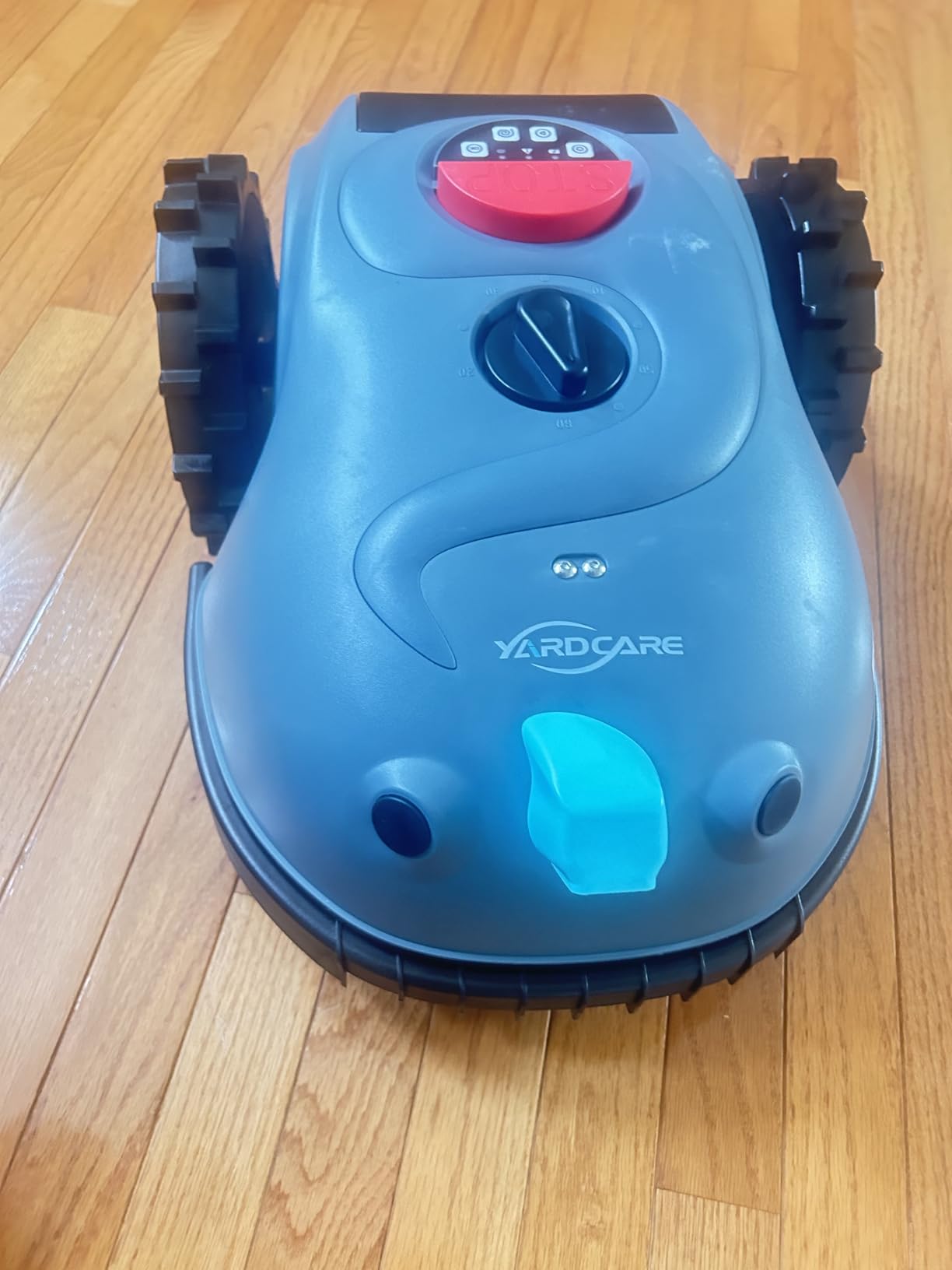
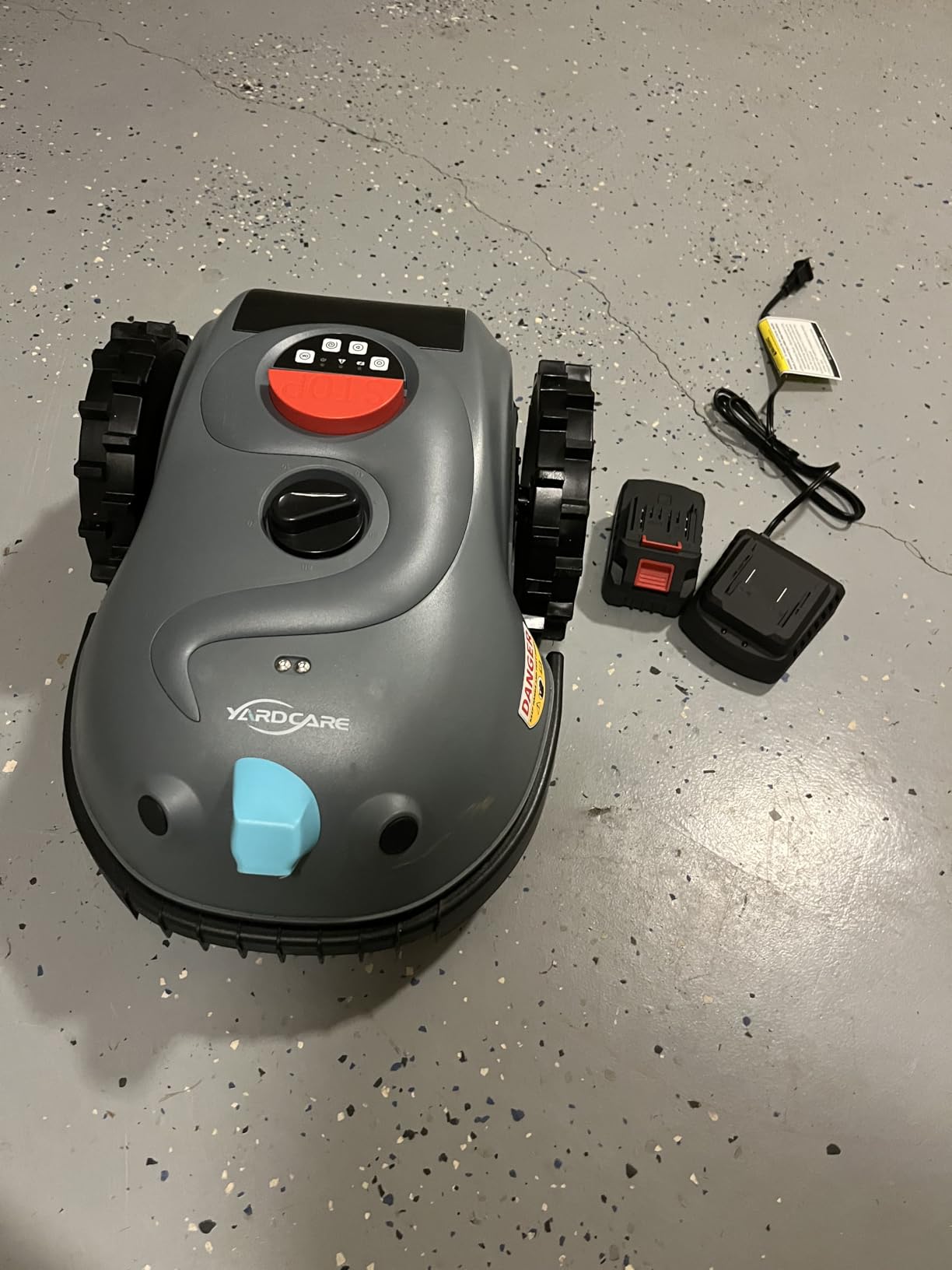
Safety hardware is solid for the money: a tilt sensor, an emergency stop switch, and a rain sensor. The box includes a 4Ah battery, an 18V charger, and three spare blade sets, so you are not hunting for consumables after the first month.
Cutting width is 6.3 inches, the narrowest here, and height adjusts from 0.8 to 2.4 inches. Slope capability tops out at 20 degrees. Mowing follows a random path only, so there are no orderly stripes.
Who the V100 suits
It suits owners of small lots under about 1,600 square feet who want reliable mowing with no app, no account, and no installation. The magnetic no-go strip is a genuinely good idea for anyone with flower beds or a pool.
For renters and first-time buyers on a tight budget, this is the lowest-risk way to find out whether you like handing over your weekends.
Who should skip the V100
Skip it if you want scheduling control. There is no app connectivity, so scheduling is limited compared with every other unit on this list. That is the single biggest functional gap here.
It is also the wrong choice for anyone who cares about the visual finish, because the random path produces no stripes. A 6.3-inch deck also means long sessions on anything larger than a small lot.
How to Choose a Robot Mower on a 1,000-Dollar Budget
The differences that matter at this price come down to four things: how the machine knows where your lawn is, how it copes with the terrain, how long the software stays out of your way, and what happens when something goes wrong. Price tells you almost nothing about any of them.
RTK, LiDAR, vision, and hybrids explained
Boundary wire is a cable you bury or pin around the perimeter. The mower follows a signal from that cable. It is the oldest method and still the most predictable, but it is exactly what most buyers are trying to avoid.
RTK GPS uses a satellite correction signal to position the mower to within a few centimetres. It is accurate, needs no wire, and works well in open yards. Its weakness is signal loss under dense tree cover or beside tall buildings.
NetRTK is RTK delivered over a cellular network instead of a local reference station. It removes the antenna but adds a dependence on coverage. Full-band NetRTK, used by the ANTHBOT M5 and the Roborock Q110H, uses multiple satellite bands for a stronger fix.
LiDAR is a spinning laser sensor that builds a three-dimensional map of the space. It does not need the sky at all, which makes it a good fit for yards with heavy tree cover. Only the Sunseeker S4 in this group carries one.
Vision navigation uses cameras and AI recognition to see grass, edges, and obstacles. It needs no hardware beyond a lens. Its weakness is conditions: heavy shade, long grass, and confusing boundaries can defeat it.
Hybrid systems pair RTK with vision or LiDAR, and in practice those are the strongest machines here. The i105N, the M5, the X3 Plus, and the Q110H all use a hybrid approach for that reason.
Does a boundary wire need a power supply
Yes, most boundary wire systems do. A small generator or charging unit energises the wire, and the mower senses the signal to find its limits. If the power goes out, the mower stops at the boundary it already knows.
Owners on forums ask this question constantly because it is rarely explained before purchase. It is one of the strongest arguments for the wire-free class: a wired setup is a weekend project, and a cut wire is a repair.
What boundary wire actually costs in time
For a typical quarter-acre suburban lot, plan on 300 to 400 feet of wire and a full weekend. Most of that time goes into trenching or pinning the cable along edges, and connecting it properly at the charging base.
The failure mode owners complain about most is cuts. Aerators, edging tools, and dog traffic all sever buried cable, and repairs mean finding the break with a detector. Forum owners describe it as the single most common reason they would switch to a wire-free unit.
That is the honest case for spending your budget on RTK or LiDAR instead. Owners on gardening forums point out that simple wired setups still do the job perfectly, but if you are starting from scratch the installation time is the real cost.
Matching a mower to your lawn size
Match the coverage rating to your actual lawn, not to the size you hope to own. Every mower here is rated for between 1,600 square feet and about 13,000 square feet.
Under 3,000 square feet, the V100 and the i105N are both comfortable. Between 5,000 and 8,000 square feet, look at the M800Plus, the i105N, and the GOAT O1000. Above 10,000 square feet, your choices narrow to the GOAT O1000, the X3 Plus, and the S4.
Be aware that rated coverage is a best-case figure. A mower on a 1,350-square-foot-per-charge battery working a quarter acre will return to base many times, and uneven ground with obstacles reduces effective area. The Segway i206 AWD is the clearest example of that gap.
Also check the minimum cutting height against your grass type. Bermuda and St. Augustine need the 1.2 to 1.6 inch options, while most cool-season lawns are happy at two inches or higher.
What goes wrong, and how to avoid it
Software instability is the most common failure across this entire list. Owners of the GOAT O1000, the X3 Plus, and the i206 AWD all report lockouts, false stuck alerts, or lost maps. There is no way to avoid it entirely, but you can reduce the impact.
Choose the machine with the largest review count for its model. More ratings means more owners have hit the same firmware version, so bugs are more likely to be found and fixed. The i105N, with 391 reviews, has the deepest evidence base here.
Watch the app rating in the store, not just the star rating. A high hardware rating dragged down by software complaints, as with the ECOVACS, is a warning sign.
Long grass is the other common issue. Several units will not start properly on grass over roughly 2.6 inches, and mowing in short daily cycles is what robot mowers are designed for. Cut tall grass once with a conventional mower first.
Finally, plan for edge work. Most of the ten units here still leave some kind of strip along fences, walls, or borders, and the ones that claim ride-on-edge cutting tend to leave detail work in practice. Budget a few minutes with a string trimmer each week.
Maintenance, blades, and ownership costs
Blades are the main consumable, and they need replacement far more often than most buyers expect. Dull blades shred grass instead of cutting it, which makes the lawn look worse and stresses the motor. Check them monthly during the season.
The GOAT O1000 CARE bundle includes 36 replacement blades, and the V100 ships with three spare sets, so both start you well ahead. The others rely on reorder cycles, so check blade availability in your region before buying.
Winter storage matters more than most guides admit. Charge the battery fully, clean grass out of the deck and wheels, and store the unit in a dry place above freezing. Leaving a battery drained through winter is the most common way these machines fail permanently.
On theft protection, PIN lockout and alarms are standard on the Roborock Q110H, and real-time GPS alerts on the i206 AWD stand out in this group. An optional 4G module is offered for the i105N and the Q110H.
Buyers on forums raise after-sales support and parts availability as a real concern with newer brands, and several commenters say reviews can look inflated when owners may have received the unit free. A three-year warranty exists on the i105N and the WORX, while the Sunseeker units carry two years with US-based support.
Frequently Asked Questions
What is the best and cheapest robot lawn mower?
The YARDCARE V100 is the least expensive option here and averages 4.8 stars across 58 ratings. It uses HD vision with a bumper sensor, needs no boundary wire, and creates no-go zones with an included 32-foot magnetic strip. It has no app, so scheduling control is limited.
What is the best budget-friendly robotic lawn mower?
The Segway Navimow i105N is our top pick in this price band. It combines RTK with vision for centimetre-level positioning, runs at 58 dB, manages up to 12 zones, and carries 391 ratings at 4.1 stars. That review volume gives the clearest picture of long-term behaviour of any model on this list.
What is the most reliable robot lawn mower?
Reliability is best judged by review volume and support. The Segway Navimow i105N has 391 ratings, and multiple owners report the support team sending free accessories or a weather garage to resolve issues. The WORX Landroid WO7144 pairs cloud RTK with a three-year warranty and no installation steps.
Are Segway robotic mowers any good?
Yes, with one caveat. The i105N and i206 AWD are well regarded for quiet operation, even cuts, and slope handling, and both receive frequent praise for support resolving hardware issues at no cost. The recurring complaint is software: auto mapping can fail, maps can be lost after the unit is lifted, and both leave an unmowed strip next to fences.
What are the problems with robotic lawn mowers?
The most common problems are app instability, lost maps, poor edge cutting, and getting stuck on long grass. Buyers report lockouts and false stuck alerts on several models, and most leave a narrow unmowed strip along fences and borders. You also need to trim tall grass manually before the first run, because these mowers maintain lawns rather than cut them down.
Do robot lawn mowers need a boundary wire?
No, not at this price. Every model on this list is wire-free, using RTK satellite positioning, cameras, LiDAR, or a combination. Older budget models used a buried cable that needs a power supply and can be cut by aerators or edging tools. All ten here define their boundaries in the app instead.
The Best Robotic Mower Under 1,000 Dollars for 2026
After comparing all ten, the Segway Navimow i105N is the best robotic mower under 1,000 dollars for most people. RTK plus vision navigation holds position under trees, 58 dB operation means you can mow at night, and 391 ratings give you far more real-world evidence than any competitor here.
Buy the ANTHBOT M5 instead if your yard is steep and you want the most complete box in the group, or the Sunseeker S4 if trees and narrow passages are your biggest problem. Go with the WORX Landroid WO7144 if you refuse to install anything at all, and the YARDCARE V100 if you have a small lot and want the simplest machine on this list.
Whatever you choose, buy the one whose weakness matches your yard rather than the one with the longest feature list. Use the buttons above to check current pricing, and set up the app before the first mow so you can watch it learn your lawn for a few days before leaving it alone.