
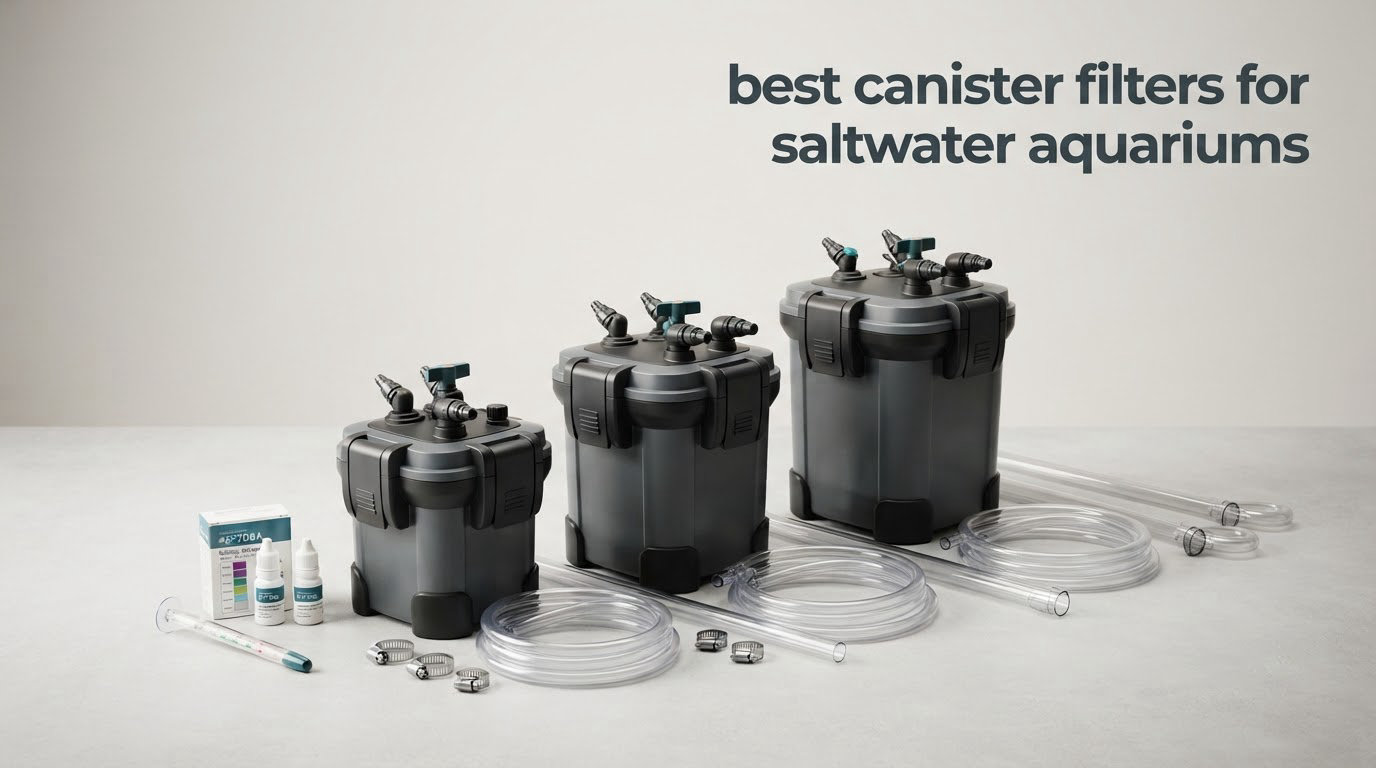
If you have spent any time on reef forums, you already know the reaction you will get for proposing a canister filter. There is a Humble.Fish thread literally titled The Dreaded Canister Filter, and the recurring claim is that canisters are a nitrate factory that demands cleaning twice a week. We spent October 2026 reading the manufacturer specs on eight canisters and cross-checking them against the long-term reports of people who actually run them in salt.
The short version of what we found: the skeptics are describing a maintenance failure, not a filter design flaw. A reef keeper on Reef2Reef reported being in year 17 of running a reef on a canister with a monthly floss pad change that takes about three minutes, while another runs a 400 GPH canister on a 65 gallon system and has never seen nitrates climb past 10 ppm. Both things are true because both of those keepers clean on a schedule.
That is the frame for our list of the best canister filters for saltwater aquariums. Every filter below is evaluated on the things that decide whether it works in marine water: rated flow against actual tank volume, how much media it holds and whether that media can be reordered for salt, whether it self-primes when the chamber fills with heavier salt water, and whether the manufacturer rates it for marine use at all. We also flag the two units here whose listings carry no saltwater statement, because that omission matters more in salt than it does in fresh.
A note on method: we did not cycle eight reef tanks for six months. We read published specifications, read the long-form owner reports on reef communities, and weighted tenure heavily. A keeper running a filter on a 75 gallon reef for a decade told us more than a first-week buyer did, and we treated it that way. Prices change constantly, so we leave those to the buttons.
Table of Contents
Are Canister Filters Good for Saltwater Tanks?
Yes. Canister filters are good for saltwater tanks when the media order is reversed for marine use, the unit self-primes, and you commit to a monthly cleaning schedule. They fail in salt when keepers skip cleaning for months and the sponges clog, or when a 250 GPH unit is asked to run a 150 gallon reef. The filter does not care whether the water is fresh or salt. Flow, media volume, and your hose to the kitchen sink do.
What a saltwater rating actually certifies is narrower than most buyers assume. It means the wetted components are made from materials chosen to resist corrosion in saline water, and that the pump head and impeller shaft are not brass or copper parts that will pit and seize. It does not mean the filter is reef-safe in the biological sense, and it does not replace a skimmer. Three of the eight units below carry an explicit marine or fresh-and-salt rating in their published specifications.
There is one reef-specific detail the ratings do not cover. A canister plumbed directly into a display tank has no bubble column, so it exports very little gas exchange. That is why reefers who run one almost always pair it with a hang-on-back protein skimmer fed by the canister return, which restores the aeration the canister cannot provide.
Top 3 Saltwater Canister Picks for 2026
Penn-Plax Cascade 1000
- 265 GPH for tanks up to 100 gallons
- Rated for both freshwater and saltwater
- Three stackable media baskets with handles
- 360 degree rotating valve taps
- Push button self-primer

Fluval FX6
- 925 GPH rated up to 400 gallons
- Smart Pump self optimization
- 5.9 L of stackable media capacity
- Integrated drain valve
- Auto air evacuation every 12 hours

Fluval 407
- eTEC pump runs up to 25 percent quieter
- EZ-Lift media baskets with center handle
- Quick disconnect valves
- Four size variants
- Self-priming startup
Best Canister Filters for Saltwater Aquariums in 2026 at a Glance
| Product | Specs | Action |
|---|---|---|
| Penn-Plax Cascade 1000 |
|
Check Latest Price |
| Fluval 407 |
|
Check Latest Price |
 Marineland Magniflow 250 Marineland Magniflow 250 |
|
Check Latest Price |
 Marineland Magnum 290 Marineland Magnum 290 |
|
Check Latest Price |
| Fluval FX6 |
|
Check Latest Price |
 Fluval FX4 Fluval FX4 |
|
Check Latest Price |
 EHEIM Classic 2213 EHEIM Classic 2213 |
|
Check Latest Price |
 SunSun Hw303B Pro SunSun Hw303B Pro |
|
Check Latest Price |
Read the flow column against your actual tank volume, not the manufacturer maximum. The maximum assumes a short, wide intake with no head pressure; a 10 foot run of hose and a canister tucked behind a stand will cost you a meaningful share of the rated number. Media basket volume is the second column to check, because a reef stocking a canister full of floss and carbon needs liters of capacity, not a token tray.
1. Penn-Plax Cascade 1000 – Best Overall Canister Filter for Saltwater Aquariums
Penn-Plax Cascade 1000 Canister Filter – 265 GPH Aquarium Filter for Tanks Up to 100 Gallons – 360 Degree Flow Valves, Poly Fiber Pads, Bio-Sponge & Activated Carbon -Fresh & Saltwater -11.5x10x17in
265 GPH for tanks up to 100 gallons
Three stackable baskets
Saltwater rated
28.5W motor
Pros
- Rated for both freshwater and saltwater
- Three stackable handle-equipped baskets let you set your own media order
- 360 degree rotating valve taps adjust flow direction in a tight cabinet
- Push button primer for clean startup
- Complete media set plus spray bar clamps and tip proof base
Cons
- 28.5W motor draws more power than comparably rated canisters
- 10 percent one-star share points to long-run durability complaints
The Cascade 1000 is the canister we keep coming back to for marine work, and the reason is unglamorous: it is the only unit in this group rated for both freshwater and saltwater by the manufacturer while also carrying more than 10,000 reviews. That combination of a documented marine rating and an enormous owner base means the failure modes are well known and mostly avoidable, which is what you want from a box of moving parts sitting under a stand in water you cannot afford to lose.
At 265 GPH it is rated for tanks up to 100 gallons. On a reef that works out to a healthy turnover on something in the 50 to 70 gallon range once you account for head and pipe friction, and it pairs naturally with a hang-on-back skimmer. The three media baskets all have lift handles and stack in any configuration you like, which is the part that actually matters for a reef canister. You will want mechanical at the bottom, biological in the middle, and chemical on top, and swapping the whole stack to run carbon for two weeks after a rock blast takes about a minute.
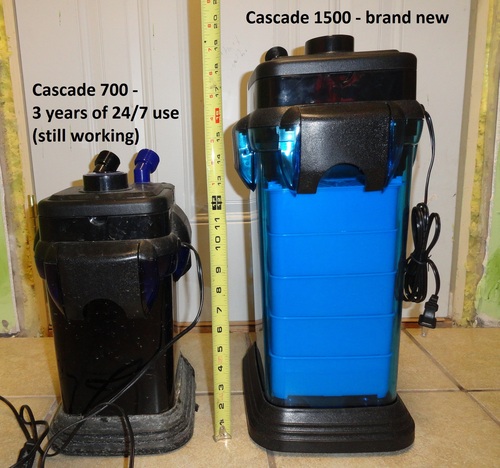
The rotating dual outlet valve taps are an underrated feature for marine setups. Most canisters shoot water out in one fixed direction, which on a reef display means a single hot spot against the front glass. The Cascade taps swing through 360 degrees, so you can aim the return across the tank instead of into it, and you can dial the rate down with the same motion.
The push-button primer means you are not filling the chamber by hand with a jug of RO-mixed saltwater at install. In a system where every drop counts and the water is at a specific density, not having to prime by pouring is a real convenience on day one and every time the power goes out after a storm.
How the Cascade 1000 handles a reef media stack
Three separately handled baskets is enough to build the marine-standard stack with room to spare: coarse sponge or floss in the bottom basket, ceramic media or a structured biocarrier in the middle, and a carbon bag or phosphate remover on top. Because each basket lifts out by its own handle, you can pull only the top tray for a carbon change instead of dismantling the entire stack.
The included media package is unusually complete for this class. You get poly fiber pads, a coarse bio-sponge, a carbon bag, the spray bar, hose clamps, alignment clamps, and a tip-proof base, so a new setup can be running the same day it arrives. Plenty of reef keepers replace the included carbon with their own bulk media within a month anyway.
Where it falls short in salt water
The 28.5W motor is the honest drawback. That is more draw than several canisters rated in a similar gallon range, and on a tank running a canister plus a skimmer plus a heater plus lighting it adds up on a power meter.
The 10 percent one-star share is the largest of any product here, and it clusters around motor and seal durability over a very long production run. A unit bought a decade ago is a different durability question than one bought today, which is worth remembering when you read historic reviews of long-lived Cascade owners.
2. Fluval 407 – Best Value Performance Filter for a Mid-Size Reef
Fluval 407 Performance Canister Filter – For Aquariums Up To 100 Gallons
Rated up to 100 gallons
eTEC pump
Up to 25 percent quieter
EZ-Lift center handle baskets
Pros
- Exceptionally quiet even at high flow
- Strong steady pressure that clears a tank quickly
- EZ-Lift center handle baskets make media changes fast
- Simple self-priming with no repeated canister filling
- Four size variants let you size to the system
Cons
- Some buyers report the impeller cover disengaging over time
- Included carbon pouches are thinner than typical Fluval media
- Occasional low hum at certain water levels
The 407 is the canister most reef keepers on forums have actually run, and the owner reports are consistent enough to trust. A Fluval FX4 on a 75 gallon with a monthly floss change is a documented setup with reported results, and the 407 covers the same practical ground for less money and less space. At 4.4 stars across more than 10,000 reviews, it is also one of the better-evidenced picks in the entire category.
The eTEC motor is the reason it is quiet. Fluval rates it as running up to 25 percent quieter than the previous generation, and quietness is not a luxury on a display reef in a living room or a bedroom nano. Reviewers call out the flow as strong and steady, with one owner reporting cleaning a 50 gallon tank in under two hours, which tells you something about how much detritus it can pull through the trays.
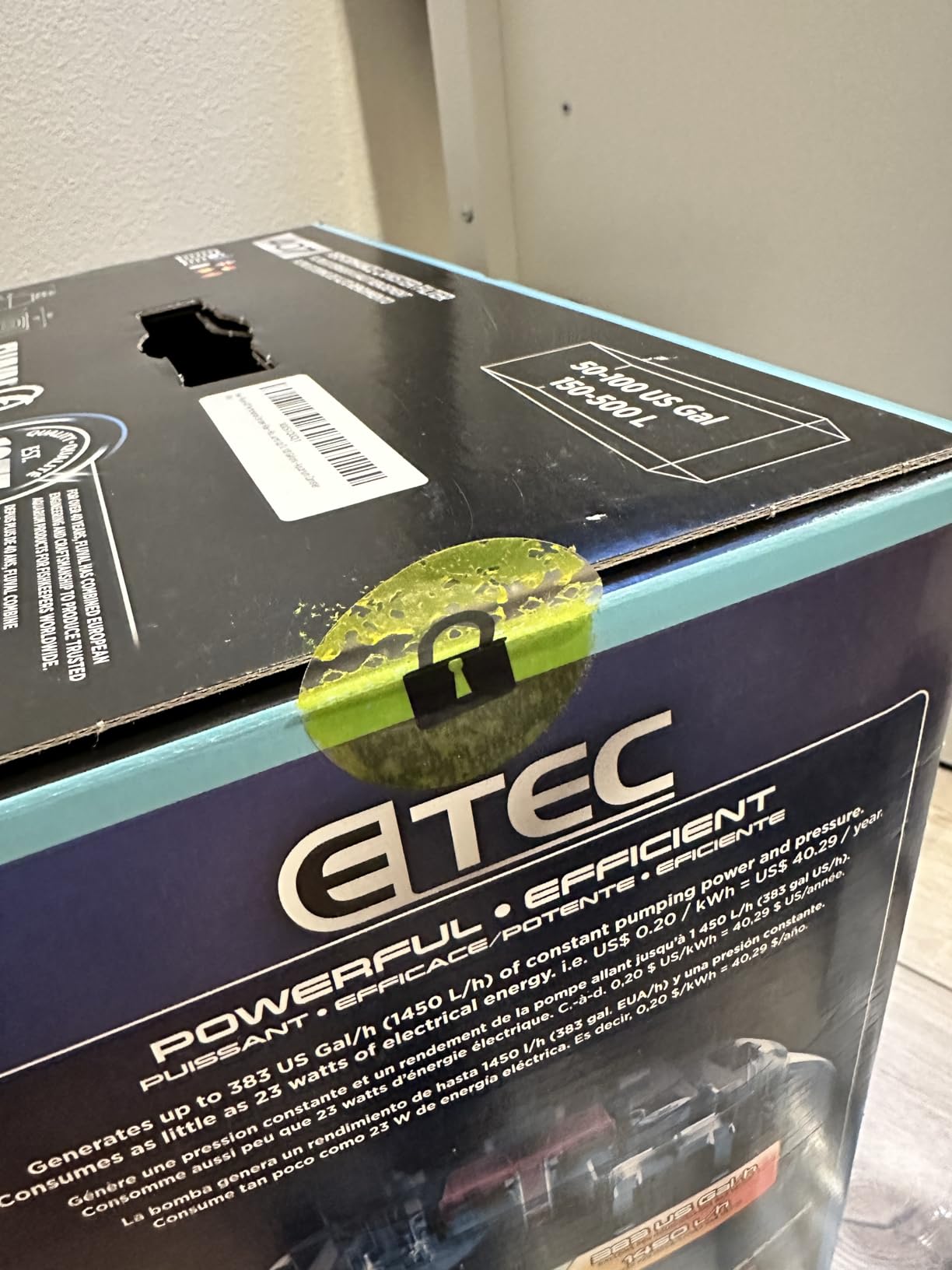
Self-priming matters more in salt than in fresh. A canister you have to fill with a pitcher and then coax to prime is a canister that will be sitting half full of expensive saltwater the first time the power flickers. The 407 primes cleanly without repeated chamber filling, which makes it a good first marine canister.
The four size variants matter for reef keepers specifically. You can step up to the 100 gallon version for a system in the 70 to 80 gallon range or drop to the 45 gallon version for a 40 gallon mixed reef, and the media layout stays the same across the line.
What the EZ-Lift baskets actually change for a reef keeper
The center-handle baskets let you lift the entire media stack out with one hand instead of fishing trays out one at a time with wet arms. In salt water that is more than convenience. A canister full of carbon and wet sponges is heavy, and the fewer times you have to handle it, the fewer times you drop it on your tank rim.
Quick-disconnect valves and lift-lock clamps mean a service takes minutes rather than requiring the whole hose layout to come apart. For a monthly floss change on a tank with live rock, that difference decides whether you actually do it monthly or drift to every three months.
Where it falls short in salt water
The recurring complaint on this platform is the impeller cover seal. Some owners report it disengaging under pressure over time and needing the motor head replaced, which is a repair rather than a failure if Fluval supplies the part but an expense if they do not.
The included carbon pouches and floss are smaller and thinner than the Fluval-branded media sold separately, and plenty of reefers buy their own carbon in bulk after the first month. There are also occasional reports of a low hum at certain fill levels inside the chamber, which is a water-level issue rather than a defect.
3. Marineland Magniflow 250 – Best Canister for Nano and Mid-Size Saltwater Tanks
Marineland Magniflow 250 GPH Canister Aquarium Filter
250 GPH rated up to 60 gallons
Saltwater rated
Stack N' Flo trays
12.56 pounds
Pros
- Explicitly rated for saltwater aquariums up to 60 gallons
- Unusually complete included media package
- Stack N' Flo trays force water through every media layer
- Quick prime button and watertight lift-off lid
- Uses standard Rite-Size S media
Cons
- 14 percent one-star share points to durability complaints
- 250 GPH is modest for high-flow reef needs
- Lowest rating tier among the higher flow models here
The Magniflow is the one to look at if your reef is small, your stand is cramped, or you want a second canister for polishing duty. Its published specifications rate it at 250 GPH for freshwater or saltwater aquariums up to 60 gallons, which puts it squarely in nano and small mixed-reef territory. It is also the answer to the recurring forum question about the Magniflow as a sump alternative on a 100 gallon reef, where the honest answer is that 250 GPH is not enough to carry that tank on its own.
Its real strength is the media situation. The Stack N’ Flo trays are designed to force water through every media layer rather than letting it short-circuit around them, and the box includes foam, activated carbon bags, bio-filter balls, ceramic rings, and polishing pads. That is a full marine media stack in the box, which matters when you are deciding whether a canister can serve as your only filter on a small system.
The quick prime button and the watertight lift-off lid are both good marine details. A lift-off lid means you can open the chamber over a sink or a bucket without unhooking a hose, and the quick prime button removes the jug-pouring step at startup.
It accepts standard Marineland Rite-Size S media, which keeps replacement cost predictable over years. That matters for total cost of ownership in a way that does not apply to proprietary-media ecosystems, and for a reef on a budget it is a genuine advantage.
Where 250 GPH actually puts you on a reef
At 250 GPH the unit works out to roughly four times turnover on a 60 gallon system, and considerably less once head pressure from a long hose run and a stand shelf is subtracted. That is workable for a fish-only marine system or a mixed reef with soft corals and modest stocking, and thin for a heavily stocked SPS display.
The practical answer for a 100 gallon reef is to run it as a polishing or secondary stage rather than the primary filter. Plenty of nano and mid-size keepers use exactly that configuration, and it is where this canister earns its place on a serious system.
Where it falls short in salt water
The 14 percent one-star share is the second highest here and clusters on long-term durability. It is a heavy, well-built canister, but owners who have run one for a decade are a smaller group than the 407 and Cascade cohorts, and the failure reports concentrate in that older group.
Its rating of 4.1 sits in the lowest tier among the higher flow models in this list, and the review base of about 4,100 is much smaller than the two leaders. For a tank under 30 gallons none of that matters much. For a display reef, the flow ceiling is the practical limit.
4. Marineland Magnum 290 – Best Polishing Unit for Detritus Clean-Ups
Marineland Magnum 290 GPH Polishing Canister Aquarium Filter
290 GPH for tanks up to 97 gallons
Two refillable chambers
Included micron cartridge
2.91 pounds
Pros
- Compact 2.91 pound body is easy to lift for media changes
- Two refillable chambers accept carbon or custom media
- Included micron cartridge gives fine final polishing
- 290 GPH throughput in a small footprint
Cons
- Listed as an internal canister with a submerged motor
- Two chambers hold less media than three-basket designs
- Manufacturer listing states no saltwater compatibility
- 11 percent one-star share on polish consistency
The Magnum is the polishing specialist in this group, and it fills a real gap that most canister roundups ignore. Reef keepers who blast rock, vacuum sand, or strip a tank of detritus need something that runs heavy mechanical filtration on demand without turning a 20 pound canister into a chore. At 2.91 pounds this one is lifted with one hand, which is the whole point.
It moves 290 GPH for tanks up to 97 gallons, so it is not a slow unit. The two refillable chambers take carbon or custom media, and the included micron polishing cartridge handles the fine particulate that a floss pad lets through. That combination is exactly the after-the-fact cleanup stage a reef tank needs after a maintenance day.
For a nano reef owner who wants to replicate what the old diatom filters used to do, this is the closest thing on the market now. Run it for a few hours after a blast, put a carbon bag in one chamber and a micron cartridge in the other, and the water clears without you renting anything.
The continuous three-stage design and the submerged motor mean quick startup with no priming ritual. For a tool that runs occasionally rather than continuously, that is the right design choice.
When a polishing canister is the right tool
Think of it as an on-demand stage rather than a life support system. Run it after water changes, after rock work, after a cyanobacteria event, or as a temporary boost while your main filter media settles. On a nano or pico tank under 30 gallons it can carry the whole system, because the volume is small enough that the two chambers are adequate.
It also works well as a secondary unit plumbed to a second tank. One reef keeper on a reef forum described running a canister to a second system as an oversized refugium, and a light polishing unit like this is an easy way to add that capability without building cabinet space for a large canister.
Where it falls short in salt water
The manufacturer listing does not state saltwater compatibility, and that omission is the reason this is not a full marine recommendation. We are listing it as a polishing tool, not as primary biological filtration for a marine system.
Two media chambers is genuinely less capacity than the three-basket designs, and the submerged motor layout means it sits in the tank or in a submerged housing rather than acting as a true external canister. The 11 percent one-star share reflects mixed satisfaction with how consistently the polish stage performs.
5. Fluval FX6 – Top Rated Canister for Large Saltwater Systems
Fluval FX6 High Performance Aquarium Filter, up to 400 Gal.
925 GPH for tanks up to 400 gallons
5.9 L media capacity
Smart Pump
Auto air evacuation
Pros
- Highest rated in this roundup at 4.6 with 83 percent five-star
- 925 GPH handles heavy bioloads without clouding
- Automatic air evacuation every 12 hours needs no intervention
- Integrated drain valve simplifies water changes
- 5.9 L media capacity prevents bypass
- Every wear part is user-replaceable
Cons
- Bulky 15.1 x 15.6 x 20.7 inch body at 19.9 pounds needs stand clearance
- Large diameter hoses are stiff and can stop a lid sitting flush
- Intake tube can only be lengthened not shortened
- The 12 hour auto evacuation cycle produces a brief burble
The FX6 is the highest rated canister in this roundup at 4.6 stars, with 83 percent five-star and only 6 percent one-star across roughly 3,400 reviews. It moves 925 gallons per hour and is rated up to 400 gallons, which makes it the only unit here that can credibly serve a large reef on a canister alone, with a hang-on-back skimmer handling gas exchange and nutrient export.
Two features matter most for marine use. The Smart Pump microchip continuously monitors and optimizes performance, which helps when a heavily stocked tank is loading the media faster than a fixed-speed pump would manage. And the removable stackable baskets hold 1.5 US gallons, 5.9 liters, of media, so you can run a real reef stack: sponge, then biocarrier, then carbon, without water bypassing around the load.
The integrated drain valve is a quiet hero for marine keepers. It turns a water change into a hose-and-valve job rather than a bucket-hauling exercise, and on a large system where you are moving RO water in and mixed water out, that saves both your back and your floor.
Self-starting operation means you add water and plug it in. Trapped air is evacuated automatically every 12 hours, which in salt is more than a convenience because air pockets in a heavy-media canister are what cause the gurgling and lost flow people complain about.
Serviceability is the number one long-term advantage
Reviewers repeatedly confirm that the impeller, O-rings, and baskets are all user-replaceable. On a canister you plan to keep for a decade, that is the single most valuable trait in this list, because it converts a failed part into a cheap consumable instead of a dead filter.
The 5.9 liters of capacity is what lets a large reef run a serious floss load during a cleanup event and then swap back to a normal carbon and biocarrier configuration. Nothing else in this roundup has that much media volume.
Where it falls short in salt water
Size is the real constraint. At 15.1 by 15.6 by 20.7 inches and 19.9 pounds, it needs genuine clearance under a stand, and on a low stand you may end up with a canister sitting beside the cabinet rather than inside it. The large-diameter hoses are stiff and can stop a tank lid sitting flush.
The intake tube is very long and can only be lengthened, not shortened, which means in a shallow tank it can reach down into the sand substrate and pull sand into the impeller. The 12-hour air evacuation cycle also produces a brief burble and restart that surprises first-time owners. Instructions omit guidance on setting the outflow height relative to tank water level, which risks a siphon flood if you are not careful.
6. Fluval FX4 – Best Flow Per Unit of Space for Heavily Stocked Reefs
Fluval FX4 High Performance Aquarium Filter, up to 250 Gal.
700 GPH for tanks up to 250 gallons
3.9 L media capacity
Smart Pump
Flow adjustable
Pros
- 4.5 average with 81 percent five-star
- 700 GPH handles a heavily stocked system or pairs with a sump
- Self-starting removed the priming hassle
- Flow is easy to dial back for sensitive species
- Impeller O-rings and baskets all owner-replaceable
Cons
- Bulky 15.6 inch footprint at 14.17 pounds needs stand clearance
- Lower media basket seats low and is awkward to fill
- Heavy lid latches and somewhat rigid tubing
- Some reviews describe slow warranty support
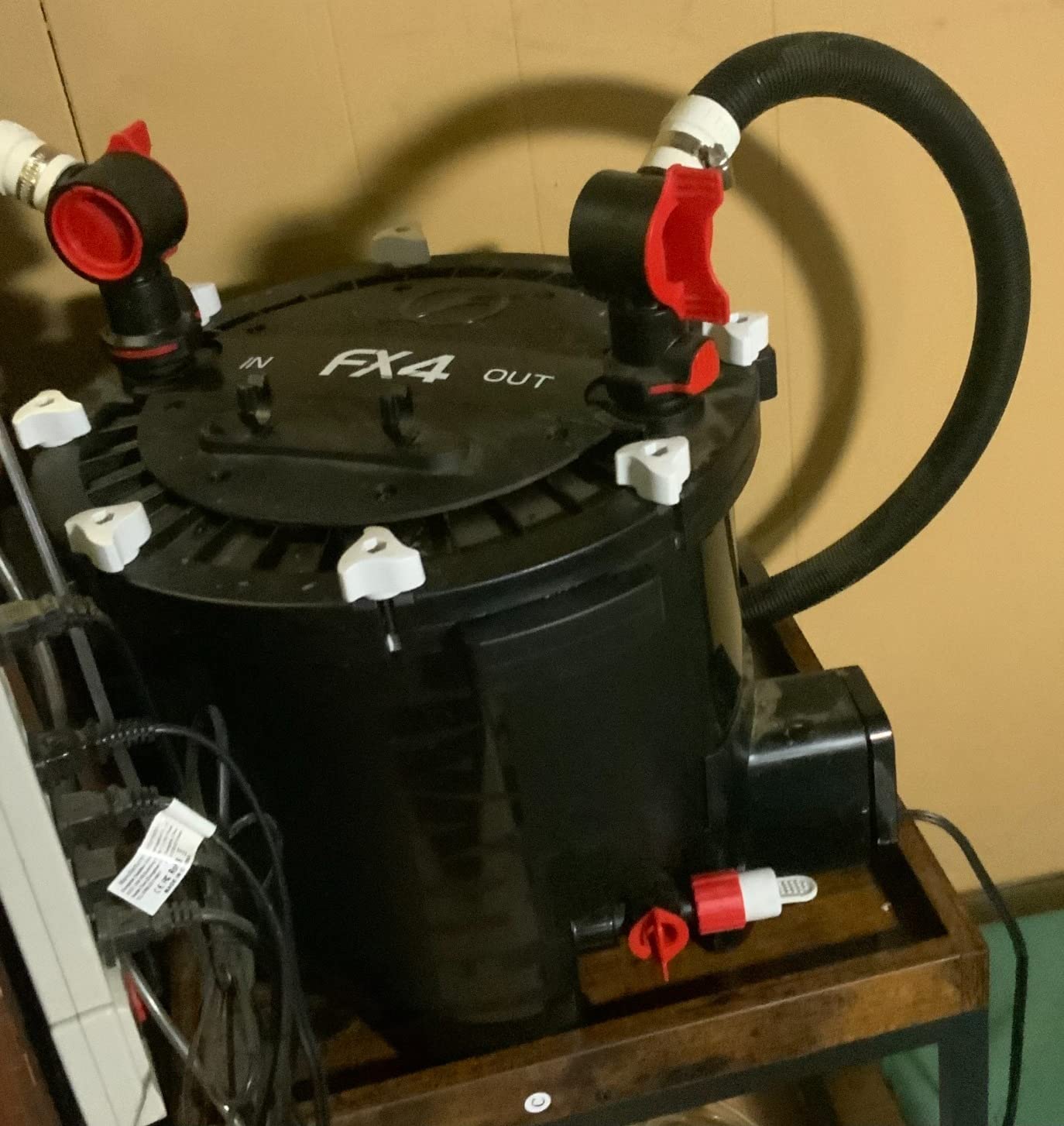
The FX4 is the step down from the FX6 and the model a reef keeper actually chooses most often. At 700 GPH rated up to 250 gallons, it covers the 75 to 150 gallon range that dominates the reef hobby, and at 4.5 stars with 81 percent five-star it sits just below the FX6 on rating with a smaller but still substantial owner base of about 2,500 reviews.
It has documented reef use. One owner on a reef forum reported running a Fluval FX4 on a 75 gallon with good results, with the caveat that monthly cleaning is not optional or hair algae gets out of hand. That is a fair summary of the whole canister category in one sentence, and it is why the cleaning cadence section below exists.
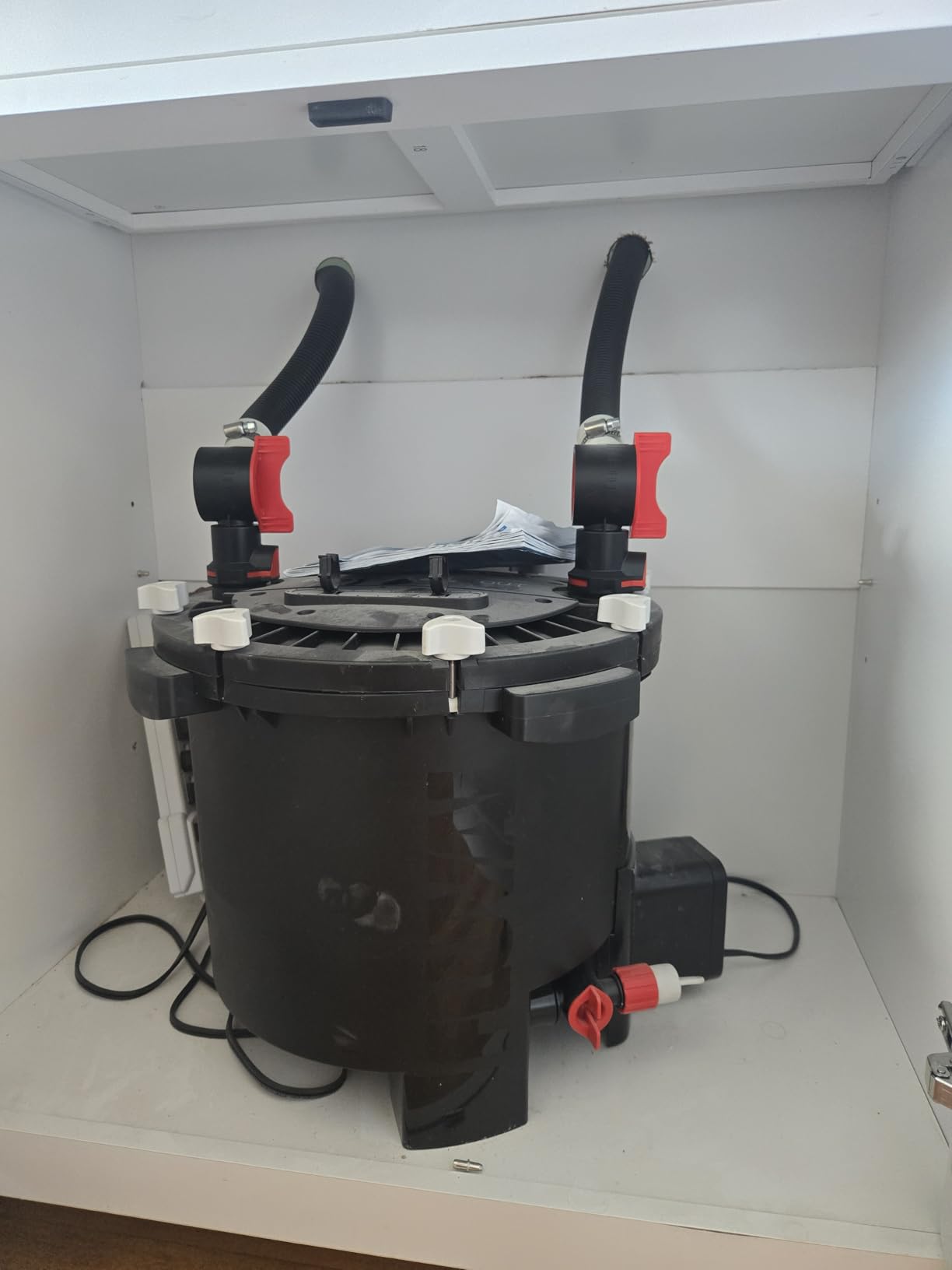
The Smart Pump self-starting behavior means you can fill a 120 gallon tank straight from the pump without priming drama, and adjustable flow lets you dial turnover back for delicate specimens. On a reef with a mix of hardies and softies, that range is more useful than a single fixed output.
Like the FX6, every wear part is owner-replaceable. Long-term owners describe it as a repairable workhorse rather than a sealed appliance, which is the trait that matters when you are thinking in five year intervals.
FX4 or FX6: which one you actually need
Work out your real turnover before you decide. The FX4 covers a system up to about 150 gallons comfortably alongside a hang-on-back skimmer, and it is the right answer for a mixed reef in that range. The FX6 earns its extra size if you are above that, if you want to run two canisters, or if you want enough flow to also drive a refugium or a second tank off the same pump.
Both hold their media in removable stackable baskets, so the marine media order works identically in each. The FX4 gives you 3.9 liters of media volume, the FX6 gives you 5.9. That difference decides whether you can run a heavy floss stage during cleanups without splitting media across two canisters.
Where it falls short in salt water
The 15.6 inch square footprint and 14.17 pound weight need real stand clearance, and the lower media basket seats low enough that filling it completely is awkward. Owners recommend loading media vertically rather than flat for that reason.
The lid latches are heavy and feel like ordinary plastic, the tubing is somewhat rigid, and there is at least one documented leak at the input connection on a new unit that was resolved with PTFE tape. Several reviews also describe slow, frustrating support when a motor failed under warranty, so factor that into how you weigh the purchase.
7. EHEIM Classic 2213 – Best Lightweight Canister for Compact Stands
EHEIM Classic Canister Filter 2213, Classic 250 – PetOverstock
Permo-elastic silicon seal on pump head
Ships with EHEIM media
4.49 pounds
40 66 and 92 gallon sizes
Pros
- Genuinely light at 4.49 pounds for easy media changes
- Classic platform available since 2004 with established media support
- Fixed permo-elastic silicon seal makes reassembly consistent
- Complete kit with spray bar inlet pipe hose valves and media
Cons
- Smallest media capacity in the group
- Manufacturer listing states no saltwater or marine suitability
- 12 percent one-star share on reliability
- Older models are widely reported to need manual priming
The EHEIM Classic 2213 is the traditional canister, and its case in salt water is weight and simplicity. At 4.49 pounds it is by a wide margin the lightest unit here, so a monthly media change on a tank where you are kneeling under a stand is a two-minute job rather than a two-person job. The fixed permo-elastic silicon seal on the pump head is the detail that makes it reliable to reassemble correctly after every service.
It ships complete with EHEIM Mech and Substrat Pro media, plus valves, spray bar, inlet pipe, and hose. Available in 40, 66, and 92 gallon configurations, it covers the range where a light, small-footprint canister makes sense, which is a nano display, a quarantine tank, or a second system you do not have cabinet space for.
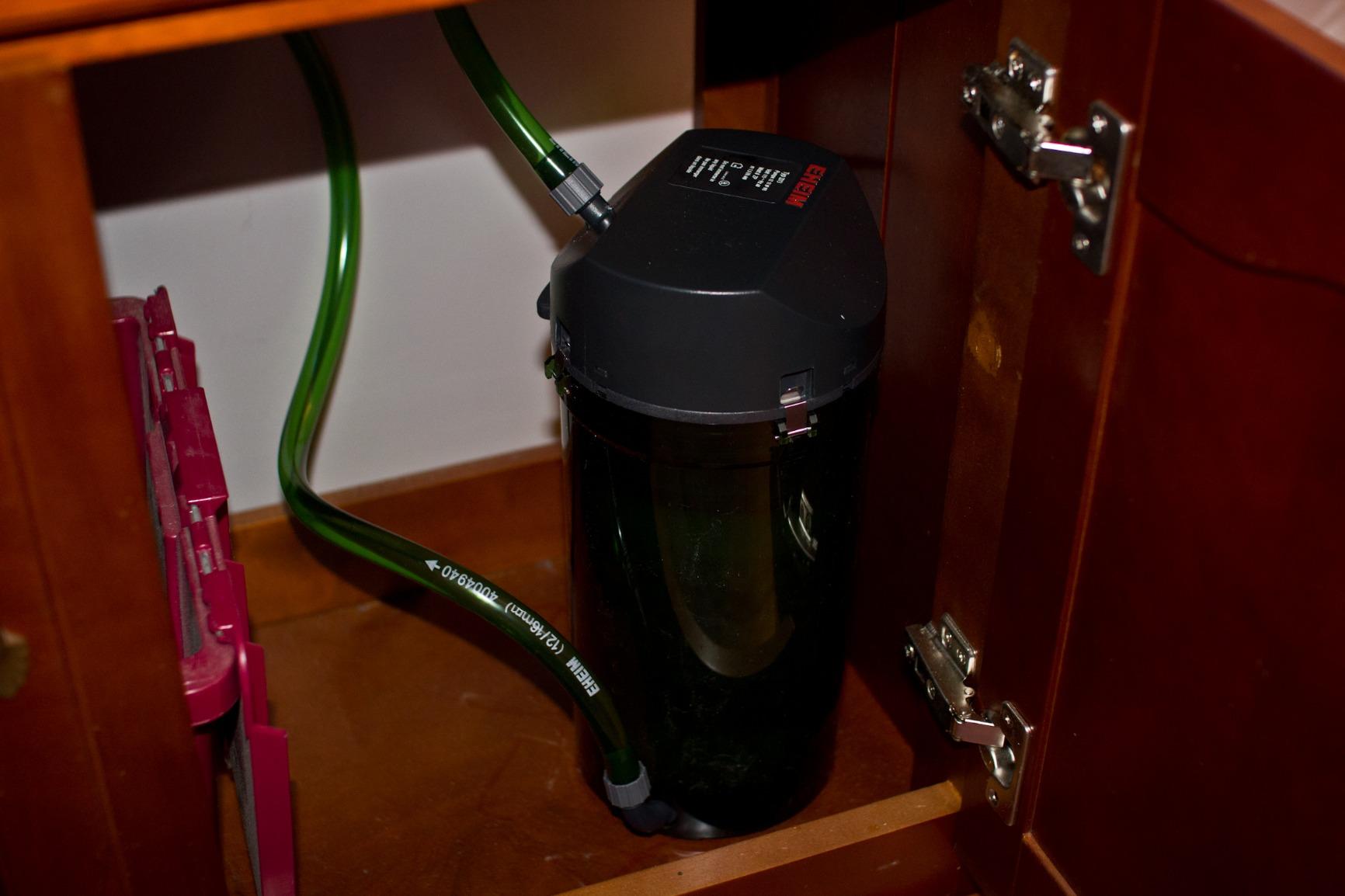
The platform has been in production since 2004, which means replacement media and parts are not a question you will have to solve. For a keeper who wants to stop thinking about filter consumables for a decade, that is a real advantage over newer platforms with thinner support.
As a quarantine or refugium filter it is particularly well suited, because the small media volume is not a problem when the tank is a few gallons and you are changing water often anyway.
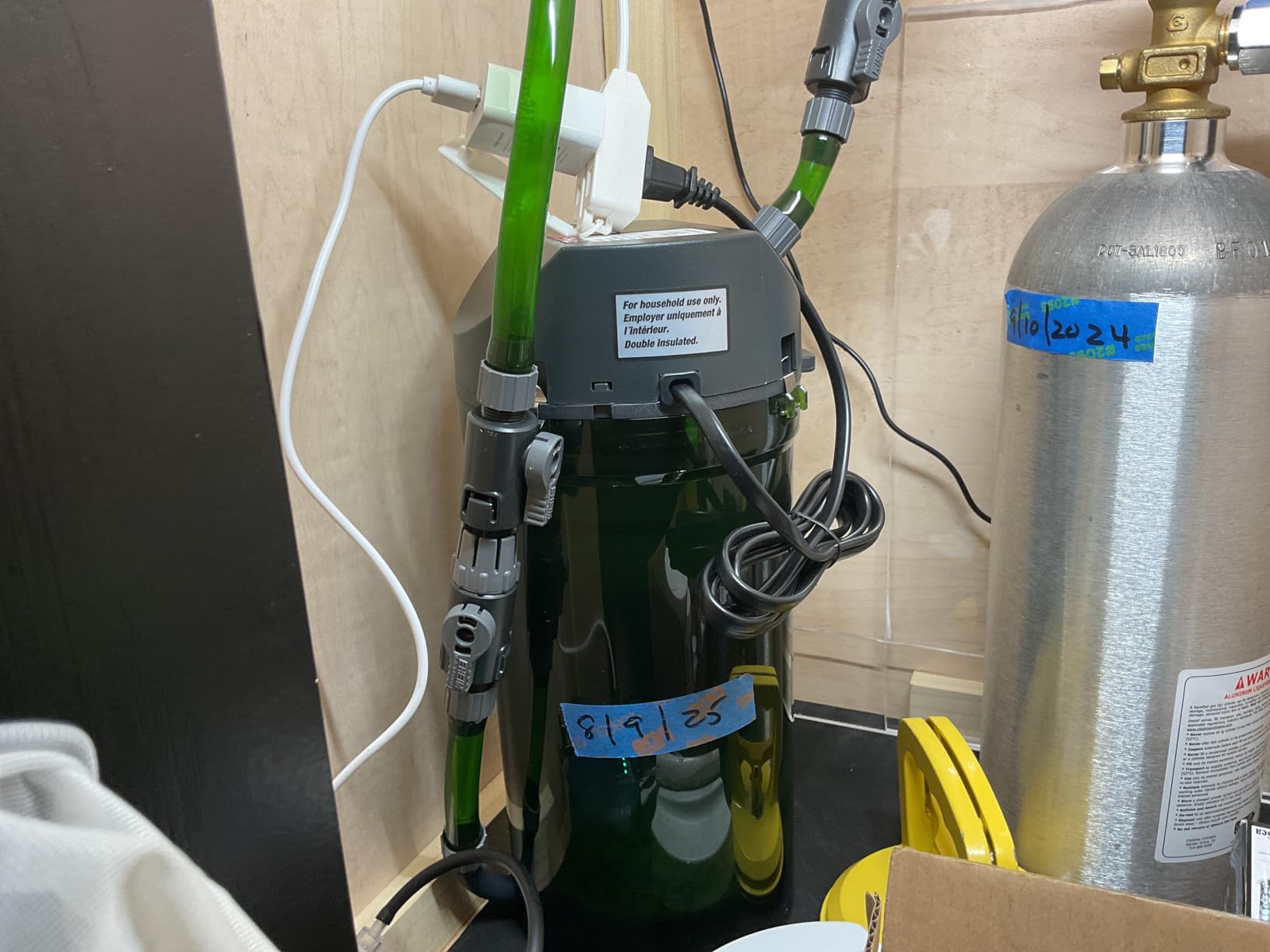
When the EHEIM Classic makes more sense than a Fluval
Weight and footprint. If your stand has a low shelf, or you need to lift the filter out to service it, 4.49 pounds changes the ergonomics completely. A Fluval FX4 at more than three times the weight is a two-hand operation in a confined space.
The 40 gallon variant is also one of the few genuinely appropriate canisters for a nano or pico reef under 30 gallons, where a large canister is simply oversized. The 66 and 92 gallon versions cover small mixed systems where media volume is not the deciding factor.
Where it falls short in salt water
The manufacturer listing does not state saltwater or marine suitability. That is the single biggest reason this is not higher on a roundup about marine aquariums, and it is a gap you should weigh rather than ignore.
Media capacity is the smallest in the group, and the light body is a direct consequence. On a reef where you want to run a floss stage plus a biocarrier plus carbon, this tray simply does not have the volume. There is also a 12 percent one-star share, and older models are widely reported to require manual priming, which in salt water means handling mixed water at install and after outages.
8. SunSun Hw303B Pro – Best Canister With a Built-In UV Sterilizer
SunSun Hw303B 370GPH Pro Canister Filter Kit with 9-watt UV Sterilizer
370 GPH for tanks up to 100 gallons
Integrated 9 watt UV
Three media baskets
16 pounds
Pros
- Only canister here with an integrated 9 watt UV sterilizer
- 370 GPH with a generous media package included
- Three baskets allow distinct mechanical chemical and biological layers
- Blue coarse pad captures debris ahead of finer pads
Cons
- No explicit saltwater or reef statement in the listing
- UV lamp is a consumable that must be replaced
- 16 pound weight is heavy for a 370 GPH rating
- Smallest review base here at about 1378 reviews
The SunSun Hw303B Pro earns its place for one reason: it is the only canister on this list with a UV sterilizer built into the body, and UV is the closest thing the canister category has to a replacement for the diatom filters that disappeared. It runs a 9 watt lamp, moves 370 GPH, and is rated for tanks up to 100 gallons.
The bundled media is unusually generous for the class: three white filter pads, one blue coarse pad, three media baskets, a pound of premium carbon, a pound of ceramic rings, and a set of bio balls. That is a complete stack in the box, and the three baskets let you separate mechanical, chemical, and biological layers the way a reef canister needs them separated.
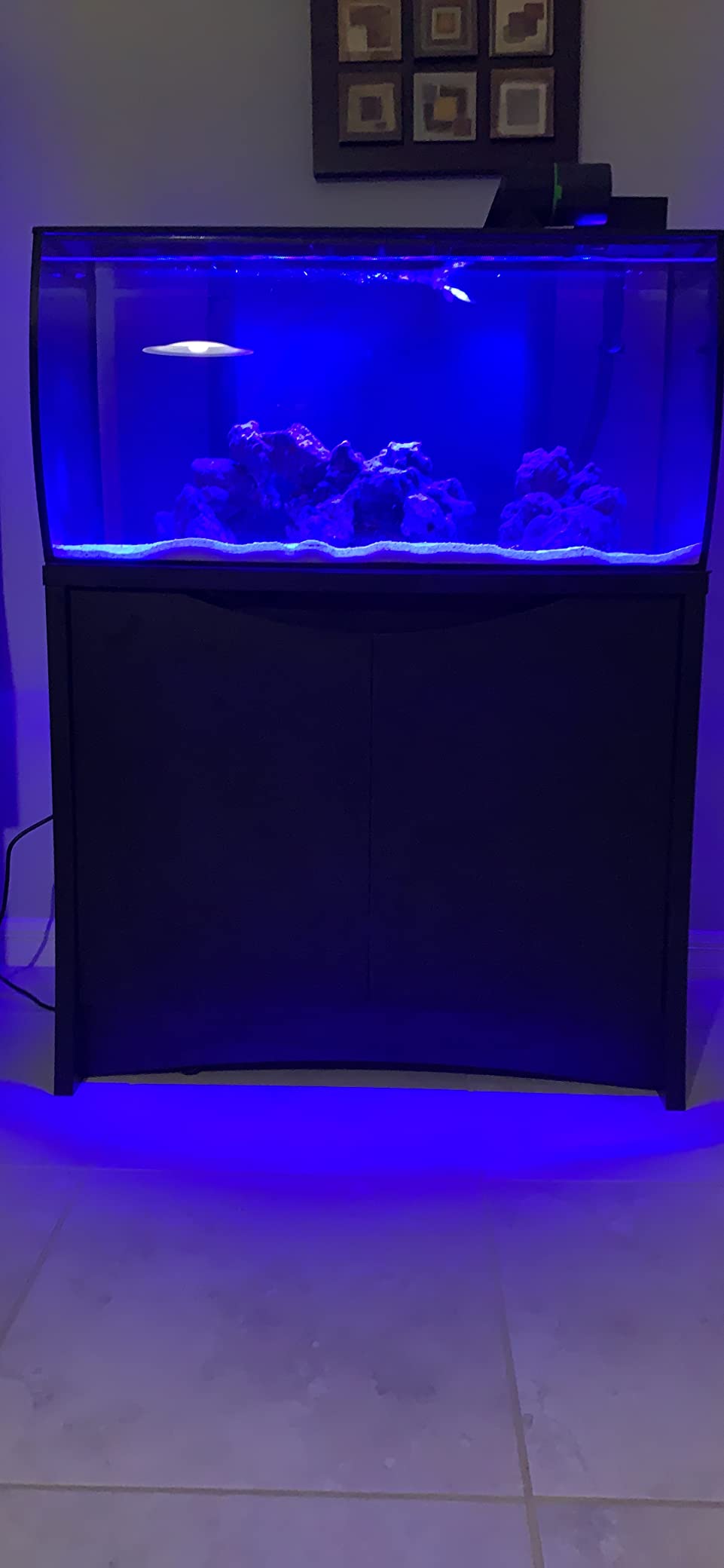
The blue coarse pad ahead of the finer white pads is a sensible design for marine, where a debris event happens without warning. The coarse stage takes the large particulate so the floss is not shot within a day of a rock blast.
At 370 GPH it covers a 60 to 70 gallon reef comfortably with a skimmer alongside, and it is a reasonable second unit for a nano display where you want UV without a separate inline sterilizer taking up stand space.
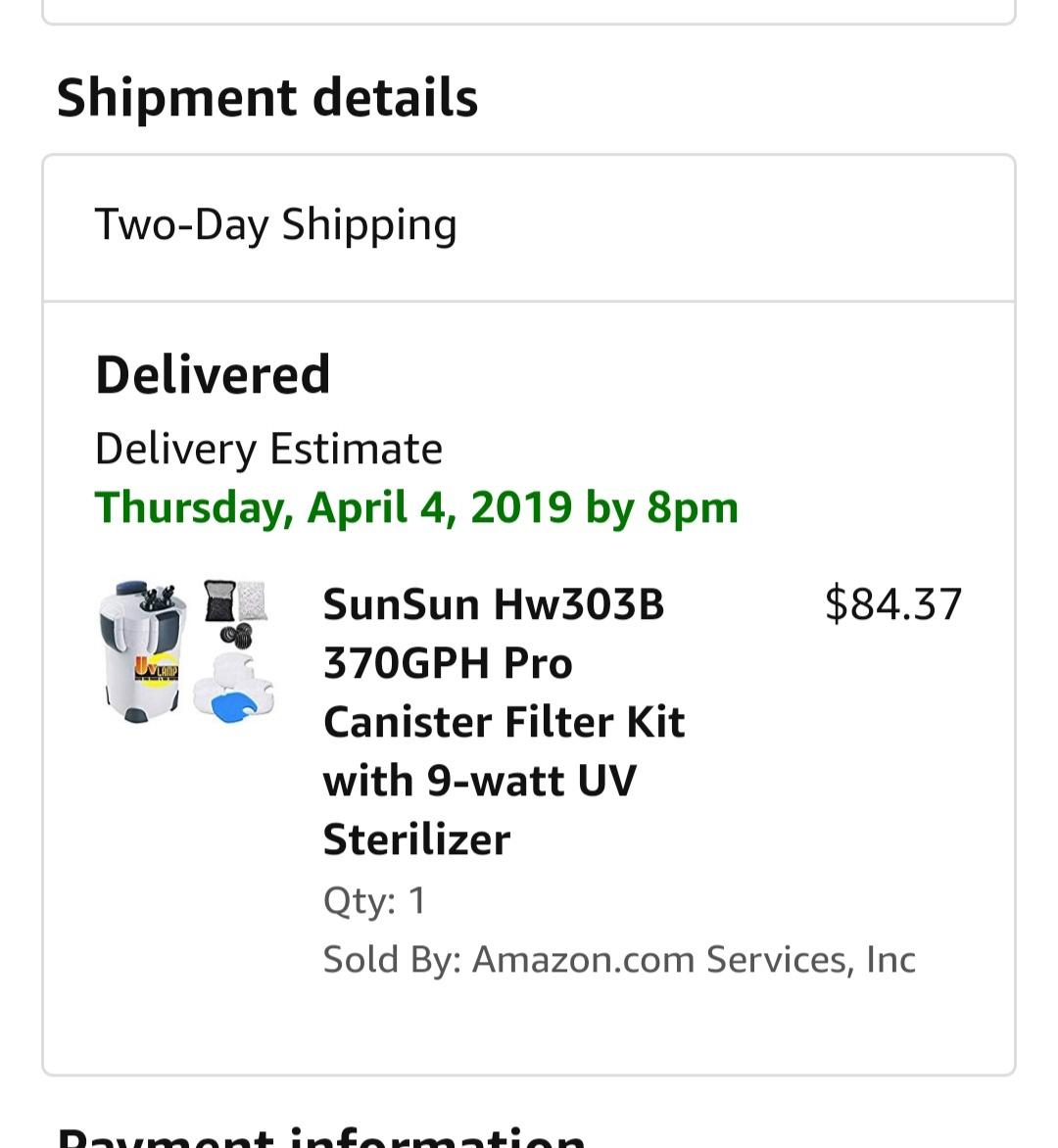
What the UV stage actually does on a reef
An inline UV sterilizer is a common addition to reef systems for a specific reason: it helps with nuisance algae, cyanobacteria, and some free-floating parasites that pass through the water column. A nano reefer keeping SPS reported running a canister combined with a UV for exactly this purpose.
Important caveat: a UV is only as useful as the water actually passing through the lamp, and it is no substitute for a skimmer or for stable parameters. Keep the flow through the canister at a level where water is visibly moving through the chamber, or the lamp is doing very little.
Where it falls short in salt water
The manufacturer listing carries no explicit saltwater or reef suitability statement, which is a meaningful gap for a roundup about marine systems. Confirm compatibility for your own setup before committing.
The UV lamp is a recurring consumable, and a unit where a bulb is out of production is a unit that eventually becomes a normal canister with a plastic chamber in the way. The listed 16 pound weight is heavy for a 370 GPH rating, and at roughly 1,380 reviews this has the smallest evidence base of anything on the list.
Canister vs Sump for Saltwater: Which One Should You Run?
This is the question reef keepers actually argue about, and it is the one no canister roundup on page one addresses. A sump wins on flexibility and gas exchange. A canister wins on silence, simplicity, and the fact that it requires no cabinet build, no plumbing into the stand, and no permanent hole in your floor.
The sump side of the argument is strong for one specific reason: a sump gives you a second chamber where you can put a refugium, a frag section, a protein skimmer, and a particulate reactor. None of that fits inside a canister. A reef with a sump can add equipment over years without touching the display tank plumbing, and a canister owner who outgrows their setup has to re-plumb.
The canister side is just as real. It is quiet enough for a living room, it costs a fraction of a sump build once you count the skimmer, refugium, and plumbing, and its media stack is trivially reconfigurable in a way that lets you drop carbon or floss on demand. One nano reefer described the combination of a canister and a hang-on-back skimmer as the best of both, and a 400 GPH canister feeding a Reef Octopus skimmer is a documented configuration that held nitrates under 10 ppm.
Here is the framework we would use. If your tank is 20 to 40 gallons, has no sump, and you cannot drill the stand, a canister plus a hang-on-back skimmer is the right answer. If your tank is 75 gallons or larger, heavily stocked, or you plan to keep it for a decade, build the sump. If your budget is the binding constraint and you already own a nano, the canister is a genuine alternative to the sump, provided you commit to monthly cleaning and run a skimmer alongside it.
One configuration to avoid: a canister plumbed to drain from a sump defeats its own purpose. If you have a sump, the canister should be a polishing stage returning to the display, not the main loop drawing from the sump.
EHEIM vs Fluval for Reef Tanks: A Direct Comparison
For a reef tank, Fluval is the stronger choice on flow, quietness, and serviceable wear parts. EHEIM is the stronger choice on weight, footprint, and low-friction media availability. Most keepers end up choosing on the tank size and the cabinet rather than on brand.
Flow is the clearest differentiator. The Fluval line spans from the 407 through the FX4 and FX6, covering 30 gallons to 400 gallons with self-optimizing Smart Pump models in the FX range and markedly quieter eTEC motors in the 07 and 40 series. The EHEIM Classic 2213 comes in 40, 66, and 92 gallon configurations, which is a narrower range and, at its lightest weight, a smaller one physically.
Quietness favors Fluval by design. The eTEC motor on the 407 is rated as running up to 25 percent quieter than the previous generation, and the FX pumps use a microchip-driven motor that keeps hum low under load. If the tank is in a bedroom or an office, that difference is audible.
Media and media cost favor EHEIM and the Marineland units. EHEIM has supported the Classic platform and its media since 2004, and the Magniflow takes standard Rite-Size S media. Fluval media is more expensive per unit volume in some categories, though the FX baskets hold far more of it, which changes the math over years.
Serviceability favors Fluval. On the FX4 and FX6, reviewers confirm the impeller, O-rings, and baskets are all owner-replaceable, and the FX6 in particular is described as repairable rather than disposable. On the 407, some owners report the impeller cover seal engaging under pressure over time, which is still a replaceable part but is a known issue in the platform.
Marine rating is where the two brands diverge most. Fluval FX and 07 series canisters are the units most commonly reported on reef forums. The EHEIM Classic 2213 manufacturer listing does not state saltwater or marine suitability, which is the reason it does not rank higher in a marine-focused roundup despite being the best lightweight option available.
Our take: if your tank is 60 gallons or larger, choose Fluval. If you are under 30 gallons or your stand shelf is genuinely tight, the EHEIM Classic is the better physical fit, and you should confirm marine compatibility for your own water first.
How to Stack Canister Media in a Saltwater Tank
Stack marine canister media with mechanical on the bottom tray, biological in the middle, and chemical or carbon on the top tray. This is the reverse of the advice most freshwater canister guides give, and getting it backwards is the most common reef technique error we see.
Here is the reasoning. Water enters at the top of the canister, so the top tray sees the cleanest water after the rest of the stack has done its work. Putting chemical media there means carbon or a phosphate remover is the last thing to see water before it enters a display tank, which is exactly where you want it. Put it at the bottom and it strips the incoming water before the sponges have caught the detritus, so it clogs with organics long before it is exhausted, and you are back to changing it weekly.
The bottom tray should be coarse mechanical media: a sponge, floss pad, or a woven pad rated fine enough to catch the particles that would otherwise settle on your sand. One nano reefer reported a stack of Seachem Matrix in the top tray, sponge in the middle, and ceramic media in the bottom, and another corrected him in-thread to the sponge-bottom, bio-middle, chemical-top order. The correction is the right one.
For the middle tray on a reef, this is where your nitrogen-fixing media goes. Ceramic rings, glass rings, or a structured biocarrier all work, and the tray should be filled loosely enough that water passes through the media rather than around it. In a canister with a bottom basket that sits low, load the media vertically rather than flat, as owners of the FX4 recommend.
One more marine-specific note. Rinse every media tray in RODI water or in water drained from your own tank, never in tap water. Chlorine and chloramine kill the nitrifying bacteria on your media, and in a reef with a small bioload relative to the livestock, that is how people end up with a nitrate spike after a well-meaning cleaning.
How Often to Clean a Canister Filter in a Saltwater Tank
Clean a canister filter in a saltwater tank roughly every four to six weeks, with a monthly floss pad change as the common baseline. Reef owners running canisters report a range from every few weeks to a few months, and the variable is not tank size. It is stocking, feeding, and whether you are running carbon.
Here is what the community actually reports. One keeper is in year 17 of running a reef on a canister and changes the floss pad once a month, which takes about three minutes. Another runs a canister on a 90 gallon system and cleans it every four to six weeks with no issues. A third cleans every few months and reports never having nuisance algae, running the canister plumbed to a second tank as a large refugium. And a user with canisters on 75 and 16 gallon tanks cleans monthly and credits it with keeping the water polished and clear.
The cautionary report is equally useful. The same person running an FX4 on a 75 gallon reported that it works well, but that if you do not clean monthly, hair algae get out of hand. That is the failure mode: a canister in salt water is not self-cleaning, and detritus trapped in a sponge in a closed loop is precisely the nutrient source that feeds nuisance algae in a reef.
When you do clean, the sequence matters. Unplug, shut the valves, remove the baskets, rinse each tray separately in tank water, and reassemble in the same order you removed them. Change the floss pad while you are in there. Run the rinse water back into your tank or your water change rather than down a drain, because that water carries your nitrifying bacteria.
One reef configuration worth copying: a canister feeding a hang-on-back filter where the carbon lives in the hang-on unit. One documented setup does exactly this, running reef-spec carbon in the hang-on filter fed from the canister return. It gives you on-demand carbon without reconfiguring the canister stack.
How to Choose a Canister Filter for Saltwater
Size by turnover first, then check the other six things. The rule of thumb used across this category is to look for a rated flow of roughly five times your tank volume in gallons, and reef keepers often want to exceed that because flow drives detritus export. Check your actual hose run before you trust the rated number, since head pressure cuts real flow.
Self-priming is the second item and it is not optional in salt. A canister that needs manual priming means filling a chamber with mixed saltwater by hand, and it means doing that again after every power interruption. The push-button primers on the Cascade and the Magniflow, and the self-starting Smart Pump behavior on the FX4 and FX6, all solve this cleanly.
Media basket volume is the third. Count liters, not trays. A 40 gallon reef running a weekly floss stage plus a biocarrier plus carbon needs real volume, and the two-chamber designs in this roundup will not give it to you. The FX6 at 5.9 liters and the FX4 at 3.9 liters are the generous ones here; the Cascade and the Magnum 290 are the entry level.
Media compatibility is the fourth. Any canister will physically accept any media, but proprietary ecosystems lock you into branded consumables at branded prices. Standard media like Marineland Rite-Size S keeps replacement cost predictable, which is a meaningful factor over five years on a reef with a large bio load.
Corrosion and fittings are the fifth, and this is where marine differs most. Check that the manufacturer states a marine or saltwater rating, and check the hose clamps. Forum reports describe hose connections loosening over time on some units, so re-tighten clamps during every service and use PTFE tape on any threaded joint that seeps.
Noise is the sixth. Canisters are quieter than hang-on-backs because the pump is enclosed, but models differ meaningfully, and a bedroom display is a different requirement from a basement rack. Fluval rates its eTEC motors as running up to 25 percent quieter than the previous generation, and the Smart Pump models hold flow steady without hunting.
Two more things worth checking. Power draw, because a canister at 28.5W running next to a skimmer and a heater adds up over a year. And repairability, because a filter with a user-replaceable impeller and O-rings is a filter you own for ten years rather than one you replace.
Finally, ask whether you need a canister at all. If you are under 20 gallons, a canister may be overkill for the biology and a hang-on-back may serve you better. And if your system is large enough that you are considering the FX6, a sump will almost certainly serve it better in the long run.
Frequently Asked Questions
What is the best canister filter for a saltwater aquarium?
The Penn-Plax Cascade 1000 is the best all-round canister for salt water: 265 GPH rated for tanks up to 100 gallons, a manufacturer saltwater rating, and three stackable baskets that let you set a marine media order. The Fluval FX6 is the strongest choice above roughly 150 gallons, and the Fluval 407 covers mid-size systems quietly.
Are canister filters good for saltwater tanks?
Yes, as long as you stack media with mechanical on the bottom tray, biological in the middle and chemical on top, and clean the unit every four to six weeks. Canisters fail in salt only when cleaning is skipped for months or when a small unit is asked to run a large reef. Pair one with a hang-on-back skimmer to restore gas exchange.
Which is better, Eheim or Fluval?
Fluval is better for reef tanks above 60 gallons because of stronger flow options, quieter eTEC and Smart Pump motors, and owner-replaceable wear parts. EHEIM is better below that size or on a tight stand shelf because the Classic 2213 weighs only 4.49 pounds. Note that the EHEIM Classic 2213 listing does not state marine suitability.
What are the pros and cons of a canister filter?
Pros: large media capacity, quiet operation, flexible media order, self-priming on most models, and no sump plumbing. Cons: it exports very little gas exchange so a skimmer is still needed, hoses and clamps need regular checking in salt, media must be rinsed in RODI or tank water only, and a neglected canister in salt becomes a detritus and algae problem within weeks.
How often should I clean a canister filter in a saltwater tank?
Every four to six weeks is the common range, with a monthly floss pad change as the typical baseline. Reef owners report a three-minute pad change and multi-year runs on that schedule, and also report hair algae taking over when monthly cleaning is skipped. Rinse trays in tank water or RODI, never tap water.
Can you use a canister filter with a sump?
Yes, as a polishing stage rather than the main loop. Run the canister return to the display tank with carbon or floss loaded, and let the sump handle the skimmer, refugium and frag space. Do not draw the canister intake from the sump, because that defeats the purpose of having both.
Which filter is best for a salt water aquarium?
It depends on system type. Under 40 gallons, a canister plus a hang-on-back skimmer is the practical answer. From roughly 75 to 150 gallons, a canister handling mechanical filtration alongside a skimmer works well. Above that, a sump with a refugium and skimmer outclasses any canister for flexibility and gas exchange.
Which canister filter is the best for an aquarium?
Look for rated flow near five times your tank volume in gallons, a manufacturer saltwater rating, a self-priming start, and enough media basket volume for floss, biological media and carbon. On those criteria the Penn-Plax Cascade 1000 leads for tanks under 100 gallons and the Fluval FX4 or FX6 covers larger systems.
Our Final Pick for Saltwater Aquariums
The Penn-Plax Cascade 1000 is our pick for the best canister filters for saltwater aquariums. It is the rare unit that pairs an explicit manufacturer saltwater rating with a documented marine media layout, and it has more than 10,000 reviews documenting both what works and what eventually fails, which is the kind of evidence base we want under a pump that sits in salt water.
Go Fluval when your tank is bigger or your living space is quiet-sensitive: the 407 for mid-size systems, the FX4 for heavily stocked reefs, the FX6 above roughly 150 gallons. Add a hang-on-back skimmer either way, stack your media mechanical on the bottom and carbon on top, and clean every four to six weeks. That routine is what turns a canister into saltwater equipment instead of a compromise.