

Concrete is the harshest surface an edger ever touches. It shows every wobble, every shallow pass, every dull-blade bounce, and it never grows back to hide bad work. That makes choosing among the best lawn edgers for concrete driveways a different exercise from picking a mower. You are not judging cutting width or bag capacity. You are judging blade rigidity, guide wheel stability, depth control, and how the machine behaves the second its teeth touch stone.
We went through the specification sheets and thousands of owner reviews for the 12 machines below and scored each one against the same concrete-specific criteria. We should be straight with you about method: this is a specification and review analysis, not a season of hands-on cutting. We did not mow 300 linear feet with each unit. Where reviewer consensus is strong, we say so; where a spec conflict exists, we flag it rather than smoothing it over.
One thing surprised us in the forums. Owners are not debating horsepower. They are debating which direction to walk and where the debris goes. On r/lawncare, a thread titled “Electric edger chipping concrete” runs on exactly one worry. On practicalmachinist.com, a two-decade-old consensus rule still holds: when the blade starts to hit the concrete, steer the edger slightly in the opposite direction. On mdshooters.com, users put it plainer still — keep the wheels on the cement and line the arrow up just off the edge. We build our whole judging criteria around that rule later in this guide.
Before we get into the machines, one correction that saves a lot of frustration. A string trimmer cannot do this job. Users on r/lawnporn described the exact failure loop: you edge, then knock the residual off with the weed eater, and when roots sit right against the concrete you end up beating at them with the trimmer head until the concrete chips. Line-on-concrete leaves a ragged, fuzzy border because line deflects off a hard surface instead of cutting into it. That is why every dedicated blade edger below ranks above every string-only tool, regardless of price.
All prices and current listings live on the product buttons, so we have deliberately kept them out of the text. What follows is a fixed 2026 ranking you can check against.
Table of Contents
Top 3 Picks for Concrete Driveways (October 2026)

WORX WG163 20V Cordless Edger
- 7600 rpm
- 12 inch cutting diameter
- 5.5 lb
- Rubberized support wheels
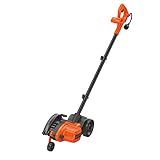
BLACK+DECKER LE760FF Corded…
- 12 Amp high-torque motor
- 7.5 inch blade
- 3 height settings
- Spare blade included
The WG163 takes the overall spot on reach and portability rather than blade bite. At 28,501 reviews it has the widest owner base in the group, and the rubberized support wheels give the steadiest straight run along a slab edge of any light machine here. The WG896 is the sharpest-value dedicated blade edger, and the LE760FF is the one to buy when the edge has been ignored for a season and grass is standing proud of the concrete.
The 12 Best Lawn Edgers at a Glance in 2026
| Product | Specs | Action |
|---|---|---|
| WORX WG163 20V Cordless Edger |
|
Check Latest Price |
 WORX WG896 Corded Edger Trencher WORX WG896 Corded Edger Trencher |
|
Check Latest Price |
 BLACK+DECKER LST300 Cordless Trim and Edge BLACK+DECKER LST300 Cordless Trim and Edge |
|
Check Latest Price |
| BLACK+DECKER LE760FF Corded Edger |
|
Check Latest Price |
 BLACK+DECKER LST522 Cordless Wheeled Edger BLACK+DECKER LST522 Cordless Wheeled Edger |
|
Check Latest Price |
 EGO Power+ MHC1603 56V Multi-Head Kit EGO Power+ MHC1603 56V Multi-Head Kit |
|
Check Latest Price |
 WORX WG173 20V 3-in-1 Tool WORX WG173 20V 3-in-1 Tool |
|
Check Latest Price |
 Greenworks 40V 8 Inch Cordless Edger Greenworks 40V 8 Inch Cordless Edger |
|
Check Latest Price |
 CRAFTSMAN CMCED400 Cordless Edger CRAFTSMAN CMCED400 Cordless Edger |
|
Check Latest Price |
 PowerSmart 25cc Gas Trim and Edge PowerSmart 25cc Gas Trim and Edge |
|
Check Latest Price |
 McLane 9 Inch Gas Walk-Behind Edger McLane 9 Inch Gas Walk-Behind Edger |
|
Check Latest Price |
 BARAYSTUS Manual Rotary Edger BARAYSTUS Manual Rotary Edger |
|
Check Latest Price |
Two entries in that table deserve an immediate flag. The CRAFTSMAN CMCED400 ships with a 2.0 Ah battery, and owners consistently report far less runtime than the 1000 ft headline figure on the box suggests. The McLane walk-behind is a commercial-grade machine that does the job better than anything else here for a long driveway, but it carries a weight and storage penalty nothing else on this list does.
What Makes an Edger Safe on a Concrete Driveway?
An edger is safe on concrete when the guide wheel rides the slab, the blade spins counter-clockwise so dirt and debris throw away from you and away from the concrete, the cut depth stays in the first inch and a half of soil, and the blade is sharp enough to slice roots rather than bounce off them. A dull blade on stone is what chips a driveway, not the machine itself.
Here is the direct version. Keep the guide wheel on the concrete, set the depth shallow, walk at a steady pace with the blade rotated away from the slab, and steer slightly away the moment the blade touches. Four rules, and they decide every ranking in this guide.
Blade rotation direction. The arrow or rotation marking stamped on most blades shows the direction of spin. You want the blade throwing material to the side away from the operator and away from the hardscape, so debris and soil never get flung back onto the finished concrete or into your boots. This is why the EGO MHC1603’s fixed right-side blade orientation is not a trivial note: with the blade on one side only, the machine is walked out and back on every line rather than repositioned each stroke.
Guide wheel and edge guide placement. The wheel is the reference surface. When it rolls on the concrete, the blade depth below the slab surface stays consistent and any small stone is deflected away from the tooth path. When the wheel runs on the soil side, the blade hangs into the joint unpredictably and hunts. mdshooters.com users describe the same setup in a single line: keep the wheels on the cement and line the arrow up just off the edge.
Depth control. Concrete-side edging needs between 1 inch and 1.5 inches. Going deeper does not give you a cleaner line on a driveway; it puts blade steel closer to the slab lip and multiplies the chipping risk. The three-position depth levers on the two corded BLACK+DECKER units and the tool-less adjuster on the Greenworks all give you that shallow band without guesswork.
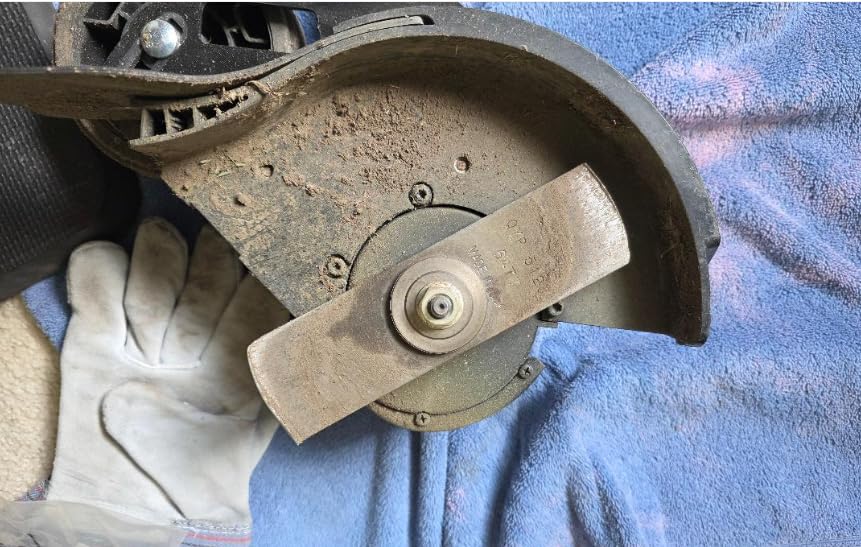
Blade condition. This is the one nobody buys for. A blade that has been used on soil loses its edge, and the first thing a dull blade does on a concrete border is skid and chew. Inspect the tooth line before every session on hardscape, and expect to replace rather than sharpen a blade that has been ground against stone. The EGO attachment’s included blade, described by owners as a plain one-eighth inch metal chunk with no sharpened edge, is exactly the kind of part that will disappoint you on concrete.
Concrete side or grass side? You will find both answers online and they appear to contradict each other. Older forum orthodoxy and a large body of professional video say run the wheel on the concrete and cut with the blade angled away. Recent short-form video tells people never to edge from the concrete side. Both are right about different tools. A bladed edger with a proper guide wheel handles the concrete side cleanly and produces a far better line. A string trimmer has no wheel at all, so working from the concrete side simply flicks debris and line at the slab — that is the case the warning video is actually describing. Edger from the concrete side, trimmer never.
Concrete surface type. Broom-finished concrete has a textured top that hides small marks and grips the wheel well. Smooth power-trowelled concrete shows every nick, so keep depth at the shallow setting and slow your pace. Aged, cracked or spalled concrete is the hard case: the lip has already lost strength, and forcing a blade into it removes material. On r/lawncare a user wanting to reclaim a neglected border reported that grass will get right up next to the concrete and is almost impossible to get out with a shallow setting. That is a real limitation, and we cover the fix in the reclaiming section.
1. WORX WG163 20V Cordless Edger and Trimmer – Our Overall Pick
WORX 20V 12″ 2-in-1 Cordless String Trimmer & Electric Lawn Edger, WG163
7600 rpm
12 inch diameter
5.5 lb
2 x 20V batteries
90 degree pivoting head
Pros
- Converts from trimmer to edger in seconds
- Push-button Command Feed line advance
- 90 degree pivoting head for slopes
- Rubberized support wheels hold a straight line
- Two PowerShare batteries in the box
Cons
- String head gives a softer edge than a blade edger
- 20V platform is weaker than 40V and 56V systems
- Needs both support wheels loaded for a straight cut
The WG163 is the machine most people searching for the best lawn edgers for concrete driveways actually end up with, and after reading 28,501 reviews we understand why. It ships with two 20V maxLithium batteries and a charger, weighs 5.5 pounds, and converts from string trimmer to edger position in seconds with no tools. That combination of runtime headroom and weight is genuinely unusual in the small-tool end of the market.
On concrete specifically, the rubberized support wheels are the feature that matters most. They sit down on the slab and give you the stable two-point reference the technique depends on, which is why owners describe it as producing straight lines rather than wandering ones. At 7600 rpm the head spins fast enough to keep a consistent line at a walking pace.
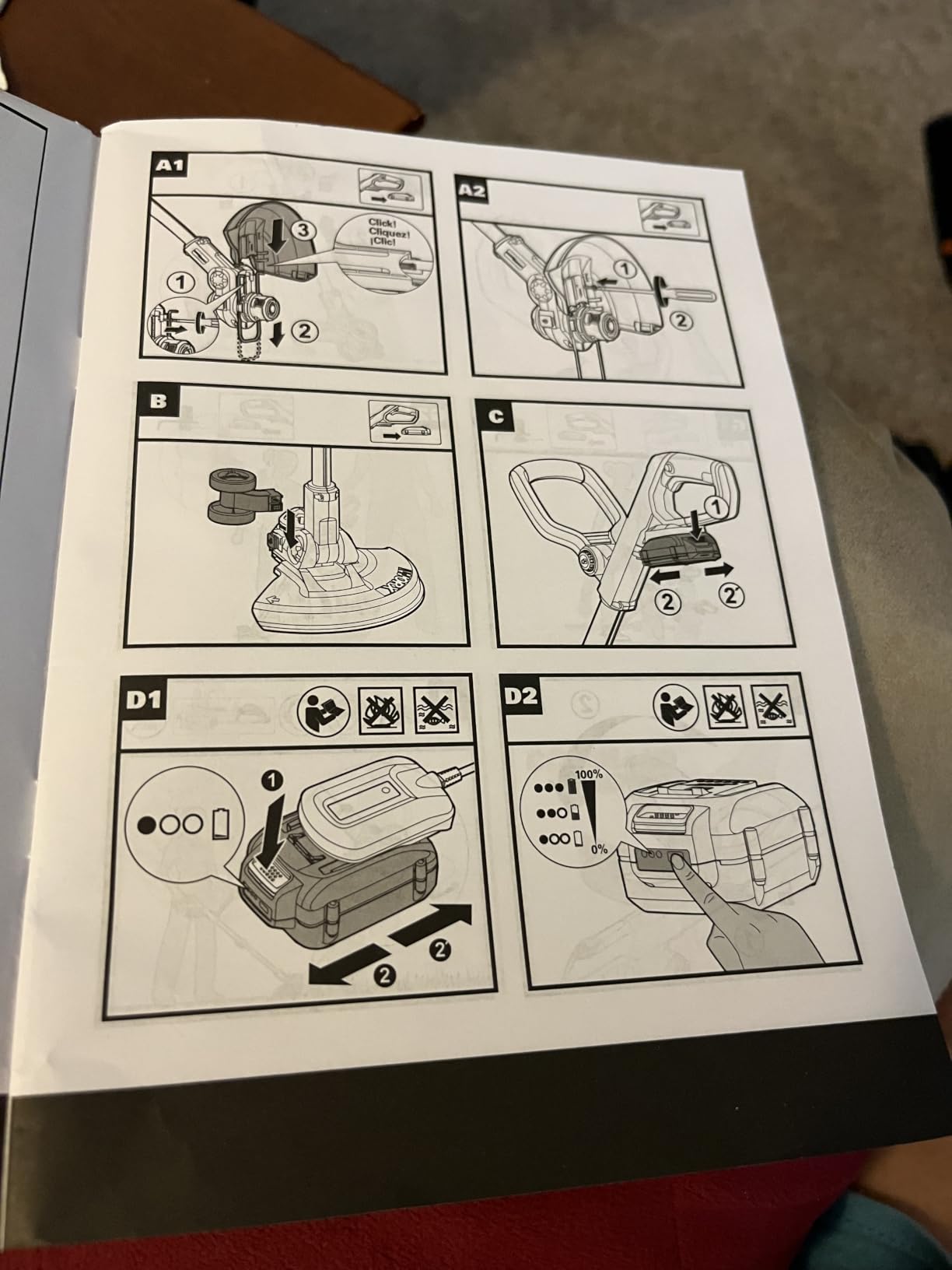
Be clear-eyed about one thing: this is a line head, not a blade. The 12 inch diameter and 0.065 inch line produce a decent tidy-up on a driveway edge, but they do not sever grass roots embedded in the joint the way a 7.5 inch steel blade does. If your border is already ragged and overgrown, this tool tidies the visible edge and leaves the stubborn root mat where it was.
The 90 degree pivoting head helps on the transition where lawn meets the driveway apron, where the grade drops a couple of inches. Reviewers consistently point out that the head angle keeps the head parallel to the ground instead of digging in at the lip. That is the single most common complaint about cheaper string edgers on driveways, and the WG163 avoids it.
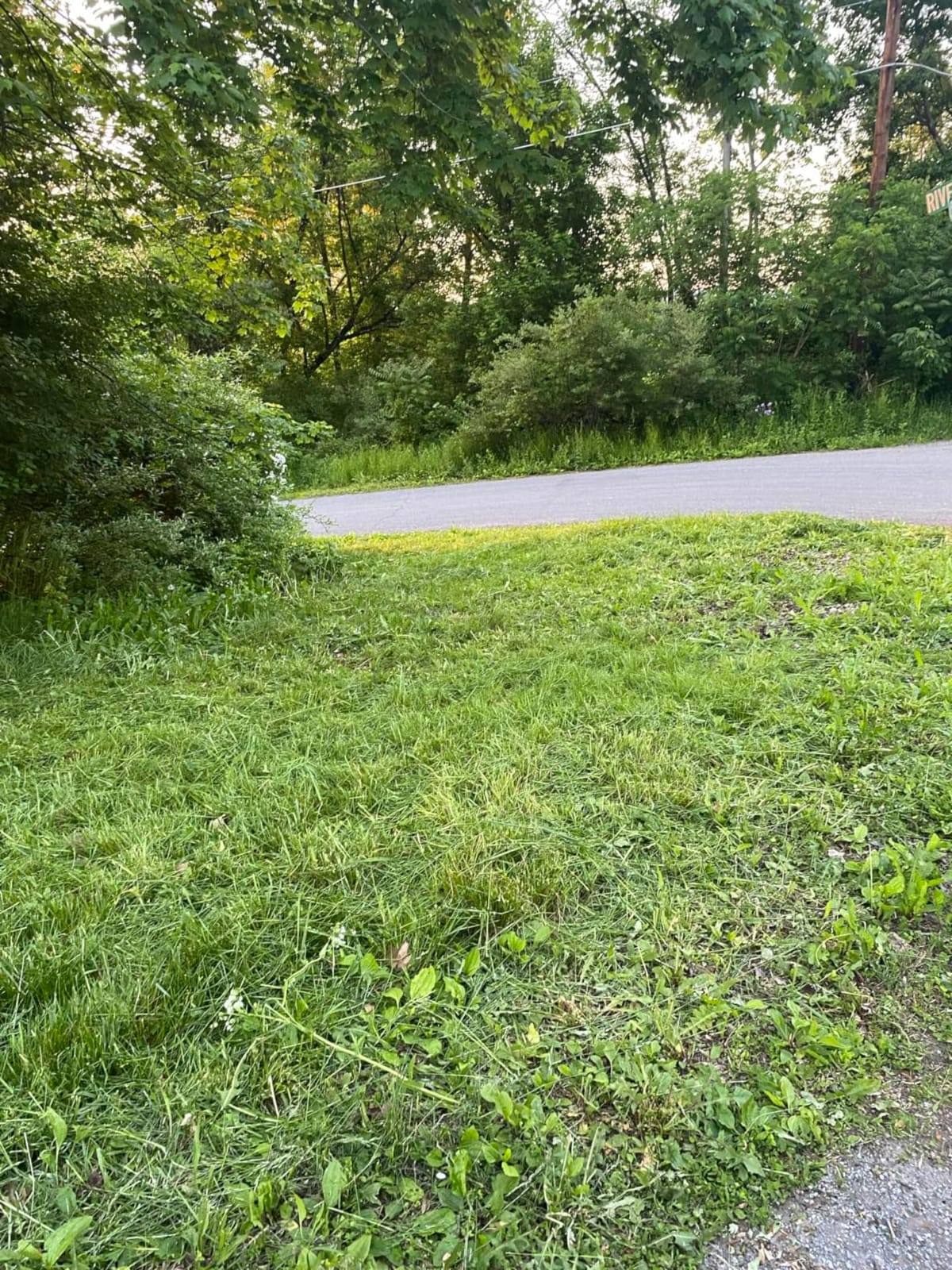
What you get on a driveway
A 5.5 pound machine you can carry one-handed to the far corner of the slab without planning a break, with two batteries so a charge swap is not a mid-job event. For a two-car driveway with both borders and the walkway, that is a comfortable single session.
Because the line head spools rather than bites, the finish is tidy rather than crisp. Run it a few days after mowing, when the grass is dry, and the border reads clean from the street. Run it on a wet lawn and the line smears instead of cutting.
Where it falls short
The 20V platform is the weak point. One owner on r/Dewalt described a 20V edger as always seeming kind of useless when it met a hard edge. Against a hardened concrete lip where grass roots have grown down into the joint, the WG163 will not generate the bite a 12 Amp corded motor can.
It also stores as two tools if you own the batteries already, since the WG163 body uses the same PowerShare packs. Homeowners who only need a trimmer most of the season and an edger twice a year should read the two-machine sections of our cordless buying notes before committing.
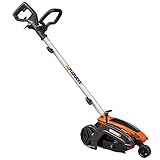
2. WORX WG896 12 Amp Corded Edger and Trencher – Best Value Blade Edger
WORX Electric Lawn Edger, 12 Amp 7.5″ Trencher for Lawn Landscaping, WG896
12 Amp at 4700 RPM
7.5 inch blade
3 depth settings
14 lb
3 year warranty
Pros
- Sustained 12 Amp torque with no battery runtime ceiling
- Three depth settings at 1
- 1-1/4 and 1-1/2 inch
- Cutting line indicator holds a straight path
- Adjustable shaft with D-grip fits different heights
- Edges and trenches for cable and irrigation
Cons
- Extension cord has to be dragged along the whole edge
- 14 lb is heavy against battery edgers
- 7.5 inch blade needs more passes on long runs
More than 15,000 reviews at a 4.4 average make the WG896 the most thoroughly proven blade edger in this guide, and it is the one we keep coming back to for anyone with a driveway near an outlet. A 12 Amp motor spinning a 7.5 inch blade at 4700 RPM does not bog down when the blade meets resistance, which is exactly the situation you get at the concrete lip.
The three depth positions — 1 inch, 1-1/4 inch and 1-1/2 inch — map almost perfectly onto what hardscape edging actually needs. Start at the shallowest position for your first pass. The cutting line indicator on the deck is what keeps the run straight, and it works because the wheel rides the slab.
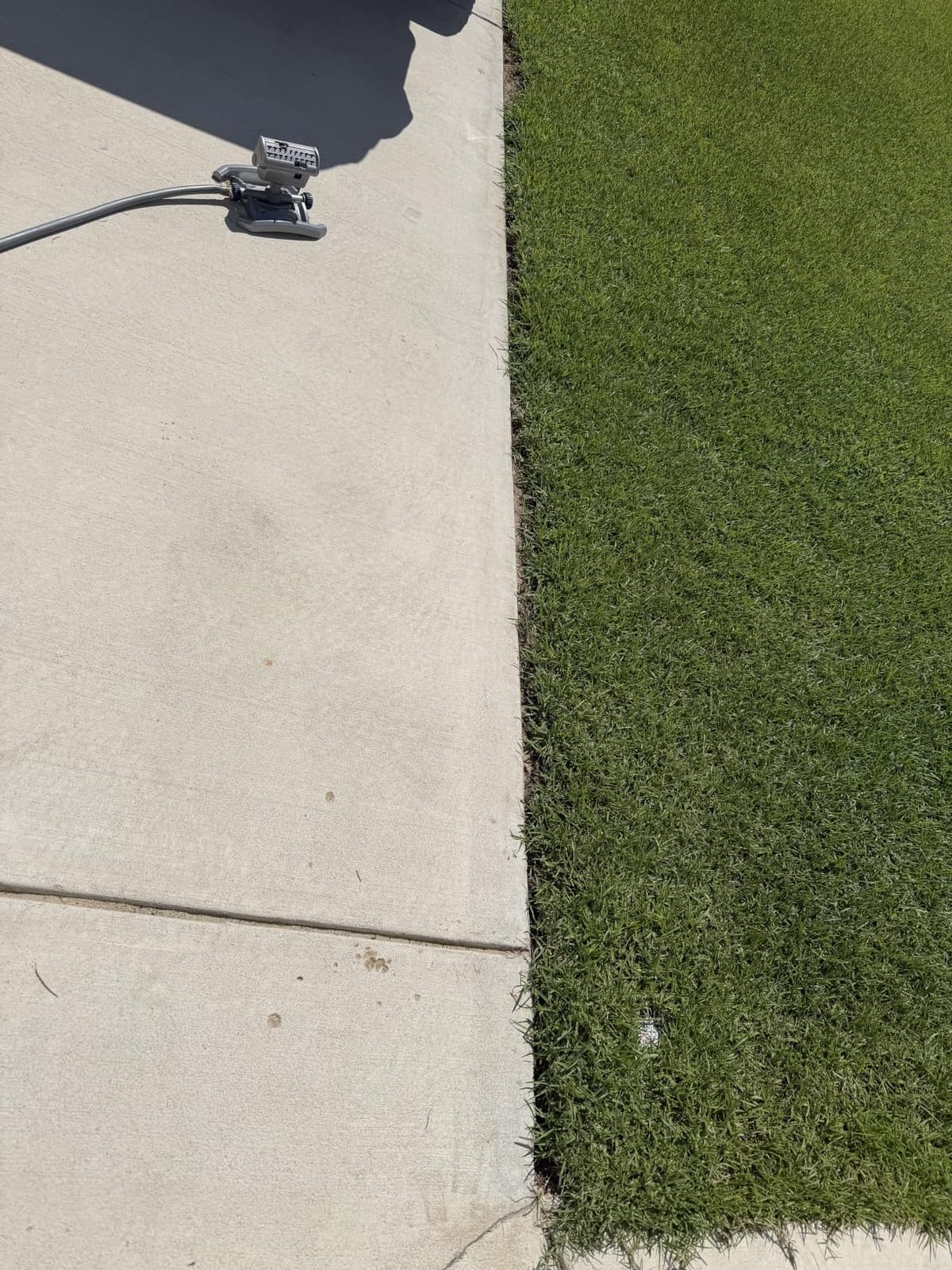
The adjustment shaft and D-grip handle mean the tool can be set to your height rather than forcing a stoop, and users chasing straight lines on driveways and sidewalks frequently single that out as a comfort win on a long job.
It converts to trenching as well, which is genuinely useful if you are running low-voltage wire or irrigation along the driveway border later. The 7.5 inch blade is narrower than a wide-deck edger, so a 300 foot driveway means more passes than you would do with a larger blade. That is a time trade, not a quality problem.
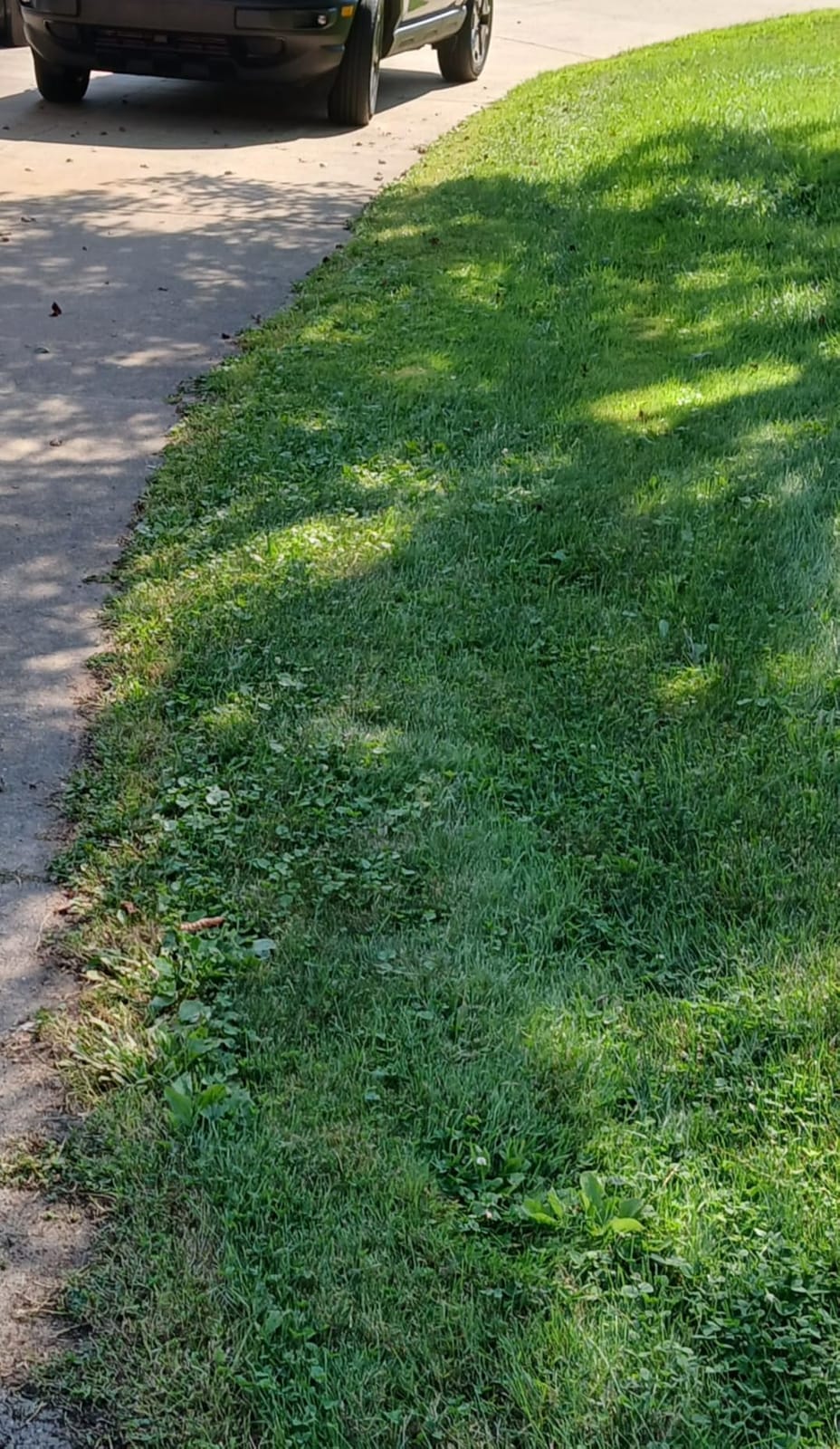
Concrete contact behaviour
With 12 Amp of continuous torque, the blade slices roots rather than bouncing them. Reviewers describe it as cutting through heavy sidewalk overgrowth that a string trimmer simply cannot touch, which is precisely the situation on an edge that has gone a season without attention.
The one caveat is blade discipline. A 4700 RPM motor does not care how dull the tooth is, and it will happily grind a dull blade along a concrete edge. Check the blade before every hardscape session and replace it when the tooth line goes ragged.
Where it falls short
The extension cord is the deal-breaker for a lot of driveways. You are feeding out 50 feet of heavy cord and then managing it so it does not catch underfoot or get run over. Cord retention on the tool is fine, but the cord is the awkward part, not the machine.
At 14 pounds, it is heavier than the battery edgers here by a wide margin, and the adjustment shaft plus D-grip add bulk for storage. If your driveway is 400 linear feet and the nearest outlet is at the far corner, this is the wrong tool and no amount of power compensates.
3. BLACK+DECKER LST300 20V Cordless Trim and Edge – Most Versatile
BLACK+DECKER 20V MAX String Trimmer and Edger 2 in 1, Cordless Weed Wacker with Auto Spool Feed, Battery and Charger Included, 12 Inch Steel Deck, Reduced Vibration (LST300)
6200 rpm
12 inch swath
5.7 lb
2.0 Ah battery
Wall mount charger
Pros
- Quiet start with no pull cord or fumes
- Automatic Feed Spool needs no bump to advance line
- Lightweight 5.7 lb with adjustable handle
- Converts to edging in seconds
- Wall mountable charging base included
Cons
- Spool edging is less crisp than a metal blade
- Single 2.0 Ah battery limits session length
- 20V entry platform is weaker than 40V and 56V
Nearly 9,700 reviews at 4.4 stars is a remarkable signal for an entry-level tool, and the reason is simple: it removes every friction point that makes people avoid yard work. No fuel, no oil mix, no pull cord, no exhaust. The POWERDRIVE transmission runs at 6200 rpm and the Automatic Feed Spool advances line without the bump-head routine that defeats a lot of beginners.
At 5.7 pounds with an adjustable handle and height positions, it is the machine most people will actually pull out every third weekend. On a driveway that gets an edge cut monthly, quiet operation matters as much as cut quality — this runs early without waking the street.
The Automatic Feed Spool is the feature owners mention most, and it is more important on hardscape than it sounds. Nothing about spool edging rewards a rushed operator, so a tool that feeds its own line lets you concentrate on keeping the wheels planted on the concrete.
Where it stops is the same place all string edgers stop. The line deflects off a hard edge rather than cutting into it, so the border is tidy rather than sharp, and roots sitting in the joint survive the pass entirely. Owners consistently position this as a driveway-edge touch-up tool, which is an honest and useful job.
Who this suits
Anyone who wants edging without a pull cord, lives on a small or medium lot with a driveway close to a charging outlet, and would rather do a quick pass every few weeks than a proper cut once a season. The included wall mountable base means it hangs in the garage rather than rolling around a floor.
It also makes a sensible second machine in a kit that already includes a battery mower in the same 20V MAX platform. If the battery pack you own fits both, the economics of a second machine change completely.
Where it falls short
One 2.0 Ah battery is the limitation owners keep naming. On a long driveway with both borders plus a front walk, you will be swapping mid-job or planning two sessions. The same pack is why the CRAFTSMAN edger further down this list underperforms its stated edging distance.
It also has no blade option at all. If the concrete edge has grass grown down into the joint, this tool will not free it, and you will end up doing what r/lawnporn users describe: beating the roots with the trimmer head until the concrete chips.
4. BLACK+DECKER LE760FF 12 Amp Corded Edger – Best for Overgrown Edges
BLACK+DECKER Lawn Edger Trencher 2 in 1, 12 Amp 7.5 in. Electric Edger Lawn Tool for Landscaping and Trench Digger, 3 Height Settings, Corded (LE760FF)
12 Amp high-torque
7.5 inch blade at 3/16 inch
3 depth positions
Pull-up edge guide
Spare blade
Pros
- Cuts dense sidewalk overgrowth string trimmers cannot touch
- Three-position depth plus pull-up edge guide give real control
- Spare blade included for no-tool changes
- Many owners report 8 to 15 years of service
- Wheels make it manageable despite the weight
Cons
- Blade hex nut can loosen during use and needs a socket
- Extension cord must be run along the work area
- Audible at full power and 14.1 lb is heavy in tight corners
This is the one we recommend for the driveway that has been ignored. Across 3,955 reviews, owners describe it as the go-to tool for driveway and sidewalk edging, especially where grass has grown thick over the concrete. The sustained 12 Amp torque is the whole point: it is the difference between slicing a root mat and skating across it.
Three-position blade depth adjustment plus a pull-up edge guide give you the two controls the concrete job needs. Depth keeps the blade shallow against the slab. The edge guide sets lateral position so the blade path is consistent along the joint rather than wandering in and out.
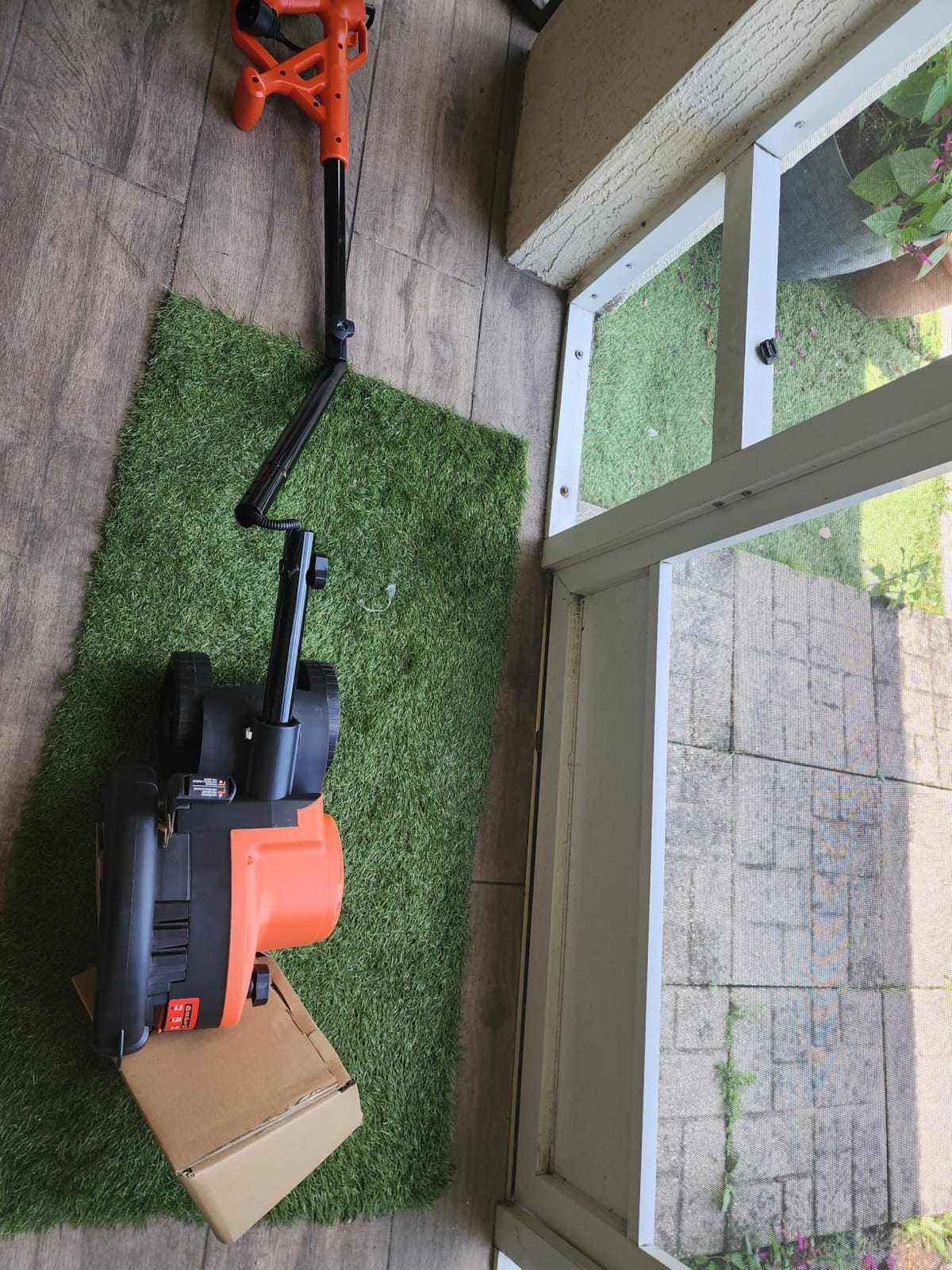
The blade is a 7-1/2 inch unit at 3/16 inch thickness, and a spare is included with the machine. Owners repeatedly note that the no-tool blade change is what keeps them running — when a blade finally goes dull from concrete contact, swapping takes a minute instead of a trip.
Longevity is the other headline. Multiple owners report 8 to 15 years of service from the same unit, and the 2-year limited warranty is the shortest in this guide. In practice that gap has not mattered much for a machine most people buy once.
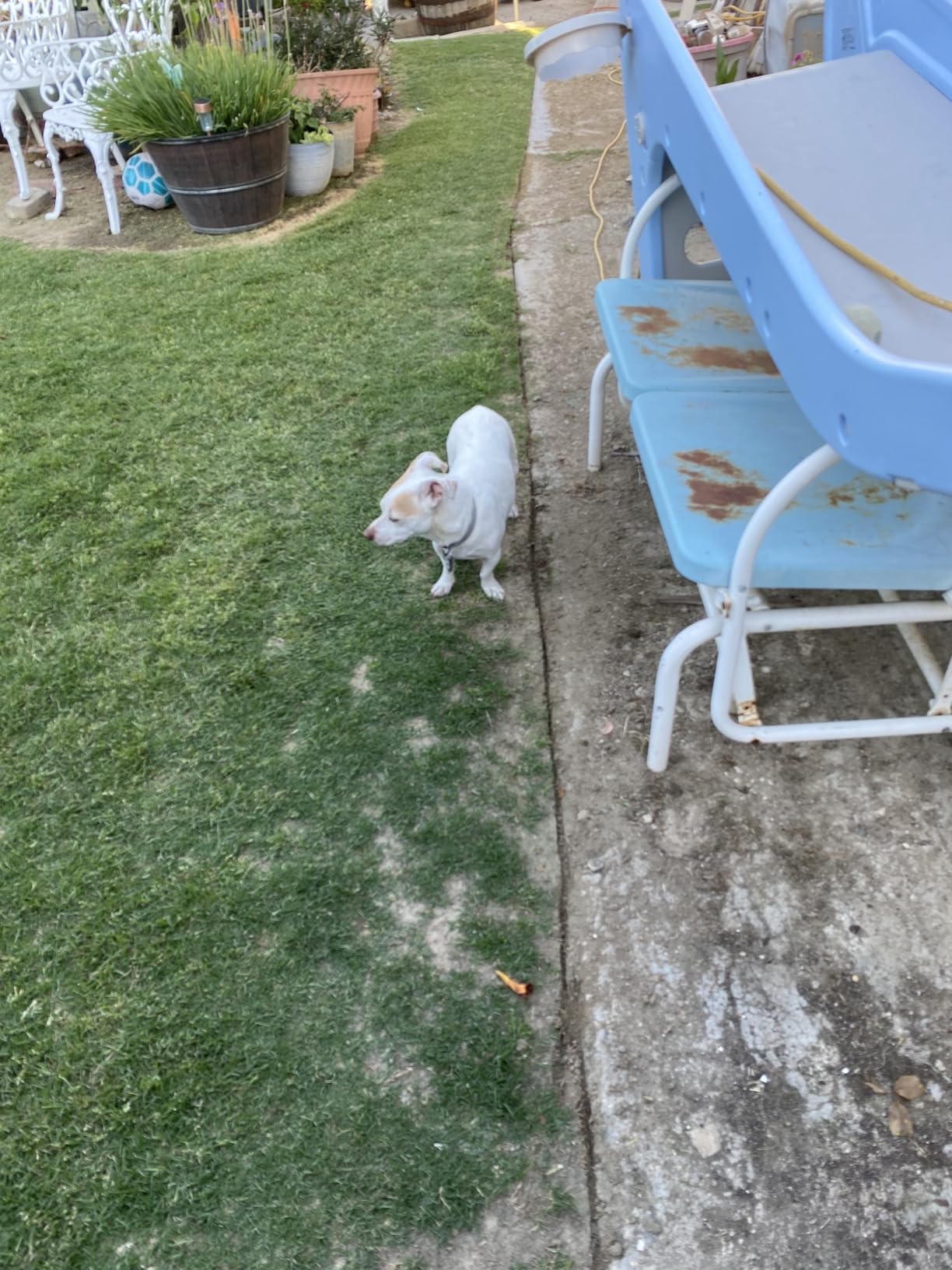
Reclaiming a neglected border
Set the depth to the shallowest position and make the first pass a few inches out from the concrete, cutting the overhanging turf away without touching the slab at all. Then step in for the second pass at 1-1/4 inch. Owners who work this way describe the second pass doing most of the root cutting with no concrete contact.
Because the blade has real thickness rather than a thin stamped edge, it holds its line against resistance. That matters on broom-finished concrete, where the texture gives the wheel slightly more grip and the blade meets variable soil depth.
Where it falls short
The blade hex nut loosening mid-job is the most-reported complaint, and the fix needs a socket and a torque wrench. It is a small failure that costs a minute, but it happens often enough that owners mention it unprompted.
At 14.1 pounds it is the heaviest handheld unit here alongside the WG896, which is awkward in tight corners against a step or a downspout. And it is genuinely loud at full power — some owners wear hearing protection, which is worth knowing in a close-in neighborhood.
5. BLACK+DECKER LST522 20V Cordless Wheeled Edger – Best for Quick Touch-Ups
BLACK+DECKER 20V MAX 12 Inch Weed Eater Cordless String Trimmer and Wheeled Edger Lawn Tool with Spool, 2.5Ah Battery and Charger Included, Lightweight, 2 Speed PowerDrive (LST522)
2.5 Ah battery
AFS line feed
Two speed control
5.7 lb
12 inch swath
Pros
- 2.5 Ah pack gives noticeably longer runtime than the 2.0 Ah LST300
- Dual speed control toggles power and runtime
- AFS advances line automatically
- Quick conversion to wheeled edging mode
- Micro-texture soft grip handle
Cons
- String spool edging is not as sharp as a metal blade on concrete
- 20V can stall in very thick wet grass
- No option to swap the wheel and blade to the opposite side
The LST522 is the sensible middle step between the bare-bones LST300 and a dedicated blade edger. Over 6,500 reviews at 4.5 stars, the two upgrades owners cite most are the 2.5 Ah battery, which delivers measurably longer runtime than the 2.0 Ah pack, and the two-speed control that lets you trade power for time.
That trade matters on a driveway. High speed is what you want through the thick grass at the corner where the lawn meets the apron. Low speed is what stretches a single charge across a 300 foot straight run. Having both on a dial removes the guesswork.
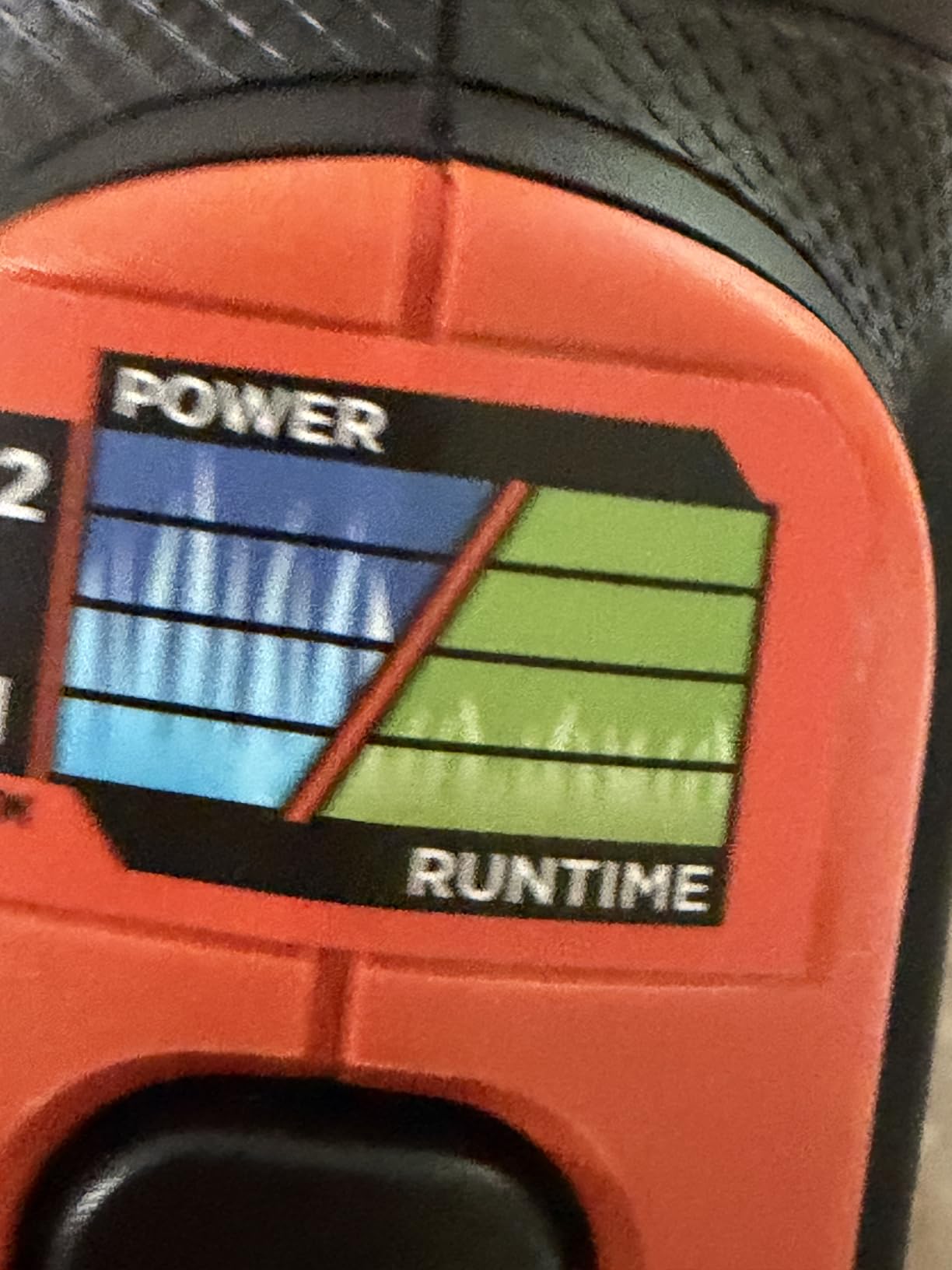
The Automatic Feed Spool handles line advancement, and conversion to the wheeled edging position is quick. On hardscape the wheels are the point again — they give the head the same stable reference surface a blade edger gets, which is why owners describe clean lines along sidewalks and driveways.
Two speed settings also help on concrete. Running low when you are tidying an already-cut edge reduces bounce, and switching up only for the sections with real growth is how owners get a full driveway done without a battery swap.
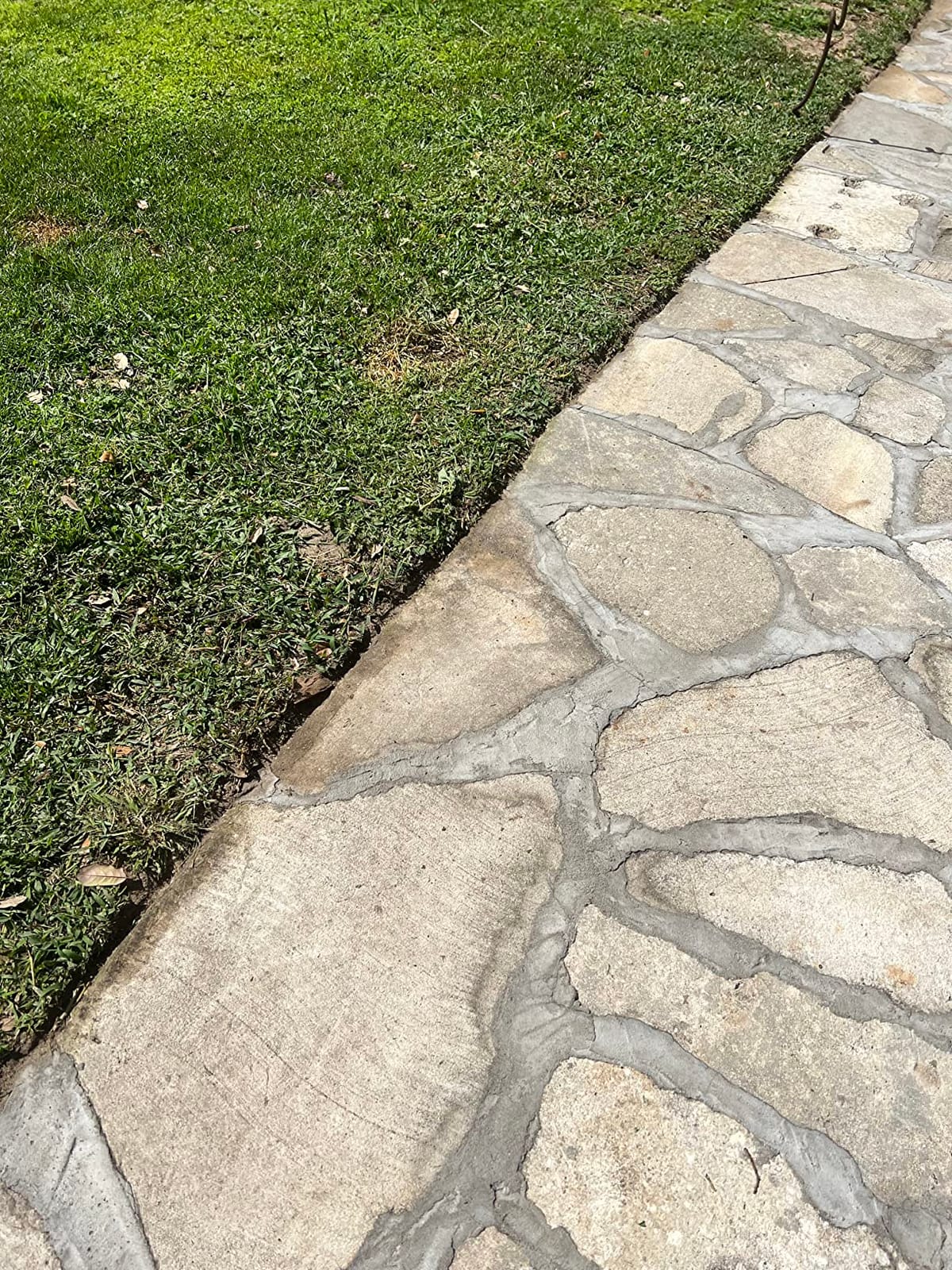
Best use pattern
Treat it as a scheduled edge-refresh tool rather than a rescue tool. A pass every three or four weeks after mowing keeps grass from establishing in the joint, and at that interval line edging looks genuinely good and the 2.5 Ah pack lasts the session.
It pairs well with a blade edger if you own both jobs. Use the LST522 for the weekly maintain and keep the blade edger for the twice-yearly correction after the season ends.
Where it falls short
The spool is still the limitation. It is described consistently as less sharp than a metal blade on concrete edges, and that is a physical property of line meeting a hard surface rather than a fault in the machine.
At 20V, it can stall in very thick wet grass, and there is no option to reverse the wheel and blade to the opposite side, so you always walk an edge in the same direction and back. For someone who is used to working both ways around a slab, that takes a session to adjust to.
6. EGO Power+ MHC1603 56V Multi-Head Combo Kit – Best Multi-Head Versatility
EGO MHC1603 Multi-Head Combo Kit 16-Inch 56-Volt Carbon Fiber String Trimmer with POWERLOAD™ & 8-Inch Carbon Fiber Edger Attachment & 56-Volt Power Head, 4.0Ah Battery and 320W Charger Included
56V 4.0 Ah battery
8 inch edger attachment
3 inch depth knob
Brushless motor
5 year warranty
Pros
- Edger attachment produces crisp lines even through overgrown turf
- Brushless 56V power without fuel mixing or pull starts
- Tool-free attachment swaps save storage space
- Interchangeable 56V batteries across the EGO platform
- Up to 75 minutes edging on low
Cons
- Included edger blade arrives with no sharpened edge
- Back-heavy with the battery mounted on the power head
- Blade is fixed on one side only so edges are walked out and back
At 4.6 stars this is the highest-rated machine in the guide, and the reasons owners give are consistent. The brushless 56V power head delivers gas-equivalent torque with no fuel mixing and no pull start, and the 4.0 Ah battery runs up to 75 minutes of edging on low. That is more than enough for a full driveway session with headroom.
The 8 inch edger attachment has its own depth adjustment knob that goes to 3 inch edging depth. You will not use the deepest setting on a concrete border — this is a case where the range is generous and your discipline matters. Start at the shallowest click and move up only into soil.
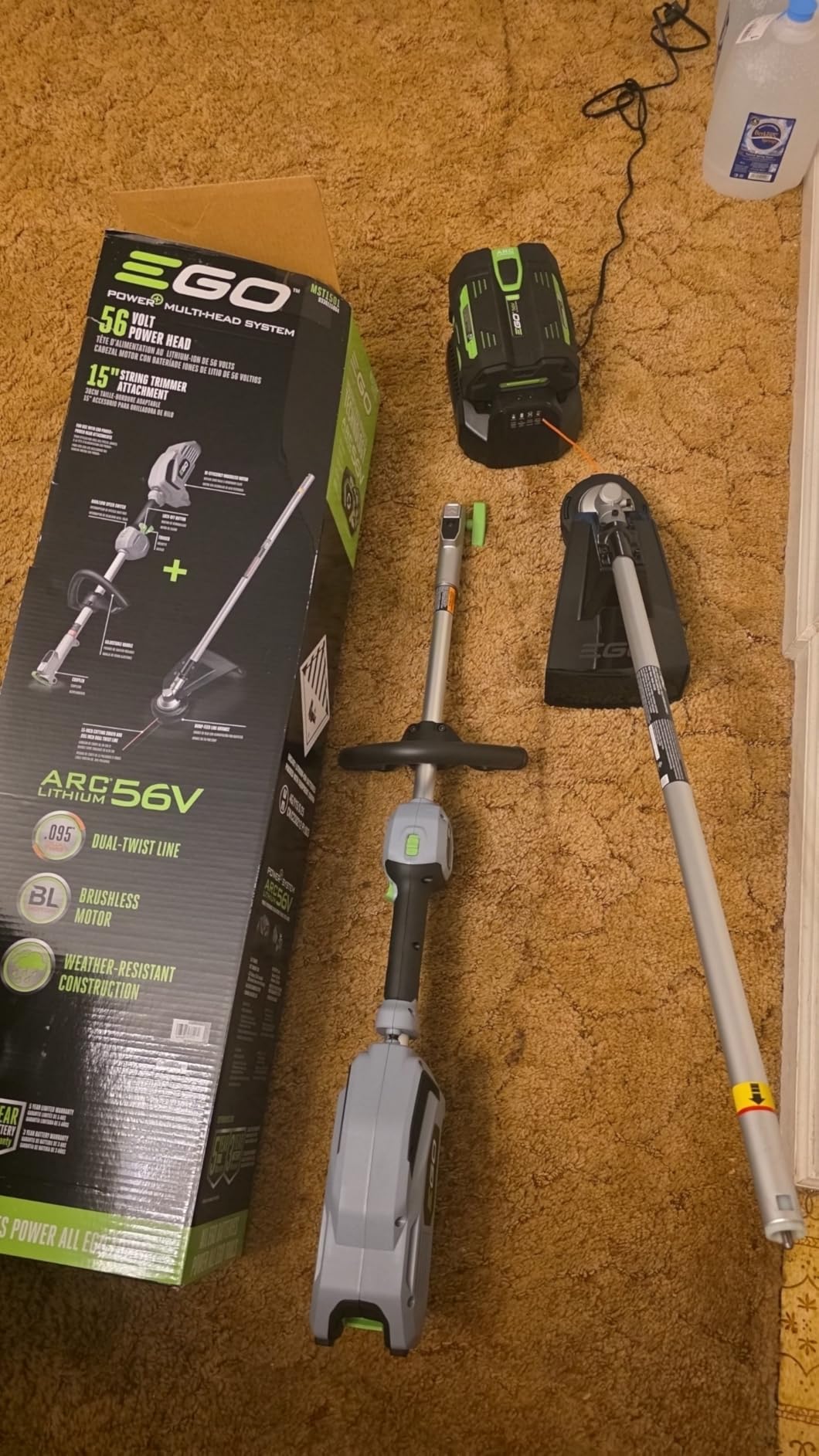
The quick-connect system swaps the trimmer and edger attachments without tools, which is the real argument for this kit. One power head, two cutting heads, and a footprint that stores in a corner. Owners who replaced a gas setup with EGO cite the tool-free head swap as one of the biggest quality-of-life changes.
POWERLOAD line loading removes the other traditional frustration with a trimmer head. For a homeowner who dreads threading line, that matters more than the spec sheet suggests.
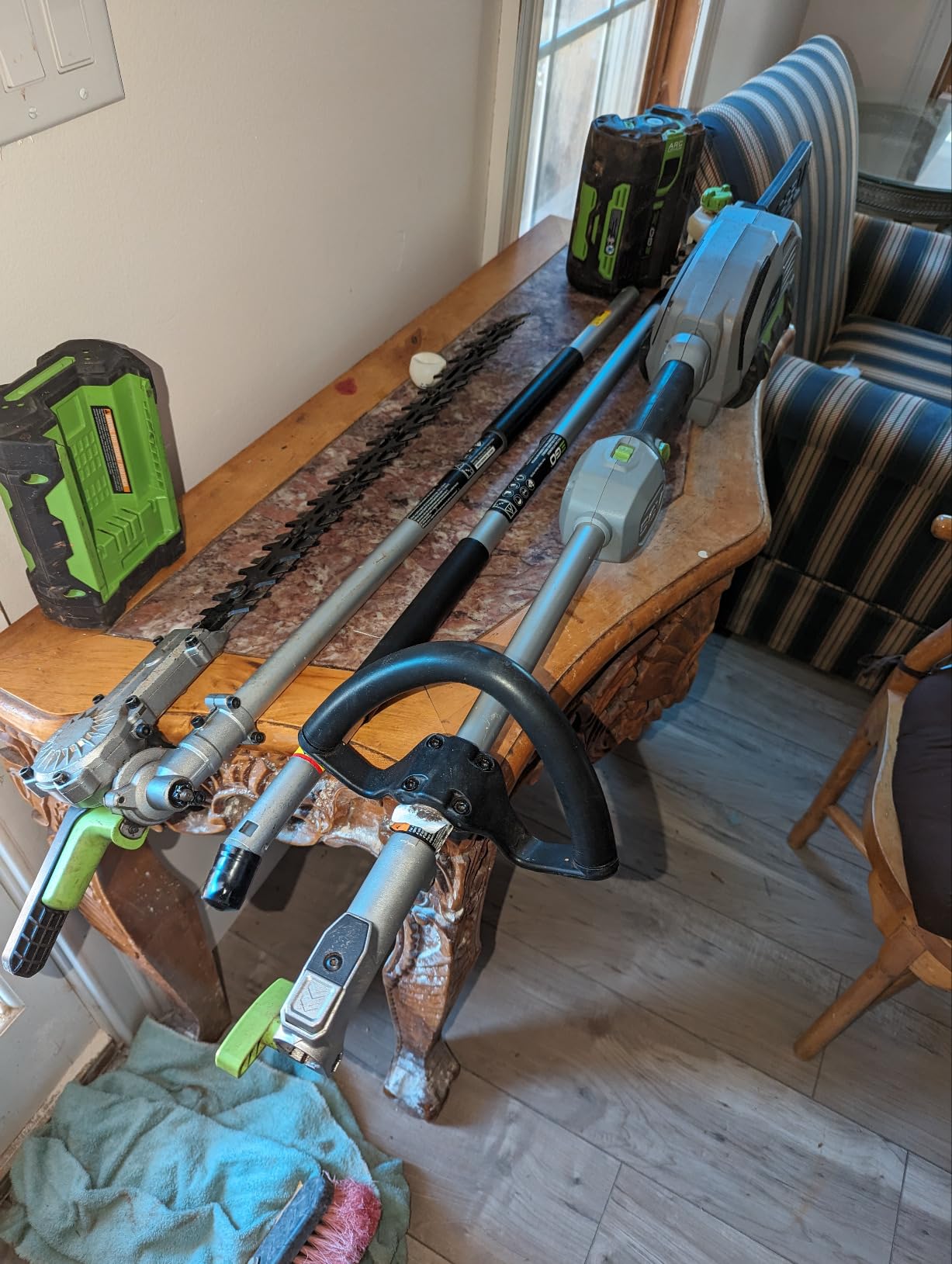
Concrete contact behaviour
Owners describe the edger attachment producing crisp, clean lines along driveways and sidewalks, even through overgrown turf, which is the behaviour you want at a concrete lip. The brushless motor holds speed instead of bogging when the blade meets resistance at a hardened edge.
Blade sharpness is the deciding factor here. The included attachment blade is described by owners as a plain one-eighth inch metal chunk with no sharpened edge, so finishing cuts are less crisp until you put a properly sharpened blade on it. That is a five-minute fix with a file and the single most useful thing you can do for concrete work with this kit.
Where it falls short
The battery mounts on the power head, which makes the tool back-heavy. The shoulder strap is not optional in practice. Budget ten minutes to get the strap adjusted properly before your first long edge.
The blade is fixed on one side only, so every line gets walked out and back rather than repositioned each stroke. On a straight driveway that is barely noticeable. Along a curved path with a bed, it is more irritating.
7. WORX WG173 20V 3-in-1 Trim, Edge and Mow – Best 3-in-1 Value
WORX 20V 13″ 3-in-1 Cordless String Trimmer/Lawn Edger/Mini Mower, WG173
Brushless motor
20V 4.0 Ah battery
13 inch dual-line head
6.6 lb
Collapsing shaft
Pros
- Three jobs from one body including a small mowing deck
- Bushless motor and 4.0 Ah pack cut thick weeds other cordless units stall on
- Dual support wheels roll along driveways for straight edging
- Quiet operation with no ear protection needed
- Collapsing shaft suits small storage spaces
Cons
- High power draw cuts runtime to roughly 30 minutes under load
- Command Feed button is awkward and line can break inside the spool
- Wheel and bar clamp screws may need tightening before first use
The WG173 is the only machine here with a brushless motor at a 20V entry price, and that combination does something the other 20V tools cannot. Reviewers specifically report it cutting thick crabgrass and stubborn weeds that cordless trimmers normally stall on, which is the same torque argument that applies to a hardened driveway edge.
The dual support wheels are the concrete-relevant feature. Two wheels rather than one means a wider, steadier footprint when the head is rolled onto the slab, and owners report straight edging lines along driveways as a direct result.
At 6.6 pounds with a telescopic shaft and seven handle positions, it adapts to different users and folds down for storage. The quiet operation is a genuine plus in a neighborhood where a gas machine at 8 am would draw comments.
Then there is the third function. Converting to a small mower deck means one body handles trimming, edging and spot mowing, which is appealing if garage space is tight and you were never going to buy three separate tools.
Best use pattern
Treat the brushless motor and the 4.0 Ah pack as the selling point, and plan around the runtime. Owners report roughly 30 minutes of real working time per charge under load, so a standard two-car driveway with both sides is one charge with a little margin.
For the edge itself, use the wheels on the concrete and keep the head at the low angle. The 90 degree pivoting head helps where the lawn steps down onto the driveway apron.
Where it falls short
The Command Feed button is awkward, and some owners report line breaking off inside the spool and needing a manual rewind. That is a real annoyance and the most common gripe in reviews.
Two smaller flags: the extendable flower guard shown in some listing images is not included on US models, and the wheel and bar clamp screws may need a tightening before first use. The battery can also slowly drain while left in the charger, so pull it after a full charge.
8. Greenworks 40V 8 Inch Cordless Edger – Best Tool-Less Adjustment
Greenworks 40V 8 in Cordless Electric Lawn Edger, 4.0 Ah Battery, Charger
Brushless motor
8 inch steel blade
Tool-less depth
40V 4.0 Ah
11.9 lb
Pros
- Brushless motor is quiet and cuts thick grass along driveways easily
- No cord to drag and no gas to store
- Roughly 200 feet of edging per charge with headroom
- Tool-less depth adjustment plus a single guide wheel
- Blade pulls the tool forward and speeds up long edges
Cons
- 11.9 lb is tiring for some users over a long session
- Wheel height suits users around 5 foot 6 inches
- Brushless motor stalls and needs a restart under firm resistance
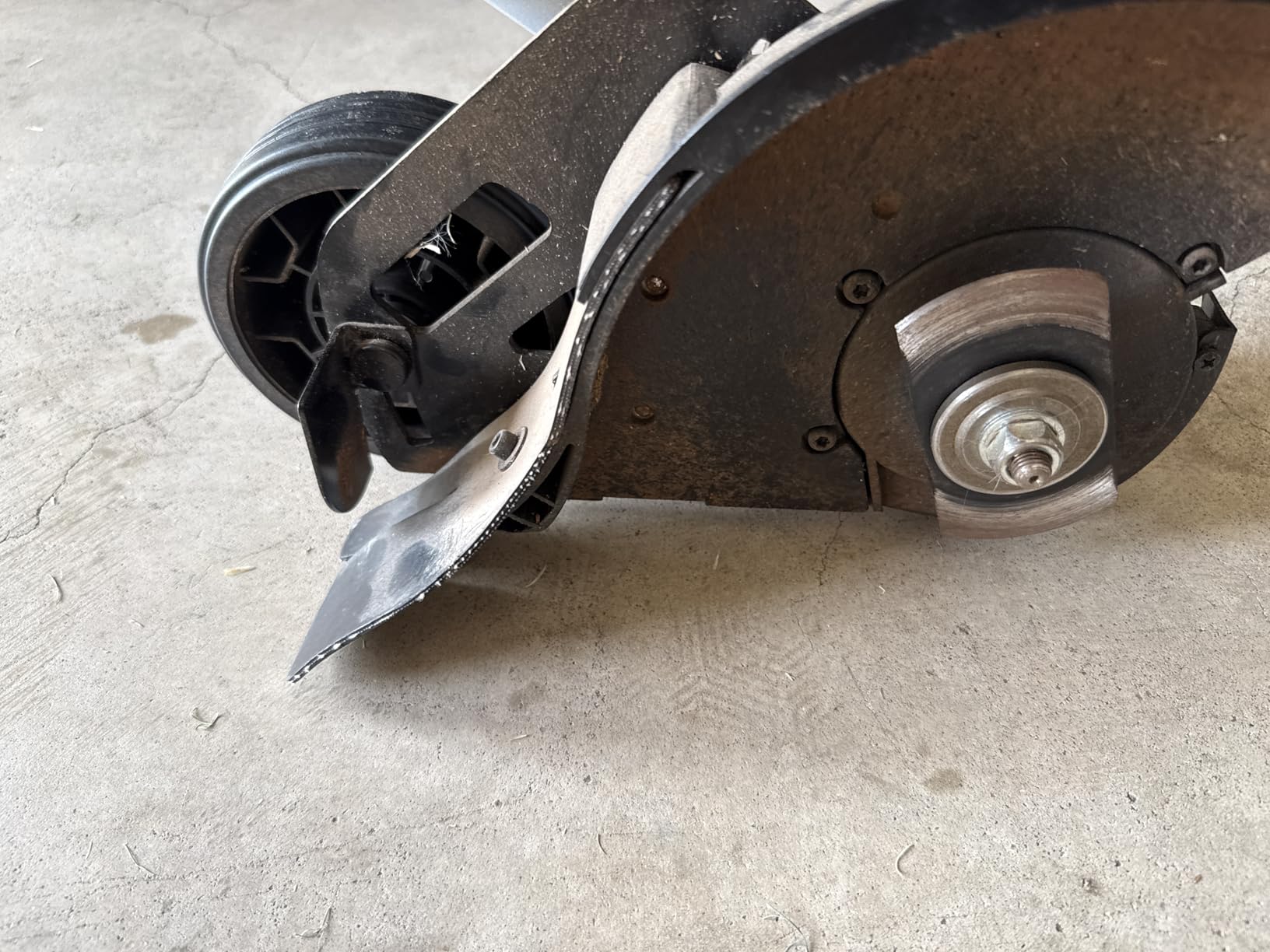
The Greenworks ED40L410 is the closest thing in this guide to a dedicated cordless blade edger at a mainstream voltage. An 8 inch steel blade, a brushless motor and tool-less depth adjustment put it in a different class from the spool-head tools above it, and that difference is exactly what a concrete border demands.
Reviewers upgrading from brushed-motor edgers name the brushless motor as the reason their old machine died, which tells you the failure mode a concrete-adjacent edger actually experiences: motor heat under sustained load, not blade breakage.
The 40V 4.0 Ah pack produces roughly 200 feet of edging per charge with headroom to spare, so a two-car driveway is a single charge with room for the front walk too. For anyone longer than that, a second pack removes the only real objection to cordless here.
There is a detail owners keep mentioning that we did not expect. The blade pulls the tool forward once the technique clicks, so on a long straight run the machine essentially guides itself along the concrete and your walking pace matters less. That is a real time saver over 300 feet.
Concrete contact behaviour
A steel blade at 40V has the bite the 20V spool tools lack, and owners report it cutting through thick grass along driveways without complaint. The single guide wheel plus tool-less depth adjustment lets you set the cut shallow in seconds and change it back without tools when you move off the slab.
The 4-year limited warranty on both tool and battery is the second-longest in this guide, which matters for a machine intended to survive decades of seasonal edging.
Where it falls short
At 11.9 pounds it is the heaviest cordless machine here, and over a long session that weight shows up in the hands and shoulders. Older users should factor that in before committing.
Two fit and behaviour notes. The wheel height suits people around 5 foot 6 inches, so taller users may not be able to get the guide wheel down to the ground. And the brushless motor stalls and requires a restart when it meets firm resistance, which is what happens when you push a blade hard into a hardened concrete lip.
9. CRAFTSMAN CMCED400 Cordless Edger – Best for V20 Battery Owners
CRAFTSMAN Cordless Edger Lawn Tool, 20V MAX Battery, Charger and Blade Included, Lightweight Lawn Edger, 7.5 in Cutting Width, 1000 Ft of Edging per Charge (CMCED400D1)
7.5 inch cutting width
8 lb
Integrated edge guide
Folding handle
V20 2.0 Ah included
Pros
- Lightweight 8 lb design that is easy on the back
- Integrated edge guide gives clean lines on driveways
- Battery
- charger and edging blade all in the box
- Folding handle simplifies storage
- Spare V20 batteries widely available at other retailers
Cons
- Included 2.0 Ah battery gives roughly 10 minutes of edging
- Struggles on hard compacted ground and long-neglected edges
- Small battery can overheat quickly
- Frequent swapping on long driveways
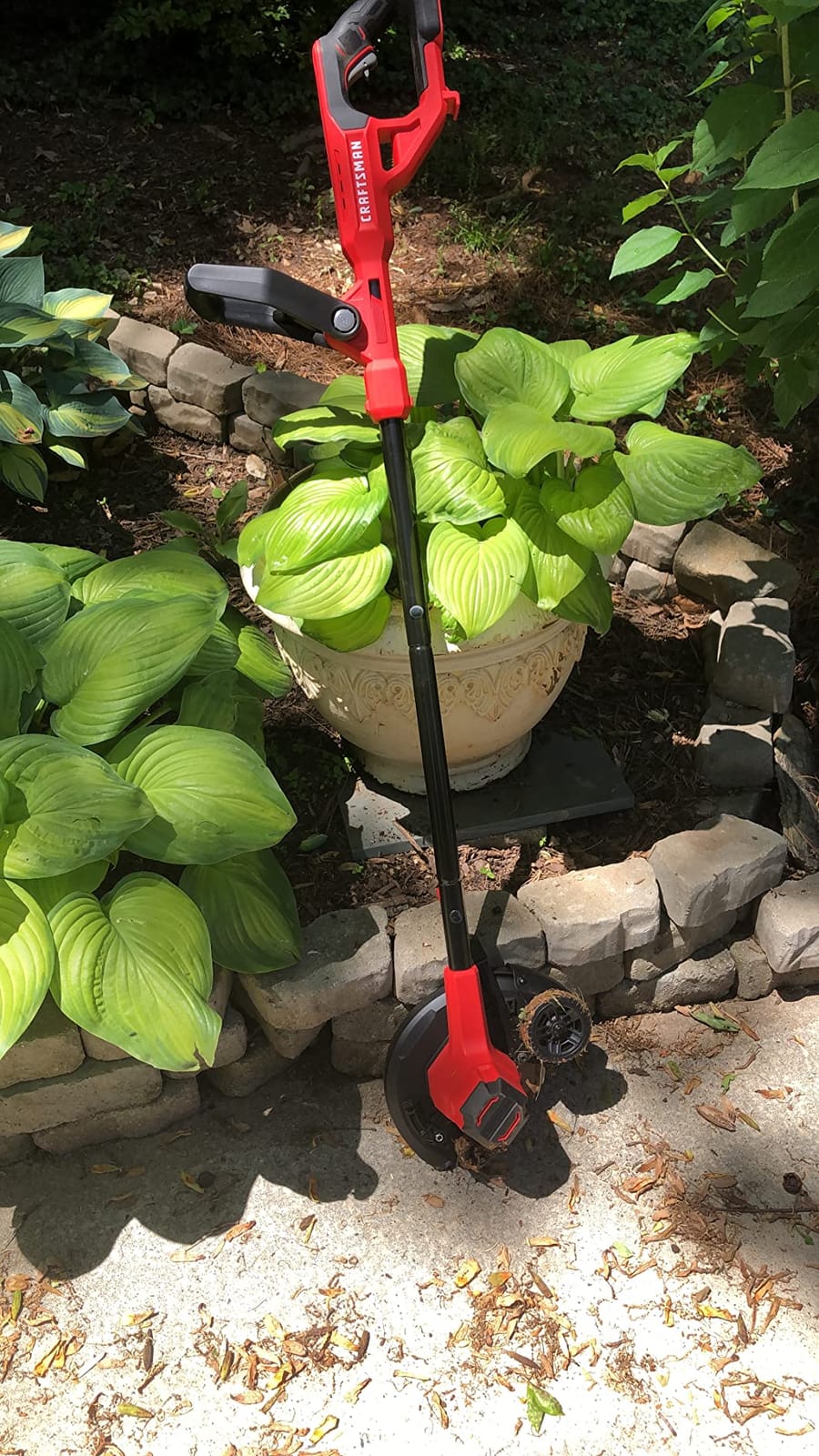
The CMCED400 is a 7.5 inch blade edger at 8 pounds, and that combination is unusual. Dedicated blade cutting at a weight you can hold for a full session changes the relationship with a 300 foot driveway considerably, and the integrated edge guide is what produces the clean lines owners report.
Everything needed is in the box: the edger, a V20 2.0 Ah battery, a charger and the edging blade. The folding handle and the integrated VERSATRACK hook mean it stores flat against a wall, which matters if garage space is the constraint.
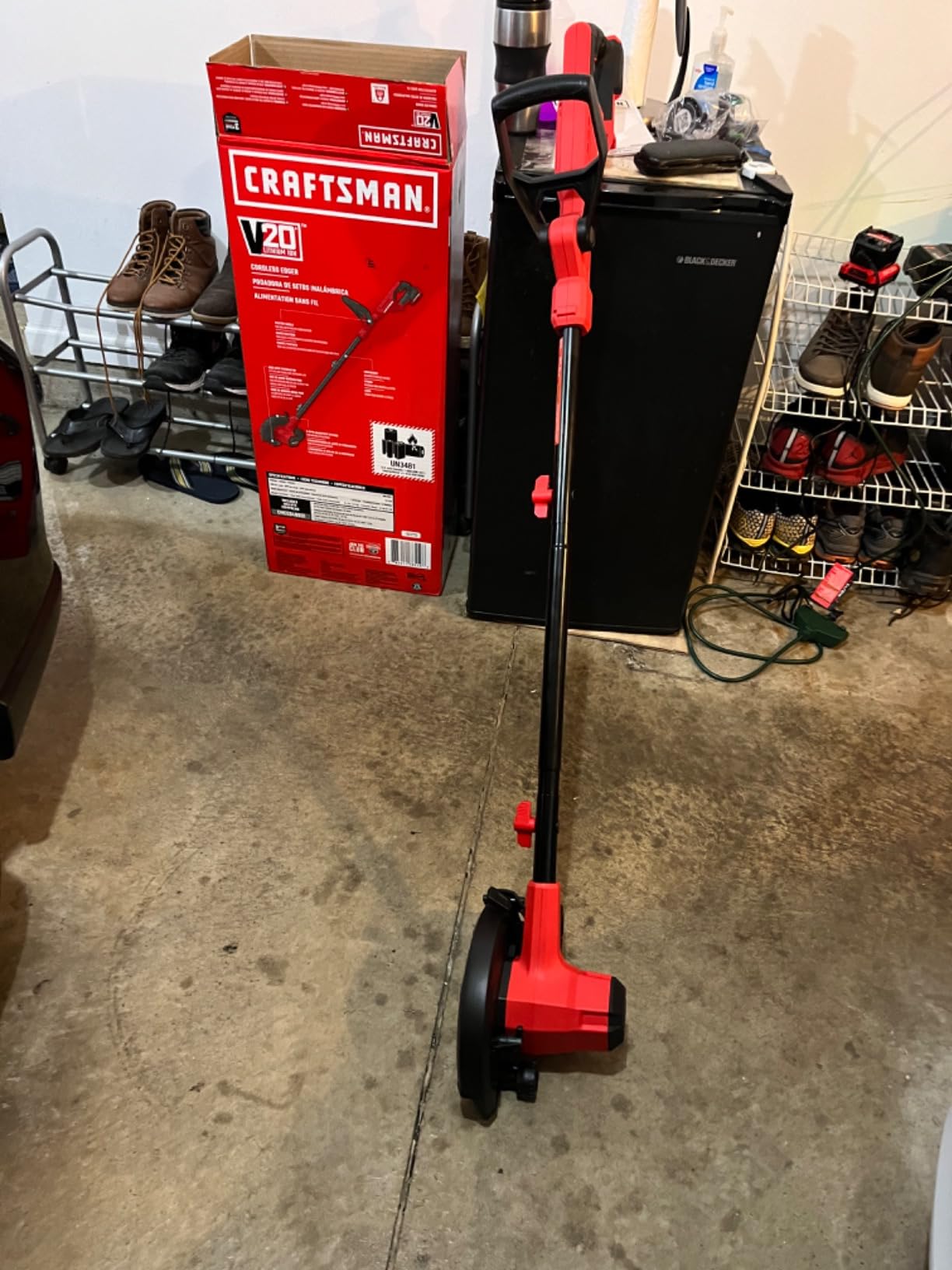
Its real argument is ecosystem. The V20 battery platform is widely stocked at other retailers, so if you already own V20 packs for a mower or blower, this tool effectively costs you only the machine.
Owners who upgrade past the included small battery report being very happy with the results. The recurring recommendation is to buy the bare tool and put the difference into 4.0 Ah packs instead of using the small pack that ships in the kit.
The runtime problem, stated plainly
The included 2.0 Ah battery delivers roughly 10 minutes of edging, which is far short of the 1000 foot figure printed on the packaging. On a standard two-car driveway with both borders, that means multiple battery swaps in one session.
We are flagging this rather than repeating the box claim because it is the dominant complaint in 749 reviews, and it also causes the second complaint: the small battery can overheat quickly under sustained load, which is exactly the load a neglected concrete edge produces.
Where it falls short
It struggles on hard, compacted ground and on edges that have not been maintained in a long time. If your border is overgrown, this is not the first tool to reach for — the BLACK+DECKER LE760FF or a gas machine will get there faster.
At a 4.0 average rating it sits at the bottom of the range in this guide, but the complaints are concentrated almost entirely in the included battery rather than the machine itself. Judge the tool, not the pack.
10. PowerSmart 25cc Gas Trim and Edge – Budget Gas Pick
PowerSmart Gas Weed Wacker 2-Cycle 25cc Gas String Trimmer/Edger 16″ and 10″ Brush Cutter & Shoulder Strap Included
25.4cc 2-cycle
16 inch swath
10 inch brush blade
Shoulder strap
18.7 lb
Pros
- 25.4cc engine power for heavy weed and brush clearing
- Runs on line or the included 10 inch metal brush blade
- Low vibration and a shoulder strap reduce fatigue
- Quick-start and tool-free disassembly for storage
- Suitable for large properties and long driveway edges
Cons
- 18.7 lb is heavy for sustained use and small users
- Assembly instructions are incomplete and confusing
- Has a learning curve and the fuel and oil mix must be correct
- Reports of the choke switch and handle breaking
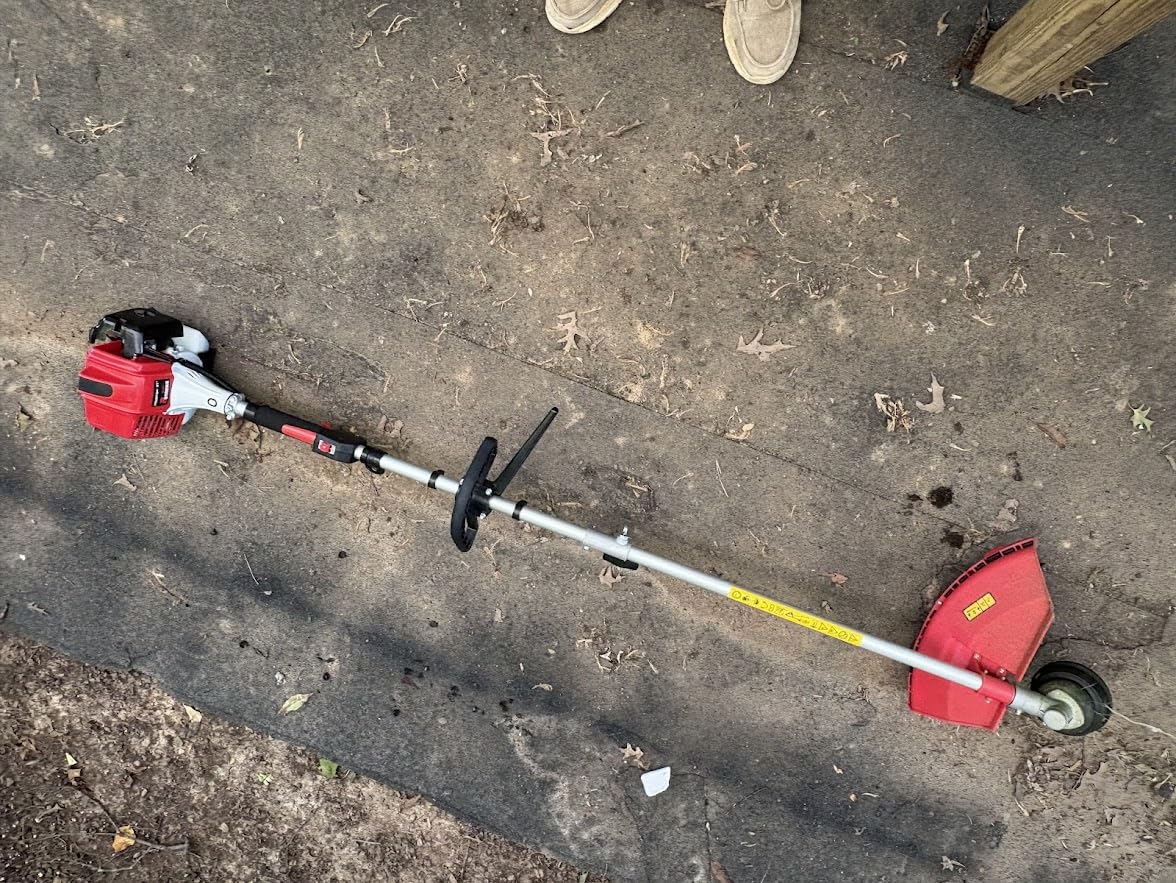
The PowerSmart is here for one reason: a 25.4cc two-cycle engine does not run out of torque halfway down a long driveway edge. If your border is genuinely overgrown, or you are edging several hundred feet at once, gas power is the simplest answer and this is the cheapest way into it.
Note what it actually is. The head is a string trimmer head, and the included 10 inch piece is a brush blade for weed and bramble clearing, not a concrete-safe edging blade. That distinction matters: this machine tidies a grass edge and clears brush, but it does not give the defined cut a blade edger produces against a slab.
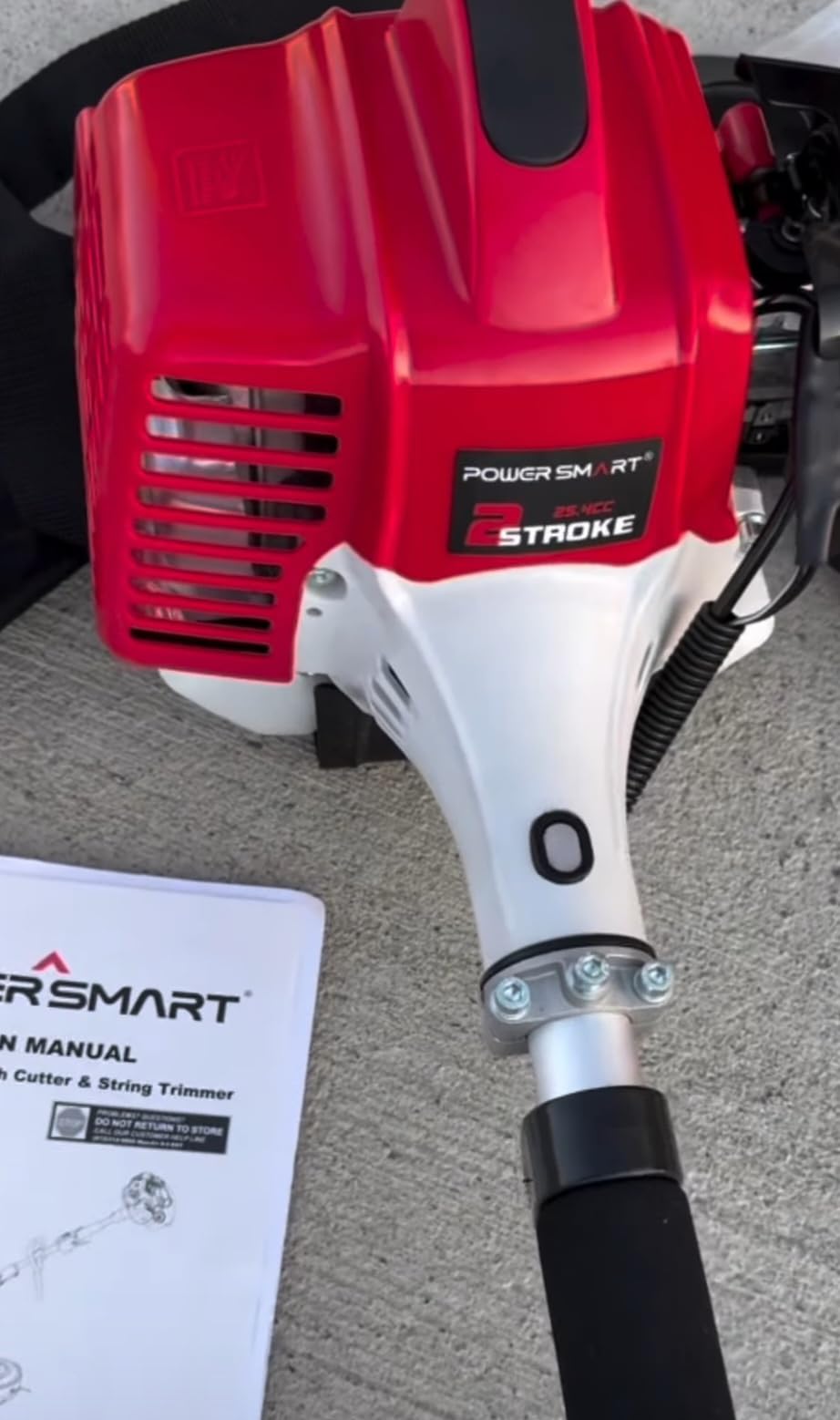
The shoulder strap and low-vibration balance are the features owners with more than a short driveway cite most. On an 18.7 pound machine, that is the difference between a session and a chore.
It starts quickly and disassembles tool-free for storage, which partially offsets the fact that fuel and oil have to live somewhere. Owners who already handle gas equipment rate the power delivery highly.
Where a gas machine earns its place
Runtime and torque are the case. On a property with a long driveway, a sidewalk run and a curb line, there is no battery swap and no stall. If your edge has roots grown deep into the joint and the grass is chest-high at the transition, this class of machine keeps moving when a cordless would stop.
It is also the honest choice if you already own a gas trimmer and want one more tool rather than a second battery ecosystem. Consolidating platforms is where a budget machine makes sense.
Where it falls short
At 302 reviews with an 18 percent one-star share, this has the highest negative share in the guide, and the complaints cluster in two groups. Experienced gas owners like the power; first-time buyers report confusing assembly, a steep learning curve and durability issues with the choke switch and handle.
It is also a two-cycle engine, so fuel and oil must be mixed correctly. Get that wrong and you will have a poor first impression that has nothing to do with the edging. If you have never run a two-stroke, this is not the place to start.
11. McLane 9 Inch Gas Walk-Behind Edger – Best for Long Driveways
McLane 9 Inch Gas Powered Walk Behind Lawn Edger with 4 Rubber Wheels, 5.50 Gross Torque Engine and Spring Steel Blade, Powder Coat Finish, Red/Yellow
5.50 gross torque engine
2 x 9 inch spring steel blade
4 rubber ball bearing wheels
7 depth positions
Pros
- Steel frame and a serviceable engine owners maintain themselves
- Handles 400 to 800 foot driveways with little effort
- Blade tilts to almost any angle for vertical or horizontal cutting
- Wide rubber ball-bearing wheels roll over curbs and rough ground
- Simple intuitive controls made in the USA
Cons
- Very high cost against every handheld and battery edger here
- Pushes itself forward hard at the deepest cut setting
- Handle length and grip diameter are small for tall users
- Debris flap fills the fresh cut and needs a second pass
Nothing else in this guide is built for volume. The McLane has a 5.50 gross torque engine, a 9 inch spring steel blade running on sealed precision ball bearings, four wide rubber ball-bearing wheels and seven depth positions under a single lever clutch. On a 600 foot run of driveway and sidewalk, this is the machine that finishes the job in one session.
Owners with 30 and 40 years of McLane use describe it as a durable, serviceable machine with a steel frame and an engine they can work on themselves between seasons. That is a meaningful difference from a plastic-bodied consumer tool.
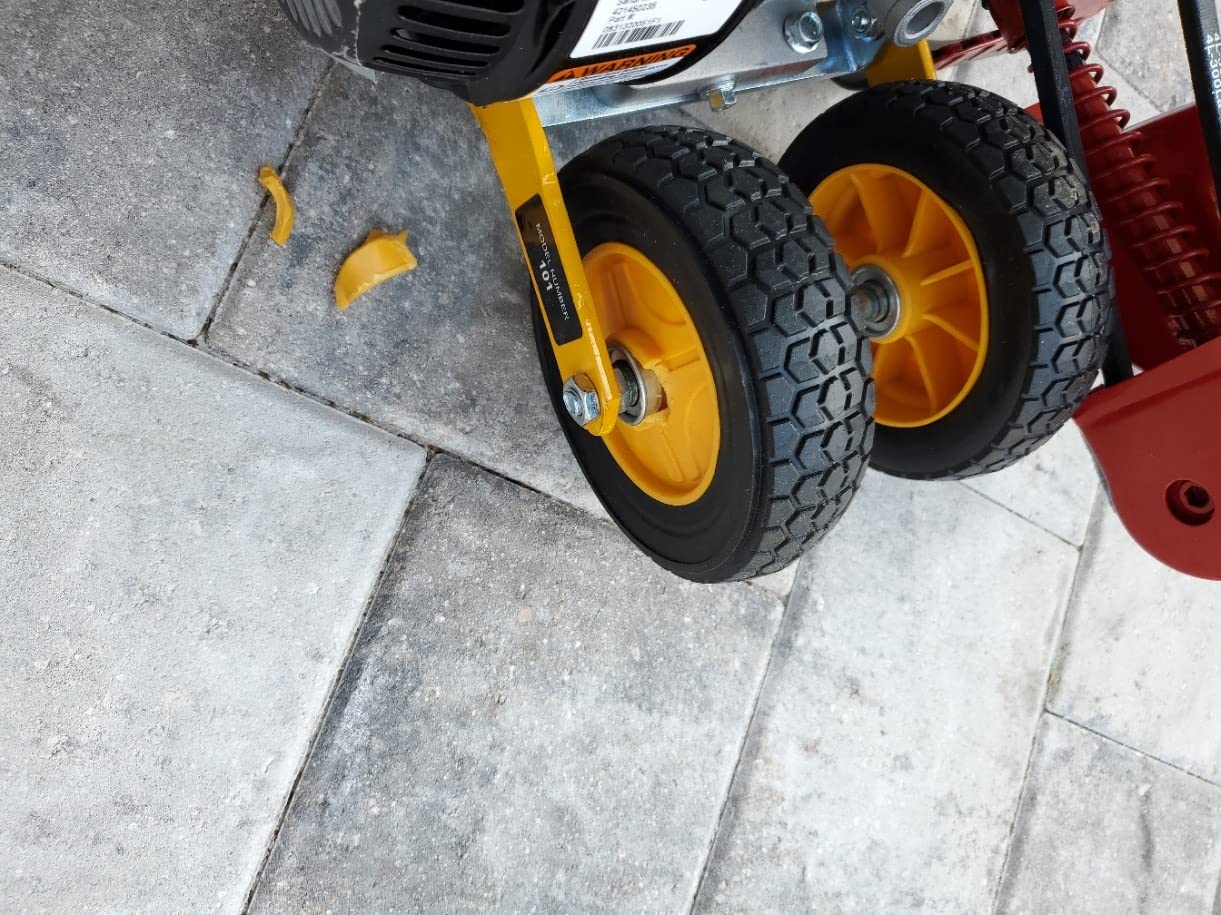
The blade tilts to nearly any angle, so the same machine edges vertically and cuts horizontally. Wide rubber wheels roll over curbs and uneven ground, which on a driveway with a settled slab or a curb transition is the difference between a smooth line and a series of jumps.
This is the machine a professional crew would use. If you have more than about 600 linear feet of concrete edging to maintain, or you do this work for a living, the productivity gap versus a handheld is not marginal.
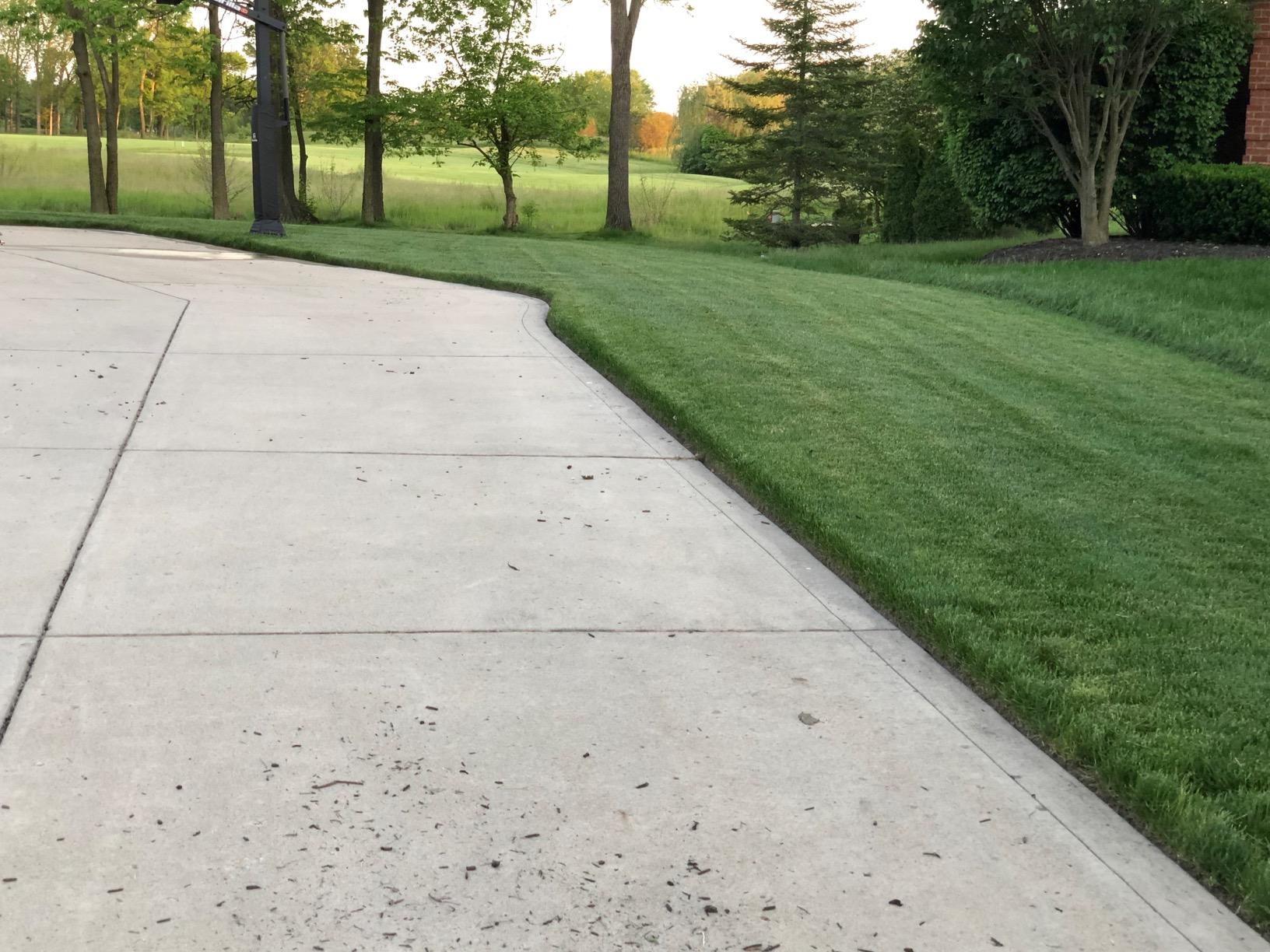
Concrete contact behaviour
A 9 inch spring steel blade on ball bearings at that engine size has real bite, and it is the most forgiving machine here on a neglected edge. The tilt capability means you can adjust the cutting angle as you move between a flush border and a bevel cut without changing tools.
Seven depth positions under one lever give fine control, which is what you want near a concrete lip where depth changes the difference between a clean line and a chip.
Where it falls short
Cost is the first fact. It carries a price several times that of any handheld machine here, and we are deliberately not framing that as a deal. Then there is the forward pull at the deepest setting, which owners describe as the machine pushing itself, plus a debris flap that backfills each cut and forces a second pass.
Ergonomics are the quiet complaint. Handle length and grip diameter are too short and small for very tall users with large hands, the oil fill ports are awkwardly placed and prone to spilling, and the muffler housing gets hot enough to burn during first use. All of that is manageable, but none of it is small.
12. BARAYSTUS Manual Rotary Edger – Best Manual Finisher
BARAYSTUS Wheel Rotary Edger Lawn Tool, Grass Edge Trimmer, Sidewalk Manual Lawn Edger, Strong 3 Sections Stainless Steel Handle with Cushion Grip, 58.3-Inch
Manual rotary action
16 oz
3 height settings up to 58.3 inch
Serrated self-sharpening blade
Anti-rust head
Pros
- No battery
- gas or cord to manage or store
- 16 oz body is easy to lift and control on concrete
- Three height options fit different users and situations
- Serrated self-sharpening blades cut sod along sidewalks and driveways
- Stainless steel handle assembles quickly
Cons
- Hand-powered
- so long driveway edges are slow
- Not suitable for overgrown thick turf and cannot trench
- Wheel axle needs regular clearing or it binds
- Less precise than a motor-driven edger on long straight runs
The BARAYSTUS earns its place for the corners, the steps and the short runs where no machine fits. At 16 ounces with a weighted wheel, it is the most controllable tool on this list, and control is what you need when you are cutting a line around a downspout or finishing where the slab meets a wall.
Three height settings at 30.7, 44.5 and 58.3 inches let you set it for the job, and owners using it on driveways praise the CNC ground serrated blades, which are self-sharpening and cut through sod rather than sliding off it.
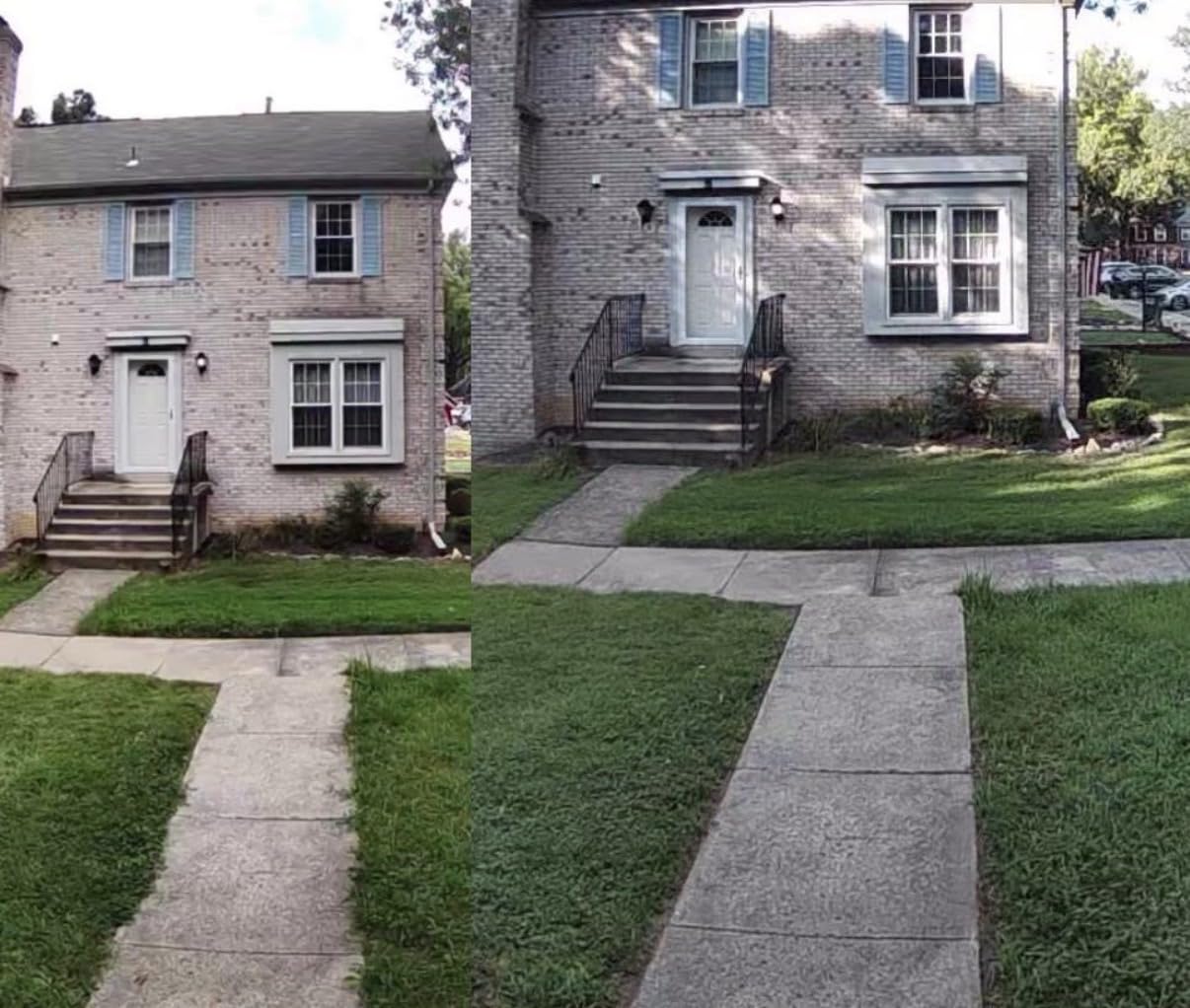
This is also the answer to the grade-offset problem. On r/landscaping, a user whose yard sits a couple of inches above the sidewalk described grass spilling over the concrete and concluded that a manual edger was the only option. Where a power head cannot get its angle down to the surface, a hand tool can.
At 1,455 reviews and 4.0 stars, buyers treat it as a low-cost finishing tool for concrete-edge touch-ups rather than a primary machine. That framing is honest and it is exactly how we would use it.

Where a hand tool actually wins
Corners, steps, and the last 18 inches around a downspout are where machines lose. A rotary edger puts the blade exactly where you want it, at your speed, with no battery and no cord crossing the wet grass you just cut.
It is also the cheapest way to keep an edge crisp on a small property. Many owners use one for monthly touch-ups and never unplugs a machine at all.
Where it falls short
It is hand-powered, which means the work scales directly with your arm. A long driveway edge is slow in a way that no battery tool is, and precision on a long perfectly straight run will not match a motor-driven edger with a guide wheel.
The wheel axle binds if grass and debris build up around it, so clear it regularly. And it cannot handle overgrown thick turf or trenching at all — for a neglected border, reach for a powered blade edger instead.
How to Edge Along Concrete Without Damaging It
Chipping a driveway is almost always a technique failure rather than a machine failure. Follow these seven steps and the concrete stays intact while the border gets sharper than a string trimmer could ever produce.
1. Put the guide wheel on the concrete. This is the rule the forums agree on without exception. The wheel rolling on the slab is what holds a consistent depth and deflects small stones away from the tooth path. Running the wheel on the soil side lets the blade hunt into the joint.
2. Confirm the blade rotates away. Check the arrow stamped on the blade or the rotation marking on the gearbox before you start. You want debris thrown away from you and away from the concrete, never back onto the finished slab.
3. Set the shallowest depth that will cut. Start at the 1 inch position. You can always step deeper for a second pass in soil. Against concrete, deeper is not better — it just brings blade steel closer to the lip.
4. Trim back the overhang first. If grass is hanging over the slab, make the first pass a few inches out from the concrete, cutting the overhanging turf without touching the slab. This removes the bulk before the blade goes near the joint.
5. Keep a steady walking pace. Consistency beats speed. The Greenworks blade tends to pull the tool forward once it bites, which helps here. Let the machine move at the pace it wants rather than dragging it.
6. Steer away the instant the blade touches. This is the consensus rule from practicalmachinist.com and it is the one habit that prevents most damage. The moment you feel contact, angle slightly away from the concrete. You are trimming the soil just behind the lip, not cutting into it.
7. Sweep the cut before you walk away. Concrete dust and slurry settle into the fresh cut and settle onto the slab. Sweep or blow the line clean, or you will be looking at a dirty trench instead of a crisp edge.
Two habits worth building. Check the blade before every hardscape session — a dull blade is the real cause of chipping. And keep the concrete side of the run as the reference. Every time you flip to the other side to change direction, confirm the wheel is back on the slab.
How Much Edging Does Your Driveway Actually Need?
A two-car driveway is roughly 150 to 200 linear feet per side, so 300 to 400 feet when you edge both borders. Add the front walk and you are near the figure that r/MilwaukeeTool users cite as a conservative estimate for concrete edging: about 600 linear feet of sidewalk, driveway and curb combined. That number is the pivot point for your machine choice.
Under 100 feet, a manual rotary edger is genuinely competitive and costs almost nothing to run. Between 100 and 300 feet, a cordless machine with a spare battery is the sweet spot. Between 300 and 600 feet, you want either a 40V or 56V cordless with two packs, or a corded machine if an outlet is close. Past 600 feet, runtime stops being a preference and becomes the whole decision — gas or a walk-behind.
Runtime planning is simple arithmetic once you have a number. The Greenworks 40V does roughly 200 feet of edging per charge. The EGO 56V combo does up to 75 minutes on low, which comfortably clears a 300 foot driveway. The CRAFTSMAN with its included 2.0 Ah pack manages about 10 minutes, so a 300 foot edge is many swaps unless you buy larger packs.
Time is the other half of the calculation. One user on r/landscaping described a routine of 21 minutes mowing and 24 minutes edging, and concluded that skipping the edging was not an option because the untidy border bothered them too much. That ratio is typical. Budget roughly as much time for edging as for mowing, and buy accordingly.
One more workload factor: if grass roots have grown down into the joint, your first pass is far slower than the steady-state maintenance pass. Plan one heavy session at the start and then short touch-ups, rather than assuming every session is the same length.
Cordless vs. Gas vs. Corded: Which Power Source Handles Concrete Best?
All three power sources cut a clean line on concrete if the blade and technique are right. They differ on runtime, noise and how much force they can hold against a hardened edge, and those three differences decide it for most driveways.
Cordless is the easiest to control and the quietest, which matters for early starts and close-in neighborhoods. Brushless 40V and 56V machines deliver enough torque for a maintained edge. The weakness is stall behaviour on firm resistance, plus battery logistics on long runs.
Corded gives you continuous torque with no runtime ceiling and no stall. Both 12 Amp machines here are the strongest handheld options for overgrown borders. The cost is a heavy extension cord you must drag along the edge, which is why these suit driveways near an outlet.
Gas is the only realistic answer past 600 linear feet or on an edge that has not been cut in a season. Two-cycle engines like the PowerSmart deliver unflagging torque. The price is noise, fuel mixing, and storage that takes up real garage space.
Manual tools win only in corners and steps. Anywhere you have more than a short run to cover, the time cost is steep.
For most single-family driveways the honest answer is a cordless blade edger in the 40V to 56V range with a second battery, or a 12 Amp corded machine if an outlet is within reach. Gas becomes the correct choice when the footage is large or the edge has been neglected, and a manual tool is a companion rather than a primary machine.
Reclaiming an Edge That Has Grown Into the Concrete
This is the situation that generates most of the concrete-chipping fear, and it deserves its own method. The mistake is trying to cut it all in one pass at full depth.
1. Cut the overhang back first. Stay 3 to 4 inches off the concrete and remove the grass hanging over the slab. The bulk of the material goes now, with no blade contact at all.
2. Set the depth to the minimum and take a thin pass. One inch. You are cutting the top layer of soil and root, not trenching. The goal is to sever what is holding the grass mat in place.
3. Step the depth up gradually. Once the first pass is clean, move to the middle position for a second pass. Only go to the deepest setting if you are cutting soil well away from the slab lip.
4. Slow down over the joint. The concrete-to-soil transition is where a blade meets stone at an unpredictable angle. Reduce your pace there and steer away on contact. This is exactly what the practicalmachinist.com rule exists for.
5. Finish the last stubborn roots by hand. Some roots will survive a powered pass in a hardened joint. A hand edger or a narrow trowel removes them without any blade steel near the slab. That is the honest end of the process rather than forcing a machine into a spot it should not go.
If the edge has been neglected for multiple seasons, a gas or high-torque corded machine will get there far faster than a 20V cordless. One owner described a 20V edger as seeming kind of useless when it met asphalt, and a hardened concrete lip behaves similarly. Match the tool to how far behind you are.
Buying Guide: How to Choose an Edger for Your Driveway
Start with the surface, not the machine. Broom-finished concrete gives the wheel grip and hides small marks, so you have some latitude. Smooth power-trowelled concrete shows every nick, so keep depth shallow and your pace even. Cracked, spalled or aged concrete has a weakened lip that should not be forced — work shallow and finish stubborn roots by hand.
Choose a real blade over a string head. This is the single clearest divide in this guide. A line head deflects off concrete and cannot sever roots in the joint. If your border is already ragged, every spool-based machine above is the wrong tool regardless of how good its battery is.
Check the guide wheel and edge guide. At least one wheel that rides the slab, and preferably two on the spool tools for a stable straight run. The integrated edge guides on the CRAFTSMAN and the pull-up guide on the BLACK+DECKER LE760FF both serve this purpose.
Look at depth adjustment quality, not just range. Three discrete positions you can feel without tools beat a wide theoretical range. The Greenworks tool-less adjuster and the three-position levers on both corded machines let you move between a shallow concrete pass and a soil pass quickly.
Match the power to the footage. Under 100 feet, manual. Up to 300, cordless. Beyond 300 feet with a nearby outlet, corded. Beyond 600 feet or a long-neglected edge, gas or walk-behind.
Count batteries before you buy. If you already own packs in a platform, that changes the economics more than the machine itself. The WORX PowerShare, BLACK+DECKER 20V MAX and CRAFTSMAN V20 platforms all cover several tools, and the CRAFTSMAN is specifically worth considering for V20 owners. The EGO 56V system is the one to look at if you want a single battery across trimming, edging and mowing.
Buy for weight honestly. The gap in this guide runs from 16 ounces to a walk-behind machine you push rather than carry. Anyone with back or shoulder issues should weight the lighter cordless and manual options far more heavily than the power ratings suggest.
Think about noise. Gas at full throttle in a close-in neighborhood in the early morning is a real issue, and HOA rules occasionally reflect it. Cordless and corded machines remove that variable entirely.
Frequently Asked Questions
What is the best driveway edger?
For a typical two-car driveway, a cordless blade edger in the 40V to 56V range with a spare battery is the best balance of control, noise and runtime. If an outlet is close and the edge is overgrown, a 12 Amp corded machine gives stronger sustained torque. Past roughly 600 linear feet of concrete edging, gas or a walk-behind edger becomes the right answer on runtime alone. Whatever the power source, put the guide wheel on the concrete and keep the depth in the first inch and a half of soil.
How do you edge grass along a driveway?
Trim the overhanging grass back 3 to 4 inches from the slab first, with no blade contact. Set the edger to its shallowest depth, place the guide wheel on the concrete, and confirm the blade rotates away from the slab. Walk at a steady pace along the joint and steer slightly away the moment you feel the blade touch stone. Sweep the finished cut to remove concrete dust and slurry.
What is better, an edger or a string trimmer?
A blade edger is better for a concrete driveway, without exception. Line deflects off a hard surface instead of cutting into it, so a string trimmer leaves a ragged, fuzzy border and cannot sever grass roots in the joint. Users commonly end up beating roots against the concrete with the trimmer head, which chips the driveway. A bladed edger with a guide wheel produces the defined line and keeps debris off the slab.
Do edgers damage concrete driveways?
They can, but it is almost always technique rather than the machine. The three causes are a dull blade that grinds against stone, cutting too deep, and riding the blade into the concrete lip at a fast walking pace. Keep the blade sharp, set depth to 1 inch or 1-1/2 inches, keep the guide wheel on the slab, and steer away the instant the blade makes contact. Done correctly, an edger never touches the concrete surface itself.
Should you edge from the concrete side or the grass side?
From the concrete side, if you are using a bladed edger with a proper guide wheel. This older forum consensus produces the straightest line and keeps the wheel as a stable reference surface. The recent advice to never edge from the concrete side applies to string trimmers, which have no wheel and simply flick line and debris at the slab. Edger from the concrete side; trimmer never.
Final Verdict: Which Edger Wins on Concrete
The WORX WG163 takes our overall spot among the best lawn edgers for concrete driveways. With 28,501 reviews behind it, a 5.5 pound frame, two batteries in the box and rubberized support wheels that give a genuinely straight run along a slab, it is the lowest-friction way to keep a driveway edge presentable all season.
Buy the WORX WG896 instead if you want a real steel blade and have an outlet nearby — 12 Amp of sustained torque is the strongest handheld value here. Buy the BLACK+DECKER LE760FF when the edge has been ignored for a season and grass is standing proud of the concrete. Buy the Greenworks 40V if you want cordless freedom with a genuine 8 inch steel blade and tool-less depth control, and add a second pack.
Two cautions carry more weight than any ranking. Check blade sharpness before every hardscape session, because a dull blade is what chips concrete. And keep depth in the first inch and a half of soil with the guide wheel riding the slab. Those two habits do more for your driveway than the difference between any two machines on this list.
Methodology note: this roundup is built from manufacturer specifications and analysis of owner review patterns, not from hands-on testing sessions. We say so plainly because the difference matters. Re-verify runtime and concrete contact behaviour against your own surface before committing to a machine for a large property, and treat the 2026 ranking as a snapshot that is worth revisiting each season.