
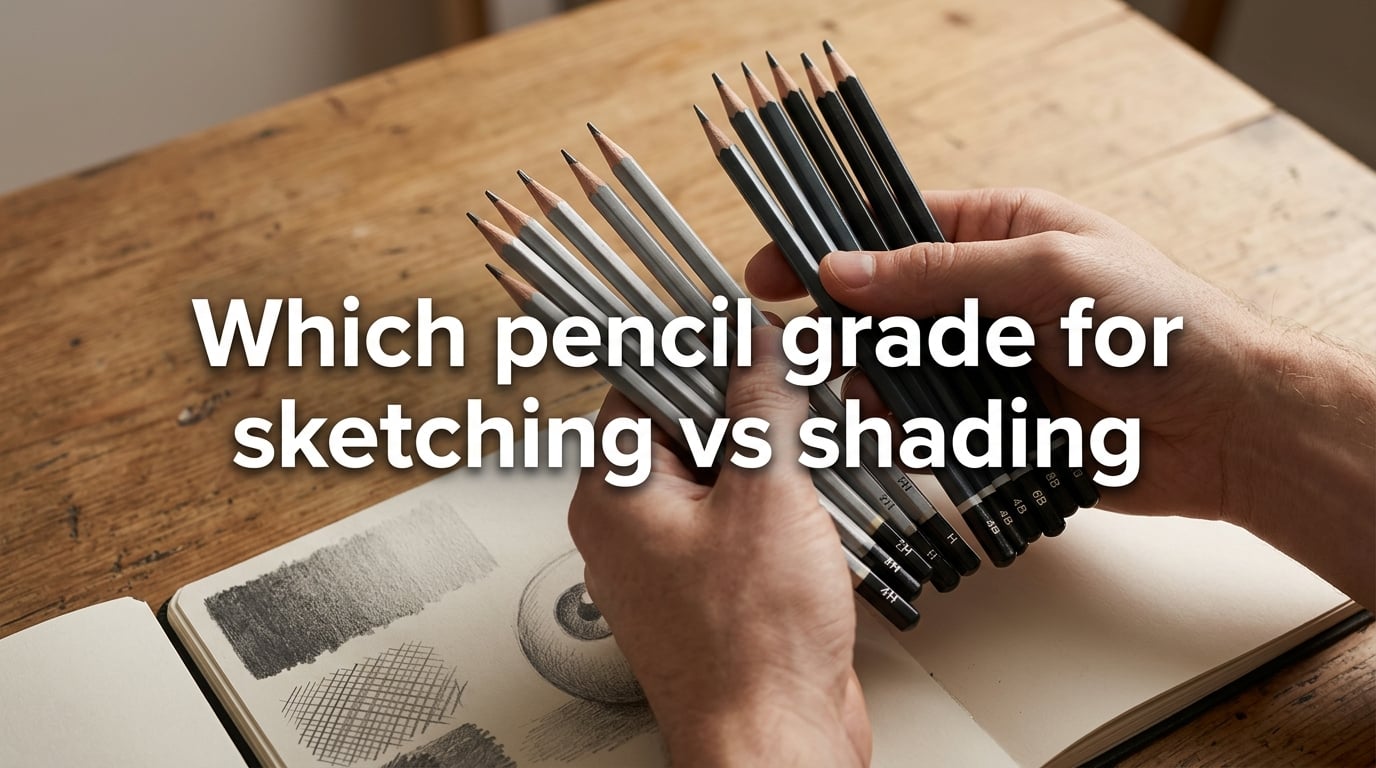
When I first started drawing, I grabbed whatever pencil was closest and hoped for the best. The result? Smudgy sketches with no dark values and shading that looked like flat gray patches. The problem wasn’t my technique — it was my pencil grade. If you’ve ever wondered which pencil grade for sketching vs shading actually matters, here’s the short answer: H pencils (hard) are best for sketching and light outlines, while B pencils (soft) are best for shading and dark values. HB sits in the middle as your versatile default. Understanding this one distinction transforms how your drawings look.
In this guide, I’ll walk you through the entire pencil grade scale, explain which grades to use at each stage of a drawing, and share the workflow that professional artists follow. By the end, you’ll know exactly which pencil to reach for — whether you’re laying down a light sketch or building deep, rich shadows.
Table of Contents
What Do Pencil Grades Mean?
Pencil grades are a classification system based on the ratio of graphite to clay inside the pencil’s core. More clay produces a harder pencil that makes lighter marks. More graphite produces a softer pencil that makes darker marks. This ratio is what determines a pencil’s grade on the H-to-B scale.
The letters actually stand for something specific:
- H = Hard — Higher clay content means these pencils hold a sharp point longer and leave lighter, finer lines.
- B = Blackness — Higher graphite content means these pencils lay down darker, richer marks with less effort.
- HB = Hard-Black — The midpoint of the scale. This is your standard writing pencil and a versatile drawing pencil.
- F = Fine point — Slightly harder than HB, it maintains a sharp tip well. Popular for technical drawing.
The numbers that precede the letter indicate the degree of that quality. A 2H pencil is harder and lighter than an H pencil. A 6B pencil is softer and darker than a 2B pencil. The full scale runs from 9H (hardest, lightest) through HB in the middle to 9B (softest, darkest).
The Complete Pencil Grade Scale
Here’s every pencil grade listed from hardest to softest. You don’t need to buy all of them — most artists work with a subset of five or six grades that cover the full tonal range.
- 9H, 8H, 7H, 6H — Very hard, very light. Used for technical drafting and very faint guidelines.
- 5H, 4H, 3H — Hard and light. Good for detailed line work and architectural sketches.
- 2H, H — Moderately hard. Ideal for initial sketch lines that erase cleanly.
- F, HB — The middle ground. HB is the most common drawing pencil; F holds a slightly finer point.
- B, 2B — Softening up. These are your go-to for mid-tones and gentle shading.
- 3B, 4B — Definitely soft. Great for building darker shadows and blending.
- 5B, 6B — Very soft and dark. These create deep, rich shadows with minimal pressure.
- 7B, 8B, 9B — Extremely soft. Best for the darkest areas of a drawing and expressive marks.
A helpful cheat sheet for quick reference:
| Grade Range | Mark Quality | Best For |
|---|---|---|
| 6H – 9H | Very hard, very light | Technical drawing, guidelines |
| 3H – 5H | Hard, light | Precise line work, architectural sketches |
| H – 2H | Moderately hard | Initial sketch lines, erasable outlines |
| F – HB | Medium, versatile | General drawing, mid-tones, writing |
| B – 2B | Soft, medium-dark | Mid-tone shading, gentle shadows |
| 3B – 6B | Very soft, dark | Deep shadows, blending, tonal modelling |
| 7B – 9B | Extremely soft, very dark | Darkest values, expressive marks |
Sketching vs Shading at a Glance
| Feature | Sketching | Shading |
|---|---|---|
| Best pencil grades | H, 2H, HB, F | 2B, 4B, 6B, 8B |
| Line quality | Fine, controlled, light | Broad, smooth, varied |
| Pressure needed | Light touch | Moderate to firm (with soft pencils) |
| Smudge risk | Low | High — work from light to dark |
| Primary purpose | Outline shapes, plan composition | Build tonal depth, create form and volume |
Best Pencil Grades for Sketching
For sketching, you want pencils that leave clean, light lines you can erase easily or draw over later. That means reaching for the H side of the scale.
H and 2H pencils are ideal for your initial sketch lines. They lay down faint marks that won’t smudge into your shading later. If you’re blocking in a composition — roughing out proportions, mapping where major shapes go — a 2H gives you the control you need without leaving heavy marks you’ll fight to erase.
HB pencils work well for refining a sketch once you’ve confirmed your proportions. They’re dark enough to see clearly but still easy to erase. Many artists use HB as their primary sketching pencil because it strikes a balance between visibility and erasability.
F pencils are a favorite for detailed sketching and technical drawing. They hold a fine point longer than HB, which makes them useful for architectural sketches, botanical illustration, or any work where precision matters. As one artist on r/drawing noted, “a 2H is great for initial sketch lines because it erases cleanly and doesn’t dirty the paper.”
Avoid reaching for B pencils to sketch. They leave marks that smudge easily and are harder to erase completely. Save those for the shading stage.
Best Pencil Grades for Shading
Shading is where the B pencils shine — literally. These soft, graphite-rich pencils lay down smooth, blendable marks that make it easy to build tonal depth.
2B is your starting point for shading. It’s soft enough to produce noticeable tonal variation but still controllable. Use it for light shadows and transitional tones between light and dark areas.
4B and 6B are the workhorses of shading. They produce rich, dark marks with moderate pressure and blend beautifully. For most shading work — portraits, still life, figure drawing — 4B and 6B give you enough range to create convincing three-dimensional form.
8B pencils and above are reserved for the deepest shadows and darkest accents. They lay down almost black marks with very little pressure, which makes them perfect for the final dark values that give a drawing its punch. Use them sparingly — once you go truly dark, it’s hard to lighten those areas without damaging the paper.
One technique worth knowing: use the side of the pencil lead, not the tip, when shading large areas. Artists on r/learntodraw recommend this approach because it produces smoother, more even tones without visible streak marks. The tip is for fine details and small shadows; the side covers broad areas faster and more evenly.
A Complete Sketching and Shading Workflow
The best drawings use multiple pencil grades in sequence. Here’s the workflow that professional graphite artists follow:
Step 1: Layout with 2H. Start with light, erasable lines to block in your composition. Place the major shapes, check proportions, and map out where your lightest and darkest areas will go. These lines will disappear into your shading later.
Step 2: Refine with HB. Once your proportions are correct, go over the sketch with HB to refine the details. This is where you add the specific contours and features that define your subject.
Step 3: Establish mid-tones with 2B. Begin shading with 2B to fill in the medium-value areas. This builds the foundation of your tonal range. Start light — you can always go darker.
Step 4: Build shadows with 4B and 6B. Layer darker grades on top of your mid-tones to create depth. As r/learntodraw users advise, “start with mid-tones (HB, 2B) and push the darks with 4B-6B only where you need true black.”
Step 5: Add dark accents with 8B. For the deepest shadows — under a chin, inside a nostril, the pupil of an eye — use 8B with deliberate pressure. These final dark values give your drawing its contrast and visual impact.
Common Mistakes to Avoid
I made most of these mistakes myself when I was learning. Save yourself the trouble:
Using H pencils for dark shading. H pencils simply can’t produce dark values, no matter how hard you press. Pressing harder only damages the paper and creates grooves. If you need darker tones, switch to a softer B pencil.
Skipping mid-tones and jumping straight to darks. Going from a light sketch to 6B shadows looks flat and harsh. The mid-tones (HB, 2B, 3B) are what create the smooth gradient that makes shading look natural.
Sweeping with long strokes. Beginners often shade with big, 1-centimeter strokes that leave visible streaks. Move the pencil only a millimeter or two per stroke and overlap your marks for smooth, even coverage.
Using soft pencils too early in the drawing. B-grade pencils smudge easily. If you use 4B before you’ve confirmed your sketch lines, those soft marks will smear into everything and make your drawing look muddy.
Pressing too hard with any pencil. Let the pencil do the work. Heavy pressure tears paper, creates grooves, and makes erasing nearly impossible. Build up tone gradually with layered strokes instead.
How Paper Choice Affects Your Pencil Grades
Paper matters more than most beginners realize. The surface you draw on influences which pencil grades perform best.
Smooth paper (hot-pressed, plate finish) works best with harder pencils (H through HB). The fine surface holds the subtle marks that hard pencils make, and you can achieve crisp, detailed line work. Soft pencils on smooth paper tend to slide and smear because there’s less tooth to grip the graphite.
Textured paper (cold-pressed, rough finish) pairs well with softer pencils (B range). The paper’s tooth catches and holds the graphite, allowing you to build rich, layered tones. Hard pencils on textured paper can skip over the ridges, leaving inconsistent marks.
For general drawing with a mix of sketching and shading, a medium-tooth paper gives you the best of both worlds. It has enough texture to grab soft pencil grades while still accepting clean lines from harder ones.
Frequently Asked Questions
Should I sketch with HB or 2B?
For sketching, HB is generally the better choice. It produces clear, visible lines that are easy to erase and won’t smudge into your shading later. 2B is softer and darker, which makes it better suited for shading and mid-tone work rather than initial sketch lines. If you sketch with 2B, be aware that those marks will be harder to erase and may smear when you start shading over them.
What pencil grade is best for shading?
2B through 6B pencils are the best grades for shading. Start with 2B for light shadows and transitional tones, then build up to 4B and 6B for deeper, richer shadows. For the darkest accents, use 8B. The B range pencils have more graphite content, which produces the smooth, blendable marks that create convincing tonal depth.
What are 2B, 3B, 4B, 5B, 6B pencils used for?
These are all soft graphite pencils used for shading and tonal work. 2B handles light shading and mid-tones. 3B is good for building darker mid-tones. 4B and 5B are versatile shading pencils for medium to dark shadows. 6B creates deep, rich shadows with minimal pressure. The higher the number, the softer and darker the pencil.
What does H and B mean on pencils?
H stands for Hard and B stands for Blackness. H pencils contain more clay, making them harder and lighter. B pencils contain more graphite, making them softer and darker. HB is the midpoint of the scale, equivalent to a standard writing pencil. The number before the letter indicates the degree — 4H is harder than 2H, and 6B is softer and darker than 2B.
Is 2B or HB better for sketching?
HB is better for sketching because it produces lighter, cleaner lines that erase easily. 2B is softer and leaves darker marks that are harder to remove. However, some artists prefer 2B for sketching because the darker lines are more visible — it depends on your drawing style and how much erasing you plan to do. If you sketch loosely and don’t erase much, 2B can work well.
What grade pencil is best for beginners?
Beginners should start with a set of five grades: 4H, 2H, HB, 2B, and 4B. These five pencils cover about 90 percent of drawing needs. HB handles sketching and general drawing, 2B and 4B handle shading, and 2H and 4H handle technical lines and light guidelines. You can add darker grades like 6B or 8B later as your skills develop.
Conclusion
Knowing which pencil grade for sketching vs shading to use comes down to understanding one simple principle: hard pencils (H range) give you control and light lines for sketching, while soft pencils (B range) give you smooth, dark marks for shading. HB sits in the middle as your versatile default. Start your drawing with a hard pencil for the outline, build your mid-tones with HB or 2B, and push your shadows darker with 4B through 8B. With just five grades — 4H, 2H, HB, 2B, and 4B — you have everything you need to create drawings with full tonal range and professional-looking depth.