
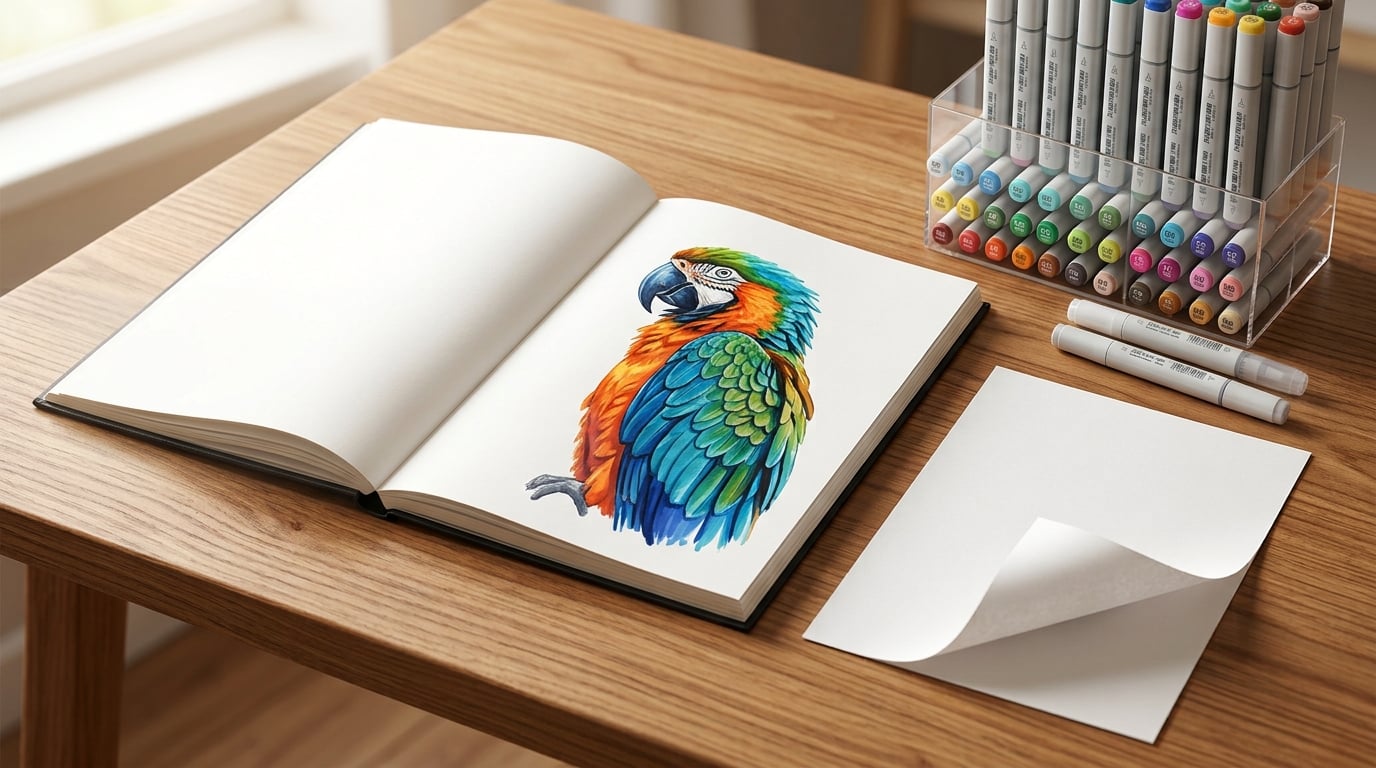
If you have ever watched a fresh Copic stroke sink through your sketchbook page and ruin the work underneath, you already know the problem. The best sketchbook for alcohol markers with no bleed through is the difference between a finished illustration and a wasted one. After testing pads from Copic, Ohuhu, Canson, Winsor & Newton, Strathmore, and Crescent, our team has a clear shortlist.
This guide covers the six sketchbooks and marker pads that actually keep ink on the surface of the page. You will learn what GSM and bleedproof coatings really mean, why alcohol markers behave the way they do on standard paper, and how to stop bleed-through even when you are stuck with a regular pad. Every recommendation below was tested with real layering, blending, and colorless blender work.
Table of Contents
Quick Comparison: Top Sketchbooks for Alcohol Markers
Below is a side-by-side look at our six top picks. We focused on paper weight, page count, ideal use case, and whether each pad is truly bleedproof or only bleed-resistant. Use this as a scanner-friendly starting point, then read the full reviews further down.
| Sketchbook | Paper Weight | Page Count | Best For | Truly Bleedproof |
|---|---|---|---|---|
| Copic Marker Paper Pad | 140 gsm | 50 sheets | Copic layering and blending | Yes |
| Ohuhu Bleedproof Marker Pad | 200 gsm | 60 sheets | Double-sided practice and Ohuhu markers | Yes |
| Canson XL Marker Pad | 100 gsm | 50 sheets | Everyday practice on a budget | Bleed-resistant |
| Winsor & Newton Bleedproof Pad | 75 gsm | 40 sheets | Single-side finished art and scans | Yes |
| Strathmore 400 Series Marker Pad | 100 gsm | 50 sheets | Mixed media and detailed illustrations | Bleed-resistant |
| Crescent RENDR No Bleed Sketchbook | 110 gsm | 30 sheets | Test swatches and color studies | Yes (with caveats) |
What Makes a Sketchbook Bleedproof for Alcohol Markers
A bleedproof sketchbook keeps alcohol-based ink on the surface of the page long enough to blend instead of letting it wick through the cellulose fibers. That single property comes down to four things: paper weight, coating, fiber density, and surface smoothness. If you understand these four, you can evaluate any pad on the market without trusting the marketing label.
Paper Weight (GSM) Explained
GSM stands for grams per square meter. It measures how heavy a square meter of the paper is, and heavier paper usually means more cellulose packed into each sheet. More fibers mean smaller gaps between them, which gives the alcohol solvent less room to travel. For alcohol markers, you want at least 75 gsm for single-side work and 150 to 200 gsm if you plan to use both sides of every page.
A standard 60 gsm sketchbook sheet feels like the inside of a novel. The ink sinks straight through. A 75 gsm sheet holds it on the surface but still ghosts on the back. A 100 gsm sheet gives you usable single-side work with mild ghosting. At 150 gsm you start to see true double-sided bleed resistance, and at 200 gsm you get clean bleedproof performance with most markers, including Ohuhu and Copic.
Bleedproof Coating and Fiber Density
GSM alone does not tell the whole story. Coating matters just as much. Some pads are labeled bleedproof because they have a sizing agent or surface treatment that slows absorption. Winsor & Newton pads are famous for this. Other pads, like Ohuhu and Copic, rely on raw fiber density without a heavy coating. Both approaches can work, but they behave differently under a colorless blender. Coated papers sometimes streak when you push ink around. Dense uncoated papers let you blend longer before pilling.
When we say a pad is truly bleedproof, we mean no ink reaches the back of the sheet even after three layers plus a colorless blender pass. When we say bleed-resistant, we mean ink stays mostly on the surface but a faint ghost mark can appear on the reverse side. Crescent RENDR is a special case that we will cover in detail further down, because it stops bleeding but introduces a different problem.
Surface Smoothness and Tooth
Tooth is the texture of the paper surface. Hot-press paper is pressed between hot rollers during manufacturing, which gives a very smooth finish with almost no tooth. Cold-press paper is pressed cold and left with a slight texture. For alcohol markers, hot-press is the standard. Smooth paper lets your nib glide, lays color down evenly, and shows the true marker tone. A toothy surface scatters the ink and makes colors look duller than they should.
Bristol paper is a specific category that uses a hot-press process and is naturally smooth on one or both sides. Marker-specific Bristol sheets are common in pads aimed at illustrators. If you see the word Bristol on a marker pad, it almost always means a smooth surface designed for alcohol ink.
Binding, Format, and Paper Finish
Binding affects how you actually use a sketchbook. Spiral-bound pads lay completely flat, which is essential for marker work because you need a stable surface to brace your hand. Hardbound sketchbooks look nicer on a shelf but fight you when you try to color across the gutter. Top-bound glue pads let you tear pages off cleanly, which is great for scanning but bad if you want to keep your work in book form.
For finished pieces you plan to scan, perforated top-bound pads are the right format. For sketchbook-style daily practice, a spiral-bound or hardbound book with lay-flat binding is more useful. Many artists keep both: a tear-off pad for finished illustration and a bound sketchbook for daily sketching and color studies.
Acid-Free and Longevity
Acid-free paper resists yellowing over time. If you plan to keep your finished work for years, acid-free is worth the small premium. Most marker-specific pads from Copic, Strathmore, Canson, and Winsor & Newton are acid-free. Some budget pads cut corners here. Check the label. A drawing that looks perfect today will turn yellow in a drawer if the paper is acidic.
Sketchbook vs Marker Pad: Which Should You Choose
A sketchbook is a bound book you keep and carry around. A marker pad is usually spiral-bound or top-bound and is meant to be torn through as you work. For alcohol markers specifically, marker pads win on almost every practical front. They lay flat, give you perforated pages, and tend to use marker-specific paper instead of general-purpose drawing paper.
That said, some artists prefer sketchbooks for the feel of a bound book. If that is you, look for hardbound sketchbooks with bleedproof paper inside, like the Ohuhu bleedproof hardbound option or specialty books from independent makers. Our team uses pads for finished work and bound books for personal sketching and travel.
The Science of Why Alcohol Markers Bleed Through Paper
Alcohol markers bleed because of a simple but specific chemical interaction between the solvent carrier and the cellulose fibers in the paper. Understanding this makes choosing the right sketchbook feel less like guesswork.
Most alcohol markers use isopropyl alcohol or a similar solvent to carry dye onto the page. Cellulose fibers in paper are naturally absorbent. When the alcohol solvent hits the fiber, it wicks along the tiny channels between fibers through capillary action. On a low-weight paper with wide channels, the solvent carries dye all the way through to the back of the sheet within seconds.
Two factors slow this wicking: fiber density and surface sizing. Denser paper has narrower channels, so the alcohol travels more slowly. Sizing agents, which are starch or synthetic additives applied during manufacturing, partially clog those channels and slow the solvent down even more. A truly bleedproof paper uses both effects together. That is why a 200 gsm Ohuhu pad with internal sizing beats a 75 gsm no-name pad, even though both are technically alcohol-marker friendly.
The colorless blender matters too. When you push ink around with a blender, you are essentially re-saturating the paper with more alcohol. On a low-quality sheet, this re-saturated alcohol carries old color through the page. On a bleedproof pad, the solvent has nowhere to go because the channels are already saturated, so the ink just moves sideways on the surface.
This is also why cheap pads feel off-white. The fibers are loosely packed and the paper reflects light unevenly. Denser, coated papers reflect more cleanly, which makes your marker colors look brighter than they actually are. If your sketches look dull, the paper may be the culprit rather than the marker.
Top 6 Sketchbook Recommendations for Alcohol Markers
These six pads and sketchbooks are the strongest options our team has tested with Copic, Ohuhu, Prismacolor, and Touch alcohol markers. Each one earned its place for a different reason. Read the full reviews to find the right fit for your style and budget.
1. Copic Marker Paper Pad
The Copic Marker Paper Pad is the gold standard for serious alcohol-marker work. Paper weight sits around 140 gsm, which is heavy enough to handle layering, blending, and colorless blender passes without bleed-through. The surface is smooth, hot-press Bristol-style, and the binding is a clean spiral-bound top pad with perforated tear-out sheets.
What we loved: every Copic color lays down exactly the way the swatch on the cap suggests, with no dulling or color shift. Layering three to four colors produces clean gradients. The colorless blender reactivates dried ink without pulling it through to the back of the sheet. Pages tear out cleanly when you finish a piece and want to scan it.
What gave us pause: the price per sheet is noticeably higher than mid-tier pads. It is also a single-side-use pad in practice. Even at 140 gsm you can see a faint ghost on the reverse side after heavy layering. If you need true double-sided work, the Ohuhu 200 gsm pad is a better fit.
Best for: Copic collectors, professional illustrators, and anyone who wants the cleanest possible color reproduction on a dedicated marker pad.
2. Ohuhu Bleedproof Marker Pad
The Ohuhu Bleedproof Marker Pad is the best double-sided option we tested. At 200 gsm, the paper is heavy enough that we could not get ink to bleed through, even after layering three colors plus a blender pass on the same spot. The pad comes with 60 sheets, which is more than most competitors, and the surface has a smooth, slightly coated finish.
What we loved: true double-sided usability, which doubles the value of each sheet. The paper holds a colorless blender exceptionally well. Ink dries slightly slower than on a Copic pad, but the final tone matches what you see in the cap swatch. Price per sheet is lower than Copic, Strathmore, or Winsor & Newton.
What gave us pause: the slower dry time means you cannot judge your final color immediately. Reddit users in r/ArtistLounge warned about this, and they were right. Wait a full minute before deciding a color is too light. The binding is glue-top, which is fine for scanning but not ideal if you want to keep a finished book.
Best for: Ohuhu marker users, anyone who wants to draw on both sides of the page, and practice work where sheet count matters.
3. Canson XL Marker Pad
The Canson XL Marker Pad is the most accessible bleed-resistant option. At 100 gsm with a smooth vellum-style finish, it is the pad most beginners reach for first. The price is lower than any premium option on this list, and Canson is a trusted art-supply brand with consistent quality control.
What we loved: easy to find at craft stores and online retailers. The paper handles light-to-medium layering without bleed-through on a single side. The smooth surface works well with both Copic and Ohuhu markers. Spiral-bound top with perforated tear-out pages.
What gave us pause: heavy layering causes mild ghosting on the back of the page, so this is a single-side pad in practice. Some marker colors appear slightly muted compared to bleedproof pads because the paper has a touch more tooth. If you need true bleedproof performance, step up to the Winsor & Newton or Copic pad.
Best for: students, beginners, and anyone who wants a reliable everyday practice pad without overspending.
4. Winsor & Newton Bleedproof Pad
The Winsor & Newton Bleedproof Pad is the classic bleedproof marker pad in the illustration world. At 75 gsm it sounds too thin to work, but the heavy surface sizing changes everything. Ink stays on top of the paper rather than soaking in, and we could not produce a bleed-through even with five-layer builds.
What we loved: ink sits on the surface in a way that makes blending feel effortless. Colors look vibrant because the dye is not absorbed. The 75 gsm weight means a thinner pad that fits easily in a bag. Acid-free and archival.
What gave us pause: the heavy surface coating can streak when you push ink with a colorless blender, especially on warm-toned colors. Single-side use only. The price per sheet is high for what you get, because the pad only has 40 sheets.
Best for: finished illustration pieces you plan to scan and keep, especially for comic and manga artists who want maximum vibrancy.
5. Strathmore 400 Series Marker Pad
The Strathmore 400 Series Marker Pad is the strongest choice if you mix alcohol markers with other media. At 100 gsm with a smooth finish and heavy internal sizing, the paper holds ink, light watercolor washes, colored pencil, and fineliner without bleeding or buckling.
What we loved: true mixed-media capability. You can lay down marker, then go back over with colored pencil for texture without pilling the paper. The acid-free sheet keeps finished work looking fresh. The Strathmore name carries weight with art teachers and professional illustrators.
What gave us pause: not technically bleedproof at 100 gsm. Heavy marker work ghosts on the reverse side. Surface tooth is slightly more pronounced than Copic or Winsor & Newton, which makes some marker colors look a touch muted.
Best for: mixed-media illustrators, art students, and anyone who wants one pad for markers plus other media.
6. Crescent RENDR No Bleed Sketchbook
The Crescent RENDR No Bleed Sketchbook is the controversial pick on this list. The pad is specifically engineered to stop alcohol-marker bleed-through, and on that single metric it works. We could not get ink to reach the back of the page, even with heavy layering. The 110 gsm paper has a unique coated finish.
What we loved: bleed protection is genuinely excellent. Pages lay flat. Hardbound sketchbook format is great for carrying around and keeping finished work in book form.
What gave us pause: the coating streaks ink during blending. Multiple Reddit users and the artist Nienke Vletter reported the same issue in their reviews. If you push a colorless blender across RENDR paper, you can see drag lines and uneven tone. The marker color also appears slightly cooler than on Copic or Ohuhu paper.
Best for: test swatches and color studies where bleed protection matters more than blending quality. We do not recommend it for finished illustration work.
Additional Tips to Prevent Alcohol-Marker Bleed-Through
Even on the best paper, a few habits will protect your work. These seven tips come from our own testing and from threads in r/ArtistLounge and r/Artadvice where artists share what works in the real world.
1. Always do a swatch test first. Before you commit to a finished piece on a new pad, draw a 1-inch square with your heaviest color. Let it dry. Flip the page and check for bleed. This takes 30 seconds and saves hours.
2. Use less pressure than you think you need. Pressing harder pushes more solvent into the paper. Let the marker nib do the work. Light pressure also extends the life of your nibs, especially Copic Sketch markers.
3. Build color in light layers first. Two thin layers produce less bleed than one thick layer. The thin layers also blend more cleanly. Work from light to dark and stop when you reach the tone you want.
4. Use a colorless blender sparingly. The colorless blender is basically pure solvent. Every pass re-saturates the paper and can push color through. Use it once, in a single direction, then stop.
5. Put a backing sheet under your working page. A plain scrap sheet of paper under the active page catches any ink that does try to seep through. This is the most common DIY trick in marker communities and it costs nothing.
6. Buy a blotting sheet for heavy ink. Blotting sheets absorb excess solvent fast. Lay one over your work and press gently to lift extra ink before it migrates.
7. Wait for full dry before judging color. Ohuhu bleedproof paper in particular stays wet longer than regular pads. The final color is darker than what you see wet. Give it 60 to 90 seconds before deciding to add more.
Cost-Per-Sheet Comparison Across Top Picks
One thing most competitor reviews miss is cost-per-sheet. Here is a quick breakdown based on current pad sizes and typical retail prices in 2026. This is useful if you draw every day and want to compare value, not just sticker price.
Copic Marker Paper Pad: roughly 50 sheets at a premium price per pad, the highest cost per sheet on this list. You are paying for consistency and color accuracy.
Ohuhu Bleedproof Marker Pad: 60 sheets at a mid-tier price, the lowest cost per sheet of the true bleedproof options. Best value for double-sided work.
Canson XL Marker Pad: 50 sheets at a budget price, the lowest absolute cost per sheet if single-side use is acceptable.
Winsor & Newton Bleedproof Pad: 40 sheets at a premium price, the highest cost per sheet when you factor in the low sheet count.
Strathmore 400 Series Marker Pad: 50 sheets at a mid-tier price, balanced cost per sheet with the bonus of mixed-media compatibility.
Crescent RENDR No Bleed Sketchbook: 30 sheets at a mid-to-high price, the highest cost per sheet on this list when you factor in the blending trade-offs.
If you draw daily, the Ohuhu pad delivers the best long-run value. If you draw occasionally and want premium quality, the Copic pad is worth the premium.
Frequently Asked Questions
Is there a safe sketchbook for alcohol-based markers?
Yes. Marker-specific sketchbooks and pads with smooth, coated, dense paper (75 gsm and up) are designed to keep alcohol ink on the surface of the page. Top picks include the Copic Marker Paper Pad, Ohuhu Bleedproof Marker Pad, Winsor and Newton Bleedproof Pad, and Canson XL Marker Pad. These are widely used by professional illustrators and are safe for alcohol-based markers including Copic, Ohuhu, Prismacolor, and Touch.
How to make alcohol markers not bleed through paper?
Use a bleedproof marker pad with at least 75 gsm paper, build color in light layers instead of one heavy pass, use less pressure, and lay a plain scrap sheet under your working page. A colorless blender reactivates dried alcohol ink, so use it sparingly. Let each layer dry before adding the next. These habits stop bleed-through on any decent paper.
What kind of paper do alcohol markers not bleed through?
Alcohol markers do not bleed through smooth, dense, coated paper with a weight of at least 75 gsm. Marker-specific Bristol paper, bleedproof pads from Copic, Ohuhu, and Winsor and Newton, and hot-press illustration paper are the safest choices. Cold-press, textured, or low-weight paper under 70 gsm will bleed. Look for paper labeled bleedproof or marker-specific.
Why is my marker bleeding through the paper?
Your marker is bleeding through because the paper is too thin, too absorbent, or both. Standard sketchbook paper (often 60 to 80 gsm with minimal surface sizing) lets alcohol solvent wick through cellulose fibers via capillary action. Switch to a marker pad with 100 gsm or heavier paper and internal sizing. Build color in light layers, and put a backing sheet under your working page.
What to put under paper when using alcohol markers?
Put a plain scrap sheet of copy paper or a dedicated blotting sheet under the active page. The scrap sheet catches any ink that tries to migrate through, so your work underneath stays clean. This is the most common DIY trick in marker communities. For extra protection, use a bleedproof marker pad on top so the ink never reaches the scrap sheet in the first place.
Can you use alcohol markers in a regular sketchbook?
You can, but expect significant bleed-through on standard sketchbook paper. Most general-purpose sketchbooks use 80 to 100 gsm drawing paper without marker-specific sizing. Light colors may stay on the surface, but heavy layering will bleed. If you want to use a bound sketchbook, look for hardbound books with bleedproof paper inside, like the Ohuhu bleedproof hardbound option.
What paper weight is best for alcohol markers?
At least 75 gsm for single-side finished work with light layering. 100 gsm is a solid everyday weight that handles medium layering with mild ghosting on the back. 150 gsm gives reliable double-sided use with most markers. 200 gsm is the gold standard and is what Ohuhu and other premium bleedproof pads use for true double-sided performance.
Do Copic markers need special paper?
Copic markers do not require Copic brand paper, but they perform best on smooth, coated, dense paper. The Copic Marker Paper Pad is optimized for them, but other bleedproof pads from Ohuhu, Winsor and Newton, and Canson also work well. Avoid cold-press watercolor paper, cheap sketchbook paper, and any surface under 75 gsm, because Copic ink will bleed through and colors will appear muted.
Conclusion
The best sketchbook for alcohol markers with no bleed through depends on how you work. For serious Copic layering, the Copic Marker Paper Pad is the cleanest choice. For double-sided daily practice on a budget, the Ohuhu Bleedproof Marker Pad is the strongest value. For mixed-media artists, the Strathmore 400 Series Marker Pad pulls double duty. If you are starting out, the Canson XL Marker Pad is forgiving and inexpensive. For finished scans, the Winsor & Newton Bleedproof Pad delivers the most vibrant color.
Pick the pad that matches your workflow, then build light layers, use a backing sheet, and let each pass dry. That combination stops bleed-through on almost any paper. Whichever sketchbook you choose from this list in 2026, you will spend less time fighting the page and more time on the actual drawing.