
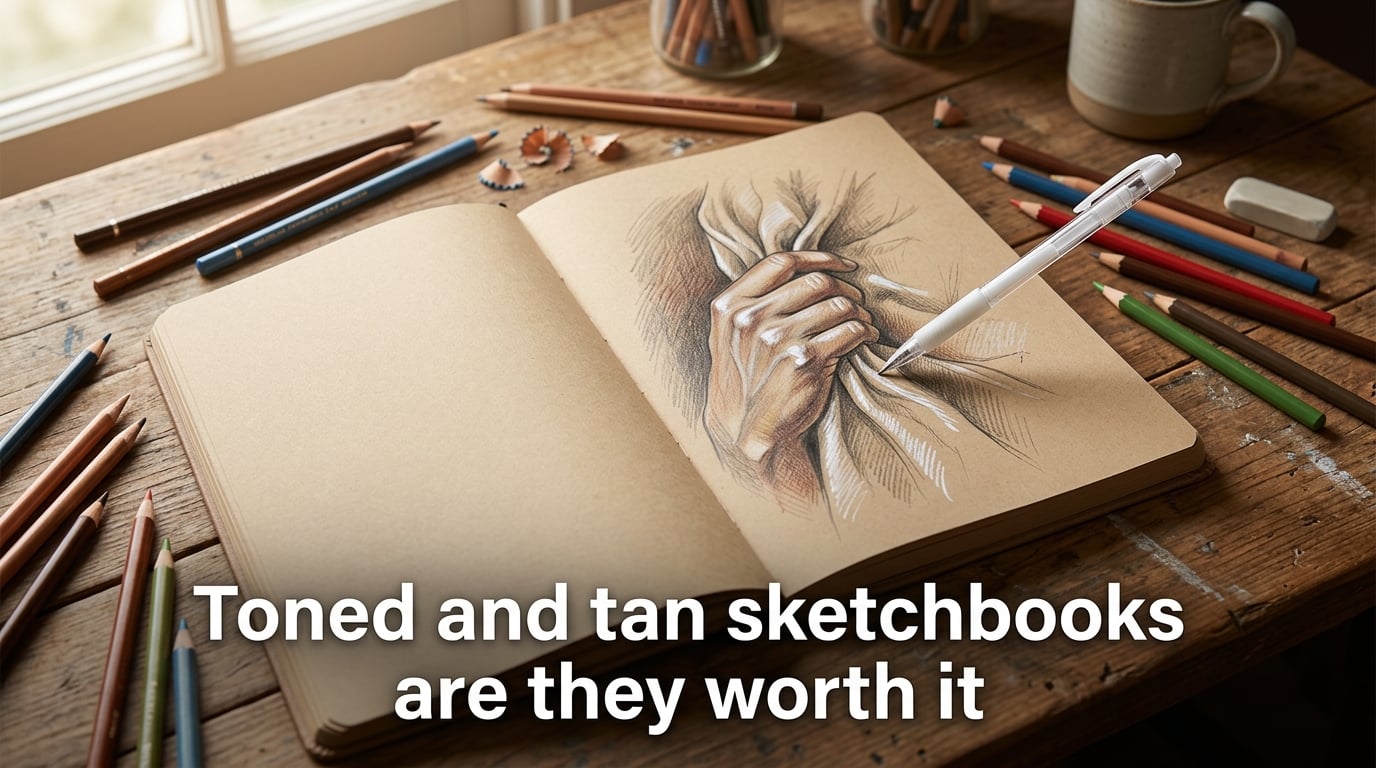
Toned tan sketchbooks are absolutely worth trying if you work with colored pencils, markers, ink, or any medium where you want highlights to pop. The tan paper acts as a built-in midtone, cutting your value range work in half and making white subjects dramatically easier to draw. If you’ve ever struggled with preserving white areas on traditional paper, a toned sketchbook could change how you approach your art.
Table of Contents
What Is a Toned Tan Sketchbook?
A toned tan sketchbook is a sketchbook with pre-colored beige or tan pages instead of the standard bright white. The tan color functions as a midtone—a middle value between pure white and pure black. This gives you a head start on your drawing’s tonal range.
Instead of starting on a white page and needing to build up every value from light to dark, you start in the middle. You push shadows darker and pull highlights lighter from that starting point. The result? Faster drawings with a more natural tonal balance.
The concept isn’t new—Renaissance artists used toned paper for figure studies centuries ago. What’s changed is accessibility. Brands like Strathmore, Stillman and Birn, and Hahnemuhle now offer pre-toned sketchbooks in multiple formats, sizes, and paper weights. You don’t have to wash your own pages anymore.
Are Toned Tan Sketchbooks Worth It? Here’s the Verdict
Yes, toned tan sketchbooks are worth it for most intermediate and advanced artists, especially those working in dry media or mixed media. They save time by providing a ready-made midtone, make white and reflective subjects easier to render, and reduce the intimidation factor of a blank white page. They’re less ideal for pure watercolorists (without upgrading to heavier mixed media paper) and for absolute beginners who prefer maximum forgiveness on white surfaces.
The “worth it” question really comes down to what you draw and how you work. If you regularly sketch portraits, still life with reflective objects, or marker illustrations, you’ll likely find toned tan becomes a regular part of your rotation. If you only do pencil sketches or watercolor washes on white paper, the benefit is smaller.
Why Artists Love Toned Tan Sketchbooks
Artists who switch to toned tan paper tend to rave about several consistent benefits:
1. The midtones are already there. This is the biggest advantage. You don’t have to render every value yourself. The page color IS your midtone, so you only need to add the darkest darks and lightest lights. This cuts rendering time significantly and helps achieve tonal balance more intuitively.
2. White highlights pop instantly. A white gel pen or opaque white marker on tan paper creates a luminous, glowing effect that’s almost impossible to replicate on white paper. As one artist on r/ArtistLounge put it: “It’s unbelievable how much the drawings pop just from drawing the light with the white pencil. Drawing reflective surfaces and glass especially is so much fun.”
3. It’s less intimidating than white paper. A blank white page can feel paralyzing. Toned tan feels more forgiving and less precious. You’re more likely to experiment and take risks when the stakes feel lower. Many artists describe it as “dark mode” for sketching.
4. White and reflective subjects become easy. Snow scenes, glass objects, metallic surfaces, white flowers—these are notoriously difficult on white paper because you have to preserve the white. On toned tan, you draw these subjects positively with a white tool. It flips the entire process.
5. Colored pencils look richer. The warm tan base makes colors appear more vibrant and saturated compared to white paper. Prismacolor, Derwent, and Faber-Castell pencils all perform well on toned surfaces. Multiple forum users confirm: “Tan toned is better for portraits and color.”
6. Pencil erases cleanly. This surprised us in testing. Graphite erases from quality toned paper without leaving scuffs or ghost marks—a detail that makes correction easier than many beginners expect.
The Drawbacks You Should Know Before Buying
Toned tan sketchbooks aren’t perfect. Here are the honest downsides:
1. They cost more per page. You’ll pay a premium compared to standard white sketchbooks. This is the most common hesitation we see from price-sensitive artists. The value calculation depends on how much you use them.
2. The 118gsm paper bleeds with markers. The standard Strathmore 400 Series toned paper (118gsm) handles dry media beautifully but struggles with heavy marker use. Copic and alcohol-based markers will bleed through. You need to keep scrap paper underneath. If you’re a heavy marker user, the 300gsm mixed media version is a better (but pricier) choice.
3. They’re harder to find in stores. White sketchbooks are everywhere. Toned tan options are usually limited to art supply stores or online retailers. If you need one today, you might be out of luck locally.
4. Watercolor requires the mixed media upgrade. Standard 118gsm toned paper can’t handle wet media without buckling. For watercolor or gouache, you need the heavier 300gsm mixed media version. That’s a separate product at a higher price point—not a one-size-fits-all solution.
5. Limited color range. You’re choosing between tan and gray. That’s it. If you want a custom-toned page (blue, green, warm ochre), you’ll need to wash your own pages or use tinted gesso. Pre-toned options are limited.
What Media Work Best on Toned Tan Paper?
Not all media perform equally on toned surfaces. Here’s what works best:
Graphite pencils work well for sketching and shading. The gray tones blend naturally with the tan midtone. HB through 6B pencils all perform well.
Colored pencils are the sweet spot for toned tan. Prismacolor Premier, Derwent Coloursoft, Faber-Castell Polychromos, and Caran d’Ache Luminance all layer beautifully. The warm paper base makes colors appear richer than on white.
White gel pens and opaque white markers are the secret weapons. Uni-ball Signo, Sakura Gelly Roll, and Winsor and Newton white pigment markers create brilliant highlights that glow against the tan background. This is the effect artists rave about most.
India ink and pigment liners like Pitt Pens and Staedtler Pigment Liners work well for line work. The contrast between black ink and tan paper is crisp and satisfying. Many comic artists use toned paper for inking practice.
Markers (with caution) can work on the heavier 300gsm mixed media paper. On the standard 118gsm, expect bleed-through. Always test on a back page first and keep scrap paper underneath.
Gouache handles beautifully on 300gsm mixed media toned paper for opaque highlights and corrections. It’s less predictable on the thinner 118gsm stock.
Toned Tan vs Toned Gray: Which Should You Pick?
The choice between tan and gray depends on your primary medium and subject matter.
Toned tan works best for colored work—portraits, color pencil illustrations, marker art, and any subject with warm tones. The warm beige base complements skin tones, earth tones, and saturated colors. If you work primarily in color, start with tan.
Toned gray works best for black-and-white studies, graphite work, and subjects with cool tones. The neutral gray is more forgiving for value studies because it doesn’t introduce a warm cast. If you focus on graphite portraits or monochromatic ink work, gray may serve you better.
Both share the same core benefits (midtone advantage, white highlight pop, reduced intimidation). The difference is the color temperature of the paper itself. Many artists eventually keep both in rotation for different purposes.
Strathmore 400 Series Toned Tan: The Most Popular Option
Strathmore dominates the toned sketchbook market, and for good reason. The 400 Series is the most widely recommended option in forums and artist communities.
The dry media version (118gsm) is the standard choice for pencil, colored pencil, and light ink work. It comes in hardbound, softcover, and wire-bound formats. The paper is smooth with a slight tooth that grabs pigment nicely. Pencils erase cleanly. This is the version most artists try first.
The mixed media version (300gsm) is heavier and handles wet media—watercolor, gouache, heavy marker use—without significant buckling. It costs more, but if you want versatility, this is the one to get. Strathmore offers it in both gray and tan.
Stillman and Birn Nova offers a toned option that some artists prefer for its smoothness, though the paper is thinner. Hahnemuhle and Clairefontaine also make toned papers in pad form. For sketchbooks specifically, Strathmore remains the default recommendation.
Who Should Buy a Toned Tan Sketchbook (And Who Should Skip)
Buy one if you:
- Work primarily in colored pencils, markers, or ink
- Draw portraits, reflective objects, or white subjects frequently
- Want to practice value studies without building every tone from scratch
- Feel intimidated by blank white pages and want a more forgiving surface
- Enjoy adding white highlights with gel pens or opaque markers
Skip it if you:
- Work exclusively in watercolor and don’t want to buy the heavier mixed media version
- Prefer maximum flexibility to create any background color you want
- Are an absolute beginner who wants the most forgiving, universal surface possible
- Draw primarily in graphite and don’t need the midtone advantage
- Are on a tight budget and can’t justify the per-page cost premium
Try Before You Buy: A DIY Test With Household Items
Before investing in a toned sketchbook, you can test the concept for free. Grab some household materials in a similar tan or brown tone:
Brown paper bags from the grocery store are surprisingly good test surfaces. Cut them open, flatten them, and sketch with a white pencil or gel pen. You’ll immediately feel the midtone advantage.
Kraft paper and cardboard work similarly. The texture is rougher than a proper sketchbook, but the principle is the same—you’re drawing on a midtone and adding lights and darks.
Manila folders or envelopes offer a smoother test surface. Great for pencil and ink work if you want to simulate the feel of toned paper more closely.
This 10-minute test will tell you more about whether toned paper suits your workflow than any article can. If you enjoy the experience, invest in a proper sketchbook. If it feels wrong, you saved yourself the cost.
Toned Tan for Watercolor: What You Need to Know
Standard toned tan paper (118gsm) cannot handle watercolor. It will buckle, warp, and potentially disintegrate. This is the single biggest confusion point for artists considering toned sketchbooks.
For watercolor or gouache on toned paper, you need the 300gsm mixed media version. Strathmore offers this in both gray and tan. The heavier paper absorbs water without significant warping. Stillman and Birn’s Nova series is another option, though some artists find it too thin for heavy washes.
One unique benefit of toned paper for watercolorists: it forces you to practice negative painting (painting around your subject rather than painting the subject itself). This builds a valuable skill that transfers to white paper work.
5 Beginner Mistakes to Avoid on Toned Paper
1. Overworking the highlights. It’s tempting to keep adding white, but toned paper rewards restraint. Lay down your highlights confidently and leave them. Over-blending white on toned paper creates muddy, chalky areas.
2. Ignoring the paper weight. If you’re using 118gsm paper, don’t expect it to handle markers or wet media. Test on a back page first. Scrap paper underneath is mandatory for marker work.
3. Not testing your eraser first. Most quality toned papers erase cleanly, but not all. Test your eraser on a corner page before committing to a full drawing. Kneaded erasers are generally gentler than vinyl erasers on toned surfaces.
4. Expecting white paper behavior. Toned paper is a different workflow. You can’t lift highlights the same way. You can’t glaze the same way. Approach it as a new medium, not just a different color paper.
5. Skipping the try-before-you-buy test. We mentioned this above, but it bears repeating. Five minutes with a brown paper bag and a white pencil will tell you if the concept resonates with your style before you spend money on a sketchbook.
Frequently Asked Questions
What are toned tan sketchbooks good for?
Toned tan sketchbooks are good for colored pencil portraits, marker illustrations, ink sketches with white highlights, and drawing reflective or white subjects like glass, metal, and snow. The tan paper acts as a midtone, saving you rendering time and making highlights pop with white gel pens or opaque markers.
Which sketchbook is considered the best quality?
Strathmore 400 Series is the most widely recommended toned sketchbook for quality and availability. The 118gsm version handles dry media beautifully, while the 300gsm mixed media version supports watercolor and gouache. Stillman and Birn Nova is another respected option, particularly for artists who prefer a smoother paper surface.
Is Strathmore toned tan good for colored pencils?
Yes, Strathmore toned tan is excellent for colored pencils. The warm tan base makes colors appear richer and more vibrant than on white paper. Prismacolor Premier, Derwent Coloursoft, and Faber-Castell Polychromos all perform well on Strathmore’s 118gsm toned paper. Pencils also erase cleanly without leaving scuffs.
Why do artists use toned paper?
Artists use toned paper because it provides a built-in midtone, cutting the rendering work in half. Instead of building every value from white, you start in the middle and add darks and lights. This saves time, produces more balanced tonal work, and makes drawing white or reflective subjects dramatically easier with white highlights.
What is toned tan paper?
Toned tan paper is paper that has been pre-colored with a beige or tan shade instead of being left white. The tan color acts as a midtone between white and black, allowing artists to add both dark shadows and light highlights from a middle starting point. It comes in various weights, from 118gsm for dry media to 300gsm for mixed media work.
Final Thoughts: Should You Switch to Toned Tan?
Toned tan sketchbooks are worth it for most artists working in dry media who want to save time on value rendering and make white highlights pop. The midtone advantage is real—once you try it, you’ll understand why so many artists keep toned paper in regular rotation.
If you’re curious but hesitant, start with the DIY test: grab a brown paper bag and a white pencil. Five minutes of sketching will tell you if the concept fits your workflow. If it clicks, pick up a Strathmore 400 Series in the size that suits you. If you work with markers or wet media, go straight for the 300gsm mixed media version to avoid bleed-through frustration.
The best toned tan sketchbook for you depends on your medium, your subjects, and your budget. But for colored pencil artists, ink sketchers, and anyone who draws reflective surfaces regularly, toned tan paper isn’t just worth trying—it might become your favorite surface.