
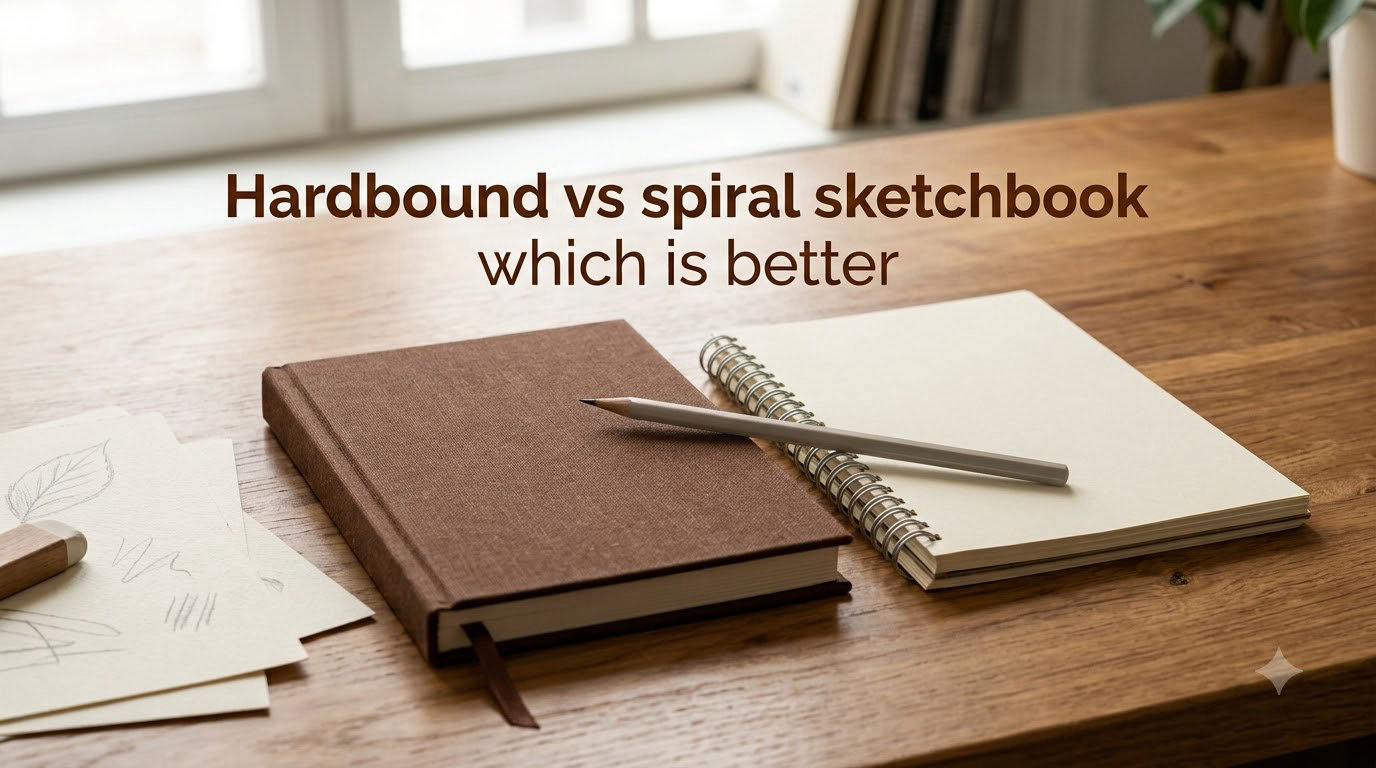
Choosing between a hardbound vs spiral sketchbook is one of those decisions every artist faces early on. Both binding types have passionate defenders, and the right choice depends entirely on how and where you draw. I’ve spent years using both styles in studios, classrooms, and out in the field, and the differences matter more than most beginners expect.
This guide breaks down exactly what sets these two sketchbook types apart—from construction and durability to portability and paper compatibility. By the end, you’ll know which binding fits your practice, your medium, and your lifestyle.
Table of Contents
What Is a Hardbound Sketchbook?
A hardbound sketchbook—also called case-bound—uses rigid board covers and sewn or glued page signatures. Pages are stitched together into sections, then attached to stiff front and back covers with a reinforced spine. Think of how a traditional novel is made.
The result is a book that feels substantial in your hand. The covers protect pages from bending, warping, and moisture far better than soft covers. Many hardbound sketchbooks include an elastic closure band, a ribbon bookmark, and sometimes a back pocket for storing loose reference materials.
Popular hardbound sketchbook brands include Moleskine, Leuchtturm1917, Stillman and Birn, and Hahnemühle. These tend to feature acid-free, archival-quality paper—often in the 120–200 gsm range—designed to last decades without yellowing.
What Is a Spiral-Bound Sketchbook?
A spiral-bound sketchbook uses a continuous wire or plastic coil threaded through punched holes along the page edges. This allows the pages to rotate a full 360 degrees around the binding and lay completely flat—or fold all the way back on themselves.
You’ll hear them called wire-bound or coil-bound as well. The construction is simpler than hardbound: pages are punched, threaded through a single coil, and usually paired with stiff but not rigid covers. Some spiral books have a hard front cover with a thinner back.
Strathmore, Canson, and Fabriano all offer popular spiral-bound options. These sketchbooks typically range from 65–150 gsm, with specialized versions for watercolor paper reaching 200–300 gsm. Many include perforated pages for clean removal.
Hardbound Sketchbook: Pros and Cons
Advantages of Hardbound Sketchbooks
Durability that lasts years. Hardbound sketchbooks survive backpacks, travel abuse, and daily flipping far better than spiral alternatives. The rigid covers act as a protective shell, preventing pages from dog-earing or bending during transport.
Archival quality. Most hardbound books use acid-free paper designed to resist yellowing for decades. Artists who keep sketchbooks as visual diaries or portfolio pieces value this longevity—your work stays intact for years.
Premium feel. There’s something satisfying about sketching in a well-made hardbound book. The weight, the cover texture, the stitching—it all adds up to an experience that makes you want to draw.
Built-in features. Elastic closures, ribbon bookmarks, and pen loops are standard on most hardbound models. These small details matter when you’re using a sketchbook daily.
Disadvantages of Hardbound Sketchbooks
They resist laying flat. Despite marketing claims, most hardbound books don’t lay perfectly flat—especially when new. You’re fighting the spine, and working into the gutter (the center crease) often produces distorted lines or missing details.
Weight and bulk. Hardbound sketchbooks are heavier than spiral alternatives of the same page count. A 9×12 hardbound book can weigh significantly more than its spiral counterpart, which matters for travel and plein air work.
Spine interference with drawing. The rigid spine creates a raised area that disrupts pencil and brush strokes when working across the center spread. This is the single most common complaint from hardbound users.
Higher cost. Quality hardbound sketchbooks cost more than comparable spiral options. The construction is more labor-intensive, and that premium gets passed to you.
Spiral-Bound Sketchbook: Pros and Cons
Advantages of Spiral-Bound Sketchbooks
True lay-flat performance. Spiral books open completely flat with zero spine resistance. You can work across the full spread without the gutter interfering with your lines. For detailed work or large compositions, this is a game-changer.
360-degree fold-back. You can fold the cover and completed pages entirely behind the current working surface. This reduces the book’s footprint dramatically—perfect for cramped desk spaces, classroom tables, or outdoor painting where you’re balancing on a knee.
Easy page removal. Perforated pages let you tear out finished work cleanly for framing, scanning, or display. Hardbound books rarely offer this option without damaging the binding.
More affordable. Spiral sketchbooks cost less to manufacture, which means you pay less. For students, beginners, or anyone who burns through sketchbooks quickly, this adds up over time.
Better for left-handed artists. The fold-back ability eliminates the hand-on-binding discomfort that left-handed artists struggle with in hardbound books.
Disadvantages of Spiral-Bound Sketchbooks
Coil snagging. Metal wire ends catch on bag interiors, clothing, and other materials. Pulling a spiral sketchbook out of a tight backpack often results in a frustrating snag-and-tug sequence.
Coil warping and bending. Over time, the wire coil deforms—especially with heavy use or rough transport. Bent coils cause pages to sit unevenly and can scratch surfaces.
Less durable overall. The binding itself wears out faster than hardbound stitching. Pages can tear free from the coil, and the cover offers less protection against crushing forces in packed bags.
Drawing interruption at the coil. The raised coil creates a physical barrier between facing pages. Continuing a drawing across the binding gap is impractical with spiral books.
Hardbound vs Spiral Sketchbook: Side-by-Side Comparison
| Feature | Hardbound | Spiral-Bound |
|---|---|---|
| Durability | Excellent—survives years of use | Good but coils degrade over time |
| Lay-flat ability | Poor to fair—spine resists opening | Excellent—opens completely flat |
| Fold-back cover | No—rigid covers don’t fold | Yes—360-degree fold-back |
| Portability | Heavier, bulky in bags | Lighter, slimmer profile |
| Page removal | Difficult—damages binding | Easy—perforated pages tear cleanly |
| Paper options | 120–200 gsm typical, archival | 65–300 gsm, wider range for wet media |
| Price | Higher investment | More affordable |
| Best for | Archival work, travel diaries, ink | Classroom, plein air, watercolor, students |
Which Sketchbook Should You Choose?
For Beginners
Start with spiral-bound. The lower cost means you won’t stress about “ruining” expensive pages. The lay-flat design removes a physical barrier that discourages new artists from drawing regularly. Use the savings to buy more paper and practice more often.
For Students
Spiral is the clear winner for classroom use. The fold-back design fits on narrow school desks, perforated pages make submission easy, and the durability holds up to daily backpack transport. Teachers almost universally recommend spiral for art class.
For Watercolorists
This one depends on style. Hardbound books with heavyweight paper (140 gsm or above) handle wet washes better—the rigid cover prevents warping while you paint. But if you prefer loose sheets or need to work flat against a table, spiral-bound watercolor pads with 200–300 gsm paper are the better call. Many watercolorists keep both types.
For Travelers and Urban Sketchers
Spiral-bound wins for portability. The fold-back feature lets you sketch in cramped spaces—bus seats, café counters, park benches. The lighter weight matters when you’re carrying supplies all day. That said, if your bag is rough and tumble, a hardbound book survives abuse better.
For Archivists and Illustrators
Hardbound is the choice for work you want to preserve. The archival paper, protective covers, and sewn binding keep pages intact for decades. If you’re building a portfolio sketchbook or a visual diary you’ll revisit in years, hardbound is worth the investment.
For Plein Air Painting
Spiral dominates outdoors. Wind won’t flip pages as easily when you fold the cover back, and the compact footprint works on easels, knees, and rocky surfaces. Many plein air artists specifically seek out spiral-bound watercolor pads for this reason.
How to Extend the Life of a Spiral Sketchbook
Spiral coils wear out—that’s their nature. But you can significantly extend their lifespan with a few simple tricks.
Fishing line reinforcement. Thread thin fishing line through the spiral alongside the metal coil. This adds structural support and prevents the coil from spreading apart under page stress. It’s a trick that classroom art teachers have used for years.
Washi tape on the spine. Wrap washi tape around the exposed coil ends to prevent snagging. It also cushions the wire against bending and adds a personal touch to your sketchbook.
Proper storage. Don’t stack heavy items on top of spiral sketchbooks. Store them upright or in a dedicated slot where the coil won’t get crushed. A simple portfolio sleeve prevents most transport damage.
Trim bent wire ends. Use wire cutters to snip any protruding coil ends that catch on materials. File the cut smooth to prevent scratching.
Frequently Asked Questions
Which type of sketchbook is best?
There is no single best sketchbook—it depends on your medium, how you work, and where you sketch. Hardbound sketchbooks excel for archival work and travel diaries because they protect pages and last for years. Spiral-bound sketchbooks are better for classroom use, plein air painting, and any situation where laying flat and easy page removal matter most.
What are the disadvantages of spiral notebooks?
Spiral notebooks have several drawbacks: the wire coil can snag on bags and clothing, the binding degrades over time and pages may tear free, the coil interrupts drawing across facing pages, and the covers offer less protection against crushing compared to hardbound books. Metal wire ends can also bend and scratch surfaces.
Are spiral-bound books better?
Spiral-bound books are better for specific use cases: classroom settings, plein air sketching, left-handed artists, and anyone who needs to remove pages cleanly. They lay completely flat and cost less. However, hardbound books are better for archival work, long-term durability, and protecting pages during rough transport.
Is hardback or spiral better for watercolor?
For watercolor, hardbound sketchbooks with heavyweight paper (140 gsm minimum) work well because the rigid cover prevents warping while you paint. However, spiral-bound watercolor pads with 200-300 gsm paper are also excellent—especially if you prefer working flat against a table or want to remove finished pieces for framing. Many watercolorists keep both types on hand.
Why is spiral bound more expensive?
Spiral-bound sketchbooks are actually less expensive than hardbound alternatives in most cases. The confusion sometimes arises because specialty spiral-bound books with heavyweight watercolor paper (200-300 gsm) can cost more than standard hardbound sketchbooks with lighter paper. The paper quality, not the binding type, drives the price difference.
Is there a sketchbook that doesn’t have spiral binding?
Yes—hardbound or case-bound sketchbooks use rigid covers with sewn or glued pages instead of spiral coils. Perfect-bound sketchbooks use adhesive to hold pages to a spine similar to paperback books. Tape-bound sketchbooks use cloth or paper tape along the spine. Each binding type has different lay-flat and durability characteristics.
Can I repair a broken spiral binding?
You can extend a spiral binding’s life by threading fishing line through the coil for reinforcement, wrapping washi tape around exposed wire ends to prevent snagging, and trimming bent wire with cutters. For a fully broken coil, some art supply stores offer re-binding services, though it is often more cost-effective to transfer pages to a new sketchbook.
Final Verdict: Hardbound vs Spiral Sketchbook
There is no universal winner in the hardbound vs spiral sketchbook debate. Hardbound is the right choice when durability, archival quality, and a premium drawing experience matter most—think travel journals, ink illustration, and work you want to preserve for decades. Spiral-bound wins when laying flat, easy page removal, portability, and affordability are your priorities—think classroom work, plein air painting, watercolor practice, and left-handed comfort.
Many serious artists keep both types in rotation. Use spiral for daily practice, studies, and outdoor sessions. Reserve hardbound for polished pieces, visual diaries, and work you want to last. The binding type should match the work you’re doing today—not the artist you hope to become someday.