
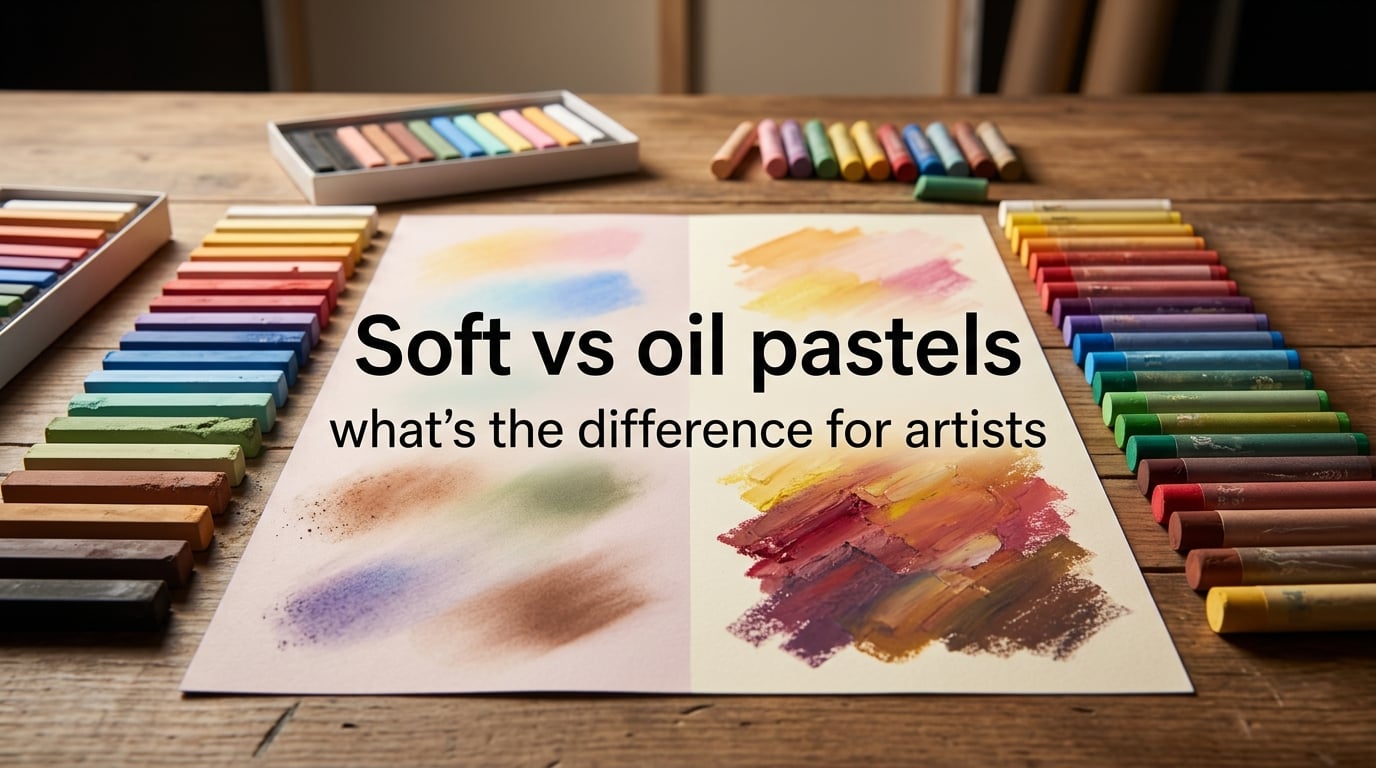
Choosing between soft pastels and oil pastels can feel like standing at a crossroads in your artistic journey. Both mediums produce stunning, vibrant artwork, yet they work in fundamentally different ways. If you’ve ever wondered what the real difference is between soft pastels and oil pastels for artists, you’re in the right place.
I’ve spent years working with both types of pastels in my studio, and I can tell you that understanding their core differences will save you frustration, money, and a lot of trial-and-error. In this guide, we’ll break down everything from binder composition to blending techniques so you can confidently choose the right medium for your artistic style.
Table of Contents
What Are Soft Pastels?
Soft pastels are dry drawing sticks made from pure pigment powder bound together with a minimal amount of gum arabic or methyl cellulose. The ratio of pigment to binder is deliberately high, which is why soft pastels produce such intense, luminous color on paper.
When you pick up a soft pastel stick, you’ll notice it feels chalky and brittle. That’s by design. The minimal binder allows the pigment particles to transfer easily to paper, creating that signature velvety, powdery texture that pastel artists love. This high pigment concentration also means soft pastels offer exceptional color vibrancy right out of the box.
Composition and Chemistry
The binder in professional-grade soft pastels is typically gum arabic, the same natural gum used in watercolor paints. Some manufacturers also use tragacanth or methyl cellulose. The binder amount is minimal, just enough to hold the pigment particles together in stick form.
Because soft pastels are essentially dry pigment, they don’t contain any oil or wax. This makes them chemically different from oil pastels and affects everything from how they blend to how you store finished artwork. The particle size of the pigment also plays a role: finer particles create smoother, more blendable pastels, while coarser particles produce more textured marks.
Characteristics That Define Soft Pastels
- High pigment concentration — Professional soft pastels contain up to 85% pure pigment
- Dry, powdery texture — They feel chalky and transfer pigment easily to paper
- Excellent blendability — Colors can be mixed directly on the surface with fingers, blending stumps, or cloth
- Produces dust — Soft pastels release fine pigment dust during use, which is a major consideration for workspace setup
- Layerable — Multiple layers can be built up on textured paper without muddying colors
- Lightfastness varies — Quality depends heavily on the brand and specific pigment used
What Are Oil Pastels?
Oil pastels are pigment sticks bound with a combination of wax (typically paraffin or beeswax) and mineral oil. Some formulations also include non-drying oils like coconut oil. Unlike soft pastels, oil pastels have a creamy, buttery consistency that feels similar to a crayon but with much richer pigment.
The wax-and-oil binder gives oil pastels their distinctive working properties. They glide smoothly across paper, produce bold strokes, and can be blended with solvents, heat, or layering techniques. Because the binder doesn’t evaporate, oil pastels never truly “dry” the way oil paints do, which has implications for storage and framing.
Composition and Chemistry
The binder system in oil pastels is fundamentally different from soft pastels. Instead of a minimal amount of gum arabic, oil pastels use a significant proportion of wax and oil to create their characteristic creamy texture. This binder-to-pigment ratio is higher than in soft pastels, which is why oil pastels feel waxier and produce less dust.
Professional-grade oil pastels from brands like Sennelier use a combination of mineral wax, oil, and pigment to achieve exceptional color intensity. Student-grade versions typically use more filler and less pigment, which affects both vibrancy and blendability.
Characteristics That Define Oil Pastels
- Creamy, buttery texture — They glide smoothly and feel more like painting than drawing
- No dust production — Unlike soft pastels, oil pastels produce virtually no airborne particles
- Wax-and-oil binder — Contains paraffin wax, beeswax, or synthetic wax combined with mineral oil
- Never fully dries — The oil binder remains slightly tacky, requiring special framing
- Solvent blendable — Can be thinned and blended with turpentine, mineral spirits, or baby oil
- Versatile surfaces — Works on paper, canvas, wood, and mixed media substrates
Soft Pastels vs Oil Pastels: Key Differences
The core difference between soft pastels and oil pastels comes down to their binder. Soft pastels use a minimal amount of gum arabic, creating a dry, powdery medium. Oil pastels use wax and oil, creating a creamy, buttery medium. This single difference cascades into every aspect of how each medium behaves.
| Property | Soft Pastels | Oil Pastels |
|---|---|---|
| Binder | Gum arabic, minimal amount | Wax and mineral oil |
| Texture | Dry, powdery, chalky | Creamy, buttery, waxy |
| Pigment concentration | Very high (up to 85%) | Moderate to high |
| Dust production | Significant — requires ventilation | Minimal to none |
| Blending method | Fingers, stumps, cloth, erasers | Fingers, solvents, heat, layering |
| Drying time | Instant (already dry) | Never fully dries |
| Fixative required | Yes — mandatory for preservation | Recommended but optional |
| Detail work | Excellent for fine details | Better for broad strokes |
| Layering capacity | Excellent on textured paper | Can get muddy if overworked |
| Surface requirements | Textured paper with tooth | Smoother surfaces work well |
| Archival quality | Excellent when framed properly | Good with proper framing |
| Cost range | Varies widely by brand | Generally more affordable |
Pigment Intensity and Vibrancy
Soft pastels generally deliver more intense, pure color because they contain a higher pigment-to-binder ratio. When you lay down a stroke of professional-grade soft pastel, you’re applying mostly pigment with just enough binder to hold it together.
Oil pastels still produce vibrant colors, but the wax binder slightly dulls the initial pigment intensity. However, oil pastels have an advantage in that their colors don’t shift as much after application. With soft pastels, you might notice slight color changes as loose particles settle.
Working Time and Flexibility
One of the biggest practical differences is working time. Soft pastels give you infinite working time because they’re already dry. You can leave a piece unfinished for weeks and come back to blend it exactly where you left off.
Oil pastels, by contrast, remain workable as long as the binder stays soft. This means you can revisit and rework areas, but it also means finished pieces need careful handling. If you stack oil pastel artworks face-to-face, they can transfer pigment between surfaces.
Blending and Layering Techniques
Blending is where these two mediums truly diverge. Each requires a different approach, and mastering the blending technique for your chosen medium will dramatically improve your results.
Blending Soft Pastels
Soft pastels blend through physical manipulation of the pigment particles on the paper surface. The most common methods include:
- Finger blending — Using your fingertips to smudge and mix colors directly on the paper. This gives you the most control but can cause skin irritation with prolonged use.
- Blending stumps and tortillons — Tightly rolled paper tools that let you blend small areas with precision. Great for details in portraits and landscapes.
- Cloth and chamois — Soft fabric pieces for blending large areas smoothly. Ideal for sky gradients and backgrounds.
- Brush blending — Using a soft-bristled brush to gently move pigment particles. Creates a soft, ethereal effect.
- Layering light over dark — Building up layers from dark to light values, allowing the paper tooth to grab successive layers of pigment.
The key to successful soft pastel blending is working on paper with enough tooth to hold multiple layers. Pastel paper like UART, Canson Mi-Teintes, or sanded papers work exceptionally well because their textured surface grabs pigment particles.
Blending Oil Pastels
Oil pastels blend through their wax-and-oil binder, which can be manipulated with heat, solvents, or pressure. Common techniques include:
- Finger blending — Similar to soft pastels, but the waxy texture creates a smoother, more paint-like blend.
- Solvent blending — Applying turpentine, mineral spirits, or baby oil with a brush to dissolve and spread the pigment. This creates effects similar to oil painting.
- Heat blending — Using a heat gun or hair dryer to soften the wax binder, making it easier to spread and mix colors.
- Sgraffito — Scratching through layers to reveal underlying colors. The wax binder holds the surface layer in place, making this technique very effective.
- Impasto effects — Applying thick layers with a palette knife for textured, three-dimensional effects.
Oil pastels can also be layered, but you need to be careful not to overwork the surface. Too many layers can create a muddy, waxy buildup that loses vibrancy. A good rule is to work from dark to light and limit your layers to three or four.
Surfaces and Paper Recommendations
Choosing the right surface is crucial for both types of pastels, but they have very different requirements.
Best Surfaces for Soft Pastels
Soft pastels need paper with tooth — tiny ridges and valleys that grab and hold pigment particles. Without sufficient tooth, soft pastel pigment slides right off the surface. The best options include:
- Sanded pastel paper — Papers like UART, Pastelmat, and Fisher 400 have a fine abrasive coating that holds multiple layers of pigment beautifully.
- Canson Mi-Teintes — A popular mid-range option with a slightly textured surface that works well for most soft pastel techniques.
- Wallis paper — Belgian-made sanded paper favored by professional pastel artists for its exceptional layering capacity.
- Velour paper — A soft, fabric-like surface that creates incredibly soft, luminous effects but limits detail work.
Best Surfaces for Oil Pastels
Oil pastels are more versatile when it comes to surfaces. They work on both textured and smooth papers, though some surfaces perform better than others:
- Pastel paper with moderate tooth — Canson Mi-Teintes and similar papers provide enough grip without being too rough.
- Canvas paper — Textured canvas-like paper that mimics the feel of painting on stretched canvas.
- Mixed media paper — Heavy-weight paper designed for wet and dry media, perfect for oil pastel and solvent techniques.
- Wood panels — Gessoed wood provides a smooth, durable surface for oil pastel work.
- Smooth Bristol board — For detailed work and illustration-style oil pastel pieces.
Pros and Cons of Each Medium
Understanding the strengths and limitations of each medium helps you make an informed choice based on your artistic goals.
Soft Pastels: Advantages and Disadvantages
Advantages:
- Exceptional color vibrancy and pigment intensity
- Excellent for fine detail work and photorealistic styles
- Infinite working time — no drying to worry about
- Easy to correct mistakes by brushing away pigment
- Lightfast and archival when properly framed
- Wide range of hardness grades for different techniques
Disadvantages:
- Produces significant dust — requires good ventilation
- Can be messy on hands, clothes, and workspace
- Fragile sticks that break easily
- Requires fixative to prevent smudging
- Needs textured paper, which can be expensive
- Not ideal for travel due to dust and fragility
Oil Pastels: Advantages and Disadvantages
Advantages:
- No dust production — cleaner workspace and safer for lungs
- Creamy texture that’s satisfying and intuitive to use
- Works on a wider variety of surfaces
- Can achieve oil painting effects without solvents
- More portable and less fragile than soft pastels
- Great for expressive, painterly styles
Disadvantages:
- Never fully dries — requires special framing considerations
- Harder to achieve fine detail work
- Can become muddy if overworked
- Waxy buildup on paper surface limits layering
- More difficult to correct mistakes
- Solvent blending requires proper ventilation
Which Pastels Are Best for Beginners?
This is one of the most common questions I hear from artists exploring pastels for the first time. The answer depends on your goals, your workspace, and what kind of art you want to create.
If you’re interested in detailed, realistic work like portraits or landscapes, soft pastels are the better choice. They offer more control, finer detail capability, and the ability to build up complex color layers. However, be prepared for the dust and mess — you’ll want a dedicated workspace with good ventilation.
If you prefer expressive, painterly work and want a cleaner, more portable medium, oil pastels are the way to go. They’re more forgiving for beginners because you can blend and rework areas easily. The lack of dust also makes them more suitable for working at a kitchen table or shared space.
Many artists, myself included, eventually use both types for different purposes. Soft pastels for detailed studio work, and oil pastels for quick sketches, plein air painting, or mixed media projects.
Recommended Beginner Approach
Regardless of which medium you choose, I recommend starting with a student-grade set of 24 to 36 colors. This gives you enough range to experiment without a huge financial commitment. Once you’ve developed your technique and preferences, you can invest in professional-grade individual sticks in the colors you use most.
Scholar-grade soft pastels from brands like Rembrandt or Faber-Castell offer excellent quality for the price. For oil pastels, Sakura Expressionist and Pentel Arts oil pastels are solid beginner options that won’t break the bank.
Fixative Use and Preservation
Fixative is a spray-on solution that helps secure pastel pigment to the paper surface. Understanding when and how to use fixative is essential for preserving your artwork.
Soft Pastels and Fixative
Fixative is virtually mandatory for soft pastel artwork. Without it, loose pigment particles will continue to shift and fall off the surface, especially during transport or framing. There are two main types:
- Workable fixative — Allows you to continue working on the surface after application. Use this between layers to build up color without overloading the paper tooth.
- Final fixative — Provides a protective coat for finished pieces. Apply in light, even coats from about 12 inches away to avoid pooling or darkening.
Oil Pastels and Fixative
Fixative is optional for oil pastels since the wax binder holds pigment in place. However, a light coat of fixative can help prevent surface smudging during storage. Avoid heavy application, as it can alter the appearance of the waxy surface.
Framing Considerations
Both mediums require special framing to ensure longevity. Soft pastel artwork should be framed under glass with a mat or spacer to prevent the glass from touching the pastel surface. Oil pastel artwork needs similar protection, plus the additional consideration that the wax binder may soften in heat, so avoid hanging oil pastel pieces in direct sunlight or warm areas.
Common Mistakes to Avoid
After years of teaching pastel workshops, I’ve seen beginners make the same mistakes over and over. Here are the most common pitfalls and how to avoid them.
Mistakes with Soft Pastels
- Using too much pressure — Let the pastel do the work. Light strokes build color more effectively than heavy-handed application.
- Not using enough layers — Soft pastels reward patience. Build up multiple thin layers for rich, complex color.
- Blending too much — Over-blending can make colors look flat and lifeless. Leave some visible strokes for texture and interest.
- Skipping fixative — Always use workable fixative between major layers and final fixative on finished pieces.
- Using smooth paper — Soft pastels need textured paper with tooth. Smooth paper won’t hold the pigment properly.
Mistakes with Oil Pastels
- Overworking the surface — Too many layers create a waxy, muddy buildup. Plan your layers and stop before the surface gets overloaded.
- Using too much solvent — A little solvent goes a long way. Too much can dissolve the binder completely and create a mess.
- Ignoring paper choice — While oil pastels work on many surfaces, thin paper will buckle and tear under heavy application.
- Not cleaning tools — Waxy buildup on brushes and palette knives affects blending quality. Clean tools between colors.
- Stacking finished pieces — Never place oil pastel artworks face-to-face. The wax binder can transfer between surfaces.
Frequently Asked Questions
What is the difference between soft pastels and oil pastels?
Soft pastels are dry pigment sticks bound with gum arabic that produce a powdery, chalky texture and significant dust. Oil pastels use wax and mineral oil binders that create a creamy, buttery consistency with no dust production. The binder composition affects everything from blending methods to archival requirements.
Which is better for beginners, soft or oil pastels?
Oil pastels are generally easier for beginners because they require less specialized equipment, produce no dust, and work on a wider variety of surfaces. However, soft pastels are better if you want to pursue detailed, realistic artwork. Many artists recommend trying both with affordable student-grade sets before committing to one medium.
Do oil pastels need a fixative?
Fixative is optional for oil pastels since the wax binder holds pigment in place. A light coat can prevent surface smudging during storage, but heavy application may alter the waxy finish. Soft pastels, by contrast, require fixative to prevent loose pigment from shifting and falling off the surface.
Can you mix soft pastels and oil pastels together?
You can use both in the same artwork, but they don’t blend together well due to their different binders. A common technique is to use soft pastels for the initial layers and details, then add oil pastels on top for bold marks and effects. The oil pastel will adhere to the dry soft pastel surface, though the reverse doesn’t work as well.
What surfaces work best for oil pastels?
Oil pastels work on pastel paper with moderate tooth, canvas paper, mixed media paper, gessoed wood panels, and smooth Bristol board. The best choice depends on your technique: textured surfaces for expressive work with visible strokes, and smoother surfaces for detailed illustration and blended effects.
Are soft pastels dustier than oil pastels?
Yes, soft pastels produce significantly more dust than oil pastels. Soft pastels are essentially dry pigment with minimal binder, so particles become airborne during use. Oil pastels use a wax-and-oil binder that keeps pigment contained, producing virtually no dust. If dust is a concern, oil pastels or pastel pencils are better choices.
Do oil pastels dry?
Oil pastels never fully dry because their wax-and-oil binder doesn’t evaporate. The surface remains slightly tacky indefinitely, which means finished pieces require careful framing and storage. Soft pastels, being dry from the start, don’t have this issue, though they do require fixative to prevent loose pigment from shifting.
What are the best brands of pastels?
For soft pastels, Sennelier, Schmincke, Rembrandt, and Unison are highly regarded professional brands. For oil pastels, Sennelier, Holbein, and Caran d’Ache offer exceptional quality. Beginners can start with more affordable options like Faber-Castell soft pastels or Sakura Expressionist oil pastels before investing in professional-grade sets.
Conclusion
Understanding the difference between soft pastels and oil pastels comes down to one thing: the binder. Soft pastels use minimal gum arabic, creating a dry, dusty medium with exceptional color intensity and detail capability. Oil pastels use wax and oil, producing a creamy, mess-free medium perfect for expressive, painterly work.
Both mediums have their place in an artist’s toolkit. The best way to find your preference is to try both with affordable student-grade sets and see which one clicks with your style and working habits. Whether you choose soft pastels, oil pastels, or both, you’ll be joining a rich artistic tradition that spans centuries of creative expression.