
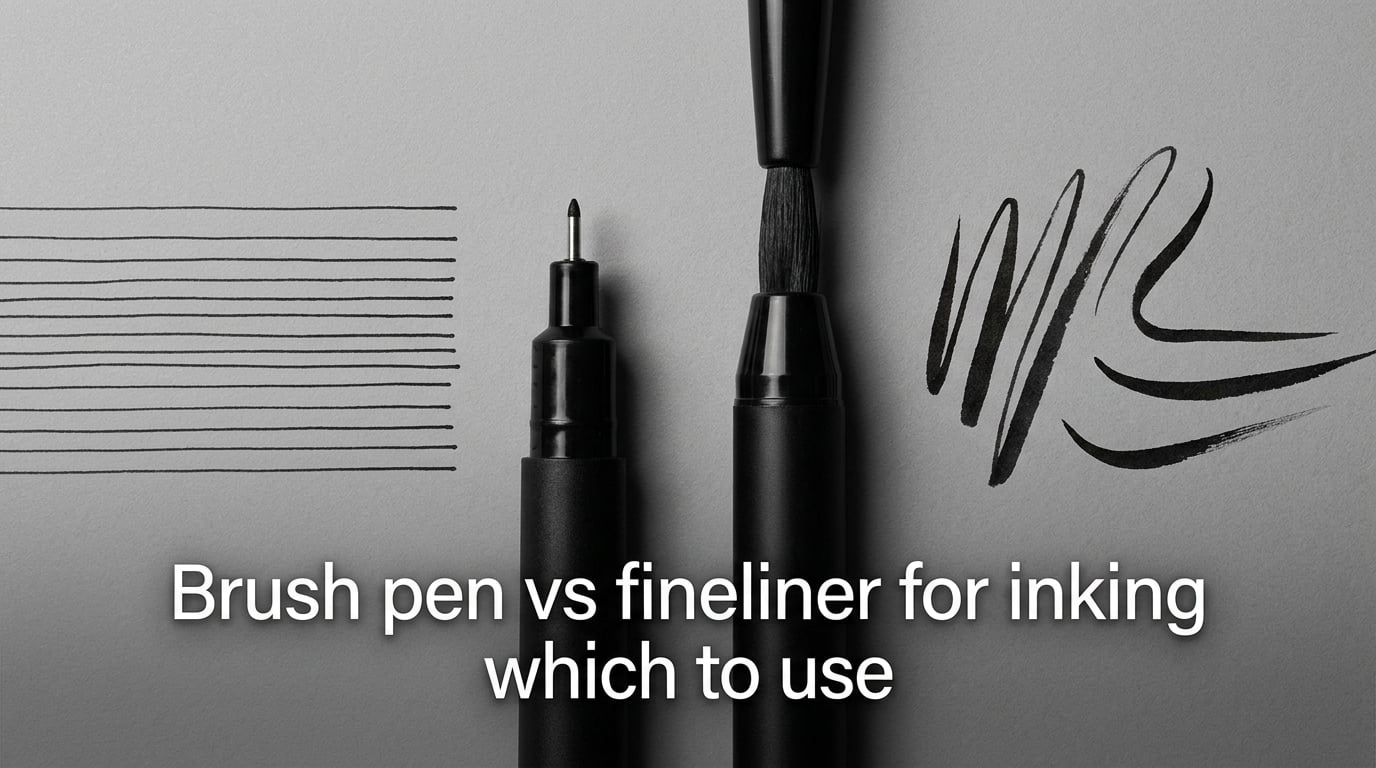
Choosing between a brush pen and a fineliner shapes how every line in your final artwork looks and feels. I have spent the past several years switching between the two for comics, illustration, and quick sketching, and the honest answer is that they are not rivals. They are different tools built for different problems. This guide walks through the real differences in brush pen vs fineliner performance so you can pick the right inking tool for the artwork in front of you, not the one the internet told you to buy.
You will learn how each pen actually works, how the line quality differs, when a fineliner beats a brush pen (and vice versa), and how to use both together for cleaner results. By the end you should know which pen belongs in your kit for your style and skill level.
Table of Contents
Quick Answer: Brush Pen vs Fineliner
Use a fineliner when you need consistent line width, precise details, and predictable outlines. Use a brush pen when you want varying line thickness, expressive strokes, and faster coverage of larger shapes. Fineliners use a rigid felt or fibre nib that holds a fixed width. Brush pens use a flexible bristle tip that responds to pressure, going from hairline to bold in a single stroke.
| Feature | Fineliner | Brush Pen |
|---|---|---|
| Line width | Fixed and consistent | Variable (pressure-controlled) |
| Best for | Detail, outlines, hatching | Expressive linework, dynamic strokes |
| Learning curve | Beginner-friendly | Steeper – needs pressure control |
| Common ink | Pigment (waterproof, archival) | Pigment or dye, varies by brand |
| Tip type | Felt or fibre nib | Nylon or synthetic bristle brush |
| Drying | Fast | Fast (waterproof ink dries almost instantly) |
| Refillable options | Rare (mostly disposable) | Some models are refillable |
If you only buy one pen today and your style is manga, technical drawing, or comic outlines, start with a fineliner. If you already ink confidently and want more life in your lines, add a brush pen next.
What Is a Fineliner Pen?
A fineliner is a pen with a thin, rigid tip that produces a constant line width from the first millimetre to the last. The nib is usually made of felt or compressed fibre, seated in a plastic or metal housing, and fed by an ink reservoir or replaceable cartridge.
The defining trait is consistency. A 0.05 mm fineliner lays down a 0.05 mm line whether you draw fast, slow, or in any direction. That reliability is what makes fineliners the standard for outlining comics, technical drawing, and detailed illustration work.
Most quality fineliners use pigment-based ink rather than dye. Pigment ink sits on top of the paper instead of soaking in, which makes it waterproof and smudge-proof once dry. You can brush watercolour or marker over a fineliner outline without smearing the line, which is why illustrators who add colour later tend to favour pigment fineliners like Sakura Pigma Micron or Faber Castell Pitt.
Fineliner nib widths typically range from 0.05 mm to 1.0 mm. The thinner sizes handle micro-detail and cross-hatching, while the broader sizes fill roles closer to a brush pen for thicker outlines.
What Is a Brush Pen?
A brush pen is a pen with a flexible bristle tip – usually nylon or a synthetic fibre – that behaves like a paintbrush. Instead of a fixed nib, the brush tip flexes with pressure: light pressure gives you a hairline, heavy pressure gives you a bold stroke, all from the same pen in a single motion.
The defining trait is variation. Brush pens exist to make line width part of the drawing itself. A tapered stroke that goes from thick to thin carries energy and rhythm into the artwork in a way a uniform line cannot.
Brush pens come in two main flavours. Filled brush pens (like Pentel Pocket Brush or Sakura Pigma Brush Pen) have an internal ink reservoir and work like a marker. Refillable brush pens (like the Pentel Water Brush or a Kuretake No. 13 fountain brush) let you load your own ink, which gives you control over pigment vs dye, colour, and drying time.
The brush tip is more delicate than a fineliner nib. It can fray, split, or lose its point if pressed too aggressively, dropped, or used on rough paper. That fragility is part of why many beginners avoid brush pens, and part of why artists who master them rarely go back to a fineliner.
Brush Pen vs Fineliner: Line Quality Compared
The most honest comparison between these two inking tools comes down to one question: do you want every line to look the same, or do you want lines that change as you draw?
Fineliner line quality is uniform and clinical. That uniformity is a feature, not a flaw. When you are inking a complex mechanical drawing or a panel of manga where every contour needs to read clearly at thumbnail size, predictability wins. There is no risk of an accidental thick stroke where you wanted thin, and the line width stays stable across a long contour even if your hand speed varies.
Brush pen line quality is organic and alive. A confident brush stroke tapers naturally, thickens on curves where pressure naturally increases, and thins out on the release. The result looks more like ink wash or a dip pen than a marker. That is exactly why comic artists like Frank Miller and manga inkers like Takeshi Obata use brush pens as their primary tool. The line carries gesture.
On ink properties, the line is similar if both pens use pigment ink. Sakura Pigma Micron and Sakura Pigma Brush Pen, for example, both use archival pigment ink that is waterproof and lightfast. The difference is only in the tip, not the ink chemistry.
On consistency over time, fineliners win. A fineliner line at minute one looks the same as the line at minute sixty. Brush pen ink flow can vary as the reservoir empties or as the tip wears, so the line character at the end of a session can differ from the start.
When to Use a Fineliner vs Brush Pen by Art Style
Different art styles reward different tools. Here is the framework I use when starting a new piece.
Use a fineliner for: manga pages, comic book panel borders and detail work, technical and architectural drawing, cross-hatching and stippling, ink illustrations where every line should read at the same weight, and any artwork that will be reduced in size for print or web.
Use a brush pen for: loose ink illustration with expressive line variation, comic book cover art and splash pages, gestural figure drawing, calligraphy and brush lettering, and any piece where you want the line itself to carry energy.
Style-based quick picks:
- Manga inkers usually combine both – fineliner for faces and backgrounds, brush pen for hair, fabric folds, and dynamic action.
- Comic book artists (Western style) lean heavily on brush pens for main lines, then add fineliner for tight detail and panel-level hatching.
- Architectural illustrators almost exclusively use fineliners for the precision that scale drawing demands.
- Botanical and naturalist illustration traditionally uses a dip pen or fine brush, but a 0.05 mm fineliner is the modern substitute.
- Watercolour and mixed-media work calls for waterproof pigment fineliner or a brush pen loaded with waterproof ink, so the line survives the brushwork on top.
Pros and Cons of Brush Pens and Fineliners
Here is a balanced look at both inking tools, drawing on what I have seen in my own work and what experienced artists on Reddit’s r/learnart and r/AbstractArt consistently report.
Fineliner pros: precise and predictable lines, low learning curve, ideal for fine detail and cross-hatching, waterproof pigment ink options, long shelf life, affordable.
Fineliner cons: lines can feel uniform or “dead” if used alone, no built-in line variation, mostly disposable plastic, harder to block in large dark areas quickly, can feather on cheap paper.
Brush pen pros: dynamic linework with natural tapering, fastest way to lay down expressive ink lines, can mimic a traditional ink brush with practice, great for filling and gestural marks, refillable options available.
Brush pen cons: steeper learning curve, brush tip can fray or split with rough use, line quality varies as ink runs low, replacement refills can be costly, harder for true micro-detail work.
How to Combine Brush Pen and Fineliner in One Artwork
This is the part most online articles skip, and it is where your finished art gets noticeably better. Combining the two tools gives you the precision of a fineliner and the energy of a brush pen in a single piece.
Step 1 – Lay down structure with a brush pen. Use the brush pen for the main outlines, gesture lines, and large shapes. The natural line variation gives the artwork energy even before detail is added.
Step 2 – Add detail and refinement with a fineliner. Switch to a 0.05 mm or 0.1 mm fineliner for facial features, mechanical detail, hatching, and the small contours that a brush tip cannot hit cleanly. The thin, consistent fineliner line reads as detail against the brush pen’s expressive contours.
Step 3 – Cross-hatch with a mid-weight fineliner. Use a 0.3 mm or 0.5 mm fineliner for shading and hatching. The consistent weight of fineliner hatching makes the shadow areas feel unified.
Step 4 – Reserve the brush pen for emphasis. Go back to the brush pen only for the darkest accents and final emphasis strokes. This is the trick comic inkers use to keep the artwork lively without losing focus.
When I tried this on a 30-day sketch series last year, the combined version read better at thumbnail size than either tool alone. The brush pen held the eye, the fineliner held the form.
Best Brush Pens and Fineliners for Beginners
You do not need a kit of 20 pens to start. These four cover roughly 90% of beginner inking work.
- Sakura Pigma Micron (0.05 – 0.5 mm) – The go-to fineliner. Archival pigment ink, waterproof, available in a full range of nib sizes. Affordable enough to keep several on hand.
- Pentel Pocket Brush Pen – The brush pen most Reddit threads recommend for dynamic linework. Replaceable ink cartridge, flexible nylon tip, very portable.
- Faber Castell Pitt Artist Pen (S and M nibs) – A solid fineliner alternative if Microns feel too scratchy. India-ink-style pigment ink, excellent for sketchbook work.
- Copic Sketch Marker (Cool Grey tones) – Not an inking pen itself, but a great companion for adding grey tones over your fineliner or brush pen lines.
Start with one fineliner (a 0.3 mm Sakura Micron is the safest pick) and one brush pen (the Pentel Pocket Brush). Add more nib sizes and brands once you know which line weights you actually use.
Paper Compatibility and Beginner Mistakes to Avoid
Both inking tools behave very differently depending on the paper you use, and most beginner frustration comes from a pen-paper mismatch rather than the pen itself.
For fineliners: any smooth, heavyweight paper (90 gsm or above) works well. Cheap copy paper feathers and bleeds, especially with pigment ink. A sketchbook with 100-120 gsm paper is the safe minimum.
For brush pens: smooth Bristol board or marker paper is ideal. Rough watercolour paper shreds the brush tip in a single session. Hot-press paper gives the cleanest brush pen lines; cold-press will give you a textured line that some artists love but most beginners find frustrating.
Common mistakes to avoid:
- Pressing too hard on a fineliner – it does not change line width, it just wears the nib faster.
- Holding a brush pen like a ballpoint – tilt it closer to vertical and let the brush tip do the work.
- Inking over pencil without testing the ink on a corner of the page first.
- Using fineliner on watercolour paper – the sizing makes the ink sit on the surface and skip.
- Forgetting that brush pens have a break-in period – the first few strokes are not representative.
Practise with five-minute gesture drawings in pen before committing to a finished piece. Pen cannot be erased, and the pressure of working with an unforgiving tool is what builds real inking confidence.
Frequently Asked Questions
What is the difference between a brush pen and a fineliner?
A fineliner has a rigid felt or fibre nib that produces a consistent line width. A brush pen has a flexible bristle tip that responds to pressure, so line width changes from hairline to bold in a single stroke.
Which is better for inking, a brush pen or a fineliner?
Neither is universally better. Fineliners are better for precision, technical detail, and uniform outlines. Brush pens are better for expressive linework, varied line weight, and gestural strokes. Most professional illustrators use both.
Can brush pens be used for detailed work?
Brush pens can handle fine detail once you have pressure control, but for true micro-detail under 0.1 mm, a fineliner is faster and more reliable. Use the brush pen for the main linework and a fineliner for tiny details.
Are fineliners good for beginners?
Yes. Fineliners are the most beginner-friendly inking tool because the line width is fixed, so you only need to focus on accuracy, not pressure. A 0.3 mm Sakura Pigma Micron is the standard starting point.
What pen do manga artists use for inking?
Most manga inkers combine both tools. A fineliner like Sakura Pigma Micron handles faces, mechanical detail, and backgrounds, while a brush pen like the Pentel Pocket Brush Pen handles hair, fabric, and dynamic action lines.
Final Verdict: Choosing Between Brush Pen and Fineliner
The brush pen vs fineliner debate comes down to your style, your subject, and your comfort with pressure control. If you want predictable, archival, detail-friendly lines, a fineliner is your workhorse. If you want line variation, energy, and brush-like expression, the brush pen is the better investment.
Pick a fineliner first if you are new to inking – the learning curve is shorter and the results are immediate. Add a brush pen once you want more expressive linework. Most artists who push past the beginner stage end up using both, switching mid-piece to combine the precision of the fineliner with the gesture of the brush pen.
Whichever you choose, ink on paper you trust, practice with timed sketches, and remember that the best inking tool is the one that stays in your hand long enough to learn its personality.