
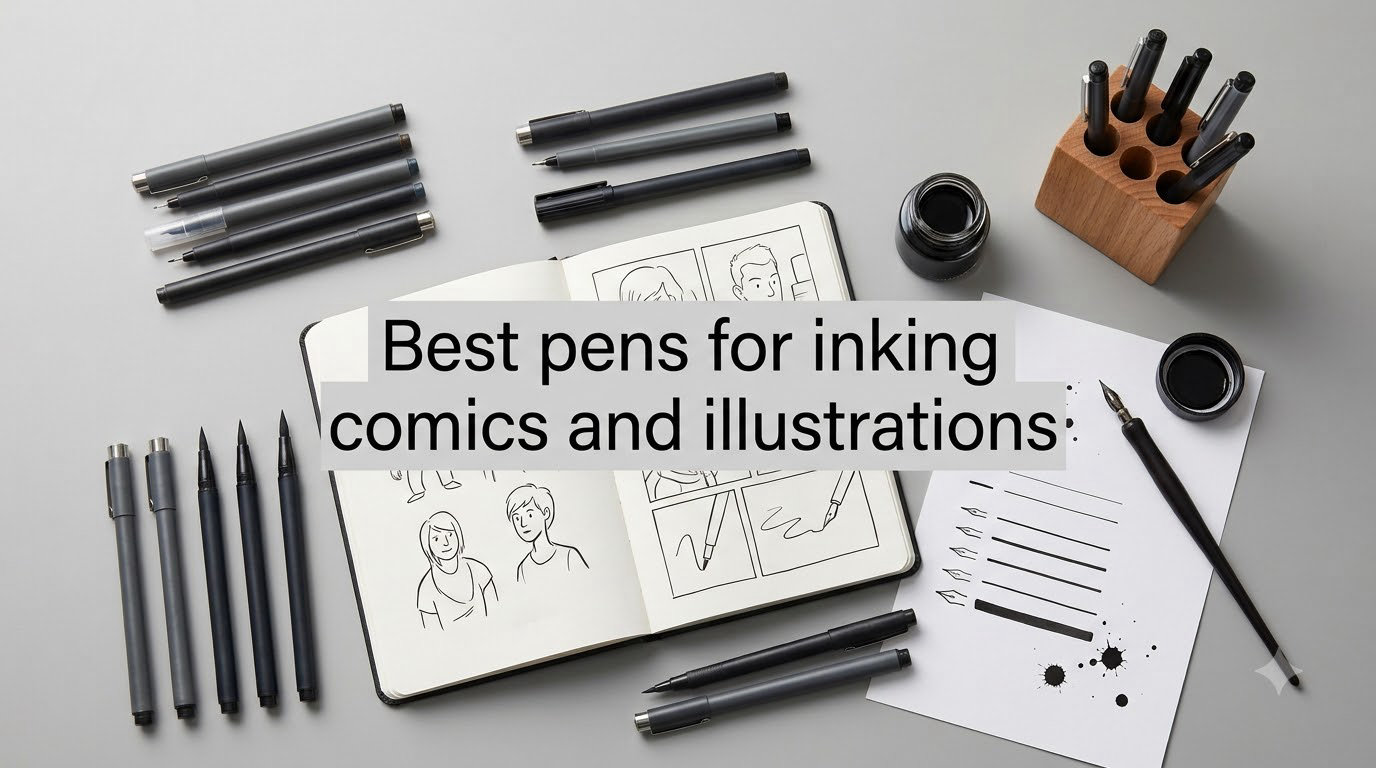
Choosing the best pens for inking comics and illustrations can completely change the feel of your finished artwork. I’ve spent years testing brush pens, fineliners, dip pens, and traditional sable brushes on everything from sequential comic pages to standalone illustration prints. The tool you pick shapes your line weight, your workflow speed, and how long your artwork survives on paper.
After talking with working comic artists, scanning forum threads, and running my own side-by-side comparisons, I’ll walk you through the pen categories that matter most, the specific models that consistently deliver, and the practical guidance I wish someone had given me when I started inking.
Table of Contents
Pen Types Every Comic Artist Should Know
Inking pens fall into four practical categories, and understanding the difference is the first step toward picking the right tool. Each type excels at a different job, and most comic artists end up combining at least two of them on a single page.
Brush Pens
Brush pens use a flexible nylon or fiber tip that responds to pressure, just like a traditional paintbrush. Press harder for thick lines, lift up for hairlines, and you get dynamic line variation without switching tools. This is the closest you can get to traditional brush inking with a portable, mess-free instrument.
Fineliners
Fineliners (also called technical pens or marker pens) dispense ink through a fixed tip, producing a single consistent line width per pen. They are the workhorses for crisp detail, panel borders, lettering, and any area where you need predictable, repeatable linework.
Dip Pens
Dip pens pair a reusable nib holder with replaceable metal nibs and a bottle of India ink. The line variation is extreme, the ink flow is unlimited, and the learning curve is steep. Traditional comic book inkers often start and end their careers here because nothing else feels quite the same.
Technical Pens
Technical pens are precision instruments borrowed from drafting and engineering. They refill from cartridges, deliver steady ink flow at a fixed width, and excel at cross-hatching, stippling, and fine architectural detail work common in sci-fi and steampunk comics.
The Best Brush Pens for Inking Comics
Brush pens are the modern shortcut to expressive inking. They are forgiving for beginners, fast for professionals, and they travel well. Here are the five brush pens I recommend most often to comic artists in 2026.
1. Copic Gasenfude
The Copic Gasenfude is widely considered the gold standard among brush pens for comic inking. The brush tip is soft yet responsive, the pigment-based ink is refillable, and the body is balanced for long inking sessions. I reach for it whenever a page needs dramatic line variation between thick outer contours and thin interior detail.
2. Pentel Pocket Brush Pen
The Pentel Pocket Brush Pen is the travel hero. It fits in a pencil case, retains its shape inside the cap, and lays down consistent ink flow for sketching on location. It is dye-based rather than pigment, so for finished comic pages I prefer archival options, but for warm-ups and thumbnail layouts it is my constant companion.
3. Zebra Disposable Brush Pen
The Zebra Disposable Brush Pen is the best entry point for beginners who want to learn brush dynamics without committing to refills. The tip has a satisfying snap, the line variation is surprisingly expressive, and once it dries out you toss it and grab another. Forum users consistently call it the best value starter brush.
4. Kuretake Fudegokoci
The Kuretake Fudegokoci is a pocket-sized workhorse that punches well above its small frame. It comes in hard and soft tip versions, and many artists keep one of each on their desk for quick line variation. The Japanese brush-making heritage shows in the tip quality.
5. Pentel Color Brush
The Pentel Color Brush is versatile and forgiving, with a nylon tip that holds its shape over months of daily inking. It is one of the few brush pens that delivers reliable performance for both Western-style superhero comics and manga-style linework.
Top Fineliner and Technical Pens for Clean Linework
Brush pens get all the attention in inking videos, but most finished comic pages still rely on fineliners for the bulk of their linework. Here are the four models I recommend most often for clean, archival linework in 2026.
1. Faber-Castell PITT Artist Pen
The Faber-Castell PITT Artist Pen uses India ink in a fineliner body, giving you the precision of a technical pen with the archival quality of traditional ink. The felt tip holds its shape better than most, the ink is waterproof, and the range of nib sizes covers every line weight a comic artist typically needs.
2. Sakura Pigma Micron
The Sakura Pigma Micron is the most popular fineliner in comic art for a reason. The pigment-based Pigma ink is waterproof, fade-resistant, and acid-free, and the tip delivers consistent lines from the first stroke to the last. Just be aware that forum reports mention Microns can dry out if left uncapped, so always recap between breaks.
3. Copic Multiliner
The Copic Multiliner is the refillable alternative to disposable fineliners, and many working artists consider it the more sustainable choice. The ink cartridges are pigment-based and archival, and the tip stays sharp through hundreds of pages. If you finish multiple comic books a year, the upfront cost pays for itself.
4. Prismacolor Premier Manga Illustration Markers
The Prismacolor Premier line offers double-ended markers with a fine bullet tip on one end and a brush tip on the other, which is a powerful combination for manga-style illustration. The ink is lightfast and the linework stays crisp under Photoshop scans.
Traditional Dip Pens and Brushes Worth Knowing
Traditional tools are not obsolete. Many of the best-known comic inkers in the industry still work with dip pens and sable brushes for client pages and original art sales. Here are the four models every inker should at least try.
1. Speedball Hunt 100 Crow Quill
The Hunt 100 crow quill nib is the American comic industry standard for traditional inking. It produces beautifully thin, sharp lines with a slight spring that responds to pressure. Reddit users consistently recommend pairing it with a good nib holder and India ink for the most authentic inking experience.
2. Speedball 512 Nib
The Speedball 512 nib is the larger sibling of the Hunt 100, and it is the right tool for bold superhero linework and dramatic splash pages. It carries more ink, lays down thicker strokes, and handles cross-hatching under heavy ink loads without skipping.
3. Winsor & Newton Series 7 Kolinsky Sable Brush
The Winsor & Newton Series 7 is the gold standard among traditional sable brushes. It holds a point like no synthetic brush can, carries India ink smoothly, and delivers the most expressive line variation of any inking tool ever made. It is also expensive and worth every penny if you take traditional inking seriously.
4. Tombow Mono Dip Pen Holder
The Tombow Mono holder is a forgiving, well-balanced dip pen holder that pairs with most standard nibs. It is a smart first dip pen if you are still experimenting with nib styles and don’t want to invest heavily in specialty holders yet.
Quick Comparison: Which Pen Fits Your Style?
The table below compares the pen types covered above side by side, so you can match each tool to the kind of linework you do most.
| Pen Type | Best For | Line Variation | Skill Level | Maintenance |
|---|---|---|---|---|
| Brush Pen | Expressive contour lines, manga inking | High | Beginner to Pro | Low (cap and store) |
| Fineliner | Detail work, lettering, panel borders | None (fixed) | Beginner | None (replace when dry) |
| Dip Pen | Traditional comic inking, archival originals | Medium to High | Intermediate to Pro | High (clean nibs, refill ink) |
| Kolinsky Sable Brush | Showcase line variation, gallery-grade art | Very High | Professional | Very High (wash and condition) |
Beginner vs Professional Inking Kit Tiers
No competitor breaks down which tools belong in which kit tier, so here is the tiered approach I wish I had when I started. Build your kit based on how committed you are and how often you ink.
Starter Kit (Budget Tier)
The starter kit is for artists who are still deciding if inking is for them. Grab a Zebra Disposable Brush Pen, a set of Sakura Pigma Microns in 05 and 08, and a pad of Bristol Board. That is enough to practice brush dynamics, experiment with line variation, and complete a few short comics without breaking the bank.
Intermediate Kit (Mid Tier)
The intermediate kit adds a refillable brush pen and a fineliner upgrade. Move from disposable to Copic Gasenfude or Pentel Pocket Brush, swap Microns for refillable Copic Multiliners, and add a small bottle of India ink with a basic nib holder. This setup handles full comic issues comfortably.
Professional Kit (Premium Tier)
The professional kit is what working comic artists and illustrators use daily. Add a Winsor & Newton Series 7 sable brush, a set of crow quill and 512 nibs, multiple brush pens for redundancy, and a complete archival fineliner set. At this level you are investing in tools that will last years and produce gallery-grade original artwork.
Buying Guide: How to Choose the Right Inking Pen
Six factors separate a good inking pen from a frustrating one. Walk through each one before you buy.
Ink Type
Ink type determines archival quality, water resistance, and finish. India ink and pigment-based ink sit at the top for permanence. Dye-based ink flows well but fades over time. For original comic art you intend to sell or display, choose pigment-based or India ink every time.
Archival and Waterproof Quality
Archival ink is acid-free, lightfast, and resistant to fading over decades. Waterproof ink matters even more for comic artists, because you may add white-out corrections or watercolor washes on top of the ink later. Forum users consistently warn that non-waterproof ink reactivates under any wet medium.
Tip Type and Nib Size
Match tip type to the linework you produce most. Fine tips (005 to 02) handle hair-thin detail and facial features. Medium tips (03 to 08) cover panel borders and most body linework. Brush tips excel anywhere line variation matters. Buy nib size ranges, not single pens.
Line Variation vs Consistency
Decide what your art needs. Brush pens and crow quill nibs deliver strong line variation but require pressure control. Fineliners and technical pens deliver rock-solid consistency but cannot taper. Many artists combine both on every page.
Refillable vs Disposable
Refillable pens are cheaper in the long run and more sustainable, but they require cleaning and occasional part replacement. Disposable pens are convenient for travel and beginners, but they pile up in landfills. If you ink weekly, refillable wins on cost and environmental impact.
Paper Compatibility
Test pens on your paper before committing. Some fineliner inks feather on cheap paper. Some brush pens pool on heavily sized watercolor paper. Bristol Board is the standard comic art surface because it works with virtually every ink type, but smooth Bristol behaves differently from vellum Bristol.
Traditional vs Modern Inking Tools: Which Should You Use?
The traditional-vs-modern debate is one of the most common in comic art communities, and the honest answer is that both still belong in most studios. Let me break down where each excels.
Traditional tools (dip pens and sable brushes) win on authenticity, line variation, and the satisfaction of working with raw materials. They are the right choice for original art you intend to sell, hand-lettered pages, and projects that call for heritage techniques. The downside is a steep learning curve, ongoing ink maintenance, and the mess that comes with dipping and washing.
Modern tools (brush pens and refillable fineliners) win on speed, portability, and predictability. They are the right choice for daily studio work, convention sketching, and tight production schedules. The downside is that line variation depends entirely on tip design and ink formulation rather than your hand-eye coordination.
Most working comic artists I know blend both. They use brush pens for primary linework, fineliners for detail and lettering, and dip pens or sable brushes for showcase pages and convention pieces. That balance gives you speed when you need it and expression when it matters.
Paper Recommendations and Inking Station Setup
Even the best inking pen underperforms on the wrong paper. Here is the surface guidance that experienced artists share most often.
Best Paper for Comic Inking
Strathmore Bristol Board is the industry standard for comic book pages, available in smooth and vellum finishes. Smooth Bristol is ideal for fine detail and precise linework. Vellum Bristol has more tooth, which gives brush pens a touch of texture and helps ink sit on the surface rather than bleeding into the paper.
For watercolor washes on top of ink, 140 lb cold press watercolor paper holds up well. Sketch paper is too thin for ink and buckles the moment water touches it. Marker paper works well for fineliners but tends to resist brush ink.
Setting Up Your Inking Station
A reliable inking station is simpler than most beginners expect. You need a smooth flat surface, good directional lighting, a sheet of scrap paper underneath your hand to prevent smudging, and a cup of water for cleaning dip pen nibs. Many artists add an angled drawing board for better wrist position during long sessions.
Keep your tools within arm’s reach. Top inking setups store pen tips upright in a shallow tray, ink bottles in a stable rack, and scrap paper on the dominant hand side. The goal is zero friction between you and the page, so anything that breaks that flow should be removed from the workspace.
Pen Maintenance and Care Tips
Pen maintenance is the most overlooked topic in comic inking, and the one that will save you the most money over a career. A few small habits add years to every pen you own.
Brush Pen Care
Always recap brush pens immediately after each stroke break. Brush tips dry out faster than you think, and a dried brush tip loses its point permanently. Store brush pens horizontally so ink does not pool at one end of the reservoir. If the tip starts to splay, wash it gently with mild soap and water, reshape it with your fingers, and let it dry before recapping.
Fineliner Care
Fineliners need very little maintenance, but the thing they need most is consistent capping. Microns, PITT pens, and Copic Multiliners all dry out when left uncapped for more than a few minutes. Store them tip-down in a cup so ink stays at the nib, and never press harder than needed, because excessive pressure splits fineliner tips faster than any other failure.
Dip Pen Nib Care
Dip pen nibs are small and easy to damage, but they will last for months with basic care. Wipe each nib with a soft cloth between dips to prevent ink buildup. Rinse nibs in water at the end of every session, dry them completely, and store them in a small tin so they do not rattle against each other and lose their points.
Sable Brush Care
Sable brushes are the highest-maintenance tool in any inking kit, and they reward the effort. Wash them in cool water with mild brush soap after every session, reshape the point with your fingers, and dry them flat or hanging tip-down. Never store a sable brush wet, and never let ink dry inside the ferrule, because that destroys the brush permanently.
Replace brushes promptly when the point starts to splay unevenly or the ferrule becomes loose. A worn sable brush produces unpredictable lines, and artists often blame themselves when the real cause is a brush that should have been retired months earlier.
Frequently Asked Questions
What are the best pens for illustration?
For illustration, the best pens depend on your style. Brush pens like the Copic Gasenfude and Kuretake Fudegokoci deliver expressive line variation. Fineliners like the Faber-Castell PITT and Sakura Pigma Micron produce clean, archival linework. Dip pens and Kolinsky sable brushes offer traditional control. Most illustrators combine a brush pen with at least one archival fineliner for full coverage.
What is the best ink for comic book inking?
Pigment-based India ink is widely considered the best ink for comic book inking because it is waterproof, fade-resistant, and archival. Brands like Dr. Ph. Martin’s Bombay India Ink and Yasutomo Black India Ink are popular choices. Pigment-based fineliner inks, such as those in Sakura Pigma Microns and Faber-Castell PITT pens, offer the same archival qualities in a more portable format.
What kind of pens do cartoonists use?
Most cartoonists use a combination of brush pens, fineliners, and dip pens. Brush pens provide expressive contour lines, fineliners handle detail and lettering, and dip pens offer traditional line variation for showcase pages. Popular brands among professional cartoonists include Copic, Faber-Castell, Sakura, Kuretake, Pentel, and Winsor u0026amp; Newton.
What is the best pencil for drawing comics?
For drawing comics before inking, most artists use HB or 2B mechanical pencils for clean, erase-friendly lines. Popular choices include the Sakura Pigma Micron 005 (used as a pencil), Faber-Castell 9000 graphite pencils, and the Tombow Mono eraser for clean corrections. Avoid overly hard leads, because they skip on Bristol Board, and overly soft leads, because they smudge during inking.
How do I choose the right nib size?
Choose nib size based on the lineweight you use most. Fine nibs (005 to 02) handle facial features and tight detail. Medium nibs (03 to 08) cover panel borders and most body linework. Wide nibs and brush tips handle contour lines and dramatic effects. Buy a range of sizes rather than one pen, because comic pages typically need at least three nib sizes.
Are expensive inking pens worth it?
Expensive inking pens are worth it for committed comic artists, but not for everyone. Refillable pens like the Copic Gasenfude and Copic Multiliner save money over time and produce more consistent results. Traditional brushes like the Winsor u0026amp; Newton Series 7 deliver the best line variation available, but require skill to justify the cost. Beginners should start with disposable options like the Zebra Disposable Brush Pen before investing in premium tools.
Final Thoughts on Building Your Inking Toolkit
Choosing the best pens for inking comics and illustrations is less about finding one perfect tool and more about building a small collection that covers every line your art needs. Start with a single brush pen and a single fineliner, practice on cheap Bristol Board until the feel becomes natural, and only then invest in refillable pens and traditional brushes.
Build your inking toolkit in tiers, favor archival pigment-based ink for anything you intend to keep, and pay attention to how each pen feels after a full hour of inking. The right pen disappears in your hand and lets the artwork take over. That is the goal, and it is well within reach with any of the tools covered here.