
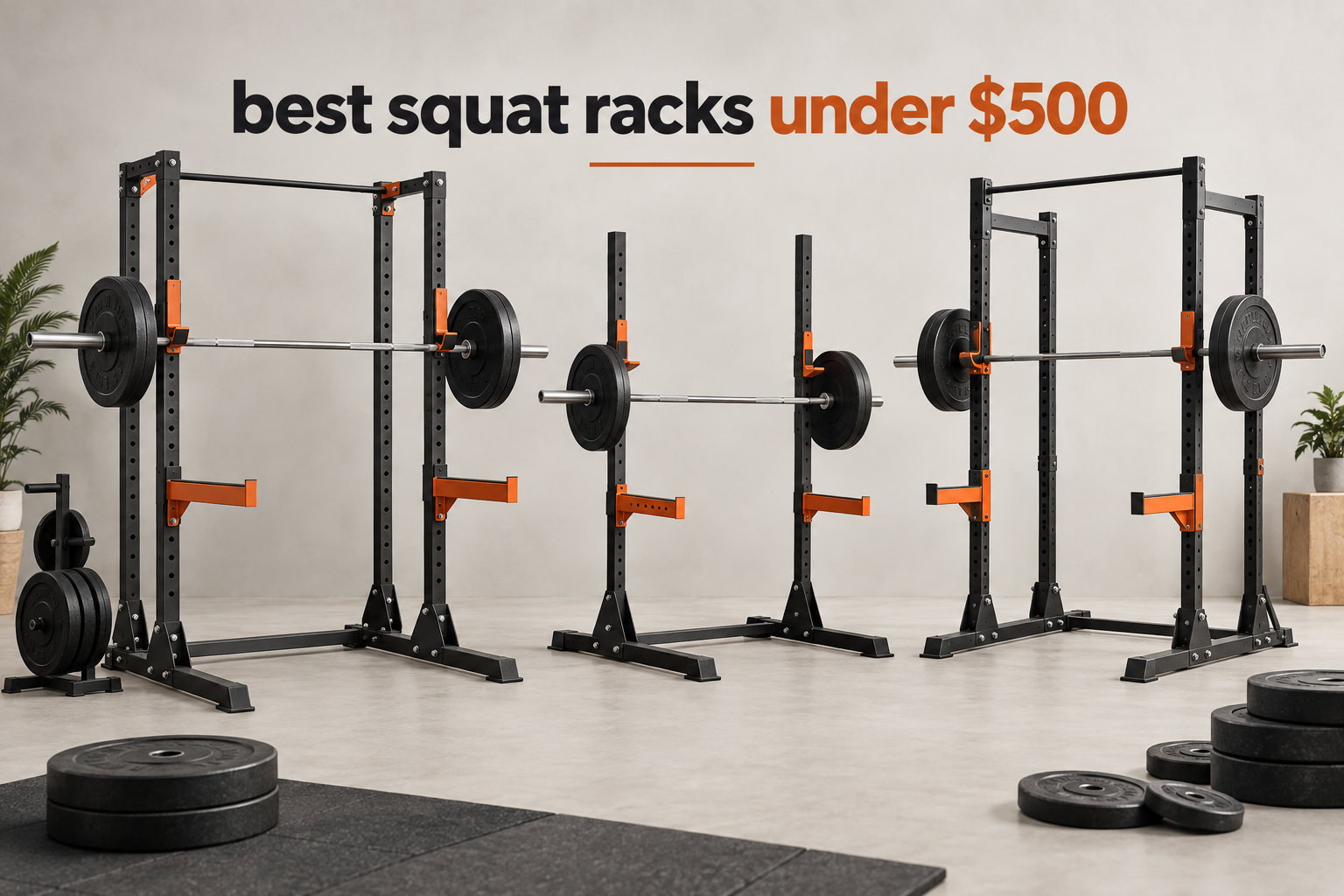
Squat rack shopping under a five hundred dollar ceiling is easier than it was three years ago, and harder than the product pages suggest. The short version: at this budget you can get a genuine four-post power cage rated well past anything a beginner or intermediate lifter will touch, plus pulleys, dip handles and a landmine on the two mid-tier picks. What you cannot get is the boutique tier, the welded-and-finished monster rack with Westside uprights and a lifetime parts program.
That is the real trade. Below five hundred dollars, steel gauge and raw capacity are no longer the differentiators they were, because several budget cages now claim 1000, 1200 and even 2000 lb ratings. What still decides whether a rack feels solid is the tube size, the hole spacing, whether the safeties are real arms or a fixed peg, and whether the frame rocks when you dump a heavy single. We ranked all eight picks below on those things.
We pulled specifications, ratings and owner feedback for every rack, cross-checked the numbers against the manufacturer listing details, and kept only racks whose advertised price sits under the ceiling. Prices on these pages move constantly, so treat every figure on the product page as live street pricing rather than a promise, and check the total before you buy. Freight is the quiet budget killer in this category and we flag it where it matters.
Table of Contents
Top 3 Squat Racks Under Five Hundred Dollars (October 2026)

Sunny Health & Fitness…
- 300 lb per point rating
- 18-point J-hook adjustment
- Compact 38 x 53 inch footprint
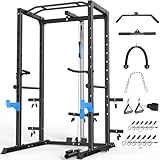
ULTRA FUEGO Power Cage
- Pulley system and lat bar included
- Landmine and dip handles included
- 10-level height adjustment

CANPA Multifunction Power Rack
- 800 lb rated frame
- Standard 1 inch accessory holes
- Rear plate storage bar
All 8 Squat Racks Compared in 2026
| Product | Specs | Action |
|---|---|---|
| Sunny Health & Fitness Full Size Power Rack |
|
Check Latest Price |
 CAP Barbell FM-8000F Deluxe Power Rack CAP Barbell FM-8000F Deluxe Power Rack |
|
Check Latest Price |
| CANPA Multifunction Power Rack |
|
Check Latest Price |
| ULTRA FUEGO Power Cage |
|
Check Latest Price |
 Sportsroyals Power Rack RK2 Sportsroyals Power Rack RK2 |
|
Check Latest Price |
 FLYBIRD SR1 Squat Rack FLYBIRD SR1 Squat Rack |
|
Check Latest Price |
 Mikolo Folding Wall Mounted Squat Rack Mikolo Folding Wall Mounted Squat Rack |
|
Check Latest Price |
 JELENS S11 Power Cage JELENS S11 Power Cage |
|
Check Latest Price |
1. Sunny Health & Fitness Full Size Power Rack – Best All-Round Budget Cage
Sunny Health & Fitness Full Size Power Rack for Complete Strength Training
38 x 53 x 87 inch frame
83 lb alloy steel
300 lb on J-hooks safeties and pull-up bar
18-point J-hook adjustment
Pros
- Compact 38 x 53 inch footprint fits tight rooms
- 18-point J-hook adjustment with safety lock spotter arms
- Includes pull-up bar safety arms and two plate holders
- Hardware pre-sorted into assembly steps
- 3890 owner reviews at a 4.7 average
Cons
- Non-standard 0.8 inch peg holes block most third-party attachments
- Short safety arms limit comfortable squat depth and wide bench setups
- Unbolted frame can rock when re-racking heavy weight
- Pull-up bar is smooth rather than knurled
This is the rack I keep coming back to for the money. Four thousand owner reviews at a 4.7 average is not a thin sample, and what those reviews describe is a cage that stays put at everyday training loads while occupying a genuinely small patch of floor. At 38 by 53 inches it is narrower than most four-post racks, which matters more in a spare bedroom than the raw capacity number does.
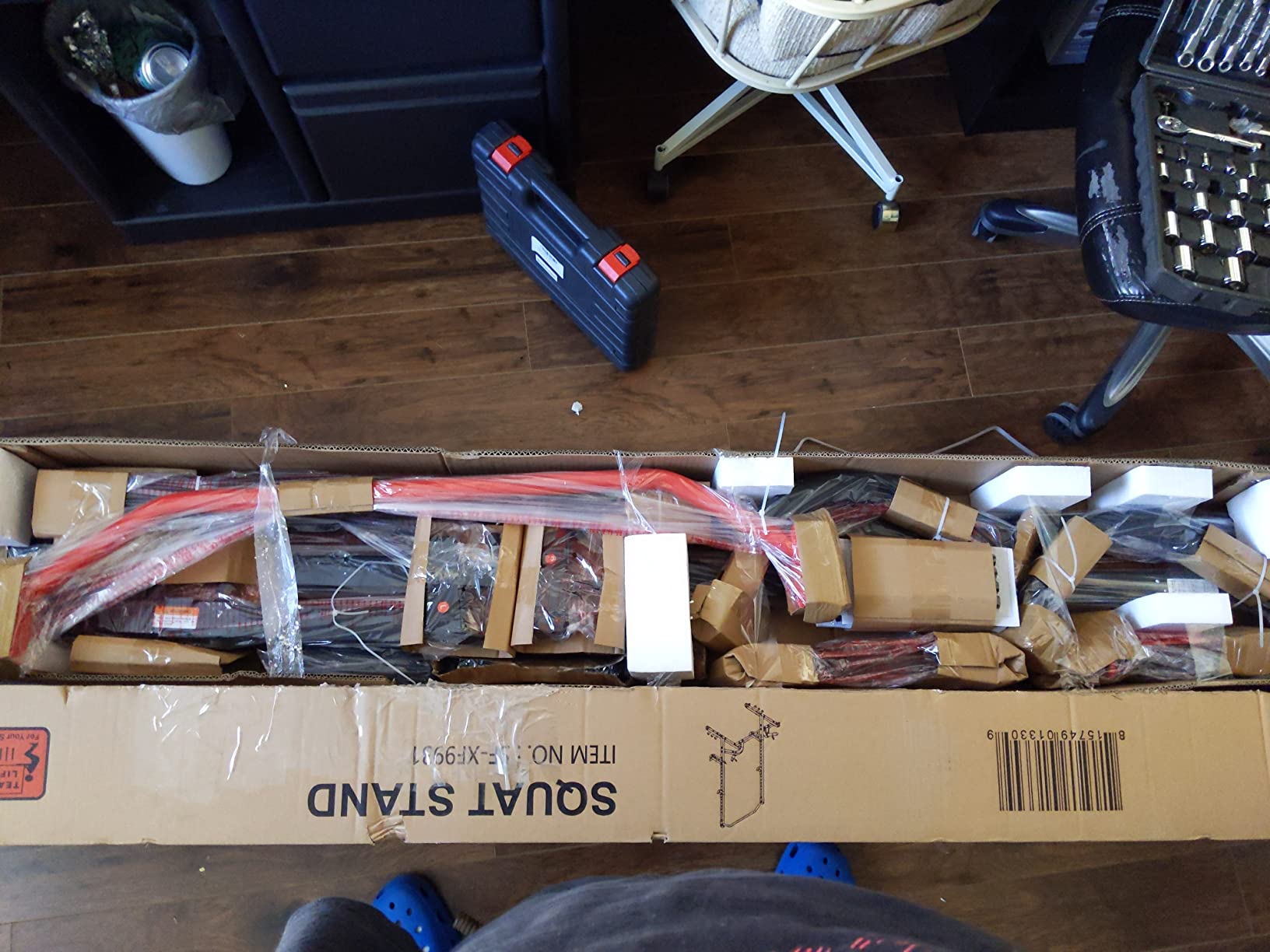
The frame is alloy steel at 83 pounds, with an 18-point J-hook adjustment and an 8-position angled pull-up bar. Two built-in Olympic plate holders are unusual at this tier and save you buying a separate tree. Assembly is the part people praise most: the hardware arrives sorted into the step it belongs to, which is a small thing until you are on the floor of a garage at nine at night.
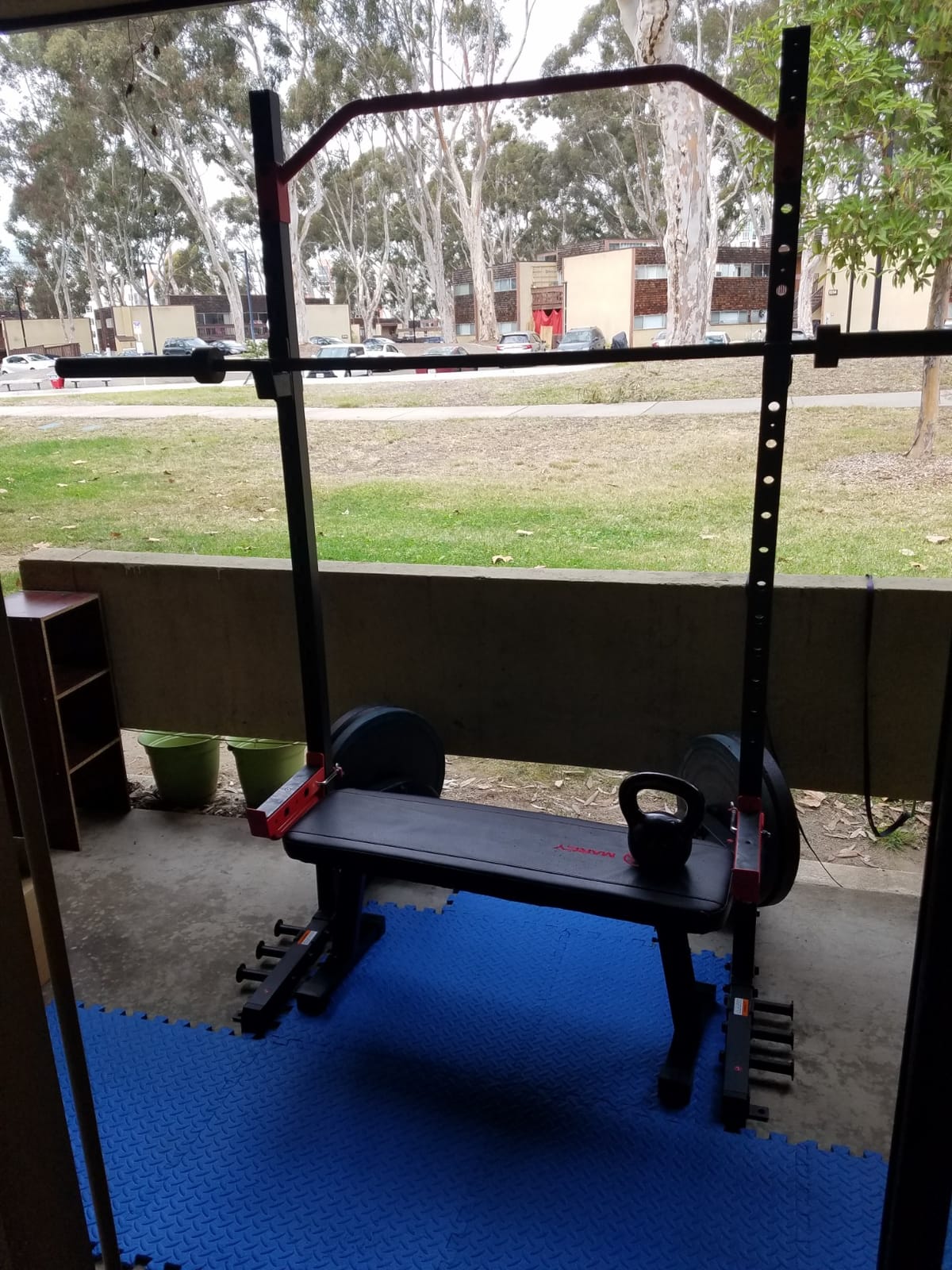
It is not a heavy-duty competition frame and it is not sold as one. The honest read on the review base is that it is stable and well built for home lifting, with the same caveat appearing again and again about the hardware pattern. More on that below.
For the record, the listed capacity is 300 lb on the pull-up bar, 300 lb on the J-hooks, 300 lb on each safety spotter arm and 100 lb per plate holder. Those are point ratings, not a single frame-wide number, and they are the most honest capacity figure most budget cages publish.
What the 300 lb per-point rating means for your lifts
A point rating tells you the limit of one component, not of the whole cage. In practice the J-hooks and safety arms on this rack are rated to 300 lb, which is well past what a bar plus plates reaches for most people training alone. It also means the limiting component is the bar supports rather than the uprights, so the frame is not what fails first.
Where you feel that limit is on the safety arms during a heavy squat. Short arms mean the bar has to travel a limited distance before it is caught, so a missed rep is caught earlier and lower. Set the rack for a conservative depth and treat the arms as a backstop rather than a parking spot.
What the non-standard peg holes cost you later
This is the single most repeated caveat in the reviews: the rack uses non-standard 0.8 inch peg holes, so most third-party attachments will not bolt straight on. Several owners in the review base plan around it by adding a pulldown unit, which is a reasonable path, but you should decide whether you want a closed ecosystem before you buy.
Two other fit-and-finish notes. Owners report the unbolted frame can shift or rock when re-racking heavy weight, so anchor it or tighten it down once assembled. The pull-up bar is smooth rather than knurled, which a few lifters with sweaty hands find slippery. Neither is disqualifying, both are worth knowing.
2. CAP Barbell FM-8000F Deluxe Power Rack – Best for Plate and Band Storage
CAP Barbell FM-8000F Deluxe Power Rack, Gray
45.6 x 61.4 x 85 inch frame
97 lb alloy steel
600 lb total capacity
3x3 posts with 1 inch holes
Pros
- 3x3 inch posts with 1 inch holes accept standard rack accessories
- Two plate posts and three band posts per side
- Can be anchored to the floor for extra rigidity
- Thousands of reviews covering years of use
- Five colour options
Cons
- Thin-gauge steel and J-cups feel cheap under load
- Safety arms can flex on heavier sets
- Thin cardboard packaging leads to bent or missing parts
- Slow replacement parts service
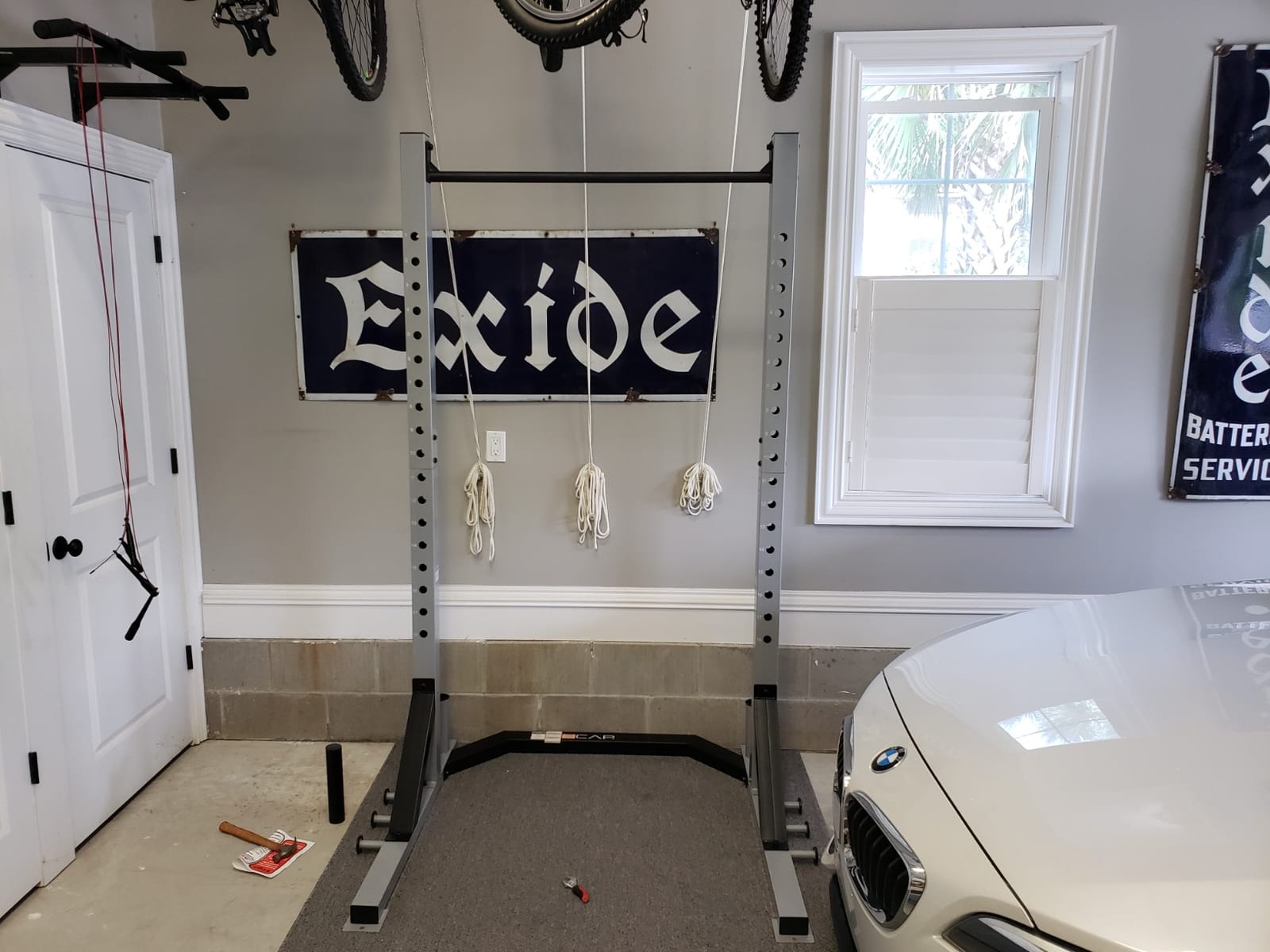
This is the old guard of the budget category, and its value proposition is boring in the best way. CAP has been building racks long enough that the review base covers multiple house moves and years of regular use. Buyers describe it as an entry-level home half cage that has held up, which is exactly the claim a first home gym needs to hear.
What separates it from the generic cages in this roundup is the hardware standard. The posts are 3 by 3 inch and drilled with 1 inch holes, so you are in the same accessory ecosystem as the well-known monster racks rather than locked out of it. Two plate posts, three band posts per side and bar holders with ABS sleeves come as standard, and the powder coat runs in a three-step finish with gussets and capped frame ends.
The total capacity is listed at 600 lb across the frame, with individual J-cup and safety catches carrying their own lower allowance. It measures 45.6 inches deep by 61.4 wide by 85 tall and weighs 97 pounds, so it is a proper footprint. Plan on that width before you buy.
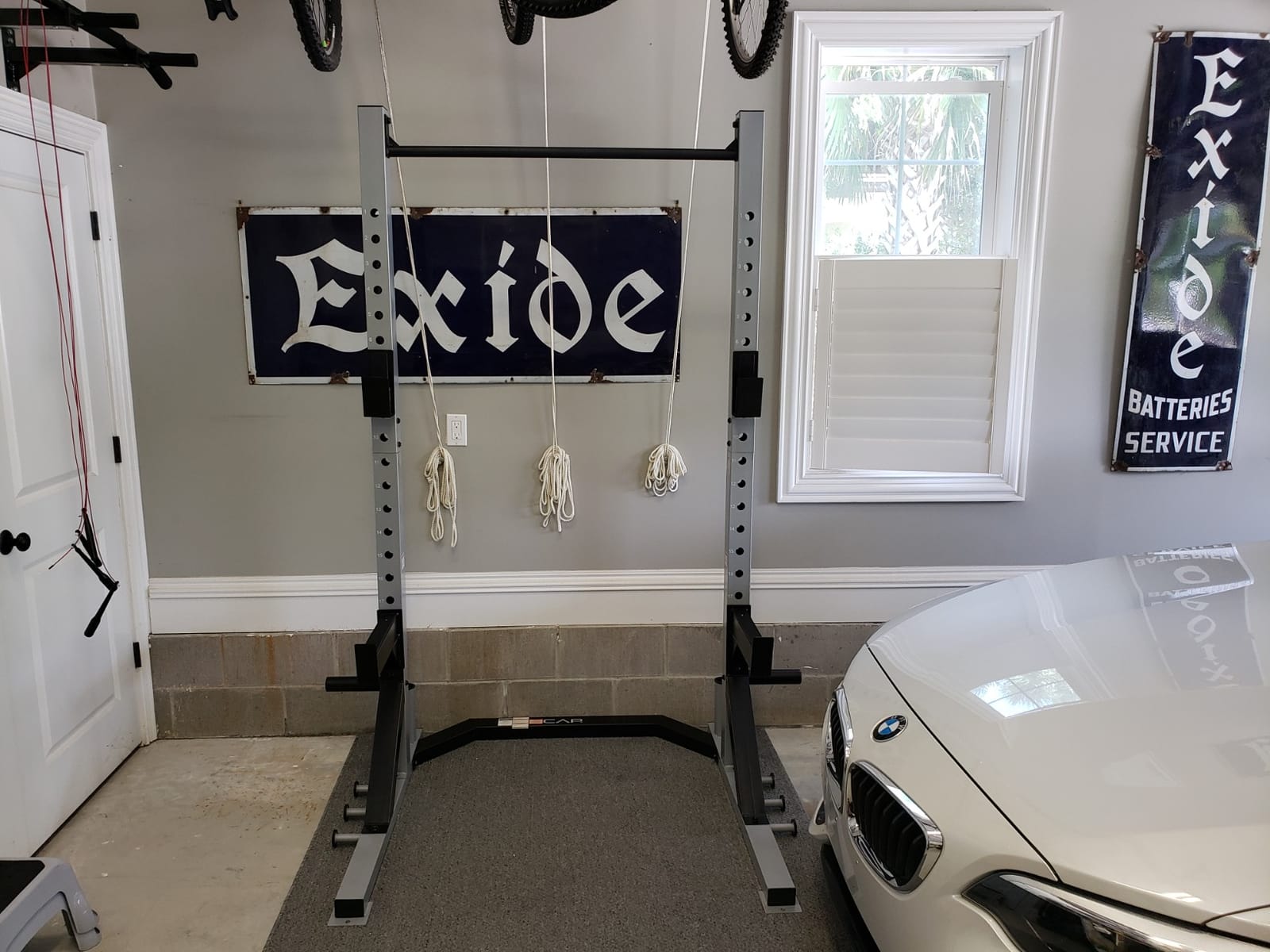
Two details in the reviews are worth acting on. The safety catch design wraps in from one side, so plates may need to come off before you can reposition it, which is annoying mid-session. And owners commonly anchor the rack to the floor for extra rigidity, which is the cheapest upgrade available to you.
Whether 3×3 posts and 1 inch holes are worth the switch
Yes, if you think you will ever add a dip bar, a landmine, a pulldown or a J-cup replacement. Those attachments are the single biggest reason buyers end up buying a second rack, and the 3×3 with 1 inch hole pattern here is the pattern most of that aftermarket is built around.
It also makes the 30 day limited manufacturer warranty feel less exposed. Parts for a standard hole pattern are easier to source than parts for a proprietary one, and CAP sells replacement components even when the original warranty has run out.
Where the thin-gauge build shows up
The build is 12- and 14-gauge steel, which is on the thinner side, and owners say you can feel it. The J-cups and safety arms are the components reviewers single out as flexing under heavier loads. For beginners and intermediates training at moderate loads that has not been a problem, but it is the reason this sits in the middle of the ranking rather than the top.
The logistics complaints are more actionable. The rack arrives in thin cardboard and bent or missing parts on delivery are reported often enough that you should inspect the frame and hardware the day it turns up. Replacement parts service is also the weak point of the whole package, so photograph any damage before assembly.
3. CANPA Multifunction Power Rack – Budget Pick for Small Rooms
CANPA Multifunction Power Rack with Pull up Bar, Heavy Capacity and Adjustable Squat Stand Rack for Home Gym Equipment, Power Rack Cage (Black)
43.03 x 40.75 x 85.71 inch frame
800 lb rated capacity
17-hole support arm with 1 inch holes
Rear Olympic plate storage bar
Pros
- Compact rectangular footprint fits corners and small rooms
- Standard 1 inch holes accept most market accessories
- 17-hole support arm plus 6-speed frame height adjustment
- Rear plate storage bar can be loaded for stability
- Assembly reported as quick with video guidance
Cons
- Supplied J-hooks cannot double as safety arms at the lowest setting
- No matching safety arms for some configurations
- Height mechanism can block very short lifters racking a loaded bar
- Mid-width design suits 6 ft bars better than 7 ft
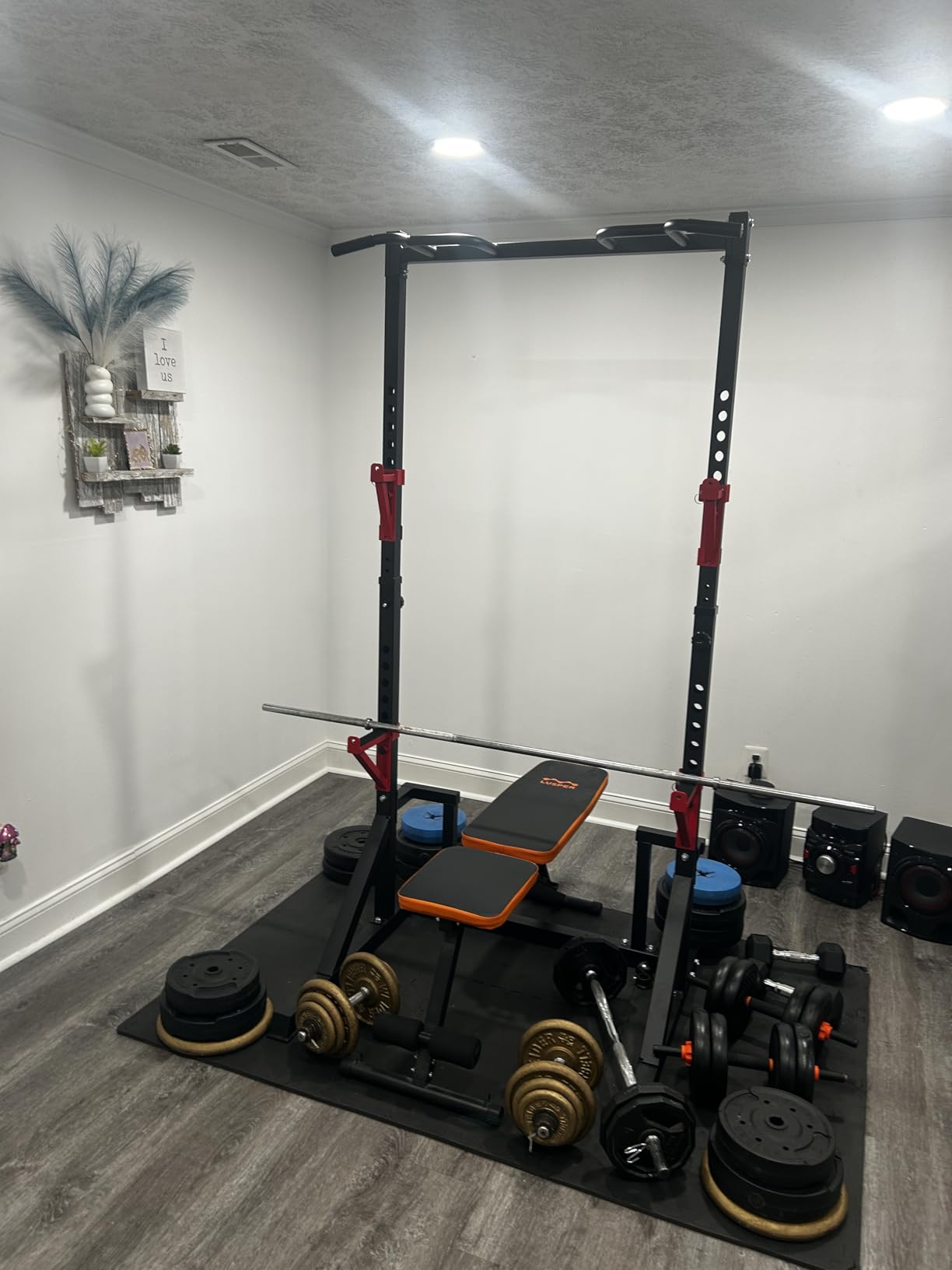
The CANPA is the reason this roundup exists for anyone working in a small space. Its 43 by 40.75 inch footprint is the second-tightest in the group and its rectangular frame tucks into a corner without a cage footprint sprawling into the walkway. The front and rear double support frame is rated at 800 lb.
Height control is unusually granular for the money: a 17-hole barbell support arm with random height adjustment plus 6-speed main frame height adjustment, all on standard 1 inch holes that accept most market accessories. A multi-direction pull-up bar and a rear Olympic plate storage bar round out the frame, and the storage bar can itself be loaded to quiet the rack down.
Reviewers consistently call it a budget space-saving rack that performs correctly for casual to intermediate lifting, with several noting it is not intended for competitive powerlifting. That is a fair description and worth taking at face value.
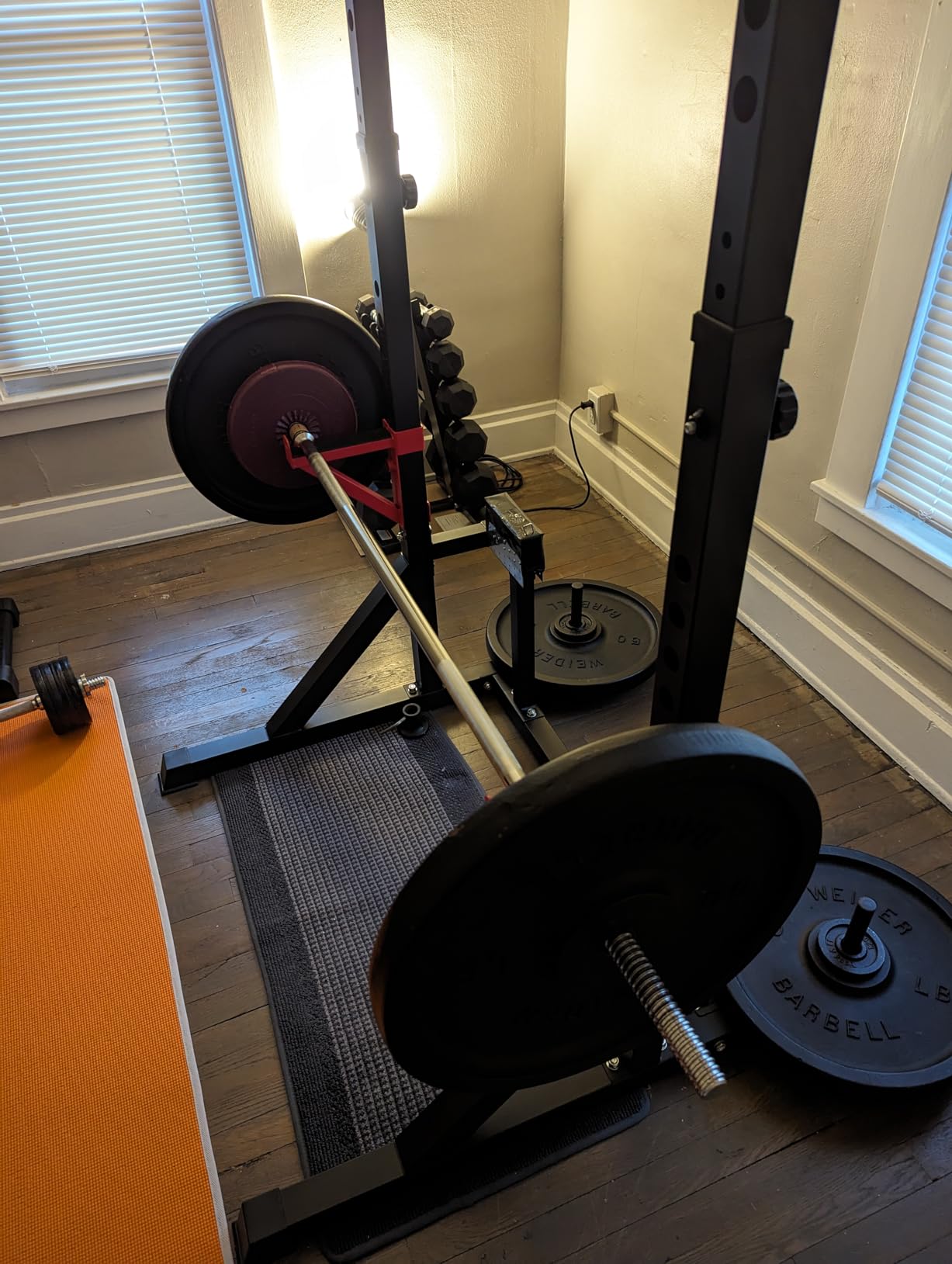
Assembly comes up as a genuine positive, with step-by-step video guidance and a build that reviewers describe as quick.
What the 800 lb rating covers in practice
The 800 lb figure is a frame rating, and it is a believable one for the construction. It is comfortably above what a solo home lifter loading an Olympic bar will reach, and it is not the kind of inflated headline figure that has no relationship to the steel. The limits show up in the components rather than the frame.
Plan on buying one accessory after purchase. The most common upgrade in the reviews is replacing the supplied hooks with compatible safety catches, because the included J-hooks cannot be used as safety arms at the lowest setting. Budget for that as part of the rack cost rather than a surprise.
What the supplied hooks will not do
Two honest constraints. There are configurations where the manufacturer does not offer matching safety arms, so verify which setup you are buying before you commit. And the mid-width design suits a 6 foot bar better than a 7 foot one, which limits your grip width and your stance if you are a taller lifter with a longer stance.
There is also a reach problem. The height adjustment mechanism can sit in front of a shorter lifter and block them from racking a loaded bar at the lower settings. If you are under about five foot six, stand at the rack and rehearse the rack height before you buy.
4. ULTRA FUEGO Power Cage – Most Accessories Per Dollar
ULTRA FUEGO Power Cage, Multi-Functional Power Rack with J-Hooks, Dip Handles, Landmine Attachment and Optional Cable Pulley System for Home Gym
63 x 47 x 82.7 inch frame
1.5mm steel with 50mm uprights
1000 lb recommended capacity
Pulley lat bar landmine and dip kit included
Pros
- Pulley system lat bar tricep rope and T-bar included
- Landmine attachment and dip handles included as standard
- Laser-cut powder-coated steel with reinforced tabs
- 10-level J-hook and safety bar adjustment
- Two-year warranty
Cons
- Supplied J-hooks are weak and a common upgrade point
- Thin steel can bend if bolts are over-tightened
- Assembly often takes 2 to 6 hours and suits two people
- Side plate pegs dip under moderate loads
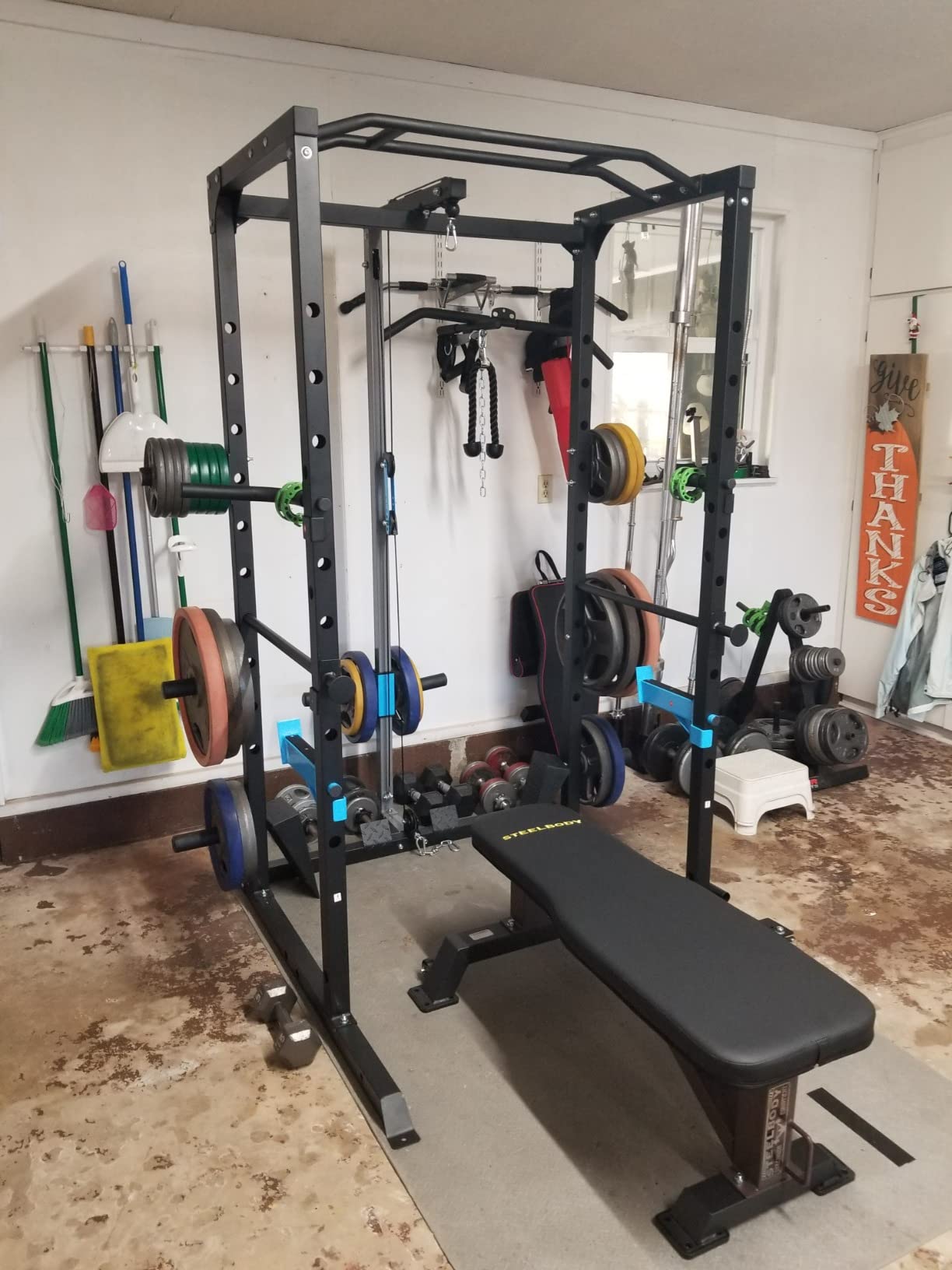
Buyers rate this one as exceptional value, and the reason is the box contents rather than the frame. The included list covers a pulley system, lat pulldown bar, tricep rope, T-bar, a 360 degree landmine attachment, dip handles, J-hooks, safety bars and band pegs. Add a bar and a bench and you have a functioning gym, which changes the arithmetic for anyone splitting a fixed budget.
The frame is laser-cut 1.5mm steel on 50 by 50mm uprights with reinforcing tabs and heavy bases that resist tipping. There are 10 levels of J-hook and safety bar adjustment plus 5 levels of dip handle adjustment, and the maximum recommended load is 1000 lb.
One dimension to plan around: at 63 inches deep and 47 wide it is the longest footprint in this roundup, because the depth is what gives the cage its stability. That is a garage purchase, not a spare bedroom purchase.
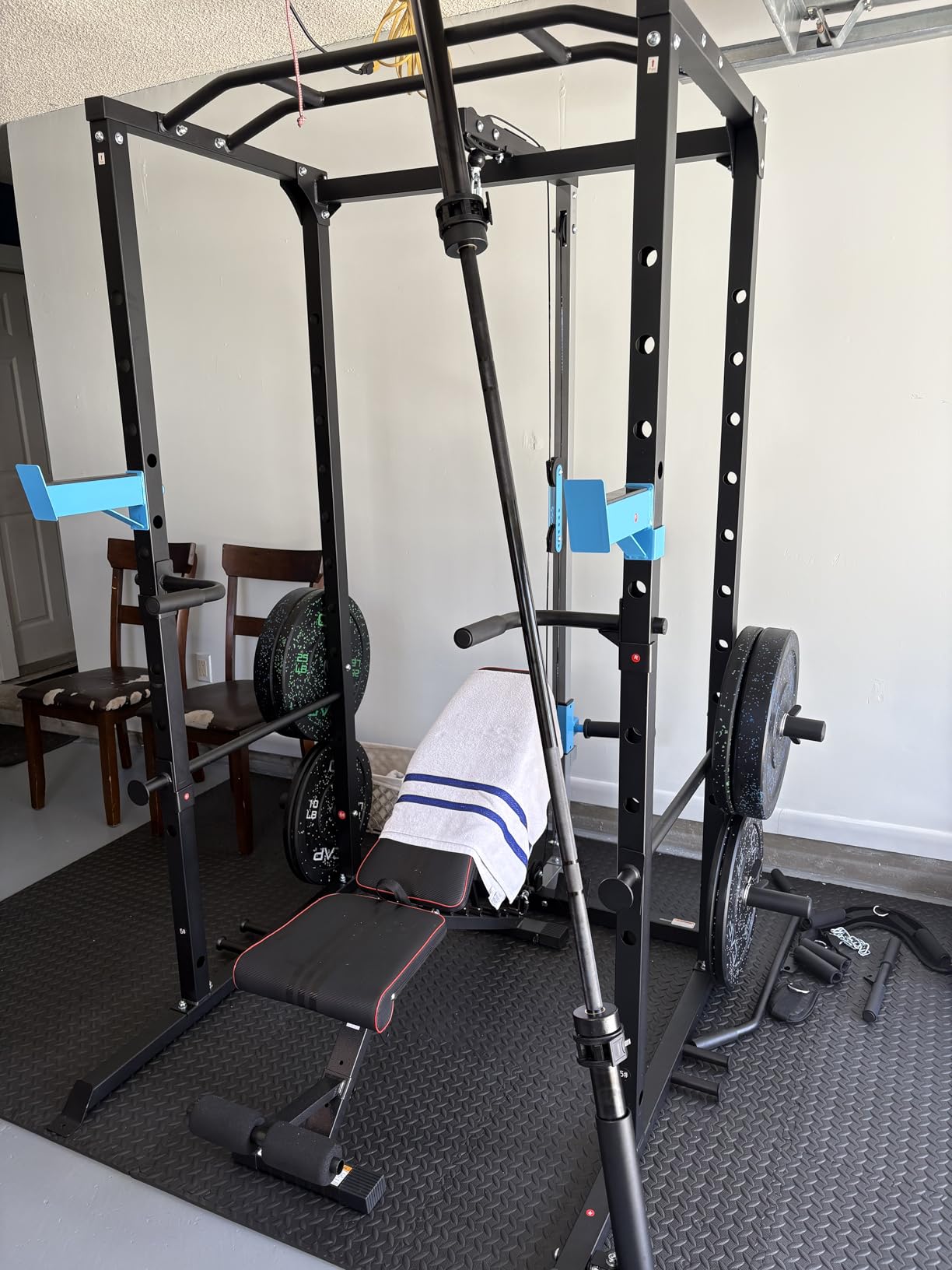
Owners report the cable pulley runs smoothly and more quietly than many budget cages, and several describe heavy barbell sessions including 400 lb bench work and 600 lb squats. The laser-cut construction is what makes that plausible.
Why the pulley package changes the math
Because it removes a whole second purchase. A lat pulldown and cable station sold separately is one of the more expensive additions to a home gym, and here it arrives in the box. If you were going to add one anyway, this is the pick that gets you furthest for the ceiling.
It also keeps the floor clear. With pull-ups, dips, rows, landmine work and cable work all on one frame, you are not chasing a wall-mounted pulley or a corner attachment every session. For a beginner building their first gym, that consolidation is worth more than a raw capacity number.
What the 4 inch hole spacing and weak J-hooks mean
The holes measure 1.14 inch at 4 inch spacing. That is a real limitation: wide spacing means fewer usable positions and a bar that sits awkwardly if you need a precise height between settings. It also does not match the 1 inch standard the cheaper accessories assume, so plan on staying mostly with what is included.
Nearly every critical review points at the same component, the supplied J-hooks, which are rated around 225 lb and are the component most owners replace first. Note the interaction: replacing hooks designed for 1 inch holes with hooks built for 1.14 inch holes on 4 inch centres is a parts hunt, so check the hole pattern before you order anything.
Assembly is the other caution. Owners report two to six hours, easier with two people, and warn that thin steel can flex if the bolts are over-tightened during the build. Tighten to snug and stop. The 82.7 inch assembled height is also tight in a low-clearance basement.
5. Sportsroyals Power Rack RK2 – Largest Walk-In Cage Here
SPORTSROYALS Squat Rack, 1200 lb Power Cage with LAT Pulldown for Home Gym
56 x 61.6 x 82.6 inch frame
150 lb of 50 x 50mm steel
1200 lb rated frame
Pulley cable rated to 500 lb
Pros
- Largest walk-in footprint here at 56 by 61.6 inches
- 1200 lb rated frame with upper and lower pulleys
- Long accessory list including landmine dip stands and foot board
- 14 laser-marked height levels
- Barbell storage and six weight racks clear the floor
Cons
- Heaviest unit here at 150 pounds
- Arrives in two boxes that may come on different days
- Assembly recommended for two to three people
- 82.6 inch height needs ceiling clearance
The Sportsroyals RK2 is the biggest walk-in frame in this group, at 56 by 61.6 inches, and that interior space is the feature. Two people can train in it at once, and a lifter who moves around inside the cage during a set has room to do it.
It is also the heaviest unit here at 150 pounds, built on a 50 by 50mm steel frame of 1.5mm thickness with two reinforcing tabs and a 1200 lb rating. There are 14 adjustable height levels with laser-marked positions, and the PU-coated cable on the lat pulldown is rated to 500 lb.
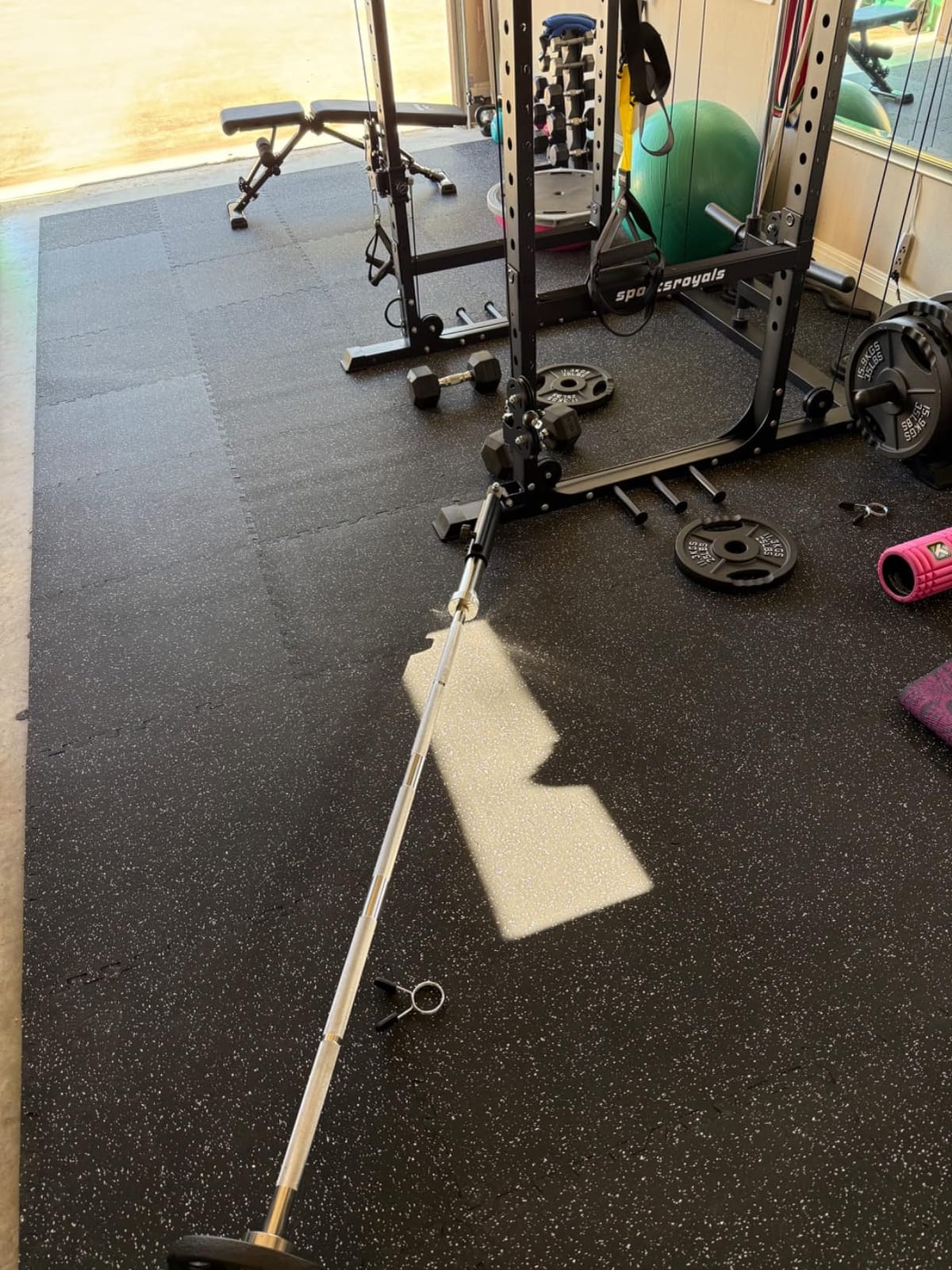
The included accessory list is long enough to matter: a rowing bar, four weight plate storage units, six band pegs, two safety arms, two safety bars, a lat pulldown bar, two J-hooks, dip stands, a tricep rope, an ankle strap, six barbell clamps in 1 inch and 2 inch sizes, two cable handles, a wide and narrow pull-up frame, a 360 degree landmine and a foot board.
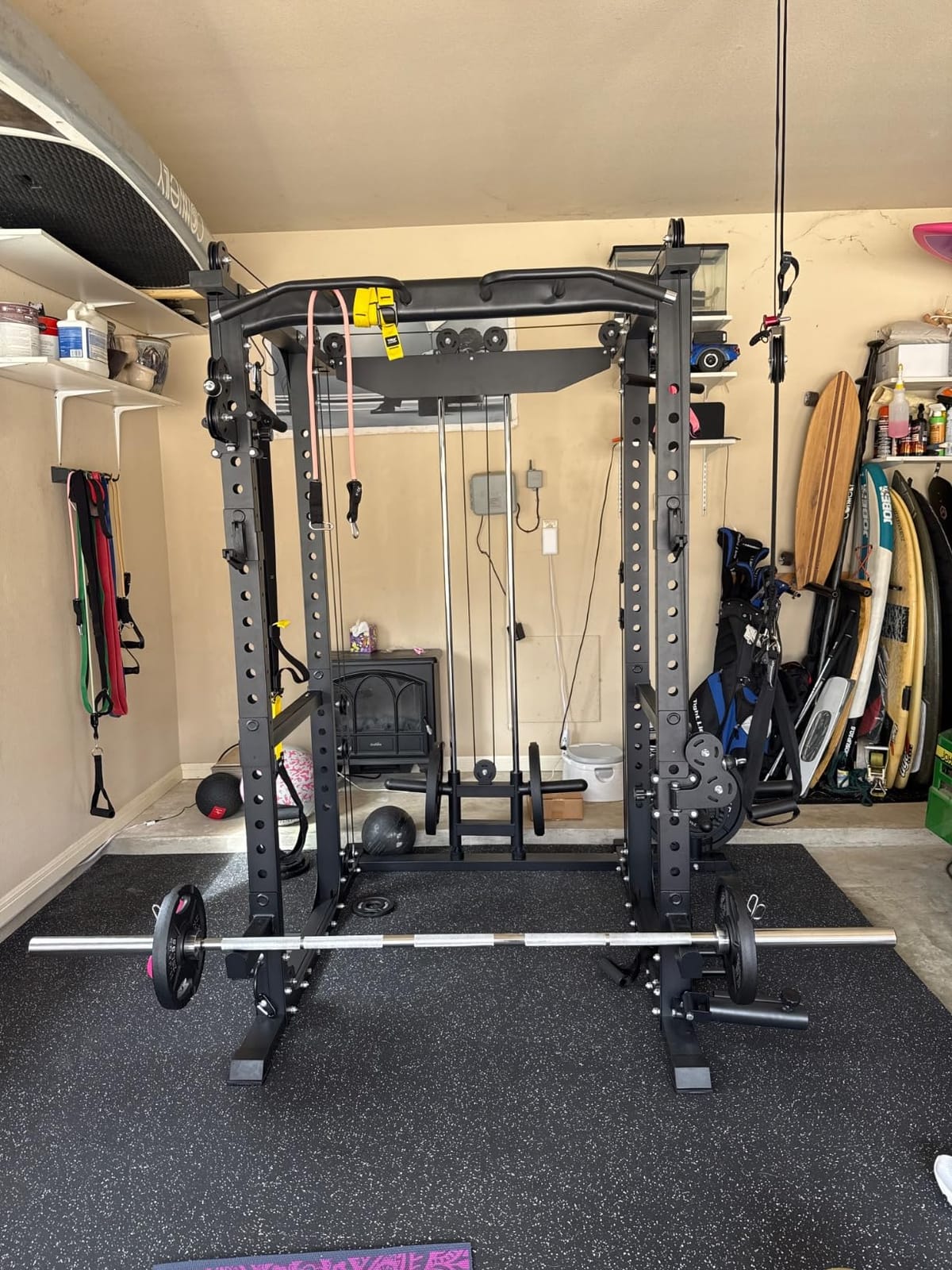
Buyers see this as the most complete all-in-one cage in its class, praising build thickness, pulley smoothness and the sheer count of included attachments. The plate storage accepts both 2 inch Olympic and 1 inch standard plates, which is a small compatibility win most cages do not offer.
Whether the 1200 lb frame is usable in a domestic room
The frame rating is not the constraint. The constraint is the room. At 56 by 61.6 inches you need roughly a nine foot wall to place it without blocking a walkway, and 82.6 inches of internal height means a standard seven foot ceiling clears it by very little once the top pull-up station is counted.
If your space is a garage or a converted room with a proper ceiling, this is the most capable frame at the ceiling. If you are working in a basement or a small bedroom, the depth alone disqualifies it and you should look at the half racks further down.
What 150 pounds of steel means for setup
It means you are not moving it casually, and it means the build is a two or three person job. The 150 pound figure also tells you why it is stable, so the weight is doing work rather than being dead weight in your garage.
The most reported annoyance is logistical rather than build quality: it arrives in two boxes, and the reviews describe them arriving on different days. Order both against the same window and have the storage space clear before the first one lands. One more detail, the rubber pads on the safety arms and bar show wear under heavy daily use, so keep an eye on them if you train every day.
6. FLYBIRD SR1 Squat Rack – Lightest Frame and Longest Safety Arms
FLYBIRD SR1 Squat Rack with Pull-Up Bar, Multi-Functional Power Rack for Home Gym, 22 Safety Position Height & Adjustable Width for 6/7ft Barbells, Includes Extended J-Hooks & Landmine Attachment
42 x 51 x 83 inch frame
68 lb of 2 x 2 inch steel
950 lb rated capacity
16.7 inch extended safety arms
Pros
- 950 lb rating on 2 x 2 inch commercial-grade steel
- 22 height settings on standard 1 inch holes
- Adjustable width fits both 6 ft and 7 ft barbells
- 16.7 inch safety arms give good catch space
- Lightest published weight here at 68 pounds
Cons
- Half rack format gives no cage-style safety net
- A very compact footprint limits stance room
- Assembly needs two people or a spare hand
- Barbell and bench sold separately in this configuration
Among the racks here with a published weight, this is the lightest frame by a wide margin at 68 pounds, and that changes the practical reality of putting a rack in a room. It is the one you can shift, rotate or carry to the other side of the garage without a second person.
It is also a half rack, not a cage. You stand in front of the uprights, bench behind, and the safety arms are the only thing between a failed press and the floor. Buyers call out the 16.7 inch extended safety arms as the feature that matters most, and with arms that long you get real catch space rather than a token catch.
The steel is 2 by 2 inch commercial grade with a 950 lb rating and 22 precision height adjustments on standard 1 inch holes. The adjustable width fits both 6 foot and 7 foot barbells, which is more flexibility than most half racks in this range offer.
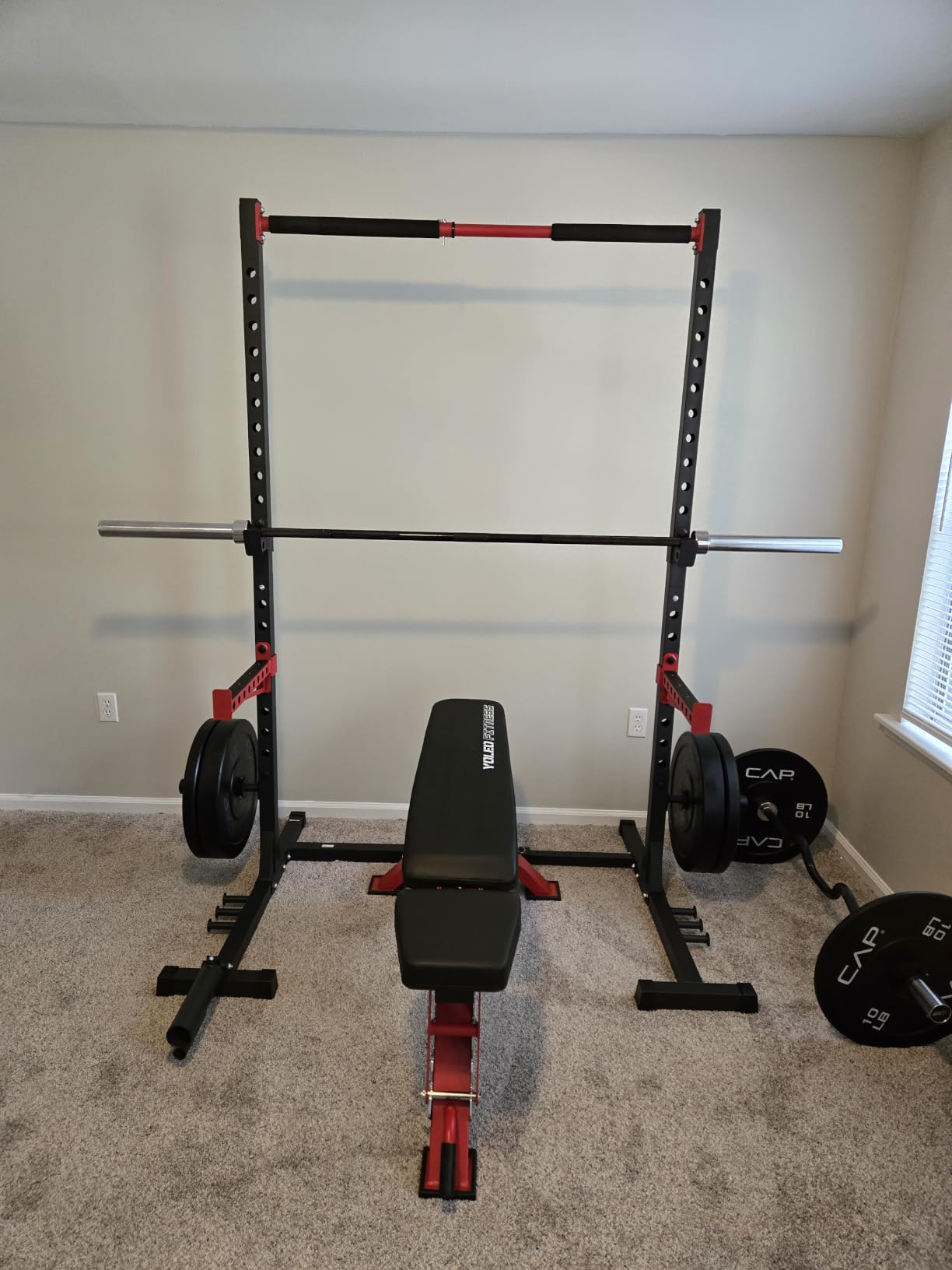
Also included: a landmine attachment, six resistance band pegs and a foam-padded pull-up bar. The foam padding on the pull-up bar is a genuinely thoughtful detail at this tier.
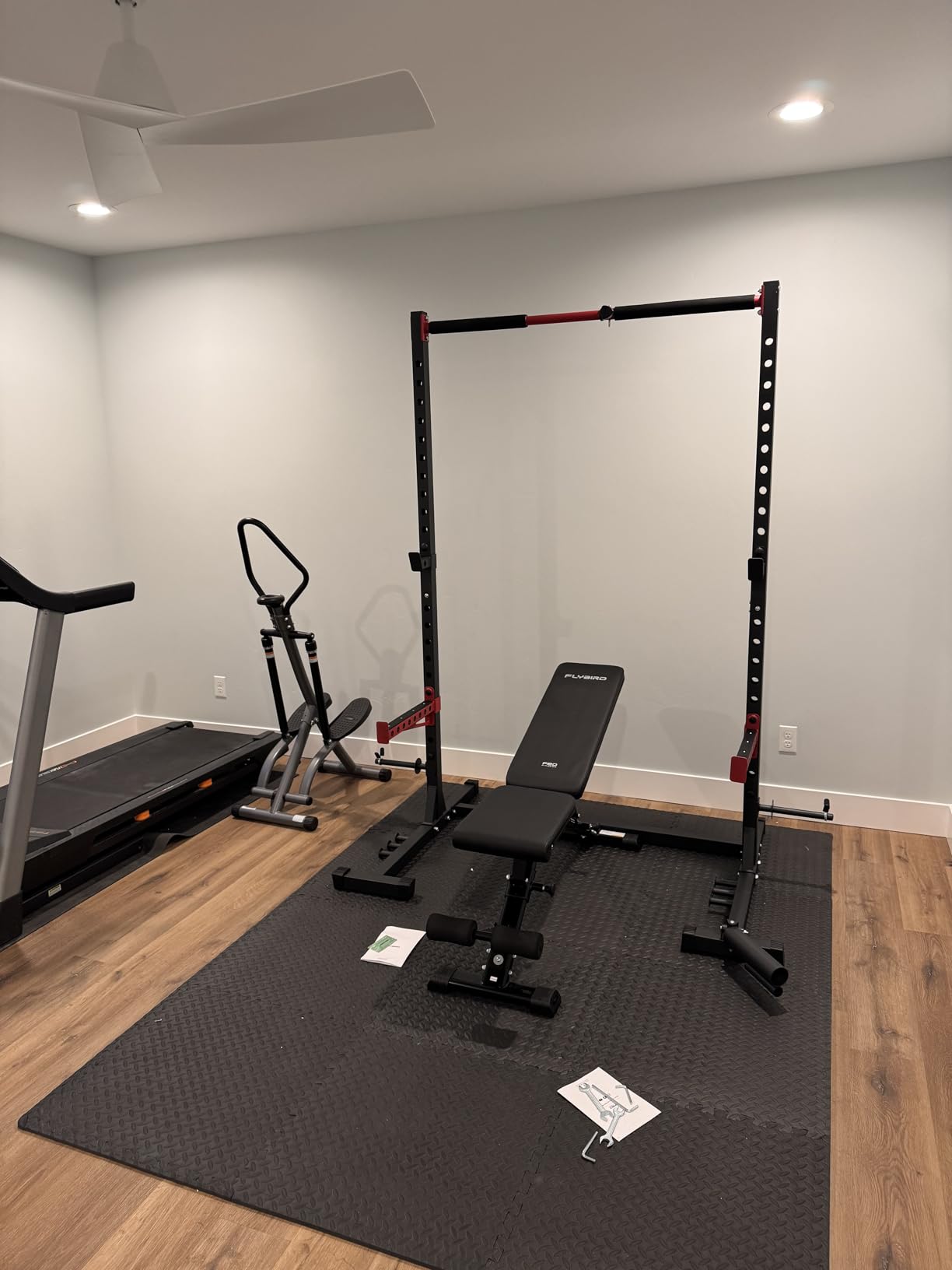
Whether a half rack is safe enough for solo work
For bench press and overhead work, yes, provided you set the arms at the right height every session and treat them as a limit rather than a target. The 16.7 inch arms are long enough to catch a bar that drifts forward, which is the failure you actually see at home.
For heavy squats, be honest about the difference. A half rack gives you one less boundary around the lifter, and the review base notes it suits intermediate home lifters rather than maximal sets without a spotter. If your plan involves heavy singles or training to failure alone, spend the money on a four-post cage instead.
What the 1 square meter footprint forces you to give up
Room, mostly. The listed dimensions are 42 by 51 by 83 inches, and the compact footprint limits how wide you can take your stance. It also means the arms have less clearance to the side, so a wide grip or a band variation is harder to set up.
What you get back is the lowest weight in the group, which is a real advantage in a basement, a spare bedroom or a rented property. The rack also needs two people or a spare hand to assemble, and in this configuration the barbell and bench are sold separately, so plan that second purchase into your budget.
7. Mikolo Folding Wall Mounted Squat Rack – Best for a Shared Garage
Mikolo 2″ x 2″ Folding Wall Mounted Squat Rack, 1000 Pounds Capacity Power Rack with Safety Catches, Pull Up Bar, J Hooks and Landmine Attachment, Space-Saving Home Gym(Red
47 x 19.7 x 85.8 inch open size
Folds to 47 x 2 x 85.8 inches
2 x 2 inch 13 gauge steel rated to 1000 lb
Pull-up bar reaches 89 inches
Pros
- Folds flat against the wall in about 15 seconds
- 2 x 2 inch 13 gauge uprights rated to 1000 lbs
- Wide lag bolt slots accept uneven stud spacing
- J-cups use UHMW plastic inserts that protect the bar
- Mounting hardware stringer and studs included
Cons
- Needs a structurally sound wall and accurate stud layout
- The instruction measurement diagram is easy to misread
- Bolt-on legs can sit slightly out of level
- Two people required to install
This is the pick for a garage that still has to hold a car, or a room where 86 inches of steel standing on the floor is one trip away from an argument. It folds against the wall in about fifteen seconds and stores at a depth of 2 inches.
When open, the frame measures 47 by 19.7 by 85.8 inches. The uprights are 2 by 2 inch 13 gauge steel rated to 1000 lb, the quick-attach pull-up bar reaches 89 inches off the ground, and the J-cups use UHMW plastic inserts that protect the knurling on your bar. A 360 degree dual size T-bar row attachment handles both Olympic and standard bars.
Owners rate it highest in the group, and the reason is consistent: people who had little floor space describe how compactly it stows and how solidly it performs once mounted. Mounting hardware, a stringer and metal studs are included, with a one-year parts replacement service behind it.
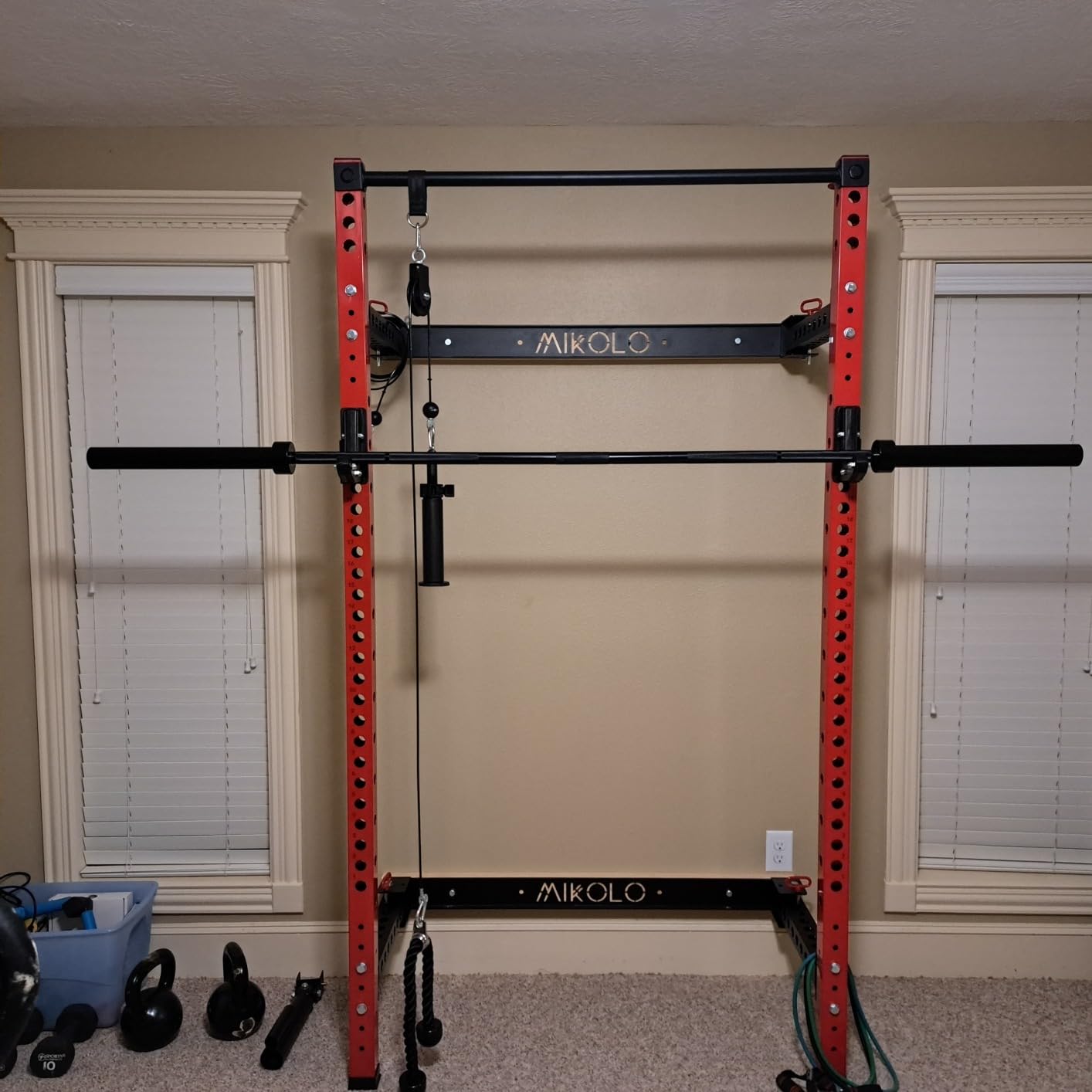
The wide lag bolt slots are a small engineering choice with a big practical payoff, because they tolerate unevenly spaced studs that a fixed pattern would not.
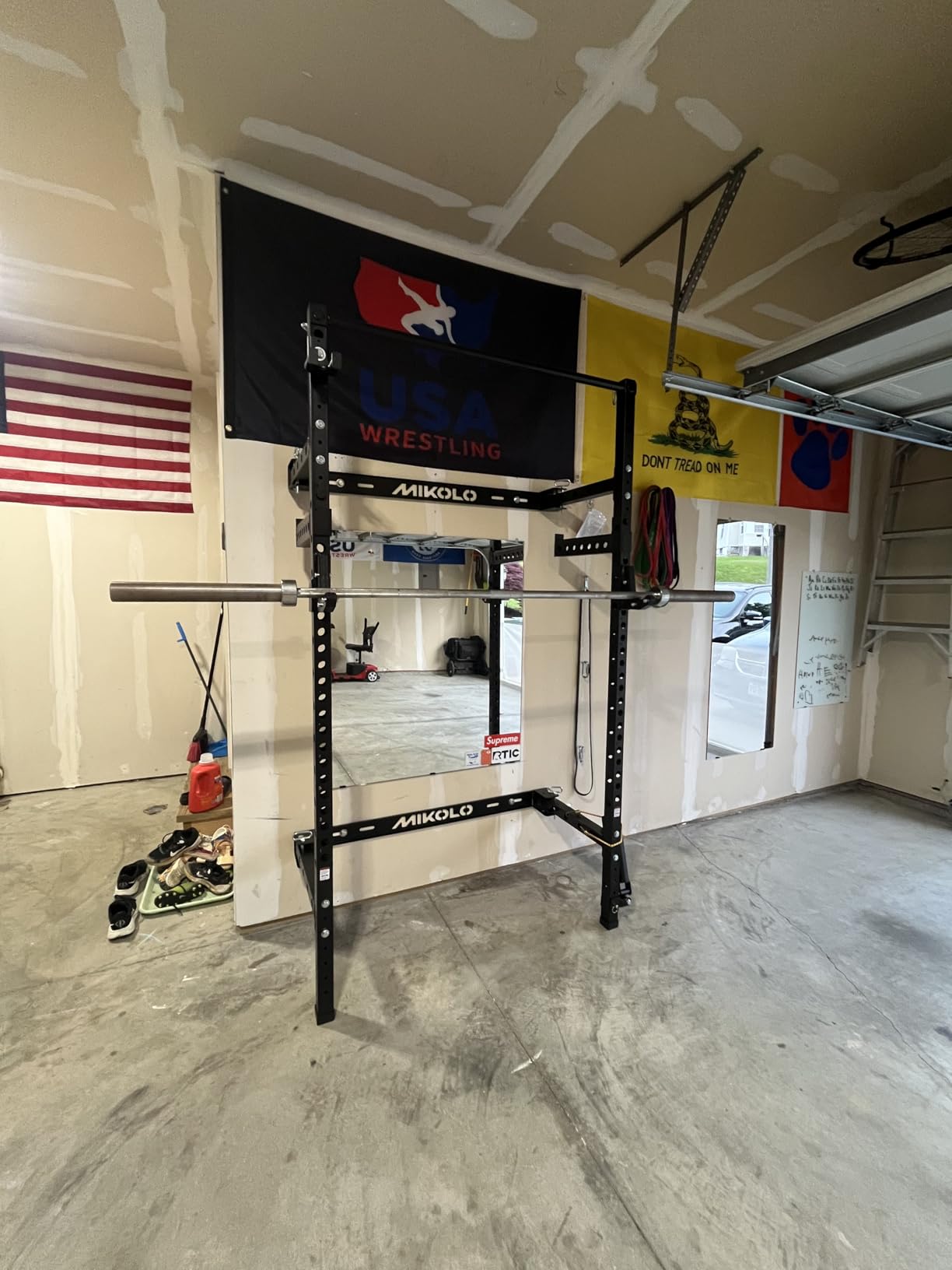
Whether your wall can carry the load
This is the decision question, and it is not about the rack. The frame applies its full load into a horizontal timber member, and if that member is not there and is not load-rated, the rack is decoration. Find the studs, verify they are structural and not a partition stub, and use the included stringer so the load spreads across two of them.
Never mount this into drywall alone. If you are renting, check the lease before you drill. If you cannot locate solid framing, buy a floor-standing half rack from this list instead and accept the footprint.
What changes once it is mounted
Once it is on the wall it behaves like a proper half rack with excellent catch geometry, and the folded footprint means the garage floor is free. The reported friction points are all installation problems rather than performance problems.
Read the measurement diagram carefully before drilling, because the reports of remounting all trace back to misreading the height diagram. Bolt-on legs can also sit slightly out of level, which offsets the J-cups, so level the frame before you load a bar. Two people are required for the install.
8. JELENS S11 Power Cage – Highest Stated Capacity
JELENS S11 Power Cage, 2000LB Multi-Function Power Rack with LAT Pulldown, Squat Rack with Adjustable Pulley System and Training Attachments, Weight Rack for Home Gym
57.48 x 44.49 x 82.6 inch frame
50mm x 50mm steel rated to 2000 lb
13 laser-marked height positions
Precision steel shaft pulleys
Pros
- Highest stated capacity here at 2000 lb on a 50mm frame
- Upgraded precision steel shaft pulleys run quietly
- Thirteen laser-numbered height positions
- Compact 12.5 square foot footprint for the feature set
- Attachments detach quickly for mode switching
Cons
- Smallest review base in the roundup at 182 reviews
- Arrives in two boxes that may come separately
- Weight plate storage clamps are basic
- 79.7 inch cage height limits overhead clearance
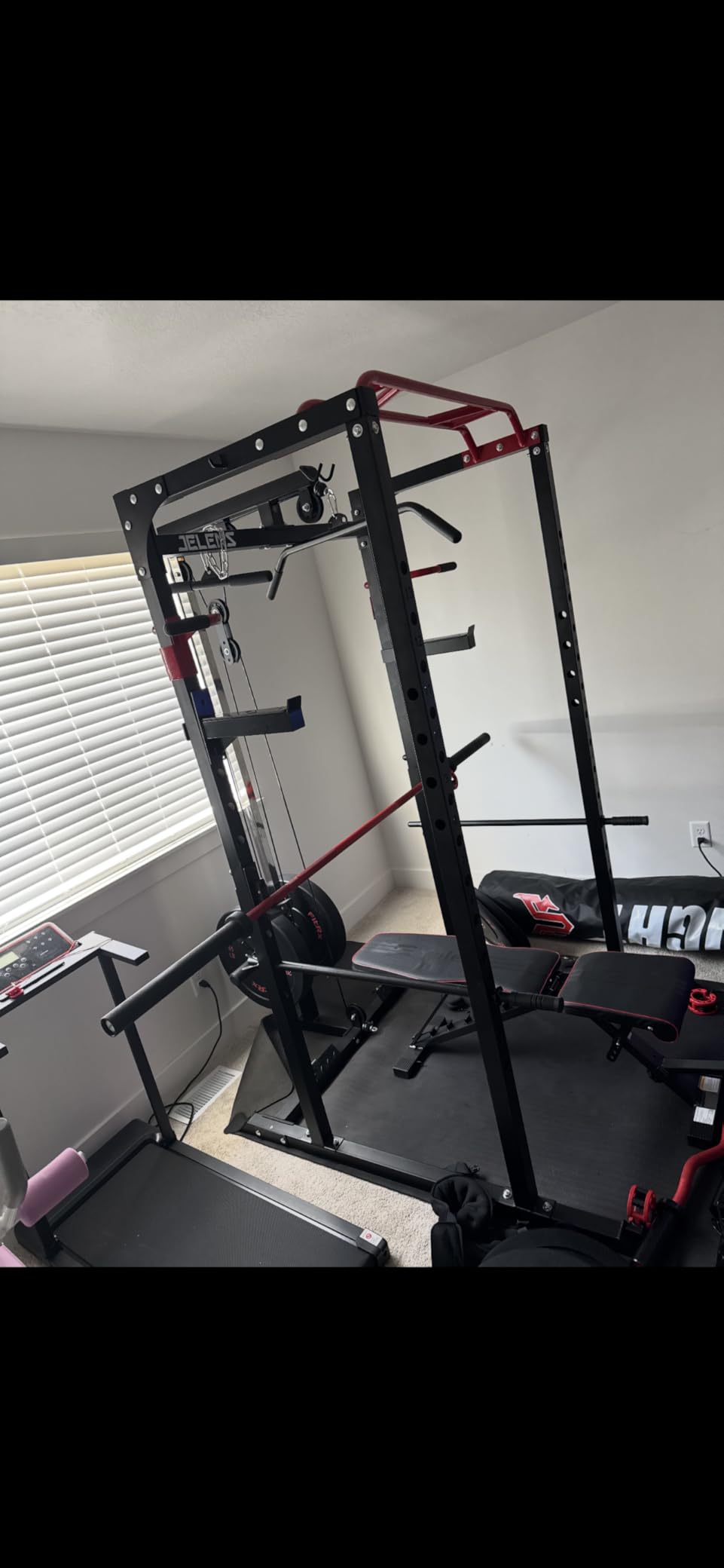
The JELENS S11 posts the highest stated capacity in the group, a 2000 lb maximum weight recommendation on a 50 by 50mm steel frame that has been sandblasted for rust resistance. At 57.48 by 44.49 by 82.6 inches it also fits into a smaller floor area than most four-post cages.
The pulley system is the part owners comment on most. Upgraded precision steel shaft pulleys with polished high-strength cable give quiet, steady travel, and 13 laser-marked height positions make repositioning fast once you know where you want them. Included: a lat bar, cable bar, T-bar, J-hooks, safety rods, a 360 degree landmine and four counterweight racks with clamps.
There is one honest caveat about the rating. A 2000 lb headline on a cage in this price band is a frame and hardware claim, not an invitation to load 2000 lb. No home gym bar and plate inventory approaches that, and treating a marketing figure as a training permission is how people get hurt.
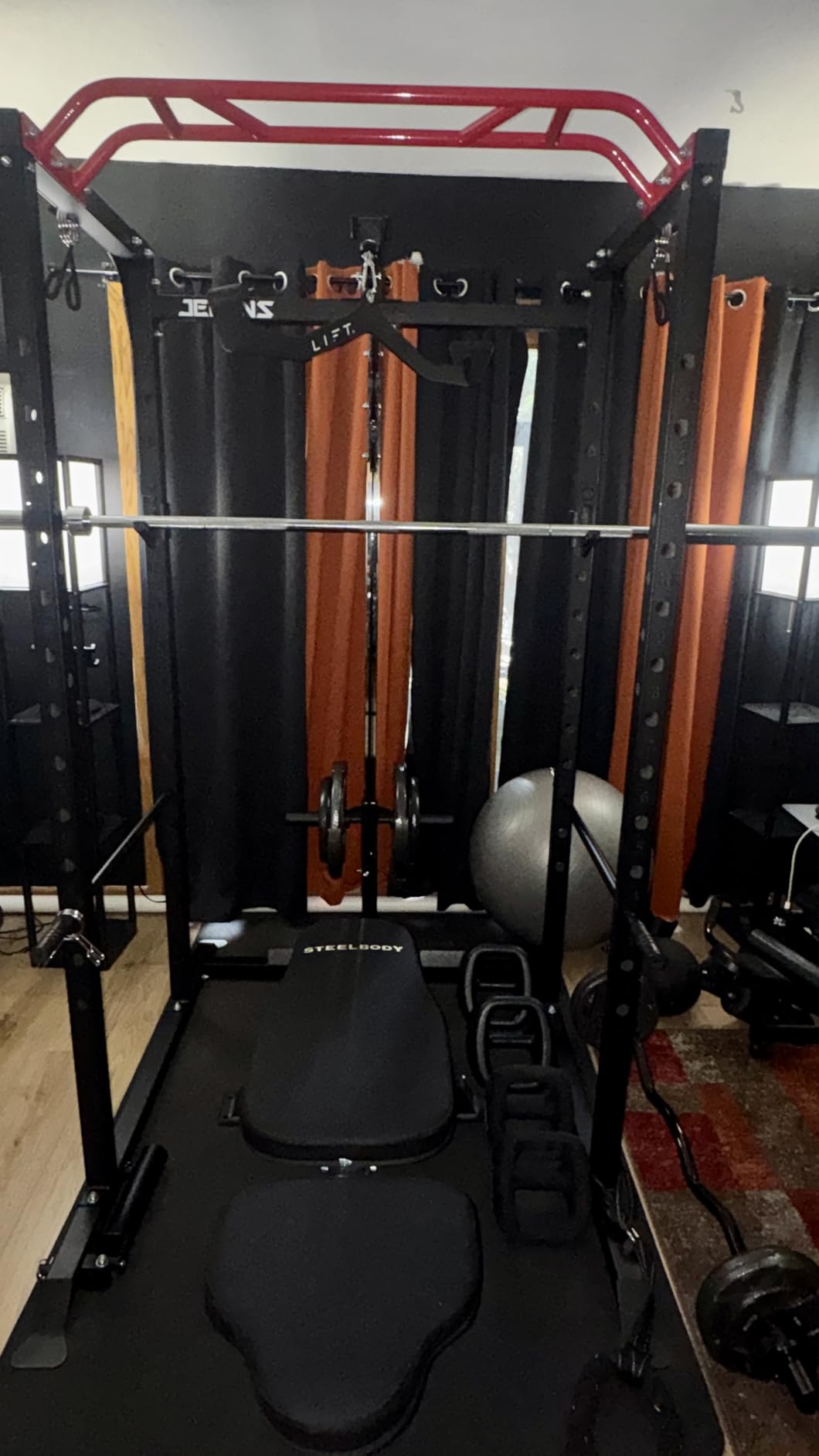
What the review base does support is the quiet, smooth pulley run and the high stated capacity relative to footprint. All attachments detach quickly, which makes switching between cable work and barbell work fast.
What 2000 lb on paper actually tells you
It tells you the manufacturer is claiming the frame and hardware can handle substantially more than you will ever load, which is useful as a margin of safety and useless as a specification to shop on. Between the 800 lb and 2000 lb claims in this roundup, the difference in your training will be zero.
Shop on steel gauge, tube size, hole spacing, safety arm geometry and whether the frame rocks. Those are the things that change how a rack feels under a heavy single. The headline number is marketing until proven otherwise.
What the shorter cage height changes for tall lifters
The cage height is listed at 79.7 inches, which is shorter than the 82 to 86 inches of the other four-post racks here. That difference is small on paper and noticeable in practice for anyone over about six feet, because the overhead clearance for the pull-up frame shrinks with it.
Before you buy, stand under the rack position and check that you can pull yourself up with your knees clear. Forum lifters repeatedly flag low pull-up bars on budget racks as one of the most common disappointments, and it is a five-minute check that avoids a return.
The other trade-offs are practical. This is the newest listing in the roundup with the smallest review base, so you have less history to lean on. It arrives in two boxes that may come separately, and the weight plate storage clamps are basic next to the premium racks. It carries a one-year warranty.
Which Rack Type Do You Need?
Four rack types cover almost every home gym under this ceiling, and picking the wrong one is the most expensive mistake available to you. The decision comes down to one question: can you squat and press inside a frame, or in front of one?
Full power rack or cage. Four uprights, you stand inside, adjustable safety bars catch a failed lift. This is the only option that makes heavy barbell work genuinely safe alone. It needs the largest footprint and usually a decent ceiling, and it is what most beginners should buy first.
Half rack. Two uprights with a base, you stand in front, bench access is open. Safety arms sit behind you rather than around you. It suits intermediates, bench-focused training and rooms where four uprights will not fit.
Squat stand. Two independent uprights, no safeties at all. A spare-room space saver for experienced lifters who already know how to bail. We did not include a standalone squat stand in this roundup because every rack here gives you more for the same ceiling.
Wall-mounted folding rack. Folds flat against wall studs when unused. The right answer for a garage that doubles as parking or a room that has to reset quickly.
Match the type to the training. Squats and heavy singles push you toward a full cage. Bench and overhead work with a spotter or a bail plan can run on a half rack. Space alone decides between floor and wall.
How to Choose a Squat Rack Under Five Hundred Dollars
Measure before you shop, and measure twice. You need your standing height plus 12 to 18 inches of overhead clearance inside the rack. Most budget cages stand between 80 and 86 inches, so a seven foot garage works for lifters up to roughly five foot ten. If you are taller, the FLYBIRD half rack or a low-ceiling model suits you better than a cage. Check the rack’s depth as well as its width, because a 63 inch deep cage needs a wall most spare rooms do not have.
Understand steel gauge, because the number runs backwards. Lower gauge means thicker steel, so 11-gauge is heavier than 14-gauge. Twelve gauge is the budget sweet spot and eleven gauge is where the premium tier starts. Where a manufacturer does not publish a gauge, the tube size tells you something: 3 by 3 inch uprights here are the CAP Barbell, while the 2 by 2 inch frames are the lighter half racks and wall units.
Treat the capacity number as a marketing figure until you break it down. Ask what is being rated. A per-point rating of 300 lb on the J-hooks and safety arms tells you the support components are the limit, which is what matters in practice. A single frame-wide number tells you almost nothing, and a headline figure above 1500 lb tells you the copywriter was working.
Check the hole spacing before you plan attachments. Standard 1 inch holes on 1 inch centres open up the whole accessory market. The ULTRA FUEGO uses 1.14 inch holes at 4 inch spacing, and the Sunny uses non-standard 0.8 inch peg holes, and both limit what you can bolt on later. Decide whether you want an open ecosystem or a closed one before you buy.
Budget for freight, because advertised price is not landed price. This is the line item that breaks a five hundred dollar rack budget, and it is the one most guides leave out. Oversize items often carry a delivery charge on top of the advertised price, and in this category the difference can be the difference between a rack that fits your budget and one that does not. Check the delivered total before you commit, not the headline figure.
Expect company for the assembly. Budget one to three hours with a hex key set and usually two people. Heavier four-post racks in this group run longer, with owners reporting two to six hours, and a wall-mounted unit needs two people but far less time once the studs are located. Order the parts you will need for anchoring at the same time, because a second delivery is a second wait.
Split the budget instead of spending it all on the rack. The most common question from people starting a home gym is whether one budget covers a rack, a bar and plates. It does not, and trying to force it means compromising on all three. Put roughly half toward the rack, a quarter toward a bar, and the remainder toward plates, then add a bench once those are covered. The racks at the lower end of this roundup leave more of your budget for the iron.
Consider the used route if you want a premium frame. The community consensus in home gym forums is clear: a used 3×3 rack from a well-known brand is the single biggest budget lever available, and it is how people reach a boutique-tier frame without a boutique-tier ceiling. Know what to check before you commit: rack the frame under load and listen for creaks, inspect the welds and upright holes for deformation, count the included hardware, and confirm the J-hooks and safeties are present and undamaged. Treat any rack with a bent hole spacing or a cracked weld as scrap.
Anchor it. On a concrete garage slab, anchoring the rack feet is a few bolts and a drill, and it is the cheapest improvement available. It kills the rocking on re-racks that owners mention in almost every review here. For a wall-mounted unit, the anchoring decision is a structural one and is covered in the Mikolo section above.
Finally, check the warranty and parts story before you buy, because on a cheaper rack it is the part that saves you when a J-hook wears out. Terms range from a 30 day limited warranty on the CAP Barbell to two years on the ULTRA FUEGO and the Mikolo, with the Sunny offering one year or 180 days. A longer term is a reasonable proxy for a manufacturer standing behind its own steel.
Frequently Asked Questions
What is the best squat rack for the money?
Under this ceiling the best value depends on rack type rather than a single winner. The Sunny Health u0026amp; Fitness Full Size Power Rack is the best all-round budget cage, combining a compact 38 by 53 inch footprint with 18-point J-hook adjustment and a large owner review base. The ULTRA FUEGO Power Cage is the best value once you count attachments, since the pulley system, lat bar, landmine and dip handles arrive in the box. The Mikolo folding wall-mounted rack is the best option for a garage that also has to hold a car.
How much is a decent squat rack?
A decent budget squat rack costs considerably less than the ceiling, and should be rated for at least 500 lb, built from 11 or 12 gauge steel with 2×2 or 3×3 inch tubing. In the upper part of this range you enter territory where 1000 lb capacity ratings and folding or wall-mounted designs become available. Spend on hole spacing and tube size rather than the headline capacity number.
What are the types of squat racks available?
Four main types. A full power rack or cage has four uprights, you lift inside, and adjustable safety bars catch a failed rep. A half rack has two uprights with a base, open bench access, and safeties behind the lifter. A squat stand is two independent uprights with no safeties at all, and suits experienced lifters only. A wall-mounted folding rack folds flat against wall studs when not in use, which makes it the right pick for a shared garage.
What is the best home gym equipment on a five hundred dollar budget?
Split the money rather than committing it all to a rack. Spend roughly half on a rack, a quarter on an Olympic bar, and the remainder on plates, adding a bench once those are covered. The lower-priced racks in this roundup leave more of the budget for the iron, and a used 3×3 rack is the biggest lever if you want a premium frame on a tight ceiling.
Are cheap Amazon squat racks safe?
Safety depends on steel gauge, capacity rating and anchoring rather than the retailer. Anything at least 12 gauge with a 500 lb or higher rating, anchored to the floor, and used with the safeties set correctly, is adequate for most home lifting. Watch the two-upright stands below 150 dollars, which offer no safeties at all. In this roundup the ULTRA FUEGO, Sportsroyals and JELENS cages use widely spaced holes that limit some third-party attachments, so check that before planning an accessory budget.
Final Verdict
After working through all eight, the Sunny Health & Fitness Full Size Power Rack is our best squat racks under five hundred dollars pick. It has the largest owner review base in the group at a 4.7 average, a footprint that fits a normal room, the most granular J-hook adjustment we found, and a three-year-old listing with a body of feedback behind it. The non-standard peg holes are the real tradeoff, so buy it if you plan to stay with its own accessories or add one pulldown unit and stop.
Buy the ULTRA FUEGO if you want the most complete gym in the box and have the floor area for a 63 inch deep cage. Buy the Mikolo if the rack has to disappear when you park. Buy the FLYBIRD or the CANPA if the room is tight and you train lighter.
Two final rules before you check out. Look at the delivered total rather than the advertised price, and split the ceiling across a rack, a bar and plates instead of trying to make one purchase do all three jobs. Measured that way, this ceiling buys more than it did three years ago.