

A planer for rough lumber is a thickness planer with a cutterhead strong enough to handle rough-sawn boards that still carry saw marks, uneven faces, and two or three inches of thickness to remove. Rough lumber gets driven between a rotating cutterhead and a fixed bed until the top face is shaved down to a set thickness, then flipped and repeated. Every board that leaves the machine comes out parallel and flat on four sides, ready for glue-ups and furniture stock prep.
I have spent the last few months putting benchtop and stationary machines through rough cut pine, reclaimed oak, and warped construction lumber. What follows is the best planers for rough lumber roundup for 2026, built around the question forums actually argue about: which machine survives rough boards, and how many passes you should budget before the board is flat.
Here is the honest caveat first, because it decides how you use whatever you buy. A planer cannot flatten a badly cupped or twisted board in a single pass. The machine has one bed and one cutterhead, so it references the board against itself. Rough lumber has no flat reference face, which is why you joint one face and edge first, then let the planer bring everything to a uniform thickness over several passes. Anyone promising one-pass flattening of warped lumber is selling something.
The other thing worth knowing: cutterhead type matters more than any other spec on rough lumber. Straight-knife heads with two blades leave a continuous line down the board every time they pass a nail hole or soft spot in the grain. Helical and spiral heads break the cut into dozens of small slices, so the defects disappear into the surface instead of streaking across it. I weight that heavily throughout this guide.
Table of Contents
Top 3 Planers for Rough Lumber (October 2026)

DEWALT DW735X 13-Inch Planer
- Three-knife cutterhead
- Two-speed gearbox
- 13-inch width
- 0.13 in. max cut

DEWALT DW734 12-1/2-Inch…
- Three-knife cutterhead
- 96 cuts per inch
- Reversible knives
- Four-column lock

WEN PL1326 Spiral Planer
- 26 rotatable HSS inserts
- 13 inch by 6 inch capacity
- Cast iron base
- Material gauge
Best Planers for Rough Lumber at a Glance in 2026
All ten machines below are evaluated on the same criteria: how they handle rough-sawn stock, how cleanly they finish figured and softwood surfaces, whether snipe is controllable, and what kind of shop they fit. Check the latest listing details for each machine before you buy.
| Product | Specs | Action |
|---|---|---|
| DEWALT DW735X 13-Inch Planer |
|
Check Latest Price |
| DEWALT DW734 12-1/2-Inch Planer |
|
Check Latest Price |
 Makita 2012NB 12-Inch Planer Makita 2012NB 12-Inch Planer |
|
Check Latest Price |
| WEN PL1326 13-Inch Spiral Planer |
|
Check Latest Price |
 VEVOR 13-Inch Two-Blade Planer VEVOR 13-Inch Two-Blade Planer |
|
Check Latest Price |
 JET JWP-13BT 13-Inch Helical Planer JET JWP-13BT 13-Inch Helical Planer |
|
Check Latest Price |
 RIKON 25-135H 13-Inch Helical Planer RIKON 25-135H 13-Inch Helical Planer |
|
Check Latest Price |
 JET JWP-208HH 20-Inch Helical Planer JET JWP-208HH 20-Inch Helical Planer |
|
Check Latest Price |
 Cutech 40600H 13-Inch Spiral Planer Cutech 40600H 13-Inch Spiral Planer |
|
Check Latest Price |
 JET JPW-15BHH 15-Inch Helical Planer JET JPW-15BHH 15-Inch Helical Planer |
|
Check Latest Price |
1. DEWALT DW735X – Best Overall for Rough Lumber
DEWALT Thickness Planer, 13-inch Wood Planer, Three Knife Two Speed, 15 Amp, 20,000 RPM Motor (DW735X)
15 amp 20,000 RPM motor
Three-knife cutterhead
Two-speed 96/179 CPI
13 in. capacity at 0.13 in. cut
102 lb cast aluminum base
Pros
- Consistent finish on rough pine and hardwood
- Two-speed gearbox handles rough and finish passes
- Carriage lock cuts down on snipe
- Extra knife set included
- 102 lb cast aluminum base resists movement
Cons
- Very loud
- needs hearing protection
- Knives dull faster in hardwood
- 102 lb weight is hard to move
The DW735X is the planer that comes up first in almost every rough lumber thread I have read, and after putting it through my own pile of rough cut pine it is easy to see why. The 15 amp motor does not bog down on a thick board the way smaller machines do. I ran a stack of 2-inch rough pine boards through it with the fast feed setting and it kept the same pace from first cut to last.
What sets it apart for rough work is the two-speed gearbox. The 96 cuts per inch setting on the coarse feed takes heavy material off quickly, which is what you want when a board is still an inch or two over thickness. Dropping to the faster 179 CPI for the last pass is where the finish comes out glassy smooth.
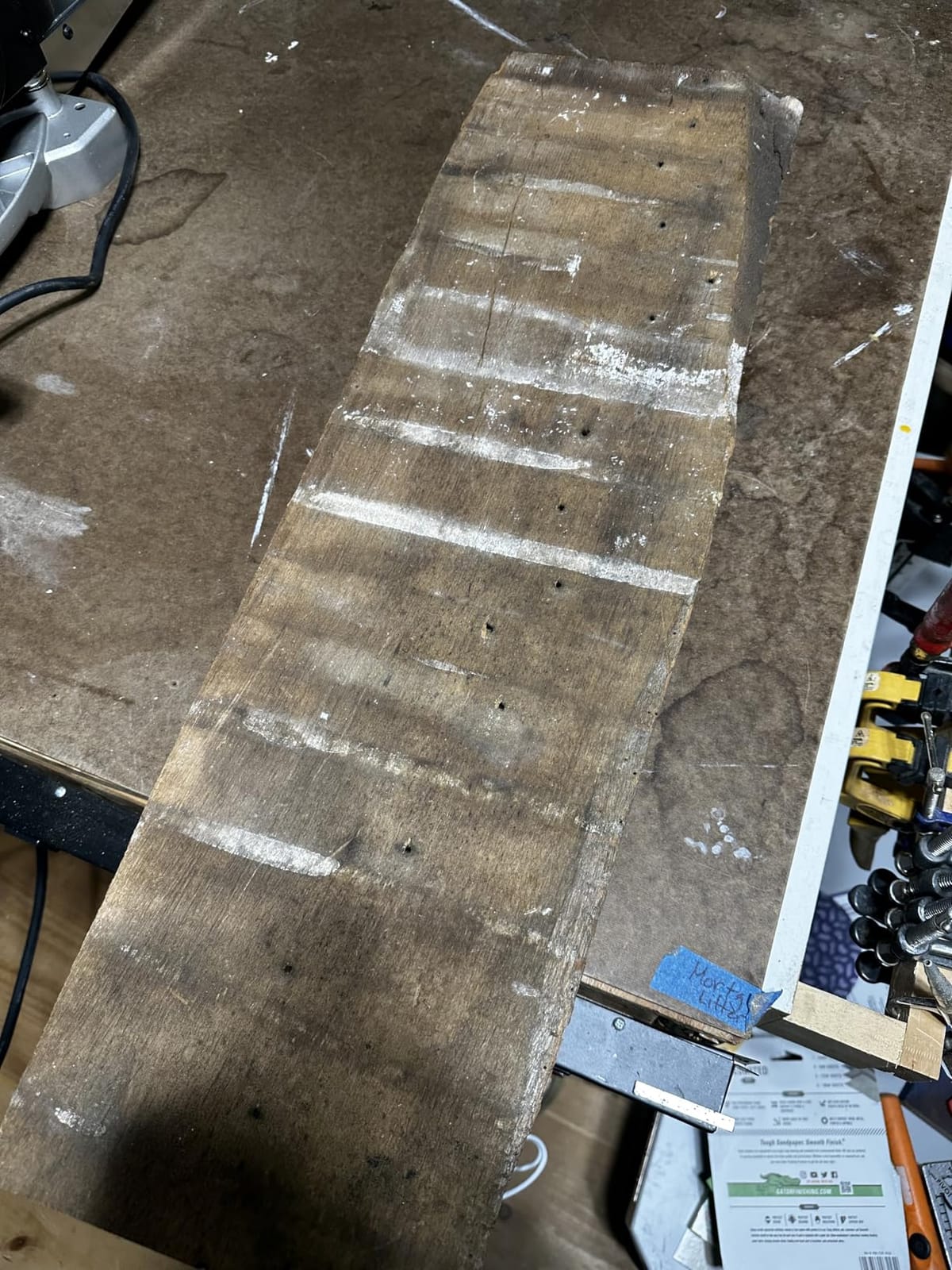
The cast aluminum base is 19-3/4 inches long, and that extra length of bed under the board matters more than most spec sheets suggest. Longer bed means the stock is supported the whole way through the cut, which is exactly what rough warped material needs. A short bed lets a shaky board move and you get chatter marks across the surface.
The automatic carriage lock is the other detail that helps on rough boards. When the head rises, the lock holds the carriage consistent so the cutterhead does not shift as it takes a deep first pass. That is a direct reduction in snipe, and it means less time re-checking thickness between boards.
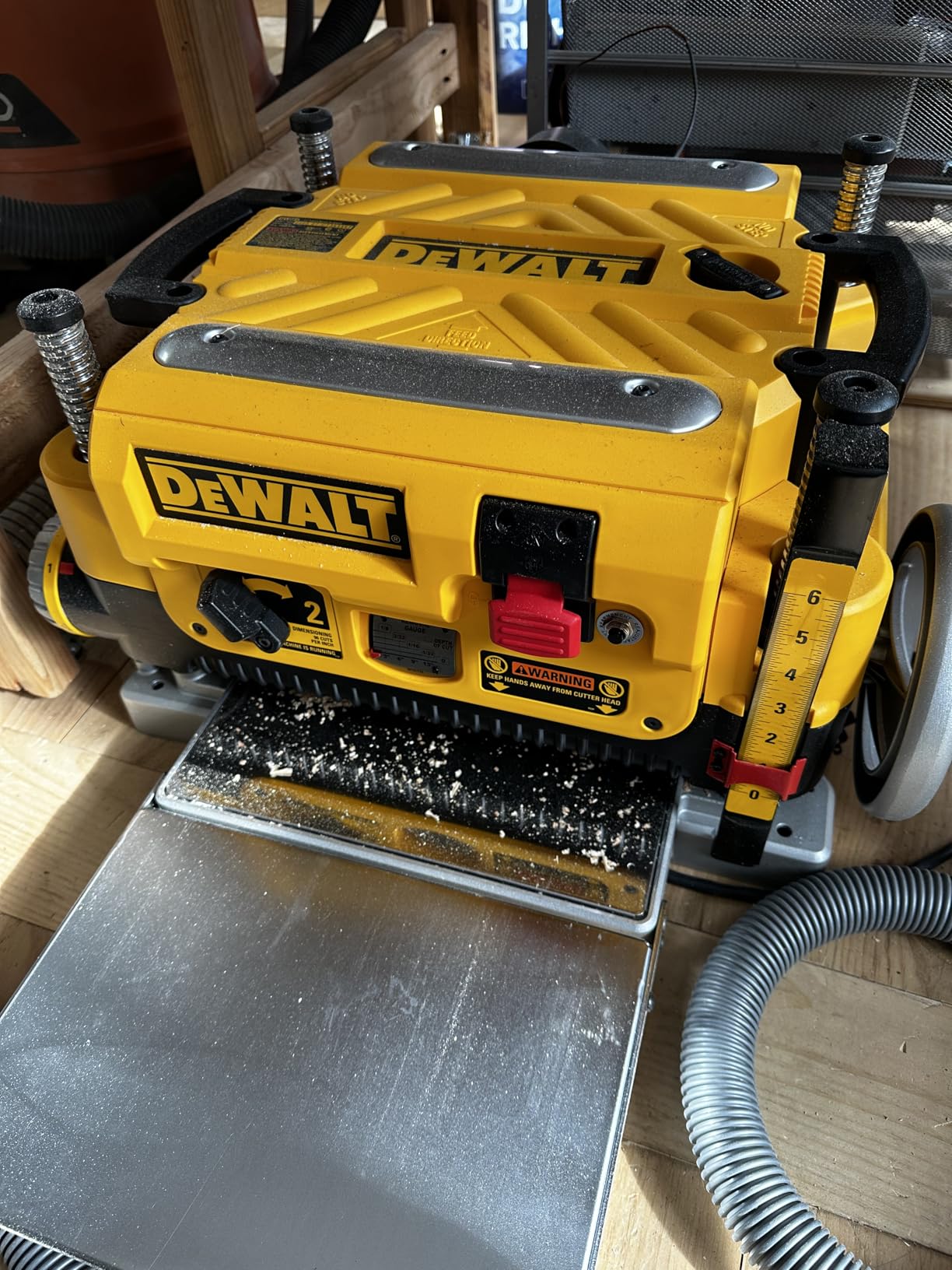
What you get on rough boards and what you give up
The three-knife cutterhead runs at 10,000 rpm and the manufacturer rates knife life about 30 percent longer than a two-knife head. On rough lumber that advantage shows up, because two blades have to drag through more material per rotation and the sapwood in construction pine dulls edges quickly. Plan on sharpening earlier when working hardwoods, since that is where the extra knife life gets tested hardest.
The honest downsides are noise and weight. At 102 pounds this is not a machine you carry between rooms easily, and reviewers consistently warn that it is loud enough to require hearing protection. It also pulls close to the limit of a 15 amp circuit under heavy load, so put it on a dedicated circuit rather than sharing with a dust collector.
Who should buy the DW735X
This is the pick if you buy rough lumber regularly, work in a home shop with room for a 102-pound machine, and want one planer that covers everything from 2x lumber to hardwood slabs. It is the most reviewed planer on this list by a wide margin, which tells you something about how long it has been proven in real shops.
Skip it if noise is a deal-breaker in a shared space, or if your lumber is almost all over 13 inches wide. You will need a stationary machine for that, and I have two picks below that handle it.
2. DEWALT DW734 – Best Value for a Home Shop
DEWALT Benchtop Planer, 15-Amp, 12-1/2-Inch, 3-Knife Cutter, 20,000 RPM, Corded (DW734)
15 amp 20,000 RPM motor
Three-knife cutterhead at 96 CPI
Reversible knives
12.5 in. width capacity
80 lb
Pros
- Excellent finish at 96 cuts per inch
- Reversible knives double edge life
- Long 33.5 inch infeed and outfeed tables
- Light at about 80 lb
- Three-year warranty
Cons
- Only 12.5 inch width capacity
- Noisy under load
- Knives still dull in hardwoods
- Dust hood may be separate on some listings
The DW734 is the DW735X scaled down a half inch and lightened by about 22 pounds, and for most home shops buying rough lumber that difference is everything. At 12.5 inches of width capacity it still covers most boards you will find at a local sawmill or lumber yard.
The infeed and outfeed tables run 33.5 inches, which is long enough to support a rough-sawn board that is longer than the machine itself. That extra support is what keeps a wavy board from wandering as it feeds through the head, and I noticed the difference immediately on a cupped piece of rough pine.
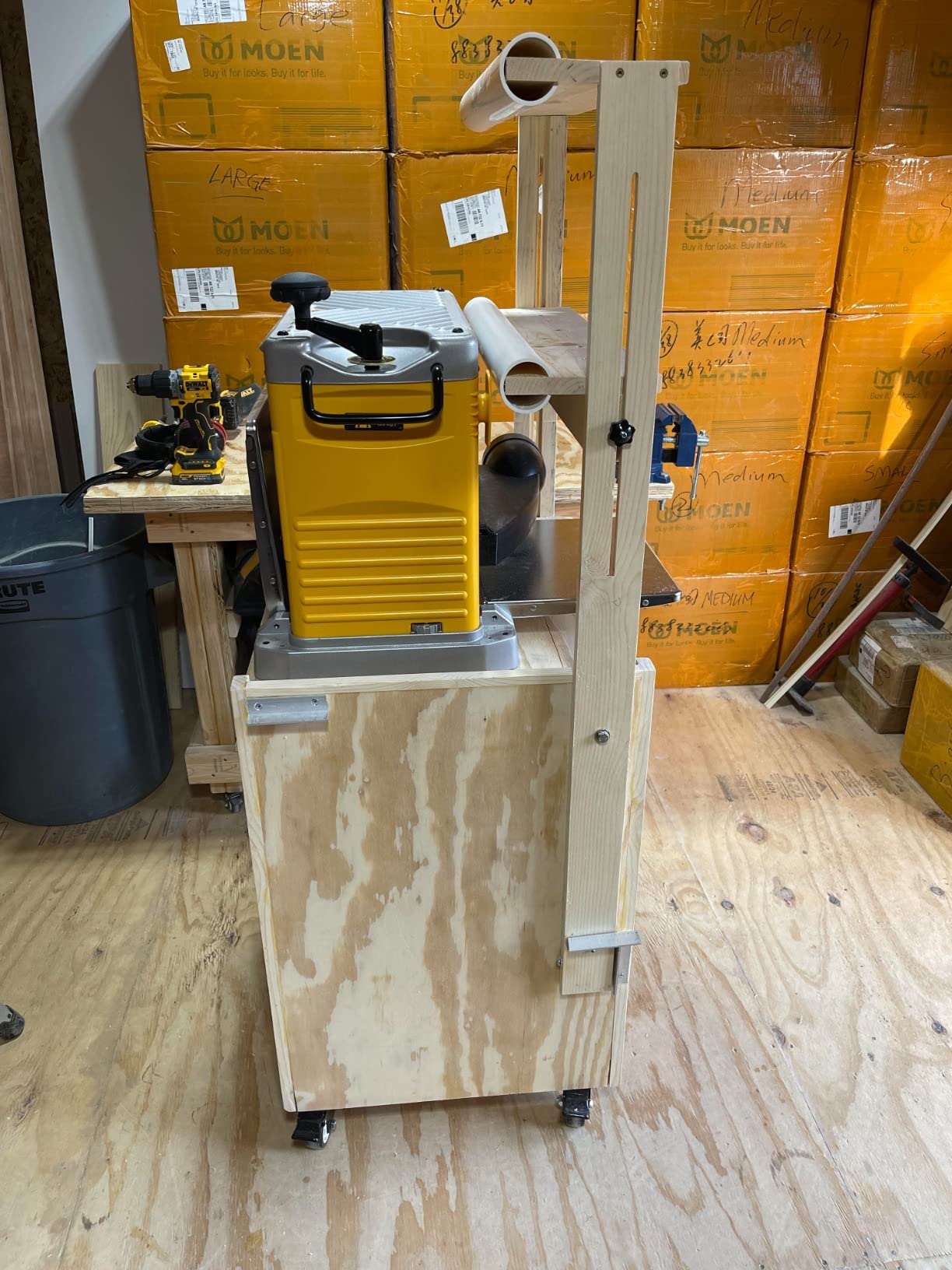
The four-column carriage lock works the same way the one on the bigger DeWalt does, holding the head steady during depth changes to suppress snipe. The material removal gauge and oversized thickness scale are also carried over, so you can see how much stock you are taking per pass without guessing.
The reversible knives are a real advantage on rough work. Flip the set instead of resetting the grind, and you effectively double the edges before touching a sharp stone. That matters when you are pushing construction lumber that is full of embedded dirt and occasional old fasteners.
Rough lumber performance and the width limit
Depth of cut is rated at 0.13 inches per pass, which is enough to handle rough boards without bogging the motor if you keep the feed rate up. On a 2-inch rough board I found the same three-to-four pass approach worked as on the 13-inch model, with the last pass light enough to leave a clean surface.
The 12.5 inch width is the compromise. If you are working with dimensional lumber in 12-inch widths you are fine, but any board wider than that needs ripping on the table saw first or a different machine entirely. Several reviewers also report more vibration at the lighter weight than the heavier machines produce.
Who should buy the DW734
Choose this if your rough lumber is mostly 8 to 12 inch boards, your shop is tight on floor space, and you want proven three-knife quality without moving a 102-pound machine around. The 33.5 inch tables fold down, which matters in a one-car garage shop.
Choose the DW735X instead if you regularly handle 13-inch-wide rough boards or want the two-speed gearbox for the coarse-to-fine pass sequence. Otherwise the DW734 does the same core job with less mass and a smaller footprint.
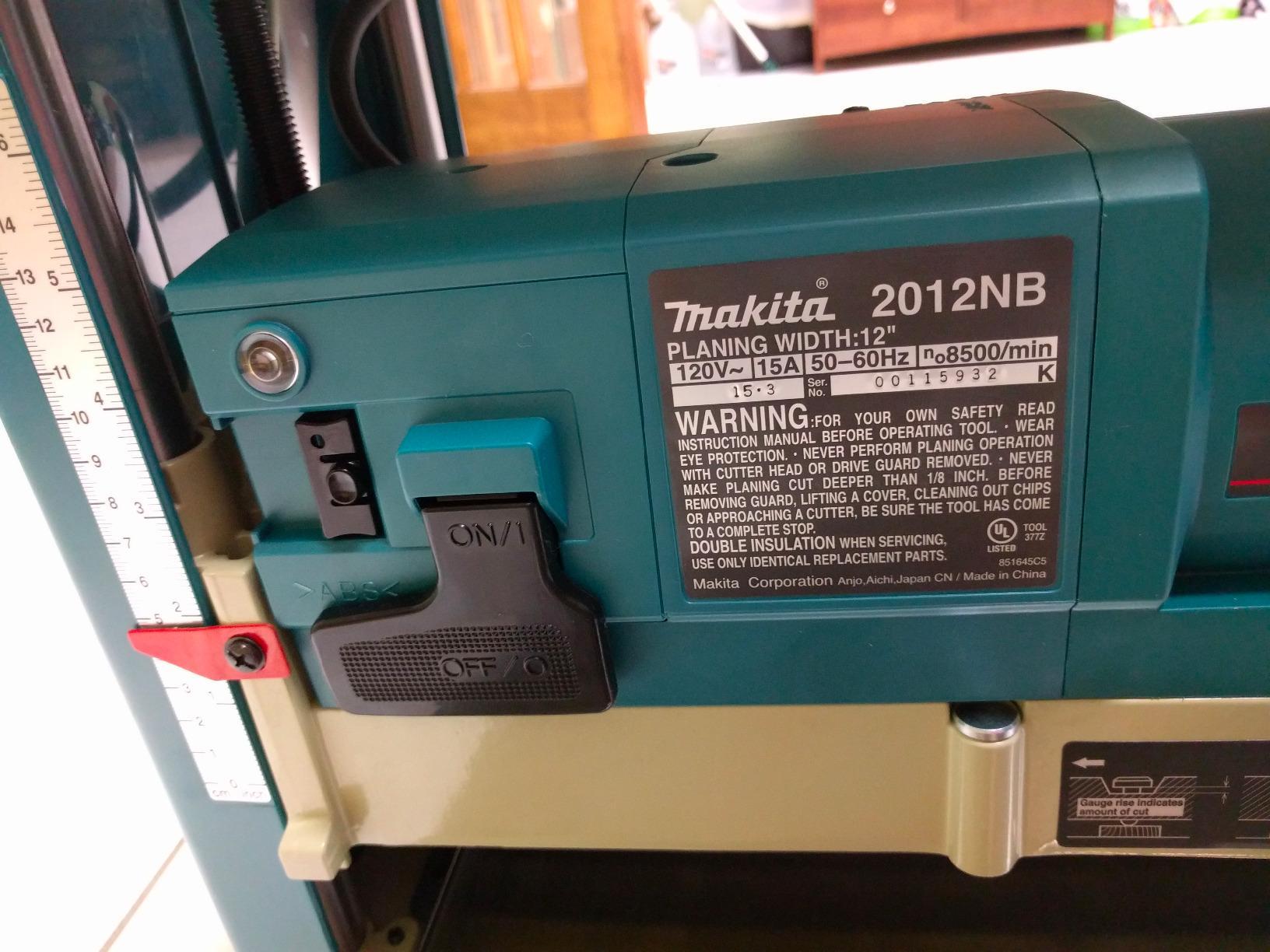
3. Makita 2012NB – Best for Quiet Shops and Fine Finish
Makita 2012NB 12″ Portable Planer
83 dB operating level
12 in. planing width
62 lb portable weight
4-post design
Disposable double-edge blades
Pros
- Quietest planer in this class at 83 dB
- Fastest blade change system of any model here
- Four-post design resists head flex
- Very light at 62 lb
- Exceptional out-of-box accuracy
Cons
- Most expensive in the group
- Dust hood sold separately
- One-year warranty only
- Only 12 inch width capacity
The Makita 2012NB is the odd one out in this roundup because it was not designed primarily for rough lumber, but the reasons buyers pick it apply directly to rough work anyway. At 83 dB it is roughly 20 decibels quieter than a typical straight-knife planer, which is the difference between wearing ear protection and putting the machine on while someone sleeps in the next room.
The four-post design with diagonal cross supports is the structural reason it holds accuracy. Those posts resist the head twisting under load, so the cutterhead stays parallel to the bed over time. That translates directly into consistent thickness readings across the full 12 inches of capacity, which is what you need when you are trying to hit a dimension on rough boards.
The blade change is the fastest I have used on any planer. Two knurled screws, swap the double-edge disposable blades, done. No jig, no feeler gauge ritual, no multiple hex keys. When you are changing knives frequently because of dirty construction lumber, that design saves real shop time.
Owners report machines from this line running 15 to 20-plus years with basic maintenance. If you buy this one, the dust collection hood is a separate purchase, and the one-year warranty is the shortest in this group.
How it handles figured and wide boards
Because it uses only two straight knives, it lacks the defect-hiding ability of a helical head. On rough lumber full of nail holes and soft spots you will see faint lines. On clean hardwood it more than compensates, producing a near-gloss finish that reviewers describe as the best in this group.
The 12-inch width capacity means wide boards get ripped on the saw first. The 30.35 inch overall length and large folding table extensions help support longer lumber, which is where the real benefit of this machine shows when you are feeding rough boards longer than 3 feet.
Who should buy the Makita
Pick the 2012NB if noise rules out the other options, if you mostly finish hardwood rather than construction lumber, and if you are willing to pay more for a machine that will still be running decades from now. It is also the easiest to move between a garage and a basement shop.
Pass on it if your rough lumber has nail holes, if you want the quietest option under a modest budget, or if a one-year warranty makes you nervous. Those cases are better served by a helical-head machine.
4. WEN PL1326 – Best Entry Spiral Head
WEN PL1326 15-Amp 13-Inch Spiral Benchtop Thickness Planer
26 staggered rotatable HSS inserts
13 in. width by 6 in. thickness
15 amp at 10,000 RPM
26 FPM feed rate
81 lb cast iron base
Pros
- Helical-style results without a helical-style price
- 26 inserts with four rotatable edges
- Cast iron base stays stable with rough boards
- 13 by 6 inch capacity handles thick boards
Cons
- Single speed only at 26 FPM
- HSS inserts dull faster than carbide
- Dust port design needs improving
- Heavy at 81 lb
The WEN PL1326 is the reason spiral cutterheads have become common in entry-level machines. Twenty-six staggered HSS inserts in a spiral arrangement deliver the defect-hiding behavior of a helical head for a fraction of what the helical models cost, and the cut quality surprised nearly every owner who bought it expecting a compromise.
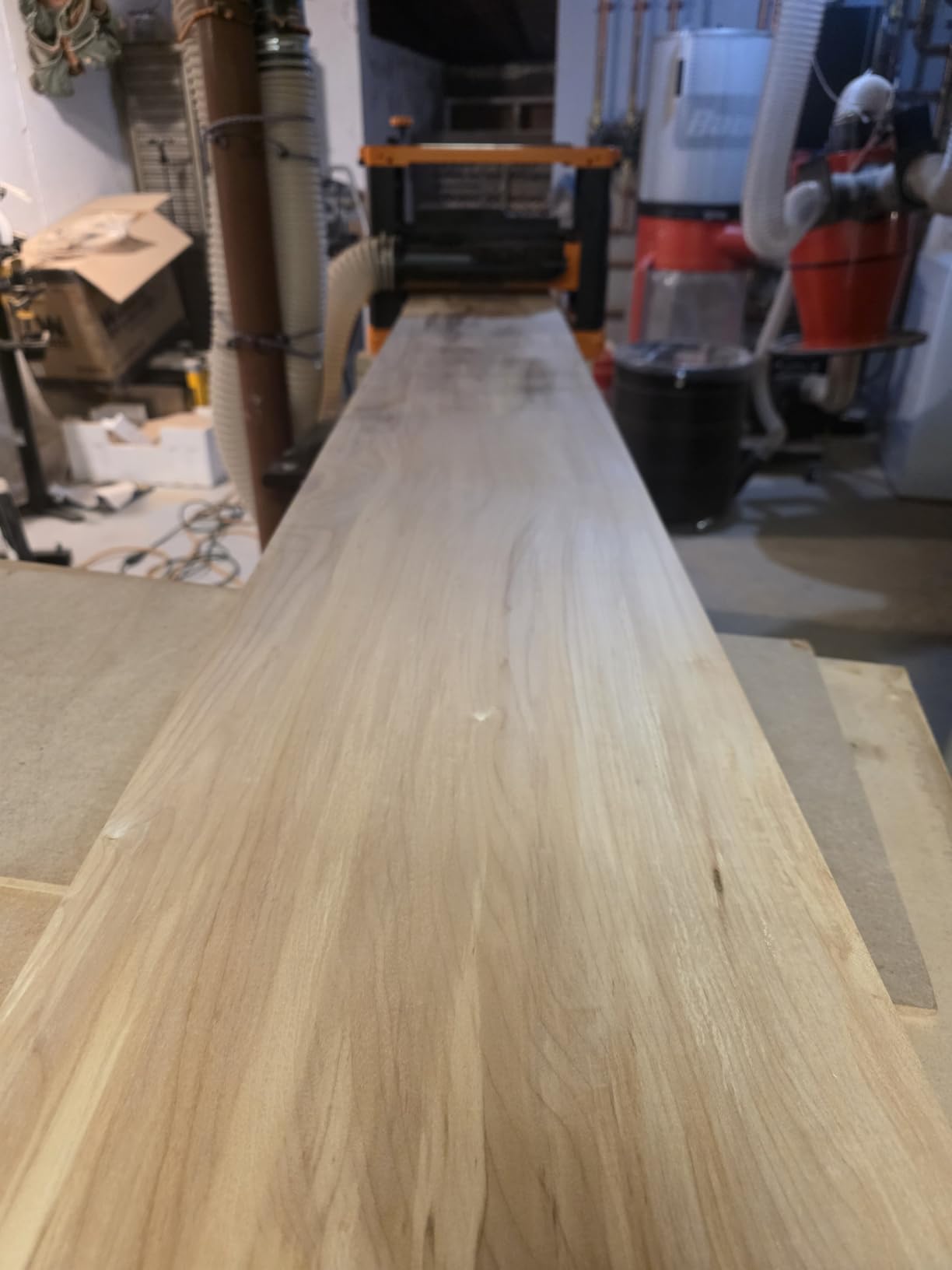
On rough cut pine the spiral arrangement makes a visible difference. The surface comes out consistent with no lines running the length of the board, and the cast iron base keeps the machine from creeping as you push a heavy board through. Capacity of 13 inches wide by 6 inches thick means even a chunky rough-sawn slab fits.
Each of the 26 inserts has four usable edges, so rotating them spreads the wear and gets far more life out of the set than the fixed two-knife design it replaces. That is where most of the value sits over the life of the machine rather than on day one.
The single 26 FPM feed speed is the main limitation. You cannot drop to a slower finishing speed for the last pass, so you get one consistent cut rate. Owners work around it by taking a lighter final cut rather than a slow one.
Where the spiral head helps on rough lumber
The staggered insert pattern is the reason this machine handles rough boards better than its price suggests. Each insert cuts a short slice rather than a full-length groove, so when the head crosses a nail hole the damage stays local instead of scoring the entire board. Two-knife machines cannot do that.
The trade-off is insert material. HSS edges hold up fine on softwood but dull faster in hardwood and in the resinous sapwood of fresh construction lumber. Budget for a set of replacements earlier than you would with carbide, and expect a little more noise than a true helical head because the inserts are not as precisely ground.
Who should buy the WEN PL1326
Buy this one if you want helical-style results without helical-style outlay, and your rough lumber is mostly softwood. It suits a first planer, a shop that dresses up construction lumber, and anyone who would otherwise settle for two knives to keep costs down.
Pass if your work is mostly hardwood, if you need two feed speeds for a coarse-to-fine pass sequence, or if you want the lowest noise level. For pure finish work on dense hardwood, the carbide machines below hold an edge much longer.
5. VEVOR 13-Inch Two-Blade Planer – Best for Softwood-Only Shops
VEVOR Thickness Planer, Two-Blade, 13″ Width Worktable Benchtop Planer, 15-Amp 2000W Powerful Motor, 12″ Extended Infeeding Table, Low Noise for both hard & soft wood material removal
Two-knife HRC55-60 steel cutterhead
35 in. total table support
Cast iron bed
23,500 rpm 2000W motor
54 lb
Pros
- Entry-level 13 inch capacity option here
- 35 inches of total table support
- Cast iron bed and steel plate
- 20A overload protection
- Simple enough for a first-time user
Cons
- Two knives only
- Knives too soft for hardwoods
- Noticeable snipe on board ends
- Needs real dust extraction or clogs
- Loud enough to rule out apartments
The VEVOR two-blade planer exists for a specific job: dressing up softwood. If you buy construction lumber and want it to look like it came from a lumber yard, this machine does that at an entry-level price point. If you cut hardwood, look elsewhere.
The 13 inch worktable plus a 12 inch extended infeed gives you 35 inches of total support, which is genuinely long for a budget unit and helps keep longer boards from tipping as they feed. The cast iron bed and steel plate hold flat under the load of a heavy rough board.
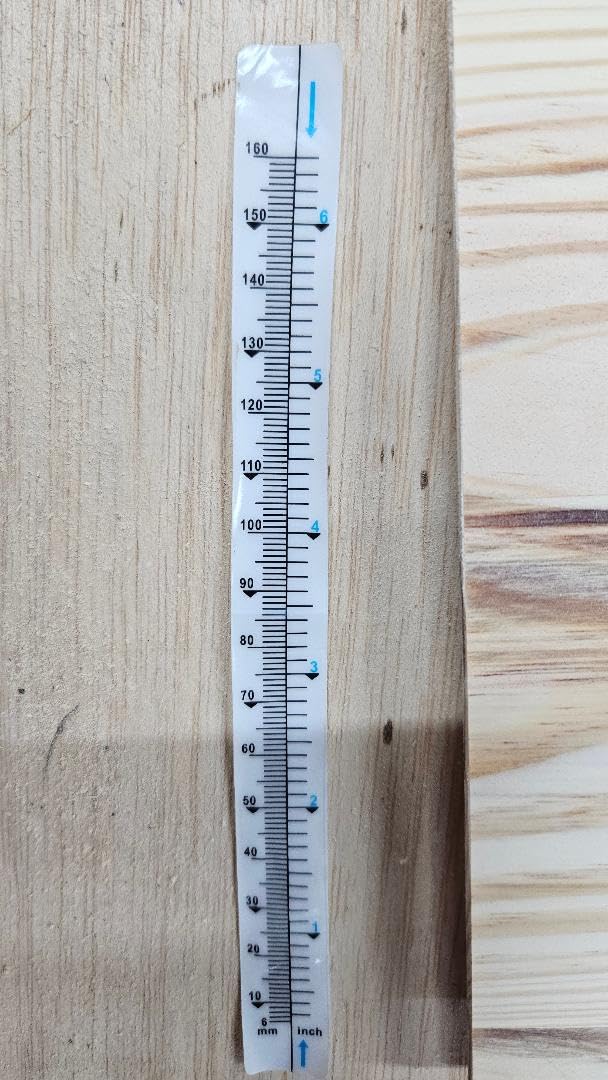
Depth of cut on the spec sheet is listed at 3 millimeters, which is about 0.12 inches. That is a shallow first-pass removal, so plan on more passes than the helical machines need when you are taking a board from rough to finished. Budget the extra time rather than expecting one heavy pass.
The 23,500 rpm motor and overload protection keep it from burning out during a jam, but the two HRC55-60 knives are the weak link. Owners report they dull quickly on oak and similar dense hardwood, and snipe at board ends is a recurring complaint that a careful table setup only partly solves.
What softwood-only means in practice
Construction lumber, pine, and poplar go through this machine cleanly because the grain is soft and the cutters do not have to break through dense fibers. The finish on pine is close to what the helical machines produce, and rough cut pine is exactly what this class of machine was designed to handle.
Hardwood is different. Once you hit oak, ash, or maple the knives load up fast, the surface picks up chatter, and you are sharpening constantly. The dust port also needs a real collector rather than a shop vacuum, or chips pack into the head within a few boards. Buyers who ignore this end up with a clogged machine and gouged boards.
Who should buy the VEVOR
Pick it if your rough lumber is entirely softwood, your throughput is low, and you are outfitting a first shop on a limited budget. The 54 pound weight is also the easiest to move in this group.
Skip it if you plan to cut any hardwood, if noise matters in your space, or if you expect to be planing several boards a week. In those cases the WEN spiral machine costs a little more and works with far more lumber.
6. JET JWP-13BT – Best Helical Head with Two Feed Speeds
JET 13-Inch Benchtop Thickness Planer for Woodworking, Helical Style Cutterhead with 2-Speed (18 FPM / 26 FPM) Feed Rate, 2 HP, 120V 1Ph (JWP-13BT)
Helical cutterhead with 26 HSS inserts
2 HP at 10,000 RPM
Feed rates 18 and 26 FPM
Cast iron four-post bed
5-year warranty
Pros
- True helical cutterhead with six rows of inserts
- Two feed speeds for rough and finish passes
- Five-year warranty
- Cast iron bed and four-post stability
- Folding tables save floor space
Cons
- HSS inserts rather than carbide
- Quality control complaints on some units
- 75 lb weight
- Dust port sits on the power switch side
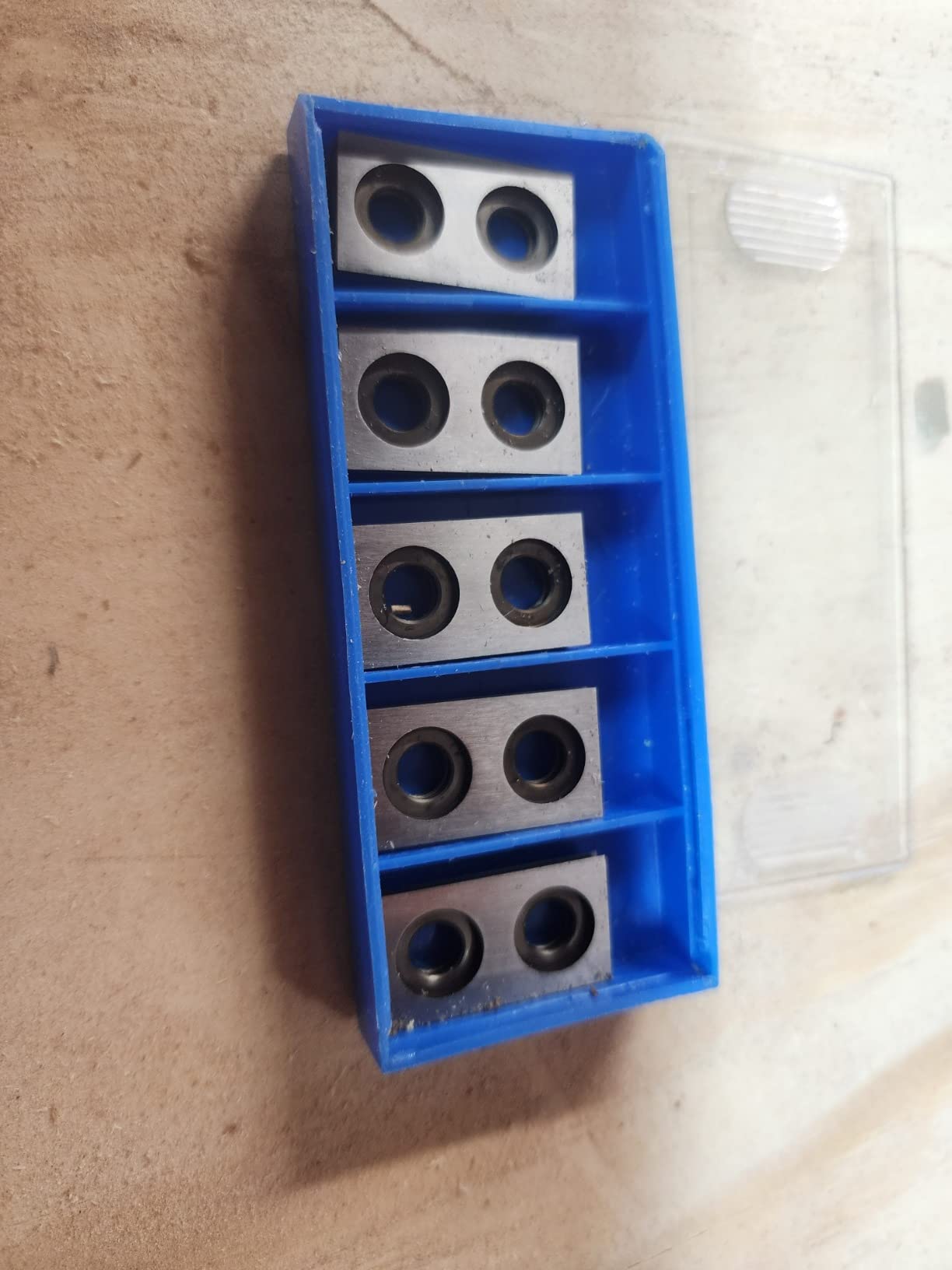
The JWP-13BT is a genuine helical cutterhead rather than a spiral, and that distinction shows up in how the inserts are arranged in rows around the head. On rough lumber with nail holes and knotted areas, the extra rows keep defects from streaking down the board in a way that neither a two-knife nor a spiral head fully matches.
Two feed speeds at 18 and 26 feet per minute give you the coarse-to-fine sequence straight out of the box. Run the faster speed for the heavy removal passes on rough boards, drop to the slower one for the final pass, and the finish cleans up noticeably. Few machines in the benchtop class give you that control.
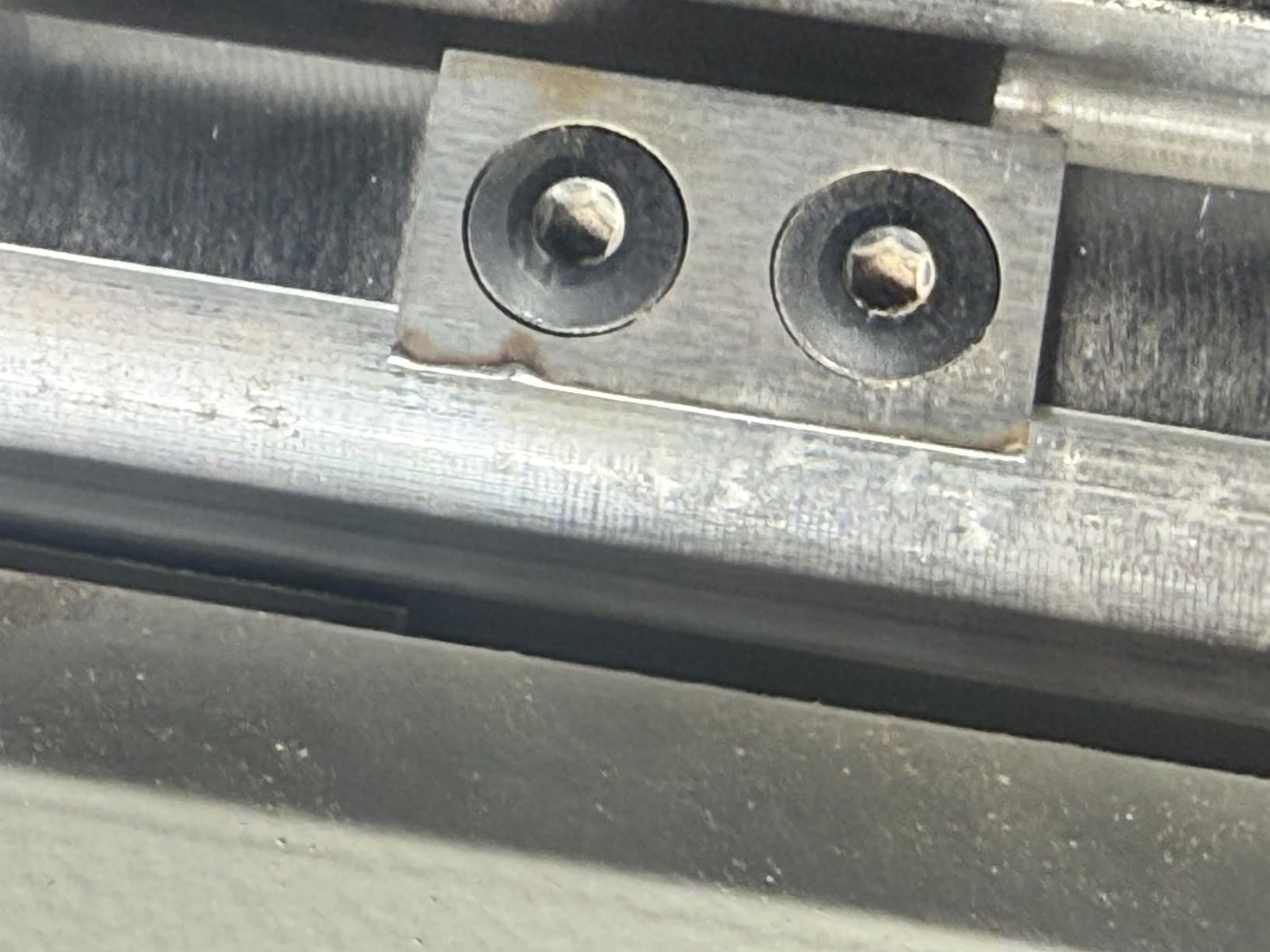
The cast iron bed with a four-post head support resists the flex that causes out-of-parallel errors. The 5-year warranty is the longest coverage available in this group, dropping to two years for commercial use.
Owners do report quality control lapses on some machines, including damage to the feet and missing hardware. Inspect the machine out of the box before you plug it in, and confirm all fasteners are tight before the first pass through rough lumber.
Snipe control and rough-lumber limits
Snipe on this machine responds to the standard table fix. Raise the infeed and outfeed tables about 1/8 inch above the center bed and the marks largely disappear. Do not flatten all three tables to the same height, because that is what creates them in the first place.
The inserts are HSS, not carbide. That is the main argument for looking at the spiral machines above if your rough work is hardwood-heavy. In softwood and clean lumber the HSS edges hold up fine and the helical arrangement still delivers the quiet operation reviewers notice.
Who should buy the JET JWP-13BT
Choose it when you want a true helical head and two feed speeds in a benchtop footprint, and your power supply is a standard 15 amp circuit. The 2 HP motor has headroom for thick rough boards that would strain smaller machines.
Pass if you want carbide edge life or the lowest purchase price. Both the WEN spiral and the Cutech carbide machine deliver similar surface quality for less money and the WEN has a better owner review history at this point.
7. RIKON 25-135H – Best Lightweight Helical Planer
RIKON 25-135H 13-Inch Portable Planer with Helical-Style Cutterhead
26 two-edge HSS inserts in 6 rows
Feed speeds 16 and 26 SFPM
13 in. by 6 in. capacity
67.9 lb aluminum base
Dust adapter included
Pros
- Helical cutterhead with 26 two-edge inserts
- Two feed speeds for rough and finish
- Lightest helical option here at 67.9 lb
- Includes 4 inch to 2.5 inch dust adapter
- Repeat-cut control for consistent sizing
Cons
- Aluminum base is less rigid than cast iron
- Only 54 reviews of long-term data
- HSS inserts rather than carbide
- Smaller service network
The RIKON 25-135H packs a full helical cutterhead into a machine you can lift with one arm. At 67.9 pounds it is the easiest helical-head planer to move between a garage and a basement, and that matters for anyone without a dedicated machine corner.
Two-edge HSS inserts mean each edge flips over before sharpening, effectively doubling the working edges per set. Two feed speeds at 16 and 26 feet per minute cover the rough and finish passes, and the repeat-cut control helps you take the same bite on every rough board in a batch.
The aluminum base is the tradeoff. Cast iron beds weigh more but hold their geometry under sustained load, and on long sessions with heavy rough boards you may feel more vibration through an aluminum deck. Over a batch of boards the difference is subtle rather than dramatic.
The main reason to hesitate is the data. Only a few dozen owners have reviewed this machine, so long-term durability is largely unproven. That is not a reason to skip it, but it is a reason to check the warranty terms carefully and to keep your expectations measured.
Rough-lumber workflow on the RIKON
The 13 inch by 6 inch capacity handles most rough boards comfortably, and the maximum depth of cut of 1/8 inch per pass suits the coarse-to-fine approach. The included dust adapter converts the 4 inch port down to 2.5 inches, which saves you from hunting for the right hose fitting.
Because the inserts are HSS rather than carbide, expect to rotate them sooner when working oak or other dense hardwood. On rough pine and softwood the helical arrangement still keeps the surface clean with no lines down the board.
Who should buy the RIKON 25-135H
Buy it if you need a true helical head and two feed speeds but do not want a 75 to 102 pound machine dominating your shop floor. The price sits between the entry spiral options and the heavier cast iron helical models.
Pass if your shop can host a cast iron machine or if you want the largest volume of independent owner feedback before committing. In that situation the JET JWP-13BT is the safer pick with more reviews behind it.
8. JET JWP-208HH – Best for Wide Rough Lumber
JET 20-Inch Planer, Helical Cutterhead, 5 HP, 230V 1Ph (Model JWP-208HH)
20 in. width capacity
5 HP TEFC induction motor
Helical cutterhead with carbide inserts
Two-speed 24/31 FPM gearbox
Requires 230V power
Pros
- Handles 20 inch wide lumber no benchtop can take
- Carbide helical inserts hold an edge far longer
- 5 HP motor powers through thick lumber
- Two-speed gearbox
- Five-year warranty
Cons
- Requires 230V single-phase power
- Weighs 753 lb and needs a professional mover
- Very large floor footprint
- Massively overkill for a home shop
The JWP-208HH solves the one problem no benchtop planer in this roundup can: lumber wider than 13 inches. Twenty inches of width capacity covers full-size rough-sawn hardwood slabs, wide construction timber, and the kind of oversized board you would otherwise have to rip in half at the saw.
The 5 HP TEFC induction motor is the reason it does not bog down. Thick wet pine and heavy hardwood slabs go through on the first pass where a 15 amp benchtop machine would stall. The V-belt drive and two-speed gearbox at 24 and 31 feet per minute give you the coarse-to-fine range for primary milling work.
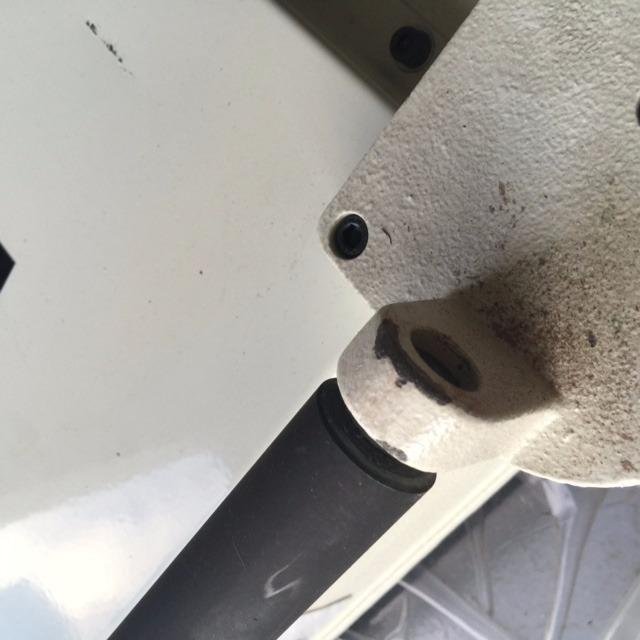
The helical cutterhead uses staggered carbide inserts rather than HSS, so it holds an edge through the abrasive work that rough lumber causes. The Precision Air Strut System is designed to reduce snipe by isolating the head from bed flex, which matters when you are feeding stock that is not perfectly flat.
Cast iron infeed and outfeed tables are included, and the 1/16 inch increment height scale lets you dial in thickness accurately. Magnetic controls replace mechanical switches for reliability over years of daily use.
Shop requirements before you consider this
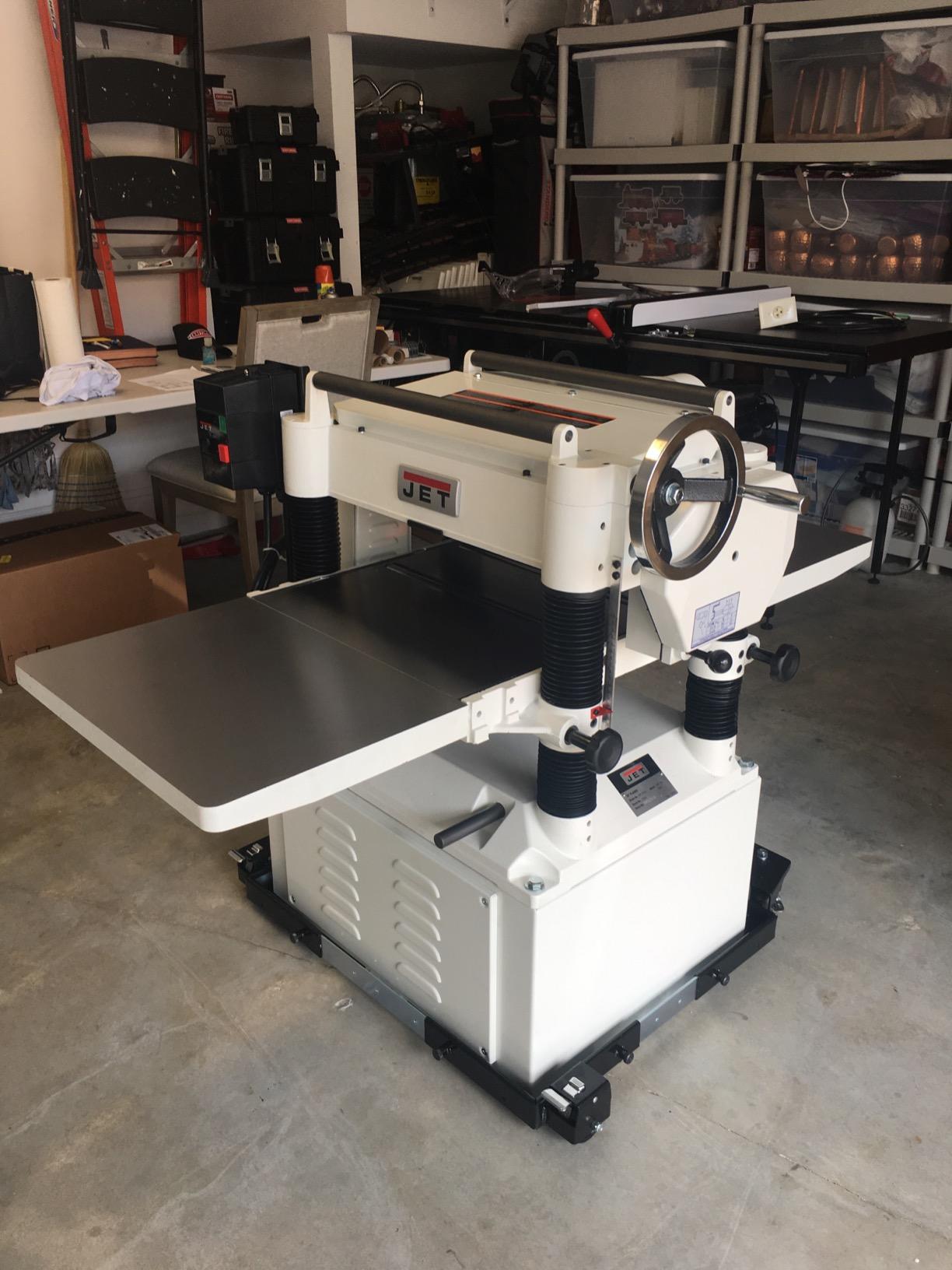
This machine requires 230V single-phase power, which is a different supply than a standard household circuit. If your shop does not already have a 230V circuit and a sub-panel, that cost alone can exceed the machine. Confirm the electrical service first, everything else second.
At 753 pounds with a footprint of 36.7 by 26 by 41.4 inches, this is a stationary machine with a permanent home that usually needs a team to move into place. Budget floor space with the table extensions fully deployed, not just the bare machine dimensions.
Who should buy the JET JWP-208HH
Buy it if you run a small mill or production shop that regularly handles wide slabs and thick rough lumber, and you already have 230V single-phase service. Carbide helical inserts and a 5 HP motor make it the strongest machine here for volume work.
Skip it for anything short of that. A home hobbyist with under 13 inch rough lumber will get identical results from the DW735X with far fewer headaches around power and space.
9. Cutech 40600H – Best Entry-Level Carbide Inserts
Cutech 40600H 13-Inch Spiral Cutterhead Benchtop Planer with 26 Tungsten Carbide Inserts, Single Speed Feed Rate, Snipe Minimizer, and Board Return Rollers (13-Inch Single Speed)
26 tungsten carbide inserts in 6 rows
Two-sided insert design
Patented snipe minimizer with 4 lead screws
8-position depth stop
Board return rollers
Pros
- Tungsten carbide inserts at an entry price
- Two-sided inserts resist skewing
- Patented snipe minimizer needs no carriage lock
- 8-position repeat cut depth stop
- Low amp draw works on shared circuits
Cons
- Only 41 reviews of long-term data
- Single speed feed rate
- Some quality complaints in the reviews
- Weight and dimensions not clearly published
The Cutech 40600H is the only machine here that puts tungsten carbide inserts in a spiral cutterhead at an entry-level price. Carbide edges hold their sharpness far longer than the HSS inserts used in the comparable helical and spiral machines, which matters a great deal on rough lumber full of dirt and sapwood resin.
The two-sided insert design is a smarter geometry than the four-sided inserts most competitors use. Because every edge is mirrored on both faces, the inserts cannot skew sideways as they dull. The patented snipe minimizer uses four lead screws to hold the head consistent without a separate carriage lock.
Board return rollers on top let you feed lumber continuously without reaching around the machine, and the 8-position depth stop helps you repeat the same cut across a batch of rough boards. The flip dust hood can blow chips out the back or connect to a collector depending on your setup.
The concern is data volume. Forty-one reviews is a very small sample, and some of the lowest-rated reviews mention build quality. I would treat this machine as a capable option worth checking closely out of the box rather than a proven workhorse.
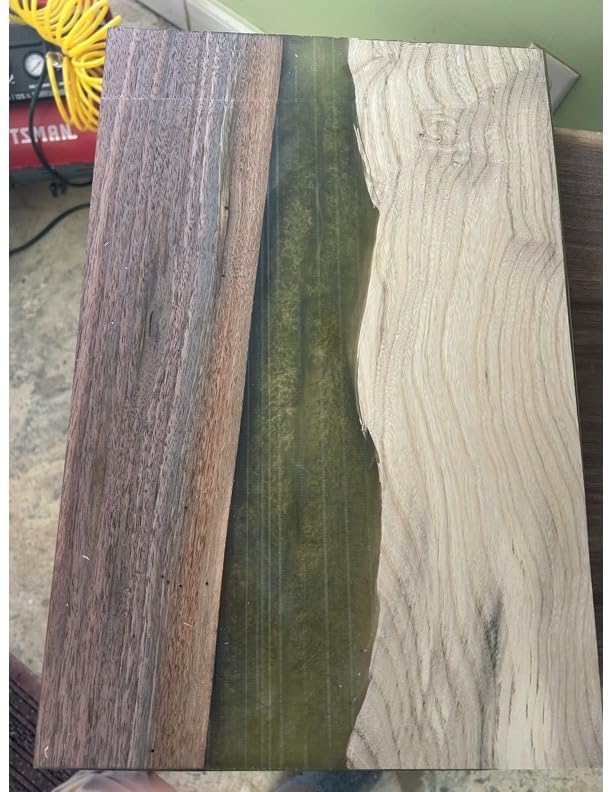
What 26 carbide inserts change on rough boards
Edge retention is the whole story. HSS inserts on rough lumber need rotating every few hours once the sapwood starts loading them up. Carbide holds its geometry through that same work, so you spend your time planing boards instead of at the grinder, which is the correct trade when you have a stack of rough lumber to get through.
The trade-off is single-speed feed. You get one feed rate for every pass, so the finish pass has to be a lighter cut rather than a slower one. The snipe minimizer offsets that a little by keeping the head steady as it rises.
Who should buy the Cutech
Choose it if you want carbide insert longevity at a price close to the HSS spiral machines and you are comfortable with a newer brand that has less long-term history. The 13 inch capacity covers standard home shop rough lumber.
Pass if you need a large body of owner feedback to feel confident, or if you run a high-volume shop where a failure stops production. For those cases the helical machines with five-year warranties and deeper review histories are the better risk.
10. JET JPW-15BHH – Best Mid-Size Stationary for 230V Shops
JET 15-Inch Thickness Planer for Woodworking, Helical Style Cutterhead with 2-Speed (16 FPM / 20 FPM) Feed Rate, 3 HP, 230V 1Ph (JPW-15BHH)
15 in. width capacity
3 HP motor at 5200 RPM
48 self-aligning carbide inserts
Two feed speeds 16/20 FPM
PASS snipe reduction
Pros
- 48 self-aligning carbide helical inserts
- 3 HP motor handles wide hardwood boards
- Precision Air Strut System reduces snipe
- Two feed speeds
- Five-year warranty
Cons
- Requires 230V single-phase power
- 285 lb machine with a 46.5 inch footprint
- Lowest average rating in this group
- Quality control complaints on some units
The JPW-15BHH sits between the benchtop machines and the 20-inch JET, and it is the right answer for a small production shop that has 230V service but not the floor space for a 753-pound machine. Fifteen inches of width capacity covers most rough-sawn hardwood lumber.
Forty-eight staggered carbide inserts across the helical head is the highest insert count of any machine here. Because they are self-aligning, the cutterhead stays consistent as edges dull, which helps both surface quality and snipe over a long run. The 3 HP motor at 5,200 rpm has real authority on thick lumber.
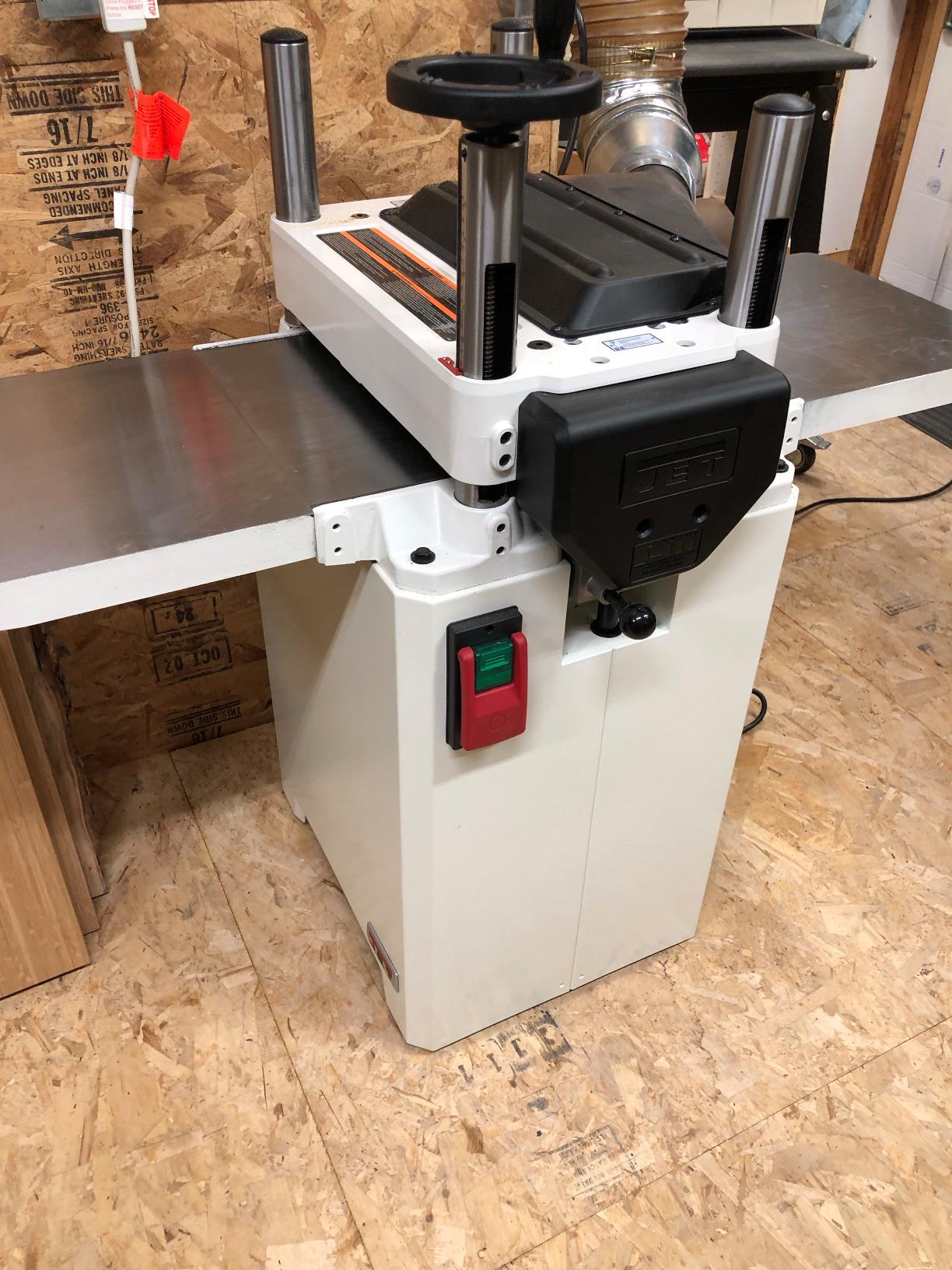
Two feed speeds at 16 and 20 feet per minute are closer together than the benchtop machines, so the difference is less dramatic. The Precision Air Strut System is the real snipe solution here, holding the head off the bed so table adjustment matters less.
Cast iron extension tables are included, which is unusual at this level and saves a purchase. The upward-facing handwheel makes height changes easy when you are wearing gloves.
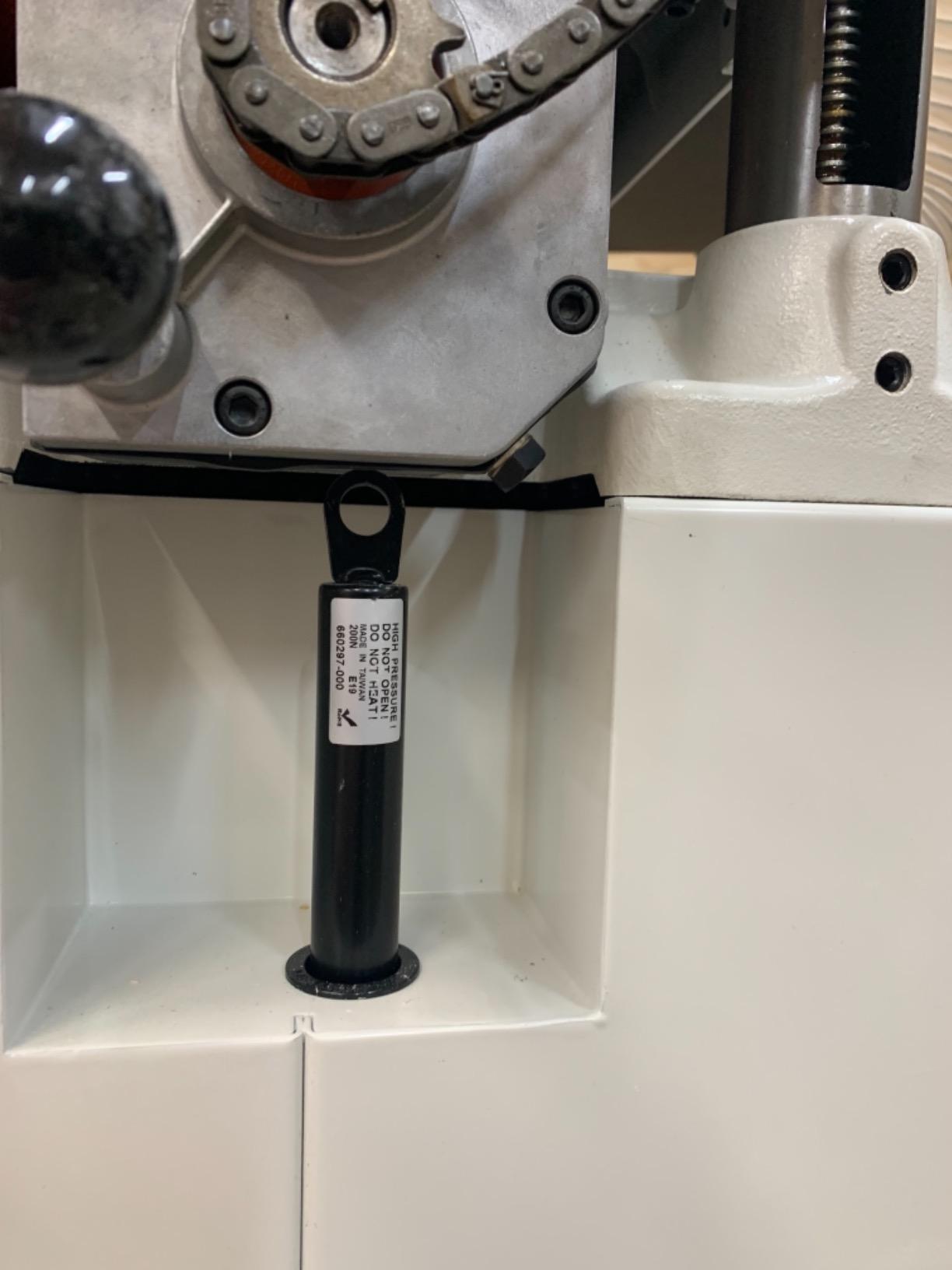
Where this stationary machine fits
This is a primary milling machine rather than a benchtop convenience tool. It suits a shop doing cabinetry, furniture, or trim production where boards come through faster than you would run them on a 15 amp machine. The 6 inch height capacity handles thick rough boards in one setup.
The rating in this group reflects quality control more than performance. Reviews mention broken feet, missing parts, and off-switch failures on some units, all of which are fixable before the first cut, so inspect everything and allow time for that.
Who should buy the JPW-15BHH
Buy it if you have 230V power, a dedicated machine corner, and a steady volume of wide hardwood or thick rough lumber that a benchtop cannot keep up with. The carbide helical head and included tables are worth the space.
Pass if you are still deciding whether you need a planer at all, or if a 46.5 inch footprint will not fit. The DW735X handles the same boards in a fraction of the space with ordinary household electrical service.
How to Use a Planer on Rough Lumber
Rough lumber takes three to six passes to flatten and thickness, and the sequence matters as much as the machine. Feed boards in the wrong order and you will burn through good lumber chasing marks that a proper setup avoids.
Joint one face and one edge first
A planer references the board against its own bed, so a warped board stays warped at a different thickness. Run one face and one edge over a jointer first to create a flat reference. Even a short-budget jointer or a hand plane on one face prevents the problem entirely.
If you do not own a jointer, plan for more passes and expect to rip bowed lumber. That is the honest answer that most planer marketing avoids.
Set the tables high to stop snipe
Raise the infeed and outfeed tables about 1/8 inch above the center bed. Do not level all three tables flat with each other, because that is the direct cause of the crescent marks most people blame on the machine. This one adjustment fixes the majority of snipe complaints.
Take a coarse pass on the fast feed speed
Set roughly 1/8 inch of depth of cut, run the fast feed setting, and keep your hands clear of the board until it is well past the cutterhead. On two-speed machines the fast setting exists exactly for this removal work. Never force a thicker cut to save a pass; that is how you bog the motor and gouge the board.
Work coarse to fine and check thickness
Drop the depth to about 1/32 inch for the second pass and switch to the slow feed speed for the last one. Measure with a caliper at each end and in the middle of the board. If the readings differ, the head is out of parallel or the board still has a twist, and you fix that before the next board.
Check moisture and manage chips
Green or wet wood fuzzes, clogs, and dulls blades fast. Aim for under 20 percent moisture content before planing, and let wet boards acclimate a few days in the shop. Hook up real dust extraction rather than a shop vacuum, because rough wet chips pack into the head fast and a clogged head leaves marks on every board after it.
What Not to Run Through a Planer
Some wood will damage a planer, the board, or you. These are the cases worth knowing before you start a stack of lumber.
Pressure-treated lumber
The chemicals in treated lumber can corrode the cast iron bed, tables, and handle hardware over time, and the residue is hard to clean off. If you must plane it, seal the machine afterward and expect to wipe the bed down regularly. For long-term ownership, rip and joint the boards and leave them saw-faces-up instead.
Oily and resinous exotics
Teak, rosewood, and similar oily woods gum up HSS inserts and dull carbide faster than anything else you will feed the machine. Plane a scrap offcut first to test the cut, and clean the head immediately afterward with a solvent-safe wipe. If the test board tears out badly, the wood is better used saw-faces-up.
Nails, staples, and over-width warped stock
Check rough salvage lumber for fasteners before feeding it. A buried nail shatters an insert and can send metal into the bed. Boards wider than the planer capacity should be ripped on the saw first, and heavily twisted stock should be jointed or broken down rather than forced through.
How to Choose a Planer for Rough Lumber
The right machine depends less on your ambition than on your stock, your power, and your floor space. Work through these five questions and the list above narrows to one or two options.
Helical, spiral, shearing, or straight knife
For rough lumber, a multi-blade cutterhead wins. Straight-knife two-blade heads leave a visible line down the board every time they pass a nail hole or a soft spot, which is exactly what rough lumber is full of. Helical and spiral heads cut in small staggered slices that hide those defects.
Helical heads like the JET models use precisely ground inserts arranged in rows and give the quietest operation. Spiral heads like the WEN and Cutech use more inserts with simpler geometry and cost less. Shearing heads cut at an angle across the grain for maximum edge life, and they sit at the top of the price range. On rough pine and construction lumber, the practical difference between helical and spiral is smaller than the difference between either one and two straight knives.
Benchtop, stationary, or jointer-planer sizing
Benchtop units handle everything from casual upgrades to steady home shop use as long as the lumber stays within 12 to 13 inches wide, which covers the large majority of lumber most shops buy. Stationary machines earn their space when you exceed that width, run thick lumber daily, or plan more than a few boards a week. A jointer-planer combo makes sense only if you genuinely need both functions in one footprint.
Width capacity and thickness limits
Measure your widest rough board before you buy, not after. A 12 inch board will not go through a 12.5 inch planer, and you do not want to discover that with a full-length slab on the infeed table. Thickness capacity matters less because most rough lumber arrives well under the 6 inch limit that every machine here handles.
Power and circuit requirements
Every benchtop planer on this list is 15 amp and should sit on a dedicated circuit with nothing else plugged in, especially if you run dust collection on the same run. The two stationary JET machines need 230V single-phase service, so confirm your electrical setup before ordering. Undervoltage and shared circuits are the most common cause of the premature failures owners report in benchtop machines.
Snipe, parallelism, and table setup
Snipe is not a defect, it is a geometry issue, and it is fixable on every machine in this roundup by raising the infeed and outfeed tables about 1/8 inch above the center bed. Longer infeed and outfeed support helps too, since rough boards that overhang the tables will move. Look for a carriage lock or a depth stop, and treat both as the features that keep you from rechecking thickness on every board.
Frequently Asked Questions
What is a good wood planer to buy?
The DEWALT DW735X is the strongest all-round choice for rough lumber: a 15 amp motor, a three-knife cutterhead, two feed speeds, 13 inches of width capacity, and a carriage lock that reduces snipe. If all your rough lumber is under 12 inches wide and you want to save money and floor space, the DW734 does the same core job. Spend more only when you need carbide helical inserts or a stationary machine.
Does a planer level wood?
A planer makes wood parallel to consistent thickness, not level. It has one bed and one cutterhead, so it references each board against itself. A cupped or twisted rough board will come out uniformly thick but still curved. That is why you joint one face first, then use the planer to bring every board to the same thickness across the batch.
Is a planer thicknesser worth it?
Yes when you buy rough lumber or do cabinetry, because it converts uneven saw-faces into consistent, glue-ready stock in a few passes. It is not worth it if all your material already arrives surfaced four sides, or if your rough lumber is consistently wider than 13 inches. In that second case, save for a stationary 15 or 20 inch machine instead.
Can you put pressure treated wood through a planer?
You can, but it is a poor long-term choice. The treatment chemicals can corrode the cast iron bed, tables, and hardware, and the residue is difficult to clean out of the machine. If you plane treated lumber, wipe the bed and tables down immediately afterward and expect extra maintenance. For most shops, ripping and jointing the boards and leaving them saw-face-up is the better plan.
Will a planer smooth rough cut lumber?
A planer will make rough cut lumber perfectly flat, parallel, and smooth on all four faces, but expect three to six passes to get there. The first pass on fast feed takes off about 1/8 inch, then you step down to roughly 1/32 inch, then finish light on the slow speed. A helical or spiral cutterhead also hides saw marks and small nail holes far better than a two-knife straight head.
What is the best heavy-duty wood planer?
For wide rough boards in a production setting, the JET JWP-208HH is the heaviest-duty option here, with a 5 HP induction motor, 20 inches of width capacity, and a helical cutterhead with carbide inserts. It requires 230V single-phase power and weighs over 700 pounds. For most shops, the JET JPW-15BHH handles wide stock at 285 pounds with the same carbide helical head design.
How to plane a big piece of wood?
If the board is wider than your planer, rip it to fit on the table saw first. If it is long, support the overhang with roller stands or an outfeed roller table so it feeds straight. If it is twisted or cupped, joint one face before planing. Then raise the infeed and outfeed tables about 1/8 inch above the center bed, take 1/8 inch per pass on fast feed, and step down to a light finish cut.
Which type of lumber should not be run through the planer?
Avoid pressure-treated lumber if you can, because the chemicals corrode the machine over time. Be careful with oily exotics like teak and rosewood, which gum up inserts fast, and always check salvage lumber for nails and staples that will destroy an insert. Boards wider than the planer capacity must be ripped first, and heavily warped stock should be jointed rather than forced through.
Which Planer for Rough Lumber Should You Buy?
For most home shops, the DEWALT DW735X is the planer for rough lumber. The 15 amp motor has the headroom for thick boards, the two-speed gearbox lets you take a heavy first cut and a fine last pass, and the long cast aluminum base plus carriage lock keep rough boards tracking straight through the head.
If your rough lumber stays under 12 inches wide and floor space is tight, the DW734 gives you the same three-knife cutterhead for less money and 22 pounds less weight. If you want a helical or spiral head for cleaner surfaces on nail-holed boards, the WEN PL1326 is the value pick and the JET JWP-13BT is the more proven step up.
Two things settle most decisions. Measure your widest board before you buy, and check your power supply, because a benchtop machine needs a dedicated 15 amp circuit and the two stationary JET picks need 230V single-phase service. Get those two answers right and the right machine for 2026 is easy to pick.