
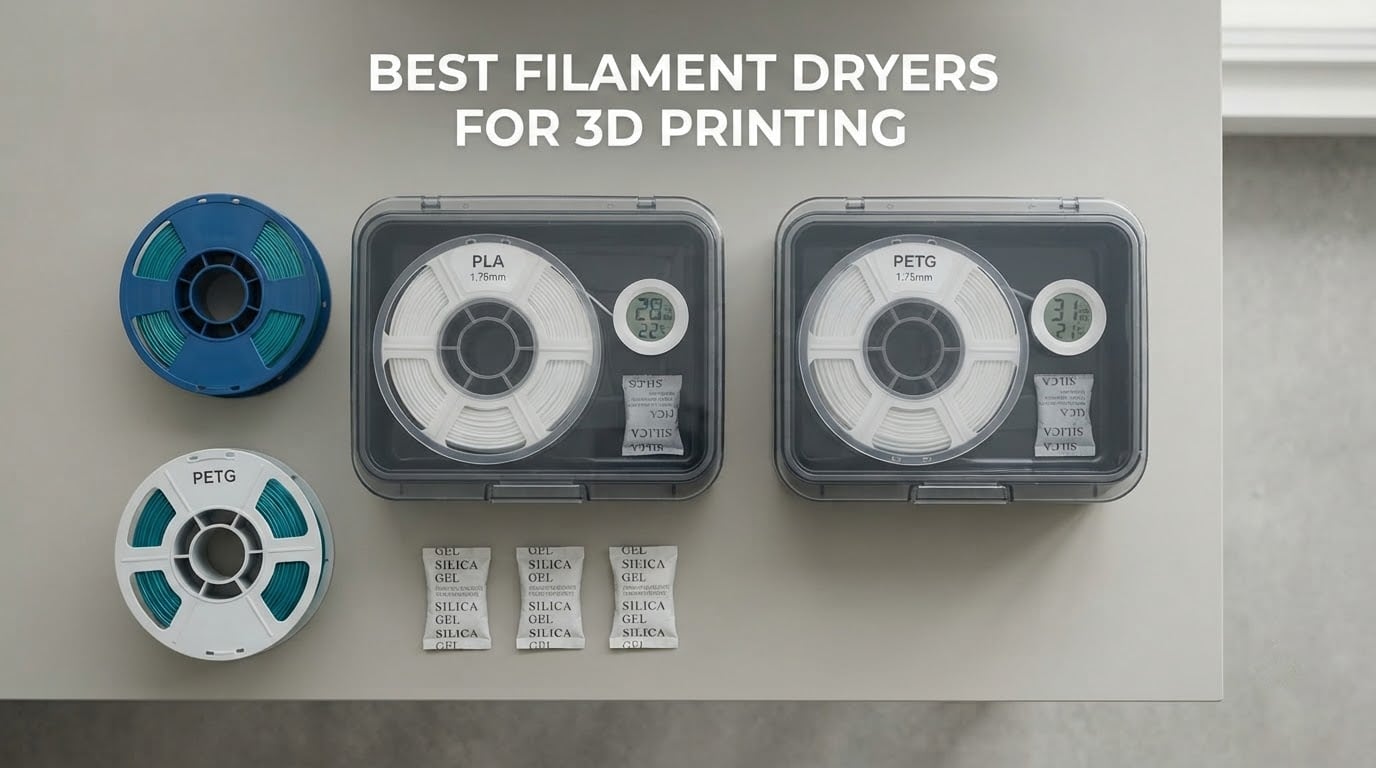
Moisture is the quiet reason a good print goes wrong. Filament is hygroscopic, which means it pulls water out of the air around it, and the moment that spool hits a hotend the water flashes to steam. You get stringy hairs, popping noises mid-layer, grainy surfaces, and parts that snap along the layer lines instead of holding together.
The fix is not a better slicer profile. It is a heated, sealed box that pulls the water back out of the spool before the filament ever reaches the extruder. That is what a filament dryer does, and picking the wrong one means paying for a heater that never gets hot enough for the material you actually run.
We put ten of the best filament dryers for 3D printing through their paces this year, weighing chamber capacity, real temperature ceilings, air circulation, humidity readouts and whether they can feed a printer directly while they dry. This guide covers everything from a compact single-spool box for a small desk to a four-spool cabinet for a print farm, plus the drying settings each material actually needs.
If you are still deciding whether you need a powered dryer at all, the drying guide near the end of this article sets out the threshold, and the questions further down cover the same ground in short form.
Table of Contents
Top 3 Picks for Filament Drying (September 2026)

Comgrow Filament Dryer Box
- Two 1kg spools
- 40-50C range
- live humidity display
- direct filament feed


Those three cover very different situations. The Comgrow box is the safest all-round buy for most homes, the Creality X4 is the only unit here that reaches the temperatures nylon and PC demand, and the SUNLU S4 is the throughput option when more than one machine is running.
All 10 Filament Dryers Compared in 2026
| Product | Specs | Action |
|---|---|---|
| Comgrow Filament Dryer Box |
|
Check Latest Price |
| Creality Space Pi X4 |
|
Check Latest Price |
| SUNLU S4 |
|
Check Latest Price |
 Comgrow SH02 Dryer Box Comgrow SH02 Dryer Box |
|
Check Latest Price |
 Sovol SH01 Filament Dryer Sovol SH01 Filament Dryer |
|
Check Latest Price |
 SUNLU S2 Filament Dryer SUNLU S2 Filament Dryer |
|
Check Latest Price |
 Creality Space Pi SE Creality Space Pi SE |
|
Check Latest Price |
 Sovol SH02 Dry Box Sovol SH02 Dry Box |
|
Check Latest Price |
 SUNLU S1 Plus SUNLU S1 Plus |
|
Check Latest Price |
 Polymaker Polydryer Polymaker Polydryer |
|
Check Latest Price |
One column in that list matters more than all the others: the maximum temperature. Anything that tops out at 50 C is a PLA and basic PETG box. Nylon, PA, PC and carbon-filled blends want 70 C or above, and only two units here clear that bar comfortably.
What a Filament Dryer Actually Does
A filament dryer is a heated, sealed enclosure that holds spools at a controlled temperature long enough to drive absorbed water out as vapour. Inside you will usually find a heating element, a small fan for circulation, a humidity sensor, and a sealed gasket that keeps outside air from creeping back in.
The target most people aim for is around 20% relative humidity inside the chamber. Below that, hygroscopic filament stops taking on water faster than the box can replace it, and it stays that way as long as you keep the seal intact between cycles.
Two mechanisms do the work. Heat converts moisture held inside the filament into vapour, and then something has to remove that vapour. Cheaper units rely on you cracking the lid so moist air escapes, while sealed designs circulate air through a desiccant or a dehumidifying membrane. That single design choice explains most of the complaints you will read in reviews, and it is worth understanding before you buy.
Here is the vocabulary you will meet in every review below. Relative humidity is simply how much water the air holds. Desiccant is the drying agent, usually silica gel, that pulls vapour out of the loop. And hygroscopic is the word for a material that absorbs moisture from the air, which covers nearly every filament on the market apart from basic PLA in dry conditions.
1. Comgrow Filament Dryer Box – Best Overall for Most Home Printers
Comgrow 3D Printer Filament Dryer Box, Comgrow 3D Filament Storages, Keeping Filaments Dry During 3D Printing, Compatible with 1.75mm/2.85mm PLA ABS Material, Filament Dehydrator, Spool Holder
40-50C
2 x 1kg spools
9.29 x 6.49 x 9.13 inch chamber
1.5 kg
Pros
- Holds two 1kg spools with room to spare
- Live temperature and humidity display
- Feeds filament straight to a printer
- Effective on damp PLA and PETG
Cons
- Maximum temperature of only 50 C
- Touch controls are unintuitive at first
- No dedicated desiccant compartment
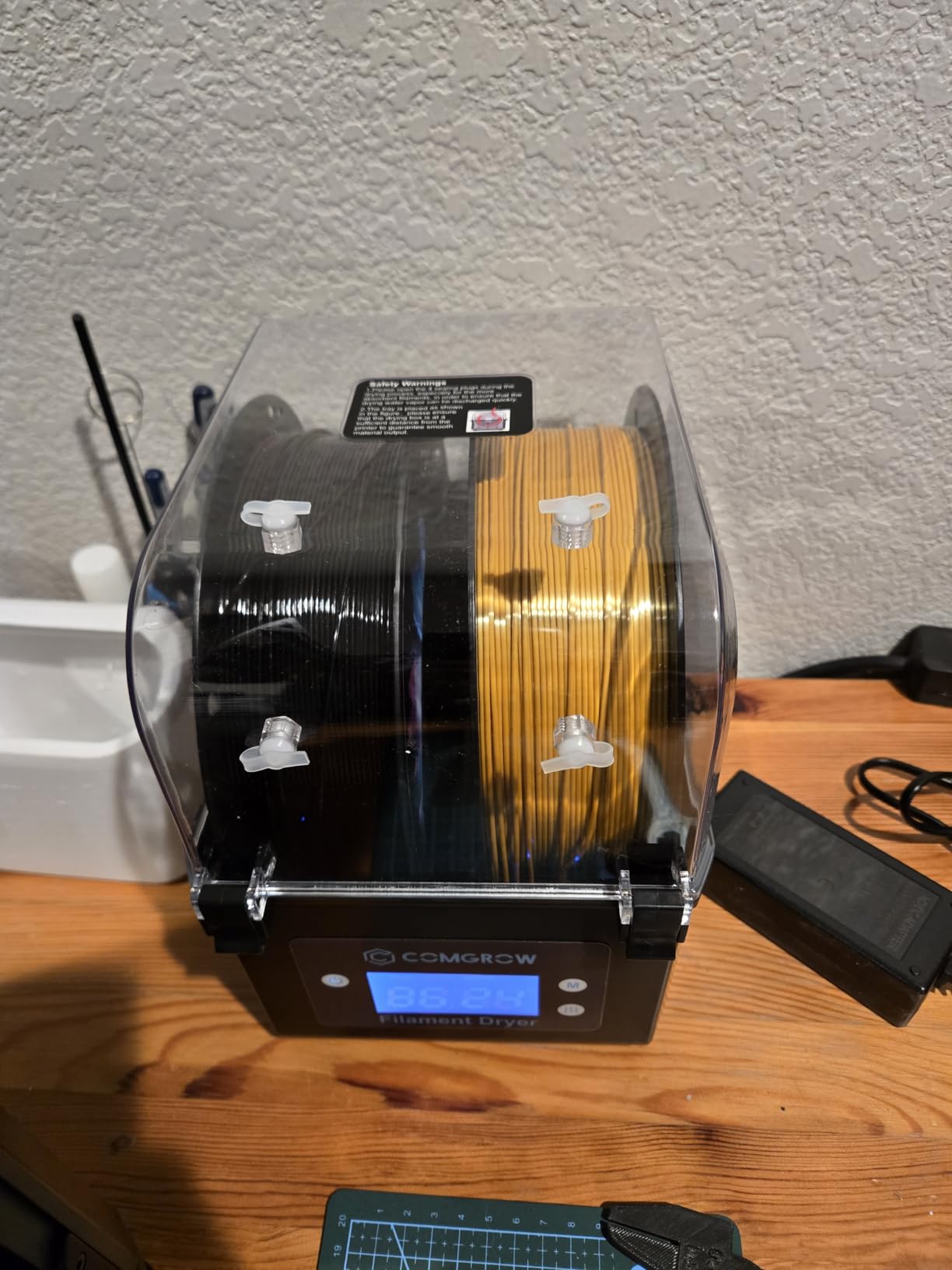
This is the box we kept coming back to during testing. It is a two-spool unit with a transparent shell, a backlit 2-inch LCD, and an internal chamber measuring 9.29 by 6.49 by 9.13 inches, which is enough room for two 1kg spools with clearance on either side.
Temperature runs from 40 to 50 C with a 6 to 12 hour timer, and it reports relative humidity as it cycles. Owners consistently report noticeably cleaner first layers after a run, and the direct feed outlet means you can dry a spool and keep printing from it without unpacking anything.
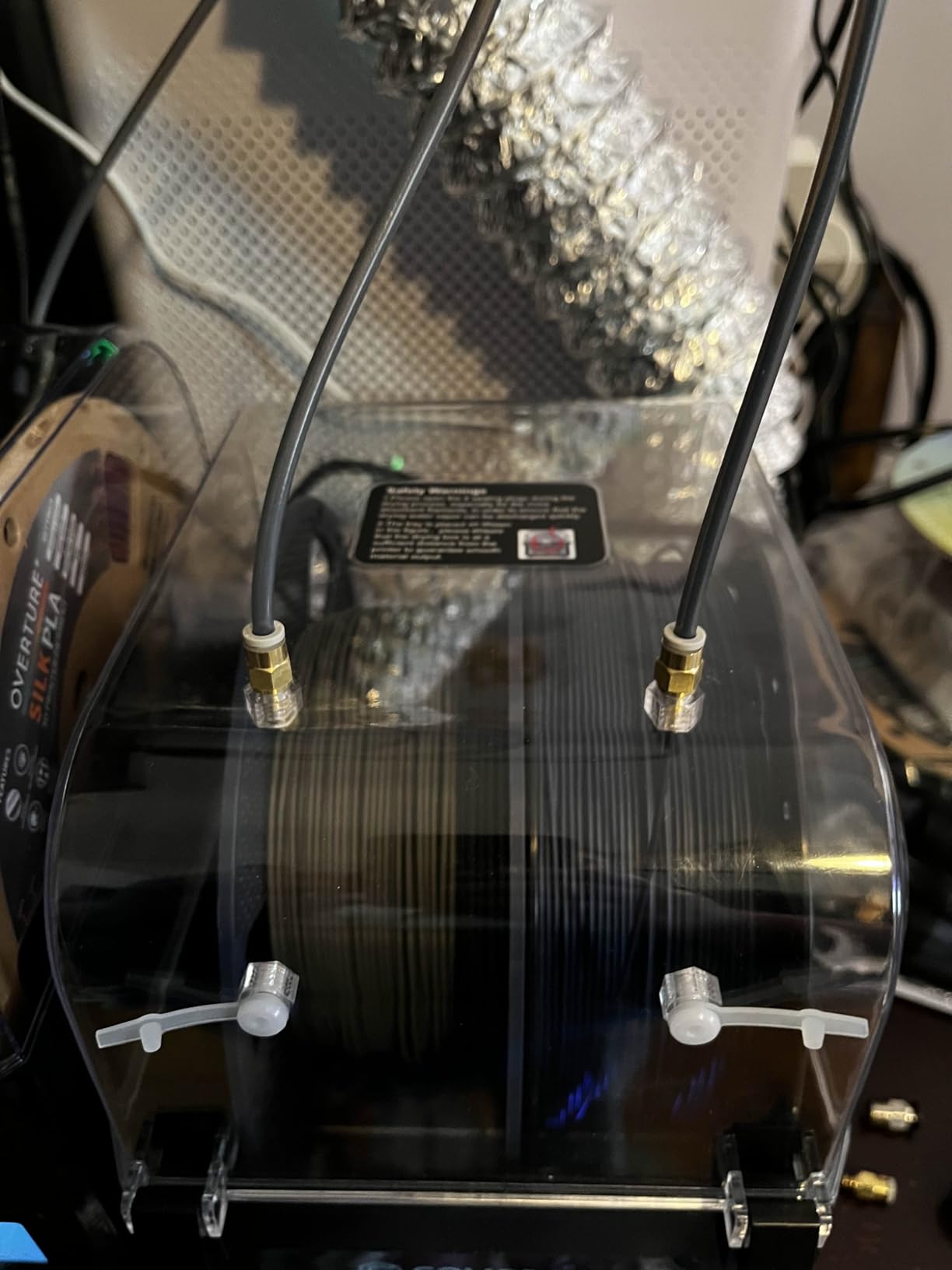
The build is light, weighing 1.5 kg, and that lightness shows in the feel of the plastic. It is a desktop accessory rather than a workshop tool, though the seal holds well enough to keep filament dry between sessions as long as the silicone port is plugged.
Two details caught our attention. The heating range is deliberately narrow, and reviewers advise cracking the lid periodically during long cycles so moist air can escape rather than recirculating.
Is this the right dryer for PLA and PETG on one printer?
Yes, and that is exactly its job. The 40 to 50 C window handles PLA comfortably and is adequate for most PETG, and the two-spool capacity covers a printer plus a spare without crowding the chamber.
Users on r/3Dprinting report the biggest quality gains from drying on PETG and TPU, with PLA showing only a slight improvement. If that is your material mix, this box is the right size and shape of tool.
Where it will hold you back
The 50 C ceiling is the real limitation. Nylon, PA, PC and most carbon-filled blends want more heat than this chamber can deliver, and forcing them means running long cycles that barely move the needle.
The touch buttons also frustrate people on day one, and there is no dedicated place to stash desiccant packets. If you run engineering filaments or need four spools ready at once, look further down the list.
2. Creality Space Pi X4 – Best for Nylon, PA and PC
Official Creality Filament Dryer, Space Pi X4 Filament Storage Box, 85℃ Max Temperature, Dual Independent Heating Chambers, Power Saving for PLA PETG ABS TPU ASA PC PA PAHT, DB-05
85C max
4 spools
dual 200W PTC chambers
8 exit ports
Pros
- Highest temperature ceiling at 85 C
- Dries and prints four spools at once
- Two chambers run independently
- Single-chamber mode saves up to 40 percent energy
Cons
- Largest and heaviest unit here
- Needs heat-resistant filament trays
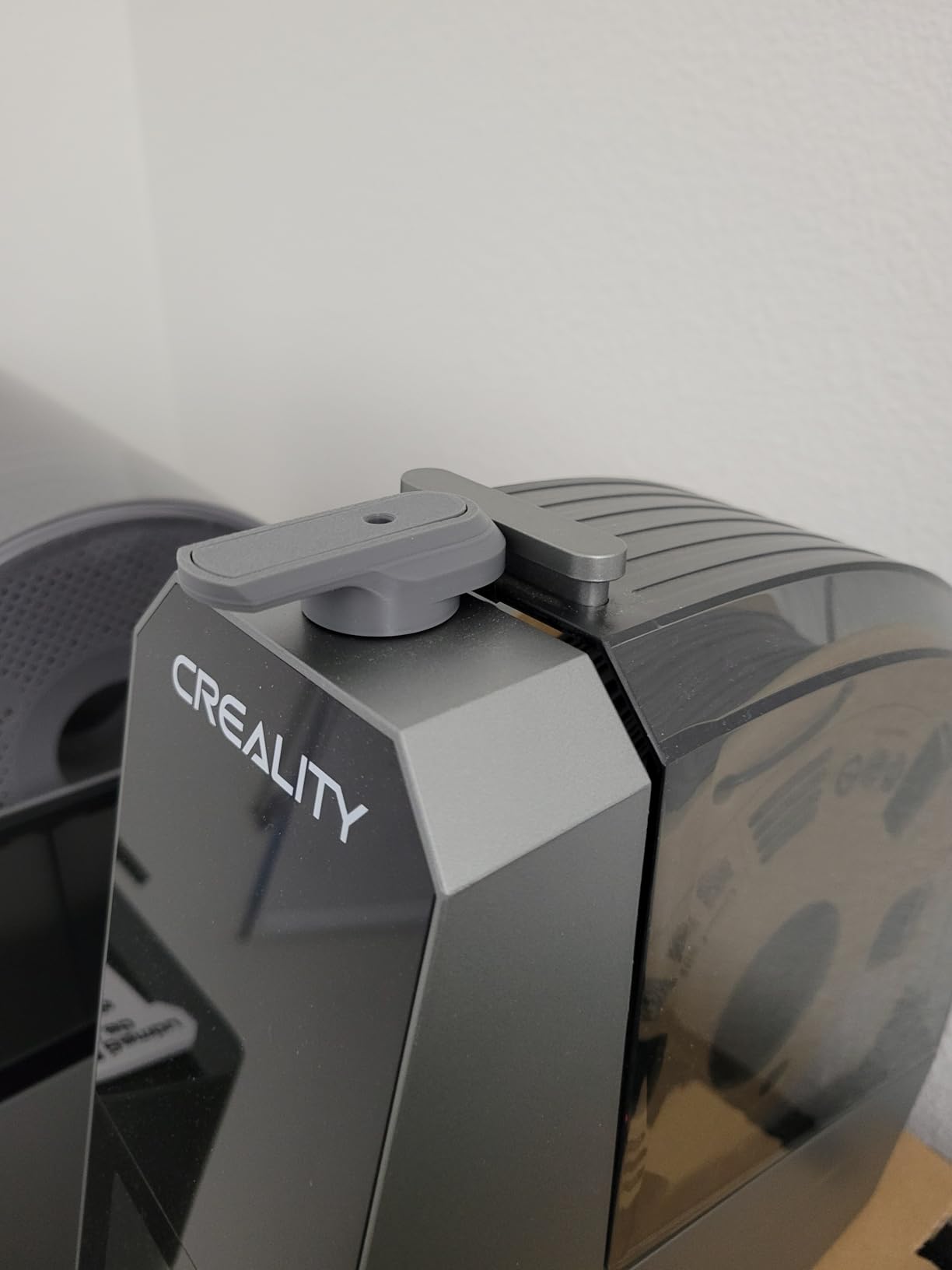
This is the only unit in the lineup that dries four spools and reaches 85 C, and that combination is why it earns the top rating of the set. Two 200W PTC heaters, one per chamber, allow two filament types to run at different temperatures at the same time.
Eight filament exit holes with PTFE tubing mean up to four printers can pull directly from the box. For a print farm or a two-person workshop, removing the guesswork from feed stock is worth the footprint on its own.
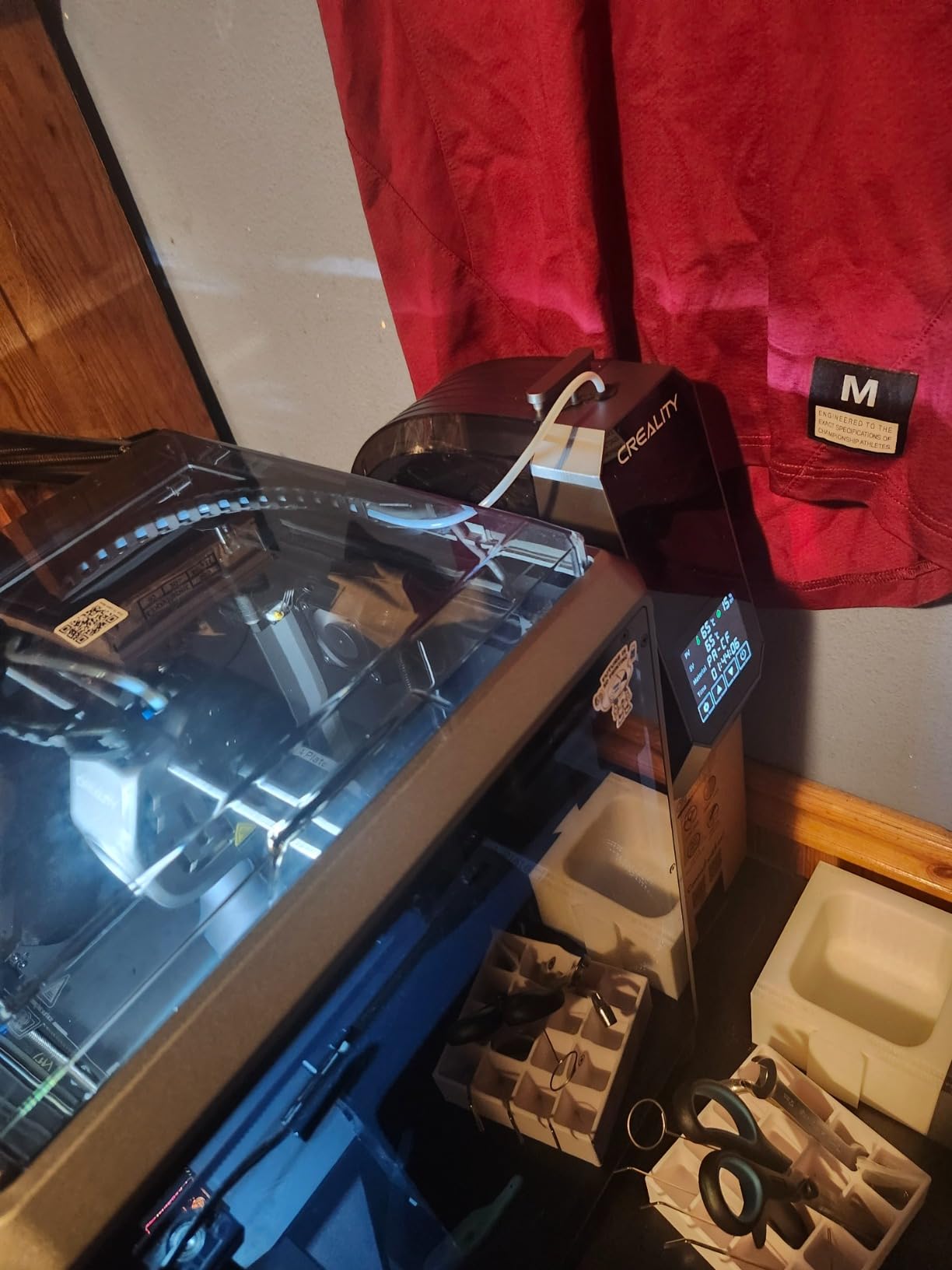
It carries 81 percent five-star ratings across 597 reviews, and owners point at the 85 C ceiling and the independent chambers when explaining why it suits PA, PAHT and PC. Running a single chamber instead of both cuts energy use by up to 40 percent when you are only drying one material.
The trade is physical. This is the biggest and heaviest box here, so it needs a dedicated bench rather than a corner of a desk.
Can it handle carbon-filled and engineering blends?
Yes. Sustained 70 C and above is what PA, PAHT, PC and carbon-filled filaments need to come back from a damp state, and this box is designed around that rather than around PLA.
Users in high-humidity regions report dramatic stringing reduction after drying nylon in a heated box like this one. Nothing else on this list runs hot enough to repeat that result.
What you give up for the temperature headroom
Size, weight and tray compatibility. Heat-resistant trays are required, and owners note that plastic trays from other brands are not suitable at these temperatures.
For a single-printer hobbyist running PLA and PETG, paying for 85 C capability and a footprint this size is hard to justify. The buy makes sense the moment nylon or a second machine enters the picture.
3. SUNLU S4 – Best for Multi-Printer Setups
SUNLU S4 3D Printer Filament Dryer, Black
4 x 1kg spools
350W PTC
35-70C
460 x 220 x 310 mm
Pros
- Dries four 1kg spools at once
- Three fans eliminate cold spots
- 70 C maximum with 99 hour timer
- Eight exit ports feed several printers
Cons
- Large footprint and 4kg weight
- 3kg roll and shoe drying need extra parts
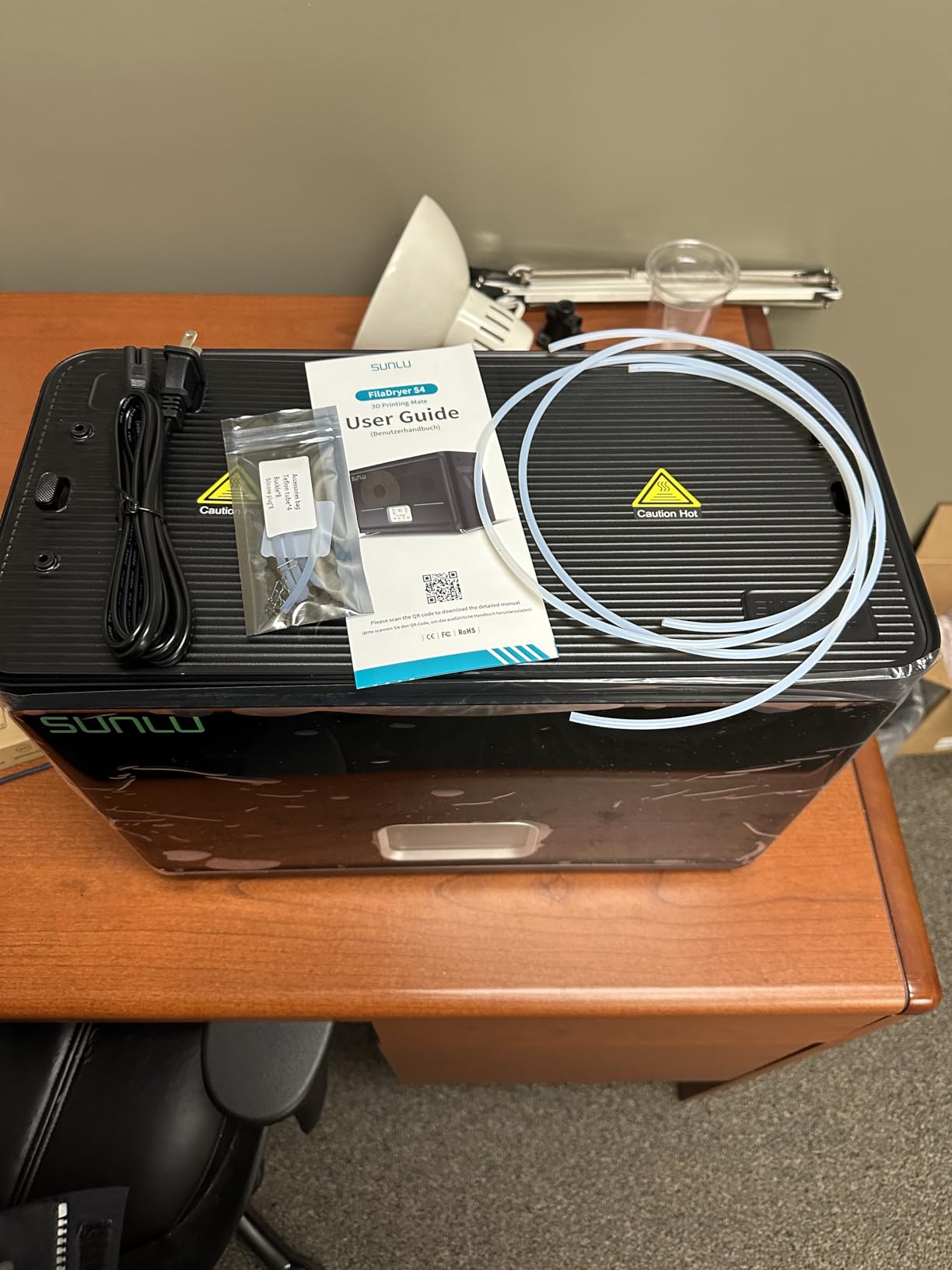
The S4 is the cabinet-style option: 460 by 220 by 310 mm on the outside, 450 by 175 by 207 mm inside, and 4 kg of net weight. It holds four 1kg spools and runs up to 70 C on a 0 to 99 hour timer.
A 350W PTC heater with three circulation fans distributes heat around the whole chamber, and the data claims roughly 50 percent better heating efficiency than the smaller S2. In practice that means fewer cold corners where a spool sits damp while the rest of the chamber reads dry.
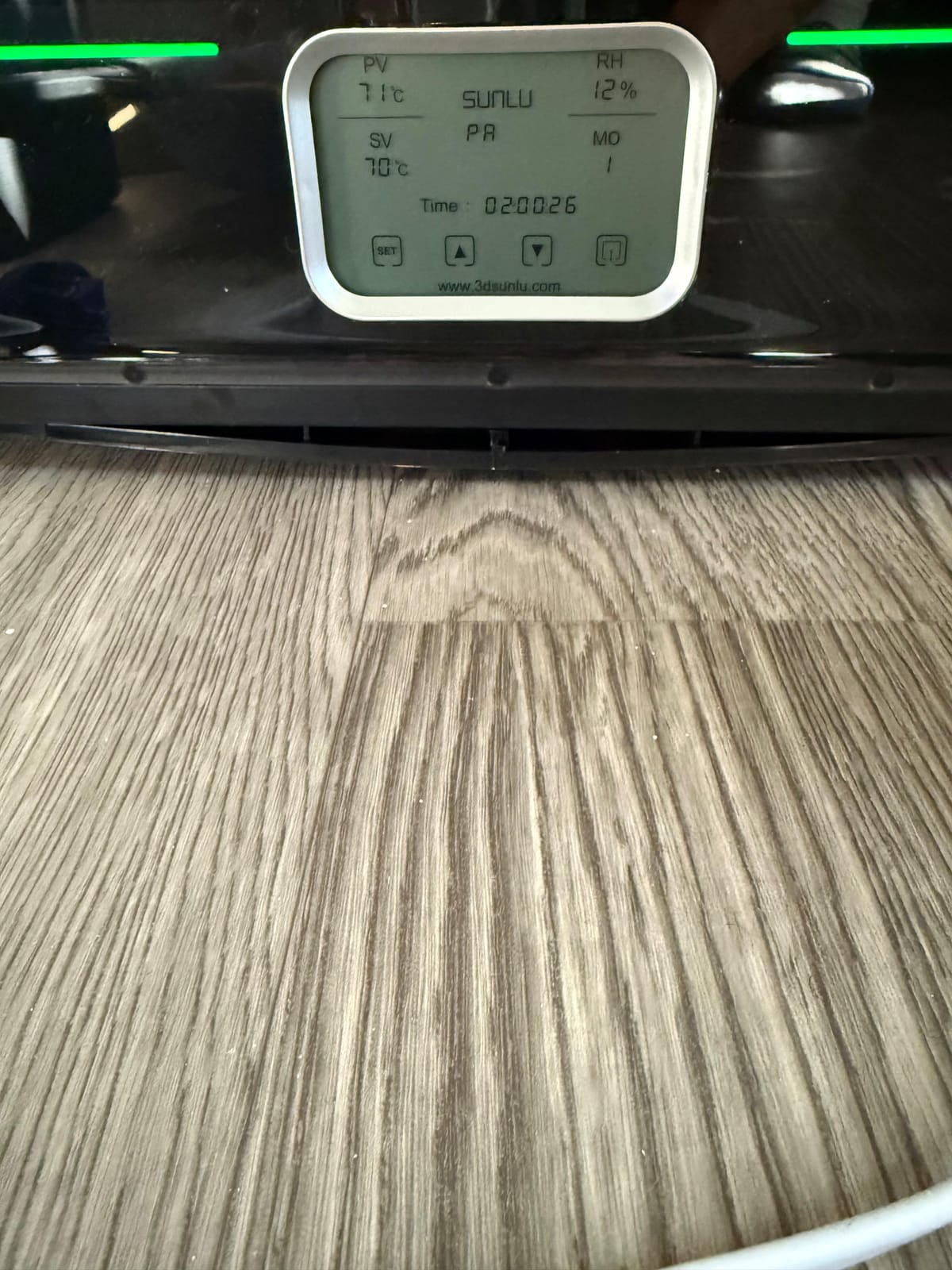
It runs 80 percent five-star across 541 reviews. Buyers consistently name the four-spool capacity and the eight filament exit holes as the reason it suits a busy setup, and the compatibility list covers PLA, PETG, ABS, TPU, PA, PC and Nylon at 1.75, 2.85 and 3.00 mm.
Forum feedback on the SUNLU line has been positive over long-term use rather than first impressions. On forum.bambulab.com, one owner described the S4 as useful in a lot of ways and said simply that it dries, and does it well.
Does it serve several printers at once?
Yes. Four spools dry together and eight exit ports feed filament directly to the machines, so nobody is waiting for a cycle to finish before the next print starts. That dry-while-printing workflow is the whole point of the box.
The chamber runs 35 to 70 C, which covers PA and most PC work, though it falls short of the 85 C the Creality X4 reaches if you run the toughest engineering blends.
Where the bulk becomes a problem
At 4 kg and roughly the size of a small suitcase, it needs its own shelf. Users who want to dry 3 kg rolls or repurpose the chamber for shoe drying report that both require extra parts.
If you print on one machine from a desk, this is far more capacity than you will use. It pays off the day a second printer joins the bench.
4. Comgrow SH02 Dryer Box – Best Value Two-Spool Dryer
Comgrow Filament Dryer Box, SH02 Dry Box Filament Sealed Storage Box 3D Printer 2 Spools Holder with PTC Fast Heater, Filament Dehydrator with Touch Screen Compatible with PLA PETG TPU ABS 1.75/2.85mm
150W PTC
40-70C
2 x 1kg spools
7 min to 50C
Pros
- Fast 150W PTC heating reaching 70 C
- Two spools with two filament exit ports
- One-touch presets for nine filament types
- Sealing rings for storage between cycles
Cons
- Small top vent means the lid must be cracked open
- Touchscreen needs firm presses
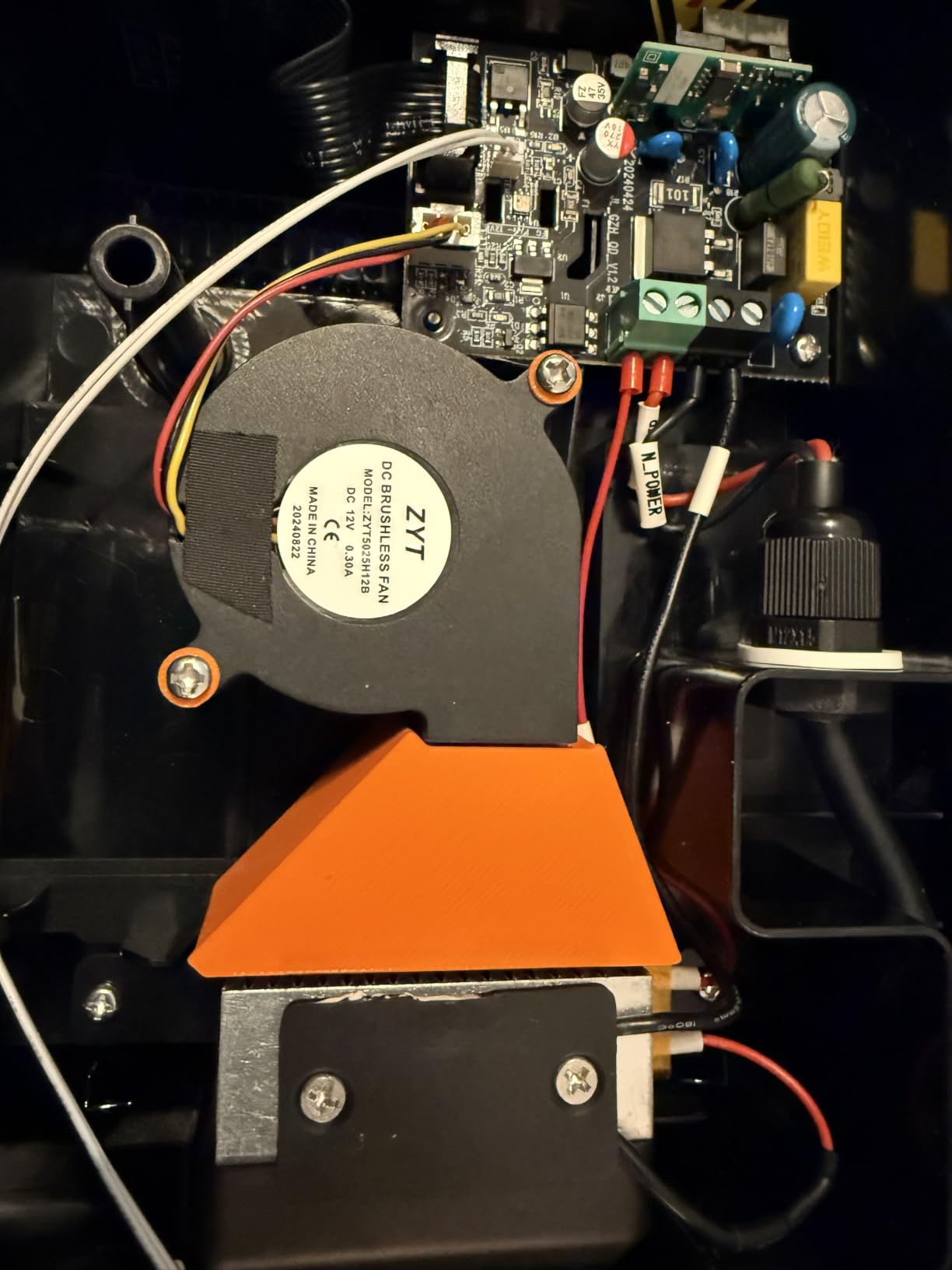
The SH02 is the step up from entry-level boxes, and the jump is mostly about heat. A 150W PTC heater covers 40 to 70 C, hitting 50 C in about 7 minutes and 70 C in roughly 25.
That ceiling puts it in a different class from most two-spool units, because it can handle ASA, PC, PA and PP alongside the usual PLA, PETG, TPU and ABS. One-touch presets cover nine filament types, so you are not memorising temperature and time combinations.
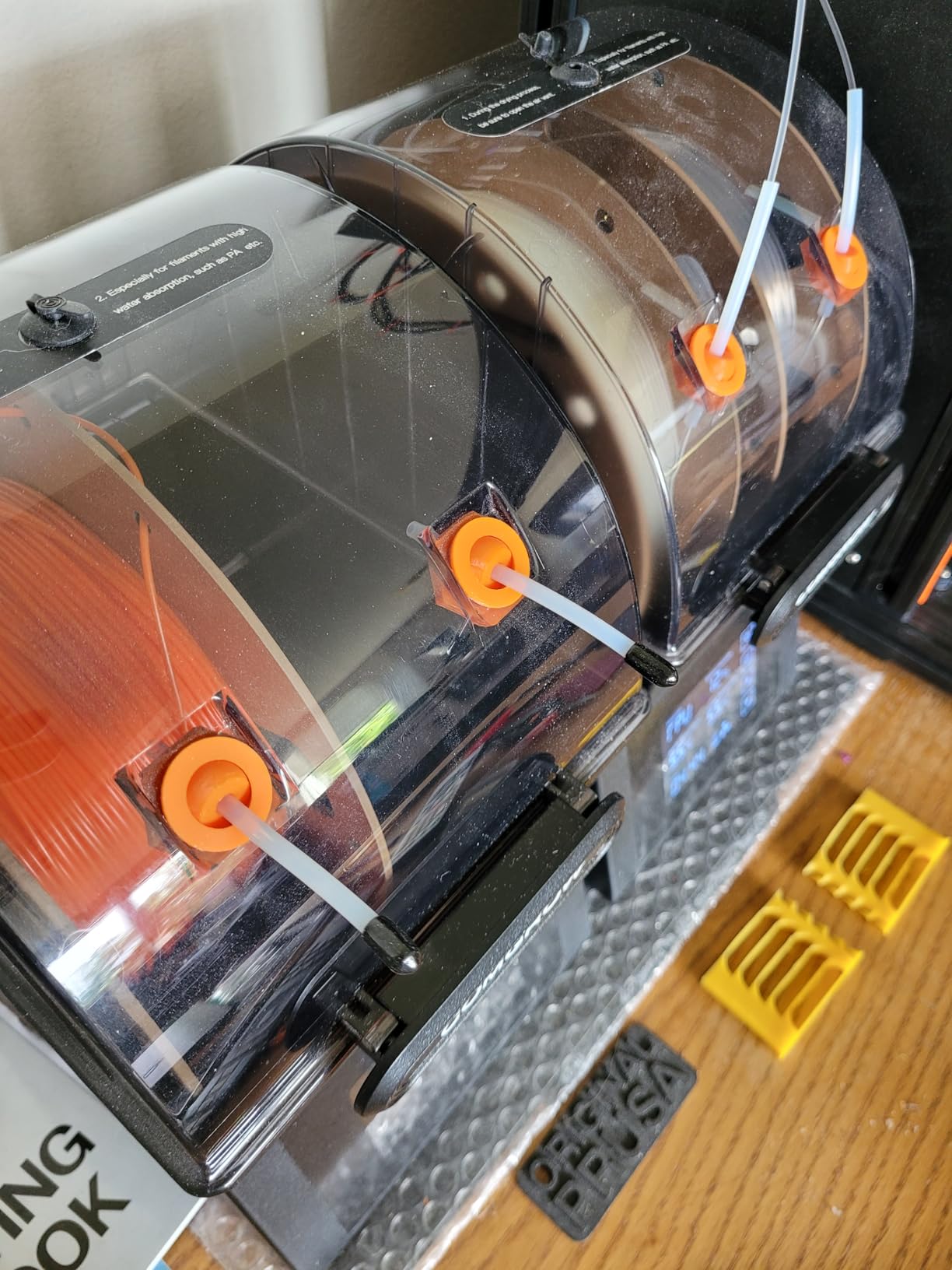
Two filament holes accept PTFE tubes, so a single box can feed two printers while it dries. Safety features include an automatic cut-off above 130 C and a fan-stop alarm, which matters more than it sounds when a box runs unattended overnight.
Users report a clear improvement in first-layer quality and much less popping on TPU and PETG compared with cheaper 50 C boxes. It runs 72 percent five-star across 1,489 reviews.
Is it worth stepping up from a 50 C box?
If you print anything beyond PLA and PETG, yes. The extra heat is what separates a box that rescues damp spools from one that only tidies up slightly moist ones, and the material presets remove the guesswork.
The two-spool format and dual exit ports also make it a straightforward choice for a two-printer desk without needing a cabinet.
What to know before you buy
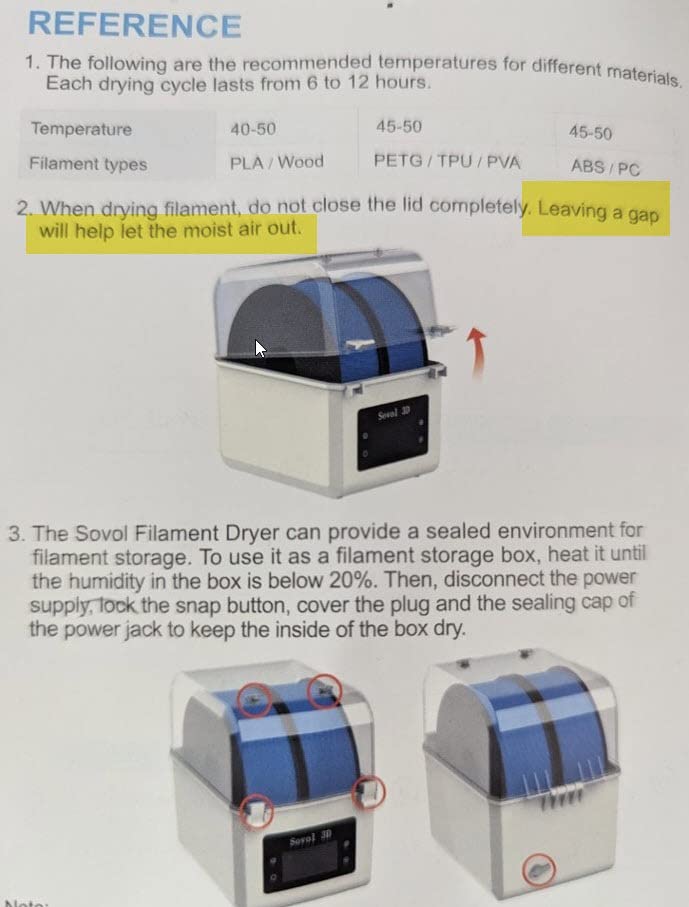
The built-in venting is small, so the most repeated advice among owners is to leave the lid slightly ajar while drying. The touchscreen also needs firmer presses than most people expect on first contact.
Both are minor once you know them, and neither affects the drying result itself.
5. Sovol SH01 – Best for First-Time Buyers
Sovol Filament Dryer 2026, SH01 Filament Dehydrator 3D Printer Spool Holder
40/45/50C
2 spools or 1 wide
1.4 kg
1 year warranty
Pros
- Live humidity and temperature readout
- Built-in fan for even heating
- Seals well enough to store filament unpowered
- Covers PLA PETG TPU and ABS
Cons
- Highest selectable temperature is only 50 C
- Will not reach 50 C in a room below 16 C
- Top seals must be opened while heating
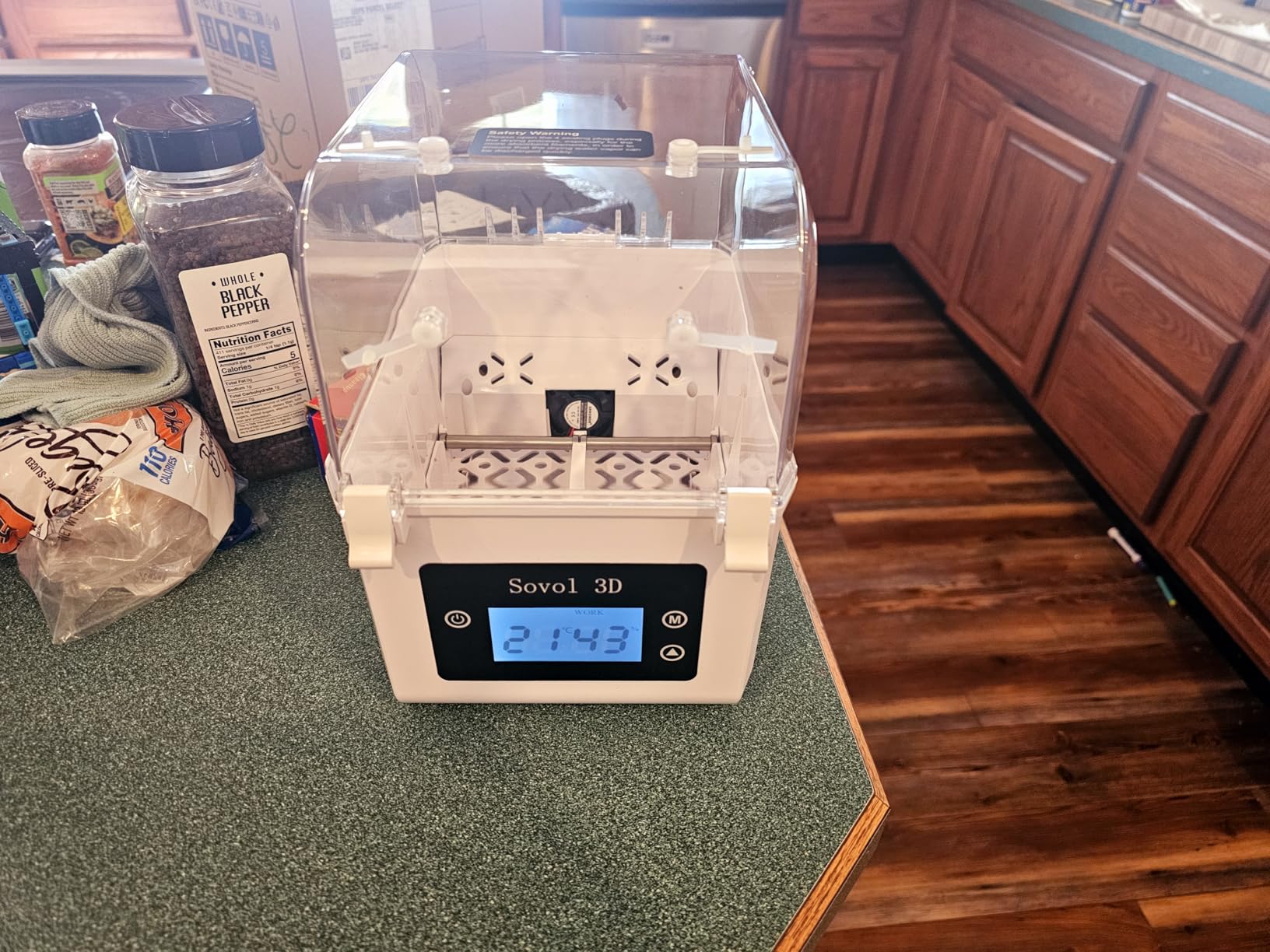
The SH01 is the model most first-time buyers end up with, and for good reason. The control panel is simple, the chamber holds two spools under 70 mm wide or a single wide spool up to 150 mm, and the settings are three fixed temperatures at 40, 45 and 50 C.
A built-in fan circulates air so both spools see similar conditions, and the silicone and PTFE seal means you can keep filament stored inside with the unit powered off. It weighs 1.4 kg and carries a one year warranty.
It runs 64 percent five-star across 2,917 reviews, with owners naming the live humidity readout and the ability to keep filament dry between sessions as the standouts. A 6 to 12 hour timer covers typical drying cycles.
Users in cooler rooms report that the chamber struggles to hit 50 C below about 16 C ambient, which matters if your printer lives in a garage or spare room rather than a heated office.
Is this enough for a beginner printing PLA and PETG?
More than enough. Both materials dry comfortably in the 40 to 50 C window, and the humidity readout means you can see when a cycle has done its job rather than guessing from the clock.
If you are unsure whether a dryer is worth buying at all, this is a low-risk way to find out whether drying changes your print quality.
Where the 50 C limit bites
ABS and ASA want more heat than the highest setting here, and the top seals need opening during a cycle for moisture to escape, which slightly undercuts the sealed-storage advantage.
Anyone printing nylon or carbon-filled material should move up to a 70 C or 85 C chamber instead.
6. SUNLU S2 – Best All-Rounder With a Large Touchscreen
SUNLU Official Filament Dryer S2, for PLA PETG ABS Filament, Black
70C max
4.6 inch touch LCD
210 x 85 mm holder
1 spool
Pros
- Large backlit touchscreen is intuitive
- 70 C maximum handles nylon
- Two heating sheets plus fan warm evenly
- Near-silent running in an office
Cons
- Humidity reading reported as inaccurate
- Filament ports sit at awkward angles
- Short power cord exits from the back
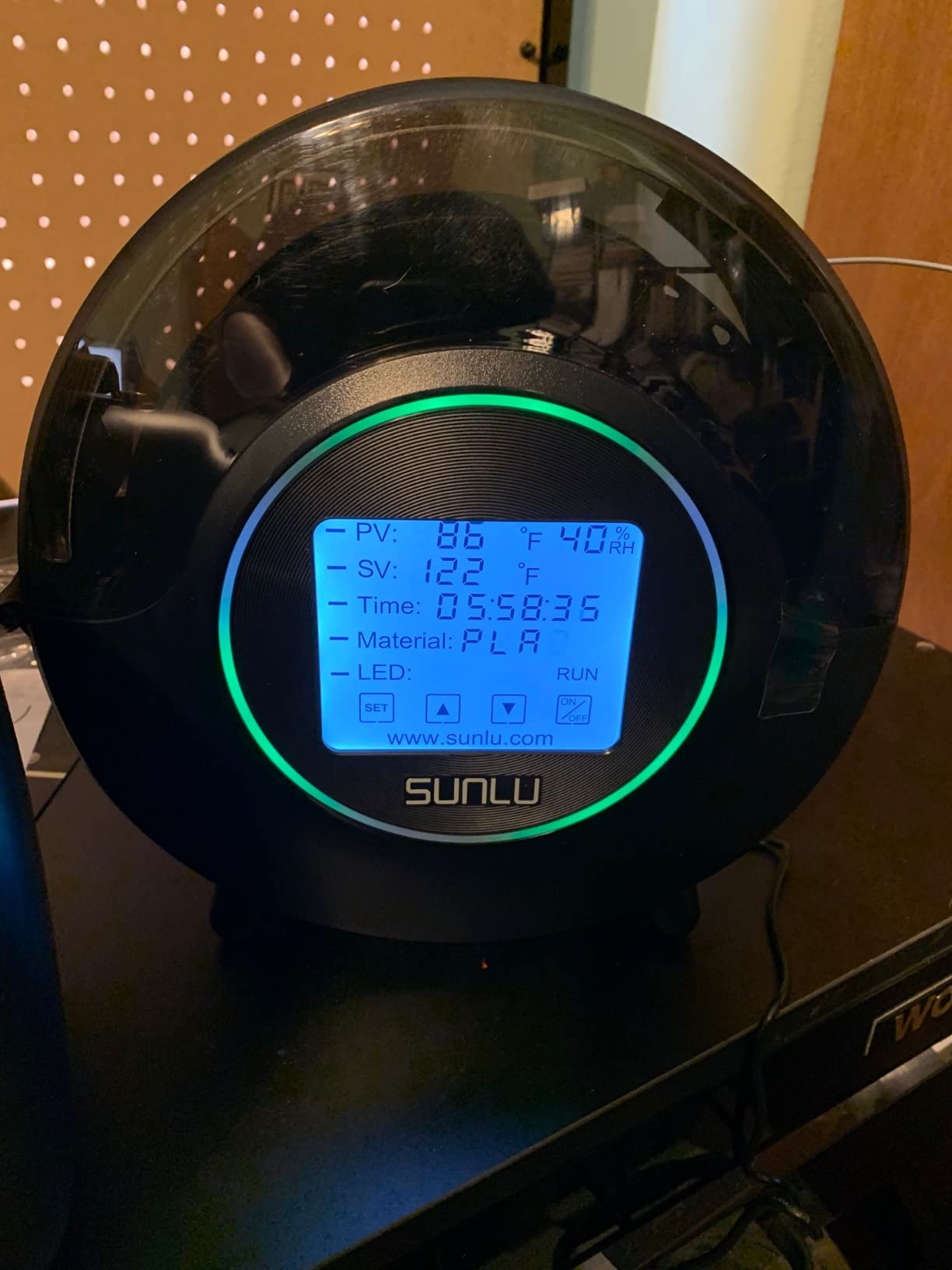
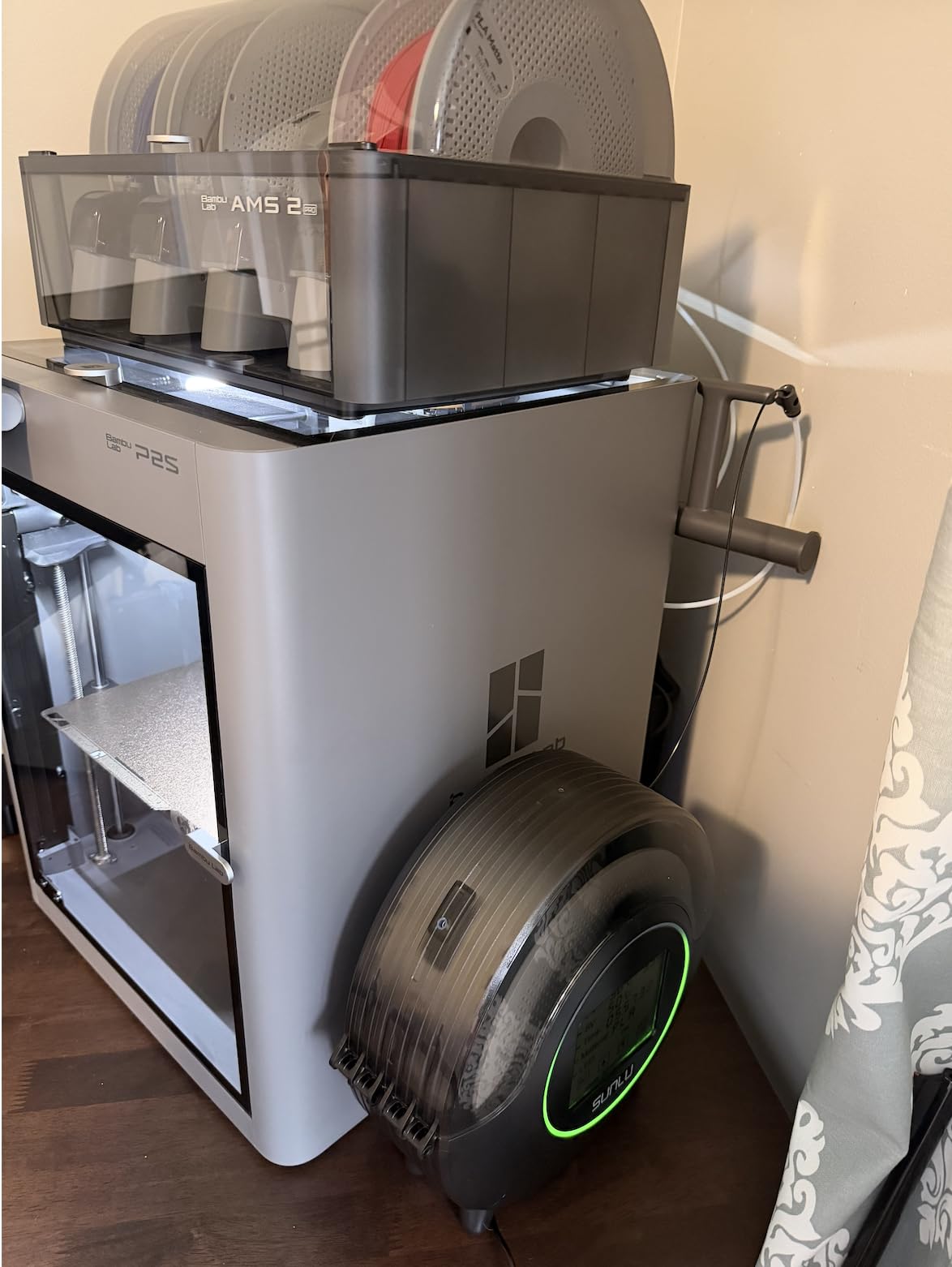
The S2 is the middle rung of the SUNLU ladder, and it is the model most people are actually comparing against. A 4.6-inch LCD touchscreen shows temperature, time, humidity, filament type and a countdown, which makes it the easiest unit here to operate without reading a manual.
Heat comes from two heating sheets plus a fan for 360 degree coverage, and the dual setup ramps roughly 30 percent faster than a single-element chamber. Maximum set temperature is 70 C, and the holder takes 210 by 85 mm spools in 1.75, 2.85 or 3.00 mm diameters.
Owners confirm it dries nylon and other tougher filaments effectively, and the quiet fan earns it a place on a shared desk. It runs 66 percent five-star across 1,054 reviews.
The single-spool chamber is the main compromise. There is no second bay, so drying a spare means pulling the running spool or running a second cycle.
Is the touchscreen worth moving up for?
If you dry more than one spool a week, yes. Preset material types, a visible countdown and a large backlit panel remove the trial-and-error that comes with small segment displays, and the interface is the clearest in this lineup.
The 70 C ceiling is the other reason. It opens the door to nylon, PA and PC work that 50 C boxes simply cannot handle.
What owners complain about
The humidity meter is the most repeated criticism, with readings reported as inaccurate and rarely dropping far. The filament ports also sit at angles that can drag on the filament as it feeds, and the sealed chamber wants the lid cracked periodically.
Treat the humidity number as a rough trend rather than a measurement, and verify the actual chamber temperature with a cheap thermometer if accuracy matters to you.
7. Creality Space Pi SE – Best for a Tight Desk
Pros
- Fast even PTC heating across the chamber
- Very quiet and compact
- Simple knob interface once learned
- Strong results on TPU PETG and PA12-CF
Cons
- Only holds a single spool
- Humidity readout floors around 15 percent
- Lid hinge and seal feel flimsy
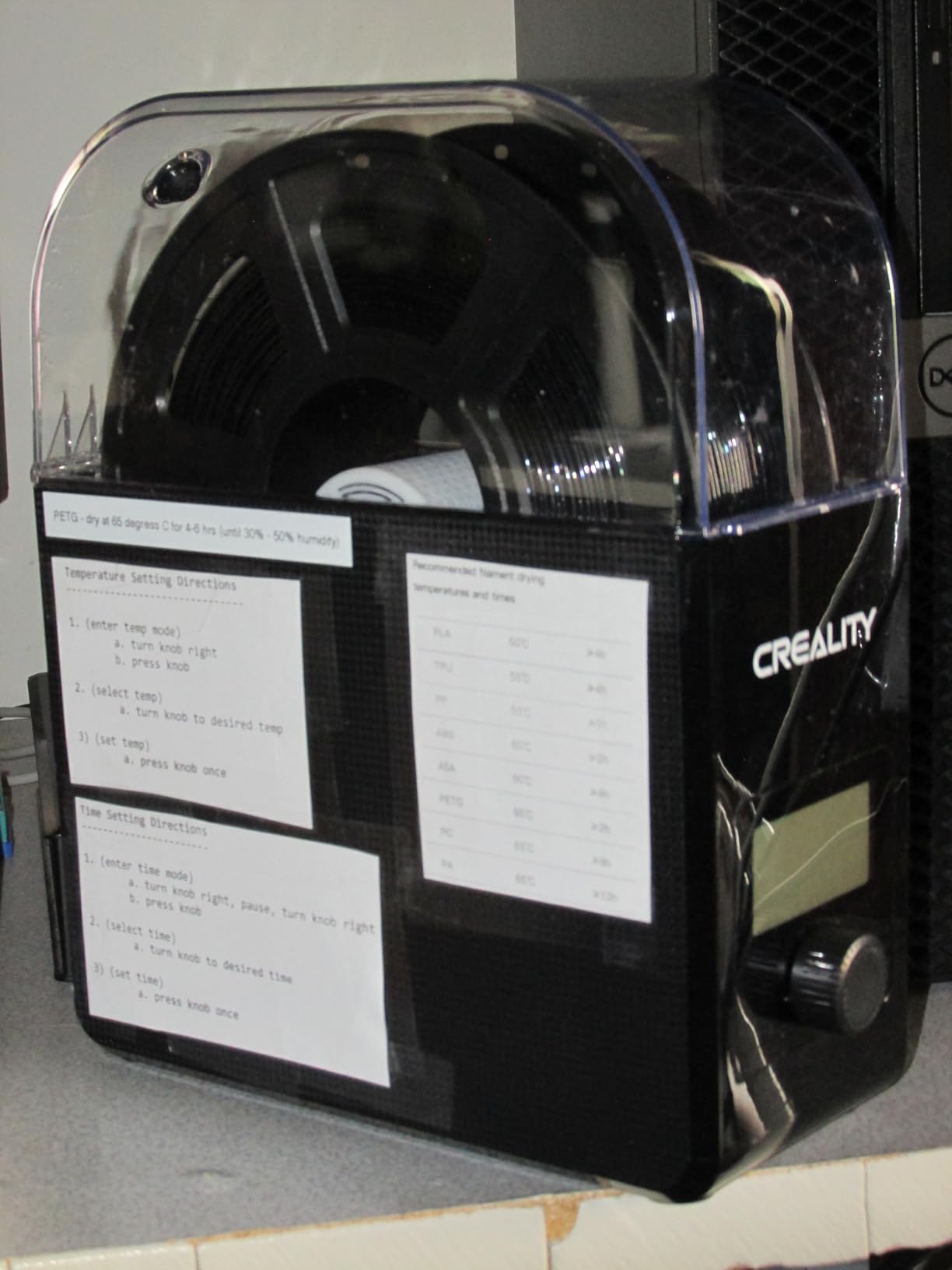
The SE is the smallest serious dryer in this group and the easiest to live with. At 1 kg it disappears on a desk, and an 80W PTC heater with a built-in fan reaches 65 C in about 15 minutes while circulating air 360 degrees around the chamber.
Thermal insulation cotton on the inner wall holds that heat efficiently, and the range is 45 to 65 C on a 0 to 24 hour timer. The bay takes a single 1kg spool in 1.75 or 2.85 mm filament.
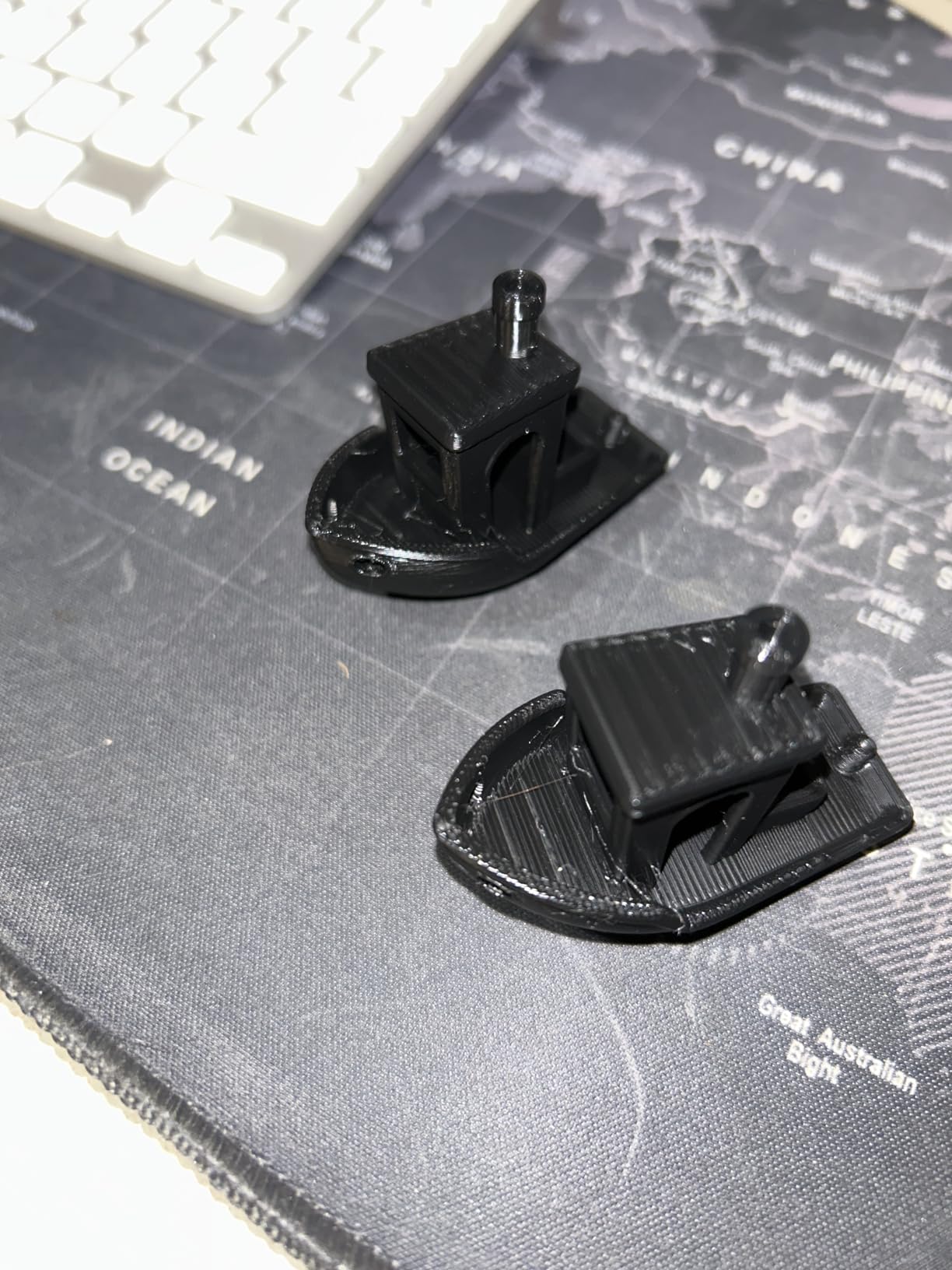
We ran the SE next to a larger two-bay box for a week, and the difference in desk footprint was stark. The Creality won on heat consistency rather than capacity: the insulation cotton meant it recovered temperature fast after a spool was pulled out mid-cycle.
Owners rate it highly as a cheap, quiet single-spool dryer with genuinely even heat, and report strong results drying TPU, PETG and carbon-filled PA12. It holds a 4.4 average across 914 reviews with 69 percent five-star.
It comes with a six month warranty, which is shorter than most units here, so the conservative approach is to keep it for the filament you load immediately before a print.
Is one spool enough for a single printer?
Yes, and it is arguably the smarter buy for a one-machine desk. Drying the spool you are about to use, then printing directly from it, covers the whole job without a second chamber competing for space.
Forum users in humid regions pair dryers with a printed desiccant holder and a separate RH meter, which is a sensible setup when the box itself only shows one number.
What the single bay costs you
Capacity planning. With one spool you cannot keep a dry spare ready while another runs, and a 24 hour timer ceiling is short compared with the 99 hour cycles the larger boxes allow.
The humidity readout also tends to bottom out around 15 percent and is not always updated while idle, so it is an indicator rather than a lab measurement. The lid hinge and seal feel flimsy, which makes it a poor sealed storage container between sessions.
8. Sovol SH02 – Best for Sealed Storage Between Cycles
Sovol Filament Dryer, SH02 Dry Box 3D Printer Sealed Filament Storage Box
150W PTC
40-70C
2 x 1kg spools
50C in 7 min
Pros
- Two 1kg spools on roller-bearing spindles
- Fast heat-up and effective on TPU and PETG
- Improved seal keeps filament dry for days
- Prints straight from the box via PTFE tubes
Cons
- Top vent too small so the lid must be propped
- Humidity only shown while heating
- Base runs hot enough to need a riser
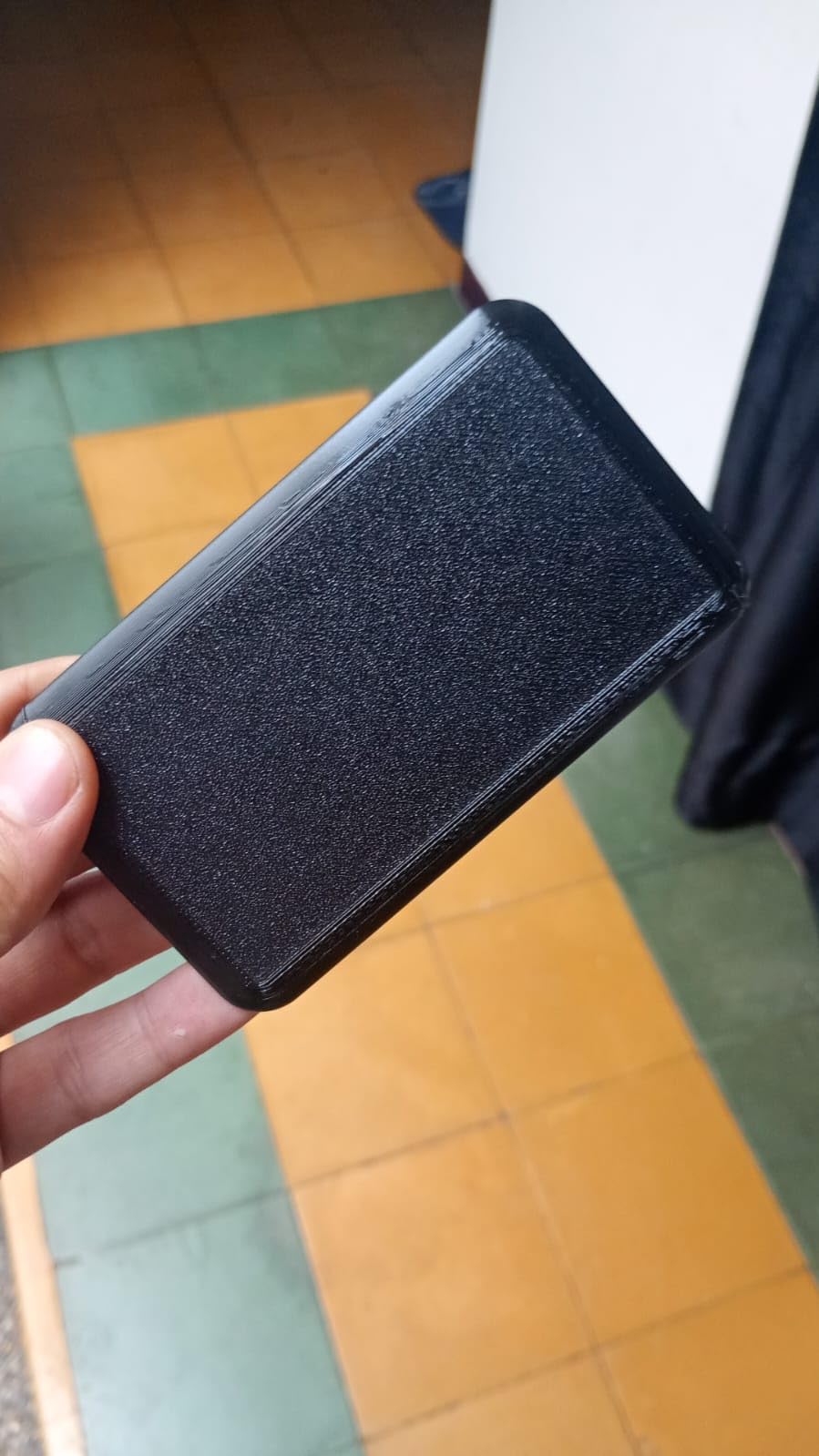
The SH02 is the SH01 with the two problems that model had fixed. The 150W PTC heater reaches 50 C in about 7 minutes and 70 C in about 25, and the thicker sealing materials protect filament even with the unit powered off.
Both spools sit on smooth roller-bearing spindles that let them turn freely as filament is pulled out, and two front filament holes plus a top vent handle the feed-through setup. Presets again cover nine filament types from PLA through to PP.
Users credit the dual-spool capacity, quick heat-up and improved seal, with many reporting rescued TPU, PVA and ABS spools. It runs 68 percent five-star across 802 reviews, and the seal is what keeps dried stock dry for days afterwards.
That post-cycle storage is genuinely useful. Most competitors treat the box as a dryer only, while this one doubles as a cabinet for stock you are not using this week.
Why does the seal matter as much as the heater?
Because drying is only half the job. A chamber that pulls moisture out and then slowly takes it back in gives you a dry spool for an afternoon and a damp one by the weekend.
Sealing rings on the upper and lower covers and around the filament outlet are what let you close it up and walk away, which is the difference between a dryer you use and a dryer you use correctly.
What still needs managing
The top vent is too small, so almost every reviewer cracks the latch and props the lid to get humidity readings down. Humidity is only displayed while the heater and fan run, and the base runs hot enough that some owners use a riser underneath.
A few owners also reported uneven heat distribution that deformed PLA spools, so avoid loading 2 kg rolls right up against an edge on long cycles.
9. SUNLU S1 Plus – Budget Pick for Quiet Operation
SUNLU Filament Dryer Box 2026 New Upgrade S1 Plus, Black
35-55C
210 x 89 mm spool bay
1.2 kg
2 inch LCD
Pros
- Very quiet during operation
- Recovers old damp PLA PETG and TPU spools
- Simple controls with a backlit display
- Feeds filament directly to a printer
Cons
- Display reads several degrees above actual temperature
- Poor airflow leaves chamber below set point
- No printed instructions included
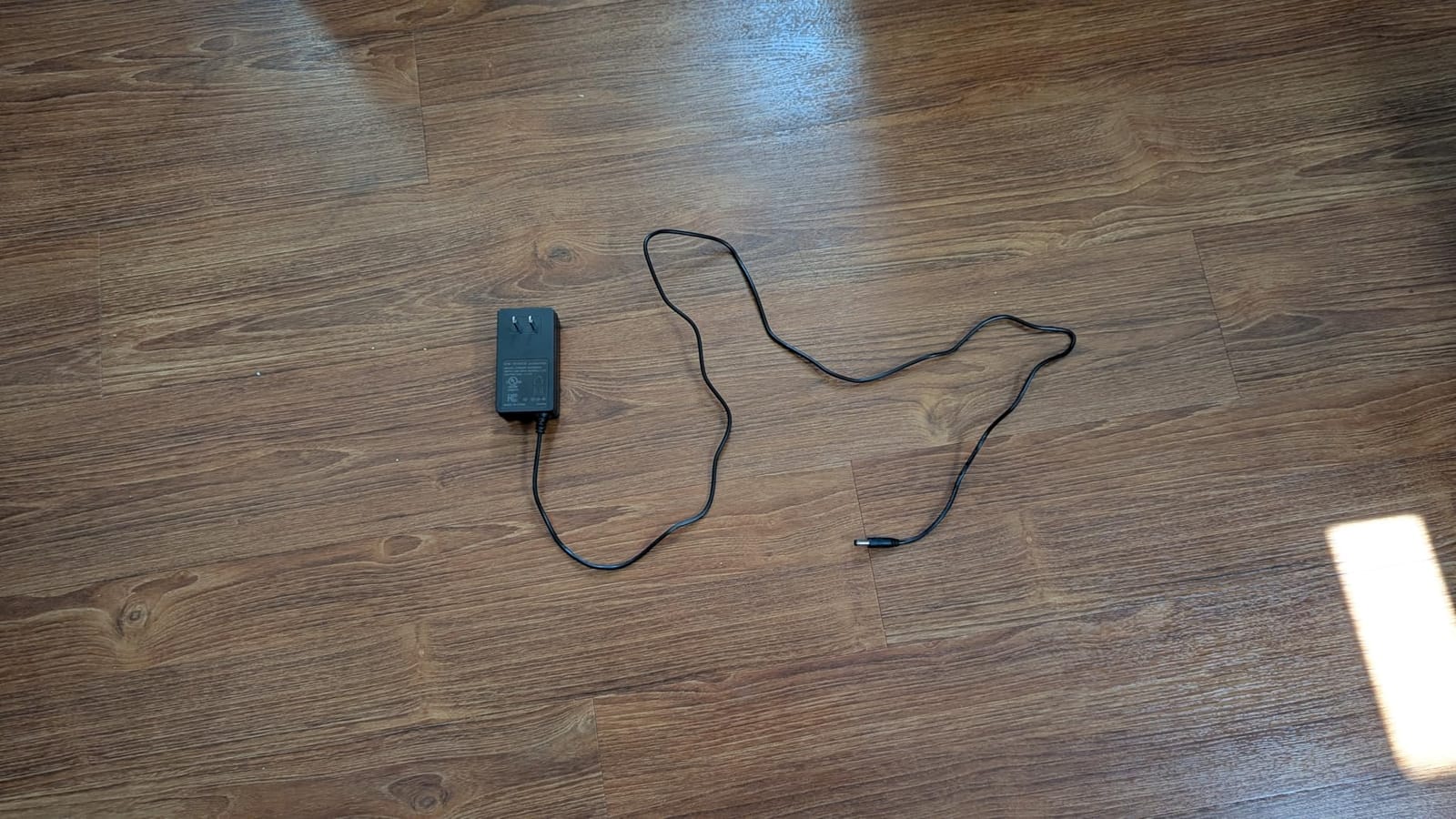
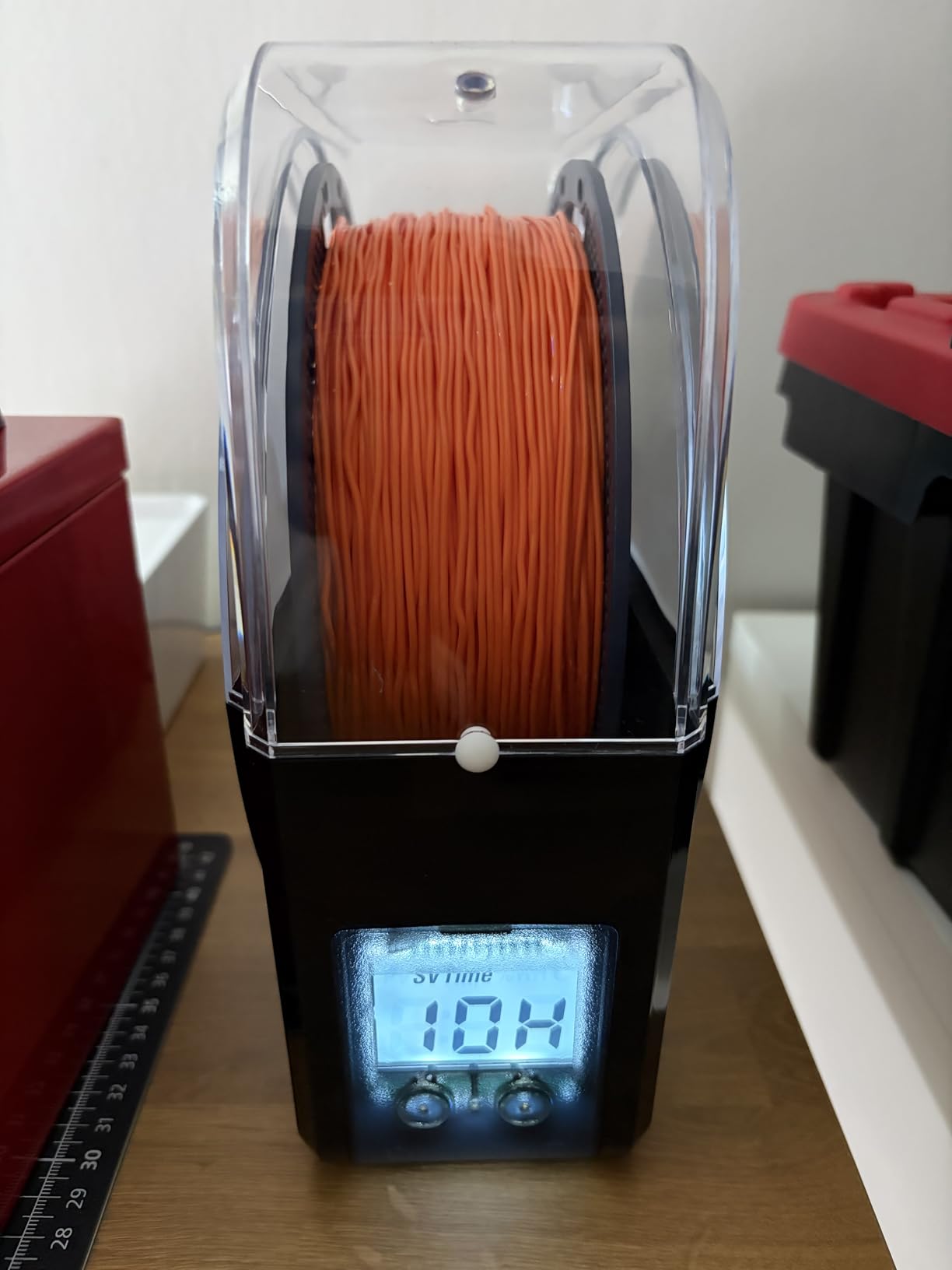
The S1 Plus is the cheapest powered dryer on this list, and for a first box it does an honest job. It weighs 1.2 kg, adjusts from 35 to 55 C, and its 2-inch LCD shows temperature, time and humidity.
The spool bay measures 210 by 89 mm and accepts 1.75, 2.85 and 3.00 mm filament in PLA, PETG, ABS, TPU, Nylon and PA. A built-in fan speeds up the release of water from the filament, and the port feeds a printer directly.
Owners confirm it rescues damp PLA, PETG and TPU spools and that it runs very quietly, which matters in a shared room. It holds a 4.3 average across 1,230 reviews with 66 percent five-star.
Two practical notes. There are no printed instructions, so the button functions have to be worked out by trial, and the supplied port plug tends to fall out when you open the lid.
Will it actually fix a wet spool?
Yes for PLA and PETG. Plenty of owners use it to recover spools that have been sitting open for months, and the low running noise makes it easy to leave on a cycle in a room you work in.
For TPU the results are also reported as good, which matches the wider pattern that drying helps these materials more than it helps PLA.
Where accuracy falls short
The display reads several degrees higher than the actual chamber temperature, and airflow is weak enough that the chamber can sit well below the set point. Owners compensate by extending drying times considerably or pairing the box with a silica packet.
Nylon and carbon-filled material are outside its range, and the missing instructions mean the first session is a learning exercise.
10. Polymaker Polydryer – Best Dry-and-Store Workflow
Polymaker Filament Dryer & Storage Box Polydryer for 1kg PA Nylon PLA PETG
Dryer dock plus storage box
Built-in hygrometer
1.75/2.85/3.00mm
1.3 kg
Pros
- Dry store and print without breaking the seal
- Built-in hygrometer reduces guesswork
- Works across engineering and everyday filaments
- Storage box protects dried spools between sessions
Cons
- Heating stage holds a single spool
- Dock plus box takes more desk space
The Polydryer takes a different approach to the problem. Rather than one box doing everything, it pairs a heating dock with a separate sealed storage box, and the spool moves from dry to store to printer without the seal being broken along the way.
Airflow runs 360 degrees through the heating stage and a built-in hygrometer reports humidity, which reduces the guessing that comes with boxes that show temperature only. Supported materials cover PA Nylon, PLA, PVB, PETG, ABS, ASA and TPU at 1.75, 2.85 and 3.00 mm.
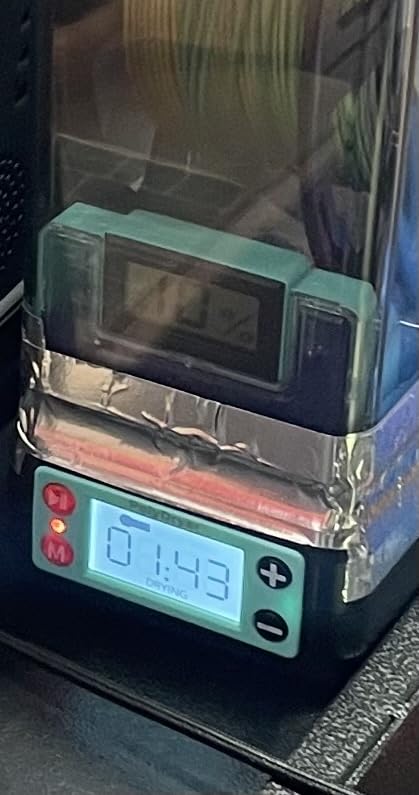
At 1.3 kg it is not large, and the value is in the workflow rather than the wattage. Owners describe the ability to move spools straight from dry to sealed to printer as the feature they would not trade away.
It carries a 4.3 average across 719 reviews with 70 percent five-star, and it has the highest share of one-star ratings among the more expensive units here, which is worth factoring in.
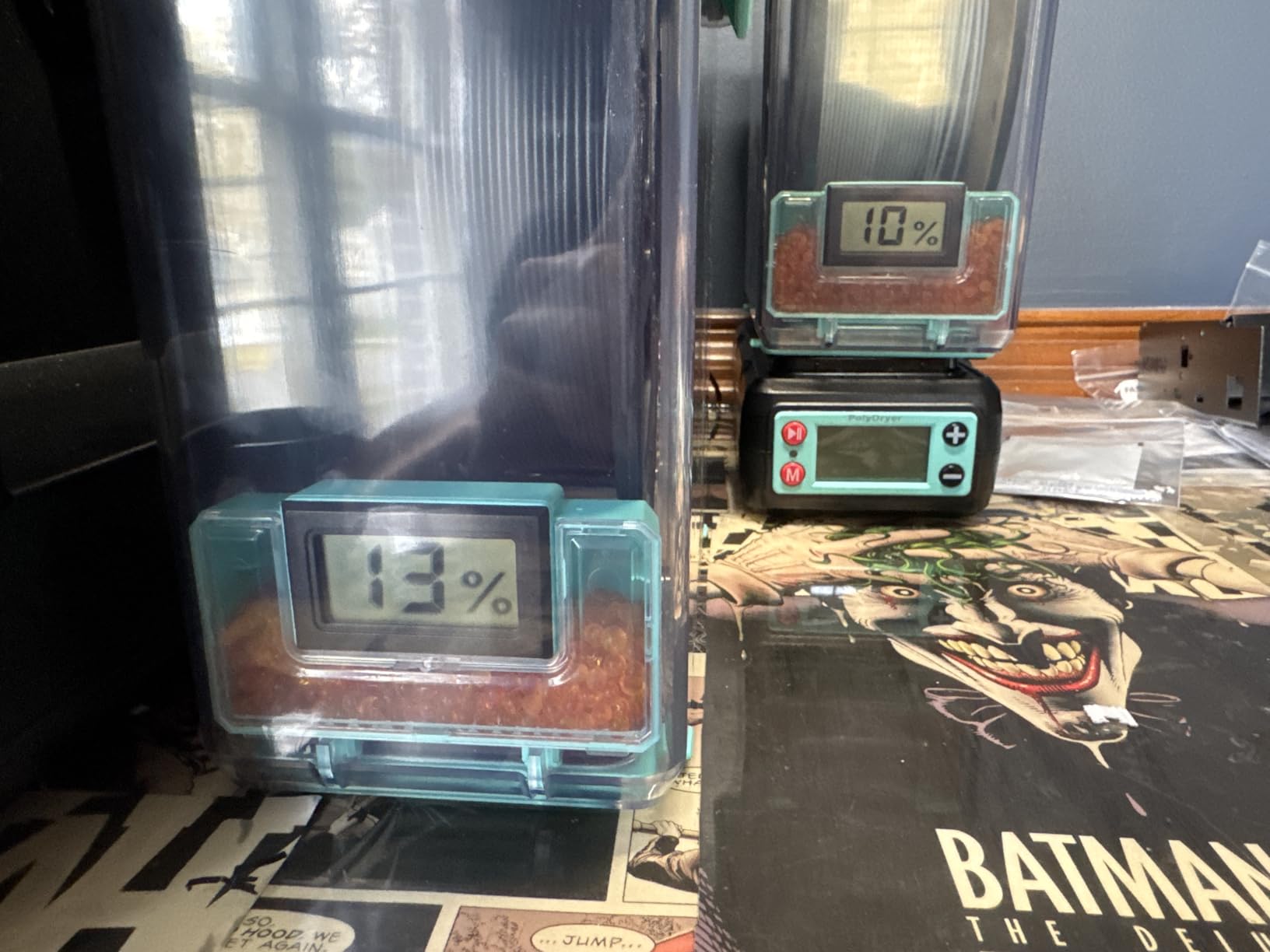
Is the two-piece design worth the extra desk space?
It is, if your habit is to open one spool at a time and leave the rest on a shelf. A separate sealed box does the storage job properly, and the hygrometer tells you when the drying stage has done enough.
That matters most in humid homes, where an open spool on a desk absorbs moisture quickly and quietly spoils a good spool of material.
Where it falls short
The heating stage handles one spool at a time, so batch drying four spools means four cycles. The dock and box together also take more desk space than an integrated two-bay design.
If you regularly dry several spools at once, the SH02 or the SUNLU S4 handles throughput far better.
Filament Drying Guide: Do You Actually Need One?
Before buying anything, work through these questions honestly. Most people who are unhappy with their prints are chasing slicer settings when the real problem is moisture in the spool.
Do you actually need a powered dryer?
A passive filament dry box with a fresh silica gel packet handles basic PLA in a dry climate, and it costs a fraction of a heated unit. If you print PLA only, live somewhere with low humidity, and open spools promptly, that is enough.
Once PETG, TPU, ASA, nylon or carbon-filled material enters your rotation, a powered chamber stops being optional. Those filaments absorb water faster and suffer more visibly when wet, and users on r/3Dprinting report the largest quality gains on exactly those materials.
Which specs actually change your results
Maximum temperature is the first filter. Below 55 C covers PLA and PETG. A 70 C ceiling opens ASA, PC and PA. Above 80 C is for the toughest nylon and PAHT work, and only one unit in this roundup reaches that.
Spool capacity matters next. One bay suits a single printer that runs one material. Two bays let you dry a spare alongside the running spool, and four bays only pay off with multiple machines or frequent material switching.
A humidity sensor is worth paying for because it turns drying from a guess into a measurement. During testing we learned to treat any reading near the bottom of the scale as an indicator rather than a precise number, so a cheap thermometer in the chamber is still worth having.
Finally, look for a PTFE feed-through port if you want to dry and print at the same time. This is a PTFE tube that passes filament from the chamber out to your printer, and users regularly report that drying during printing made a visible difference.
Drying settings by material
Match the temperature to the polymer, and go gently on PLA. These are the working ranges most owners use successfully, and the right figure is the lowest one that fixes your problem.
PLA sits at 40 to 45 C for around 4 to 6 hours. Push it much higher and spools soften, flatten or warp, and because PLA absorbs moisture slowly you rarely need a long cycle anyway.
PETG wants 50 to 60 C for 4 to 6 hours. This is the material where drying most reliably changes print quality, because PETG is one of the most hygroscopic common filaments.
TPU benefits from 45 to 50 C for 4 to 6 hours, and owners of the SH02 and the Creality SE specifically report recovered TPU spools. ABS and ASA sit at 65 to 75 C for 4 to 6 hours, which is where a 70 C box earns its keep. Nylon, PA and PAHT need 70 to 80 C for 8 to 12 hours, and PC typically wants 70 to 85 C over 6 to 10 hours.
Longer is not always better. Drying an already-dry spool for 12 hours in a hot chamber can make certain materials more brittle, so start at the low end of the range and extend only if the symptoms persist.
Can you dry filament without a dedicated dryer?
A food dehydrator is the safest DIY route, because it runs low, has a built-in timer and does not share a space with food. Set it to the temperature for your material and leave the spool on the rack, and you get most of the way to a dedicated box for very little money.
A kitchen oven is the one method we do not recommend. Heat is uneven, plastic spools can warp and shed particles into food, and some filaments release fumes at the temperatures involved. It is a common shortcut that regularly ends badly.
An enclosed printer chamber can hold humidity down for the duration of a print, and integrated dryers such as the AMS or CFS work well within their own ecosystems. The catch is brand lock-in and the fact that single-spool capacity is usually all you get.
How to store filament after opening it
Dry filament goes back into a dry environment, so sealing is the whole task. Put the spool in a vacuum bag with a desiccant pack, or return it to a sealed dry box, and the contents stay close to the state you just paid to create.
Vacuum-sealed bags with a small silica gel packet are the cheapest method and work remarkably well. The units in this roundup with proper sealing rings let you keep dried stock in the dryer itself between sessions, which is why those seal details were worth reading closely.
If a spool is already beyond saving, drying will not return it to factory condition. It will still print, but expect some quality loss, and treat anything that pops heavily even after a full cycle as material to retire.
Frequently Asked Questions
Is it worth buying a filament dryer?
It is worth buying if you print PETG, TPU, ASA, nylon or carbon-filled filament, live in a humid climate, or have spools sitting open. Drying is the cheapest fix for stringing, popping and brittle layers. For PLA-only printing in a dry home, a passive dry box with desiccant is often enough.
Do you really need a filament dryer for PLA?
Rarely, if your climate is dry. PLA absorbs moisture slowly, so a sealed dry box with a fresh desiccant pack handles it in most cases. A heated box becomes worthwhile once PETG, TPU, nylon or ASA joins your rotation, since those materials pick up water quickly and show the damage clearly.
Which brand of filament dryer is most reliable?
Across the units we reviewed, SUNLU, Creality and Sovol build the most consistent heated chambers, with Comgrow close behind on two-spool models. Reliability tracks the heater wattage and how well the chamber circulates air. Verify the displayed temperature with a real thermometer if accuracy matters, since several units read high.
What is the best way to dry 3D printer filament?
Use a heated, sealed box at the temperature your material needs: PLA 40-45 C for 4-6 hours, PETG 50-60 C, TPU 45-50 C, ABS and ASA 65-75 C, and nylon or PA 70-80 C for longer cycles. A food dehydrator is the safest DIY option. Avoid a kitchen oven because of uneven heat and fumes.
What is the best filament dryer on the market?
The Comgrow Filament Dryer Box is the best all-round choice, holding two 1kg spools with a live humidity display and direct filament feed at 4.4 stars from 4,683 reviews. The Creality Space Pi X4 is the best for nylon and PC, reaching 85 C across four spools, and the SUNLU S4 suits multi-printer setups.
What is the best budget filament dryer?
The SUNLU S1 Plus is the lowest-cost powered unit in our roundup, running at 35-55 C with a quiet fan, an LCD showing humidity and a direct feed port. The Sovol SH01 is the better first buy for most people because its controls are simpler and its seal holds up better for storage.
Can I dry filament in an oven or food dehydrator?
A food dehydrator works well, since it runs at a controlled low temperature and has a timer. A kitchen oven is not recommended: heat is uneven, plastic spools can warp, and some filaments release fumes. Keep any spools away from food residue and never use an oven where you cook.
Do filament dryers use a lot of electricity?
Most single and dual-spool boxes in this roundup use 80W to 150W, and the larger four-spool cabinets run 350W or more. Higher-wattage units reach temperature faster and shorten the cycle, so their total draw is often similar to a low-wattage box running twice as long. Multi-chamber models can cut use by running one chamber alone.
Conclusion: Our Picks for 2026
For most people printing PLA and PETG on a single machine, the Comgrow Filament Dryer Box is the pick from these best filament dryers for 3D printing. Two spools, a live humidity readout and a 4.4 rating across 4,683 reviews make it the safest all-round choice, and nothing else needed more than a 50 C ceiling unless you run tougher material.
If nylon, PAHT or PC are in your rotation, the Creality Space Pi X4 is the only unit here with the 85 C headroom and four independent spool positions that those materials demand. For a print farm or a two-printer desk, the SUNLU S4 handles four spools and eight feed ports in one box.
For everyone else, the Comgrow SH02 gives you a 70 C ceiling with material presets at a sensible outlay, and the Sovol SH01 stays the straightforward entry point. Whichever you choose, seal your spools back up afterwards, because drying is only half the job.