
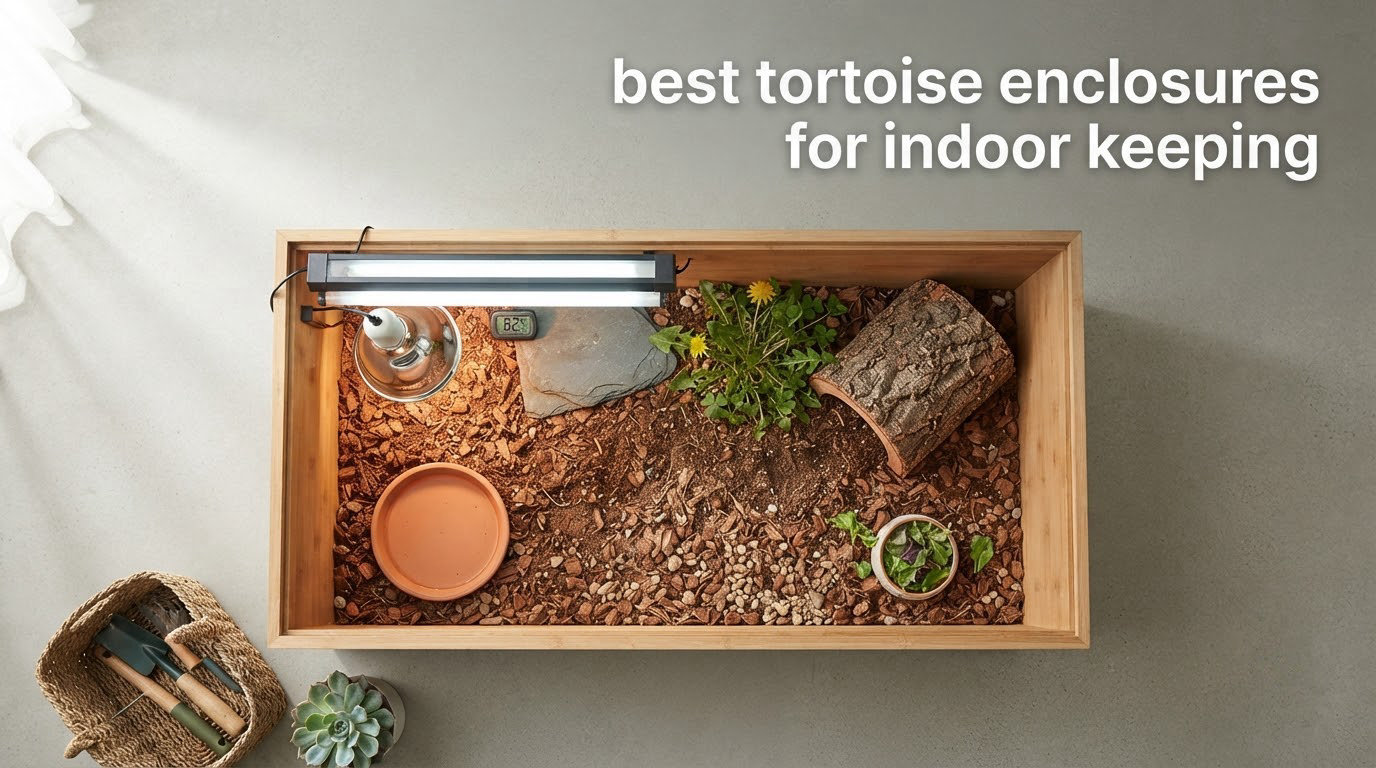
Most indoor tortoise enclosures sold online are far smaller than they look in photos. We went through twelve of the highest-rated wooden and composite habitats for indoor keeping, pulled their measured dimensions and real owner feedback, and flagged exactly which ones can carry a juvenile tortoise and which are really transitional setups.
The best indoor tortoise enclosures share three things: enough floor space measured after hides and dishes are placed, a solid basking end plus a separate shaded hide, and walls the animal cannot climb high enough to flip over. Every pick below is rated for small to medium species – Russian (Horsfield’s), Hermann’s, Greek, and Egyptian – including hatchlings and juveniles.
This is not a list for sulcatas, leopard tortoises, or adult red-foots. Those animals cannot be housed properly indoors, and the enclosures here will not change that. Read the sizing section before you buy anything, because buying for the animal you have now rather than the adult it becomes is the most common expensive mistake we see. We rechecked every measurement, rating, and owner complaint below in 2026.
Table of Contents
What Is the Best Indoor Tortoise Enclosure?
The best indoor tortoise enclosure is a low, wide, opaque-sided wooden habitat with at least eight shell lengths by four shell widths of usable floor space, a shaded hiding area, a lit basking zone with clearance for heat and UVB lamps, and a removable waterproof tray. That combination matters more than any brand name.
Most of the enclosures on this list fall short of that floor space for a fully grown adult, so treat them as a step up from a plastic tub rather than a final home. Measure your tortoise’s shell from the front of the plastron to the tip of the tail, then multiply.
Top 3 Indoor Tortoise Enclosures (October 2026)
These three earned the top spots on the strength of rating and review volume together, not on marketing copy.

Aivituvin Wooden Tortoise…
- Solid wood build
- Waterproof pull-out tray
- Adjustable lamp holder
- Acrylic panels

Zoo Med Tortoise House
- Fir wood
- Modular and expandable
- Lockable wire top
- 37 x 25 inch footprint

New Age Pet ECOFLEX 24
- Molded composite base
- Locking sliding doors
- Vented panels
- 10-year warranty
The 12 Best Indoor Tortoise Enclosures at a Glance
Scan this first. Footprint is the column that decides whether an enclosure works for you, and the tray and lamp details decide how much work it is to keep clean.
| Product | Specs | Action |
|---|---|---|
| Aivituvin Wooden Tortoise House |
|
Check Latest Price |
| New Age Pet ECOFLEX 24 Small Reptile Enclosure |
|
Check Latest Price |
| Zoo Med Tortoise House |
|
Check Latest Price |
 GEGURI Tortoise Habitat with Detachable Legs GEGURI Tortoise Habitat with Detachable Legs |
|
Check Latest Price |
 Aivituvin Habitat with Large Storage Shelf Aivituvin Habitat with Large Storage Shelf |
|
Check Latest Price |
 PetsCosset Tortoise Habitat with Detachable Legs PetsCosset Tortoise Habitat with Detachable Legs |
|
Check Latest Price |
 PawHut Tortoise Habitat with Shelf Storage PawHut Tortoise Habitat with Shelf Storage |
|
Check Latest Price |
 Magazoopet Large Tortoise Enclosure with Lamp Stand Magazoopet Large Tortoise Enclosure with Lamp Stand |
|
Check Latest Price |
 ZENTAVO 3-Room Tortoise Habitat ZENTAVO 3-Room Tortoise Habitat |
|
Check Latest Price |
 VEVOR Cedar Wooden Tortoise Habitat VEVOR Cedar Wooden Tortoise Habitat |
|
Check Latest Price |
 BIRASIL Two-Tier Wood Tortoise Enclosure BIRASIL Two-Tier Wood Tortoise Enclosure |
|
Check Latest Price |
 PawHut 2-Layer Tortoise Enclosure PawHut 2-Layer Tortoise Enclosure |
|
Check Latest Price |
1. Aivituvin Wooden Tortoise House – Best Overall Indoor Setup
Aivituvin Wooden Tortoise House Large Tortoise Habitat Cage, Indoor Tortoises Enclosure for Small Animals, Outdoor Reptile Cage – Upgraded Weatherproof Bottom
15.5 x 9.5 x 4.9 inch footprint
Solid wood with waterproof tray
23.9 lb
Pros
- Solid wood resists rot from moist substrate
- Waterproof tray keeps substrate contained
- Adjustable lamp holder for UVB distance
- Acrylic panels on two sides for observation
- Works indoors and outdoors
Cons
- Footprint suits juveniles and hatchlings rather than adults
- Wide-spaced wire top needs a separate lamp stand
This is the enclosure we keep coming back to. With more than 2200 ratings it has the deepest review base of anything we tested, and 74% of them sit at five stars. Owners single out the same three things every time: the solid wood, the waterproof base tray, and the adjustable lamp holder.
That last detail matters more than it sounds. Tortoise UVB bulbs need to sit at a specific distance from the shell to deliver useful output without overheating, and a free-adjust holder means you can dial that distance in as your animal grows instead of replacing the whole enclosure.
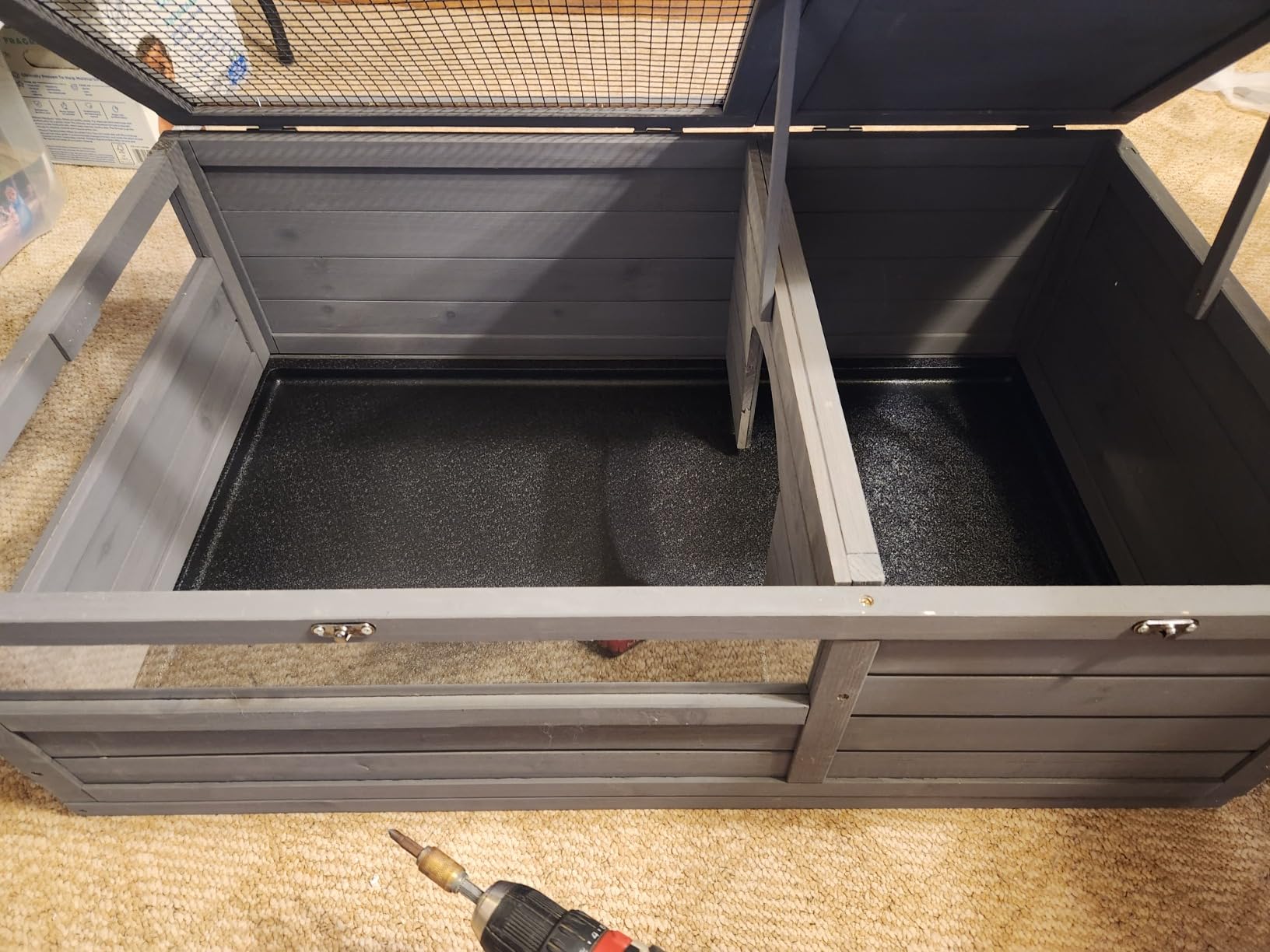
The construction details are the reason it lasts. Solid wood rather than plywood resists rot from damp soil and repeated soaking, and the upgraded waterproof tray means substrate and water stay contained instead of reaching the frame. Assembly uses pre-drilled holes, and owners report it going together without a fight.
Two acrylic viewing panels give you a good look without lifting the lid, which matters for monitoring a hatchling’s first weeks. The private weatherproof sleeping area sits apart from the public basking space, so the animal can choose between them.
Check the footprint before you order
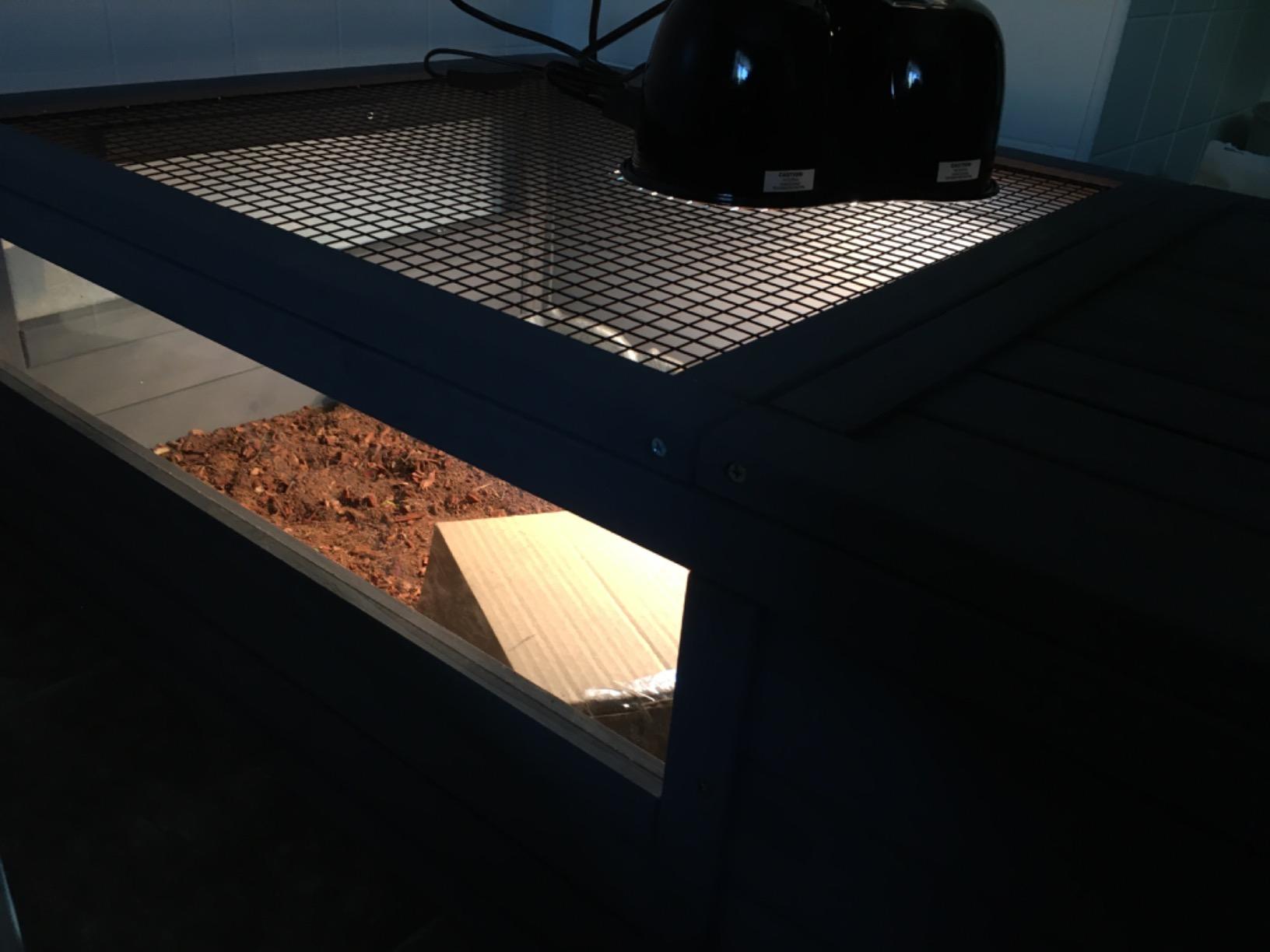
At 15.5 by 9.5 inches, this is a small footprint. A hatchling or juvenile Russian tortoise is comfortable here, and it works as a hospital or quarantine box for an adult. An adult tortoise will outgrow it, and you will be shopping again within a year.
The other thing to plan for is the top. The wire lid is wide-spaced, so it cannot carry a heat lamp on its own. Budget for a separate lamp stand or a secure clamp arrangement, and check the lamp reaches the shell without being able to be tipped by the animal.
Who should skip it
If you need humidity control for a closed-chamber hatchling setup, an open wooden frame will not hold it. The wire top vents constantly, which is exactly right for a dry adult habitat and exactly wrong for a tropical or baby setup.
Skip it too if you want a wide viewing window from above. The panels are on the sides, so watching from a seated position works better than looking down into the habitat.
2. New Age Pet ECOFLEX 24 Small Reptile Enclosure – Best Value
New Age Pet® ECOFLEX® 24″ Small Reptile Enclosure, Grey
22.6 x 10.4 x 10.3 inch interior
Molded composite base
Locking doors
10-year warranty
Pros
- Molded composite base wipes clean and resists odor
- Locking sliding doors for quick access
- Vented panels and mesh top move air well
- Assembles in about 20 to 30 minutes
- Backed by a 10-year warranty
Cons
- Moisture-resistant rather than waterproof
- Stand sold separately for floor setups
- Some durability complaints over time
This is the only enclosure on the list that arrives as a complete moulded unit rather than a flat-pack wood project. If assembly is the thing standing between you and getting a tortoise, that alone makes this the strongest value pick in the group.
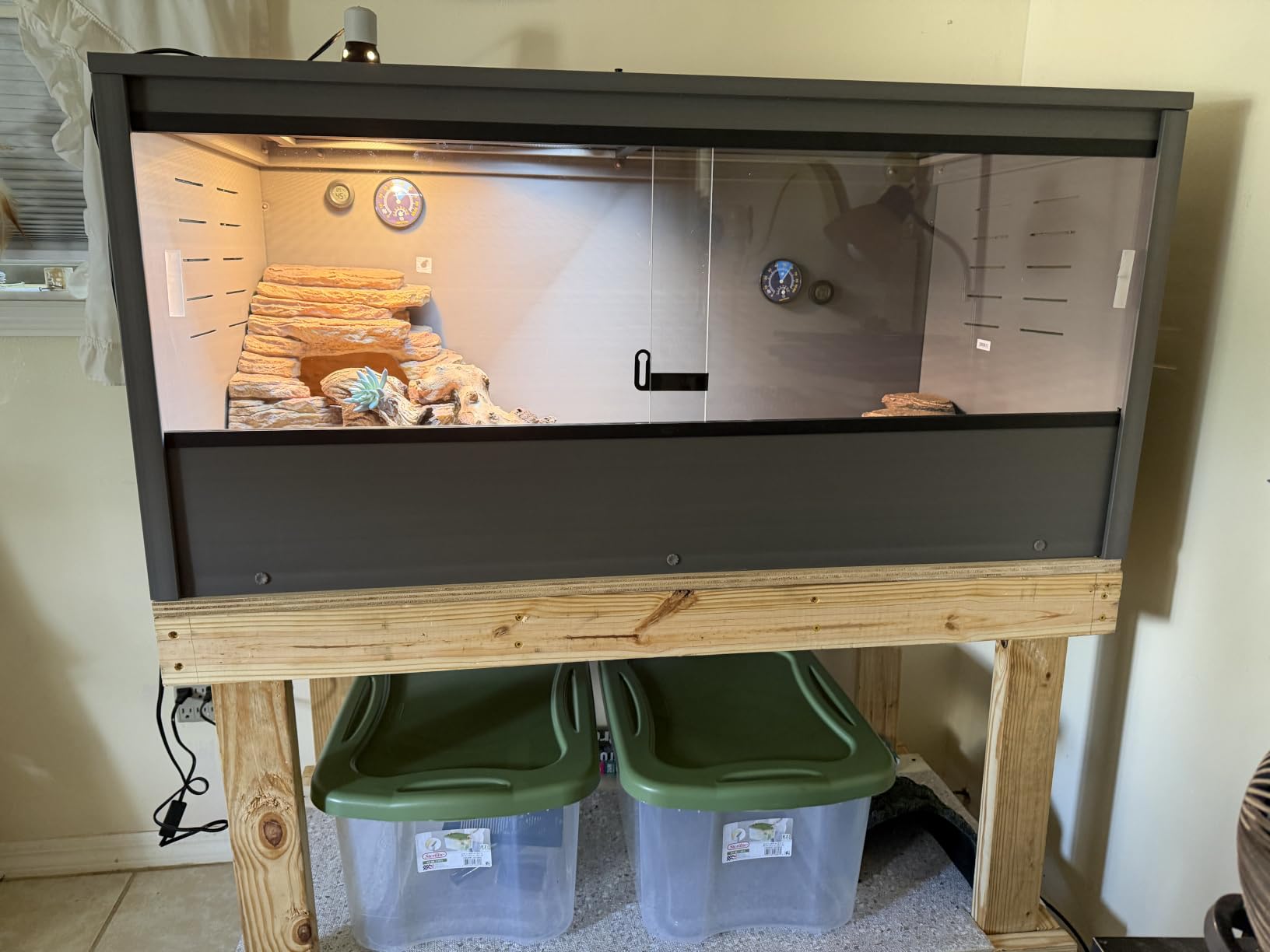
Interior space measures 22.6 by 10.4 inches with 10.28 inches of height, and the wide unobstructed front makes it easy to watch the animal without disturbing it. The locking sliding doors are a genuine upgrade over most wooden habitats at this level.
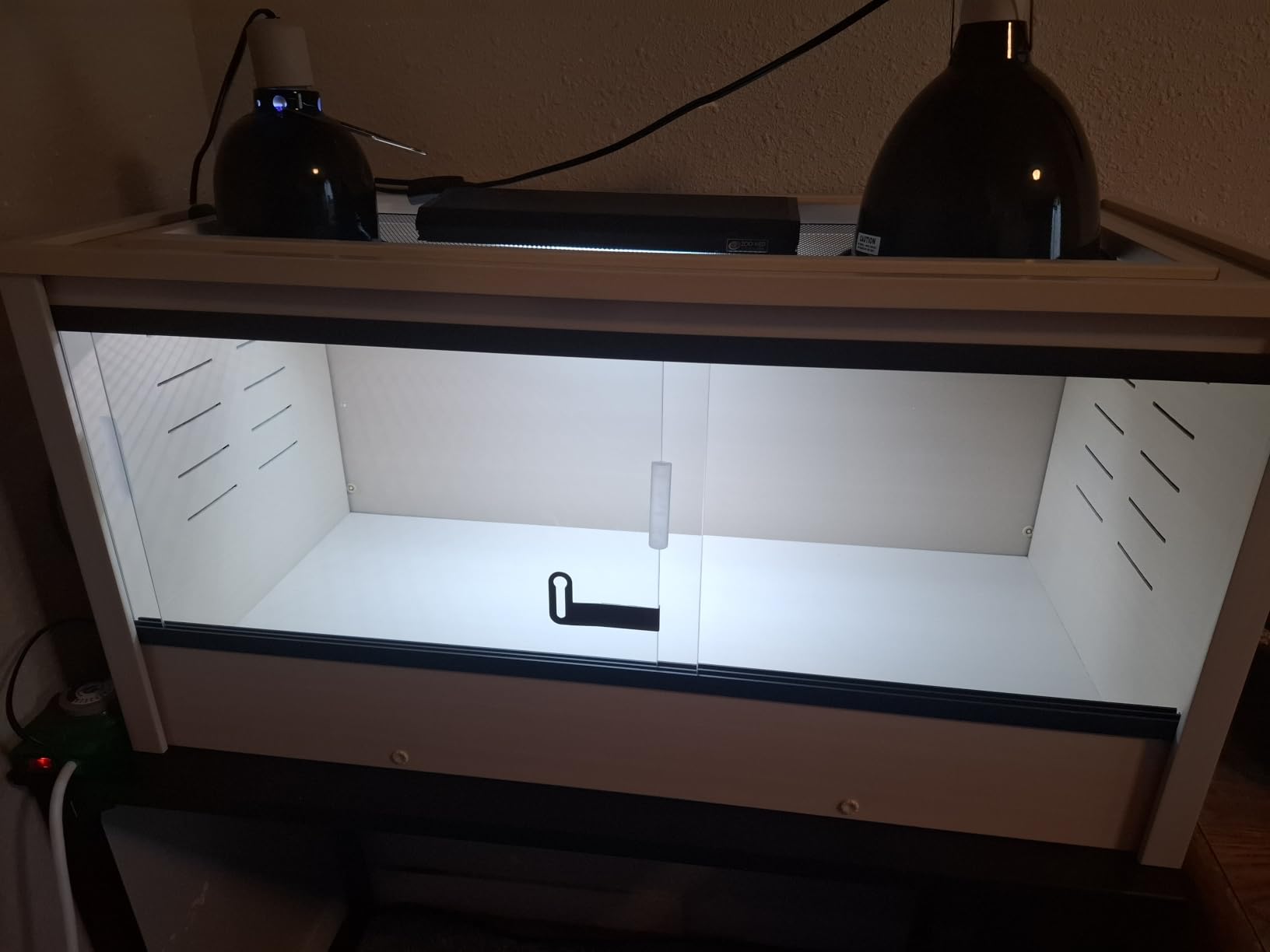
The ECOFLEX composite is the reason it is worth a look for indoor use. It wipes down fast, resists odor, and does not need sealing the way raw wood does. With 1831 ratings it is among the most-reviewed reptile enclosures available, and 66% of those ratings sit at five stars.
Ventilation is handled by vented side panels plus a large mesh screen top, which gives you freedom in where a lamp sits. Assembly runs roughly 20 to 30 minutes with basic tools, and it is light enough at 13.9 pounds to reposition for cleaning.
Plan around the humidity limit and the missing stand
ECOFLEX is moisture-resistant, not waterproof, and the manufacturer is clear that it suits low to moderate humidity only. That is fine for Russian, Hermann’s, and Greek tortoises. For a baby in a closed chamber or any tropical species, you would need to line it, which adds work.
The stand is a separate purchase, so an indoor floor setup usually needs an extra item. A 9% one-star share suggests some durability complaints accumulate over years, so think of it as a hatchling and juvenile home rather than furniture you buy once.
Who it suits best
This is the pick for someone in an apartment who wants a tidy, furniture-looking unit that assembles in half an hour and wipes clean between spot cleans. The low weight makes it easy to move into position for basking lamp changes.
It is a poor match if you need heavy digging depth, because the moulded base will not take a burrow. It also sits low to the ground, so an adult tortoise inside it is visible to cats and dogs in a busy household.
3. Zoo Med Tortoise House – Top Rated
Zoo Med Tortoise House
37 x 25 x 13 inch footprint
Fir wood modular build
24.4 lb
8.25 inch doorway
Pros
- Highest-rated enclosure here at 4.6 stars
- Modular so two houses join to double space
- Lockable wire top keeps cats out
- Screws apart for seasonal storage
- Design in continuous use since 2005
Cons
- Bare wood floor is not waterproof
- Pre-drilled holes are inconsistent
- Light-duty latches
At 37 by 25 inches, this is one of the largest footprints in the roundup, and it earns the highest average rating at 4.6 stars across 764 ratings with 76% five-star reviews. Owners describe repeat purchases stretching back more than a decade, which is the strongest durability signal we found anywhere in this data.
The modular end panel is the feature that separates it from everything else here. Remove one panel and two houses join end to end, so you can double your floor space later without buying a different system. That solves the single biggest complaint about wooden enclosures, which is that they stop being big enough.
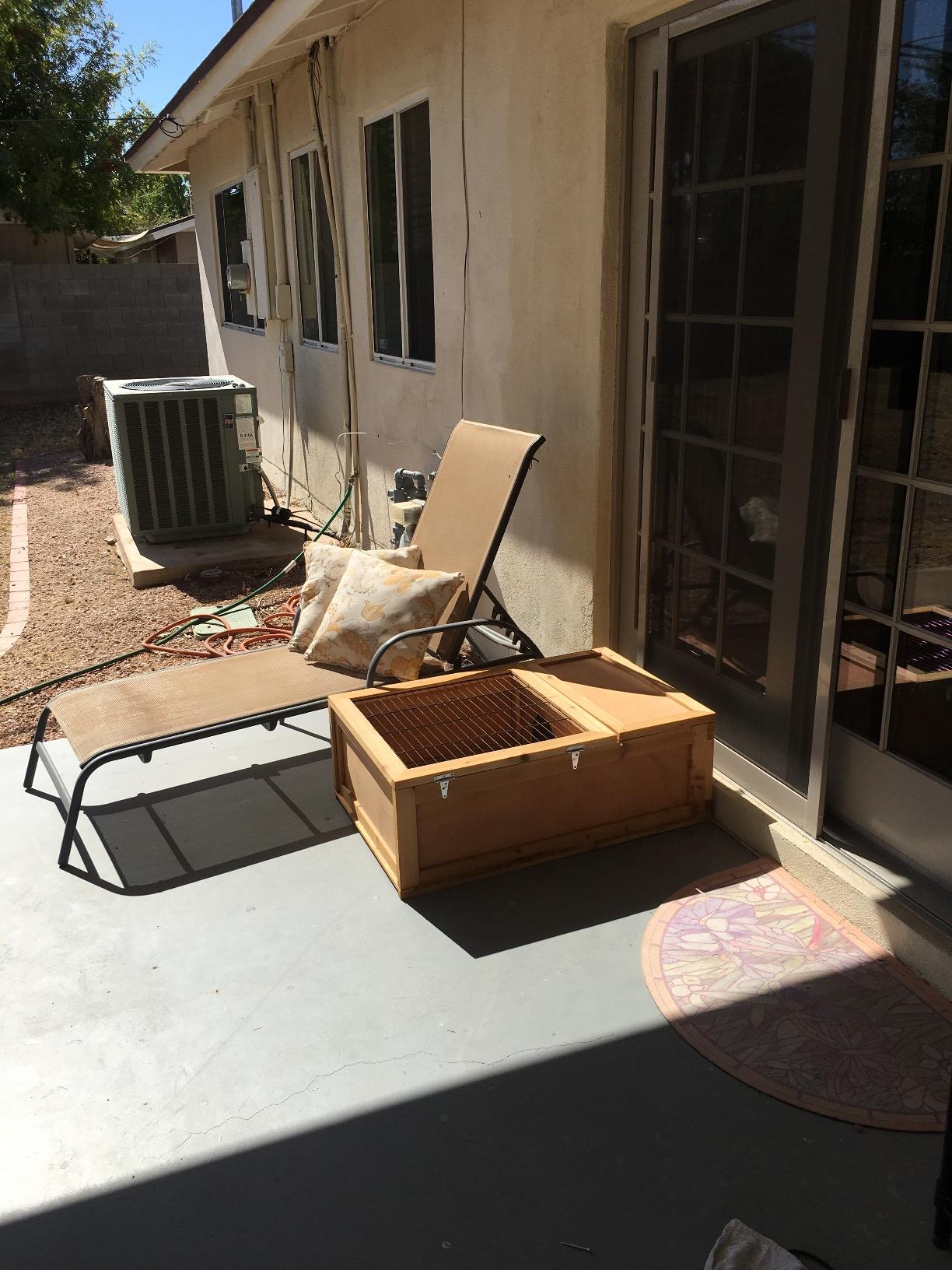
The private weatherproof sleeping area is properly weatherproofed rather than an open corner, and the doorway opening measures 8.25 by 8 inches, wide enough for a juvenile to enter without squeezing. The lockable wire safety cover keeps curious cats out, which several owners specifically tested.
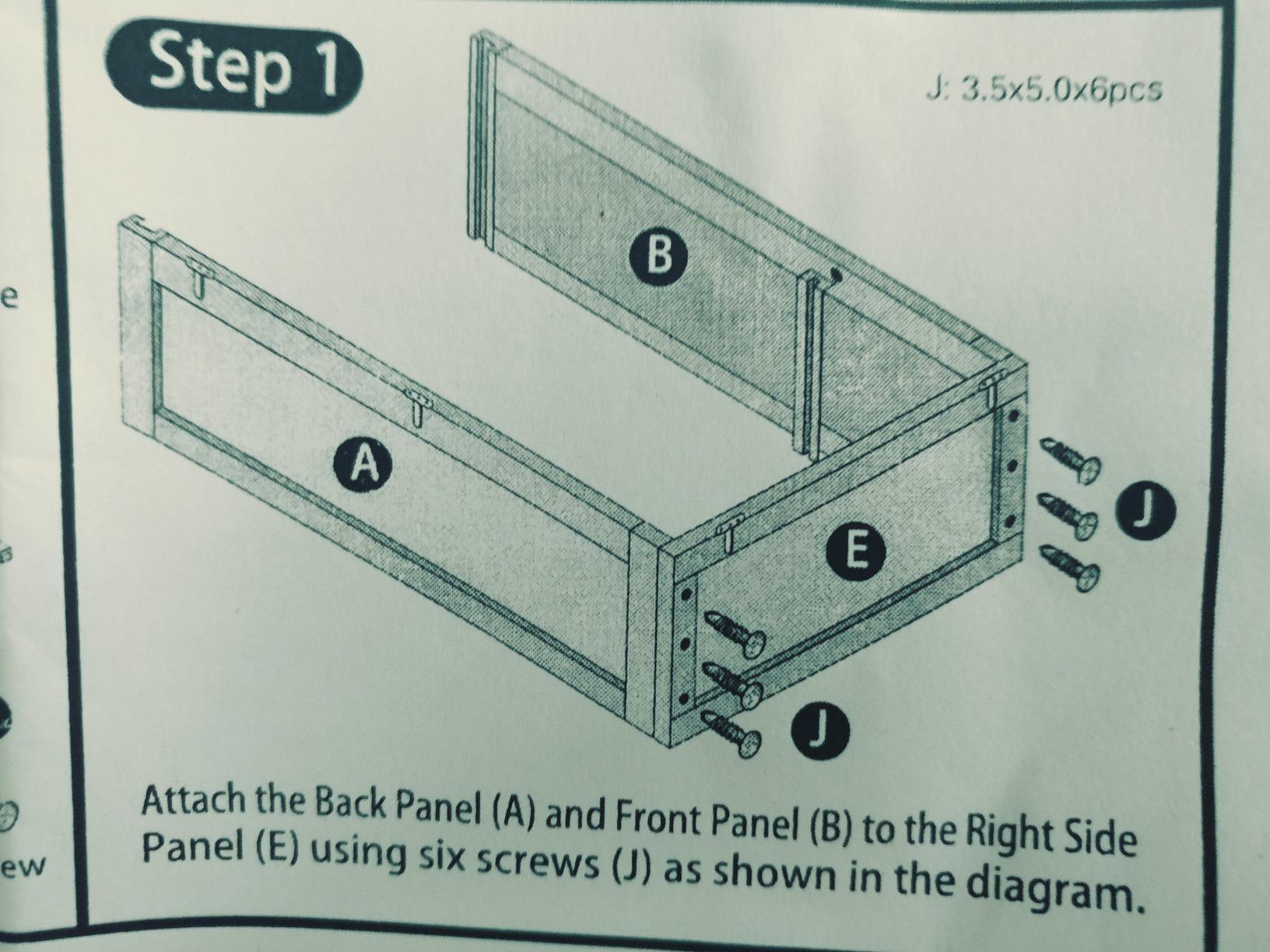
It also disassembles for seasonal storage, which matters if you pair indoor winter housing with outdoor summer keeping. Reported assembly time runs 20 to 45 minutes with a screwdriver, though uneven pilot holes can add time.
Line the floor before you set up substrate
The floor is solid wood with no waterproof layer, and several owners line it with plastic sheeting or tile to stop spills and urine causing warping. We would do this on day one rather than after the boards start to swell.
Expect to drill a few pilot holes yourself. Owners report inconsistent pre-drilling, and the latches are light-duty, so do not treat the wire top as a child-proof barrier.
Who it suits best
This is the one we recommend for a juvenile you expect to grow into an adult within a couple of years, precisely because you can add a second house later. It suits Russian, Hermann’s, Greek, and similar small species kept indoors year round.
It is not the right choice for a hatchling needing a closed chamber, since the wire top vents constantly. At 24.4 pounds it is also awkward in a small room, so measure your doorway before committing.
4. GEGURI Tortoise Habitat with Detachable Legs – Best for Floor Space
GEGURI Tortoise Habitat Indoor & Outdoor, Wooden Tortoise House with Detachable Legs, Reptile Cage for Small Animals
38 x 24 inch footprint
Fir wood with detachable legs
32 inch tall overall
17.9 lb
Pros
- Wide 38 x 24 inch footprint for a wooden habitat
- Detachable legs raise it to working height
- Removable pull-out tray speeds up cleaning
- Three-sided window for monitoring
- Fir wood described as warp-resistant
Cons
- Tall 32 inch profile needs room to place
- Open wood holds less humidity than glass
Floor space is the deciding factor for indoor keeping, and this enclosure delivers a 38 by 24 inch footprint in a wooden frame. That is closer to a usable adult table than several of the boxes on this list, and it costs less floor space than it appears because the legs lift the whole thing clear.
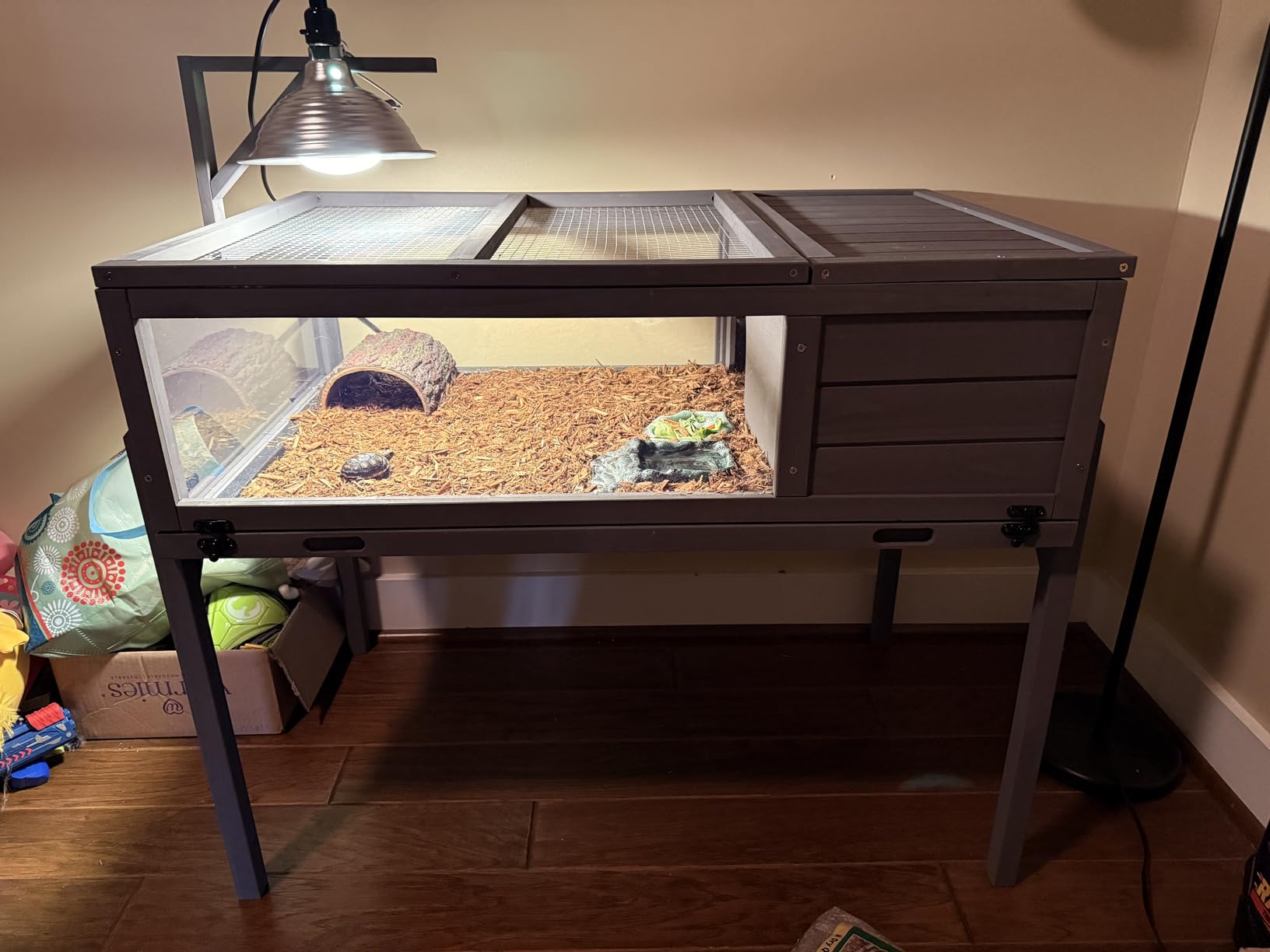
With detachable legs you get two setups from one purchase. Leave them off for table or countertop placement, or attach them so the habitat sits at a height where you are not kneeling to reach the tray every day. The three-sided window means you can watch from most of the room.
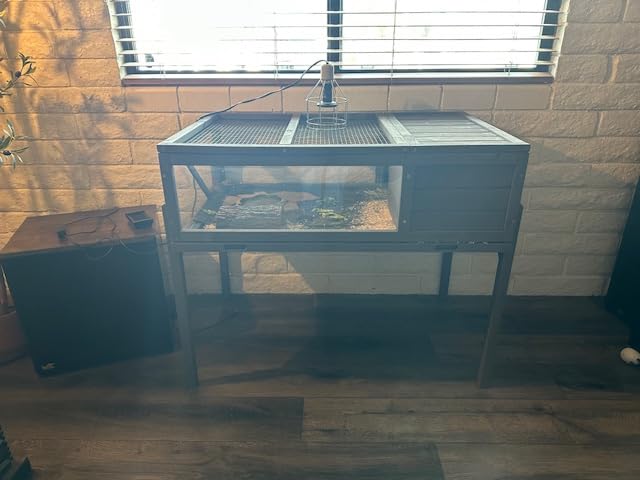
The upgraded removable plastic tray has an all-surrounding bottom, so water and substrate stay inside during a soak. Reviewers with 507 ratings and 65% five-star mentions single out the tray and the legs as the two features that made daily husbandry easier.
Owners also describe the fir as lightweight and resistant to warping, and at 17.9 pounds the assembled unit is manageable for one person to reposition. It is rated for tortoises, lizards, geckos, and snakes, so it works as a general reptile box.
Check your vertical clearance
Overall dimensions including legs reach 32 inches high. That is fine in a spare room but tight in a low-ceiling apartment, and it matters more because a lamp stand needs clearance above the basking end. Measure the space above the habitat as well as the footprint.
The open wooden construction also means humidity retention is limited compared with a sealed glass terrarium. That is correct for a dry adult setup and wrong for a hatchling in a closed chamber.
Who it suits best
This is the pick for someone who wants a generous walkable floor area per unit and has a room where a 38 by 24 inch footprint is realistic. The pull-out tray also makes it a good choice if your tortoise is soaked regularly.
Skip it if you need a sealed environment or if humidity control matters. A fixed-position floor plan with no casters means moving it to chase sunlight across a room is a two-person job.
5. Aivituvin Tortoise Habitat with Large Storage Shelf – Best for Organization
Aivituvin Tortoise Habitat Turtle Enclosure, Wooden Tortoise House Reptile Cage for Small Animals, Reptile Tank with Large Storage Shelf
39.4 x 22.5 inch footprint
29.5 lb
Adjustable 11 to 31 inch light stand
Pros
- Largest Aivituvin footprint in the range at 39.4 inches
- Light stand adjusts from 11 to 31 inches tall
- Roof opens for straight-in access
- Two separate rooms plus weatherproof hide
- Storage shelf keeps supplies off the floor
Cons
- Heavy build at 29.5 pounds
- Tall profile limits smaller rooms
- Newer listing with a smaller review pool
The reason this model exists is the lamp stand and the shelf. The stand adjusts from roughly 11 to 31 inches tall with a width range of about 13 to 21 inches, and the holder rotates 360 degrees, so you can dial in UVB distance without rebuilding the enclosure.
The under-cage storage shelf is the practical win in a small room. Substrate, water dishes, thermometers, and UVB tubes all live underneath instead of on your floor or counter, which keeps the whole footprint tidy.
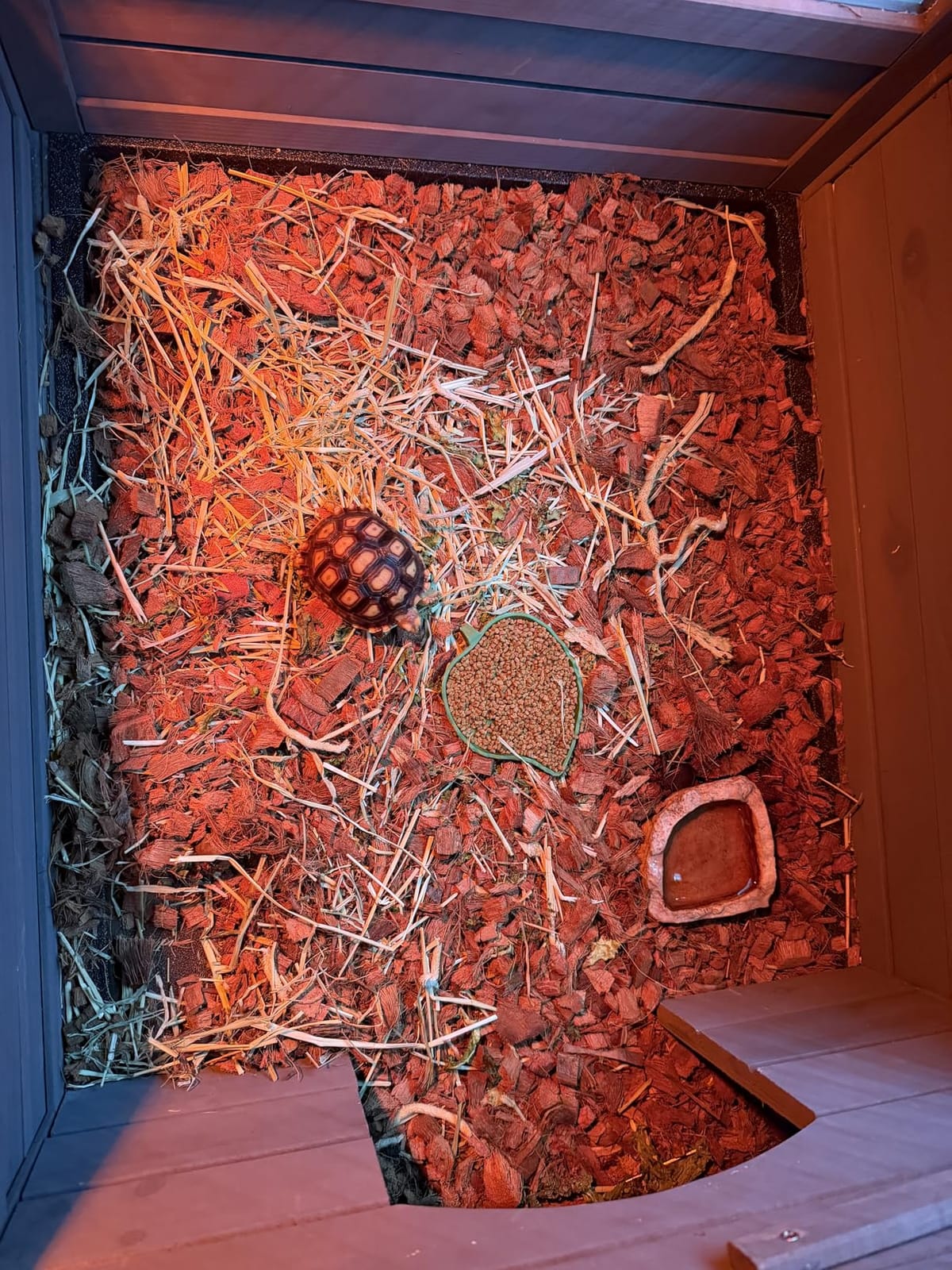
The two-bedroom layout gives a genuine hide plus a separate activity zone rather than a corner pretending to be one. An acrylic panel in the activity area and an openable roof mean you can check on the animal without lifting anything, and the moisture-proof finish suits both indoor and outdoor placement.
At 39.4 by 22.5 inches this is one of the wider footprints here, ranking 26th in Reptile Terrariums with 322 ratings and 67% five-star mentions. Detachable legs mean you can skip the stand entirely on a table.
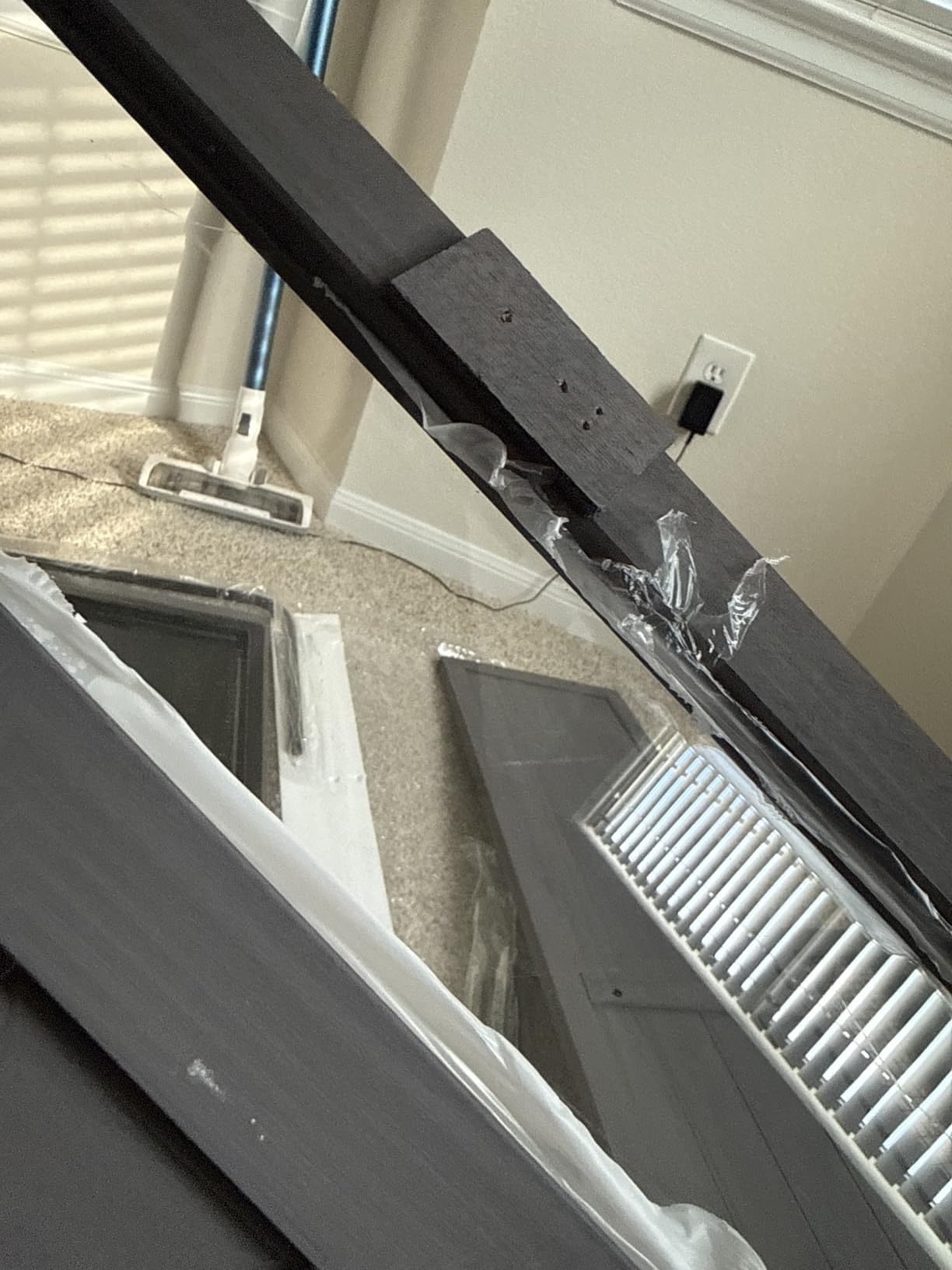
Budget for the weight
At 29.5 pounds this is the heaviest of the Aivituvin models and awkward to move once assembled. If your basking lamp needs regular repositioning across a room, buy casters or plan the layout so the habitat does not move at all.
The tall profile with legs also limits where it can go. Make sure you have lamp clearance above the basking end before the box arrives, because discovering a ceiling problem afterwards is expensive.
Who it suits best
Choose this one if storage and lamp control are your two biggest frustrations. Apartment keepers who are already short on surface area get a real shelf and a genuine basking zone from a single footprint.
It is not the choice for a hatchling in a closed chamber, since the openable roof and mesh vent continuously. It is also a newer listing, so the review pool is smaller than the brand’s flagship model.
6. PetsCosset Tortoise Habitat with Detachable Legs – Best for First-Time Keepers
PetsCosset Tortoise Habitat with Detachable Legs, Wooden Indoor & Outdoor Turtle Enclosure, Two-Room Reptile House, Large Observation Windows, Removable Pull-Out Tray, for Tortoises
37.2 x 22.8 inch footprint
Two-room layout
Detachable legs and pull-out tray
Pros
- Full 37 inch two-room footprint at the entry price of this group
- Detachable legs switch between floor and table
- Numbered wood pieces and clear instructions
- Three acrylic windows plus removable trays
- Lightweight wood that does not split easily
Cons
- Panel gaps let humidity drop and substrate fall through
- Trays can slip off their ledges
- Thin top mesh cannot carry a heat lamp
This is the budget entry, and for a first indoor setup it gives you a generous floor area for the money. A 37.2 by 22.8 inch two-room layout with detachable legs and a pull-out tray is a genuine upgrade from a plastic storage tub.
Assembly is straightforward. Panels are numbered, instructions are clear, and one owner built it solo in about 30 minutes using lightweight wood that does not split during assembly. Three acrylic windows give you good sightlines for checking basking temperature and feeding behaviour.
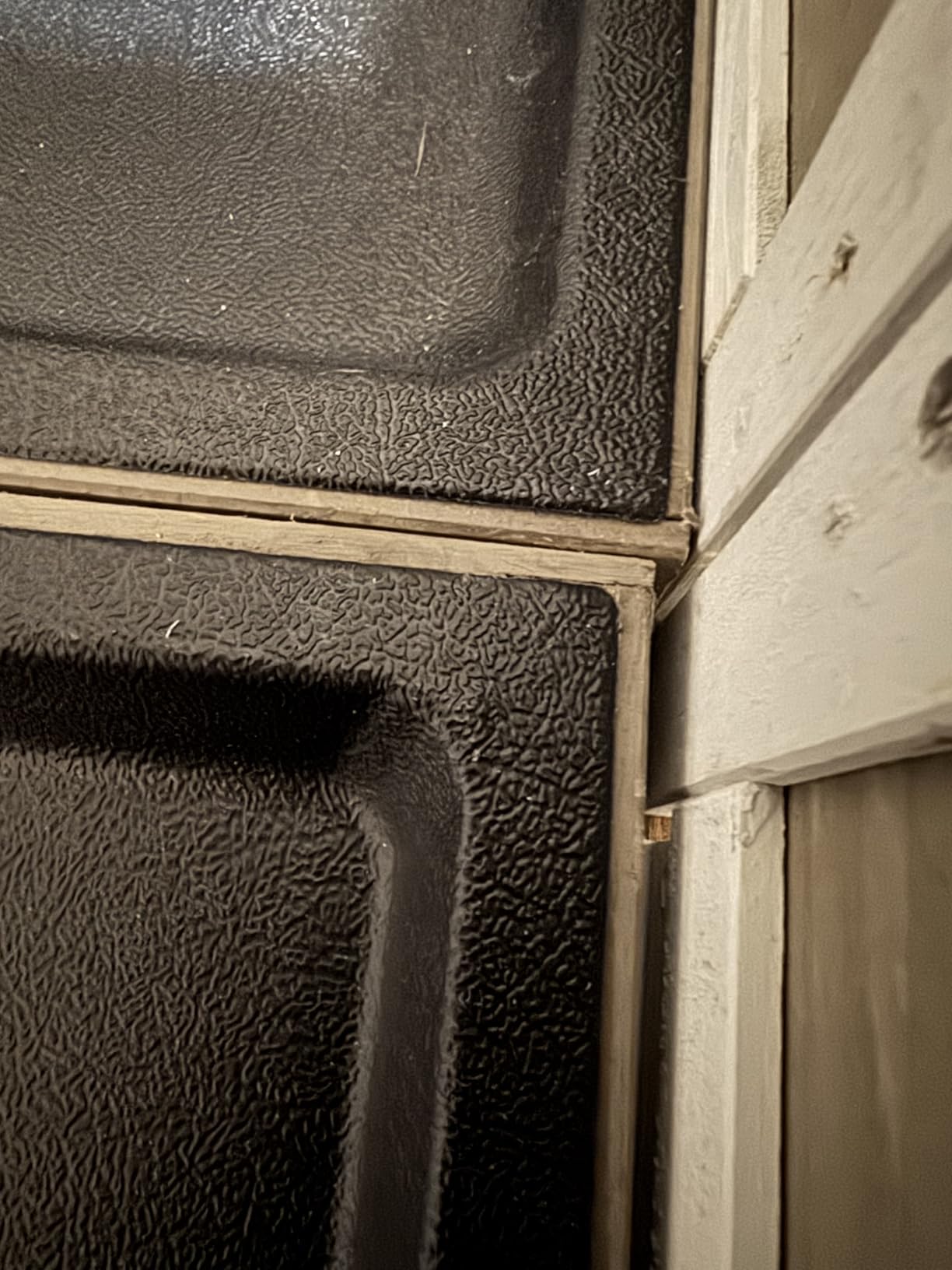
The two-room layout divides a dedicated resting area from a play area, which is the correct basic arrangement. Removable trays mean cleaning happens at a counter rather than in a bathroom, and the listing is stated as suitable for Russian, Hermann’s, Greek, Marginated, Red-Footed, and Sulcata tortoises alongside small reptiles.
Reviews split on exactly what you get for the money, with 182 ratings averaging 4.0 stars. Happy owners lined the seams themselves and were glad of the size; several others flagged the gaps between panels as a real problem indoors.
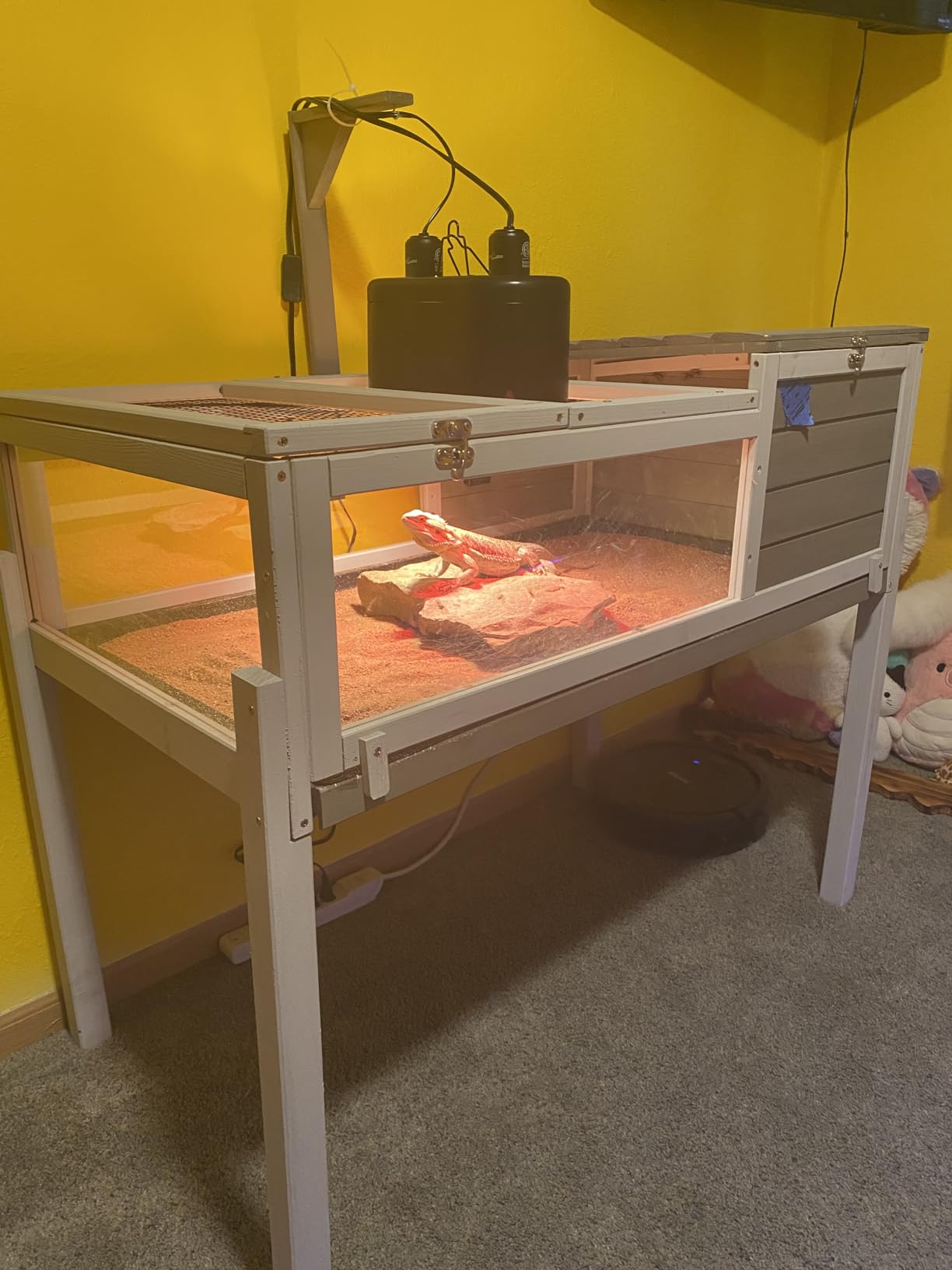
Seal the seams and mount your lamp elsewhere
Multiple reviewers report gaps at the corners and between panels. In an outdoor setting that is minor, but indoors it lets humidity drop in winter and lets substrate fall through the floor, so run a bead of aquarium-safe sealant along the joins before you add bedding.
The thin top mesh will not support a heat lamp directly, so use a separate stand or a secure clamp. The pull-out trays can also slip off their ledges during use, so check them when you spot clean.
Who it suits best
This is the right pick for a first indoor habitat on a tight budget, and for juveniles in a room where nothing is precious yet. It also comes in multiple sizes, so you can move up a size later within the same design.
Skip it if humidity control is important or if you want a lamp-free setup without a separate stand. An 11% one-star share is one of the highest in the group, so expect some finish inconsistency between pieces.
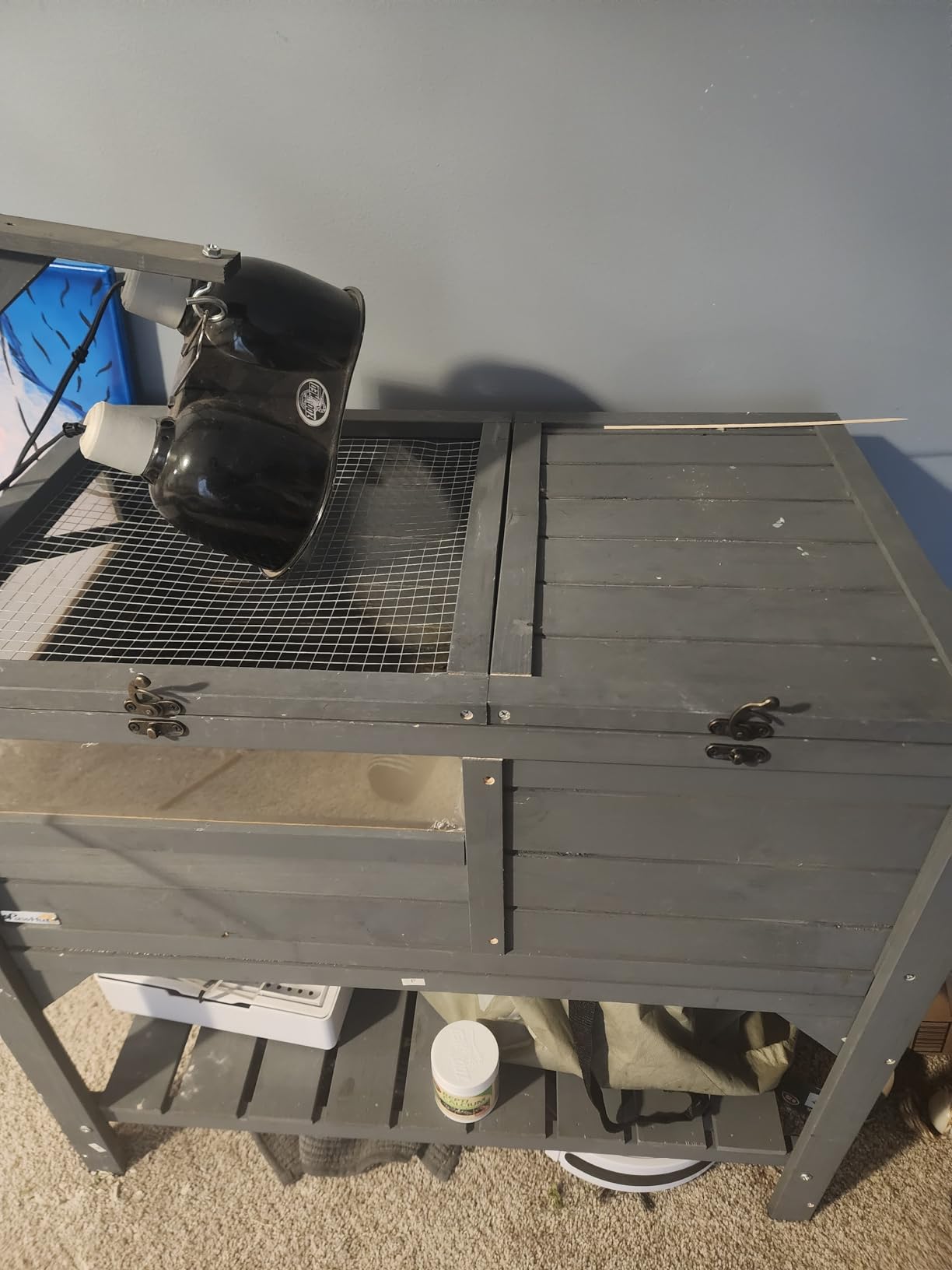
7. PawHut Tortoise Habitat with Shelf Storage – Best for a Dedicated Basking Zone
PawHut Tortoise Habitat with Shelf Storage, Tortoise Enclosure with Weather Protection, Reptile Gift Accessory, Reptile Enclosure with Tray, Light Support Frame, Light Gray
33 x 20 x 40.5 inch overall
Hide box 12.5 x 17.25 inch
Basking area 16.25 inch
Pros
- Integrated shelf storage beneath the cage
- Dedicated lamp support frame included
- Proper hide box plus steel-grate basking area
- Observation windows on both sides
- Openable lid for quick access
Cons
- Narrower 20 inch width reduces floor area
- Tall unit at 40.5 inches
- 10 percent one-star ratings
The standout here is that the hide box and the basking area are properly specified rather than improvised. The hide measures 12.5 by 17.25 by 12.5 inches and the basking area 16.25 by 17.25 by 12.5 inches, so you can put a heat and UVB lamp over a defined zone rather than hoping for a gradient.
A light support frame is built into the design, which removes the headache of buying a wooden habitat and then finding nothing to hang a lamp from. The steel grating over the basking section keeps a bulb above a reachable distance.
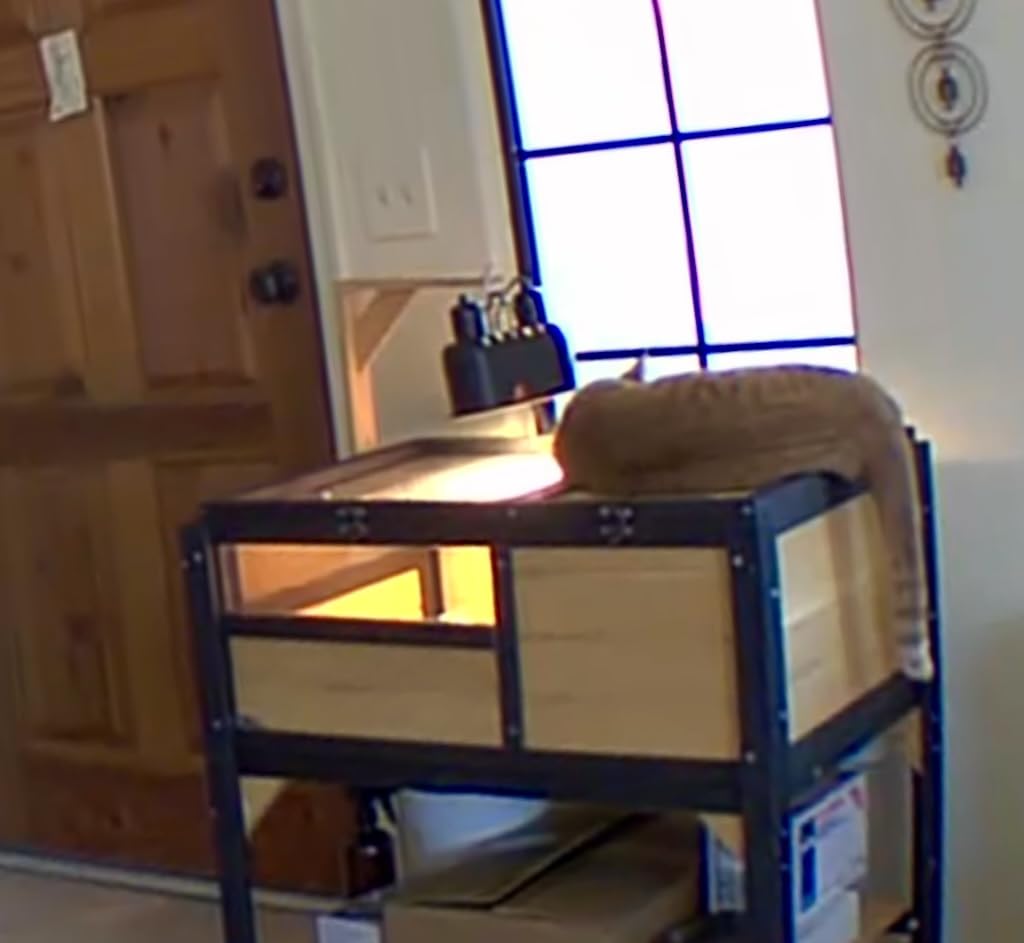
Owners in small apartments call out the integrated shelf as the reason to buy it. At 32 by 19 inches it holds food, substrate, and water dishes without any floor space of its own, and the 33 by 20 by 40.5 inch overall footprint stays tight for something this tall.
Observation windows on both sides plus a mesh wire screen over the living space give you airflow and a view. The openable lid allows quick access, and the build is rated as solid across 119 ratings averaging 4.1 stars.
Width is the compromise
At 20 inches across, this is narrower than most enclosures in the roundup, and width is what converts into usable walking area. For a hatchling or juvenile that is not a problem. For an adult you will be relying on the length dimension alone.
It is also one of the tallest units in this group at 40.5 inches, so check ceiling and lamp clearance. A 10% one-star share points to the usual fit-and-finish complaints rather than any structural failure.
Who it suits best
Pick this if your main frustration is that purchased habitats never include a proper lamp mount. The frame and the defined basking area solve that in a way most wooden boxes do not.
It is a poor fit for a tropical species needing a closed chamber, or for anyone in a small room where 40.5 inches of vertical space is not available. Available in light gray and yellow.
8. Magazoopet Large Tortoise Enclosure with Lamp Stand – Best for Lamp Adjustment
Large Tortoise Enclosure with Lamp Stand, Wooden & Plastic Turtle Habitat
40.3 x 22.8 inch footprint
Five-level lamp holder
30.5 to 38.4 inch height range
27.6 lb
Pros
- Best lamp holder range here with five levels and height adjustment
- Wide 40.3 inch footprint
- Slide-out tray makes cleaning fast
- Compact enough to use as a travel setup
- Acrylic window for viewing without opening
Cons
- Instructions are vague and diagram-dependent
- Some pieces arrive cracked or not flush
- Strong odor on arrival
- Painted-on assembly numbers cannot be removed
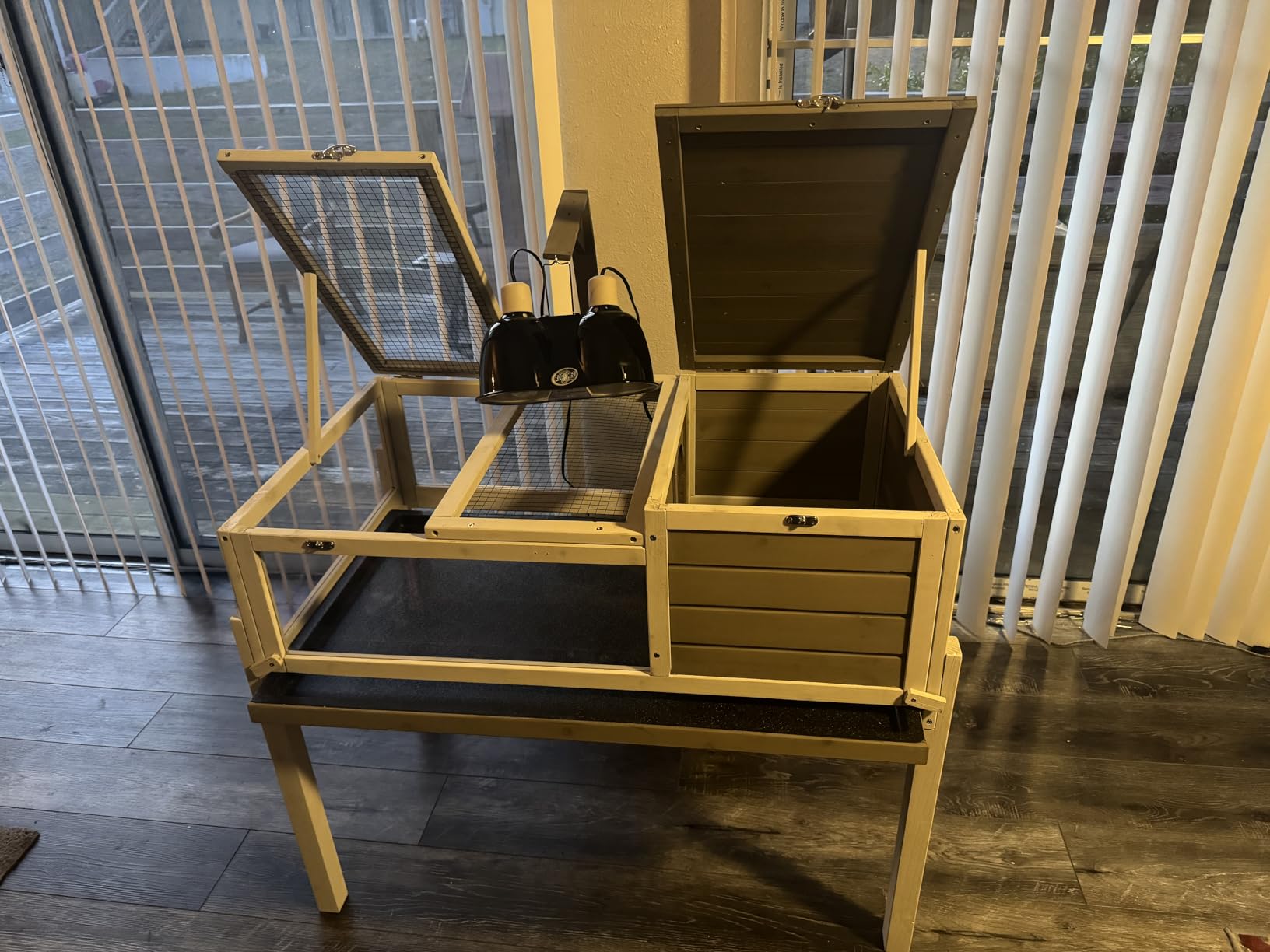
If UVB distance is the thing you keep fighting, this is the enclosure to look at. The lamp holder adjusts across five horizontal levels from 14.6 to 22.4 inches and a height range of 30.5 to 38.4 inches, which reviewers rate as the most adjustable lamp holder in the group.
At 40.3 by 22.8 inches it is one of the wider footprints we reviewed, and the dual-zone design gives a separate lounging area and an activity area. Natural fir wood and plastic with reinforced edges keep the frame from flexing under a lamp.
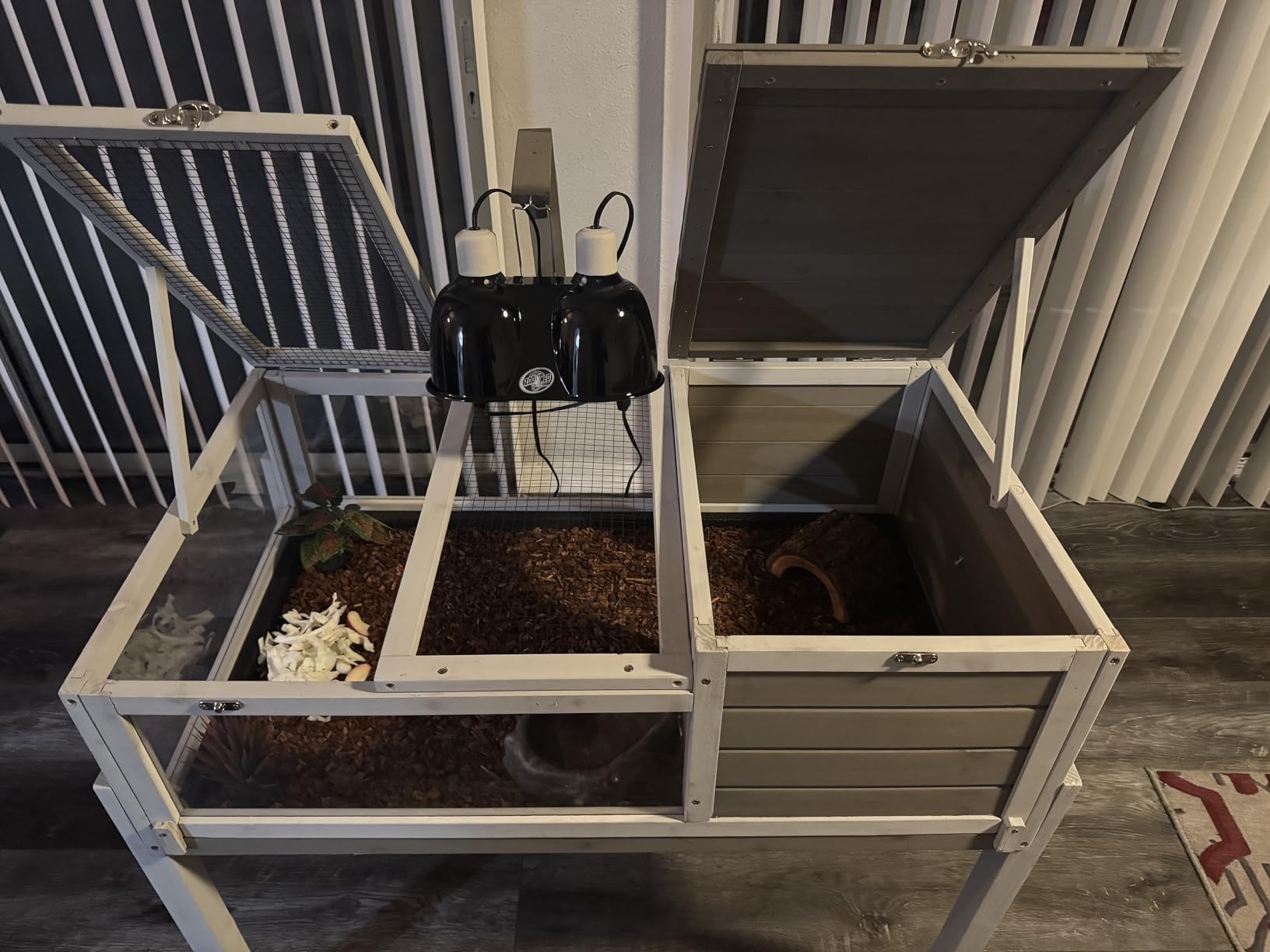
Reviews average 4.4 stars with 78% five-star mentions, which is an unusually strong distribution for a newer listing at 100 ratings. Buyers consistently praise the lamp stand range and the slide-out tray, and several use the unit as a travel or porch setup because it fits in a camper.
The acrylic window gives a clear view without opening the lid, which means you can check the animal without letting the enclosure lose heat. Lights are not included, so budget for a proper UVB fixture and heat lamp separately.
Allow time for finishing flaws
The criticisms are mostly cosmetic but real. Instructions are vague enough that assembly depends on reading the diagrams carefully, and some owners received wood pieces that were cracked or not flush and needed sealing before assembly.
Plan for an odor that takes a few days to dissipate after delivery, and know that the blue assembly numbers painted on the parts are permanent. One owner described the finished unit as not super sturdy, so treat it as a stationary habitat.
Who it suits best
This is for the keeper who has already had to reposition a lamp three times in a week. The adjustment range means you can dial UVB and heat distance properly and then leave it alone, which is what UVB-dependent species need.
Skip it if you need a sealed environment or want furniture-grade fit and finish. It is also listed as lights not included, so the true setup cost is more than the enclosure alone.
9. ZENTAVO 3-Room Tortoise Habitat – Best for Multi-Level Layouts
3-Room Large Tortoise Habitat with Pull-Out Tray, Wooden Tortoise Enclosure Indoor & Outdoor with Ramp, Grass Mat, Openable Roof, Luxurious Reptile Enclosure for Small Animals, Yellow
44 x 25.6 inch footprint
Three zones plus balcony
32 lb
Ramp and grass mat included
Pros
- Three distinct zones with an upper balcony
- Wide 44 x 25.6 inch floor area
- Water-resistant paint on tight-grain fir
- Pull-out tray for cleaning
- Metal mesh balcony gives airflow and light
Cons
- Heavy build at 32 pounds
- Open mesh balcony holds less humidity
- Tall three-level build takes longer to scrub
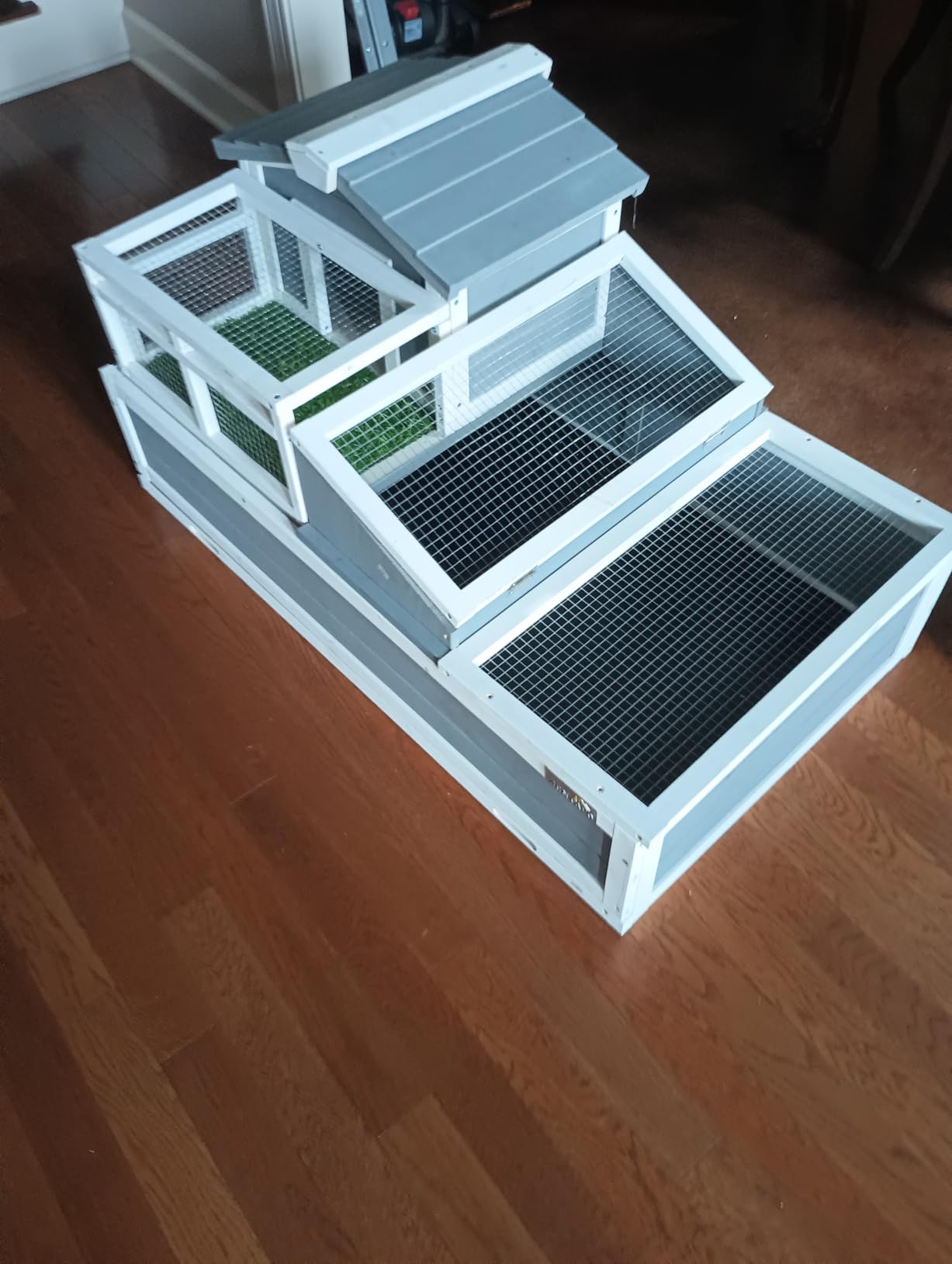
This one functions more like a small vivarium than a basic box. There are three distinct zones: an upper sleeping area, a balcony with metal mesh for airflow and light penetration, and a wide lower activity level reached by an included ramp.
The 44 by 25.6 inch lower footprint is among the largest floor areas we found in this roundup, and that matters most for tortoises since they use horizontal space. The included ramp and grass mat make it usable out of the box rather than requiring you to build an access route.
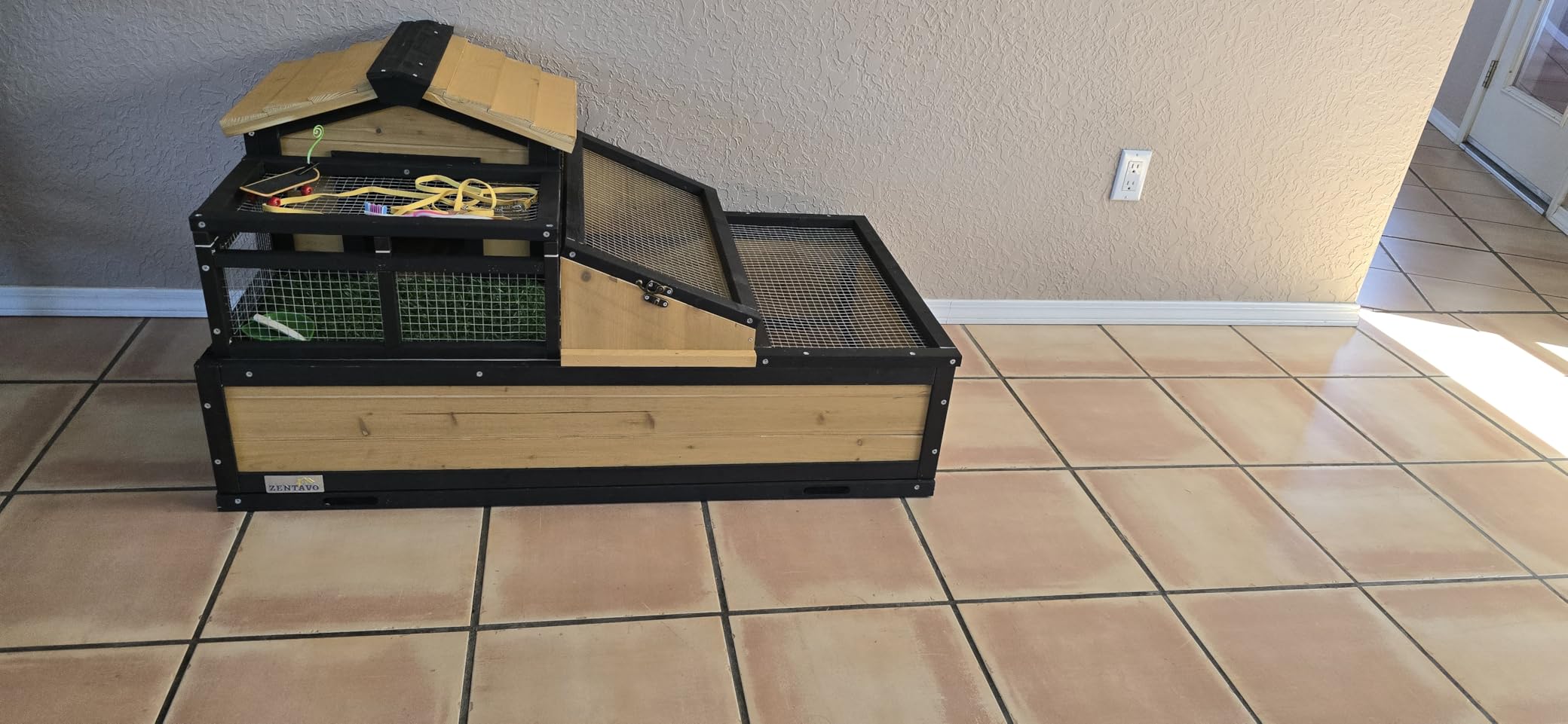
Construction uses premium fir with a water-resistant outdoor paint and a tight grain structure, which explains the durability reports across 94 ratings averaging 4.3 stars with 66% five-star mentions. Pre-drilled holes and detailed instructions make assembly quicker than many flat-pack wooden habitats.
The pull-out plastic tray keeps cleaning simple despite the more complex internal layout. That matters here, because a three-level design with corners and a balcony is otherwise a harder habitat to scrub than a simple two-room box.
Not a portable or sealed habitat
At 32 pounds this is one of the heaviest enclosures we tested. Once assembled, expect to leave it in one spot rather than repositioning it for cleaning or lighting changes.
The open mesh balcony limits humidity retention compared with a sealed terrarium, so this works well for dry adult setups and poorly for tropical species or closed-chamber hatchlings. Plan lamp placement carefully, since the balcony roof limits vertical clearance.
Who it suits best
Choose this when floor space is your binding constraint and you have a room where a 44 by 25.6 inch footprint fits. It suits adult Russian, Hermann’s, and Greek tortoises kept indoors where a single open area would feel exposed.
Skip it for a hatchling, a tropical species, or a small apartment. The height and the weight make it a commitment once it is built.
10. VEVOR Cedar Wooden Tortoise Habitat – Best for Patio Setups
VEVOR Tortoise Habitat, Cedar Wooden Tortoise House Indoor & Outdoor, Tortoise Enclosure with Light Stand, Reptile Enclosure Small Animal Cage with Stand Legs for Gecko, Lizard, Snake
33 x 19.7 x 32.5 inch overall
Cedar wood with leg frame
Light stand included
26.5 lb
Pros
- Leg frame with a heavy-duty storage shelf underneath
- Clear two-zone split between solid hide and meshed area
- Caster-legged variant available
- One person can build it in about 40 minutes
Cons
- Cedar is a poor wood choice for tortoises
- Thin material with reported splitting during assembly
- Unsupported bottom tray bows under substrate
This enclosure has one serious problem that we cannot design around: the material is cedar. Several owners independently flag cedar as an inappropriate wood for tortoises because of respiratory risk, and the strong aroma that some enjoy is the same aromatic oil at issue.
Set that aside and the build is sensible. The leg frame carries a heavy-duty storage shelf underneath for food and supplies, a light stand is included, and the two-zone split puts a solid wood top over the private sleeping space with metal mesh over the open activity area.
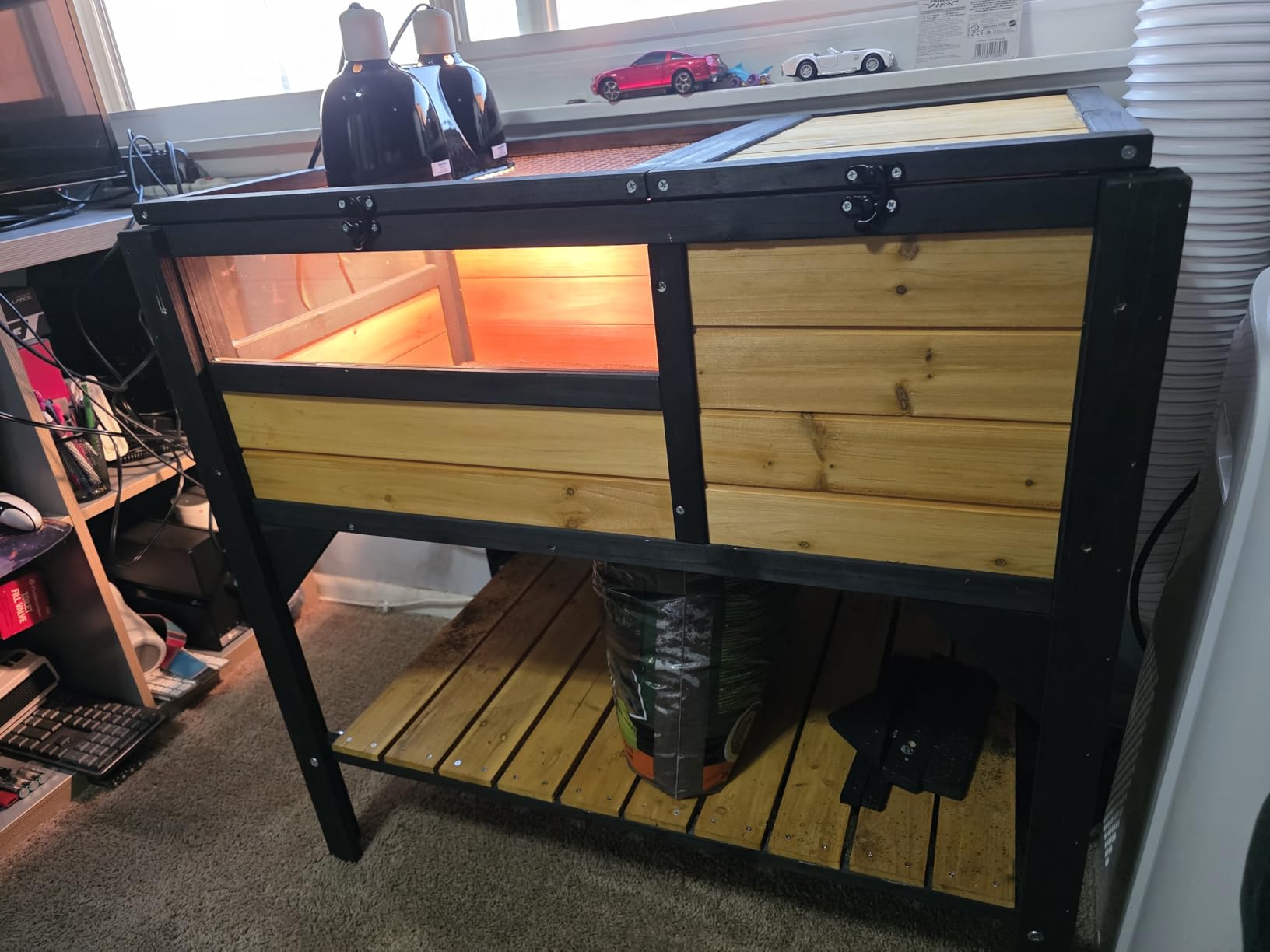
At 33 by 19.7 by 32.5 inches it is on the narrower side, and a caster-legged variant is offered if you want to move the whole unit. Owners report one person assembling it in roughly 40 minutes and liking the pleasant cedar aroma, which is exactly the point we would rather you did not.
Other complaints cover thin, inexpensive material including wood splitting during assembly, a bottom tray with no support that bows under substrate, and instructions printed in reverse order. Ratings average 4.2 stars across 59 reviews.
Resolve the cedar question first
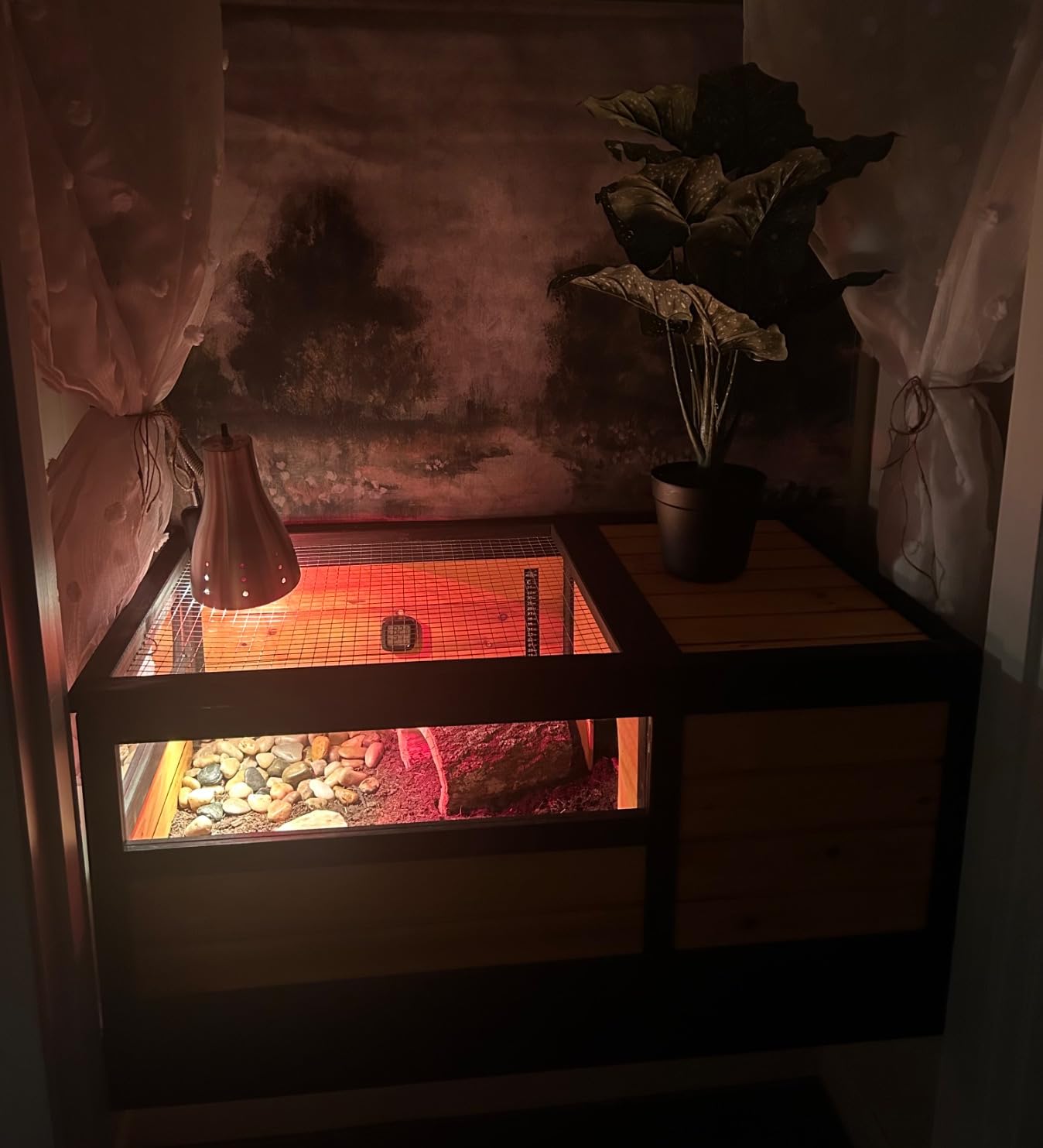
If you buy this for indoor use, line every interior surface the animal can touch with a non-toxic waterproof covering and seal the seams, and keep ventilation high. That mitigates contact with the wood, though it is extra work every time you deep clean.
Also reinforce or replace the bottom tray before adding substrate, since owners report it bowing under weight. For a patio or porch setup the exposure is short and the material matters less.
Who it suits best
It works for someone who wants a temporary seasonal setup where the enclosure lives outside during warm months and comes in for winter. The storage shelf underneath is genuinely useful in a small room.
Skip it as a permanent indoor home for a tortoise that will spend years breathing that air. There are better-reviewed fir and composite options in a similar price range.
11. BIRASIL Two-Tier Wood Tortoise Enclosure – Best With a Built-In Soaking Pool
BIRASIL Wood Tortoise Enclosure with Adjustable Light Stand,2-Tier Habitat Reptile Cage with Swimming Area Feeding Area, Tortoises House for Small Animals Lizards Hamster (Gray/White)
38 x 24.2 inch overall
Two tiers with built-in trough
32.6 lb
Fir wood with steel mesh
Pros
- Only enclosure here with a built-in soaking and feeding pool
- Two tiers add usable area without a bigger footprint
- Wide-spaced mesh does not block UVB
- Latch lock kept cats out in one test
- Removable light stand and detachable legs
Cons
- Sliding bottom leaves gaps that leak humidity
- Clear plastic panels scratch easily
- Wood can splinter and some pieces arrive cracked
- Lamp bar does not span full panel height
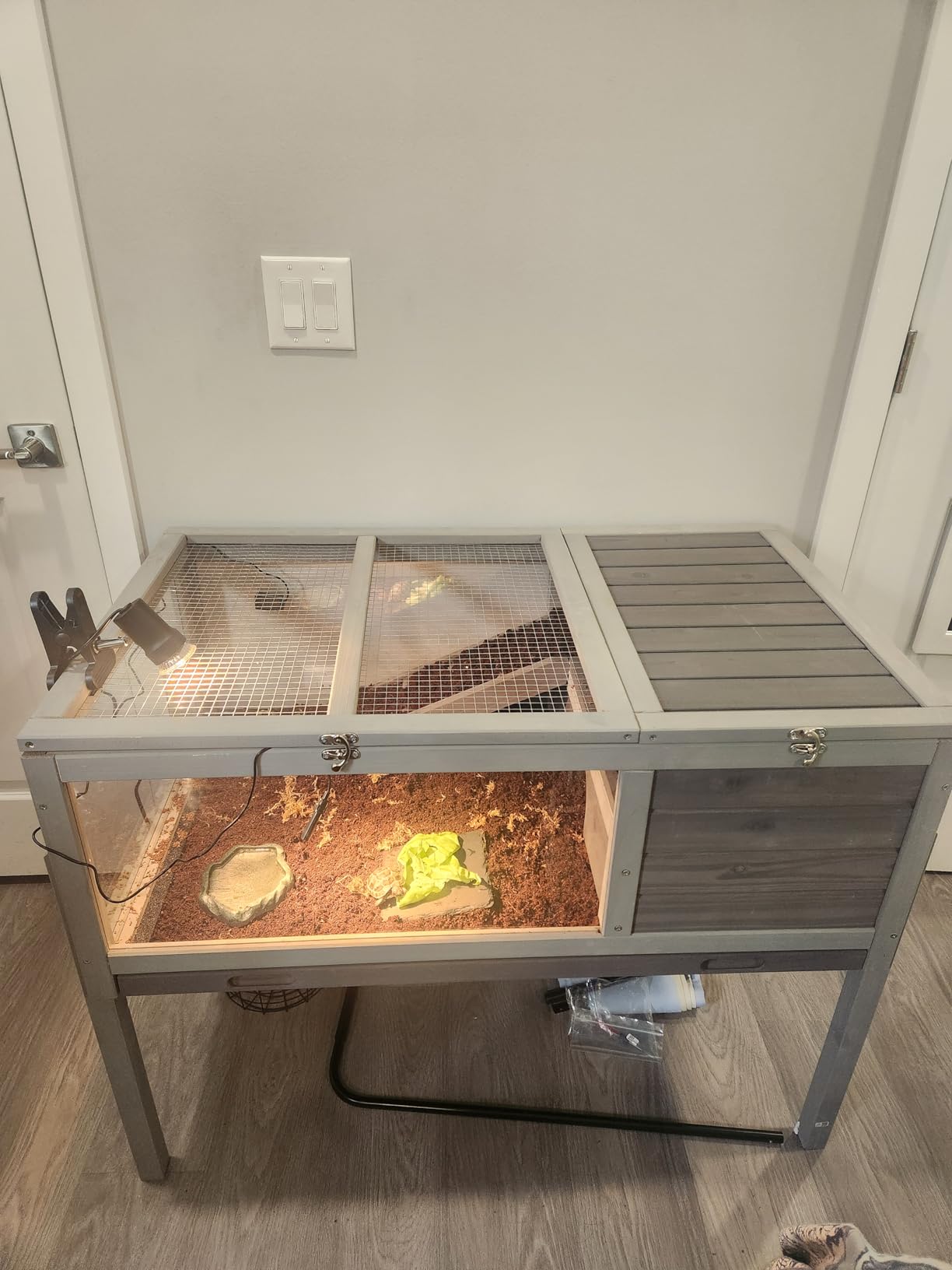
The built-in plastic trough on the upper level is the reason this enclosure exists. It gives you a permanent soaking and feeding pool inside the habitat rather than a dish you have to remove, wash, and reposition, which is the most convenient upgrade here for a keeper who soaks regularly.
The two-tier layout adds usable area without demanding a larger footprint. The lower level has a private room and an activity room, while the upper level holds the pool and feeding area. Detachable legs let you drop it onto a table for smaller animals.
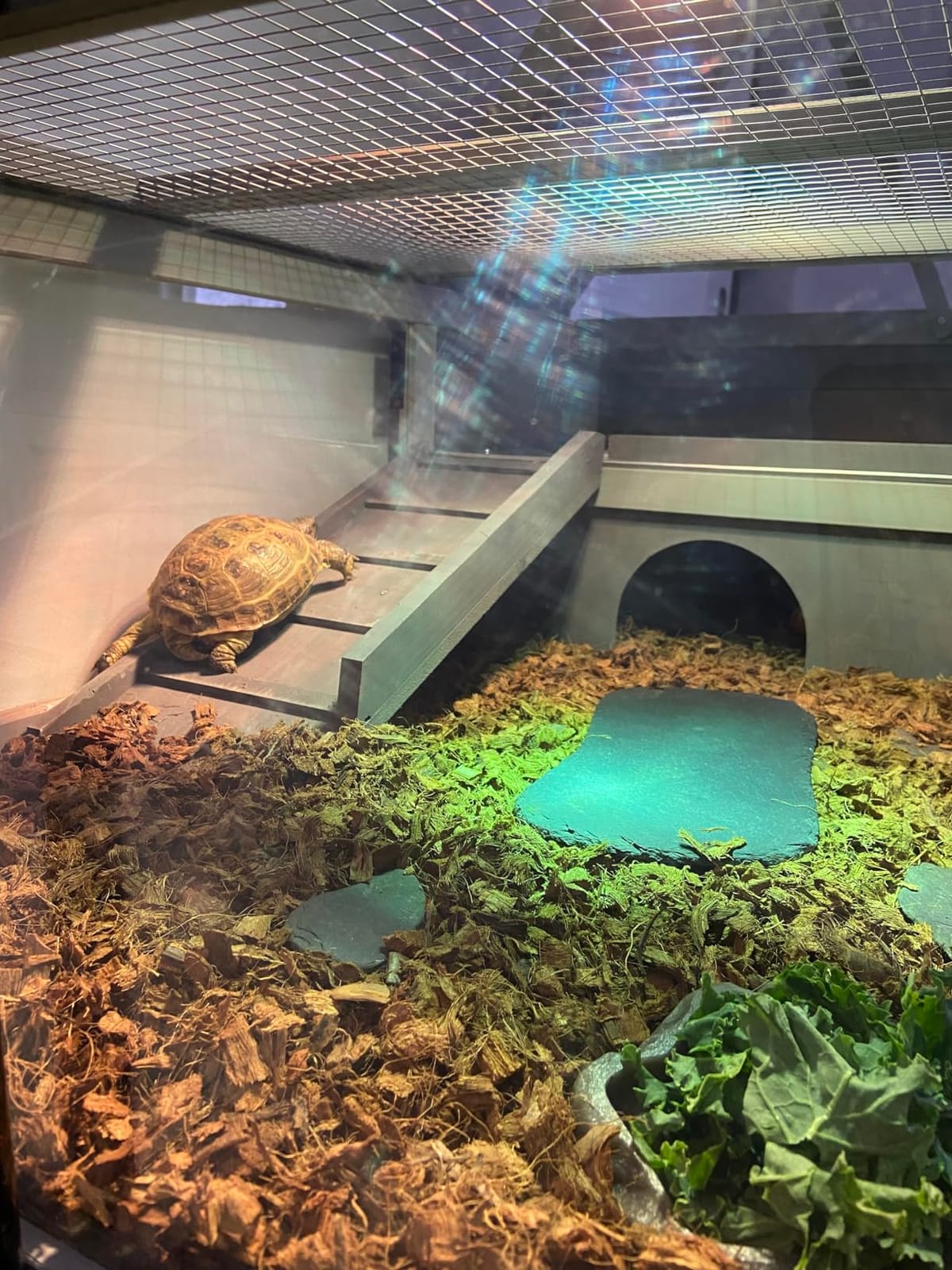
The wide-spaced steel mesh over the living space does not block UVB, which several owners confirm after setting up lamps. A latch lock kept a curious cat out in one owner’s test, and the removable light stand adjusts as your animal grows. Seller support was reported as responsive.
Ratings average 4.0 stars across 55 reviews, tied for the lowest average in the group. The recurring complaint is design rather than concept: the sliding bottom leaves gaps between the walls and the floor, which lets humidity escape and lets live feeders escape.
Seal the sliding bottom
That bottom gap is the thing to fix. Run a sealant bead along the joint where the sliding base meets the walls, and check it again after a few weeks as the wood moves. Until it is sealed, humidity control indoors will frustrate you.
Expect finish inconsistency. Owners report clear plastic panels scratching easily, light wood that can splinter, some pieces arriving cracked, and missing pre-drilled holes on some pieces, all of which lengthen assembly.
Who it suits best
This suits a keeper who soaks their tortoise on a schedule and wants the pool permanently part of the habitat. It also works well for box turtles and other species that benefit from a built-in water area.
Skip it if indoor humidity control is your main concern, or if you want furniture-grade finish. The 14% one-star share is the highest in this group, so inspect the unit on arrival.
12. PawHut 2-Layer Tortoise Enclosure – Best for Deep Cleaning
PawHut Tortoise Habitat with Adjustable Lamp Holder, 2 Layer Tortoise Enclosure with Storage Shelf, Removable Main House, Fixed Tray, Openable Lid, Gray
40.2 x 22 x 40.9 inch overall
Removable main house and ramp
34 lb
Attached leak-prevention tray
Pros
- Removable main house and ramp make deep cleaning straightforward
- Attached plastic tray prevents water and sand leakage
- Adjustable lamp holder for basking setup
- Bottom shelf keeps supplies within reach
- Good-routed joinery
Cons
- Open top makes humidity hard to hold
- Fixed center ramp cannot be repositioned
- Some parts mislabeled in the instructions
- Heavy at 34 pounds once assembled
Everything about this enclosure is designed around taking it apart. The main house lifts out and the ramp comes with it, so you can carry the whole upper section to a sink rather than scrubbing inside a tall box. That single design decision is worth more over years of daily husbandry than any cosmetic upgrade.
The attached plastic tray stops water and sand leaking out of the structure, which matters for box turtles and for any enclosure where you soak the animal in place. The adjustable lamp holder and bottom storage shelf round out an otherwise very practical design.
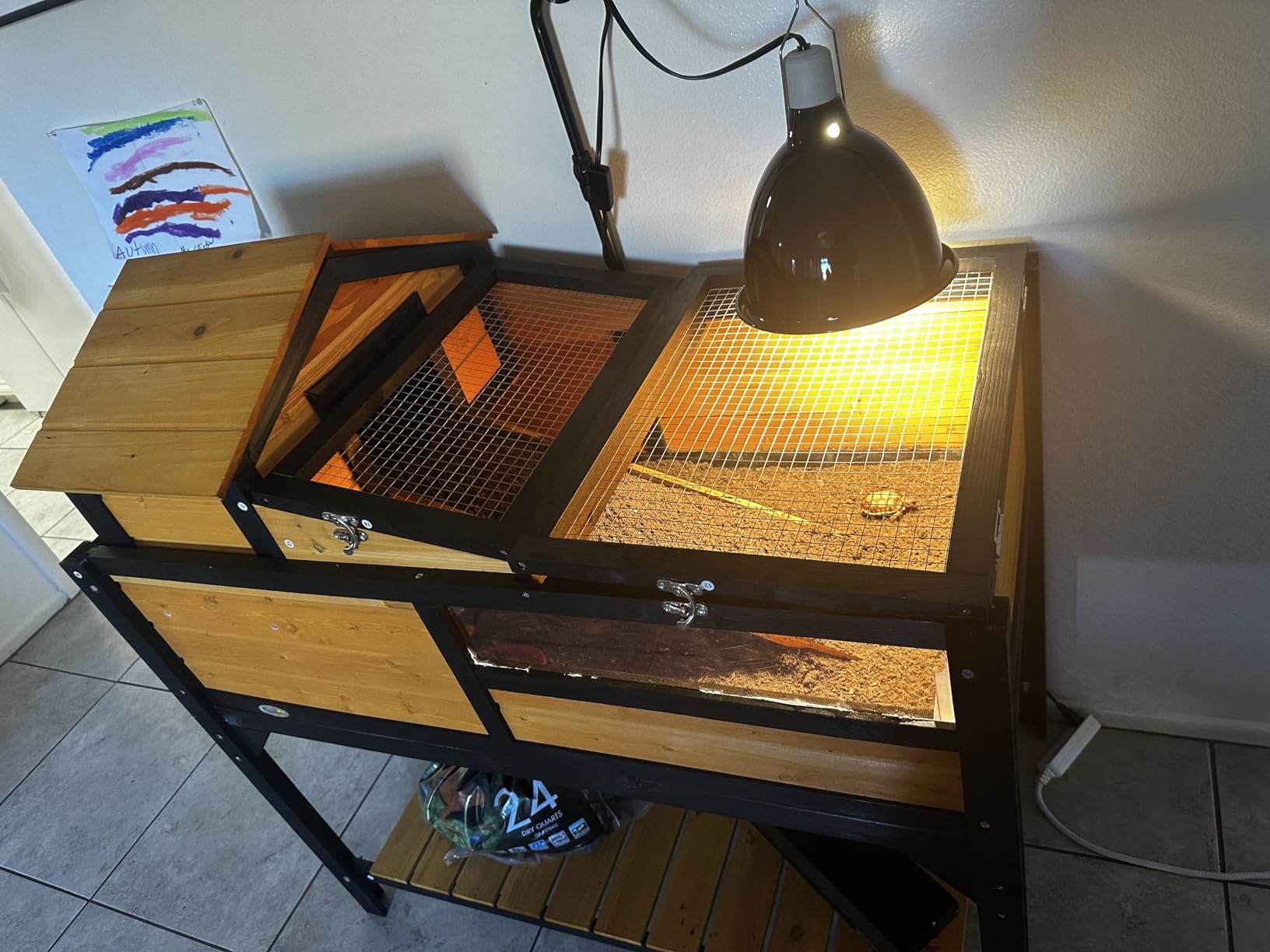
At 40.2 by 22 by 40.9 inches excluding the lamp holder, this is a tall two-level hutch with a spacious main house above a lower run box. Build quality is rated as good across 50 ratings averaging 4.1 stars, and owners like it particularly for box turtles.
The joinery is well routed and the tray stays attached during cleaning, so neither is a source of frustration. Reviewers flag the openable top and clear viewing window as good for full access and monitoring.
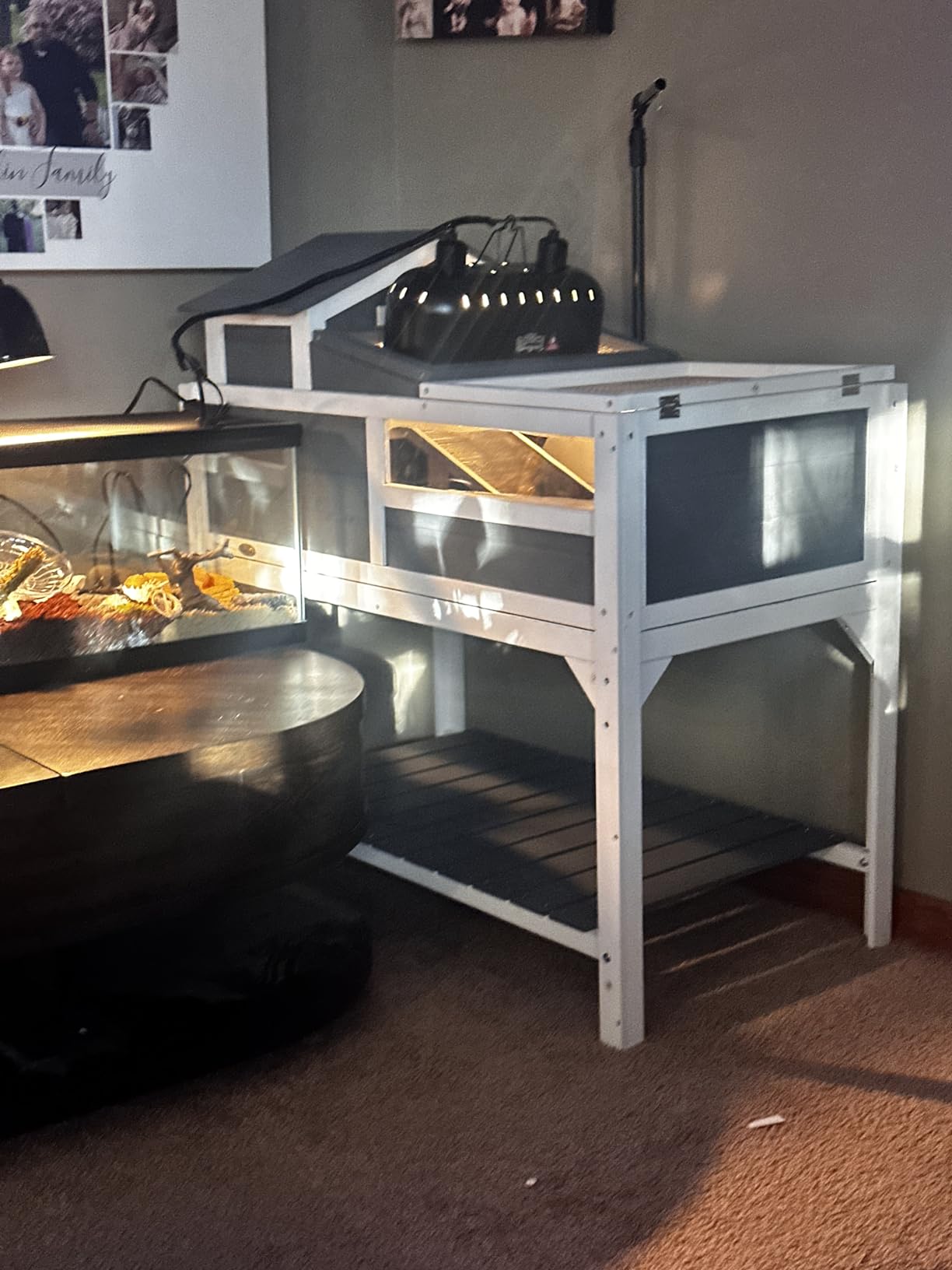
The open top rules out humid setups
One reviewer is direct that the open-top design makes it impossible to maintain the humidity tropical tortoises need. That is accurate, and it is the deciding drawback for indoor keeping, where a dry winter room already works against you.
Plan for assembly time of around an hour and a half even if you are handy, some mislabeled parts in the instruction book, and a 34 pound weight once built. The ramp is fixed in the center and cannot be moved against a wall.
Who it suits best
This is the pick for someone whose tortoise needs frequent soaking and whose enclosure needs to be genuinely deep-cleanable. It also works well for box turtles, which appreciate vertical structure and a lower run box.
Skip it for a hatchling in a closed chamber or for a tropical species, and skip it in a small room where 40.9 inches of height and a heavy frame will dominate the space.
How Big Should an Indoor Tortoise Enclosure Be?
The rule most experienced keepers use is eight shell lengths by four shell widths. Measure the shell from the front of the plastron to the tip of the tail, multiply by eight, and that is your minimum length. Multiply the widest part of the shell by four for the width.
Then subtract the footprint of your hide, your water dish, and any ramps or platforms. Accessories routinely eat 30% or more of a small enclosure, so the number printed on the box is almost never the number your tortoise actually gets to walk on.
As an example, a 4 inch adult Russian tortoise needs roughly 32 inches of length and 12 to 14 inches of width. Keepers on Reddit r/tortoise consistently note that Russians and Hermanns need only about 35 square feet as adults, which is why these smaller species suit indoor keeping and larger ones do not.
Wall height follows a similar rule of thumb at two to three times shell length. Tortoises are strong climbers and will use anything they can reach, so a wall tall enough that the animal cannot get its feet over the top is the safest setup.
Wood, Plastic, or Glass?
Wood is the right default for most indoor keeping. It is opaque on all sides, which removes the wall-pacing behaviour keepers describe on r/tortoise where animals clawed at the glass of a tank they could see and smell through. Fir, pine, and similar untreated softwoods are the common choices.
A glass tank is acceptable only as a temporary hospital or quarantine box. Long term, glass walls cause stress, they concentrate heat unevenly, and they prevent the height difference you need. The one useful exception is a hatchling in a closed chamber, where a sealed container holds humidity more reliably than wood.
Moulded composite enclosures like the New Age Pet ECOFLEX sit between the two. They are easier to clean than wood and stay cool at the edges, but they are moisture-resistant rather than waterproof, so they suit dry species only. Avoid cedar, which several owners of the VEVOR unit flag as a respiratory risk.
What to Put Inside an Indoor Tortoise Habitat
Substrate is where well-meaning keepers go wrong, and the consequences are real. A Tortoise Forum thread puts it plainly: soil or sand should not be used as tortoise substrate, and many tortoises die each year from sand impaction. Use a soil-based mix you can dig into, or paper-based bedding you can spot clean.
Never pour water over the shell as a general hydration method. Occasional soaking is species-dependent and time-limited, and pouring water over the animal does not hydrate it. A shallow water dish that the tortoise can climb into and out of is the right everyday solution.
Every habitat needs three zones. The basking zone under a heat lamp and a UVB tube, the shaded zone away from lamps, and a hide the animal can disappear into. For a room shared between two tortoises, provide two hides so neither has to share, and never keep two males together.
Safe, low-growing, non-toxic plants add hydration and enrichment. Good choices include collard greens, dandelion greens, hibiscus, spider plant, and pothos, planted where the tortoise cannot be tempted to uproot a heavy pot. Remove anything treated with pesticide or fertilizer.
Also add a thermometer and a hygrometer, and a thermostat for the heat lamp so a bulb failure does not cook the animal overnight. Without a thermostat you are relying on being awake at the right time, which is not a plan.
Heating, UVB, Cleaning, and Safety
Mount the UVB lamp so the shell sits at the correct distance for that bulb, and measure with a thermometer rather than trusting the lamp’s label. The enclosures with adjustable lamp holders make this a one-time job instead of a monthly adjustment. A larger enclosure makes heating harder, so expect a longer warm-up time.
Tortoises do get cold at night, and a natural drop is normal and healthy. What matters is that the night-time low stays above the species threshold. If your room drops further than that, add controlled heat rather than running the basking lamp all night.
For cleaning, remove waste daily, spot clean the tray as needed, and do a full substrate change on a schedule rather than waiting for odour. Enclosures with a pull-out tray make this minutes instead of an afternoon. Line bare wood floors with plastic sheeting to prevent warping from spills and urine.
On safety, secure tall enclosures to a wall so a climbing tortoise cannot tip them, and check the wall-height rule before you buy rather than after. Free-roaming a house is genuinely dangerous around stairs, doors, dogs, and draughts, and one Reddit owner describes finding a re-homed Russian tortoise clawing at the glass of a 20-gallon tank under a towel with no heat lamp at all.
Finally, do not plan on leaving your tortoise alone for two days without a reliable automatic setup. Daily waste removal and fresh water are still needed, and most indoor owners who travel arrange a sitter or a boarding stay rather than gambling.
Frequently Asked Questions
What is the best indoor enclosure for a tortoise?
The best indoor tortoise enclosure is a low, wide, opaque-sided wooden habitat with at least eight shell lengths by four shell widths of usable floor space, a shaded hiding area, a basking zone with clearance for heat and UVB lamps, and a removable waterproof tray. Buy for the adult size of your tortoise, not its current size.
Which tortoise species is best for keeping indoors?
Russian (Horsfield’s), Hermann’s, Greek (spur-thighed), and Egyptian tortoises suit indoor keeping best because adults of those species need the least floor space. Sulcatas, leopard tortoises, adult red-foots, and Aldabras cannot be housed properly indoors and need outdoor space year round.
What type of enclosure is best for a tortoise?
A wooden habitat with opaque sides, a two-zone interior, mesh or ventilated top, and a removable waterproof tray is the best general choice. Moulded composite works for dry species and is easier to clean. A glass tank is suitable only as a temporary hospital or quarantine container.
Can a tortoise live in a glass tank?
Only as a temporary hospital or quarantine box, not as a long-term home. Glass walls cause constant wall-pacing behaviour, which keepers often misread as curiosity rather than stress, and they concentrate heat unevenly through the enclosure.
What is the best thing to put in a tortoise enclosure?
A soil-based substrate you can dig into, a shaded hide the tortoise can disappear into, a shallow water dish it can climb in and out of, a basking zone under a heat lamp and UVB tube, and a thermometer and hygrometer. Never use sand or ordinary potting soil, because many tortoises die each year from sand impaction.
What live plants are safe to put in a tortoise enclosure?
Safe, non-toxic, low-growing plants include collard greens, dandelion greens, hibiscus, spider plant, and pothos. They add hydration and enrichment, and a tortoise may nibble them. Plant them where the animal cannot uproot a heavy pot, and avoid anything treated with pesticide or fertilizer.
Do tortoises get cold at night?
Yes, and a natural night-time temperature drop is normal and healthy. What matters is that the low stays above your species threshold. If the room falls further than that, add controlled heat rather than leaving the basking lamp running overnight.
Can I leave my tortoise alone for 2 days?
It is risky without a reliable automatic feeding and watering setup, because daily waste removal and fresh water are still needed. Most indoor owners arrange a sitter or a boarding stay for a two-day absence rather than leaving the animal unattended.
The Bottom Line on Indoor Tortoise Enclosures
Our pick for the best indoor tortoise enclosure is the Aivituvin Wooden Tortoise House, the strongest combination of rating and review volume in the set at 4.5 stars across more than 2200 ratings. It just is not large, so treat it as a step up rather than a final home.
If you need real floor space, go with the Zoo Med Tortoise House, which is expandable and joins end to end, or the GEGURI habitat with detachable legs at 38 by 24 inches. If you want the easiest clean, the New Age Pet ECOFLEX wipes down in seconds and needs no assembly project.
Measure your tortoise, subtract the space your hide and dishes take, and buy for the adult animal. That step matters more than any brand on this list, and it is the reason we refreshed our picks for 2026 rather than recycling last year’s shortlist.