
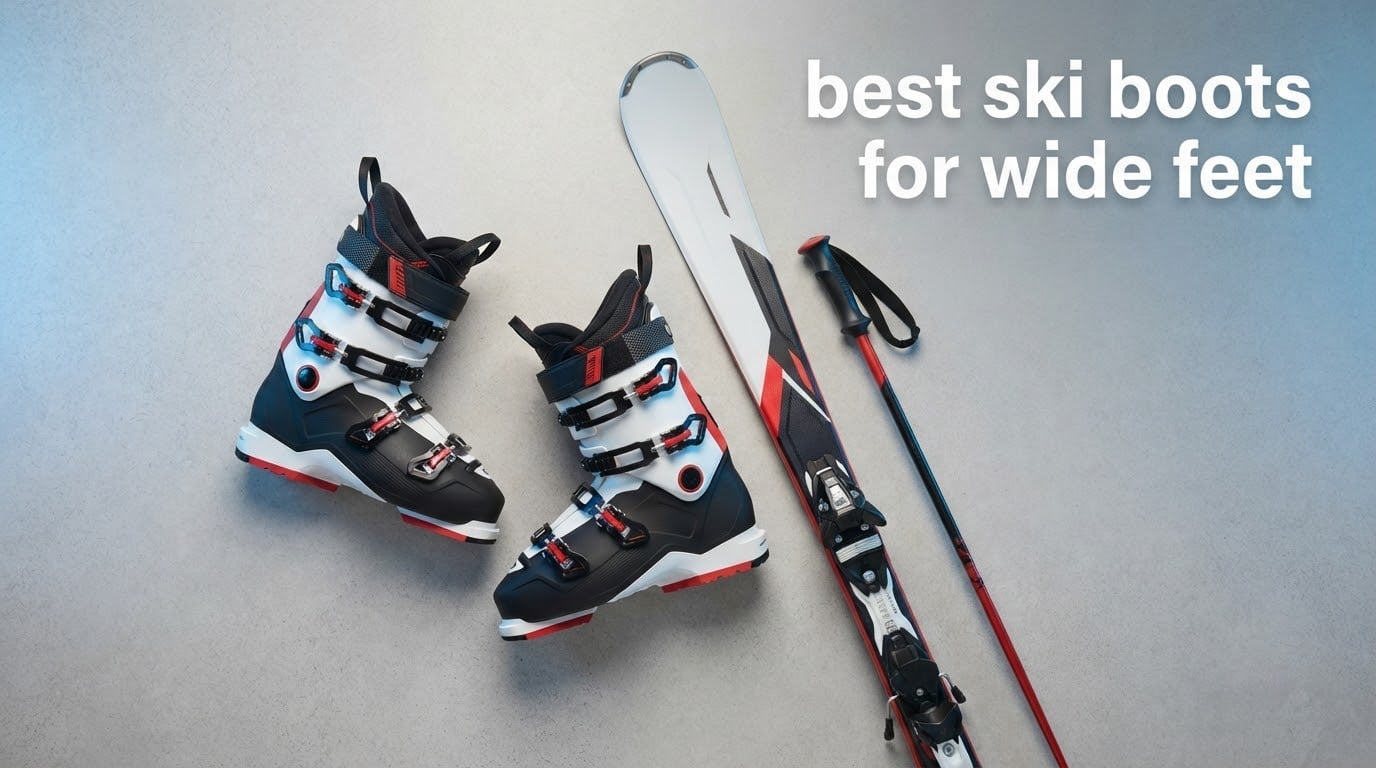
Wide feet need a high-volume (HV) last, typically 102mm to 104mm across the forefoot, against the roughly 98mm standard volume most boots use. That single number is the reason some skiers can ski a full day in a boot while others lose feeling in their toes after forty minutes, and it is the number almost no roundup bothers to print.
Our team pulled ten wide-fit alpine boots and read the published specifications on every one of them, including the last width where the manufacturer states it. We also went back through the places skiers actually swap advice, because the complaints there are consistent: forefoot numbness, instep pressure in boots marketed as wide, and heel lift that wider volumes can make worse rather than better. Those three symptoms map to three separate fit factors, and only the first one is fixed by buying a wider last.
Below is what the best ski boots for wide feet actually look like in 2026, with last width, volume class, flex index and the skier each boot suits. We have flagged where a figure is not published rather than guessing at it, and we have kept every pick’s honest trade-off in plain view.
Table of Contents
Top 3 Wide-Fit Ski Boot Picks for (October 2026)

Wide-Fit Ski Boots in 2026: Quick Overview
Every boot below appears in the comparison table with its own last width, volume class and flex number. The three bands that matter are low volume around 98mm, medium volume around 100mm, and high volume at 102mm to 104mm. If you measure across the ball of your foot and come out past 105mm, no off-the-shelf alpine boot on this list will be wide enough, and a bootfitter becomes the only route.
| Product | Specs | Action |
|---|---|---|
| Head Edge LYT RX HV |
|
Check Latest Price |
 Head Edge 65 W HV Women’s Head Edge 65 W HV Women’s |
|
Check Latest Price |
 Nordica HF Pro 95 W Nordica HF Pro 95 W |
|
Check Latest Price |
 Rossignol Evo 70 Rossignol Evo 70 |
|
Check Latest Price |
 Rossignol Kelia 50 Rossignol Kelia 50 |
|
Check Latest Price |
 Nordica Cruise S W Nordica Cruise S W |
|
Check Latest Price |
 Nordica Cruise 120 Nordica Cruise 120 |
|
Check Latest Price |
 K2 BFC 90 K2 BFC 90 |
|
Check Latest Price |
 Atomic Hawx Magna 100 Atomic Hawx Magna 100 |
|
Check Latest Price |
 Rossignol Pure Comfort 60 Rossignol Pure Comfort 60 |
|
Check Latest Price |
Note that brands do not measure on an identical ruler, and the same millimetre figure from two manufacturers can feel different once the shell is moulded. Treat the table as a shortlist for a fitting appointment, not as a substitute for standing in the boot.
1. Head Edge LYT RX HV: The Best Overall Pick for Wide Feet
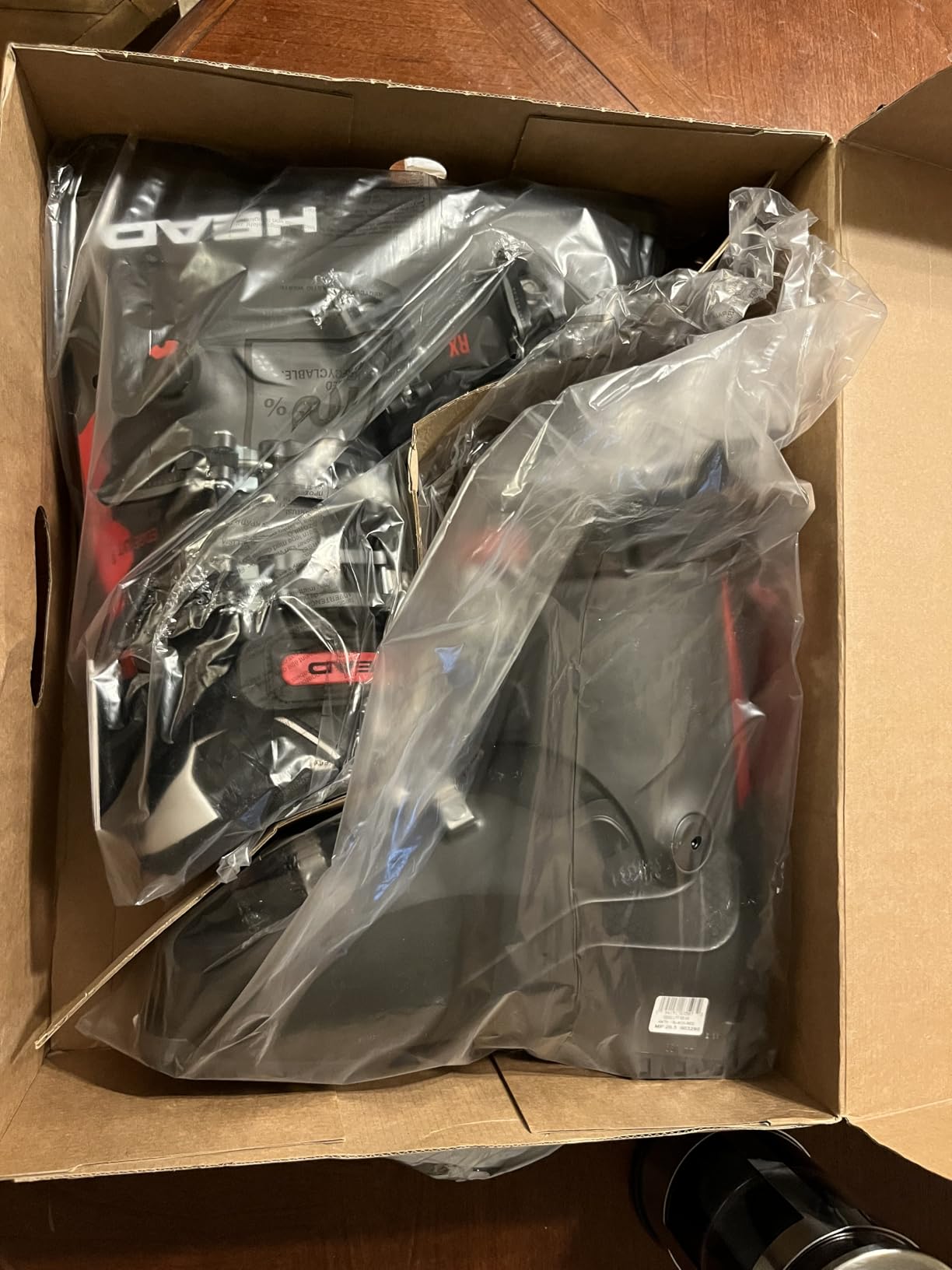
Head Edge LYT RX HV Alpine Ski Boots, Anthracite/Black, 26.5
High Volume fit through forefoot and instep
E-width last
Polyurethane shell
Beginner flex
Pros
- Extra room through forefoot and instep
- E-width last specification
- Beginner friendly flex
- Strong buyer satisfaction at 4.7 out of 5 across 71 reviews
Cons
- Heavier polyurethane shell than ultralight alpine boots
- Beginner level flex offers limited support for aggressive skiing
The manufacturer’s own description of this boot is unusually precise for a beginner model: extra room through the forefoot and the instep, not just one of the two. That combination is the reason it tops our list. Most wide boots widen the toe box and stop, which leaves a high instep compressed, and the Head is one of the few in this group that treats both surfaces as part of the volume spec.
It is listed at 26.5 mondo in Anthracite/Black with a polyurethane outer shell and a one year limited manufacturer warranty. Buy it as a first season boot or as a comfort-first boot for an adult who will not be skiing bumps at speed.
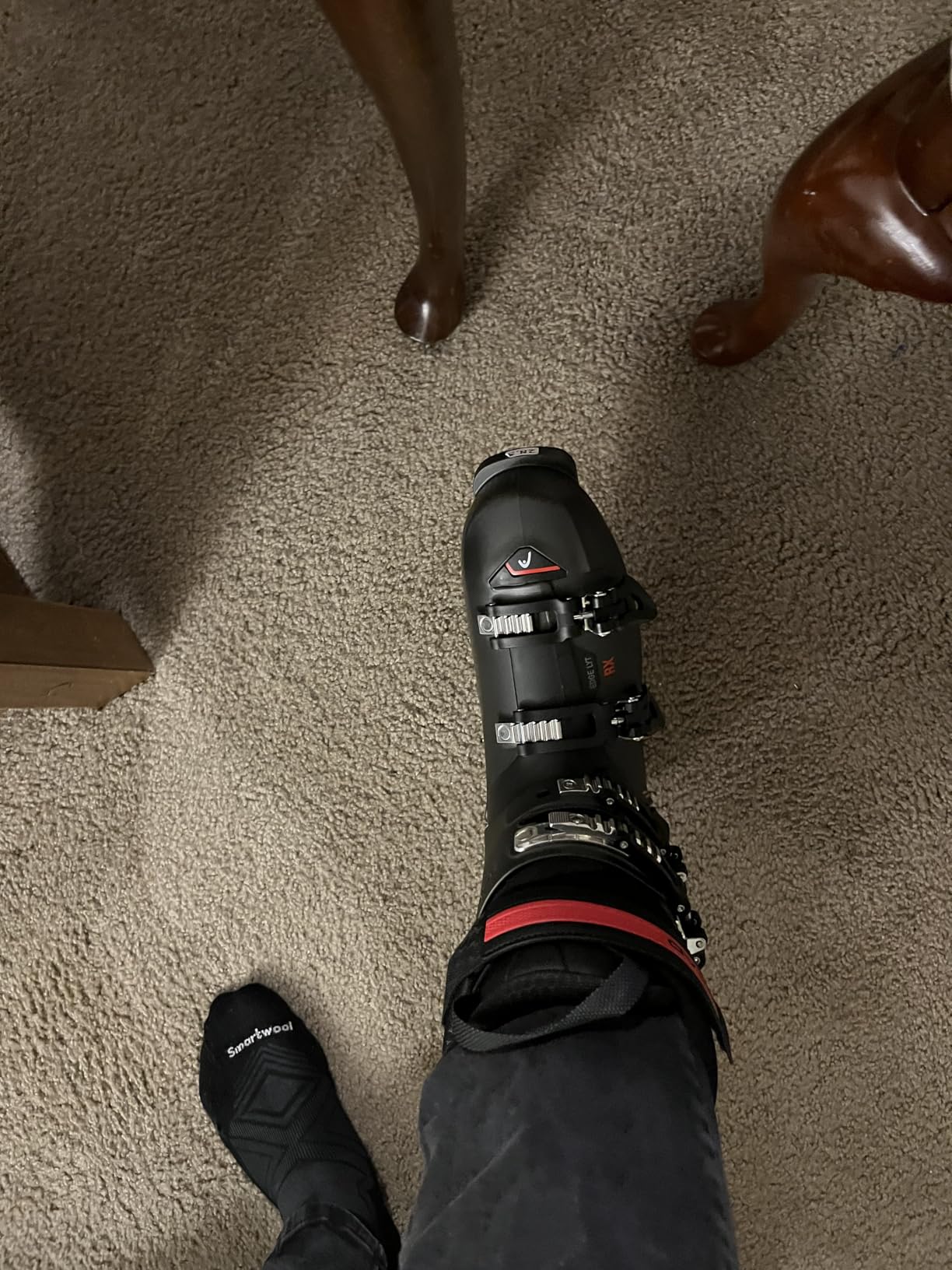
The fit is what buyers react to most. Owners describe the roomy high-volume fit across forefoot and instep as the reason the boot works for wide feet, and the review distribution is unusually clean, with 85 percent of ratings at five stars and no three-star reviews at all in the returned data. That pattern usually means a boot that does one thing and does it consistently.
The trade-off is weight. At three pounds the shell is on the heavy side compared with ultralight alpine construction, and a beginner flex will feel vague on steep, firm groomers once you can already ski parallel turns. If that describes you, step up a flex level rather than reaching for a narrower last.
How the volume actually feels on foot
Wide across the forefoot and instep means the boot will feel different in a chairlift queue than it will in a turn. Standing, the room is obvious. Flexed, the tongue and soft instep plastics close the gap and pull your foot back toward the centre of the shell, which is where the useful work happens.
Expect a soft first day and a noticeably better second day once the liner has taken the shape of your foot. The shell is heat mouldable, so a fitter session is worth the appointment fee on this model specifically.
When to skip this boot
Skip it if you are a strong intermediate skier shopping for performance. A beginner flex removes the support you need to hold an edge through chopped snow, and no amount of forefoot width changes that. Skiers with genuinely extreme width should also look elsewhere, since the manufacturer publishes an E-width designation rather than a numeric millimetre figure for this shell.
2. Head Edge 65 W HV: Softest Flex With a Stated 102mm Last
Head Edge 65 W HV Women’s Alpine Ski Boots (White, 27.5)
Wide 102mm last
Flex 65
5 degree ramp angle
12.5 degree forward lean
Pros
- Explicit 102mm wide last
- Soft flex tuned for first seasons
- Half sizes from 22.5 to 27.5
- Buckle closure with Ergo Balance alignment
Cons
- Soft flex gives little response for advanced skiing
- Very small number of customer reviews limits long-term feedback
This is one of the few boots in the whole list that prints the millimetre figure in its published specifications: 102mm last, flex 65, five degree ramp angle, 12.5 degree forward lean. If you are matching a boot against a measured width rather than a marketing word, that transparency is worth a lot.
The sizing run is the other reason it earns a place. Variants run from 22.5 through 27.5 in half sizes, which is wider than most wide-fit boots we looked at and removes a common failure point where the correct width is unavailable in your size.
Whether the 65 flex is right for you
A 65 flex is a genuinely soft boot. It bends easily at the cuff, which makes learning to flex your legs straightforward and reduces the shin-bang risk on a bad day. It also gives you almost no support on hard-packed pistes or moguls.
The ramp angle and lean figures matter for wide feet specifically. A moderate forward lean with a low ramp keeps the load gentle across the forefoot, so the extra room in the last is used rather than fought.
What the small review base tells you
Four reviews is too thin to draw conclusions from, so treat the rating as directionally positive and nothing more. What we can say is that there is no cluster of complaints about width in the feedback we read, which is at least not nothing for a wide-fit boot.
3. Nordica HF Pro 95 W: Rear Entry That Handles Both Wide Feet and Big Calves
Nordica HF Pro 95 W Women’s Wide Fit Easy Entry Alpine Ski Boots (Green/Black/White, 24.5)
100mm mid volume last
Rear entry hands free closure
Cuff adjustable by up to 8mm
95 flex
Pros
- Wide fit rear entry design cuts the hardest part of putting boots on
- Cuff profile adds up to 8mm of calf circumference
- Adjustable cable buckle keeps micro fit adjustments
- Wired cable buckle retains settings between sessions
Cons
- Very small review base of one rating for a premium boot
- Rear entry format is unconventional and not offered in every fit
The most interesting thing about this boot is that it solves the wide feet and big calves problem at the same time. The adjustable cuff profile can add up to eight millimetres of calf circumference, and the 100mm last handles a wide forefoot. Few alpine boots let you change both.
Rear entry means you step in rather than wrestling with buckles, and the wired cable buckle retains its micro adjustments between sessions so you are not resetting the fit every morning. The anatomical Primaloft liner sits inside a Tri Force shell, and the closure is adjusted for both foot and lower leg shapes.
Why rear entry suits wide feet
A wide foot compresses most during entry, because the shell has to flex open to pass the widest part of you. Rear entry sidesteps that compression entirely. For a skier with bunions or an irregular width profile that flexes badly against a closing overlap, that difference is larger than any millimetre adjustment inside the boot.
The caveat is honest: 100mm is mid volume, not high volume. If your forefoot measures past the high-volume band, this is not the widest boot here even though it is the most accommodating in every other direction.
When to skip it
Skip it if you want a well-worn fit history. A single five-star rating tells you very little about how the shell ages or how the cuff adjustment holds up over a season. Skiers who want a specific numeric width and no compromises should read the other 104mm options on this list instead.
4. Rossignol Evo 70: Widest Stated Forefoot in the Roundup
Rossignol EVO 70 HV+ – Ski Boots for Men and Women – Black
Relaxed 104mm last
Sensor Matrix shell
Custom fit liner
70 flex
Pros
- Relaxed 104mm last with wider forefoot and toe box
- Custom fit liner with softer padding at ankle and instep
- Sensor Matrix shell cuts weight while keeping energy transfer
- Best reviewed boot in the group at 4.8 out of 5 across 73 reviews
Cons
- 70 flex is soft for aggressive skiing
- GRIPWALK soles sold separately
At 104mm with a wider forefoot, toe box and ankle area, this is the widest published last in our group, and the 4.8 average across 73 reviews is the strongest rating-and-volume combination we found. The liner adds softer padding through the ankle and instep, which is the second thing wide feet need after room.
Rossignol describes the construction as a relaxed fit with a custom fit liner that has heel support and customizable zones, wrapped in a Sensor Matrix shell intended to reduce weight while keeping direct energy transfer to the ski. Variants listed include 30.5, 33.5 and 24.5.
Whether a soft 70 flex costs you control
Wide-footed skiers often worry that room equals vagueness on groomed pistes. On a 70 flex that worry is worth taking seriously, because the boot will not fight back when you need edge hold on firm snow. It will still steer fine on softer days and at recreational speeds.
If you are already linking turns on blue runs, the trade is a stiffer flex in the same last rather than a narrower boot. The room in the forefoot is what keeps your toes healthy, and flex is what keeps you connected.
What the reviews point out
Owners highlight the roomy relaxed 104mm fit across forefoot and toe box, comfort across a full day and a light feel. The rating distribution of 87 percent five stars and no two-star ratings at all is one of the cleanest we saw. The one consistent limitation mentioned is that the sole system is an add-on rather than included.
5. Rossignol Kelia 50: Built Around a Tulip Cuff for Wide Calves
Rossignol Kelia 50 – Downhill Ski Boots for Women – Black/White
Relaxed 104mm last
Tulip shaped cuff
Three buckle forgiving flex
Heat moldable liner
Pros
- Tulip shaped cuff relieves shin and calf pressure
- Relaxed 104mm last for wide feet
- Customizable heat moldable liner
- Soft instep plastics make entry easy in cold conditions
Cons
- 50 flex limits performance for advanced skiing
- Composite shell is heavier than premium alpine constructions
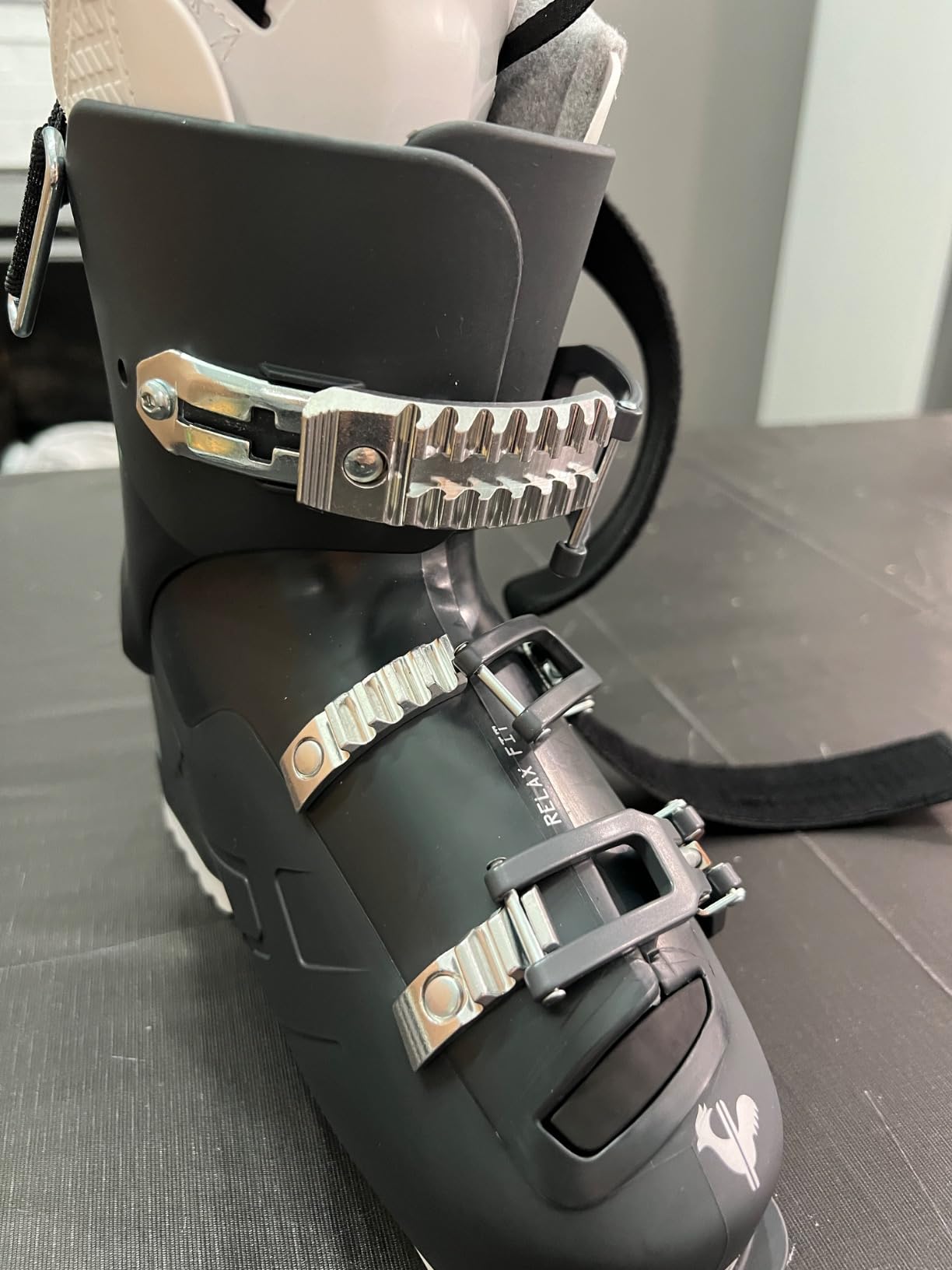
Wide calves and wide feet are two different problems, and this boot is built for both. The relaxed 104mm last handles the forefoot while the tulip-shaped cuff is tailored to relieve shin and calf pressure. Reviewers with large calves specifically report no rubbing or pinching.
The liner is customizable and heat moldable, which matters more than usual here because the calf is a moving target across a day. Three buckles with a forgiving flex keep the shell easy to open and close, and the soft plastics around the instep help with entry when your hands are cold.
Why the cuff shape matters more than the width
A narrow cuff on a wide calf creates a pressure point at the shin bone that no amount of forefoot room can offset. Skiers who have moved from stiffer boots to this one report being able to ski pain-free all day, which points at the cuff rather than the last as the fix.
Skiers coming from stiff race boots often underestimate how much a 50 flex changes. You will move your feet faster and ski with less effort. Anyone chasing performance above ability level should step up in flex rather than searching for a narrower last that lets them feel the ski.
Where the limits sit
A 50 flex is the softest number in this roundup, and it is not a boot for someone who already skis steeps and trees at speed. The composite shell also adds weight compared with premium alpine constructions, which is a fair trade for the cuff geometry.
6. Nordica Cruise S W: The Easiest Boot to Get Into and Out Of
Nordica Cruise S W Women’s Comfort Fit All Mountain Alpine Ski Boots (Black/White/Mauve, 24.5)
High volume 104mm last
Extra wide comfort fit
Dual soft flap instep
Aluminum micro buckles
Pros
- Extra wide comfort fit on a 104mm last
- Dual soft flap instep opens the throat very wide
- Micro adjustable aluminum shell and cuff buckles
- Streamlined anatomical shape keeps control despite the roomy fit
Cons
- Soft synthetic construction is less durable long term than a full alpine shell
- A small share of reviews rate it below average
The defining feature is the dual soft flap instep, which opens the throat far wider than a conventional overlap shell. On a wide foot that is not a luxury. You get into the boot without the compression that makes wide fits miserable, and the 104mm high volume last gives the forefoot room once you are in.
Variants listed cover 23.5 through 27.5, with a soft synthetic comfort liner, alpine soles and micro-adjustable aluminum shell and cuff buckles. Owners single out the wide comfort volume and how easily the flap opens for entry and exit.
Room at the instep versus room at the toe
Most wide-feet complaints split cleanly between the toe box and the instep, and this boot attacks the second one harder than most. If your discomfort is a hot spot on top of your foot rather than at your toes, the soft flap is the relevant feature here.
If the pain is in the toe box, the 104mm last is doing the work instead. Either way, ask a fitter to check the fit with the flap closed and buckled, because that is the position that matters on a ski.
What we would watch
The soft synthetic construction is less durable than a full alpine shell over a decade of use, and a small share of owners rated it below average. With 87 percent five-star ratings and an 11-review base, the signal leans positive but remains thin.
7. Nordica Cruise 120: The Only Boot Here With Adjustable Instep Height
Nordica Cruise 120 Men’s Comfort Fit All Mountain Alpine Ski Boots (Black/Anthracite/Red, 31.5)
104mm high volume last
Instep volume control plus or minus 4mm
3D custom cork liner
120 flex
Pros
- Instep volume control adjusts boot board height by 4mm either way
- Adjustable cuff profile adds upper leg volume
- 3D custom cork liner is heat moldable and insulating
- Owners with wider footbeds report no toe box pressure
Cons
- Some skiers find the fit too plush for aggressive skiing
- Only 11 reviews leave limited long term data
This is the boot to read twice if you have a high instep. Most wide boots widen the boot and leave the top of your foot exactly as compressed as it was. The Instep Volume Control system here raises or lowers the boot board height by four millimetres either way, which is a real adjustment rather than a marketing adjective.
It also carries a 120 flex, making it the stiffest boot in the roundup, and the adjustable cuff profile with double rear screws adds upper leg volume on top of the 104mm last. The 3D Custom Cork liner is natural cork over the heel surface for lateral feedback and easy customisation, and a dual soft flap makes entry straightforward.
Why instep adjustment beats buying bigger
A high instep is a height problem, not a width problem. Widening the shell does not raise the ceiling over your foot, so the boot still presses from above while feeling roomy at the toe. A four millimetre boot board adjustment changes the height of the floor under your arch, which is a more direct intervention.
The tradeoff is stiffness. A 120 flex is built for advanced skiing, and one reviewer returned these boots for being too soft for reactive skiing, which tells you something about the liner rather than the shell. If you are not yet skiing at that level, the room this boot offers may still be wasted on you.
Who should look elsewhere
Anyone who needs a soft boot or wants to fine-tune a high instep on a budget. There is no cheaper way to raise the instep volume, and no way to soften this particular shell. Reviewers with wider footbeds do report the fit working well, which is the reason this boot made the list.
8. K2 BFC 90: Heat Mouldable Fit Without a Published Width
K2 BFC 90 Men’s Ski Boots (Black, 28.5)
Hands free entry and exit
Fully heat moldable
TPU shell with polypropylene cuff
90 flex
Pros
- Hands free entry removes the buckle wrestling
- Fully heat moldable for wide or irregular feet
- 90 flex balances comfort and responsiveness
- Highest five star share at 90 percent in the group
Cons
- Large package dimensions and 8 pound listed weight
- A small share of reviews rate it below average
The K2 BFC 90 takes a different route to wide feet. Instead of publishing a last width, it is listed as fully heat moldable, in a TPU shell with a polypropylene cuff, with hands free entry and exit. For a bunion or an irregular width profile, letting a fitter mould the shell to your exact outline is a strong argument.
Skiers who moved to this boot report liking the fit and performance and describe it as a wide, high volume shell with good features and build quality. That is the pattern of a boot that gets bought again, which is worth more to a wide-footed skier than any single millimetre figure.
What heat moulding actually changes
Heat moulding does not make a narrow boot wide. It changes the shape of the shell and liner so it matches yours, which reduces pressure but cannot create room where none exists. On a foot that is wide everywhere, a genuinely wide last is still the better starting point.
On a foot that is wide in one place, moulding is the better starting point. That asymmetry is why we list this boot alongside the measured models rather than in place of them.
Where it falls short
The listed weight is 8 pounds with large package dimensions, which reflects the hands free hardware rather than a genuinely heavy boot in use. Warranty is two years, the longest we saw. Ten percent of ratings came in at one star, so the design is not universally loved.
9. Atomic Hawx Magna 100: An Advanced-Level 102mm Boot
Atomic HAWX Magna 100 Men’s Ski Boots (Black/Red, 28/28.5)
Anatomical 102mm wide last
Memory Fit heat fitting
Energy Link cuff connection
100 flex
Pros
- Anatomical 102mm wide last marketed for wider feet
- Memory Fit reshapes the cuff and shell to your leg and foot
- Energy Link improves responsiveness and control
- Full half size range from 25 to 30.5
Cons
- 100 flex is firmer than most recreational wide fit models
- Lowest average rating in the group at 4.2
- One reviewer reports it suits neither large nor wide men's feet
The Hawx Magna 100 is the performance answer in this roundup. It pairs an anatomical 102mm wide last with a 100 flex and an Energy Link connection between cuff and shell that is designed to increase responsiveness and control. The Memory Fit system heat fits the plastic cuff and shell to your leg and foot shape.
It is the boot most often named by skiers who want a wide last that still drives well, and the sizing run from 25 through 30.5 in half sizes is one of the widest in the group. Positive reviews describe the boots as lighter and more comfortable after heat fitting.
Why this boot has the lowest rating here
Two reasons, and both are worth taking seriously. First, a 100 flex is firmer than most recreational wide-fit boots, so it will feel aggressive to a skier who came here expecting comfort. Second, one international reviewer says the fit is unsuitable for very large, wide men’s feet despite the wide last, with an 11 percent one-star share in the ratings.
That single report is not a verdict on the boot. It is a reminder that 102mm is a mid-to-high figure that still falls short of the 104mm class, and that the largest feet need the widest lasts on the market.
When it is the right call
If you ski at advanced level and need a stiff boot, a 102mm wide last is a better trade than a stiff standard last with numb toes. The Memory Fit system is designed precisely for skiers whose foot shape does not match a standard mould.
10. Rossignol Pure Comfort 60: Warmth First for Recreational Skiers
Rossignol Pure Comfort 60 – Ski Boots for Women – Relaxed Fit Ski Boots – Black
Women's relaxed 104mm last
Soft instep plastics for easy entry
Polar fleece liner
60 flex
Pros
- Women's specific relaxed 104mm last built for wider feet
- Soft instep plastics open the overlap easily
- Polar fleece stays insulating when wet and dries quickly
- Owners call the boots light and suited to wider feet
Cons
- Lowest but one average rating at 4.3 with 36 percent three star reviews
- 60 flex limits progression to more aggressive skiing
The Pure Comfort 60 is a relaxed 104mm women’s last with a 60 flex and a Polar Fleece liner that keeps its insulation when wet and dries quickly. That is a sensible combination for long days in cold, wet spring conditions rather than cold and dry.
Soft plastics around the instep let the boot overlap open easily for entry and exit, and the Sensor Matrix shell design is intended to reduce weight while delivering direct energy transfer. Variants listed run from 22.5 to 27.5.
Reading a thin review base honestly
Five reviews averaging 4.3 is a weak signal, and 36 percent of them came in at three stars. The written feedback is positive, calling the boots light and suitable for wider feet, but the ratings say a minority were not convinced. We include it because the 104mm women’s last is genuinely relevant, not because the reviews are conclusive.
There is also a useful warning here about fit expectations. A 60 flex is soft enough that some skiers will find it unsupportive within a season or two, which is the more common regret than pain.
What it pairs well with
If you ski cold resorts on easy terrain, this is a reasonable first own-boot purchase. Skiers who want more support and the same width should look at the Kelia 50 or the Nordica Cruise S W, both of which also carry a 104mm last.
How to Choose Wide-Fit Ski Boots: Width, Instep, Heel Hold and Flex
Shopping for wide ski boots goes wrong in one predictable way: a buyer solves forefoot width, feels progress for a day, and then meets a new problem at the instep or the heel. Treating fit as three separate factors is what stops that cycle.
Last width in millimetres: what the numbers mean
Last width is the width of the moulded foot shape at the ball of the foot, measured in millimetres. Standard-volume alpine boots land around 98mm. Medium volume sits around 100mm. High volume runs from 102mm to 104mm across the models in this roundup.
The measurement method matters when comparing numbers from different sources, and brands do not all use an identical ruler. A shell that has been heat moulded or punched can measure wider than its published figure. Use the millimetre number to shortlist and the fitting to decide.
Volume classes and the mm bands that match them
Volume describes the overall three-dimensional space around your foot, not just the width. A tall boot with a narrow last is high without being wide, which is the single most common misunderstanding we came across. Read width and volume together or you will buy the wrong boot twice.
Low volume suits narrow feet and is the tightest class. Medium volume at roughly 100mm is the reasonable middle for feet that are average to slightly wide. High volume at 102mm to 104mm is the wide-feet answer, and it is what most of this list uses.
Instep height: the reason wide boots still hurt
A high instep is a height problem. Widening the shell adds room around the sides of your foot but does not raise the ceiling above it, so the boot can feel roomy at the toe and still press hard on top. That is why instep volume features matter, and why the boots with soft flap insteps or adjustable boot boards earn their place.
If your hot spot is on top of your foot, tell the fitter that before you talk about millimetres. It changes what should be modified, and sometimes it changes which boot you should be wearing.
Heel hold and heel lift in wide feet
Heel lift means your heel rises inside the boot when you flex, and the shin drops until it strikes the cuff. Wide feet are not automatically immune to it, and a roomy boot can make it worse by giving the heel somewhere to move. The fixes are a tighter power strap, a volume-reducing insole, or a liner with a firmer heel pocket.
Skiers who move up in flex often find heel lift resolves itself as the boot stiffens. That is another reason to fix your width first and your flex second, rather than the other way around.
Flex rating matched to ability level
Flex is the stiffness number, and it is the second filter after fit. Boots around 60 to 70 suit beginners and first-timers. The 80 to 90 band fits most intermediate skiers. Around 100 suits intermediate-to-advanced. The 110 to 120 range is for advanced and expert skiing where the boot needs to support aggressive pressure.
The problem for wide feet is that high-volume options thin out at the soft end of that scale, so a beginner with wide feet has fewer choices than a beginner with average feet. That is exactly why several 104mm boots in this list sit at 50 or 60 flex.
Wide feet and big calves together
These are two independent fit problems and the wide-feet conversation usually addresses only the first. Wide calves need cuff volume and buckle spacing, which is a different mechanism from forefoot width. Boots with an adjustable cuff profile, a tulip-shaped cuff, or buckle spacing that can be reset are the ones to try.
If you have both, plan on a fitting appointment rather than a quick size swap. The technician can widen the cuff and check that the added room does not cost you forward drive.
Heat moulding, shell punching and custom liners
When no off-the-shelf width fits, a bootfitter can heat mould the shell and liner to your shape, punch or stretch the forefoot to relieve a bunion, add custom footbeds, and in some cases fit a full aftermarket liner. Most wide-fit shells in this list are described as heat mouldable, which is the base capability for all of this.
The rule of thumb that holds up: moulding changes shape but cannot create room. If your forefoot measures past 104mm, a liner swap or a modified shell beats buying a narrower boot you will fight all day.
Measure your own foot before the shop visit
Stand on a sheet of paper with your heel against a wall, mark where your longest toe ends, measure the distance in millimetres, and add roughly 15mm for a boot shell length. Then measure across the widest part of the ball of your foot while you are standing, because seated width is not the number that matters.
Write both figures down and take them with you. They turn a vague conversation about wide into a specific one, and they let a fitter check the published millimetre figure against your own foot in front of them.
Frequently Asked Questions
What boot is best for wide feet?
The Head Edge LYT RX HV is our best overall pick because it adds room through both the forefoot and the instep, the two places wide feet hurt, and it holds a 4.7 average across 71 reviews. If you want the widest published forefoot in the group, the Rossignol Evo 70 uses a relaxed 104mm last. For wide calves as well as wide feet, the Rossignol Kelia 50 pairs a 104mm last with a tulip-shaped cuff, and the Nordica Cruise 120 is the only boot here with adjustable instep height.
What is ski boot syndrome?
Ski boot syndrome is progressive damage caused by wearing a boot that is too narrow or too short for extended periods. The compression restricts circulation and compresses the nerve and tissue at the toes, causing numbness, tingling and pain that can persist after the boots come off. Wide-feet skiers are the highest-risk group because a standard-volume last of roughly 98mm forces the forefoot into a shape it cannot hold. Warning signs include numb toes during a run, hot spots at the ball of the foot and pain that lingers for hours afterwards.
What snow boots are good for wide feet?
Snow boots and ski boots solve different problems, so the same selection logic does not transfer. Look for snow boots with a stated wide last or a wide-width designation from the manufacturer, and expect far less support and far less adjustability than a ski boot. Snow boots are insulated casual footwear; ski boots are stiff shells with a flex index, a heat mouldable liner and closure systems designed to transfer energy to a ski. If you need pressure-free warmth on a long day, choose wide-width snow boots. If you need to control a ski, you need a wide-volume alpine boot from a list like ours.
What is the widest ski boot on the market?
The widest ski boot depends on the category rather than any single model. Standard alpine high-volume boots top out around 102mm to 104mm at the forefoot, which covers the Rossignol Evo 70 and Kelia 50, the Nordica Cruise models and the Pure Comfort 60 at 104mm. Race and youth contexts go wider, with skiers measuring their children into 110mm to 115mm lasts and falling back to junior race boots when nothing else fits. Touring boots have their own volume language entirely. The practical answer is that most adults need 102mm to 104mm, and above 105mm you need a bootfitter and possibly a modified shell.
The Verdict on Wide-Fit Ski Boots in 2026
The Head Edge LYT RX HV is the best ski boots for wide feet pick in 2026 because it widens the forefoot and the instep at the same time, which is the combination most wide boots skip. For the widest published forefoot, the Rossignol Evo 70 runs a relaxed 104mm last with a 4.8 average across 73 reviews.
Whatever you buy, bring your measurements and let a bootfitter confirm the fit before you commit. Last widths vary by brand, in-store fitting overrides any spec table, and a boot that needs a modification done properly beats one that pinches from the first run.