
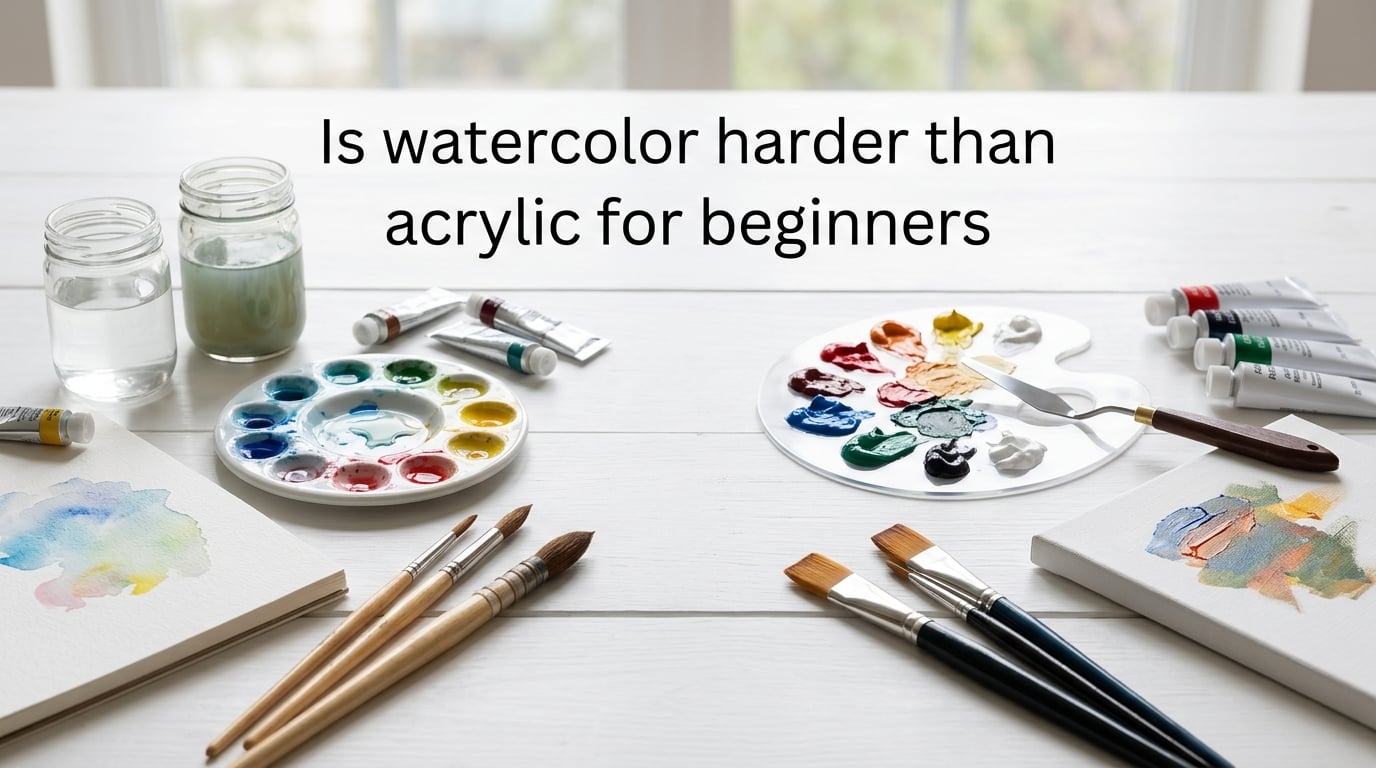
Yes, watercolor is harder than acrylic for most beginners. Acrylic paint is generally the easier medium to learn because you can paint over mistakes, blend on the canvas, and work at your own pace as it dries slowly enough to manipulate but quickly enough to layer. Watercolor, by contrast, absorbs into paper almost immediately, reacts to water unpredictably, and forgives very few errors.
That said, “harder” depends on what frustrates you most as a learner. Our team has spent years testing both mediums with complete beginners, and the answer is rarely the same for everyone. In this guide, I’ll walk you through what makes each medium behave the way it does, the five differences that matter most when you are just starting out, the mistakes nearly every beginner makes, and how to decide which one to pick up first.
If you are choosing your very first painting medium, this comparison will save you weeks of frustration and wasted supplies.
Table of Contents
Quick Answer: Watercolor vs Acrylic for Beginners
Watercolor is harder than acrylic for beginners because watercolor is transparent and dries into the paper, making mistakes nearly impossible to hide. Acrylic is opaque, dries on top of the surface, and lets you paint over errors at any time. For most people picking up a brush for the first time, acrylic offers a more forgiving entry point.
Here is the short comparison before we go deeper:
- Easier to start with: Acrylic — mistakes are fixable, colors stay where you put them, and you can build confidence quickly.
- Steeper learning curve: Watercolor — you must plan ahead, control water ratios, and accept happy accidents.
- Best for patient planners: Watercolor — rewards precision and produces luminous, transparent results.
- Best for experimental learners: Acrylic — lets you layer, scrape, and rework until you like what you see.
If you want a definitive recommendation: start with acrylic if you have never painted before, then move to watercolor once you understand color theory and brush control.
What Is Watercolor Paint and How Does It Work?
Watercolor is a transparent paint made by suspending pigment in a water-soluble binder called gum arabic. When you apply watercolor to paper, the water carries the pigment into the paper fibers, then evaporates and leaves the color behind. Because the pigment sinks into the paper rather than sitting on top, light passes through the dried paint and bounces off the white paper underneath.
This is why watercolors look luminous and glowing. You are essentially painting with light, not with paint. The white of the paper becomes your lightest value, and you build darker tones by layering more pigment or adding additional washes.
Watercolor reactivates with water even after it dries. If you add a wet brush to a finished area, the pigment lifts and moves again. This rewettable quality is what gives watercolor its soft, blendable edges — and it is also what makes the medium so tricky for newcomers.
Most watercolor paints come in two forms: pans (solid blocks you wet with a brush) and tubes (liquid paint you squeeze onto a palette). Pans are portable and shelf-stable for years. Tubes offer more pigment per stroke and are preferred by artists doing larger washes.
What Is Acrylic Paint and How Does It Work?
Acrylic paint is made by suspending pigment in an acrylic polymer emulsion that dries into a flexible, water-resistant film. When acrylic dries, the water evaporates and the polymer particles fuse together, locking the pigment in place permanently. Once dry, acrylic cannot be reactivated with water.
Because acrylic sits on top of the surface as an opaque film rather than soaking into it, you can build layers, paint over mistakes, and create thick textures called impasto. The paint behaves somewhere between watercolor and oil paint — it is water-based and cleans up easily with soap and water while wet, but it dries into a permanent, durable finish once cured.
Acrylics come in tubes at student, artist, and professional grades. Student-grade acrylics contain more filler and less pigment, making them more affordable while still offering good coverage. Artist-grade acrylics use higher pigment loads and produce richer color with less paint per stroke.
Acrylic dries quickly — typically within minutes — which is helpful for layering but can be a problem on the palette. Paint left on a palette dries out and becomes unusable within 15 to 30 minutes, so beginners often waste paint before they get a feel for how much to squeeze out.
5 Key Differences Between Watercolor and Acrylic
The difference between watercolor and acrylic comes down to five properties that affect how forgiving each medium is for beginners. Understanding these will tell you exactly where each medium gets difficult.
1. Opacity vs Transparency
Watercolor is transparent. You cannot make it opaque by adding more paint — the pigment just gets denser, but the paper still shows through. To create lighter areas, you must preserve the white of the paper or use a white gouache or masking fluid.
Acrylic is opaque by default. You can mix in white paint to create tints, layer opaque colors over each other, and cover mistakes completely with fresh paint.
Why this matters for beginners: with watercolor, every stroke is permanent because it stains the paper. With acrylic, every stroke is reversible until it dries, and even after drying you can paint over it.
2. Drying Time
Watercolor dries through evaporation and absorption, often within seconds on dry paper and within minutes on wet paper. The drying time depends on humidity, paper weight, and how much water you used.
Acrylic dries through evaporation in 10 to 30 minutes for thin layers and faster in warm, dry conditions. Heavy impasto layers can take hours to fully cure, but the surface feels dry to the touch much sooner.
Why this matters for beginners: acrylic’s longer working time gives you a chance to blend and adjust before the paint sets. Watercolor’s fast absorption means you must commit to a stroke the moment the brush touches paper.
3. Mistake Correction
Watercolor offers limited correction options. You can lift wet pigment with a damp brush or blot with a paper towel, but once the paint dries into the paper fibers, it is essentially permanent. Some pigments stain more than others — quinacridone and phthalo blues, for example, are notoriously hard to lift.
Acrylic allows extensive correction. While the paint is wet, you can wipe it off with a damp cloth. Once dry, you can paint over it with white or another color, scrape it off with a palette knife, or sand it down. Some acrylics even make dedicated “extender” gels that slow drying time on the palette to give you more working room.
Why this matters for beginners: being able to fix mistakes is the single biggest reason acrylic is easier for first-time painters.
4. Surface Compatibility
Watercolor requires paper designed for the job — typically cold-pressed or hot-pressed watercolor paper with a weight of 140 lb (300 gsm) or higher. Regular printer paper or sketch paper will buckle, bleed, and pill when wet. Cotton paper holds up best, but it costs more than wood-pulp paper.
Acrylic works on canvas, wood, paper, fabric, glass, and most non-greasy surfaces. You can use stretched canvas, canvas boards, or even heavyweight paper. Priming surfaces with gesso creates a slightly absorbent surface that gives better tooth.
Why this matters for beginners: watercolor requires a specific, more expensive paper to produce good results. Acrylic works on cheaper, more accessible surfaces.
5. Cleanup and Cost
Watercolor cleanup is minimal — you rinse your brushes, wipe your palette, and you are done. No solvents required. A starter watercolor kit with a basic palette, two brushes, and a watercolor pad costs less than an acrylic starter kit.
Acrylic cleanup requires prompt washing of brushes before the paint dries on the bristles. Dried acrylic ruins brushes permanently. You will also need water cups, palette paper or a stay-wet palette, and rags for wiping brushes. Starter acrylic kits cost slightly more than watercolor kits, but the gap is small.
Why this matters for beginners: watercolor wins on cleanup and starter cost. Acrylic wins on the ability to fix mistakes without starting over.
Common Beginner Mistakes in Each Medium
No competitor in our research covered the specific mistakes beginners make — and these are the stumbling blocks that determine whether someone sticks with painting or quits in frustration.
Watercolor Mistakes Beginners Make
- Using too much water. The most common error. Excess water causes unpredictable blooms, warps the paper, and dilutes the pigment to a pale wash that disappears when dry.
- Painting in the wrong order. Watercolor works light to dark. Beginners often try to add highlights on top of dried shadows, which is nearly impossible without lifting the underlayer.
- Skipping paper quality. Cheap paper pills, buckles, and bleeds. The paper matters as much as the paint for watercolor.
- Overworking wet areas. Adding more brushstrokes to wet paint creates muddy blooms and disrupts the wash.
- Not planning the composition. Because watercolor is hard to correct, beginners who dive in without a sketch often regret where the first wash landed.
Acrylic Mistakes Beginners Make
- Using too much paint. Beginners squeeze out far more than they need, leading to waste and a palette full of dried paint.
- Not waiting for layers to dry. Painting wet-on-wet acrylic creates muddy blends instead of clean layers. Most acrylics need 10 to 20 minutes between coats.
- Leaving brushes in water. Soaking brushes bends the bristles and loosens the ferrule. Brushes should be cleaned and dried, not stored in water.
- Skipping surface prep. Painting on unprimed wood or cheap canvas causes poor adhesion and uneven color.
- Expecting oil-like blending. Acrylic dries fast. Beginners who try to blend like oils end up with streaks and hard edges instead of smooth transitions.
How Long Does It Take to Get Comfortable?
This is the question every beginner asks, and most articles skip it. Based on forum discussions from r/Watercolor and r/learnart, the learning curve for each medium follows a predictable pattern.
Acrylic: Most beginners feel comfortable with the basics in 2 to 6 weeks of regular practice. By the end of the first month, you understand how much paint to load on the brush, how long to wait between layers, and how to correct mistakes. Producing work you are proud of typically takes 2 to 3 months.
Watercolor: Most beginners feel frustrated for the first 2 to 3 months. Controlling water ratios, lifting mistakes, and layering transparencies takes time. Producing work you are genuinely proud of typically takes 6 months to a year of regular practice.
The forum consensus is clear: watercolor has a steeper learning curve but can be more rewarding once you click with it. Acrylic flattens the learning curve at the cost of less luminous, less portable results.
Which Should You Start With? A Beginner’s Decision Guide
Neither medium is universally “better” — the right choice depends on your goals, personality, and budget.
Start with watercolor if you:
- Want a portable, low-mess painting practice you can do at a cafe or on a trip
- Prefer precise planning and find joy in controlling outcomes
- Are drawn to soft, luminous, transparent effects
- Already have patience for slower skill-building hobbies
- Want to journal or paint outdoors with minimal setup
Start with acrylic if you:
- Have never picked up a paintbrush and want fast feedback
- Get frustrated by mistakes and need the option to fix them
- Want to paint on canvas, wood, or unconventional surfaces
- Prefer bold, opaque, vibrant color
- Plan to explore mixed media later
My recommendation for absolute beginners: start with acrylic. The faster feedback loop, ability to fix mistakes, and lower paper requirements make it the more accessible medium. Once you have built confidence in color mixing and brushwork, transition to watercolor if the transparent aesthetic appeals to you.
When to Switch From One Medium to the Other
Switching mediums is more common than most beginners realize, and there is no wrong time to do it. Here are the signs that signal a good transition point.
Switch from acrylic to watercolor when: you can mix colors confidently, understand value and saturation, and feel limited by acrylic’s opacity. Watercolor will challenge you to plan ahead, but it rewards those who already understand color theory.
Switch from watercolor to acrylic when: you find yourself avoiding the medium because mistakes feel too permanent, or you want to paint on canvas and other rigid surfaces. Acrylic will free you to experiment more freely.
Many working artists use both. Acrylic handles underpainting and bold base layers well, while watercolor adds luminous finishing details. You do not have to choose one forever.
Frequently Asked Questions
What is easier, acrylic or watercolor?
Acrylic is easier for most beginners. You can paint over mistakes, blend on the canvas, and build layers without the urgency of fast-drying watercolor. Watercolor rewards precision but forgives very few errors, which makes it a steeper starting point for first-time painters.
How long does it take to learn watercolor?
Most beginners need 2 to 3 months of regular practice before watercolor starts feeling intuitive, and 6 months to a year before producing work they are proud of. Acrylic typically feels comfortable within 2 to 6 weeks, which is why many instructors recommend it as a first medium.
Which type of painting is the easiest to learn for beginners?
Acrylic is the easiest painting medium for beginners. It dries slowly enough to blend, permanently enough to layer, and forgives mistakes by allowing you to paint over them. Watercolor is the hardest of the common painting mediums because it is transparent, fast-drying, and absorbed into paper with no room for correction.
Why is watercolour so hard?
Watercolor is hard because it is transparent and dries into the paper rather than sitting on top of it. Once pigment soaks into the fibers, you cannot remove it without damaging the paper. Watercolor also requires precise control of water ratios — too much water causes blooms and warping, too little produces streaky washes. Unlike acrylic, every stroke must be planned in advance.
What is the golden rule of watercolor?
The golden rule of watercolor is: you cannot add white, only preserve it. Because watercolor is transparent, the lightest values come from the white of the paper showing through, not from white paint. Plan your composition with the lightest areas first and paint around them, or use masking fluid to reserve whites before you begin.
What is the best paint to start with as a beginner?
Acrylic is the best paint to start with for most beginners. It offers the most forgiving learning curve, works on inexpensive surfaces, and lets you paint over mistakes. If you specifically want a transparent, portable medium and accept a steeper learning curve, watercolor is a fine second choice — just invest in 140 lb cold-pressed paper from the start.
Final Verdict on Watercolor vs Acrylic for Beginners
Watercolor is harder than acrylic for beginners, and acrylic is the better first medium for most people. The mistake-correction advantage alone makes acrylic a more forgiving starting point, and the cheaper surface requirements lower the barrier to entry. Watercolor is a wonderful second medium once you understand color theory and brush control — and many lifelong painters eventually keep both in their toolkit.
Pick the medium that matches your patience level and aesthetic goals, then commit to at least a month of regular practice before deciding whether painting is for you.