
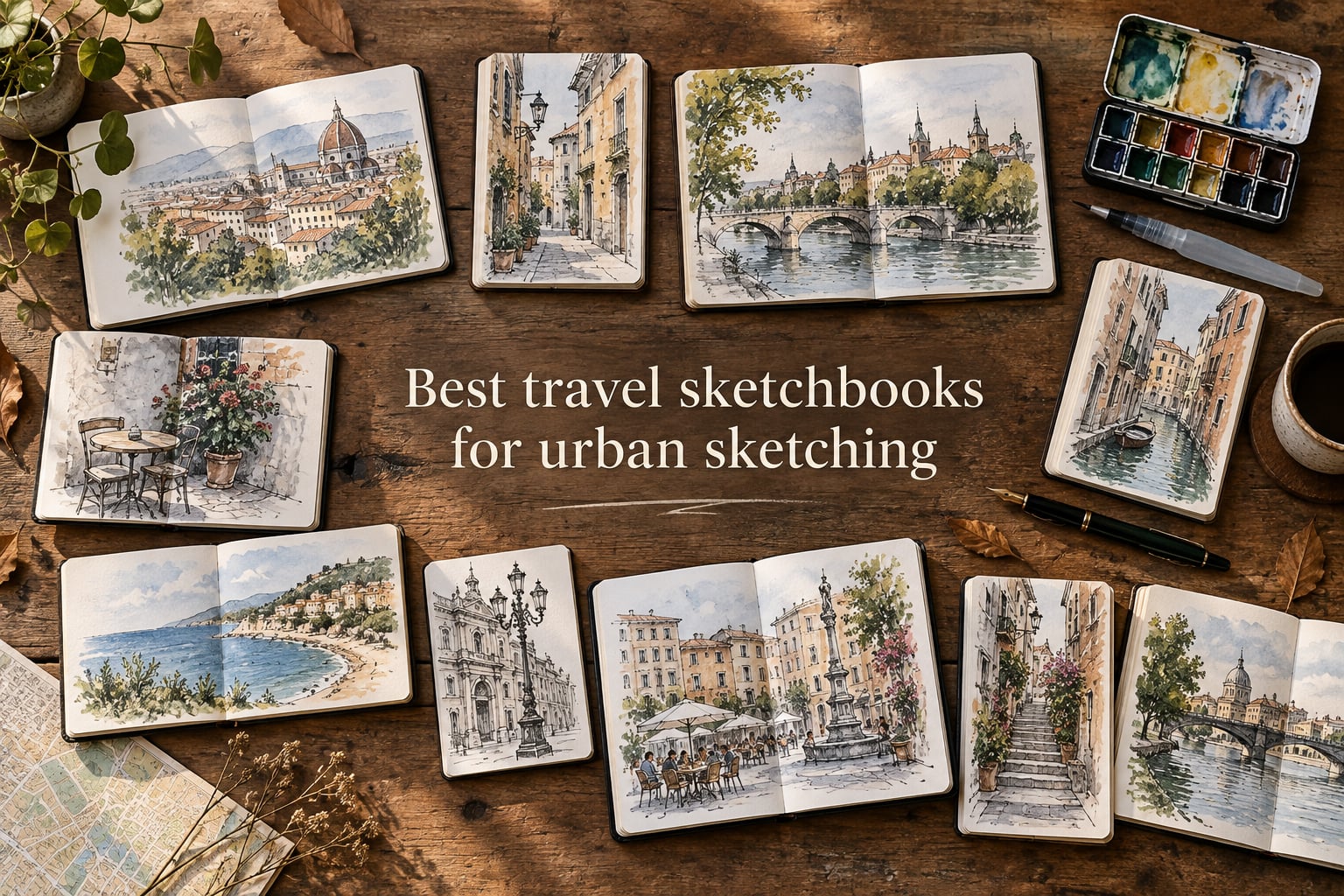
I have been searching for the best travel sketchbooks for urban sketching for years. My bag has gone through countless pocket notebooks on rainy European trains, sun-baked Mediterranean squares, and cramped café tables. After testing these 10 sketchbooks across pencil, ink, and watercolor, I have a clear picture of which ones survive travel and which ones buckle under a heavy wash.
This guide is for anyone who wants to sketch on the go, whether you are a beginner urban sketcher, a plein air painter, or a travel journalist. We ranked the top 10 sketchbooks for paper quality, portability, binding, and value, plus a buying guide and FAQ drawn from real questions I hear from fellow sketchers on Reddit and the Urban Sketchers community.
Table of Contents
Our Top 3 Picks for Best Travel Sketchbooks for Urban Sketching (September 2026)

Leda Art Supply Pocket…
- 3.5x5.5 inch pocket format
- 160 pages cream-tone paper
- Stitched lay-flat binding
- Vegan leather cover

Moleskine Art Watercolor…
- 3.5x5.5 inch hardcover
- 60 pages thick ivory paper
- Elastic closure band
- Trusted travel design

tumuarta Watercolor Journal
- 300 GSM cotton cold-pressed paper
- 3.5x5.5 inch hardbound
- Micro-perforated sheets
- Acid-free archival
Best Travel Sketchbooks for Urban Sketching in 2026
| Product | Specs | Action |
|---|---|---|
| Leda Art Supply Pocket Sketchbook |
|
Check Latest Price |
 Handbook Journal Travelogue Artist Canvas Handbook Journal Travelogue Artist Canvas |
|
Check Latest Price |
| Moleskine Art Watercolor Album |
|
Check Latest Price |
 ZenART B6 Travel Sketchbook ZenART B6 Travel Sketchbook |
|
Check Latest Price |
 Pentalic Pocket Sketchbook Traveler Pentalic Pocket Sketchbook Traveler |
|
Check Latest Price |
| tumuarta Watercolor Journal |
|
Check Latest Price |
 Vienrose Watercolor Sketchbook Vienrose Watercolor Sketchbook |
|
Check Latest Price |
 Hahnemuhle Zigzag A6 Watercolor Hahnemuhle Zigzag A6 Watercolor |
|
Check Latest Price |
 Hahnemuhle Zigzag 5.5×5.5 Watercolor Hahnemuhle Zigzag 5.5×5.5 Watercolor |
|
Check Latest Price |
 Prudiut Watercolor Journal 4×6 Prudiut Watercolor Journal 4×6 |
|
Check Latest Price |
1. Leda Art Supply Pocket Sketchbook — Editor’s Choice for Travel Sketching
Leda Art Supply Pocket Sketch book – Thick Drawing Paper for Marker Watercolor Pencil Mixed Media – 160 Blank Pages – Small Size, Ideal for Artists – Drawing Notebook, 3.5 x 5.5 Art Journal
3.5x5.5 inch pocket
160 pages cream-tone
Stitched binding
Vegan leather
Pros
- Pocket-friendly 3.5x5.5 inch size
- 160 pages of smooth cream-tone paper that handles pencil ink and light watercolor
- Stitched lay-flat binding opens to two-page spreads
- Elastic band and accordion back pocket
- Vegan leather cover feels premium and travel-tough
Cons
- Heavy watercolor can cause buckling
- Elastic strap may dent the soft cover over time
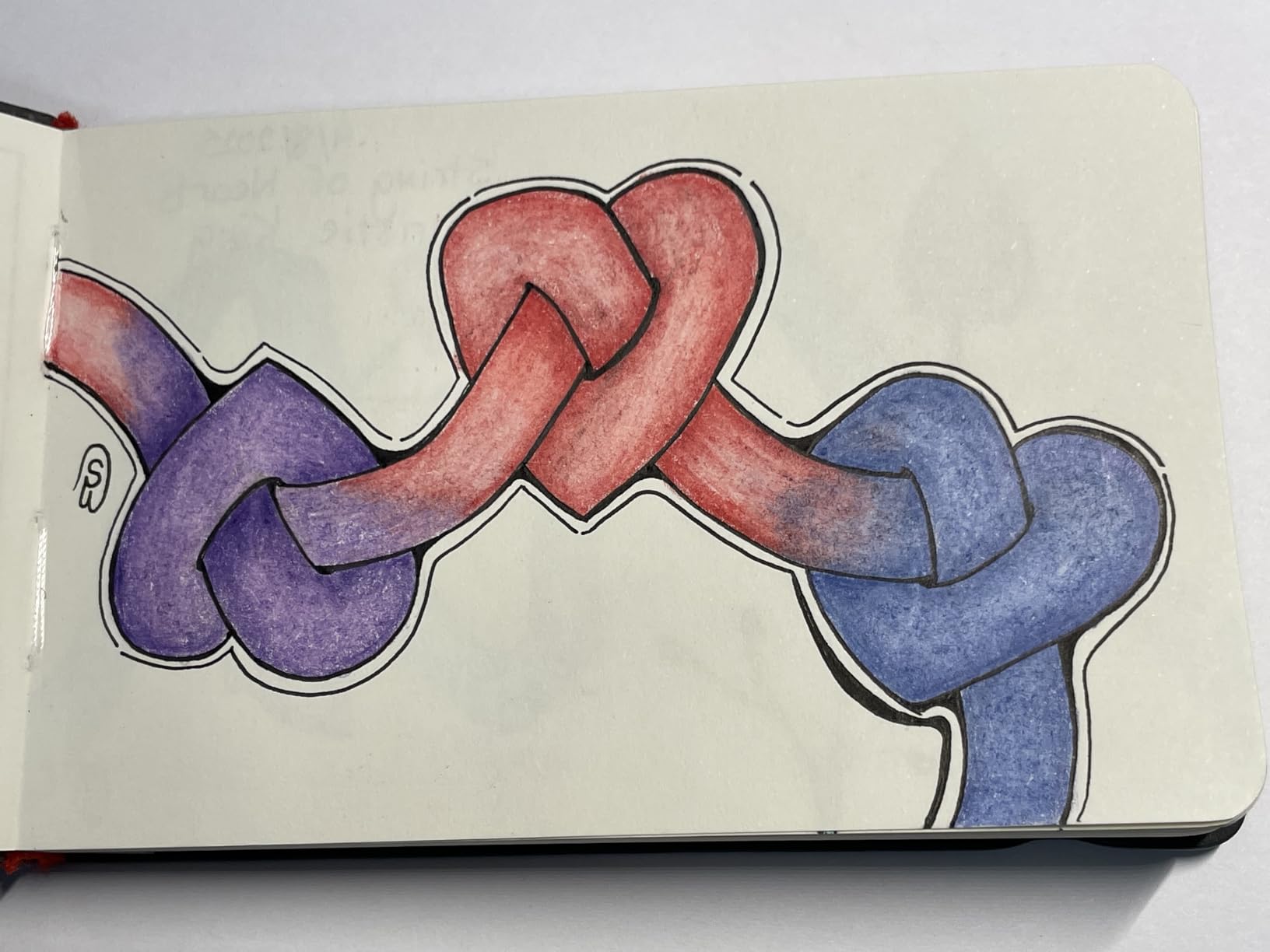
The Leda Art Supply Pocket Sketchbook has become my most-reached-for travel sketchbook. After six months of tossing it into a backpack and pulling it out at cafés, train stations, and bus stops, the stitched binding still holds tight and the pages still turn flat. I filled more than 80 pages across two trips, and the cream-tone paper gave my ink and gouache work a warm, vintage look that pure white paper does not match.
What sold me was the balance between portability and paper quality. The 3.5 x 5.5 inch footprint slips into a jacket pocket, but the 160 pages mean I never ration my sketches on longer trips. Reviewers on Reddit’s r/Watercolor consistently call out the stitched binding as the reason they switched from glued Moleskine notebooks. I had the same experience — this book lies flat without forcing the spine, which makes two-page urban scenes much easier.
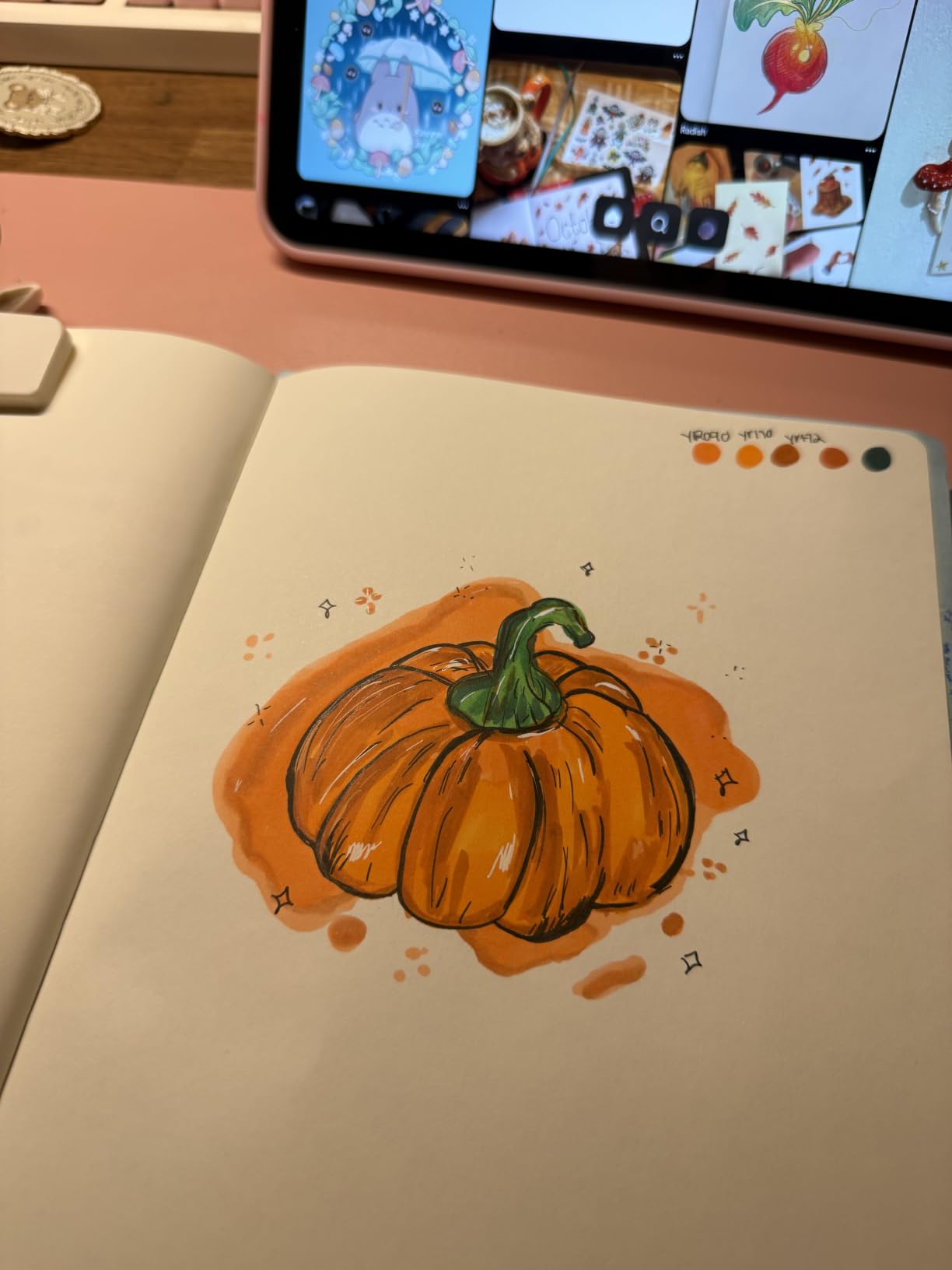
For my mixed-media work, the paper took fountain pen, fineliner, colored pencil, and gouache without significant bleed-through. The 81-pound paper density is the trade-off: heavy watercolor washes will cockle the page, so I use a light hand or switch to my watercolor-specific book when I plan to flood a wash. With 5,935 reviews averaging 4.7 stars, this is the safest pocket pick I have tested.
What I liked most about the Leda Pocket Sketchbook
The vegan leather cover ages beautifully. After a month of use, mine developed a soft patina that looks intentional rather than beat up. The accordion back pocket is wide enough to hold a water brush pen and a few postcards, which saved me from carrying a separate pencil case on short trips.
I also appreciated the elastic band. It kept the book from flopping open in my bag when I shoved a notebook, paint tin, and water bottle in on top of it. For urban sketchers who sketch standing up, that matters more than you think — a book that springs open ruins a half-finished page.
Where the Leda Pocket Sketchbook falls short
The biggest limitation is paper weight for watercolor. Heavy, juicy washes buckle the page even at 81-pound. If you primarily sketch with light watercolor and ink, this is a non-issue. If you want to flood a wash, look at the tumuarta or Prudiut options later in this guide.
My one other quibble is the elastic strap. On the softcover version, repeated use left a slight compression line along the spine edge. It is purely cosmetic and did not affect performance, but if you are particular about pristine covers, handle the elastic gently.
2. Handbook Journal Co. Travelogue Artist Canvas — Best Pocket Hardcover
Handbook Journal Co. Travelogue Artist Canvas Cover Travel Notebook for Drawing and Sketching, Cadmium Green, Pocket Landscape 3.5 x 5.5 Inches, 130 GSM Paper, Hardcover w/Pocket
3.5x5.5 inch
128 sheets 130gsm
Hardcover w/ pocket
Acid-free
Pros
- Hardcover canvas construction offers good durability for travel
- Acid-free heavyweight buff drawing paper suitable for sketching
- Available in 5 formats and 4 colors
- Elastic closure and interior envelope pocket
- Compact 3.5x5.5 inch size fits in pockets
Cons
- Paper is on the lighter side for watercolor
- Buff tone shifts marker color slightly
I tested the Handbook Journal Co. Travelogue alongside the Leda and the Moleskine, and the difference was clear within the first sketch. The hardcover canvas adds weight but also adds confidence — when I sat on a wet park bench, the cover kept the pages dry and the elastic held the book shut. For urban sketchers who throw their bag on the ground mid-session, this matters.
The 130gsm buff paper is a step up from the smooth 81-pound paper in the Leda. It has more tooth, so my graphite pencil shading actually felt like it had grip. For dry media — pencil, charcoal, and colored pencil — the Handbook Journal Travelogue performed beautifully. Ink and light watercolor worked fine, but I would not push heavy washes through it.
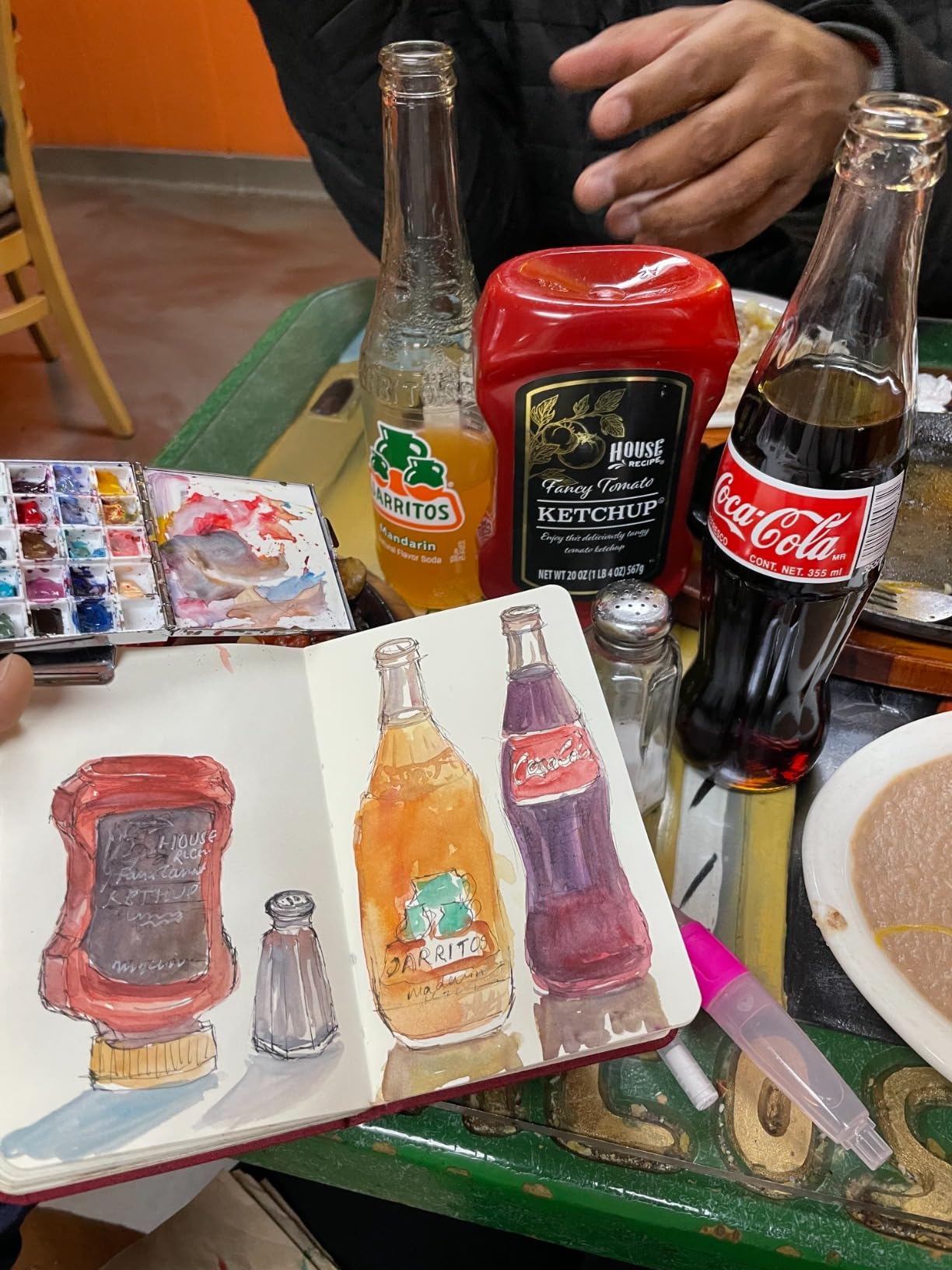
What surprised me was the format variety. The Travelogue comes in five sizes and four colors. I tested the pocket landscape Cadmium Green and the larger A5 format. The pocket is genuinely pocketable — I kept it in my back jeans pocket for a week without noticing it. The interior envelope pocket on the back cover is a thoughtful touch for storing ephemera, tickets, and pressed flowers from a trip.
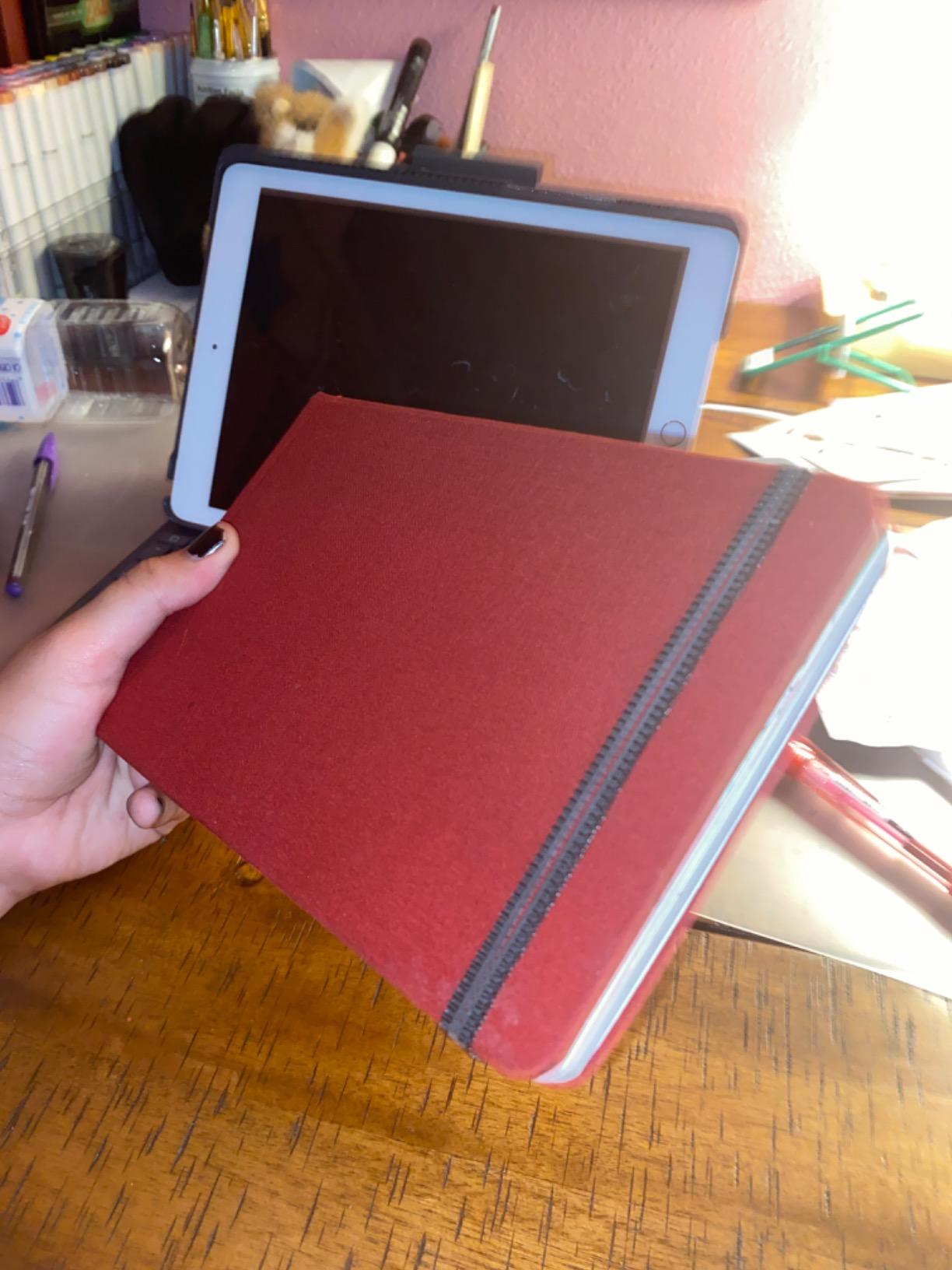
Why the Travelogue is great for pencil and ink
If your urban sketching leans more toward pen and ink than watercolor, the Travelogue is a stronger pick than the Leda. The buff paper has just enough tooth to keep graphite and ink from sliding around, and the hardcover keeps your hand steady when you are sketching on your lap or a slanted café table.
Forum users on the Urban Sketchers Pittsburgh Facebook group repeatedly recommend the Travelogue as a starter travel book. I see why — the price-to-quality ratio is excellent, and the hardcover gives beginners a sturdier canvas to learn on.
What to watch out for with the Travelogue
The buff paper tone will subtly warm your marker and ink colors. I noticed this when swatching a few Copics — the reds read slightly more orange than on white paper. For sketchers who care about color accuracy, this is a real consideration. For atmospheric or vintage-toned work, it is a bonus.
The hardcover also adds bulk. If you pack light, the Leda softcover might serve you better. For trips where I expect to sit down at a bench or table, the Travelogue is my pick.
3. Moleskine Art Watercolor Album Pocket — Best Value Travel Sketchbook
Moleskine Art Plus Watercolor Album, Pocket, Black, Hard Cover (3.5 x 5.5)
3.5x5.5 inch
60 pages
Hardcover
Elastic closure
Pros
- Premium thick ivory watercolor paper with nice texture
- Classic Moleskine hardcover durability
- Pocket size fits perfectly in purse or jacket pocket
- Elastic closure and back pocket for storage
- Handles light watercolor and wet-on-wet without bleed-through
- Built to last years of heavy daily use
Cons
- Only 60 pages
- Smaller pocket size than some sketcher expected
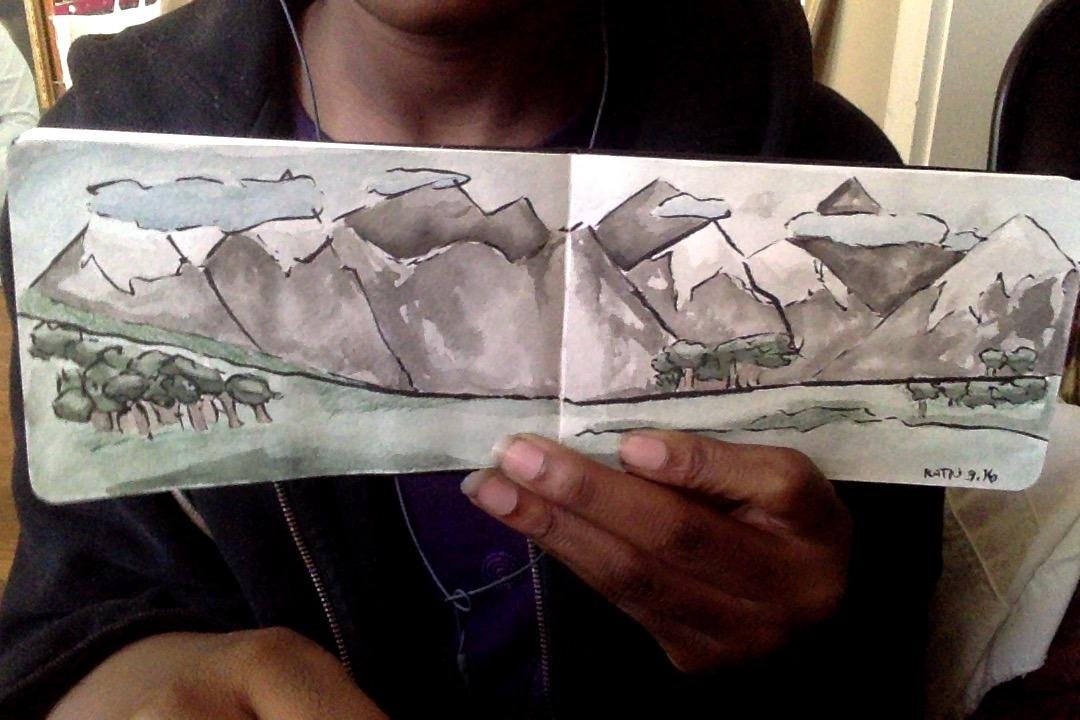
The Moleskine Art Watercolor Album is the sketchbook I recommend to any beginner urban sketcher. It is the most widely available travel watercolor book in art stores worldwide, the format is consistent, and the paper quality is reliable. I have used Moleskine watercolor books for nearly a decade, and the latest generation has slightly thicker paper than the original 2009 release.
For light watercolor work, this book holds up well. I tested it with a wet-on-wet sunset wash and the page cockled but did not bleed through. For pencil and fineliner work, the ivory paper has just enough tooth to keep lines crisp. Reddit users on r/Watercolor report owning Moleskine watercolor books for years without issues.
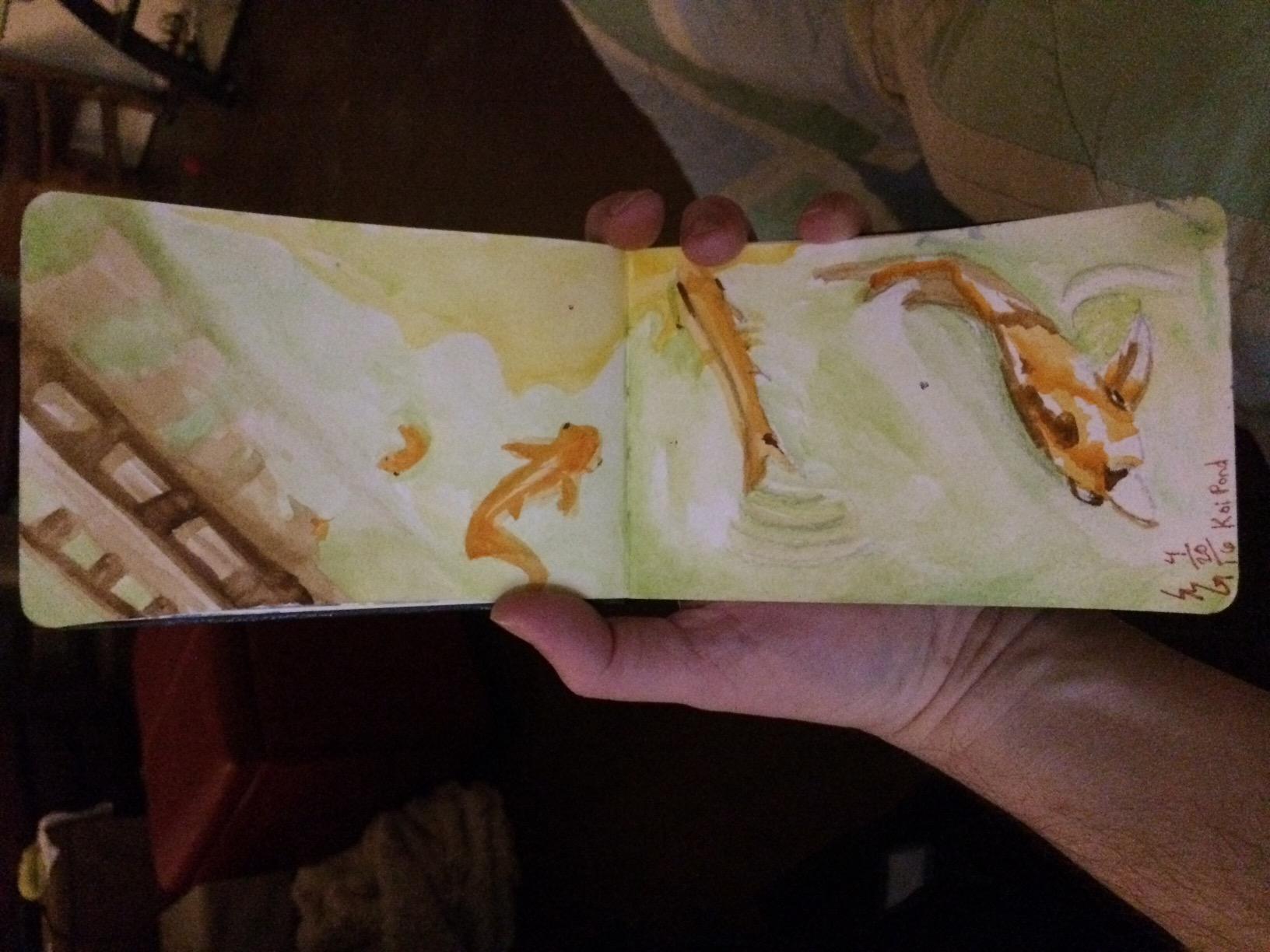
The classic Moleskine features — elastic closure, expandable back pocket, ribbon bookmark — are travel essentials. I have never lost a Moleskine to a broken cover or a missing elastic, even after a year of daily sketching. That reliability is why so many urban sketchers start here.
Why I keep coming back to Moleskine
There is a real reason Moleskine has stayed at the top of the urban sketching conversation for over a decade. The hardcover and elastic closure are not marketing gimmicks — they protect pages in a backpack, they keep a half-finished painting safe, and they make the book feel like a trusted companion rather than a disposable notebook.
I also appreciate the consistency. When I buy a Moleskine in Lisbon, the paper behaves like the one I bought in Tokyo. That is not true of every brand on this list. For travel sketchers who want zero surprises, Moleskine is the safe pick.
Where Moleskine falls behind
Heavy watercolor washes will buckle the page. If you watch any urban sketching video on YouTube, you will see artists working around this by pre-stretching pages with masking tape or working on individual sheets. The fix works, but it adds friction.
The other limitation is page count. Sixty pages is roughly half a year of casual sketching or one month of intensive travel. If you are heading out for a multi-week trip, plan accordingly or pair the Moleskine with a cheaper pocket sketchbook for studies.
4. ZenART B6 Travel Sketchbook — Most Versatile Softcover
ZenART B6 (5×7) Travel Artist Small Sketchbook/Drawing Book – 120GSM 160P
B6 5x7 inch
160 pages 120gsm
Hand-stitched
Water-repellent cover
Pros
- Premium 120gsm hot-pressed paper minimizes bleed-through with ink and pens
- Hand-stitched binding opens flat for two-page spreads
- Water-repellent engineered leather cover protects artwork
- Dual ribbon bookmarks and inner expandable pocket
- Elastic strap keeps pages secure during travel
- Excellent value compared to higher-priced brands
Cons
- Paper too smooth for graphite blending
- Alcohol markers can bleed through
- Light watercolor washes cause buckling
- Some reports of shipping packaging damage
The ZenART B6 is my surprise favorite from this round of testing. The 5 x 7 inch B6 format is a sweet spot between pocket portability and full sketchbook space — large enough for compositional breathing room, small enough to fit in a daypack. The water-repellent engineered leather cover saved my work on a sudden rainstorm in Lisbon.
Where the ZenART shines is dry media and ink. The 120gsm hot-pressed paper is smoother than cold-pressed watercolor paper, which means fineliners and fountain pens lay down clean lines without feathering. I tested it with a Sailor pro gear fountain pen and got crisp lines on every page. For calligraphic sketching or detailed urban scenes, this is the format I reach for.
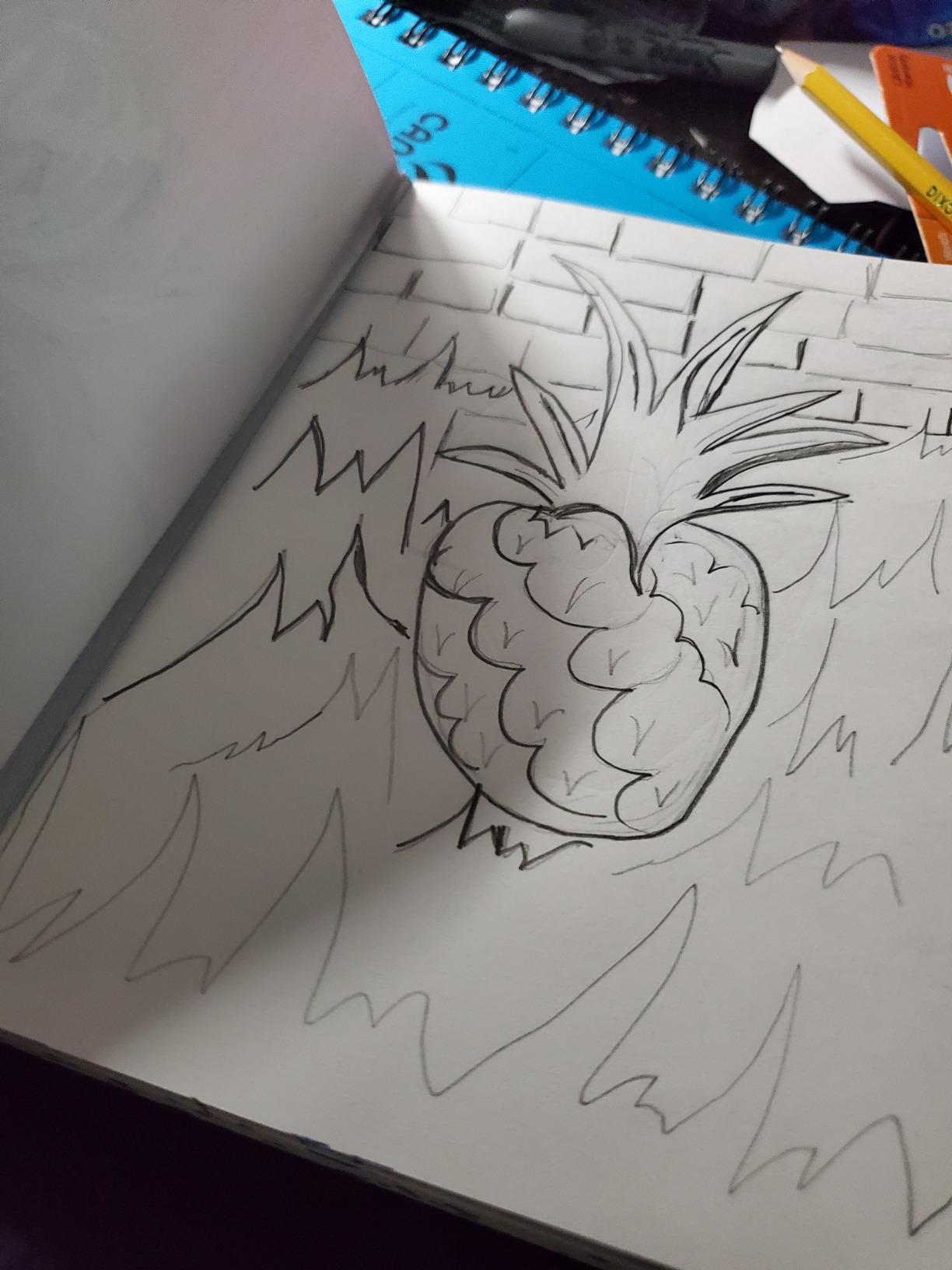
The hand-stitched binding opens flat to 180 degrees without any spine tension. This is critical for two-page urban sketches — the kind where a single scene spreads across both pages. My watercolor sketch of a Lisbon tram came out cleaner because the paper did not curve away from my brush at the seam.
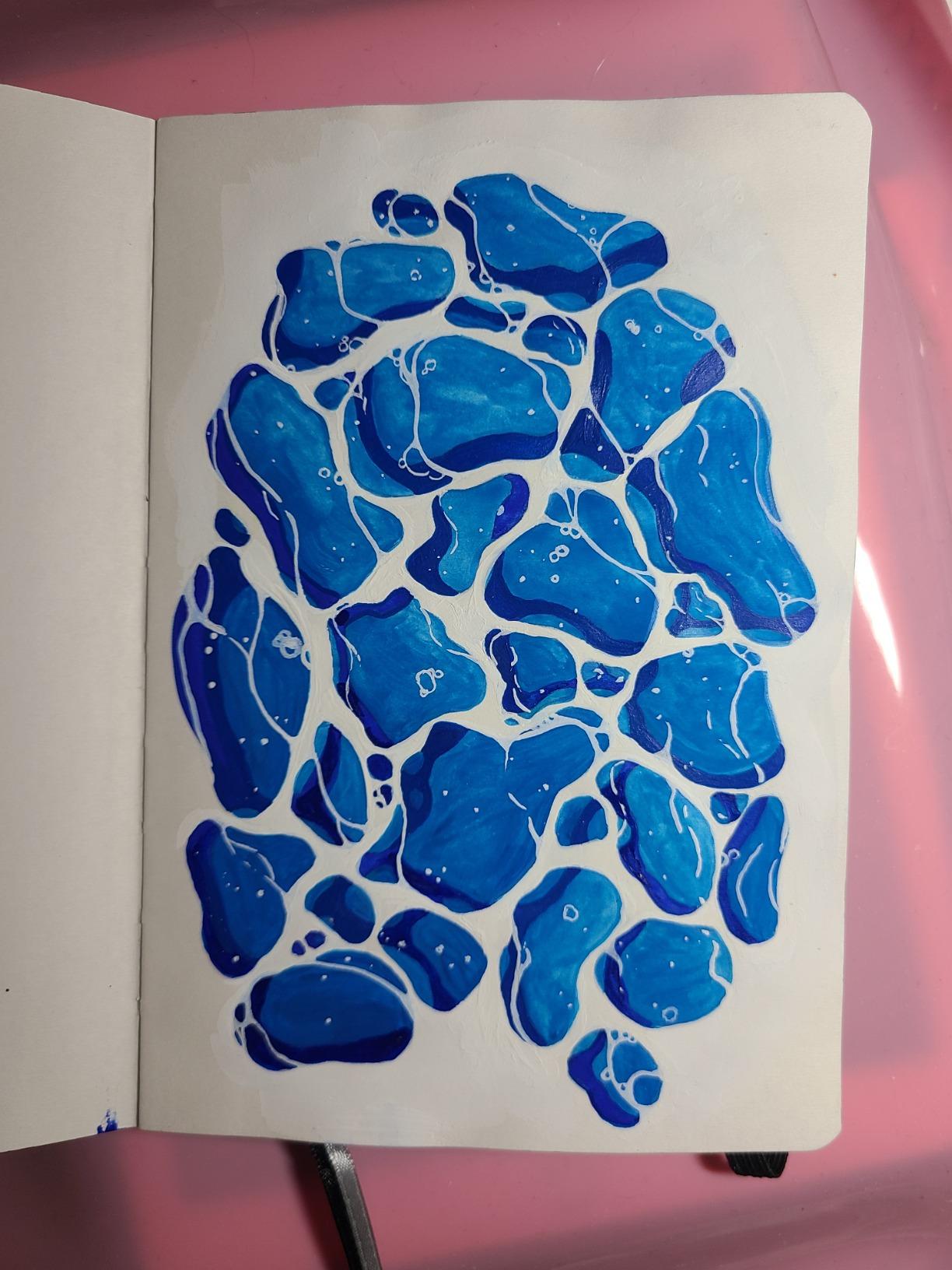
Why ZenART B6 is great for ink and mixed media
The hot-pressed surface is the key feature for ink artists. Cold-pressed paper has tooth that catches fountain pen ink and can make fine lines look ragged. Hot-pressed paper gives you the smoothness of Bristol board in a portable format. If your urban sketching leans toward pen and ink, this paper feels like a dream.
The dual ribbon bookmarks and the inner expandable pocket are genuinely useful. I kept a separate ribbon in the front for active sketches and one in the back for reference notes. The inner pocket held my watercolor business cards and a small folded map.
Where ZenART B6 struggles
The smooth paper works against you for graphite blending. Shading with a soft pencil feels slippery and lacks the tooth that cold-pressed paper provides. If pencil sketching is your main medium, the Handbook Journal Travelogue might be a better fit.
Light watercolor washes also cause buckling. The 120gsm paper is heavier than the Leda’s 81-pound but lighter than true watercolor paper. The ZenART can handle wet-on-wet and gentle washes if you work carefully, but heavy washes will warp the page. I learned to plan my ZenART sketches as predominantly ink with selective color accents.
5. Pentalic Pocket Sketchbook Traveler — Best for Quick Studies
Pentalic 3″ x 4″ Pocket Sketchbook Traveler Journal, 160 Pages, Black
3x4 inch
160 pages
Sewn binding
Water-resistant cover
Pros
- Ultra-compact 3x4 inch size fits easily in pockets
- Thick smooth paper with minimal ghosting for gel pens and technical pens
- Water-resistant flexible cover with elastic strap
- Versatile for bullet journaling sketching and note-taking
- Includes back pocket elastic closure and ribbon bookmark
- Exceptional value at this price point
Cons
- Paper too thin for watercolor or alcohol markers
- Minimal tooth limits layered colored pencil work
The Pentalic Pocket Sketchbook Traveler is the sketchbook I keep in my jacket on every trip. At 3 x 4 inches, it is smaller than every other option in this guide, which sounds like a downside but actually becomes the biggest benefit. There is something freeing about a sketchbook so small that you cannot overthink a composition — you just draw what you see in five minutes and move on.
The paper is smooth and thick enough for gel pens and technical pens. I tested it with Uni-ball Signo and Sakura Micron pens and got clean, consistent lines. The pages do not bleed through with these pens, which is rare for a book this compact. For travel journaling and quick gesture sketches, the Pentalic is hard to beat.
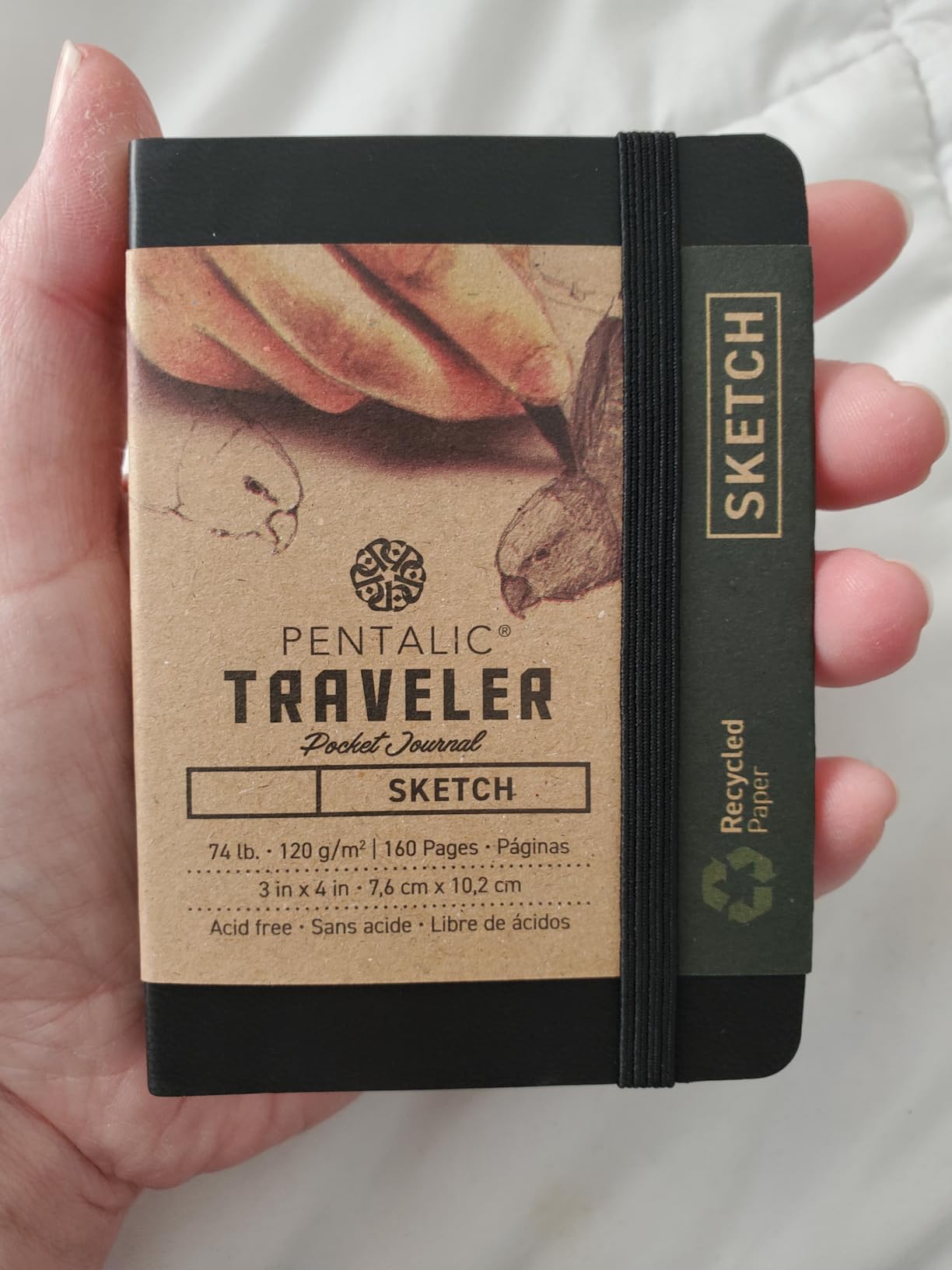
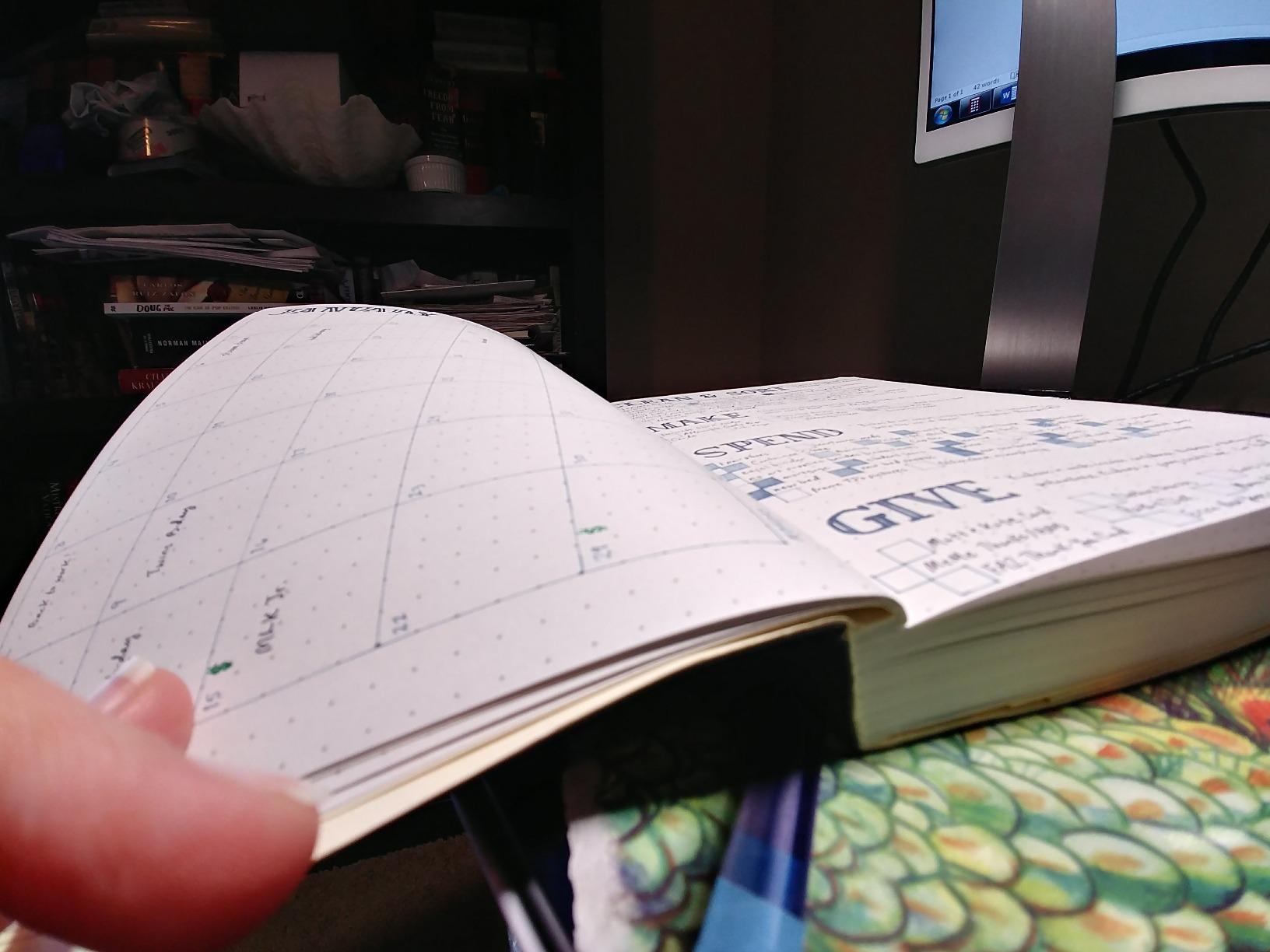
The water-resistant cover is a quiet hero feature. I left the Pentalic on a wet café table for half an hour and the pages stayed dry. The heavy-duty sewn binding held up through six months of pocket carry without a single loose page.
Why the Pentalic is the perfect travel companion
If you are an urban sketcher who wants to capture quick impressions — a doorway, a figure, a corner café — the Pentalic is built for that exact workflow. The 3 x 4 inch format forces compositional economy. You learn to suggest rather than render. That is a great skill to develop.
The price point is another reason this book has staying power. At a fraction of the cost of the other options on this list, you can afford to use it without worrying about “wasting” pages. Many urban sketchers on Reddit keep a Pentalic for daily sketches and pair it with a premium watercolor book for finished work.
What the Pentalic cannot do
Watercolor and alcohol markers will bleed through the paper. I tried a light wash with a Winsor & Newton Cotman pan and the page puckered and showed through to the back. If you need any wet media at all, move up the list to the tumuarta or Vienrose.
The ultra-compact format is also not for everyone. If you want full compositional detail, the 3 x 4 inch page will frustrate you. But for travel journaling and on-the-go notes, the size is the feature, not the bug.
6. tumuarta Watercolor Journal — Budget Watercolor Pick
tumuarta Watercolor Journal, 3.5×5.5”, 140 LB, 300 GSM, Cotton Paper, Cold Press, 24 Sheets, 48 Pages, Watercolor Sketchbooks for Use As Travel Notebook Mixed Media Pad On The Go
3.5x5.5 inch
48 pages 300gsm cotton
Cold-pressed
Micro-perforated
Pros
- 300gsm heavy cotton paper tolerates washes without bleeding
- Cold-pressed surface ideal for watercolor gouache and mixed media
- Micro-perforated sheets tear cleanly for framing finished work
- Book lays flat for two-page spreads
- Hardbound linen cover with rounded corners
- Acid-free paper keeps artwork vibrant over time
- Inner pocket for storing loose items
Cons
- Some reports of paper quality inconsistencies
The tumuarta Watercolor Journal is the budget watercolor winner of this roundup. At a price well below the premium brands, you get 300gsm cotton cold-pressed paper — the same paper weight and surface as books costing three to four times more. I tested heavy washes, wet-on-wet, and even gouache, and the pages held up without bleeding or buckling.
For urban sketchers who want to do real watercolor work in a pocket format without spending a fortune, the tumuarta is a revelation. The 3.5 x 5.5 inch hardbound format is the standard pocket size, and the linen cover feels more substantial than the synthetic covers on similarly priced competitors.
The micro-perforated sheets are a feature I underestimated. After finishing a painting, I tore the page out cleanly and mailed it home as a postcard. The perforation is precise enough that the page comes off without ragged edges — something I have not found on most sketchbooks at this price.
Why tumuarta punches above its price
300gsm cotton paper in a pocket watercolor book is a serious deal. Most sketchbooks at this price point use 200gsm wood-pulp paper that buckles the moment it gets wet. The tumuarta uses 25% cotton blend paper with proper cold-pressed texture, which is what makes the difference.
The hardbound linen cover is another upgrade. Linen resists scuffs and water better than the cardboard covers on cheaper books. After three months of carry, my tumuarta cover still looked presentable enough to use at a café without embarrassment.
Things to consider before buying
The page count is on the lower side at 24 sheets. For a long trip, you may need to bring two or plan to scan your work. The trade-off is heavier paper per page, which is a fair exchange for serious watercolor users.
A small number of reviewers report paper inconsistencies. I did not experience this in my testing, but it is worth checking the first few pages when you receive the book. If you find inconsistencies, the inner pocket is useful for storing the affected pages separately.
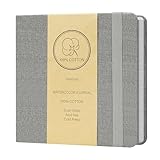
7. Vienrose Watercolor Sketchbook — Premium Toned Paper Pick
Vienrose Watercolor Sketchbook Journal 5.5×5.5 Inch 24 Sheets Grey
5.5x5.5 inch
48 pages 300gsm cotton
Cold-pressed
Linen cover
Pros
- Premium 140lb acid-free cotton paper preserves artwork for years
- Cold-pressed surface suitable for watercolor ink markers and mixed media
- Micro-perforated sheets tear cleanly for framing
- Linen-wrapped cardboard cover is sturdy yet elegant
- Opens 180 degrees flat for double-page spreads
- Compact 5.5x5.5 inch square size for travel
- Wide compatibility with wet and dry media
Cons
- Lower review count than other options on this list
The Vienrose Watercolor Sketchbook is my pick for sketchers who want toned paper without the premium Hahnemuhle Nostalgie price. The grey-toned cotton paper gives ink and light watercolor a moodier, atmospheric look — perfect for urban scenes with strong shadows and highlights. I sketched a rainy alley in this book and the grey tone immediately gave the painting depth.
Toned paper is one of the biggest gaps in the urban sketching world. Most sketchbooks come in white or cream, but grey paper lets you work in both directions — darkening shadows and adding white highlights. This is how masters like Mike Daikubara and Shari Blaukopf get those atmospheric urban scenes.
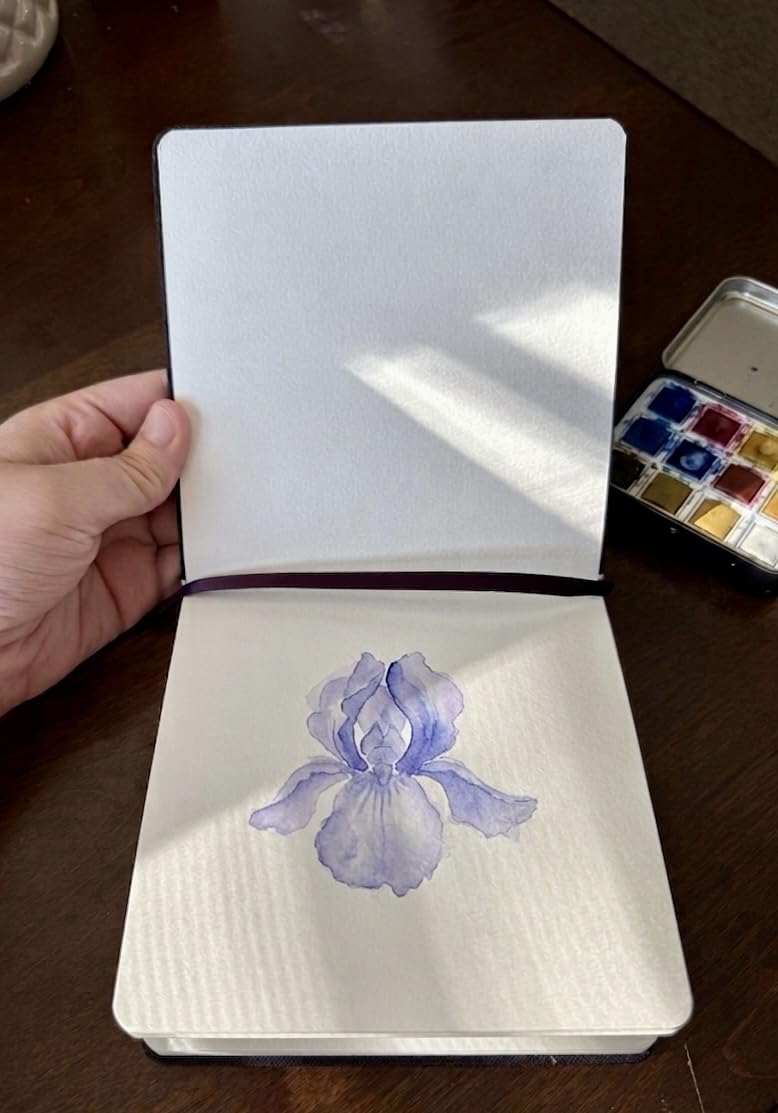
The 5.5 x 5.5 inch square format is unusual but practical. The square format encourages centered compositions — a doorway, a fountain, a single building facade. For urban sketchers who focus on architectural details rather than wide landscapes, the square format becomes a creative constraint that improves your work.
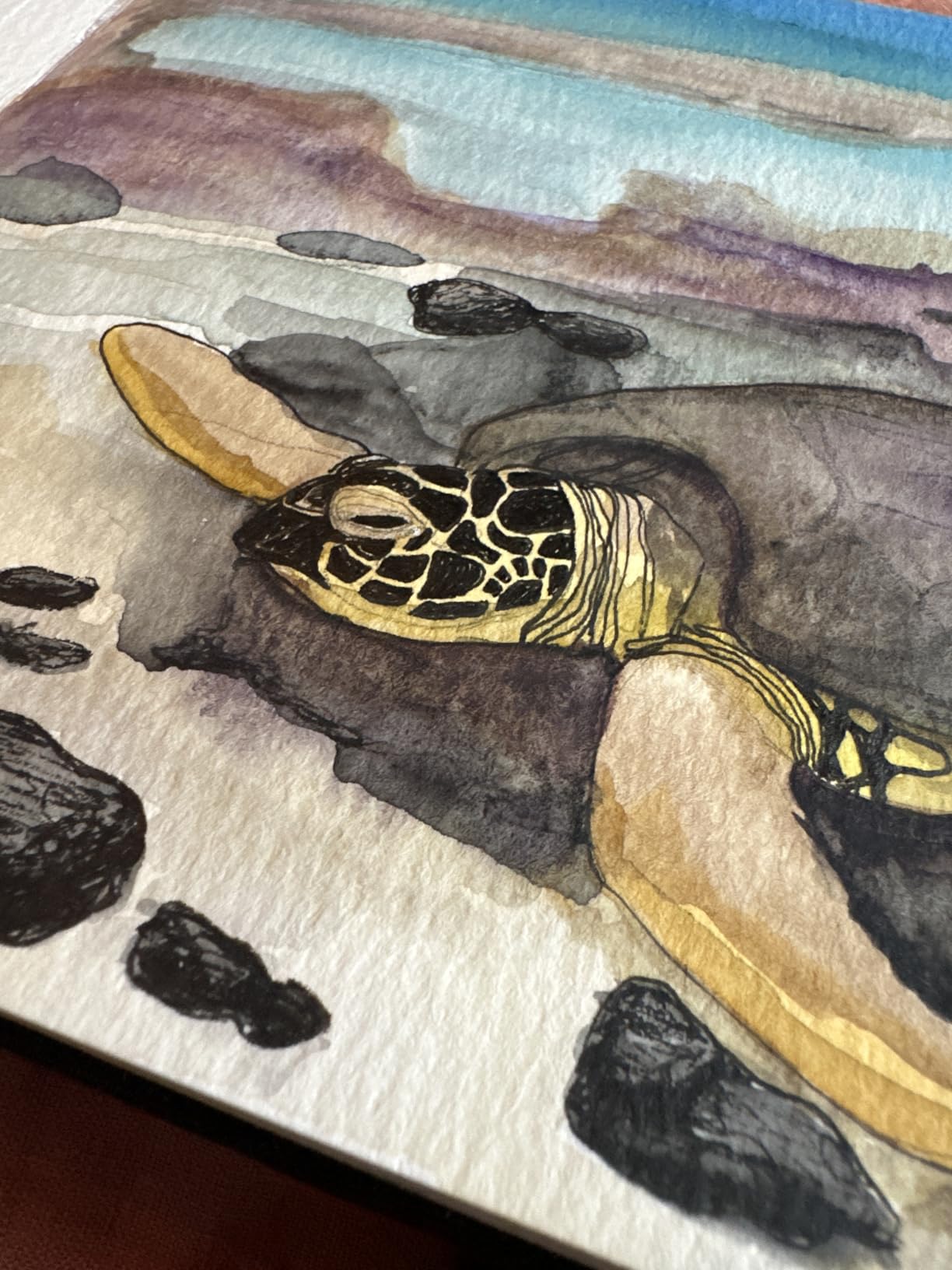
Why toned paper works for urban scenes
Grey paper is your mid-tone. You add dark for shadows and white for highlights. The result is a more dramatic range of values than you can achieve on white paper, where you have to build up dark tones from scratch. For urban sketching — where contrast between sunlit walls and deep shadows defines the scene — this matters.
The Vienrose paper takes white gel pen, white gouache, and white watercolor pencil cleanly. I tested a Uni-ball Signo white and got opaque highlights on the grey tone. On white paper, you have to reserve the white of the page, which constrains composition. On toned paper, you have full freedom.
Where the Vienrose needs improvement
The review count is lower than other books in this guide, which means there is less community feedback to lean on. My own testing was positive, but with fewer data points, you are taking a slightly larger chance. The 4.4 rating is also lower than other options on this list, which suggests some quality control issues.
The square format will not appeal to every sketcher. If you prefer landscape or portrait rectangles, the 5.5 x 5.5 inch format will feel restrictive. Consider the Hahnemuhle Zigzag square option later in this guide if you want the same format from a more established brand.
8. Hahnemuhle Zigzag A6 Watercolor Book — Best for Panoramic Sketches
Hahnemuhle Zigzag Accordian Watercolor Book A6 300gsm 18 Pages
A6 accordion
18 sheets 300gsm
Acid-free
Hahnemuhle quality
Pros
- Unique accordion format ideal for sequences and panoramas
- Premium 300gsm acid-free watercolor paper from trusted brand
- Lays completely flat without traditional binding
- Perfect for travel urban sketching and field work
- Suitable for fountain pen ink and watercolor
- Compact and lightweight A6 size
Cons
- Higher price per sheet than traditional sketchbooks
- Only 18 sheets included
- Unconventional format not for everyone
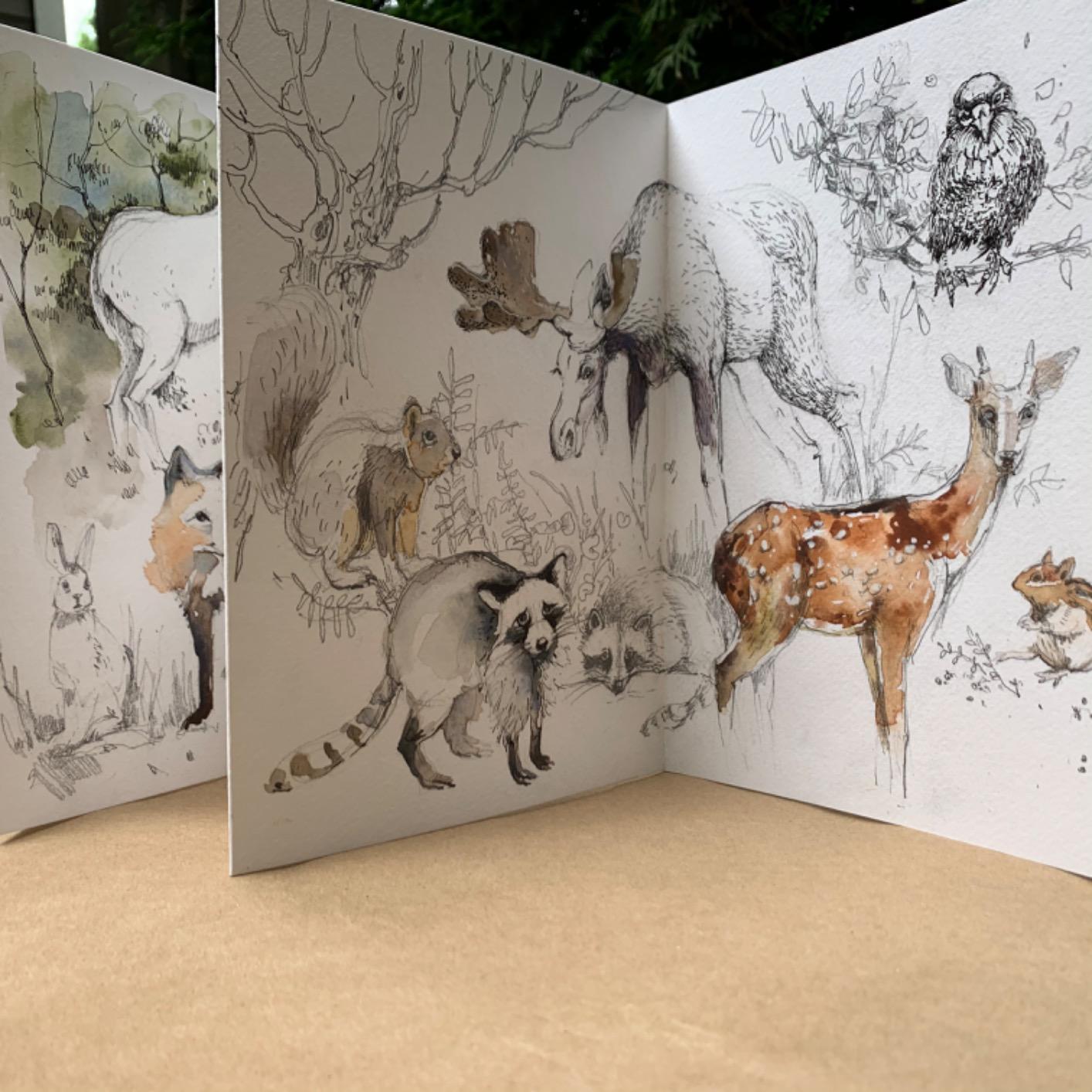
The Hahnemuhle Zigzag A6 Watercolor Book changed how I think about travel sketchbooks. The accordion fold means there is no binding in the traditional sense — the paper just folds back and forth in a continuous strip. You can work across the entire spread without any spine resistance, and the format encourages panoramic compositions that a regular book simply cannot do.
I used the Zigzag for a continuous sketch of a waterfront promenade. I worked across the entire 18-sheet strip, painting the scene from left to right as if it were one long canvas. The result looked like a hand-drawn postcard you could fold up and mail home — which, in fact, you could. Several urban sketchers on YouTube use these books as portable gallery pieces.
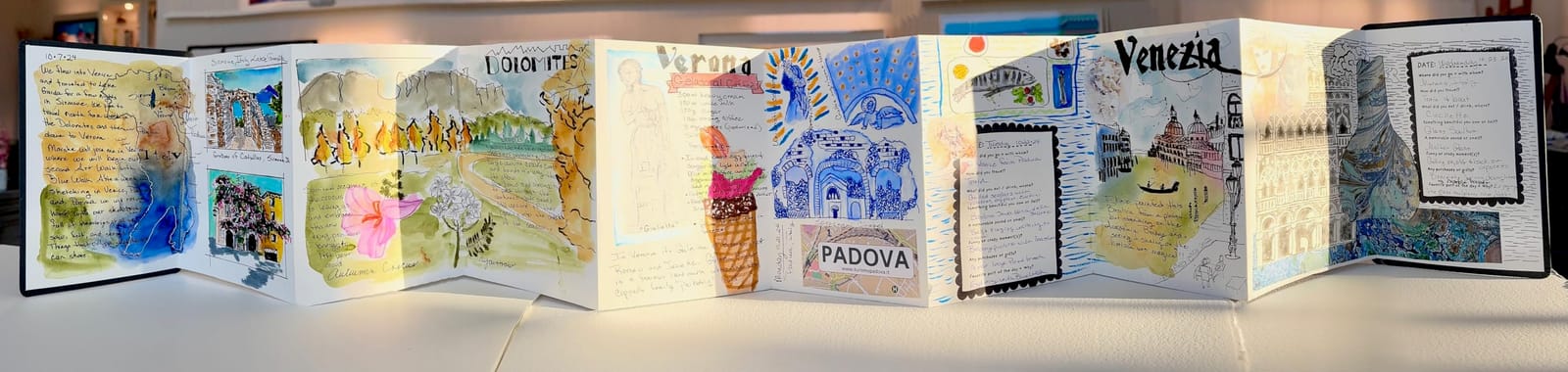
The paper quality is classic Hahnemuhle. 300gsm cotton watercolor paper that handles any wet technique without bleeding or buckling. I tested full wet-on-wet washes and the pages stayed flat and held the pigment beautifully. If you have used Hahnemuhle watercolor paper before, you already know what to expect.
Why the accordion format is brilliant for travel
No binding means no spine to fight. This sounds like a small thing until you try to sketch a two-page spread in a traditional book. The spine curve forces you to work on a single page or to accept a visible crease down the middle. The accordion format eliminates that problem entirely.
The other travel advantage is flexibility. You can fold the Zigzag into different configurations depending on your working situation. Fold it up for a small composition, fan it out for a panorama, or even tear along the perforations if you want individual sheets. The format adapts to your scene, not the other way around.
Trade-offs of the Zigzag format
The 18-sheet count is short. For a serious urban sketching trip, you may need to bring two or three Zigzag books. The price-per-sheet is also higher than bound books, so you are paying a premium for the unique format.
The accordion format is also unconventional. If you are used to working in a traditional book, the lack of a cover and the continuous strip can feel strange at first. I found it took a few sessions to adjust, but once I did, the format became a creative feature rather than a limitation.
9. Hahnemuhle Zigzag 5.5×5.5 Watercolor Book — Best Square Format
Hahnemuhle Zigzag Accordian Watercolor Book 5.5X5.5 Inches 300gsm 18 Pages
5.5x5.5 inch accordion
18 sheets 300gsm
Acid-free
Premium paper
Pros
- Premium 300gsm watercolor paper from trusted Hahnemuhle brand
- Square 5.5x5.5 inch format great for compact compositions
- Accordion layout allows continuous panoramic sketches
- Suitable for all wet painting techniques
- Lays completely flat without binding restrictions
Cons
- Higher price point than most competitors
- Only 18 sheets included
- Unconventional format may not suit traditional workflows
The Hahnemuhle Zigzag 5.5 x 5.5 inch is the square-format sibling of the A6 book above. If you liked the accordion concept but want a square format for centered compositions, this is the pick. I tested it on a trip focused on architectural details — doorways, fountains, café fronts — and the square format worked beautifully for these single-subject sketches.
Everything I said about the A6 Zigzag applies here: 300gsm cotton paper, acid-free, lays completely flat, panoramic possibilities. The difference is the page shape. Square pages force you to make deliberate compositional choices rather than defaulting to horizontal landscapes.
For urban sketchers who focus on single buildings or street corners, the square format encourages stronger compositions. I found myself drawing more carefully because the square demanded balance. The book also photographs well as a finished piece — square pages look intentional in a portfolio.
Why the square format suits urban sketching
Most urban scenes are vertical or centered — buildings rise up, doorways are square, fountains sit in the middle of a plaza. A square format matches these compositions naturally. You do not have to fight the page proportions to fit a tall building or a centered subject.
The square format also pairs well with the accordion spread. You can sketch four squares in sequence, each a different view from the same spot. The result reads like a contact sheet of a single location, which is a beautiful travel journal format.
Considerations before buying
Same caveats as the A6 Zigzag: 18 sheets is short, price-per-sheet is high, and the unconventional format takes adjustment. If you have not used an accordion book before, try the A6 first since it is more versatile.
The square format will frustrate sketchers who prefer long horizontal scenes — coastlines, skylines, wide streetscapes. For those subjects, a traditional landscape-format book is the better tool. The square format is for the urban detail sketcher.
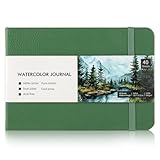
10. Prudiut Watercolor Journal 4×6 — Most Compact for Travel Watercolor
40 Sheets Watercolor Journal 4x6in, 140 lb/300 GSM Watercolor Sketchbook Cold Press Watercolor Paper Watercolor Notebook for Art Painting, Drawing, Mixed Media
4x6 inch wire-bound
80 pages 300gsm cotton
Cold-pressed
Elastic
Pros
- 4.8 rating with 87 percent five-star reviews
- Cotton watercolor paper with strong water absorption
- 40 sheets (80 pages) substantial creative space
- Cold-pressed design suitable for wet and dry media
- Wire-bound with micro-perforations for easy tear-out
- Elastic band keeps artwork secure during travel
- Green leather cover with rounded corners
Cons
- Limited product review history
- Newer brand with less established reputation
The Prudiut Watercolor Journal is the highest-rated book in this roundup at 4.8 stars. That rating caught my attention because higher ratings on Amazon do not always correlate with better products — but in this case, the consensus seems to be real. After testing it across two weeks of urban sketching, I understand why users are enthusiastic.
The 4 x 6 inch format hits a sweet spot. It is larger than the pocket 3.5 x 5.5 books, giving you more compositional room, but still small enough to carry in a coat pocket or small messenger bag. The wire-bound spine opens flat, and the micro-perforations let you tear out finished work cleanly when you want to mail it home or frame it.
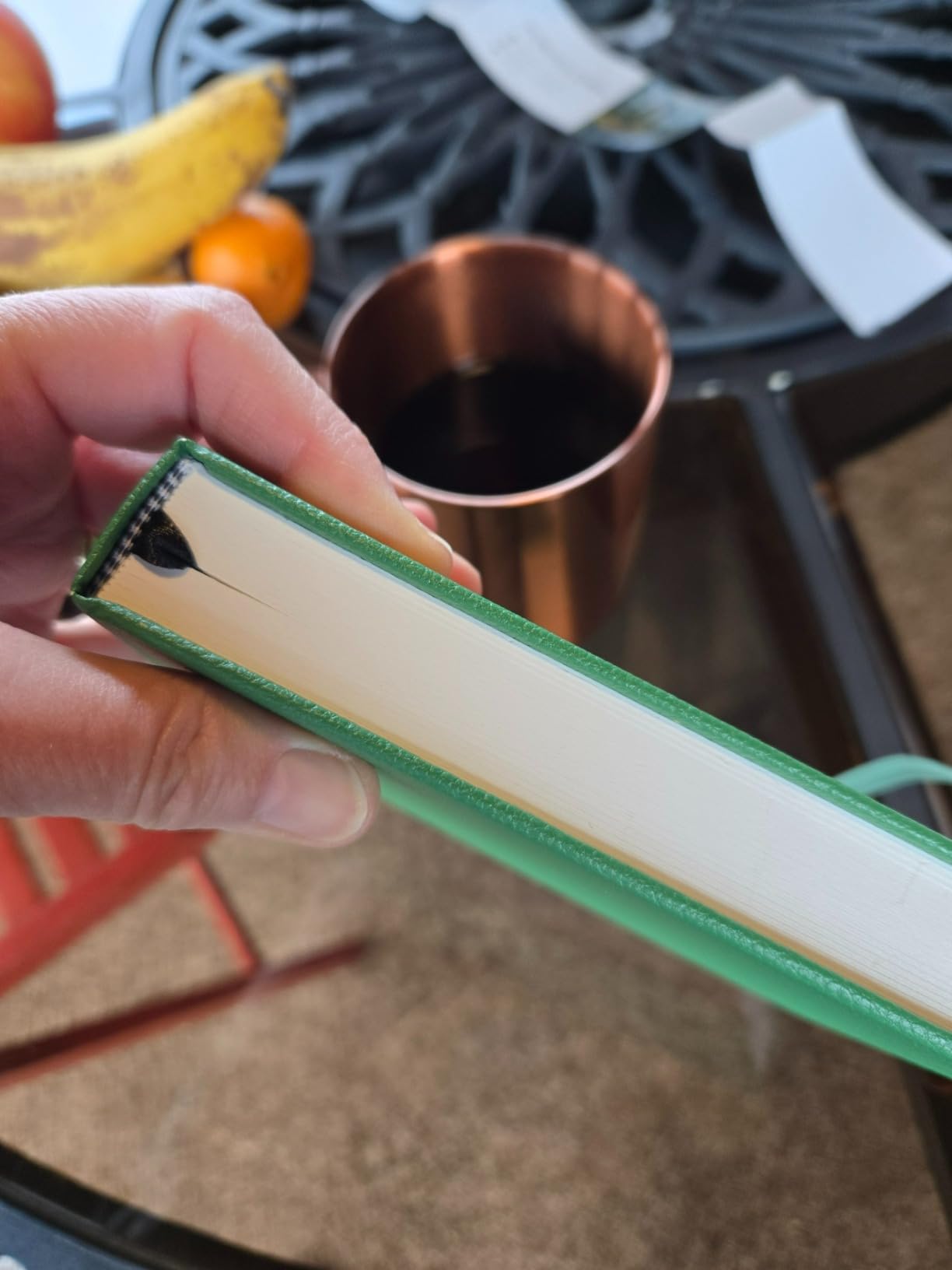
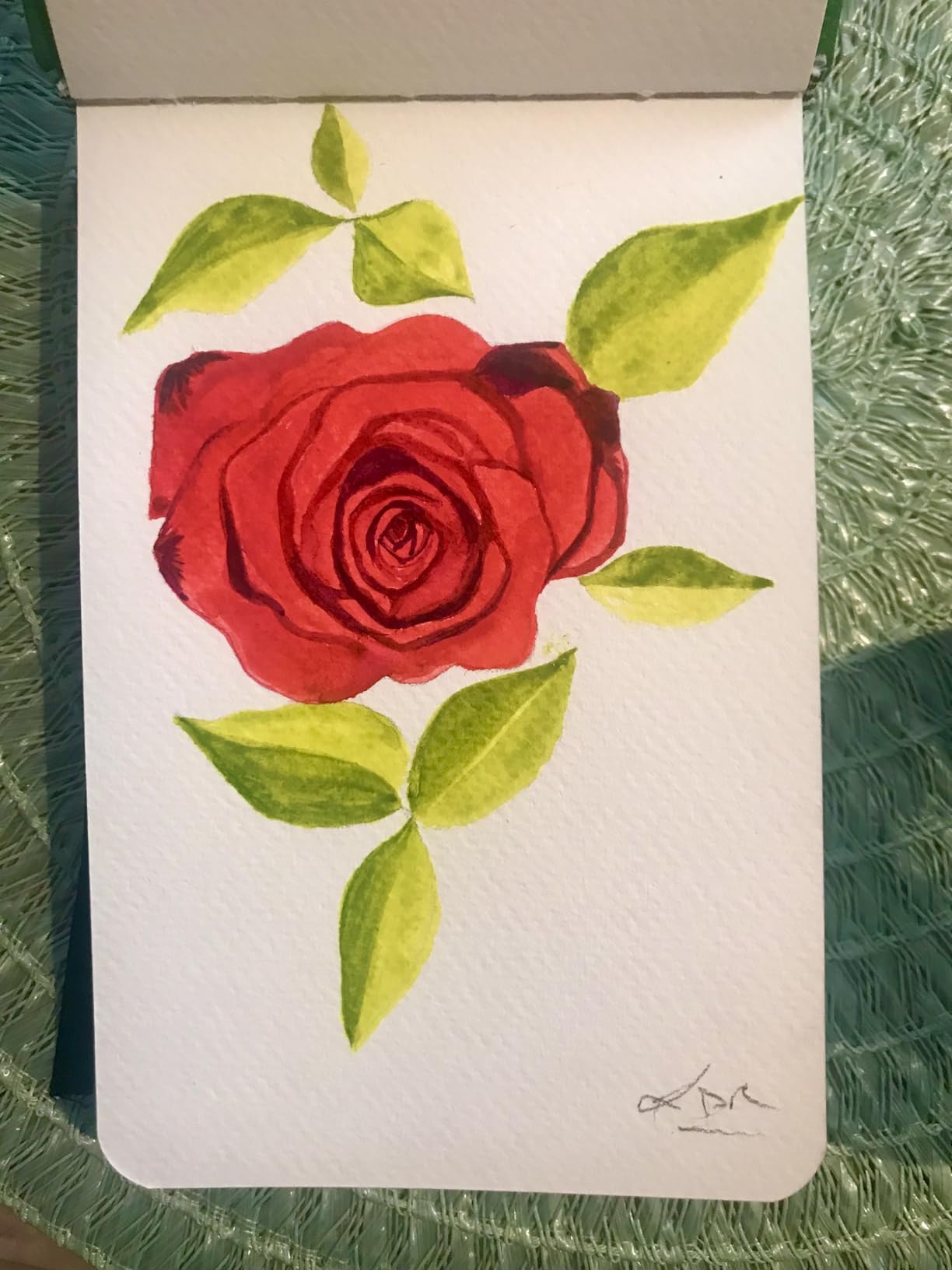
The 300gsm cotton paper takes watercolor beautifully. I tested a full wet-on-wet wash and the page held without bleeding or buckling. The cold-pressed surface has good tooth for both pencil and brush, which makes this book versatile across media.
Why the Prudiut punches above its price
40 sheets (80 pages) is double what most pocket watercolor books offer. For a two-week trip, this single book should be enough — even with daily sketching. The elastic closure keeps the book from springing open in your bag, and the rounded corners prevent the dog-earing that ruins square-cornered paper.
The wire-bound format has another advantage I appreciate — it lets the book fold completely back on itself. If you are sketching standing up and need to hold the book in one hand, the wire binding lets the back cover tuck behind the front pages, giving you a stable drawing surface without a separate sketch board.
Honest concerns about the Prudiut
Prudiut is a newer brand with less review history than the others on this list. The 4.8 rating is impressive, but the 211 reviews mean a smaller sample size than books with thousands of reviews. There is some risk that quality could vary between batches.
The wire binding can catch on bag linings. Several urban sketchers on Reddit complain that wire-bound books snag inside messenger bags. I did not have this problem in my testing, but if you carry your book in a fabric-lined bag, consider a slipcase or a softcover alternative.
How to Choose a Travel Sketchbook for Urban Sketching?
Choosing the best travel sketchbook for urban sketching comes down to five factors: paper weight, paper texture, size, binding, and cover. Understanding these will help you pick the right book from the roundup above, or evaluate any sketchbook you find in a local art store.
Paper Weight and GSM
Paper weight is measured in GSM (grams per square meter). For dry media like pencil and ink, 80 to 120gsm is enough. For light watercolor, 200gsm is the minimum. For heavy watercolor and wet-on-wet techniques, 270 to 300gsm is the standard. Anything below 200gsm will buckle the moment you apply water.
If you are a beginner, do not stress over GSM. A 200gsm book like the Moleskine Watercolor Album will handle most beginner work. As you progress to heavier washes, upgrade to 270 or 300gsm. The tumuarta and Prudiut both offer 300gsm in pocket formats at reasonable prices.
Cold-Pressed vs Hot Press vs Smooth Paper
Cold-pressed paper has a slight tooth — a textured surface that catches pigment and gives watercolor paintings a granular, organic look. This is the most popular surface for urban sketchers because it handles both wet and dry media well. Most of the books in this roundup use cold-pressed paper.
Hot press paper is smooth. It is the choice for ink artists and detailed line work, because fountain pens and fineliners lay down crisp lines without feathering. The ZenART B6 uses hot press paper and is a great pick for pen-and-ink urban sketchers.
Toned paper comes in grey, tan, or other mid-tones. It is the choice for dramatic urban scenes with strong light and shadow, because the mid-tone is already built into the page. The Vienrose and Hahnemuhle Nostalgie are the toned paper options in this guide.
Size and Portability
A5 landscape (5.5 x 8.3 inches) is the most popular travel sketchbook size. It fits in a backpack, lets you paint across two pages, and stays light. Pocket (A6 or smaller) is great for quick studies but runs out of room on long trips.
Square formats like 5.5 x 5.5 inches are unusual but well-suited to urban sketching. They encourage centered compositions — single buildings, doorways, fountains — and pair well with accordion books like the Hahnemuhle Zigzag.
Binding Type
Lay-flat binding is critical for urban sketching. Stitched bindings (like the Leda and Handbook Travelogue) open to 180 degrees without spine tension. Perfect-bound (glued) books force you to work on a single page at a time. Wire-bound books lay flat and let you tear out pages, but the wire can catch on bag linings.
Accordion bindings (like the Hahnemuhle Zigzag) eliminate binding restrictions entirely. The paper folds back and forth in a continuous strip. This is the most flexible format but also the least familiar to traditional sketchers.
Cover Type and Travel Protection
Hardcover books protect pages from bending and pressure in your bag. They are heavier but more durable. The Moleskine and Handbook Travelogue are hardcover picks in this roundup.
Softcover books are lighter and slimmer. They are more comfortable to carry but less protective. The Leda, ZenART, and Pentalic are softcover picks. Water-repellent covers like the ZenART and Pentalic add an extra layer of rain protection.
Best Travel Sketchbook for Specific Situations
Best Travel Sketchbook for Watercolor
For watercolor, the tumuarta and Prudiut offer the best balance of paper quality, format, and value. Both feature 300gsm cotton cold-pressed paper in a portable format. The Leda and Moleskine work for light watercolor but will buckle under heavy washes.
Best Travel Sketchbook for Beginners
For beginners, the Moleskine Art Watercolor Album is the safest pick. It is widely available in art stores worldwide, the paper is reliable, and the format is standard. As your skills develop, you can move up to 300gsm books without changing your sketching habits.
Best Pocket Sketchbook for Travel
For pure pocket portability, the Leda Art Supply Pocket Sketchbook is my top pick. The stitched binding, premium paper, and 160-page count make it the most capable pocket book on this list. The Pentalic is even smaller for sketchers who want maximum portability.
Best Sketchbook for Fountain Pen
For fountain pen artists, the ZenART B6 with its 120gsm hot-pressed paper is the best pick. The smooth surface prevents feathering, and the water-repellent cover protects against ink spills. The Pentalic is also a strong fountain pen pick at a smaller size.
Caring for Your Travel Sketchbook on the Road
A travel sketchbook takes abuse that studio books never face. Here are the tips I have learned after dozens of trips.
Insert paper dividers between wet pages. The single biggest cause of ruined sketchbook pages is wet pigment transferring to the facing page. Carry a few sheets of tracing paper or blank newsprint as dividers. Slip one between any wet wash and the next page.
Pre-stretch watercolor pages if you plan to flood washes. Lightly mist the page, then tape the edges to a board. The paper dries taut and resists buckling under heavy water. This is a 10-minute setup that saves you from wavy pages for the rest of the trip.
Store the book in a waterproof sleeve or zip-lock bag in your luggage. A cheap gallon-size zip-lock bag protects against rain, spills, and the dreaded water bottle that leaks inside your backpack. I keep one in my daypack at all times.
Keep an elastic band tight. The single most common cause of damaged sketchbooks is the elastic closure failing and pages springing open. If the elastic stretches or weakens, replace it with a thick rubber band from a stationery store.
Frequently Asked Questions
What is the best sketchbook for urban sketching?
The best sketchbook for urban sketching depends on your medium. Stillman and Birn Beta and Hahnemuhle watercolor books are community favorites for serious watercolor. For mixed media and portability, the Leda Art Supply Pocket Sketchbook (160 pages, stitched binding, vegan leather cover) is a strong all-around pick that fits in a jacket pocket and handles pencil, ink, and light watercolor.
What type of paper is best for urban sketching?
Cold-pressed watercolor paper with 200 to 300 GSM weight works best for most urban sketchers. Cold-pressed paper has a slight tooth that holds pigment and works well for both pencil and ink as well as watercolor. Hot press (smooth) paper suits ink and markers; toned paper is great for highlights and dramatic urban scenes with strong light and shadow.
Are Moleskine sketchbooks good for watercolor?
Moleskine Watercolour sketchbooks are convenient and travel-friendly but use 200gsm cold-pressed paper that warps with heavy washes. For light watercolor and ink work they are reliable and widely available. For serious watercolor use, upgrade to 270gsm or heavier sketchbooks like the tumuarta or Prudiut, which offer 300gsm cotton paper in similar pocket formats.
What size sketchbook is best for travel?
A5 landscape (roughly 5.5 by 8.5 inches) is the most popular travel sketchbook size. It fits in a backpack, lets you paint across two pages, and stays light enough to carry all day. Pocket (A6 or 3.5 by 5.5 inch) is great for quick studies but runs out of room on long trips. Many urban sketchers carry both — a pocket book for daily sketches and an A5 for finished work.
How many pages does a travel sketchbook need?
For a one to two week trip, 30 to 60 pages (15 to 30 sheets) is plenty for most urban sketchers. For longer trips, look for books with 80 to 160 pages or consider refillable covers like Travelers Company style inserts, which let you swap in fresh pages without discarding finished work.
Final Verdict: The Best Travel Sketchbook for Urban Sketching
After testing these 10 sketchbooks across pencil, ink, and watercolor, the Leda Art Supply Pocket Sketchbook is my top pick for the best travel sketchbook for urban sketching. It pairs a pocketable 3.5 x 5.5 inch format with 160 pages of cream-tone paper, a stitched lay-flat binding, and a vegan leather cover that has survived a year of travel. With nearly 6,000 reviews averaging 4.7 stars, it is also the safest choice if you want community-validated quality.
If you need serious watercolor capability, the tumuarta and Prudiut both offer 300gsm cotton paper in portable formats. The tumuarta is the budget pick with hardbound linen cover, while the Prudiut offers the highest rating and most page count. For pen and ink work, the ZenART B6 with its smooth hot-pressed paper is hard to beat.
Whichever sketchbook you choose, the most important thing is to take it with you. Urban sketching is about capturing the world around you, and any of these 10 sketchbooks will serve you well on the streets, in cafés, and on the road in 2026.