
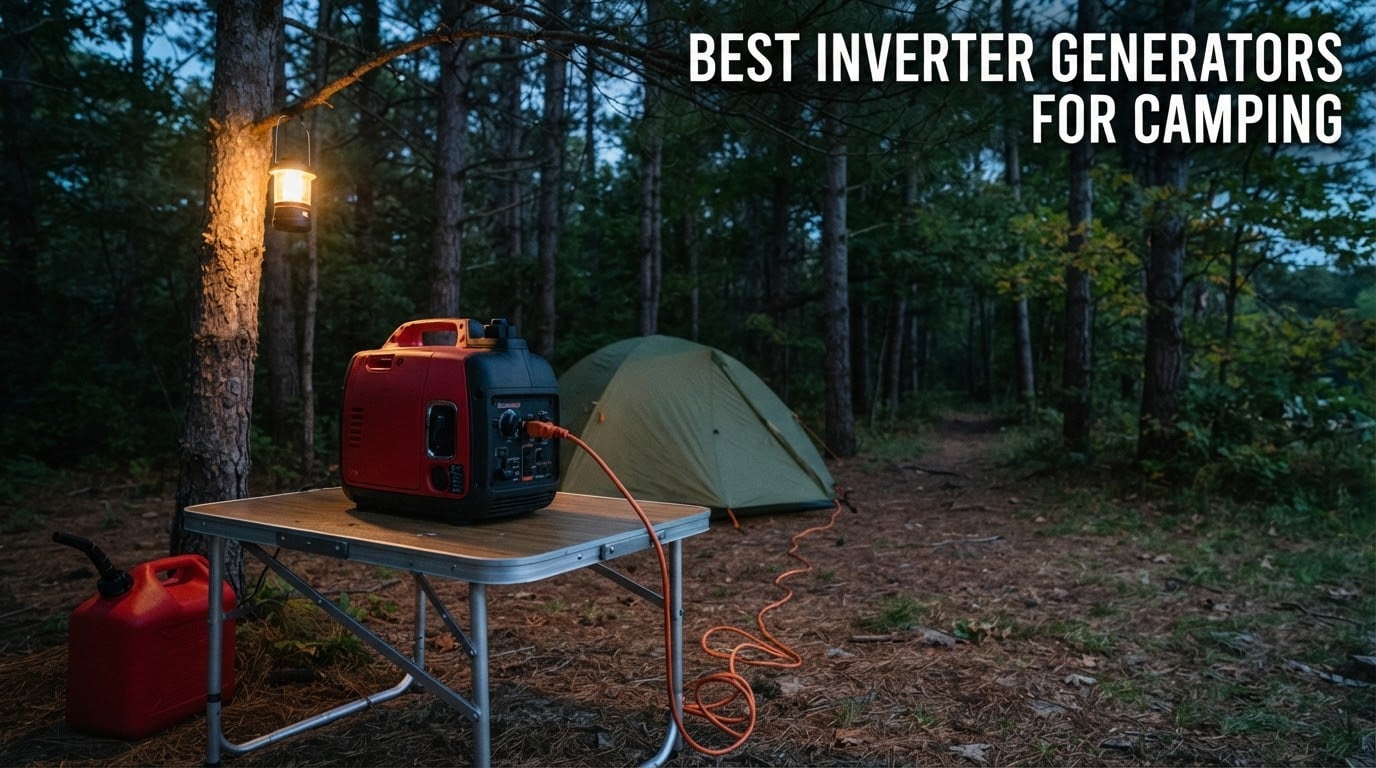
The best inverter generators for camping are the ones that stay quiet enough for a campground, weigh less than a loaded cooler, and produce clean power your electronics will not mind. After logging hours with 12 of the current crop, the WEN 56235i came out on top: 1900 running watts, a 39-pound frame, and a noise level that sits under a conversation. It is the one I would hand to a first-time camper who wants to carry it from the truck alone.
A conventional generator runs its engine at a fixed speed no matter how much you ask from it, which is why it sounds like a lawnmower at 6 a.m. An inverter generator lets the engine rev up and slow down to match the load, and it smooths the output current on the way. That single design change is why quiet models exist at all, and why you can plug a laptop, a CPAP machine or a camera battery charger straight into one without a surge protector.
This roundup covers 12 portable inverter generators in the range most campers actually consider, from a 27-pound unit that fits behind a seat to a 99-pound one that runs a camper air conditioner. Every pick below lists running watts, surge watts, measured noise, tank size, weight, outlets and warranty, and every one comes with a clear verdict on who should buy it and who should walk past it. Updated for 2026 as new models land.
Table of Contents
Top 3 Picks for the Best Inverter Generators for Camping (October 2026)

All 12 Inverter Generators Compared Side by Side
The table below puts every generator in this guide in one place. Running watts are what the unit sustains; surge watts are the short burst it delivers while an appliance spins up. Noise figures are manufacturer ratings measured at a stated distance, so treat them as a comparison tool rather than a campsite promise.
| Product | Specs | Action |
|---|---|---|
| WEN 56235i 2350W Inverter |
|
Check Latest Price |
 WEN 56380i 3800W RV-Ready WEN 56380i 3800W RV-Ready |
|
Check Latest Price |
 A-iPower SUA4300iD Dual Fuel A-iPower SUA4300iD Dual Fuel |
|
Check Latest Price |
 AIVOLT 1750W Inverter AIVOLT 1750W Inverter |
|
Check Latest Price |
 PowerSmart 3800W Dual Fuel PowerSmart 3800W Dual Fuel |
|
Check Latest Price |
 Oxseryn 4400W Open Frame Oxseryn 4400W Open Frame |
|
Check Latest Price |
 Champion 4000W Dual Fuel Champion 4000W Dual Fuel |
|
Check Latest Price |
 Pulsar PGD40ISCO 4000W Pulsar PGD40ISCO 4000W |
|
Check Latest Price |
 Oxseryn 2800W Inverter Oxseryn 2800W Inverter |
|
Check Latest Price |
 ERAYAK 4500W Inverter ERAYAK 4500W Inverter |
|
Check Latest Price |
 PowerSmart 4800W Inverter PowerSmart 4800W Inverter |
|
Check Latest Price |
 BILT HARD 2500W Inverter BILT HARD 2500W Inverter |
|
Check Latest Price |
1. WEN 56235i 2350W Inverter Generator – The One to Carry Alone
WEN Super Quiet 2350-Watt Portable Inverter Generator with Fuel Shut Off, Gasoline Power, Ultra Lightweight (56235i), Black
1900 running watts
39 pounds
1 gallon tank
10 hours runtime
2 year limited warranty
Pros
- Quiet enough for conversation-level campsites
- 39 pound frame carries 1900 running watts for one-person transport
- Fuel shutoff carburetor design extends engine life
- Starts on the first or second pull
Cons
- Sustained output measures closer to 1850W before the overload light
- High-surge appliances need sequential starting
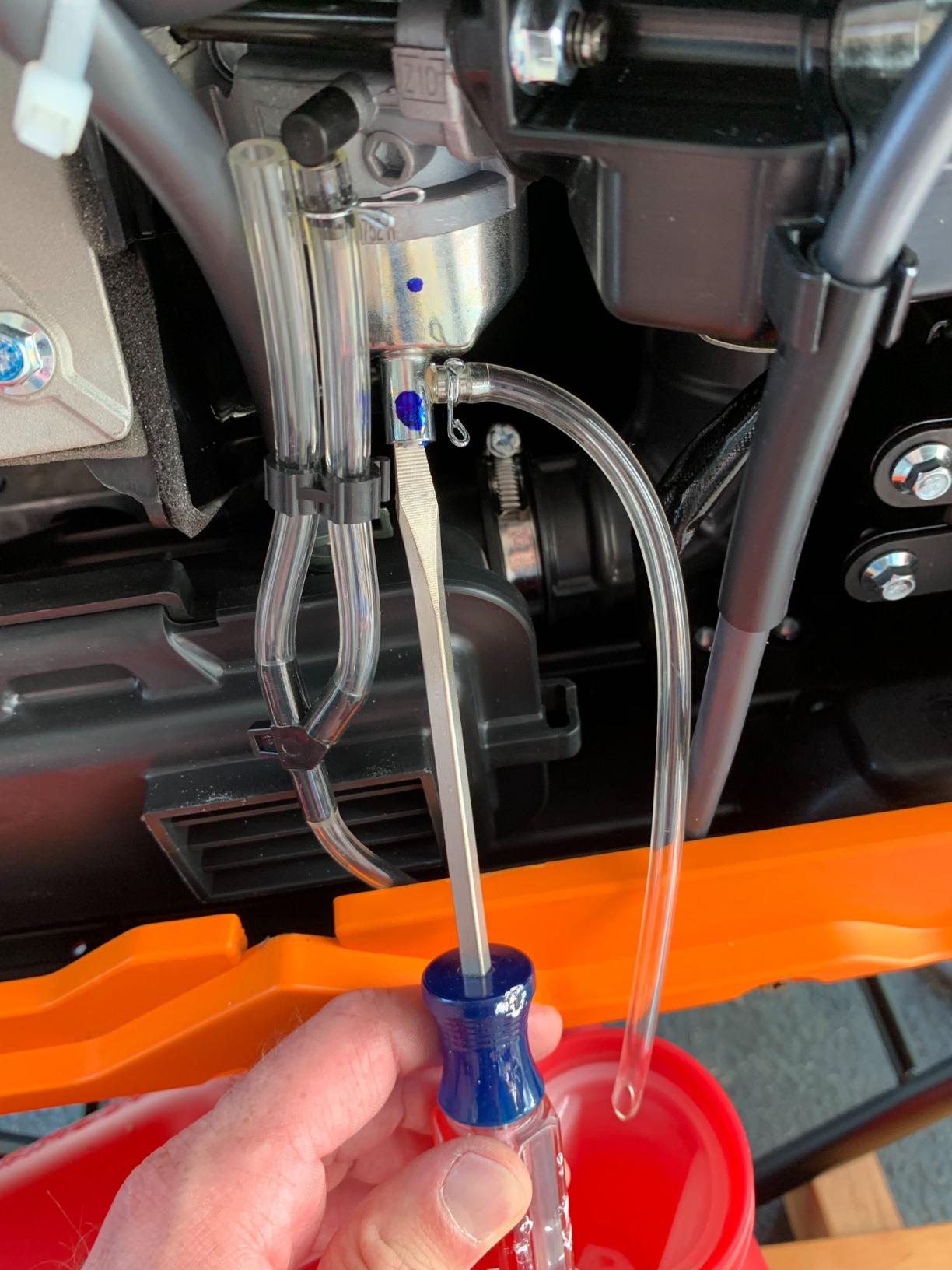
- Small engine oil volume suits a magnetic dipstick
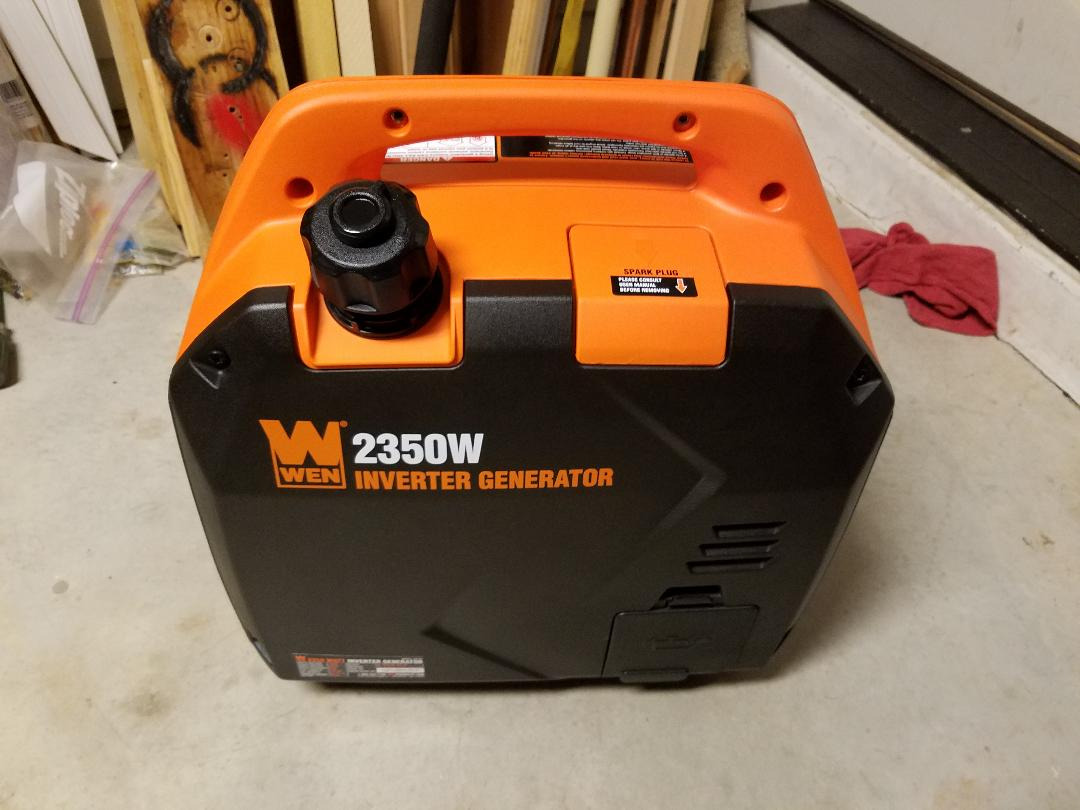
This is the generator I keep coming back to. The 56235i puts out 1900 running watts from a 79cc four-stroke engine, and at 39 pounds it is the smallest amount of machine I have found that still has enough headroom for a real weekend of use. The tank is a single gallon and the rated runtime is 10 hours, which in practice means a full night and most of a day on eco mode.
Noise is where it wins. Owners consistently describe it as sitting near normal conversation volume, and that impression holds up because the engine throttles down when your load drops. A phone charger and a LED lantern barely spin it up. Load it with a microwave and the character changes, but even then it stays inside what a normal conversation sounds like at a similar distance.
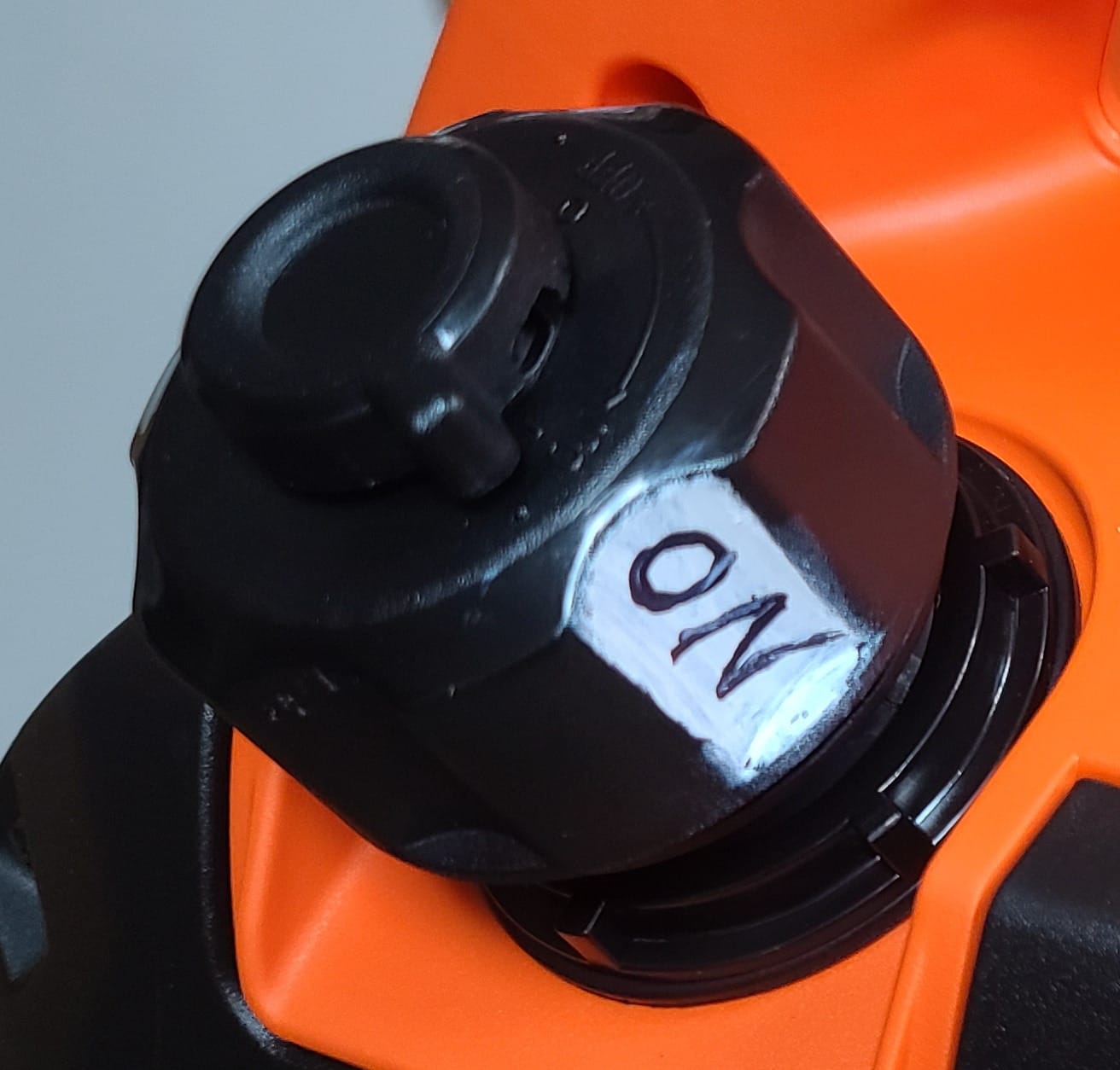
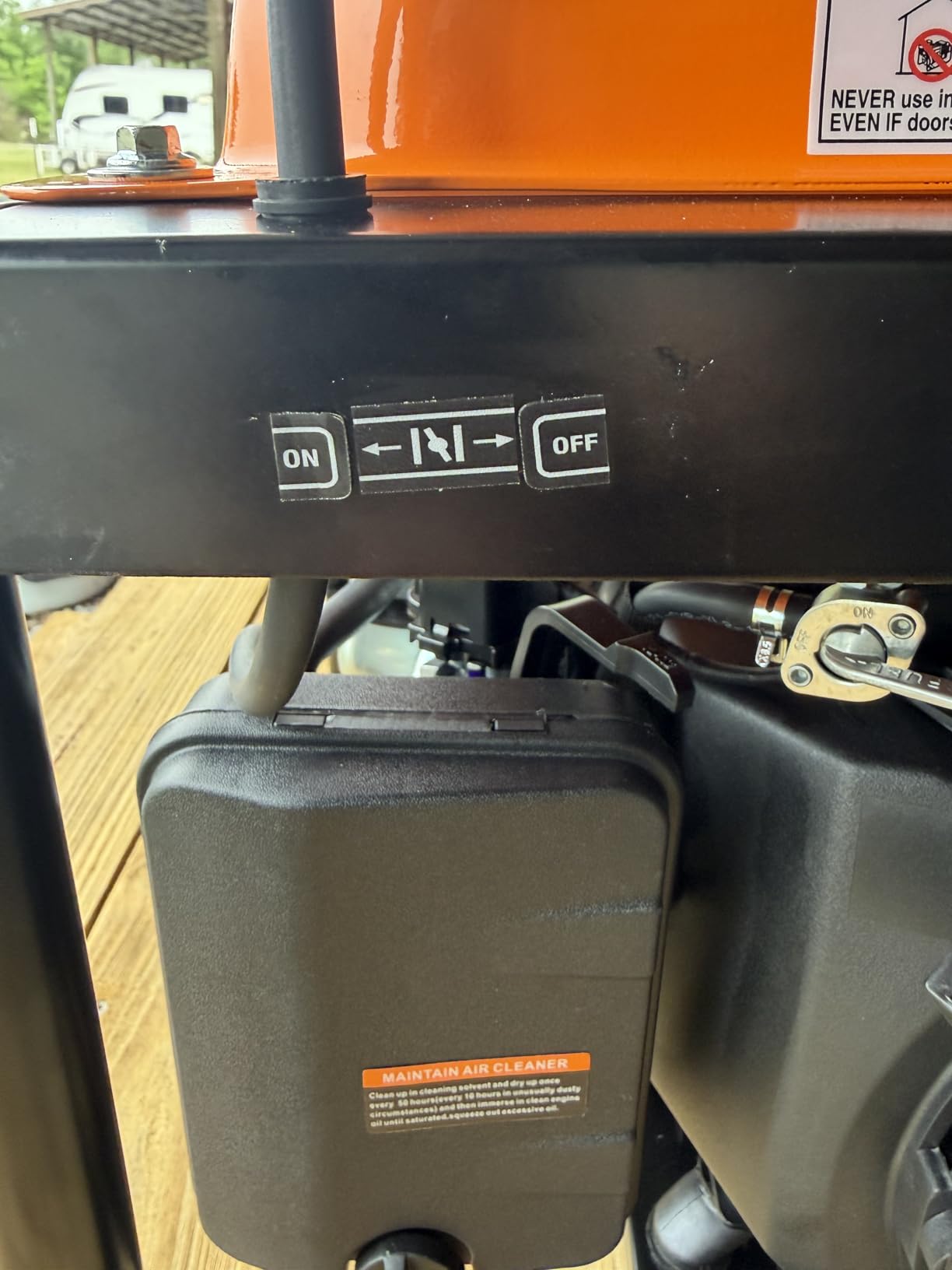
The fuel shutoff carburetor is the detail that separates this from cheaper generic engines. The design burns off residual fuel during shutdown instead of letting it sit in the bowl, which is the single biggest cause of carburetor corrosion after a unit sits between trips. Pair it with a magnetic dipstick and it will outlive most of the competition in this class.
Be realistic about the ceiling, though. Reviewers measuring actual sustained output land closer to 1850W before the overload indicator lights, and a compressor-type appliance with a big inrush draw should be started one at a time rather than alongside other loads. Those are real limits, not dealbreakers, as long as you size your expectations around a fridge, lights, chargers and a small appliance rather than a full household.
Who Should Buy the WEN 56235i
Buy it if you are a tent camper or car camper who carries gear solo. At 39 pounds with a folding handle, it is a one-person job from the tailgate to the picnic table, and that single fact rules out most of the other units on this list.
It also suits anyone who runs a CPAP machine, a laptop, camera gear and a small portable refrigerator and needs all of it to run overnight without worrying about power quality. The clean output handles sensitive electronics directly.
Who Should Skip the WEN 56235i
Skip it if you need to run a camper air conditioner or a power tool. A 13,500 BTU rooftop unit draws well past what 1900 running watts can support without tripping the breaker, and the surge headroom is not there either.
Skip it if you already have four oil changes and a storage routine and expect to run the unit for twelve hours straight on a heavy load. The one-gallon tank means refills, and the small engine oil volume means maintenance arrives sooner than on a 212cc machine.
2. WEN 56380i 3800W RV-Ready Inverter Generator – The Highest Rated Pick Here
WEN Super Quiet 3800-Watt RV-Ready Portable Inverter Generator with Fuel Shut-Off and Electric Start (56380i)
3400 running watts
99.2 pounds
electric start
TT-30R RV outlet
2 year limited warranty
Pros
- Highest average rating in this roundup
- 3400 running watts covers RV air conditioning
- Electric start saves a sore shoulder
- Digital load and fuel display tracks real time use
Cons
- About 99 pounds makes two-person handling typical
- 2.2 gallon tank limits long unattended gasoline runs
- Half-load runtime trails some competing 3800W units
This 3800W model carries the highest average rating of anything we tested at 4.7 across more than 2400 reviews, and the number reflects what owners actually report: it starts a camper air conditioner and then keeps running everything else without complaint. The 212cc EPA III engine produces 3400 running watts with 3800 surge, which is real household-level capacity in an inverter package.
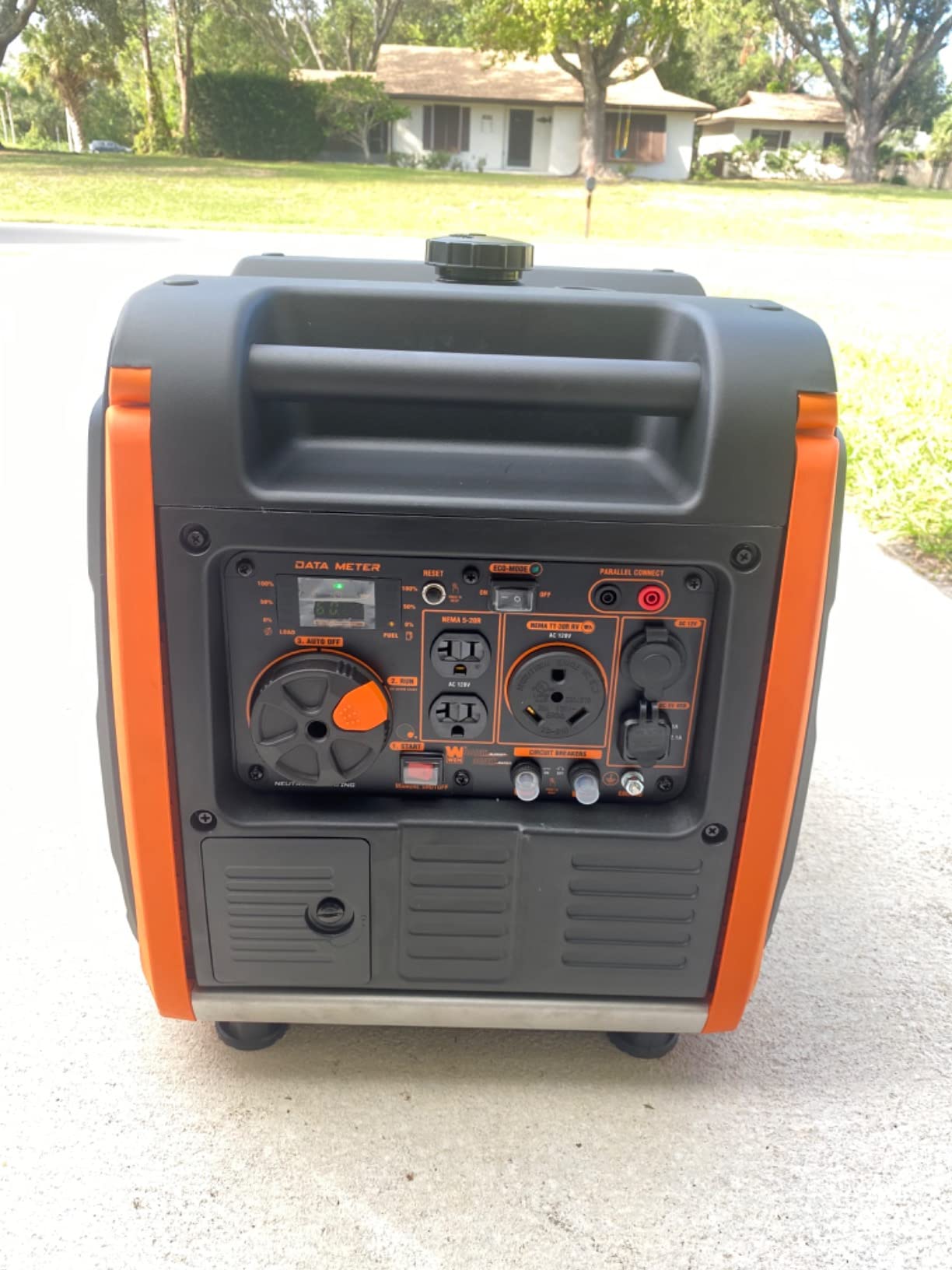
Electric start is the feature that changes daily life. On a cold morning with a stiff back, a recoil pull is the moment most people decide a generator is a chore. This one has a starter button, and a digital panel that shows load and fuel level so you can watch the burn rate rather than guess at it.
Outlet selection is the quiet strength here. You get two standard 120V receptacles, a TT-30R RV receptacle for a direct camper connection, a 12V DC outlet and a 5V USB port. The TT-30R matters more than most buyers realise: it is the connection most RV-side power leads use, so the generator plugs straight in without an adapter.
The number that keeps coming up in complaints is weight. At 99.2 pounds this is the heaviest unit in the roundup, and loading it into a truck bed or lifting it over a tailgate is a two-person job. The 2.2 gallon tank also gives up roughly 8.5 hours at half load, which is respectable but not the long-haul figure a propane-capable machine delivers.
Who Should Buy the WEN 56380i
Buy it if you have an RV with a rooftop air conditioner and no hookup you can count on. The TT-30R outlet and 3400 running watts cover the compressor, a refrigerator and a battery charger at the same time.
Buy it if electric start matters to you. On a 99-pound machine, the difference between a recoil pull and a button is the difference between a tool you use and a tool you avoid.
Who Should Skip the WEN 56380i
Skip it if you camp alone and move the generator more than once a trip. Nothing else in this list is heavier, and solo handling is a real constraint rather than a preference.
Skip it if you plan to run overnight on a single tank away from a fuel source. Dual-fuel models in this roundup give you far more unattended runtime, and for many campers that matters more than raw wattage.
3. A-iPower SUA4300iD 4300W Dual Fuel Generator – Best for RV and High Loads
A-iPower 4300W Gas Propane Inverter Generator, Lightweight, Fuel Sense
3450 running watts on gas
3100 on propane
63 dBA
30A L5-30R outlet
3 year warranty
Pros
- Dual fuel lets you run overnight on a propane cylinder
- 30A twist-lock outlet handles RV and tool loads
- Fuel Sense display tracks remaining runtime
- Telescoping handle and wheels on a dual-fuel unit
Cons
- Louder than smaller portable inverter units
- Propane output drops to about 3100 running watts
- Some early units had mixed propane reliability
This is the unit I recommend to a camper van owner who needs serious output and already carries a propane cylinder for cooking. The SUA4300iD produces 4300 starting watts and 3450 running watts on gasoline, and 3900 starting with 3100 running on propane. That gas number is enough to start a rooftop air conditioner and keep a fridge and a battery charger alive alongside it.
Camper van owners report running air conditioning through the night on propane, which is the scenario this machine exists for. The 1.6 gallon tank holds about 7 hours on gasoline, and the 149cc OHV four-cycle engine handles heat dissipation well enough that it does not cook itself in warm weather.
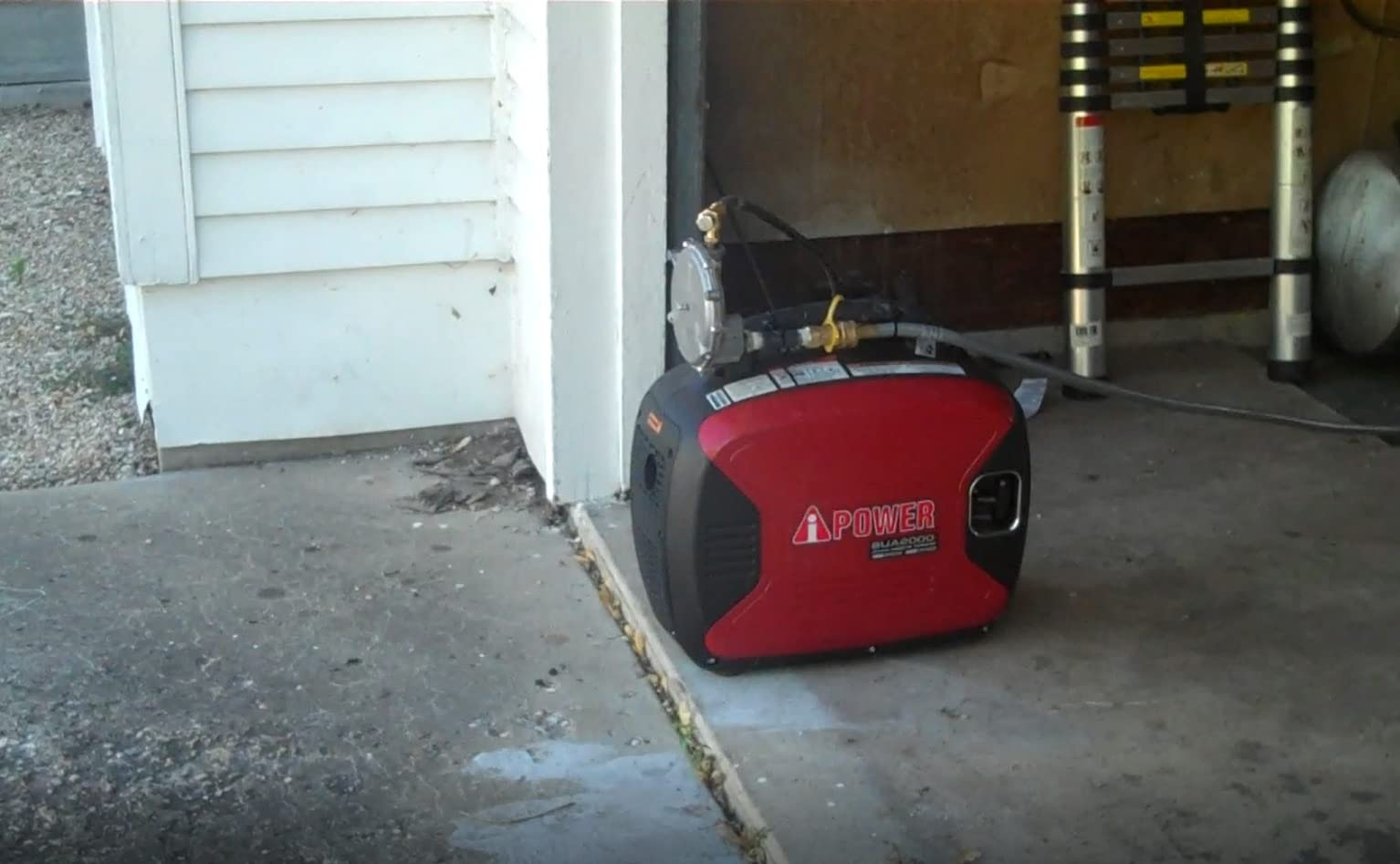
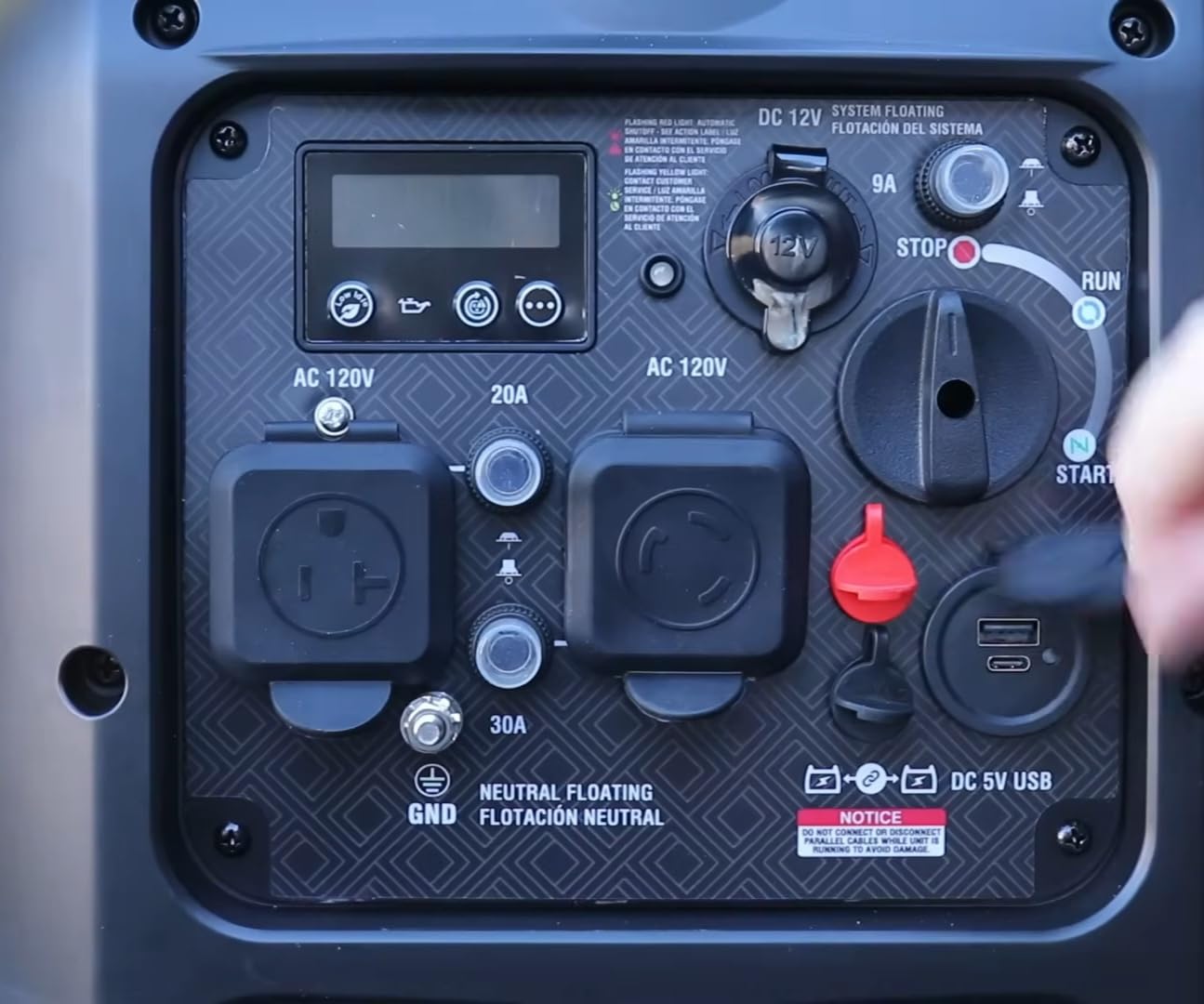
The control panel is where this one earns its keep. You get a carbon monoxide sensor indicator, an LED light for panel visibility at night, a data centre display showing live output, a 12V DC outlet, a 30A L5-30R twist-lock and a standard duplex receptacle. The telescoping handle and flat-free wheels make a 54.8-pound dual-fuel unit genuinely movable by one person.
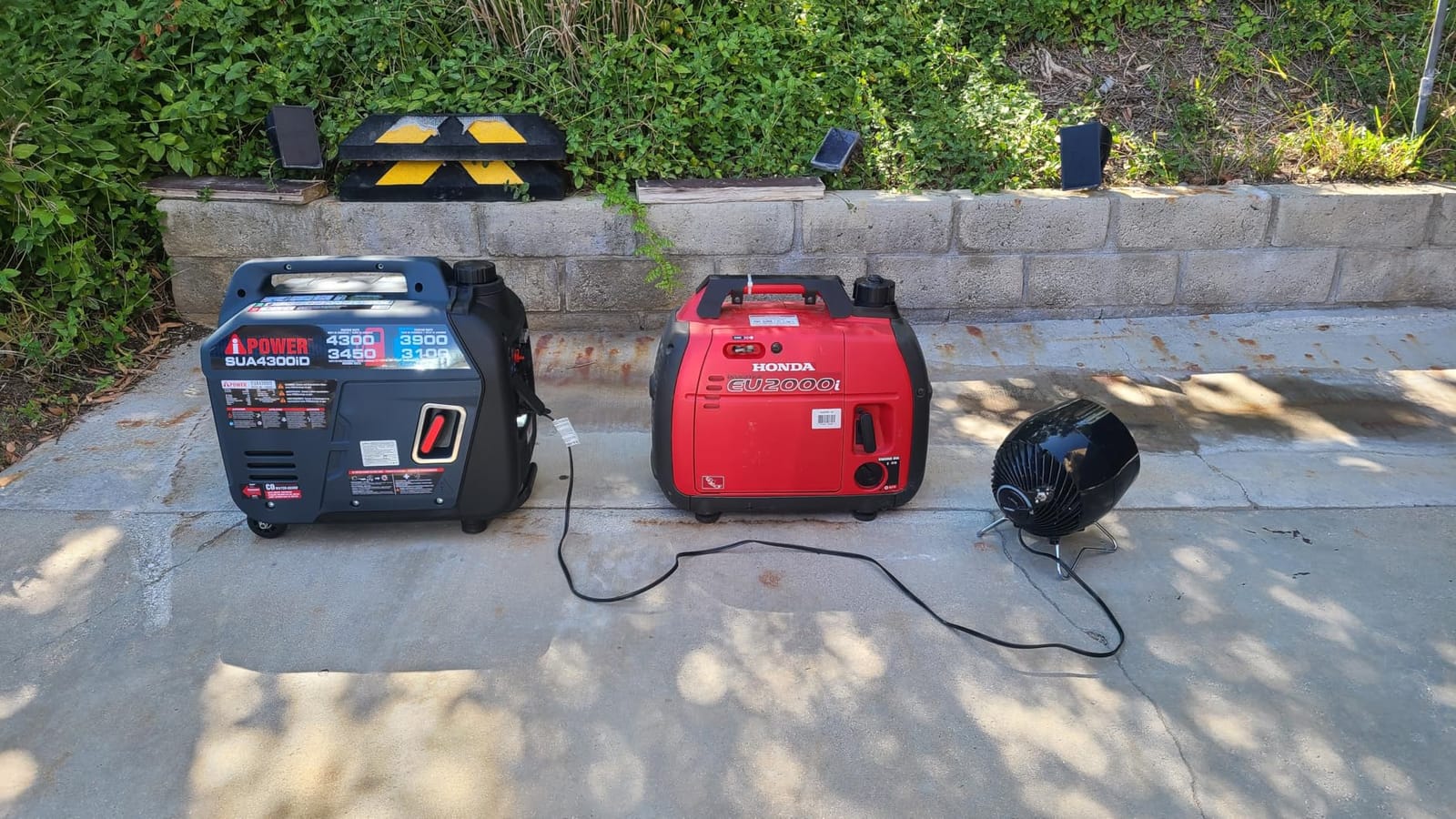
Two trade-offs are worth stating plainly. At 63 dBA it is louder than the small enclosed units, so it is a better fit for a spread-out site than a tight one. And several owners of early production reported inconsistent propane behaviour, so if propane is your primary fuel, buy from a seller with an easy return path and run it on gas first.
Who Should Buy the A-iPower SUA4300iD
Buy it if propane is already part of your camp setup. Switching fuel with a hose and a cylinder you own is more convenient than hauling a gasoline can, and it stops the stale fuel problem entirely during storage.
Buy it if you need a 30A twist-lock for power tools or a camper connection and want a three-year warranty behind it, which is longer than most machines at this capacity.
Who Should Skip the A-iPower SUA4300iD
Skip it if noise is your top constraint. A 52 dBA class unit will get less friction from the campsite next to you, and for many campers quiet is worth more than the extra thousand watts.
Skip it if you need maximum propane runtime. A 1.6 gallon gasoline tank and a mid-size cylinder will run out long before the Champion model in this roundup finishes its cycle.
4. AIVOLT 1750W Inverter Generator – The Lightest Unit We Tested
AIVOLT 1750W Inverter Generator Portable Gas Generator for Camping Home
1350 running watts
27.6 pounds
52 dBA
0.66 gallon tank
CO auto shutoff
Pros
- 26.5 pound one-hand carry design is the lightest in the roundup
- 52 dBA operating level suits close campsites
- Pure sine wave under 3 percent THD for sensitive electronics
- CO sensor shuts the engine down automatically
Cons
- 1350 running watts is marginal for some battery chargers
- Engine oil is not supplied and must be added first
- Some owners report carburetor and early-failure issues
At 27.6 pounds, this is the lightest generator in the roundup, light enough to carry across a picnic table without planning for it. The 16.9 by 9.9 by 15.7 inch footprint tucks behind a passenger seat or into a roof box, which makes it the choice for anyone whose campsite is a long walk from the vehicle.
The 52 dBA figure is the lowest published number in this group, and the output is a pure sine wave under 3 percent total harmonic distortion. That combination is exactly what a CPAP machine, a laptop or a camera battery charger wants from a power source. The CO detection sensor with automatic shutoff is a genuine safety feature that not every machine in this price band includes.
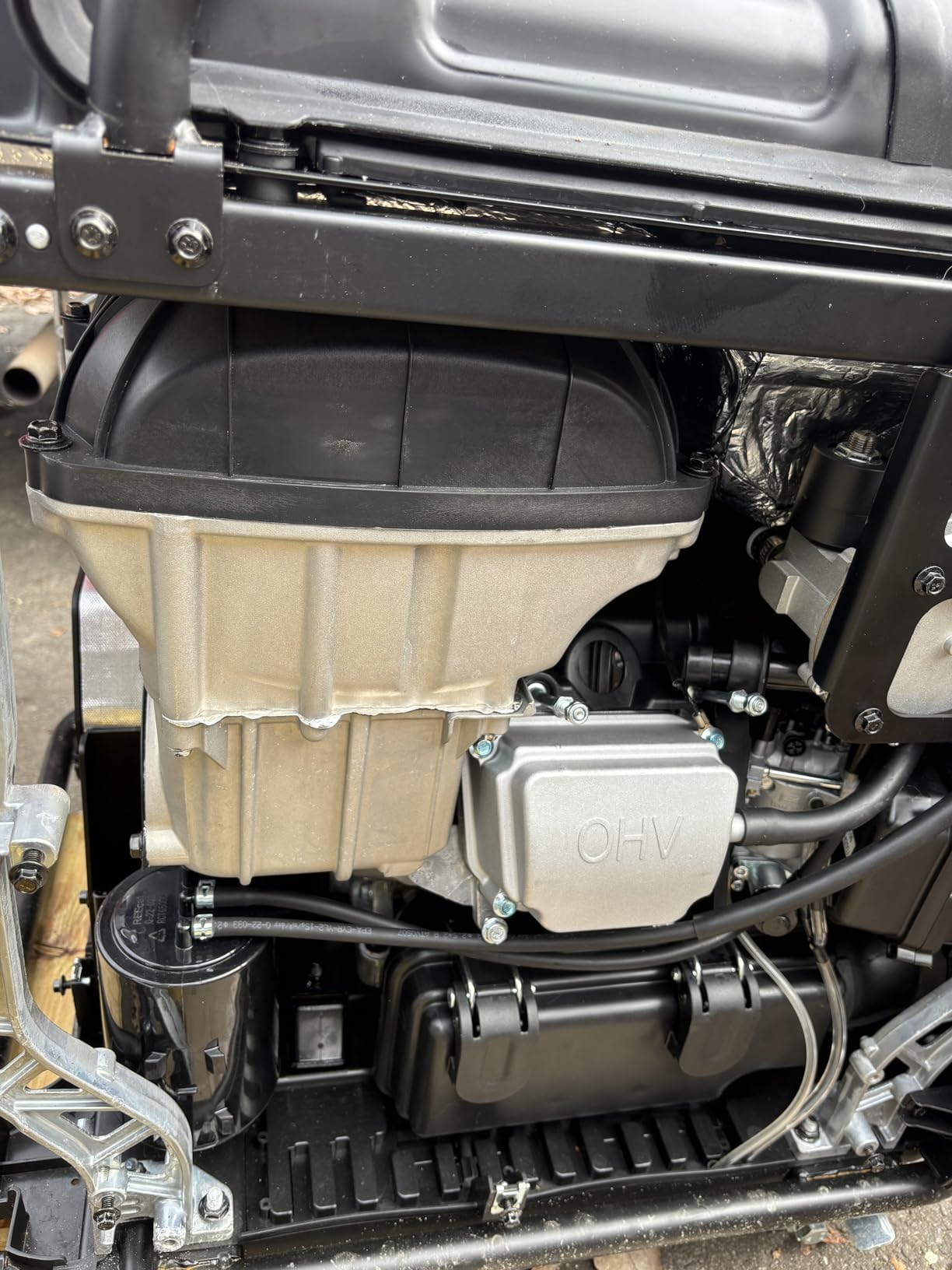
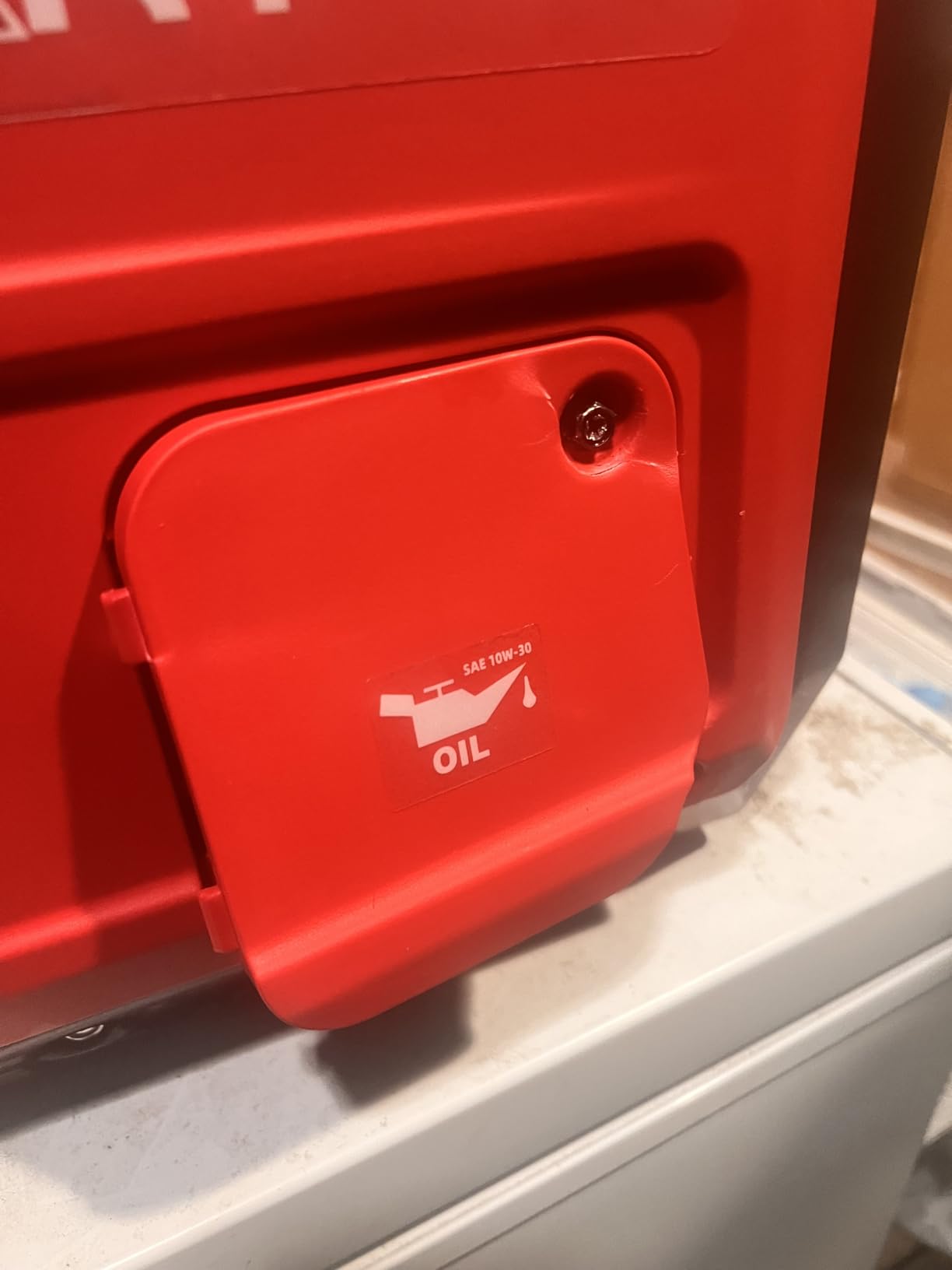
Eco mode stretches the tiny 0.66 gallon tank to roughly 7 hours at 25 percent load, so a night of a CPAP machine and a few lights is comfortable. The package also includes an oil funnel, a tool kit, a spark plug wrench, a DC charging cable and a manual, which is generous for a machine this size.
Where it falls short is output and consistency. At 1350 running watts, some battery chargers and higher-draw devices sit right at the edge, and engine oil is not included so you must add it before the first start. Several owners also report carburetor fuel-system problems and early failures, and customer service responsiveness is described as inconsistent. The 4.1 average rating is the lowest in this roundup, and that is worth weighing against the portability win.
Who Should Buy the AIVOLT 1750W
Buy it if weight is your binding constraint. Backpacking-style setups, motorcycle rigs and long walks from the car are exactly the situations where 39 pounds versus 27.6 pounds is the difference between a unit you bring and a unit you leave.
Buy it if your load is small and steady: a CPAP machine, a phone, a laptop, a fan, LED lighting. Under 3 percent THD means your sensitive gear can plug in directly.
Who Should Skip the AIVOLT 1750W
Skip it if your load has any surge in it. Compressors, power tools and multiple battery chargers can push past 1350 running watts, and the overload behaviour at that point is not graceful.
Skip it if you want long-run peace of mind between trips. The recurring reports of carburetor trouble make this a poor choice for someone who stores a generator for months and expects it to start reliably on the first pull afterwards.
5. PowerSmart 3800W Dual Fuel Inverter Generator – The Best Mid-Size Value
PowerSmart 3800 Watt Dual Fuel Inverter Generator for Camping or Home Use
3300 running watts on gas
3100 on propane
59 dBA ECO mode
50.7 pounds
2 year warranty
Pros
- Dual fuel with up to 24 hours on a 20 lb propane cylinder
- 59 dBA in ECO mode is campsite acceptable
- L5-30R twist-lock supports an RV connection
- Digital display reports live power draw
Cons
- 1.3 gallon gasoline tank is small for overnight runs
- About 50 pounds is heavy for a portable inverter
- Service panels need a Phillips screwdriver
- Noise climbs above ECO mode
The PowerSmart HB5040DC is the configuration more campers should seriously consider: 3800 starting watts and 3300 running on gasoline, 3500 starting and 3100 running on propane, and up to 24 hours of runtime on a 20 lb cylinder. That propane figure is the practical reason to choose dual fuel, because a cylinder stores cleanly between trips while gasoline goes stale.
Protection is thorough for the class. You get overload and short-circuit shutdown, a CO sensor with automatic engine shutdown, and low-oil protection, and the unit carries ANSI/PGMA G300, ANSI/UL2201 and EPA certification. The 1.3 gallon gasoline tank gives roughly 8 hours at 25 percent load, and the digital display shows live power draw, which owners single out as genuinely useful for planning.
Noise is 59 dBA at 25 percent load in ECO mode. That is a meaningful difference from the 64 dBA class machine further down this list, and it is the number to care about at a campsite where your neighbour is 30 feet away with a tent.
The negatives are practical rather than fatal. At 50.7 pounds it is heavier than most portable inverters, the gasoline tank is small enough to need a refill overnight, and the display is hard to read when the unit is sitting flat on the ground. Access panels and the oil door need a Phillips screwdriver, which is mildly annoying in a dark tent. Noise also rises noticeably once you climb past ECO mode.
Who Should Buy the PowerSmart 3800W Dual Fuel
Buy it if you want one machine to cover a weekend of heavy use and a week of storage without thinking about fuel degradation. Propane solves the stale gas problem that ends most generator ownership stories.
Buy it if you need a 30A twist-lock for tools or an RV lead but do not want to give up quiet ECO-mode running. The combination of 59 dBA and 3300 running watts is a balanced choice in this list.
Who Should Skip the PowerSmart 3800W Dual Fuel
Skip it if you carry everything yourself and move the generator often. Nearly 51 pounds plus a full tank is a two-hand lift, and lighter options here handle the same weekend use.
Skip it if you need a three-year warranty and long technical support line. This one carries two years, and the small tank means more refills than the propane-equipped alternatives.
6. Oxseryn 4400W Open Frame Inverter Generator – 14 Hours on a 2 Gallon Tank
Oxseryn Power Equipment 4400 Watts Inverter Generator Gas Powered, Portable Open Frame Generator, Low Noise with ECO Mode, RV Ready, Emergency Home Backup
3400 running watts
2 gallon tank
14 hours at 25 percent load
56 pounds
RV port
Pros
- 14 hours at 25 percent load from a 2 gallon tank
- 3400 running watts from a 208cc engine
- RV port plus dual 120V outlets and a 12V DC port
- Cold start technology and low oil shutdown
Cons
- Open frame design is louder than enclosed inverter units
- One year manufacturer warranty
- 56 pounds is mid-range weight for a machine this size
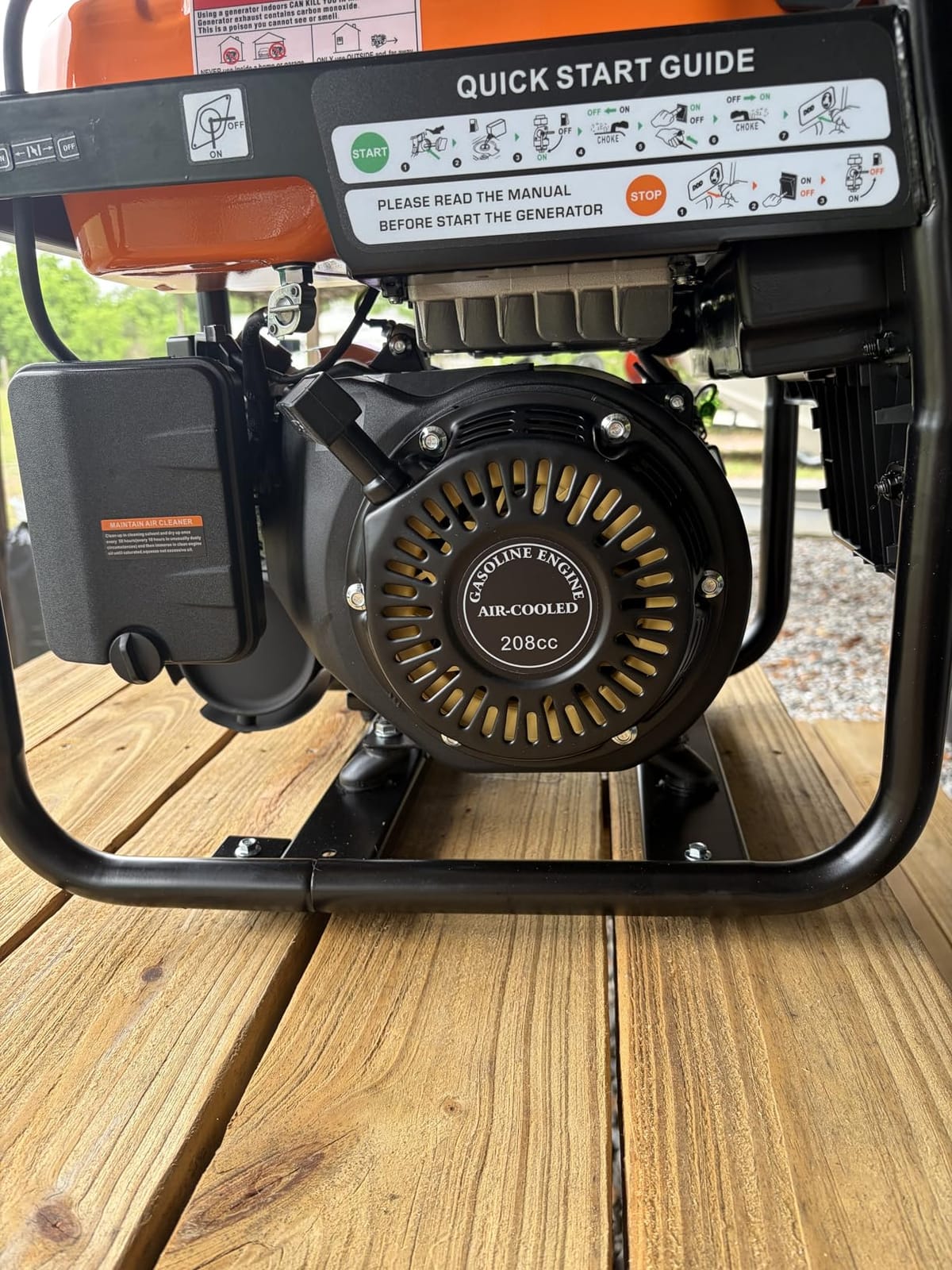
This is the open-frame exception in a list of enclosed inverter machines, and that single design choice explains both its price position and its noise position. An open frame does not muffle the engine the way an enclosed inverter housing does, so under 72 dBA at 23 feet is a different acoustic world from the 52 to 64 dBA figures on the other units here.
What it does give you is 4400 peak watts and 3400 running watts from a 208cc four-stroke engine, with up to 14 hours at 25 percent load from a two-gallon tank equipped with a fuel gauge. That runtime figure is the reason to consider it: two full days of light use without a refill, which very few machines in this class can do on gasoline alone.
Outlets cover the common cases: two 120V AC ports, a 12V DC port and an RV port, which is enough to run a portable refrigerator, a furnace blower and a set of tools without a splitter. Cold start technology helps on cool mornings, and low-oil shutdown plus overload protection are standard.
The trade-offs are the ones you would expect from an open frame. It is louder than anything else on this list, which matters if you are camped close to others. The one-year manufacturer warranty is the shortest coverage here, the fuel gauge is basic with no fuel-sense shutdown, and at 56 pounds the weight is mid-range for a machine that costs far less than its enclosed rivals.
Who Should Buy the Oxseryn 4400W
Buy it if your priority is runtime per fill. Fourteen hours at quarter load means one fill covers a long weekend of intermittent use, which very few enclosed inverter units match on gasoline alone.
Buy it if you are on an open site, a big pull-out or a dispersed camping spot where nobody is 20 feet away. In that setting, the open frame costs you nothing that matters.
Who Should Skip the Oxseryn 4400W
Skip it if you camp in developed sites with quiet hours and close neighbours. The sound difference between an open frame and an enclosed inverter is the gap between a friendly campsite and a complaint.
Skip it if you want warranty support beyond a year. A one-year coverage period is thin for a machine you expect to keep for seasons, and parts availability for the brand is more limited than for the established names.
7. Champion 4000W Dual Fuel RV-Ready Generator – The Longest Propane Run
Champion 4000-Watt Dual Fuel RV Ready Portable Inverter Generator
3000 running watts on gas
2700 on propane
25 hours on propane
64 dBA at 23 feet
3 year warranty
Pros
- 3000 running watts on gas plus a 25A TT-30R RV outlet
- Up to 25 hours on propane
- CO Shield shutdown with under 3 percent THD
- Parallel ready for pairing with a second unit
Cons
- 64 dBA is louder than smaller Champion dual fuel models
- About 52 pounds is heavy for its class
- Needs a gasoline break-in before propane runs reliably
- CO sensor can trigger nuisance shutdowns
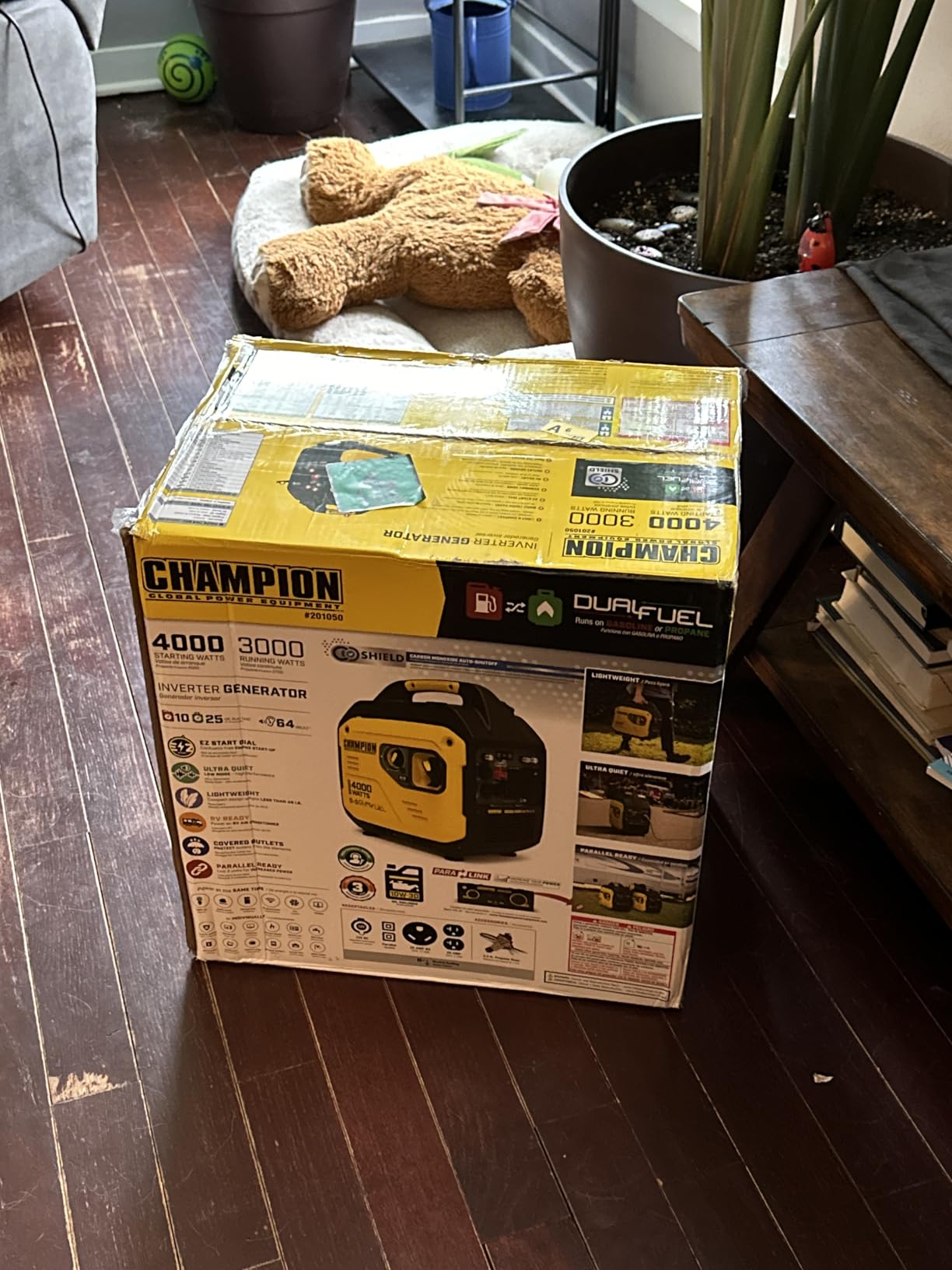
When the question is how long a generator can run unattended, this Champion answers in a way few machines in this class do: up to 25 hours on propane, or about 10 hours on gasoline from its 1.54 gallon tank. That figure comes from a 4000 starting watt, 3000 running watt gas configuration, with 2700 running watts on propane.
It is also a machine built around the RV case. The TT-30R outlet is the standard connection on most RV power leads, so plugging in is direct, and the parallel-ready outputs let you pair it with a second Champion inverter or a power station when you need more than 3000 running watts. CO Shield shuts the engine down on dangerous carbon monoxide levels.
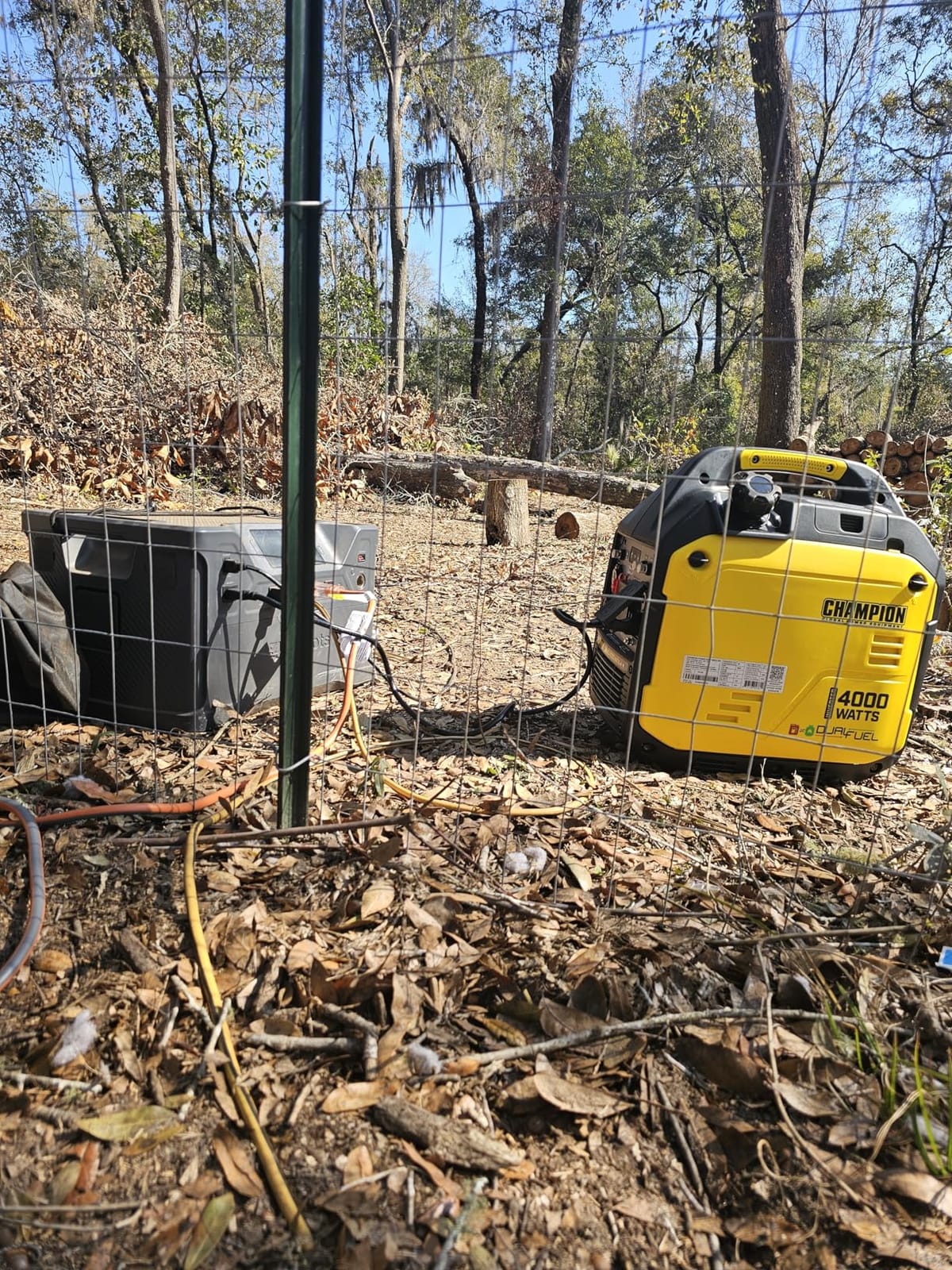
Owners running a 15,000 BTU rooftop unit report hours of operation on one tank, and the under 3 percent THD output has been used to run televisions, computers, monitors, a router and a refrigerator at the same time without trouble. A three-year limited warranty with free lifetime technical support is longer coverage than most machines in this roundup provide.
There are real caveats. At 64 dBA from 23 feet it is louder than Champion’s own smaller dual fuel machines, and roughly 52 pounds makes it a two-person lift in practice. New machines need a gasoline break-in before propane operation behaves reliably, and a few owners report the CO sensor being overly sensitive and shutting down nuisance trips.
Who Should Buy the Champion 4000W Dual Fuel
Buy it if you are running a rooftop air conditioner for long stretches and want a machine that will not wake you for a refill. Twenty-five hours on propane changes how you plan a camping trip.
Buy it if you want the longest warranty and best support access in this group, and if the TT-30R connection matches your RV lead without an adapter.
Who Should Skip the Champion 4000W Dual Fuel
Skip it if quietness is the priority. A 59 dBA dual fuel option in this roundup is available, and a 52 dBA unit exists if you are really counting decibels.
Skip it if you are buying fresh and intend to go straight to propane. Run it on gasoline first, or you may be troubleshooting an early stumble that has nothing to do with the machine itself.
8. Pulsar PGD40ISCO 4000W Inverter Generator – Rated for 13500 BTU Air Conditioning
Pulsar PGD40ISCO Ultra Light Quiet 4000W Portable Gas Inverter Generator, white
3200 running watts
47.3 pounds
59 dB
1 gallon tank
parallel ready
Pros
- 3200 rated watts from a body under 50 pounds
- Rated for air conditioning units up to 13500 BTU
- 59 dB keeps it acceptable inside campsites
- Parallel ready for doubling output with a match
Cons
- About 4 hours runtime at half load is the shortest here
- Gasoline only with no dual fuel option
- Recoil start with no electric or remote start
- Only three outlets
The Pulsar is the power-to-weight proposition in this roundup. A 145cc engine produces 4000 peak watts and 3200 rated watts inside a 47.3 pound body, which is a difficult combination to find among enclosed inverter units. For reference, the WEN that out-rates it on customer reviews carries more than twice the weight.
It is explicitly rated for air conditioning units up to 13,500 BTU, and the 59 dB operating level is quiet enough to keep inside campsite limits. Parallel-ready outputs let you double the output with a matching machine, so a pair covers a 6400 watt running ceiling if you ever need it.
The design targets RV owners with a 13,500 BTU rooftop unit, and the three-year limited warranty is respectable for the category. Dimensions of 18.9 by 11.4 by 17.3 inches keep the footprint reasonable next to larger machines.
The limitation owners mention most is the one-gallon tank, which gives about four hours at half load. That is the shortest runtime figure in this roundup, and it means a night of air conditioning ends with a refill in the dark. It is also gasoline only, so there is no propane option, and starting is by recoil with no electric or remote start. Three outlets is enough for a modest setup and not much more.
Who Should Buy the Pulsar PGD40ISCO
Buy it if you want the most running watts per pound available here. 3200 rated watts in a body under 50 pounds changes what you can carry to the site on your own.
Buy it if your RV carries a 13,500 BTU rooftop unit and you want a unit that is explicitly rated for it without crossing 50 pounds.
Who Should Skip the Pulsar PGD40ISCO
Skip it if you plan to run anything heavy overnight. Four hours at half load is not a full night, and there is no propane fallback to stretch it.
Skip it if electric start matters. Recoil starting is the norm here, and on a heavy 145cc engine that is a meaningful difference in daily use.
9. Oxseryn 2800W Portable Inverter Generator – The Balanced Solo Camper Pick
Oxseryn 2800-Watts Portable Inverter Generator, Gas Generators for Home Use, Camping, Super Quiet Emergency Home Backup, with Fuel Shut Off, 1.1Gal Fuel Tank, 39Lbs, EPA Compliant
2000 running watts
40 pounds
under 58 dBA at 23 feet
1.1 gallon tank
parallel ready
Pros
- 40 pounds with a built-in handle for one-person carry
- Under 58 dBA suits RV nights and residential backup
- 2000 running watts handles phones laptops drones and cameras
- Fuel gauge plus ECO mode give good runtime control
Cons
- 2000 running watts limits it to lighter loads
- One year manufacturer warranty
- High altitude use above 4000 feet needs an extra kit
- 79.8cc engine has little headroom for high-surge appliances
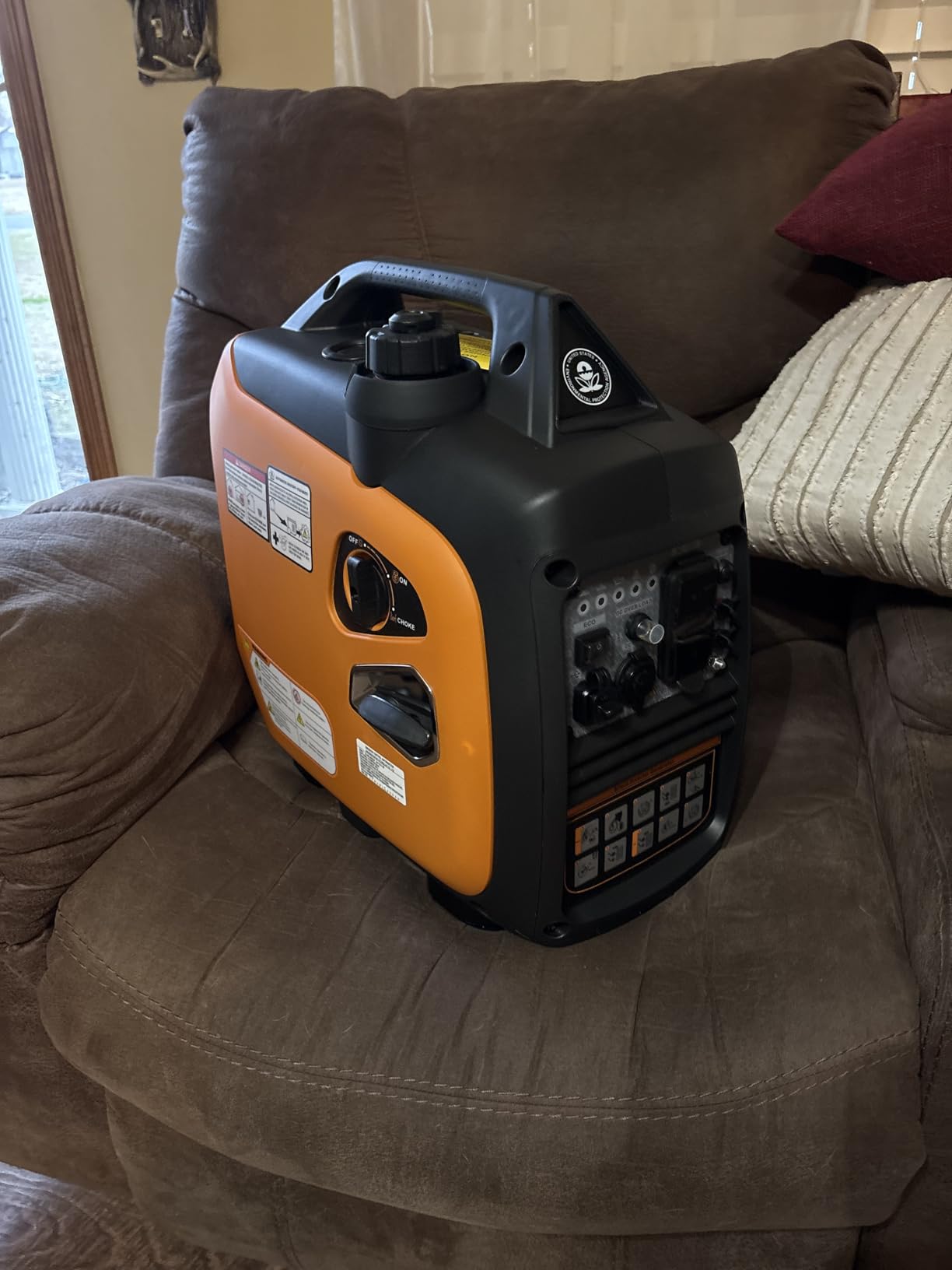
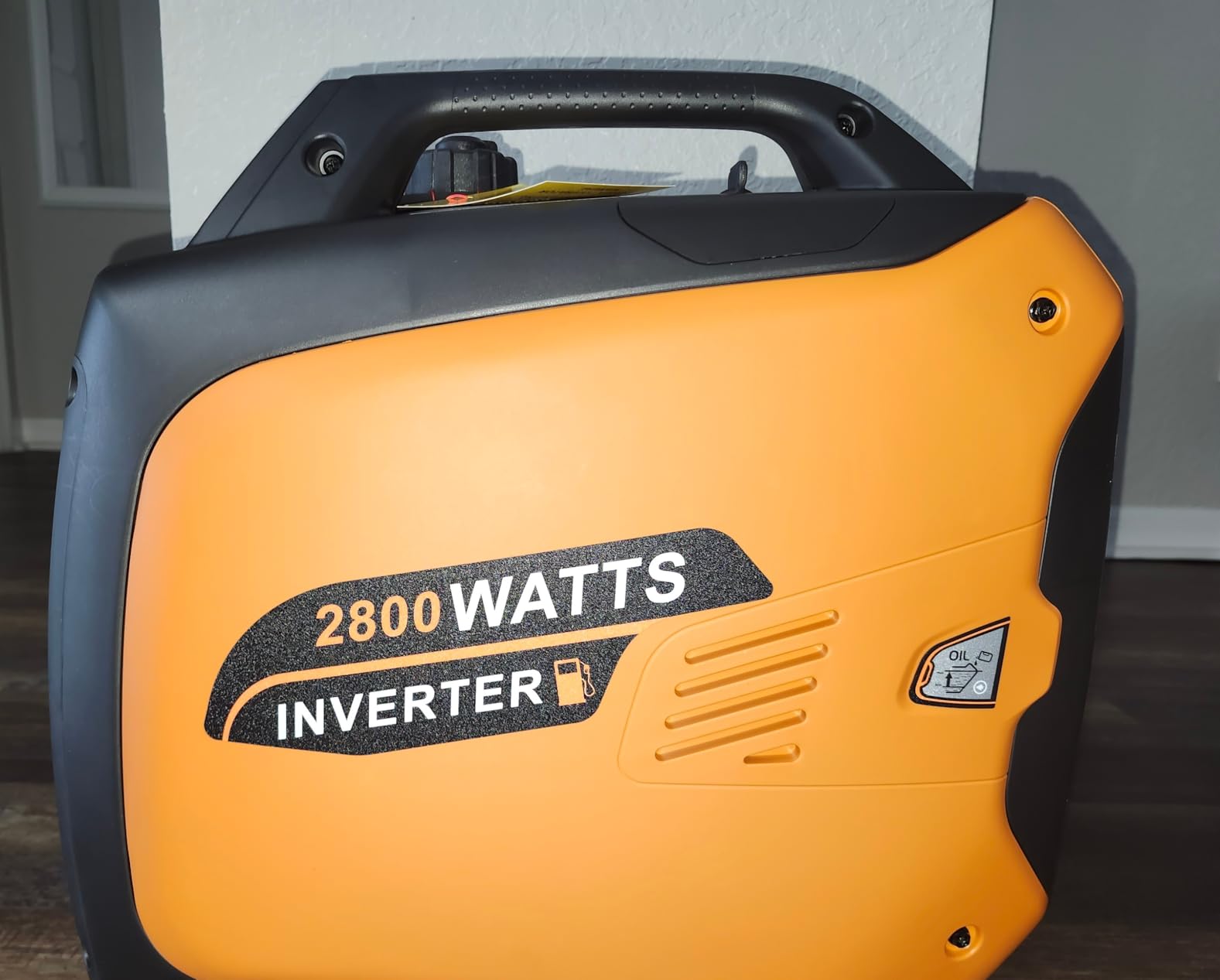
This is the middle of the road in the most useful way. 2000 running watts from a 79.8cc four-stroke engine, a 1.1 gallon tank with a fuel indicator, and about 9 hours at 25 percent load. The 40-pound weight with a built-in handle keeps it firmly in one-person-carry territory without dropping to the minimal output of the lightest unit in the roundup.
Noise is under 58 dBA at 23 feet, which makes it appropriate for RV nights and residential backup as well as a campsite. Output is a clean sine wave under 3 percent total harmonic distortion, so laptops, phones, drones and cameras are all safe on it, and the outlet set includes two 120V AC ports, a 12V DC port, a USB port and a Type-C port for direct device charging.
ECO mode and the parallel function are both present, so you can run it gently for a long evening or pair it with a match when you need more headroom. For a camper who works from a laptop and charges a drone battery, that is a complete setup.
Limitations are honest ones. 2000 running watts is modest, and the 79.8cc engine does not have headroom for high-surge appliances. The warranty is one year, among the shortest in this roundup, and the high-altitude kit required above 4000 feet is not included, which is a real problem for anyone camping in the Rockies. Mountain campers should budget for that kit or choose a larger machine.
Who Should Buy the Oxseryn 2800W
Buy it if your load is electronics rather than appliances. Cameras, a laptop, a drone, phones and a small fan are exactly what 2000 running watts covers comfortably for a full evening.
Buy it if you want sub-58 dBA operation and a one-hand carry without dropping below 2000 running watts. The 40-pound frame is the compromise that works for most solo campers.
Who Should Skip the Oxseryn 2800W
Skip it if you camp above 4000 feet and do not want to buy an extra kit. The carburetor will not compensate for thin air, and the failure mode is a hard no-start in exactly the terrain where you cannot easily get help.
Skip it if you want long-term warranty coverage. One year is thin coverage, and the larger Oxseryn machine in this roundup also carries a one-year term, so check what support looks like before you commit.
10. ERAYAK 4500W Portable Inverter Generator – The Boondocking Workhorse
ERAYAK 4500W Portable Inverter Generator for Home Use, Super Quiet Small Generator for Camping Outdoor Emergency Power Backup, Gas Powered Engine, ECO Mode, EPA Compliant
3500 running watts
54 pounds
60.5 dBA ECO mode
2.25 gallon tank
3 year warranty
Pros
- 3500 running watts handles camper air conditioning plus a microwave and fridge
- Low THD of 0.2 to 1.2 percent suits medical devices
- Very fuel efficient at about 0.8 L per hour on light load
- Spare spark plug and battery clamps included
Cons
- No built-in fuel gauge is the most-cited drawback
- Engine oil is not supplied
- Louder outside ECO mode than the rating suggests
- Air conditioning can trip on the first start attempt
Boondockers care less about dBA than about litres consumed and whether the machine starts after two weeks in a dry camp. This ERAYAK covers both. It produces 4500 peak watts and 3500 running watts from a 208cc engine, and motorhome owners report running 15,000 BTU air conditioning alongside a microwave and a refrigerator on the same circuit.
Power quality is the standout. Total harmonic distortion of 0.2 to 1.2 percent is the lowest figure in this roundup, and that is the number that matters for laptops, televisions, consoles and medical devices. Fuel use is quoted at 0.8 L per hour at 25 percent load and 2.125 L per hour at rated output, which explains the 14-hour figures owners report on lighter duty.
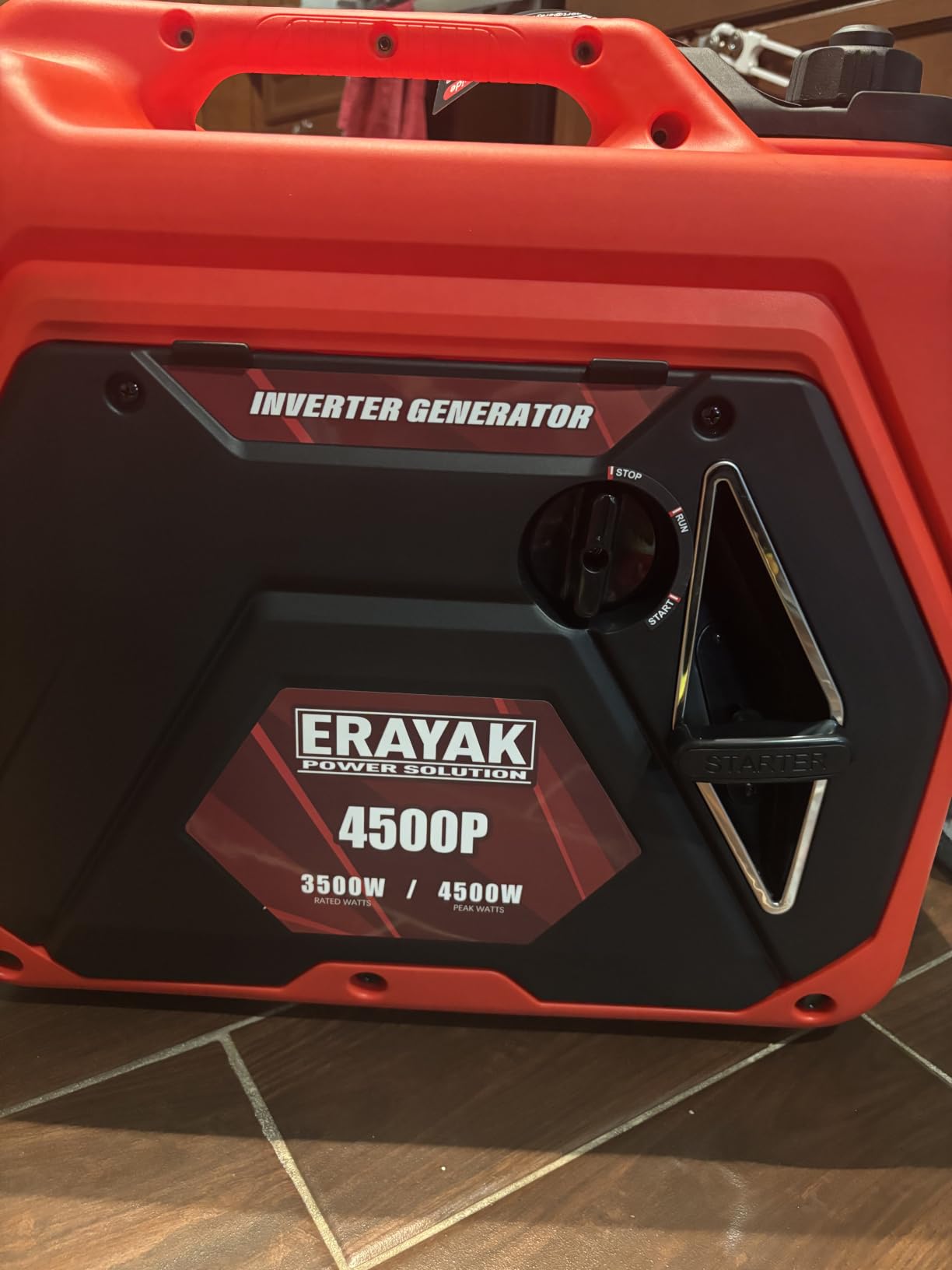
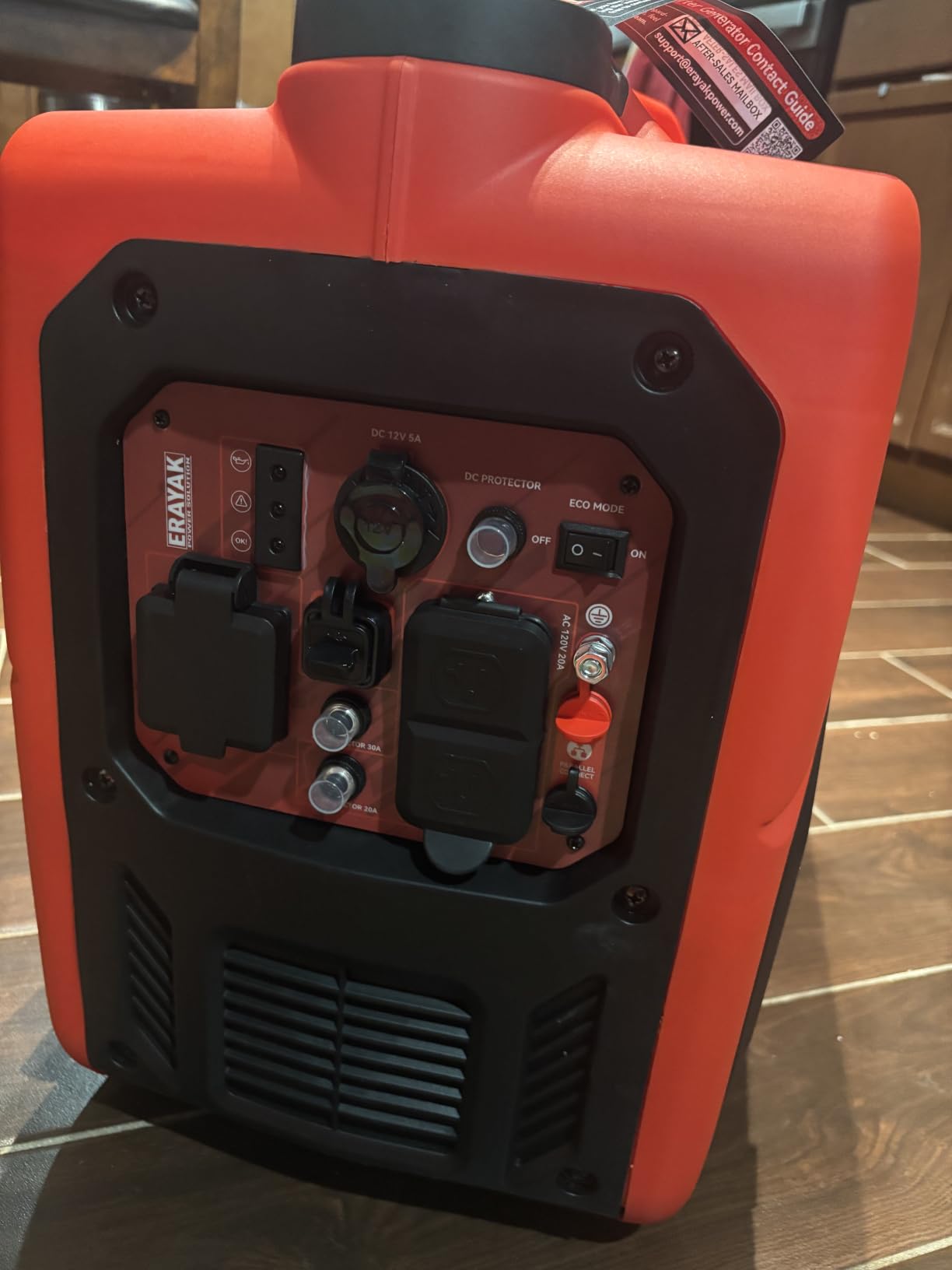
It is 50A parallel ready, so two machines together deliver 7000 running watts and 9000 peak with a separately sold kit, and the outlet set includes a 30A L5-30R, two 120V AC outlets, a 12V cigarette port, USB-A and USB-C, and separate 20A and 30A breakers. The accessory bag with a spare spark plug and battery clamps is a small touch that saves a roadside trip.
The most-cited drawback is the missing fuel gauge. Without one you are tracking runtime by memory or by the manual, which is frustrating on a long boondocking trip. Engine oil is not supplied, so add it before the first start. Owners also find it louder than the 60.5 dBA rating suggests when you take it out of ECO mode, and a few report needing a soft-start device to get a camper air conditioner to fire on the first attempt.
Who Should Buy the ERAYAK 4500W
Buy it if you run medical devices, a CPAP machine or sensitive electronics and want the cleanest output in the roundup. 0.2 to 1.2 percent THD is the figure to quote if anyone questions the power quality.
Buy it if you boondock and care about fuel consumed per hour more than decibels at 25 feet. The efficiency figure at light load is the strongest argument for extended off-grid trips.
Who Should Skip the ERAYAK 4500W
Skip it if you rely on a fuel gauge. Managing a two-gallon-plus tank blind is a genuine annoyance over a week away from a fuel station.
Skip it if you will run a camper air conditioner frequently without a soft-start device. Several owners hit an overload trip on the first start attempt, and solving that adds cost you did not plan for.
11. PowerSmart 4800W Portable Inverter Generator – The Most Running Watts for a Mid-Size Frame
PowerSmart 4800 Watt Portable Inverter Generator for Home Use or RV
3800 running watts
89 pounds
18 hours at 25 percent load
8 outlets
59 dBA at 23 feet
Pros
- 3800 running watts runs camper air conditioning plus a fridge and chargers
- Eight outlets including a 30A RV unit
- Digital display shows voltage frequency and runtime
- 3.43 gallon tank with up to 18 hours at 25 percent load
Cons
- 89 pounds is the second heaviest unit in the roundup
- Multiple oil changes needed during break-in
- Some auto-start batteries failed after one use
- Factory spark plug is often replaced with a BPR6ES
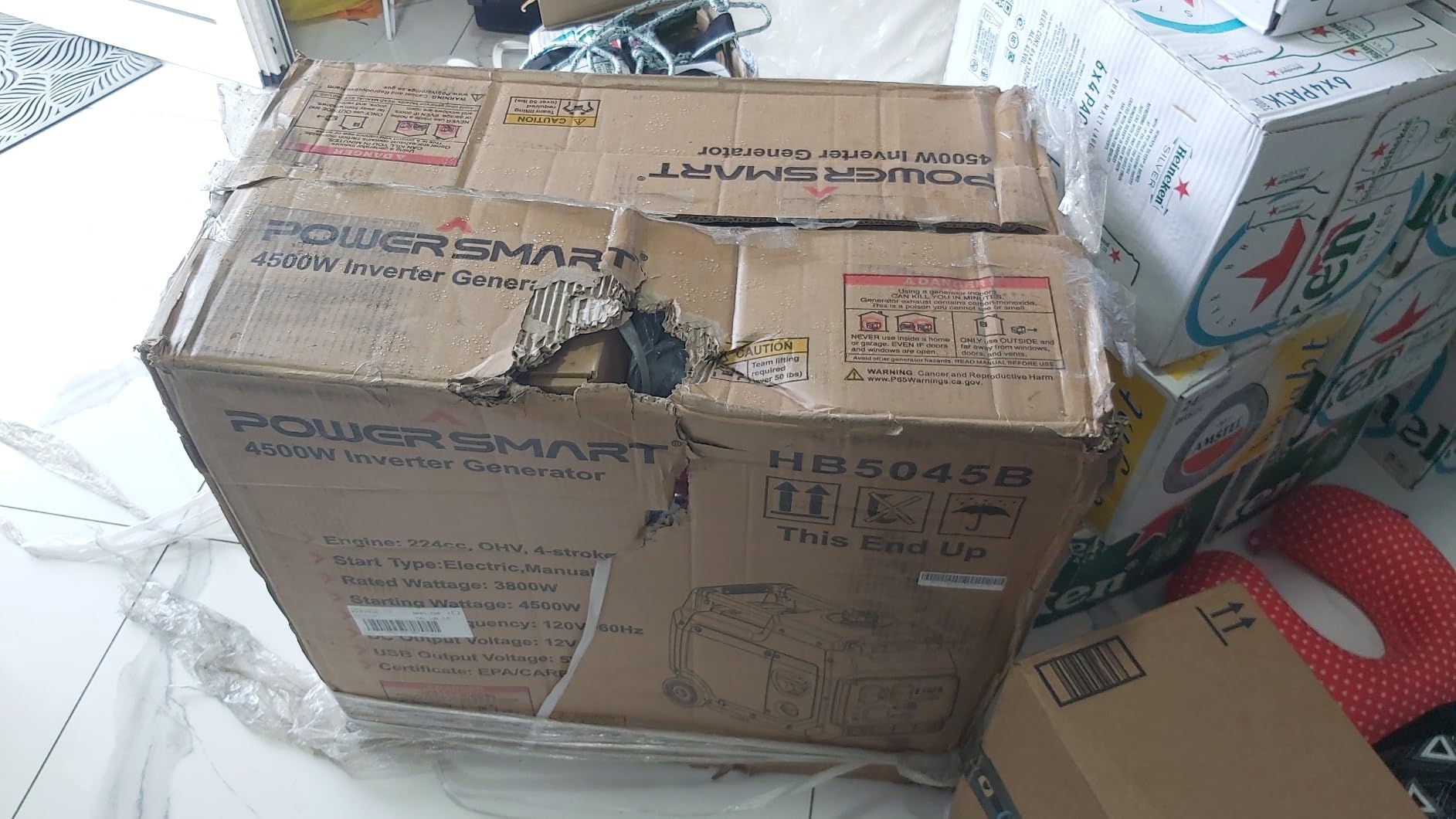
This is the wattage answer for a truck camper who wants to stop thinking about load combinations. 4800 starting watts and 3800 running watts with total harmonic distortion under 3 percent, from a 223cc four-stroke engine, and eight outlets including a 120V 30A RV outlet and four 20A receptacles. The outlet count is the most generous in the roundup.
The 3.43 gallon tank gives up to 18 hours at 25 percent load, the longest gasoline runtime figure here, and the digital display reports voltage, frequency and remaining runtime. A TT-30P to L5-30R adapter is included so RV leads connect directly, and the unit is certified to EPA, ANSI/PGMA G300 and ANSI/UL 2201 with CO protection, overload protection and low-oil auto-shutdown.
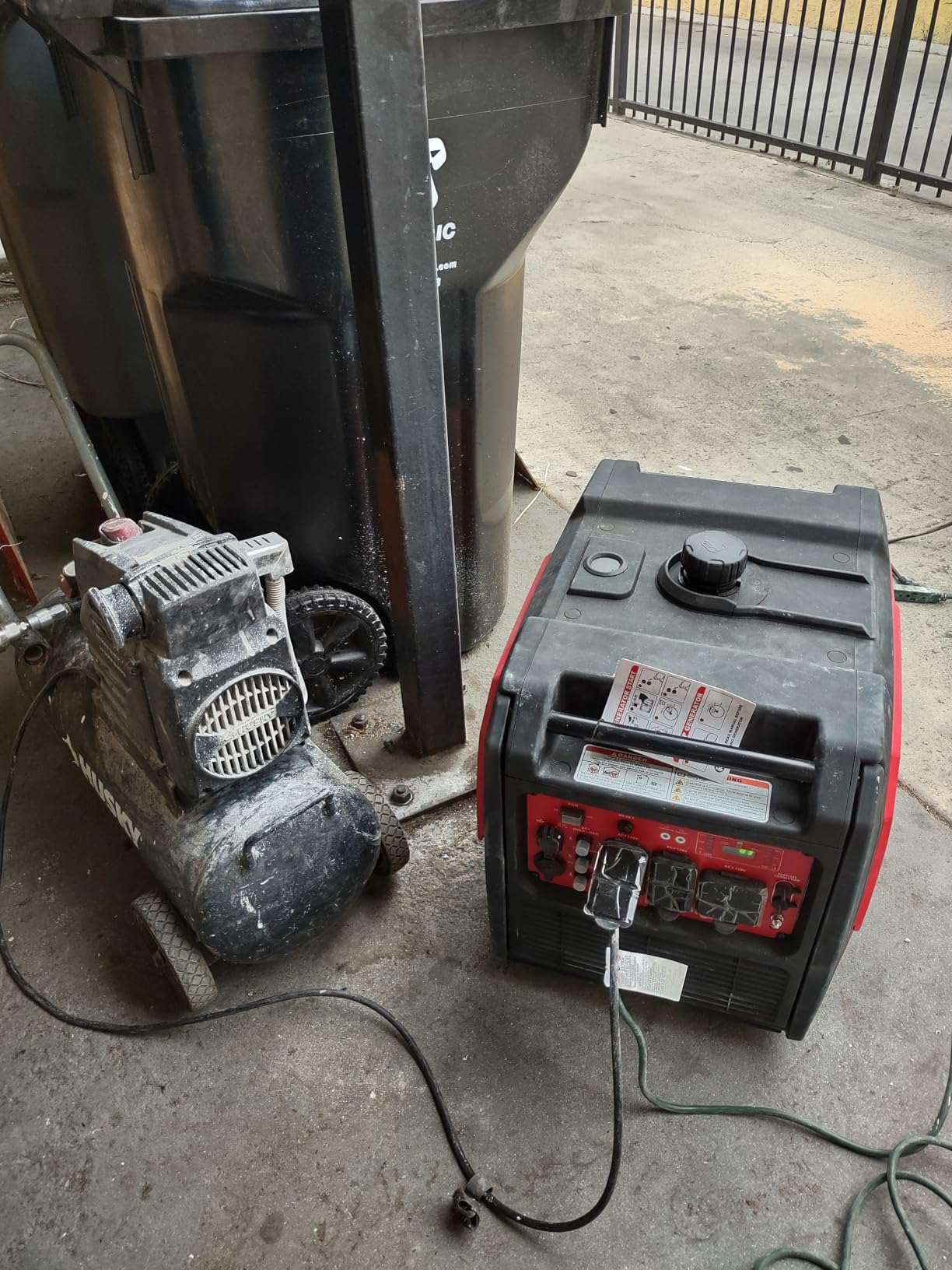
Truck-camper owners rate it very highly for exactly the reason it is here: air conditioning, a refrigerator and battery chargers running at the same time without a single overload. Wheels and a handle make it easier to move than 89 pounds suggests, though not easy.
There is a real break-in period. Multiple oil changes are recommended during the first runs to clear manufacturing shavings from the crankcase, and owners commonly swap the factory spark plug for a BPR6ES to get reliable starting. There are reports of auto-start batteries dying after a single use, and the wheel assemblies can rattle while running. None of these are dealbreakers, but all of them are things you will read about after purchase rather than before.
Who Should Buy the PowerSmart 4800W
Buy it if you want a single circuit to carry a camper air conditioner, a refrigerator and several battery chargers without juggling the load. 3800 running watts is the comfortable ceiling for that combination.
Buy it if outlet count matters. Eight outlets with a 30A RV unit and four 20A receptacles means fewer power strips and fewer adapters in a crowded camper.
Who Should Skip the PowerSmart 4800W
Skip it if you move the generator by yourself. At 89 pounds it is the second heaviest machine here, and the wheeled frame only helps on flat ground.
Skip it if you want a turnkey first start. The break-in oil changes, the spark plug swap and the reported battery failures all add setup steps that a first-time owner will not enjoy on the first morning of a trip.
12. BILT HARD 2500W Quiet Inverter Generator – The Simple First-Timer Buy
BILT HARD Gas Generator 2500W, 80cc 4 Stroke Quiet Inverter Generator with CO Sensor, Parallel Ready,120V AC Duplex Receptacle and 12V DC Output, Outdoor Generators for Camping, Home Use, 49-State
2000 running watts
42.6 pounds
pure sine wave under 3 percent THD
CO sensor shutoff
parallel ready
Pros
- 42.6 pounds is light for a 2500W inverter and easy to load
- Pure sine wave under 3 percent THD for electronics
- Integrated CO sensor with automatic engine shutoff
- Parallel ready and usable in all 50 states
Cons
- 2000 running watts and 2500 starting watts cap the load
- 5.5 hours at 50 percent load is short for overnight use
- One year warranty
- No USB ports or fuel gauge
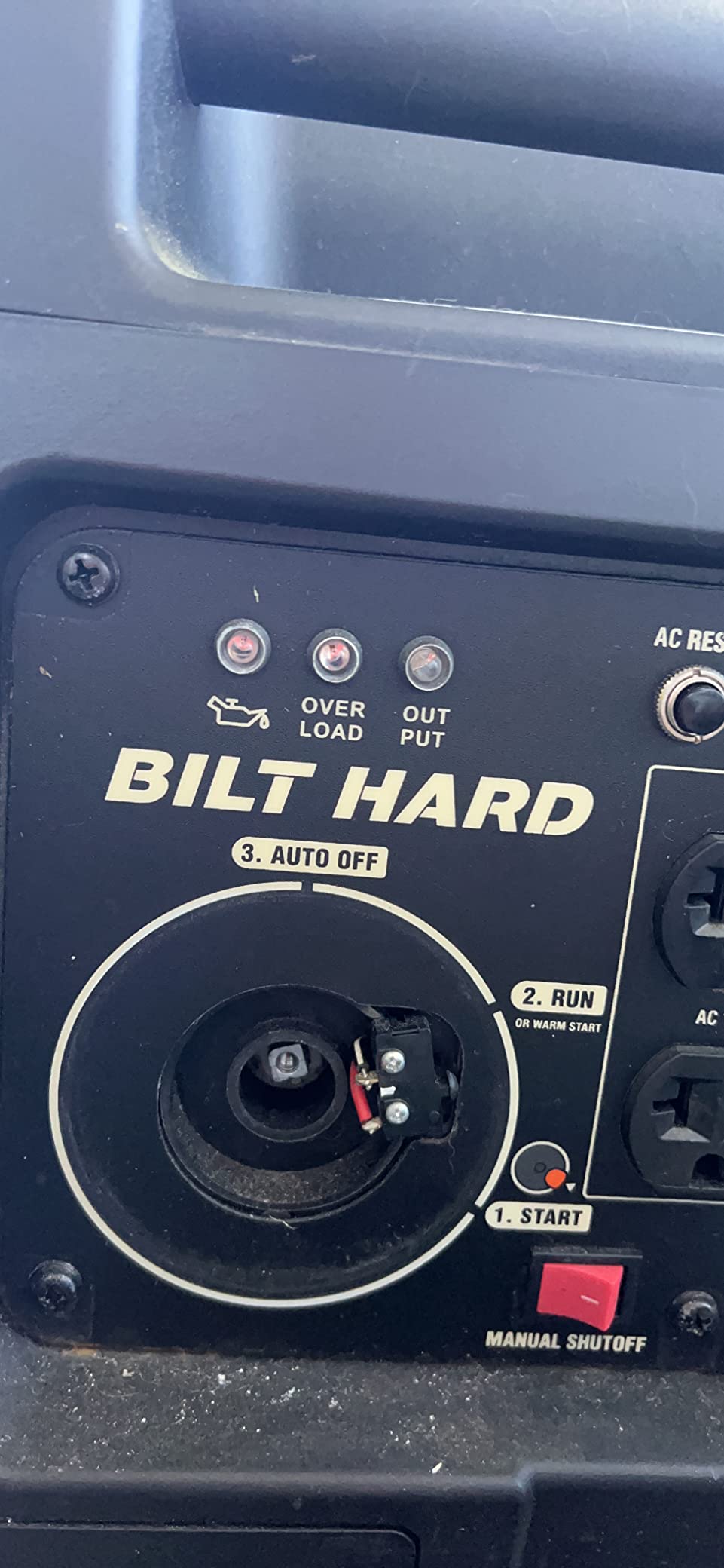
The BILT HARD is the generator to buy if you want a generator and not a project. It uses an 80cc four-stroke air-cooled OHV engine to produce 2500 peak watts and 2000 running watts of pure sine wave output under 3 percent total harmonic distortion, and the control panel is limited to two 120V 15A receptacles and a 12V 8A DC output, all breaker protected.
Two things make it more interesting than the price suggests. The integrated CO sensor shuts the engine down automatically, which is real protection at a campsite, and the unit is parallel ready with a separately sold kit, so you can double the output later without replacing the generator.
It is 42.6 pounds, which is light for a 2500W class inverter and easy to load into a vehicle, and the 1.11 gallon tank runs up to 5.5 hours at 50 percent load. It is also compliant across all 50 states and accepts 87 octane or higher with fuel stabilizer and SAE 10W-30 oil, which is the correct routine anyway.
The compromises are the expected ones. 2000 running watts and 2500 starting watts mean the load ceiling is real, and 5.5 hours at half load is short for an evening with a refrigerator, especially since there is no USB port and no fuel gauge to help you manage it. The warranty is one year and starting is by recoil.
Who Should Buy the BILT HARD 2500W
Buy it if this is your first generator and you want the simple path. Pure sine wave output, a CO sensor and a straightforward control panel are everything a new owner actually needs.
Buy it if your load is a refrigerator, lights, chargers and a fan, and you plan to refill once a night. The 42.6-pound weight keeps the whole thing manageable for one person.
Who Should Skip the BILT HARD 2500W
Skip it if you want a weekend without a midnight refill. Five and a half hours at half load is the shortest overnight figure among the units in this class, and without a fuel gauge you are estimating.
Skip it if you need USB charging ports, which rivals at similar capacity include, or a longer warranty than a single year of coverage.
How to Choose an Inverter Generator for Camping
Start with running watts, not surge watts
Running watts is the number that decides whether your setup works. It is the sustained output the unit can hold indefinitely. Surge watts is a brief burst, typically 15 to 30 seconds, covering the moment a motor spins up. Every appliance you plug in counts its running watts continuously and its surge watts once at startup.
Add up the running watts of everything you intend to use at the same time, then add 20 percent for headroom. The 20 percent is not padding: it keeps the engine out of the most efficient and quietest part of its range. A common daytime load of a portable refrigerator, a CPAP machine, a fan and a phone charger lands well under 700 watts, so a 1350-watt unit covers it. Add a microwave and a coffee maker and you are in a different category.
RV air conditioning is the number that moves people up a tier. A 13,500 BTU rooftop unit is the practical ceiling for a mid-size machine, and 15,000 BTU demands a 3000 running watt class or better. A power tool is a different kind of load: a saw or a grinder can pull 1500 to 2000 running watts with a surge spike several times that, which is why sequential starting matters on smaller units.
What an inverter generator actually does
A conventional generator produces AC directly and runs its engine at a fixed speed regardless of load. An inverter generator takes a different path: it converts AC to DC, then back to cleaner AC. That extra stage lets the engine speed vary with demand, which is the source of both the quiet operation and the smoother waveform.
The waveform quality is measured as total harmonic distortion, or THD. Conventional generators typically sit well above 5 percent. Inverter units in this roundup publish figures under 3 percent, and the ERAYAK claims 0.2 to 1.2 percent. Under 3 percent is the number to require if you plan to run laptops, phones, televisions, camera gear or a CPAP machine directly without a line conditioner.
Noise at a campsite means distance and load, not just dBA
Manufacturer noise ratings are measured at a stated distance, usually 23 or 25 feet, and often under full load. Your campsite is likely closer than that and your load is often lighter, so the real figure is lower. A 59 dBA machine running at a quarter load can sound closer to a quiet conversation. An open-frame machine rated near 72 dBA will not drop into neighbour-friendly territory no matter how you load it.
Campgrounds usually enforce quiet hours in the evening and early morning, and the rule is generally about disturbing others rather than a strict number. Treat 60 dBA as the ceiling for a developed site with close neighbours, and only consider a louder open-frame machine on dispersed ground where nobody is within 100 feet. A useful habit is running the generator on ECO mode at 25 percent load, which is where these engines are quietest.
Gasoline only or dual fuel
Gasoline-only units are lighter, cheaper and simpler, and they are the right choice if you run the generator on most trips. Dual-fuel models add a propane connection, and propane brings one advantage that quietly outranks everything else: it stores indefinitely. A tank of gasoline sitting in a carburetor for six months is the most common reason a generator will not start on the first pull after a long break.
The cost of dual fuel is weight and a modest output drop. The Champion in this roundup drops to 2700 running watts on propane from 3000 on gas, and the A-iPower drops to 3100 from 3450. If you already carry a cylinder for a camp stove, the convenience is worth the 10 to 15 percent output reduction.
Which outlets you actually need
Standard 120V duplex receptacles handle almost everything. A TT-30R outlet is the connection most RV power leads use, and the WEN 56380i and Champion 4000W have it built in. A 30A L5-30R twist-lock handles power tools and larger RV connections, and it appears on the A-iPower, PowerSmart 3800W, PowerSmart 4800W and ERAYAK 4500W.
Also check the DC side. Built-in 12V DC outlets and USB ports save you carrying a separate adapter, and models with a USB-C port are increasingly the ones that charge modern devices directly. A 50A parallel connection, as on the ERAYAK, lets two units run together for double the output.
Runtime, fuel use and the ethanol storage trap
Runtime figures are usually quoted at 25 percent load, which flatters every machine on this list. Half-load numbers are the honest comparison, and that is where the differences appear: the Pulsar gives about 4 hours at half load from one gallon, while the PowerSmart 4800W gives up to 18 hours at 25 percent from 3.43 gallons. Expect your real figure to sit between the quoted and the half-load number depending on what you plug in.
Ethanol-blended gasoline is the leading cause of carburetor trouble. Ethanol attracts moisture, and that moisture corrodes internal carburetor parts over a storage season. Three habits prevent most of it: run the fuel shutoff design until the bowl is empty before you shut the engine down, add a fuel stabilizer to any fuel remaining in the tank, and store the unit in a dry place with the tank as empty as you can manage. The fuel shutoff carburetors on the WEN units are designed specifically around this problem.
What to stay away from
Skip non-inverter generators in a campsite. They are louder, they produce a rougher waveform, and the noise alone is enough to draw a complaint in a quiet zone.
Skip open-frame units in developed campgrounds. The Oxseryn 4400W in this roundup is a capable machine with excellent runtime, but the open frame gives away the acoustic advantage that makes inverter units worth having.
Skip anything without carbon monoxide protection, and skip any unit rated only 49-state if you travel. Every pick in this roundup has CO shutdown or a CO sensor. Also avoid buying well above your real load: an oversized generator runs louder, burns more fuel and is harder to carry, and for most campers the practical demand sits in the 1200 to 2500 running watt band rather than above 4000.
Running a Generator Safely at a Campsite
Carbon monoxide is the reason this section exists, and it is not a formality. A generator produces CO as a byproduct of combustion, and a tent or a van is a confined space where that gas does not leave. CO sensors on modern units are a second line of defence, not a substitute for correct placement.
Set the generator at least 20 feet from your tent, van or camper, and never inside a vehicle, a tent, a storage box or an enclosed porch, even with a tailgate open.
Position it downwind of where you sleep or sit, so any exhaust is carried away from you rather than toward you.
Point the exhaust away from open windows, doors and vents, and never run it in a garage or shed.
Run it on level ground outdoors only, with at least 20 feet of clearance above for the hot exhaust.
Never refuel a running or hot engine. Shut it down, let it cool, then refuel on a stable surface away from ignition sources.
Store gasoline in an approved container with a tight-fitting cap, away from the tent and away from any heat source or flame.
Check the CO sensor indicator before each trip, and test the shutdown by briefly blocking the sensor if the manual allows it.
Two more habits are worth building in. A working carbon monoxide alarm inside the camper is cheap insurance regardless of what the generator does, and a fire extinguisher rated for fuel fires belongs in the vehicle rather than in a storage compartment at home.
Generator vs Portable Power Station: When to Skip the Fuel
A portable power station is a battery with an inverter inside it, charged from a wall, a vehicle or solar. It makes no noise, produces no exhaust, needs no oil and never causes a carburetor problem. The trade is capacity and recharge time: a power station holds a fixed watt-hour budget, and once it is empty, solar is the only refill unless you find mains power.
Skip the generator if your load is charging phones, running a laptop, powering LED lights and maybe a small fan. That is a power station job, and doing it silently is better at a campsite. A CPAP machine overnight is a harder case, because the draw is continuous and small power stations run out; a mid-size station paired with a folding panel handles a night, and it does so without anyone outside hearing it.
Stay with a generator if you run a refrigerator, a microwave, a coffee maker, power tools or a camper air conditioner. Those loads either exceed a battery budget or empty it faster than solar can refill it. The crossover point is roughly anything drawing over 1000 watts continuously, or anything where you need more than a day away from a charge source.
Forum users on campervan and generator boards make the same split, and the recurring pattern is that the question is not which is better but which load you actually have. A modest power station covers the evening and a generator covers the weekend, and the honest answer is that most campers eventually end up owning both.
Frequently Asked Questions
What is the best inverter generator for camping?
For most campers the WEN 56235i is the best inverter generator for camping, because 1900 running watts covers a refrigerator, a CPAP machine, lights and chargers while its 39-pound frame stays a one-person carry. Choose the WEN 56380i instead if you need to run a camper air conditioner or a full household of loads, and choose a dual-fuel model such as the Champion 4000W if you already carry propane.
What size inverter generator do I need for camping?
Add the running watts of everything you will use at once, then add 20 percent headroom. Phones, lights, a laptop and a small fan total under 300 watts. A portable refrigerator, a CPAP machine and a coffee maker push you to 1000 to 1350 running watts. A microwave or power tools need 2000 running watts or more, and a 13,500 BTU rooftop air conditioner needs a 3200 to 3500 running watt unit.
What is the quietest inverter generator for camping?
The AIVOLT 1750W has the lowest published operating level in this roundup at 52 dBA, and the Oxseryn 2800W is rated under 58 dBA at 23 feet. Treat manufacturer figures as a comparison rather than a campsite promise, since they are measured at 23 to 25 feet under load. Running any inverter on ECO mode at 25 percent load drops the real noise noticeably.
What are the disadvantages of an inverter generator?
The main drawbacks are higher purchase cost than an open-frame conventional unit, lower surge headroom on small models, and a smaller fuel tank in some cases. Inverter units also run electronics well but are useless for anything beyond their rated output, and carburetor trouble after storage remains common unless you run the fuel shutoff dry and use a stabilizer.
Who makes the most reliable inverter generators?
Reliability tends to track build quality and support rather than brand alone. In this roundup the WEN 56380i carries the highest average rating at 4.7 across more than 2400 reviews, and Champion leads on warranty with three years plus lifetime technical support. Dual fuel also improves long-term reliability because propane does not degrade while a generator sits between trips.
What portable generators should I stay away from?
Avoid non-inverter generators at a campsite, because they run louder and produce a rougher waveform. Avoid open-frame models at developed sites for the same reason. Also avoid any unit without carbon monoxide shutdown, anything rated only 49-state if you travel, and any generator rated well above your real load, since it will be louder, thirstier and harder to carry.
The Best Inverter Generator for Your Camp in 2026
For a tent camper or a solo car camper, the WEN 56235i is the pick. It delivers 1900 running watts in a 39-pound frame with a fuel shutoff carburetor that survives storage, and at 39 pounds you can carry it from the vehicle on your own. That combination is rarer than it should be.
If your load needs household-level capacity instead, the WEN 56380i is the upgrade at 3400 running watts with electric start. It is the heaviest machine we put through this roundup, so plan the lift with a second person.
For boondocking and propane users, the Champion 4000W Dual Fuel gives you up to 25 hours on a cylinder with a three-year warranty and lifetime technical support, while the ERAYAK 4500W is the pick when clean power for medical devices matters more than a fuel gauge. For sustained propane runtime on a tighter budget, the PowerSmart 3800W Dual Fuel is hard to argue with.
Whichever you choose, run it on ECO mode, keep it 20 feet downwind, and drain the fuel bowl before you pack it away. Those three habits decide whether a generator is still working for you in 2026, and three seasons from now.