
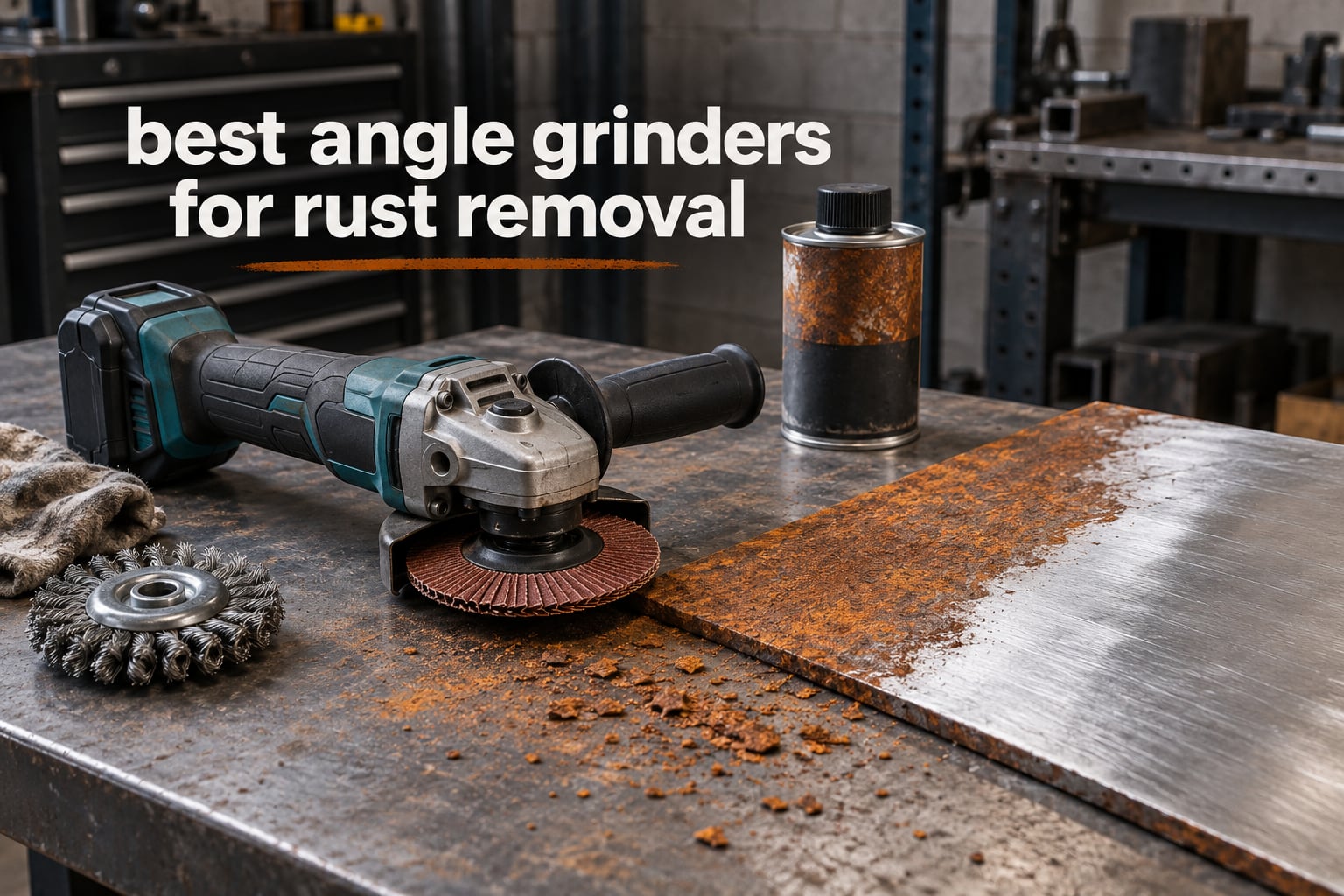
Ask ten people to grind rust off a trailer frame and you will get ten answers about grinders. What actually decides the outcome is the disc you mount. The tool is the motor and the handle; the abrasive or wire wheel is what cuts through iron oxide and leaves bright steel behind.
That is why the best angle grinders for rust removal in 2026 are not chosen on horsepower alone. Two grinders with near-identical motors can behave completely differently on the same rust job, because one holds 12,000 RPM with steady torque under load while the other bogs down halfway through a wheel’s worth of work. A third difference, safety hardware, matters more on vehicles than on a bench.
We compared eight grinders for this guide: two brushless cordless flagships, one variable-speed corded model, and five corded machines spanning the entry to the professional end. Alongside each one we cover the consumables that pair with it, because a strip disc, a flap disc, a wire wheel and a surface-conditioning wheel behave very differently on surface rust, on pitted rust, and on thin-gauge base metal you cannot afford to gouge.
Two safety notes before the trigger gets pulled. Wear eye protection and a face shield every time, because a wire wheel throws whole strands of steel, not just dust. And never grind a vehicle with the fuel system intact or anywhere near fuel vapour, brake lines or a charged extinguisher in arm’s reach. Grinding rust produces sparks and hot iron oxide particles, and both will ignite something.
Table of Contents
Top 3 Angle Grinders for Rust Removal (October 2026)


Best Angle Grinders for Rust Removal Compared Side by Side in 2026
| Product | Specs | Action |
|---|---|---|
| DEWALT DCG413B 4-1/2 Inch Cordless Brushless |
|
Check Latest Price |
 Metabo HPT G12SR4 4-1/2 Inch Corded Kit Metabo HPT G12SR4 4-1/2 Inch Corded Kit |
|
Check Latest Price |
 AVID POWER 7.5-Amp 4-1/2 Inch Corded AVID POWER 7.5-Amp 4-1/2 Inch Corded |
|
Check Latest Price |
| Milwaukee 2880-20 M18 FUEL Cordless |
|
Check Latest Price |
 Bosch GWS8-45 4-1/2 Inch Corded Bosch GWS8-45 4-1/2 Inch Corded |
|
Check Latest Price |
 DEWALT DWE4011 4-1/2 Inch Corded DEWALT DWE4011 4-1/2 Inch Corded |
|
Check Latest Price |
 WEN 94475 7.5-Amp 4-1/2 Inch Corded WEN 94475 7.5-Amp 4-1/2 Inch Corded |
|
Check Latest Price |
 Metabo HPT G12VE2 4-1/2 Inch Variable Speed Metabo HPT G12VE2 4-1/2 Inch Variable Speed |
|
Check Latest Price |
What Is the Best Angle Grinder Attachment for Rust Removal?
The best angle grinder attachment for rust removal is a strip disc for fast bulk removal, a flap disc for controlled stripping and blending, a wire wheel for fast mechanical removal of loose scale, and a surface-conditioning wheel for final blending. Match the attachment to how bad the rust is, not to the grinder you happen to own.
Strip discs are fiberglass or heavy synthetic mesh wheels coated with silicon carbide. The open structure lets heat escape, so they cut fast and do not warp thin metal. They are the aggressive choice, and the right one for heavy scale on a truck bed or a trailer frame.
Flap discs are softer, with abrasive flaps folded onto a backing plate. They remove surface rust quickly and blend edges at the same time, which is why they are the first step in most restoration sequences. The trade-off is that a rigid backing cannot reach into pitting, and reviewers consistently report a considerable amount of residual rust left in the low spots.
Wire wheels come in crimped, twisted, knotted and cup formats. Crimped and twisted wheels are fast on loose scale and flaking chrome. Knotted and cup brushes are more aggressive and hold their shape longer. The catch is that they bite, and they throw whole wire strands rather than dust, so eye protection stops being optional.
Surface-conditioning wheels combine non-woven abrasive with a nylon webbing matrix. They are the finishing layer: they take the shine off ground steel and scuff a surface uniformly without cutting into it, which makes them the right call on aluminium, thin-gauge steel and anything already close to bare metal.
One material fact explains why all of this works. Iron oxide, the substance rust is made of, sits around 6.0 on the Mohs hardness scale. Silicon carbide abrasive sits near 9.5. A harder grain shearing across a softer rust layer is the entire mechanism, and it is why a wheel rated for steel removes rust in seconds while a wire wheel removes it by mechanical abrasion alone.
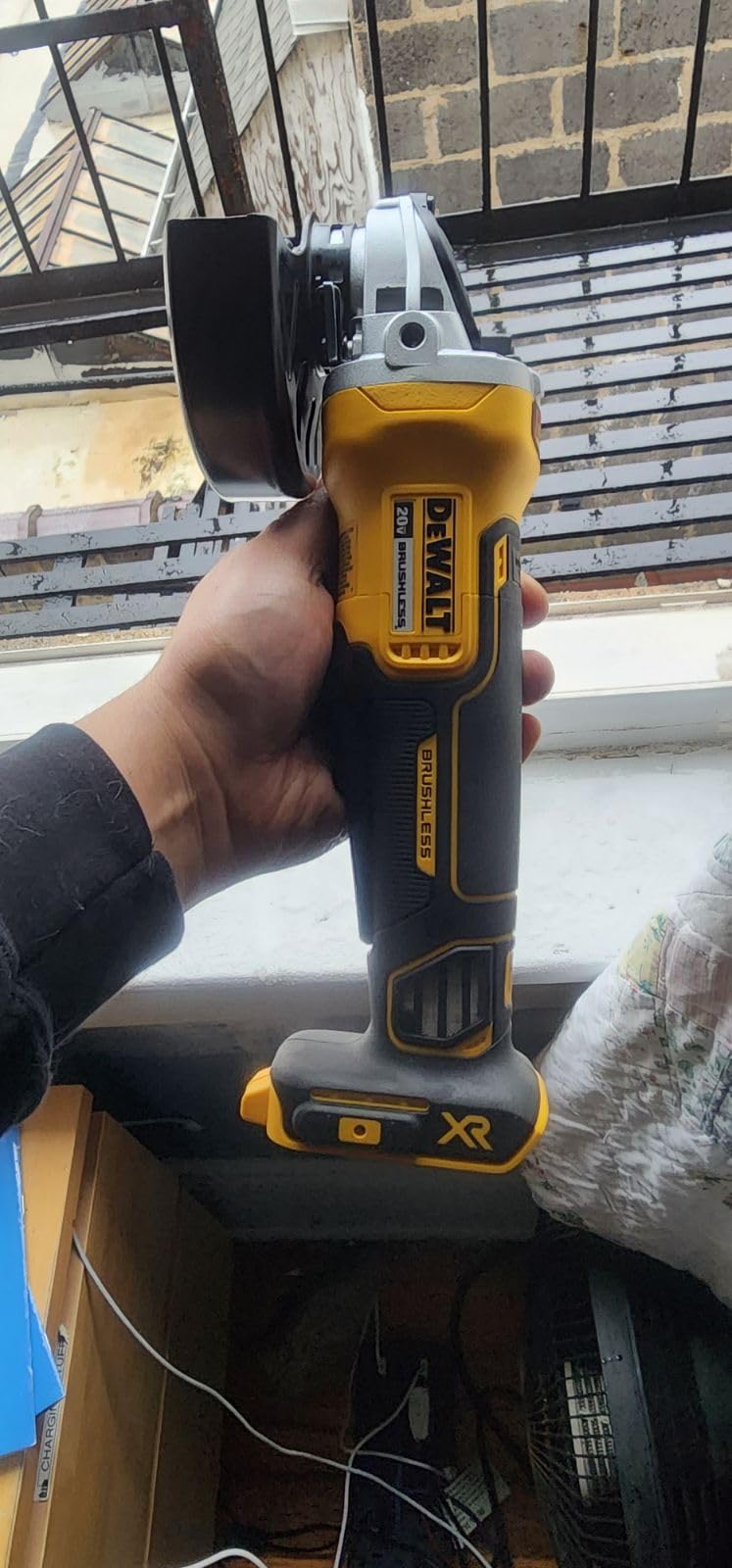
1. DEWALT DCG413B – Best Overall Cordless Grinder for Rust Removal
DEWALT 20V MAX* Angle Grinder Tool Cordless Brushless, 4 1/2 Inch, with Paddle Switch and Kickback Brake, Tool Only (DCG413B)
20V brushless
3450 RPM
3.8 lb
Kickback brake, paddle switch
Pros
- Brushless motor needs no brush changes
- Kickback brake stops the wheel in 2 seconds or less
- Two-stage trigger blocks accidental starts
- Light at 3.8 lb for overhead work
Cons
- Tool-only
- so a battery and charger are extra
- Runtime is roughly 20-30 minutes of hard grinding on a 4Ah pack
- Less raw power than a 12 amp corded grinder under sustained load
This is the one I keep reaching for on vehicle work. The DCG413B runs a brushless motor, so there are no carbon brushes to change when rust dust has been pulled through the gear case all afternoon. Balance is the part I noticed most: at 3.8 pounds it is the lightest tool in this group by a clear margin, and that matters when you are working overhead on a roof rail or the underside of a bed.
The safety package is the reason it leads the list. A kickback brake engages on a pinch, stall or bind-up and stops the wheel in 2 seconds or less, and E-Switch protection with a no-volt release means the tool will not start again by accident after a power interruption. A two-stage trigger requires two deliberate actions to spin the disc. On a car with a lot of tight spaces and awkward angles, that hardware is worth more than a few extra amps.
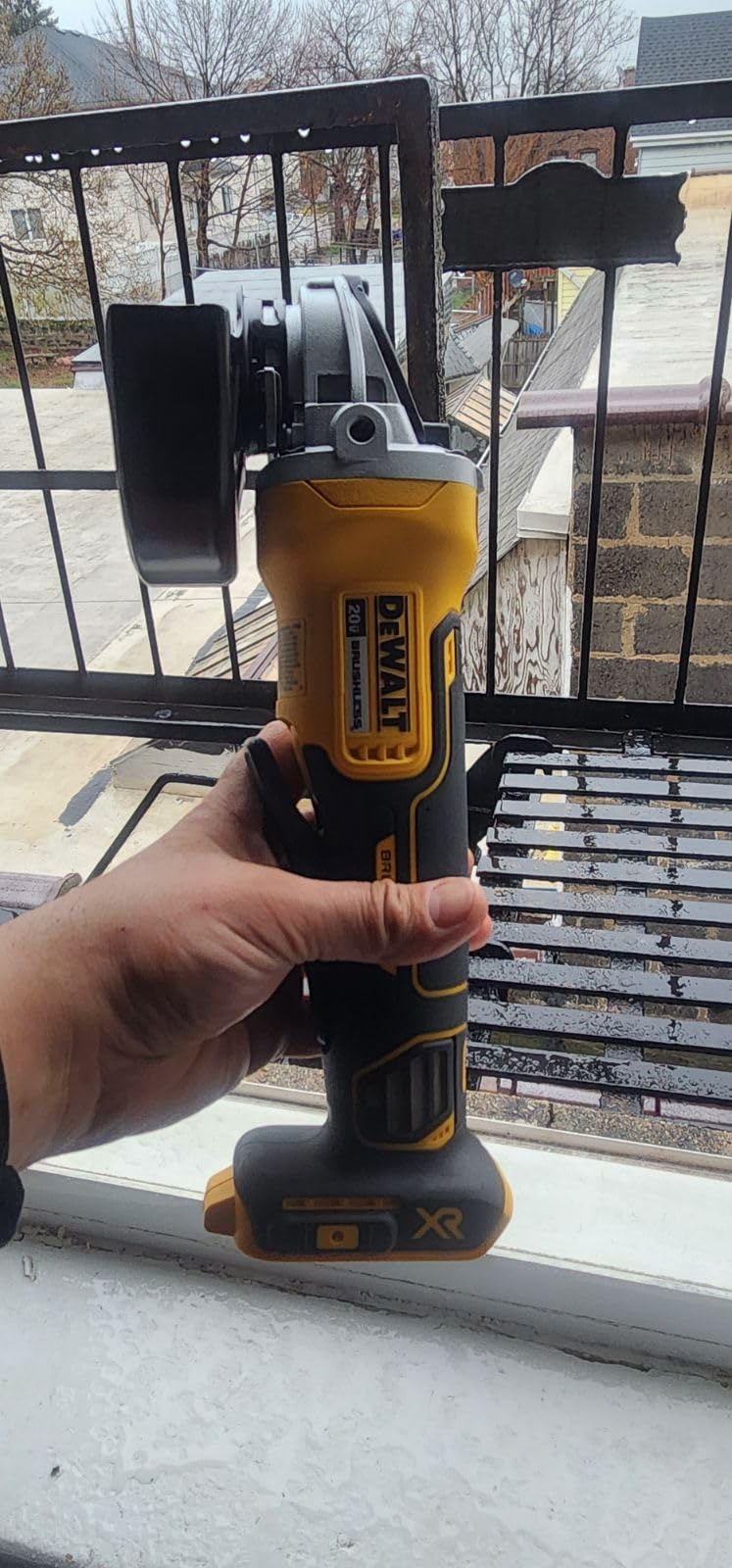
Where you feel the compromise is runtime. Buyers report 20 to 30 minutes of hard grinding on a 4Ah pack, which is enough to clear a door jamb or a section of floor pan but not enough for a full frame. The rated 3450 RPM is also a grinder speed, not a saw speed, so this is a surface-preparation tool rather than a cut-off tool.
Pair it with a 40-grit flap disc for surface rust and a 60-grit to refine, then follow with an 80-grit surface-conditioning wheel to blend the edges. On thin-gauge door skins, drop to a 60-grit flap immediately and keep the tool moving, because a brushless motor that does not bog down can also keep cutting when you want it to stop.
What to check before you buy the DCG413B
Confirm you already own DEWALT 20V MAX batteries. This is a tool-only purchase, so a bare-metal buyer ends up paying for a battery and a charger before the first job, and reviewers flag basic packaging with no instructions as a real annoyance on some shipments.
Check the disc size you already stock. The 4-1/2 inch class is the most common and the discs are cheap, but if your existing work uses 5-inch or 6-inch wheels, budget for a new set of consumables rather than assuming they fit.
Where the DCG413B is the wrong choice
Do not buy it for a long trailer restoration where the grinder will run for hours. The 20-30 minute runtime window means mid-surface battery swaps, and on a wide frame the cord is a better answer.
Skip it if you plan heavy weld prep or bead grinding. A brushless 20V motor will not match a 10 to 13 amp corded machine running disc after disc, and the one detail reviewers repeat most often is that it does not match a corded tool for heavy continuous use.
2. Metabo HPT G12SR4 – Best Corded Starter Kit for Rust Removal
Metabo HPT 4-1/2-Inch Angle Grinder, Includes 5 Grinding Wheels & Hard Case, 6.2-Amp Motor, Compact & Lightweight, G12SR4
6.2 amp / 980W
12000 RPM
4.0 lb
Spindle lock, 5 wheels included
Pros
- Five grinding wheels and a hard case in the box
- Light at 4.0 lb for long sessions
- Spindle lock makes disc changes fast
- Sealed gear case design resists rust dust
Cons
- 1-year warranty is short
- 6.2 amp is light on sustained heavy stock removal
- Some vibration reported at high speed
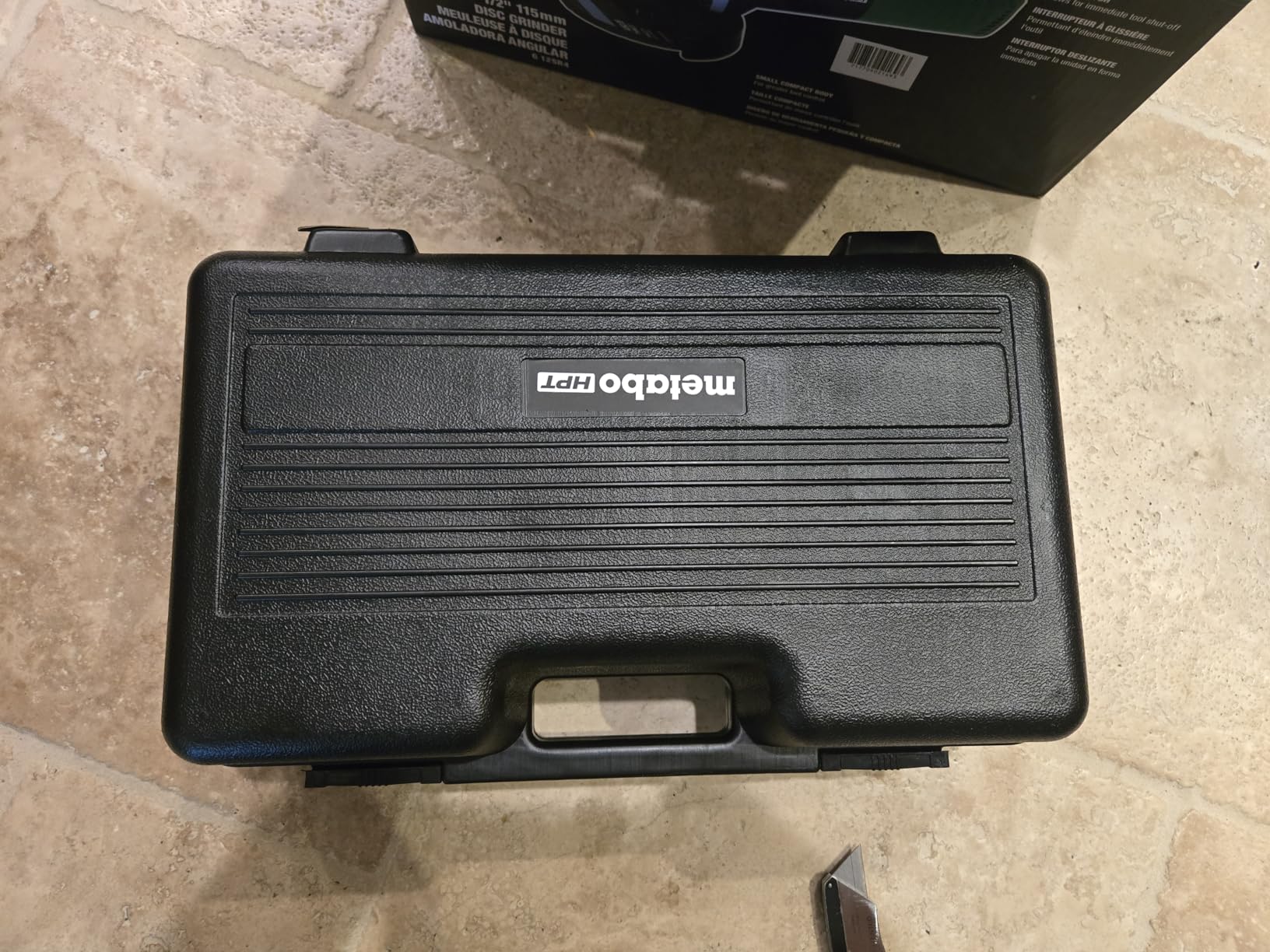
This is the kit I recommend to someone buying their first grinder for rust. It arrives with five grinding wheels and a hard carrying case, which matters more than it sounds: a first-time buyer does not have a 40-grit flap disc in a drawer, and ordering a mixed pack of discs is a separate errand most people skip and regret.
The motor is 6.2 amps with 980W maximum output at 12,000 RPM. That is plenty for surface rust, fence panels, gate hardware and the kind of pitting that a trailer frame picks up. The low-profile gear case is the detail I appreciate on confined work, and the spindle lock makes disc changes fast enough that you will not dread swapping from a wire wheel to a flap disc halfway through.
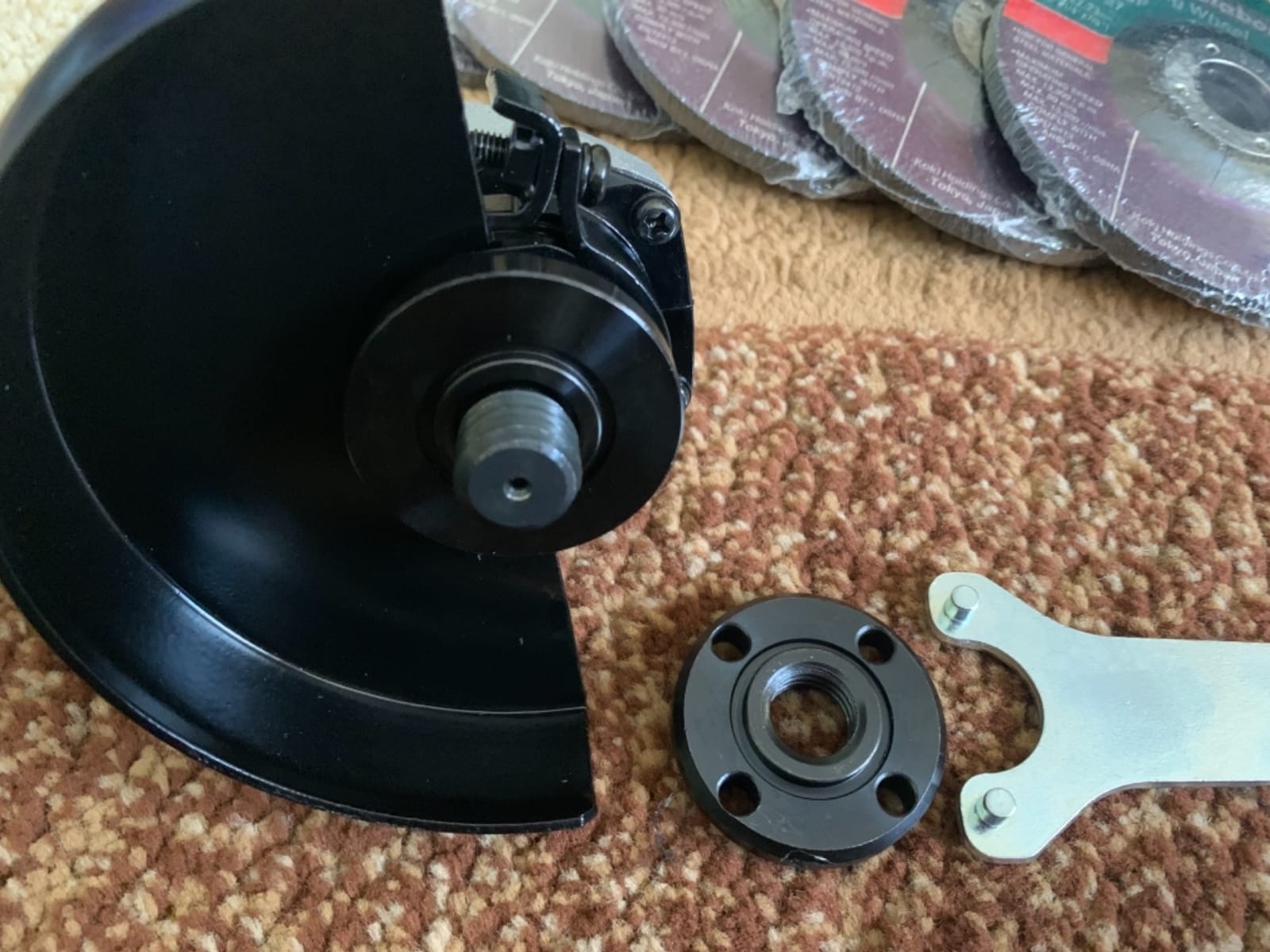
It is also a sealed-design machine. The gear case is built to keep dust and debris out, and for rust work specifically that is the feature that decides tool life, because the abrasive dust generated by stripping a rusty panel is exactly what destroys an open, unprotected motor over time.
What the included wheels are is worth being honest about. They are grinding wheels, not a curated rust kit. Treat the box as a way to start, then buy a 40-grit flap disc and a crimped wire wheel as your real working consumables.
What to check before you buy the G12SR4
Check the warranty length against how long you plan to own it. One year is on the short side compared with what some competing models offer, and on a shop tool that difference is real.
Check your disc inventory too. It ships with grinding wheels, so if you have never ground anything you will want at least one 40-grit flap disc and one wire wheel before you start.
Where the G12SR4 is the wrong choice
Skip it for deep structural pitting on thick sections. At 6.2 amps, sustained passes on heavy scale will have the motor bogging, and some buyers report noticeable vibration at high speed when pushing it that hard.
Pass if you need to work far from a wall outlet. It is corded only, and a 20 to 30 foot cord across a driveway is a trip hazard you will think about on every job.
3. AVID POWER 7.5-Amp – Best Budget Grinder for Surface Rust
AVID POWER Angle Grinder, 7.5-Amp 4-1/2 inch Electric Grinder Power Tools with Grinding Wheels, Cutting Wheels and Auxiliary Handle for Cutting, Grinding, Polishing and Rust Removal – Red
7.5 amp / 900W
12000 RPM
5.1 lb
Tool-free guard, flap disc included
Pros
- Ships with two cutting wheels
- two grinding wheels and a flap disc
- Tool-free adjustable guard saves time mid-job
- Two-position side handle works for either hand
- Extra carbon brushes included in the box
Cons
- 5.1 lb is the heaviest corded tool here
- Spanner wrench can bend under heavy use
- Some reports of motor overheating on long cutting sessions
The AVID POWER is the most complete box on this list, and for a first rust job that completeness is the whole argument. Two cutting wheels, two grinding wheels and a flap disc come in the kit, plus a side handle, guard, spanner wrench and spare carbon brushes. You can start stripping a railing the afternoon it arrives.
The 7.5 amp, 900W motor with a 7/8-inch arbor is the useful part. The 7/8-inch arbor is the common standard, so wheels from other brands fit without adapters, which is the opposite of the usual budget-tool compromise where you end up hunting for discs that will mount.
The tool-free adjustable guard is genuinely useful on this job, and that is rare at this level. Reorienting a guard takes seconds instead of a wrench, and on a vehicle where you work from many angles you will reorient it many times in one session.
The 5.1 pound weight is the honest drawback. It is the heaviest corded machine in this group, and on a long vertical pass along a fence post the difference between 4 pounds and 5.1 pounds shows up in your forearm before the end of the post.
What to check before you buy the AVID POWER
Check that a 7/8-inch arbor matches your existing disc stock, and note that the spindle is a 5/8-inch 11 thread, so both standards are handled. That makes disc shopping painless compared with narrower-platform tools.
Check what the job actually is. Surface rust on a gate or a set of hand tools is a good fit. Continuous cut-off work on rebar or structural steel is where a 7.5 amp budget motor starts running hot.
Where the AVID POWER is the wrong choice
Do not buy it for daily professional work. Buyers report the spanner wrench bending or stripping under heavy use, the guard locking mechanism feeling simplistic, and the on/off switch feeling fragile, all of which are signs of a tool built for occasional jobs.
Avoid it for a multi-day restoration. Motor overheating under extended heavy use is a recurring complaint, and a job that will span a weekend is exactly when you want sustained power rather than short bursts.
4. Milwaukee 2880-20 M18 FUEL – Best Cordless Grinder for Kickback Protection
Milwaukee 2880-20 M18 Fuel Brushless Lithium-Ion 4-1/2 in. / 5 in. Cordless Small Angle Grinder with No-Lock Paddle Switch (Tool Only)
18V 800W brushless
8500 RPM
5.0 lb
Electronic clutch, anti-vibration handle
Pros
- Electronic clutch cuts the wheel free on a bind-up
- Overload protection extends motor life
- Anti-vibration side handle reduces hand fatigue
- Works with every M18 battery
Cons
- Tool-only purchase
- 8500 RPM is below the 12000 corded figures
- Heavier at 5.0 lb than most cordless rivals
The Milwaukee earns its place on one specific feature: the electronic clutch. Where a mechanical or electronic kickback brake kills the motor, a clutch decouples the drive and lets the wheel spin free, so a jammed flap disc on a pinch weld does not tear the tool out of your hand. On a restoration where the disc binds constantly, that is a safety difference you notice every time.
Overload protection is the other quiet win. Rust removal on a frame means long passes at sustained load rather than short taps, and a motor that protects itself under that pattern is the motor that survives a season of fence and railing work.
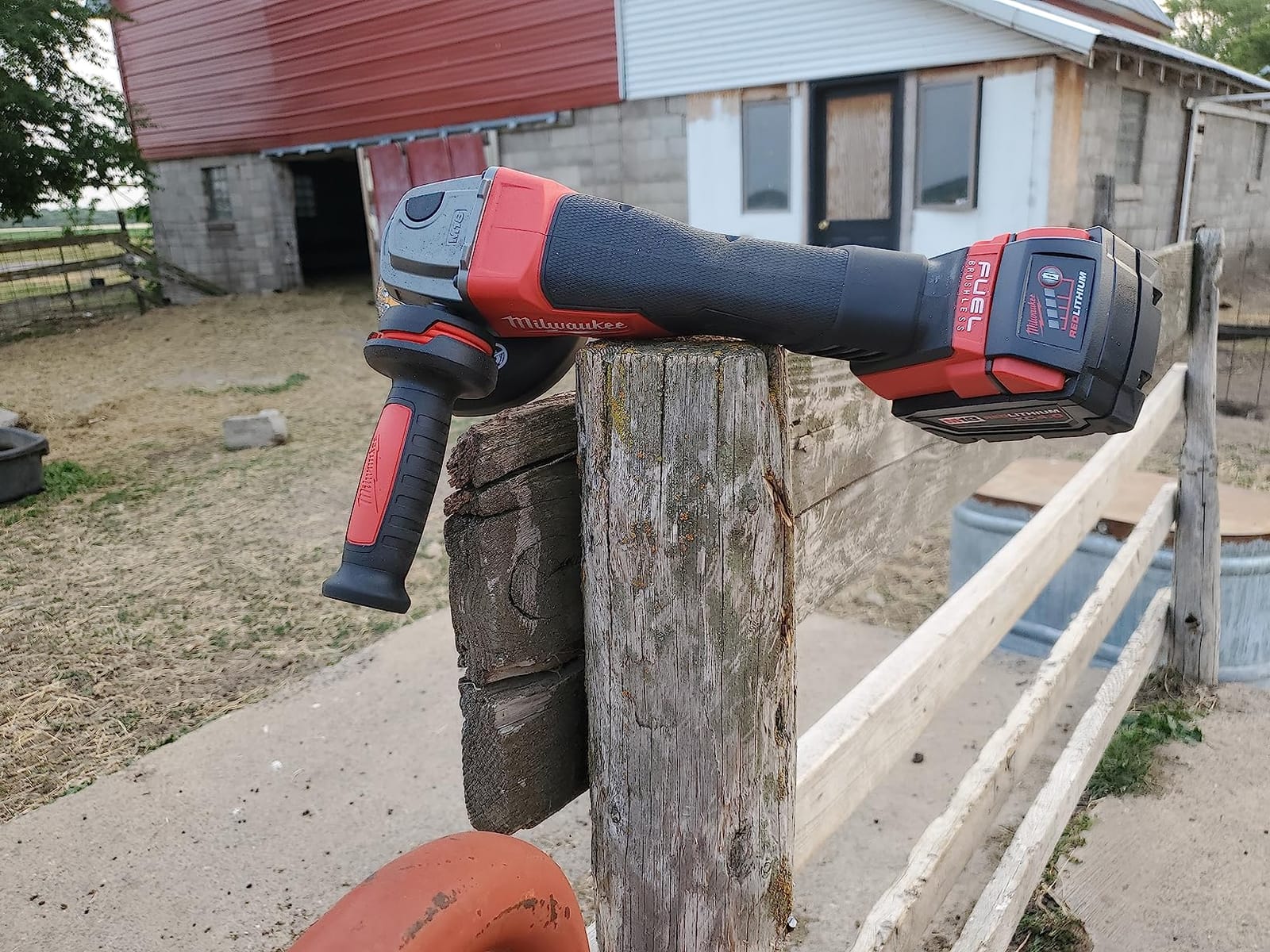
The anti-vibration side handle is the feature I would underline for this job specifically. Vibration is what tires the hand during long grinding passes, and a rusty panel is many passes rather than one. Combine it with the no-lock paddle switch and the 5/8-11 spindle, which takes the standard grinding accessory range, and the tooling question mostly disappears.
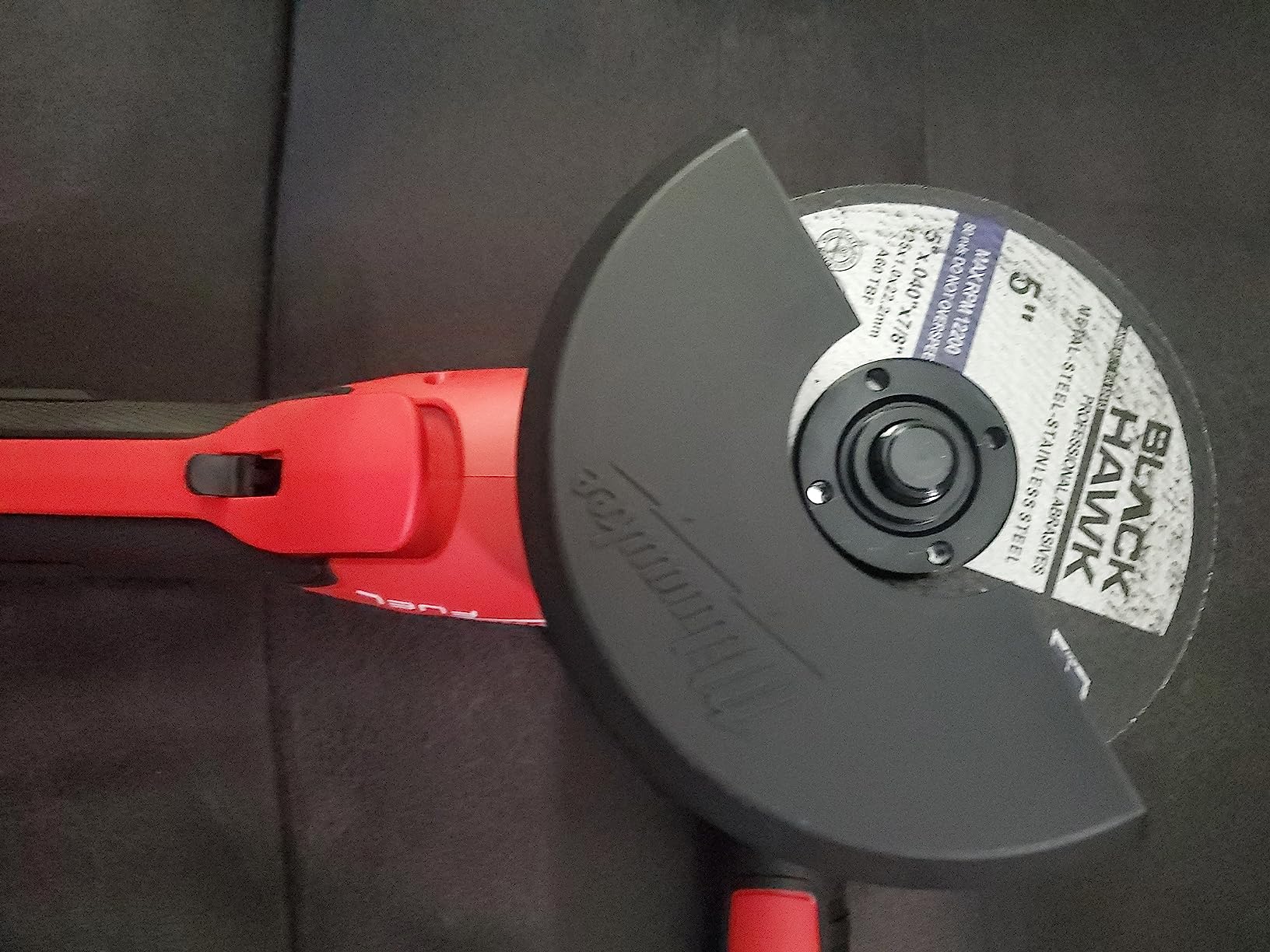
The 8500 RPM ceiling is worth understanding. It is a surface-preparation speed, not a cut-off speed, and the lower figure is one of the reasons buyers pair it with a 40-grit flap disc rather than trying to thin a plate with it.
What to check before you buy the 2880-20
Check your battery platform. This is tool-only, and if you are not already in the M18 ecosystem you are buying a battery and a charger as well. Buyers who already own M18 packs rate this tool extremely highly for that reason.
Check the handle. At 5.0 pounds it is heavier than the DEWALT cordless option despite the anti-vibration handle, and for extended overhead work that weight still lands on your wrist.
Where the 2880-20 is the wrong choice
Do not buy it for a full-day frame job. Battery life is limited for continuous heavy grinding, and a large restoration will drain a pack several times over.
Skip it if you need fast stock removal on thick metal. The 8500 RPM ceiling and the cordless power curve both work against heavy grinding, where a 12000 RPM corded machine finishes in a fraction of the passes.
5. Bosch GWS8-45 – Best Grinder for Rust Dust and Motor Protection
Bosch GWS8-45 4-1/2 In. Angle Grinder
7.5 amp / 11000 RPM
4.2 lb
Directed airflow, service minder brushes
Pros
- Directed airflow routes abrasive dust away from motor internals
- Service minder brushes flag when replacement is due
- Slim grip handles well one-handed
- Burst-protection guard adjusts quickly
Cons
- Guard adjustment needs an Allen key rather than being tool-free
- Vibration is somewhat elevated and the tool runs noisy
- Switch placement is awkward one-handed
Rust dust is the quiet enemy of a grinder, and the GWS8-45 is the pick built around that. Its directed airflow system diverts dust away from the components that matter, which on a rust job is the difference between a motor that lasts years and one that grinds to a halt after a season of trailer work.
The service minder brushes are the second practical feature. A small indicator shows when the carbon brushes are worn instead of leaving you to guess from symptoms, and for a tool you will use in bursts over months rather than continuously, that is genuinely useful.
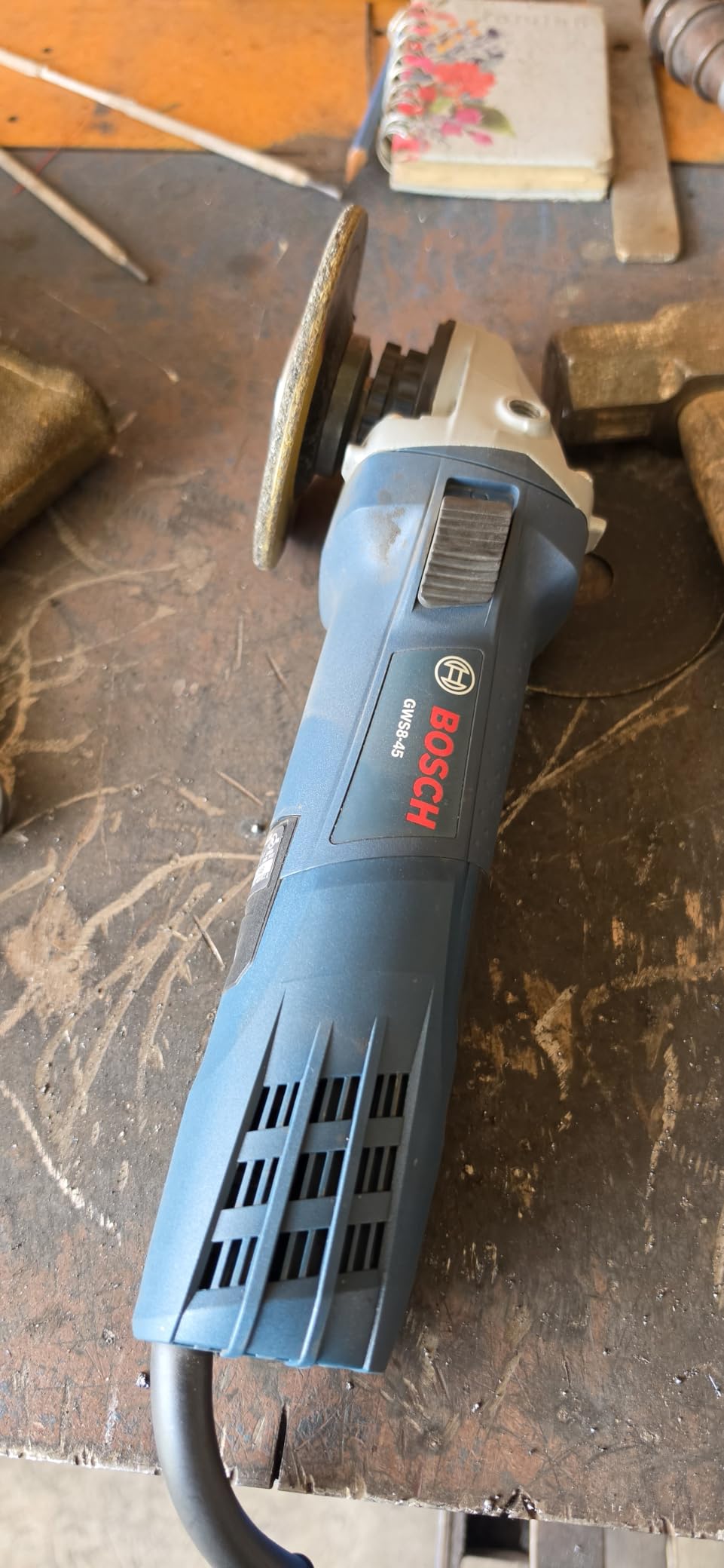
At 7.5 amps and 11,000 no-load RPM it has the numbers for real work, and the burst-protection guard with quick adjustments keeps the wheel orientation correct as you move around a curved panel. The rubber power cord stays flexible in cold weather, which matters more than it sounds for outdoor work in a garage or driveway in the wrong season.
One documentation note: the manual states the tool is not for cut-off applications, though users report it works in practice. For rust removal alone that disclaimer does not affect you, and the slim-grip body is genuinely comfortable for a one-handed pass on a hand tool or a hinge.
What to check before you buy the GWS8-45
Check whether you will reorient the guard often. Adjustment takes an Allen key, so on a job where you constantly change working angle, a tool-free guard will save more time than this motor saves.
Check the box contents against your own consumables. It ships with a depressed centre grinding wheel, a backing flange, lock nut, spanner wrench, a Type 27 guard and a side handle, so you will still need a flap disc or wire wheel to start on rust.
Where the GWS8-45 is the wrong choice
Pass if you are left-handed or work with a glove on. Switch placement is reported as awkward, and a slide or paddle you cannot hit without removing your hand is a real problem with a spinning wheel.
Skip it for a quiet workshop. Vibration is somewhat elevated and the tool runs noisy, and a louder grinder inside a home shop is tiring over a long session.
6. DEWALT DWE4011 – Best Grinder for Tool-Free Rust Disc Changes
DEWALT Angle Grinder, One-Touch Guard, 4-1/2 -Inch (DWE4011)
7 amp AC/DC
12000 RPM
3.9 lb
One-Touch guard, quick wheel release
Pros
- One-Touch guard adjusts without any tool
- Quick-Change release pulls the wheel off without a wrench
- 3.9 lb and a slim ergonomic body
- Users report 20+ years of service from the platform
Cons
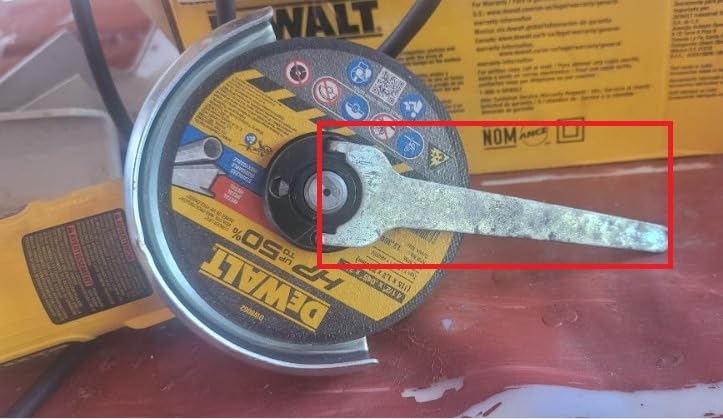
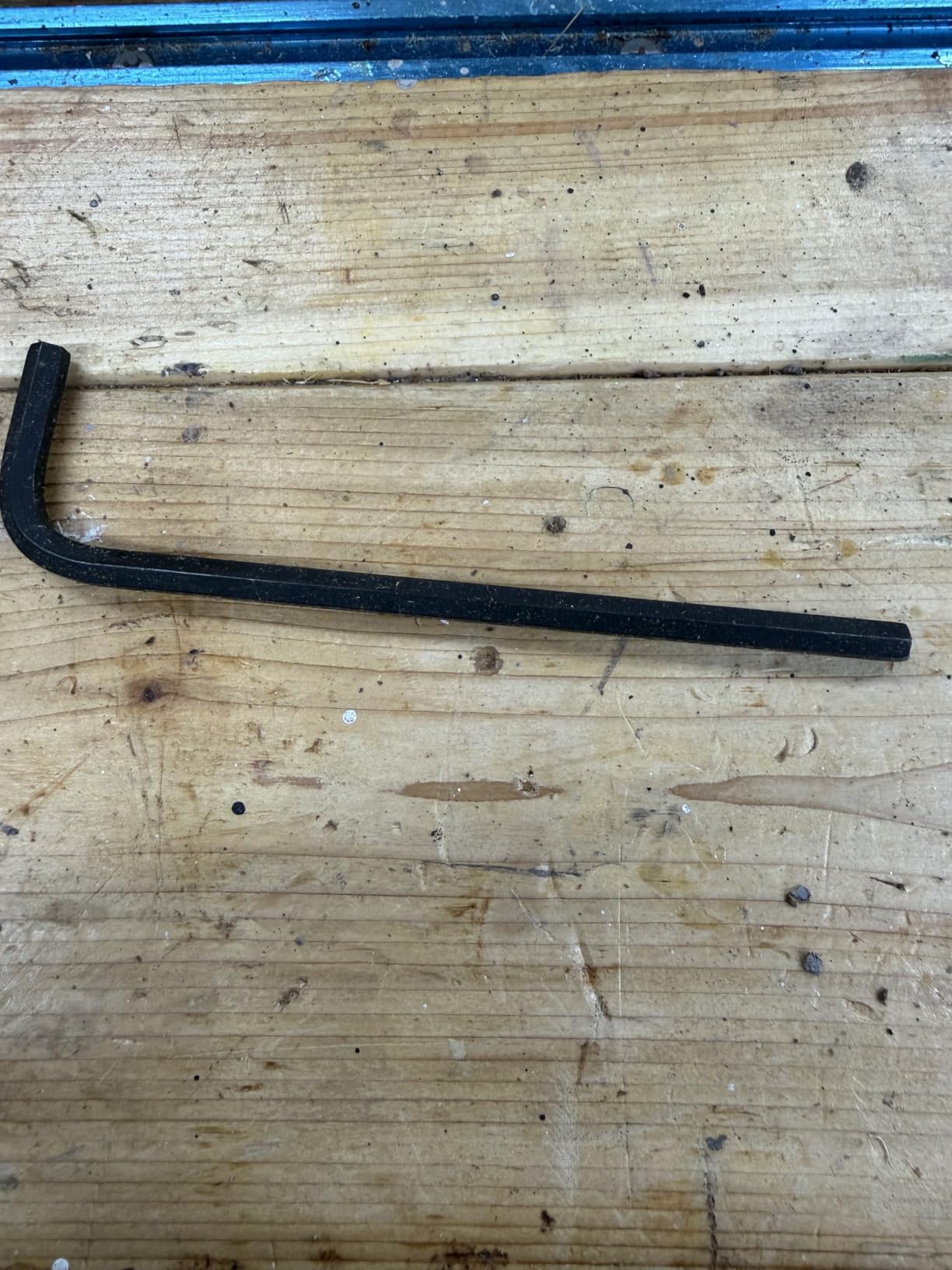
- Hex wrench replaces the traditional spanner wrench
- Switch can be hard to hit with smaller hands
- Guard lever is stiff for the first few uses
For a rust job specifically, disc changes happen constantly. A wire wheel to knock off loose scale, a 40-grit flap to strip, a surface-conditioning wheel to blend, and the DWE4011 makes all three swaps tool-free. The One-Touch guard needs no wrench either, so you reorient it the same way.
The 7 amp AC/DC motor at 12,000 RPM and 850 watts is the most proven configuration in this group. Long-term owners report tools from this platform still running after two decades, which is the kind of durability claim that matters more on a rust job than on any other job, because rust jobs are usually on something you want to keep.
At 3.9 pounds it is the second-lightest corded tool here, and the slim body plus a 2-position removable side handle let you set up a comfortable grip on a vertical post or the flat of a trailer side rail.
The included depressed centre wheel and hex wrench cover the basics, but the real consumable for this job is still a 40-grit flap disc and a crimped wire wheel, which you will order separately.
What to check before you buy the DWE4011
Check what you are used to holding. The hex wrench is the only tool provided, and buyers who are used to a spanner wrench note that as a change. If you work with the wheel on often, buy a proper spanner wrench anyway.
Check your hands. The switch can be difficult to hit with smaller hands, and a rust pass means a lot of trigger time, so the ergonomics are more visible than on a cutting job.
Where the DWE4011 is the wrong choice
Do not buy it for heavy structural pitting. Seven amps will clear surface and moderate rust convincingly, but on thick scale you will be swapping discs more than you are removing rust.
Skip it if you already own a full battery platform and want to work away from power. It is corded only, and on a long driveway the cord becomes the thing you are watching instead of the rust.
7. WEN 94475 – Best First Grinder for Occasional Rust Jobs
WEN 94475 7.5-Amp 4-1/2-Inch Angle Grinder with Reversible Handle, Three Grinding Discs, and Carrying Case, Black,orange
7.5 amp / 900W
11000 RPM
4.0 lb
Arbor adapter, reversible handle
Pros
- Arbor adapter accepts both 5/8 and 7/8 inch wheels
- Reversible auxiliary handle suits either hand
- Three grinding discs and a carrying case included
- Light at 4.0 lb
Cons
- Build quality trails the professional brands
- Vibration runs higher than premium models
- Guard adjustment may require tools
- Best suited to occasional rather than daily work
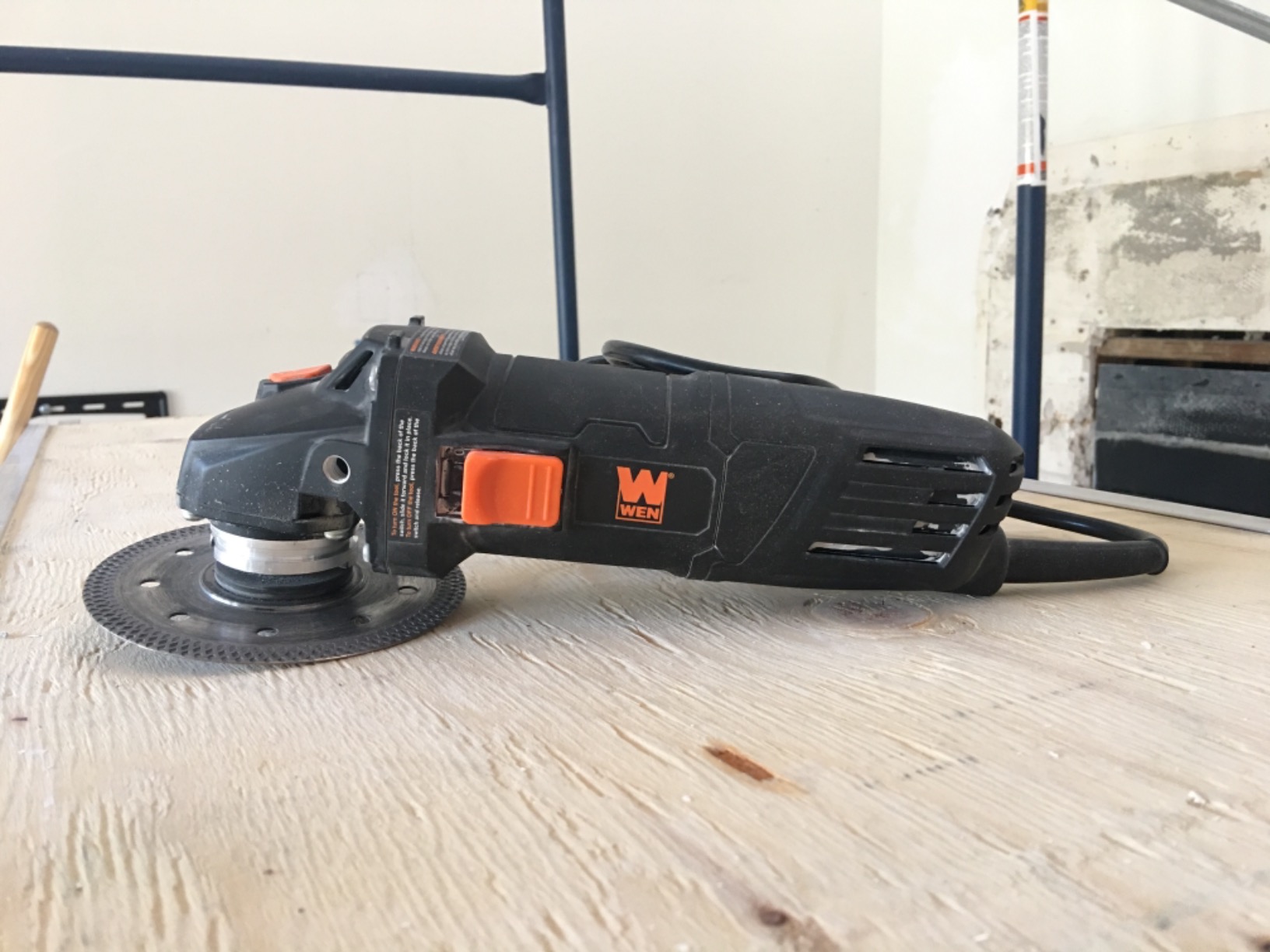
The WEN 94475 makes sense in a specific situation: a weekend rust job, an outdoor furniture rescue, a set of rusty hand tools, once or twice a year. It ships with three grinding discs and a carrying case, and the 7.5 amp motor reaches 11,000 RPM, which is more than enough to strip surface rust off a planter or a railing.
The arbor adapter is the feature I would not buy without. It takes both 5/8-inch and 7/8-inch wheels, so if you already own a mixed pile of discs, most of it will mount. On a first grinder that is a meaningful saving in frustration.
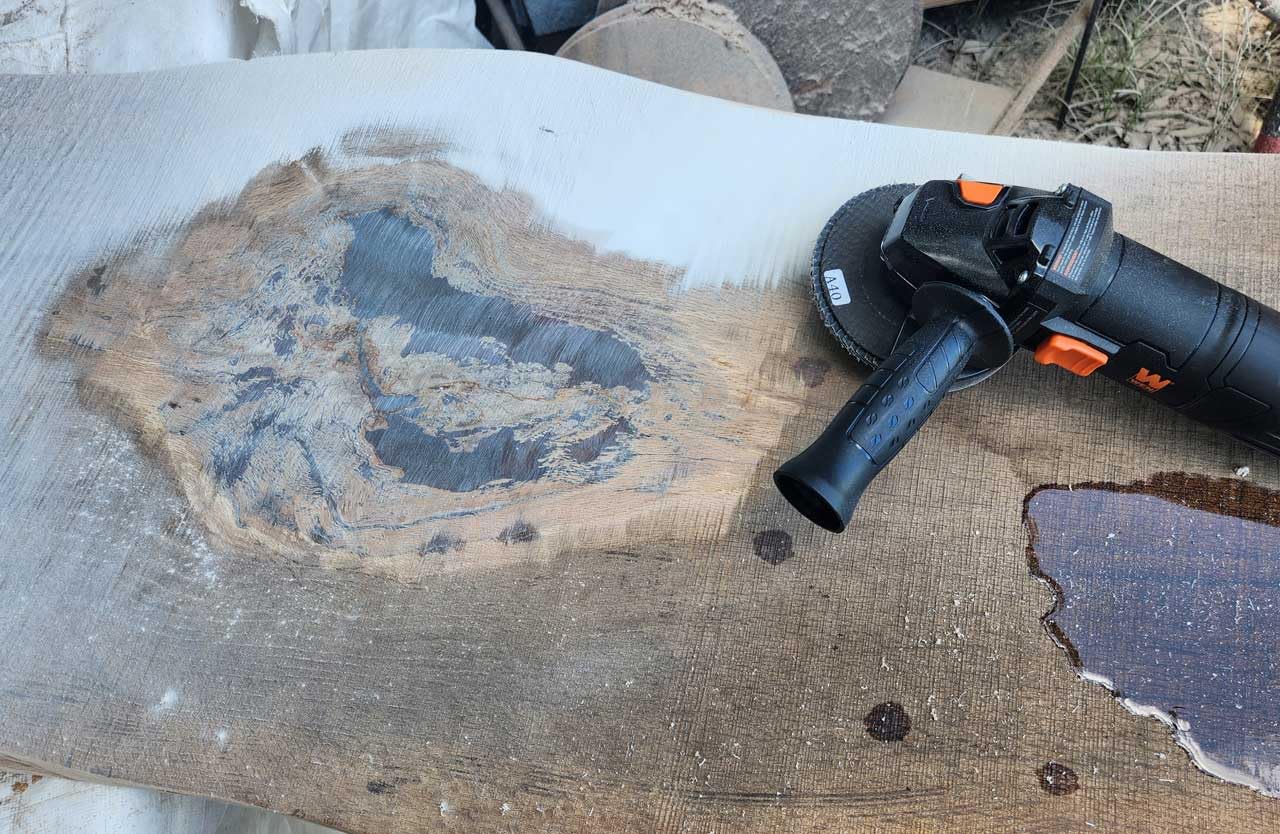
The reversible auxiliary handle is another one for a first-time buyer, since it can be fitted on the side that suits you rather than forcing a grip you will fight. At 4.0 pounds it stays light through a short session.
What you are buying is entry-level. Buyers report build quality that is not on par with premium brands, higher vibration, and a guard that may need tools to adjust, and none of that matters much on a two-hour job a year.
What to check before you buy the 94475
Check how often you will use it. A couple of rust jobs a year, yes. A weekly hobby, no. Long-term durability is the open question in the reviews for anyone committing to heavy use.
Check whether your discs are 5/8 or 7/8 inch and confirm the adapter covers both before you order a new consumable set.
Where the 94475 is the wrong choice
Pass if this is a shop tool. The build quality and the vibration level both point to a tool you will replace, not one you will keep for a decade of daily grinding.
Skip it for a vehicle body. Surface rust on flat steel is well within its ability, but anything near thin panel metal deserves a machine with better speed control and a guard you can reposition quickly.
8. Metabo HPT G12VE2 – Best Variable-Speed Grinder for Finishing Rust Work
Metabo HPT Angle Grinder | 4-1/2-Inch | 12 Amp | AC Brushless Motor | Variable Speed | 3-Position Side Handle | G12VE2
12 amp AC brushless
6 speeds 2800-8500 RPM
3.8 lb
3-position handle
Pros
- Six speed settings from 2800 to 8500 RPM for real control
- AC brushless motor runs cool at low speed
- Anti-kickback plus zero-voltage restart protection
- 3-position side handle and an ultra-slim grip
Cons
- 8500 RPM ceiling is below typical corded figures
- 1-year warranty
- Spanner wrench is not stored on the tool
- Newer model with a much smaller review base
Variable speed changes how this job feels. Six settings from 2800 to 8500 RPM let you strip a heavy layer at full speed, then drop to a low setting for the final pass on a panel, and running the motor cool at low speed is what makes that possible without cooking the windings.
At 12 amps and 1500W with an AC brushless motor, this has the highest sustained output of any corded machine here. The 3-position side handle and a 2-13/64 inch grip diameter give you real options on a confined frame rail, and the tool-less wheel guard with a quick release lever speeds up changes mid-job.
Anti-kickback protection and zero-voltage restart protection handle the two things that ruin a session: a jammed wheel and a tripped breaker. An internal inverter circuit also makes it tolerant of generator power, which matters if your rust work happens somewhere without a clean outlet.
The 8500 RPM ceiling is the compromise. It is fine for surface preparation with a flap or surface-conditioning wheel and short of what you want for aggressive cut-off work, and buyers consistently list the lower maximum as the main trade-off.
What to check before you buy the G12VE2
Check what you need the tool for. If it is finishing and blending after a heavier tool has done the stripping, the variable speed range is the feature that makes it worth owning on its own.
Check the warranty and the review base. It carries a 1-year warranty and sits with a much smaller pool of owner feedback than the other picks, so treat the durability picture as less settled.
Where the G12VE2 is the wrong choice
Skip it for heavy stock removal. The 8500 RPM ceiling and single-year warranty are a poor pairing with a machine you intend to run daily on structural work.
Pass if you need a cut-off wheel for thick stock. Buy it for surface preparation, and keep a higher-RPM corded grinder for cutting if both jobs are on the table.
How to Choose an Angle Grinder for Rust Work
Corded or cordless for a real rust job. A cordless grinder wins whenever the work is away from an outlet: a vehicle in a driveway, a fence line, a boat on a trailer. The cost is runtime. Budget 20 to 30 minutes of hard grinding per 4Ah pack, which sounds generous until you are three-quarters through a frame. A corded machine never stops, and the only cost is managing the cord.
Factor the battery into the decision. Both cordless picks here are tool-only purchases. If you already own DEWALT 20V MAX or Milwaukee M18 packs, the tool is the only purchase and the platform is a genuine advantage. If you own neither, you are buying a battery, a charger and the tool, and that total should decide between the two ecosystems and a corded alternative.
Disc size. The 4-1/2 inch class covers almost all rust work, and every pick in this guide is that size, which also means one consumable shelf instead of three. Step up to 5 or 6 inches only for wide flat panels where coverage per pass matters more than control, and remember a larger disc needs a higher-output machine to push it.
Kickback brake, electronic clutch, or neither. A kickback brake stops the wheel in 2 seconds or less on a pinch, stall or bind-up. An electronic clutch decouples the drive so the wheel spins free, protecting both the tool and your hands. Either is a real upgrade on vehicle work, where the disc binds constantly. A plain slide switch with no protection is acceptable for a bench, where the workpiece cannot grab.
Amps and RPM. Amps tell you how hard the tool pushes under load. Seven to 7.5 amps clears surface and moderate rust well. Twelve amps plus a brushless motor handles sustained passes on heavy scale. RPM above 11000 is what makes a wire wheel or a fine surface-conditioning wheel work; below 9000 is a surface-preparation speed only.
Rust dust and heat management. Two things shorten a grinder’s life on rust work: abrasive dust pulled into the motor and heat build-up in the disc. Directed airflow systems and sealed gear-case designs are worth real money here, and variable speed lets you match the speed to the wheel so the disc does not glaze.
What an Angle Grinder Cannot Fix
Grinding removes rust. It does not restore metal that has already been lost. Surface rust and light orange pitting grind back to sound steel, and that is where a grinder earns its place. Deep pitting, where corrosion has eaten into the metal and left a ragged cavity, does not grind back to a flat surface because there is no metal left to grind to.
This is the question every forum thread ends on and no competitor answers. When a flap disc strips a panel fast and a considerable amount of residual rust stays in the pitting, that is not a technique failure. It is a rigid backing that cannot reach the low spots, and no amount of grinding changes the shape of the hole.
For a pitting area you have three realistic options: fill it with body filler or epoxy and sand it back, weld in new sheet metal and finish it, or replace the panel. On a trailer frame, a structural rust area is a welding job. On a door skin, filler is normal practice. On a load-bearing rail, replacement is the only answer that is honestly safe.
The second limit is base metal. Every abrasive disc cuts steel, and on thin-gauge panel or aluminium there is very little margin. Use a coarser grit than you think you need, keep the tool moving, and finish with a surface-conditioning wheel rather than grinding harder.
How to Stop Rust Coming Back After Grinding
Bare steel is the most vulnerable surface a vehicle has. Clean it, and within days it starts oxidising again, which is why a grinder that strips a trailer back to bright metal without any follow-up can actually leave the metal worse off than the paint it removed.
Work in this order. Degrease the surface with a brake cleaner or a dedicated degreaser, then coat bare metal with a rust converter or an etch primer within the same session. Once the conversion or etch layer is dry, follow with a high-temperature paint or a primer suited to the surface. On a hot item like an exhaust or a stove pipe, a high-temperature-rated coating is the one that lasts.
For structural steel where paint is not an option, cold-galvanizing primer is the answer. It leaves a sacrificial zinc layer that corrodes instead of the steel underneath, and it is what keeps a ground trailer frame from going orange at the welds. For bare antique tools, a light oil or a corrosion inhibitor film is the standard finish.
Doing this correctly turns a weekend of grinding into a job that stays done. Skipping it turns the same weekend into something you repeat next spring.
Frequently Asked Questions
Can an angle grinder be used to remove rust?
Yes, and it is the fastest mechanical method available. An angle grinder spins a strip disc, flap disc or wire wheel at 9,000 to 12,000 RPM, and the harder abrasive shears through iron oxide down to bare steel in seconds. It beats vinegar soaking or wire brushing on time by a wide margin. Hold the tool at a shallow angle, keep it moving, and drop to a coarser grit as the surface clears.
What is the best angle grinder attachment for removing rust?
A strip disc for heavy scale, a 40-grit flap disc for general surface rust, a crimped wire wheel for loose scale and flaking chrome, and a surface-conditioning wheel for final blending. Match the attachment to the severity of the rust rather than to the grinder. Strip and flap discs cut rust, wire wheels abrade it, and surface-conditioning wheels scuff it without cutting into the base metal.
Will a flap disc remove rust?
Yes, and it is usually the right first tool. A 40-grit flap disc strips surface rust quickly and blends the edges in the same pass. The limitation is pitting: the rigid backing cannot reach into low spots, so a considerable amount of residual rust often remains in deep corrosion. Follow up with a wire wheel or a 60-grit disc, and accept that a pit deeper than the disc can reach will need filling rather than grinding.
When should I use a grinding wheel instead of a flap disc?
Use a grinding wheel for shaping, weld prep and taking down heavy mill scale, where you want solid material removal. Use a flap disc for surface rust, blending and finish work, where a rigid grinding wheel would gouge the panel. On a rust job the usual sequence is a grinding wheel or strip disc to knock off heavy scale, then a 40-grit flap disc, then an 80-grit pass to feather the edges.
Is it safe to use an angle grinder on a car to remove rust?
It is safe with preparation. Wear eye protection and a face shield, because a wire wheel throws whole strands of steel rather than dust. Drain and cap the fuel system, keep the area clear of fuel vapour, remove the battery on electric vehicles, and never grind near brake lines or airbags. Have an extinguisher within reach, expect sparks, and mask the surface you are protecting before the first pass.
Final Verdict
The best angle grinders for rust removal in 2026 are not all the same tool, because rust work is not one job. Our pick is the DEWALT DCG413B: a 3.8 pound brushless cordless grinder with a kickback brake and a two-stage trigger, which is the right combination for vehicle work anywhere a cord cannot reach.
For a corded bench setup, the Metabo HPT G12SR4 is the sensible first machine and the Bosch GWS8-45 is the one built to survive rust dust. Control-oriented finishing work is what the Metabo HPT G12VE2 exists for. Whatever you choose, pick the disc first, and treat rust converter or cold-galvanizing primer as part of the job rather than an afterthought.