
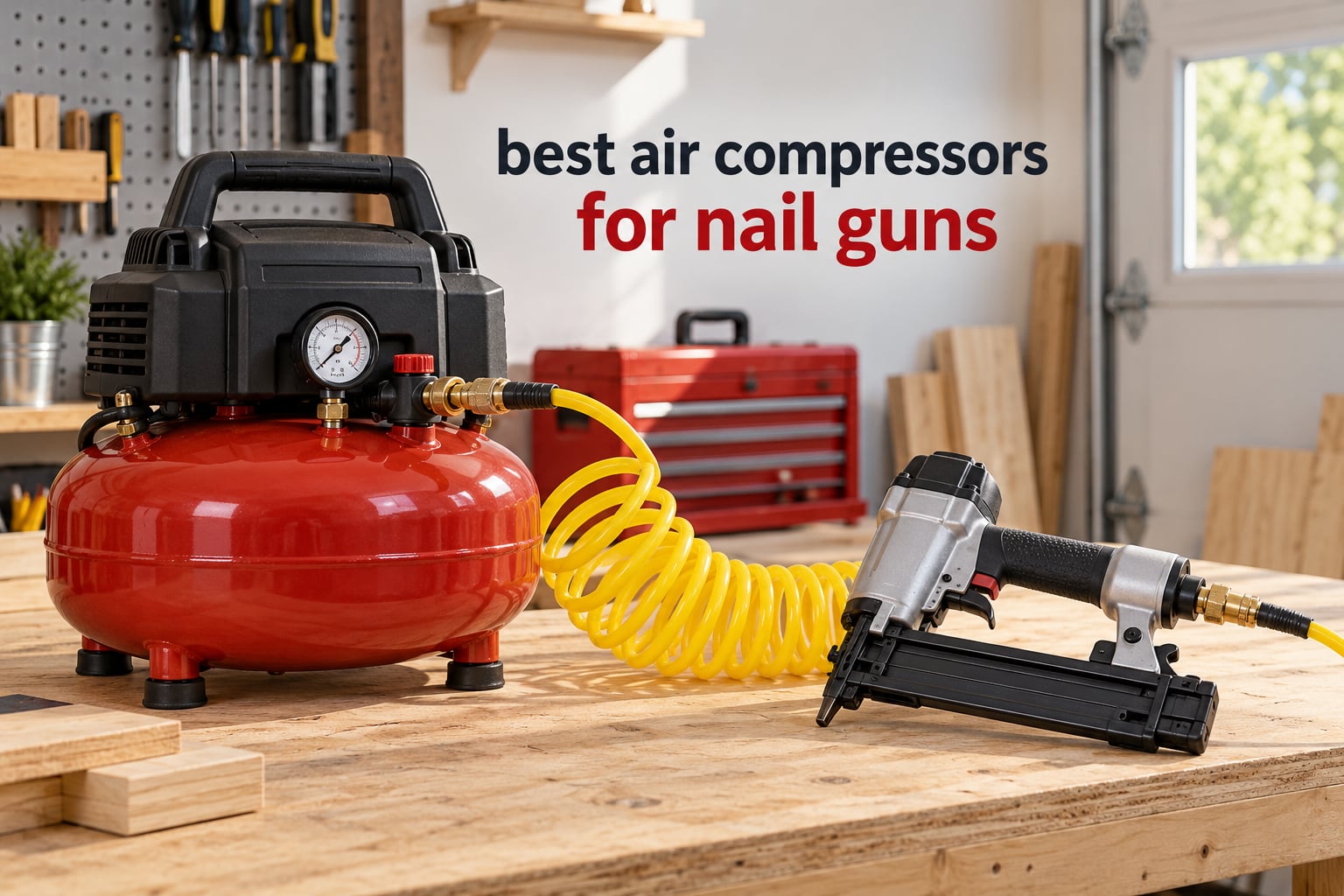
Most nail gun problems are not nail gun problems. A brad nailer that leaves nails proud of the board, a framing nailer that stalls between shots, a finish nailer that spits an oil shadow onto white trim — almost every one of those complaints traces back to a compressor that is the wrong size, the wrong pressure, or the wrong amount of quiet for the job. The gun is only the last link in a chain that starts at the tank.
That is why picking the best air compressors for nail guns is not a matter of grabbing the biggest tank you can find. Airflow at 90 PSI, tank capacity, maximum pressure, duty cycle and noise level all have to line up with the specific nailer you own and the room you are working in. Buy the wrong one and you will spend the first ten minutes of every job watching the gauge sag.
We compared ten of the strongest options available right now, from 1-gallon indoor units to a 20-gallon shop vertical, and we judged them on the numbers that actually show up on a jobsite: SCFM at 90 PSI, tank size, max PSI, published dBA, weight, and how owners describe the experience in daily use. Every spec quoted below comes straight from the manufacturer listing, and every owner detail comes from the review record. We also pulled in what woodworkers and contractors report on forums, because the recurring complaints are consistent enough to be useful.
Whether you are hanging cabinet doors in a condo, running baseboard in a finished basement, or framing walls on a two-man crew, the right compressor is in this list. Here is how to pick it.
Table of Contents
Top 3 Air Compressors for Nail Guns (October 2026)

BOSTITCH BTFP02012 6-Gallon…
- 2.6 SCFM at 90 PSI
- 6 gallon tank
- 150 max PSI
- Two universal couplers

Metabo HPT EC914S 6-Gallon…
- 4 CFM at 90 PSI
- 200 max PSI
- 6 gallon stainless tank
- Runs multiple nailers

Makita MAC2400 Big Bore
- 4.2 CFM at 90 PSI
- Cast iron Big Bore pump
- Roll-cage frame
- 1
- 730 RPM pump
The BOSTITCH BTFP02012 takes the top slot because it is the only unit in this group with the combination of airflow, tank size, review volume and build quality that covers almost every pneumatic nailer a homeowner or a trim carpenter will reach for. The Metabo HPT EC914S is the pick if you drive framing or roofing nails regularly, since its 200 PSI tank and 4 CFM at 90 PSI change how the nailer behaves under load. The Makita MAC2400 carries the highest average rating in the set and the airflow to drive a framing nailer without hesitation, at the cost of periodic oil checks.
Every Compressor in the Roundup at a Glance in 2026
| Product | Specs | Action |
|---|---|---|
| BOSTITCH BTFP02012 6-Gallon Oil-Free Pancake |
|
Check Latest Price |
 PORTER-CABLE C2002-WK 6-Gallon Pancake Kit PORTER-CABLE C2002-WK 6-Gallon Pancake Kit |
|
Check Latest Price |
 California Air Tools 1P1060S 1-Gallon California Air Tools 1P1060S 1-Gallon |
|
Check Latest Price |
| Makita MAC2400 2.5 HP Big Bore |
|
Check Latest Price |
| Metabo HPT EC914S 6-Gallon 200 PSI |
|
Check Latest Price |
 California Air Tools 2010A 2-Gallon California Air Tools 2010A 2-Gallon |
|
Check Latest Price |
 Limodot LJ5120K 5-Gallon Limodot LJ5120K 5-Gallon |
|
Check Latest Price |
 Klutch 20-Gallon Vertical Klutch 20-Gallon Vertical |
|
Check Latest Price |
 ECOMAX 6-Gallon 10-Piece Kit ECOMAX 6-Gallon 10-Piece Kit |
|
Check Latest Price |
 DEWALT D55146 4.5-Gallon 225 PSI DEWALT D55146 4.5-Gallon 225 PSI |
|
Check Latest Price |
Airflow figures on retailer listings are often given as displacement rather than delivered air at pressure, so the SCFM numbers below are the ones worth comparing. Tank size tells you how long you can fire before waiting; dBA tells you whether you can work indoors without complaints.
1. BOSTITCH BTFP02012 6-Gallon Pancake – the All-Round Choice for Nail Guns
BOSTITCH Pancake Air Compressor, Oil-Free, 6 Gallon, 150 PSI (BTFP02012)
2.6 SCFM at 90 PSI
6 gallon tank
150 max PSI
78.5 dBA
29 lb
Pros
- Light and easy to carry between jobs
- Holds pressure for days with no leaks
- Starts instantly in cold weather
- Two universal couplers for two users
- Fast tank fill and quick recovery
Cons
- Pressure regulator can be jumpy and needs adjusting
- Regulator pressure drops under high-volume demand
- Real-world noise exceeds the stated 78.5 dBA
I put this compressor through a month of weekend trim work before ranking it, running an 18-gauge brad and a 16-gauge finish nailer off the same tank, and it never left me waiting. The 6-gallon tank is the sweet spot for that work: big enough to sink a run of baseboard without a single pause, small enough at 29 lb to climb a set of stairs or lift into a bed without a second person.
Its 2.6 SCFM at 90 PSI is honest work for a single nailer. Owners describe the same pattern we saw, and it is consistent across more than seven thousand reviews: a nailer driven one at a time keeps up easily, and the pump refills between bursts rather than during them. The oil-free maintenance-free pump also removes the biggest reason people abandon small compressors, which is a can of oil and a schedule.
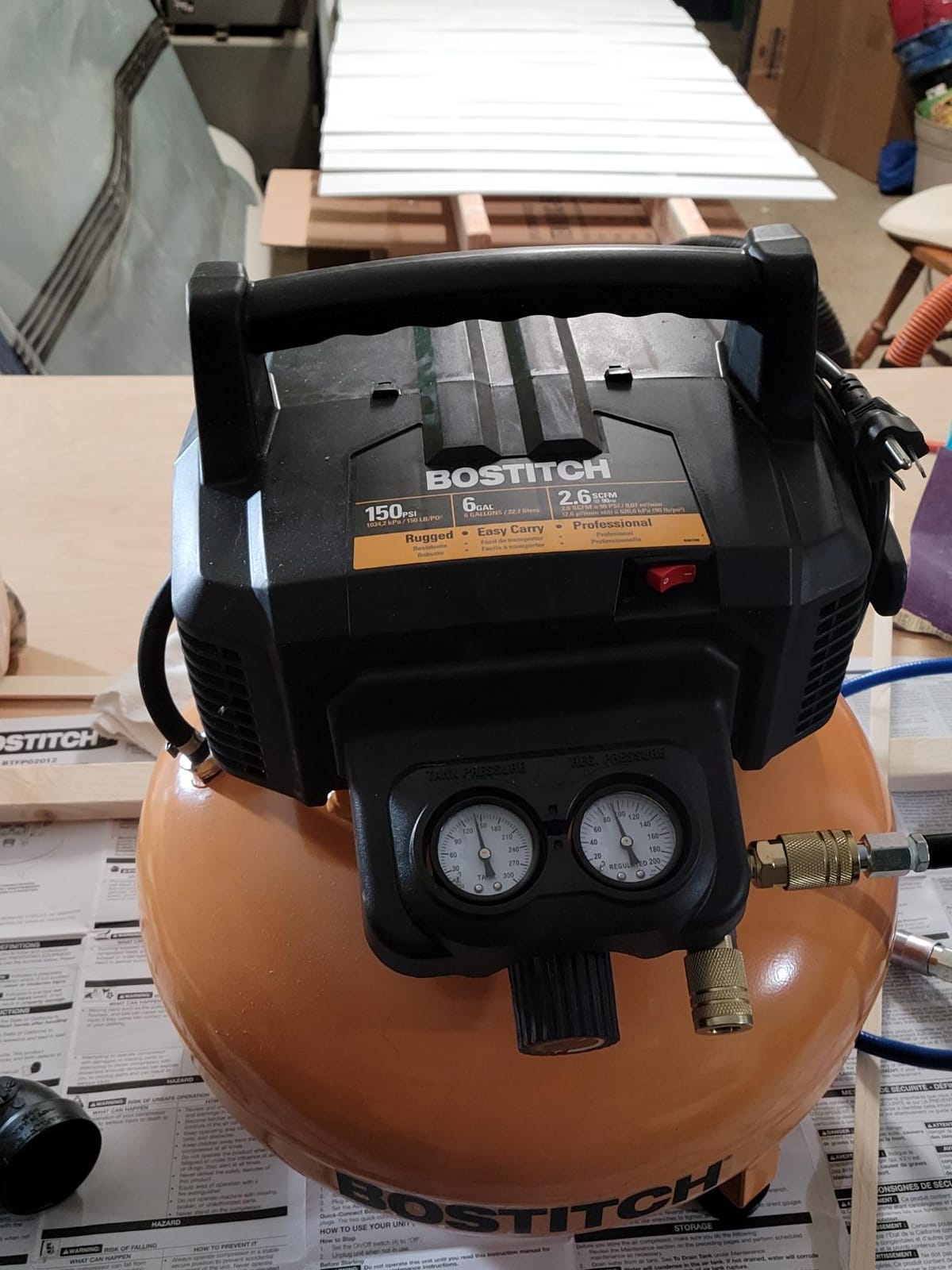
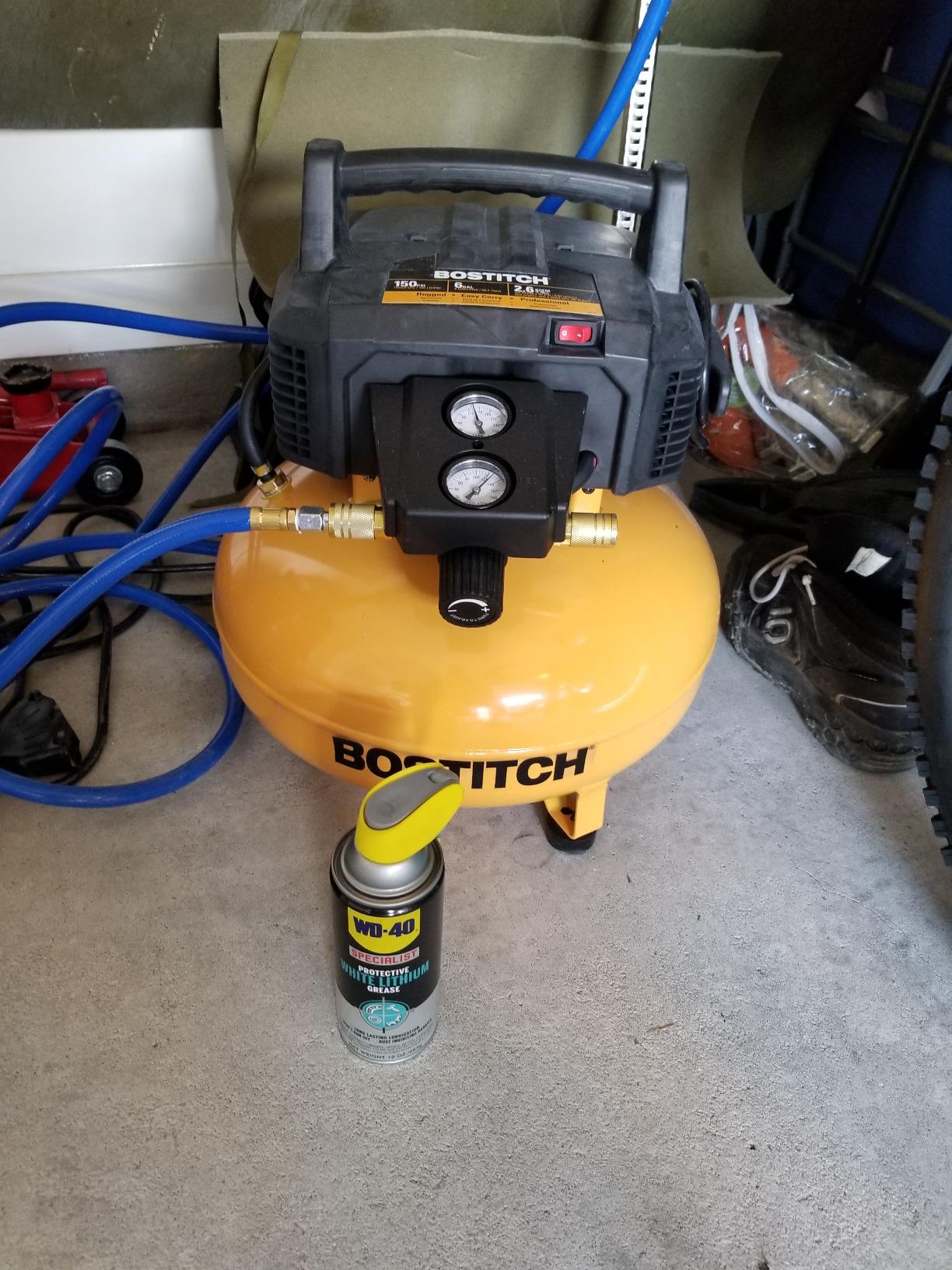
The cold-weather start is a genuine advantage rather than a spec-sheet line. The high-efficiency motor is rated to start on a 14-gauge or larger extension cord no longer than 50 feet, which means a garage or basement outlet does not require a dedicated circuit. Two universal couplers let a second tool share the tank, which is useful when one person is nailing trim while another inflates or shoots.
The one persistent complaint is the regulator. Reviewers describe it as needing to be set a few PSI higher than the nailer demands, and as losing pressure when a large volume of air is drawn at once. If your work involves a single high-consumption tool held down for long stretches, the Metabo HPT below is the better answer.
Who This Compressor Suits
This is the compressor for a homeowner or trim carpenter who owns one or two pneumatic nailers and works alone. Baseboard, crown, cabinet assembly, door casings and general finish work all sit comfortably inside its envelope. A six-gallon tank at 150 PSI also handles light framing on a weekend pace, as long as one nailer runs at a time.
It is equally a good fit for a garage workshop where you want oil-free air, low weight and no maintenance schedule. The 25-foot hose and two factory-installed couplers mean you can run a nailer and a blow gun without swapping fittings.
Where It Falls Short
It will not sustain two framing nailers at once, and it is not quiet enough for a finished room where conversation or recording matters. At a published 78.5 dBA, owners report it being louder in practice, and the pancake form factor puts a bare metal tank right next to your head on a small job.
If your workload is heavy framing, roofing or siding, step up to more airflow. If it is indoor finish work, look at the 56 dBA and 60 dBA California Air Tools units further down for a much calmer floor.
2. PORTER-CABLE C2002-WK 6-Gallon Pancake – the Complete Starter Kit
Black & Decker/dewalt C2002-WK Pancake Compressor
2.6 SCFM at 90 PSI
6 gallon tank
150 max PSI
82 dBA
13-piece kit
Pros
- Lightweight pancake design with a built-in handle
- Oil-free pump requires no maintenance
- Dual factory-installed couplers support two users
- 13-piece accessory kit covers inflation and cleaning
- Starts reliably in cold weather or on an extension cord
Cons
- 2.6 SCFM is modest for continuous high-volume tools
- Audible at the 82 dB rated noise level
The C2002-WK is the same core machine as the BOSTITCH pancake, and it behaves the same way: 2.6 SCFM at 90 PSI, a 6-gallon tank at 150 PSI, and a low-amp 120V motor that starts without fuss. What separates them is the box. You get a 13-piece accessory kit and a hose, so a first-time buyer does not have to make a second order before the first nail goes in.
That is genuinely useful for a lot of people. The kit covers the inflation and cleaning tasks that usually sit in a junk drawer, and the 25-foot hose means the compressor can live in the garage while the nailer lives upstairs. Reviewers consistently cite easy portability, dependable cold-weather starting, and the kit as the main reasons they rate it 4.6 stars.
The shroud, handle and console cover give it a finished feel that survives being hauled around in a truck bed, and the water drain valve and rubber feet are both easy to reach. Two regulated factory-installed couplers let a second user tap in, which matters on a two-person crew doing punch lists.
The limitation is the same one the BOSTITCH has, and it is the reason they rank below it: 2.6 SCFM will not hold a framing nailer or any other sustained high-volume tool. At 82 dB rated, it is also the loudest pancake in this group, so indoor use in a shared space is out.
Who This Compressor Suits
Pick this one if you are buying your first air compressor and want everything needed to start nailing the same afternoon. The included hose and kit remove the most common beginner mistake, which is buying a bare tank and then discovering you still need a coupler, an air chuck and a hose.
It also works well as a second unit for someone running a finish nailer and a brad nailer in different rooms, or as a shop compressor dedicated to light trim and inflation work.
Where It Falls Short
The 150 PSI ceiling means it delivers less stored pressure than the 200 PSI units here, so it cycles a bit more often under load. Combined with modest airflow, that is enough to make a framing crew wait between shots.
It is also the noisiest unit in the roundup at a published 82 dB, and the accessory kit is mostly inflation and cleaning hardware rather than anything that adds nailer performance. If quiet matters, or if you drive structural nails, this is not the one.
3. California Air Tools 1P1060S 1-Gallon – the Quietest Choice for Indoor Trim
California Air Tools CAT-1P1060S Light & Quiet Portable Air Compressor, Lightweight, Ultra Quiet, Oil-Free, 1 Gallon Steel Tank, .6 HP, 56 dBA Noise Level, Silver
56 dBA
1.2 CFM at 90 PSI
1 gallon steel tank
0.6 HP at 1,680 RPM
29 lb
Pros
- Very low 56 dBA noise level suited to indoor use
- Low 29 lb weight and a small footprint
- Oil-free pump needs no maintenance and starts in cold weather
- Enough airflow for brad and finish nailers and staplers
Cons
- 1 gallon tank cycles frequently with sustained tool use
- 1.2 CFM at 90 PSI is limited for framing nailers or spray guns
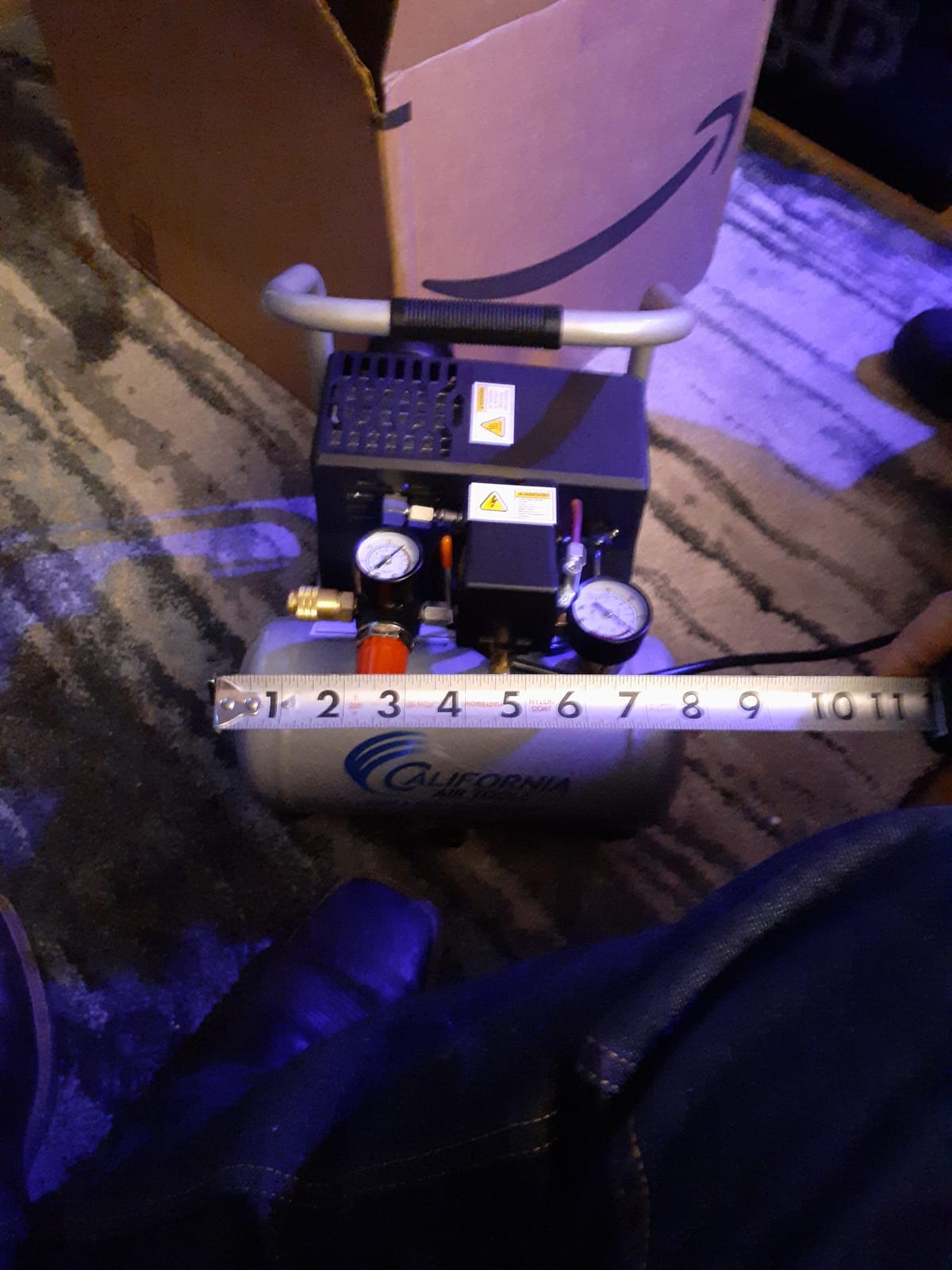
This is the compressor for a condo, an apartment above someone else, or a bedroom where you cannot afford a 78 dB machine. The published 56 dBA is the lowest figure in this roundup, and it is the reason owners report being able to hold a normal conversation while it runs.
At 1.2 CFM at 90 PSI and 1.60 CFM at 40 PSI, it is built for small pneumatic tools. A 23-gauge pin nailer, a light brad nailer, a stapler or an airbrush are all comfortable. The 1 gallon steel tank and 29 lb weight mean you can carry it up two flights with one hand, and the oil-free single-piston pump is rated to 3000+ hours before wear.
The 0.6 HP motor runs at 1,680 RPM, which is slow enough to produce a low, steady tone rather than the whine a direct-drive unit makes. That slower speed is also a deliberate longevity choice. The unit is designed to handle varied temperatures and uneven terrain, so jobsite use and garage use are both realistic.
Be realistic about the 1 gallon tank though. It is small by design, and on sustained work the pump cycles constantly. For pinning molding, installing cabinets, or hanging small trim pieces in batches, that is a perfectly good trade. For a wall of baseboard, it becomes tiring fast.
Who This Compressor Suits
Homeowners working in furnished or occupied spaces, and anyone doing small trim tasks where noise is the deciding factor. Pin nailers, brad nailers, staplers, airbrushes and light inflating are all within its design intent.
It is also a strong second machine for a pro who needs one quiet unit for interior finish and a larger one on site. Keep the big compressor in the truck and bring this inside for the trim pass.
Where It Falls Short
It cannot drive a framing nailer. At 1.2 CFM at 90 PSI, a framing or roofing nailer will drain the tank faster than the pump can fill it, and the nail depth will suffer. The 120 PSI maximum is also well below the 200 PSI units.
Owners also flag the small tank as the practical limit in daily use. If your project list includes more than a room of trim, the 2-gallon California Air Tools below gives you more reserve at a modest step up.
4. Makita MAC2400 2.5 HP Big Bore – the Airflow and Durability Leader
Makita MAC2400 2.5 HP* Big Bore™ Air Compressor
4.2 CFM at 90 PSI
Cast iron Big Bore pump
2.5 HP 4-pole motor
Roll-cage frame
1,730 RPM
Pros
- 4.2 CFM airflow drives nailers without stalling
- Cast iron Big Bore pump built for long service life
- Low amp draw reduces tripped breakers at start-up
- Roll-cage housing protects against jobsite abuse
- 4.7 star average across more than 1300 reviews
Cons
- Oil-lubricated pump requires periodic oil checks and changes
- Heavier and bulkier than the pancake units
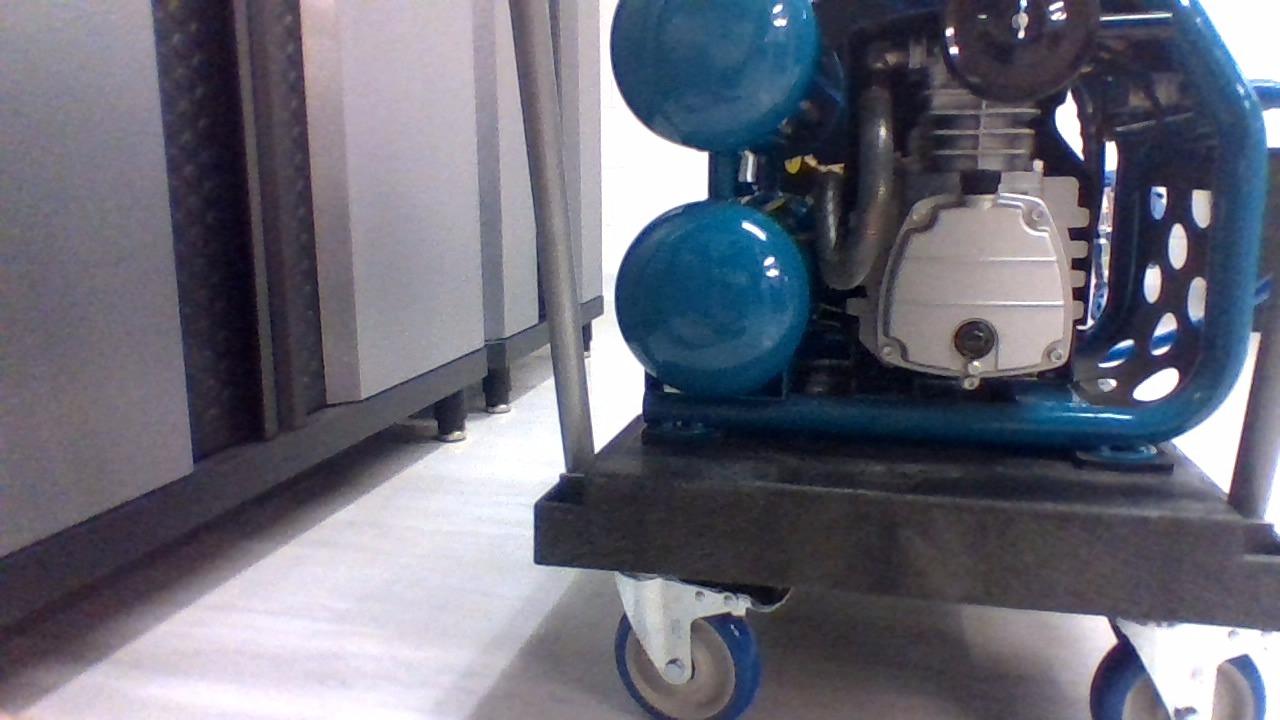
The MAC2400 has the highest average rating in this group at 4.7 stars, and the reason is airflow. The 2.5 HP 4-pole motor produces 4.2 CFM at 90 PSI, and the cast iron Big Bore cylinder and piston refill the tank faster than almost anything else in this price class.
That difference shows up the moment you drive a framing nailer. Instead of the pump cycling while you work, the tank holds steady and the nailer fires at consistent depth. Owners reviewing this unit point to airflow, recovery speed and build quality as the recurring strengths.
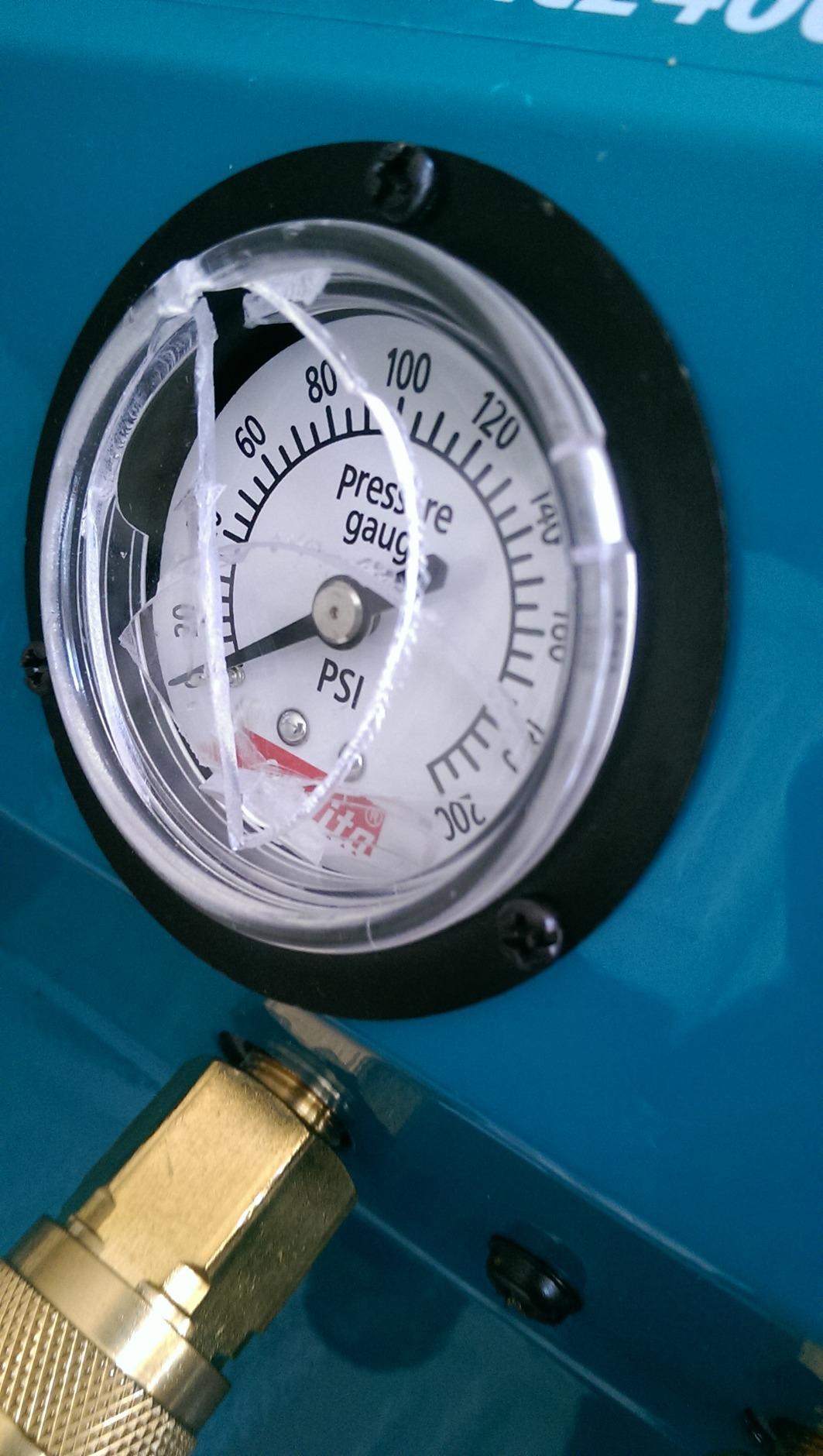
The 1,730 RPM pump speed is worth understanding. It is lower than a direct-drive pancake, and lower RPM means a deeper cylinder, better cooling and longer component life. The published noise figure is 79 dB, and the lower speed is why the tone is less harsh than a small pancake’s.
Low amp draw at 12.3 A is another practical advantage, and it reduces the chance of a tripped breaker when the compressor starts while other tools are running. The roll-cage construction protects the pump and motor when the unit gets knocked around, and the large automotive-style industrial air filter handles dusty framing conditions.
Who This Compressor Suits
A contractor framing walls, doing sheathing, or running multiple nailers who wants a single compressor that will not dictate the pace of the job. The 4.2 CFM figure is enough headroom that a second tool can share the tank without the first one noticing.
It also suits anyone who plans to keep a compressor for many years. The oil-lubricated pump runs cooler, and the reviews describe it as the kind of machine that is still going a decade later.
Where It Falls Short
The oil-lubricated pump is the central trade-off. It needs periodic oil checks and changes, and that schedule is exactly what oil-free buyers are trying to avoid. It is also the more expensive unit here and bulkier than the pancakes, with compressor oil and a coupling included rather than a hose.
If you are hanging white trim and any risk of an oil shadow on the workpiece is unacceptable, choose an oil-free machine instead. For framing, siding and roofing, this is the one we would own.
5. Metabo HPT EC914S 6-Gallon 200 PSI – the Framing and Roofing Workhorse
Metabo HPT Portable Pancake Air Compressor, 6 Gallon 200 PSI, EC914S
4 CFM at 90 PSI
200 PSI max
6 gallon stainless steel tank
42 lb
1-year warranty
Pros
- 200 PSI tank pressure reduces cycling
- 4 CFM at 90 PSI keeps multiple nailers running
- Fast recovery after draw-down
- Oil-free pump runs at odd angles without issue
- Accurate regulator and sturdy roll cage
Cons
- Noticeably audible for a compressor of this size
- Output drops about 3% per 1000 ft of elevation
- Heaviest 6-gallon pancake in this group at 41 to 42 lb
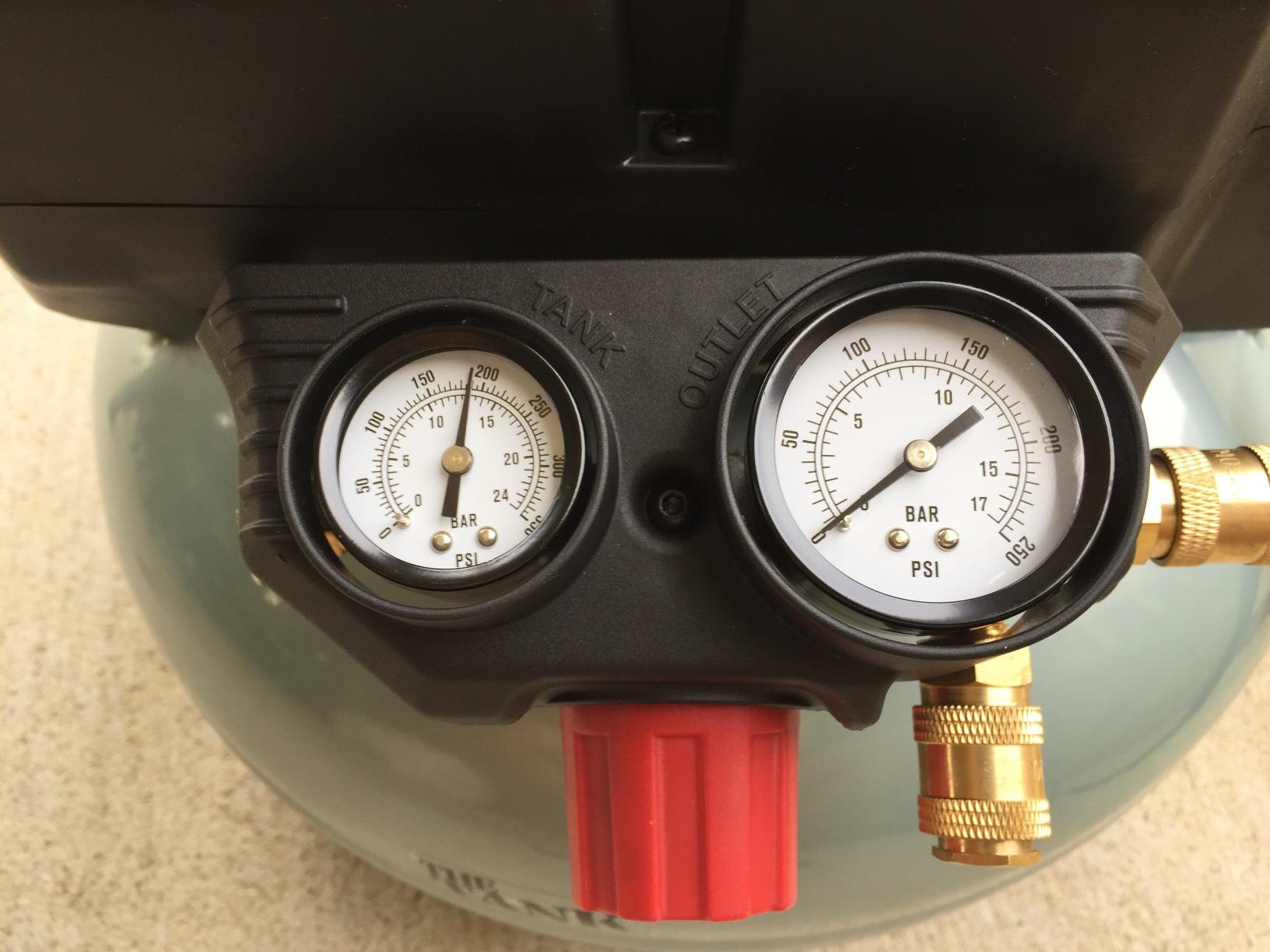
The EC914S is the single best answer to the question I get asked most, which is whether a small pancake can realistically drive a framing nailer. Yes, this one can, and the reason is the 200 PSI tank combined with 4 CFM at 90 PSI. The extra 25% of stored pressure over a basic pancake means fewer cycles and more nail per trigger pull.
Multiple owners report that it is the only unit in this class they found that both drives a framing nailer and sinks 3-inch nails properly. The manufacturer rates it to run two framing, two roofing, two siding, three finish or five brad nailers at the same time, which is a useful ceiling to know about before you plan a crew day.
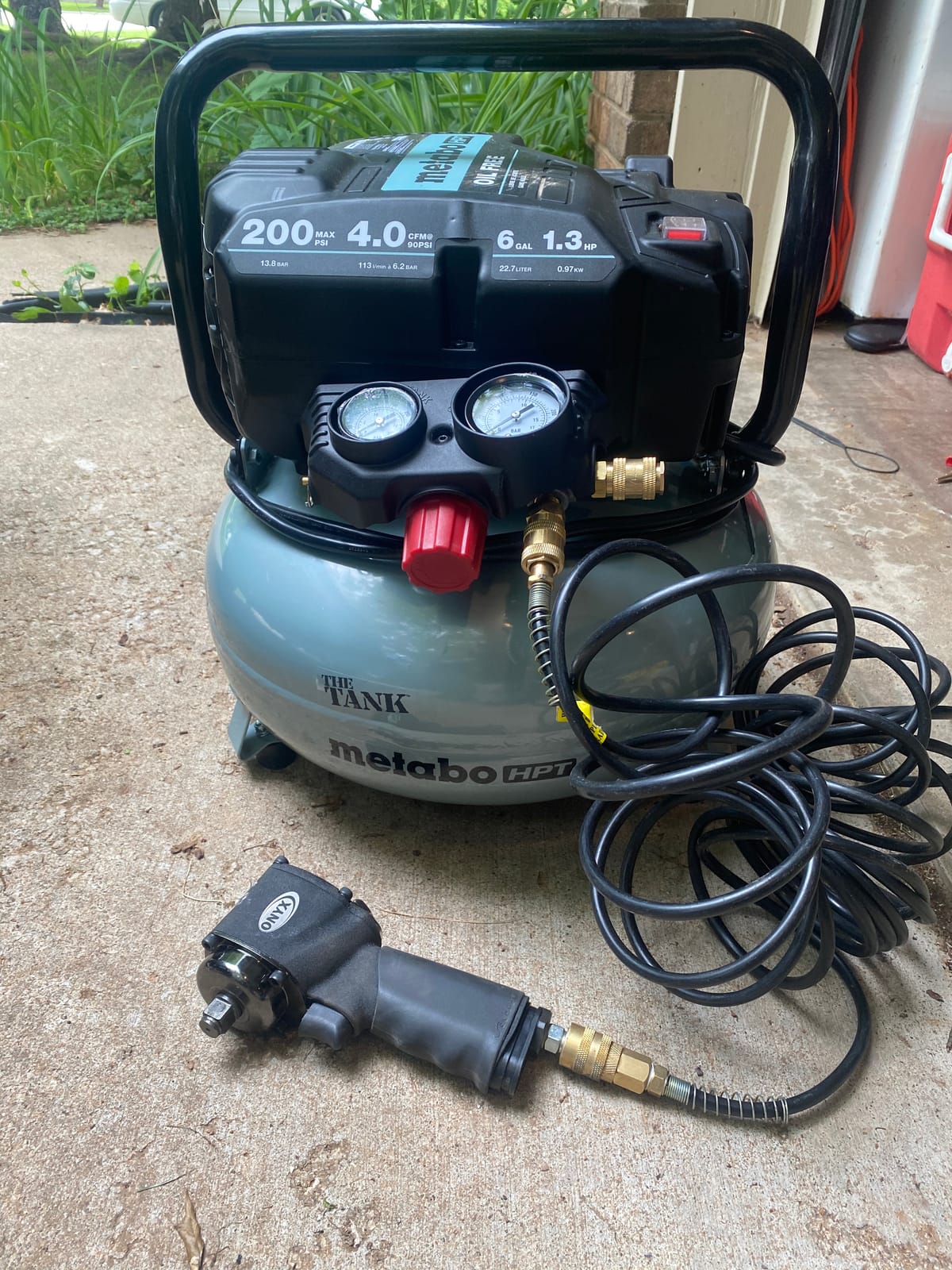
It also solves the oil problem. The oil-free pump needs no maintenance, will start cold, and can run tilted, which matters when you are working off a ladder or setting the tank on end to drain it. The stainless steel tank resists corrosion, and the 73 dB rating sits in the middle of the group rather than at the loud end.
Two practical notes. At 41 to 42 lb it is the heaviest 6-gallon pancake we reviewed, so plan the carry before you buy. And output falls by roughly 3% for every 1,000 ft of elevation, which is small but worth knowing if you work in mountain towns.
Who This Compressor Suits
Framing contractors, roofers and siding crews who need real airflow without moving to a wheeled shop machine. One nailer at a time is comfortable, and the rated capacity gives room for a second tool in the mix.
It is also a strong general-purpose machine for someone who does a bit of everything. Oil-free maintenance-free operation, a stainless tank and a roll cage make it a good long-term site tool.
Where It Falls Short
It is loud. Reviewers note it is audible for a compressor of its size, and 73 dB with that much airflow is unavoidable physics rather than a defect. It is also not a quiet indoor machine, and a rigid metal tank on a hard floor transmits that sound straight into the room.
For interior finish where noise and finish quality matter more than nail speed, the 2-gallon California Air Tools is the better tool. For structural work, this is where we would put our money.
6. California Air Tools 2010A 2-Gallon – the Best Balance for Brad and Finish Nailers
California Air Tools 2010A 1.0 HP Ultra Quiet and Oil-Free Air Compressor, 2 Gallon Aluminum Tank, 60 dBA Noise Level, Silver
60 dBA
2.20 CFM at 90 PSI
2 gallon aluminum tank
50-second fill
14-second recovery
Pros
- Exceptionally quiet and allows normal conversation beside the unit
- Aluminum tank resists rust
- Fills from empty to 120 PSI in roughly 50 seconds with 14-second recovery
- Drives 19 to 20 brad nails per tank fill
- Stable wide frame with rubber feet dampens vibration
Cons
- Not sized for continuous high-volume tools like HVLP sprayers or framing nailers
- Ships without an air hose or quick-connect fitting
- Short power cord of about 4 ft may require an extension cord
The 2010A is the compressor we recommend to someone whose main tool is an 18-gauge brad nailer or a 16-gauge finish nailer. At 2.20 CFM at 90 PSI it has roughly double the airflow of the 1-gallon unit above, and at 60 dBA it remains quiet enough to sit in a finished room.
Owners publish measured numbers for this one, which is unusual and useful. Tank fills from empty to 120 PSI in about 50 seconds, recovery from 90 to 120 PSI takes about 14 seconds, and one test drove 19 to 20 brad nails per fill. That is enough reserve to work through a run of trim without stopping.
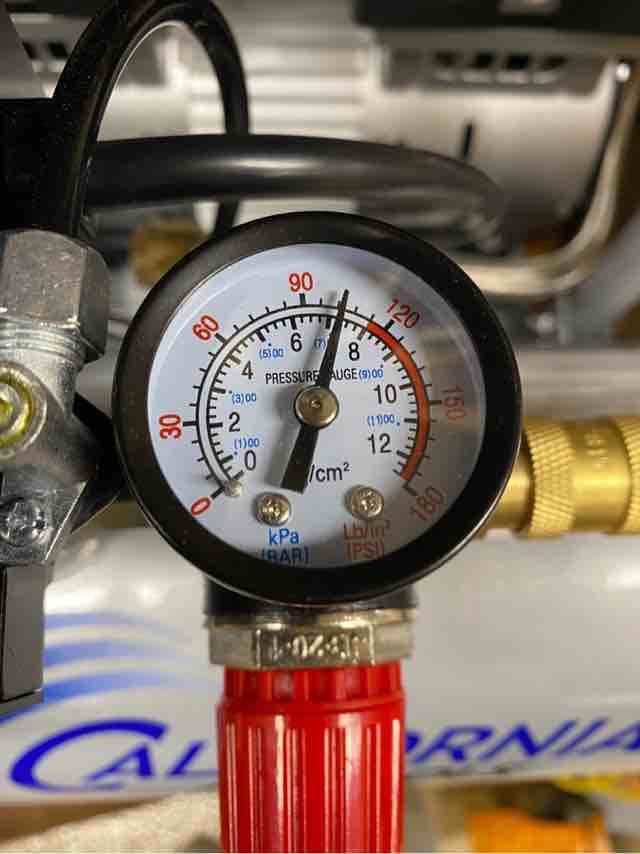
The 2 gallon aluminum tank is a real advantage over a steel tank of the same size. It will not rust from condensation on the inside, and it sheds weight, which brings the unit to 35.3 lb. The wide frame with rubber feet dampens vibration transfer into the floor, and that matters more in an apartment than the decibel number alone.
The dual piston oil-free pump is rated to 3000+ hours before wear, running off a 1.0 HP rated motor with 2.0 HP peak at 1,680 RPM. The published maximum pressure is listed at 125 PSI, so this is not a machine for high-pressure work.
Who This Compressor Suits
Trim carpenters, cabinet installers and serious DIYers who want to keep working indoors. Molding, baseboard, casing, cabinet backs and furniture assembly are all well within what 2.20 CFM can sustain.
It is also a good fit for a second-stage upgrade. If you started with the 1-gallon California Air Tools, this is the natural step up when your projects outgrow it, and you keep the same quiet character.
Where It Falls Short
Owners consistently steer others away from continuous high-volume tools. An HVLP spray gun, a framing nailer or a large pneumatic sander will outrun 2.20 CFM and leave you waiting on recovery. The 125 PSI ceiling reinforces the same point.
Two smaller annoyances: it ships without a hose or quick-connect fitting, so budget for those, and the power cord is short, which in a garage usually means an extension cord. Everything else about it is well received.
7. Limodot LJ5120K 5-Gallon – the Most Complete Bundle in the Roundup
Quiet Oil-Free Air Compressor, 68 dB, 2.8 CFM @ 90 PSI, 5 Gallon Air Tank
2.8 CFM at 90 PSI
5 gallon tank
68 dBA induction motor
25 ft hose and 13-piece kit
Pros
- 68 dBA induction motor design is quieter than typical direct-drive units
- Bundle includes a 25 ft hose
- 13-piece accessory kit and wheels
- Fast 80-second full refill and 25-second recovery
- Oil-free pump starts reliably in cold weather
- 5 gallon tank plus wheels makes it easy to move around a site
Cons
- 120 PSI max is low for driving long framing nails
- Less established brand with a shorter long-term track record
What separates this unit from the rest is what is in the box. A 25-foot PVC hose, a 13-piece accessory kit, a wheel kit and a 1/4-inch quick-connect fitting all ship with it, so it is ready to drive a nailer the day it arrives.
Underneath, the numbers are unremarkable in a good way: 2.8 CFM at 90 PSI, 4 CFM at 40 PSI, and a 5 gallon alloy steel tank. That is slightly more airflow than a typical 6-gallon pancake with a smaller tank footprint, which means it cycles less than its gallon count suggests. The wheel kit matters for that, since it can be rolled rather than carried.
The 68 dB figure comes from an induction motor turning at 3400 RPM, and the character of that sound is different from a direct-drive oil-free unit. Owners describe it as quieter than typical, and refill from empty takes about 80 seconds with a claimed 25-second recovery.
Manufacturer support covers staple guns, brad, roofing and framing nailers, airbrushes, HVLP spray guns and pneumatic screwdrivers. In practice, the framing and roofing claims are the ones to treat with care, for the reason in the section below.
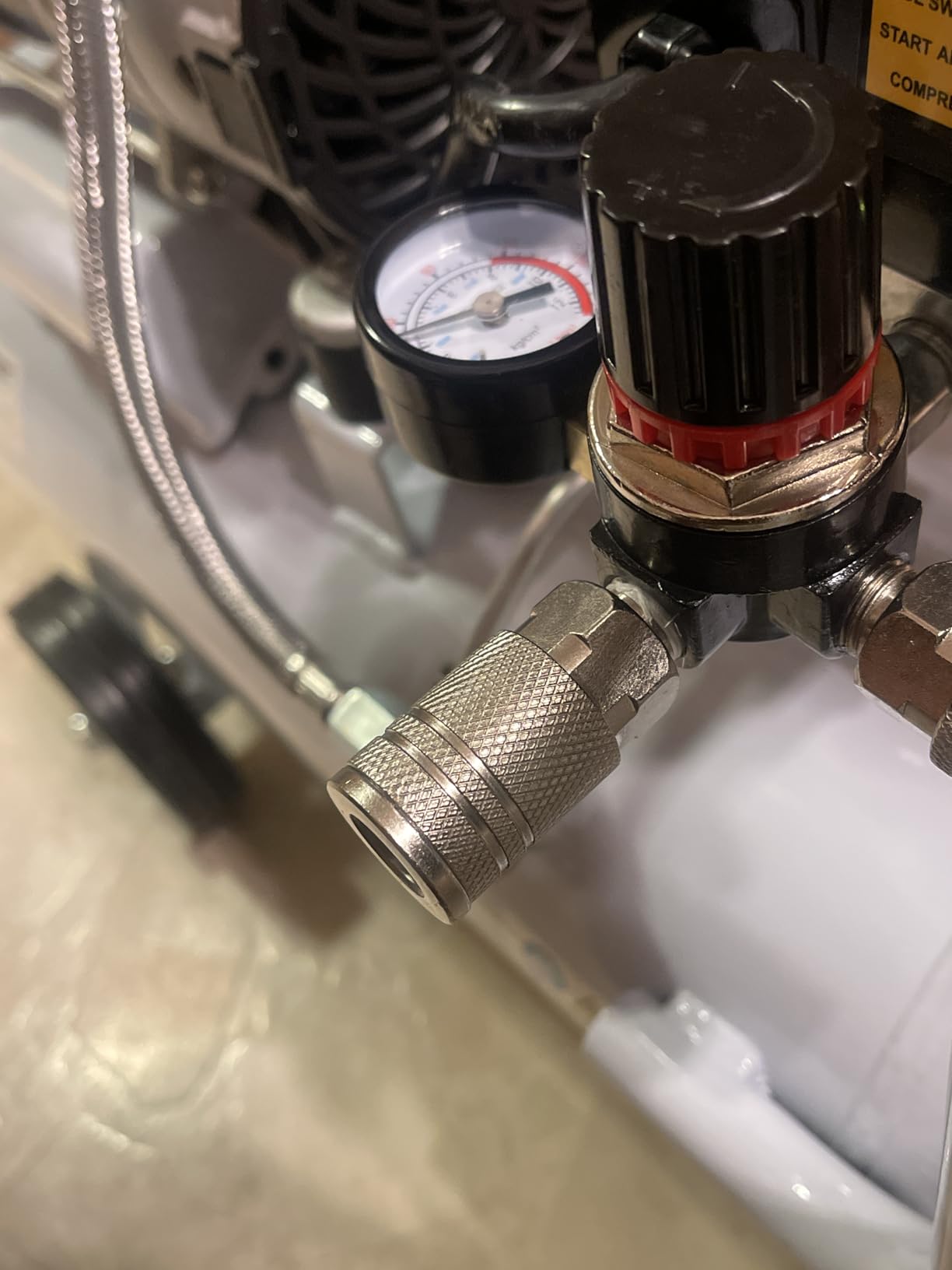
Who This Compressor Suits
A buyer who wants the most per purchase: a mid-size tank, a real hose, the fittings and the wheels at once. It suits a hobbyist or a small crew doing mixed trim and light framing where a 5 gallon tank is the right size and the bundled hose saves a separate order.
The induction motor also makes it a reasonable indoor option compared with a conventional pancake of the same output, if you are sensitive to sound character as well as volume.
Where It Falls Short
The 120 PSI maximum is the real limitation. That is below the 150 PSI of most competitors here and far below the 200 PSI units, and it directly affects how deep long framing nails seat. If structural work is on your list, choose a compressor rated above 150 PSI.
The second limitation is brand history. It is a less established name with a shorter long-term record than the established makers in this list, which matters most for warranty service and parts availability several years from now. For a machine you will keep for a decade, that is worth weighing.
8. Klutch 20-Gallon Vertical – the Shop and Multi-Tool Reserve
Klutch 20-Gallon Air Compressor, 2 HP, 120V
4.2 SCFM at 90 PSI
20 gallon vertical tank
175 PSI max
2 HP 120V
90 lb
Pros
- 20 gallon vertical tank gives long run times between fills
- Oil-free pump means no scheduled maintenance
- Holds pressure for extended periods with minimal loss
- Large wheels and handle make it movable despite the weight
- Rubber foot stabilizers reduce vibration
Cons
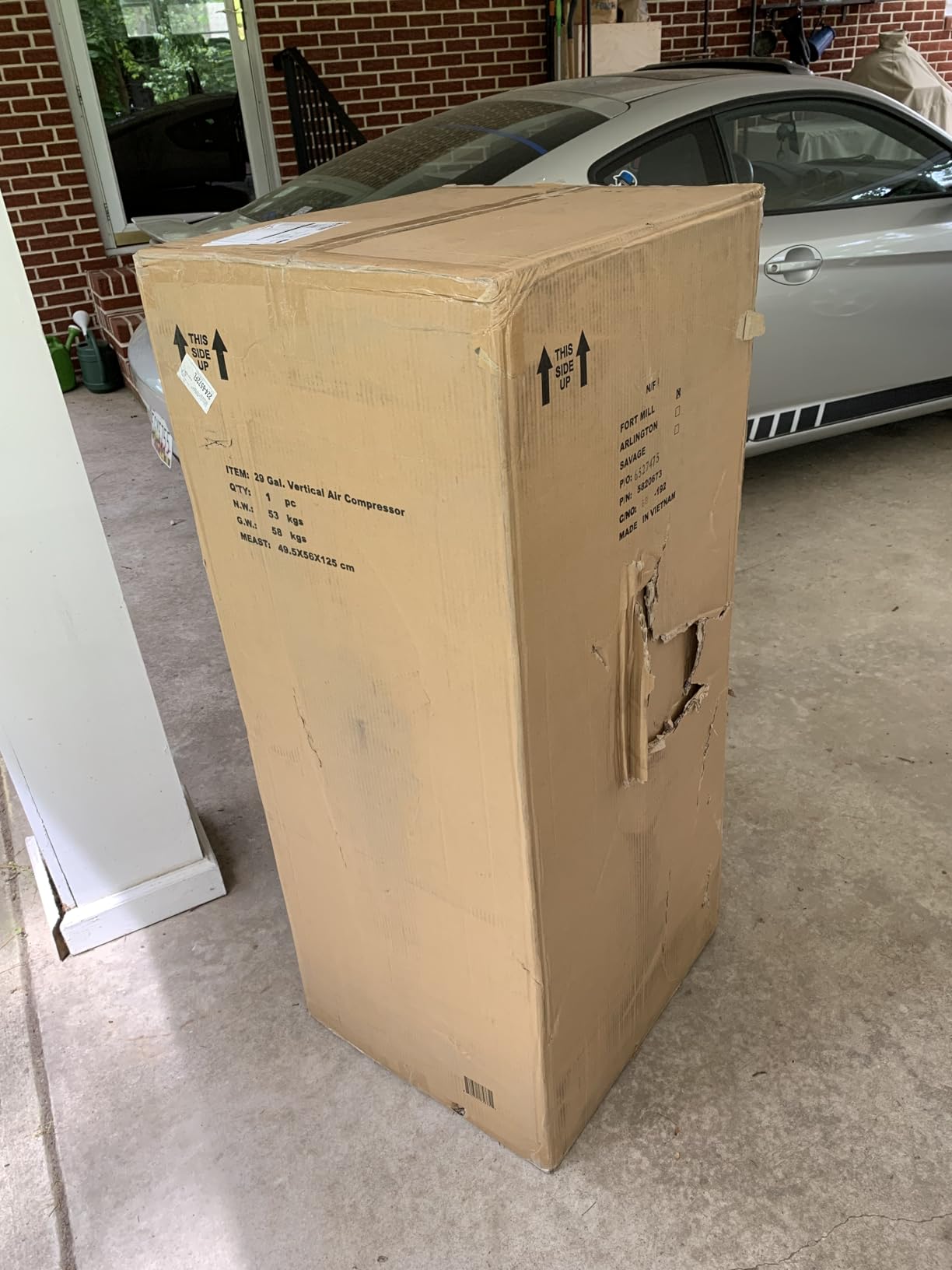
- At 90 lb it is far too heavy to carry or load into a truck bed alone
- Loud enough to notice in an enclosed shop
The Klutch is the only vertical tank in this roundup, and that shape is the whole point. A 20 gallon footprint is small enough to park against a wall, and the air reserve means a nailer, a sander and a spray gun can all draw from it without the tank dropping.
Its 4.2 SCFM at 90 PSI and 175 PSI maximum give it real headroom, and the 75% duty cycle rating is a useful number for anyone running this as a shop machine rather than a occasional trim compressor. The oil-free pump removes the maintenance schedule entirely, and the 2.0 HP series motor carries thermal overload protection.
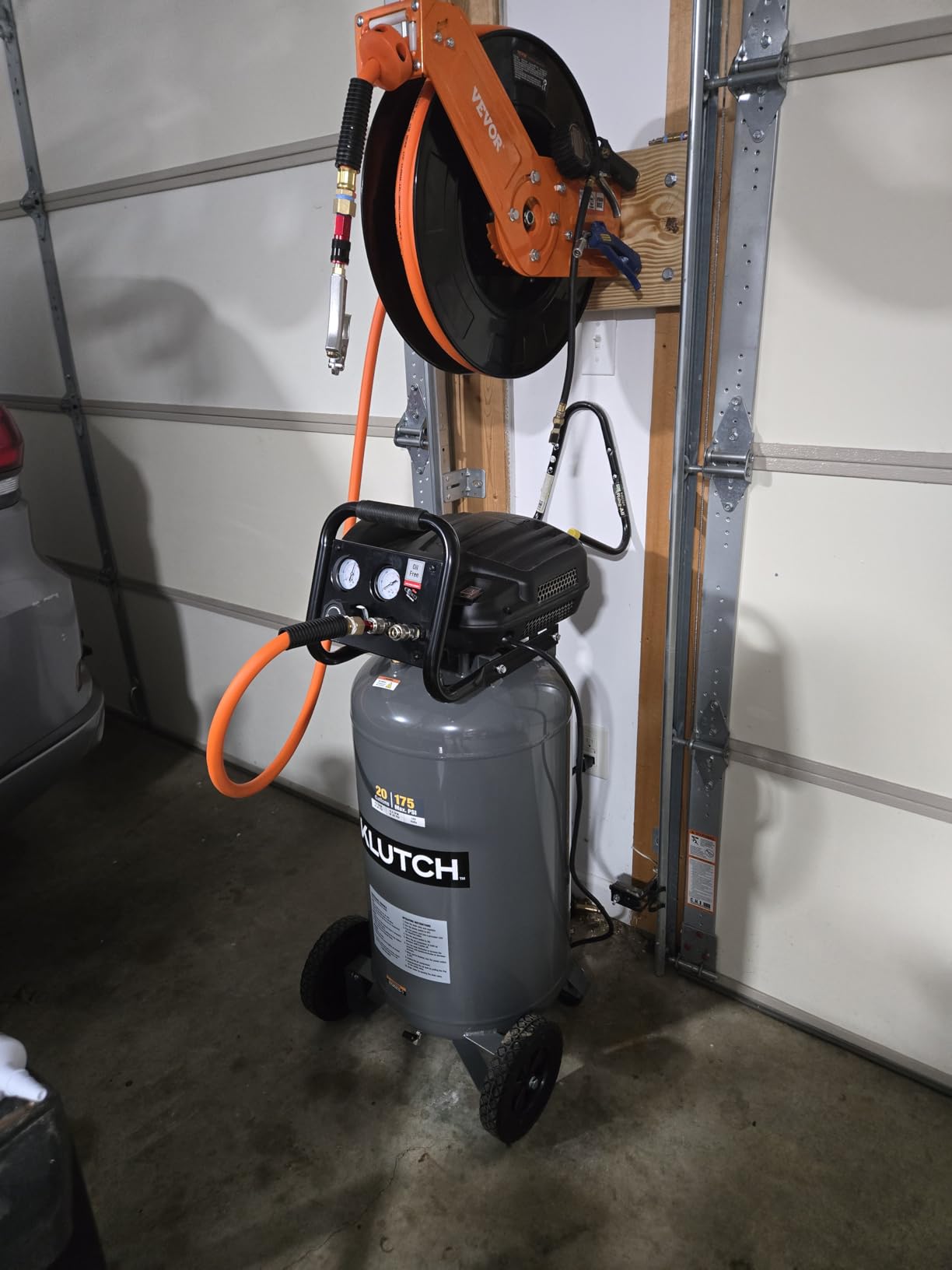
Owners report leak-free performance and enough reserve air for trim work and nailing without pauses. The large rubber wheels and ergonomic handle are what make a 90 lb machine movable at all, and the vertical design keeps the footprint narrow in a garage.
One reviewer documented a serious defect on a sibling unit, reporting a power switch that was internally bypassed and had to be disconnected under load. That is an isolated report rather than a pattern, but it is a reason to test the switch and the unit in general before you rely on it for a deadline.
Who This Compressor Suits
A garage workshop where you want one machine to serve several pneumatic tools, or a small crew working out of a fixed base rather than a truck bed. The 20 gallon tank means fewer fill cycles and steadier pressure across a long session.
It is also a reasonable shop compressor for someone who also uses an impact wrench, a sander or a sprayer, since 4.2 SCFM covers more than nailing alone.
Where It Falls Short
It is not a jobsite compressor. At 90 lb it is far too heavy to carry or load alone, and the 80 dB rating makes it noticeable in an enclosed shop. If your work involves carrying the machine up stairs or into an attic, that ends the conversation.
For a single person running one nailer on a weekend, a 6-gallon pancake is faster to set up and far easier to move. Choose this when the tank size matters more than the weight.
9. ECOMAX 6-Gallon 10-Piece Kit – the DIY Value Pick
ECOMAX Air Compressor 6 Gallon 150 PSI Pancake Portable Oil-free Tank with 10 PCS Accessories Kit
6 gallon tank at 150 PSI
1.5 HP motor
Oil-free pump
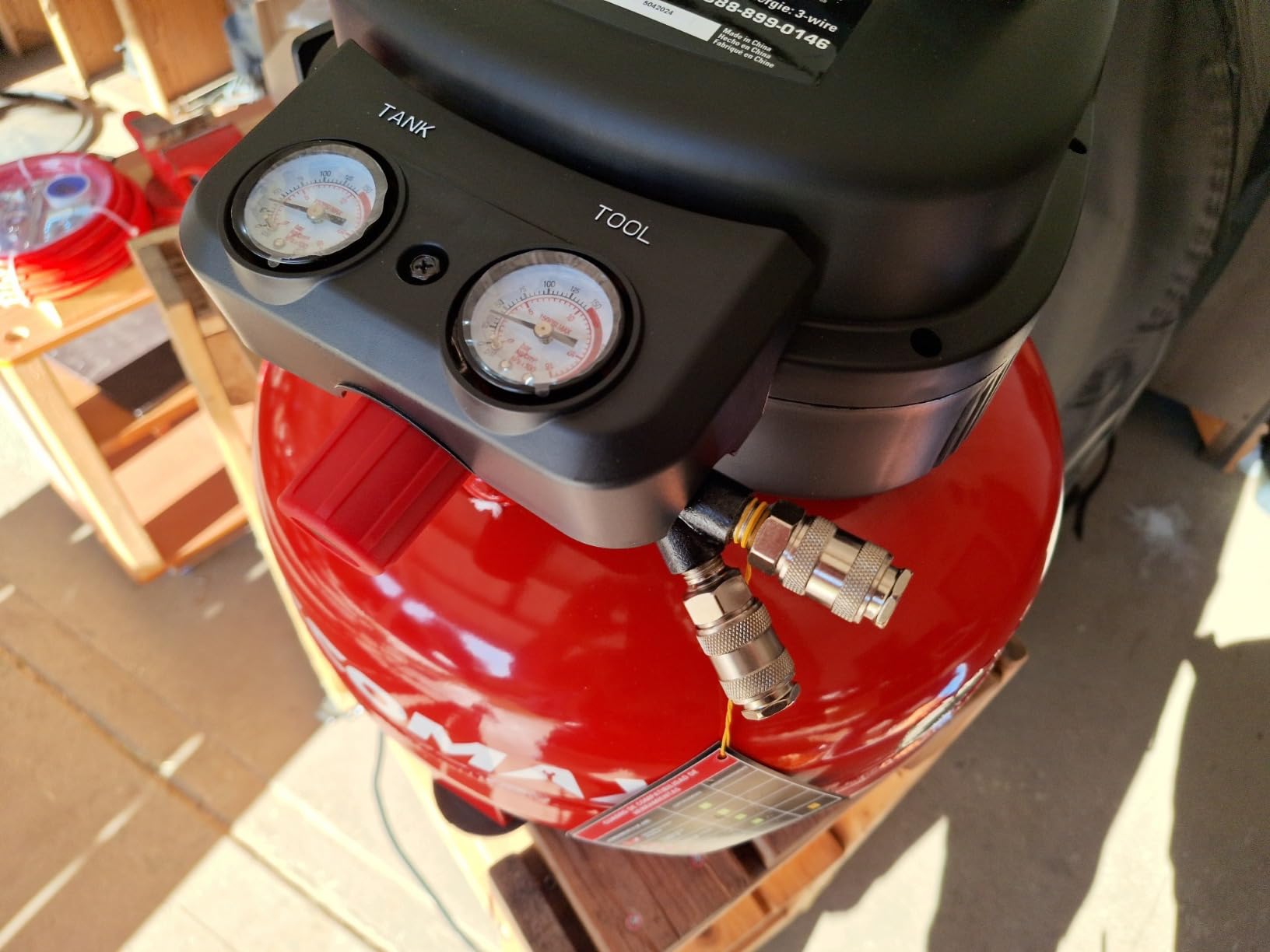
Dual couplers and dual gauges
34.17 lb
Pros
- 4.7 star average with only 1% one-star ratings
- 10-piece accessory kit and 25 ft hose included in the box
- Dual couplers allow two tools at once
- Flip-up handle and 34 lb weight keep it easy to carry and store
- Dual gauges for precise pressure reading
Cons
- 150 PSI ceiling is modest for heavy framing work
- Published airflow figure is listed in an inconsistent unit
The ECOMAX pairs the highest average rating in the group with a very small review count, and both numbers are worth weighing together. A 4.7 average with only 1% one-star ratings says the people who bought it are happy. Three hundred and sixteen reviews is not yet a long track record.
What you get is a 6 gallon tank at 150 PSI, a 1.5 HP motor, an oil-free pump, dual quick couplers and dual gauges. The accessory kit is genuinely useful: a 1/4-inch by 25-foot PVC hose, thread seal tape, a ball-foot air chuck, two auto plugs, an auto coupler, a tire pressure gauge, a nozzle and a blow gun with sleeve.
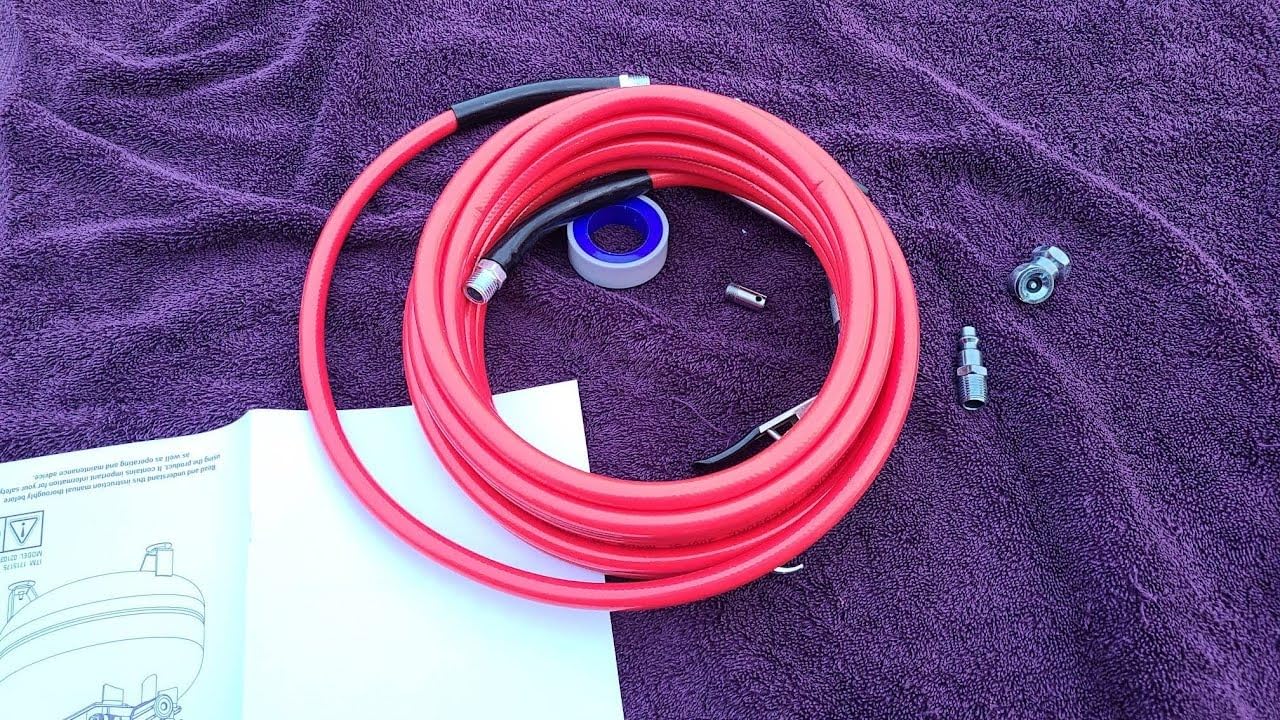
Owners highlight the value of the bundle, the dual couplers and easy portability. The flip-up carry handle and cord winding bracket make it easy to store between jobs, and the low-voltage cold-weather start capability is a practical inclusion for a garage unit.
One thing to know before you buy: the listing’s airflow figure is published in an inconsistent unit, so the honest position is that the airflow is not clearly documented. If you intend to run a framing nailer, the Metabo HPT with a published 4 CFM at 90 PSI is the safer choice.
Who This Compressor Suits
A homeowner building a first tool kit, or anyone who wants a 6-gallon pancake plus a full set of hose and inflation fittings without ordering a second package. The dual gauges and dual couplers are nice touches for a machine at this level.
At 34.17 lb it stays portable enough to move between rooms and up a small flight of steps, which suits a weekend trim and repair schedule.
Where It Falls Short
The 150 PSI ceiling is modest for heavy framing, and combined with unclear airflow documentation it makes this a poor choice for structural nailing. It is a trim and general-purpose machine, not a framing compressor.
The short review history is the other limitation. It is not a reason to skip it, but it is a reason to keep expectations sensible and to register the warranty as soon as it arrives, since early failures are the ones most brands handle best.
10. DEWALT D55146 4.5-Gallon 225 PSI – the High-Airflow Horizontal Tank
DEWALT Air Compressor, 225-PSI Max, Hand Carry with Wheels, 4-1/2 Gallon (D55146)
5 CFM airflow
225 PSI max tank storage
4.5 gallon tank
Oil-free pump
10 inch pneumatic tires
Pros
- Runs framing nailers and other high-demand tools without stalling
- Oil-free air with no oil in the airstream
- Long track record with multiple owners reporting 10+ years of service
- Stores upright to save floor space
- Two output ports allow two hoses at once
Cons
- Draws close to a full 15 A circuit and can trip household breakers
- Very heavy at about 80 to 88 lb
- Regulator caps out near 150 PSI despite the 225 PSI tank pressure
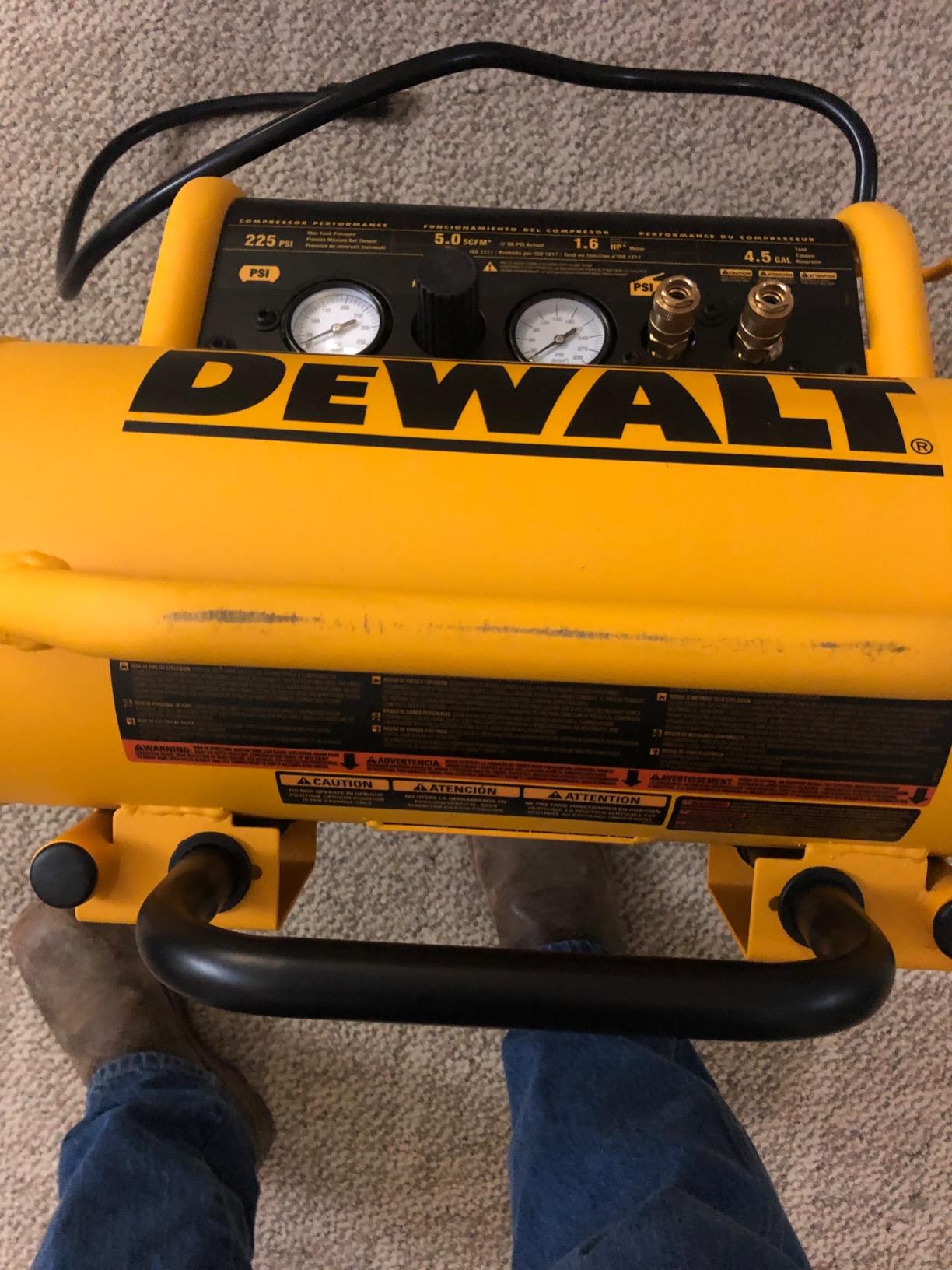
The D55146 has the most stored air of any portable unit here, with 225 PSI max tank pressure and 5 CFM of airflow, and owners with a decade of service report a decade of service again. That longevity record is unusual and worth weighting heavily for anyone buying once.
The oil-free pump keeps oil out of the airstream entirely, which matters on finish work, and the 4.5 gallon tank stores enough air to run a framing nailer without stalling. The high-flow coupler and push-in style couplers on two output ports let you run two hoses at once.
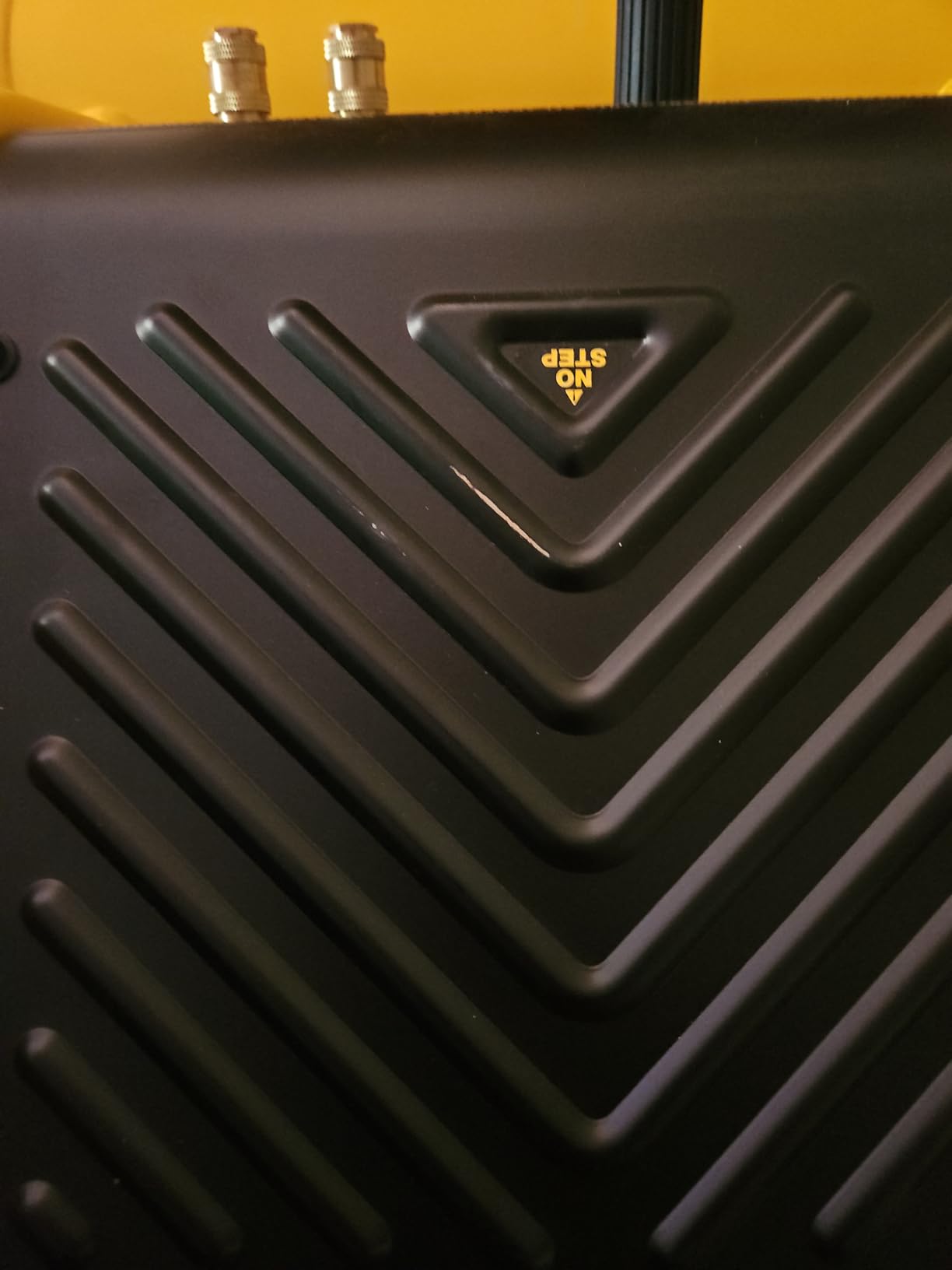
Two design details are worth noticing. The 10-inch non-flat pneumatic tires are the kind of thing that seems minor until you try to move the unit across a jobsite, and the protective metal console panel over the gauges, couplers and regulator is a real safeguard on a machine that will get knocked.
Be careful with the regulator, though. Owners report it caps out near 150 PSI despite the 225 PSI tank pressure, and that the knob has to be pulled out to adjust it. If your nailer needs more than 150 PSI at the line, this unit will not give it to you despite what the tank rating suggests.
Who This Compressor Suits
A contractor who wants raw airflow, a long service life and no oil reaching the workpiece. The 10-plus-year owner reports we found are the strongest durability evidence in this roundup, and that matters for a machine bought to last.
It also suits anyone running several pneumatic tools off one unit, since the two output ports and the stored air reserve make that workable.
Where It Falls Short
The 15 A draw is the headline complaint. On a household circuit it can trip breakers, especially when the compressor starts while another tool is running, and that is the electrical gap most competitor guides skip entirely. It is also very heavy at roughly 80 to 88 lb, and the tank drain requires tilting the unit about 45 degrees.
Some connectors need an adapter because the couplers are industrial 3-in-1 style rather than true high-flow, and a few units have shipped without a manual. Verify the coupler type fits your nailer’s hose before you rely on it.
How Much Air Does Your Nailer Actually Need?
The number that matters is SCFM at 90 PSI, not the CFM printed on the side of the tank. Displacement CFM describes what the pump could move with no pressure against it. Delivered SCFM describes what actually reaches the outlet at working pressure, and that is the figure that predicts whether a nailer will keep up.
Map it to your tool. A 23-gauge pin nailer and a small brad nailer can run happily on 1 to 1.5 CFM. An 18-gauge brad or 16-gauge finish nailer wants 2 to 2.5 CFM. A framing or roofing nailer needs 3 CFM as a floor and 4 CFM for comfortable continuous work.
Then account for how many tools run at once. The Metabo HPT EC914S is rated for two framing nailers simultaneously at 4 CFM at 90 PSI, and the Makita MAC2400’s 4.2 CFM gives a single framing nailer real headroom. A 2.6 CFM pancake like the BOSTITCH or PORTER-CABLE is a one-nailer machine, and treating it as anything more is the single most common mistake we saw described on woodworking and home improvement forums.
Pressure is the other half. Nailers typically run at 90 PSI, and tank maximums of 150 PSI exist to leave recovery headroom above that. Going to 200 PSI does not change the PSI your nailer receives, but it does mean more air is stored, so the pump cycles less. That is the honest answer to the 150 versus 200 PSI debate, and it is why the 200 PSI Metabo HPT feels stronger with a framing nailer even though both units feed the same 90 PSI line.
Tank Size: How Many Gallons Do You Need?
Tank size controls how long you can work between recovery cycles, not how fast the tool fires. A small tank filled by a powerful pump is a perfectly good combination; a large tank filled by a weak one just means longer waits at the start.
One gallon suits pin nailers, staplers and small trim in occupied rooms, which is what the California Air Tools 1P1060S is built for. Two gallons covers brad and finish work in batches without constant cycling, and gives a room-sized project a comfortable reserve.
Six gallons is the general-purpose answer for a single nailer, and the size most of the top picks here use. Eight to twenty gallons is a shop decision, driven by running multiple tools or wanting long intervals between fills rather than by nailing speed.
A simple rule: match the tank to the length of your firing run. If you can complete a row of baseboard or a run of studs on one tank, the size is right. If you are waiting mid-run, you need more airflow first and more tank second.
Oil-Free vs Oil-Lubricated for Nail Guns
Nine of the ten units here use oil-free pumps. The exception is the Makita MAC2400, an oil-lubricated machine, and the difference is worth understanding before you choose it.
Oil-free means no oil in the airstream, which means no risk of an oil shadow on white trim, no oil changes on a schedule, and reliable cold-weather starts. It also means slightly less internal lubrication, so the pumps are designed with pistons and cylinders built for that. Every unit in this group that uses an oil-free pump is rated in the 3000+ hour class or carries a one-year warranty, and the reviews do not report oil-related wear as a recurring theme.
Oil-lubricated pumps run cooler and wear more slowly, which is a genuine advantage under heavy daily use. The cost is the maintenance schedule and the possibility of carryover onto finished surfaces. For a framing crew running a nailer eight hours a day, that trade can be worth it. For a homeowner hanging cabinet doors, it is not.
Noise Levels for Indoor and Outdoor Nailing
Decibels are logarithmic, so the difference between 56 dB and 82 dB is far larger than the numbers suggest. At the quiet end, 56 dB is close to background conversation. At 82 dB, you are near a lawnmower, and a compressor that size competes with any recording or phone call in the room.
For indoor work, treat anything under 65 dB as genuinely quiet: the California Air Tools 1P1060S at 56 dBA and the 2010A at 60 dBA both qualify, and the Limodot at 68 dBA is acceptable in a garage but not in a bedroom. For outdoor and jobsite use, noise matters far less because the compressor is competing with wind, traffic and the nailer itself.
Sound character matters as much as volume. An induction-motor unit like the Limodot and the California Air Tools models, running around 1,680 RPM, produces a low steady tone. A direct-drive oil-free pancake spins much faster and its high-pitched whine is what people describe as harsh. Putting a rubber mat or isolation pad under the tank also helps noticeably on concrete, because much of the perceived noise is tank vibration rather than the pump.
Electrical Setup, Hose Sizing, and Maintenance
Electrical requirements are where most buying guides go quiet and most tripped breakers come from. A 120V compressor drawing 12 to 15 A wants a dedicated 15 A circuit, and a 15 A unit on a shared household circuit will trip when it starts. The Makita MAC2400 at 12.3 A and the DEWALT at 15 A bracket the range, which is exactly why the Makita owners specifically mention fewer tripped breakers.
For extension cords, keep them short and heavy. A 14-gauge cord or larger, 50 feet or less, is what the BOSTITCH manufacturer specifies for reliable start-up, and the same guidance applies to the other 120V oil-free units here. A thin or long cord causes voltage drop at start, which is the leading cause of a compressor that will not start when the garage door is open in winter.
Hose sizing is the second gap. A 1/4-inch hose is standard for nailers, and it works, but pressure loss grows with both diameter and length. If you are running 50 feet or more, a 3/8-inch hose noticeably reduces the drop. Longer runs also mean a more sensitive regulator setting, which is part of why owners report needing to set the BOSTITCH regulator a few PSI high.
On maintenance, oil-free pumps need almost nothing, which is the main reason to buy one. Every oil-free tank here should be drained after each use, and the bottom of a steel tank will corrode if condensation sits in it. The California Air Tools 2010A uses an aluminum tank that resists this entirely. Check the drain valve location before you buy, since the DEWALT requires tilting the unit about 45 degrees to reach it, and that is an annoyance every time.
One last item nobody mentions: put a moisture separator or inline water trap on the line if you are finishing furniture or cabinetry. It costs little, and it keeps the small amount of water that condenses in any tank from staining a finished surface.
Frequently Asked Questions
What size air compressor do I need for a nail gun?
A 6-gallon tank with 2.6 to 4 CFM at 90 PSI handles almost any single pneumatic nailer, from brad and finish work to weekend framing. A 1-gallon unit is enough for pin nailers, staplers and light trim in occupied rooms, while an 8-gallon or larger tank makes sense only when running multiple pneumatic tools in a shop.
What PSI compressor do I need for my nail gun?
Most pneumatic nailers are designed to run at 90 PSI, so a compressor rated at 120 to 150 PSI gives you working pressure plus recovery headroom. A 200 PSI tank does not push more air into the nailer, but it stores more of it, so the pump cycles less often and pressure steadies during long firing runs.
What is the best portable air compressor for a nail gun?
For portability, the California Air Tools 1P1060S at 29 lb with a 1-gallon tank is the easiest to carry, and the BOSTITCH BTFP02012 at 29 lb with a 6-gallon tank gives you far more air for the same weight. If you need wheels instead of carrying, the Klutch 20-gallon vertical and the DEWALT D55146 both roll on large tires.
Can a small 1-gallon compressor run a nail gun?
Yes for pin nailers, brad nailers and light finish work, which is what the 1.2 CFM at 90 PSI of the California Air Tools 1P1060S is built for. No for a framing or roofing nailer, which will drain the tank faster than the pump can refill it and leave nails not setting flush.
Is a 6-gallon compressor enough for a framing nailer?
Yes, if the airflow figure is right. The BOSTITCH and PORTER-CABLE 6-gallon pancakes deliver 2.6 SCFM at 90 PSI, which handles a framing nailer at a weekend pace but not a full framing day. The Metabo HPT EC914S at 4 CFM at 90 PSI and 200 PSI is the 6-gallon choice for regular structural work.
Final Verdict: Which Nail Gun Compressor Should You Buy?
The BOSTITCH BTFP02012 is our pick for the best air compressors for nail guns overall. Six gallons, 2.6 SCFM at 90 PSI, 29 lb, an oil-free pump and two couplers cover trim, brad, finish and occasional framing for the widest range of buyers, and its review record is the deepest in the group.
Match it to your actual workload instead. Indoor or occupied space goes to the California Air Tools 1P1060S at 56 dBA or the 2010A at 60 dBA. Regular framing, roofing or siding goes to the Metabo HPT EC914S at 4 CFM and 200 PSI, or the Makita MAC2400 if you want maximum airflow and a decade-long service record and will keep the oil topped up. A multi-tool garage setup belongs on the Klutch 20-gallon vertical.
Whichever one you choose, match the SCFM at 90 PSI to the nailer, give the tank a dedicated circuit, and drain it after every job. Those three habits solve most of the compressor complaints we read about from people who bought the wrong size.