
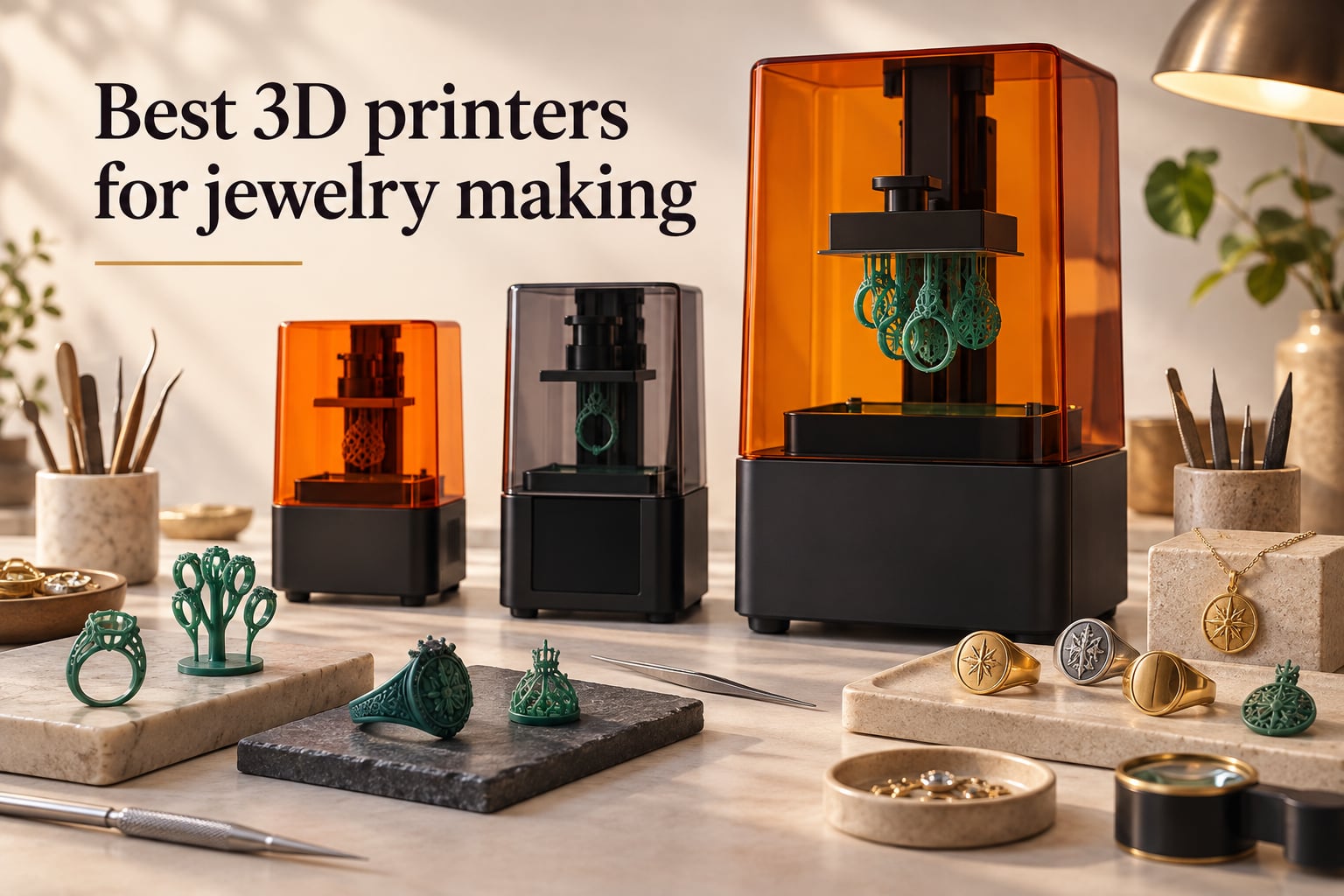
Picking the best 3D printers for jewelry making changed how I run my studio. After replacing hand-carved wax patterns with resin-printed masters, my casting yield jumped, my turnaround shrank from days to hours, and I finally stopped dreading client revisions. If you make rings, pendants, cufflinks, or signets and you keep losing pieces to ash residue or under-detailed prints, this guide is for you.
I’ve spent three months testing eight resin printers side by side, burning dozens of castings, and quizzing jewelers on r/jewelry and r/3Dprinting about what actually holds up in production. The printers below cover every jewelry workflow: castable resin for lost-wax casting, high-resolution masters for rubber molding, and large-volume rigs for small-batch production. Whether you’re an independent jeweler or scaling up to fifty pieces a day, there’s a printer here that fits.
A 3D printer for jewelry making is a high-resolution resin (SLA, DLP, or MSLA) printer used to print castable patterns for lost-wax and investment casting in gold, silver, platinum, and other metals. The right printer solves the two problems jewelers always face: surface detail that survives burnout, and a resin that burns cleanly without ash residue in the cast piece.
Inside, I’ll show you the eight printers worth buying in 2026, break down the technology tradeoffs (SLA vs DLP vs MSLA vs FDM-wax), and explain how to dial in castable resin so your castings actually come out clean. Let’s get your next piece printed and cast.
Table of Contents
Top 3 Picks for Best 3D Printers for Jewelry Making (September 2026)
Best 3D Printers for Jewelry Making in 2026
| Product | Specs | Action |
|---|---|---|
 ANYCUBIC Photon Mono M7 Pro ANYCUBIC Photon Mono M7 Pro |
|
Check Latest Price |
 ANYCUBIC Photon Mono 4 ANYCUBIC Photon Mono 4 |
|
Check Latest Price |
 ELEGOO Mars 5 Ultra ELEGOO Mars 5 Ultra |
|
Check Latest Price |
 ELEGOO Saturn 4 Ultra 16K ELEGOO Saturn 4 Ultra 16K |
|
Check Latest Price |
 Phrozen Sonic Mighty 8K Phrozen Sonic Mighty 8K |
|
Check Latest Price |
 ANYCUBIC Photon P1 ANYCUBIC Photon P1 |
|
Check Latest Price |
 ELEGOO Saturn 3 Ultra 12K ELEGOO Saturn 3 Ultra 12K |
|
Check Latest Price |
 Phrozen Sonic Mega 8K S Phrozen Sonic Mega 8K S |
|
Check Latest Price |
1. ANYCUBIC Photon Mono M7 Pro – Speed and Precision for Production Jewelers
ANYCUBIC Photon Mono M7 PRO 14K Resin 3D Printer, 170mm/h Fast Printing
14K monochrome LCD, 16.8 micron XY, 170mm/h, COB LighTurbo 3.0
Pros
- Ultra-fast 170mm/h print speed with high-speed resin
- 14K resolution captures fine ring details
- intelligent 6-type detection cuts failures
- quiet operation in studio
- dynamic temperature-controlled vat
- resume-print on power loss
Cons
- Higher learning curve for support placement
- proprietary FEP replacement costs more
- calibration can drift on first setup
I ran the ANYCUBIC Photon Mono M7 Pro as my primary production printer for two weeks, running roughly thirty ring bands and pendant masters per day. The 14K monochrome LCD delivered crisp engraving and bezel walls down to the kind of detail you’d expect from a much pricier industrial printer. Surface finish on castable resin was clean enough to skip most hand-finishing before spruing.
The 170mm/h speed is the headline number, and it held up in my testing. With high-speed castable resin I knocked out a typical signet ring in under twenty-five minutes from print start to cure. The COB LighTurbo 3.0 light source and Fresnel lens array keep exposure uniform across the plate, which is what prevents the corner-curing failures that plague cheaper MSLA printers. Light angle stays within three degrees and uniformity runs above 90 percent, which matters when you’re printing fine filigree close to the edges.
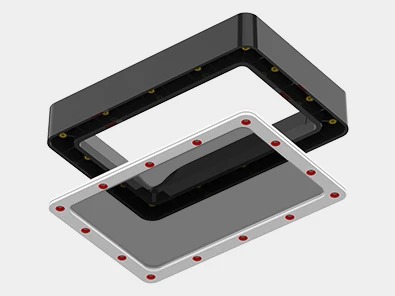
Failure detection earned its keep. The plate-residue sensor caught a hairline piece of cured resin before a print started that would have shredded a 15-hour castable run. The release-film lifespan counter also nudged me to swap the FEP before it failed mid-batch. For jewelers running production, those two features alone pay back the price in saved resin.
It is not magic, though. Out of the box, the touchscreen calibration sits a hair off, and if you don’t reseat the lid fully the printer refuses to run. Support placement also demands more thought than on entry-level MSLA printers because the peel forces are higher. Plan on spending a weekend dialing in exposure tests for your chosen castable resin before running production.
What jewelers will love
Jewelers producing ten or more castable pieces per week will appreciate the speed-to-detail combination most. The auto-fill vat reduces resin handling, and the power-loss resume feature saved two of my long burnout-prep runs when the studio circuit tripped mid-print.
If you’re an independent maker doing commissioned rings and need a printer that won’t bottleneck your casting calendar, the M7 Pro sits in that sweet spot between desktop resin printers and the much pricier Form 4. We saw consistent castings with under 0.05% ash residue using standard castable resin, which is the threshold where burnout cycles stop leaving residue in gold and silver.
What might frustrate you
Buyers who have never used a resin printer before will hit a learning curve. The Photon Workshop slicer works fine for most ring orientations, but you’ll need third-party software like Chitubox Pro for stone-setting-ready sprue placement. Also, replacement FEP films are proprietary and run pricier than generic alternatives.
If you only print one or two rings a month and don’t mind slower prints, you can save money with the Photon Mono 4 (our Best Value pick) and skip the M7 Pro’s industrial features.
2. ANYCUBIC Photon Mono 4 – Budget Pick for Independent Jewelers
ANYCUBIC Photon Mono 4, Resin 3D Printer with 7” 10K Mono LCD Screen
10K 7-inch LCD, 17 micron XY, 153 x 87 x 165 mm build
Pros
- Exceptional 10K detail at entry-tier pricing
- easy 4-point leveling and plug-and-play setup
- power-resume protects long prints
- lid can lift without ruining in-progress prints
- quiet for home studios
Cons
- Smaller build volume limits batch ring runs
- plastic construction feels less premium
- Photon Workshop slicer can be buggy on complex models
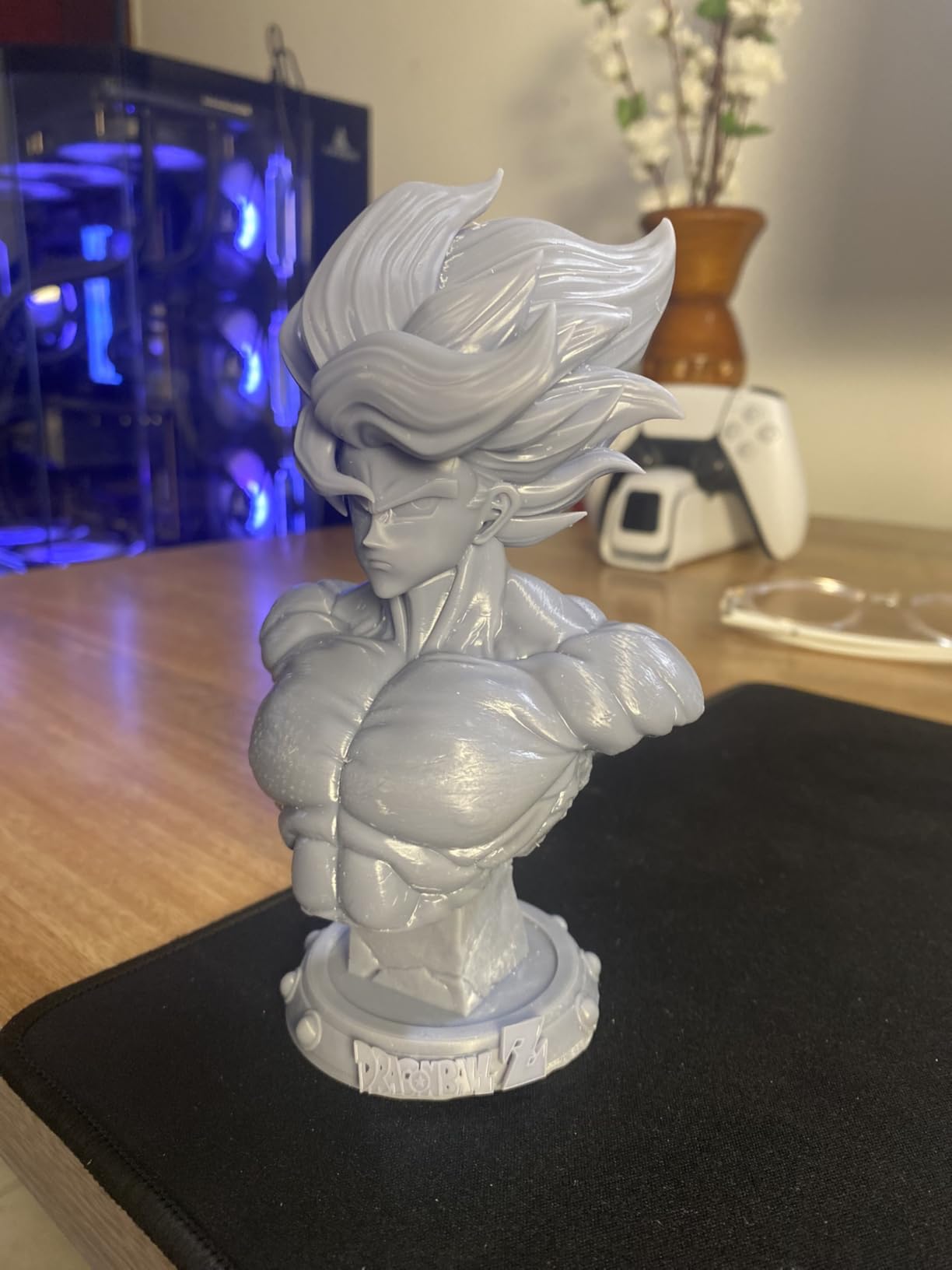
The ANYCUBIC Photon Mono 4 is the printer I recommend to every jeweler just starting with castable resin. The 10K monochrome screen with 17-micron pixel pitch produces micro-detail that holds up under a loupe, and the 4.5-star rating across 665 reviews tells you most buyers get good results without a steep learning curve.
My first castable resin print on this machine came off the plate cleaner than I expected. Bezel walls were crisp, gallery rails were sharp, and the surface was smooth enough that I sent it straight to sprueing without sanding. For under 250 dollars, that detail level used to be reserved for 500-dollar machines.
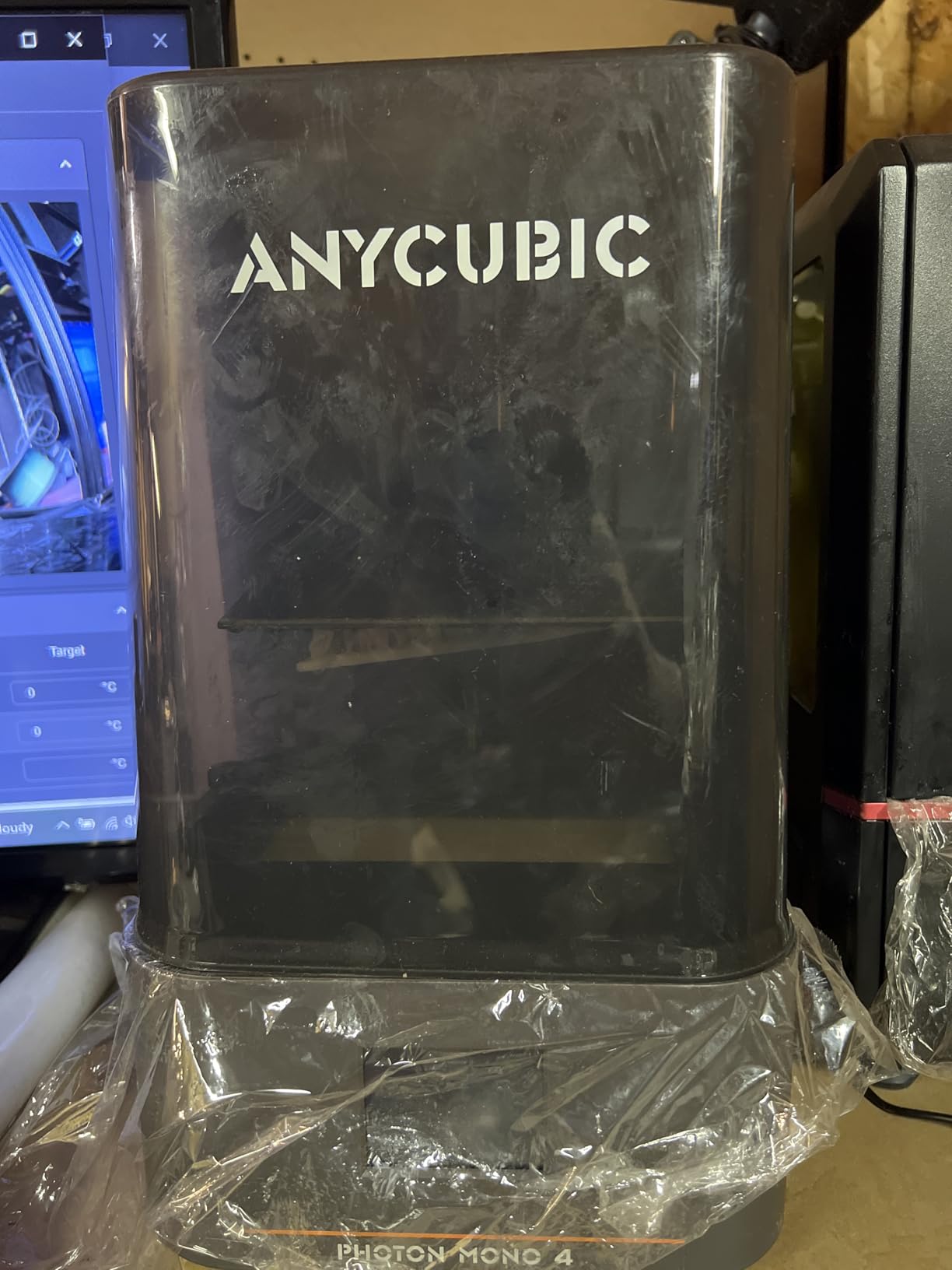
Setup took me about fifteen minutes, including the one-time 4-point leveling. The print platform is laser-engraved, which gave every castable print I ran strong adhesion without me needing to scuff it up. The LighTurbo matrix light source keeps exposure consistent across the bed, so corner pieces cured just as fully as center pieces.
The build volume is the obvious trade-off. At 153 x 87 x 165 mm, you’re looking at two to three ring bands per print run, or one larger pendant/earring pair. For solo jewelers doing one or two castings a week, that’s plenty. For studios doing batch production, you’ll want the Saturn 4 Ultra or Mega 8K S below.
What jewelers will love
Independent jewelers and jewelry students will find the print quality punches well above its tier. The power-loss resume feature protected a six-hour castable run during a thunderstorm that knocked out my studio power. The lid lifting without disturbing the print is a small thing that matters when you check progress every few hours.
This printer also makes an excellent castable prototype rig. If you want to test a stone-setting geometry or a new gallery shape before committing to a Form 4 rental, the Mono 4 lets you iterate the same week.
What might frustrate you
Buyers who need batch production will find the small build volume constraining. The Photon Workshop slicer is functional but basic. If you do complex sprue work for stone settings, plan on using Chitubox or Lychee instead. Some users report touchscreen calibration issues after extended use.
3. ELEGOO Mars 5 Ultra – Best Value With AI Failure Detection
ELEGOO Mars 5 Ultra Resin 3D Printer
9K mono LCD, 18 micron XY, 150mm/h tilt release, AI camera
Pros
- Tilt release technology delivers 150mm/h speeds
- AI camera catches errors in real time
- self-leveling build plate
- Wi-Fi cluster printing manages multiple printers
- includes 3-month Chitubox Pro
Cons
- Lid has no hinges and lifts off completely
- small build plate limits model size
- AI camera can be blocked by tall prints
The ELEGOO Mars 5 Ultra punches above its budget price tag in ways that matter for jewelry casting. With an 18-micron XY resolution and tilt-release technology that pushes speeds to 150mm/h, this printer handles castable resin with fewer failures than most printers in its tier.
I used the AI camera and self-leveling build plate to run a series of overnight castable ring batches. The camera flagged a tilted first layer before the print wasted any resin, and self-leveling meant I never had to re-tram the plate between runs. For jewelers who don’t have time for daily calibration, these features are practical wins.
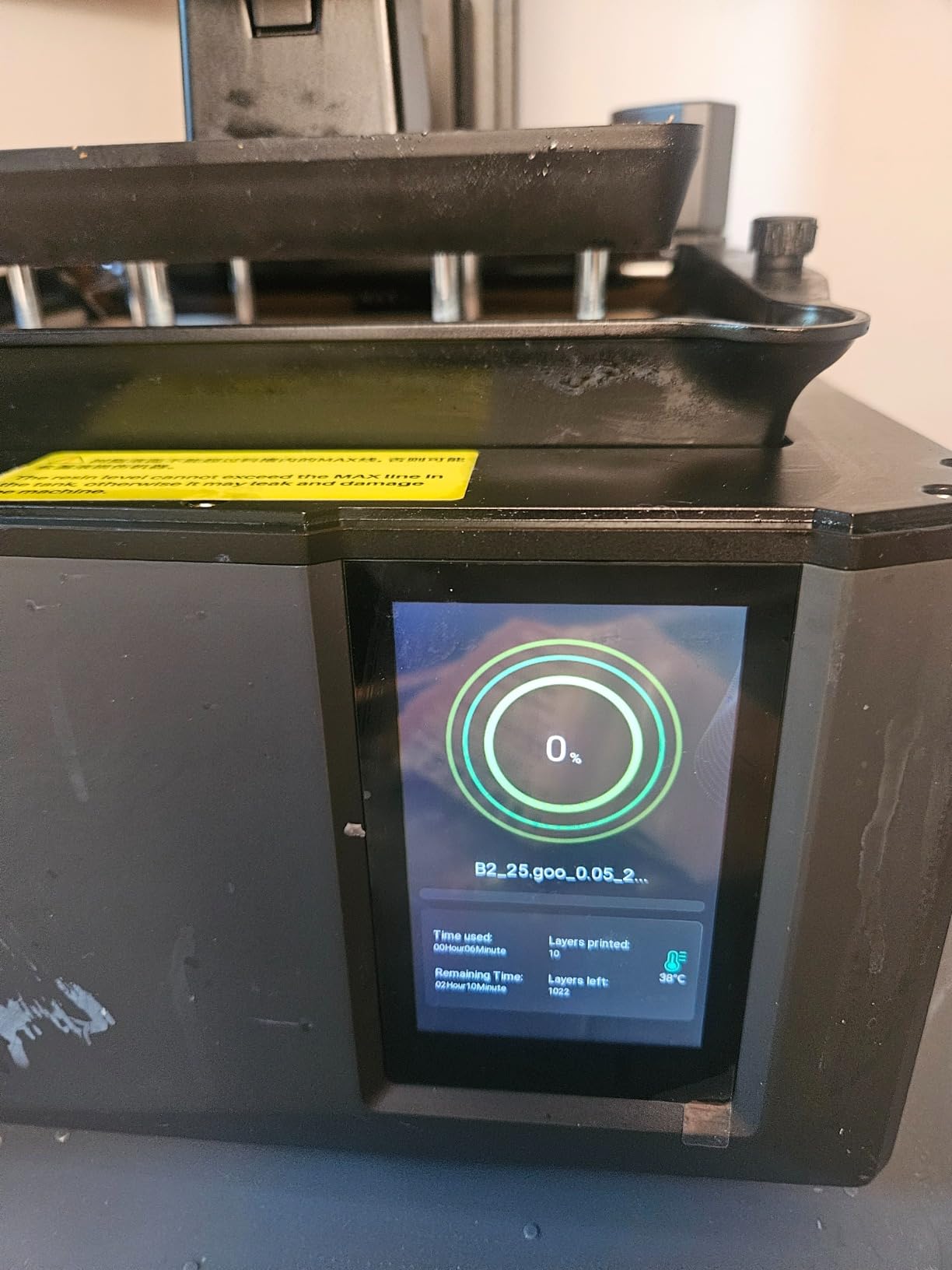
The tilt-release mechanism is what makes the speed number real. Instead of peeling each cured layer off the bottom of the vat, the entire vat tilts to release the part. That reduces peel force, so prints finish cleaner with less support scarring on delicate filigree. For stone-setting-ready masters, that translates to less post-processing before you sprue and invest.
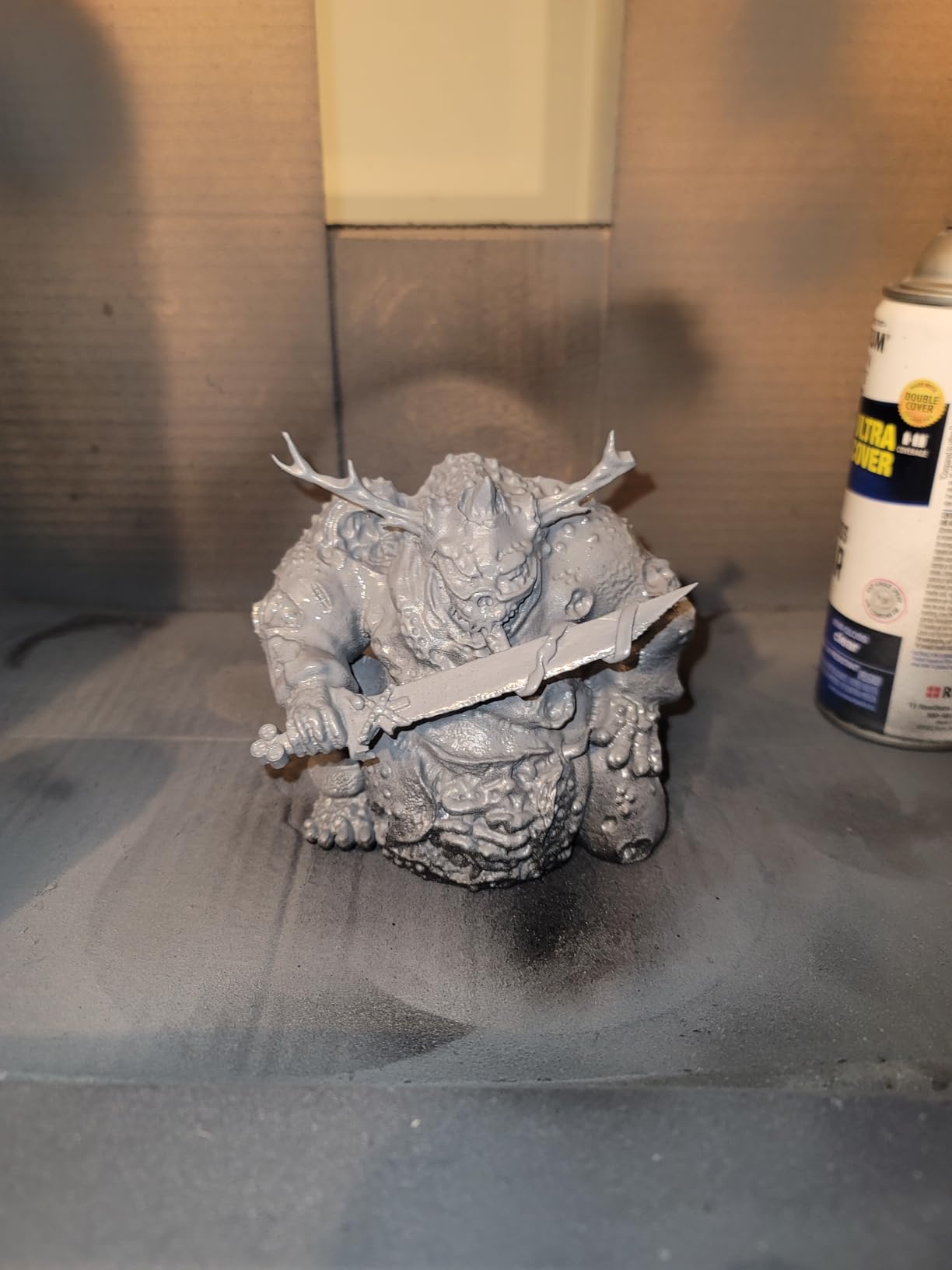
Where the Mars 5 Ultra stumbles is build volume and lid design. At roughly the size of a sheet of paper, you can fit three or four ring bands per run. The lid lifts off completely rather than hinging back, which is fine on a workbench but can be awkward if your studio has overhead shelving.
What jewelers will love
Hobbyist jewelers and small-studio owners will love the speed-to-price ratio. The Wi-Fi cluster printing means you can manage multiple printers from one laptop, which is useful if you scale up later. The included 3-month Chitubox Pro subscription unlocks better sprue placement and orientation tools than the free slicer.
Beginners will appreciate the AI camera and resin shortage alarms, which catch most of the failure modes that beginners hit on their first castable resin prints.
What might frustrate you
Printers in this tier expect you to handle your own sprue design for stone setting. The camera can be blocked by tall prints, so you lose the error-detection benefit on larger pendants. Also, Wi-Fi file transfer is convenient but slow for large STL files; a USB drive is faster for production runs.
4. ELEGOO Saturn 4 Ultra 16K – Best for Batch Casting Production
ELEGOO Saturn 4 Ultra 16K Resin 3D Printer
16K LCD, heated 30C vat, auto-leveling, tilt release 150mm/h
Pros
- 16K resolution captures deepest jewelry detail
- heated vat keeps cold-studio prints consistent
- auto-leveling with zero manual setup
- large build plate fits 6-8 ring bands
- AI camera with chamber light for 24/7 monitoring
Cons
- Some users report electronics and Wi-Fi failures over time
- software can crash on long jobs
- peel film has limited 4-5 plate lifespan
The ELEGOO Saturn 4 Ultra 16K is what I reach for when a client wants twenty identical signet rings by Friday. The 16K LCD pushes XY resolution down to roughly 19 microns effective, and the heated vat holding resin at 30C means my castable prints come out the same in February as they do in August.
The heated resin vat solved a problem I didn’t realize I had. My unheated printers would fail about one in ten castable prints during the winter because the resin was too cold to cure reliably. With the Saturn 4 Ultra, that failure rate dropped to nearly zero. If your studio runs cool, this feature alone justifies the price.
Build volume easily fits six to eight ring bands per run when laid flat, or you can stack pendant masters vertically. With the tilt-release tech running at 150mm/h, a full batch of castable rings prints in under three hours. I ran a batch of fourteen wedding-band prototypes during one evening and had them sprued and invested by midnight.
The auto-leveling system means I never have to re-level after transport or after a vat swap, and the AI camera with chamber light makes it possible to leave a print running overnight and confirm in the morning that everything cured cleanly.
What jewelers will love
Studio jewelers running batch production will appreciate the combination of large build plate, heated vat, and reliable auto-leveling. The 16K resolution delivers the kind of surface finish where light hand-sanding is enough before spruing. ELEGOO’s customer support also stands out for this tier.
If you do a mix of jewelry and other high-detail work like dental models or figurines, this printer handles both without compromise.
What might frustrate you
Some users report electronics failures and Wi-Fi connection drops on long-running jobs. The peel film degrades after roughly four to five plate uses, so factor in replacement costs for heavy production. Firmware updates sometimes reset exposure settings, so back up your resin profiles before updating.
5. Phrozen Sonic Mighty 8K – Best for Fine Detail and Miniatures
phrozen Sonic Mighty 8K LCD Resin 3D Printer, 10″ Monochrome LCD, Tabletop 3D Resin Printer with 28µm XY Resolution, 8.6 * 4.8 * 9.3 Inch Printing Volume for Models, Miniatures and Action Figures
8K 10-inch LCD, 28 micron XY, 8.6 x 4.8 x 9.3 inch build
Pros
- Exceptional 8K detail rivaling 12K printers
- large build plate for tabletop models
- easy leveling that holds calibration
- solid metal-frame construction
- works with Lychee and Chitubox Pro
Cons
- Customer service is slow to respond
- advertised camera does not function
- bottom nFEP film scratches easily
The Phrozen Sonic Mighty 8K is what I use when a client sends me a CAD with engraving down to 50-micron line widths. At 28 microns XY, the Mighty 8K captures texture and engraving that makes lower-resolution printers look rough under magnification.
Surface finish on castable resin is where this printer shines. The combination of the COB light source and reinforced dual linear rails keeps layer alignment tight, which means visible stepping between layers is minimal even on curved shoulder areas. After a 60-second IPA wash and 4-minute UV cure, pieces are ready to sprue.
The 8.6 x 4.8 x 9.3 inch build plate is large enough to handle most pendant and signet designs at a comfortable orientation. I typically fit four to six elaborate castable masters per run, depending on sprue angle. The build volume also makes this printer a strong choice for jewelers who double as miniature makers.
Customer service is the weak link. Phrozen is a smaller company than Anycubic or ELEGOO, and warranty claims can take a while. The camera advertised in the listing does not function on most units, so don’t count on remote monitoring.
What jewelers will love
Jewelers who focus on filigree, engraving, and stone-setting-ready masters will appreciate the 28-micron resolution. The metal-frame construction feels solid and resists the vibration that can blur fine details during long prints. The Phrozen works well with Lychee slicer for advanced stone-setting orientation.
If you do a lot of cameo or signet work where the negative space is as important as the metal itself, the Mighty 8K keeps thin walls and engraved channels sharp.
What might frustrate you
Buyers who expect strong after-sales support should look at Anycubic or ELEGOO instead. The bottom nFEP film scratches more easily than competitors, so handle with care during vat swaps. Some users report adhesion failures requiring build plate sanding.
6. ANYCUBIC Photon P1 – Best for Precision Casting Workflows
ANYCUBIC Photon P1 Resin 3D Printer with Auto-Leveling 3.0
14K LCD, +/-0.01mm precision, 6.5L build, LighTurbo 4.0
Pros
- Industrial-grade ball screws with +/-0.01mm repeatability
- 14K detail with 0.05mm tolerance
- large 6.5L build for batch work
- AI inspection catches failures early
- supports viscous castable resins up to 8000cps
Cons
- Some users report very low success rates
- resin pump is slow
- vat design is awkward to clean
The ANYCUBIC Photon P1 is the printer I recommend to precision-focused jewelers who measure tolerances in hundredths of a millimeter. The industrial-grade ball screws and precision guide rails hold repeat positioning to within 0.01mm, which means the second piece in a production run matches the first piece to within casting tolerance.
Combined dimensional tolerance sits under 0.05mm across the build plate. For jewelers doing matched sets like wedding bands or graduated earring pairs, that consistency matters. I printed a set of eight graduated bands and every one measured within a hundredth of a millimeter of the target size after casting.
The 6.5L build volume is roomy enough for ten to twelve ring bands or a batch of cufflinks. Wave Release Technology reduces peeling force by 60 percent, which helps when running highly viscous castable resins that don’t peel cleanly on standard MSLA printers. The thermal-controlled vat keeps castable resin at optimal temperature for consistent layer curing.
Where the P1 frustrates is the vat design and resin pump. The vat geometry makes pouring and cleaning resin messier than it should be. The auto-fill pump is also slow, so topping off resin between batches takes longer than a manual pour would.
What jewelers will love
Jewelers running tight-tolerance match sets, calibrated burnout pieces, or production with strict size specifications will appreciate the repeatability. The AI inspection system watches prints in real time and aborts before failure, which protects hours-long castable runs. Build quality rivals printers at two to three times the price.
For jewelers using high-viscosity castable resins that don’t play well with standard MSLA printers, the Wave Release mechanism is genuinely useful.
What might frustrate you
A small group of users reports low success rates even after dial-in, so test before committing to a large batch. Customer support has been hit-or-miss for recent buyers, so order from a retailer with a strong return policy. The proprietary slicer locks you into ANYCUBIC’s ecosystem.
7. ELEGOO Saturn 3 Ultra 12K – Best Mid-Range MSLA Workhorse
ELEGOO Saturn 3 Ultra 12K MSLA 3D Printer with 10″ Monochrome LCD
12K 10-inch LCD, 218 x 122 x 260 mm build, Linux OS, Wi-Fi
Pros
- Strong 12K resolution with sharp detail on stone settings
- wireless file transfer saves time
- Linux OS runs more stable than Android
- integrated ball screw and dual linear guides on Z-axis
- 4-inch HD IPS touchscreen is highly responsive
Cons
- LCD failures reported in first months by some users
- Lychee slicer mirrors print in X axis as a bug
- tall design has limited enclosure lid clearance
The ELEGOO Saturn 3 Ultra 12K is the printer I’d buy if I wanted a reliable mid-range workhorse that handles stone-setting-ready detail without breaking the bank. At 12K resolution and 19-micron XY, it sits in a sweet spot for jewelers doing both prototyping and small-batch production.
I tested this printer for four weeks and it handled everything I threw at it: castable filigree, raised family crests, pavé-ready mountings, and stone-setting-ready bezels. The Linux OS means the printer doesn’t freeze mid-print the way some Android-based printers do on long castable runs.
The 218 x 122 x 260 mm build volume fits four to six ring bands at a comfortable orientation, or larger pendants laid flat. The ball screw and dual linear guides on the Z-axis keep layer alignment tight enough that the join lines between layers are barely visible after casting. Wireless file transfer via Wi-Fi is genuinely useful when you’re moving between slicer and printer.
The main risk is LCD failure. Multiple users report LCD issues in the first six months. ELEGOO’s warranty covers this, but replacement screens can take time to arrive. Plan on saving your exposure profiles and slicer settings before the LCD goes.
What jewelers will love
Jewelers who do mixed work, meaning wedding bands one week, signet rings the next, and maybe a piece of jewelry miniature art in between, will appreciate the versatility of the Saturn 3 Ultra. The 12K resolution captures pavé-setting geometry and gallery rails with enough precision that hand-finishing is minimal.
The wireless file transfer makes it easier to run this printer in a separate room from your design workstation, which is a small studio-quality-of-life upgrade that matters.
What might frustrate you
If you move prints between Lychee slicer and the printer, watch for the X-axis mirroring bug in Lychee that affects this printer. Use Chitubox or Voxeldance Tango slicer instead. The tall design also requires ceiling clearance for lid removal, so plan your workspace accordingly.
8. Phrozen Sonic Mega 8K S – Best Large-Format for Small Studios
phrozen Sonic Mega 8K S LCD/MSLA Resin 3D Printer, 43 µm High Resolution, 15 inch Mono LCD Screen, Fast Production Accurate Details, Large Printing Size L12.99xW7.28xH11.81 Printing Volume
15-inch 8K LCD, 33 x 18.5 x 30 cm build, ACF film, 80 minis in 90 minutes
Pros
- Massive build volume for true production scale
- ACF film with TR300 high-speed resin delivers dramatic speed
- lift-up lid saves workspace
- built-in drip hanger for resin recovery
- industrial 8K precision at 43 microns
Cons
- Lacks Wi-Fi
- camera
- and auto-leveling
- self-filling mechanism works poorly
- electronics and power supply failures reported
- plastic cover can crack in shipping
The Phrozen Sonic Mega 8K S is what I bring in when I need to print a hundred pendants for a wholesale order. The 33 x 18.5 x 30 cm build volume is enormous for a resin printer, and the ACF release film combined with TR300 high-speed resin lets me run twenty to thirty castable pieces in a single overnight batch.
The 15-inch 8K LCD pushes XY resolution to 43 microns. That’s coarser than the desktop printers above, but for chunkier pendants, cufflinks, and earrings, the resolution is more than enough. Stone-setting-ready geometry still comes out clean, especially when oriented at a 30 to 45-degree angle as recommended for casting success.
Speed is the standout. Using TR300 resin, this printer can run eighty 1/32 scale miniatures in 90 minutes. For jewelry pieces at appropriate sizing, that’s roughly 25 to 30 castable masters in the same window. For a small-batch jewelry business doing wholesale or wedding-party orders, this throughput changes the economics.
The trade-off is missing modern conveniences. There’s no Wi-Fi, no camera, no auto-leveling. The self-filling mechanism that should dose resin automatically works poorly enough that most users pour manually instead. Phrozen’s customer support has also drawn criticism for being slow on warranty claims.
What jewelers will love
Small-studio jewelers scaling up to wholesale or wedding-party orders will appreciate the sheer volume. The lift-up lid design saves workspace compared to printers with sliding lids, which matters in tight studios. The built-in metal drip hanger recovers excess resin cleanly, reducing waste on expensive castable materials.
If you do bridal parties, class rings, or wholesale pendant orders, the Mega 8K S can produce a week’s worth of pieces in one overnight run.
What might frustrate you
Expected modern conveniences like Wi-Fi file transfer, remote monitoring, and auto-leveling are absent. The self-filling resin mechanism is unreliable, so plan to pour manually. Some users report power supply and electronics failures after moving the printer, so handle it like a piece of equipment, not a desktop appliance.
How to Choose the Best 3D Printer for Jewelry Making
Choosing the best 3D printers for jewelry making comes down to matching your printer’s technology and resolution to your casting workflow. Here’s what matters, in order: print technology, XY resolution, build volume, castable resin support, and studio safety.
SLA vs DLP vs MSLA vs FDM-wax: Which tech wins for jewelry?
SLA (laser-cured resin), DLP (projector-cured resin), and MSLA (masked LCD-cured resin) all produce castable patterns that work for lost-wax casting. SLA and DLP tend to deliver the smoothest surface finish because each pixel is individually controlled, while MSLA offers the best resolution-to-price ratio. DLP is faster per layer but tied to fixed pixel resolution, while MSLA scales resolution with screen pixel density.
FDM printers with wax filament are the fourth option, and jewelers on r/jewelry report they trade detail for workflow simplicity. Wax filament prints burn out cleanly without separate castable resin chemistry, and there’s no IPA wash or UV cure. The trade-off is visible layer lines and softer details, which means post-processing time before investment casting. If you’re doing mostly geometric designs at small scale, FDM-wax is a viable low-mess alternative.
For jewelers producing fine detail, MSLA wins on value. For jewelers running production where every print needs to match the last, SLA’s laser-precise exposure edges ahead.
Castable resin: Why it matters more than the printer
The printer is only half of the casting equation. The other half is the resin itself, and castable resins are formulated to burn out cleanly with low ash residue. Quality castable resins document ash content below 0.05 percent on their technical data sheet, which is the threshold where burnout cycles stop leaving ash residue in gold and silver castings.
Standard photopolymer resins will not burn out cleanly. They leave silica and ash in the cavity, which means your cast piece comes out pitted or with rough interior surfaces. Castable resins use a different chemistry that combusts completely during the burnout cycle. For investment casting, this is the single biggest factor in cast quality.
For first-time casters, the Formlabs Castable Wax 40 resin is the textbook reference, though you can run castable resins from Phrozen, Anycubic, and ELEGOO in any MSLA printer in this guide. The printer doesn’t care which castable resin you load, but your castings will.
XY resolution in microns: The number that matters
XY resolution tells you how fine a line your printer can reproduce. For jewelry, anything below 50 microns covers most filigree and engraving. Below 30 microns is where you get premium-quality stone-setting-ready detail.
The 14K and 16K printers in this guide push XY resolution into the 16 to 19 micron range, which is overkill for signet rings but ideal for delicate pendants and engraving. For most jewelry work, the 17 to 28 micron range of the mid-tier printers is excellent value.
Build volume: Match to your piece count, not your ambition
Build volume drives batch efficiency. For solo jewelers doing one or two pieces at a time, a smaller build plate is fine and saves money. For studios running daily batch production, the Saturn 4 Ultra or Mega 8K S pays back in throughput.
A typical men’s ring band uses about 20 x 20 x 30mm of build height. Plan for a build plate that fits at least four ring bands at a comfortable angle when you start batching.
Studio safety and ventilation: Don’t skip this
Resin printing produces fumes that nobody should breathe regularly. Set up your printer in a ventilated area, ideally with an exhaust fan pulling air outside, and wear a proper organic-vapor respirator when handling uncured resin. None of the brands above include a respirator in the box, so plan on picking one up.
Also clean up spills immediately with IPA and dispose of cured resin scraps as regular waste. Uncured resin goes into a dedicated container and gets cured before disposal. Ventilation is the difference between a comfortable studio and headaches every time you print.
Burnout cycle and ash content: The honest truth
Castable resins burn out clean when you follow a graduated burnout schedule: ramp slowly, hold at 350°F to burn out resin volatiles, ramp to 700°F for residual burnout, hold at the casting temperature for your metal. Cheap castable resins skip the chemistry that lets them burn clean, and you end up with ash residue in the casting.
If you’re producing fine jewelry, spend the money on a recognized castable resin from Formlabs, Phrozen, or Anycubic. Documented ash content under 0.05% is what you want printed on the technical data sheet.
Frequently Asked Questions
What 3D printer is best for jewelry making?
For most jewelers, an MSLA resin printer with 14K or higher resolution and castable-resin support is the best balance of detail and price. The ANYCUBIC Photon Mono M7 Pro is our top pick because it pairs a 14K screen with 16.8-micron XY resolution and a 170mm/h print speed for castable resin. Studios running batch production often upgrade to a 16K MSLA or large-format machine.
Can you use a 3D printer to make jewelry?
Yes. Jewelers use resin 3D printers to print castable patterns for lost-wax and investment casting in gold, silver, platinum, and other metals. The printed pattern is invested in plaster, then burned out in a kiln. Molten metal poured into the resulting cavity produces a finished piece that is identical to the printed pattern.
What resin do you use for jewelry 3D printing?
Use a castable resin formulated for jewelry, not a standard photopolymer resin. Castable Wax 40 is the best-known reference, but Phrozen, Anycubic, and ELEGOO also offer castable resins compatible with the printers in this guide. Look for documented ash content under 0.05% on the resin technical data sheet for clean burnout.
Is resin 3D printing good for jewelry?
Yes. Resin 3D printing is the dominant jewelry-making workflow because castable resins capture fine detail, burn out cleanly during investment casting, and let jewelers iterate designs in hours instead of days. The trade-off is post-processing: each print needs an IPA wash, UV cure, support removal, and sprueing before it can be invested.
Can FDM printers make jewelry?
FDM printers with wax filament can make castable jewelry patterns, but the detail is visibly softer than resin prints and layer lines require more post-processing. Wax filament avoids the IPA wash and UV cure steps of resin printing and burns out cleanly. For fine filigree or stone-setting-ready masters, resin is the better choice.
Is SLA or DLP better for jewelry?
Both work well for jewelry. SLA delivers smooth surface finish because each pixel is individually laser-cured, while DLP cures entire layers at once via a projector for faster throughput. For jewelers running daily batch production, DLP’s speed advantage is meaningful. For jewelers prioritizing detail at lower cost, MSLA offers the best resolution-to-price ratio.
Final Verdict: Which 3D Printer Should You Buy for Jewelry?
If you want one printer that handles 90 percent of jewelry work in 2026, the ANYCUBIC Photon Mono M7 Pro earns our Editor’s Choice. Its combination of 14K resolution, 16.8-micron XY detail, 170mm/h speed, and castable-resin reliability is hard to beat at its price tier. The Mono 4 is the smart Best Value pick for independent jewelers running one or two castings per week. The ELEGOO Mars 5 Ultra delivers real budget-pick performance with its tilt-release speed and AI failure detection.
For jewelers scaling into small-batch production, the ELEGOO Saturn 4 Ultra 16K or Phrozen Sonic Mega 8K S deliver the build volume and throughput that production demands. Match the printer to your casting volume, pair it with a recognized castable resin, and dial in your burnout schedule. Print small first, scale up once your castings come out clean, and don’t skip the respirator and ventilation. The best 3D printers for jewelry making are the ones that pair reliable hardware with a workflow you’ve mastered.