
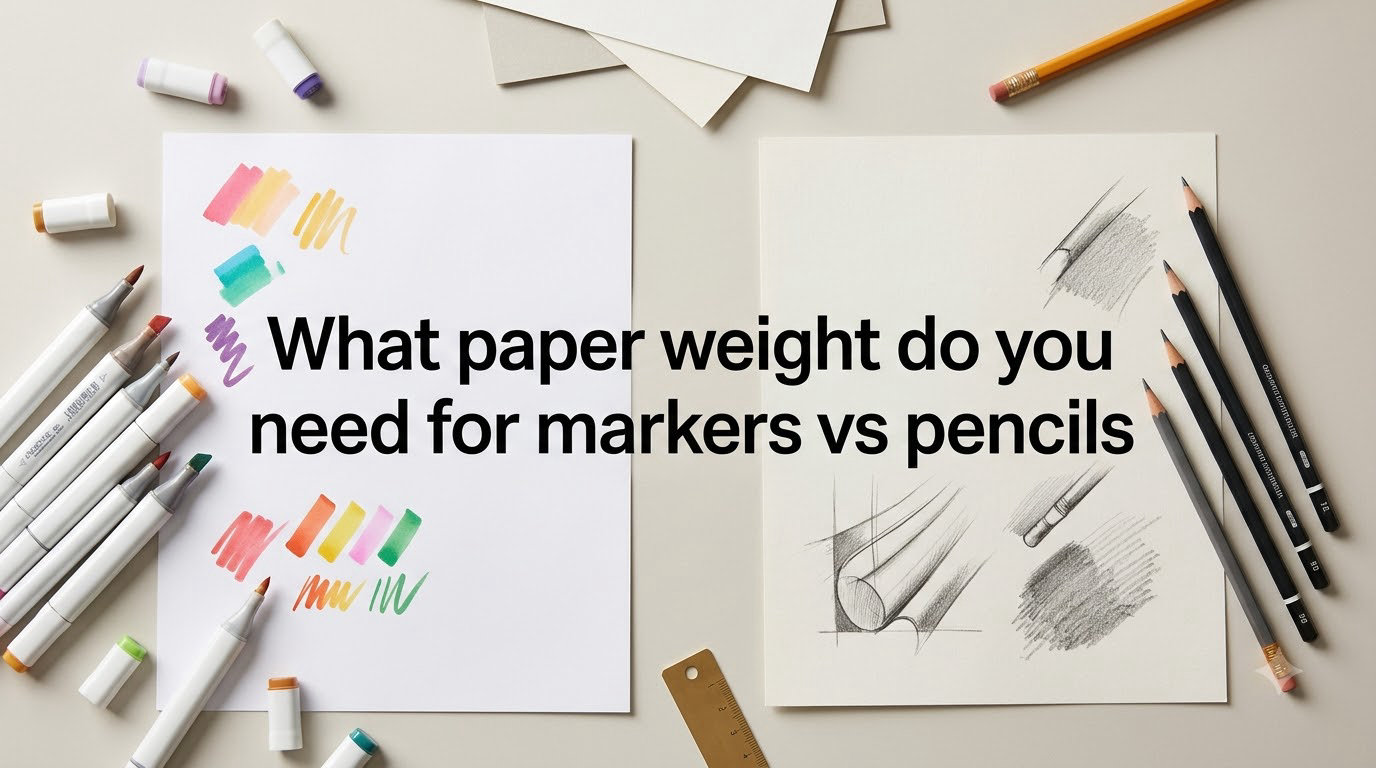
Paper weight for markers vs pencils is one of those topics that sounds simple until you actually shop for art supplies. I remember buying a “premium” coloring book at a big-box store, only to watch my Copic marker bleed straight through the page and ruin the kitchen table underneath. That single ruined sketchbook sent me down a rabbit hole of GSM charts, paper weight tiers, and tooth comparisons. What I learned is that markers and pencils want almost opposite paper — and choosing the wrong weight wastes ink, kills your marker nibs, and flattens your pencil layering.
This guide is the resource I wish I had back then. I’ll walk you through the GSM numbers that actually matter, explain why markers demand heavier paper while colored pencils thrive on lighter textured stock, and show you how to pick the right paper whether you work with one medium or both. By the end, you’ll know exactly which weight to reach for, regardless of whether a brand labels its pad in grams or pounds.
Table of Contents
What Paper Weight Means for Artists: GSM and Pounds Explained
Paper weight is simply how heavy a square meter of paper would feel if you cut it out and weighed it. The metric version, GSM (grams per square meter or g/m²), is the universal measurement most professional artists use. The US system uses pounds (lb), which is where confusion kicks in because the same pound number can mean totally different things depending on the paper category.
Here’s the cheat sheet: 80 GSM is roughly 50 lb text weight, 120 GSM sits around 80 lb text, 160 GSM is about 60 lb cover, and 200 GSM lands near 74 lb cover. Cover weight is thicker than text weight at the same pound number, so two pads labeled “60 lb” can feel completely different in your hands. When in doubt, trust the GSM number — it’s universal and never lies about thickness.
To make conversions painless, here’s the quick-reference box I keep taped above my desk:
GSM to LB conversion (approximate):
– 90 GSM ≈ 60 lb text
– 120 GSM ≈ 80 lb text
– 160 GSM ≈ 60 lb cover
– 200 GSM ≈ 74 lb cover
– 240 GSM ≈ 90 lb cover
– 300 GSM ≈ 110 lb cover
Why does this matter for your art? Because two papers with the same “weight” in pounds can behave like night and day in your sketchbook. The GSM tells you the actual fiber density, while the LB number depends on what type of paper (text, cover, index, or Bristol) you’re holding. When you’re choosing paper for markers vs pencils, GSM is the number to memorize.
Paper Weight for Markers: GSM Tiers That Actually Work
Markers are thirsty. Alcohol-based ink, in particular, soaks into paper fibers and refuses to stop until it hits something denser than itself. That’s why GSM matters more for marker artists than for almost any other medium. Below 100 GSM, you’ll watch your strokes bleed through the back of the page, feather across your linework, and bleed into whatever’s lying beneath.
I tested six paper weights over three months with my Copic Sketch markers, and here’s the tier-by-tier breakdown that actually held up in real use.
Under 90 GSM — Avoid for markers. Standard copy paper lives here. Alcohol markers will bleed through instantly, water-based markers will feather uncontrollably, and acrylic markers will pill the surface. Save this weight for pencil sketches and notes only.
90 to 120 GSM — Lightweight cardstock, still risky. Many mass-market coloring books use paper in this range. Light layering with water-based markers (like Crayola SuperTips) is possible if you go slow, but alcohol markers will still ghost through. If you only own one pad in this range, plan to work on the back side of every page.
160 to 200 GSM — The sweet spot. This is where most professional marker artists land. Copic, Ohuhu, Prismacolor, and Spectrum Noir all behave predictably on paper in this range. Colors layer cleanly, you can do three or four passes without bleed-through, and the surface stays smooth enough to protect your nibs. Our team found this was the most forgiving tier across marker brands.
240 to 300 GSM — Heavyweight cardstock. When you want zero bleed-through and don’t mind the extra cost per sheet, this is the bulletproof option. Great for finished illustrations, single-sided art prints, and presentation pieces. The trade-off is that your sketchbook gets heavy fast.
Is 140 GSM paper good for alcohol markers? Marginally. It works for single-pass coloring with light pressure, but expect ghosting on the back and visible feathering when you overlap strokes. If you already own 140 GSM paper, you’ll get away with simple designs — just don’t expect professional results.
What GSM paper is best for alcohol markers? For most hobbyists and professionals, 160 to 200 GSM is the answer. Anything below that compromises layering, and anything above 240 GSM is overkill unless you’re doing final presentation work.
Paper Weight for Colored Pencils: Why Lighter and Toothy Wins
Colored pencils are the opposite of markers in almost every way. Instead of needing dense paper to stop ink, they need textured paper — what artists call “tooth” — to grab pigment and hold it in layers. Heavyweight marker paper looks beautiful and smooth, but put a Prismacolor Premier pencil on it and watch your pigment slide around like it’s skating on ice.
The ideal paper weight for colored pencils sits between 80 and 150 GSM. Lighter paper in this range (80-100 GSM, or roughly 50-70 lb text) is perfect for sketching and light layering. Mid-weight paper (120-150 GSM, or 80-100 lb text) gives you enough body to handle multiple layers of pigment without buckling under pressure.
Vellum-finish Bristol paper is the classic choice for pencil artists. The slightly rough surface grips pigment so each layer builds on the last instead of smearing back into your blending pencil. For comparison, my Strathmore 400 Series Plate Bristol (270 GSM, plate finish) is too smooth for aggressive layering — it makes colors look polished but prevents deep saturation.
Is 70 lb paper good for colored pencils? Absolutely. In fact, a 70 lb text-weight drawing paper is often better for pencils than the heavy cardstock you might use for markers. The lighter weight lets you press hard without crushing fibers, and you can still get four to six visible layers before the tooth fills in.
The key insight is this: markers want heavy and smooth, pencils want light and textured. When you put a colored pencil on 200 GSM marker cardstock, the surface is so slick that your pigment can’t find purchase, and your colors look washed out after two layers. The paper that feels luxurious for markers feels wrong for pencils.
Tooth, Texture, and Surface: Why Markers and Pencils Want Opposite Finishes
Beyond weight, the surface finish of your paper determines whether your medium behaves or fights back. Three terms cover most of what you’ll see on a paper pad label.
Smooth (plate finish): Pressed under heavy rollers during manufacturing to create a polished surface with minimal tooth. Perfect for markers because ink glides on without snagging, and your chisel and bullet nibs last longer because there’s no friction to wear them down. The downside for pencils is the lack of tooth means your pigment has nowhere to grip, which kills layering.
Vellum: A lightly textured surface with subtle tooth. The middle ground between smooth and laid paper. Most Bristol pads come in vellum or smooth versions, and vellum is what colored pencil artists reach for by default. The tooth holds pigment in place while still being smooth enough for some marker work — though heavy alcohol marker layering will still bleed on most vellum surfaces.
Laid or textured: Visible texture with intentional ridges or felt marks. Stonehenge, Canson Mi-Teintes, and pastel papers live here. These surfaces are pencil paradises but absolutely hostile to markers, because the texture shreds nibs and soaks ink unpredictably.
Coated versus uncoated matters too. Coated papers have a surface sealant that locks ink near the top of the sheet, which is why marker-specific paper feels almost waxy. Uncoated paper absorbs ink deeper into the fibers, which causes bleed-through on lighter stocks. For markers, coated wins every time. For pencils, uncoated with tooth wins every time.
One warning from experience: don’t use highly textured paper with markers. I tried a sheet of Stonehenge with Copics once and the bullet nib started fraying within five minutes. The texture that makes pencils sing destroys marker nibs.
Markers vs Pencils: Side-by-Side Paper Weight Comparison
Here’s the comparison I wish every art supply store handed out at the register. This is the at-a-glance reference for picking the right paper based on what you’re working with.
Markers (alcohol-based): 160 to 200 GSM, smooth or coated finish, minimal tooth, high bleed resistance required.
Markers (water-based): 120 to 160 GSM, smooth finish, moderate bleed resistance, layering-friendly.
Markers (acrylic): 200 to 240 GSM, smooth or coated finish, very low absorbency, supports opaque coverage.
Colored pencils (wax-based like Prismacolor): 100 to 150 GSM, vellum or lightly textured finish, visible tooth for layering, Prismacolor and Polychromos friendly.
Colored pencils (oil-based): 120 to 180 GSM, vellum or laid finish, slightly heavier tooth, less prone to waxy buildup.
Mixed media (both markers and pencils): 160 to 200 GSM, vellum finish, moderate tooth, balanced for layering and bleed resistance.
The pattern is clear: markers shift the weight range higher, pencils shift it lower, and mixed media sits right in the middle. If you remember nothing else, remember that markers and pencils want opposite paper.
Mixed Media Paper Weight: Using Markers and Pencils Together
Working with both markers and colored pencils on the same page is where most paper shopping goes wrong. You pick up a heavyweight marker pad, and your pencils slide uselessly across the surface. You grab your favorite pencil Bristol, and your markers bleed through instantly.
The answer is a 160 to 200 GSM mixed media paper with a vellum finish. This is the overlap zone where both mediums can perform. The paper is heavy enough to handle two or three marker passes without bleed-through, while still having enough tooth to grab pencil pigment for layering on top.
Several paper lines are built specifically for this overlap. Strathmore 400 Series Mixed Media (190 GSM, vellum finish) is the gold standard for hobbyists. Canson XL Mixed Media (160 GSM) is a budget-friendly alternative that handles light marker work plus full pencil layering. Both let you start with markers for base color, then come back with colored pencils for shading and detail work.
The trick with mixed media is layering order. Apply your markers first while the surface is clean and dry, then let them cure for at least ten seconds before you bring pencils in. Pencils on top of wet marker ink will smear the ink and lift pigment from the page. If you’re going to layer pencil first and marker second, keep your marker passes light and your pressure low.
One Reddit user in r/AlcoholMarkers summed up what most mixed media artists discover the hard way: “I tried using marker paper for my colored pencils and my Prismacolors looked like they’d been erased. Switched to mixed media and everything finally looked right.” That captures the lesson perfectly — the paper needs to compromise between two extremes, and that compromise lives at 160 to 200 GSM with vellum texture.
How to Stop Marker Bleed-Through: Blotter Sheets and Printer Tips
Even on the right paper weight, marker bleed-through can sneak up on you when you’re layering heavily or working on the back of a page. The oldest trick in the artist’s playbook is the blotter sheet.
A blotter sheet is just a spare sheet of heavy paper (200 GSM or higher) placed underneath your working page. When your marker bleeds through, the ink soaks into the blotter instead of your table, your desk pad, or the next page in your sketchbook. Many artist-grade pads include a few blotter sheets at the back — those aren’t filler, they’re working tools.
If your pad didn’t include any, just cut a few sheets of cardstock to size and tuck them under every page you work on. This single habit will save your desk and let you work on both sides of every page without ghosting.
For artists who print their own coloring pages at home, printer compatibility becomes the next challenge. Most home printers struggle above 200 GSM, and anything heavier often causes paper jams. If your printer has a straight-through paper path (most Canon and Brother inkjets do), you can push to 240 GSM. If you’re feeding through a curved paper path (most HP and Epson inkjets), stick to 160 to 180 GSM.
Inkjet prints versus laser prints matters more than most people realize. Inkjet prints use water-soluble dye that reactivates the moment alcohol touches it — so an alcohol marker over an inkjet print will smear the linework almost instantly. Laser prints use toner that sits on top of the paper and doesn’t reactivate. If you’re printing coloring pages for alcohol markers, use a laser printer whenever possible.
One last tip from the artist forums: if you only own an inkjet printer, set your linework to print in bold black and let it dry for at least 24 hours before using alcohol markers. Some users report success sealing the page with a light coat of clear acrylic spray, but that’s experimental and not what I’d recommend for finished work.
Choosing Paper by Project: Coloring Books, Illustration, and Layering
Different projects call for different paper weights, and buying one pad for everything usually means compromising somewhere. Here’s how I break it down by use case.
Adult coloring books (markers): Look for 160 to 200 GSM paper with a smooth or coated finish. Anything lighter will frustrate you with bleed-through. Hammermill 60 lb cardstock (160 GSM) is a popular community pick because it’s affordable, widely available, and feeds through most home printers.
Adult coloring books (colored pencils only): 100 to 150 GSM vellum Bristol is the sweet spot. The slightly heavier weight than standard printer paper gives you room for two or three layers without buckling, while the tooth holds pigment for that satisfying build-up of color.
Illustration and comic art (markers + ink): 200 to 240 GSM smooth Bristol is the industry standard. Comic artists need bleed-proof paper because the wrong choice ruins an entire page of finished ink work.
Fine art pencil portraits: 150 to 200 GSM vellum Bristol with archival quality. Look for acid-free paper if you want your work to last decades without yellowing.
Mixed media journals: 160 to 200 GSM mixed media paper, ideally perforated so you can tear pages out cleanly. This weight handles watercolor, marker, and pencil without buckling or bleeding.
When you see labels like “marker-friendly coloring book,” check the GSM number before buying. Many books advertise themselves as marker-friendly but ship with 100 to 120 GSM paper that still bleeds through. Our team has tested this — the claim on the cover rarely matches the paper weight inside.
Frequently Asked Questions
Is 20 or 24 lb paper heavier?
24 lb paper is heavier than 20 lb paper. The pound number refers to the weight of 500 sheets at the paper’s standard size, so a higher lb number always means thicker, denser paper. In text-weight papers, 24 lb is the standard for most office printers and feels noticeably sturdier than 20 lb copy paper.
What is 70 lb paper good for?
70 lb paper is good for colored pencils, sketching, light watercolor washes, and everyday printing. It has more body than standard 20 lb copy paper but is still flexible enough for sketchbooks. It’s too light for alcohol markers, which will bleed through almost immediately.
Is 100 lb or 80 lb paper thicker?
100 lb paper is thicker than 80 lb paper. As long as both are in the same category (text weight, cover weight, or index), the higher pound number always means thicker paper. A 100 lb cover stock is roughly equivalent to 270 GSM, while 80 lb text weight is closer to 120 GSM.
Is 140 GSM paper good for alcohol markers?
140 GSM paper is borderline for alcohol markers. Light pressure and single passes will work without major bleed-through, but layering two or three strokes in the same area will ghost through to the back. For reliable marker work, step up to 160 GSM or heavier.
What GSM paper is best for alcohol markers?
The best GSM range for alcohol markers is 160 to 200. This range gives you enough density to handle three or four layering passes without bleed-through, while staying affordable and printer-friendly. Below 160 GSM you’ll see ghosting; above 240 GSM is overkill for most hobbyist projects.
What type of paper is best for markers?
Smooth, coated marker paper or heavyweight cardstock (160 to 200 GSM) is best for markers. Look for Bristol or marker-specific pads with a slick, non-porous surface that lets ink sit on top rather than soaking in. Bleedproof and coated finishes help ink dry evenly without feathering.
What is the difference between marker paper and regular paper?
Marker paper is heavier (usually 160 GSM or more), smoother, and often coated to resist ink absorption. Regular printer paper (70 to 90 GSM) is too thin and porous, which causes markers to bleed through instantly. Marker paper also tends to have a slicker surface that protects marker nibs from wear.
Conclusion
Paper weight for markers vs pencils comes down to a simple rule: markers want heavy and smooth, pencils want light and textured, and mixed media lives in the middle. Reach for 160 to 200 GSM smooth cardstock when you’re working with alcohol, water-based, or acrylic markers. Reach for 80 to 150 GSM vellum Bristol when colored pencils are your main tool. Reach for 160 to 200 GSM mixed media paper when you want to use both on the same page.
The GSM number is your most reliable guide — trust it over the pound label, which varies by paper category. Start with one good pad at the 180 GSM vellum mark and you can handle most marker and pencil projects without buying specialized paper for each medium. Your markers will stop bleeding, your pencils will finally layer, and you’ll save money on supplies that actually work for your style.