
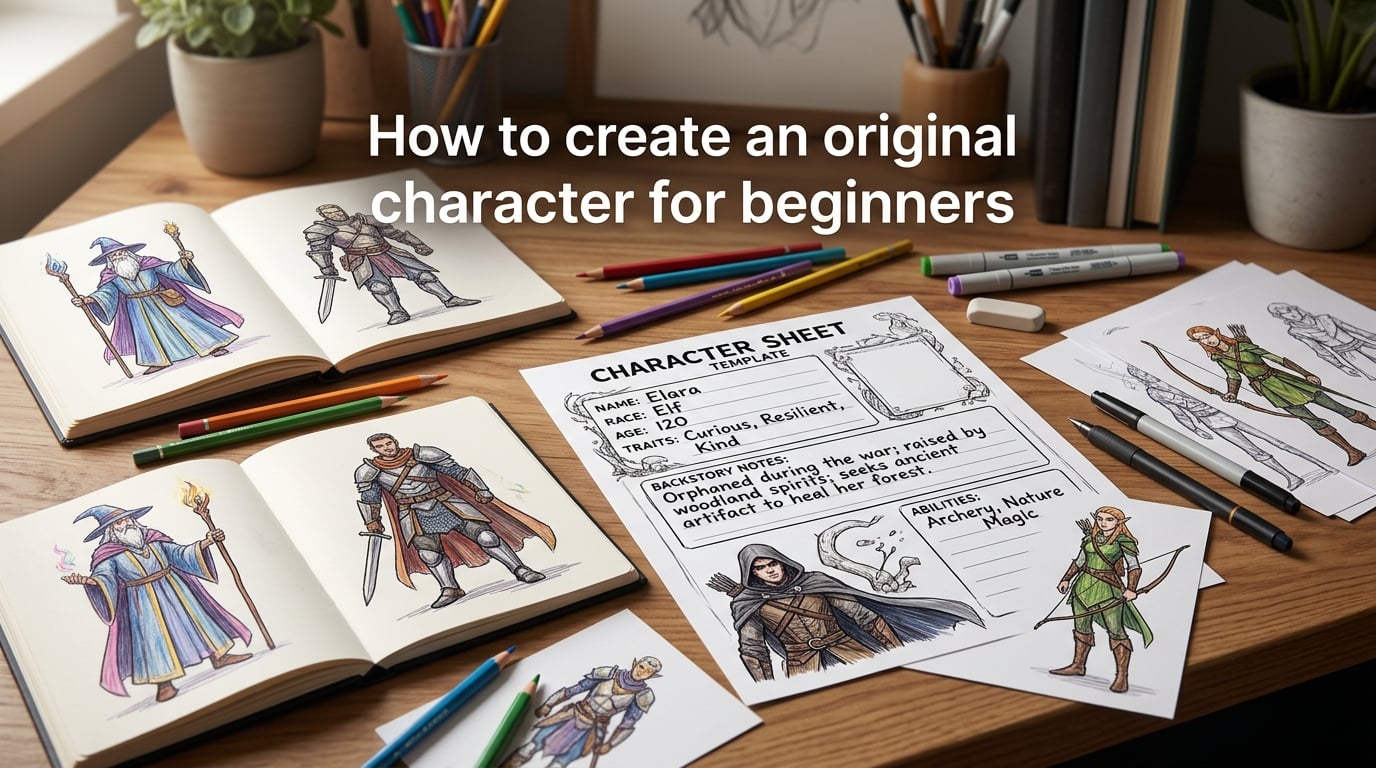
An original character (OC) is a fictional character you create from scratch that does not belong to any existing franchise. Whether you want to design characters for stories, comics, roleplay, or fan art, learning how to create an original character for beginners opens up an incredibly rewarding creative outlet. I have spent years building OCs and helping others do the same, and this guide walks you through the entire process step by step.
Creating an OC might feel intimidating when you stare at a blank page. You might wonder if your idea is original enough or worry you cannot draw well enough to bring your character to life. The good news is that character creation is a skill anyone can develop, and plenty of free tools exist to help even non-artists produce solid character designs.
In this guide, you will learn what an original character actually is, how to build one from concept to finished character sheet, which free tools work best, and what mistakes to skip. By the end, you will have a clear roadmap for creating OCs you genuinely love.
Table of Contents
What Is an Original Character?
An original character, usually abbreviated as OC, is a fictional character you create that is not based on any existing copyrighted franchise. The character belongs to you, and you decide everything about them: their name, appearance, personality, backstory, and world.
OCs differ from fan characters (or fan OCs) because they exist independently of established universes like Naruto, Marvel, or Harry Potter. A fan character lives inside someone else’s world, while an original character can inhabit a world you also created or exist without a specific setting at all.
People create OCs for all kinds of reasons. Writers build them for novels and comics. Roleplayers use them in tabletop games and online RP communities. Digital artists draw them for portfolios and social media. Cosplayers bring them to life at conventions. Even people who never share their work publicly find the process of building a character deeply satisfying as a creative exercise.
There is no single “right” way to make an OC. Some people start with a visual design they love and build the personality afterward. Others begin with a concept or theme and let the appearance follow. The steps below give you a reliable framework, but feel free to rearrange them to fit how your brain works.
How to Create an Original Character for Beginners
This section covers the six core steps for building an OC from nothing to a complete character sheet. Each step builds on the previous one, so working through them in order produces the most cohesive results.
Step 1: Define Your Core Concept
Every strong OC starts with a central idea. This is the seed that everything else grows from. Your core concept answers the question: what makes this character interesting?
A core concept can come from many places. Maybe you saw a piece of artwork that inspired a feeling. Maybe you want to explore a specific personality type, like a cheerful villain or a reluctant hero. Maybe you are drawn to a visual motif, such as celestial themes or deep-sea creatures.
Write down a one-sentence pitch for your character. For example: “A traveling medic who hides their own chronic illness” or “A retired thief who runs a bookshop but keeps getting pulled back into heists.” This sentence becomes your anchor whenever you feel stuck during the creation process.
If you struggle to come up with anything, try combining two random concepts. Pick a character archetype (like “the mentor” or “the trickster”) and pair it with an unexpected setting, occupation, or trait. Mashups often produce the most original ideas.
Step 2: Build the Personality
Personality is what makes your OC feel like a real person instead of a cardboard cutout. A well-developed personality influences every other aspect of the character, from how they dress to how they react under pressure.
Start with a few core traits. Aim for a mix of strengths and weaknesses. A brave character who is also reckless reads as more believable than one who is simply brave. A kind character who struggles with jealousy or impatience feels three-dimensional.
Here is a method that works well for beginners: the Funnel Method. Start broad and narrow down.
First, pick a general archetype. Are they the leader? The loner? The caretaker? Then add two or three specific traits that flesh out that archetype. Finally, add one or two quirks or habits that make them feel unique. For example: leader archetype, decisive and protective but stubborn, and they hum when they are nervous.
Another approach is the Why Method. Ask yourself “why” five times about a single trait. “Why is she guarded?” Because she was betrayed. “Why was she betrayed?” Because she trusted too easily. “Why did she trust easily?” Because she grew up in a close-knit community. Each answer adds depth and creates backstory almost automatically.
Forum communities like r/OriginalCharacter on Reddit consistently emphasize that starting with personality tends to produce more interesting characters than starting purely with visual design. Your character’s look should reflect who they are, not the other way around.
Step 3: Create a Backstory
Backstory gives your character context. It explains why they are the way they are, what motivates them, and what shaped their worldview. You do not need to write a novel-length history, but having a few key events in mind makes a big difference.
Focus on three areas: origin, defining moments, and relationships. Where did they come from? What was their childhood like? What is one event that changed them fundamentally? Who are the important people in their life, and how do those relationships affect them now?
A common beginner mistake is making the backstory too tragic or too perfect. Real people have a mix of good and bad experiences. Your OC can have endured hardship without being defined solely by trauma. Similarly, a happy backstory does not make a character boring; it just means their conflicts come from somewhere else.
Keep your backstory flexible at this stage. You do not need every detail locked in. Many creators find that their character’s backstory evolves as they draw, write, or roleplay them. That is perfectly normal and part of the creative process.
Step 4: Design the Visual Appearance
Visual design is where your OC starts to feel real. Even if you do not consider yourself an artist, thinking through your character’s appearance helps solidify who they are in your mind.
Start with the big picture. What is their body type, height, and general build? Then move to distinguishing features: hair color and style, eye color, skin tone, and any scars, tattoos, or birthmarks. Think about what their appearance says about their lifestyle and personality.
Color palette matters more than most beginners realize. Colors carry emotional associations. Warm reds and oranges suggest energy or passion. Cool blues and greens feel calm or mysterious. Dark palettes can signal brooding or elegance, while bright palettes feel approachable or whimsical. Pick two to four main colors that reflect your character’s personality and stick to them.
Clothing and accessories tell a story on their own. A character who dresses practically in durable boots and layered jackets lives a different life than one in flowing robes and delicate jewelry. Think about what your OC would actually choose to wear based on their occupation, environment, and personality.
Shape language also plays a role in character design. Rounded shapes tend to read as friendly and approachable. Sharp angles convey intensity or danger. Triangular shapes suggest stability or power. Professional character designers use these principles constantly, and they work just as well for OC creation.
Step 5: Choose a Name
A name might seem like a small detail, but it carries significant weight. The right name feels natural for your character and can hint at their personality, cultural background, or the world they inhabit.
There are several approaches to naming. You can choose a name based on meaning; many names have historical or linguistic roots that connect to traits. For instance, the name “Nadia” comes from a Slavic word meaning “hope.” You can also focus on how the name sounds. Hard consonants feel strong and decisive, while softer sounds feel gentle or ethereal.
Consider your character’s world when naming them. A fantasy character might have a name that sounds archaic or invented, while a modern-day character needs something that fits their cultural setting. Mixing naming conventions within a world can signal different regions, species, or social classes.
Say the name out loud. Does it feel right when you imagine your character introducing themselves? Does it fit naturally in a sentence? If a name feels clunky or forced, keep searching. You will know the right one when it clicks.
Avoid names that are too similar to famous existing characters, especially in the same genre. Naming your dark-haired wizard “Harry” is going to raise eyebrows. A quick search helps you sidestep unintentional overlaps.
Step 6: Build a Character Sheet
A character sheet brings all your work together into one organized document. It serves as a quick reference that keeps your character consistent, especially if you plan to use them in stories, roleplay, or ongoing art projects.
A solid beginner character sheet includes these elements:
Basic Info: Name, age, gender, species (if applicable), and occupation. Keep this section straightforward.
Appearance Summary: Height, build, hair, eyes, skin, distinguishing marks, and typical outfit. This is your visual reference sheet.
Personality Profile: Core traits, strengths, weaknesses, quirks, fears, and habits. A few bullet points work better than long paragraphs here.
Backstory Highlights: Key life events, important relationships, and current situation. Bullet points again.
Motivations and Goals: What does your character want right now? What do they want long-term? What stands in their way?
Skills and Abilities: What are they good at? What are they bad at? If your character exists in a world with magic or special powers, document those here.
You can create a character sheet in a Google Doc, a notebook, or a dedicated template. Many free character sheet templates exist online, and communities like r/OriginalCharacter frequently share theirs. The format matters less than the habit of keeping your character information organized.
Free Tools for Creating an OC (Even If You Cannot Draw)
Not being able to draw does not block you from creating an OC. The character creation community has embraced a wide range of tools that let anyone produce visual designs without traditional art skills.
Picrew is a popular avatar maker website with hundreds of user-created character generators. You pick and choose features like hair, eyes, clothing, and accessories to assemble a character illustration. The style varies by creator, so you can find everything from anime-inspired to realistic to cartoonish options.
Gacha Life and Gacha Club are mobile games with built-in character creators. They are widely used in the OC community, especially for younger creators. The chibi art style is simple but surprisingly customizable, with options for clothing, accessories, poses, and backgrounds.
AI character generators have become increasingly popular for creating character art. Tools powered by AI can generate character illustrations from text descriptions. They work well for getting a visual starting point, though most creators refine the results or use them as reference material rather than final art.
Hero Forge is a 3D character builder originally designed for tabletop miniatures. It lets you customize a 3D model with armor, weapons, clothing, and poses. The free version lets you design and screenshot characters without purchasing anything.
Clip Studio Paint and Krita are digital art programs worth mentioning. Clip Studio Paint is a paid industry favorite for character illustration, while Krita is completely free and open source. Both have learning curves, but plenty of free tutorials exist on YouTube to get you started.
The community on r/OriginalCharacter regularly discusses tool recommendations, and the consensus is clear: use whatever helps you express your character. There is zero shame in using generators, templates, or collaborative tools. The goal is to bring your OC to life, and the method is secondary.
Common Mistakes to Avoid When Creating Your OC
Every creator makes mistakes when starting out. Knowing the most common pitfalls helps you skip the frustrating parts and build better characters faster.
Making your character overpowered or flawless. This is the infamous “Mary Sue” problem. A character who is the best at everything, universally loved, and has no real weaknesses is not interesting because they have no room to grow. Give your OC meaningful flaws that create real conflict and drive their story forward.
Designing appearance without personality. A gorgeous character design means nothing if there is nothing behind it. Forum users frequently point out that the most visually striking OCs tend to be ones where the design reflects a developed personality. Build who they are first, then let that inform how they look.
Using only tragic backstories. Trauma is not the only source of depth. If every OC you create has a dark, painful past, the characters start to blur together. Mix it up. Some characters are shaped by positive experiences, by quiet determination, or by the absence of major events.
Copying existing characters too closely. Inspiration is fine, but straight-up copying a famous character and changing their name does not make them original. If someone can look at your OC and immediately name the character they are based on, you need to push the design further from the source material.
Overloading with accessories and details. More is not always better. A character covered in belts, chains, scars, tattoos, and glowing elements can look cluttered rather than cool. Strong character design often uses restraint, with a few well-chosen details that tell a clear visual story.
Refusing to iterate. Your first version of a character almost certainly will not be your final one. Most OCs go through multiple redesigns, personality tweaks, and backstory revisions. This is not failure; it is the normal creative process. Communities report that OCs often develop over months or even years through continuous refinement.
What to Do After Creating Your OC
Finishing your first character sheet feels satisfying, but the journey does not end there. Here are some next steps that help your OC grow and give you more enjoyment from the creative process.
Share your OC in communities. Online spaces like Reddit (r/OriginalCharacter, r/characterdesign), DeviantArt, Toyhou.se, and Discord servers are full of creators who share, discuss, and support each other’s characters. Posting your OC and receiving feedback helps you see your character through fresh eyes.
Write short scenes or stories. Putting your OC into action reveals things you never planned. You might discover they have a sense of humor you did not expect, or that their personality shifts in stressful situations. Even a few paragraphs of writing can deepen your understanding of who they are.
Try roleplaying. Roleplay, whether in tabletop games, forum-based RP, or Discord servers, is one of the fastest ways to develop a character’s personality organically. When you have to respond as your OC in real time, their voice and mannerisms emerge naturally.
Create additional characters. Many OC creators build collections of interconnected characters. Adding a friend, rival, or companion to your first OC creates relationship dynamics that enrich both characters and open up story possibilities.
Let your OC evolve. Characters are not static. As you grow as a creator, your OCs will change too. Some get complete redesigns. Some have their backstories rewritten. Some get retired and replaced by new ideas. All of that is healthy and expected.
Frequently Asked Questions
How can I create my own original character?
Start by defining a core concept or idea that interests you. Then develop the character’s personality with a mix of strengths and flaws, create a backstory that explains who they are, design their visual appearance, choose a fitting name, and compile everything into a character sheet. Working through these steps in order produces the most cohesive results, but feel free to adjust the process to match your creative style.
How do I start creating an OC?
Begin with a single spark of inspiration. This can be a personality trait you find interesting, a visual theme you want to explore, or a scenario you want your character to exist in. Write a one-sentence pitch that captures what makes your character unique, and use that as your anchor throughout the creation process. Do not overthink it at this stage; just get the core idea down and build from there.
How can I create an OC for free?
Several free tools make character creation accessible to everyone. Picrew offers hundreds of avatar generators with different art styles. Gacha Life and Gacha Club are free mobile games with built-in character creators. Krita is a free, open-source digital art program for drawing characters from scratch. You can also use free character sheet templates available in online communities and simply write out your OC’s details in a Google Doc or notebook.
Can an OC be yourself?
Yes, an OC can absolutely be based on yourself. Many creators build characters inspired by their own personality, appearance, or experiences. This is sometimes called a self-insert character. The key is deciding how much you want to exaggerate or alter reality. Some creators make a slightly idealized version of themselves, while others take one aspect of their personality and build an entirely fictional character around it. Both approaches are completely valid in the OC community.
Conclusion
Learning how to create an original character for beginners comes down to following a clear process and giving yourself permission to iterate. Start with a core concept, build a personality with real strengths and flaws, craft a backstory that feels authentic, design a visual appearance that reflects who they are, pick a name that fits, and organize everything into a character sheet.
The tools available today mean that anyone can create an OC regardless of artistic skill. Picrew, Gacha, AI generators, and free art software all make visual character design accessible to everyone. What matters most is the idea and the personality behind the design.
Your first OC will not be perfect, and that is fine. The best characters evolve through iteration, feedback, and time. Share your work in communities, write scenes that test your character’s voice, and let them grow alongside you as a creator. The most important step is simply starting.