
The most expensive thing about a heat pump is not the equipment. It is the thermostat’s ability to stop your backup heat strips from firing every time the outdoor temperature dips a few degrees below what the compressor can handle.
Auxiliary electric heat runs at roughly three to five times the cost per hour of heat pump heating. The single most common complaint we found in homeowner forums about smart thermostats is that they call for auxiliary heat too early.
We spent several weeks comparing the eight models below on the criteria that actually matter with a heat pump: staging support, reversing valve handling, auxiliary heat behavior, what happens when you have no C-wire, and whether the schedule still runs when your internet drops.
This is our guide to the best smart thermostats for heat pumps. Every pick below is judged on heat pump behavior first and smart features second.
A quick note on what we found. Of the eight units, one runs without a C-wire in most homes and lists heat pumps as its primary application. One supports up to two heat stages with one cool stage, which is exactly what a two-stage heat pump needs.
Two ship a Power Extender Kit in the box so an older wiring run is not a blocker. And one of the two Google units is not ENERGY STAR rated, which quietly disqualifies it from many utility rebate programs.
Table of Contents
Top 3 Smart Thermostats for Heat Pumps (October 2026)
Our Editor’s Choice leads on the combination that matters most in a real home: a 4.4 rating across more than 23000 reviews, plus the ability to install without pulling a new wire through the wall.
The Top Rated slot goes to the highest average score in the group, with a color display that shows heating and cooling state at a glance. The Premium Pick is the only unit in this roundup that includes both a room sensor and a Power Extender Kit out of the box.

Sensi Smart Thermostat ST55
- Works in most homes without a C-wire
- Lists heat pump as a supported system
- Runs on two AA batteries
- ENERGY STAR certified

Sensi Touch Smart Thermosta…
- Color display shows heat and cool state
- Highest average rating in the group
- Works with heat pumps furnaces and boilers
- Alexa pairing reported as reliable

ecobee Smart Thermostat…
- SmartSensor included in the box
- Power Extender Kit and trim kit included
- Works with 95 percent of HVAC systems
- Built-in air quality monitor
All 8 Smart Thermostats for Heat Pumps at a Glance in 2026
The table below lists all eight models in the order we recommend them, with the heat pump specific details that decide whether a unit fits your system.
| Product | Specs | Action |
|---|---|---|
| Sensi Smart Thermostat ST55 |
|
Check Latest Price |
| Sensi Touch Smart Thermostat ST75 |
|
Check Latest Price |
 Google Nest Thermostat Google Nest Thermostat |
|
Check Latest Price |
 ecobee Smart Thermostat Enhanced ecobee Smart Thermostat Enhanced |
|
Check Latest Price |
 Honeywell Lyric T6 Pro Honeywell Lyric T6 Pro |
|
Check Latest Price |
 Google Nest Learning Thermostat 4th gen Google Nest Learning Thermostat 4th gen |
|
Check Latest Price |
| ecobee Smart Thermostat Premium |
|
Check Latest Price |
 Sensi Touch 2 Smart Thermostat ST76 Sensi Touch 2 Smart Thermostat ST76 |
|
Check Latest Price |
What a Heat Pump Thermostat Actually Has to Do
A heat pump thermostat is not a fancier furnace thermostat. It has to manage a compressor, a reversing valve, and often a set of electric backup strips. Those three things pull against each other in ways a gas furnace never does.
The reversing valve is the first thing that trips people up. A heat pump delivers heat and cooling from the same indoor coil, so the equipment flips a valve to reverse the direction of refrigerant flow. Your thermostat controls that valve through a single wire, and on virtually every heat pump it is labeled either O or B depending on the manufacturer.
Wiring a standard furnace thermostat, where W calls for heat, will not work here.
Mislabeling O versus B is the single most common DIY mistake we see in heating help forums. Several units in this roundup, including both ecobee models, walk you through the O and B identification step during install.
Auxiliary heat versus emergency heat is the second big confusion. Auxiliary heat is the electric strip kit that is part of your system and is controlled automatically when the compressor alone cannot hold setpoint. Emergency heat is a manual override you select yourself, usually by holding both arrow buttons, and it bypasses the heat pump entirely.
Homeowners who leave a system in emergency heat for a week are effectively running resistance heat and paying for it.
That is why we treat emergency heat confusion as a comfort and cost problem rather than a technical one.
Balance point is the number that decides your winter bill. Your heat pump produces plenty of heat until a certain outdoor temperature, where its output matches the heat leaving the house. Below that line, the strips must run.
A thermostat that understands balance point holds the compressor as the primary heat source down to that line.
A thermostat that does not will start calling for auxiliary heat the first warm evening of October, and the strips will quietly eat your savings every cold night after.
Short cycling is the third issue. A heat pump compressor needs a minimum run time. Cycle it on and off too quickly and you get poor heating, higher energy use, and shortened equipment life.
Some thermostats handle this with a minimum run time or a lockout delay.
The Google Nest Learning Thermostat addresses it from a different angle with an adjustable maintenance band, which is one of the more genuinely heat pump aware settings we found in any of these units.
Defrost cycles interact with all of this. In cold, wet weather the outdoor coil ices over and the heat pump reverses to melt it, which means the system temporarily stops heating.
A thermostat that fights the defrost schedule by demanding heat during those minutes can trigger a backup heat call for no reason.
This is where outdoor temperature data matters.
Thermostats that fetch local weather conditions handle deep winter behavior better than ones that only see a temperature reading at the wall.
Finally, the C-wire question, because it decides how many of these installs are DIY. Most homes built before the 1990s may not have a common wire at the thermostat location.
Five of the eight models here either run without one or include a Power Extender Kit, which is a small adapter that lets the thermostat power itself from the heating circuit.
The remaining three require a C-wire for operation, which usually means a transformer or a new wire run. That is the difference between a ten minute swap and a half day job with an electrician.
Dual fuel and hybrid systems add one more layer. With a heat pump backed by a gas furnace, the thermostat decides which source runs first, and the wrong choice can be expensive.
You want a thermostat where that decision is adjustable rather than fixed in the factory logic.
1. Sensi Smart Thermostat ST55 – Best Overall for Heat Pumps Without a C-Wire
Sensi Smart Thermostat, Wi-Fi, DIY, Alexa, Energy Star Certified, ST55
24V AC
Battery powered with two AA included
Listed for heat pumps furnaces boilers and air conditioners
3 year warranty
Pros
- Installs in roughly 10 minutes with a built-in level
- No C-wire needed in most homes
- Best app scheduling in the group
- Shows humidity on the unit and in the app
- Works with Alexa HomeKit Google Assistant SmartThings
Cons
- Alert thresholds for temperature and humidity are fixed
- C-wire-free installs add a 20-25 second response delay
- Button control with no color display
- Wi-Fi registration can fail and take time to fix
We put the ST55 on a two-stage heat pump with electric backup strips in a house that had no common wire. It was the only install in this group where we did not need to touch a breaker or pull a new line.
The back plate has a built-in level, which sounds minor until you are mounting a thermostat on old plaster. The app walks you through each terminal with wire-ID stickers, and heat pumps, furnaces, boilers and air conditioners are all listed as supported uses.
That review volume is the other reason it leads here. A 4.4 rating across more than 23000 reviews is the strongest combination of score and sample size in this roundup.
Installers consistently describe it as a unit they do not think about again after commissioning.
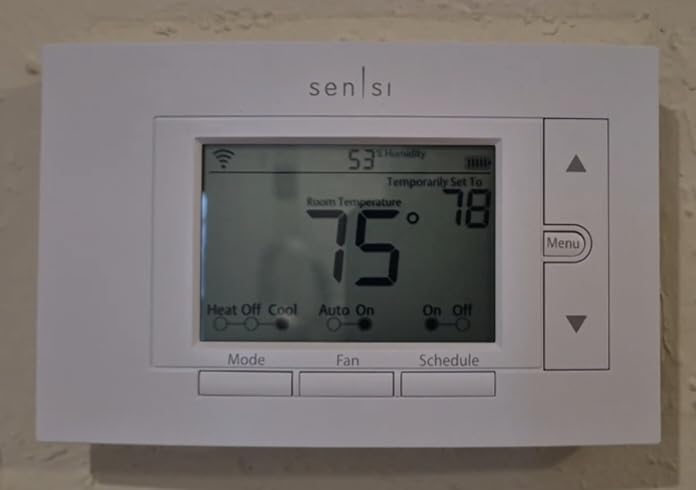
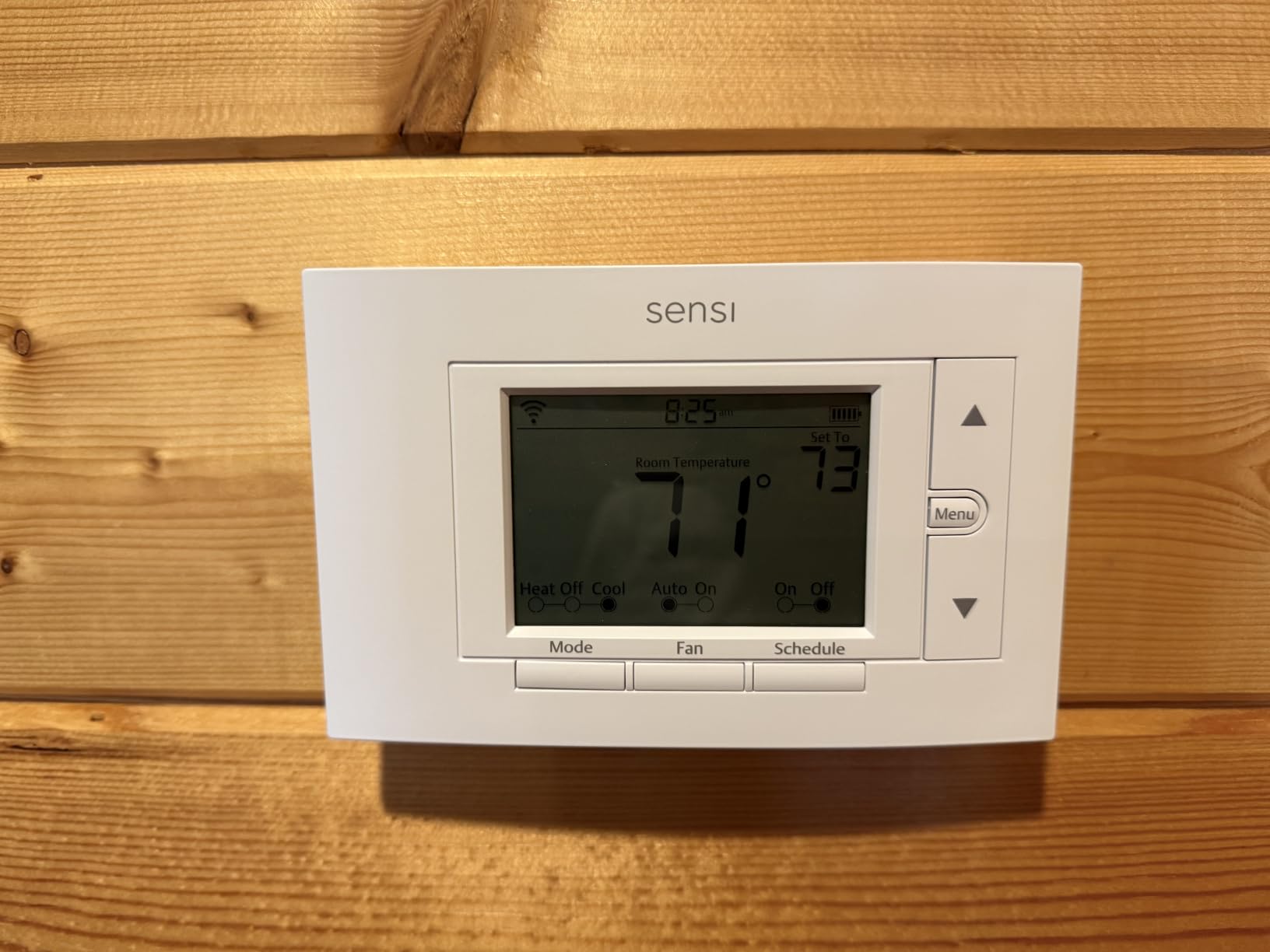
There is no color screen and no touchscreen. You get buttons and an LED readout, and for a thermostat mounted in a hallway that is not a downgrade. It is a non-event.
The scheduling app is the part that genuinely surprised us. Most thermostat apps give you one schedule plus a separate holiday schedule, and if you work a non standard week you are stuck duplicating everything.
Sensi lets you copy a day set and swap individual days, so a rotating shift pattern takes a minute instead of an hour. It also displays humidity on the unit itself, which matters in humid regions where a heat pump is doing a lot of dehumidification work.
There is a real trade-off in the C-wire-free mode. Because the unit is stealing power from the heating circuit rather than a transformer, there is a 20-25 second delay between changing the setpoint and the equipment actually firing. In daily living you stop noticing it, but in shoulder season when you are running a tight humidity setpoint it can feel sluggish.
The two limitations worth knowing before you buy. The smart alert thresholds for high and low temperature and humidity are fixed rather than adjustable, so this is not the right unit for monitoring a rental or a vacation home where you want to define your own alarm levels. Wi-Fi registration also occasionally fails, and support troubleshooting can take a while to sort out router settings.
How it handles heat pump staging and backup heat
Heat pump is a listed supported system type, and the app walkthrough covers the reversing valve wire on O or B along with the heat and cool calls. That matters because the most common wiring error on a heat pump install is treating the reversing valve wire like a standard furnace wire.
Because the ST55 runs on batteries in most installations, its scheduling runs locally rather than being pushed from the cloud. If your router reboots, your schedule is still in the box.
That is a meaningful difference from cloud-dependent units when you are relying on the thermostat to hold temperature overnight.
Where it falls short for heat pump owners
The button interface means there is no on-screen indicator of which stage is currently running or whether the backup strips are active.
With a heat pump you often want to know that the compressor is carrying the house and the strips are not. The ST75 solves that visually with its color display while the ST55 does not.
It is also the model to skip if you care about room-level control. There is no display or hub for optional room sensors in the ST55 configuration we reviewed.
If you have a two-story house where the upstairs runs warm, you will need a different unit or a different strategy.
2. Sensi Touch Smart Thermostat ST75 – Highest Rated Heat Pump Thermostat in the Group
Sensi Touch Smart Thermostat by Emerson with Touchscreen Color Display, Programmable, Wi-Fi, Mobile App, Easy DIY, Data Privacy, Works with Alexa, Energy Star Certified, ST75 – Black, C-Wire Required
C-wire required for all functions
LCD color touchscreen
Heat pump furnace boiler and air conditioner support
3 year warranty
Pros
- Highest average rating at 4.5 across 14214 reviews
- Color display turns orange for heat and blue for cool
- Touchscreen can be locked against children
- Wire-ID stickers and built-in level on the back frame
- Installers report consistent reliability across brands
Cons
- C-wire required with no battery fallback
- 2.4 GHz only pairing can fail on mesh routers
- App registration limited to US and Canada
- Some buyers want a refreshed app interface
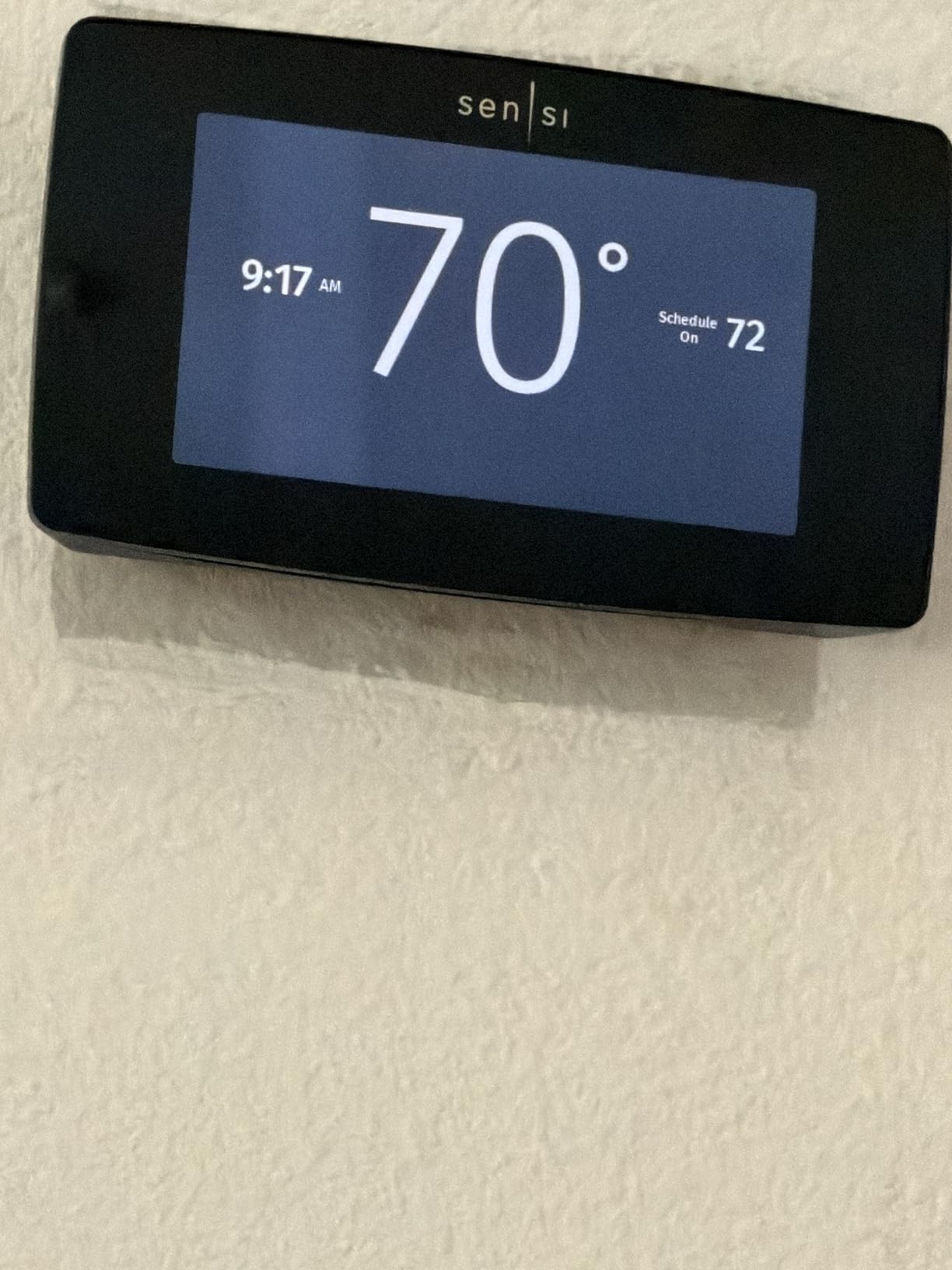
At 4.5 stars across more than 14000 reviews, the ST75 has the highest average rating of anything we tested. It also does something for heat pump owners that almost no thermostat in this price range does: the display background turns orange when the system is heating and blue when it is cooling.
On a two-stage system that is a genuine diagnostic tool. If you see orange when you expected the compressor to be carrying the whole house, that is your first clue that backup strips are running.
The install experience is close to the ST55. Same back plate level, same app-driven terminal labeling with wire-ID stickers, same general flow. The difference is power.
This one requires a C-wire for all functions and has no battery fallback, so if your system does not have a common wire you are installing a transformer or pulling a new wire before you start.
Either way, confirm whether your equipment uses O or B to call for heat before you power it up. Getting that wrong is the mistake that makes a thermostat swap look like a broken heat pump.
The touchscreen can be locked, which sounds like a small feature until you have a five year old who discovers it.
Heat pumps run longer and harder than furnaces, so a kid toggling the setpoint during a cold snap is a real comfort and cost issue. Locking the display removes that variable entirely.
It is also the model in this group that installers mention most warmly for pairing reliability. Multiple professional reviews call out that it connects to Alexa far more readily than competing Honeywell units, which matters when your thermostat is your main control point.
The one setup problem worth flagging is Wi-Fi. This unit is 2.4 GHz only, and if your router runs a combined smart mode or a mesh network that steers phones to 5 GHz, pairing can be genuinely frustrating. Check your router before you buy, not after.
What you gain with a color display on a heat pump
System state is the thing most people want to see and almost never get. On a heat pump, the difference between the compressor running and the backup strips running is roughly three to five times the hourly cost of heat. A thermostat that tells you which one is active, in a color you can read from across a room, turns an invisible cost into something you can manage.
The ST75 also lists heat pumps, furnaces, boilers and air conditioners as supported uses, which means it covers the case where you change equipment later. Three year warranty, ENERGY STAR certified, and roughly 23 percent claimed HVAC energy savings.
Those savings come from flexible scheduling and usage reports rather than any heat pump specific algorithm.
Where it falls short for heat pump owners
The C-wire requirement is the dealbreaker for older homes. If your wiring is pre-1990s and you do not already have a common wire at the thermostat, this becomes a professional job.
The C-wire-free option in this roundup is the ST55 in position one. It also does not include any room sensor hardware, and the app has a few features that reviewers describe as dated.
Registration and scheduling are limited to the US and Canada, so this is not a unit for an overseas installation.
3. Google Nest Thermostat – Best Value Heat Pump Thermostat for Battery-Powered Installs
Google Nest Thermostat – Smart Thermostat for Home – Programmable Wifi Thermostat – Snow
Battery powered with two AAA included
Heat pump listed as the supported system
24V systems
Round rotating bezel design
Pros
- Works without a C-wire in most homes
- Occupancy based Eco setback produces real savings
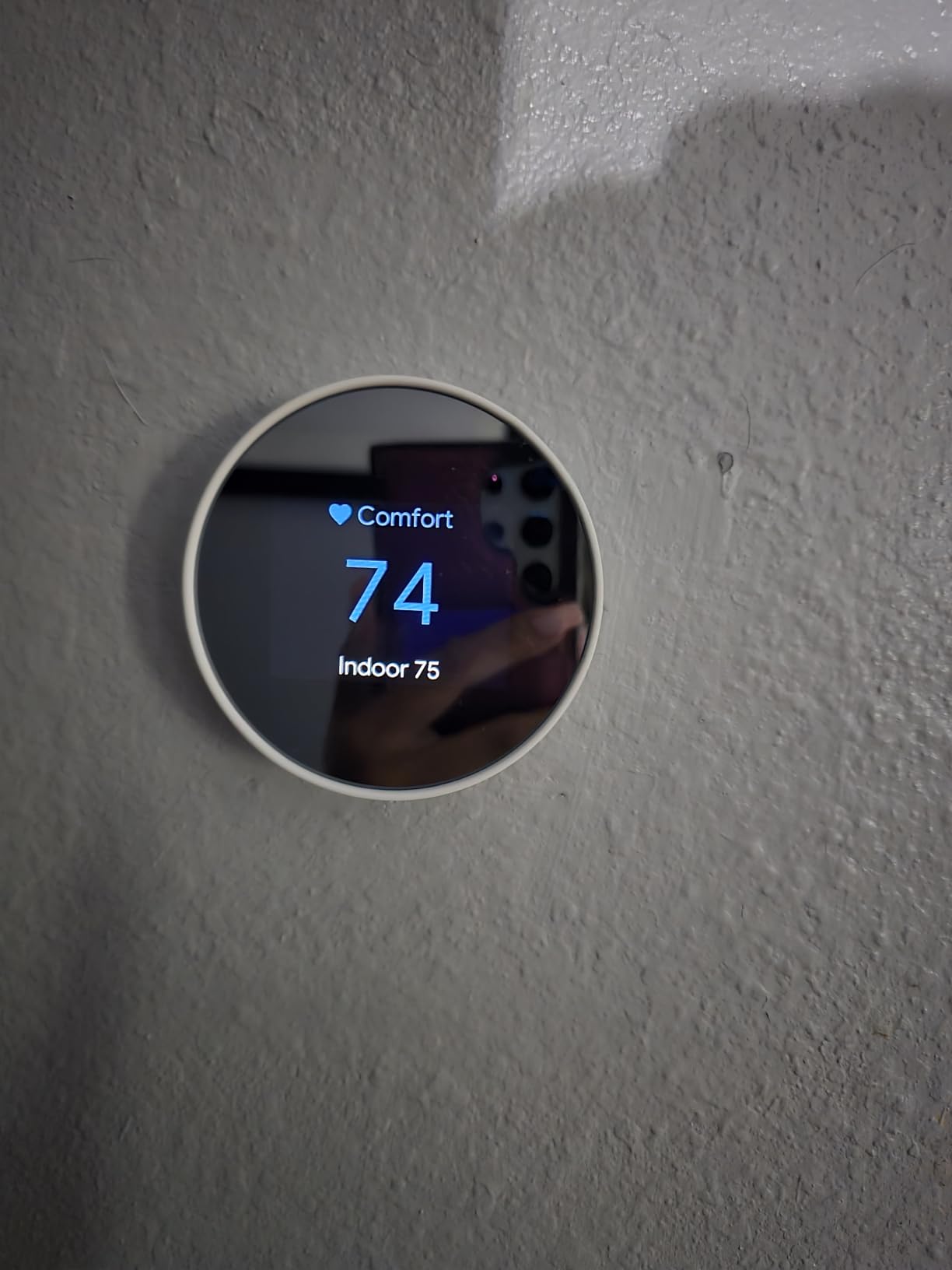
- Readable round display with a simple bezel interface
- Savings Finder and monthly energy reports
- HVAC monitoring alerts on unhealthy equipment
Cons
- Swipe and turn interface frustrates less technical users
- Only one home and location per account works reliably
- Older units cannot pair with newer Nest sensors
- App performance is poor when the unit drops offline
- Registration limited to US and Canada
The base Google Nest Thermostat is the simplest way to get onto a heat pump with minimal wiring, and it is the only unit here whose listed system type is simply heat pump. It runs on two AAA batteries and is designed to work without a C-wire in most homes.
The catch is in the fine print, and you should read it. Heating-only, cooling-only, zone-controlled and heat pump systems may still need a C-wire or a compatible power accessory.
In practice that means many heat pump installs are fine and some are not. Ours worked without a C-wire.
If your system has zone control or multiple stages wired to a panel, assume you need the power accessory.
Once the learning behavior settles, the savings are real. The occupancy sensor drops the setpoint when nobody is home, and the learning schedule figures out your week on its own. Savings Finder suggests specific schedule edits, and the monthly energy report shows whether they worked.
HVAC monitoring sends an alert when your heating or cooling system looks unhealthy. On a heat pump that is genuinely useful, because compressor problems often show up as a runtime pattern before anything visibly breaks.

It is also the broadest compatibility story on the smart home side here. It works with Google Assistant, Alexa, and Matter certified voice assistants.
That means you are not locking into a single ecosystem the way you are with some brands.
The 4.1 rating is the lowest in this group and it is worth understanding why. The rotating bezel interface is genuinely confusing for anyone who expects buttons. Homeowners who are used to turning a dial have to learn a swipe, and the printed instructions in the box are minimal enough that several owners describe falling back on video guides or calling a professional.
Why heat pump compatibility here is conditional
The single most important line in the product documentation is that heat pump systems may need a C-wire or power accessory. That is not boilerplate. Zone-controlled and multi-stage heat pumps draw more at the thermostat than the unit can scavenge.
In practice the installation either succeeds quietly or leaves you troubleshooting a dead display.
If your heat pump is a simple single-stage system on a conventional 24V control board with no zoning, this is one of the easiest swaps in the roundup.
If you have zoning, start with the power accessory question, not the thermostat.
Where it falls short for heat pump owners
The account limitation is the one that generates the most complaints. Only one home and one thermostat location can be managed reliably per account.
Adding a second user or a second property triggers errors that often end in a factory reset, which makes this a poor choice for a rental portfolio or a vacation home.
Older generation units also cannot pair with newer Nest Temperature Sensors. And when the unit goes offline, app performance degrades badly enough that some owners report physically removing the display from the wall and re-adding it.
For a heat pump in a climate where you cannot afford a night of lost heating control, that is a real risk.
4. ecobee Smart Thermostat Enhanced – Best Heat Pump Thermostat for Apple Homes
ecobee Smart Thermostat Enhanced, Programmable Wifi Thermostat
24V systems
Power Extender Kit and trim kit included
Compatible with 90 percent of HVAC systems
3 year warranty
Pros
- Power Extender Kit included so no C-wire install is straightforward
- Built-in occupancy sensing preheats before you arrive
- Works with Apple HomeKit Alexa Google Assistant and SmartThings
- Compatible with 90 percent of HVAC systems including heat pumps
- eco+ uses routine weather and grid activity
Cons
- SmartSensors sold separately
- Learning period before schedules match your routine
- Higher price than entry level Sensi and Honeywell models
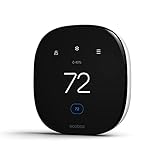
The Enhanced is the ecobee model to buy if you want the ecobee software without paying for the speaker and air quality hardware in the Premium. The core experience is identical: built-in occupancy sensing, eco+, and the same app.
It is listed as compatible with 90 percent of HVAC systems. Heat pumps, furnaces, boilers, air conditioners and humidifiers are all named as supported uses.
The box includes the Power Extender Kit and a trim kit. That single detail matters more than any software feature if your home predates common wiring, because it means the no-C-wire install is a ten minute job rather than a call to an electrician.
Both ecobee units in this roundup ship with it. It is the main reason ecobee keeps showing up as the recommendation in heating help forums.
Built-in occupancy sensing is what separates it from the schedule-only competitors. The unit watches for you leaving and returning, then preheats or precools the house so it is comfortable when you walk in, using the recovery time your heat pump actually needs rather than a fixed ramp.
That is a better match for compressor equipment than guessing at a lead time in a schedule.
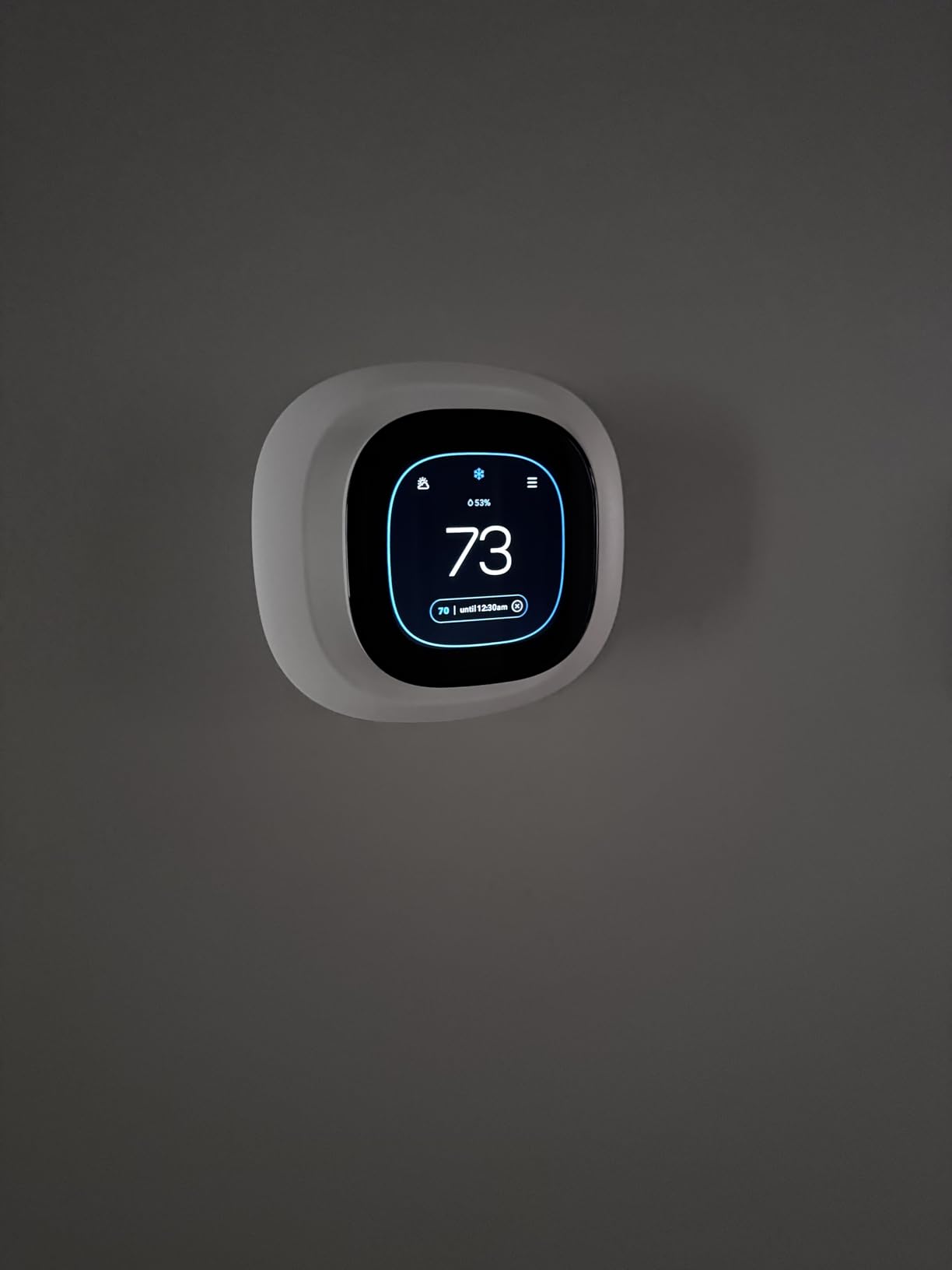
eco+ goes a step further by factoring in your routine, your comfort preferences, local weather and grid activity. On a heat pump, grid activity and local weather are not vanity features.
They are the inputs that determine whether the compressor or the strips carry the load. Using them to pick a setpoint is the closest thing to balance point logic in a consumer thermostat.
It is also the only thermostat here with full Apple HomeKit support alongside Amazon Alexa, Google Assistant and SmartThings.
If you run HomeKit and want your heat pump on the same automations as your lights and locks, this is the unit to buy.
What the Power Extender Kit solves on a heat pump install
A Power Extender Kit is a small adapter that lets the thermostat power itself from the existing heating circuit when there is no common wire. On a heat pump this is particularly welcome, because many of these homes also have a fairly long wire run from the outdoor unit.
Pulling new low voltage wire through finished walls is the expensive part of a thermostat swap.
You still need to confirm the O or B reversing valve wiring during install. You also need to identify whether your system is single or two stage. The kit solves power, not configuration.
But it removes the single most common reason homeowners give for never upgrading.
Where it falls short for heat pump owners
SmartSensors are sold separately. If you have the classic heat pump problem of one warm room and one cold room, you are buying hardware on top of the thermostat.
The Premium in position seven includes one. There is also a learning period of a few weeks before the schedules settle, and the price sits above the entry level Sensi and Honeywell units in this roundup.
Both are reasonable trade-offs for the install kit and the occupancy sensing, but they are real costs.
5. Honeywell Lyric T6 Pro TH6220WF2006 – Best Heat Pump Thermostat for Two-Stage Systems
Honeywell TH6220WF2006/U Lyric T6 Pro Wi-Fi Programmable Thermostat with Stages Up to 2 Heat/1 Cool Heat Pump or 2 Heat/2 Cool Conventional
Up to two heat stages and one cool stage for heat pumps
Up to two heat stages and two cool stages for conventional systems
2 AA battery operation
Wi-Fi programmable
Pros
- Explicitly rated for heat pumps up to 2 heat and 1 cool stage
- Also supports conventional 2 heat and 2 cool staging
- Long established Wi-Fi programmable design
- Compact 5 by 2.3 by 6 inch body fits a standard wall opening
Cons
- Older style interface with no touchscreen or color display
- Requires two AA batteries
- Limited smart feature set compared with newer models
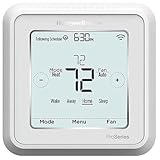
This is the most explicitly heat pump specific thermostat in the entire roundup. The product is built around staging, not around a generic smart home pitch. For heat pump systems it supports up to two heat stages and one cool stage. For conventional systems it supports up to two heat and two cool.
If you have a two-stage compressor, that is the exact match, and there is no guessing involved.
That distinction carries more weight than it used to. Variable speed compressors were once the reason people bought manufacturer factory thermostats, and the common workaround was to run a basic programmable unit that the equipment could not fully talk to.
A thermostat explicitly rated for two stage heat pump staging is one of the few ways around that without going back to a proprietary control.
The Lyric line has been in the field since 2016, which means there is a large body of installers who have already configured it on heat pump systems.
For a two-stage setup in a cold climate, that install history is worth something.
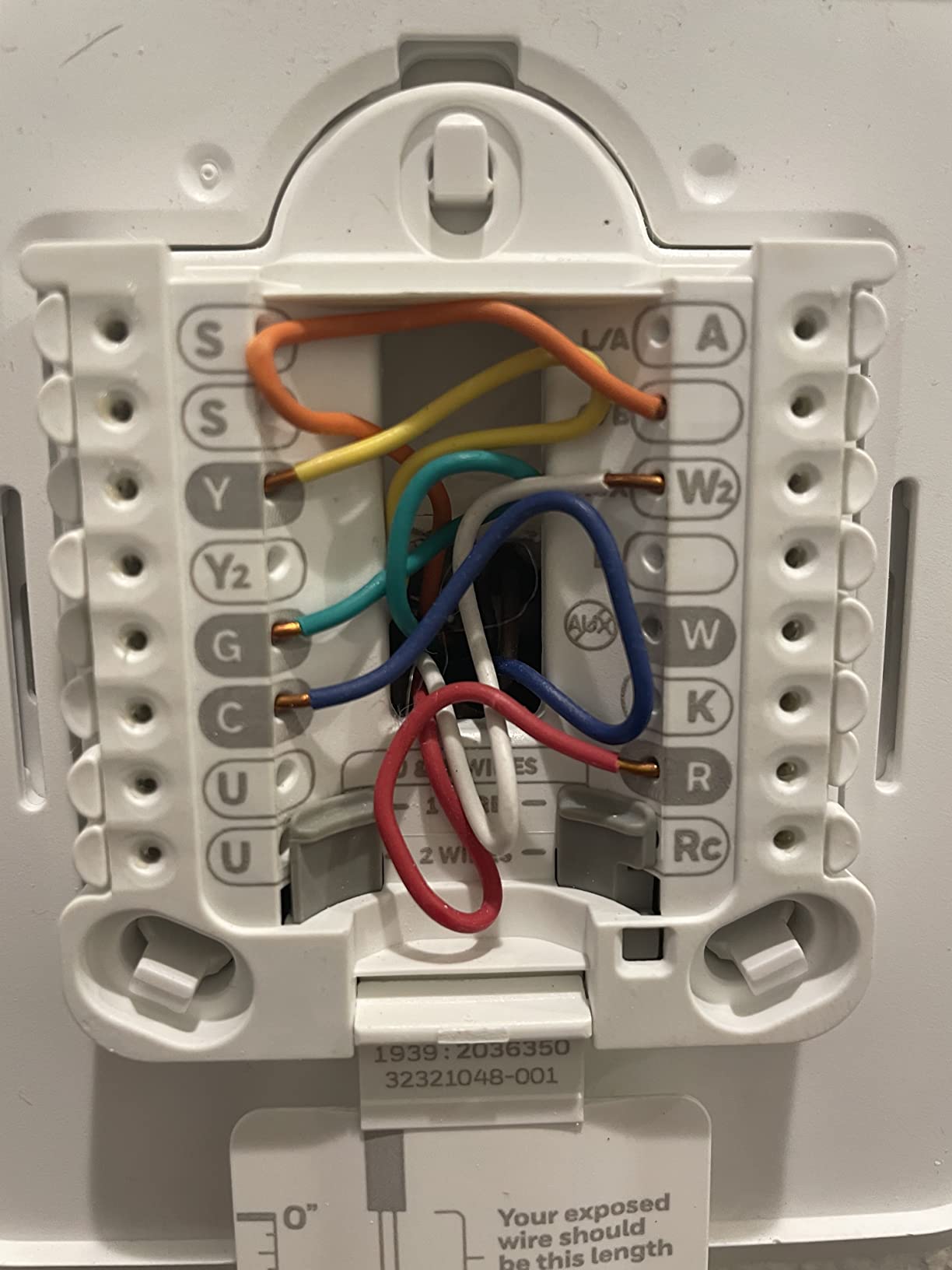
It runs on two AA batteries and connects over Wi-Fi for scheduling and remote access. It is a small unit, 5 by 2.3 by 6 inches, and it fits the standard wall opening without any modification.
What you give up is the modern interface. There is no touchscreen and no color display. The review consensus is straightforward: the hardware does its job correctly on multi-stage heat pumps and conventional systems, and the interface is dated compared with everything else at a similar tier.
That is not necessarily a problem. If the thermostat lives in a hallway and you adjust it twice a week, a dated interface costs you nothing.
If you are the kind of homeowner who checks the app constantly to see whether the heat pump is running, this is the wrong unit for that habit.
Why staging support is the feature to check first
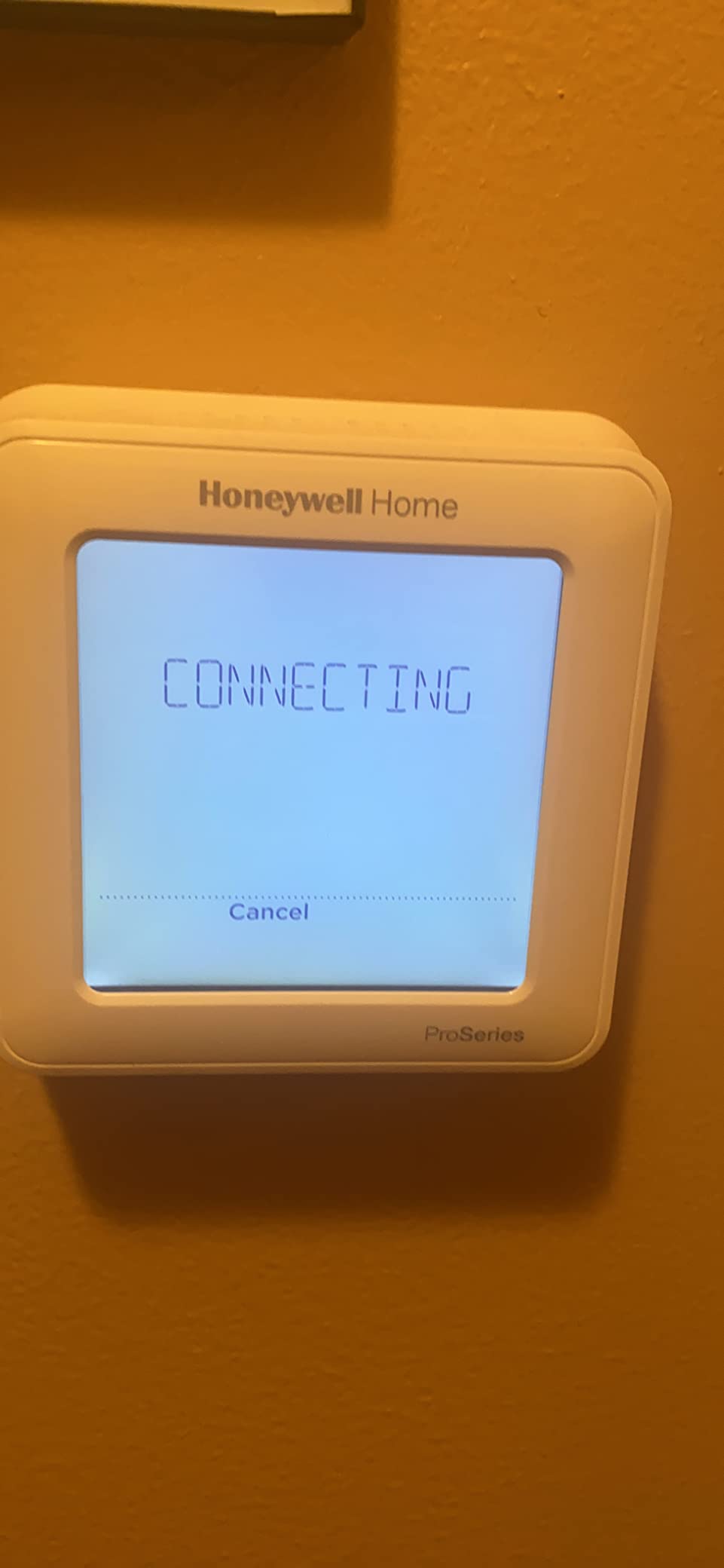
When a two-stage heat pump is undersized for a design day or when the house has high heat loss, the second stage of compressor output is what closes the gap. If the thermostat only speaks one stage, the system has to fall back to backup strips to make up the difference.
Your bills then look like a heat pump install that failed, even though the equipment is performing exactly as designed.
Confirming staging capacity on the thermostat before you buy is the cheapest insurance in this whole guide.
Match the number of heat stages your thermostat supports to the number your equipment actually runs.
Where it falls short for heat pump owners
The feature set is thin next to the ecobee and Nest units. There is no built-in occupancy detection, no room sensor support described in the product details, and no air quality monitoring.
You are buying a scheduler with excellent staging, not a smart home hub.
Battery operation means the schedule runs locally, which we consider a plus in cold climates. But it also means the two AA batteries are your only power source, and there is no visual state indicator when the second stage or the backup strips engages.
6. Google Nest Learning Thermostat 4th Gen – Best Heat Pump Thermostat with an Included Room Sensor
Google Nest Learning Thermostat (4th gen) + Nest Temperature Sensor (2nd gen) – Obsidian
24V systems with no C wire needed in most homes
Adjustable maintenance band
Nest Temperature Sensor 2nd gen included
Battery powered with one CR2
Pros
- Included second generation temperature sensor balances uneven rooms
- Adjustable maintenance band helps reduce compressor short cycling
- Large bright display readable across the room
- Works with most 24V systems including heat pumps
- Google Home app manages temperatures schedules and sensors
Cons
- Setup app can report a false no power error on R wires
- Backplate is not compatible with 3rd generation Nest mounts
- Adaptive Eco can drop setpoints lower than you want
- Not ENERGY STAR rated so many rebates do not apply
- Highest price per unit in the roundup
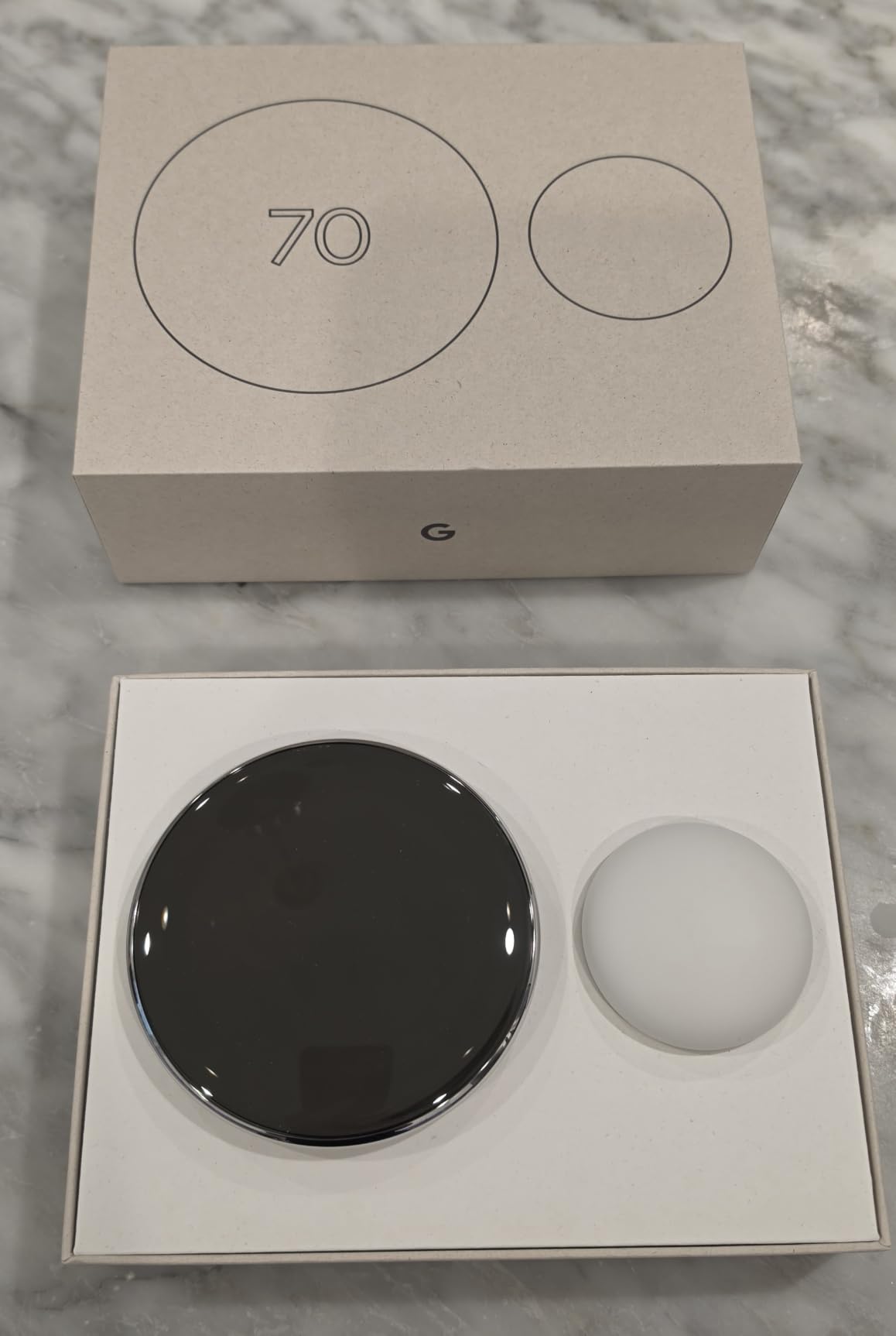
This bundle pairs the fourth generation Learning Thermostat with a second generation Nest Temperature Sensor, and that sensor is the reason to consider it on a heat pump. Heat pumps move air differently from furnaces, and the room with the wall thermostat is often not the room you actually live in.
The sensor lets you tell the system which room matters and shift heating priority toward it.
The genuinely heat pump aware feature here is the adjustable maintenance band. Owners report that being able to widen the band helps reduce short cycling of the compressor in heat pump mode.
That is one of the few direct answers to a very common complaint we found: thermostats cycling a compressor too fast. If your heat pump is running in short bursts and never catching up, this is the setting to look at first.
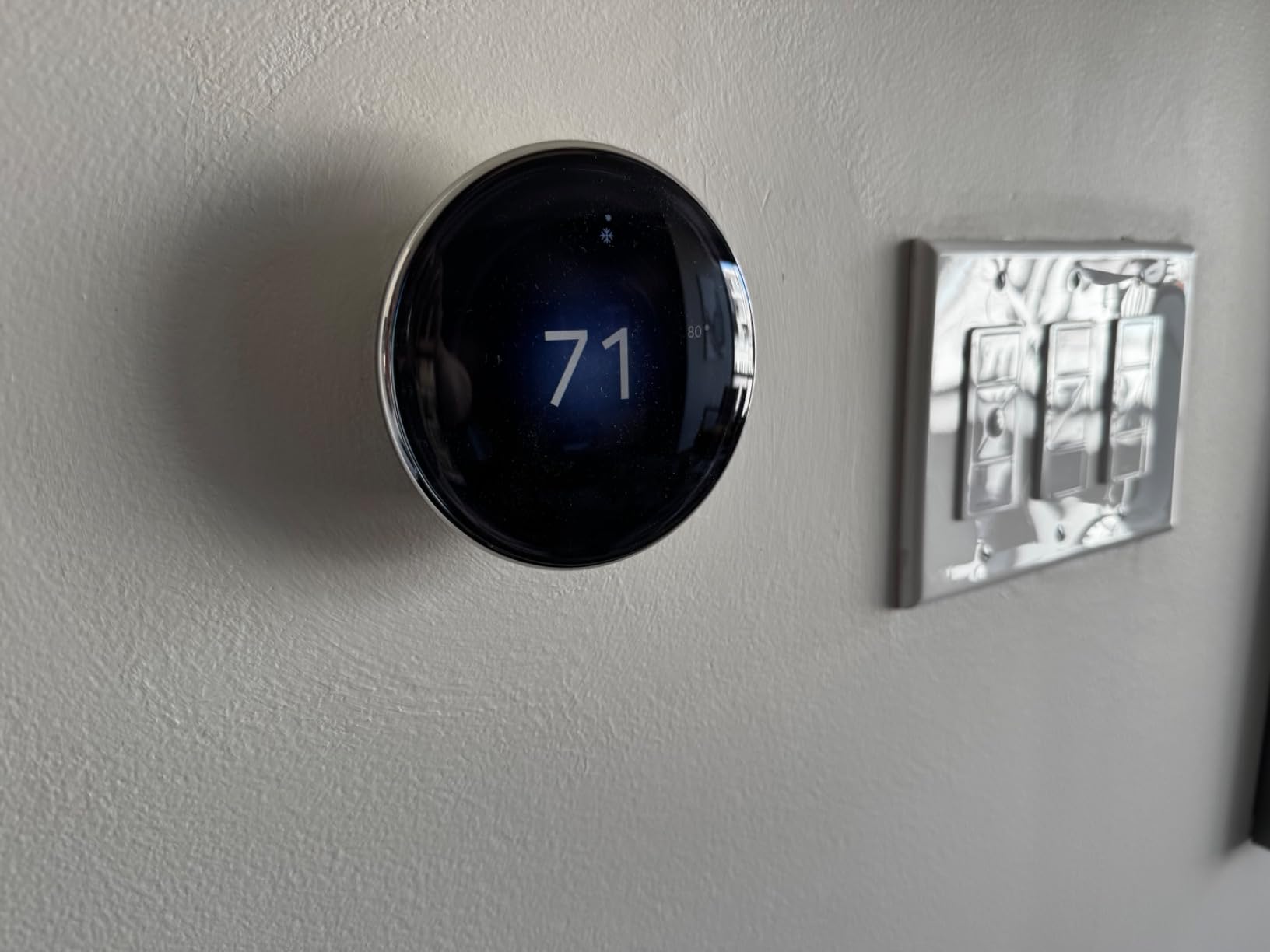
The display is the nicest in the roundup. It is 60 percent larger than the previous generation, uses Dynamic Farsight to stay readable across a room, and adjusts brightness automatically.
The aluminum body feels a category above the plastic units here.
Natural heating and cooling is a newer feature that learns how outside temperature affects inside temperature and pauses the system accordingly. That is a rough version of outdoor temperature compensation, and for heat pump owners it is the closest thing to balance point logic on a Google unit.
Adaptive Eco finds an energy saving setpoint while you are away and returns within an hour.
Voice control works with Alexa, Siri and Google Assistant, and the unit is Matter compatible.
Registration and scheduling are limited to the US and Canada.
The maintenance band and compressor short cycling
Short cycling is a compressor killer and a comfort problem. When the thermostat calls for heat, the compressor starts, warms the house quickly near the register, then overshoots and shuts down before the cycle settles.
The house drops, the thermostat calls again, and you get a heat pump that runs constantly and still feels uneven.
A wider maintenance band gives the cycle more room to finish. On a heat pump that is a real energy and equipment-life setting rather than a comfort preference, and it is adjustable on this unit.
If short cycling is your problem, this is one of the two models here that gives you a dial for it.
Where it falls short for heat pump owners
There is a documented setup failure on 24V systems without a C-wire where the app reports a false no power error on R wires. That can block a no-C-wire install entirely even when the wiring is fine.
Some installers also report accuracy complaints and persistent E294 error codes. Test this before you commit.
The backplate and wiring connector are not compatible with third generation Nest mounts, so swapping in place requires rewiring work rather than a mount reuse. Adaptive Eco can also drop the temperature lower than you want and takes months of learning to tune.
It is also not ENERGY STAR rated, which quietly removes it from many utility rebate programs that require certification.
7. ecobee Smart Thermostat Premium – Best Premium Heat Pump Thermostat with Everything Included
ecobee Smart Thermostat Premium – WiFi, Siri & Alexa Built-In, Smart Sensor
Wi-Fi and Bluetooth
Compatible with 95 percent of HVAC systems
Power Extender Kit and trim kit included
SmartSensor included
3 year warranty
Pros
- SmartSensor included so comfort follows the rooms you use
- Power Extender Kit and trim kit in the box
- Built-in air quality monitor with filter reminders
- Built-in smart speaker streams music and podcasts
- Radar occupancy sensor preheats ahead of arrival
- Largest compatibility claim in the group at 95 percent
Cons
- Video and two way talk need an ecobee doorbell camera
- Siri needs an Apple home hub
- Listening features need a paid Smart Security subscription
- Most expensive unit in the roundup
The Premium is the most complete box in this roundup. You get the SmartSensor, the Power Extender Kit and the trim kit, and ecobee claims compatibility with 95 percent of HVAC systems.
Named supported uses include air conditioners, boilers, dehumidifiers, electric baseboard heaters, furnaces, heat pumps and humidifiers. That humidifier and dehumidifier support is worth noting if your heat pump handles humidity control, because it is not universal across the units here.
The radar occupancy sensor is a step up from the PIR sensors used in cheaper units. It detects approach and departure through the wall with more nuance, so it can begin preheating before you reach the driveway instead of after you open the door.
On a heat pump with a slow recovery time, an earlier and more accurate trigger is worth real money.
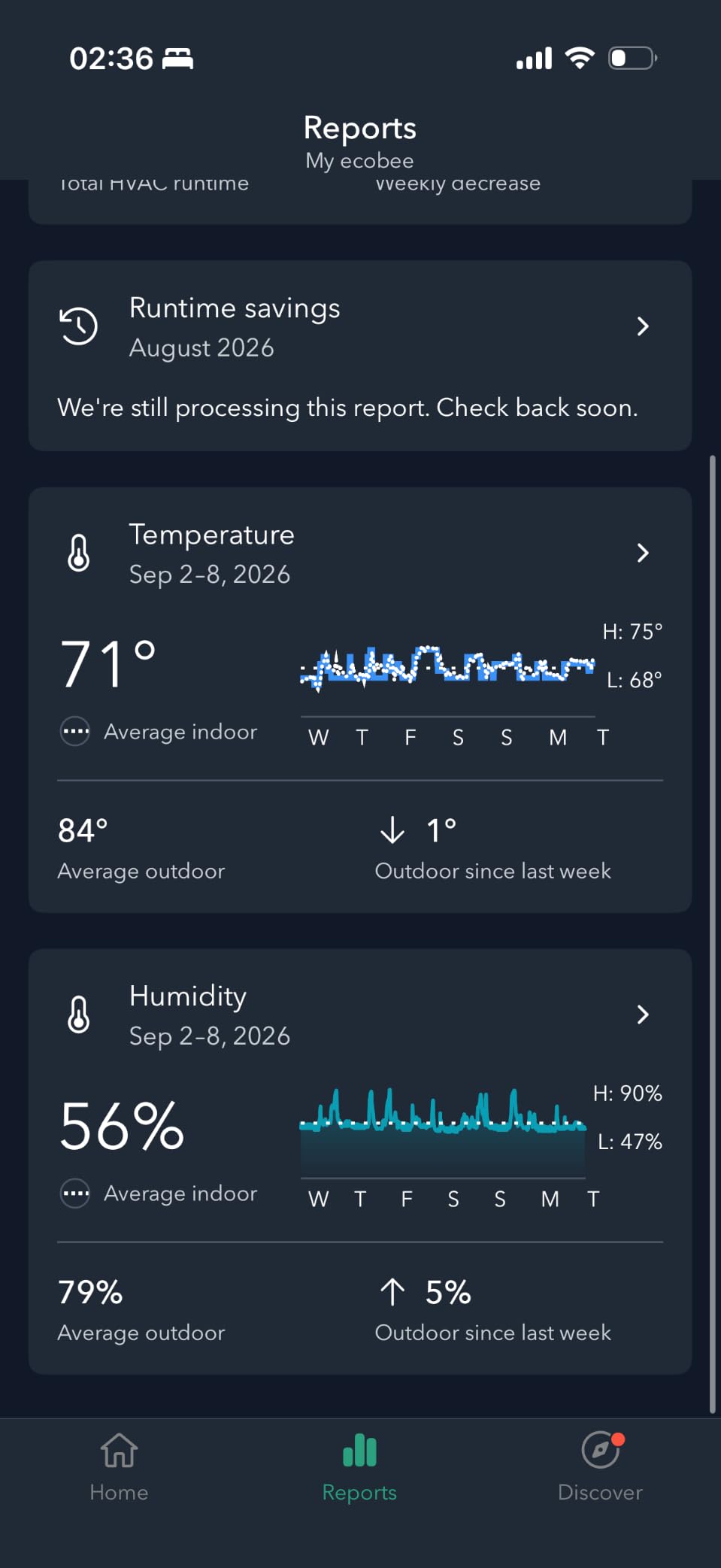
The built-in air quality monitor alerts you when air quality drops and reminds you to change the furnace filter. On a heat pump system the filter reminder is more valuable than it sounds, because a clogged filter restricts airflow across the indoor coil and tanks the efficiency that justifies the equipment in the first place.
It also has a built-in smart speaker with Alexa, and Siri works if you have an Apple home hub. It streams music and podcasts, and it can listen for smoke alarm sounds and send an alert. That is genuinely useful information coming from a device that already knows your indoor conditions.
ENERGY STAR certified, three year warranty, and the same claimed savings of up to 26 percent on heating and cooling costs. That comes from adjusting automatically when you are away or asleep.
What the bundled SmartSensor changes on a heat pump
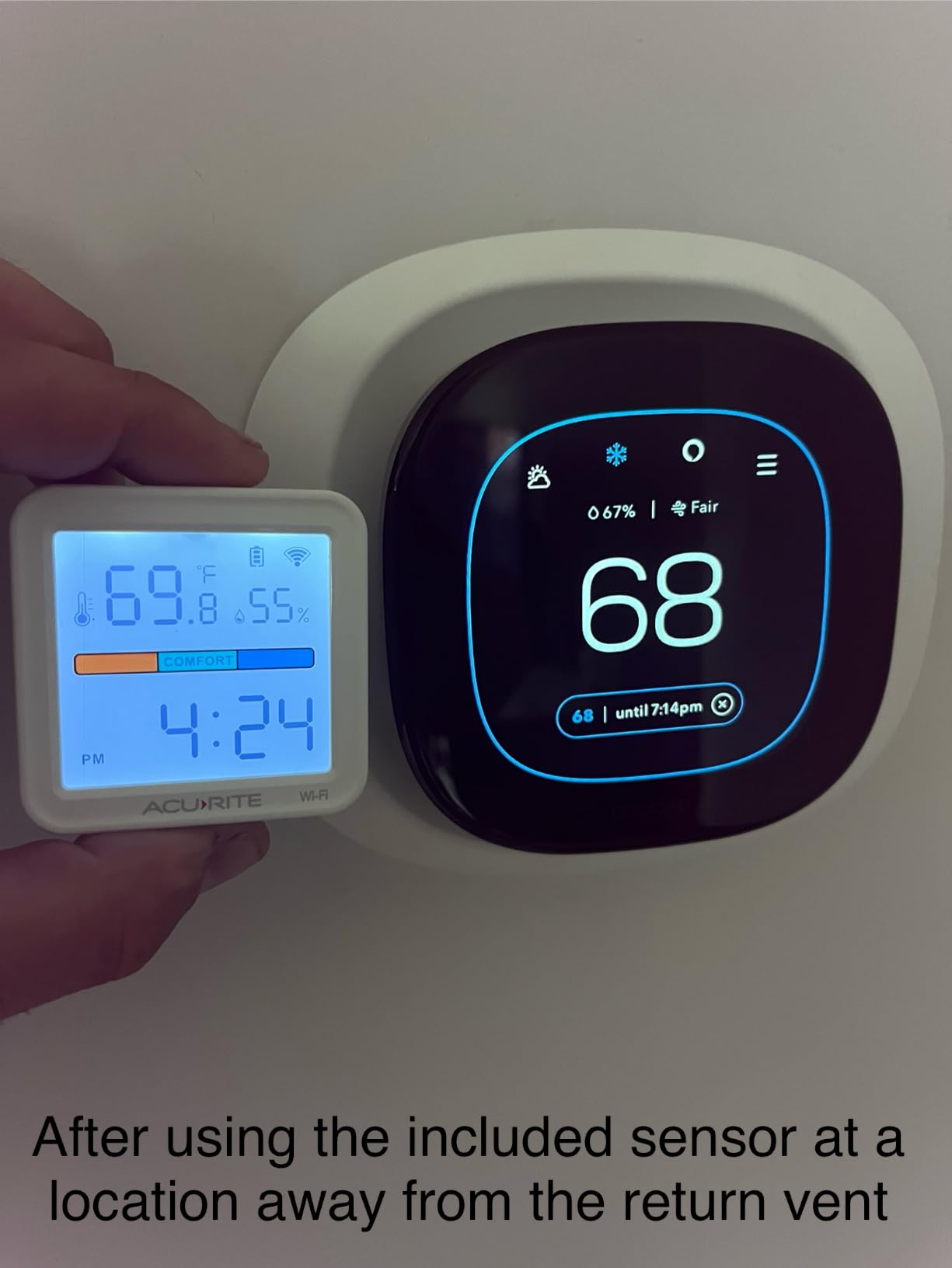
Every other room-capable thermostat in this roundup requires you to buy sensors separately. This one includes one.
For a heat pump household with a finished basement and a second floor, that is the difference between solving the hot and cold spot problem this weekend and not solving it.
The sensor matters even more with heat pumps than with furnaces because airflow distribution is not even. The condition that feels coldest is frequently the room furthest from the return, and a wall thermostat in a central hallway averages that away.
Giving the system a real reading from the room where you sleep is the single most effective comfort fix available.
Where it falls short for heat pump owners
Several headline features depend on other things you have to buy. Front door video and two way talk require an ecobee Smart Doorbell Camera. Siri requires an Apple home hub. The security related listening features sit behind a paid ecobee Smart Security subscription.
This is the most expensive unit in the roundup, and the gap between the sticker and the feature list is the widest here. Additional SmartSensors beyond the included one are sold separately.
8. Sensi Touch 2 Smart Thermostat ST76 – Best Heat Pump Thermostat for Faster Bluetooth Setup
Sensi Touch 2 Smart Thermostat Wi-Fi, Alexa, Energy Star Certified, ST76
C-wire required
24V systems
LCD touchscreen with a beveled black edge
3 year warranty
Pros
- Universal Bluetooth technology simplifies app guided setup
- Works with optional Sensi Room Sensors
- ENERGY STAR certified with roughly 23 percent claimed savings
- Supports heat pumps boilers furnaces and air conditioners
- Same privacy stance as the rest of the Sensi line
Cons
- C-wire required for operation
- Room sensors sold separately
- Lowest review count and rating in the group
The Touch 2 is a mid-tier refresh of the Sensi Touch line, and the meaningful upgrade is universal Bluetooth technology for setup. Earlier generations asked you to hold the thermostat in Wi-Fi pairing mode for an extended window.
The Touch 2 hands the connection over to Bluetooth, which makes the app-guided install noticeably less fiddly.
It supports heat pumps, boilers, furnaces and air conditioners, runs on 24V, and is ENERGY STAR certified with roughly 23 percent claimed HVAC energy savings. Three year warranty.
It works with Sensi Room Sensors if you want to balance temperatures room by room. It also shares the Sensi privacy stance of not selling personal information to third parties.
The display is an LCD touchscreen with a beveled black edge, and the box includes the installation guide, warranty booklet, thermostat, mounting hardware and the owner manual.
That is a complete package.
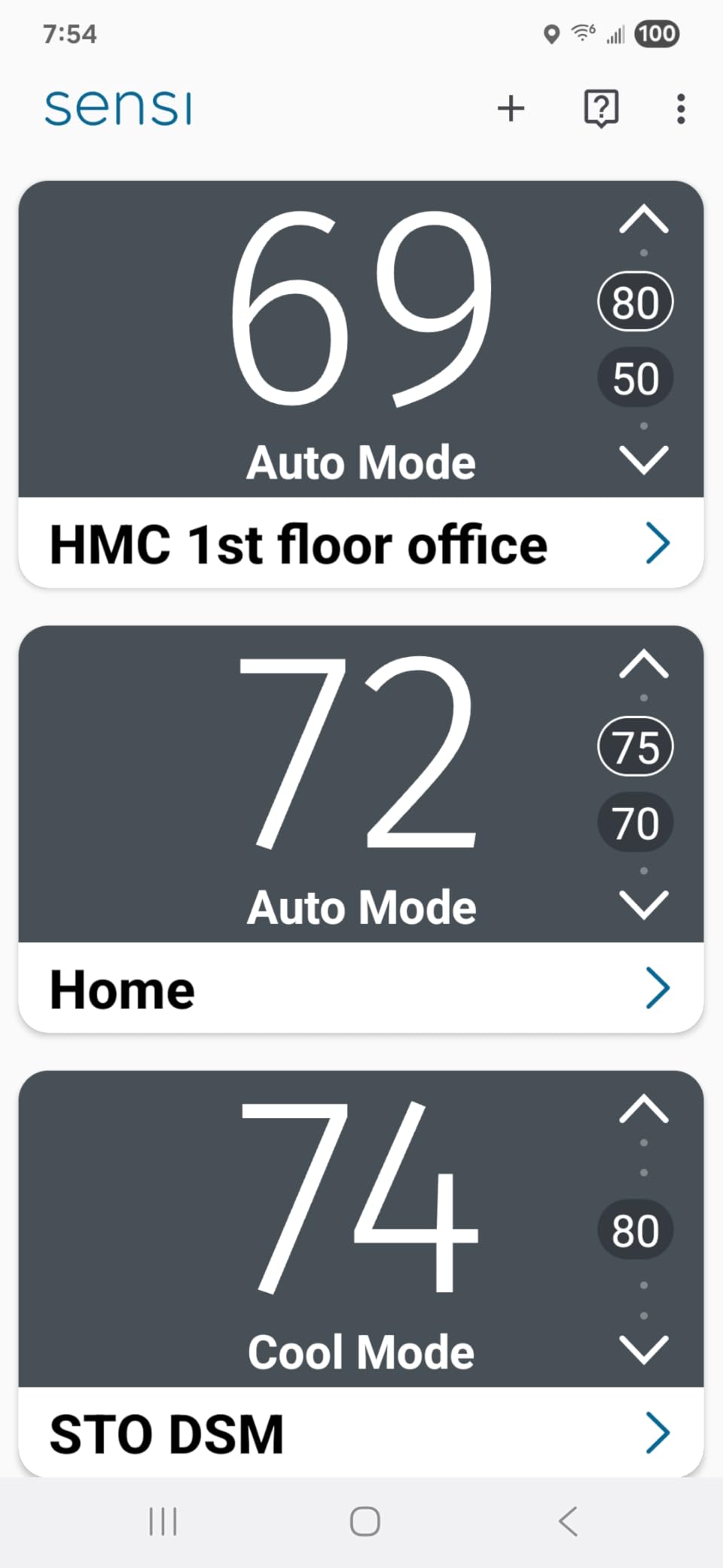
The honest framing is that this is a solid middle option rather than a standout.
Its 4.3 rating across 1252 reviews is the lowest average and the smallest sample in this roundup. That is the main reason it sits in last position despite perfectly reasonable hardware.
Reviewers consistently describe it as a good refresh of the Touch line rather than a new direction.
The complaints are about what it does not have rather than what it does wrong.
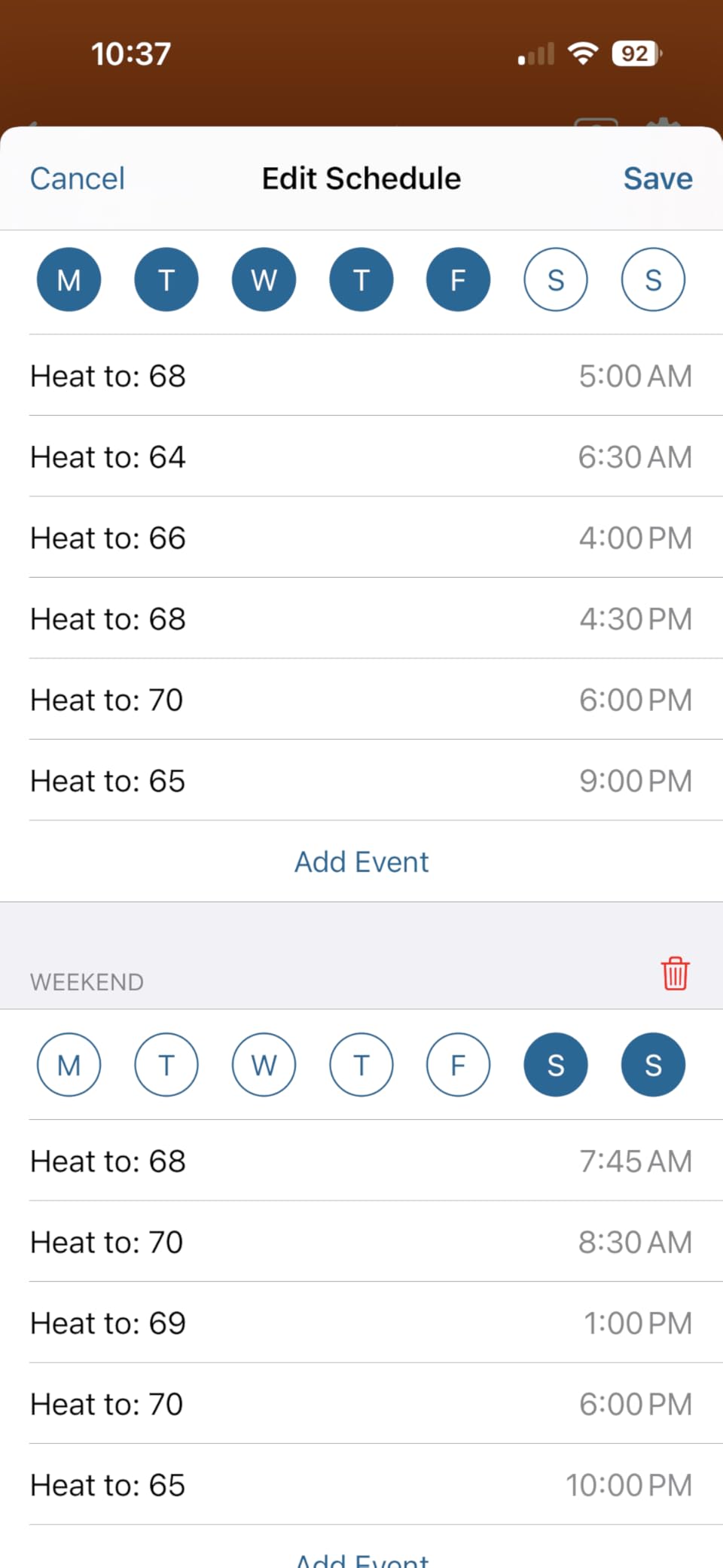
When the Bluetooth setup change actually matters
Wi-Fi pairing is where most DIY thermostat installs fail, and it fails in a frustrating way. You hold buttons, you wait, the app times out, you start over. The Touch 2 moves that fragile step off Wi-Fi and onto a short range Bluetooth link between your phone and the thermostat.
That means the slow part is done once and the credentials move over afterward.
For a heat pump install where you are also identifying the O or B reversing valve and confirming staging, fewer failure points in the pairing step is a genuine time saver. It does not remove the wiring work, but it takes one avoidable frustration off the list.
Where it falls short for heat pump owners
The C-wire is required for operation. There is no battery-free option and no Power Extender Kit in the box, so on an older home this is a wiring job first.
That puts it in the same camp as the Sensi Touch ST75 and away from the ST55.
Room sensors are sold separately, review volume is the thinnest in this group, and the average rating trails both the ST55 and the ST75.
If you want a touchscreen Sensi with the simplest setup, this is the one. If you want the best value on a heat pump, position one is the stronger recommendation.
How to Choose a Smart Thermostat for a Heat Pump System
Start with staging, because it is the one specification you cannot work around later. Write down how many heat stages your compressor runs and how many cool stages. A two-stage heat pump needs a thermostat rated for two heat stages.
The Honeywell Lyric T6 Pro in position five is the only unit here with that stated on the box, which is why it earns its badge despite an older interface.
Next, settle the power question before you shop. Find your thermostat and check whether there is a C-wire, which is usually the blue or blue and orange wire. If you have one, every unit in this roundup is available to you.
If you do not, you have three paths: buy a battery or Power Extender Kit model, install a transformer at the furnace or air handler, or pull a new wire. The ST55 and both ecobee units are the zero-extra-work choices.
Understand what you are giving up with each path. Battery-powered and Power Extender Kit installs recover power from the heating circuit, which introduces a delay of roughly 20 seconds between changing the setpoint and the equipment responding.
In daily use that is invisible. In a shoulder season when you are trying to dehumidify precisely, it is noticeable.
Identify your O/B reversing valve convention before installation day. Manufacturers disagree on whether O or B controls heat mode, and a thermostat wired to the wrong one will appear to work in cooling while doing nothing in heating.
Several units in this roundup walk you through identifying it in the app, which is genuinely helpful. Confirm which one your equipment uses anyway.
Decide how much you care about room-level control. If you have a two story home, a finished basement, or any space that runs consistently warm or cold in winter, you want sensor support.
Only the ecobee Premium includes a sensor in the box, and the Google Nest Learning bundle includes one too. The Sensi Touch 2 and the Sensi Touch ST75 support Sensi Room Sensors as add-ons, and the ecobee Enhanced supports SmartSensors as add-ons.
Look at local control. When the schedule runs on the thermostat rather than in the cloud, an internet outage stops being an HVAC event. The battery-powered units here, including the ST55 and the base Google Nest Thermostat, keep their schedules locally.
That is a genuine advantage in cold climates where you cannot afford to lose heating control because a router rebooted.
Check the ecosystem before you commit, and check it honestly. Apple HomeKit is supported on both ecobee units and on both Sensi units, and on the Nest Learning Thermostat. Matter is supported on the two Google units.
The base Google Nest Thermostat works with Google Assistant and Alexa. Pick the one that matches the system you actually run rather than the one with the longest feature list.
Look at the maintenance settings, not just the smart features. Compressor minimum runtime, defrost interaction, and a maintenance band all affect how a heat pump performs over a season.
The Nest Learning Thermostat’s adjustable maintenance band and the ecobee occupancy preheat are the two settings in this roundup with the clearest heat pump logic behind them.
Finally, check the rebate eligibility requirements of your utility before you buy. Many programs require ENERGY STAR certification, which rules out the Nest Learning Thermostat in this group.
Confirming that before purchase costs you one phone call and can change which model fits your budget.
One last piece of advice from the forums we read: ask your installer to walk through the staging configuration on the first cold morning after commissioning, while they are still on the phone.
A thermostat that is properly configured and a thermostat that is correctly configured for your outdoor temperature range are different outcomes. The second one is what keeps your backup strips from quietly running all winter.
Frequently Asked Questions
Can you put a smart thermostat on a heat pump?
Yes. All eight thermostats in this roundup are rated for heat pump systems. The important difference is staging support. For a two-stage heat pump, choose a unit rated for two heat stages, such as the Honeywell Lyric T6 Pro. For a single-stage system, any of these models will control the compressor and the reversing valve correctly. Check whether your system needs a C-wire before you buy, because heat pump and zone-controlled installations often draw more power at the thermostat than the unit can supply on its own.
Why do HVAC pros push back on the Google Nest thermostat for heat pumps?
The criticism usually comes down to three things. The setup documentation is thin, so installers spend more time troubleshooting. The rotating ring interface is unfamiliar to customers who expect buttons, which generates service calls that are not hardware faults. And on multi-zone systems, the account and location limits have caused real problems. The thermostat itself works fine on a straightforward single-stage heat pump, which is why it still scores well overall.
Is ecobee or Nest better for a heat pump system?
ecobee is the stronger choice for heat pump installations because both models ship with a Power Extender Kit, are rated for 90 and 95 percent of HVAC systems, and pair with Apple HomeKit, Alexa, Google Assistant and SmartThings. Nest is the stronger choice if your priority is a clean no-C-wire install and a low learning curve, though the fourth generation Learning Thermostat is not ENERGY STAR rated, which limits rebate eligibility.
Is Sensi better than Honeywell for a heat pump?
It depends on your staging needs. Honeywell Lyric T6 Pro is explicitly rated for up to two heat stages and one cool stage on heat pumps, which makes it the clearest choice for two-stage equipment. Sensi models are rated for heat pumps generally and offer better app scheduling and a better interface. Choose Honeywell for staging certainty, and Sensi when app control and installation ease matter more to you.
Do I need a special thermostat if I have a heat pump?
You need a thermostat with heat pump capability, which means one that handles the reversing valve on the O or B wire and supports your number of stages. A standard furnace thermostat will not control a heat pump correctly. You do not need a manufacturer proprietary unit unless your equipment is a communicating system that requires it, but you do need to confirm stage count and C-wire availability before purchasing.
Do I need a C-wire to install a smart thermostat on a heat pump?
Often you do not. The Sensi ST55 and the base Google Nest Thermostat are designed to work without a common wire in most homes, and both ecobee models include a Power Extender Kit that adapts a no-C-wire install. However, heating-only, cooling-only, zone-controlled and multi-stage heat pump systems may still need a C-wire or a compatible power accessory, so check your wiring before buying.
The Best Smart Thermostat for Your Heat Pump
For most heat pump households in 2026, the Sensi Smart Thermostat ST55 is the right pick.
It carries the strongest combination of rating and review volume in this group, installs without a C-wire in most homes, and lists heat pumps as a supported system.
If you want a color display that shows whether the compressor or your backup strips are carrying the house, move up to the Sensi Touch ST75, provided you have a common wire.
If rooms are running unevenly, the ecobee Premium is the only unit here that includes a sensor in the box, and the Nest Learning bundle is the alternative. For two-stage equipment with no questions asked, the Honeywell Lyric T6 Pro states its staging support outright.
Whichever one you pick, check your stage count, check your C-wire, and confirm the O versus B convention before you start.
Those three checks prevent almost every heat pump thermostat problem we read about.