
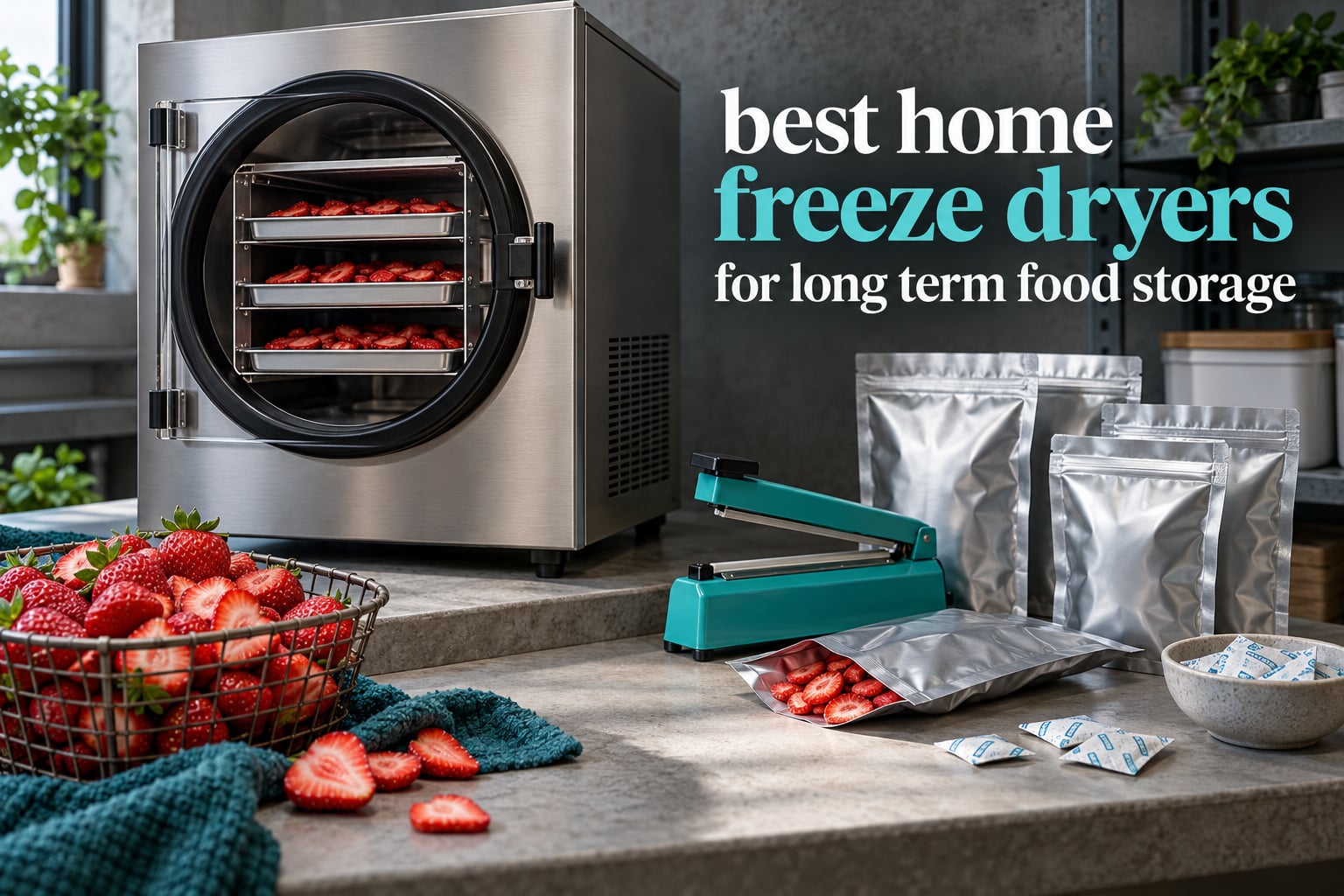
The VEVOR HFD-4 is the best home freeze dryer for long-term food storage because it is the only machine in this group with a real base of owner reviews, it processes 8.8 to 13.2 pounds per batch on four stainless steel trays, and it runs at 60 dB or below. That combination of proven performance, batch size and published noise data is what you want before you commit a basement wall to a machine that will run for a day at a time.
Freeze drying is not a dehydrator with a marketing budget. A freeze dryer takes frozen food and pulls the ice straight to vapor under vacuum, which is why a finished strawberry weighs almost nothing and still tastes like a strawberry. For a household building a multi-year food reserve, that difference is the entire point.
Our team compared the eight home freeze dryers that carry real listings in the US market right now, and the honest headline is that this is still a thin category. Only one of these machines has more than a handful of owner reviews attached to it. Everything else is a seller specification sheet with no independent history behind it, and that is the single biggest factor to weigh before you spend.
Before the individual reviews, here are the three things that decide whether a home freeze dryer works for you:
Batch capacity in pounds. The machines here run from 5 kg per batch up to 13 lb, and the ones with larger trays take longer per cycle but let you finish a harvest in fewer days.
Power requirement. Most of these run on 110V, but the 6-tray VarmBake is 220V only and needs its own dedicated circuit, which changes where in a home you can put it.
Noise and placement. Published figures cluster around 60 to 63 dB, which is a utility room conversation, not an apartment one, and the room should stay at or below about 72F or the vacuum pump loses cooling capacity.
What follows is every machine we found, in order of how much independent evidence exists behind it, plus the storage reality that almost no roundup in this category will tell you.
Table of Contents
Top 3 Home Freeze Dryers for Long-Term Food Storage (October 2026)

VEVOR HFD-4 4-Tray
- 8.8-13.2 lbs per batch
- -35C cold trap
- 60dB or less
- Touch screen with freeze-drying curves

Blue Alpine Medium Select
- 10-15 lbs per batch
- 30 year shelf life claim
- Mylar bags and impulse sealer included
- 108 pounds

VarmBake DGM-B01
- 13 lbs per batch
- Six 304 stainless steel trays
- 3 year warranty
- 220V dedicated circuit
All 8 Home Freeze Dryers Compared Side by Side in 2026
| Product | Specs | Action |
|---|---|---|
| VEVOR HFD-4 4-Tray |
|
Check Latest Price |
| Blue Alpine Medium Select |
|
Check Latest Price |
| VarmBake DGM-B01 |
|
Check Latest Price |
 HNZXIB ZZKD FD-05H HNZXIB ZZKD FD-05H |
|
Check Latest Price |
 HNZXIB FD-05H-40 HNZXIB FD-05H-40 |
|
Check Latest Price |
 EQCOTWEA 4-Tray EQCOTWEA 4-Tray |
|
Check Latest Price |
 HQHAOTWU 110V Sublimation HQHAOTWU 110V Sublimation |
|
Check Latest Price |
 LGXEnzhuo 110V Lyophilizer LGXEnzhuo 110V Lyophilizer |
|
Check Latest Price |
1. VEVOR HFD-4 4-Tray Freeze Dryer – The Only Machine Here With Owner Proof
VEVOR Vacuum Freeze Dryer Machine, 8.8-13.2 LBS/Batch Food Freeze Drying Machine with 4-Layer Trays, Vacuum Pump, Adjustable Timer and Temperature Control, for Fruits Vegetables Meat, White
8.8-13.2 lbs per batch
4-layer 304 stainless steel trays
-35C cold trap
60dB or less
1550W on 103V
Pros
- Only machine here with a meaningful owner review base
- 8.8-13.2 lb batch on four trays
- -35C cold trap with a fast-cooling compressor
- Swivel casters on a 245.8 pound chassis
- Quiet at 60dB or less with a transparent door
Cons
- Instructions and documentation widely criticized by owners
- Some units needed oil added or adjustment out of the box
- Customer service and returns reported as slow to reach
- A visible share of one-star reviews
When we lined this one up against the rest of the category, the review data was the deciding factor rather than the specification sheet. Out of eight machines, the VEVOR HFD-4 carries 48 owner reviews averaging 3.7 stars. Everyone else has either zero or a single review, and a single review tells you nothing about whether a compressor will still hold vacuum in year three.
The machine itself is a compact 29.92 inch deep by 21.65 inch wide by 35.04 inch tall box weighing 245.8 pounds, built around four 304 stainless steel trays and a compressor that pulls the cold trap down to -35C. Buyers who have had success with it describe programming the touch screen once and then loading it without fuss for fruit, jerky and vegetables.
That 3.7 average is not a comfortable number, and we are not going to pretend otherwise. The review split is unusually wide, with roughly 54% of reviews at five stars and 22% at one star, which tells you the machine has a bimodal experience: some owners get a great unit immediately, others get a setup problem in the box.
How the 4-layer tray layout handles a real load
Four trays sounds thin next to a six-tray machine, but the stated 8.8 to 13.2 lb per batch spans the widest range of any four-tray unit here. The 6-tray VarmBake manages 13 lb on more shelves, and the HNZXIB FD-05H-40 claims 10 to 15 lb on four layers, so tray count and load weight are not the same number.
For a household drying sliced strawberries or cubed potatoes, the practical limit is tray area rather than the pound figure on the box. Overloading a tray is the most common freeze-drying mistake, because food packed too thickly freezes into a solid block and the interior never sublimates.
The touch screen with programmable temperature, freeze-drying curves and process observation is genuinely useful here. You can watch the curve and stop the cycle at the right point rather than guessing at a fixed hour count, and that is the feature that separates a machine you can learn from one you can only endure.
Where owners report problems
The documentation gap is the practical problem, not the quality problem. If you have never used a sublimation machine, the first cycle is genuinely confusing without guidance, so budget an evening with written walkthroughs before you load a tray of real food.
The compressor-arrives-without-oil reports are the reason we do not put this at the top without a caveat. Check the oil level the moment it is delivered rather than after your first batch, because a dry compressor that runs a full cycle is a warranty conversation you do not want.
Customer service being slow to reach matters more than it would on a lesser machine, because the failure mode of a freeze dryer is a vacuum leak, and diagnosing one over the phone is much harder when the seller is not responsive. Budget for a local appliance technician if you can.
2. Blue Alpine Medium Select – Packaging Kit in the Box
Blue Alpine Medium Select Freeze Dryer – Home Freeze-Drying Machine for Food Preservation & Long-Term Storage
10-15 lbs per batch
Five trays
108 pounds
21x20x30 inch chassis
120V
1 year warranty
Pros
- Vacuum pump
- trays
- silicone mats
- Mylar bags and impulse sealer all included
- 108 pound chassis against 245 to 320 pound competitors
- 10-15 lb batch on five trays
- Aluminum and stainless steel construction
- Assembled in Idaho per the manufacturer
Cons
- No customer reviews on this listing
- so every performance claim is the seller's own
- Only a 1 year manufacturer warranty
- Shelf life figure is a claim rather than tested data
This is the machine that made us rethink the order of this list. The Blue Alpine Medium Select has no owner reviews at all on its listing, so every number below comes from the manufacturer rather than from people who have run it. What it does have, and what no other machine here has, is the packaging kit in the box.
The included components list is vacuum pump, trays, silicone mats, Mylar bags and impulse sealer. For long-term food storage that impulse sealer is arguably the most important item in the entire list, because a mylar bag that was heat-sealed with a hair dryer or a folded seal lets oxygen in and your shelf life collapses regardless of how good the machine was.
On paper the machine is well matched to a first-time buyer. It weighs 108 pounds, where several machines here weigh between 245 and 320 pounds, and it measures 21 inch deep by 20 inch wide by 30 inch tall on a 120V supply. A person moving it into a basement or garage solo is not asking a friend to help.
The stated 10 to 15 pounds per batch across five trays puts it in the middle of this group on capacity. The build is aluminum and food-grade stainless steel with a 120V, 60 hertz supply and a one-year manufacturer warranty, which is tied with the ZZKD for the shortest term stated among the machines here.
Why the included sealer changes the storage math
Home-packed freeze-dried food fails far more often from packaging than from drying. The typical failure pattern reported in owner discussions is a bag that looked sealed, was stored in a cool closet, and had off-gassed or gone stale somewhere between year three and year five.
An impulse sealer applies a controlled heat seal to mylar, which is the difference between a continuous hermetic bond and a partial one. Buying the machine with a sealer included removes the most common excuse for skipping that step entirely.
Pair it with oxygen absorbers sized to the bag volume, and package the finished food while it is still cool from the chamber. Warm food packs into a bag with trapped moisture, and trapped moisture is what you are trying to remove in the first place.
What the 30-year claim does not tell you
The listing claims a 30-year shelf life on freeze-dried food, a longer figure than any other machine in this group advertises. Treat it as a marketing number rather than a specification, since no independent long-term test backs it and the outcome depends almost entirely on how the food was packed.
A one-year warranty is short for an appliance you will run for a decade, so it is worth asking the manufacturer directly what that year actually covers before you commit.
If you buy this, run an empty cycle before any food goes in, and keep the pump part number written down somewhere you will find it in three years. Everything on this listing describes a machine built around standard parts, and sourcing a component in year four is far easier on a design like that than on a sealed system.
3. VarmBake DGM-B01 – Most Trays and the Longest Warranty Here
Varmbake Vacuum Freeze Dryer Machine 220V & 1800W with 6 Trays, -40°C Cold Trap & Vp≤5 Pa Commercial Food Freeze Drying Machine with Vacuum Pump,Drying for Fruit Vegetable Food Preservation
13 lbs per batch
Six 304 stainless steel trays
220V 1800W
-40C cold trap
3 year warranty
Pros
- Six trays for a full chamber load
- 13 lb batch with heating mats on every tray
- Touchscreen with 8 preset food programs
- Vacuum from 1 kPa down to under 5 Pa with a 2.2 L/S pump
- 3 year warranty is the longest coverage listed
Cons
- 220V only
- so it needs a dedicated 220V circuit
- Only one customer review on the listing
- 268.3 pounds and 36.61 inch wide
- so plan the room
The VarmBake DGM-B01 is the only machine here with six trays, and the only one listing a three-year warranty. It is also the only one that will not plug into a standard US wall outlet without a dedicated 220V circuit, which is a planning problem before it is a buying problem.
It processes 13 lb per batch, and the trays are the reason. Each tray measures 8.66 by 13.78 by 0.79 inches with 1.6 inch spacing, and every tray carries a heating mat, which is how you get even heat across a full chamber rather than a hot centre and cold corners.
The vacuum specification is among the strongest published figures in the group, running from 1 kPa down to under 5 Pa with a pumping speed of 2.2 L/S. The cold trap reaches -40C and the compressor noise is rated at 60 dB or below. The touchscreen offers 8 preset food programs, which is the closest thing here to a beginner shortcut.
The chamber is a one-piece seamless 304 stainless steel inner liner with an acrylic visible door, a silicone seal, overload current protection and up to 6 alarm functions. Seams are where leaks start, so a seamless liner is a genuine advantage for holding vacuum over years of use.
What six trays and a 13 pound batch mean for a harvest
Six trays at 13 lb per batch puts this at the top of the published load figures in this group, alongside the 13.2 lb upper end claimed by the 4-tray VEVOR. If you are working through a tomato harvest or a bulk buy of meat, the practical benefit is not the pound count alone, it is finishing a batch in one continuous run instead of three.
Cycle time still depends on the food and how thick you slice it, and we would not promise a specific hour figure for a machine with one review behind it. What we can say is that a bigger chamber with more tray area at a given load tends to move water faster than a shallow load in a small one.
The 220V question and the one-review problem
A 220V, 1800W machine needs a dedicated 220V circuit. Most homes do not have one, and adding it means an electrician, so factor that into your decision before you think about anything else on this machine.
That single review is a five-star comment from one owner who dries fruit, pet snacks and meat and reports consistently good output. It is encouraging and it is a sample of one. We will not build a long-term food storage plan on it, and neither should you.
At 268.3 pounds and 36.61 inch wide, this is the widest machine in the group and will not tuck into a corner. Budget for two people to bring it in and for a 220V outlet within a few feet of where it sits.
4. HNZXIB ZZKD FD-05H – The Deepest Cold Trap in the Group
ZZKD -60℃ Vacuum Freeze Dryer for Home, Food Lyophilizer with Vacuum Pump, Food Grade Freeze-Dried For Fruits, Candy, Fish, Milk, Pet Foods, One Freeze-Drying Area Of 0.46㎡
-60C cold trap in 40 minutes
8.8-13.2 lbs per batch
4.5 CFM rotary vane pump
0.46 sq m drying area
1500W on 110V
Pros
- Cold trap rated to -60C in 40 minutes
- deeper than anything else here
- 4.5 CFM rotary vane pump rated for 800+ hours
- 15 minute auto defrost with wastewater discharge
- 7 inch touchscreen with one-touch food presets
- Stainless steel build with 1 year warranty
Cons
- No customer reviews on this listing
- 304.2 pounds
- heavier than most machines here
- Manufacturer states a 2-3 year shelf life
- well below competing claims
The FD-05H from ZZKD runs a cold trap to -60C and gets there in about 40 minutes. Every other machine in this group is listed at -40C or above, so on paper this is the most aggressive dehydration here and the machine to beat on finished texture.
The pump is a 4.5 CFM rotary vane unit the manufacturer rates for 800 or more hours of continuous operation, which is the only CFM figure published by any machine in this group. It runs on 110V at 1500W across four trays with a freeze-drying area of 0.46 square meters, and the stated batch capacity is 8.8 to 13.2 lb.
The feature that will save you the most time is the 15-minute auto defrost with wastewater discharge. Defrosting by hand after a full batch is genuinely tedious, and an automated cycle removes a cleanup step that discourages people from running consecutive batches.
Control is a 7-inch touchscreen with one-touch presets for fruits, vegetables and pet treats, and the temperature range spans -40C to -60C. The build is food-grade stainless steel with a one-year warranty and support listed as available around the clock.
How a -60C cold trap changes the finished texture
The cold trap is the part of the machine that catches the sublimated water, and a colder trap pulls more of that water out of the chamber before the vapour rehydrates the load. Colder does not mean faster cycling so much as drier finished food.
Drier food matters for long-term storage because residual moisture is the thing that degrades texture, colour and flavour. This listing makes the usual 2 to 3 year fresh claim with no refrigeration, which is a modest and arguably more honest number than the 25 and 30 year figures other sellers here print.
The 4.5 CFM pump rating is the spec to watch if you dry wet foods like mushrooms or very ripe fruit. Those loads put more water into the chamber, and a pump with more airflow moves that water out in less time.
The honest drawbacks of a 304 pound machine
At 304.2 pounds this is one of the heaviest machines in the group, and it measures 31.89 inch deep by 17.72 inch wide by 31.1 inch high. You are moving a commercial-style cabinet, not a countertop appliance, and you should plan on a second person.
There are no customer reviews on this listing, so the -60C claim, the 800-hour pump rating and the 80% cleanup time reduction all come from the seller’s own bullet points. We are reporting them because they are the listing’s claims, not because anyone has independently confirmed them.
The 2 to 3 year stated shelf life is the most conservative figure here, and that is not necessarily a drawback. A machine that tells you three years honestly is more useful for planning than one that promises three decades and cannot show you a test.
5. HNZXIB FD-05H-40 – 10 to 15 Pounds on Only Four Trays
Vacuum Freeze Dryer Machine, -40°C Cold Trap, 0.46㎡ 10-15 LBS/Batch Food Freeze Drying Machine, 4-Layer Stainless Steel Trays,110V Freeze Dryer for Meat Fruit Vegetable Food Preservation
10-15 lbs per batch
-40C cold trap
Four 304 stainless steel trays
7 inch touch panel
60dB or less
110V
Pros
- 10-15 lb batch on only four layers of 304 stainless steel
- 7 inch touch panel with a live freeze-drying curve display
- 60dB or less with an energy-saving structure
- Electric defrost for easier cleaning
- Built-in swivel casters on a compact frame
Cons
- No customer reviews on this listing
- No weight
- dimensions or wattage published
- so the space and the move are hard to plan for
This machine makes the same claim as the 4-tray VEVOR and the 4-tray ZZKD, and then some, on four layers instead of a wider chamber. Stated capacity is 10 to 15 lb per batch with a -40C cold trap, driven by a compressor the seller describes as powerful and fast-cooling.
The control panel is a 7-inch touch display with programmable temperature, a real-time freeze-drying curve display and process monitoring. Seeing the curve is the difference between knowing when a batch is finished and running a fixed timer and hoping.
It is rated at 60 dB or less, has an electric defrost for easier cleaning, and a high-transparency acrylic door so you can watch a cycle without breaking vacuum. Built-in swivel casters are a real convenience on a machine of this class.
Everything here is 110V, which is what most homes can actually support without new wiring. That is worth more to a first-time buyer than a deeper cold trap.
Capacity per tray compared with the rest of the list
Two and a half to nearly four pounds per tray across four layers is a high load density, and it is the number to interrogate when a seller publishes a batch capacity. Divide the stated pound figure by the tray count and you get the density the machine is claiming to handle, which is a more useful comparison than the headline pound figure alone.
Run a first light load rather than a full 15 lb. A machine that reaches its rated capacity in a light test is very different from one that stalls at half load, and you cannot tell the difference from a specification sheet.
The curve display also lets you see the final plateau of a cycle, which is when the last of the water is leaving. Ending a cycle before that plateau completes, rather than after, is the difference between food that is crisp and food that is merely dry.
Missing dimensions make this a riskier purchase
No weight, no dimensions and no wattage are published on this listing. You are being asked to buy an appliance for a specific room in your house with no idea what space it takes or whether two people are needed to move it.
That is a real gap for a category where placement decides whether the machine gets used. Every other machine here at least tells you its footprint, and two of them come on swivel casters because the weight demands it.
Ask the seller for the packed dimensions and the unit weight before you commit, and measure the doorway as well as the floor space. A machine that fits in the room but not through the door is a common and entirely avoidable problem.
6. EQCOTWEA 4-Tray Freeze Dryer – Best Instrumentation on a Screen
EQCOTWEA 110V 4-Tray Freeze Dryer Vacuum Freeze Drying Machine with 0.4㎡ Freeze-Drying Area -25~+60℃ Temperature 11lbs/Batch Vacuum Food Dehydrator for Fruits Vegetables Meat, Used in Home Laboratory
11 lbs per batch
0.4 sq m drying area
-40C cold trap
7 inch LCD with vacuum curves
Rotary vane pump
110V
Pros
- Screen tracks separator
- cold trap and sample temperature plus vacuum
- 0.4 sq m drying area across four stainless steel trays
- 11 lb batch on 110V
- Transparent organic glass door with automatic frosting and defrost
- Rotary vane pump with a pure copper motor and anti-return oil
Cons
- No customer reviews on this listing
- Rotary vane pump needs to be kept from running hot in long cycles
- 254 pounds on a 28.74 by 19.69 by 35.24 inch frame
The EQCOTWEA is the machine to buy if your approach to long-term food storage is measurement rather than guesswork. Its 7-inch LCD touch screen reports separator temperature, cold trap temperature, sample temperature and vacuum degree in real time, and it draws the data curves.
Most home machines tell you the chamber is holding vacuum. This one tells you how deeply, continuously, and it lets you compare one cycle against the last. When you are running twenty batches of the same crop and trying to prove a recipe, that is a real advantage.
The drying area is 0.4 square meters across four stainless steel trays with a stated capacity of 11 lb per batch. The compressor is described as high quality for rapid refrigeration, driving a -40C cold trap, on a 110V, 1550W supply.
Automatic frosting with fast defrost and one-click automatic operation make the daily cycle straightforward, and the transparent organic glass door lets you inspect the load without cracking the seal.
What live temperature and vacuum curves let you do
A vacuum curve turns troubleshooting from guesswork into reading. If the trace climbs steadily, the pump is pulling against a real load. If it jumps and holds, you have a leak in the seal or a feed-through rather than a pump that needs replacing.
Sample temperature is the more useful line for food. Watching the food itself rather than the chamber tells you when the last of the ice is gone, and that is the moment to stop, not a fixed number of hours.
Recording those curves across batches is also how you build a recipe book for your own crops. A machine that logs what actually happened will teach you more in a season than any manual.
The rotary vane pump constraint and 254 pound footprint
The rotary vane pump is specified to run continuously but not hot, and that is a real operating constraint. Keep the room cool, keep the intake path clear, and do not expect a warm garage in July to be the right place for it.
At 254 pounds and 28.74 inch deep by 19.69 inch wide by 35.24 inch tall, this is a serious cabinet for a home. Plan the route into the room and expect to need a second person on setup day.
There are no customer reviews here, so the screen behaviour and the pump claim are seller statements. The instrumentation is the reason we would still look at this machine, but verify the screen works during the first cycle before you rely on it.
7. HQHAOTWU 110V Sublimation Dryer – Under 5 Pa Vacuum on Standard Power
HQHAOTWU Vacuum Freeze Dryer 110V Vacuum Food Dehydrator Machine with 4 Trays -40°C Cold Trap 1550W Food Sublimation Dryer Freeze Drying Machine for Fruit & Vegetable
Up to 5 kg per batch
Under 5 Pa no-load vacuum
Less than or equal to -40C cold trap
110V 1550W
Four 210 by 430 mm trays
Pros
- No-load vacuum rated under 5 Pa
- among the deepest published here
- Up to 5 kg per batch on four 210 by 430 mm trays
- Adjustable drying range from -25C to +60C
- Transparent plexiglass door for full cycle monitoring
- KF quick connector makes setup fast
Cons
- No customer reviews on this listing
- 320 pounds
- the heaviest machine in the group
- Dimensions are not stated on the listing
- Listing targets lab and industrial buyers as much as home food use
The HQHAOTWU publishes a no-load vacuum of under 5 Pa, matching the deepest figure stated anywhere in this group, and it does so on a 110V supply with a 1550W compressor. A cold trap at or below -40C and a drying temperature range from -25C to +60C complete a well-specified machine.
Batch capacity is up to 5 kg across four trays sized 210 by 430 mm, which is a shorter and narrower tray format than the 8.66 by 13.78 inch trays on the six-tray machine. The load area is real, but you are slicing to fit a different geometry than most baking sheets.
The vacuum pump is a 110V, 2 L/S, 370W unit rated at 63 dBA with a KF quick connector, and the control is a large LCD intelligent system. The chamber door is clear plexiglass so you can watch a full cycle without interrupting it.
What stands out to us is the honest specification. A stated no-load vacuum, a stated pump size and a stated noise figure are exactly the numbers a careful buyer needs, and fewer sellers in this category publish them.
Under 5 Pa no-load vacuum and what it buys you
No-load vacuum is measured with an empty chamber, so it describes the machine’s ceiling rather than its performance under a wet load. Even so, a lower no-load figure means the pump and the seals start from a better place, and the difference shows most on very wet foods.
At 2 L/S the pump is in the same class as the machines here claiming higher CFM, but the manufacturer is publishing the flow number rather than a duty-cycle claim, which is the more useful kind of disclosure.
For a household that dries mushrooms, very ripe tomatoes or greens, deep vacuum matters more than tray count. Those foods give up water slowly and steadily, and that is the workload where a stronger pump earns its place.
Weight, footprint gaps and a lab-first listing
At 320 pounds this is the heaviest machine in the group by 16 pounds over the next largest, and it needs two people. Dimensions are not published at all, so measure the space carefully and ask for the footprint in writing.
The listing describes the machine as suitable for chemical and biological products alongside food, vegetables, fruit and meat. That is not a criticism, it is a signal: this is a general sublimation unit that happens to handle food, rather than a food machine with home convenience built in.
If you are purely preserving food, weigh that against the Blue Alpine, which is a fraction of the weight and comes with the packaging supplies you need for storage. If you are drying botanicals or herbs for a small business, this specification set makes more sense.
8. LGXEnzhuo 110V Lyophilizer – Compact 5 kg Batch With Live Readouts
LGXEnzhuo Vacuum Freeze Dryer Machine, 110V 1550W Scientific Lyophilizer with Vacuum Pump, -40°C Cold Trap, 4-Layer Trays, Adjustable Temp & Timer, 5kg/Batch Capacity for Fruits Vegetables Meat
5 kg or up to 11 lbs per batch
Less than or equal to -40C cold trap
2 L/S rotary vane pump at 1700 rpm
1550W compressor
110V
Pros
- Large LCD shows temperature
- pressure and cycle time live
- 2 L/S rotary vane pump at 1700 rpm for a stable vacuum
- 1550W compressor handles up to 11 lb per batch
- Full-view plexiglass door for inspection without breaking vacuum
- Chamber range of -25C to +60C for flexible processing
Cons
- No customer reviews on this listing
- Dimensions
- tray sizes and warranty length are not published
- 254 pounds
- so two people are needed
The LGXEnzhuo closes out the list with a 5 kg, or up to 11 lb, batch capacity on 110V. The cold trap reaches or below -40C unloaded, the drying chamber spans -25C to +60C, and the compressor is 1550W.
The pump is a 2 L/S rotary vane unit running at 1700 rpm, and the listing describes fine-tuned freezing rates and a stable vacuum as the reason it produces reproducible results. That word, reproducible, is what separates a machine for experimenting from a machine for a food reserve.
Control is a large LCD interface showing real-time temperature, pressure and cycle time, and the chamber door is durable plexiglass so you can watch the whole load without breaking vacuum. Four trays carry the batch with adjustable temperature and timer.
At 254 pounds this is squarely in the heavy group, so treat installation as a two-person job and plan the room accordingly.
Reproducible cycles and the 2 L/S pump
A repeatable cycle is what lets you scale a recipe. If the vacuum trace and the sample temperature trace look the same on batch four as they did on batch one, you can increase the load and predict what happens, which is exactly what a long food reserve requires.
A 2 L/S rotary vane pump at 1700 rpm is a mainstream specification for this class. It is not the largest pump here, but combined with the readouts it is a sensible pairing for someone who wants to understand their process rather than just run it.
Why the missing footprint and warranty matter
Dimensions, tray sizes and warranty length are all absent from this listing. Those are the three details you most need before purchase, and their absence is the reason this machine sits last despite decent specifications.
An unpublished warranty is the most serious of the three. On a compressor and a vacuum pump you will own for years, you want to know who answers the phone and for how long they commit to the machine.
Our advice is the same as with any listing that publishes no independent reviews and no service terms. Ask both questions in writing before you buy, and if the answers are vague, buy from a seller who will stand behind the machine after it arrives.
Long-Term Storage Reality Check: What the 25 to 30 Year Claim Really Means
Sellers in this category print shelf-life claims between 2 years and 30 years on machines of broadly similar design. That spread is not a difference in engineering. It is a difference in what the seller chose to claim.
The 30-year figure belongs to the Blue Alpine Medium Select. A Survivalist Forum thread from the early 2020s is the useful counterweight: home-packed freeze-dried foods in that discussion failed at a much higher rate after three to five years, while commercial freeze-dried food did considerably better.
Read that carefully, because the machine is the same in both cases. What differs is packaging, sealing, and how much care went into each bag. That thread is the single most important thing we found across all of this research, and it reframes the buying decision entirely.
So the honest answer to how long freeze-dried food lasts at home is this: the machine sets the ceiling and the packaging sets the outcome. A machine with a -40C cold trap and a bag heat-sealed by a hair dryer will not reach 25 years, and a simpler machine with an impulse sealer might beat it.
Our own rule for anything we store goes like this. Seal into mylar with an oxygen absorber sized to the volume, use an impulse sealer rather than a fold, let the food cool to room temperature before it goes in the bag, and date every bag with the batch and the cycle date.
Rotate your supply on a schedule and open the oldest bag once a year. A bag you never look at is a bag you will discover is stale at the worst possible time, and a short annual check costs almost nothing next to a machine that ran for a day to fill it.
One more thing to plan for, and no roundup in this category mentions it: fat does not freeze dry well. Higher-fat items are the ones most likely to disappoint in texture and more likely to seal badly over time, so treat them as short-term food and pack them in smaller bags where a failure ruins less.
Freeze Drying vs Dehydrating for Long-Term Food Storage
Both methods remove water and both extend shelf life, but they remove different amounts of it, and that difference decides which one fits a long-term reserve.
A conventional dehydrator works with warm moving air and can typically only reach a much higher residual moisture level than a freeze dryer, which pulls water directly out of frozen food as vapour. A freeze dryer reaches roughly 3% residual moisture, and that is the number behind the multi-year claims.
Freeze drying also retains more of the original flavour, colour and nutrition because the food spends most of the cycle frozen, which is why freeze-dried strawberries taste like strawberries and dried strawberries taste like candy.
The tradeoffs are real. A freeze dryer cycle runs for many hours and needs a vacuum pump, a cold trap and a clean room. A dehydrator runs in hours, costs less to operate and fits in a kitchen cupboard, and it is better for fruit leather, jerky and chips than a freeze dryer is.
For a garden surplus that you want to eat in five years rather than six months, freeze drying is the right tool. For a weekly cooking habit and snacks for the kids, a dehydrator does the job at a fraction of the complexity.
One safety point that roundups rarely state plainly: home freeze drying is not a validated pathogen kill step. University extension guidance on home food preservation treats freeze drying as a preservation method, not a substitute for handling food safely in the first place, and residual moisture still matters for how food is stored.
That means cook meat and dairy before they go in, use fresh produce you would happily eat raw, and do not treat a finished bag as shelf-stable against everything. Freeze-dried food is one of the better preservation options available at home. It is not magic.
How to Size a Freeze Dryer for Your Harvest in 4 Steps
Capacity is where people overbuy and then underuse, so it is worth doing the arithmetic before you choose a machine. The machines in this guide run from 5 kg up to 13 lb per batch, and that spread is large enough that a bad estimate costs you a machine that is too small.
Count your harvest in pounds, not bushels. A bushel of tomatoes is roughly 50 lb of fresh product, which is enough to fill a 10 lb machine five times over. Multiply your annual surplus by the number of years you want to cover before you pick a chamber size.
Divide by batch capacity, then by cycles per year. A 50 lb bushel through a 10 lb machine is five cycles. At roughly 20 to 40 hours a cycle depending on the food, that is most of a week of machine time, and that is one bushel.
Check the tray area against your slicing style. A stated pound figure assumes thin, even slices with space between them. Thick chunks and tightly packed trays will not hit the rated capacity.
Add headroom, not ambition. Buy for your typical year plus about a third, not for the biggest harvest you have ever had. A machine you can run several batches a week will beat a larger one you use twice a season.
The honest counterargument deserves airtime. If you already have a deep freezer full of food you will not get to, a freeze dryer does not solve your storage problem, it adds a second preservation method to manage. Several owners make exactly that point in forum discussions about buying with a full freezer already.
For most households producing their own food, a mid-size four-to-five-tray machine is the sweet spot. The six-tray option is for someone running a real harvest or a small food business, not for someone who wants to dry a few trays of herbs.
Electrical, Placement and Noise Checklist Before You Buy
Half of the disappointment in this category comes from the room, not the machine. Work through this list before you order anything.
Voltage. Most machines here run on 110V. The VarmBake 6-tray is 220V only and needs a dedicated 220V circuit, which is an electrician rather than an evening.
Dedicated circuit. A compressor cycling on and off for a day can trip a shared circuit. Plugging into a general outlet is the most common reason new owners report nuisance trips.
No GFI and no surge protector. These outlets cycle too quickly for a compressor, and a GFI will trip mid-cycle and cost you a batch. Use a plain wall receptacle.
Room temperature. Vacuum pumps lose cooling capacity in warm rooms, and owners consistently report pump trouble above roughly 72F. A garage in July is the wrong room.
Weight and moving it in. Six of these machines weigh over 240 pounds. A doorway, a staircase and a second pair of hands are all part of the purchase.
Noise. Published figures run 60 to 63 dB, which is a steady mechanical hum you can hear in the next room. Plan a utility room, basement or garage, and keep it away from a bedroom wall.
If you are in an apartment and noise is the real constraint, the honest answer is that a home freeze dryer is a difficult fit. The quiet industrial pump route exists but it is a modification, and on a machine you cannot test before modifying, that is a risk.
For every machine, the first 30 days matter more than people expect. Run an empty cycle to check the vacuum, check the compressor oil on arrival, freeze your trays solid before loading, and learn the curve on cheap fruit before you point it at your garden crop.
What a Freeze-Drying Cycle Really Costs You
People compare the purchase price and stop counting, which understates the running cost. A freeze dryer is an energy machine that runs for a day at a time, and the per-cycle numbers are what tell you whether your food is cheaper than store-bought.
Electricity is the biggest line and it scales with cycle length, so the practical lever is finishing batches instead of running half-empty ones. Filling every tray you load is meaningfully cheaper per pound than running a part-full load for the same hours.
Pump oil is the second line on machines that use a rotary vane pump, and it is a routine cost rather than a surprise one. One manufacturer publishes a working model of these three lines: electricity, a quart of pump oil every several cycles, and a mylar bag with an oxygen absorber, which together add up to a modest per-cycle cost across a typical batch. Your own numbers will differ with your utility rate and your cycle length.
Packaging is the third line and the easiest to undervalue. Bags, absorbers and sealer film add up quickly if you are packing hundred-pound harvests, and the impulse sealer that comes with the Blue Alpine is part of why that machine is attractive for a first-time buyer.
Run the per-pound math yourself once you know your own batch weight and cycle hours. Store-bought freeze-dried food is the number most owners compare against, and the gap is where the case for a home machine actually lives.
Two costs people forget. Defrosting and draining between batches takes real time, and the 15-minute auto defrost on the ZZKD is worth something for exactly that reason. Oil changes and gasket checks are small but recurring, and skipping them is what turns a routine cycle into a repair.
Your First 30 Days and the Maintenance Schedule
Owners who get frustrated with a freeze dryer share one trait: they skipped the setup phase. Seven steps cover the first month.
Day 1. Check the compressor oil level on arrival before you run anything.
Day 1. Read the manual properly, then find a written walkthrough because documentation is the weakest part of this category.
Day 2. Run an empty cycle and watch the vacuum trace, so you know what a healthy pump looks like before food is involved.
Day 3. Run one batch of cheap fruit. Fruit is forgiving and teaches you the curve.
Week 1. Pre-freeze your trays the way the machine expects, and stop overpacking them.
Week 2. Practice sealing. Get an impulse sealer and oxygen absorbers before you build a serious reserve.
Weeks 3 to 4. Run your first real crop batch, record the curve, and write down the hours.
After that, the schedule is short and it keeps the machine alive.
After every cycle. Defrost and drain the chamber, wipe the gasket, and empty the wastewater tray.
After every cycle. Inspect the gasket and the door seal for cracks, since a failing gasket is the number one cause of a slow vacuum leak.
Every few cycles. Check the pump oil level and add oil to the maker’s specification.
Every few cycles. Check the oil mist at the pump exhaust. Mist is a symptom of a leak, not a pump failure, so chase the leak.
Twice a year. Clean or replace the filter, check the hose connections for thread sealant weeping, and re-torque anything loose.
One warning about repairs, learned from owner experience: self-fixing a machine can complicate a warranty claim on some brands. If the problem is inside the sealed system, document everything and go through support rather than opening it yourself.
And keep a written log of cycle hours, foods and results. A log you built in your first season will save you a hundred hours of trial and error in the next one, and it is the single most useful thing a new owner can start today.
Frequently Asked Questions
Are home freeze dryers worth it?
They are worth it if you produce your own food in volume and want to keep it for years, and they are not worth it if your deep freezer is already full or you are buying mostly packaged food. The honest test is cost per pound of finished food against store-bought freeze-dried food, plus the hours of machine time a year you are willing to spend.
Which freeze dryer is best for home use?
The VEVOR HFD-4 is the best-supported choice right now because it is the only machine in this group with a real body of owner reviews, and it pairs an 8.8 to 13.2 lb batch with a 60 dB noise rating. The Blue Alpine Medium Select is the better first purchase if you want the Mylar bags and impulse sealer included, and the VarmBake DGM-B01 is the one to consider if you want six trays and a three-year warranty.
Does freeze-dried food really last 25 years?
The 25 to 30 year figures are marketing numbers, and the outcome is decided by packaging rather than by the machine. A Survivalist Forum thread from the early 2020s reported a much higher failure rate among home-packed foods after three to five years while commercial freeze-dried food held up far better. Seal into mylar with an oxygen absorber using an impulse sealer, let the food cool first, and your result will be closer to the claim than to the failure rate.
Can you use a regular outlet for a freeze dryer?
Most machines here run on 110V, but they still want a dedicated circuit and a plain wall receptacle. Do not use a GFI outlet or a surge protector, because the compressor cycling will trip them mid-batch. The six-tray VarmBake is 220V and needs its own dedicated 220V circuit, which is an electrician rather than an evening.
What are common freeze-drying mistakes?
Overpacking trays so the food freezes into a solid block, skipping the pre-freeze, and ending cycles before the last water has finished sublimating are the big three. Others include running the machine in a room above roughly 72F, sealing food while it is still warm, and using low-cost mylar without a proper heat seal. Run an empty test cycle first and you will avoid most of them.
Is freeze drying better than dehydrating for long-term food storage?
For a multi-year reserve, yes, because a freeze dryer reaches roughly 3 percent residual moisture while a conventional dehydrator removes far less. Freeze drying also retains more flavour, colour and nutrition. A dehydrator is still the better tool for fruit leather, jerky and snacks, and it costs less to run, so many households use both.
Conclusion: The Best Home Freeze Dryers for Long-Term Food Storage in 2026
The VEVOR HFD-4 is the best home freeze dryer for long-term food storage, and it wins for one reason that has nothing to do with marketing: it is the only machine in this group with enough owner reviews to trust. Batch size, cold trap depth and noise are all competitive here, and independent evidence is not.
Match the machine to your situation rather than to the spec sheet. First-time buyers who want the storage supplies to start with should look at the Blue Alpine Medium Select. A real harvest with a 220V line available is the VarmBake DGM-B01. The deepest cold trap and fastest cleanup belong to the ZZKD FD-05H, and the machine that logs temperature and vacuum curves in real time is the EQCOTWEA.
Whichever you choose, the packaging decides your shelf life far more than the machine does. Budget for mylar, oxygen absorbers and an impulse sealer in your first month. That packaging list, not the machine on the list above it, is usually the difference between a three-year supply and a much longer one.
Read the two honest warnings one more time before you order. Home freeze drying is not a pathogen kill step, so cook what needs cooking and pack only food you would eat fresh. And if your deep freezer is already full, solve that first, because a second storage method will not fix the first one.