
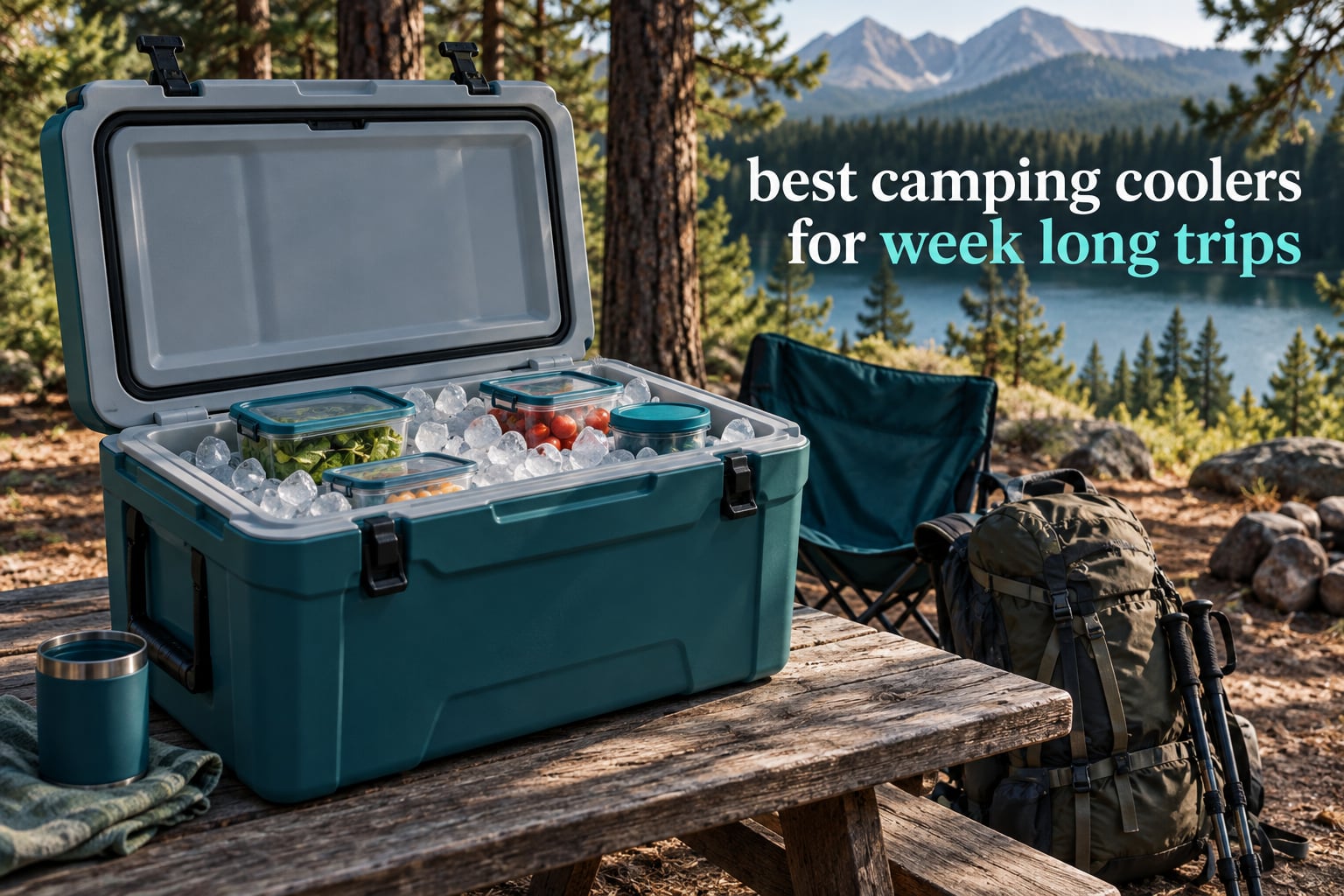
A week-long trip exposes every cooler that cannot hold temperature. Day three is easy for anything with a lid; day six is where cheap plastic walls give up and your food sits in meltwater. The best camping cooler for week-long trips is the YETI Tundra 65, a 65-quart rotomolded ice chest with up to 3 inches of PermaFrost insulation that owners routinely report holding ice for a full week even with daily openings.
We spent October 2026 reading thousands of owner reviews on 10 coolers that genuinely fit this brief, then sorted them against one question: will the contents still be cold on day six? That framing matters, because most roundups on this topic organise by trip type or price tier and then leave you to guess how the winner behaves on the back half of a week. We did the opposite.
One honest warning up front, because it changes every recommendation below. Experienced campers tend to assume you will get roughly half the ice retention the box claims, and in our reading of owner reports that is a fair rule of thumb. A cooler advertised for five days usually gives you two to three in real sun with real openings. A cooler advertised for seven days, packed correctly and shaded, is the only kind of cooler that comfortably reaches day six.
The picks below cover passive ice coolers, wheeled ice chests and compressor-powered fridges. We also settle the electric-versus-ice question with actual watt-hour math, because a powered cooler and a bag of ice solve the same problem in completely different ways and almost no one explains the difference for a seven-day trip.
Table of Contents
Top 3 Picks for a Week-Long Trip (October 2026)
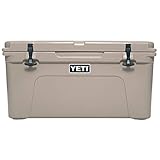
YETI Tundra 65
- 65 qt rotomolded body
- 3 inch PermaFrost insulation
- Bear-Resistant certified
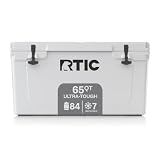
RTIC 65 QT Ultra-Tough
- 65 qt holds 84 cans
- 2.4 inch closed-cell foam
- Freezer-style gasket seal
All 10 Coolers at a Glance in 2026
This table lists every cooler we judged against the seven-day standard. Capacity is nameplate volume, which always overstates usable space once wall thickness and ice take their share.
| Product | Specs | Action |
|---|---|---|
| YETI Tundra 65 Cooler |
|
Check Latest Price |
 Lifetime High Performance Ice Chest Lifetime High Performance Ice Chest |
|
Check Latest Price |
| RTIC 65 QT Ultra-Tough Hard Cooler |
|
Check Latest Price |
 EUHOMY 48QT 12 Volt Refrigerator EUHOMY 48QT 12 Volt Refrigerator |
|
Check Latest Price |
| Coleman Classic Series 100qt Rolling Cooler |
|
Check Latest Price |
 BODEGA 53 Quart 12V Car Refrigerator BODEGA 53 Quart 12V Car Refrigerator |
|
Check Latest Price |
 Igloo Maxcold Glide 110Qt Wheeled Cooler Igloo Maxcold Glide 110Qt Wheeled Cooler |
|
Check Latest Price |
 Coleman Pro Series 55-Quart Cooler Coleman Pro Series 55-Quart Cooler |
|
Check Latest Price |
 Ninja FrostVault 65qt Cooler with Wheels Ninja FrostVault 65qt Cooler with Wheels |
|
Check Latest Price |
 BougeRV 53 Quart 12V Refrigerator BougeRV 53 Quart 12V Refrigerator |
|
Check Latest Price |
The 7-Day Ice Plan: Pounds, Blocks and Re-Ice Stops
The single most repeated question on camping forums for this trip length is simple: how much ice do I actually need for seven days? Nobody in the roundup space answers it with numbers, so here is ours.
The baseline rule is a 2:1 ice-to-food ratio by weight. Two pounds of ice for every pound of food. A family of four eating fresh for seven days carries roughly 45 to 50 pounds of food, which means 90 to 100 pounds of ice at the start. That is nine to ten standard 10-pound bags, and it is more than most people expect to be hauling.
In sustained 90F-plus heat, plan on replacing between a third and half of that ice mass every two to three days. Hot weather is the single biggest factor and no cooler design fixes it. Shade the cooler, keep it closed, and expect one or two re-ice stops along the route if your trip passes a town.
Two techniques do more for you than any cooler upgrade. First, put block ice on the bottom and crushed ice on top. Blocks melt slowly and hold the cold layer steady, while crushed ice fills the gaps around food and chills it faster. Second, rotate frozen 2-liter drink bottles in and out of the cooler. Each bottle is roughly 2 pounds of ice mass that becomes drinking water instead of meltwater pooling in the bottom.
For the back half of the week, dry ice is the underrated answer. It sublimates rather than melts, so it does not create the soggy-cushion problem at the bottom of the cooler. Never seal dry ice in an airtight container, never handle it bare-handed, and keep it in a vented cooler with the food separated from direct contact.
Finally, pack for a week by eating in order. Put the food you will eat on days six and seven at the top, keep it in sealed containers, and accept two lid openings a day as your real budget rather than the ten most people use.
1. YETI Tundra 65: Best Camping Cooler for a Week-Long Trip
YETI Tundra 65 Cooler, Desert Tan
65 qt rotomolded hard cooler
Up to 3 inches of PermaFrost insulation
Bear-Resistant certified
29 pounds empty
Pros
- Rotomolded single-piece shell resists impacts and drops
- 3 inch PermaFrost insulation slows melt rate
- T-Rex rubber latches work one-handed
- Bear-Resistant certified for backcountry week trips
- 65 quarts fits a whole week's food
Cons
- 29 pounds empty is a heavy solo lift
- Premium brand pricing versus comparable rotomolded rivals
The Tundra 65 is the cooler we would load for a seven-day trip without hesitating. Rotomolding produces a single continuous plastic shell with no seams to split, and YETI fills that shell with up to 3 inches of polyurethane foam. Forum owners running multi-day river trips report ice surviving a full week in this class of cooler with daily openings, and the review record on this model backs that up.
At 65 quarts it is also the right size band for four people, or two people who cook big. A week of fresh ingredients for a group of four simply does not compress into 45 quarts once you account for ice.
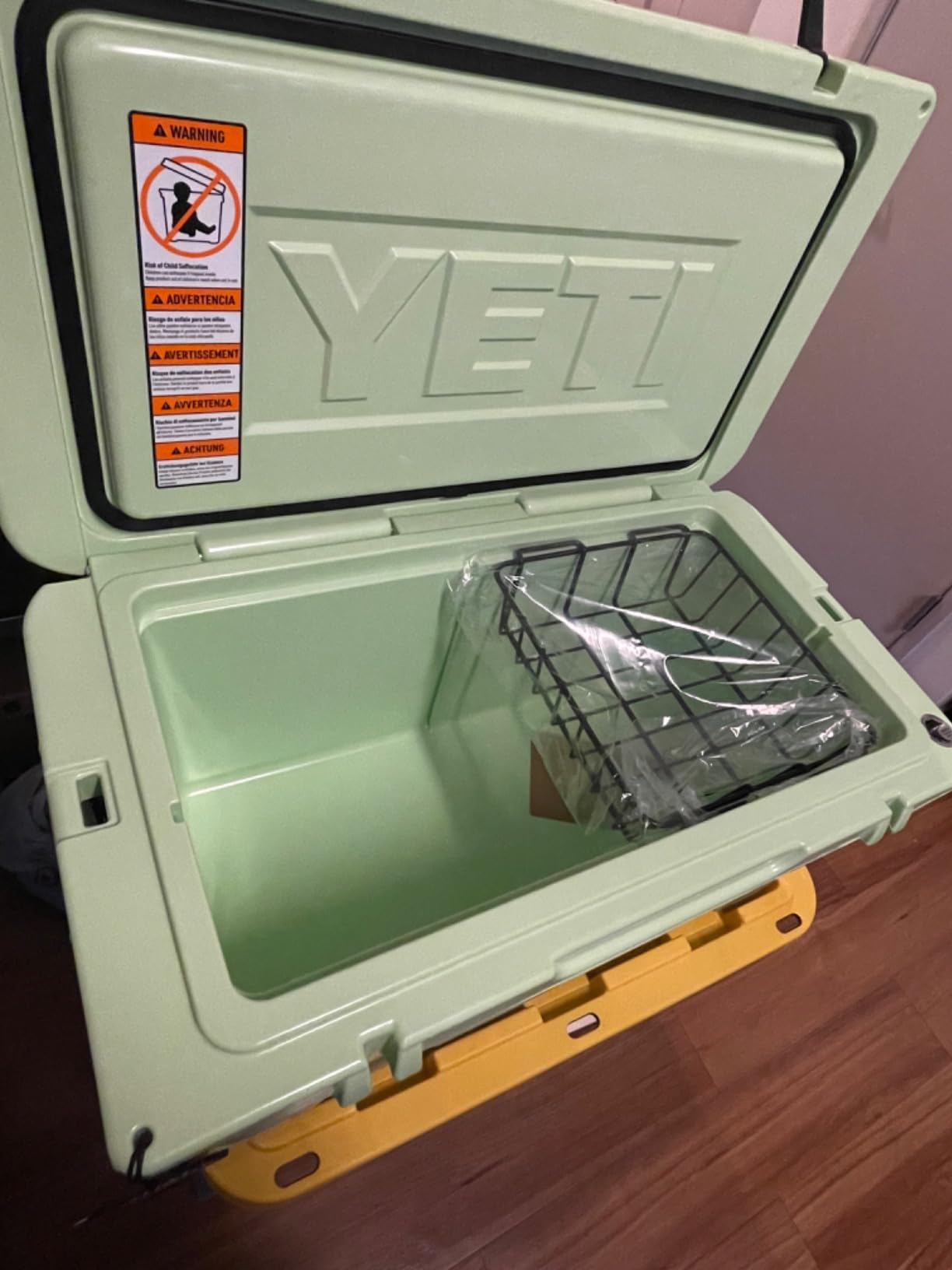
Two details matter more than the brand badge on a trip this length. The T-Rex lid latches stay closed over washboard roads, and the Bear-Resistant certification makes this one of only two picks here that is a legal food-storage choice in real bear country.
The honest drawback is weight. At 29 pounds empty, a full Tundra 65 crosses 130 pounds with a week of ice and food in it, which is a two-person lift unless you park within ten metres of camp. Budget for that, or bring a hand truck.
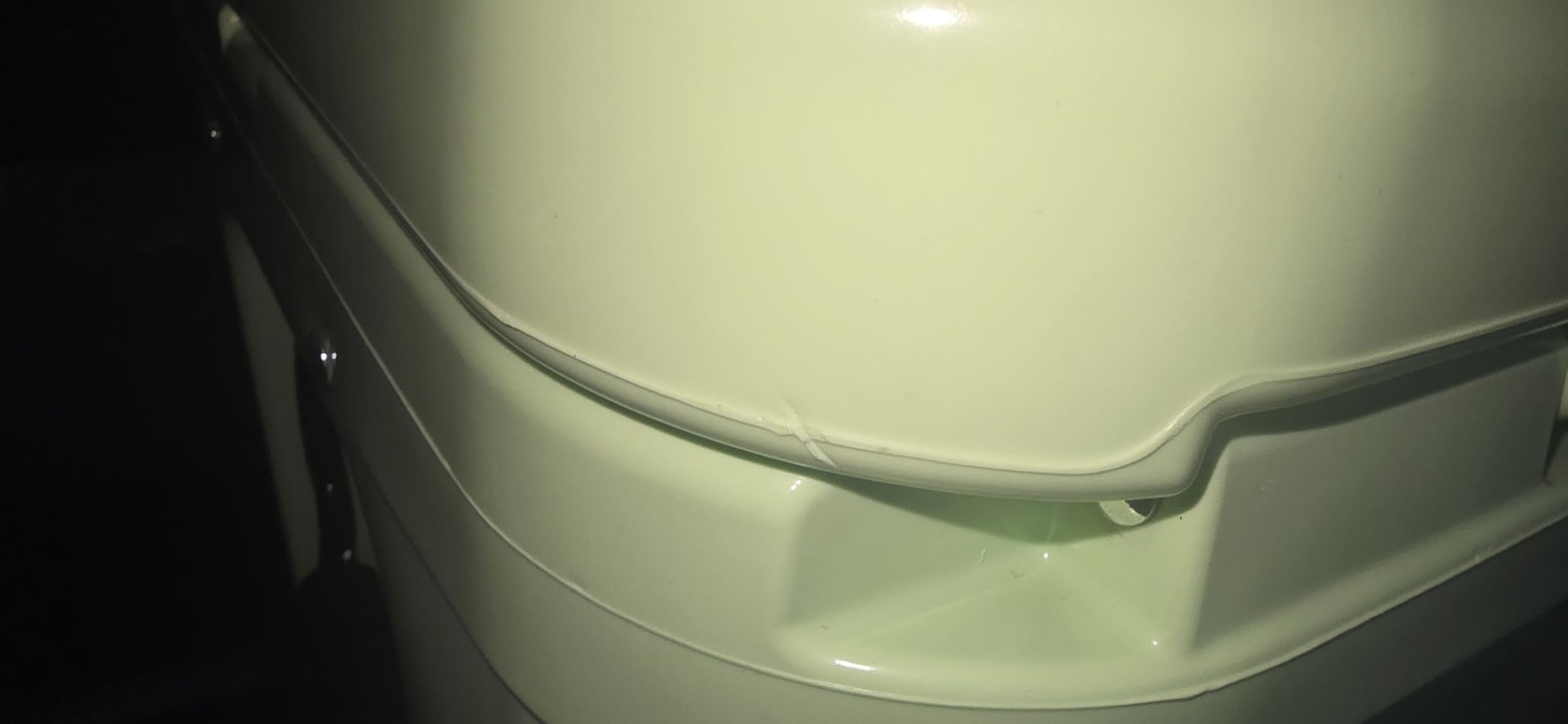
How the Tundra 65 performs across a full week
Expect roughly three to four days from an initial fill in hot sun with frequent openings, then a top-up on day four or five. Owners who pre-chill the shell with sacrificial ice for 24 hours before loading report the back half of the week holding up noticeably better.
The PermaFrost walls do the heavy lifting, but the dry goods basket matters too. It lets you keep bread, tortillas and snacks above the melt line instead of at the bottom in standing water.
Where the Tundra 65 falls short
The single biggest reason people walk away from this cooler is the money, and it is a legitimate objection when RTIC delivers comparable insulation for noticeably less. If your trip is car-based with a short carry from vehicle to site, the cheaper rotomolded options in this list are harder to argue against.
It is also a 65-quart box, not a modular system. There is no way to pull a small compartment out for drinks and leave the food cooler sealed, which is the single best habit for extending ice life over a week.
2. Lifetime High Performance Cooler: Best for Bear Country
Lifetime 90820 55 Quart High Performance Cooler, Grey
55 quart hard ice chest
Certified bear-resistant
Up to 7 day claimed retention
23.4 pounds empty
Pros
- Bear-resistant certified to withstand a bear for up to an hour
- Drain spout accepts a garden hose for fast cleanup
- Stainless steel bottle opener with padlock hole
- Lighter than the 65-quart rotomolded options
Cons
- Rubber latches can be stiff to open one-handed
- No wheels or telescoping handle for rough ground
The Lifetime is the sleeper pick of this roundup among car campers. It carries a stated retention figure of up to seven days at 55 quarts, and the owner reviews we read describe it as holding cold far longer than the price suggests it should.
At 23.4 pounds empty it is one of the lighter large hard coolers here, which matters when you are moving a full load across soft ground. That is a real 6-pound saving against the 29-pound rotomolded flagships.
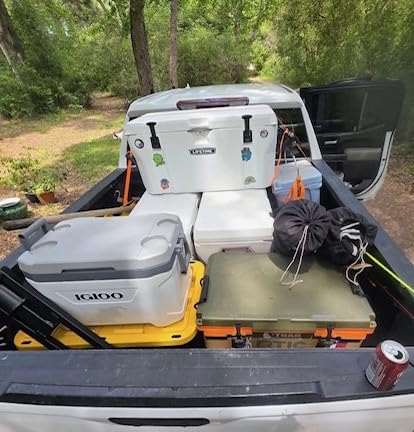
Its drain spout is the feature more coolers should copy. Instead of tipping 100 pounds of meltwater across your campsite, you attach a garden hose and drain it in place, which matters on a seven-day trip where meltwater accumulates daily.
The bear-resistant certification is not decorative. On a multi-day trip in the backcountry, a certified cooler is the difference between storing food legally and having your week ruined by a bear raid on day three.
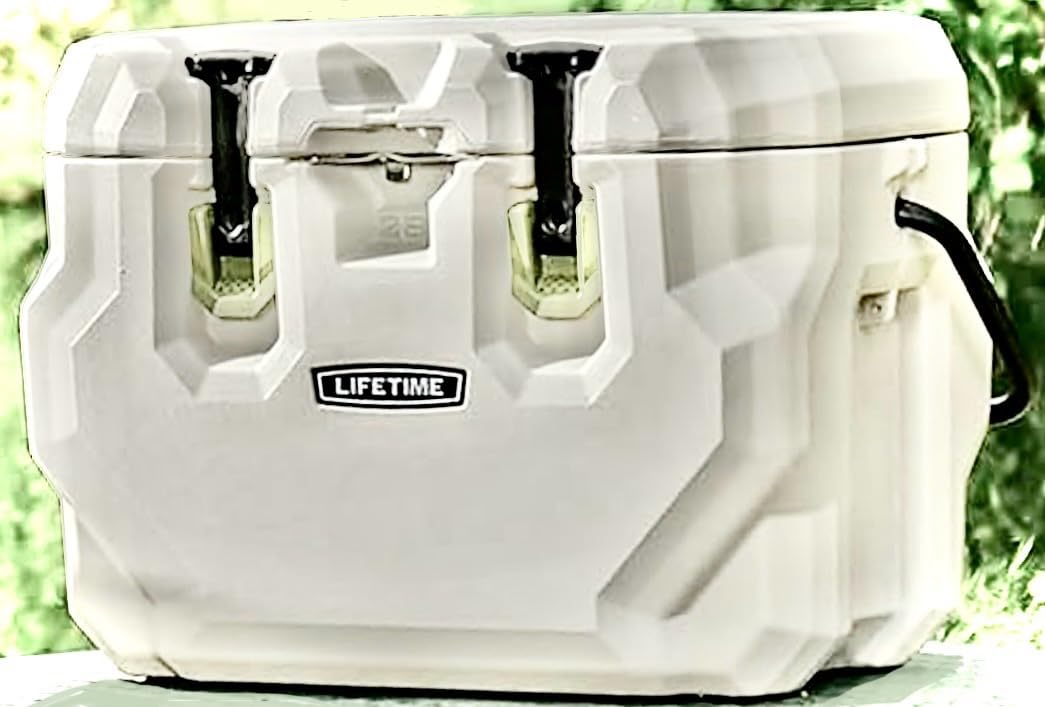
Why this one works through day six
The steel-anchored body and tight-fitting lid mean the heat path in is small, which is the whole game. Combine that with a pre-chill and a block-ice base layer, and owners consistently report food that is still cold on the final day rather than merely chilled.
It also carries a five-year limited warranty, so the durability argument holds up over multiple seasons of trips.
Where it frustrates owners
The latches are the top complaint across reviews. They are stiff rubber models that resist opening one-handed, so budget an extra second each time you need food rather than fighting a stuck latch in the dark.
No wheels means no wheels. With 55 quarts of ice in it you are hauling roughly 110 pounds, and that gets old on the fourth day of a week-long trip.
3. RTIC 65 QT Ultra-Tough: Best Value for a Week Away
RTIC 65 QT Ultra-Tough Hard Cooler, White
65 quart rotomolded polyethylene
2.4 inch closed-cell foam
Freezer-style gasket
Holds up to 84 cans
Pros
- Owners report ice lasting a full 7 days through heat waves
- Uses roughly a third as much ice as cheaper coolers
- Rotomolded polyethylene body is easy to clean
- End handles make two-person carrying straightforward
Cons
- Latch tabs can be very difficult to open
- Heavier than expected for its size
- Seal can arrive over-glued and cut retention
RTIC is the answer that comes up most often when people ask whether a cheaper cooler is as good as a YETI, and for a week-long trip the honest answer is: often yes. This 65-quart uses rotomolded polyethylene with 2.4-inch closed-cell foam and a freezer-style gasket, at a noticeably lower price point than the premium brands.
Owners of this specific model report holding ice for a full seven days through multiple heat waves with daily openings, and several point out that it uses roughly a third as much ice as cheaper coolers over a trip. That ice saving compounds across a week more than the purchase price gap does.
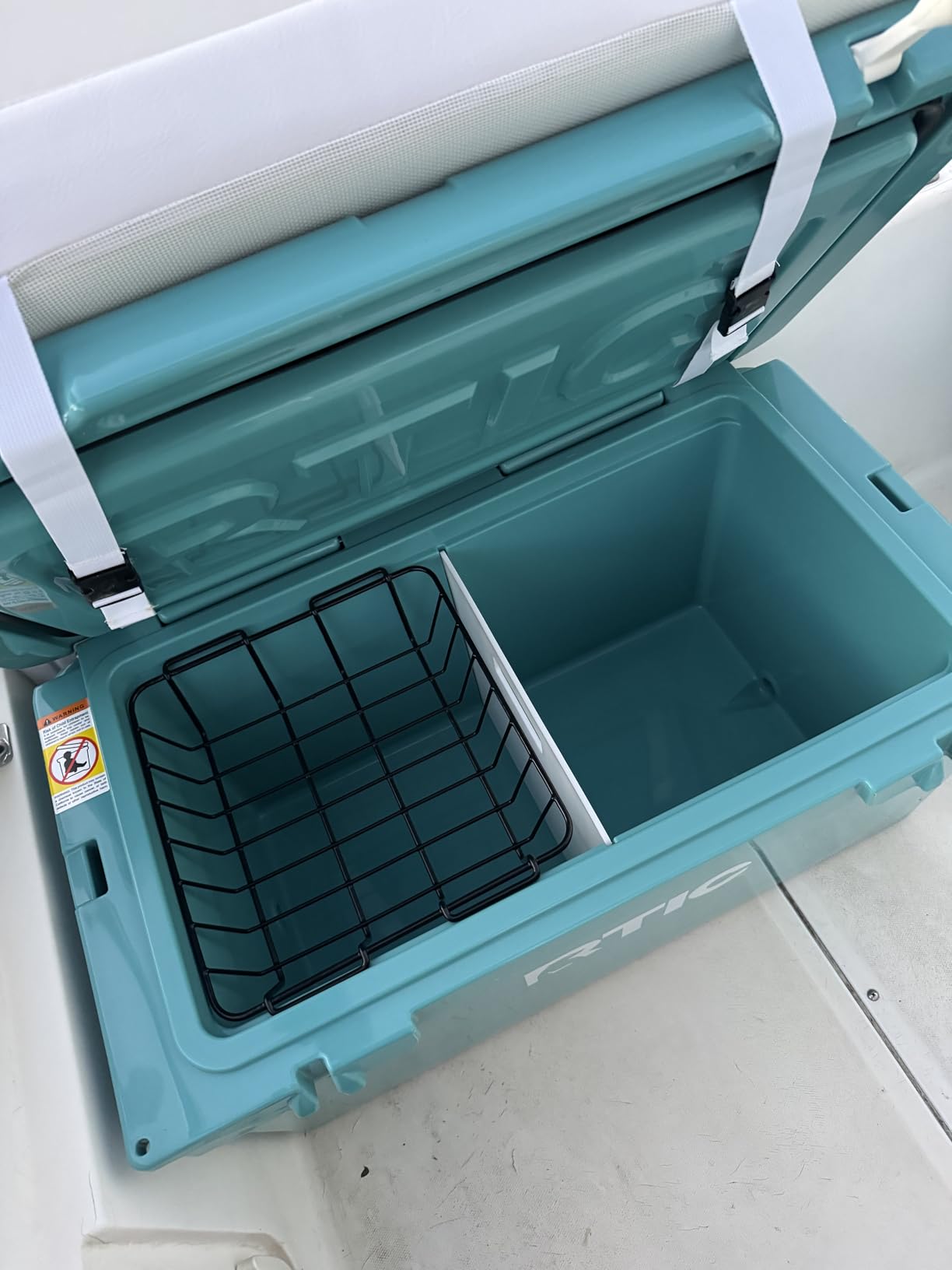
It also doubles as a bench or step stool, which matters more than it sounds when you have been standing at a cook site for six days. The 65-quart version holds up to 84 cans, and the same range runs from 20 to 145 quarts if you need a size above it.
The gasket is the one thing to check on arrival, because some examples arrive with the seal over-glued and leaking warmth until you trim it back. Five minutes with a craft knife restores rated performance.
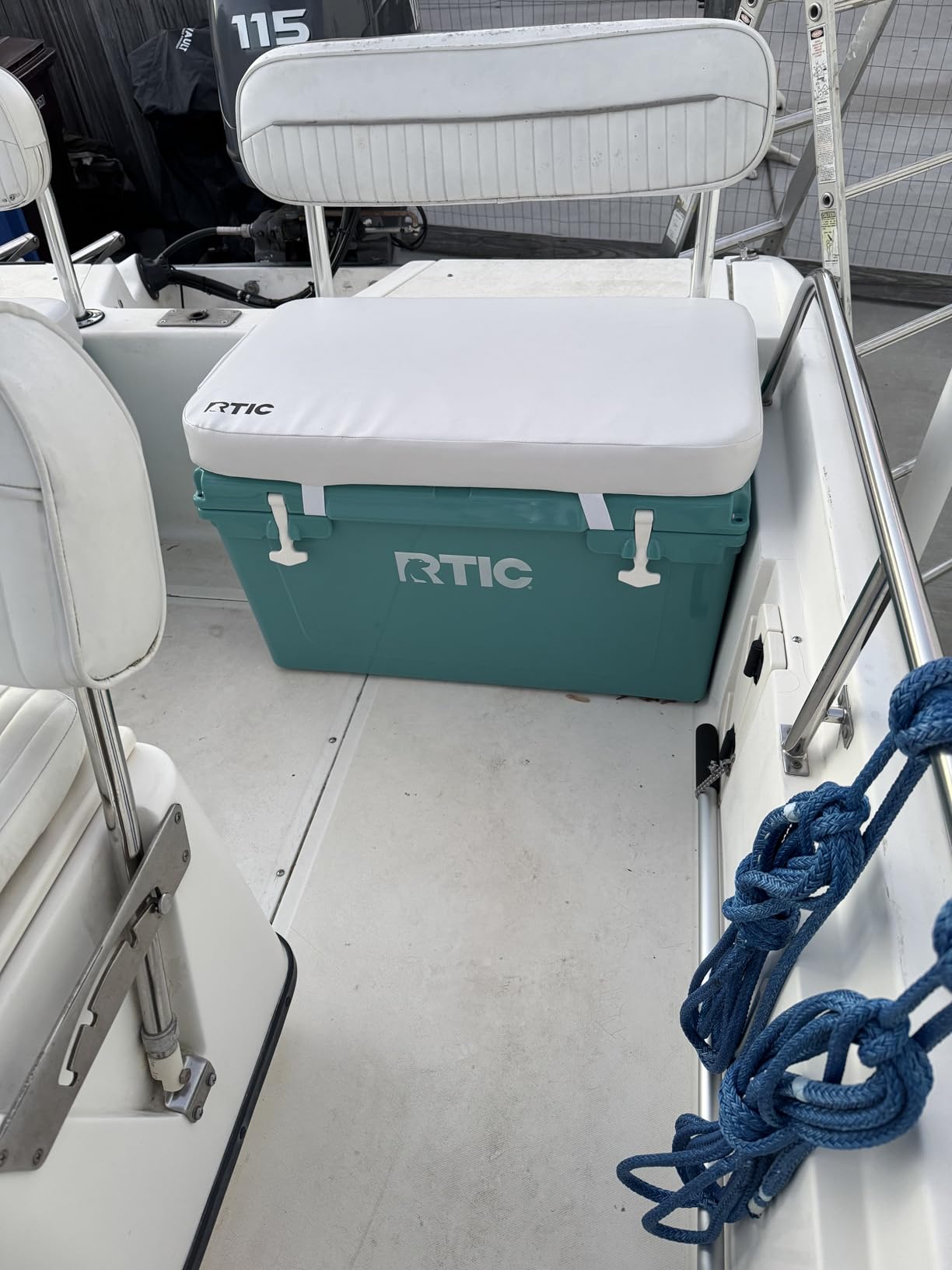
Ice economy over seven days
Because this cooler holds cold while using less ice, it changes how many re-ice stops you need. Two to three days per full load is realistic in moderate weather, which means most week-long trips only need one planned town stop for ice rather than three unplanned ones.
A five-year warranty against material and workmanship defects covers the failure modes that matter on a long trip, such as a cracked handle or a failed latch.
Where it falls short
Those latch tabs are genuinely hard to open, and reviewers single them out repeatedly. This is a cooler you open twice a day, not twenty times, which limits the annoyance but does not remove it.
At 29 pounds empty it is no lighter than the competition. You are buying insulation efficiency here, not portability.
4. EUHOMY 48QT 12 Volt Refrigerator: Best Budget Powered Cooler
EUHOMY 48QT 12 Volt Refrigerator, -4℉~68℉ Portable Freezer for Car
48 quart compressor cooler
Adjusts from -4F to 68F
Average draw of 45W
AC and DC power
Pros
- Drops from 68F to 32F in roughly 15 minutes
- 48 quart interior holds 46 standard cans
- Three-level battery protection protects a vehicle battery
- Low 45W average draw suits multi-day driving
Cons
- App control is fussier than the built-in panel
- Compressor bulk and required airflow clearance
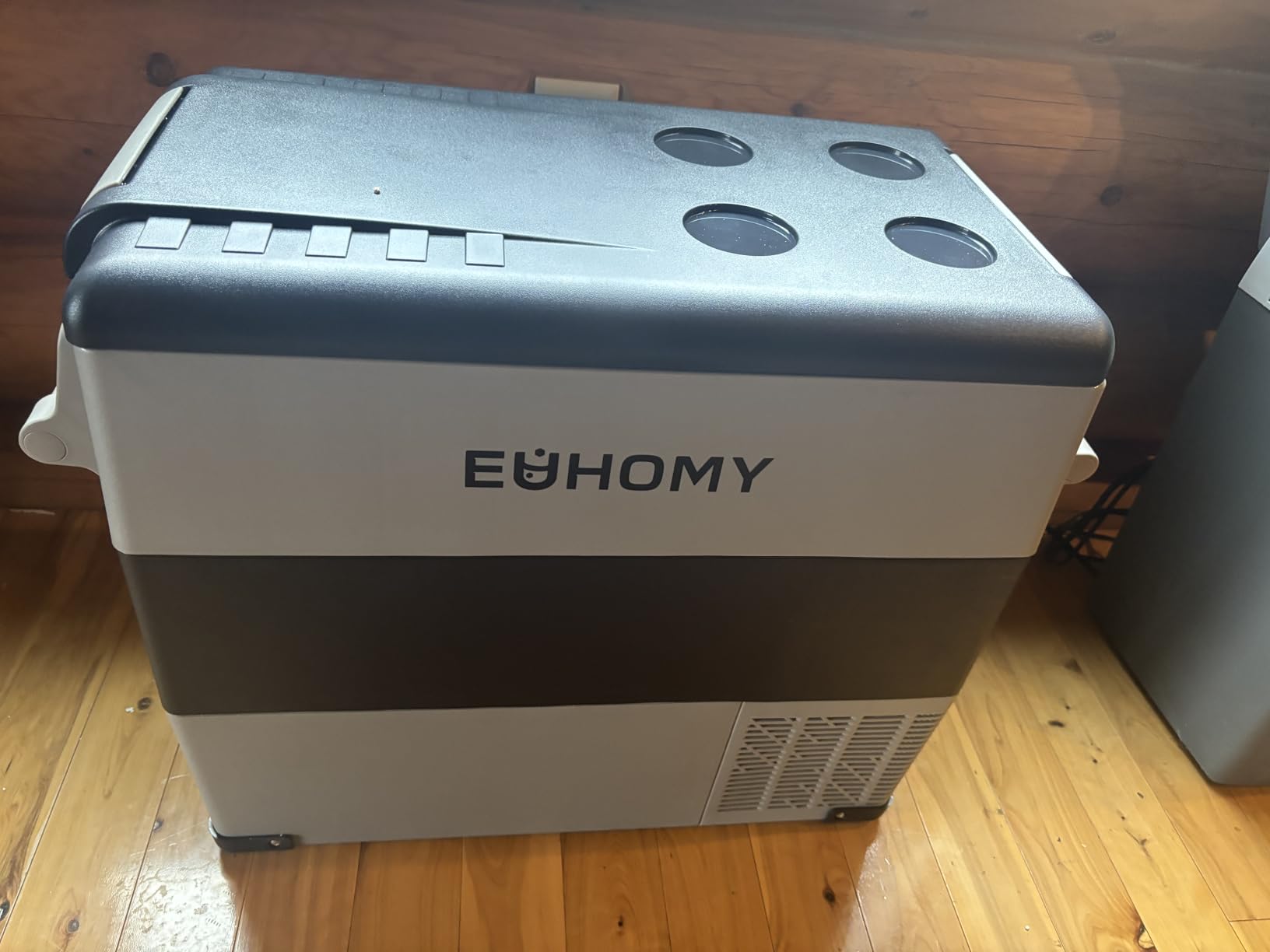
If your week-long trip is a road trip with reliable power, a compressor unit changes the arithmetic entirely. No ice means no meltwater, no re-ice stops and no hauling 100 pounds of frozen water, and this EUHOMY is a lower-cost way into that category.
It runs a compressor cooling method with an adjustable range from -4F to 68F and pulls ambient down to 32F in about 15 minutes. At 48 quarts, owners fit 46 standard 12-ounce cans alongside prepared meals.
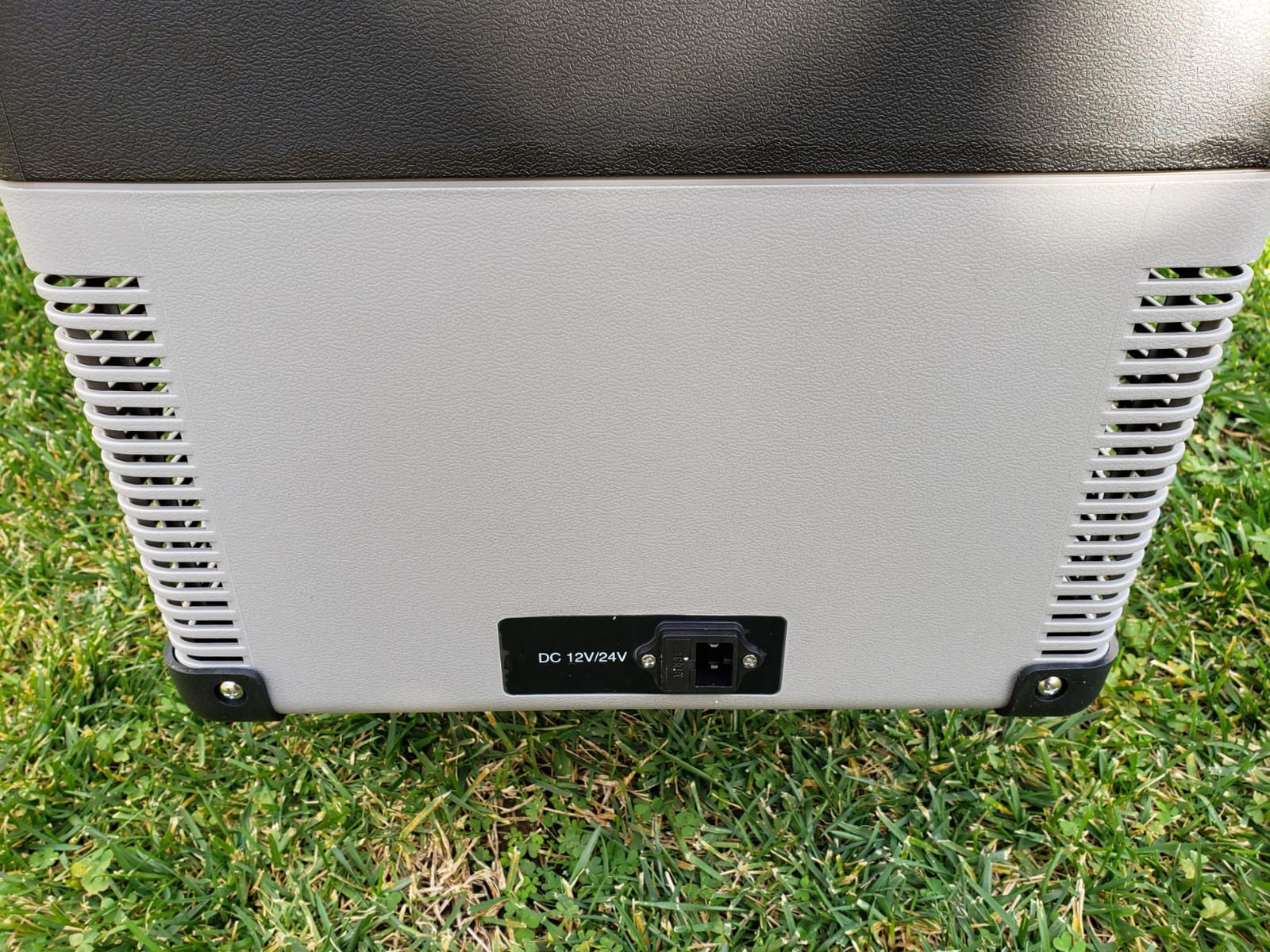
The average draw of 45W is the number that decides whether this works for a week. That works out to roughly 45 watt-hours a day at typical duty cycle, so a 1000 watt-hour power station covers a week of running before a single solar panel adds anything.
Three-level battery protection is the feature that makes overnight vehicle use survivable. Forum users report electric coolers draining a vehicle battery within a single night when battery protection is not configured.
How it holds over a full week
Temperature control is a set-and-forget system rather than a countdown. Set it to 34F, load perishable food, and it holds that target indefinitely as long as power continues, which removes the day-by-day ice check from your trip entirely.
It also runs on 110/240V AC, so you can pre-chill it at home on mains power, drive it down on 12V DC, and plug it into campground power at the other end.
Where it frustrates owners
App control is the top complaint. It is less convenient than the built-in LCD panel, and any app-only feature feels fragile when you are miles from a signal. Use the panel.
At 15 kilograms this is a heavier, bulkier object than its capacity suggests. This is not a cooler you carry into a site by hand.
5. Coleman Classic Series 100qt Rolling Cooler: Best Wheeled Cooler for a Long Haul
Coleman Classic Series Insulated Portable Rolling Cooler, 100-Quart
100 quart wheeled hard cooler
Keeps ice up to 5 days at 90F
6 inch all-terrain wheels
20.4 pounds empty
Pros
- 6 inch all-terrain wheels roll over mud and gravel
- 167 can capacity without ice
- Have-a-seat lid rated to 250 pounds
- Dual tow and swing-up handles
- Four cup holders fit 30 oz tumblers
Cons
- Lid will not stay open without being held
- In 90F plus heat some owners report faster melt
- Telescoping handle sticks when collapsed
This is the pick when the distance between the vehicle and the campsite is the real problem. Six-inch all-terrain wheels, a tow handle and swing-up handles mean one person can move a genuinely large amount of food and ice across rough ground.
At 100 quarts it holds 167 cans without ice, or 80 cans alongside 50 pounds of ice, which makes it the right capacity for a group of five or six on a week-long trip. Multiple owners report ice still present after three days in 82-90F ambient.
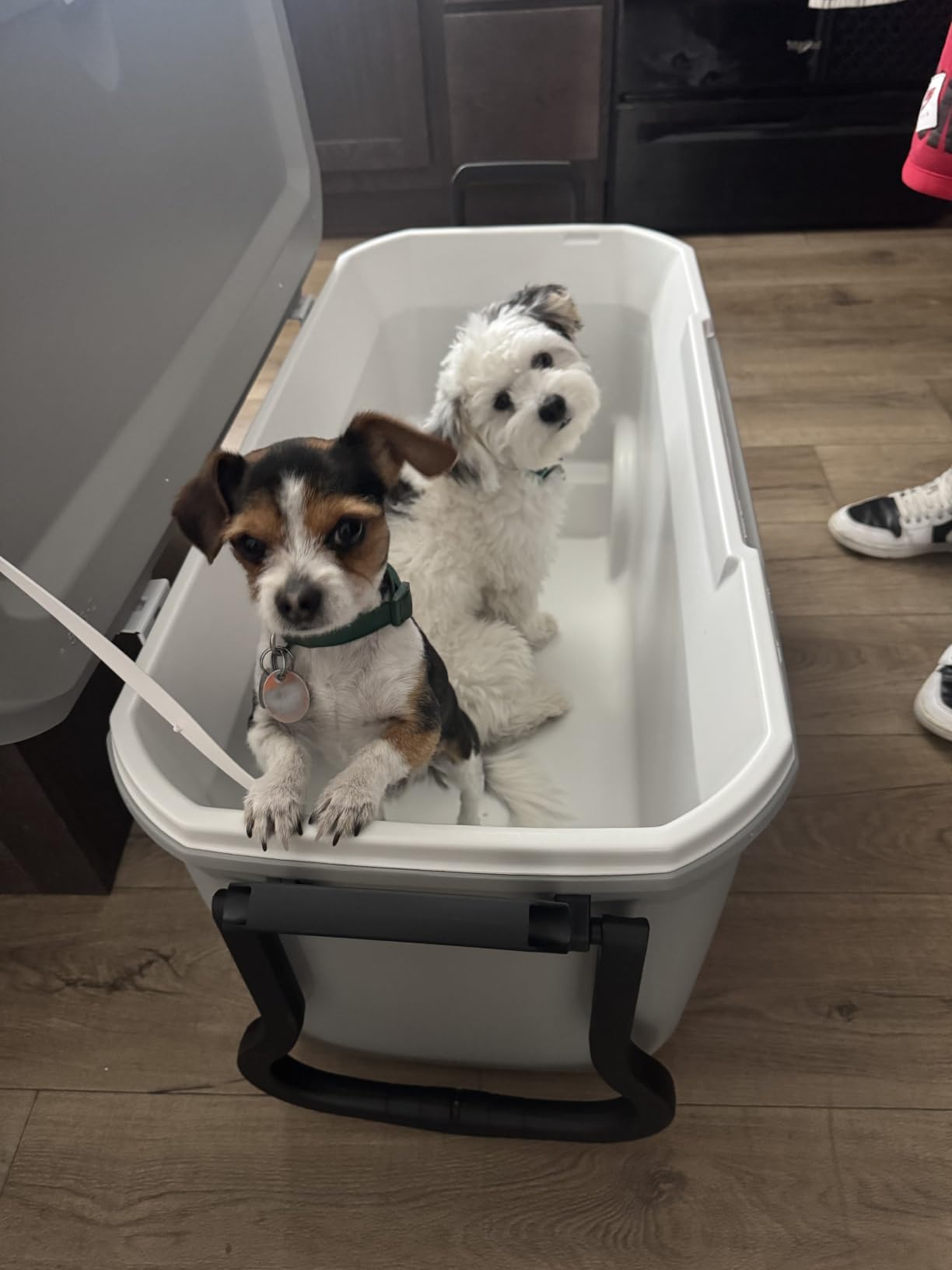
The stated retention figure is up to five days in temperatures up to 90F. Apply the half-the-claim rule and you are looking at two to three solid days per fill, which for a week means planning one or two ice stops rather than daily re-icing.
The four molded cup holders and the 250-pound have-a-seat lid are the details that turn a food box into the centre of a basecamp for a week.
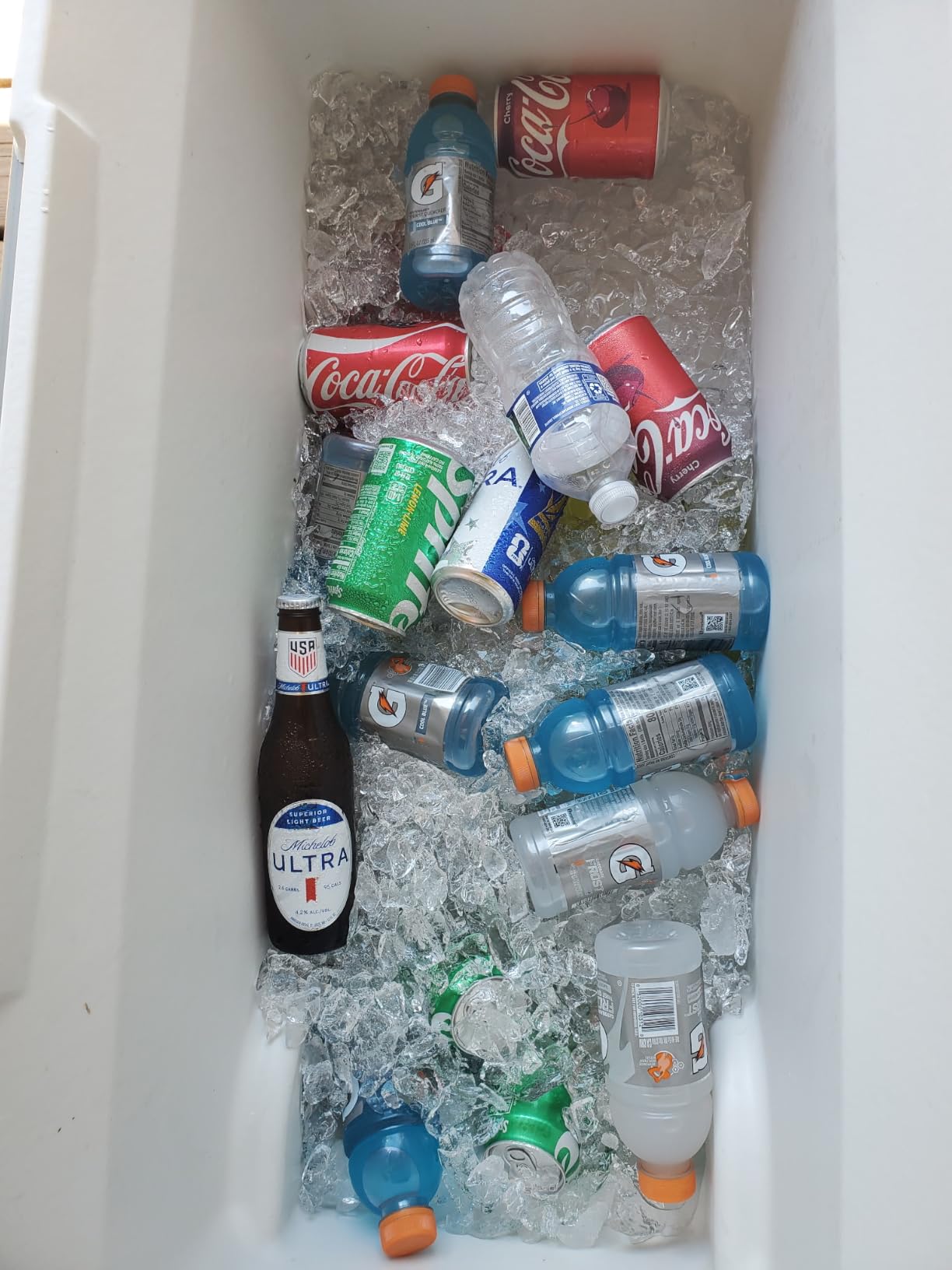
When a 100-quart wheeled cooler wins
If you are driving to a site rather than carrying a cooler, capacity is cheap. The wheels cost you nothing in retention and save your back over seven days of trips to the vehicle, which is when most cooler weight problems actually occur.
It is also assembled in the USA and made with 15 percent less plastic than comparable coolers, which is a reasonable durability compromise for an injection-molded body.
Where it falls short
There is no way to lock the lid open, and owners complain about it constantly. Cooking with the lid held by one arm for seven days is exactly the frustration this design has.
In sustained extreme heat, some owners report ice melting before the first day is out. Large ice chests have more surface area relative to volume, so a bigger cooler is not automatically a longer-lasting one. Check for an external drain before you buy, because variants without one mean tipping 100 pounds of meltwater onto the ground.
6. BODEGA 53 Quart 12V Refrigerator: Best for Long Road Trips
BODEGA 12 Volt Portable Car Refrigerator 53 Quart Single Zone
53 quart single zone compressor
-4F to 68F with MAX and ECO
Cools 75F to 40F in 12 minutes
12 kilograms
Pros
- Pulls 75F down to 40F in about 12 minutes on MAX
- A 1000Wh station dropped only 18 percent over two days
- Quiet enough to sleep beside at idle cycling
- Wheels and retractable handle add mobility
Cons
- App needs a WiFi connection to work as expected
- Best usable space needs the divider removed
- Some owners want larger wheels and a longer handle
The BODEGA is the powered pick for a trip where you drive every day, and the efficiency figures owners report are the reason. One reviewer measured a 1000 watt-hour power station falling from 100 percent to 82 percent across a two-day, two-night trip, which extrapolates comfortably past a full week with a modest top-up.
Cooling performance is strong for the category, pulling 75F down to 40F in about 12 minutes on MAX and holding temperature steadily from there. The 38-liter freezer zone handles the frozen half of the week’s food.
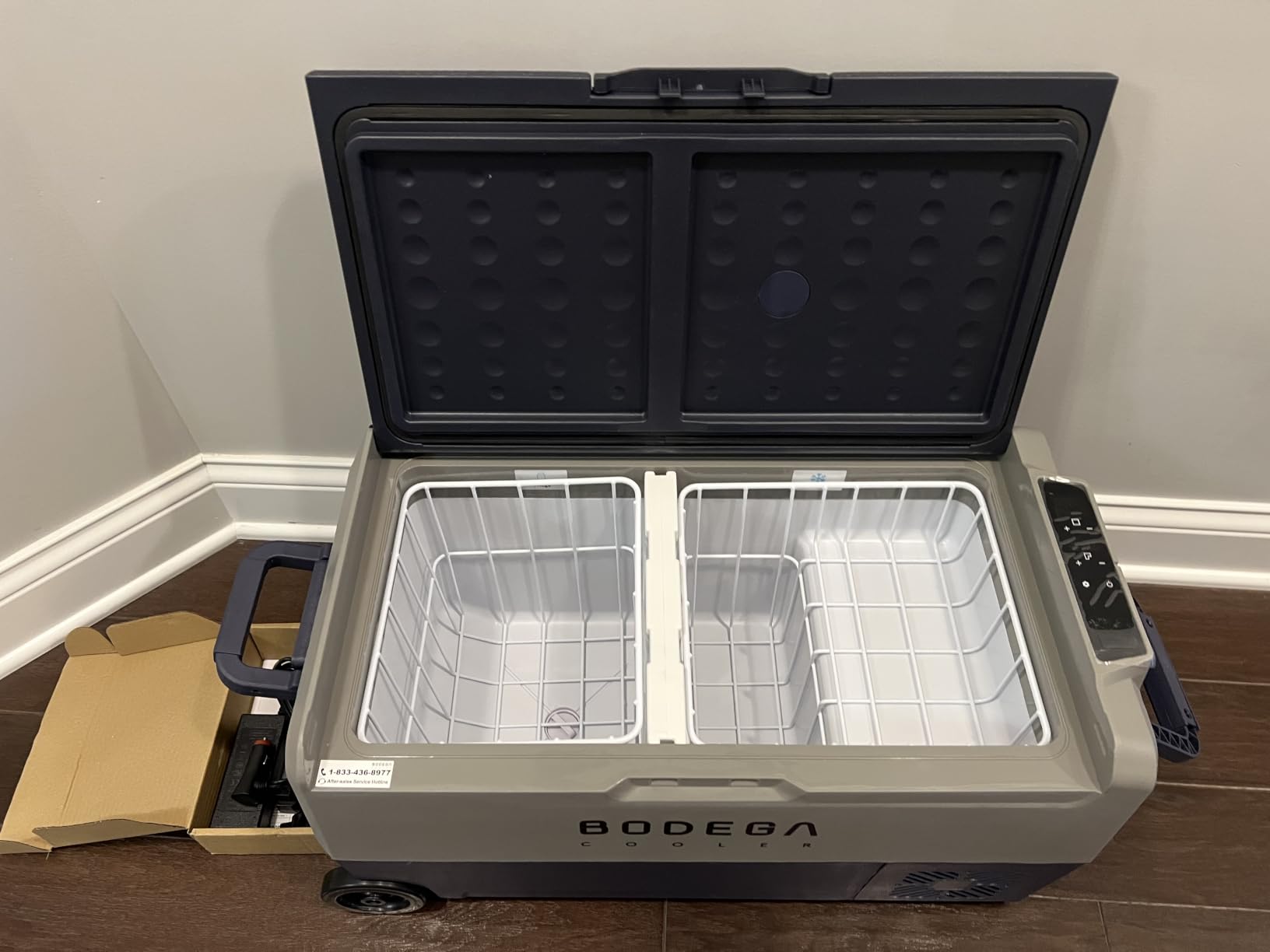
It is stable at a 30-degree vehicle incline, which matters more than it sounds when you are on washboard tracks and the alternative is a box of warm sandwiches. Power transfers between AC and DC during travel without a manual switch.
Three-level battery protection plus MAX and ECO modes let you trade a little temperature stability for significantly less draw on days you need the battery for something else.
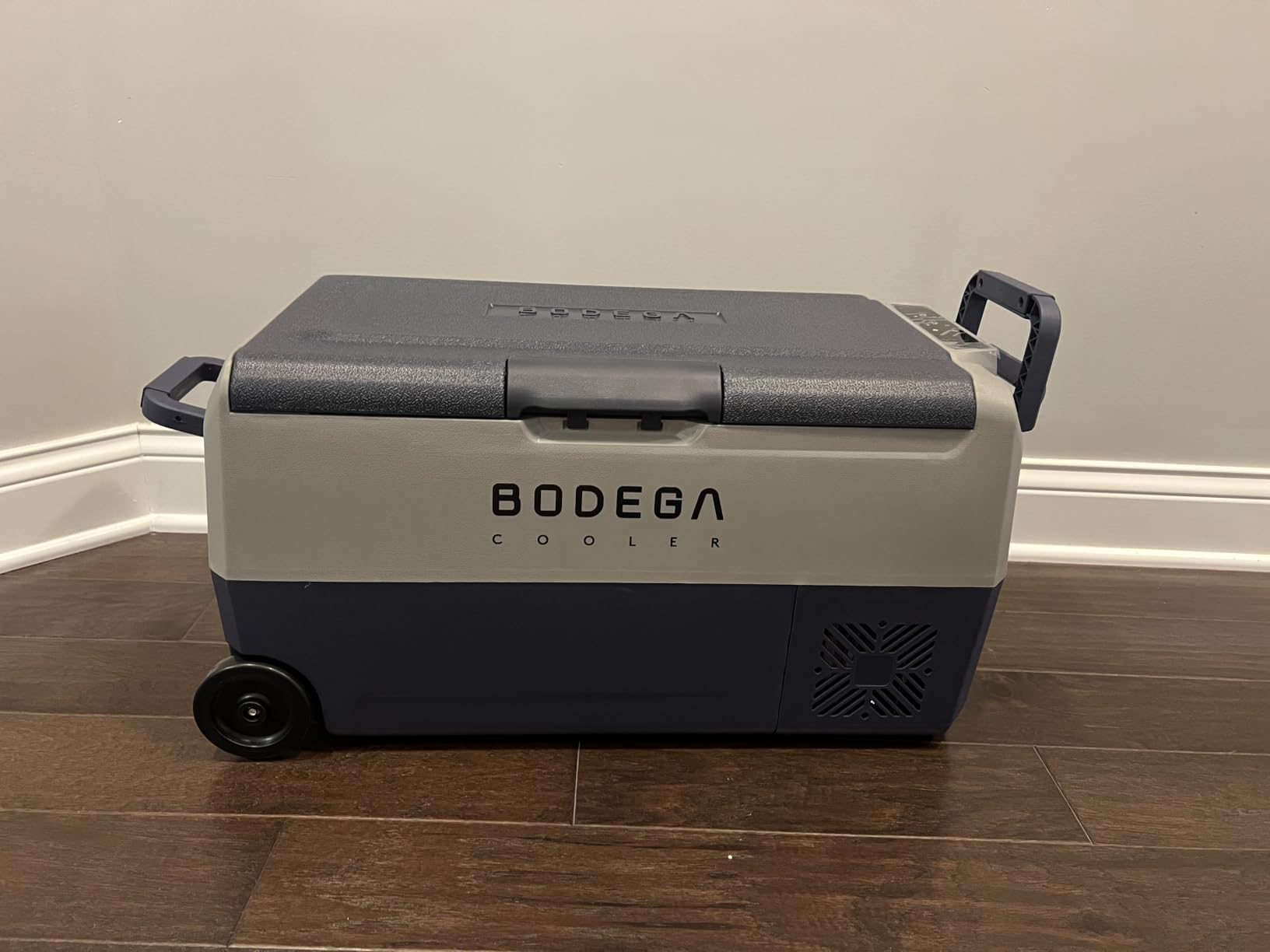
Running it for seven days on stored power
Work from the measured figure rather than the nameplate. A compressor fridge holding a steady target through hot days typically cycles for a handful of hours per day, so budget roughly 35 to 45 watt-hours per 24 hours and a 500 watt-hour station covers the week with room to spare.
Add a modest solar panel and the loop closes. Owners running extended trips report buying zero bags of ice across a full multi-week road run on this setup.
Where it falls short
The Bluetooth app depends on a WiFi connection to work as expected, which is a real limitation at a remote campsite. The manual panel handles adjustments fine, so treat the app as a bonus rather than a feature you plan around.
On the single-zone 53-quart version, removing the divider and baskets gives noticeably better usable space than the configuration it ships in. The warranty covers the compressor for five years but other parts for one.
7. Igloo Maxcold Glide 110Qt: Best for Large Groups
Igloo Glide 110 Qt Roller Cooler, White
110 quart wheeled hard cooler
THERMECOOL body and lid insulation
25.4 pounds empty
Stores 168 cans
Pros
- 110 quart capacity suits groups of six or more
- Telescoping handle with soft-ride wheels
- UV inhibitors and infrared technology slow solar heat gain
- DuraLatch closures with stainless steel hinges
Cons
- Ice retention is shorter than thick-walled rotomolded coolers
- Bulky footprint compared with 55 to 65 quart models
When the group is six people rather than four, capacity becomes the deciding variable and this Igloo is the volume play. 110 quarts holds 168 cans, which is enough for a full week of group meals without a second cooler or a mid-trip grocery stop.
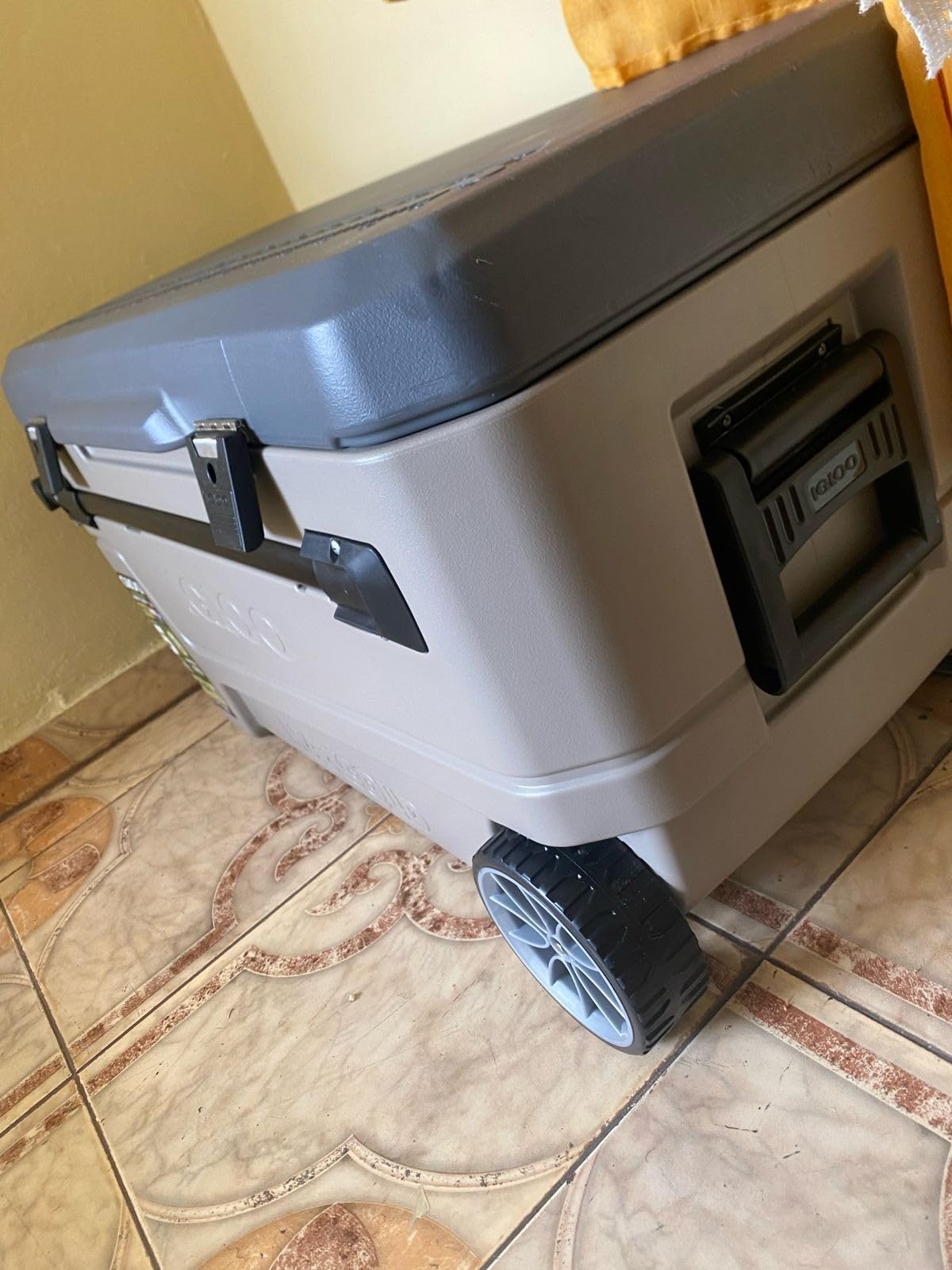
The Glide chassis does the heavy lifting for transport. A telescoping handle and soft-ride wheels handle pavement, dirt tracks and campsite grass, and at 25.4 pounds empty it is one of the lighter ways to move 100-plus quarts around.
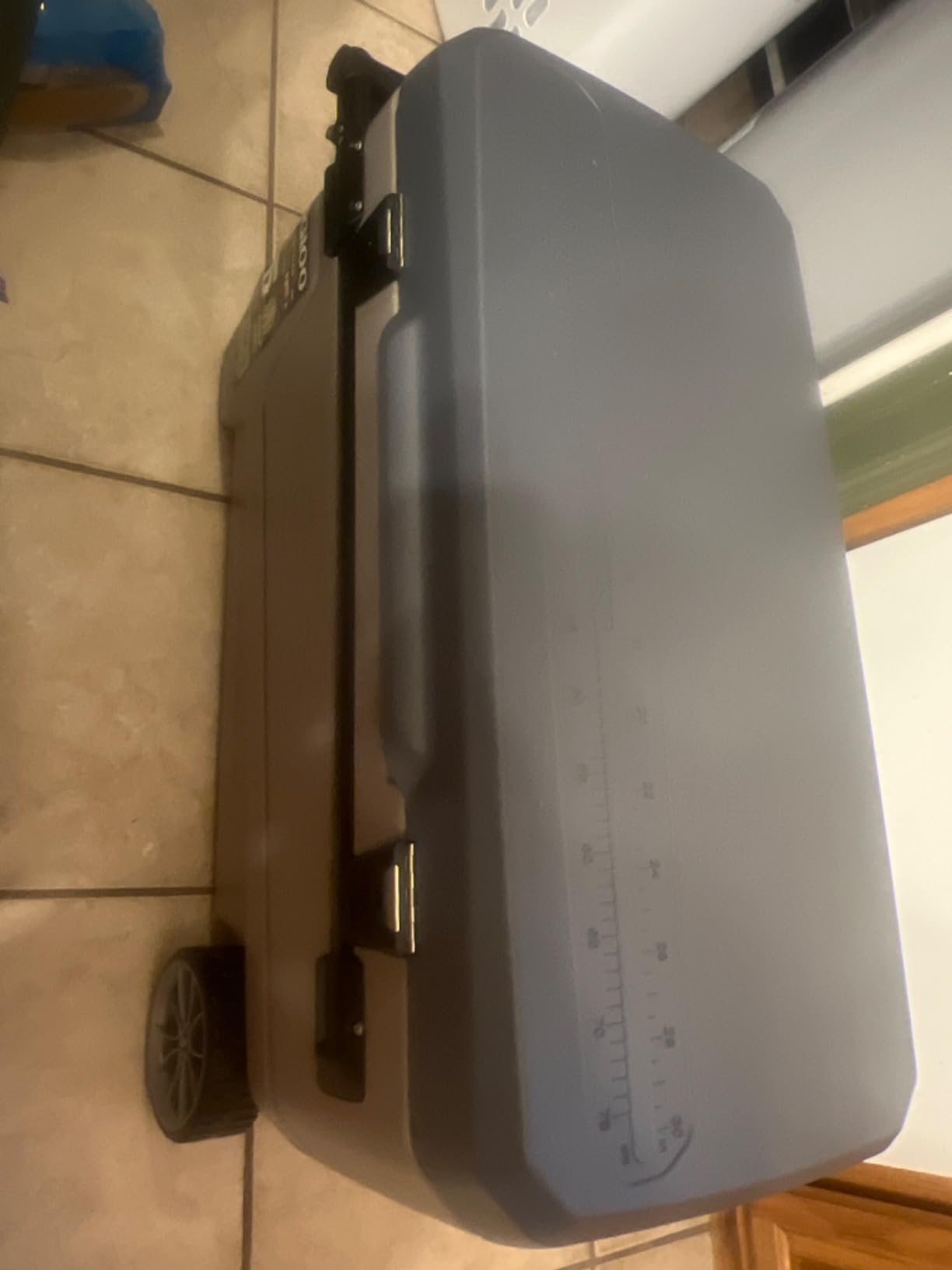
THERMECOOL insulation sits in both the body and the lid with UV inhibitors and infrared technology, which is aimed squarely at the sun exposure problem on a week-long trip. A week is long enough for solar gain on the lid to matter.
The lid also carries a molded ruler, which sounds trivial until you are measuring a catch at dusk and it saves a wet glove.
Where the extra capacity pays off
Large groups run out of food space before they run out of ice, and running out of food space on day five of a week is a trip-ending problem. This cooler removes it, and the wheels remove the weight problem that normally comes with that volume.
Impact-resistant DuraLatch closures with stainless steel hinges are the hardware you want when a 110-quart box spends a week in the back of a truck.
Where it falls short
Reviewers are consistent on the trade-off: retention is shorter than premium rotomolded coolers with thicker walls. More capacity means more surface area, so ice melts at a higher rate in high heat. Expect daily top-ups rather than multi-day holds in summer.
The footprint is also bulky. Measure your vehicle cargo area before committing, because 110 quarts will not stack neatly behind a seat.
8. Coleman Pro Series 55-Quart: Best Warranty in the Lineup
Coleman Pro Series Cooler, 92-Can Capacity, 5-Day Cold, Wheels, 55-Quart
55 quart hard cooler holding 92 cans
Up to 5 day cold retention
Walls up to 2 inches thick
10 year limited warranty
Pros
- 10 year limited warranty is the longest here
- Stainless steel one-hand latch is sturdier than rubber
- Two inch walls with fully insulated body and lid
- Tie-down straps and padlock compatibility
Cons
- Heavier than cheaper Coleman coolers
- Shoulder strap is awkward when loaded
- One owner reported seepage near the rear hinges
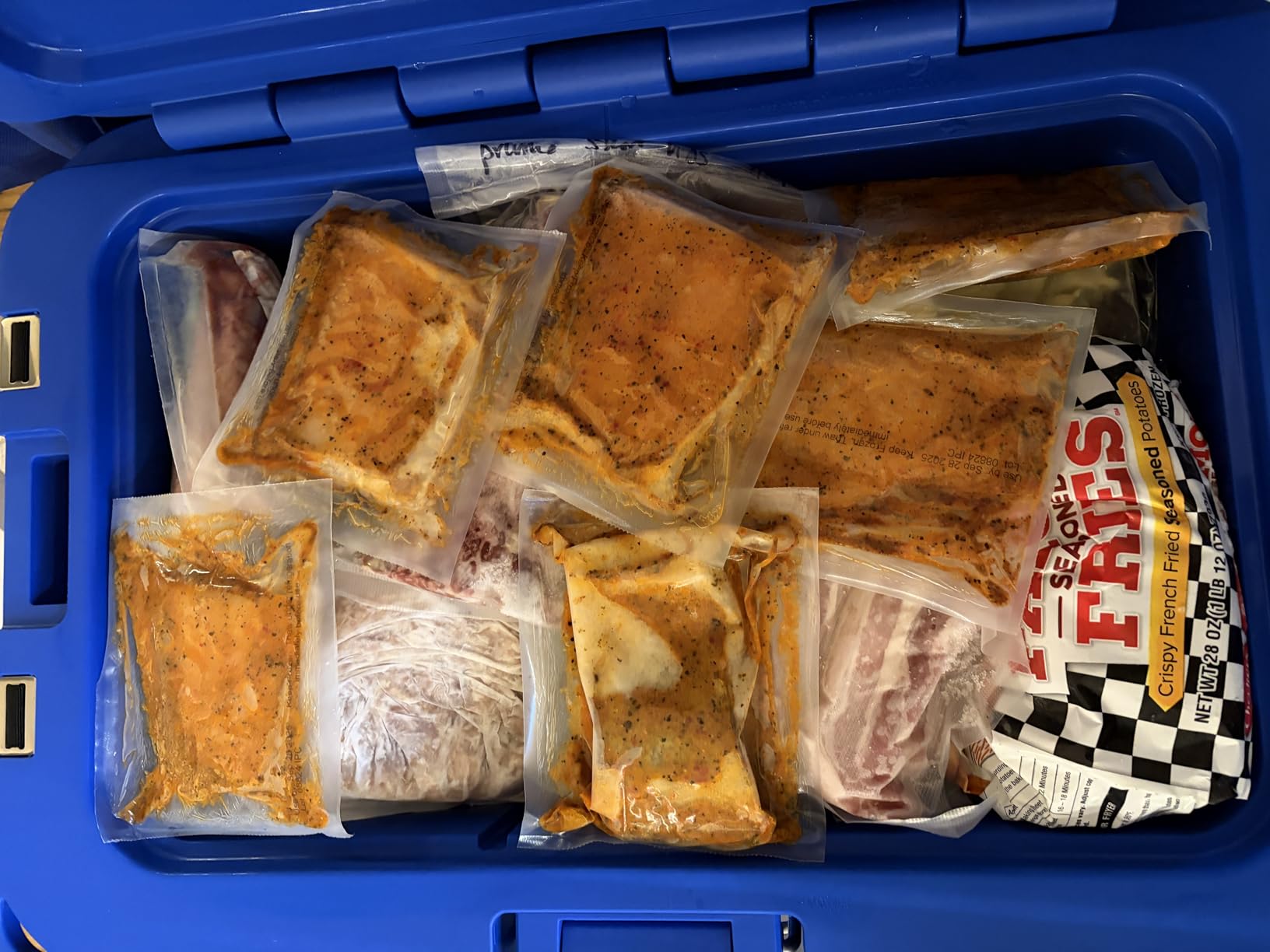
The Pro Series sits in the awkward middle of this list: more money than a basic Coleman, less insulation than a rotomolded flagship. What it does have is hardware. A stainless steel one-hand latch, walls up to 2 inches thick, and a fully insulated body and lid that owners say held ice through four to five hours of 80F-plus beach days and still had ice the next morning.
One owner measured the interior at 32F after about an hour and still at 40F the following morning, which is the honest benchmark you care about for food safety over a week.
The 10-year limited warranty is the longest in this roundup by a wide margin. That coverage is a real part of the value calculation.
Tie-down straps and padlock compatibility are small features that decide whether the cooler stays secure in a truck bed for six hours of washboard road at a time.
Where it beats cheaper plastic coolers
Owners consistently report the steel latch feeling more durable than the rubber straps used on premium brands, and having a seat lid plus non-slip feet means it works as camp furniture as well as storage.
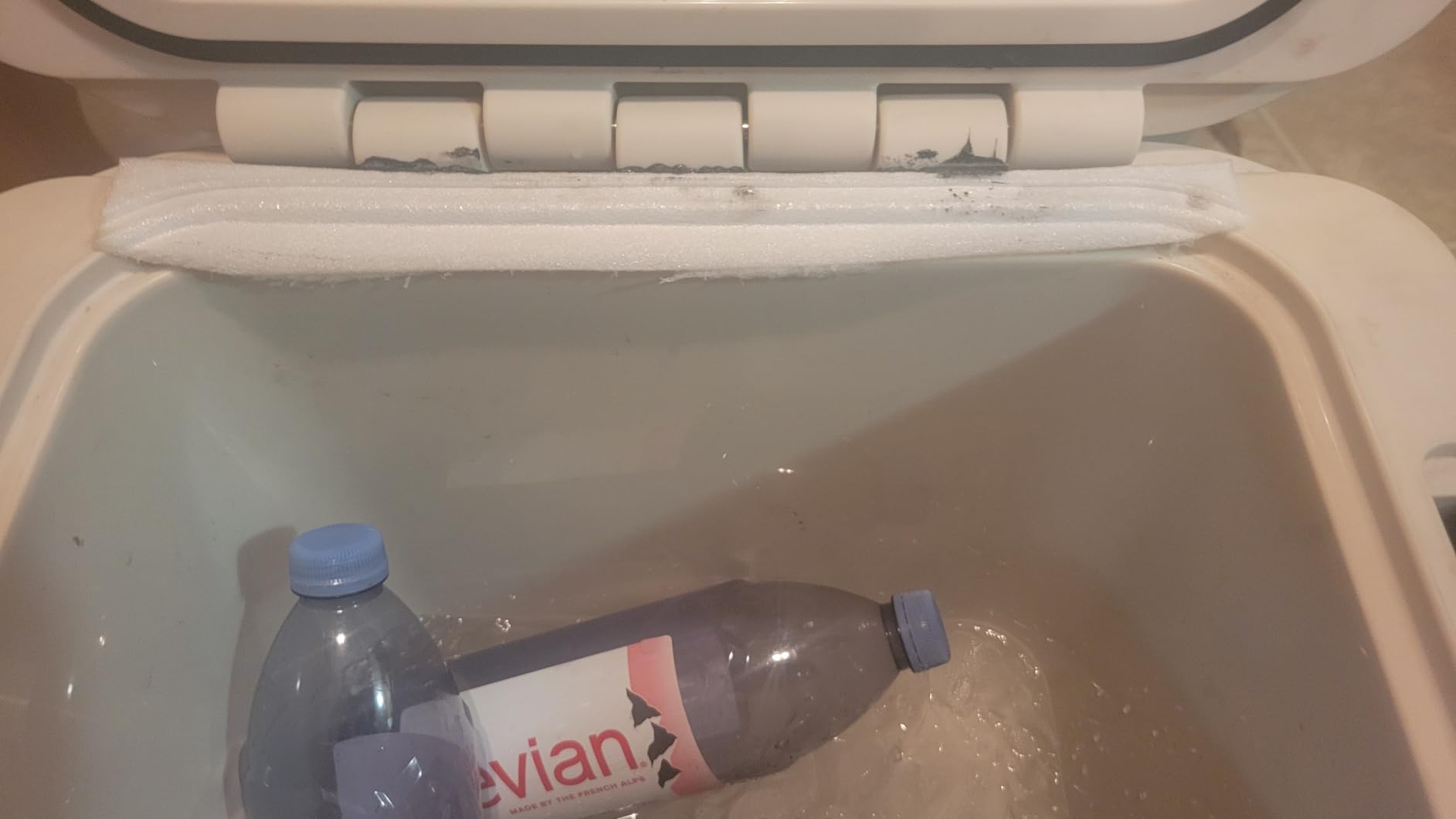
An oversized attached drain plug solves the meltwater problem that plagues cheaper coolers, and the drain hole in the base means you drain in place instead of heaving the whole box.
Where it falls short
It is heavier than cheaper Coleman coolers of similar size, and the shoulder strap is awkward when the cooler is full, so plan to use the end handles and get help.
One owner reported water seeping near the rear hinges from a thin, uneven gasket. This is a single report, not a pattern, but check the seal before a week where you cannot replace it. The manufacturer does not publish empty weight or dimensions, which makes planning a carry harder.
9. Ninja FrostVault 65qt: Best for Dry Storage
Ninja FrostVault™ 65qt Cooler with Wheels, Dry Storage, Lakeshore Blue
65 quart wheeled cooler
FrostVault dry zone under 40F
Up to 3 inches of insulation
40.5 pounds empty
Pros
- Separate FrostVault dry zone stops sandwiches and fruit getting soggy
- Lid stays open instead of slamming shut
- All-terrain wheels with a fully collapsing telescoping handle
- Release latch is easy on arthritic hands
Cons
- Heaviest ice cooler here at 40.5 pounds empty
- Latches must be closed deliberately or warm air gets in
The most common complaint we read across cooler reviews is soggy food by day three, and this is the only pick on the list engineered to solve it directly. The FrostVault dry zone is a separate compartment that holds food below 40F without sitting in meltwater, which is what keeps sandwiches, fruit and snacks edible rather than waterlogged.
Underneath that, you get up to 3 inches of insulation, all-terrain puncture-resistant wheels and a reinforced telescoping handle that fully collapses for storage in a vehicle.
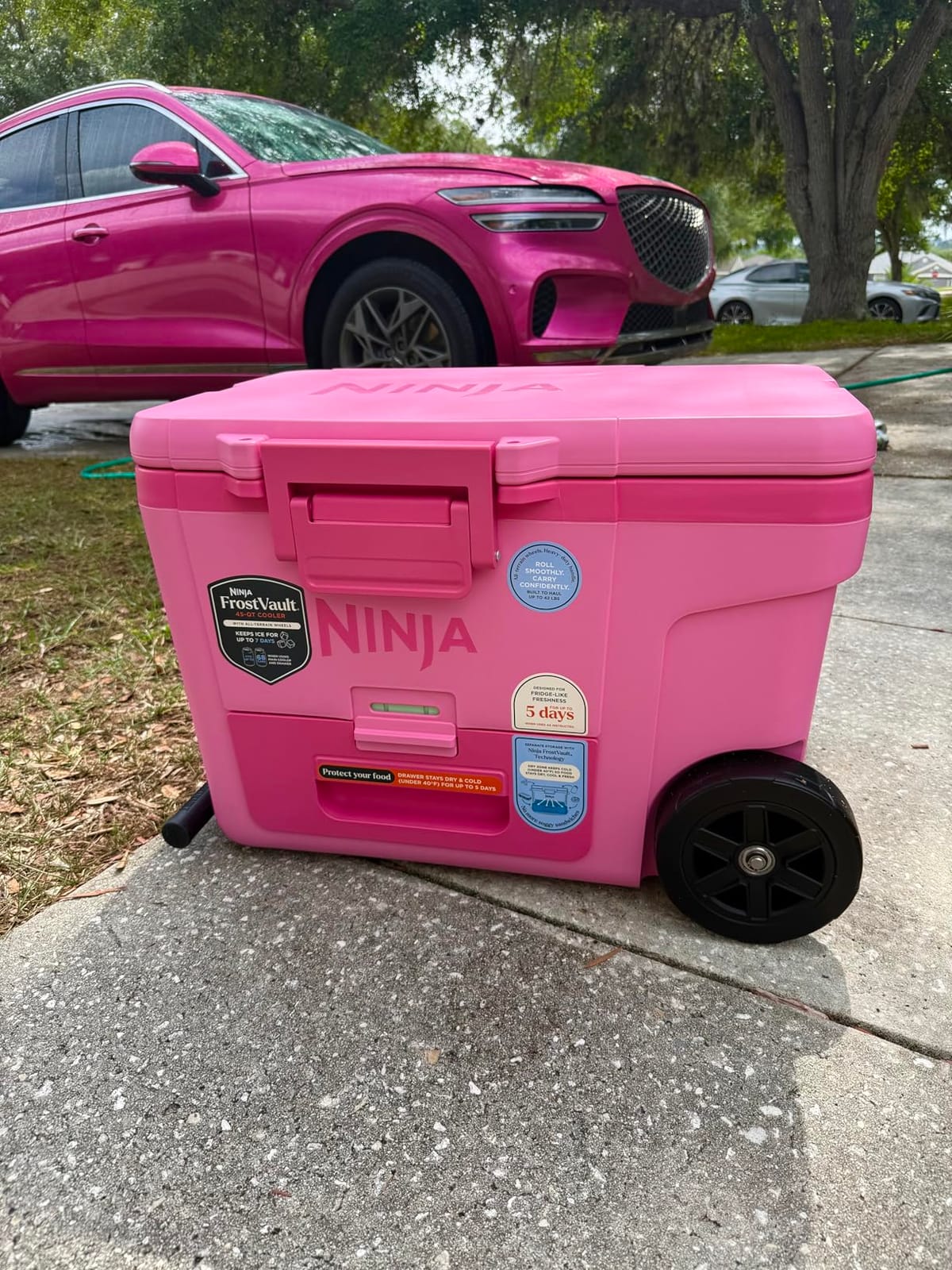
Retention is where the dry zone helps twice. Owners report ice lasting 48-plus hours on a river trip and food staying cold across a full week-long festival, which suggests this behaves like a solid 65-quart cooler when the drawer is not being opened constantly.
The lid is engineered well for week-long use. It stays open instead of slamming, so you can sort through the contents without holding it with one arm for ten minutes at a time.
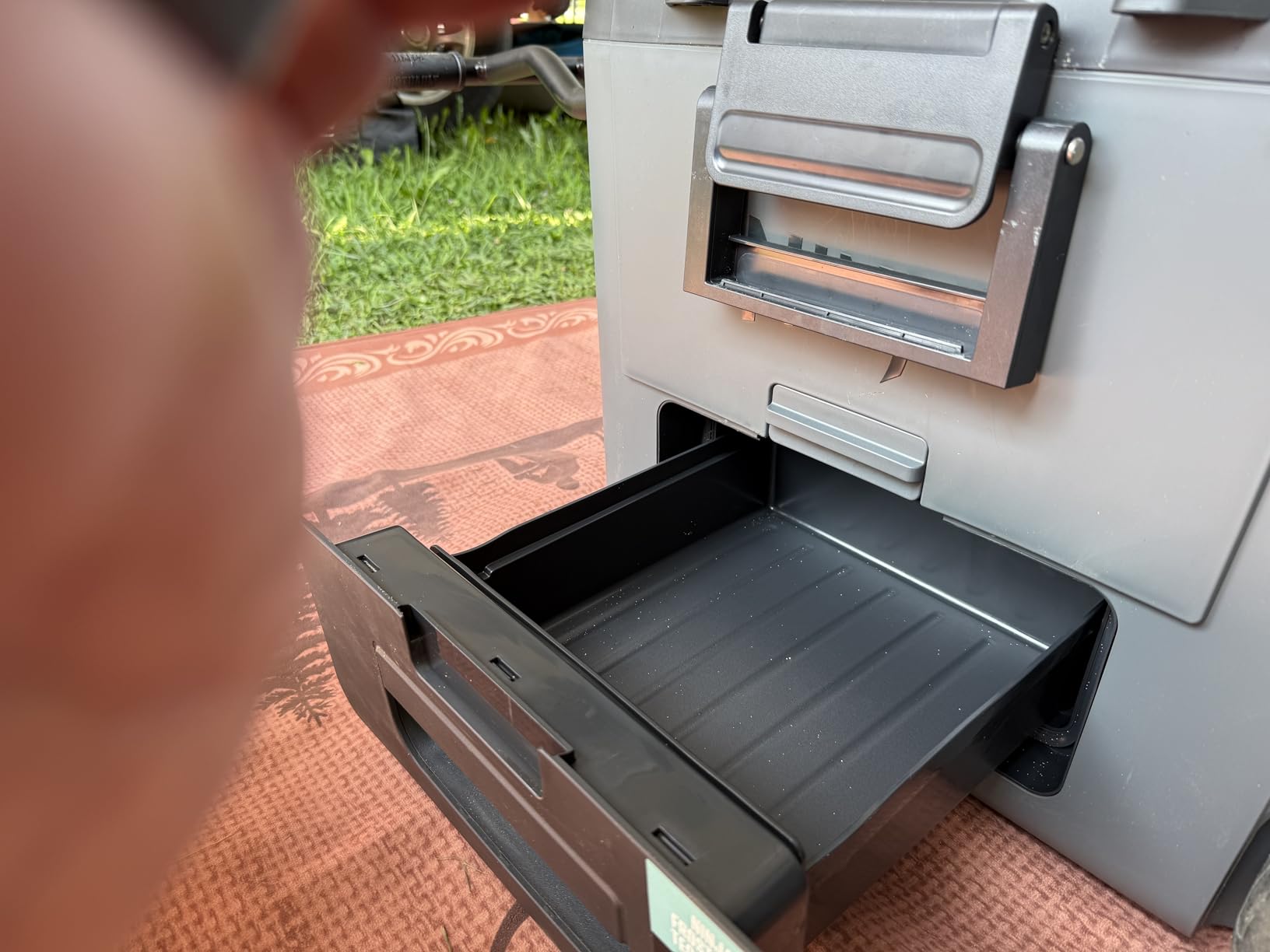
Who the dry zone is actually for
If your group’s week includes bread, tortillas, crackers, or anything that turns to mush on contact with meltwater, this is the cooler that solves your specific problem. This is the closest thing on this list to a wet-and-dry cooler system in one box.
The release latch is also an accessibility feature owners highlight. Owners with arthritic hands single it out as easy to operate one-handed, which matters when you are opening a cooler eight times a day for seven days.
Where it falls short
At 40.5 pounds empty this is the heaviest ice cooler in the roundup, and a loaded one will exceed 150 pounds. The wheels are the only reason that is manageable, so this is a vehicle-adjacent cooler only.
The latches must be closed deliberately, and owners warn that forgetting one admits warm air and undoes the whole design. Wide cup holders that fit 40 oz insulated tumblers are a nice touch but eat space you may want for ice.
10. BougeRV 53 Quart 12V Refrigerator: Best for Off-Grid Power
BougeRV 12V Refrigerator 53 Quart, Electric Car Cooler with MAX/ECO Mode
53 quart 12V compressor fridge
-4F to 50F adjustable
Under 45W in ECO mode
45 dB operation
Pros
- Held food near 32F from Thursday to Monday on ECO
- Under 45W draw in ECO suits a modest power station
- 45 dB is quiet enough to sleep beside
- Handles bolt directly into the frame
Cons
- Tall and bulky for a sedan trunk
- Small upper compartment runs about 15F warmer
- Weak insulation without the optional cover
The BougeRV is the powered pick for the trip with no reliable mains power at all, and the strongest owner report in this category comes straight from a multi-day scenario. One owner kept food at about 32F from Thursday to Monday on ECO mode with a 92Ah lithium iron phosphate battery, and another bought zero bags of ice across a 38-day road trip.
Cooling range runs from -4F to 50F, pulling 77F down to 32F in 15 minutes and reaching -4F in about 60 minutes for the frozen half of the week’s food.
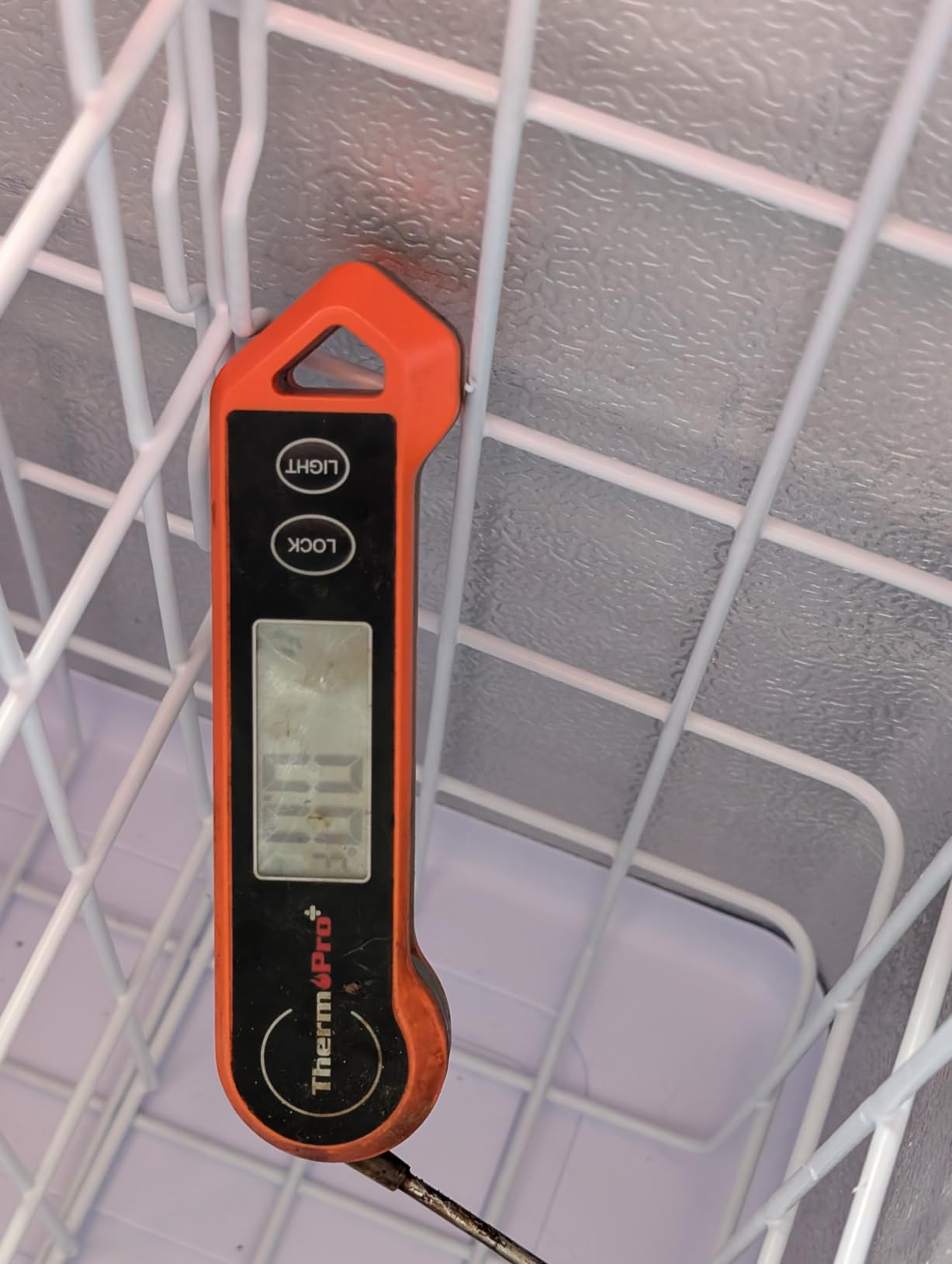
Two sections give you a workable split: a large main zone plus a small upper compartment cooled by air from the larger one. That is not a true dual-zone fridge, but it keeps snacks reachable without opening the cold chamber.
At 45 dB it is quiet enough to sleep beside in a tent or camper, and the handles bolt straight into the frame, which removes the broken-handle failure that plagues lighter portable fridges.
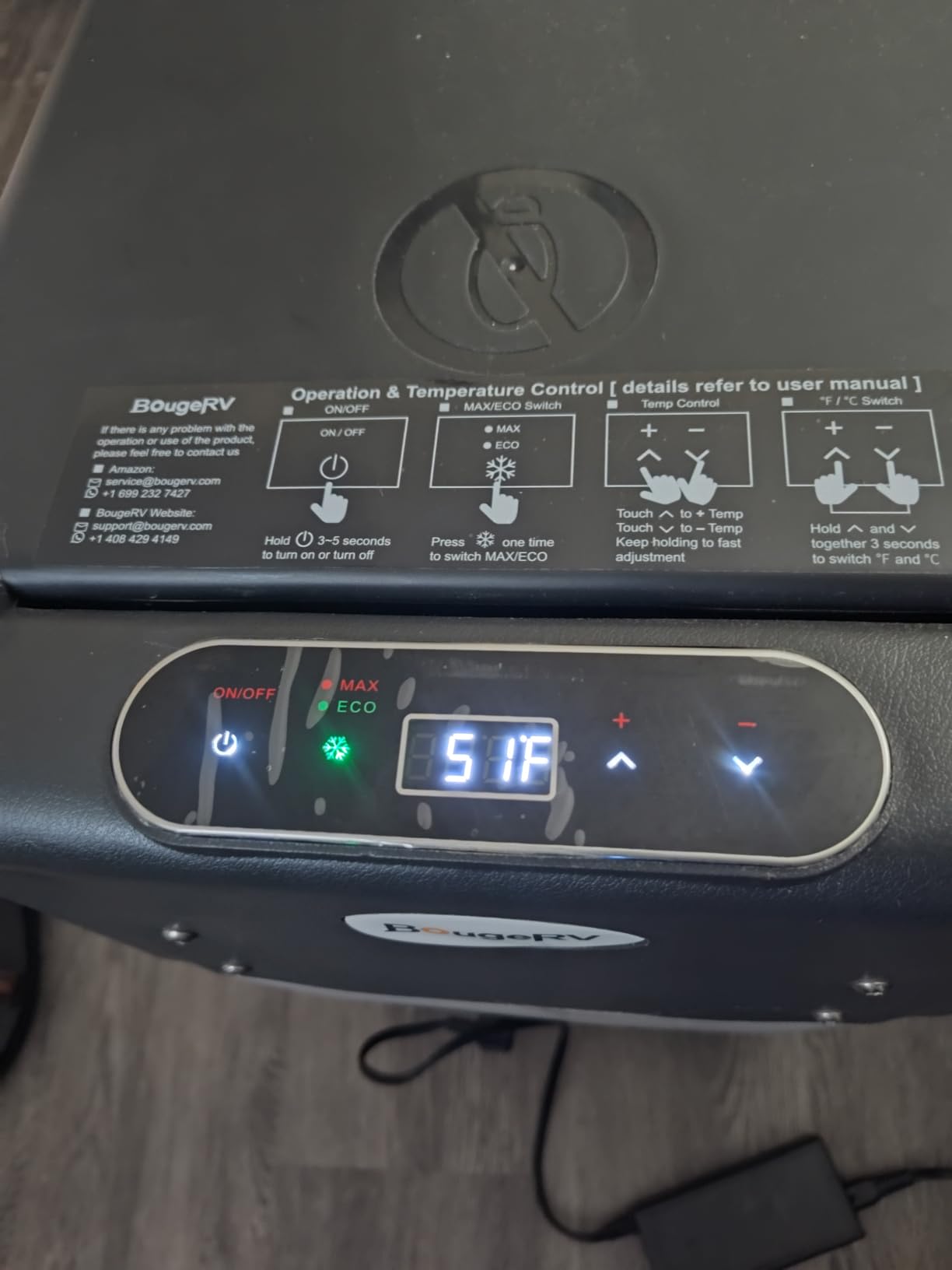
Power budget for a full week
Take the ECO figure of under 45W and a realistic duty cycle, and a compressor holding steady temperature overnight draws in the region of 35 to 45 watt-hours per day. Multiply by seven and you need a power station in the 300 to 500 watt-hour range, with headroom for the freezer zone.
Pair that with a panel and the loop runs indefinitely. This is the configuration that turns a week away from a trailhead with no generator into a normal week away.
Where it falls short
At 18 kilograms and roughly 20.7 inches tall, this is a tall, bulky unit. Owners report it will not fit a sedan trunk without being rigged into the back seat, so measure before buying.
The small upper compartment lacks its own coils and runs about 15F warmer than the main zone. Insulation is also weak without the optional cover, with one owner measuring a fully packed unit warming about 10F in an hour. Buy the cover if you plan to leave frozen food in it, and note the two-year manufacturer warranty.
Electric vs Ice for Seven Days: The Power Budget
Powered coolers and ice coolers get reviewed in separate silos, which is unhelpful when you are planning seven days. Here is the decision in one place.
An ice cooler has a fixed daily cost in labour and ice. A compressor cooler has a fixed daily cost in power. Do the arithmetic and the crossover point depends almost entirely on how often you camp and how much battery you already carry.
Ice cooler daily draw. With a 2:1 ice-to-food ratio, a group of four carries 90 to 100 pounds of ice and replaces roughly a third of it every two to three days in hot weather.
Compressor cooler daily draw. Measured owner figures put ECO-mode compressor fridges at 35 to 45 watt-hours per 24 hours. Multiply by seven days for a week-long trip.
Power station sizing. A 500 watt-hour station covers a week of compressor cooling with margin. Add a 100W panel and the charging problem disappears.
The catch with electric. You need somewhere to run the compressor from, clearance around the unit for airflow, and a battery you are not also using for anything else.
The hard filter. Electric coolers are not bear-resistant. In real bear country, a certified hard cooler is the only legal food-storage choice, and that rules out every powered unit on this list.
Condensation is the other underrated powered-cooler downside. A compressor unit sweats, and over a week that moisture collects inside the cabinet unless you leave the lid cracked during the drive. It is a small thing that gets annoying fast.
If you already carry a power station, the electric path adds almost nothing extra to your kit and is worth considering. If you are buying a cooler from scratch for occasional week-long trips, the ice path is simpler, cheaper in total, and works with zero infrastructure.
How to Choose a Cooler for a Week-Long Trip
Five decisions account for almost all of the difference between a cooler that reaches day six and one that does not.
Size it for the group and the trip, not the badge. Two people for a week can run a 45 to 55 quart cooler. Three to four people want 55 to 65 quarts. Five or more want 80 to 110 quarts, or two smaller coolers you can manage individually. Nameplate capacity also overstates usable volume, because wall thickness and ice consume space you counted on.
Buy rotomolded construction where the budget allows. Rotational molding creates a single continuous plastic shell with even wall thickness and no seam to split. Injection molding is cheaper and lighter but leaves thinner, uneven walls and more stress points, which is why budget coolers lose ice faster over a long week.
Check the gasket and latches before anything else. On a seven-day trip the seal matters more than the foam. A gasket that does not compress evenly, or a latch that pops open on washboard roads, will cost you more ice than any brand difference. Inspect the seal out of the box and trim any over-applied glue.
Treat the loaded weight honestly. A 55 to 65 quart cooler weighs 23 to 29 pounds empty. Add a week of ice and food and you are at 100 to 140 pounds, which is a two-person lift. If your site is far from the vehicle, either buy a wheeled model or plan for a hand truck and a second pair of hands.
Decide hard-sided versus soft-sided. Soft coolers are excellent for one or two days and fall short past three, which is exactly the threshold a week blows past. For this trip length a hard-sided cooler is the only realistic answer.
Two smaller details finish the job. A drain plug or spout lets you remove meltwater daily instead of letting food sit in it, and bear-resistant certification is a hard requirement in backcountry week trips rather than a nice-to-have. Warranty length is the last thing to weigh, and it matters less than ice retention in year one but more in year five.
Frequently Asked Questions
How long will 10 lbs of ice last in a cooler?
Roughly two to three days in a well-packed rotomolded cooler with a block-ice base, and only one to two days in a budget plastic cooler in 90F heat. Expect less in direct sun or with frequent openings. On a week-long trip, plan two to three re-ice stops or carry the weight upfront.
How much ice do you need in a cooler for a week?
Use a 2:1 ice-to-food ratio by weight. A group of four eating fresh for seven days carries about 45 to 50 pounds of food, so budget 90 to 100 pounds of ice, or nine to ten 10-pound bags, and top up every two to three days in hot weather.
What size cooler do I need for a week of camping?
Two people can run a 45 to 55 quart cooler for seven days. Three to four people need 55 to 65 quarts. Five or six need 80 to 110 quarts or two smaller coolers. Remember nameplate capacity overstates usable volume once wall thickness and ice take their share.
Can a portable power station run an electric cooler for 7 days?
Yes, if you size it correctly. Measured owner figures put compressor coolers at roughly 35 to 45 watt-hours per day, so a week needs about 250 to 320 watt-hours. A 500 watt-hour station covers it with margin, and a 100W solar panel closes the loop for the back half of the trip.
Are electric coolers bear resistant?
No. Compressor-powered coolers carry no bear-resistant certification, which rules them out for backcountry week trips in real bear country. A certified hard cooler such as a YETI Tundra 65 or the Lifetime High Performance is the only legal food-storage option there.
How do I keep ice from melting in a cooler?
Pre-chill the empty cooler with sacrificial ice for 24 hours, then use a 2:1 ice-to-food ratio with block ice on the bottom and crushed ice on top. Keep the cooler shaded, open it as few times a day as possible, drain meltwater, and leave it closed overnight.
Is there a cooler as good as a YETI but cheaper?
Often, yes. The RTIC 65 QT Ultra-Tough uses rotomolded polyethylene with 2.4-inch closed-cell foam and a freezer-style gasket, and owners report ice lasting a full seven days through heat waves at a noticeably lower price. Construction and packing method matter more over a week than the badge.
How long does dry ice last in a cooler?
Dry ice sublimates rather than melts, so it lasts considerably longer than wet ice and leaves no meltwater behind. It works well for the back half of a week-long trip. Never seal it in an airtight container, never handle it bare-handed, and keep food from resting directly against it.
Our Verdict for a Week Away
The best camping cooler for week-long trips is the YETI Tundra 65. Its rotomolded shell, 3 inches of PermaFrost insulation and Bear-Resistant certification make it the pick that still has ice on day six when everything else has turned to cold soup, and the 65-quart capacity fits a group of four’s week without a second cooler.
Buy the RTIC 65 QT Ultra-Tough instead if the premium tier does not make sense for your budget. It matches the retention behaviour most owners report, uses less ice per day, and the difference in outcome over seven days is smaller than the difference in outlay. Add the Lifetime High Performance for bear country, or the Coleman Classic 100qt if you need wheels and capacity for six people.
Choose the compressor route only when you already carry serious power, and remember that no electric cooler is bear-resistant. Whichever path you take, pre-chill the shell, pack a 2:1 ice-to-food ratio with block ice underneath, eat the food from the top down, and treat every claimed retention figure as roughly double what you will actually get in the sun.
We will keep testing these coolers through the 2026 season and update this roundup as the data comes in.