
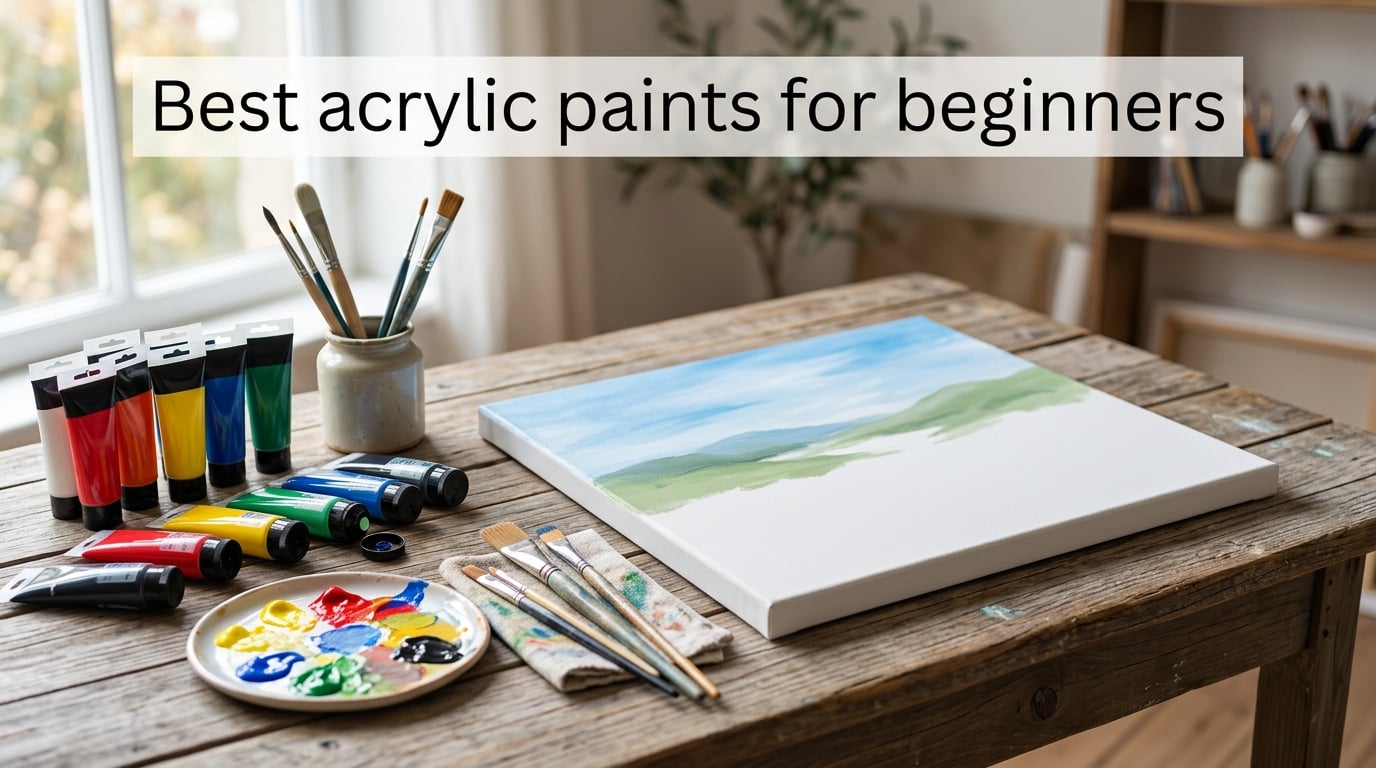
Acrylic paint is a fast-drying, water-based medium made by suspending pigment in an acrylic polymer emulsion. For beginners in 2026, it offers the easiest entry point into painting: it dries quickly, cleans up with water, and forgives mistakes you can paint over once a layer dries. In this guide, I’ll walk you through everything you need to know before buying your first acrylic paints from understanding paint types and grades to building a starter palette and avoiding the mistakes that trip up most new painters.
Table of Contents
What Are Acrylic Paints?
Acrylic paint is a water-based paint made from pigment suspended in an acrylic polymer emulsion. When wet, it thins and cleans up with water. Once dry, it becomes water-resistant and flexible.
Acrylics were first developed in the 1950s and quickly gained popularity because they combine the best qualities of oils and watercolors. They offer the opacity and vibrancy of oil paints with the fast drying time and easy cleanup of watercolors.
Today, acrylics are used on canvas, paper, wood, fabric, and even metal. They’re one of the most versatile paint mediums available, which is exactly why so many art instructors recommend them as the starting point for new painters.
Why Acrylics Are Great for Beginners
Acrylics are the most forgiving paint medium for beginners because they dry fast, clean up with water, and let you paint over mistakes once a layer dries.
Unlike oil paints, acrylics have almost no odor and don’t require solvents like turpentine. You can paint in a small apartment or bedroom without worrying about ventilation as much. Water cleanup also means you avoid the messy solvent-based cleaning that oils demand.
The fast drying time (typically 15-30 minutes for thin layers) means you can build up layers quickly. Some beginners find this frustrating at first because it limits blending time. But it also means you can fix errors fast. Painted something you don’t like? Wait a few minutes and paint right over it.
Acrylics are also remarkably affordable compared to artist-grade oils. A solid set of student-grade acrylics costs significantly less than a comparable oil set, making the financial barrier to entry much lower.
Types of Acrylic Paint Explained
There are five main types of acrylic paint: heavy body, soft body, fluid, acrylic ink, and open acrylics. Each has a different consistency suited to different techniques.
Heavy Body Acrylics
Heavy body acrylics have a thick, buttery consistency similar to oil paint. They hold brush strokes and texture marks, making them ideal for palette knife work and impasto techniques. If you want visible texture in your paintings, heavy body is the way to go.
Soft Body (Fluid) Acrylics
Soft body acrylics have a smoother, more flowing consistency. They’re easier to mix and spread evenly, making them a popular choice for beginners who are still learning brush control. They work well for flat color areas and detail work.
Fluid Acrylics
Fluid acrylics are even thinner than soft body but pack the same pigment concentration as heavy body paints. They flow easily and are great for pouring techniques, watercolor-like washes, and fine detail work with small brushes.
Acrylic Ink
Acrylic ink is the most fluid form of acrylic paint. It has an ink-like consistency but uses the same acrylic polymer binder. Artists use it for airbrushing, calligraphy, and mixed media work. It’s not typically the first choice for beginners learning to paint.
Open Acrylics
Open acrylics are formulated to stay workable much longer than standard acrylics sometimes for hours instead of minutes. This gives you more time to blend and adjust, which can be helpful if the fast drying time of regular acrylics frustrates you. They behave more like oils while still offering water cleanup.
Student Grade vs Artist Grade Acrylic Paint
Student grade acrylics use less pigment and more filler, while artist grade paints contain higher pigment concentrations with better lightfastness. For beginners, student grade is the right starting point.
Student grade paints are designed to be affordable while still offering reasonable color payoff. Brands like Liquitex Basics, Winsor and Newton Galleria, and Apple Barrel fall into this category. They’re perfectly capable of producing good paintings while you’re learning technique.
Artist grade paints (from brands like Golden, Liquitex Professional, and Winsor and Newton Professional) contain more pigment per ounce and use higher-quality pigments. Colors are more vibrant, mixtures are cleaner, and the paint maintains its color better over time. But they cost 3-5 times more than student grade.
The general advice from experienced painters: start with student grade. Once you’ve developed your technique and know which colors you use most, invest in artist grade versions of your favorites. There’s no point spending money on premium paint while you’re still learning brush control and color mixing.
Cheap vs Expensive Acrylic Paint: What You Actually Get
The main difference between cheap and expensive acrylic paint is pigment concentration. Cheap paints use more filler and less pigment, resulting in weaker color payoff and poorer coverage.
The cheapest paints typically sold as “craft acrylics” in squeeze bottles can feel chalky once dry. Forum discussions from experienced painters consistently warn against using these for serious canvas work. The colors look dull, mixtures turn muddy, and you end up using more paint to get decent coverage.
Mid-range student grade paints (the ones I recommend for beginners) sit in a sweet spot. They have enough pigment to produce vibrant, opaque colors and mix predictably. You’ll notice the difference immediately compared to craft store paints.
Expensive artist grade paints offer richer color, smoother consistency, and better lightfastness. But for a beginner still learning the basics, the improvement won’t justify the cost. Stick with quality student grade until your skills demand more from your materials.
What to Look for When Buying Acrylic Paint
When shopping for acrylic paint, focus on five key factors: pigmentation, consistency, lightfastness, drying time, and color shift. These properties determine how the paint performs and how your finished painting will look.
Pigmentation
Pigmentation refers to how much pigment is in the paint. Higher pigmentation means more vibrant colors, better coverage, and cleaner mixtures. You can gauge pigmentation by painting a swatch over a dark line if the line shows through, the pigment load is low.
Consistency
Consistency affects how the paint handles on your brush and canvas. Heavy body paints feel thick and hold texture. Soft body paints flow smoothly. The right consistency depends on your painting style, but soft body is generally easiest for beginners to control.
Lightfastness
Lightfastness measures how well a color resists fading when exposed to light over time. Paints are rated on a scale: ASTM I (excellent) to ASTM V (very poor). For paintings you want to last, choose colors rated ASTM I or II. Student grade paints often have lower lightfastness ratings.
Drying Time
Standard acrylics dry in 15-30 minutes for thin layers, though thick applications can take hours. Fast drying is both an advantage (quick layering) and a challenge (less blending time). If you need more working time, look for open acrylics or add a retarder medium to your regular paint.
Color Shift
Color shift is the change in appearance acrylic paint undergoes as it dries. Most acrylics dry slightly darker than they appear when wet. This is more noticeable with lighter colors and cheaper paints. Test a swatch and let it dry before committing to a color in your painting.
Opacity vs Transparency
Some acrylic colors are opaque (they cover what’s underneath) while others are transparent (they let underlying layers show through). Tubes are usually labeled with an opacity symbol: a filled square means opaque, an empty square means transparent. Beginners generally find opaque colors easier to work with.
The Best Beginner Starter Palette: Which Colors to Buy First
Beginners need just 6-10 colors to start. A limited palette teaches color mixing and prevents the overwhelm of choosing from dozens of options.
Here’s the starter palette I recommend:
- Warm Yellow (Cadmium Yellow or Yellow Ochre)
- Cool Yellow (Lemon Yellow or Hansa Yellow)
- Warm Red (Cadmium Red or Pyrrole Red)
- Cool Red (Alizarin Crimson or Quinacridone Red)
- Warm Blue (Ultramarine Blue)
- Cool Blue (Phthalo Blue or Cerulean Blue)
- White (Titanium White)
- Black (Mars Black or Carbon Black)
With these eight colors, you can mix a surprisingly wide range of hues. Having both warm and cool versions of the primaries (red, yellow, blue) gives you cleaner, more vibrant mixtures. Many experienced painters on Reddit’s r/learnart forum regret buying large 24+ color sets before learning to mix colors from a small palette.
You can add Burnt Umber and Burnt Sienna later as they’re extremely useful for mixing earth tones and darkening colors without using black.
How to Start Painting with Acrylics: A Step-by-Step Guide
Starting acrylic painting requires just a few basic supplies and some simple preparation. Here’s how to set up and paint your first acrylic piece.
Step 1: Gather Your Supplies
You’ll need acrylic paints (the starter palette above), brushes (a flat wash brush, a medium round, and a small detail brush to start), a palette (a disposable paper palette or a plastic plate works fine), a water cup, paper towels, and a surface to paint on (canvas paper or a pre-stretched canvas).
Step 2: Set Up Your Workspace
Protect your table with newspaper or a plastic sheet. Fill your water cup. Squeeze small amounts of paint onto your palette. Acrylics dry quickly, so only squeeze out what you’ll use in 20-30 minutes.
Step 3: Start with Simple Exercises
Before jumping into a painting, practice basic brush strokes. Paint flat color swatches, practice blending two colors together, and experiment with thinning paint with water. This builds familiarity with how acrylics behave.
Step 4: Sketch Your Composition
Use a pencil to lightly sketch your subject onto the canvas. Keep it simple for your first painting: a basic landscape, a piece of fruit, or an abstract color study are all good starting points.
Step 5: Paint from Background to Foreground
Start with the largest areas and background colors. Work from dark to light and from background to foreground. Let each layer dry before adding details on top. This prevents muddy colors and gives your painting depth.
Step 6: Clean Up Properly
Rinse brushes thoroughly in water while the paint is still wet. Acrylic paint dries permanently and will ruin brushes if left to harden. Reshape brush bristles and lay them flat to dry.
Common Beginner Mistakes and How to Avoid Them
Most beginner acrylic painting mistakes come from not understanding how the medium behaves. Here are the most common pitfalls and how to avoid them.
Over-Thinning with Water
Adding too much water breaks down the acrylic polymer, causing the paint to lose adhesion and appear chalky when dry. The general rule: don’t add more than 25-30% water to your paint. If you want a thinner consistency, use an acrylic medium instead.
Not Waiting for Layers to Dry
Painting wet paint over a still-dry layer causes colors to mix on the canvas, creating muddy results. Be patient. Use a hair dryer on low heat to speed up drying if you’re impatient, or switch to open acrylics if you prefer working wet-on-wet.
Using Too Many Colors
Starting with too many colors makes mixing confusing and produces less harmonious paintings. Stick to your limited palette. You’ll learn color theory faster and produce better results.
Skipping the Sketch
Jumping straight into painting without a pencil sketch leads to proportion and composition problems. Even a rough sketch gives you a roadmap and prevents frustrating mid-painting corrections.
Leaving Brushes in Water
Soaking brushes tip-down in water bends the bristles and loosens the ferrule (the metal part). Rinse brushes and lay them flat. Never leave them sitting in your water cup.
What Else You Need: A Beginner’s Acrylic Supplies Checklist
Beyond paint, you’ll need a few essential supplies to start painting. Here’s the complete checklist.
- Brushes: Start with 3-4 brushes: a 1-inch flat wash, a medium round (size 6-8), a small round (size 2-4), and optionally a fan brush for textures
- Palette: A disposable paper palette pad, a plastic palette, or even a ceramic plate
- Surface: Canvas paper pads (most affordable for practice), pre-stretched canvases, or acrylic painting paper
- Water containers: Two cups one for rinsing, one for clean water for mixing
- Paper towels or rags: For blotting brushes and cleaning up
- Easel (optional): A tabletop easel improves your painting posture but isn’t essential to start
- Acrylic medium (optional): A retarder medium extends drying time; a gloss or matte medium thins paint without weakening adhesion
Acrylic Paint Safety and Ventilation
Acrylic paint is generally non-toxic and safe for home use. Unlike oil paints, it doesn’t require solvents like turpentine or mineral spirits, which produce harmful fumes.
However, some pigments (particularly cadmium and cobalt) can be hazardous if ingested or if dust is inhaled. Always wash your hands after painting and avoid eating or drinking at your painting station. If you sand dried acrylic paint, wear a dust mask.
Good ventilation is still recommended when painting for extended periods, even with water-based acrylics. Open a window or work in a room with decent airflow. This is especially important if you’re using spray varnishes or aerosol fixatives on finished paintings.
Frequently Asked Questions
What are acrylic paints?
Acrylic paints are water-based paints made from pigment suspended in an acrylic polymer emulsion. They clean up with water while wet and become water-resistant once dry. They can be used on canvas, paper, wood, and many other surfaces.
What’s the difference between student and artist grade acrylic paint?
Student grade acrylics use less pigment and more filler, making them more affordable but with weaker color payoff. Artist grade paints have higher pigment concentrations, cleaner mixtures, and better lightfastness but cost 3-5 times more. Beginners should start with student grade.
How many colors do beginners need in an acrylic paint set?
Beginners need just 6-10 colors: warm and cool versions of the three primaries (red, yellow, blue) plus white and black. A limited palette teaches color mixing and produces more harmonious paintings than starting with dozens of colors.
How long do acrylic paints take to dry?
Standard acrylics dry in 15-30 minutes for thin layers, though thick applications can take several hours. Open acrylics are formulated to stay workable for much longer. You can speed drying with a hair dryer on low heat or slow it with a retarder medium.
Do you need special brushes for acrylic paint?
No special brushes are required. Synthetic brushes work well with acrylics and are more affordable than natural hair brushes. Start with 3-4 brushes: a flat wash, a medium round, a small round, and optionally a fan brush for textures.
Is cheap acrylic paint bad for beginners?
The cheapest craft store acrylics can be frustrating to use. They often feel chalky when dry, produce dull mixtures, and require more paint for decent coverage. Mid-range student grade paints from brands like Liquitex Basics or Winsor and Newton Galleria offer a much better experience at a reasonable cost.
What’s the difference between heavy body and soft body acrylic paint?
Heavy body acrylics have a thick, buttery consistency that holds brush strokes and texture marks. Soft body acrylics have a smoother, more flowing consistency that spreads easily and works well for beginners still developing brush control.
Are acrylic paints water-based?
Yes, acrylic paints are water-based. They thin and clean up with water while wet. Once dry, the acrylic polymer forms a water-resistant film. This makes them much easier to work with than oil paints, which require solvents.
Conclusion
Choosing the best acrylic paints for beginners comes down to understanding a few key factors: student grade over artist grade to start, a limited palette of 6-10 colors, and mid-range brands like Liquitex Basics or Winsor and Newton Galleria that balance quality with affordability. Don’t overthink it. Grab a small set of colors, a few brushes, and a canvas pad, and start painting. You’ll learn more from one afternoon of painting than from weeks of research. Acrylics are forgiving, fast-drying, and endlessly versatile exactly what a beginner needs to build confidence and find their creative voice.