
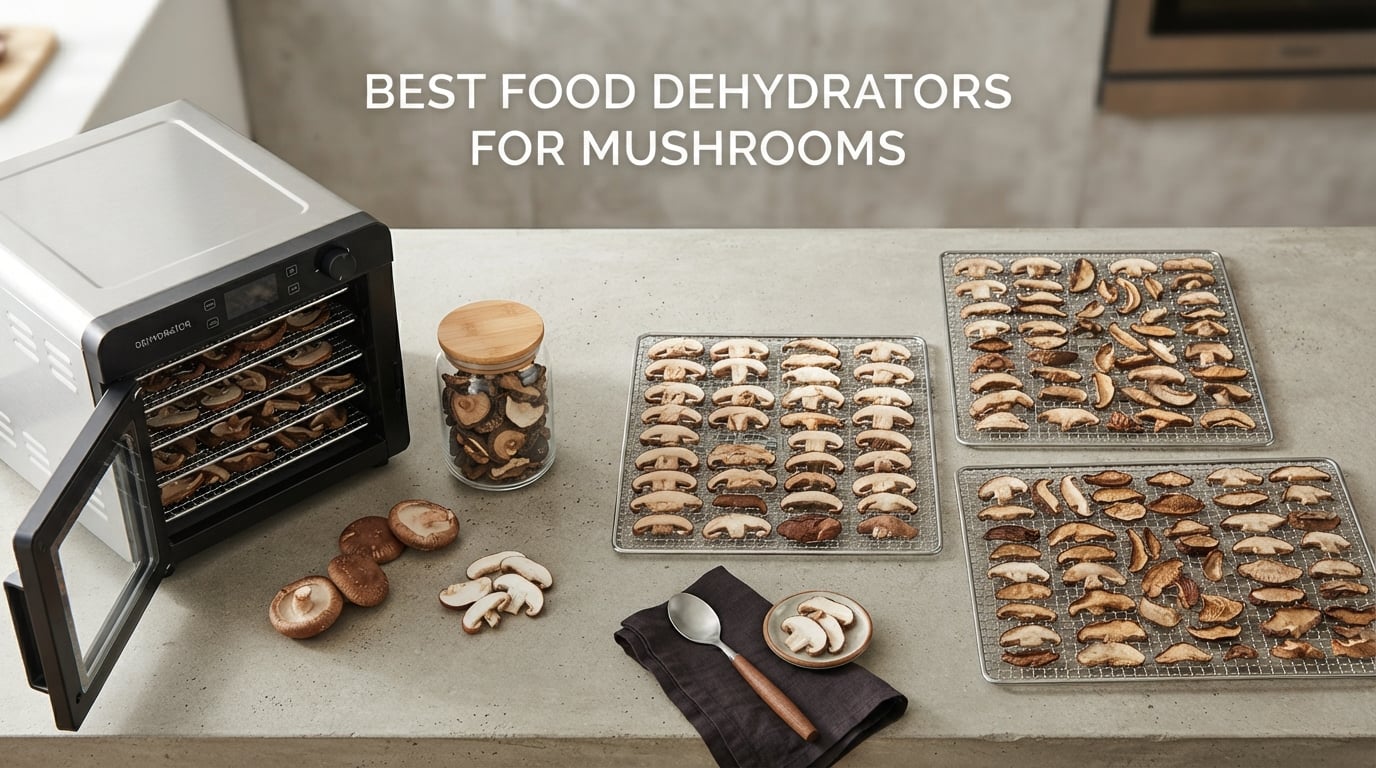
If you grow mushrooms, forage them, or keep buying a carton that goes soft in four days, a food dehydrator turns a two-day harvest into a year of usable stock. Fresh mushrooms are roughly 85 to 90 percent water, so without some form of preservation most of what you pick ends up in the compost. Drying is the least expensive preservation method available in a home kitchen, and it concentrates flavor into something that rehydrates into soups, sauces and powders all winter.
Here is the short version of the best food dehydrators for mushrooms, before the detail:
Best overall: the Cosori 6-Tray stainless steel dehydrator, rated 4.7 from more than 21k reviews, with a rear-mounted fan and 6.5 sq ft of drying space.
Best for large batches: the Magic Mill Pro with 7 full-size stainless trays and a 600W rear fan, rated 4.7 from more than 2k reviews.
Best value and most expandable: the NESCO FD-75A Snackmaster Pro, which grows from 5 to 12 trays and is a long-running forum favorite.
Best budget: the Cosori 5-Tray BPA-Free unit at 350W, rated 4.6 from more than 9k reviews.
One honest note up front. Growers searching for a unit that holds a whole mature cap will not find a true extra-tall-tray machine in this group. Every model here is a square or round box with fixed tray spacing, so whole caps need either a tall-cap-friendly layout or a quick quartering cut. I explain how to size for that in the whole caps section below.
Not sure which bucket you fall into? Start here:
Grower with a weekly flush of a few pounds: you want 6 or more trays and a rear-mounted fan so you never rotate mid-cycle.
Forager or weekend buyer: five trays at 350W is plenty, and a quiet unit matters more than wattage.
Apartment cook drying herbs and mushrooms on one appliance: compact footprint and dishwasher-safe trays decide it.
Homesteader running multi-day cycles: an 80-hour timer and easy sanitizing matter more than anything else.
Table of Contents
Top 3 Picks for Mushroom Drying (October 2026)

Cosori 6-Tray Stainless Dehydrator
- 6 stainless trays and 6.5 sq ft
- 600W rear-mounted fan
- Digital 95-165F with 48-hour timer
- Under 48 dB
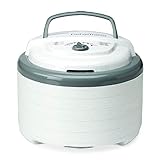
NESCO FD-75A Snackmaster Pro
- 5 trays expandable to 12
- 600W Converga-Flow top fan
- 95-160F adjustable control
- USA assembly

Cosori 5-Tray BPA-Free Dehydrator
- 5 BPA-free trays expandable to 7
- 350W with 1 degree increments
- 48-hour timer in 30-minute steps
- Under 47 dB
All 8 Dehydrators Compared Side by Side
Every unit below runs a 95F to 158F-plus range, so all of them can hold the low, slow 95F to 110F window that mushrooms actually want. The differences that matter for mushrooms are tray count, tray shape, fan placement and timer length.
| Product | Specs | Action |
|---|---|---|
| Cosori 6-Tray Stainless Dehydrator |
|
Check Latest Price |
| NESCO FD-75A Snackmaster Pro |
|
Check Latest Price |
| Cosori 5-Tray BPA-Free Dehydrator |
|
Check Latest Price |
 Magic Mill 5-Tray Stainless Dehydrator Magic Mill 5-Tray Stainless Dehydrator |
|
Check Latest Price |
 Magic Mill Pro 7-Tray All-Stainless Dehydrator Magic Mill Pro 7-Tray All-Stainless Dehydrator |
|
Check Latest Price |
 Elite Gourmet 4-Tray Dehydrator Elite Gourmet 4-Tray Dehydrator |
|
Check Latest Price |
 Rosewill 5-Tray Round Dehydrator Rosewill 5-Tray Round Dehydrator |
|
Check Latest Price |
 Excalibur 8-Tray Select Series Excalibur 8-Tray Select Series |
|
Check Latest Price |
1. Cosori 6-Tray Stainless Steel Dehydrator: Best Overall
Cosori Food Dehydrator, 6 Stainless Steel Trays with 6.5 ft² Drying Space
6 stainless steel trays and 6.5 sq ft
600W with rear-mounted fan
95-165F digital and 48-hour timer
Under 48 dB
Pros
- 6.5 sq ft across 6 stainless trays
- Rear-mounted fan removes tray rotation
- Under 48 dB for overnight runs
- 48-hour timer with auto shutoff
- Dishwasher-safe trays
Cons
- Larger countertop footprint
- Only 6 trays without buying extra ones
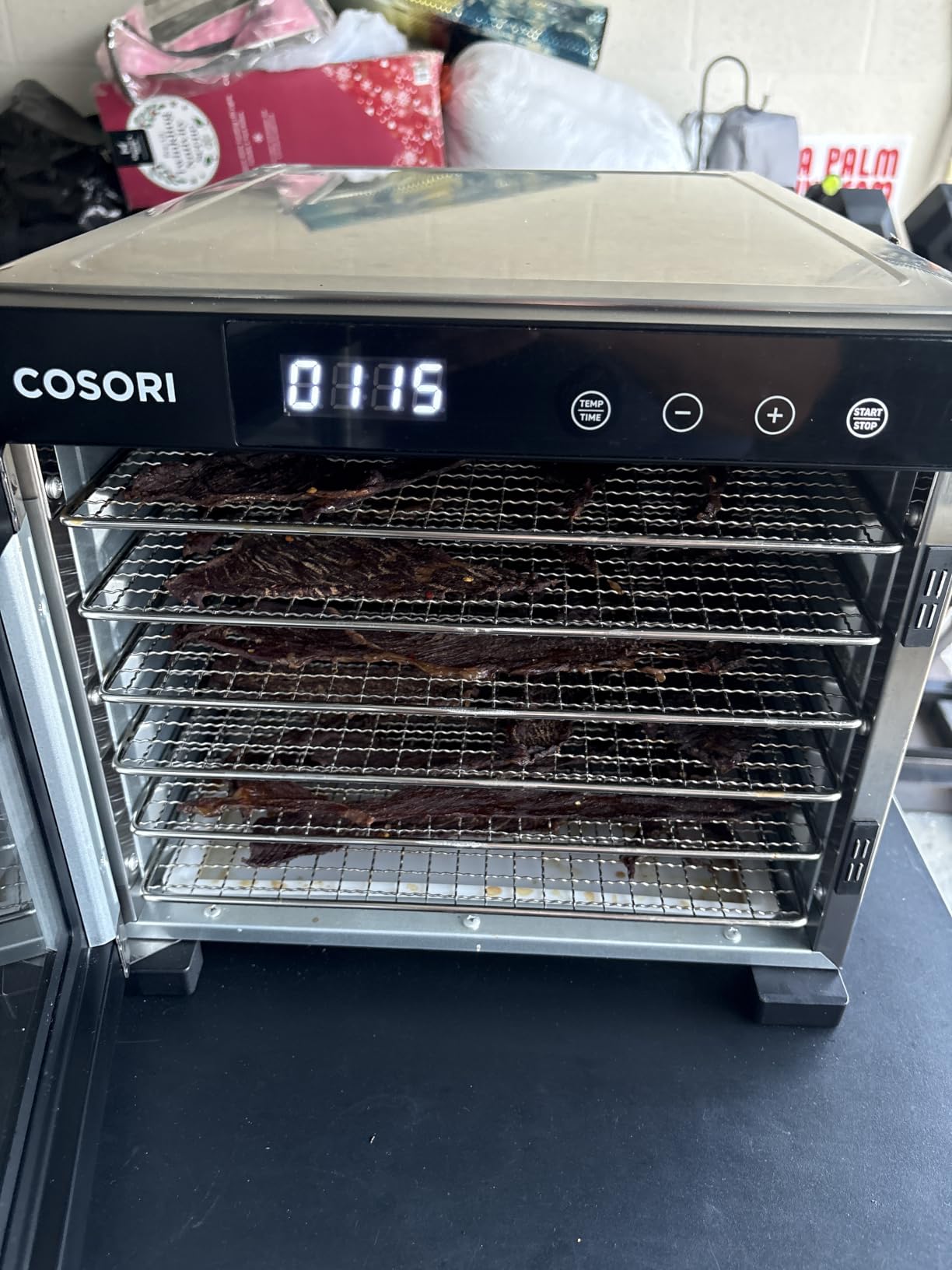
This is the unit I keep coming back to. The Cosori CP267-FD puts six stainless trays into 6.5 sq ft of square drying space, driven by a 600W element and a rear-mounted fan that pushes air horizontally across every tray at once. That fan position is the single feature that changes mushroom work, because it is the reason you do not have to pull half your load out and swap it halfway through a 12-hour run.
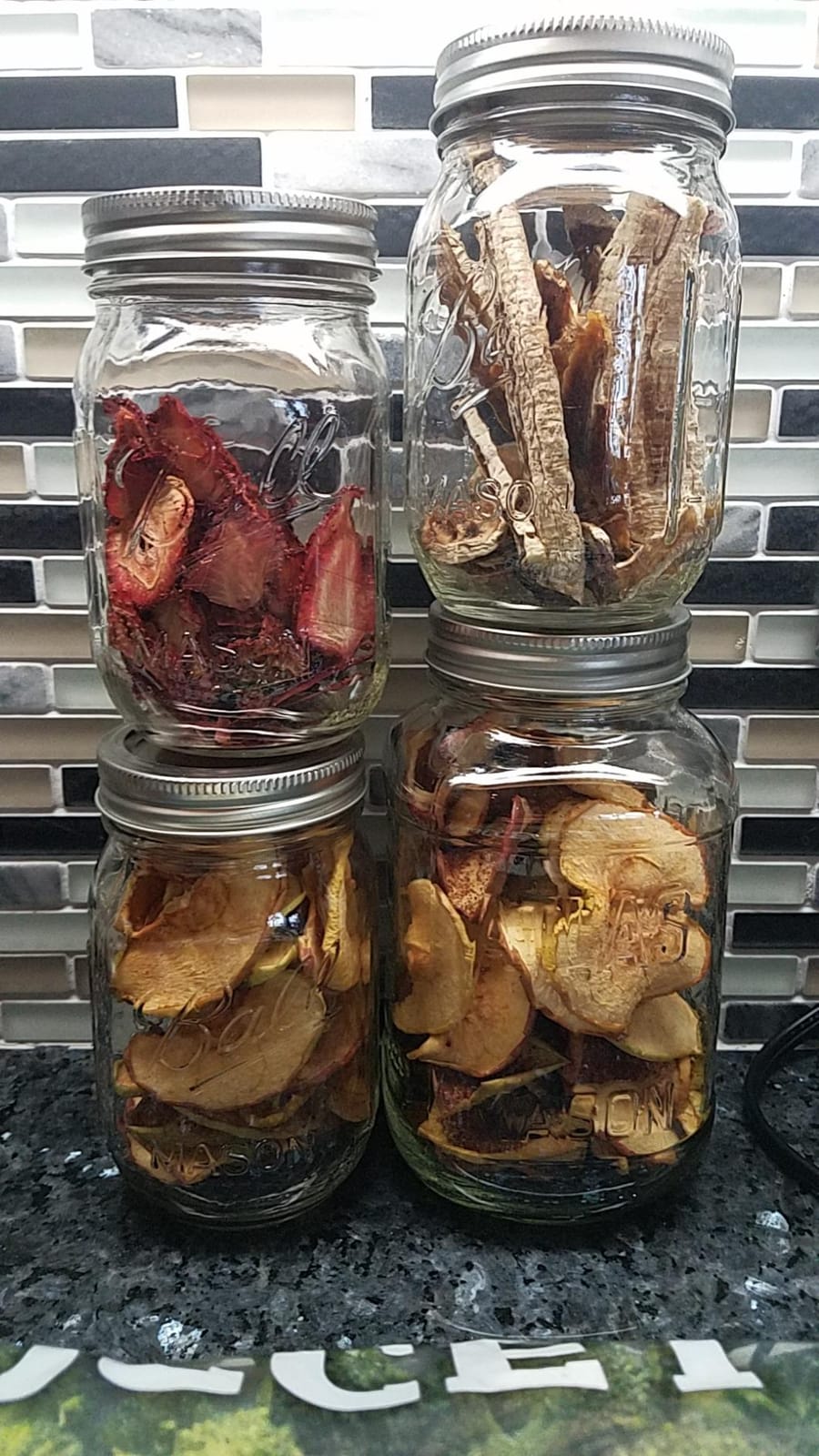
My mushroom batches on this machine are quarter-inch slices of cremini and oyster laid in a single layer with visible gaps between pieces. At 100F to 110F they are leathery and snapping dry in roughly 8 hours, with the bottom tray matching the top tray closely enough that I stopped rotating years ago. The stainless trays also survive the dishwasher between batches, which matters more than it sounds when you are handling a fresh flush that has not been washed thoroughly.
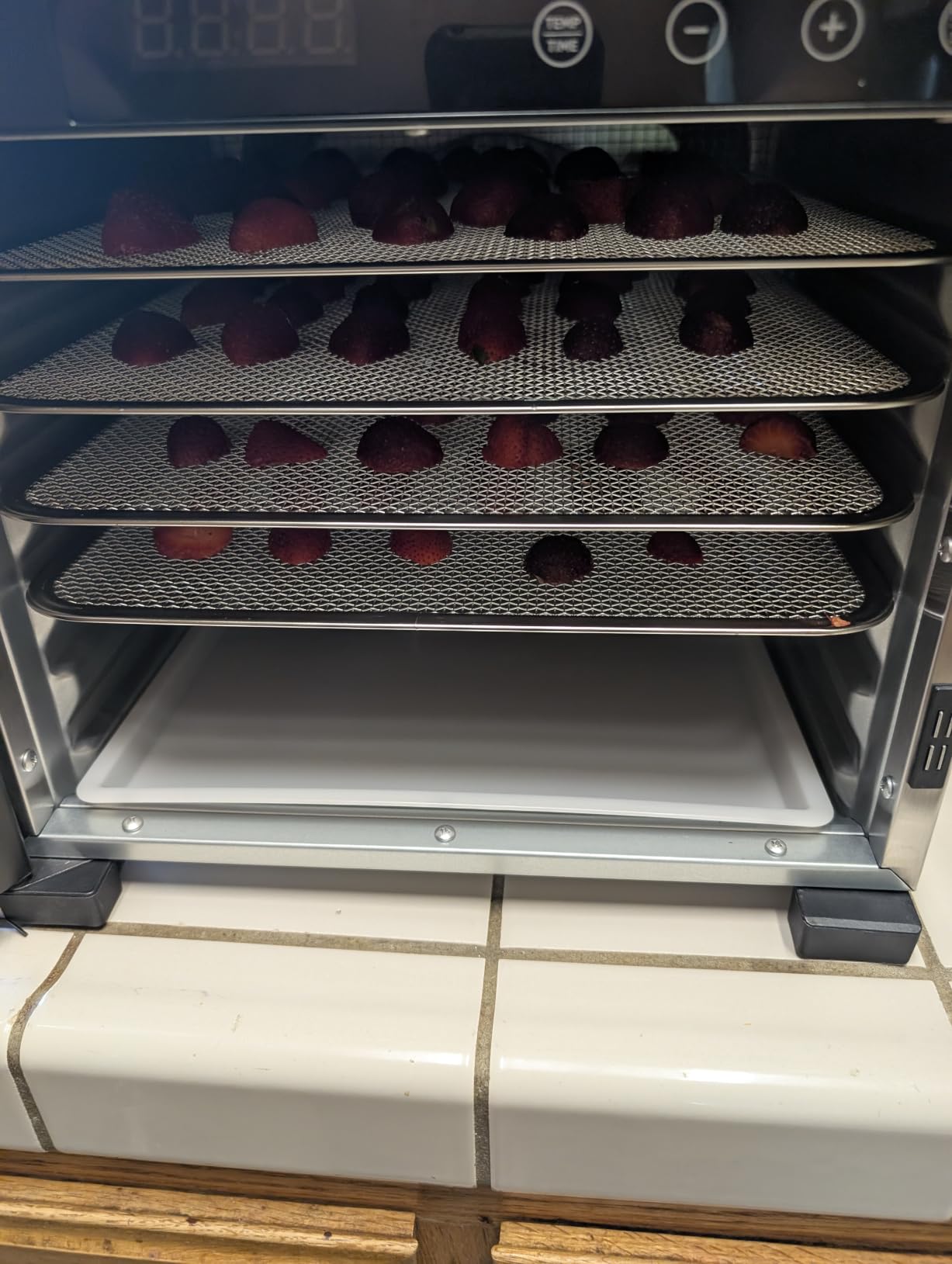
Control is digital from 95F to 165F, and the 48-hour timer with auto shutoff means I can start a load before bed and walk away. The brushless motor keeps the whole thing under 48 dB, which is quiet enough to run in a kitchen that is not a closed room. Owners report long-run reliability across more than 21k reviews, and the box includes a fruit roll sheet, a mesh screen and a recipe book.
Sizing it to your harvest is simple. Six square trays at single-layer spacing hold roughly 6 to 9 pounds of fresh sliced mushrooms, so a heavier flush runs across two cycles rather than one. The unit weighs 18.1 pounds and measures 17.8 inches deep by 13.4 inches wide, so give it clear counter space rather than tucking it into a corner where the rear fan cannot pull air.
What it does well for mushrooms
The rear fan and horizontal airflow are the reason this is my first choice. Rear-mounted fan layouts are the ones growers describe as even-drying, and even drying is what prevents the damp centers that later turn into mold in a storage jar.
The temperature range reaches down to 95F and the digital panel holds steady settings, so a long 100F cycle for shiitake slices is a set-and-forget job. Dishwasher-safe trays also mean sanitizing between mushroom batches, which is a real concern for anyone working with fresh, unsterilized harvest material.
Where it falls short
There is no built-in way to make trays taller. A mature portobello cap laid flat will sit proud of the tray walls, so you still quarter it, even on this machine. Reviewers who buy expecting a commercial mushroom dryer are disappointed by the fixed square tray spacing.
At 18.1 pounds and nearly 18 inches deep, this is not a small-appliance purchase. It also ships with six trays only, so a second machine means buying accessory trays and losing the square geometry. The 165F ceiling is fine for mushrooms and fruit, just keep in mind it is not the highest range in this group.
2. NESCO FD-75A Snackmaster Pro: Best Value and Most Expandable
NESCO FD-75A Snackmaster Pro Food Dehydrator, For Snacks, Fruit, Beef Jerky, Gray
5 trays expandable to 12
600W Converga-Flow top fan
95-160F adjustable control
USA assembly, 7.7 lbs
Pros
- Expands from 5 to 12 trays
- Top-mounted fan keeps drips off the element
- No tray rotation needed
- USA assembly
- Quiet operation
Cons
- Plastic construction and trays
- No built-in timer or on/off switch
- Tray cleaning is tedious in the crevices
The FD-75A is the machine most experienced growers actually own, and the Shroomery forum thread on mushroom cultivation keeps recommending the Snackmaster as the mid-range sweet spot. It starts with 5 trays and stacks up to 12, so a hobbyist can start small and add capacity as flushes get bigger. The 600W Converga-Flow system circulates air downward from a top-mounted fan, so nothing drips onto the heating element.
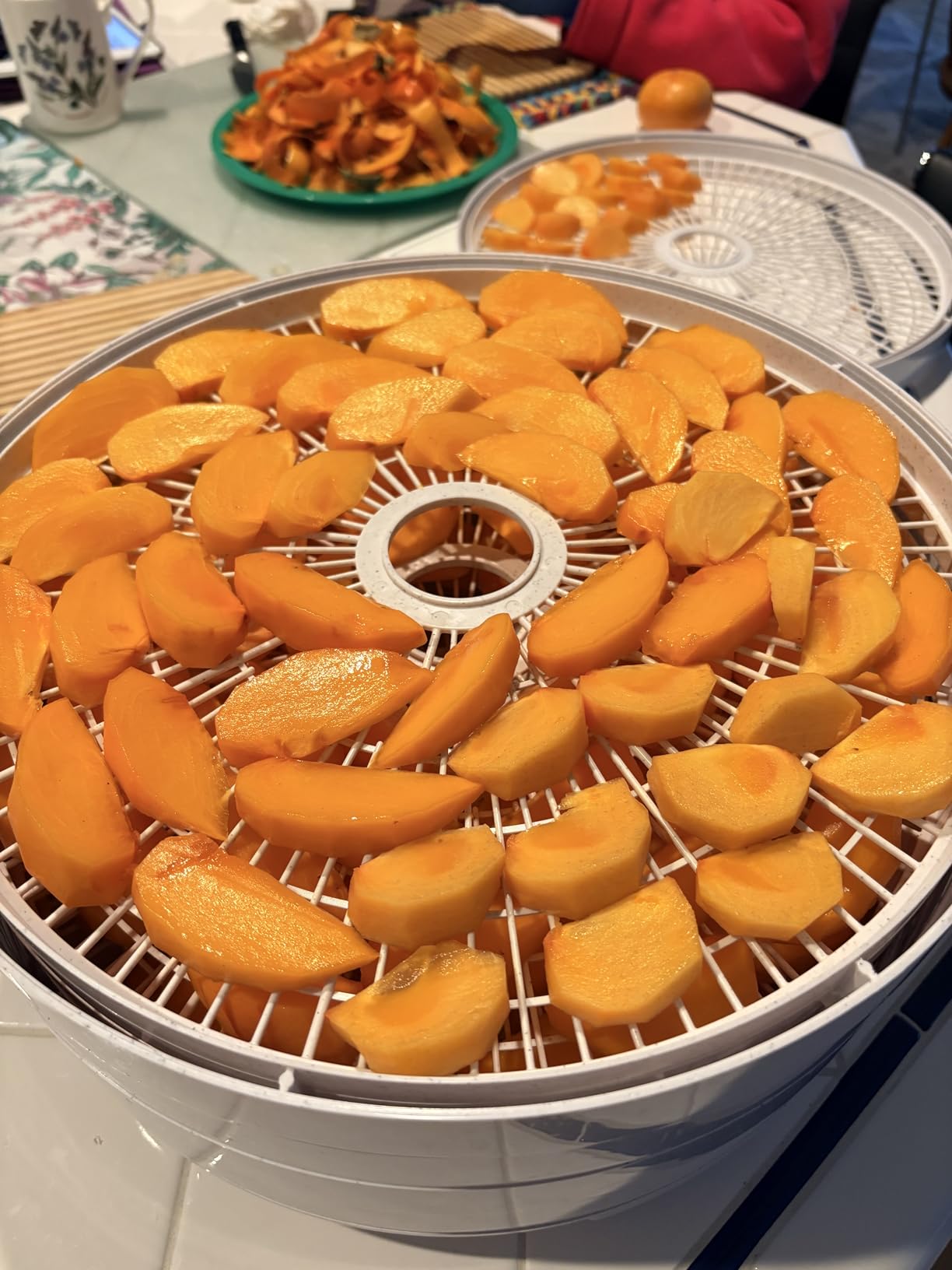
For mushroom work, the top-fan design is genuinely useful. Mushroom slices release water as they dry, and a top-mounted fan keeps that moisture moving through the column instead of pooling on the element. Converga-Flow is also sold as a no-rotation design, which matches what I see: upper and lower trays come out at roughly the same time when the column is not packed solid.
The temperature control is a simple 95F to 160F adjustment, which covers the mushroom window without any digital fuss. At 13 inches by 13 inches by 10 inches and 7.7 pounds, it is a compact unit that disappears into a cabinet between harvests. The box includes 2 fruit roll sheets, 2 Clean-A-Screens and a sample of jerky seasoning.
One thing to plan around: a 12-tray column takes considerably longer to dry than a 5-tray column, because the same 600W is moving air through more volume. When I run a full stack for sliced mushrooms I add hours, not minutes, and I keep the loading sparse so air can move between trays.
What it does well for mushrooms
Expandability is the deciding factor for a grower whose harvest size is still rising. Five trays now, twelve trays later, without changing machines, is a flexibility the fixed six- and eight-tray units cannot offer.
USA assembly and a long service life matter here too. Owners report running these for years of weekly cycles, and the plastic body wipes clean without soaking. Reviews number more than 13k, which gives you a real picture of long-term reliability rather than a handful of new-buyer impressions.
Where it falls short
There is no built-in timer and no on/off switch, so the machine runs until you unplug it. That means an external timer is effectively required if you plan to start a load overnight, and forgetting is how people scorch a batch.
Trays are plastic and the stack has crevices that catch dried mushroom residue. Cleaning takes longer than a stainless tray, and the 160F ceiling sits below the Magic Mill Pro and Excalibur. Alignment can also be finicky when you are stacking eight or more trays at once.
3. Cosori 5-Tray BPA-Free Dehydrator: Most Versatile
Cosori Food Dehydrator, 5 BPA-Free Trays, 165°F Temperature Control, 350W
5 BPA-free trays expandable to 7
350W with 1 degree increments
48-hour timer in 30-minute steps
Under 47 dB
Pros
- Precise 1 degree temperature control
- Under 47 dB
- Expandable to 7 trays
- Dishwasher-safe and easy to clean
- Consistent temperature across trays
Cons
- 350W dries slower than 600W models
- Round trays have a center hole
- Some users report tray rotation needed
This round Cosori is the value pick, and with more than 9k reviews at 4.6 it has one of the strongest rating-to-review combinations in the group. The temperature panel adjusts in 1 degree increments from 95F to 165F, which is unusual at this tier and genuinely useful for mushroom work, where 95F and 110F are settings you will use often.
My sliced shiitake batches run in this machine at 105F for around 10 hours. The 350W element is slower than a 600W unit, and on a fully loaded seven-tray column I plan for that rather than being surprised by it. Adjustable tray heights help, letting you open a gap for thicker cap pieces on one tray while the rest of the column runs at normal spacing.
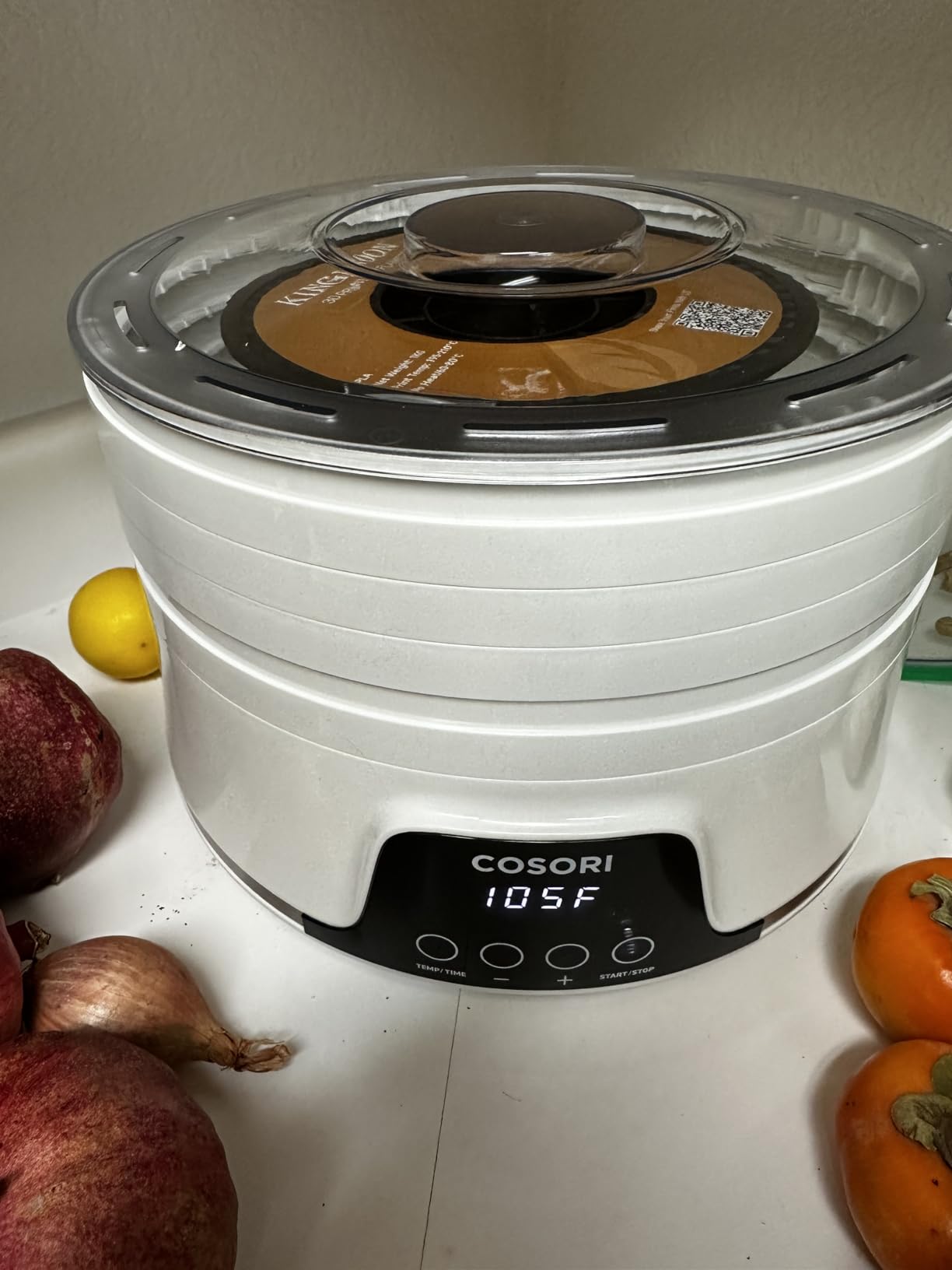
At under 47 dB and 4.9 pounds, this is the quietest and lightest machine here, which makes it the one I recommend for an apartment kitchen or a first attempt. The 48-hour timer steps in 30-minute increments, and the 2 year manufacturer warranty is longer than the warranty listed on most of the other units here.
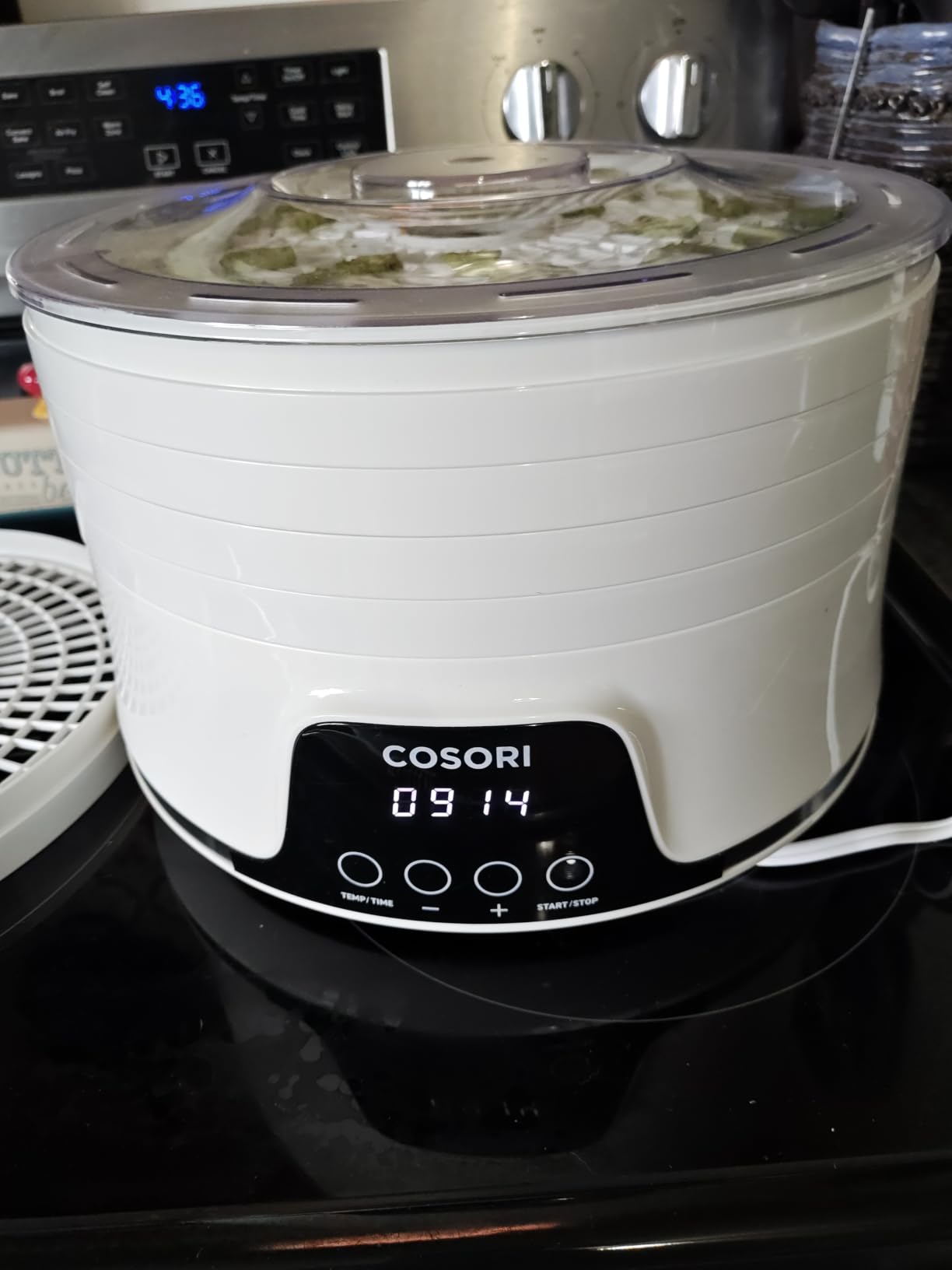
The round tray format, 12.2 inches outer diameter, is the real trade-off for mushrooms. The center hole eats a slice of usable area, and slices smaller than about half an inch want the mesh screen so they do not fall through. For quarter-inch slices laid in a single layer it works well.
What it does well for mushrooms
Fine temperature control is the headline. Being able to sit at 100F instead of guessing between coarse marks matters when you are drying for 10 hours and want a predictable pull.
Quiet operation and low weight make overnight runs painless in a shared space, and the BPA-free polypropylene trays go in the dishwasher. For a first-time buyer drying a few pounds at a time, this covers the whole job.
Where it falls short
350W is the trade-off for the price. Expect a longer cycle than a 600W machine on identical slices, and a fully expanded seven-tray load stretches that further.
The center hole in each round tray reduces usable space, and some reviewers report needing to rotate trays for even results. The 165F ceiling is fine for mushrooms, but a few owners also report the lid cracking after sustained runs at the top of the range.
4. Magic Mill 5-Tray Stainless Dehydrator: Best for Small Kitchens
Magic Mill Food Dehydrator Machine | 5 Stackable Stainless Steel Trays, 48H Digital Adjustable Timer & Temperature Control Upto 167° Electric Dryer & Preserver for Jerky, Fruit, Dog Treats & Much More
5 stainless steel trays
240W with 95-167F digital control
Tray spacing 0.6 to 1.1 inch
48-hour timer
Pros
- Stainless steel trays at a compact size
- Adjustable tray spacing for thick caps
- Dishwasher-safe trays
- Digital temperature control
Cons
- Only 240W
- so drying is slow
- Five trays and not expandable
- Some reports of temperature accuracy issues
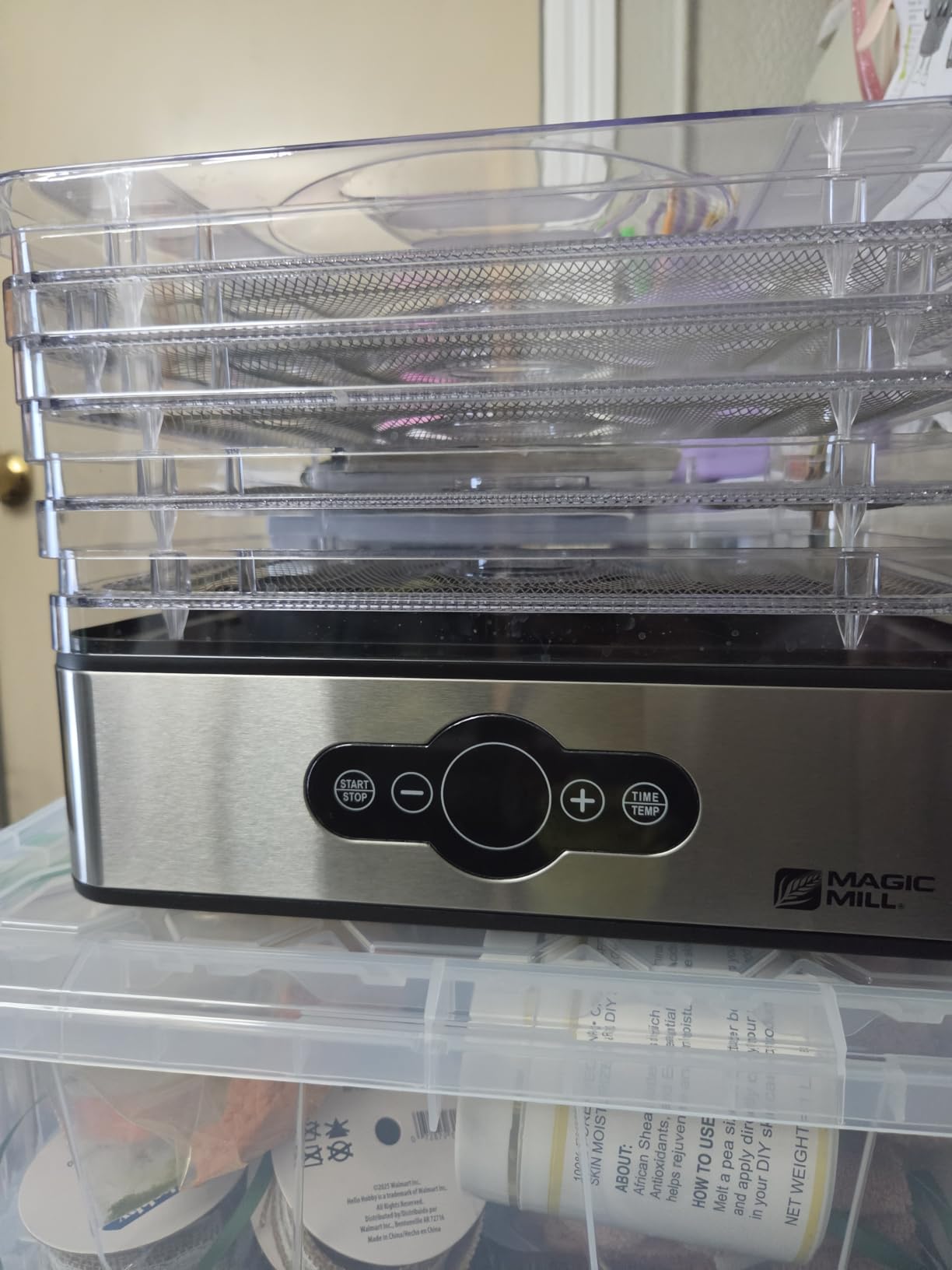
At 8.5 inches deep by 11.8 inches wide and 6.06 pounds, it is a narrow rectangular unit, and the stainless trays make it feel like more than a starter machine.
The feature that matters most for mushrooms is adjustable tray spacing. Trays can sit at 0.6 inch or open up to 1.1 inch, so a thick cap or a chunky king oyster slice can go on the bottom tray with clearance while the upper trays stay tight for small pieces. That flexibility is something none of the fixed-spacing units in this list can match.
The digital panel runs 95F to 167F and the 48-hour timer is built in. For a small harvest of oyster or cremini slices at 100F, my runs on this machine land around 10 to 12 hours on a 240W element, which is slow but predictable. I use it more as a second machine running alongside a bigger unit than as my only dehydrator.
Owners frequently describe this as a good dehydrator for a newbie, and the small tray count explains why. Five stainless trays is a weekend amount of mushrooms for a household, not a commercial flush. The body is BPA-free plastic over a stainless base rather than full stainless, and the warranty is not specified.
What it does well for mushrooms
Adjustable tray height is the reason to buy this one. Thick cap pieces and uneven mushroom sizes are the most common mushroom problem, and a tray that opens to 1.1 inch solves a good part of it.
Stainless trays at this size are unusual and they wash easily, which matters for someone sanitizing between mushroom batches in a small kitchen. The compact footprint leaves counter space for actual cooking.
Where it falls short
240W is the lowest element here. Plan hours, not minutes, and expect a full five-tray load to take noticeably longer than a 600W machine on identical slices.
It does not expand, so there is no headroom as your harvest grows. Some users report temperature accuracy issues, and the plastic body is not the sanitation story a full stainless interior gives you.
5. Magic Mill Pro 7-Tray All-Stainless Dehydrator: Best All-Stainless Build
Magic Mill Pro Food Dehydrator Machine | Powerful 600W Rear Fan Even-Drying System | 7 Full-Size Stainless Steel Trays | 95°-176° Temperature Control, 48H Timer, Keep Warm + Auto Shutoff | ETL Listed
7 full-size stainless trays
600W rear-mounted fan
95-176F plus 24-hour keep warm
ETL listed with overheat protection
Pros
- Full stainless interior and exterior
- 600W rear fan needs no rotation
- Seven full-size trays
- Keep warm hold mode at 95F for 24 hours
- Overheat protection and ETL listed
Cons
- Start and stop button is sensitive
- Larger countertop footprint
- Only a 1 year warranty
The Pro is the one I would hand to someone who wants to run mushrooms through continuously. Seven full-size stainless trays, a 600W rear-mounted fan and a fully stainless interior and exterior make it the easiest machine in this group to sanitize, since plastic trays can hold odors that stainless does not. The 95F to 176F digital control gives you 1 degree increments across the whole range.
The rear fan is the same layout that earns the Cosori its spot, and it behaves the same way on mushrooms. Quarter-inch slices of portobello and shiitake at 110F come out even across all seven trays with no rotation step, which matters when you are processing a full seven-tray load and the machine runs for many hours.
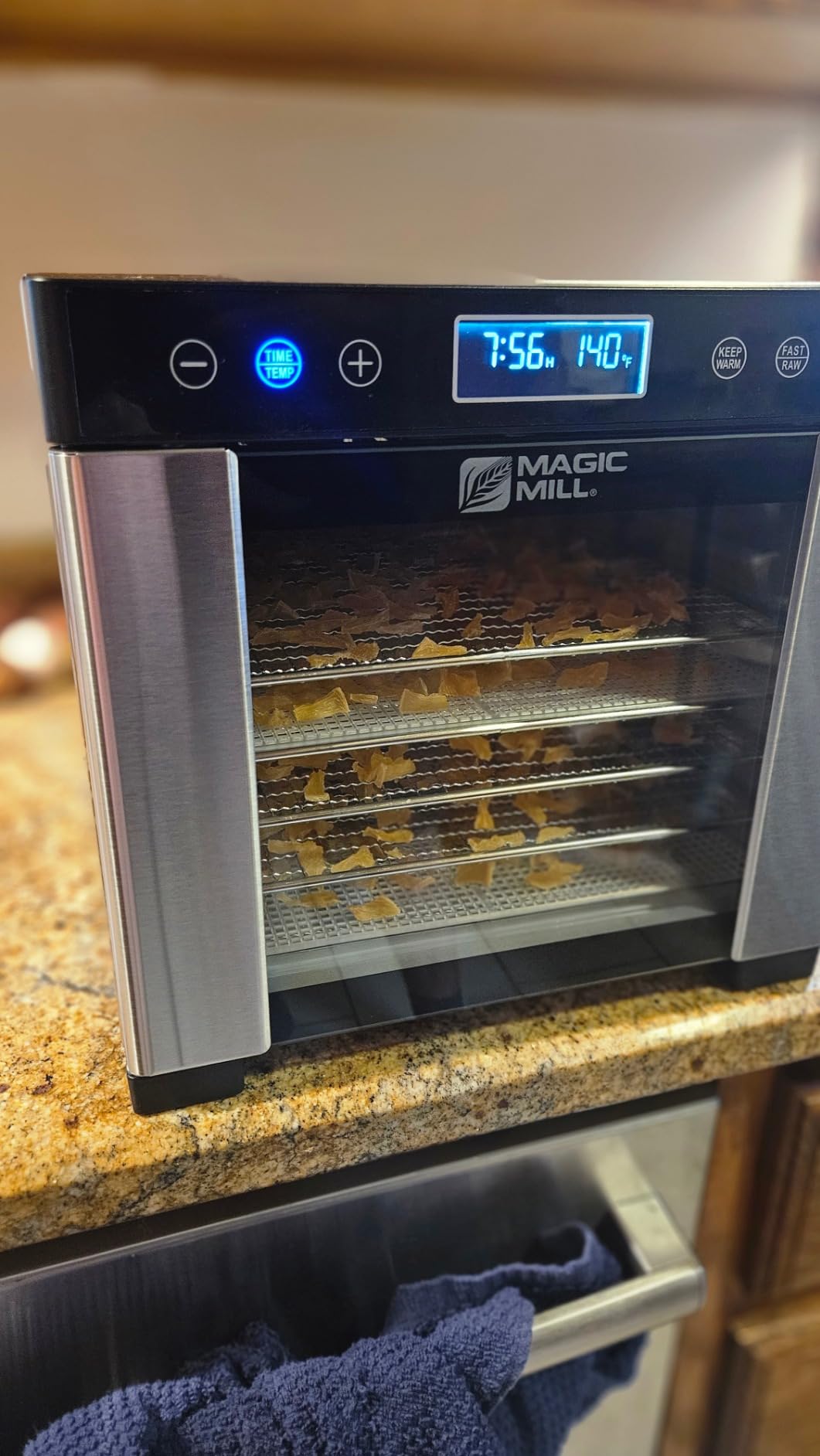
Two details make it stand out for long jobs. The 48-hour timer steps in 30-minute increments and shuts the machine off when it ends, and the keep warm mode holds 95F for up to 24 hours, so a batch that finishes while you are asleep does not need babysitting at exactly the wrong moment. ETL listed with overheat protection is the safety combination I look for on a unit I run unattended.
Seven stainless trays at single-layer spacing hold roughly 7 to 10 pounds of sliced mushroom per load, which puts it near the top of this group for throughput. At 16 pounds and 15.5 by 11.3 by 10.8 inches it needs real counter space, and the two mesh screens plus fruit roll tray in the box handle small pieces and drips.
What it does well for mushrooms
Full stainless construction is a genuine advantage with mushrooms. Dense, food-grade material does not absorb odors the way plastic trays can, and it survives repeated sanitizing between batches without degrading.
Keep warm mode is genuinely useful for mushroom work specifically. If a load finishes at 2am, holding at 95F keeps everything in the safe low band rather than continuing to cook it, and the auto shutoff covers the rest.
Where it falls short
The start and stop button is reported as overly sensitive, which is annoying on a machine you might want to nudge to 95F and walk away from. It is one of the larger footprints here, so it is not an apartment choice.
The 1 year warranty is the shortest here, and the 176F ceiling sits far above what mushrooms need, so much of the dial goes unused.
6. Elite Gourmet 4-Tray Dehydrator: Best for Small Batches
Elite Gourmet Food Dehydrator, Stainless Steel Trays, Adjustable Temp
4 stainless steel trays
350W bottom-mounted fan
95-158F digital control
24-hour timer, ETL listed
Pros
- Accurate digital temperature control
- Rectangular trays are easy to wash
- Compact and quiet
- Transparent trays show progress
Cons
- Only 4 trays and not expandable
- 158F maximum
- 24-hour timer is short
- Bottom-mounted fan
Sometimes a full tray stack is overkill. The Elite Gourmet EFD308 is a compact rectangular unit with 4 stainless trays, digital control in 1 degree increments from 95F to 158F, and a fan mounted at the bottom pushing air horizontally through the stack. At 11.5 by 10 by 8 inches it is among the most compact rectangular machines here.
For mushrooms it is a good fit when you are drying herbs and mushrooms on the same appliance, or when your harvest is a few pounds rather than a dozen. The rectangular trays are easier to scrub than round ones, which is a real advantage when dried mushroom residue has to come off a surface. Owners report verifying the temperature with a separate thermometer and finding it accurate.
The 350W element handles sliced mushrooms in roughly 8 to 10 hours at 100F to 110F on a full four-tray load, which is competitive for its size. Transparent trays let you check progress without opening the door and letting warm moist air escape, a small thing that adds up over a long cycle.
This is the model people compare against an Excalibur when they only need a small amount of jerky or dried produce. The 24-hour timer is enough for a mushroom load, and the ETL listing and dishwasher-safe removable trays and lid cover the safety and cleaning basics.
What it does well for mushrooms
Four trays is genuinely enough for a household eating from the output rather than selling it. Small batches dry fast because there is less mass in the box, and you avoid the multi-hour penalty of a fully stacked column.
Digital control at 1 degree increments means you can hold the 100F to 110F band precisely, and the accurate thermostat is confirmed by owners who tested it rather than assumed it.
Where it falls short
Four trays is the smallest tray count here and it does not expand, so a growing harvest outgrows it quickly. The bottom-mounted fan is the layout most likely to leave the top tray drier than the bottom, so plan on rotating.
The 158F maximum sits below the 160F-plus range generally cited for jerky safety, which matters if you plan to use one machine for both mushrooms and meat. The 24-hour timer is also the shortest of the digital units listed.
7. Rosewill 5-Tray Round Dehydrator: Best for First-Time Buyers
Rosewill Food Dehydrator Machine, 5 BPA-Free 12.6’ Trays, Adjustable Temperature Controls | 95-158°F | 350W, Jerky, Herbs, Fruit, Veggies, Dried Snacks, White
5 BPA-free 12.6 inch stackable trays
350W base-mounted fan
95-158F knob control
Includes herb and roll trays
Pros
- Entry-level build with BPA-free trays
- Includes herb tray and fruit roll tray
- Round trays need no alignment
- Dishwasher-safe removable parts
Cons
- Knob temperature control only
- No built-in timer
- Shallow trays and 158F maximum
- Trays yellow over time
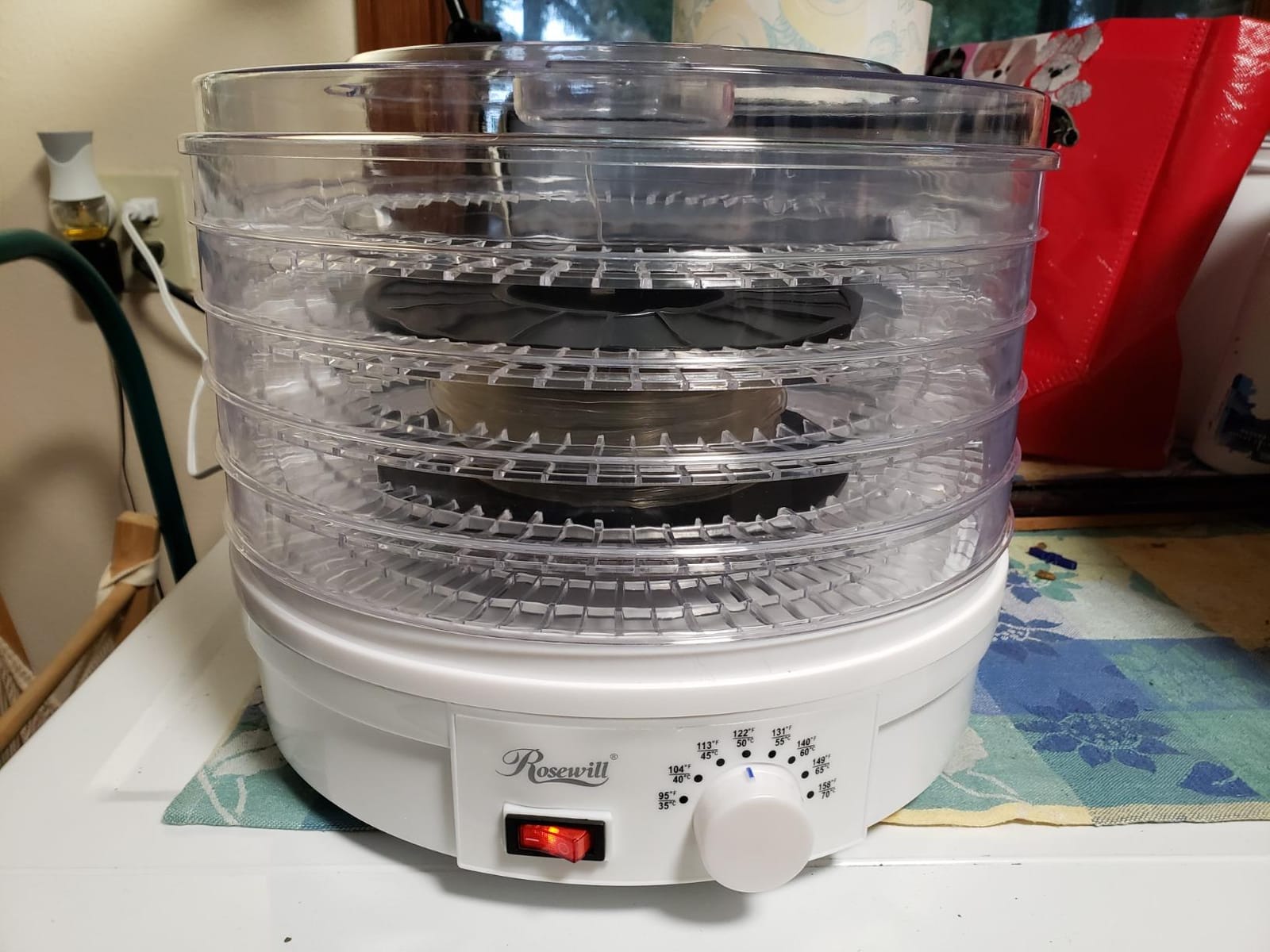
The Rosewill is the simplest machine on the list and the easiest way to find out whether you like dehydrating at all. Five BPA-free stackable trays at 12.6 inches diameter, a 350W base-mounted fan, and a temperature knob that runs 95F to 158F. There is no digital display and no built-in timer, so you set the temperature and track the run yourself.
For mushrooms, set it at the low end and give it time. Sliced button mushrooms at around 100F finish in 8 to 10 hours in my experience, but a knob that runs cool means a cycle can stretch well past what a recipe suggests. Owners describe the same behavior, and the shallow tray profile means pieces thicker than about an inch are not a good idea.
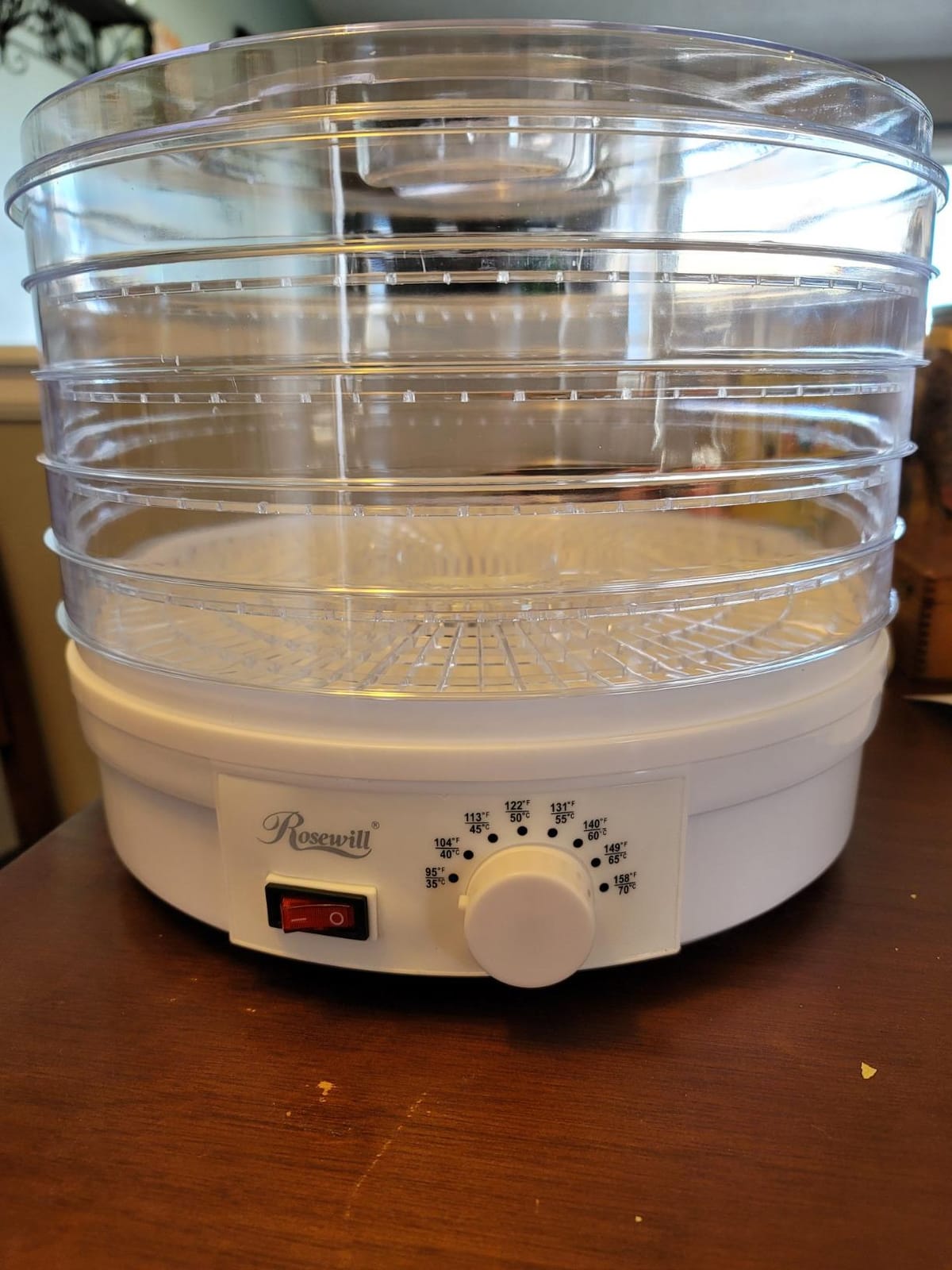
What you get is a complete kit. A herb tray and a fruit roll tray are included alongside the five drying trays, the parts are dishwasher safe, and a large viewing window means you can watch progress from across the counter. At 5 pounds and 12.5 by 12.5 by 10.8 inches it is light and easy to put away.
It also needs less shelf depth than the square stainless units, which matters if your drying shelf is already crowded by other kitchen gear.
What it does well for mushrooms
It is the least risky way to start, and the most complete kit at the entry tier.
Durability is the surprise here. Multiple owners report 10 or more years of service, and the 1 year warranty covers the early risk. Quiet operation and clear trays make it a pleasant first machine.
Where it falls short
Knob-only temperature control is the biggest limitation for mushroom work. You cannot hold a specific 100F setting with any confidence, and without a timer you are the timer.
The 158F maximum rules out reliable jerky on the same machine, and the base-mounted fan is the least even airflow here, so tray rotation is likely. Shallow trays also mean a whole cap is out of the question.
8. Excalibur 8-Tray Select Series: Best for Multi-Day Cycles
Excalibur Food Dehydrator Select Series for Jerky, Fruit, Vegetables, Herbs, Pet Treats with Adjustable Temperature Control, 8-Tray
8 chrome-plated trays and 7.2 cu ft
700W Horizontal Parallex airflow
85-165F digital thermostat
80-hour timer with glass doors
Pros
- Longest timer at 80 hours
- Lowest temperature setting at 85F
- 700W
- the highest wattage here
- Horizontal airflow removes rotation
Cons
- Shortest warranty at 1 year
- Chrome-plated trays rather than stainless
- Newer model with a smaller review base
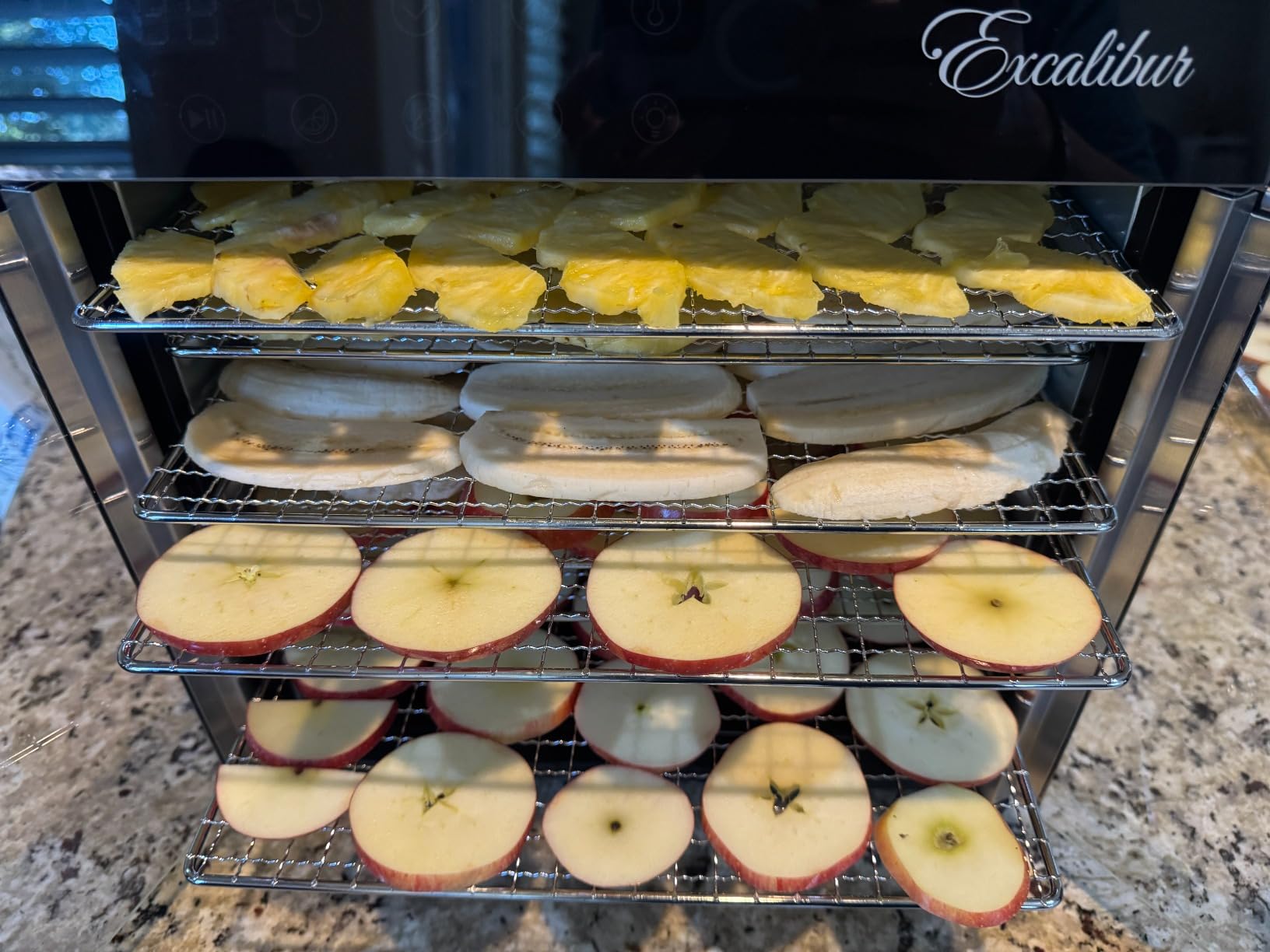
Excalibur is the name most often recommended in cultivation forums, and the Shroomery thread points to the FD-80 series as a mid-range workhorse while r/dehydrating owners describe their Excalibur trays as tough, reliable and completely dishwasher friendly. Easy to sanitize is the recurring reason, and mushroom work is exactly the application where that matters.
This Select Series 8-tray model offers 7.2 cu ft of drying space and 700W, the highest wattage listed here. That combination is what makes it the fastest option for a heavy load, and the 85F floor is the lowest start temperature of any unit on the list, which gives you real control for slow-drying wild varieties like morels.
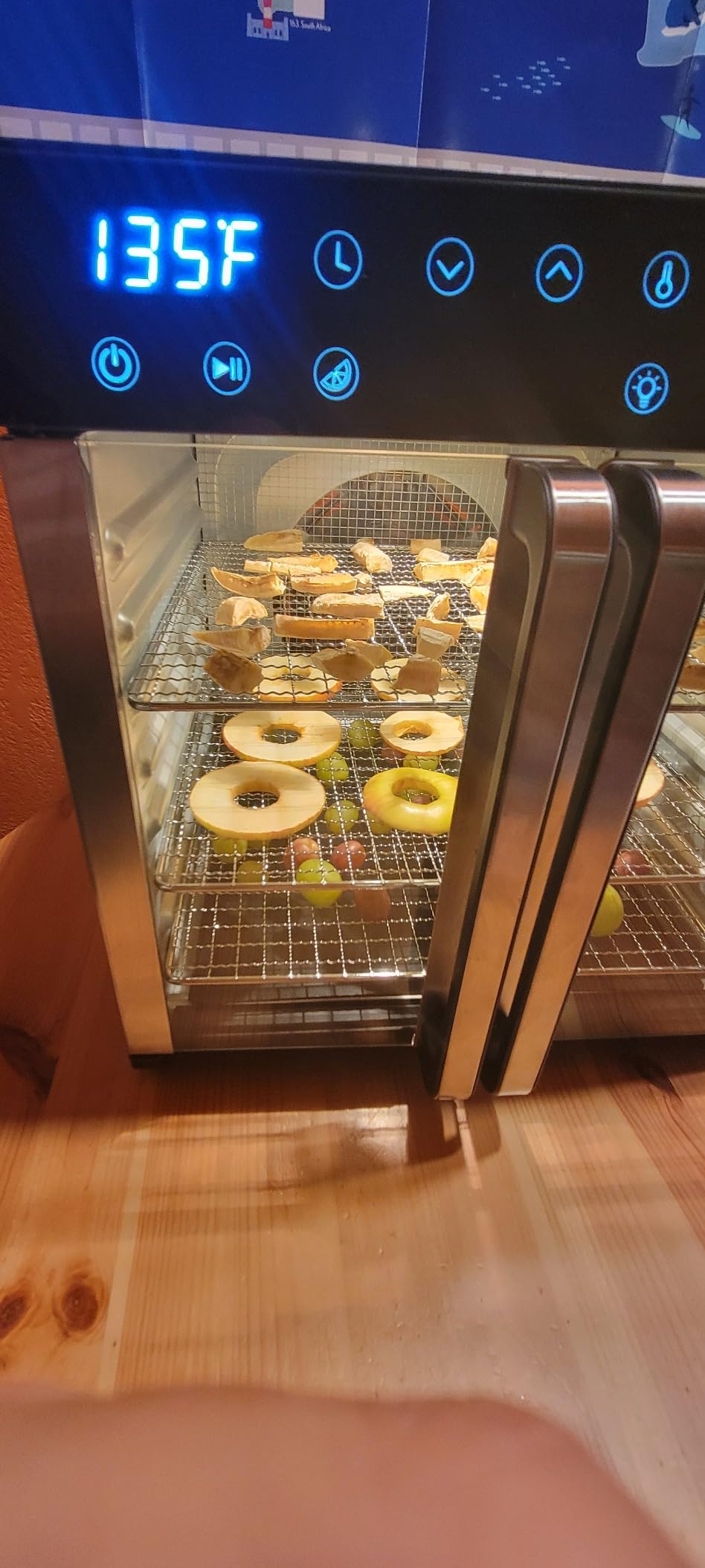
Hyperwave Pulse Technology with Horizontal Parallex airflow is the manufacturer claim for even drying without rotating, and the horizontal layout is the right family of design for mushroom work. The 80-hour digital timer is far longer than the 24 to 48 hours elsewhere, and clear glass French doors let you check a load without breaking the airflow path.
Two things temper the recommendation. The trays are chrome-plated rather than stainless, and the review base here is 153, much thinner than the 21k behind the Cosori at number one. I would treat the 4.4 rating as encouraging rather than settled.
What it does well for mushrooms
The 85F to 165F digital thermostat starts lowest of the eight, giving the most headroom for slow, low drying of thick caps or wild mushrooms without babysitting an 80-hour cycle.
Eight trays at 7.2 cu ft is a large capacity here, so a homestead-style harvest can be processed in a single load. The glass doors and crumb tray make monitoring and cleanup straightforward.
Where it falls short
It is a fully specified machine at the top of this list, and the 1 year warranty is the shortest window on a unit this size. At 17.32 by 13.39 by 14.08 inches and 16.5 pounds it needs a good amount of counter and shelf space, so measure first.
Chrome-plated trays will not last as long as full stainless in harsh use, and with 153 reviews there is less long-term owner evidence behind it than behind the picks above. If you want the Excalibur experience for less, the FD-80 family gets recommended in the same forum threads.
How to Dehydrate Mushrooms Step by Step
Drying mushrooms is not hard, but the difference between a leathery result and a leathery outside with a damp core is entirely in prep and temperature discipline. Here is the method I use.
Clean the mushrooms, not the caps. Wipe the caps with a damp cloth. Soaking washes flavor out and adds moisture you will spend hours removing.
Cut for the tray, not for the recipe. Quarter-inch slices dry evenly in roughly 6 to 10 hours at 100F to 110F. Halves take closer to 10 to 12 hours, and whole caps need 12 to 16 hours at the low end of the range.
Pre-treat if the variety suits it. A short blanch in hot water, then a cold plunge, before drying shrinks the slices and gives a more even result for shiitake and portobello.
Set 95F to 110F and leave it there. Mushrooms have very little fat to render, so hotter is not faster. Above roughly 110F you are cooking rather than drying, and the mushroom flavor flattens.
Load a single layer with gaps. Overcrowding kills airflow and leaves damp centers that mold later. Rotate trays only if your unit has a base- or bottom-mounted fan.
Check for done, not for clock time. Pieces should be leathery, bend but not snap back, and feel dry and room temperature in the center. Cool a piece in your hand, because warm mushrooms feel drier than they are.
Cool before sealing. Let the load cool on the trays, then pack airtight. Sealing warm mushrooms traps condensation, which is the number one cause of spoiled dried mushrooms.
Times by variety and cut, as a planning guide at 100F to 110F:
Button and cremini, quarter-inch slices: 6 to 8 hours
Shiitake, sliced caps: 8 to 12 hours
Shiitake, whole caps: 12 to 16 hours at 95F to 105F
Oyster, sliced: 6 to 10 hours
King oyster, thick slices: 10 to 14 hours at 105F to 115F
Portobello, gills facing up: 10 to 14 hours
Morels, halved: 8 to 12 hours
What to Look For in a Mushroom Dehydrator
Mushrooms ask for very little from a dehydrator, and the criteria that separate the machines above are narrower than a general fruit-and-jerky buying guide would suggest.
Low-temperature control that reaches 95F to 110F. This is the number one requirement. Every unit here starts at 95F or lower, and a digital panel with 1 degree increments beats a knob because you can hold 100F rather than guessing. A 158F or 165F ceiling is fine, it just is not what you are using.
Tray clearance and shape. This is the single most common complaint from growers. Standard tray spacing cannot hold a mature cap laid flat, which is why r/unclebens growers report cutting a section out of the tray to gain capacity, and why r/GroundZeroMycoLab members ask whether a compact fruit dehydrator will physically fit whole mushrooms at maturity. A square tray uses its corners better than a round one with a center hole, and adjustable spacing is better still.
Rear-mounted or 360-degree airflow over bottom- or base-mounted. This is what decides whether you rotate trays. Horizontal rear-fan layouts circulate air across the full stack at one height, and the Cosori, Magic Mill Pro and Excalibur all use it. Base-mounted and bottom-mounted designs pull air up through the column and leave the top tray drier, which is the uneven drying growers complain about.
Wattage against batch size. 600W handles a heavy mushroom load in one long cycle; 350W is fine for a few pounds; 240W is a companion machine, not a primary one. The trade is time, not quality.
Capacity matched to your real harvest, with headroom. A single layer of quarter-inch slices on one square tray runs roughly 1 to 1.5 pounds fresh. A 5-pound harvest therefore wants four to six trays, and a 10-pound flush wants two full cycles on a 6-tray unit or one cycle on an 8-tray unit. Expandable designs let you start at 5 and grow to 12 as your flush size increases.
Sanitizing and warranty. Mushroom work involves unwashed, unsterilized material, so dishwasher-safe stainless trays are a genuine advantage and reviewers on r/dehydrating treat easy sanitizing as a deciding factor. Warranties in this group run from 1 to 2 years, so plan on replacing the appliance eventually rather than expecting it to last indefinitely.
Noise if you run it overnight. Under 48 dB is quiet enough to sleep next to. The units rated in the mid-60s and above are noticeably louder, and a loud fan in a small apartment is a real quality-of-life issue over a 14-hour cycle.
Whole Caps vs Sliced Mushrooms: How Tray Height Changes Dry Time
Whole caps take roughly 12 to 16 hours at 95F to 105F. Quarter-inch slices take 6 to 10 hours at 100F to 110F. That is not a small difference, and it is why the tray height question decides which machine suits you.
The physics is simple. Water has to migrate from the center of a cap out to the surface, and that distance is what sets the time. A whole shiitake cap is a dome several centimeters thick; a quarter-inch slice is a sheet. Doubling the thickness more than doubles the time, and if you crowd the tray to fit whole caps you block the airflow that is removing the moisture in the first place.
Two workarounds come up constantly in grower forums. The first is separating caps from stems, since stems are thin and lay flat while caps are what will not fit; that single change converts most whole-cap problems into a normal slicing problem. The second is accepting the quartering cut. On a harvest of any size, quartering by hand is the biggest time cost in the whole process, and a grower with 10 pounds of shiitake will spend longer cutting than drying.
My rule is straightforward. If whole caps matter to you, buy for tray height and airflow, and choose an adjustable-spacing model so thick pieces have somewhere to go. If you are willing to slice, buy for capacity and evenness instead, because sliced mushrooms dry predictably on almost any of these machines. Only the Magic Mill in this group lets tray spacing open to 1.1 inch, which is worth knowing if you grow portobello.
Dehydrated vs Freeze-Dried Mushrooms
Both methods remove water and both make mushrooms shelf stable, but they are not interchangeable, and the differences matter depending on what you are making.
Texture: dehydrated mushrooms stay leathery and chewy; freeze-dried mushrooms crumble and reconstitute in seconds.
Flavor: dehydration concentrates flavor into something intense and cooked-forward, which is what you want in soups and sauces. Freeze-drying keeps more of the raw, earthy character.
Equipment cost: a dehydrator is a fraction of the price of a freeze-dryer, and a freeze-dryer is a dedicated appliance that does nothing else.
Storage: both store long-term when sealed airtight, and both need to be fully dry or fully frozen to keep.
Best use: dehydrate for stocks, sauces, ramen broths and mushroom powder. Freeze-dry for on-the-go meals, backpacking portions and snacks where rehydration speed matters.
For most home growers, dehydration wins on cost per pound and on what the dried output is used for. A single batch of dried shiitake will make a meaningful amount of powder for seasoning blends, which is the return that justifies the appliance.
Storage, Shelf Life and the Condensation Test
Properly dried mushrooms keep for a year or more in an airtight container in a cool, dark cupboard. The failure mode is not rancidity, it is residual moisture.
Use the condensation test. Put a few pieces in a sealed jar or bag and leave it at room temperature for a few hours, ideally overnight. If there is fogging or a drop of water on the lid, the mushrooms were not dry enough. Put them back on the trays and give them another two to three hours, then test again. This single check prevents almost all spoilage complaints in mushroom drying.
Beyond that, cool the load fully before packing, use airtight containers or vacuum bags, and add an oxygen absorber for very long storage. Keep containers away from direct light, and do not refrigerate, because condensation forms when cold jars meet warm air.
To rehydrate, cover with warm water and wait 20 to 30 minutes. Dried mushrooms rehydrate to several times their dry weight, so plan portions accordingly. Any mushroom with an off smell, visible fuzz or a slimy surface should be discarded rather than rinsed and reused.
What Not to Put in a Dehydrator
This question comes up constantly, and skipping it can damage the machine or make you sick.
Wild mushrooms you have not identified with certainty. A dehydrator removes water and concentrates any toxin, and it will not make a misidentified species safe. Do not dry unknown species, ever.
Whole eggs and foods that are mostly liquid. Whole shell eggs can explode, and liquid drippings can reach a heating element.
Cooked foods left at room temperature. Load only food that has been cooled quickly and handled cleanly, not meat or mushrooms that have been sitting out.
Dairy-heavy and heavily sauced dishes. Cream sauces and wet marinades drip, scorch and smoke the cabinet. Dehydrate the components separately instead.
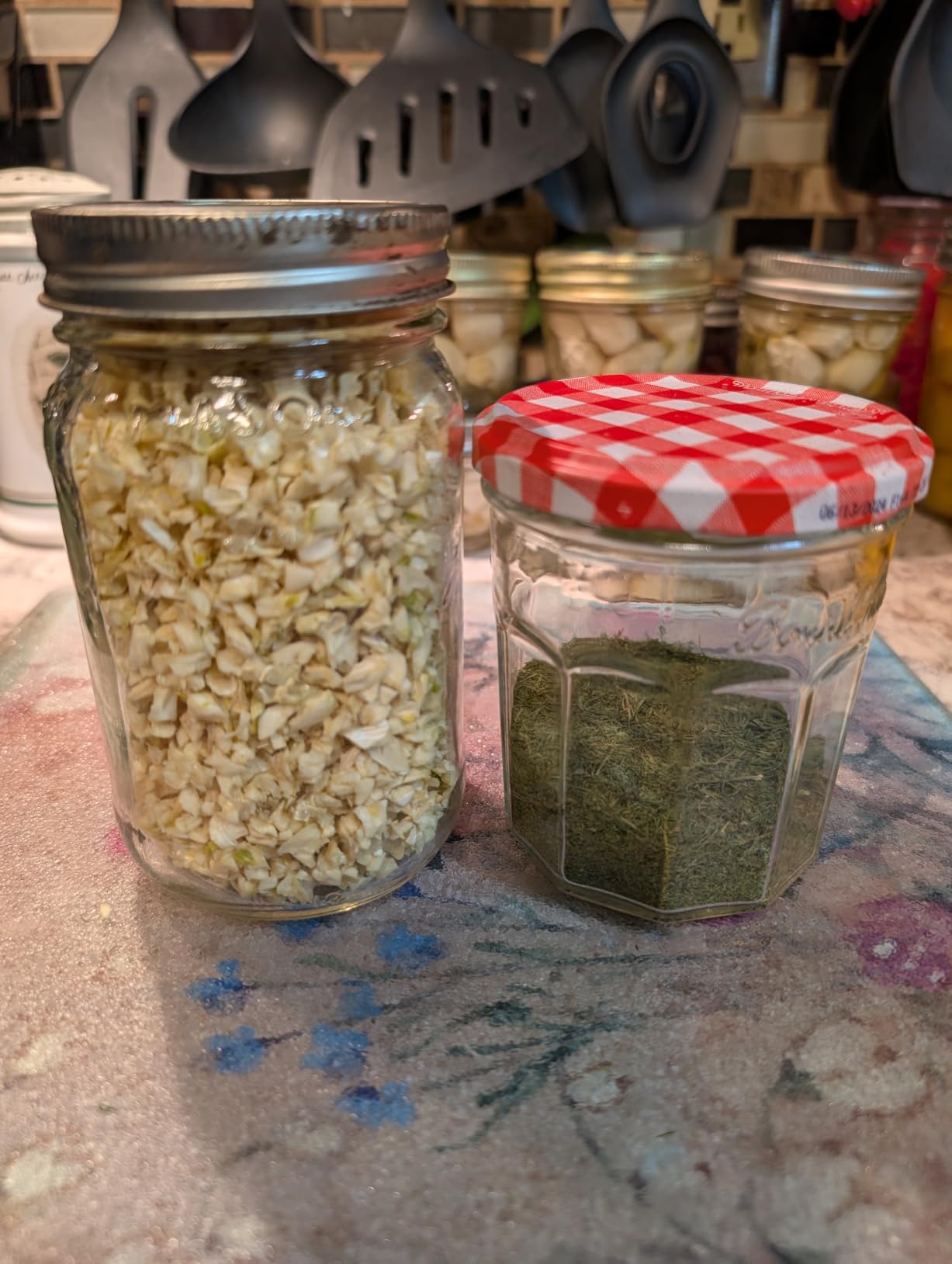
Garlic, onion and strong alliums in bulk. Not unsafe, but the odor molecules permeate plastic trays and housing and are very hard to remove.
Non-food items. No paper, no plastic film, no untreated wood, and nothing that is not rated for the temperatures the unit reaches.
For mushroom work specifically, the practical rules are simple. Sanitize trays between batches if the material is field harvested, keep pieces in a single layer, and never dry mushrooms you would not eat fresh.
How We Picked These Dehydrators
We earn a commission when you buy through the links on this page, at no additional cost to you. That never changes which machines make this list or how they are ranked.
Every product here was assessed against the same criteria: whether the temperature range reaches down to 95F, how many trays it has and whether it expands, where the fan sits and whether that forces tray rotation, wattage relative to batch size, how easy the trays are to sanitize, noise for overnight runs, and the volume of owner reviews behind the rating. Where a review count is thin, we say so rather than rounding it up.
Where owner reports are relevant, we have said so plainly. Forum discussion informed our view of tray height, sanitizing, fan failure points and the habit of running two smaller machines instead of one large one, and those are the details that decide how a dehydrator holds up over years of weekly mushroom harvests.
Frequently Asked Questions
Can you use a food dehydrator for mushrooms?
Yes. Any food dehydrator that reaches 95F will dry mushrooms well, and all eight models here start at 95F or lower. Set the temperature between 95F and 110F, lay slices in a single layer with gaps, and expect 6 to 10 hours for quarter-inch slices or 12 to 16 hours for whole caps.
How long does it take to dehydrate mushrooms in a dehydrator?
Quarter-inch slices take 6 to 10 hours at 100F to 110F, halved mushrooms take 10 to 12 hours, and whole caps take 12 to 16 hours at 95F to 105F. Larger batches and lower-wattage machines add time, so judge doneness by texture rather than the clock.
What temperature do you dehydrate mushrooms at?
Between 95F and 110F. Mushrooms are almost pure water and very low in fat, so a hotter setting does not speed things up, it just cooks the mushrooms and flattens their flavor. Thick king oyster slices can go to 115F without harm.
Are mushrooms better dehydrated or freeze-dried?
It depends on use. Dehydrated mushrooms stay leathery, concentrate flavor and cost far less per pound, which makes them better for soups, sauces, stocks and mushroom powder. Freeze-dried mushrooms crumble and rehydrate in seconds, which makes them better for backpacking meals and snacks.
Can dehydrated mushrooms go bad?
Yes, if they were not dry enough when you sealed them. Run the condensation test by sealing a few pieces in a jar overnight and checking for fogging or a water drop. Any moisture means another two to three hours on the trays. Fully dry mushrooms in an airtight container keep for a year or more.
What not to put in a dehydrator?
Never dry wild mushrooms you have not identified with certainty, since dehydration concentrates any toxin. Also avoid whole eggs, liquid-heavy dishes and wet marinades that drip onto the element, and keep bulk garlic and onion out of plastic-housed units because the odor is nearly impossible to remove.
Which Mushroom Dehydrator Should You Choose
The Cosori 6-Tray stainless steel dehydrator is our pick for the best food dehydrators for mushrooms overall, because the 600W rear-mounted fan, 6.5 sq ft of space and 48-hour timer handle heavy loads evenly without a rotation step, and it carries the strongest rating and review volume in the group.
Choose the NESCO FD-75A if your harvest is growing and you want one machine that expands from 5 to 12 trays. Choose the Magic Mill Pro if sanitation and build quality matter most and you want a full stainless interior. Choose the Cosori 5-Tray or Rosewill if you are drying a few pounds at a time in a small kitchen, and the Magic Mill 5-Tray if adjustable tray spacing for thick caps is your main requirement.
Whichever you pick, slice to a quarter inch, keep the temperature between 95F and 110F, and run the condensation test before you seal the first jar. That single habit will keep more of your harvest edible than any appliance choice.