
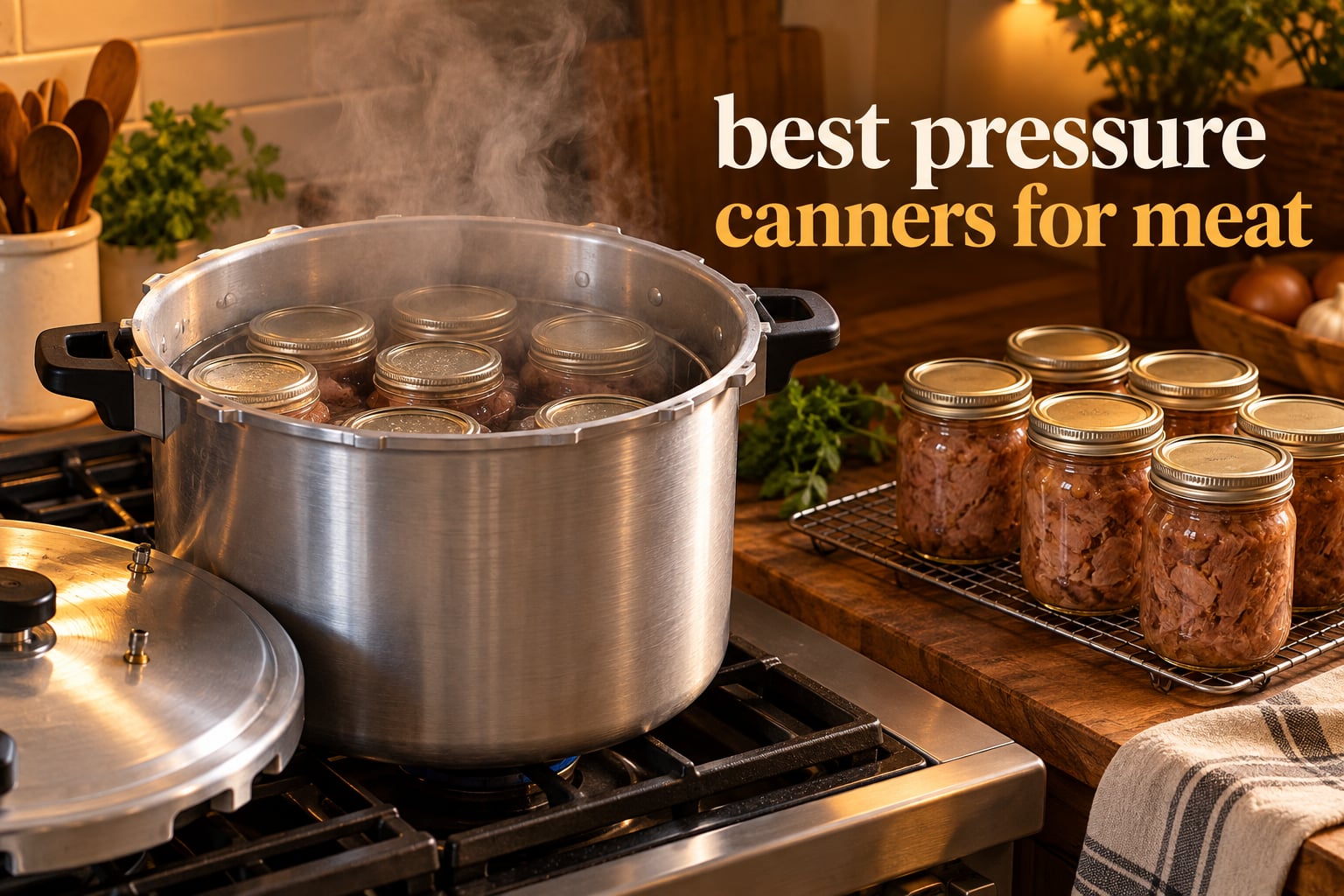
Meat is a low-acid food, and low-acid food cannot be water-bath canned safely. The only home method the USDA points to for putting chicken, beef, pork, venison and other meats on a pantry shelf is pressure canning at about 240 degrees Fahrenheit, which means the tool has to be a real pressure canner, not a pressure cooker. After sorting ten canners on jar capacity, regulator type, weight, seal design and thousands of owner reviews, the Presto 01781 23-Quart wins as the best pressure canner for meat for most households, the All American 1930 (Model 941) takes the large-harvest crown, and the T-fal 22-Quart delivers the most jars per dollar of any canner in this group.
Our team compared ten canners, from a 9.5-quart electric unit to a 41.5-quart cast aluminum pot weighing 33 pounds empty, and checked each one against the three things that actually decide whether a meat harvest gets done. Can it hold and read a processing pressure accurately? Will it take a full load of quart jars plus the rack they sit on? And will your kitchen survive the weight of it on the cooktop?
What follows is every pick with its real jar count, the load sizes each one handles, and the drawback that shows up most often in owner reviews. We also work through the batch math nobody publishes, so a family that just bought a side of beef can work out how many loads it takes before the driveway starts heating up.
Table of Contents
Top 3 Picks for Pressure Canning Meat (October 2026)

Presto 01781 23-Quart Canner
- Holds 26 half-pints
- 20 pints or 7 quarts per load
- Deluxe pressure dial gauge reads the full range
- 12-year limited warranty

All American 1930 41.5-Quart
- Holds about 32 pint or 19 quart jars
- Gasket-free metal-to-metal seal
- 33 pounds empty
- machined cast aluminum
T-fal 22-Quart Pressure Canner
- Holds 24 half-pints
- 18 pints or 7 quarts
- Built-in regulator with three PSI settings
- Two canning racks and a guide included
All 10 Pressure Canners Compared in 2026
| Product | Specs | Action |
|---|---|---|
| Presto 01781 23-Quart |
|
Check Latest Price |
| All American 1930 41.5-Quart |
|
Check Latest Price |
| T-fal 22-Quart |
|
Check Latest Price |
 Presto 02144 12-Quart Digital Presto 02144 12-Quart Digital |
|
Check Latest Price |
 Presto 01755 16-Quart Presto 01755 16-Quart |
|
Check Latest Price |
 NESCO NPC-9 9.5-Quart Electric NESCO NPC-9 9.5-Quart Electric |
|
Check Latest Price |
 Granite Ware 20-Quart Granite Ware 20-Quart |
|
Check Latest Price |
 WantJoin 23-Quart WantJoin 23-Quart |
|
Check Latest Price |
 Mirro 22-Quart Mirro 22-Quart |
|
Check Latest Price |
 Fulgutonit 12-Quart Fulgutonit 12-Quart |
|
Check Latest Price |
Pressure Canner vs Pressure Cooker: The Line You Cannot Cross
A pressure cooker is built to cook food fast at high pressure and then vent. A pressure canner is built to hold an exact processing pressure, at an exact temperature, for an exact number of minutes, with a rack that keeps jars off the pot bottom and a gauge or weighted regulator that tells you when that state is reached. The USDA lists pressure canning, not pressure cooking, as the safe home method for low-acid foods, and the reason is botulism risk: spores that survive a 212-degree boiling water bath need 240-degree processing to be rendered harmless.
Every canner in this roundup is a true canner. None of the small electric pressure cookers sold as meal cookers are, and if a listing does not state a processing pressure, a jar capacity or canning process times, treat it as a cooker.
1. Presto 01781 23-Quart Pressure Canner and Cooker
Presto 01781 23-Quart Pressure Canner and Cooker
23 qt: 26 half-pints, 20 pints or 7 quarts
Deluxe pressure dial gauge
12-year limited warranty
Pros
- Most reviewed canner in this group at more than 20000 ratings
- 7 quart jars per load suits batch meat canning
- Reads the full pressure range which matters at altitude
- Doubles as a water bath canner and large pressure cooker
- Rack and 76-page recipe book included
Cons
- Aluminum body reacts with acidic foods like tomatoes and vinegar
- Manual heat management at the stove
- Heavy and awkward when fully loaded
This is the canner our team would put on the burner first for a normal family meat harvest. It carries 26 half-pints, 20 pints or 7 quarts per load, which covers a couple of chickens or a good batch of pork shoulder without splitting the work across two stoves. It is also, by a wide margin, the most reviewed unit in this group, with more than 20,000 ratings averaging 4.8 stars, and that volume of long-term owner feedback is worth more to a first-time canner than any spec sheet.
For meat, the deluxe pressure dial gauge is the part that matters most. It registers the full processing range rather than a single target, so you can confirm the pot is actually sitting at the pressure your recipe calls for instead of guessing from the sound of the vent. Owners working above 1,000 feet mention that reading as the deciding feature, because a weighted regulator tells you nothing about how far over the target you are running.
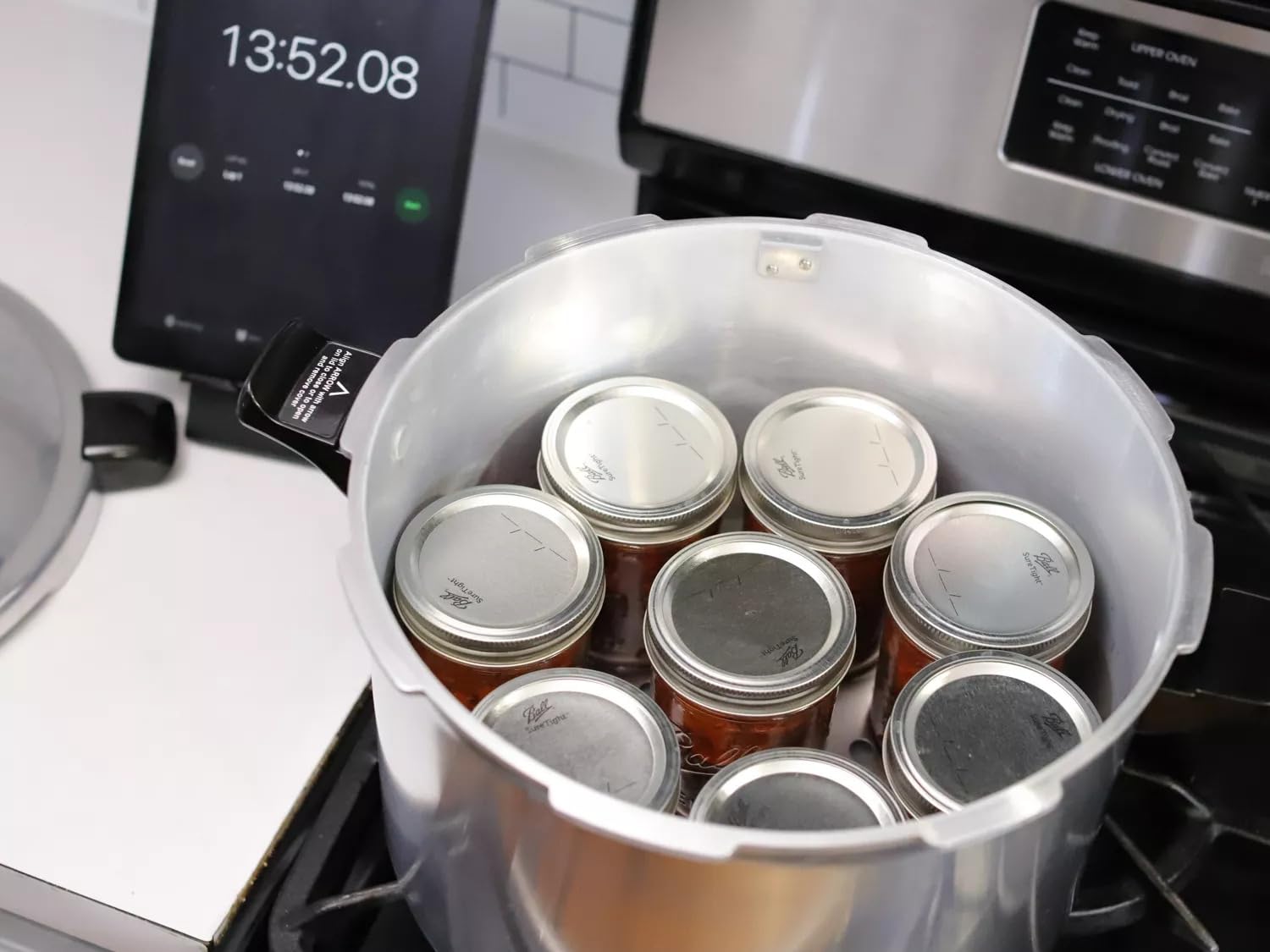
Build quality is the quiet strength. It is warp-resistant heavy-gauge aluminum, which heats fast and evenly, and it ships with the canning rack plus a 76-page instruction and recipe book that covers meat specifically. The same pot works as a boiling-water canner for fruit, jams and salsa, and as a large-capacity pressure cooker, so one pot covers most of a household’s preserving year.
Around 88% of its ratings are five stars, and the complaints that recur are material complaints rather than safety complaints. Aluminum pucks and discolors when you cook anything acidic in it, so this is a canning pot rather than a tomato sauce pot. You also manage the heat yourself, and a loaded 23-quart canner is a two-person lift.
How much meat one Presto 01781 load actually takes
Seven quart jars is a real batch, and it is the number most people underrate. Seven quart jars of raw meat at roughly a pound and a half of packed raw product per jar puts you near ten pounds of raw meat per load before you count the loose packing around chunks. If you are canning a whole pig, that pot is a weekend of cycles rather than a single afternoon.
The load also has to leave headspace and hold a canning rack, which is included. The canner is rated to take the same 7 quarts, 20 pints or 26 half-pints whether you are processing meat, poultry or low-acid vegetables, so the jar count does not shrink when you switch food type.
What you give up compared with a 41.5-quart canner
The All American 941 holds about 19 quart jars against this model’s 7. If you are processing venison, a whole beef side or a large hog, that difference is a three-to-one cut in load cycles, and cycle count is the real bottleneck in bulk canning because each one includes a heat-up, a processing hold and a cool-down you cannot shorten.
Where the Presto wins is handling. At 12 pounds empty it is a fraction of the All American’s 33 pounds, and the deluxe dial gauge gives you information the weighted regulator on a budget unit never will. Owners in r/homestead and r/TwoXPreppers threads repeatedly describe this line as the workhorse, and the Presto name carries enough installed base that parts and advice are easy to find.
2. All American 1930 (Model 941) 41.5-Quart Pressure Cooker and Canner
All American 1930: 41.5qt Pressure Cooker/Canner (The 941) – Exclusive Metal-to-Metal Sealing System – Easy to Open & Close – Suitable for Gas or Electric Stoves – Made in the USA
41.5 qt: about 32 pint or 19 quart jars
Gasket-free metal-to-metal seal
33 pounds empty
Pros
- Highest-rated canner here at 4.9 across 9769 ratings
- No gasket to replace or degrade
- 19 quart jars per load cuts bulk cycles
- Parts and service available in the USA
- Rated by owners to last for decades
Cons
- 33 pounds empty means loading and unloading happen on the stove
- Long heat-up and cool-down times
- Needs a burner large enough for the pot base
This is the canner for the person who just bought a side of beef or a whole hog. At 41.5 quarts it holds roughly 32 pint jars or 19 quart jars, which is the largest single load in this roundup by a wide margin, and it carries the highest average rating of the group at 4.9 across more than 9,700 ratings with roughly 93% five stars.
The feature that converts owners is the metal-to-metal sealing system. Precision-machined clamping surfaces form a steam-tight seal with no rubber gasket anywhere in the loop, so there is no seal to replace, no gasket to go hard or perish, and no mid-harvest failure from a part that costs a few dollars. That single design decision is the reason the same threads that argue about Presto versus All American settle so quickly once gasket anxiety comes up.
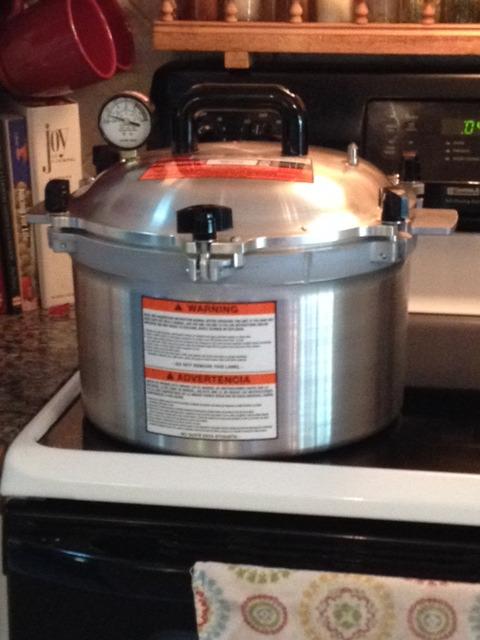
You also get an easy-to-read steam gauge, a precision-machined regulator weight for pressure control, and a phenolic top handle that stays cool enough to touch. The family-owned manufacturer is based in the USA and offers free safety labels, a printed manual, and an inspection service, with replacement parts available across the 900, 920, 930 and 940 line.
None of that comes without weight. At 33 pounds empty, with nineteen quart jars of hot meat inside, this pot does not move from the burner once it is hot. Reviewers almost universally accept that as the trade, and the long heat-up and cool-down times are the other half of the same bargain. A few owners mention that the lid can vapor-lock after a full cycle and needs gentle prying once pressure is fully released.
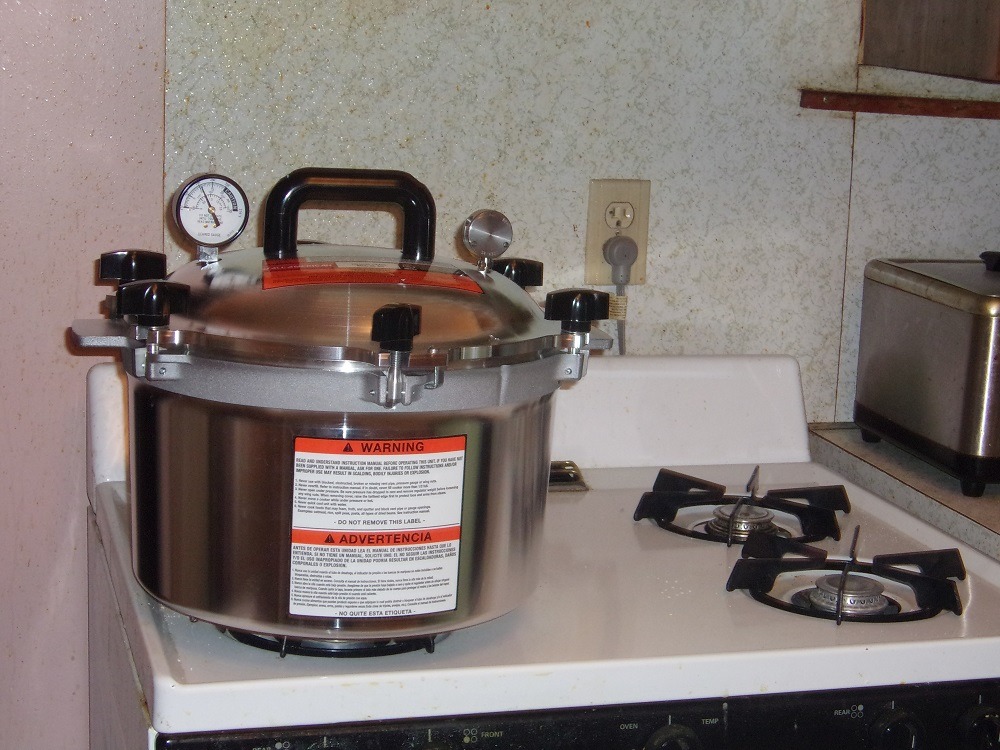
Whether 19 quart jars justifies a 33-pound pot
The math decides it fast. Nineteen quart jars is the difference between three loads and one for a typical bulk beef buy, and each load you remove is a full heat-up, process and cool-down cycle you no longer spend standing at a stove. For a homestead putting up a whole animal, that throughput is worth a real premium over a 23-quart unit.
For an average household canning a few pounds of chicken a month, it is the wrong tool. A pot that weighs 33 pounds empty needs a burner large enough to cover the base and a cooktop that can take the load, and you will be lifting it less often but with far more at stake when you do.
What the gasket-free seal actually saves
Owners in r/homestead, SurvivalistBoards and r/TwoXPreppers conversations describe the no-seal design as the decisive reason to buy, and the reasoning is simple. A gasket-based canner needs periodic replacement, and a seal that hardens or swells during a long harvest season is the kind of failure that costs you a load of meat and a day of work.
Two caveats before you commit. The aluminum pot still reacts with acidic foods, so keep it on canning duty, and the instruction manual spreads key information across many pages, so read it before your first big batch rather than during it.
3. T-fal 22-Quart Aluminum Pressure Canner
T-fal 22-Quart Aluminum Pressure Canner, 3 PSI Settings, Home Canning, Includes Racks & Canning Guide, Large Capacity, Pressure & Water Bath Canning for Vegetables, Meats, Seafood & Fruits, Silver
22 qt: 24 half-pints, 18 pints or 7 quarts
Three-setting built-in regulator
Two racks included
Pros
- Seven quart or 18 pint jars per load at a mid-range price point
- Built-in weighted regulator needs no separate weights
- Two canning racks allow stacking
- Works as a water bath canner too
- Gas and electric coil cooktop compatible
Cons
- Pressure indicator valve is slow to rise and hard to see
- Regulator markings read as 1/2/3 rather than 5/10/15 PSI
- Higher one-star share than the well-reviewed canners here
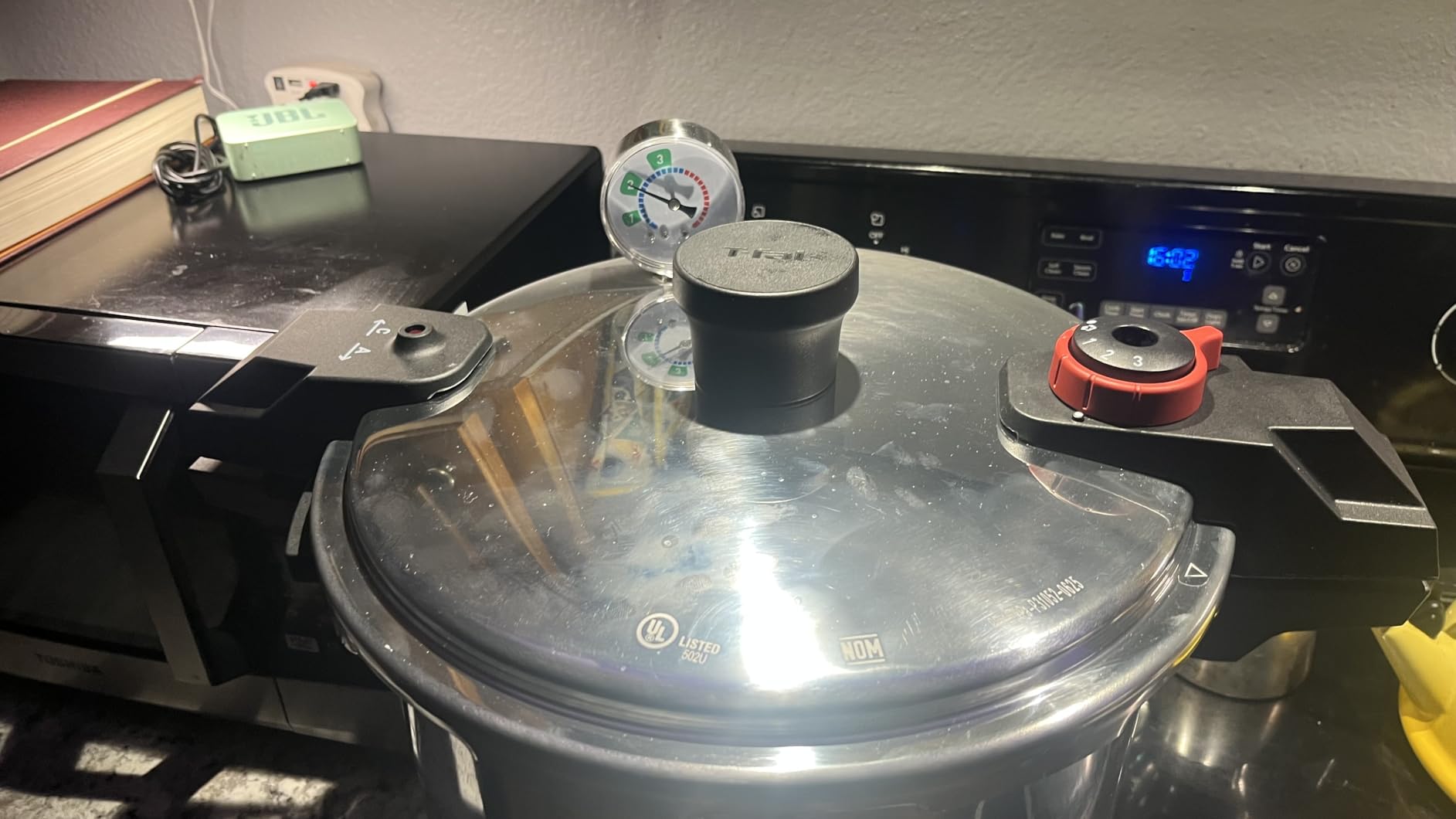
The T-fal 22-Quart is the pick if you want a large-batch canner without the All American price step, and its jar numbers are the strongest in this group for the money. It holds up to 24 half-pint jars, 16 wide-mouth pints, 18 pints or 7 quarts per batch, and it comes with two canning racks so you can stack a second layer in the larger size.
What makes it easy to learn is the built-in weighted regulator. Instead of passing separate weights onto a stem, you select a pressure setting on the unit, which removes the most common beginner mistake and means you are listening for the regulator rather than watching a needle. The locking lid, steam release valve and easy-to-read gauge round out a design that several first-time canners describe as the first pressure canner that did not intimidate them.
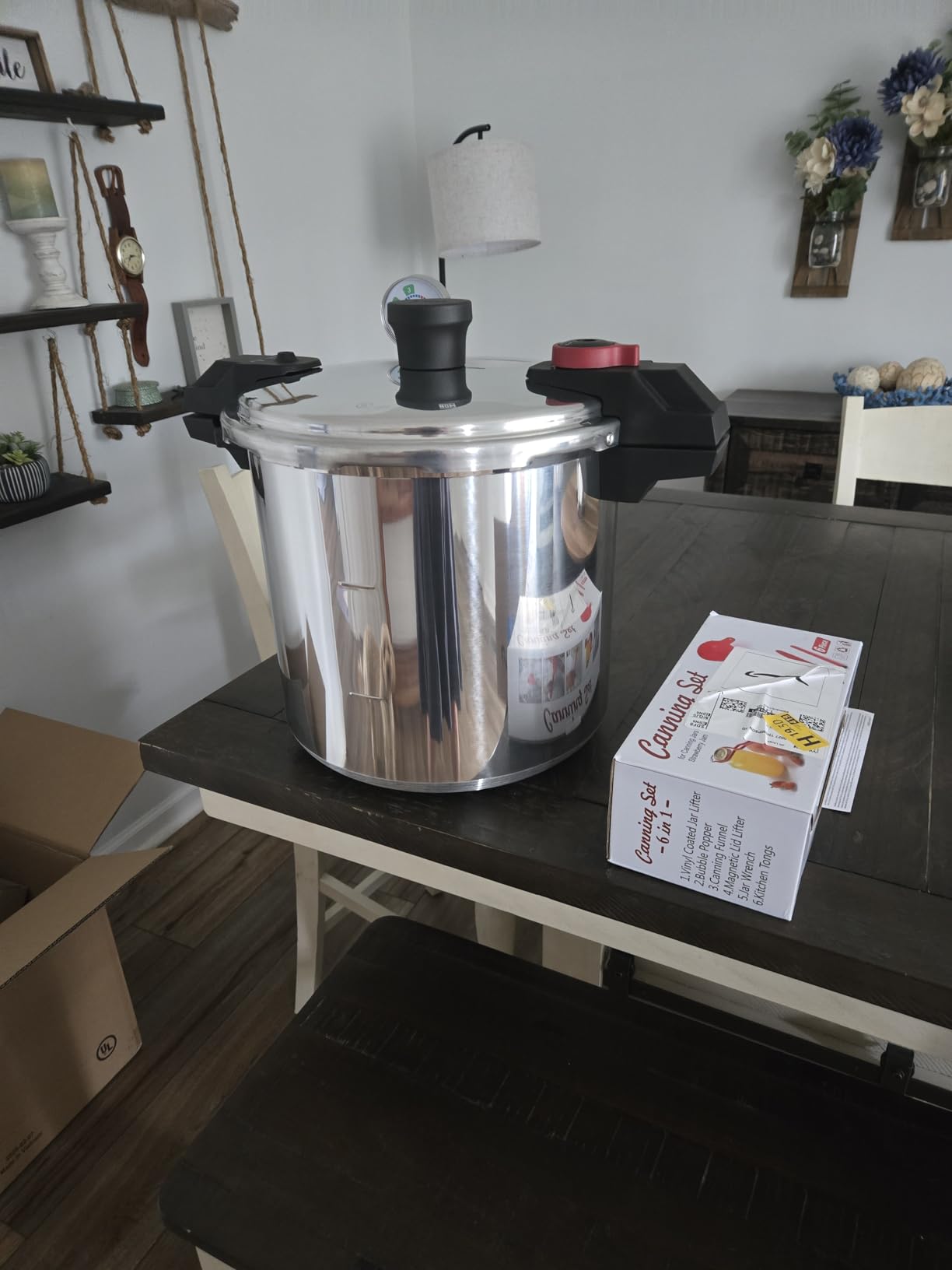
The user base is more polarized than the other big-name models, with a 4.4 average and a 9% one-star share, the highest among the well-reviewed canners here. Recurring gripes are practical: the pressure indicator valve takes a while to pop up and sits inside the housing where it is hard to see, and the regulator is marked with three settings rather than the familiar 5, 10 and 15 PSI labels that most meat processing tables use.
A few owners report steam escaping near the handle or gasket before the seal is broken in, and a handful received units with damaged pressure gauges after shipping. Uncoated aluminum also discolors and etches with acidic food, so it stays in the canning lane.
How it handles a wide-mouth meat batch
That 16 wide-mouth pint figure is the one to pay attention to. Wide-mouth jars take larger meat chunks without cutting them into the small, uniform pieces that turn into textureless mush after a long process, and this canner accepts sixteen of them per load. A canner that only takes standard pints forces you to dice your meat smaller than most recipes suggest.
Seven quart jars per load matches the Presto 23-Quart, so the extra capacity over smaller units shows up in the pint count and the rack count rather than the quart count.
When the slower pressure rise is a real problem
The complaint that matters for meat is the slow pressure rise. Meat processing holds pressure for a long time once you are there, so a slow approach adds to the total cycle, and a hard-to-see indicator makes it harder to know when the timer should start. First-time canners who like visible feedback should factor that in.
For anyone who prefers the weight of hands-on operation, this is still a well-equipped pot at 14.8 pounds, usable on gas or electric coil cooktops, and backed by a one-year warranty. Check the stove type and your own comfort with weighted gauges before you commit.
4. Presto 02144 12-Quart Digital Pressure Canner
Presto 02144 12-Quart Digital Pressure Canner
12 qt: about 4 quarts or 5 pints per cycle
Automatic cycles, no altitude adjustment
Cover-locking system
Pros
- Guided LED cycles remove constant heat adjustment
- No altitude adjustment required
- Runs cooler and quieter than stovetop canning
- Ten built-in safety features
- Doubles as a water bath canner
Cons
- Small load of about 4 quarts or 5 pints per cycle
- Long cool-down cycles that cannot be skipped
- Tall body needs counter clearance
The digital approach changes what canning feels like. This unit runs a fully automated pressure canning cycle with LED icons and audible prompts for each step, so instead of watching a dial and adjusting a burner for 90 minutes you press start and walk away. Owners who switch from stovetop canning report that they rarely go back, and several describe the guidance as close to foolproof.
It also removes the altitude variable. The unit holds the correct processing temperature automatically, so if you live above 1,000 feet you do not adjust times by hand the way you would on a weighted stovetop canner. The stainless steel body and lid run cooler than a stovetop pot, which is a genuine advantage when you are processing a load of meat in July.
There are ten built-in safety features including a cover-locking system and a temperature sensor that maintains pressure, and it doubles as a water bath canner for fruit, jams, jellies and salsa. The canning rack is included, and Presto customer service has replaced broken liners and lids quickly for multiple owners.
The constraint is batch size. At 12 quarts you are processing roughly 4 quart jars or 5 pints per cycle, which is a third of what the Presto 01781 handles. The preprogrammed cool-down also cannot be skipped, so a long fixed cool-down per load adds real hours to a bulk session.
Whether a 4-jar cycle is enough for your meat
Four quart jars per cycle is fine for a household canning a few pounds of chicken or a batch of stock a month. It is painful for a bulk harvest, and the pain compounds because every cycle repeats the same fixed cool-down. Before buying, count your annual meat volume and divide by 4 to see how many cycles you are signing up for.
Quart jars will not fit for water bath canning in this model because there is not enough room for water to cover the lids, so plan on standard pints and half-pints for high-acid batches.
What automation does not remove
Automation does not remove jar prep, headspace, siphoning, or the requirement to follow the official processing time for your meat. You still own the parts of the process where mistakes happen, and the unit does not fix a badly filled jar.
Two practical notes: the body is tall and needs real clearance under lower cabinets, and a few owners report needing to reseat screw bands tighter than usual to get jars to seal. Some also report a nonstick liner peeling after about two months, so check the liner early.
5. Presto 01755 16-Quart Aluminum Pressure Canner
Presto 01755 16-Quart Aluminum Pressure Canner and Cooker
16 qt stovetop canner
10.5 pound aluminum body
Deluxe pressure dial gauge
Pros
- Light and easy to move between burners
- Established Presto design with a 12-year brand track record
- Works as a pressure canner and large pressure cooker
- Handles a meaningful mid-size batch
Cons
- Fewer jars per load than any 22-quart or larger canner here
- Manual heat monitoring at the stove
- Aluminum is unsuitable for acidic cooking
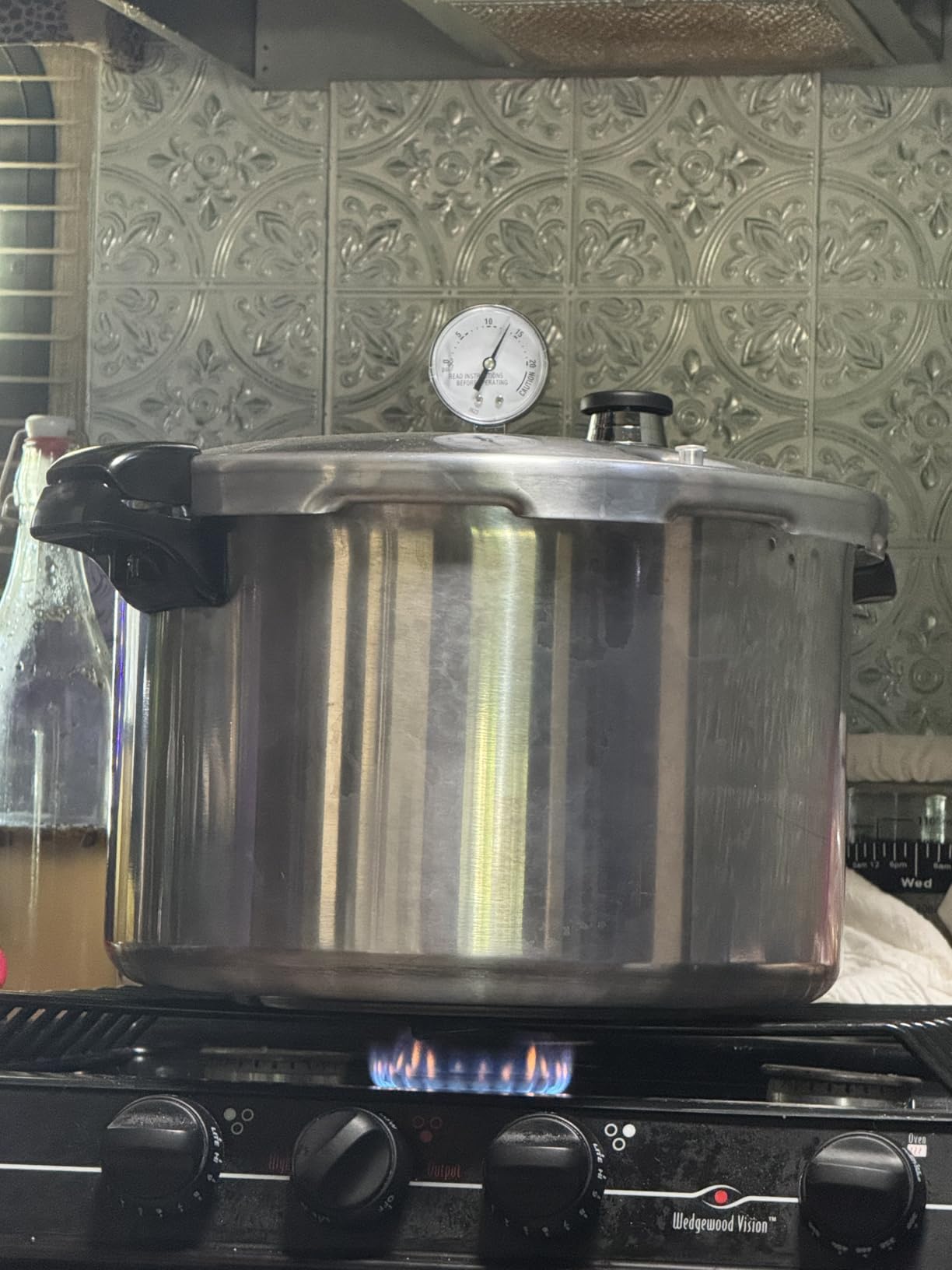
This is the compact choice for a small household or a kitchen with one usable burner. At 16 quarts and 10.5 pounds empty, it is one of the easiest canners in this roundup to lift on and off a stove, which matters more than most buyers expect when the pot is full of hot meat. It carries a 4.7 average across more than 4,200 ratings, with roughly 85% five stars.
The build is the same idea as the Presto 01781, just smaller: warp-resistant aluminum and a deluxe pressure dial gauge that reads the full pressure range. It works as both a pressure canner and a large-capacity pressure cooker, and the 12-year warranty attached to the Presto canning line gives long-horizon buyers some comfort.
The honest limitation is capacity. Whatever jar count you get in 16 quarts is well below the 7 quarts or 18 to 20 pints the 22 and 23-quart units take, so a bulk harvest means more cycles and more stove time. For someone canning a few pounds of meat a month, that trade is usually the right one.
Manual weighted-gauge operation means monitoring the stove and adjusting heat continuously, and the aluminum body should stay away from tomato and vinegar cooking. The product listing is also thinner than on the newer Presto models, so expect fewer detail bullets when you compare it in-store.
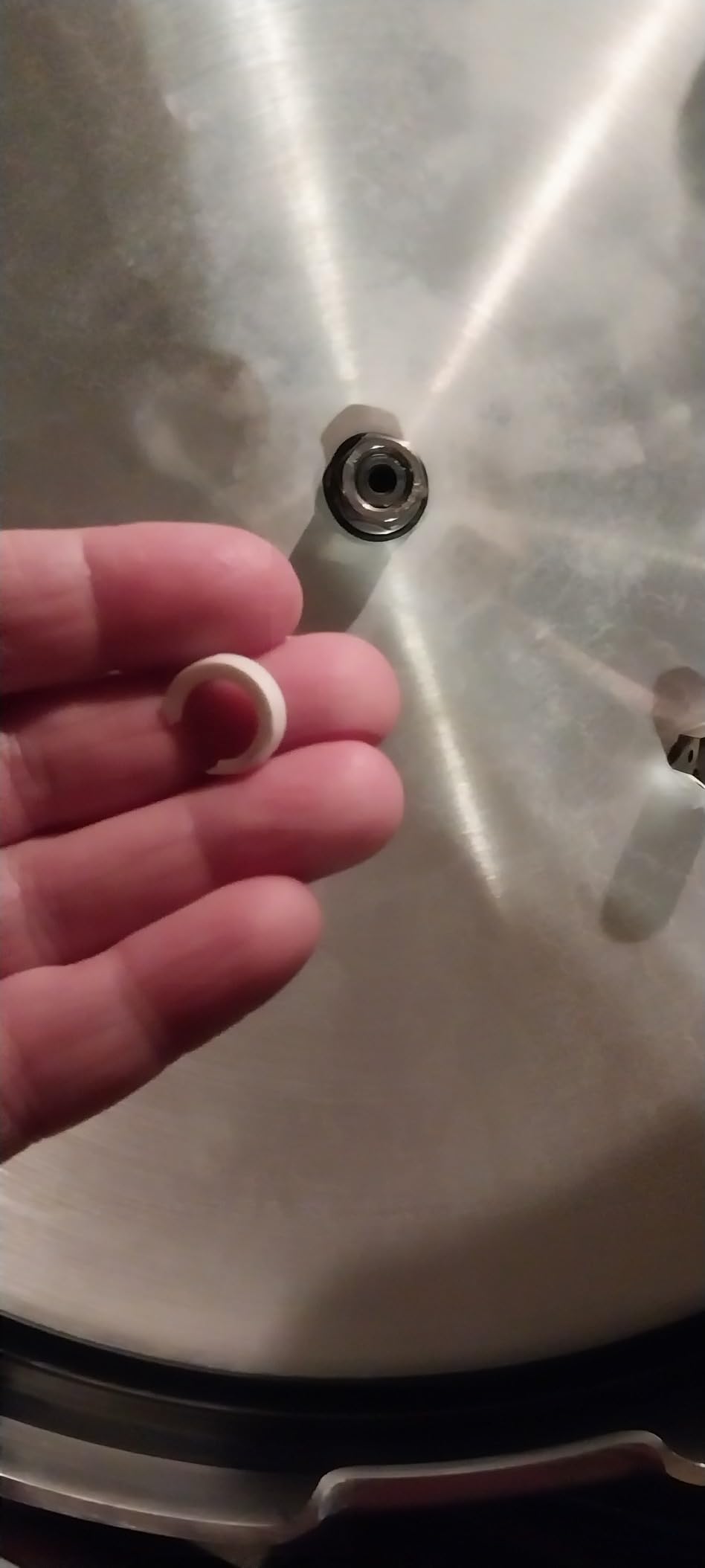
How a 16-quart pot fits a small kitchen
The 10.5-pound empty weight is the number to compare against the 12-pound 23-quart, the 14.8-pound T-fal and the 33-pound All American. On a burner you need to reach across, and for anyone lifting a hot canner regularly, that difference is felt every time rather than once.
Its footprint, 13.5 inches deep by 17.25 inches wide, also leaves more counter and range space than the wider 22-quart models, which matters in a kitchen where the canner shares a stove with a burner you still want to use.
When to step up to a larger canner instead
If you plan to can a whole bird, a rack of venison or any bulk beef buy in a single weekend, this pot will not save you time. More cycles means more heat-up and cool-down, and on a stovetop canner you are standing there for each one.
Owners who already trust the Presto name choose this as the compact option for smaller harvests, accepting reduced capacity in exchange for the brand’s stovetop reliability record. For a first canner or a two-person household, that is a defensible starting point.
6. NESCO NPC-9 9.5-Quart Smart Electric Pressure Canner
NESCO NPC‑9 Smart Electric Pressure Canner and Cooker for Home Food Preservation, 9.5‑Quart Stainless Steel with Digital Controls
9.5 qt electric canner: about 4 quarts or 5 pints
Safety lock lid and float valve
Removable nonstick inner pot
Pros
- Automatic pressure and temperature regulation
- Safety lock prevents opening under pressure
- Cooks
- steams and water baths in one appliance
- Does not heat up the kitchen
- Stainless steel body
Cons
- Smallest batch here at about 4 quarts or 5 pints
- Wordy instruction booklet with a learning curve
- You still wait for pressure before walking away
The NESCO NPC-9 is the canner that converts people who were afraid of stovetop pressure canning. It regulates pressure and temperature automatically, and a safety lock lid plus an automatic float valve prevent the unit opening under pressure, which removes the two failure modes beginners worry about most. Owners who were hesitant about dial watching describe it as the confidence-restoring entry point.
It is also the only pick here that does something else useful while it sits there. Pressure cook, slow cook, steam and water bath modes mean the same appliance handles soup, stews, jams and batch meals between canning sessions, and the stainless steel body is more durable and non-reactive than aluminum for canning work.
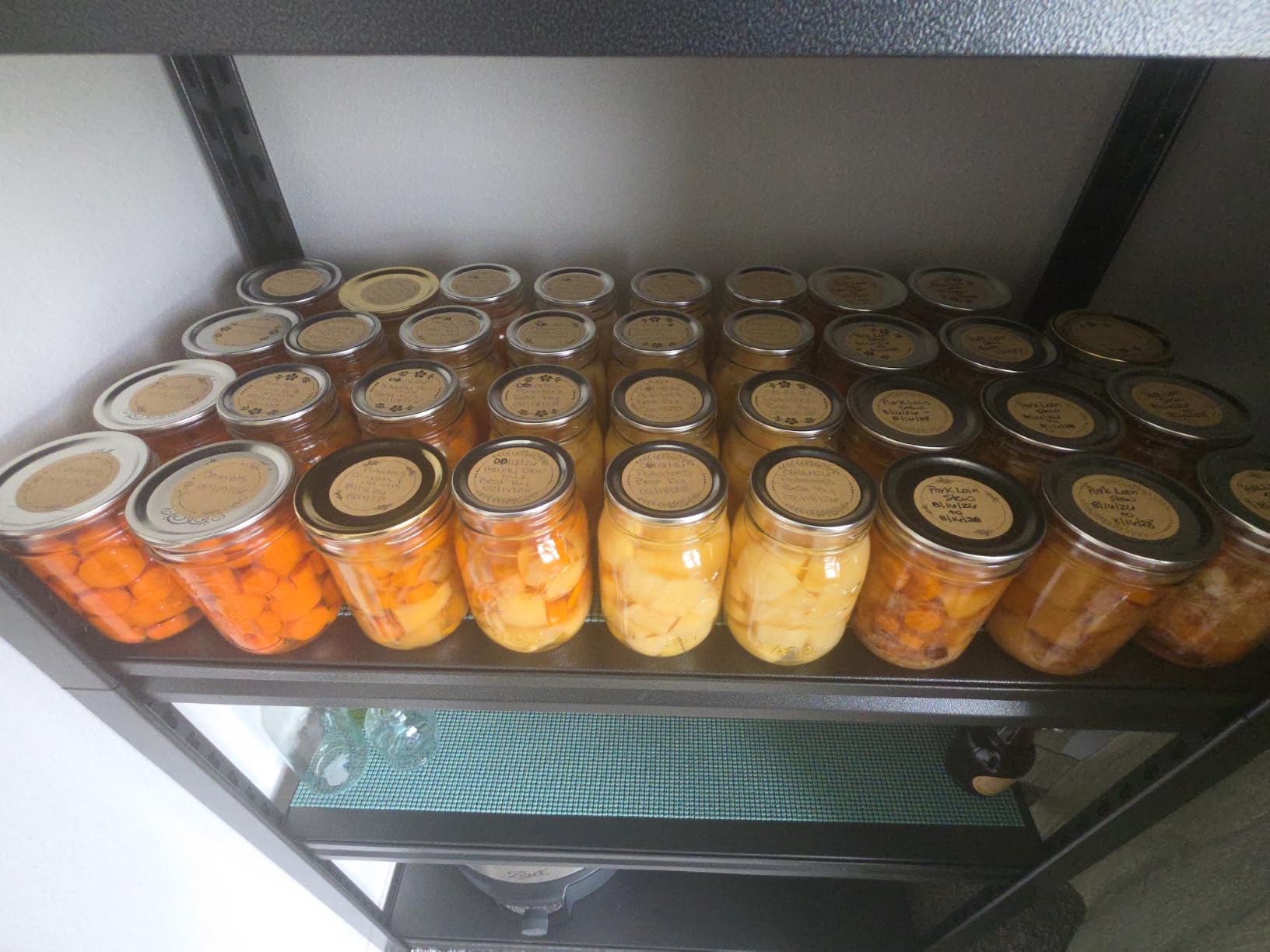
Cleanup is straightforward, with a removable nonstick inner pot, an included canning rack and steam rack, a removable condensation catcher, and limiting valves for standard and high-altitude use. It also runs cool in the kitchen, which matters during a summer harvest.
Capacity is the trade. At about 4 quart jars or 5 pints per batch, it is the smallest here, and wide-mouth pint jars are hard to grip coming out of the narrow inner pot, though quarts lift more easily. The instruction booklet is also wordier than the Presto digital canner, which gives you a more guided first run.
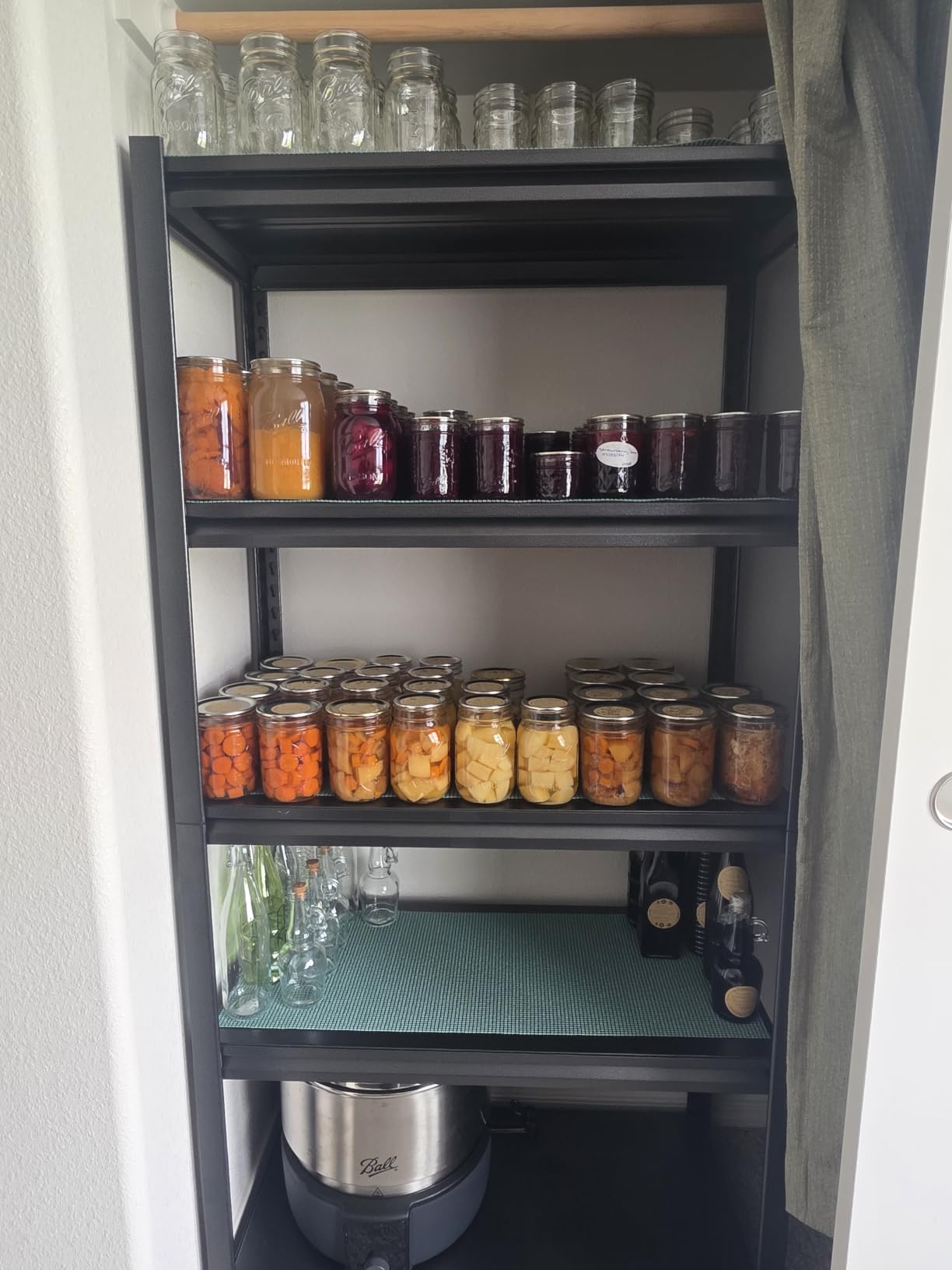
Whether 4 quarts or 5 pints per batch is workable
For a household canning a few pounds of meat a month, four quarts per cycle is a manageable rhythm. The appliance does the pressure work while you prep the next set of jars, which partly offsets the small load, and a cooling kitchen is a real bonus for anyone canning in warm months.
For a bulk harvest it is the wrong shape entirely. Nine and a half quarts is a fourth of the All American 941’s capacity, and the four multi-function modes do not make a load larger.
What the safety lock does and does not cover
The lock and float valve handle the two mechanical risks that matter at the stove: opening under pressure and losing your read on where the pressure sits. They do not handle process decisions, so the processing time still comes from the official table for your meat, and jar prep is still on you.
A few owners note you must wait for the unit to come up to pressure before switching modes and leaving, and that the alert beeps are loud enough to be startling in a quiet house. Budget a one-year warranty and know replacement parts are the deciding factor if you live far from a supplier.
7. Granite Ware 20-Quart Pressure Canner, Cooker and Steamer
Granite Ware Pressure Canner/Cooker/Steamer, 20-Quart
20 qt hard-anodized aluminum
Adjustable 5, 10 and 15 PSI regulator
10.5 pounds empty
Pros
- Hard-anodized body resists rust and staining
- Three-piece regulator at 5
- 10 and 15 PSI
- Functions as canner
- cooker and steamer
- 20-quart size at a moderate weight
Cons
- Only 801 ratings
- so less long-term owner feedback
- Aluminum limits it to canning rather than everyday acidic cooking
- Manual regulator operation at the stove
The Granite Ware 20-Quart is the middle of the size ladder, and its hard-anodized aluminum body is the reason. Owners highlight that it will not rust or stain over long use, which is a genuine difference from lighter-coated aluminum competitors, and at 10.5 pounds empty it stays easy to reposition while still holding a 20-quart batch.
The adjustable three-piece regulator is calibrated at 5, 10 and 15 PSI, which is exactly the range meat processing uses, so you can match pressure to the food rather than being locked to one setting. It also triples as a pressure cooker and a steamer, which broadens its usefulness beyond canning days.
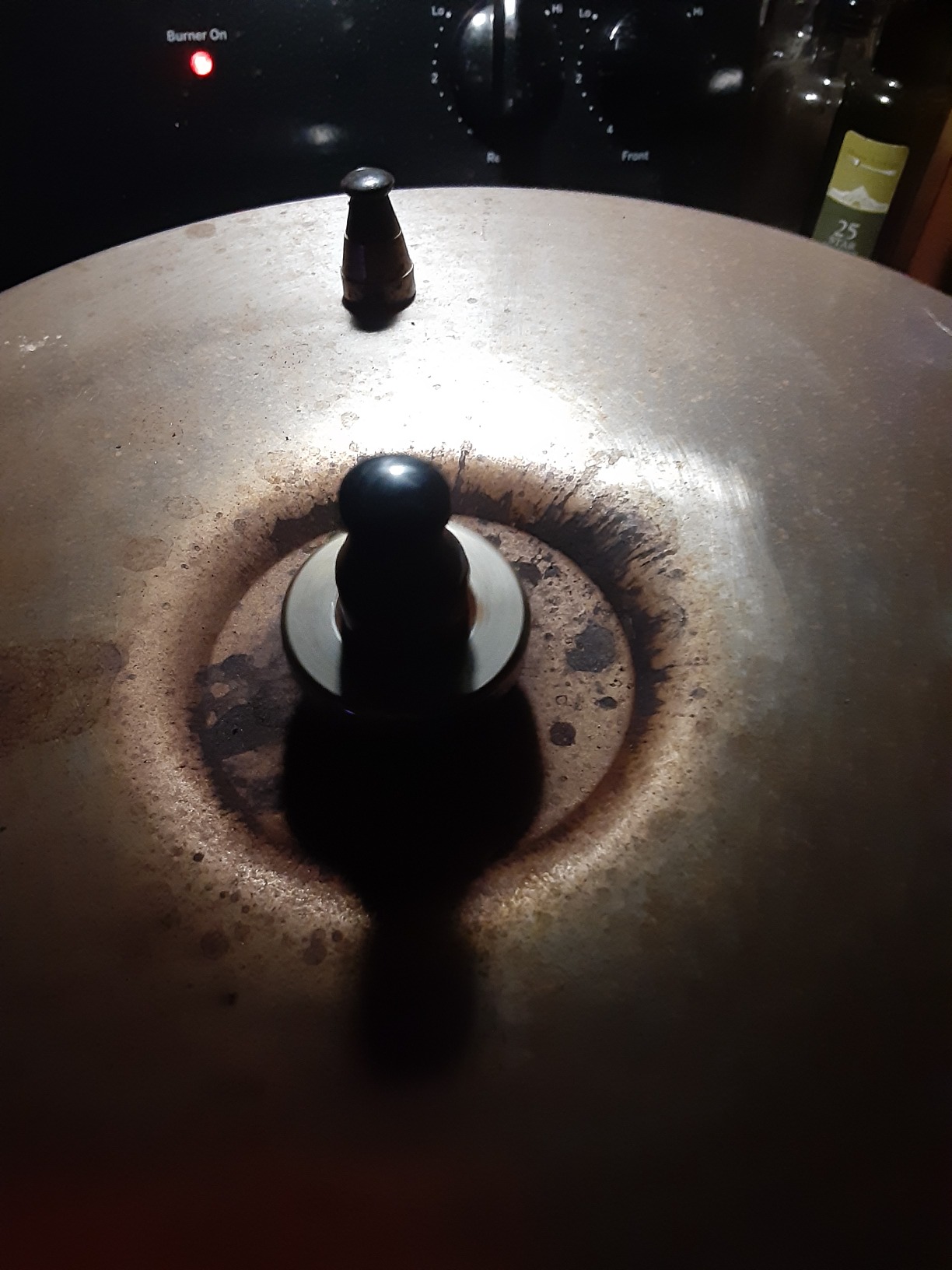
The honest limitation is evidence. With 801 ratings and a 4.6 average, it has roughly a quarter of the review volume of the leading Presto models, so there is less long-term owner history to lean on when something behaves oddly. The category sales rank is also lower than comparable 20-quart models.
Material limits it the same way it limits most aluminum canners: keep it on canning and pressure cooking duty, and do not expect it to handle tomato or vinegar work without etching. Manual regulator operation means constant stove monitoring.
Whether 20 quarts splits the difference well
It does, for a household that wants more than a small canner and less than a bulk unit. The weight matches the 16-quart Presto while the volume is meaningfully larger, so you get more jars per lift without moving a 33-pound pot.
The trade is gauge flexibility against precision. An adjustable weighted regulator at 5, 10 and 15 PSI is simpler than a dial gauge but gives you no reading, so you are matching pressure by sound and weight rather than by measurement.
What less review history means for a first canner
Owners of well-reviewed models can lean on thousands of reports of real behaviour, including failures. With a smaller base, you have less warning about the quirks that might show up in your unit, and warranty support becomes more important as your fallback.
If you can accept that tradeoff, the regulator range and hard-anodized body are genuinely useful features for meat work, and the triple-function design means the pot earns its counter space between harvests.
8. WantJoin 23-Quart Induction-Ready Pressure Canner
Wantjoin Aluminum Pressure Cooker 23Qt Pressure Canner, Pressure Pot with Pressure Control for Home Kitchen or Restraurant, Commercial Pressure Cooker with Gauge
23 qt with induction-ready composite base
Six safety valves
6.03 kg aluminum body
Pros
- Induction and gas compatible
- unlike most aluminum canners
- 23-quart capacity at a low price point
- Six safety protections
- Uncoated food-grade aluminum
Cons
- Documented more as a commercial cooker than a home canner
- No stated canning process times or jar capacity guidance
- Higher one-star share than the top-rated canners
The reason to look at this one is the base. A thickened composite bottom makes it usable on gas and induction cooktops, which rules out most aluminum canners in this roundup. If your kitchen has induction and nothing else on the list will heat on it, that single feature changes the comparison entirely.
Capacity is generous at 23 quarts, and the safety hardware is unusually extensive: automatic lock, check valve, pressure limiting valve, safety valve, alarm valve and an anti-blocking cover. The body is uncoated food-grade aluminum that will not scratch or flake, and the storage bag is a nice touch for off-grid storage.
Now the part that matters for meat. The listing is written toward commercial and restaurant pressure cooking rather than a clearly documented home canning workflow, and it gives no canning process times and no jar capacity guidance. For a low-acid food where the processing time is the safety margin, that documentation gap is not a minor complaint.
Owners also report some inconsistency in sealing, which is reflected in a 9% one-star share, and the lighter aluminum body feels less substantial than the heavy-gauge cast aluminum on the Presto and All American units. We would want a clearly stated process time before trusting it with a full load of meat.
Whether induction compatibility is worth the trade
If you have an induction cooktop, this may be the only canner on the list that will heat on it, and that is a real, concrete answer to a problem. If you have gas or coil, the comparison against a Presto or T-fal at similar capacity gets harder to justify.
Induction heats the base efficiently, which is part of why owners report faster, more even cooking than conventional stovetop methods, and that responsiveness makes holding a processing pressure easier.
What missing process documentation means for a first batch
For vegetables you can improvise a little. For meat you cannot, because the processing time is the entire safety margin against a low-acid spoilage organism, and the right figure depends on the cut, the packing and your altitude. Take the time from the official Complete Guide to Home Canning, not from a product page.
If you are new to canning, the short product copy and a smaller review base make this a harder first purchase. It makes more sense for an experienced canner who already knows their processing times and wants induction capability at 23 quarts.
9. Mirro 22-Quart Pressure Canner with 5, 10 and 15 PSI Regulators
MIRRO 22 Qt Aluminum Pressure Canner with 3 Regulators, 5, 10 & 15 PSI
22 qt with 5, 10 and 15 PSI weighted regulators
Two racks and cool-touch handles
6.21 kg
Pros
- Weighted design means no dial to watch
- 7 quart jars per batch
- Heats fast and holds a steady temperature
- Good seals with very little siphoning
- Dishwasher safe and easy to clean
Cons
- No pressure reading valve or dial gauge
- Regulator must be pushed firmly onto the stem to seat
- Some users avoid it on glass-top stoves
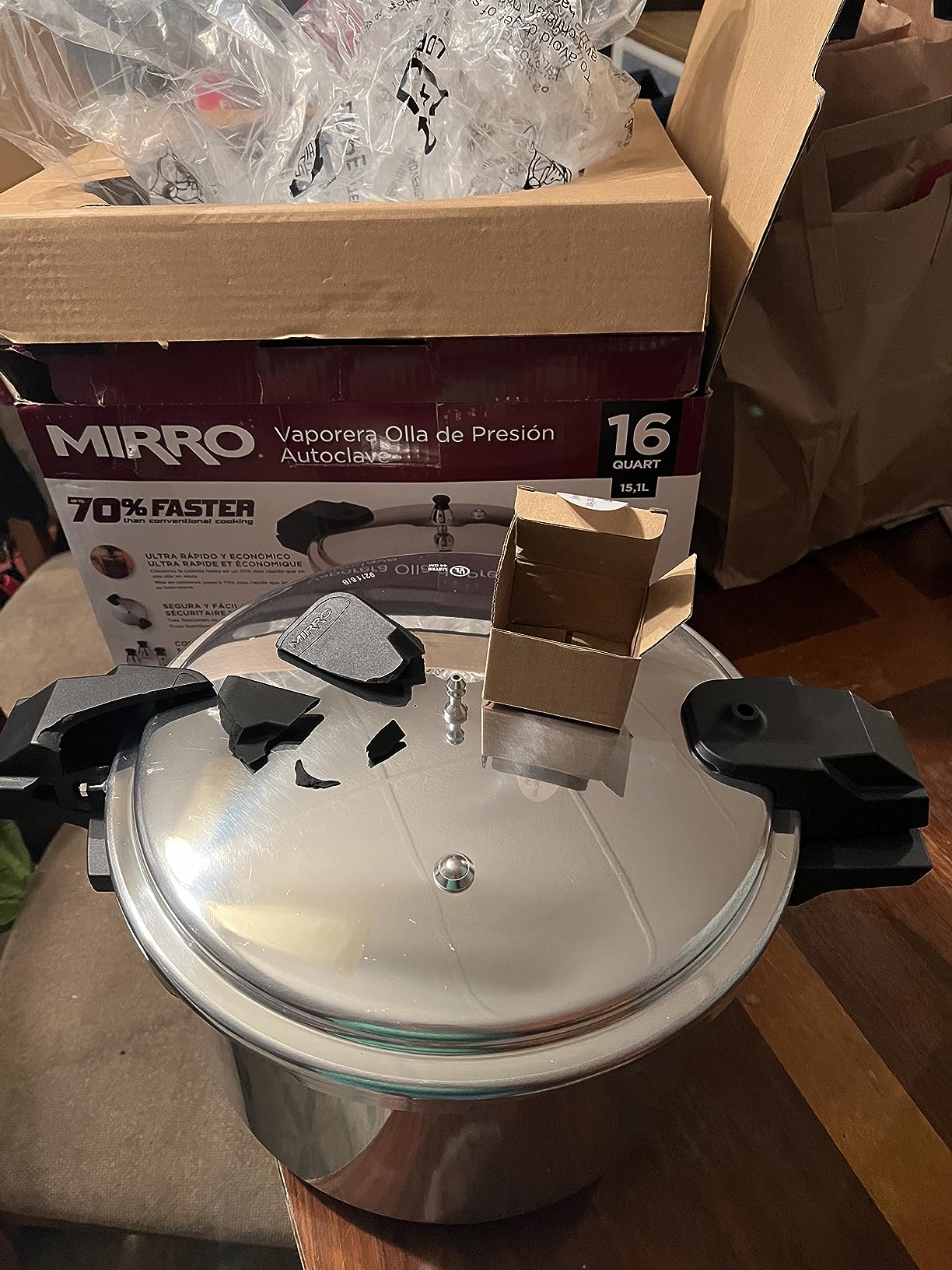
Experienced canners come back to the Mirro specifically because it is a weighted-gauge design. You set a 5, 10 or 15 PSI regulator on the stem and judge pressure by the sound and movement of the weight rather than by watching a needle, and plenty of experienced canners find that easier than constant dial monitoring on a stovetop pot.
Performance is well regarded. Owners report fast heat-up, a steady temperature with little heat adjustment, and jars that seal reliably with very little siphoning, which matters when you are processing stocks and broths alongside meat. The 22-quart size takes 7 quart jars per batch, and a second rack is included for stacking.

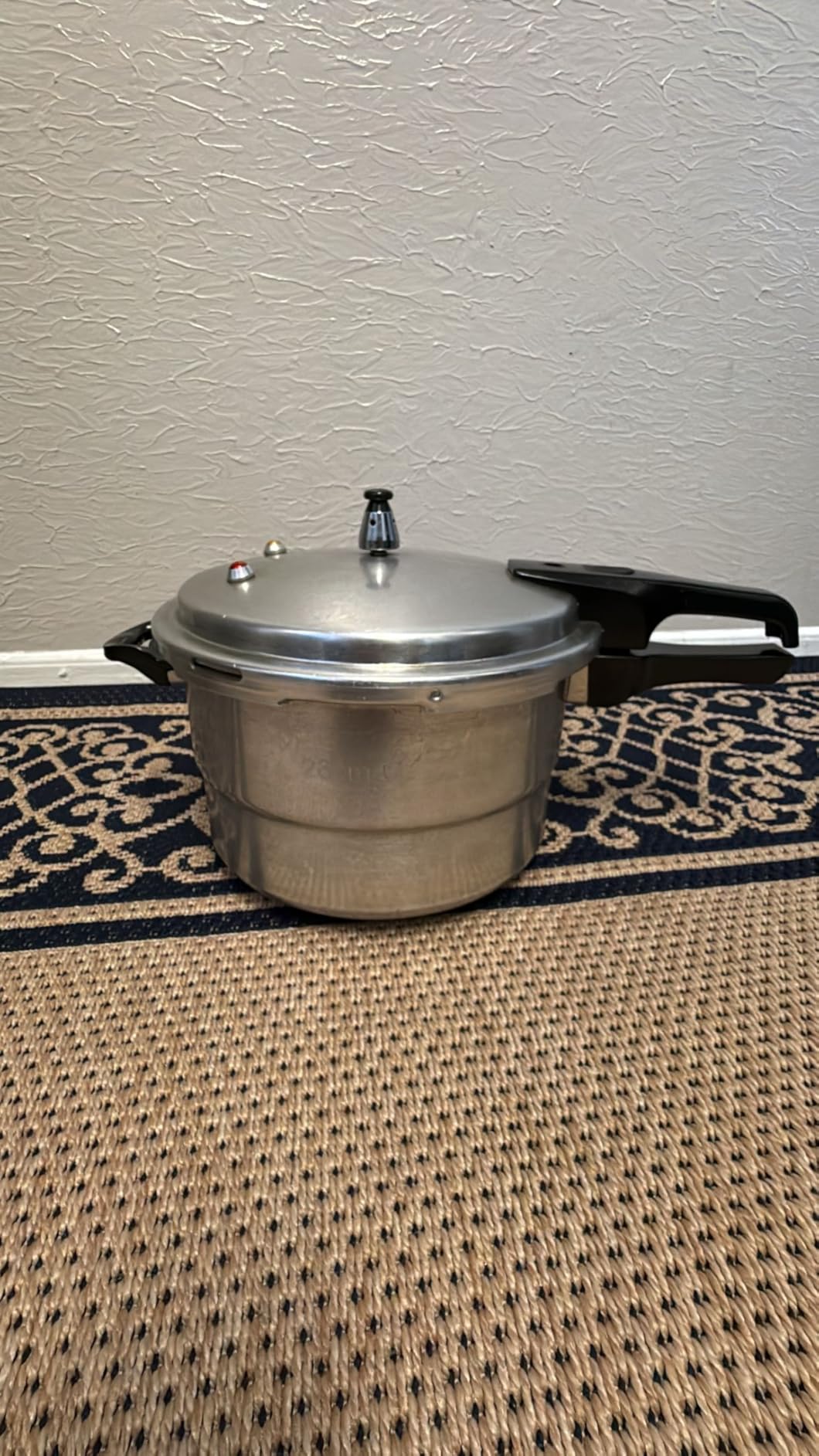
Handling details are better than most in the category, with dual cool-touch handles and a locking mechanism that is easy to latch. The aluminum is mirror-polished outside, easy to clean and dishwasher safe, which is practical after a long day of processing.
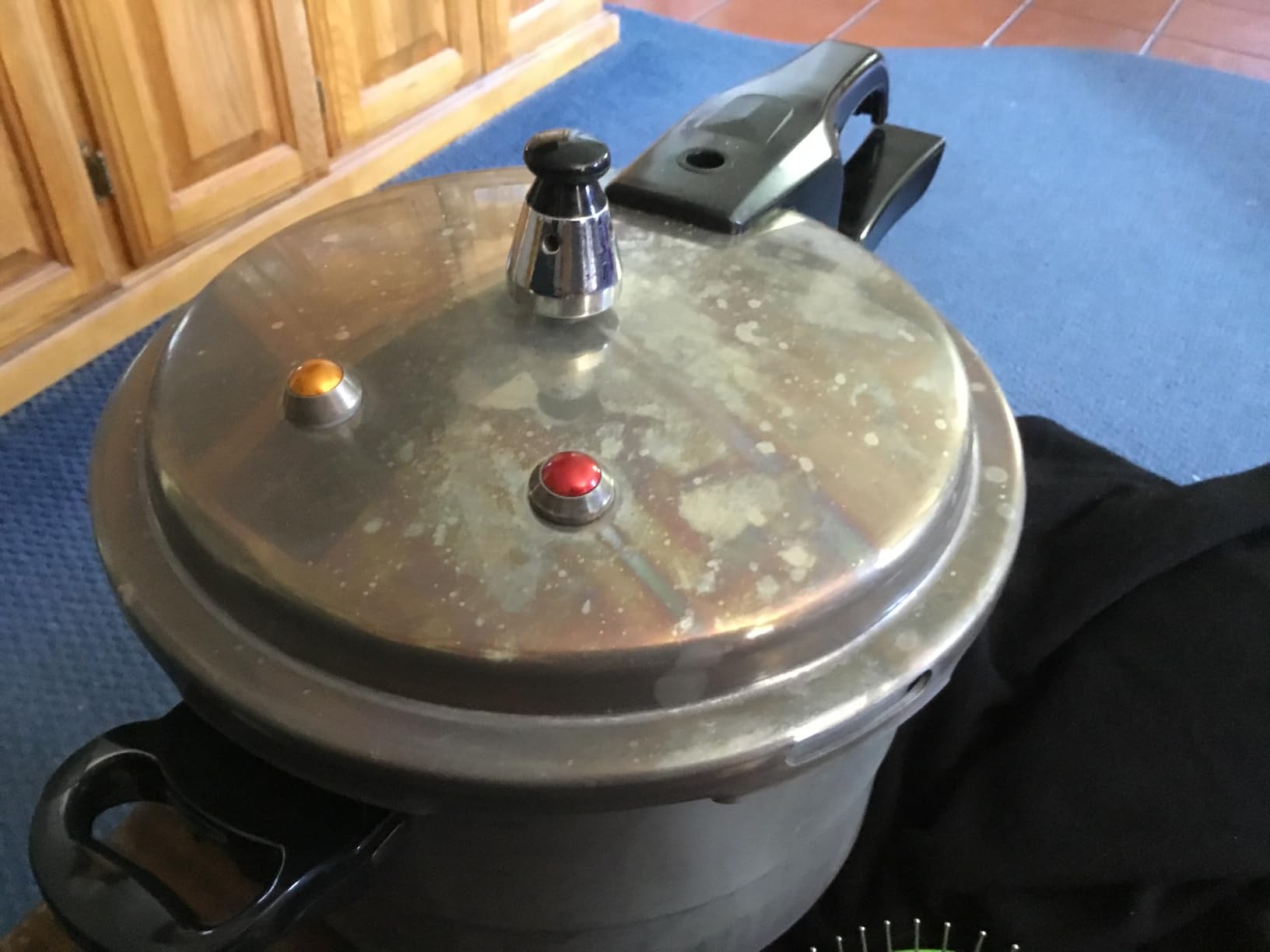
The nits are specific. There is no pressure reading valve, so you have no measurement at all. The regulator has to be pressed firmly onto the stem until two audible pops seat it, and it can leave a rust-colored stain around the steam vent. Some users also steer clear of it on glass-top stoves, and the 22-quart size is heavier than expected at 6.21 kg.
Whether weighted pressure suits your processing style
Weighted gauges are a good match if you are comfortable with a steady sound and do not want to watch a dial for the length of a meat process. They are a poor match if your stove runs hot, your burner cycles unevenly, or you want to confirm a specific pressure reading while the pot is running.
Having all three settings at 5, 10 and 15 PSI is what makes it usable for a mixed meat and low-acid vegetable season rather than a single-pressure pot.
How siphoning relates to your jar prep
Siphoning is the loss of liquid from a jar through the headspace when the contents are under pressure as the canner cools, and it leaves a seal that looks fine but has lost liquid. Owners report very little of it here, which points to fast heat-up and steady pressure rather than to any special technique.
Still, siphoning starts with headspace discipline, so measure headspace after the meat is packed rather than before, and keep the two racks level so every jar sits at the same depth. Note that the 16-quart variant of this model does not include the stacking rack.
10. Fulgutonit 12-Quart Aluminum Pressure Cooker
Fulgutonit 12 Quart Aluminum Pressure Cooker
12 qt aluminum-manganese-titanium body
63-77 kPa raises boiling point to 239F
3.27 kg
Pros
- Largest capacity available at the lowest price point
- Several safeguard devices including sensors and safety valves
- Self-locking lid that opens easily once depressurized
- Owners report canning meat successfully in 7-8 pint batches
Cons
- Smallest review base here at 190 ratings
- Thin plastic handles have broken for some owners
- Handles ship unassembled and no dial gauge is included
This is the budget entry, and the honest way to describe it is as a high-capacity pot at the lowest price point in the roundup. At 12 quarts and 3.27 kg, you get more internal volume per dollar than anything else here, and the aluminum-manganese-titanium alloy is specified for fast, even heat distribution.
It is a genuinely capable pressure pot. It achieves 63 to 77 kPa, which raises the boiling point of water to 239 degrees Fahrenheit, and it carries multiple safeguard devices including pressure sensors, working valves, safety valves and a safety window. First-time canners report successfully canning 60 pints of meat in 7 to 8 pint batches, which is a real workload result from an owner rather than a claim from the manufacturer.
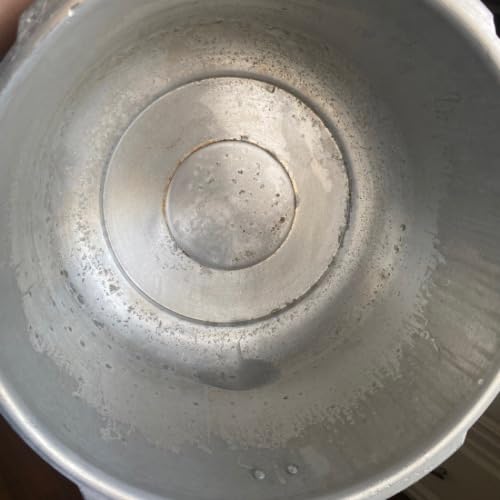
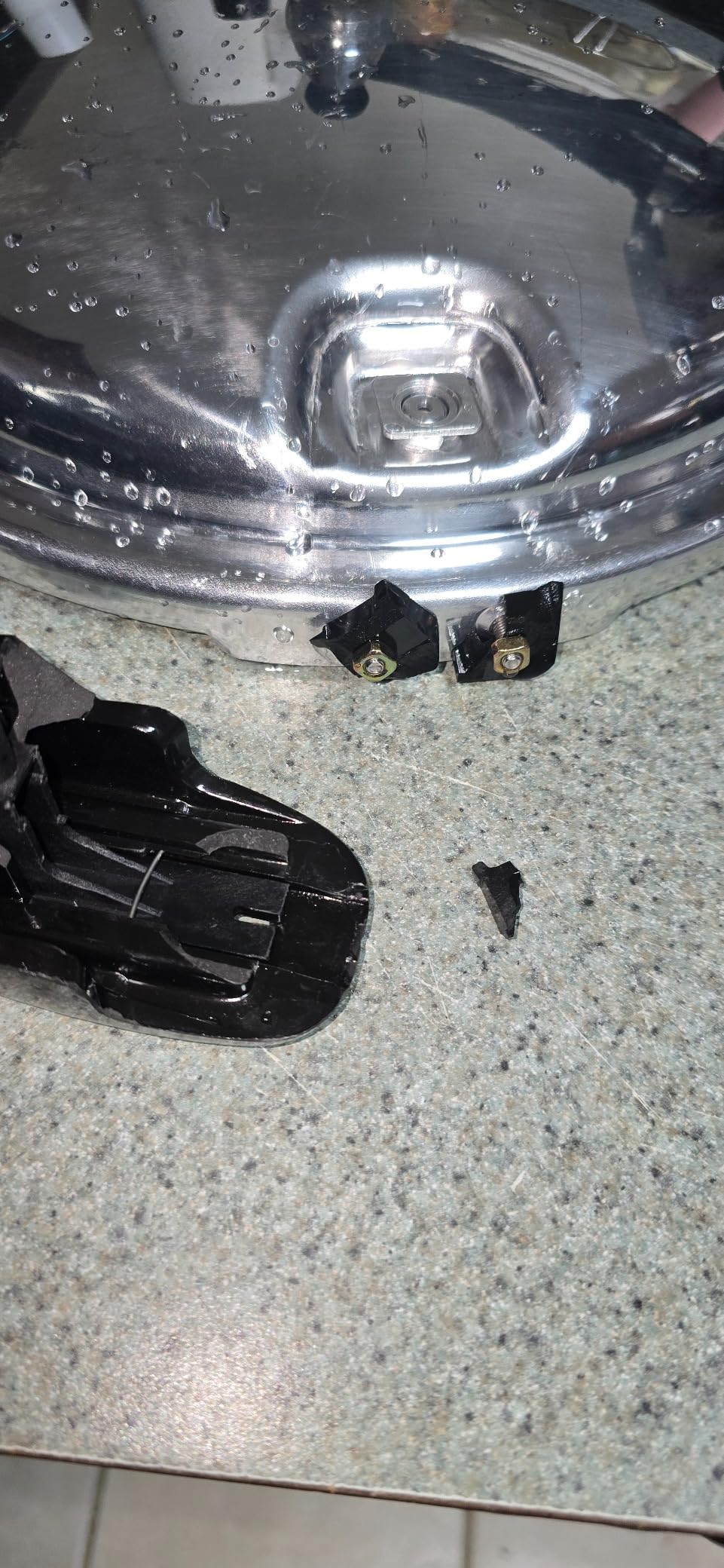
What gives us pause is build quality and the thin evidence behind it. Thin plastic handles have broken for some owners during first use, handles ship unassembled and have to be fitted by the buyer, and finish quality is inconsistent with knicks and scratches reported. One buyer received incorrect screws, so the lid would not lock to the pot at all.
There is no dial gauge, so pressure is judged by the spinning knob, and with 190 ratings the one-star share is the highest in this roundup. For a tool that handles hot, heavy jars of meat, hardware durability is not a trivial category.
Whether a 12-quart budget pot can handle a meat harvest
It can, at the pace of about 7 to 8 pint jars per batch based on owner reports, which is genuinely workable for a small household or a first season. It is slow for anything larger, because each batch is small and every batch pays the full heat-up and cool-down cost.
For a first canner on a tight budget who is processing a few pounds of meat a month, capacity per dollar is a defensible reason to consider it. For a bulk harvest, the small load and the extra hardware risk make the economics poor.
What to inspect before your first load
Before you fill it with jars, fit the handles properly and check them for tightness, confirm the lid locks and the safety window and valves are present, and run a short test cycle. The reports of broken handles and missing screws are assembly and quality control issues rather than design flaws, and both are far cheaper to catch in week one than in the middle of a harvest.
Use the official processing table for your meat regardless of what any listing says, and treat this as a cooking pot with canning capability rather than a canner with cooking capability. That is a different safety expectation than the units above it.
How to Choose a Pressure Canner for Meat
Match the pot to your batch size
Start from your annual meat volume, not from the canner size. A household canning a few pounds of chicken a month is well served by a 12 to 16-quart unit. A family processing a side of beef, a whole hog or several deer needs the 22-quart class or above, because cycle count is what determines whether a harvest weekend is pleasant or endless.
Then think about jars. Wide-mouth pints take larger meat chunks, but not every canner in this roundup is documented for wide-mouth loads at scale, so check the jar capacity line on the listing and match it to the jars you actually own.
Dial gauge or weighted gauge for meat
Meat is processed at specific pressures, usually 10 or 15 PSI depending on the cut, and a dial gauge tells you where the pot actually is. That matters on an uneven burner, at altitude, and whenever you are new enough that you cannot yet hear a weighted regulator accurately.
A weighted gauge is simpler, has no moving needle to fail, and many experienced canners prefer the sound-based feedback. Both are legitimate approaches. Electric digital units sit in a third category, holding temperature for you with no adjustment, which is the reason to pay for one if heat management is the part you dread.
Gasket-free versus gasket-based seals
Gasket-based canners use a rubber or silicone ring to seal the lid. They work, but the seal is a consumable that hardens, and a failed seal during a long harvest season is a genuinely stressful failure mode. Replace them on a schedule and keep a spare.
The All American 1930 line uses a precision-machined metal-to-metal seal instead, so there is nothing to replace. That is the single most decisive buying factor reported in forum threads about this category, and it is worth paying up for if you intend to can meat for many years.
Stovetop compatibility and burner size
This is where most expensive mistakes happen. A 33-pound loaded canner dropped onto a glass or ceramic cooktop can crack it, and reviewers raise this repeatedly. Cast aluminum and glass do not mix casually, so check your cooktop material and manufacturer guidance before you commit to a heavy pot.
Burner output matters too. A large canner needs a burner with enough BTU to bring the pot to pressure and hold it, and on a glass cooktop the outer ring may not be enough. Most of these units work on gas and electric coil surfaces without drama. The WantJoin 23-Quart is the one here with a documented induction-compatible base, which matters if induction is your only heat source. Add a canning rack that fits your pot and a heat diffuser if your cooktop calls for one.
Electric canners and the testing question
Electric pressure canners automate pressure and temperature and free your stove entirely, and both electric units here are USDA-recommended for pressure canning. The NESCO NPC-9 includes a high-altitude limiting valve and the Presto 02144 states that no altitude adjustment is needed.
The common objection is independent testing, and it is worth taking seriously rather than dismissing. The practical answer is to weigh batch size against supervision. Electric units win when you want hands-off operation on modest volumes. They lose when your volume is high and the fixed cool-down per cycle compounds, because the 12-quart models process about 4 quart jars or 5 pints at a time.
How Much Meat Fits in One Canner Load
Start with the jar, not the canner. A quart jar packed with raw meat typically takes roughly a pound and a half of product, and leaving room for headspace plus liquid for safe processing means real-world yields land near that figure. A pint jar takes roughly half of that, so wide-mouth pints are worth the extra trip for larger chunks.
Multiply that by the canner’s documented jar count. Seven quart jars is about ten to eleven pounds of raw meat per load on the Presto 01781, the T-fal 22-Quart and the Mirro 22-Quart. The All American 941 at 19 quart jars is closer to 28 pounds per load. The small electric units at 4 quart jars are about six pounds.
Then divide your total raw meat by the pounds per load. A 200-pound beef side at roughly 10 pounds per load on a 23-quart canner is about 20 loads, and that is a two-day job once you add heat-up, processing and cool-down time to each cycle. Doubling capacity halves the cycle count, which is exactly why the biggest canner wins for bulk work and loses for everything else.
Use lean cuts. Fat is the enemy of shelf life in canned meat, and the recipe that produces the best flavor often produces the shortest storage life, so follow the official process for the cut you have. The same caution applies to game: wild venison and poultry are lean, and they are the foods most often processed at the longer end of the recommended time.
Frequently Asked Questions
Do the Amish use pressure canners?
Yes. Pressure canning, not boiling-water canning, is standard practice in Amish and similar plain-communities kitchens precisely because it is the safe way to preserve low-acid food such as meat. Many households prefer wood or gas heat and a stovetop canner over an electric appliance, and the emphasis is on tested processing times rather than tradition for its own sake.
Can I use a pressure canner to cook meat?
A pressure canner will cook meat, but that is not what it is for. It is built to hold an exact processing pressure and temperature for a specified time so low-acid food can be stored on a shelf. A pressure cooker is built to cook food fast and then vent, and the USDA does not treat pressure cooking as a safe canning method.
Is there a pressure canner that doesn’t require a gasket?
Yes. The All American 1930 series uses a precision-machined metal-to-metal sealing system, so there is no rubber gasket to replace or degrade. Gasket-based canners such as the Presto, T-fal, Mirro and Granite Ware models do use a seal, and it should be replaced on a schedule with a spare on hand.
What foods cannot be pressure canned?
Do not pressure can tomato puree or soup, pumpkin or butternut squash puree, pasta, rice or flour-based mixes, dairy-based spreads, or any product thickened with those ingredients. Those foods are not recommended for home canning by the National Center for Home Food Preservation. Also avoid canning meat with excessive fat, since fat shortens shelf life.
Is there an USDA approved electric pressure canner?
Yes. The Presto 02144 digital canner and the NESCO NPC-9 both state that they process low-acid foods such as meat, poultry, fish and vegetables using the USDA-recommended pressure canning method, and the Presto states that no altitude adjustment is needed. Both automate pressure and temperature so you do not manage heat yourself.
What size pressure canner do I need for canning meat?
Match the canner to your annual volume. A 12 to 16-quart unit suits a household putting up a few pounds of meat a month, while a 22 to 23-quart canner handles a bulk harvest. Choose 7 quart jars per load at the 22 to 23-quart size, and larger capacities for whole animals. Check your cooktop material and burner size before buying a heavy pot.
Conclusion
The best pressure canner for meat depends almost entirely on how much meat you are putting up. For most households, the Presto 01781 23-Quart is the answer: 7 quart jars per load, a dial gauge that reads the full pressure range, and the largest body of long-term owner feedback in the category. For a whole animal or a rack of venison, the All American 1930 941 moves to the front with about 19 quart jars per load and a gasket-free metal-to-metal seal that never needs replacing.
Underneath those two, the T-fal 22-Quart is the value pick, the Presto 02144 and NESCO NPC-9 are the hands-off picks for modest volumes, and the Mirro 22-Quart is there if you prefer a weighted gauge to a dial. Whichever you choose, check your cooktop material and burner size first, keep a spare gasket if your canner uses one, and take your processing time from the official Complete Guide to Home Canning rather than from any product page, including this one.