
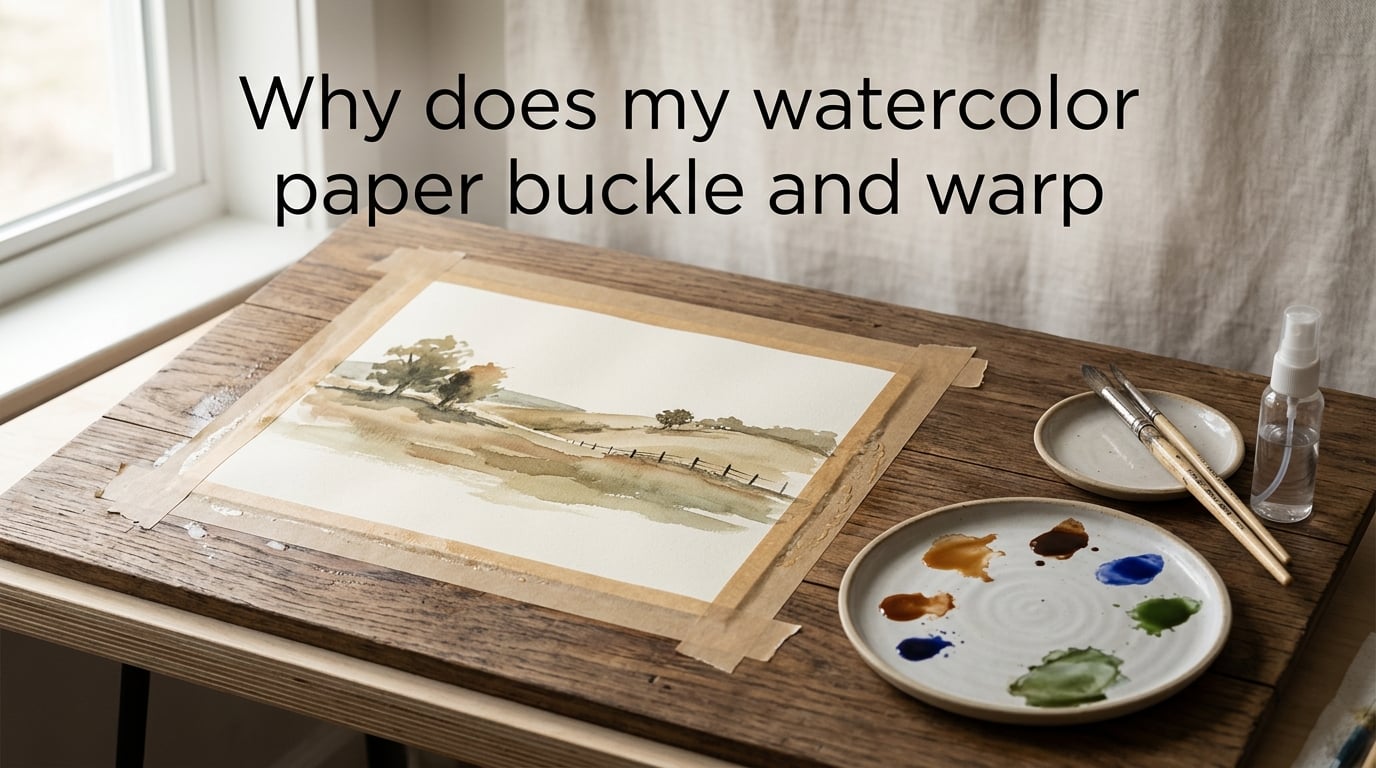
Watercolor paper buckles and warps because its cellulose fibers absorb water unevenly, swelling more on the wet side than the dry side. This uneven expansion creates curls, ripples, and buckles across the surface. The good news: once you understand the science, you can prevent it entirely with the right paper weight, taping technique, or a watercolor block.
I lost a finished painting to buckling my first year painting with watercolors. The pooled pigment settled into the warped grooves, dried patchy, and refused to sit flat in a frame. That frustration sent me down a rabbit hole of testing paper weights, tape brands, and stretching methods over the next three years. This guide compiles what I learned so you skip the trial-and-error.
Here’s what we’ll cover: the fiber science behind warping, the factors that make it worse, seven prevention techniques that actually work, step-by-step flattening methods for already-warped paper, a paper selection guide, and the beginner mistakes that cause most buckling. By the end, you’ll know exactly how to keep your paper flat from sketch to frame.
Table of Contents
Why Does Watercolor Paper Buckle and Warp? The Science Behind It
Watercolor paper warps because paper fibers absorb water and expand, but they expand unevenly. The top surface gets wet from paint while the bottom stays drier, so the top swells more than the bottom. That imbalance curls the sheet upward at the edges and creates waves across the middle.
Every sheet of watercolor paper is made from either cotton fibers or wood pulp cellulose. Both fiber types are hygroscopic, meaning they drink in moisture from the air and from any water you apply. When water hits the top surface, those fibers swell outward. The bottom fibers stay closer to their original size, so the sheet bows upward like a shallow bowl.
Paper sizing plays a big role here. Sizing is a starch or gelatin additive that slows water absorption. Well-sized paper resists buckling longer because water spreads more evenly before soaking in. Cheap, lightly-sized paper soaks up water instantly and buckles within seconds of the first brushstroke.
Cotton fibers behave differently than wood pulp. Cotton has longer, stronger fibers that expand more uniformly and recover their shape as they dry. Wood pulp fibers are shorter and weaker, so they distort more under moisture stress. That’s why 100 percent cotton paper holds its shape better during wet-on-wet techniques, even at lower weights.
The direction of the grain also matters. Paper fibers align during manufacturing, and the sheet expands more across the grain than along it. If you paint with the long edge parallel to the grain, you get less curl. Most pads mark the grain direction on the packaging, but you can also test it by tearing a small corner. Paper tears straighter along the grain.
One more piece of fiber science worth knowing: paper has a “memory.” Once fibers dry in a curled position, they want to return there. That’s why fixing warped paper often requires re-wetting it to reset the memory, then drying it under tension. We’ll cover that in the flattening section below.
What Makes Watercolor Paper Warping Worse
Lightweight paper buckles faster than heavyweight paper because it has less fiber mass to resist moisture expansion. A 90lb (190gsm) sheet curls within seconds of contact with water, while a 300gsm sheet holds its shape through multiple washes. Paper weight is the single biggest factor in warp resistance.
Excess water is the second culprit. Sopping wet brushes, puddles of paint water pooling on the surface, and aggressive wet-on-wet washes all add moisture faster than fibers can absorb it evenly. The wetter the sheet gets, the more it swells, and the more it curls.
Large sheets warp more than small ones for a simple reason: more surface area means more uneven expansion. A 4×6 inch card might stay flat through a light wash. A full 22×30 inch sheet will buckle badly under the same treatment unless taped down.
Loose sheets buckle more than attached sheets. A sheet floating freely on a table has nothing holding it flat. The moment the top fibers swell, the sheet curls. The same sheet taped on all four edges to a rigid board cannot curl because the edges are anchored.
Heat and humidity accelerate the problem. Painting in a dry climate causes water to evaporate from the top surface faster than the bottom, creating a stronger moisture differential. Painting in a humid room slows drying, which can mean longer exposure to swelling forces.
7 Proven Ways to Prevent Watercolor Paper From Buckling
Start with heavyweight paper. Use 300gsm (140lb) paper as your baseline. Anything lighter buckles under moderate water. Save 90lb paper for dry media or light sketches, never for full watercolor washes.
Choose 100 percent cotton paper over wood pulp. Cotton fibers are longer, stronger, and more resilient. They absorb water more evenly and recover shape better as they dry. Brands like Arches, Fabriano Artistico, and Saunders Waterford are cotton. Cheap student-grade pads are usually wood pulp and buckle almost immediately.
Tape all four edges to a rigid board before painting. Use artist tape or gummed tape and stretch the paper slightly as you apply it. The tape anchors the edges so the sheet cannot curl. This is the most common prevention method among professional watercolorists.
Stretch your paper for large washes or wet-on-wet work. Soak the sheet in clean water for 3 to 5 minutes, then tape it down to a board and let it dry completely before painting. The dried, taut sheet resists buckling even under heavy water.
Switch to a watercolor block for casual work. A watercolor block is a pad of paper glued on all four edges. You paint on the top sheet, and the glued edges hold it flat. When dry, you slide a palette knife under the edge to release it. Blocks eliminate taping entirely.
Control your water load. Wipe excess water from your brush before loading pigment. Work with damp rather than soaked brushes. Pool water off the surface with a clean damp brush if it starts to bead. Less water means less swelling.
Paint on a flat, rigid surface. A warped board transfers its warp to your paper. Use a hard, flat surface like gator board, marine plywood, or a dedicated watercolor board. Avoid foam core for serious work; it bends under pressure.
How to Flatten Warped Watercolor Paper After Painting
Method 1: Iron with care. Set your iron to the lowest dry heat setting with no steam. Place your painting face down on a clean, flat surface. Iron gently on the back of the paper in short passes, moving constantly. The heat relaxes the fibers and the flat surface resets the shape. Use this method only on fully dry paper, and never on paper with thick impasto or heavy gouache that could melt or smear.
Method 2: Heavy books overnight. Sandwich your dry painting between two sheets of clean parchment paper, then place it under a stack of heavy books for 24 to 48 hours. The weight flattens mild warps without risking damage to pigment. This is the safest method for finished work you cannot risk ruining.
Method 3: Re-wet and tape method. For stubborn warps, mist the back of the paper lightly with clean water until it relaxes. Tape the damp paper face down to a rigid board with gummed tape on all four edges. Let it dry completely, ideally overnight. The paper dries flat under tension.
Method 4: Press under weights. Place your dry painting between sheets of blotting paper, then under a flat board with weights on top. Leave for 24 hours. The blotting paper absorbs any residual moisture and the weights press the sheet flat. This works well for moderately warped sheets.
Method 5: Steam from the back. Hold a steaming kettle 12 inches from the back of the dry painting. The steam relaxes the fibers briefly. Immediately press the painting flat under weights while still warm. Use caution with finished work; test on a practice sheet first.
Tip: Always flatten a finished painting before framing. A warped watercolor will buckle further under glass as humidity changes. Flatten first, then frame with a mat to allow air circulation.
Watercolor Paper Selection Guide: Pick Paper That Resists Warping
Paper weight is measured in either pounds (lb) or grams per square meter (gsm). The conversion is not exact because pounds refers to a ream of paper while gsm measures actual density, but the rough mapping is: 90lb equals 190gsm, 140lb equals 300gsm, and 260lb equals 550gsm. Always check the gsm number on the pad if you want certainty.
For minimal warping, choose 300gsm (140lb) or heavier. This weight handles wet-on-wet work, large washes, and multiple glaze layers without buckling. It is the standard for serious watercolor painting.
Cotton versus wood pulp is a quality and durability decision. Cotton paper lasts decades without yellowing, handles water better, and resists warping. Wood pulp paper is cheaper but more prone to buckling, especially in student-grade pads. If your budget allows, cotton is worth the investment.
Texture choices: cold press has a slight tooth that grabs pigment and shows brushstrokes well, making it the most popular choice. Hot press is smooth and works for detailed illustration but shows every imperfection. Rough has heavy texture for expressive, loose work. Texture does not affect warping much; weight and fiber content matter more.
Watercolor blocks solve the warping problem for casual painters. A block has all four edges glued, so the sheet cannot curl. You paint, let it dry, then slice it off the block with a palette knife. Great for travel, plein air, and beginners who do not want to tape.
Common Beginner Mistakes That Cause Paper to Buckle
Mistake 1: Using too much water. Beginners often load their brushes dripping wet, then flood the paper with pigment. This causes immediate, severe buckling. Fix it: always wipe your brush on the edge of your water container before loading pigment.
Mistake 2: Not taping paper down before painting. Many beginners paint on loose sheets and are surprised when the paper curls. Fix it: tape all four edges to a board, or switch to a watercolor block for tapeless painting.
Mistake 3: Choosing 90lb paper for serious work. Cheap pads use lightweight paper that buckles under any wet technique. Fix it: invest in a 140lb (300gsm) pad. The cost difference is small compared to the frustration savings.
Mistake 4: Overworking the paper. Scrubbing, lifting, and re-wetting the same area breaks down the surface fibers and creates a fuzzy, warped spot called pilling. Fix it: paint with confidence, accept happy accidents, and use fresh paper for major corrections.
Mistake 5: Skipping the dry time before flipping or moving. Picking up a damp, unpainted sheet or moving a wet sheet causes immediate buckling and denting. Fix it: let your painting dry completely before moving it.
Frequently Asked Questions
What is the best way to flatten warped watercolor paper?
The safest method for finished paintings is to sandwich the dry work between two sheets of parchment paper and place it under heavy books for 24 to 48 hours. For stubborn warps, mist the back of the paper lightly with clean water, tape it face down to a rigid board with gummed tape, and let it dry completely under tension. Avoid ironing finished work unless you are confident the pigment is fully set and dry.
Is there non-warping watercolor paper available?
No paper is completely warp-proof, but 100 percent cotton 300gsm (140lb) paper resists warping far better than lighter wood pulp sheets. Watercolor blocks come closest to eliminating warping because the glued edges hold the sheet flat during painting. For zero warping, combine a watercolor block with controlled water use.
What are the signs that watercolor paper is bad?
Bad watercolor paper pills and fuzzes up after a few brushstrokes, buckles severely under light water use, and bleeds pigment unevenly. It may also yellow within months, feel slick or overly smooth without tooth, or tear easily when wet. Quality paper feels substantial in the hand, holds up under scrubbing, and dries back to a smooth surface.
What are three common mistakes that people make when using watercolor?
First, using too much water on the brush and flooding the paper, which causes immediate buckling. Second, painting on loose sheets without taping them down, so the paper curls the moment it gets wet. Third, choosing lightweight 90lb paper for wet techniques when 140lb (300gsm) is the minimum weight that holds its shape under water.
Conclusion
Why does my watercolor paper buckle and warp? Because cellulose fibers absorb water unevenly, swelling more on the wet side than the dry side. Once you know that, the fix is simple: use 300gsm (140lb) cotton paper, tape it down or switch to a watercolor block, and control your water load. Combine those three steps and you’ll spend your time painting instead of fighting ripples.
Grab a pad of 140lb cotton paper this week, tape four edges to a board, and try a wash using the methods above. Your paper will stay flat, your colors will lay down evenly, and your finished piece will frame without a fight.