
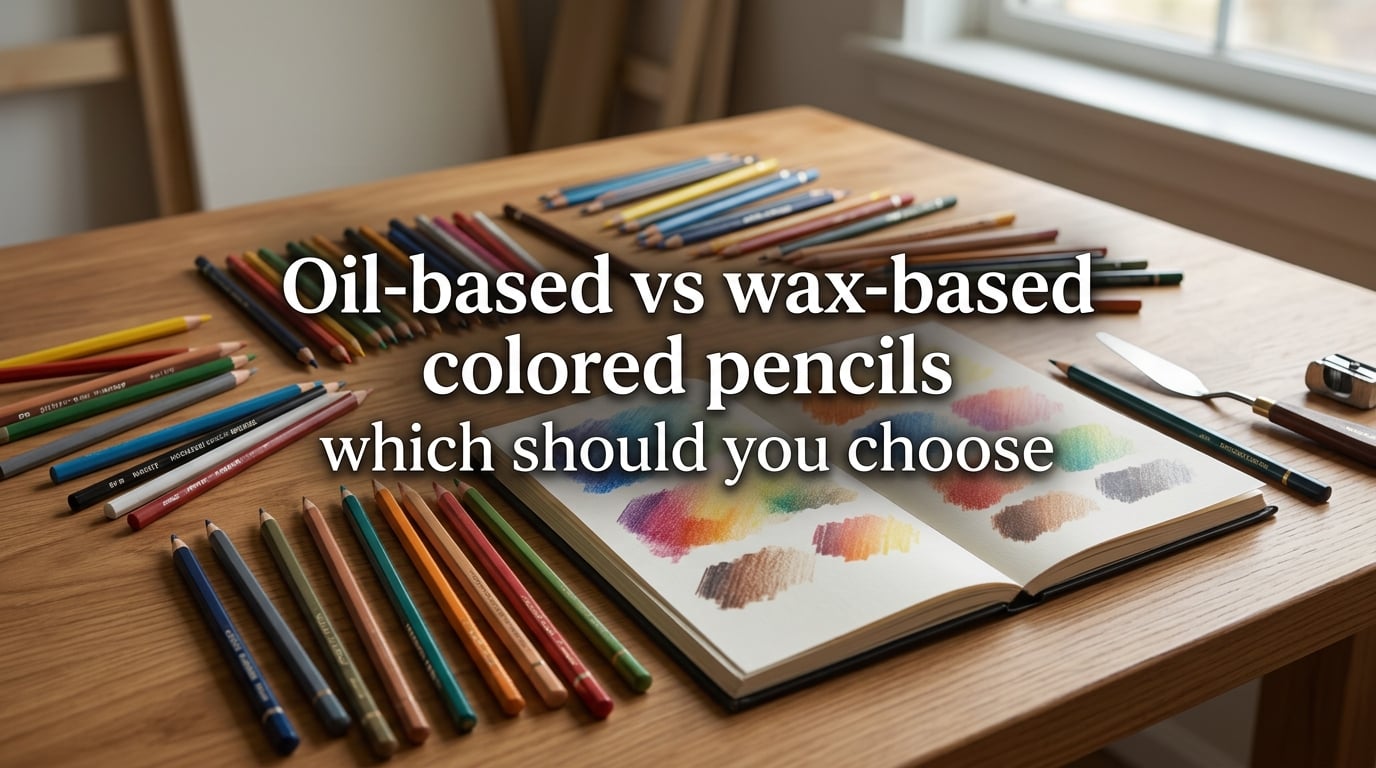
Choosing between oil-based and wax-based colored pencils can feel overwhelming when you’re standing in the art supply aisle. Both types produce beautiful artwork, but they behave differently on paper, respond to blending in distinct ways, and suit different artistic styles. In this guide, I’ll break down everything you need to know about oil-based vs wax-based colored pencils so you can pick the right type for your next project.
After spending years working with both types across portraits, landscapes, and coloring book projects, I’ve learned that the “better” pencil depends entirely on what you’re creating and how you like to work. Let me walk you through the key differences.
Table of Contents
Quick Answer: What’s the Difference Between Oil-Based and Wax-Based Colored Pencils?
The core difference between oil-based and wax-based colored pencils is the binder—the substance that holds the pigment together in the pencil core. Wax-based pencils use a waxy binder, typically paraffin or beeswax, which creates a softer pencil that lays down rich color with less effort. Oil-based pencils use a vegetable oil binder that produces a harder core, sharper point retention, and greater resistance to wax bloom.
This binder difference affects everything: how the pencil feels on paper, how easily colors blend, how long your artwork lasts, and even how much sharpening you’ll need to do. Neither type is universally better—they’re designed for different strengths.
Think of it this way: wax-based pencils are like buttercream frosting—smooth, easy to spread, and forgiving. Oil-based pencils are like fondant—more precise, holds its shape better, and takes more skill to manipulate.
Wax-Based Colored Pencils: Soft, Blendable, and Beginner-Friendly
Wax-based colored pencils are the most popular type on the market and what most beginners start with. The waxy binder gives these pencils a buttery, smooth feel that glides across paper with minimal pressure.
How Wax-Based Pencils Work
The wax binder melts slightly from the friction of drawing, allowing pigment to transfer onto the paper surface. This creates the rich, saturated look that artists love. The soft core means you can lay down heavy layers quickly, and the colors tend to look vibrant right from the first stroke.
Popular Wax-Based Pencil Brands
The most recognized wax-based brands include Prismacolor Premier (known for their ultra-soft cores), Caran d’Ache Luminance (premium Swiss quality), Derwent Coloursoft, and budget-friendly options like Crayola and Staedtler Noris Colour. Prismacolor Premier pencils are the go-to choice for many artists learning colored pencil techniques.
Advantages of Wax-Based Pencils
- Easier blending: The soft wax binder allows colors to mix and meld with minimal effort, whether using a colorless blender pencil, solvent, or simple layering
- Rich color saturation: Wax pencils produce intense, vibrant colors that look almost paint-like when layered heavily
- Great for burnishing: The wax melts under pressure, creating a smooth, polished finish that fills paper tooth completely
- Beginner-friendly: More forgiving of mistakes, easier to erase, and require less technique to achieve satisfying results
- Smooth laydown: Less pressure needed means less hand fatigue during long drawing sessions
Disadvantages of Wax-Based Pencils
- Wax bloom: Over time, the wax binder can migrate to the surface, creating a hazy white film called wax bloom that dulls your artwork
- Soft cores break easily: Prismacolor pencils in particular are notorious for core breakage during sharpening, which frustrates many artists
- Less detail control: The soft core dulls quickly, making it harder to maintain a sharp point for fine lines and intricate details
- Smudging risk: Fresh wax layers can smear if you accidentally drag your hand across them
Oil-Based Colored Pencils: Durable, Precise, and Professional
Oil-based colored pencils use a vegetable oil binder instead of wax, creating a harder, more durable pencil core. Professional artists often gravitate toward oil-based pencils for their precision and longevity.
How Oil-Based Pencils Work
The oil binder doesn’t melt from friction the way wax does. Instead, pigment transfers through pressure and abrasion against the paper tooth. This means oil pencils feel slightly firmer on paper and require a bit more intentional pressure to build up color, but the results are incredibly precise and long-lasting.
Popular Oil-Based Pencil Brands
Faber-Castell Polychromos are the gold standard for oil-based colored pencils—beloved by professional illustrators and fine artists worldwide. Other notable oil-based brands include Caran d’Ache Pablo, Derwent Lightfast, Lyra Rembrandt, and Bruynzeel Design. Polychromos pencils are especially popular for portraiture and detailed illustration work.
Advantages of Oil-Based Pencils
- Superior point retention: The harder oil core holds a sharp point far longer than wax pencils, perfect for fine detail work like hair strands and textures
- No wax bloom: Oil binders don’t migrate to the surface, so your artwork stays crisp and clear for years without hazy buildup
- Better lightfastness: Many oil-based pencils (especially Polychromos and Derwent Lightfast) carry excellent lightfastness ratings, making them ideal for artwork you plan to sell or display
- More durable layers: Oil pencil layers are less prone to smudging and can handle more aggressive blending techniques
- Longer pencil life: The harder core wears down more slowly, so oil pencils generally last longer per pencil than their wax counterparts
Disadvantages of Oil-Based Pencils
- Steeper learning curve: Building up rich, saturated color takes more patience and technique—beginners may feel frustrated by the initial muted appearance
- Harder to erase: Once oil pigment bonds with paper tooth, it’s much more difficult to remove completely
- More hand pressure required: The firmer core means you need to press harder, which can cause fatigue during long sessions
- Initial layering feels less rewarding: Oil pencils build slowly, and the first few layers often look patchy and underwhelming
Blending and Layering: Where the Real Differences Show
Blending is where oil-based and wax-based colored pencils diverge most noticeably. Understanding these differences is key to choosing the right pencil for your technique.
Blending with Wax-Based Pencils
Wax pencils blend beautifully through layering alone—the soft wax binder allows colors to melt together naturally as you add successive layers. You can also use a colorless blender pencil, which is essentially a wax-only pencil that melts and mixes the pigments beneath it. Solvent blending with mineral spirits or odorless turpentine works exceptionally well on wax pencils, dissolving the wax binder and creating a painterly, smooth effect.
Burnishing with wax pencils (pressing hard with a light color or colorless blender) fills the paper tooth completely and creates a glossy, almost photographic finish. This technique is one of the biggest strengths of wax-based pencils.
Blending with Oil-Based Pencils
Oil pencils respond differently to blending. Layering builds color gradually, and while the transitions are smooth, they don’t have the same buttery meld that wax pencils achieve. However, oil pencils respond exceptionally well to solvent blending—mineral spirits dissolve the oil binder effectively and create rich, paint-like washes.
One unique advantage of oil pencils is tool blending. Because the pigment doesn’t melt from friction the same way wax does, you can use brushes, blending stumps, tortillons, and even cotton swabs to physically move pigment around on the paper. This gives oil pencil artists more control over soft transitions, especially in portraiture and realistic work.
Burnishing Compared
Both types can be burnished, but the results differ. Wax pencil burnishing creates a high-gloss, polished look because the wax melts and fills every gap in the paper surface. Oil pencil burnishing produces a smoother result too, but with more of a matte or satin finish. Many artists prefer oil pencils for burnishing large areas because the harder core doesn’t wear down as quickly during the process.
Wax Bloom: The Silent Enemy of Wax-Based Artwork
Wax bloom is probably the most common complaint about wax-based colored pencils, and it’s one of the main reasons some artists switch to oil-based pencils entirely.
What Is Wax Bloom?
Wax bloom occurs when the wax binder in colored pencil artwork migrates to the surface over time, forming a milky, hazy film over your drawing. It’s most visible on dark, heavily layered areas—think deep blue skies, black fur, or rich shadow tones. The bloom can appear within weeks or months after completing a piece, and it significantly dulls the vibrancy of your colors.
How to Prevent and Fix Wax Bloom
There are several approaches to dealing with wax bloom on your colored pencil artwork:
- Apply a fixative: Spray your finished artwork with a workable fixative or final fixative designed for colored pencils. This seals the wax binder and prevents migration.
- Gently wipe the surface: Use a soft, lint-free cloth to carefully wipe away existing wax bloom. The artwork underneath still looks good—it’s just covered by the bloom layer.
- Store artwork properly: Keep drawings flat, uncovered, in a cool dry place. Framing behind glass immediately after completion helps prevent bloom.
- Switch to oil-based for dark areas: Some artists use wax pencils for lighter areas and oil pencils for deep darks to avoid bloom in the most visible spots.
Oil-based colored pencils don’t produce wax bloom because they use oil instead of wax as the binder. If you’re creating artwork for sale or long-term display, this is a significant advantage worth considering.
Which Should You Choose as a Beginner?
If you’re just starting out with colored pencils, the choice between oil and wax depends on what kind of art you want to create and how you learn best.
Choose Wax-Based Pencils If:
- You want immediate, satisfying results without a steep learning curve
- You enjoy blending and creating smooth gradients
- You primarily work on coloring books or relaxed illustration projects
- You prefer softer pencils that require less hand pressure
- You’re exploring colored pencils for the first time and want to build confidence
Choose Oil-Based Pencils If:
- You’re interested in photorealism, portraiture, or detailed illustration
- You want artwork that lasts without wax bloom issues
- You don’t mind a steeper learning curve for better long-term results
- You value precise control over fine details like hair, fur, and textures
- You plan to sell or display your artwork and need excellent lightfastness
Many experienced artists keep both types in their toolkit—using wax pencils for base layers and blending, then oil pencils for detail work and finishing touches. There’s no rule that says you have to pick just one.
Can You Mix Wax and Oil Pencils Together?
Yes, you can mix wax-based and oil-based colored pencils in the same artwork, and many artists do it successfully. However, there are some guidelines to follow for the best results.
The general rule is to apply wax-based layers first, then add oil-based pencil on top. Oil pencil over wax works well because the harder oil core can grip the wax surface. Going the other direction—putting wax over oil—can be trickier because the soft wax struggles to adhere to the slick oil layer underneath.
When mixing types, be aware that solvent blending may react differently to each layer. Test your combination on scrap paper before committing to your final piece. Some brands, like Derwent Lightfast, use a unique formula that doesn’t always play well with other oil-based pencils, so brand compatibility matters too.
A practical mixed-media approach many artists use: lay down foundational colors and gradients with wax-based Prismacolor Premier pencils, then switch to Faber-Castell Polychromos for fine details, textures, and finishing. This gives you the best of both worlds—easy blending from wax and precision from oil.
Paper and Surface Compatibility
The surface you draw on matters just as much as the pencils you choose, and wax and oil pencils interact with paper differently.
Wax-Based Pencils and Paper
Wax pencils work best on medium-tooth paper—surfaces with enough texture to grab the soft wax binder but not so rough that they eat through your pencils quickly. Popular choices include Strathmore 400 Series, Bristol board (smooth or vellum), and heavyweight drawing paper. Because wax pencils are soft, they fill paper tooth faster, meaning you can reach saturation point more quickly on smoother papers.
Oil-Based Pencils and Paper
Oil pencils are more versatile with paper surfaces. Their harder core works well on smoother papers like hot-pressed watercolor paper, drafting film, and smooth Bristol board. They also perform beautifully on textured surfaces like Pastelmat and cold-pressed watercolor paper, where the extra tooth gives oil pigment more to grip onto for building up layers.
Because oil pencils don’t fill paper tooth as aggressively as wax pencils, you can typically achieve more layers before the surface becomes saturated. This is a big advantage for artists who build up dozens of layers to achieve realistic depth and color mixing.
Lightfastness and Longevity: Which Lasts Longer?
If you plan to sell your artwork, display it in galleries, or simply want it to look vibrant for decades, lightfastness is a critical consideration.
Lightfastness measures how resistant a pigment is to fading when exposed to light. Oil-based pencils generally outperform wax-based pencils in this area. Faber-Castell Polychromos carry excellent lightfastness ratings across most of their color range, and Derwent Lightfast pencils are specifically engineered to resist fading for 100+ years.
Wax-based pencils vary more widely. While premium brands like Caran d’Ache Luminance offer excellent lightfastness, many popular wax pencils (including some Prismacolor colors) have poor lightfastness ratings. This means artwork created with those pencils can fade significantly within just a few years of light exposure.
For hobby work and coloring books that stay in a drawer, lightfastness doesn’t matter much. But for anything you plan to frame, sell, or gift, check the manufacturer’s lightfastness rating for each color you use. ASTM D-6901 is the standard to look for—the higher the rating, the more resistant the color is to fading.
Frequently Asked Questions
Are Prismacolor pencils wax-based or oil-based?
Prismacolor Premier colored pencils are wax-based. They use a soft wax binder that creates their signature buttery smooth feel and rich color saturation. This wax binder is also what makes them prone to wax bloom over time and causes their soft cores to break during sharpening.
Are Crayola colored pencils wax-based or oil-based?
Crayola colored pencils are wax-based. They use a wax binder similar to other budget-friendly colored pencils, though their formula is harder and less pigmented than artist-grade wax pencils like Prismacolor Premier. Crayola pencils are a great affordable option for beginners and casual coloring.
Are Faber-Castell Polychromos colored pencils wax-based or oil-based?
Faber-Castell Polychromos colored pencils are oil-based. They use a vegetable oil binder that creates a harder, more durable core with excellent point retention and lightfastness. Polychromos are considered the gold standard for professional oil-based colored pencils and are widely used by fine artists and illustrators.
What are oil-based colored pencils good for?
Oil-based colored pencils excel at detailed illustration work, photorealistic portraits, and artwork that needs to last without fading. They hold a sharp point longer for fine lines, resist wax bloom, and offer superior lightfastness. They are also ideal for layering extensively since the harder core does not fill paper tooth as quickly as wax pencils.
Conclusion
The debate between oil-based and wax-based colored pencils comes down to your priorities as an artist. Wax-based pencils offer easier blending, richer initial color payoff, and a gentler learning curve—making them perfect for beginners, coloring enthusiasts, and artists who love smooth gradients. Oil-based pencils deliver superior precision, no wax bloom, better lightfastness, and longer pencil life—making them the choice for professionals, detail-oriented illustrators, and anyone creating artwork meant to last.
When deciding between oil-based vs wax-based colored pencils, consider your art style, the techniques you enjoy, and how long you want your finished pieces to last. Many artists find that keeping both types in their collection gives them the flexibility to tackle any project with the right tool for the job.