
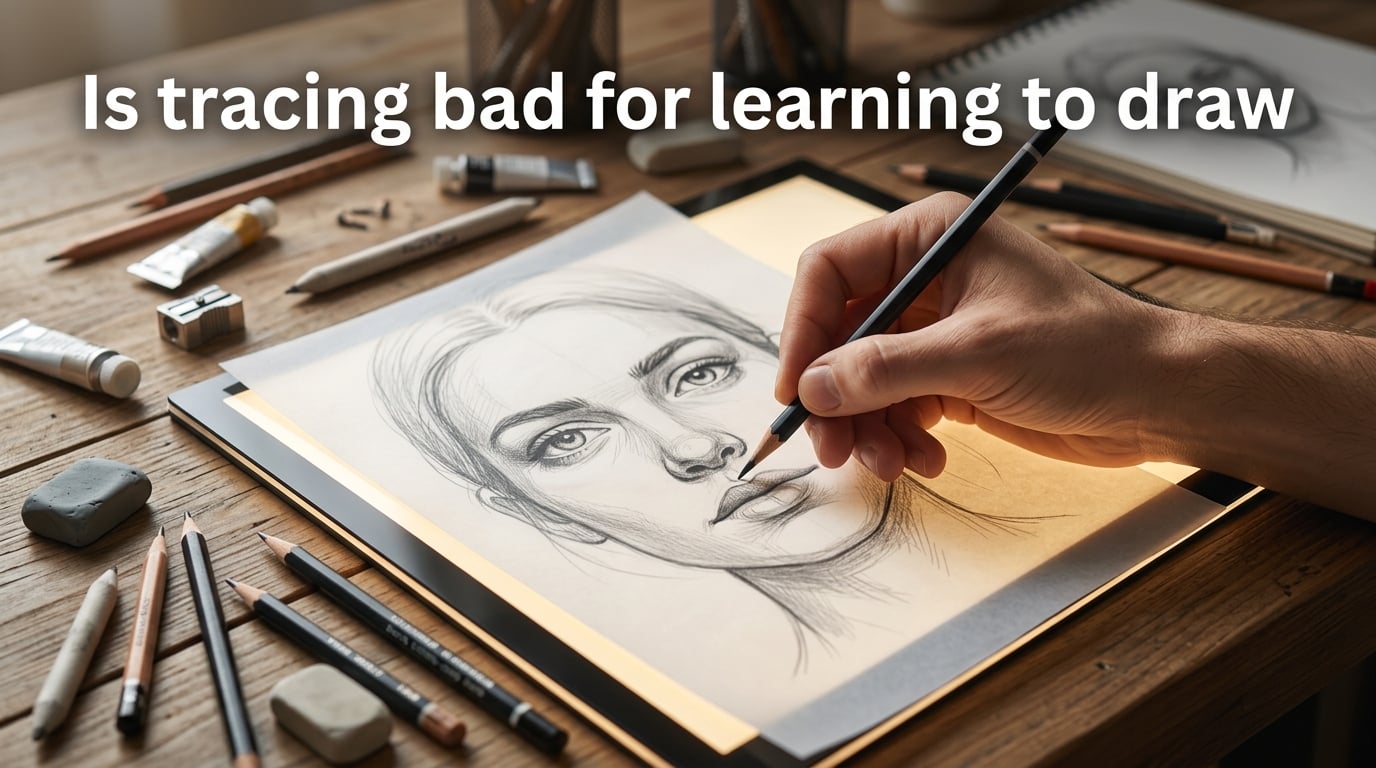
Is tracing bad for learning to draw? This question sparks heated debate in every art community, and the honest answer is more nuanced than most people expect. Tracing is not inherently bad—it’s a legitimate technique that has helped countless beginners develop foundational skills. The problem arises when tracing becomes a crutch instead of a stepping stone.
Whether you’re a complete beginner picking up a pencil for the first time or an experienced artist wondering if tracing is holding you back, understanding when and how to use tracing makes all the difference. In this guide, we’ll explore the benefits, risks, ethical considerations, and practical strategies for using tracing as an effective learning tool.
Table of Contents
Quick Answer: Is Tracing Bad for Learning to Draw?
Tracing is not bad for learning to draw when used as a temporary learning tool alongside freehand practice. It helps beginners understand proportions, build hand-eye coordination, and develop confidence. The problem starts when tracing replaces original drawing entirely, stunting the development of observational and freehand skills. The key is balance: use tracing to learn, then practice freehand to grow.
What Is Tracing in Art?
Tracing in art is the practice of reproducing an image by drawing over it, typically using tracing paper, a light box, or digital tools. Artists place a reference image beneath their drawing surface and follow the lines with a pencil or pen, transferring the outline to a new piece of paper.
Tracing has been used for centuries. The ancient Egyptians used a technique called “pouncing,” where they pricked holes along outlines and dusted pigment through them to transfer designs onto walls. Renaissance masters like Vermeer are believed to have used camera obscura devices to trace projected images. The practice is far from modern—and far from cheating.
Common Tracing Techniques
There are several ways artists trace today:
- Tracing paper: Place transparent paper over a reference image and draw along the lines
- Light box or light table: Place the reference beneath your drawing paper on an illuminated surface to see through both layers
- Window tracing: Tape your reference and paper to a sunny window for a free light box effect
- Carbon or transfer paper: Place carbon paper between the reference and your drawing surface to transfer lines with pressure
- Digital tracing: Use apps like Procreate or Photoshop to draw over reference images on a tablet
- Grid method: Draw a grid over the reference and your paper, then copy one square at a time (not technically tracing, but often grouped with it)
Benefits of Tracing for Learning to Draw
Tracing offers several genuine benefits for beginners and developing artists. Here’s why many art educators recommend it as part of a balanced practice routine:
1. Builds Hand-Eye Coordination
Tracing trains your hand to follow what your eyes see. This connection between visual input and motor output is fundamental to all drawing. When you trace, you’re practicing the same neural pathways you’ll use for freehand drawing—but with a built-in guide that reduces frustration.
2. Teaches Proportions and Spatial Awareness
One of the hardest things for beginners is understanding how big or small different parts of a subject should be relative to each other. Tracing shows you these relationships directly. Over time, your brain starts to internalize these proportional relationships, making it easier to judge them when drawing freehand.
3. Reduces Beginner Frustration
Staring at a blank page can be intimidating. Many aspiring artists quit before they really start because their early freehand attempts look nothing like what they envision. Tracing provides an early win—something that looks recognizably good—which builds the confidence to keep practicing.
4. Develops Muscle Memory
Drawing involves complex hand movements—curves, straight lines, varying pressure, and speed control. Tracing lets you practice these movements without worrying about where to place each line. Your muscles learn the motions, which transfer to freehand drawing later.
5. Helps You Study Specific Subjects
If you want to learn to draw faces, hands, or animals, tracing a few reference images helps you understand the underlying structure. You start to see the shapes and curves that make up a face, rather than just seeing “a face.” This structural understanding is invaluable for freehand work.
6. Introduces Negative Space
When tracing, you naturally become aware of the shapes around and between objects—not just the objects themselves. This concept of negative space is a powerful observational skill that improves all your drawing.
7. Used by Professionals
Professional artists, architects, and illustrators regularly use tracing techniques. Architects trace to transfer accurate measurements. Illustrators trace rough sketches to create clean line art. Knowing that professionals use tracing without shame can free beginners from unnecessary guilt.
The Risks of Over-Reliance on Tracing
While tracing has clear benefits, relying on it exclusively creates real problems. Here’s what happens when tracing becomes a permanent habit instead of a temporary tool:
Stunted Freehand Skills
If you only trace, you never develop the ability to translate what you see onto paper without a guide. Freehand drawing requires you to make decisions about line placement, proportion, and composition independently. Tracing bypasses these decisions entirely, so the skills don’t develop.
False Confidence
Traced drawings often look polished and accurate, which can create an inflated sense of ability. When you try to draw freehand and the results don’t match your traced work, the gap can be discouraging. This false confidence delays real skill development.
Reduced Observation Skills
Drawing from observation forces you to really see—angles, curves, relationships between shapes, light and shadow. Tracing lets you skip this deep observation because you’re following lines rather than analyzing them. Over time, this can make you a less observant artist overall.
Dependency Cycle
The more you trace, the harder it feels to draw without tracing. This creates a cycle where tracing feels necessary rather than optional. Forum discussions reveal this pattern frequently—artists on Reddit’s r/learntodraw describe feeling “stuck” and unable to produce original work after months of primarily tracing.
Missing the Problem-Solving
Drawing freehand involves constant problem-solving: How do I represent this curve? Where should this line end? How do I show depth? These problems are where real artistic growth happens. Tracing eliminates the problems—and therefore eliminates the growth opportunities.
Is Tracing Cheating in Art?
This is the question that generates the most heated arguments in art communities. The short answer: it depends entirely on context and intent.
When Tracing Is NOT Cheating
Tracing for personal practice and learning is universally accepted in art communities. No serious artist considers it cheating to trace a reference image while studying proportions or practicing line quality. Art educators have used tracing as a teaching tool for centuries.
Tracing is also not cheating when:
- You’re learning a new subject (like faces or hands) and studying structure
- You’re creating a base sketch that you’ll then develop into original work
- You’re transferring a composition to a final surface (common in watercolor and mural work)
- You’re using tracing as a warm-up exercise before freehand drawing
When Tracing IS Cheating
Tracing crosses the ethical line when you claim traced work as original freehand drawing, especially in these situations:
- Submitting traced work as original art: In school, competitions, or professional contexts, presenting traced work as freehand is dishonest
- Tracing other artists’ work without credit: Copying someone else’s composition, character design, or style and claiming it as your own
- Selling traced work as original: Commercial use of traced images without permission or transformation can be copyright infringement
- Posting traced work without disclosure: On social media or portfolios, tracing should be disclosed if asked about your process
Reddit’s art communities consistently emphasize this distinction. The consensus on r/ArtistLounge and r/learntodraw is clear: tracing for practice is fine, but claiming traced work as original is the “cardinal sin” in art.
The 70/30 Rule in Drawing
One of the most practical frameworks for balancing tracing and freehand practice is the 70/30 rule. This concept, frequently discussed in art communities, suggests that 70% of your practice time should be freehand drawing, while 30% can involve tracing or copying references.
The reasoning behind this ratio is straightforward: freehand drawing builds the core skills you need for original work, while tracing provides targeted learning opportunities for specific challenges. Neither should be eliminated entirely, but freehand practice should dominate.
How to Apply the 70/30 Rule
Here’s what a balanced practice session might look like:
- Warm-up (10 minutes): Quick gesture drawings or loose sketches to get your hand moving
- Freehand practice (30-40 minutes): Draw from observation, reference photos, or imagination without tracing
- Tracing study (15-20 minutes): Trace a reference to study specific elements—proportions, line quality, or complex shapes
- Cool-down (5-10 minutes): Apply what you learned from tracing to a quick freehand sketch
This structure ensures tracing serves your freehand development rather than replacing it.
When Is Tracing Acceptable vs Harmful?
Understanding when tracing helps versus when it hurts makes it easier to use this technique responsibly. Here’s a practical guide:
Tracing Is Acceptable When:
- You’re a complete beginner building foundational skills
- You’re studying a new subject (anatomy, architecture, animals)
- You’re transferring a composition to a final surface
- You’re using it as one part of a balanced practice routine
- You’re learning to see proportions and spatial relationships
- You’re creating reference studies, not claiming original work
- You’re warming up or loosening your hand before freehand work
Tracing Becomes Harmful When:
- It’s your only drawing practice
- You can’t produce any recognizable drawing without tracing
- You’ve been tracing for months without attempting freehand
- You feel anxious or incapable without a reference to trace
- You’re submitting traced work as original art
- You’re tracing to avoid learning fundamental skills
- Your freehand skills have declined since you started tracing
How to Use Tracing Effectively as a Learning Tool
If you want to use tracing as part of your learning journey, here’s how to do it in a way that actually builds skills rather than creating dependency:
Step 1: Trace with Intention
Don’t just trace passively—trace with a specific goal. Focus on one element at a time:
- Trace only the outlines to study proportions
- Trace only the major shapes to understand structure
- Trace line weight variations to learn pressure control
- Trace one section (like just the eyes) and then try drawing it freehand
Step 2: Trace and Then Redraw
This is one of the most effective exercises. Trace a reference image, then put it away and try to draw the same subject from memory or from a different angle. This bridges the gap between tracing and freehand drawing by testing what you actually learned.
Step 3: Use the Tracing-Freehand Cycle
Follow this progression for any subject you’re learning:
- Day 1: Trace the subject 2-3 times, focusing on proportions and structure
- Day 2: Try to draw it freehand using what you learned
- Day 3: Compare your freehand attempt to the traced version and note differences
- Day 4: Trace again, focusing on the areas where your freehand was weakest
- Day 5: Attempt freehand again—you should see improvement
Step 4: Gradually Reduce Tracing
As your skills develop, make tracing a smaller part of your practice:
- Week 1-2: 50% tracing, 50% freehand
- Week 3-4: 30% tracing, 70% freehand
- Week 5-6: 20% tracing, 80% freehand
- Week 7+: Use tracing only for specific studies or challenges
Step 5: Tracing Exercises for Beginners
Try these specific exercises to build skills through tracing:
- Contour tracing: Trace the outline of a simple object, then try to draw it freehand
- Shape breakdown: Trace over a complex image, but only outline the basic geometric shapes you see
- Line quality practice: Trace the same image multiple times, experimenting with different line weights and speeds
- Partial tracing: Trace half of an image, then draw the other half freehand (symmetry exercise)
- Upside-down tracing: Trace an image that’s been flipped upside down to train your eye to see shapes rather than objects
Tracing vs Freehand Drawing: A Comparison
Understanding the differences between tracing and freehand drawing helps you decide when to use each approach:
| Aspect | Tracing | Freehand Drawing |
|---|---|---|
| Skill development | Hand-eye coordination, line control, proportions | Observation, problem-solving, composition, creativity |
| Learning curve | Low—produces recognizable results quickly | High—requires patience and practice |
| Accuracy | High—directly follows reference | Variable—depends on skill level |
| Confidence building | Immediate positive results | Gradual improvement over time |
| Creativity | Limited—you’re following existing lines | Full creative expression |
| Long-term growth | Stops improving without freehand practice | Continuous improvement |
| Best for | Learning structure, proportions, warm-ups | Developing original style and skill |
The ideal approach combines both: use tracing to learn structure, then freehand to develop your unique artistic voice.
When to Stop Tracing and Draw Freehand
One of the most common questions from beginners is knowing when they’ve traced “enough.” Here are clear milestones to help you recognize when you’re ready to shift toward freehand drawing:
Signs You’re Ready to Reduce Tracing
- You can identify basic shapes in complex objects without tracing
- Your traced drawings look confident, not shaky or hesitant
- You start seeing proportional relationships automatically
- You feel curious about what your freehand attempt would look like
- You’ve traced the same type of subject multiple times
Signs You’re Ready to Stop Tracing
- Your freehand drawings are recognizable and reasonably accurate
- You can draw basic subjects (simple objects, cartoon characters) without tracing
- You understand proportions well enough to spot when something looks “off”
- You only reach for tracing when tackling something genuinely new or complex
- Your freehand practice shows steady improvement
The Transition Plan
Don’t stop tracing abruptly. Instead, use this gradual approach:
- Phase 1 (Weeks 1-2): Trace first, then immediately draw the same thing freehand
- Phase 2 (Weeks 3-4): Sketch freehand first, then trace to check your proportions
- Phase 3 (Weeks 5-6): Draw freehand primarily, trace only when you’re stuck on a specific element
- Phase 4 (Ongoing): Use tracing occasionally for new subjects or complex studies, but default to freehand
Frequently Asked Questions
Can I learn to draw by tracing?
Yes, you can learn to draw by tracing, but only if tracing is part of a balanced practice routine that also includes freehand drawing. Tracing helps you develop hand-eye coordination, understand proportions, and build muscle memory. However, tracing alone won’t teach you to draw from observation or develop original work. Use tracing as a stepping stone, not a destination.
Is tracing cheating in art?
Tracing is not cheating when used for personal practice, learning, or as a tool in your creative process. It becomes cheating only when you present traced work as original freehand drawing, especially in professional, academic, or competitive contexts. The art community generally accepts tracing for learning but expects honesty about your process.
What is the 70/30 rule in drawing?
The 70/30 rule is a practice guideline suggesting that 70% of your drawing time should be freehand practice, while 30% can involve tracing or copying references. This balance ensures you develop core observational and freehand skills while still benefiting from tracing’s targeted learning opportunities. The exact ratio is flexible—some artists prefer 80/20 or 60/40 depending on their skill level.
What is the 50% rule in art?
The 50% rule in art refers to spending half your practice time drawing from imagination or observation without references, and the other half using references or tracing. This ensures you develop both your technical skills (through reference work) and your creative problem-solving abilities (through original drawing). It’s similar to the 70/30 rule but emphasizes imagination work more heavily.
Do professional artists use tracing?
Yes, professional artists use tracing regularly. Architects trace to transfer accurate measurements to final drawings. Illustrators trace rough sketches to create clean line art. Comic artists use tracing to maintain consistency across panels. Watercolorists trace compositions onto watercolor paper. The key difference is that professionals use tracing as a tool within their workflow, not as a substitute for skill.
How long should I trace before drawing freehand?
There’s no fixed timeline, but most art educators suggest tracing as your primary practice method for 2-4 weeks at most. After that, start incorporating freehand exercises using the trace-then-redraw method. Within 1-2 months, you should be drawing freehand more than you trace. The goal is to use tracing to build a foundation, then transition to freehand as your confidence and skills develop.
Conclusion
Is tracing bad for learning to draw? No—tracing is a valuable learning tool when used with intention and balance. It helps beginners develop hand-eye coordination, understand proportions, and build the confidence needed to keep practicing. The problems only arise when tracing replaces freehand practice entirely.
The best approach is to treat tracing as a stepping stone: use it to learn structure and build foundational skills, then gradually shift toward freehand drawing as your abilities develop. Follow the 70/30 rule, practice the trace-then-redraw technique, and remember that every professional artist started somewhere. Tracing isn’t cheating—it’s learning. The key is knowing when to let go and trust your own hand.