
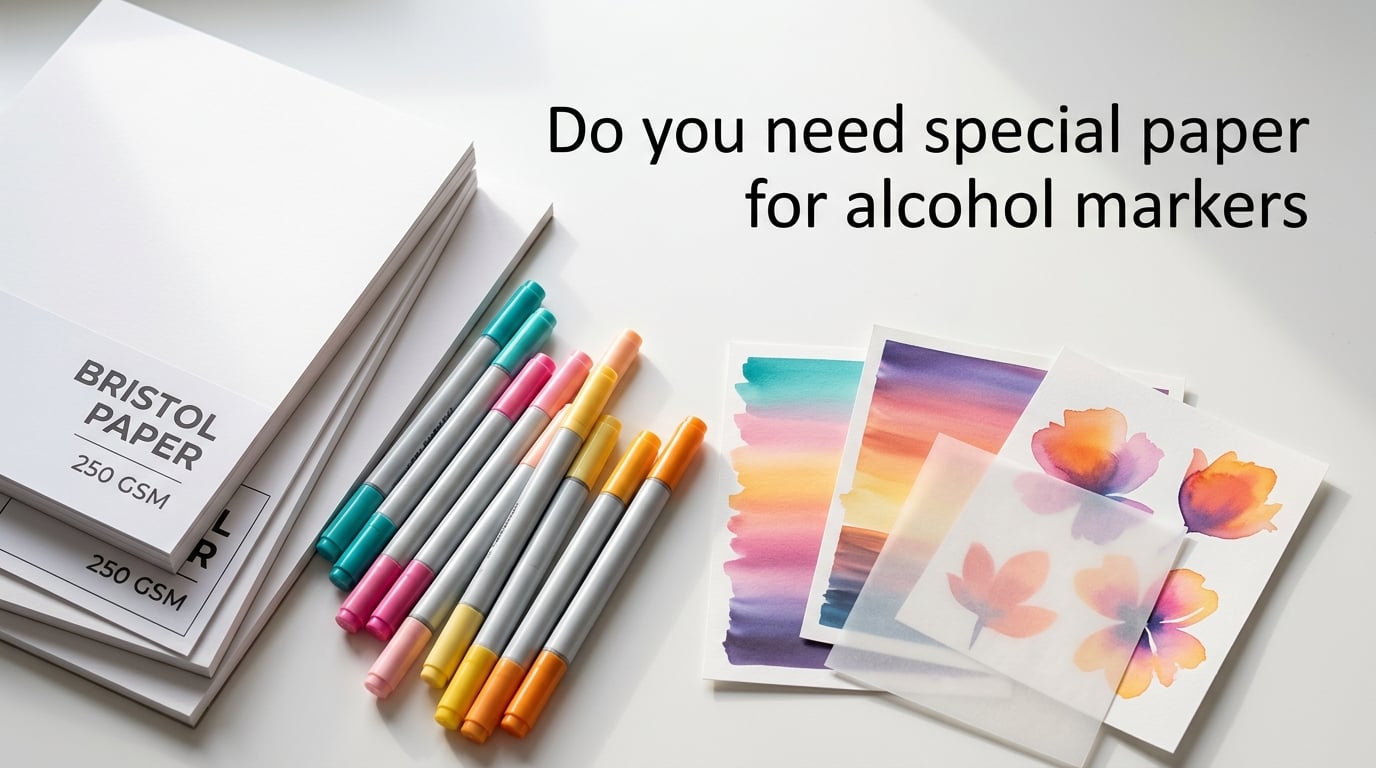
If you just picked up a set of alcohol markers and wonder whether that ream of copy paper in your printer will do the trick, the short answer is no. You really do need special paper for alcohol markers if you want clean lines, smooth blending, and artwork you can actually keep. Standard printer paper is too thin, too absorbent, and too rough to handle alcohol-based ink.
We’ve spent years testing markers on everything from dollar-store sketchbooks to premium Bristol pads. This guide shares what we learned, plus the GSM thresholds, paper types, and test methods that separate a great marker drawing from a soggy, bled-through mess.
Table of Contents
Quick Answer
Yes, special paper helps alcohol markers perform the way they were designed to. Look for smooth, bleedproof paper weighing at least 200 GSM, ideally 250 GSM or more. Dedicated marker paper, Bristol board, heavyweight cardstock, and vellum are all strong choices.
Standard printer paper (75 to 90 GSM) bleeds through almost instantly, feathers past linework, and dries out your marker nibs. Watercolor paper absorbs ink unevenly and leaves streaks. Neither is built for solvent-based ink.
Why Regular Paper Fails With Alcohol Markers
Alcohol-based markers like Copic, Ohuhu, Spectrum Noir, and Prismacolor use ink dissolved in alcohol rather than water. That solvent stays liquid longer than water-based ink, which is great for blending, but terrible for thin or absorbent paper. The ink keeps moving long after it touches the page.
Here’s what goes wrong on the wrong paper:
- Bleed-through: Alcohol ink soaks through thin paper and ruins the sheet below.
- Feathering: Ink spreads sideways outside your linework, especially on rough or fibrous paper.
- Streaking: Uneven absorption leaves visible streaks instead of smooth color.
- Tip drying: Cheap sketchbooks absorb alcohol so fast it dries out your marker nibs prematurely.
- Color dulling: Rough fibers scatter light and mute the vibrancy of your markers.
Beginners often blame their markers for streaky results when the real culprit is the paper underneath. Switch to a smooth, heavyweight sheet and the same markers look like a completely different set.
What Makes Paper Work for Alcohol Markers
Four properties separate good marker paper from bad: GSM weight, surface smoothness, bleed resistance, and acid content. If you understand these, you can evaluate any paper on the shelf without trusting the marketing label.
GSM (Grams Per Square Meter)
GSM measures how heavy and dense a sheet of paper is. Higher GSM means thicker paper. For alcohol markers, we recommend at least 200 GSM for everyday work, with 250 GSM or higher as the sweet spot for bleed-free, double-sided illustrations.
Smoothness
A smooth, coated surface lets your marker nib glide without snagging on fibers. Marker paper, hot-press Bristol, and vellum all share this trait. Cold-press or textured paper grabs the nib and produces streaks.
Bleedproof Construction
Bleedproof paper is engineered with a dense inner layer or surface sizing that stops alcohol ink from soaking through. You can lay down heavy saturation and flip the sheet without ink reaching the back.
Acid-Free Longevity
Acid-free paper resists yellowing and brittleness over time. If you plan to keep, sell, or scan your artwork, acid-free is non-negotiable. Most quality Bristol and marker papers meet this standard out of the box.
Best Paper Types for Alcohol Markers
There is no single “best” paper for everyone. Your choice depends on budget, project type, and how often you color. Here are the four categories we recommend most, ranked by versatility.
Dedicated Marker Paper
Brands like Canson XL Marker, Strathmore Marker Paper, and Winsor & Newton Marker Paper are made specifically for alcohol ink. They are smooth, bleedproof, and typically fall between 70 and 160 GSM. The trade-off is that thinner pads can warp if you flood large areas with ink.
Marker paper is the go-to for coloring books, planner spreads, and casual illustration. Reddit’s r/ArtistLounge frequently recommends Canson XL Marker as a budget-friendly starter pad.
Bristol Board
Bristol is our top pick for serious illustration. It comes in smooth (hot-press) and vellum (slightly toothed) finishes, with weights between 180 and 300 GSM. Smooth Bristol produces buttery blending and crisp linework. Multi-ply Bristol (2-ply, 3-ply) holds up to heavy marker saturation without buckling.
Strathmore Smooth Bristol is the brand we see recommended most often across art forums. It’s affordable, widely available, and tolerates aggressive blending.
Heavyweight Cardstock
Cardstock covers a huge range. Cheap 65 lb cardstock from a craft store is closer to printer paper than to proper marker paper. Look for 100 lb (about 270 GSM) cover-weight cardstock for reliable bleed resistance.
Cardstock works well for cardmaking, layered die-cuts, and projects where you need stiffness. For blending-heavy illustrations, dedicated Bristol still beats most cardstocks.
Vellum and Translucent Papers
Vellum is smooth, semi-transparent, and naturally bleed-resistant because of how it’s processed. It is a favorite for layering, vellum overlays on cards, and delicate coloring. Some illustrators love vellum for ethereal, soft effects.
Drawback: vellum is usually thin (under 100 GSM), so plan to mount it on white cardstock for opacity.
Paper GSM Comparison
This table sums up the weight ranges and best use cases we recommend. Bookmark it the next time you’re shopping for a pad.
| Paper Type | Typical GSM | Bleedproof | Best For |
|---|---|---|---|
| Printer Paper | 75 to 90 | No | Documents only |
| Marker Paper (Canson XL) | 70 to 160 | Yes | Coloring, planner art |
| Vellum | 90 to 110 | Yes | Overlays, card layers |
| Lightweight Cardstock | 130 to 180 | Sometimes | Cards, tags |
| Smooth Bristol (2-ply) | 180 to 250 | Yes | Illustration, blending |
| Heavyweight Cardstock | 250 to 300 | Yes | Cards, die-cuts, mixed media |
| Heavy Bristol (3-ply) | 300+ | Yes | Display pieces, heavy saturation |
| Yupo (Synthetic) | 158 to 200 | Yes | Advanced effects, non-absorbent work |
Papers to Avoid With Alcohol Markers
Some papers look promising but turn out to be a waste of ink and time. Skip these.
- Standard printer paper: Bleeds through within seconds. Reviewers call it “the worst option” for alcohol markers.
- Cheap sketchbooks under 120 GSM: Many bundled marker sets (including Ohuhu and Tombow dual-brush packs) ship with thin paper that bleeds heavily.
- Cold-press watercolor paper: The texture grabs your nib and absorbs ink unevenly, leaving streaks and wasting marker alcohol.
- Newsprint or tracing paper: Too thin, too absorbent, and yellows fast.
- Recycled office paper: Often coarse and inconsistent, with fibers that feather badly.
If a paper feels soft, flimsy, or fibrous, trust your hands. It is almost certainly wrong for alcohol markers.
How to Test Paper Quality Before Buying
Before buying a full pad, do a 30-second bleed test at home or in the store. Here’s the method our team uses whenever we review a new paper.
- Draw a small saturated circle on the front of the sheet with a dark marker.
- Wait 10 seconds, then flip the paper over.
- Check for visible bleed-through on the back.
- Run your finger over the dried circle. Smooth = good. Grainy = streaking ahead.
- Layer a second color into the circle while still slightly wet. If it blends without streaks, the paper passes.
Any paper that bleeds heavily on the first pass fails the test. Move on. The right paper lets you flood an area and still flip the page cleanly.
Frequently Asked Questions
What kind of paper do I use with alcohol markers?
Smooth, bleedproof paper weighing at least 200 GSM works best. Dedicated marker paper, Bristol board, heavyweight cardstock, and vellum are the most reliable options.
Can I use alcohol markers on any paper?
No. Thin, absorbent, or rough paper causes bleeding, feathering, and streaking. Standard printer paper and cheap sketchbooks fail almost immediately with alcohol ink.
Is cardstock paper good for alcohol markers?
Heavyweight cover cardstock (100 lb or around 270 GSM) works well for alcohol markers. Lightweight cardstock under 180 GSM often bleeds through and is best reserved for cards with limited coloring.
What weight of paper is best for alcohol markers?
Aim for 200 GSM at minimum and 250 GSM or higher for double-sided, heavy-saturation work. Bristol board in 2-ply or 3-ply is the most forgiving choice.
Why are my alcohol markers streaky?
Streaking usually comes from absorbent or textured paper that pulls alcohol out of the ink too quickly. Switching to smooth Bristol or marker paper eliminates streaks in most cases.
How to stop alcohol markers from bleeding through paper?
Use paper rated at 250 GSM or higher with a bleedproof surface. Place a scrap sheet underneath as a safety net, and avoid flooding areas beyond what the paper can absorb.
Final Thoughts on Special Paper for Alcohol Markers
Special paper for alcohol markers is not a marketing trick. It is a working requirement for clean, blendable, bleed-free results. Start with a smooth Bristol pad at 250 GSM if you want one paper that handles almost any project. Add a pad of Canson XL Marker for casual coloring and a sheet of vellum for overlays, and you have a setup that covers most marker workflows.
Do the bleed test on any new pad before committing. Your markers, your linework, and your sanity will thank you.