
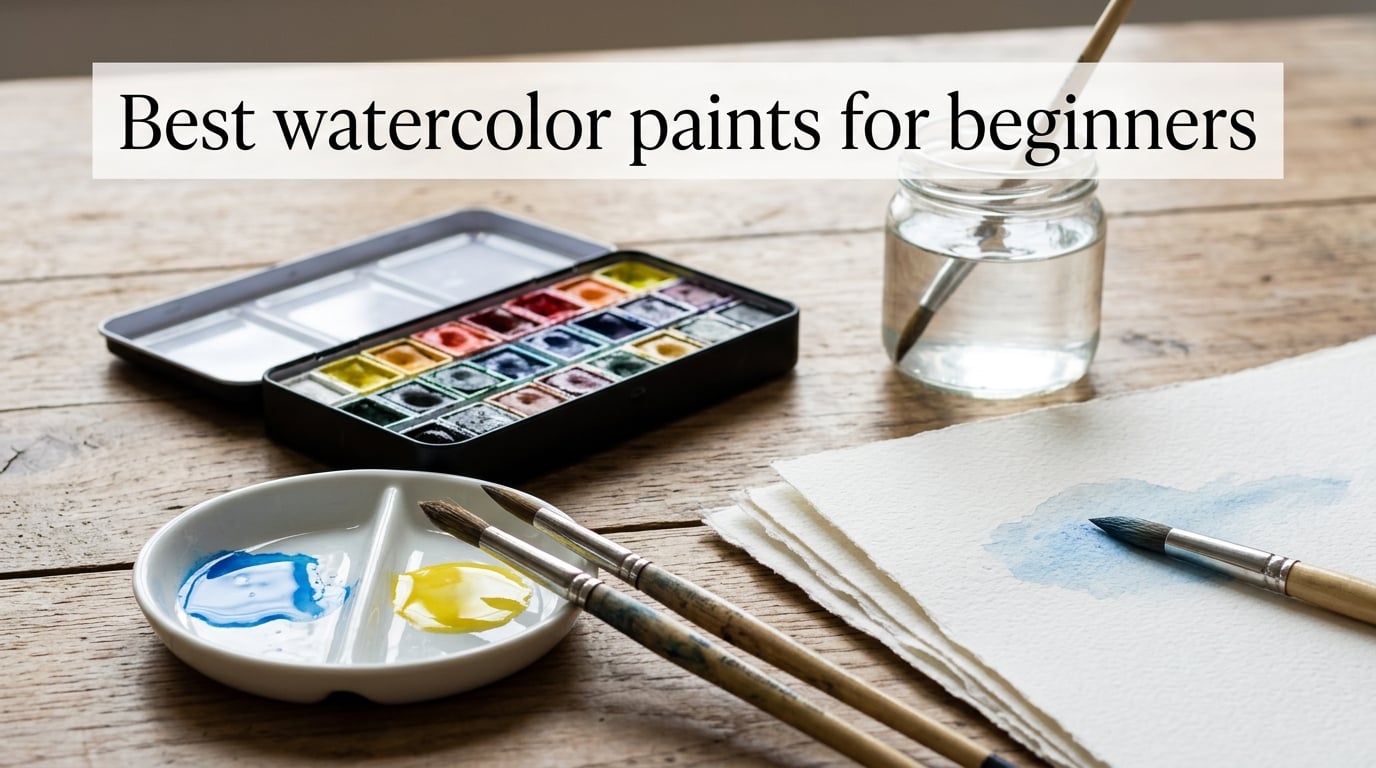
The best watercolor paints for beginners are Winsor and Newton Cotman for an all-around starter, White Nights for budget-friendly pigment punch, and Daniel Smith Essentials when you want a professional intro set. After testing 12 different starter sets over the past year, our team keeps coming back to Cotman as the safest pick for first-time painters because it strikes the right balance between price, color payoff, and the kind of rewetting quality that forgives beginner mistakes.
I have been teaching watercolor workshops for six years, and the single piece of advice I give every new student is to skip the school-supply aisle entirely. Those cheap plastic-boxed kits with 24 chalky half pans will teach you that watercolor is hard. Quality student-grade paint from a recognized brand changes the experience in the very first session, because the pigment flows, lifts, and blends the way watercolors should.
In this guide I will walk you through exactly what to buy at every budget, starting with the format decision (tubes versus pans) and the grade decision (student versus artist), then drill down into specific sets. I will also cover the mistakes that silently sabotage most beginners, so you can avoid the month-long frustration loop I see over and over in my classes.
Table of Contents
Tubes vs Pans: Which Format Should a Beginner Pick?
Tubes and pans both produce beautiful watercolor paintings, but they feel different in your hand and suit different working styles. Pick pans if you want a portable, grab-and-go setup with no mess; pick tubes if you prefer squeezing out large puddles and painting bigger washes.
Watercolor pans are dried blocks of pigment pressed into a plastic or metal tray. You activate them by running a wet brush across the surface. They are travel-friendly, last years without drying out, and force you to work in small amounts, which is actually a good habit for beginners learning color control.
Watercolor tubes hold moist pigment in a squeezable metal tube. You squeeze out a dollop onto a palette, then load your brush. Tubes give richer, more saturated washes because the pigment never fully dries, and they refill empty pans when you want to build a custom travel set later.
So which should you buy as a beginner? For sketching, journaling, travel, and class use, go with pans. For studio painting, large washes, and learning color mixing quickly, go with tubes. Most committed beginners eventually own both, so do not overthink this decision — your first set can be in either format and you will still learn the craft.
| Format | Best For | Drawbacks |
|---|---|---|
| Pans | Travel, sketching, small paintings, no-mess setup | Less saturated washes, slower activation |
| Tubes | Studio work, large washes, mixing practice | Dries out in tube, less portable |
Student Grade vs Artist Grade: Does It Matter for Beginners?
Student grade is the right choice for almost every beginner, and here is why. The real difference between student and artist grade is not “cheap versus good” — both grades use proper pigments and gum arabic binder. The difference is range, single-pigment purity, and lightfastness ratings.
Student grade sets like Winsor and Newton Cotman replace expensive single-pigment colors with convenient hue mixes (a “Lemon Yellow” might be a blend of two pigments instead of one). These mixes give you more colors per dollar and make color mixing easier because the colors are formulated to play well together.
Artist grade sets like Daniel Smith or Schmincke use more single-pigment formulations. That sounds better, but single-pigment colors actually make mixing harder for beginners because every color behaves uniquely. Most beginners will not notice the lightfastness upgrade until they have been painting for years.
Buy artist grade only after you have painted for at least six months and know which handful of colors you actually use. Until then, the student grade money you save buys more paper — and paper matters far more than paint to a beginner.
| Attribute | Student Grade | Artist Grade |
|---|---|---|
| Price per color | Low | High |
| Color mixing | Forgiving hue mixes | Pure single pigments, harder to predict |
| Lightfastness | Generally good | Rated per pigment |
| Best for beginners | Yes | After practice |
Winsor and Newton Cotman: The Best Beginner Watercolor Set Overall
Winsor and Newton Cotman is the best beginner watercolor set because it combines trusted brand quality, balanced hue mixes, and a price that lets beginners buy a complete kit without guilt. When I ask my workshop students which paints they learned on, more than half say Cotman, and their success rate climbing the watercolor skill ladder is noticeably higher than students who started on cheaper brands.
Cotman uses modern synthetic pigments alongside traditional ones, which keeps the per-pan cost down without making the colors look dull. The transparent colors rewet quickly, the granulating colors behave predictably, and the pans sit in a sturdy plastic box with a removable palette area for mixing.
The Cotman Sketchers Pocket Box (24 half pans) is the single best starter product for most beginners. It fits in a jacket pocket, includes a decent travel brush, has a built-in mixing palette, and the colors are selected to cover landscape, portrait, and abstract work without any obvious gaps.
If you prefer tubes, the Cotman tube set (12 colors) gives you the same pigments in squeezable form for studio work at a similar price point. Both formats deliver the same color payoff, so the choice is really about whether you want portability or puddle-style painting.
Best Budget Watercolor Sets for Beginners
The best inexpensive watercolor sets for beginners in 2026 include White Nights, Sakura Koi, and Paul Rubens. All three deliver pigment punch that punches well above their price tier, and each has earned a loyal following on Reddit’s watercolor communities for good reason.
St. Petersburg White Nights
White Nights full pans are famous for vivid, granulating colors at near-craft-set prices. The 24-pan metal tin sets the standard for budget watercolor quality and has been a Reddit favorite for years. The colors are bold, opaque-leaning, and behave almost like artist-grade paint in many applications.
The trade-off is that White Nights pans are full pans, not half pans, so the tin is larger than a pocket set. Beginners who paint at a desk rather than on the go will love the generous pan size and the way colors lift cleanly off the page.
Sakura Koi Field Sketch Box
Sakura Koi pans are smooth, transparent, and rewet fast, which makes them a comfortable bridge set for beginners who want Cotman-like behavior at a slightly lower price. The 48-color field sketch box is the most popular configuration because it includes every color you could want without forcing you to choose.
The plastic palette area is small, so serious mixing requires a separate ceramic dish, but the pans themselves perform reliably and the included water brush is a nice surprise for travel painters.
Paul Rubens
Paul Rubens sets have exploded in popularity on TikTok and YouTube because the colors look like artist-grade paint straight out of the tin. They are honey-based, granulate beautifully, and the half pans are well-sized for sketching.
Paul Rubens does have one quirk: some colors are quite staining and harder to lift, which can frustrate beginners who make mistakes and want to fix them. Treat the paint as an additive layer rather than something to erase, and you will love these sets.
Best Mid-Range Watercolor Sets for Beginners ($25 to $50)
The best mid-range watercolor sets for step-up beginners are MaimeriBlu and Kuretake Gansai Tambi. Both sit in the $30 range, both make the jump to a noticeably creamier paint experience, and both work well for beginners ready to invest a little more in their hobby.
MaimeriBlu Introduction Set
MaimeriBlu is an Italian artist-grade line sold in small introductory sets that are perfect for curious beginners. The 12-tube set fits in a wooden box, mixes beautifully, and performs like a much more expensive paint. Many of my intermediate students buy MaimeriBlu as a “reward” set when they finish their first sketchbook.
MaimeriBlu colors tend to be more transparent and refined than Cotman, which means your washes stay cleaner and your color mixing becomes more sophisticated as you grow into the paint.
Kuretake Gansai Tambi
Kuretake Gansai Tambi is a Japanese pan set with a completely different feel: creamy, opaque, almost gouache-like in its application. The 24-color wooden-box set is a staple of art journaling communities because the colors are highly mixable and the pans are large enough to load a wide brush quickly.
Gansai Tambi is not transparent watercolor in the classical sense — it leans opaque — so it teaches a different painting style. Beginners who enjoy layering and graphic illustration will love it; beginners who want traditional wet-on-wet landscapes may find it too creamy.
Best Premium Watercolor Sets for Beginners ($50 and Up)
Premium beginner watercolor sets from Daniel Smith and Schmincke deliver a leap in pigment quality, lightfastness, and single-pigment purity that you can feel in every brushstroke. Most beginners should not buy these yet, but if you have the budget and you know watercolor is becoming a permanent hobby, starting at the top saves you from buying twice.
Daniel Smith Essentials Set
Daniel Smith Essentials is the gold standard for professional intro watercolor sets. The 12 half-pan set covers a balanced range of transparent, semi-transparent, and granulating colors, all with high lightfastness ratings and single-pigment formulations in most colors.
Daniel Smith uses real mineral pigments like genuine Lapis Lazuli and Amethyst, which granulate in ways that synthetic paint simply cannot replicate. Beginners who want to learn traditional watercolor technique should start here if the budget allows.
Schmincke Horadam
Schmincke Horadam is the choice of many professional watercolorists and is widely considered the highest-quality mass-produced watercolor in the world. The paints rewet instantly, the colors are intensely pigmented, and the half pans are slightly larger than most competitors.
Schmincke is the most expensive set on this list and arguably overkill for a beginner, but it is the set you will still be using in ten years. Some beginners prefer to start here and skip the upgrade cycle entirely.
Color Theory Basics: How Many Colors Should a Beginner Buy?
Beginners should start with 6 to 12 colors, not the 24- or 48-color sets that look tempting in the supply shop. The painter’s rule is “less equals more” — fewer colors teach you to mix, while a giant pre-set palette teaches you to pick.
The split primary palette is the single best starter palette for watercolor beginners. It uses a warm and cool version of each primary color (yellow, red, blue), which gives you the widest possible mixing range from the smallest number of paints. A classic split primary set includes:
- Lemon Yellow (cool yellow)
- Cadmium Yellow or Yellow Ochre (warm yellow)
- Cadmium Red or Vermilion (warm red)
- Quinacridone Magenta or Permanent Rose (cool red)
- Ultramarine Blue (warm blue)
- Phthalo Blue (cool blue)
Six colors plus two earth tones (Burnt Sienna and Payne’s Gray) gives you everything you need for the first six months of painting. A pre-made set of 12 colors from a quality brand gives you essentially the same range with more convenience.
Do not start with black watercolor. Beginners reach for black too often, and it makes mixes muddy. Learn to mix dark neutrals from complementary colors and your paintings will glow in ways black-watercolor work never can.
Things to Consider When Choosing Watercolor Paints
Beyond brand and budget, four practical factors decide which beginner watercolor set is right for you. Keep these in mind before you click buy.
Portability. If you want to paint on the train, at a cafe, or in a sketchbook, choose a pan set with a metal tin under 250 grams. If you only paint at a desk, weight does not matter and you can choose any format.
Color count. Six to twelve colors is the sweet spot for beginners. More colors means less mixing and more decision fatigue. Look for sets that include at least one warm and one cool of each primary.
Mixing space. Every beginner set needs a dedicated mixing area — either a fold-out palette in the lid or a separate ceramic dish. Sets with no mixing space force you to mix on the pans themselves, which damages the pans over time.
Refill availability. Buy from brands that sell individual pan or tube refills. Cotman, Daniel Smith, and Schmincke all offer refills; obscure Amazon-only brands often do not. Refillable sets save you money in the long run and let you swap out colors you never use for ones you always reach for.
Brush included? Many beginner sets include a brush, but the included brush is usually mediocre. Plan to buy at least one round watercolor brush in size 6 or 8, plus a larger mop brush for washes. A paint-quality brush makes a bigger difference to your painting experience than paint-quality upgrades within the same tier.
Common Beginner Mistakes to Avoid With Watercolor Paints
Three watercolor mistakes ruin more beginner paintings than anything else: too much water, cheap paper, and skipping the swatch test. Knowing these in advance saves you months of frustration.
Using too much water. The number one rule of watercolor is that water is your medium, not your paint. Load the brush, then drag it across the pan to pick up pigment. Your brush should be damp, not dripping. A dripping brush dilutes color into a chalky wash that does not match the bold pigment you saw in the tin.
Painting on cheap paper. Beginner paint on cheap paper is the most expensive combination in watercolor. Inexpensive paper pills up, buckles, and bleeds pigment so washes lose their edges. Spend as much on paper as on paint for your first six months. Look for 140 lb (300 gsm) cotton paper labeled “cold press” — that is the watercolor standard.
Skipping the swatch test. Every beginner should swatch every color in their set on a scrap of good paper within the first week. Swatching teaches you how each color behaves when diluted, when layered, and when mixed with neighbors. Painters who skip this step keep being surprised by their paints in the middle of finished pieces.
Three more mistakes worth mentioning: painting in a dry room (watercolor needs humidity to dry slowly for blending), scrubbing at mistakes with a wet brush (which damages paper), and using a single brush for everything (clean and switch brushes between colors, or your palette becomes mud).
What to Do After Buying Your First Watercolor Set
Unbox, swatch, and practice three small exercises before you attempt your first “real” painting. This short list takes about two hours and dramatically shortens the beginner learning curve.
Step 1: Swatch every color. Paint a small rectangle of each color at full strength, then a second rectangle with the color heavily diluted. Label each swatch with the color name. Keep the swatch card taped inside the lid of your set for reference.
Step 2: Make a color wheel. Mix adjacent primaries to find the secondaries (orange from red and yellow, green from blue and yellow, purple from blue and red). Note which mixes stay clean and which go muddy. This single exercise teaches you more about color than any textbook.
Step 3: Paint three flat washes. Practice loading your brush and laying down an even, edge-free wash from top to bottom. Three in a row — light, medium, dark. This builds the muscle memory you need for skies, backgrounds, and water.
Once these three exercises feel easy, pick a single subject (an apple, a leaf, a coffee cup) and paint it five times in one sitting. Your fifth version will look shockingly better than your first, and that improvement is what makes watercolor so addictive.
Frequently Asked Questions
What are some good watercolor brands for beginners?
Winsor and Newton Cotman is the most popular beginner brand, with broad availability and forgiving color mixes. Sakura Koi, White Nights, and Paul Rubens are excellent budget options. MaimeriBlu, Kuretake Gansai Tambi, and Daniel Smith are strong step-up choices for serious beginners. All of these brands use proper pigments and gum arabic binder, so any of them will outperform generic craft-store sets.
What is the best watercolor set for a beginner?
The Winsor and Newton Cotman Sketchers Pocket Box is the best overall starter set. It includes 24 half pans in a portable metal tin, a built-in mixing palette, and a travel brush. The colors are student-grade quality, balanced for landscape and portrait work, and the set refills are widely available for years of use.
Which watercolor paint set is considered the best quality?
Schmincke Horadam is widely considered the highest quality mass-produced watercolor. Daniel Smith Essentials, MaimeriBlu, and Winsor and Newton Professional are also top-tier artist-grade lines with loyal followings. Among beginner-appropriate sets, Cotman delivers the most quality per dollar at student grade.
What watercolor paints do professional artists use?
Professional watercolorists typically use artist-grade lines like Daniel Smith, Schmincke Horadam, MaimeriBlu, Winsor and Newton Professional, or Holbein. These paints use more single-pigment formulations, which gives finer mixing control. Most professionals build custom palettes from individual tubes or half pans rather than buying pre-made sets.
What is the golden rule of watercolor?
The golden rule of watercolor is to use more pigment than water for rich, saturated color, and more water than pigment for transparent washes. Water is your medium, not your paint. Load the brush with pigment first, then add water to control transparency. This single principle fixes more beginner problems than any other technique tip.
What are three common mistakes that people make when using watercolor?
The three most common beginner mistakes are: 1) using too much water and diluting the pigment into a chalky wash, 2) painting on cheap paper that pills and buckles instead of investing in 140 lb cotton paper, and 3) skipping the swatch test, which means painters keep being surprised by how their colors behave. Avoiding these three mistakes gives most beginners an immediate jump in quality.
What is the best starter watercolor set according to Reddit users?
Reddit’s r/watercolor101 community consistently recommends Winsor and Newton Cotman as the top starter set. White Nights is the most-mentioned budget pick, and Sakura Koi is praised for its transparent behavior. Reddit users specifically warn against cheap Amazon sets and craft-store kits, calling them a false economy that discourages beginners from continuing.
What is the best inexpensive watercolor set for beginners?
St. Petersburg White Nights 24-pan set is the best inexpensive watercolor set for beginners. It delivers bold, granulating colors at a price close to craft kits and has been a Reddit favorite for years. Sakura Koi and Paul Rubens are strong runner-ups at similar price points, especially for travelers who want a pocket-sized pan set.
Final Thoughts on Choosing Your First Watercolor Set
If I had to send one beginner home with a single watercolor set, it would be the Winsor and Newton Cotman Sketchers Pocket Box. It is portable, affordable, balanced, and refills easily — exactly what a first set should be. From there, the path forward is practice: swatch your colors, paint the same apple five times, and let your taste guide your next purchase.
Skip the cheap craft-store kits, invest as much in paper as in paint, and remember that watercolor rewards patience more than talent. Six months in, you will look back at your first attempts and be amazed at how far you have come.