
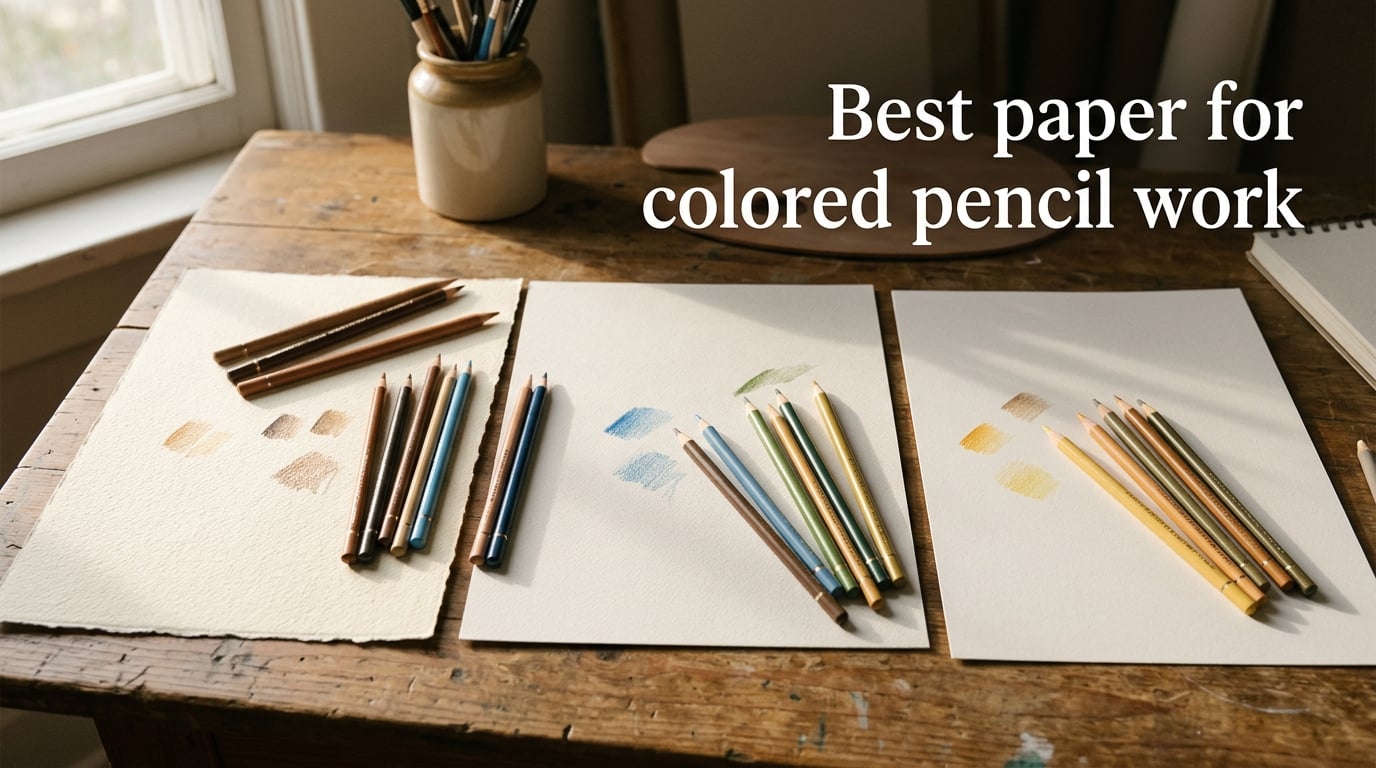
Choosing the best paper for colored pencil work is one of the most impactful decisions you can make as an artist. The right surface determines how many layers you can build, how fine your details can go, and whether your finished piece will last decades or yellow within a few years. After testing dozens of papers across multiple pencil brands and techniques, I’ve put together this comprehensive guide to help you find your perfect match.
Whether you use wax-based pencils like Prismacolor Premier or oil-based options like Faber-Castell Polychromos, your paper needs to have specific qualities: enough texture (called “tooth”) for pigment to grip, sufficient weight to resist buckling, and ideally cotton fibers for archival longevity. The wrong paper can limit your layering, cause warping under solvent blending, or yellow within a few years. Let’s break down exactly what to look for and which papers deliver.
I’ve spent years testing papers across Prismacolor, Polychromos, and budget pencil brands — and the differences are dramatic. Some papers accept 20+ layers effortlessly while others clog after five. Some stay perfectly flat through aggressive burnishing while others buckle at the first touch of blending solvent. This guide distills those tests into clear recommendations you can act on today.
Table of Contents
Top Paper Picks at a Glance
Here’s a quick reference if you want to skip ahead. Each of these papers earned its place through consistent performance across layering, blending, and detail work:
- Legion Stonehenge — 100% cotton, medium tooth, excellent layering capacity. The go-to for many professional colored pencil artists.
- Strathmore 400 Series Bristol (Vellum) — Affordable medium-weight bristol with a slight tooth. Great for beginners and intermediate artists.
- Clairefontaine PastelMat — Unique sanded surface that grips pigment aggressively. Ideal for rich, saturated work but pricier per sheet.
- Hot Press Watercolor Paper — Smooth, heavyweight surface from brands like Fabriano or Arches. Excellent for detailed realism.
- Canson Mi-Teintes — Toned pastel paper available in dozens of colors. Perfect for toned-paper artwork and mixed media.
- Strathmore Mixed Media — Versatile vellum finish that handles both wet and dry media. A solid all-rounder for experimentation.
Paper Tooth and Texture Explained
“Tooth” refers to the surface texture of the paper — the tiny bumps, valleys, and fibers that grab and hold colored pencil pigment. Understanding tooth is fundamental because it directly controls how many layers of color you can apply and how much detail you can achieve.
Rough Tooth
Rough or heavily textured paper has pronounced peaks and valleys. Cold press watercolor paper and some pastel papers fall into this category. Rough tooth grabs pigment aggressively and allows for many layers, but the texture shows through your work and makes fine detail nearly impossible.
This type of surface works well for expressive, painterly styles where visible texture adds character. It’s less suited for photorealistic portraits or botanical illustration where smooth gradations matter.
Medium Tooth (Vellum Finish)
Medium tooth is the sweet spot for most colored pencil work. Papers with a vellum finish — like Strathmore Bristol Vellum, Stonehenge, or Strathmore Mixed Media — have enough texture to grip multiple layers while still allowing fine line work and smooth blending.
If you’re unsure which tooth level to start with, medium is the safest choice. It handles Prismacolor, Polychromos, and budget pencils equally well. Most professional colored pencil artists work primarily on medium-tooth surfaces.
Smooth Tooth (Plate/Hot Press)
Smooth papers like plate-finish bristol or hot press watercolor paper have minimal texture. These surfaces excel at hyper-detailed work — individual hair strands, reflective eyes, tiny botanical details — but they limit how many layers you can build before the paper stops accepting color.
Smooth paper is a trade-off: you gain precision but lose layering capacity. Artists working in this style often use heavy pressure or solvent blending to maximize color density on limited layers.
Understanding Paper Weight: GSM vs Pounds
Paper weight affects durability, how it handles pressure, and whether it warps when using solvents. Two measurement systems exist: grams per square meter (GSM) and pounds (lb), and they don’t convert directly because lb measures a paper’s category (drawing, bristol, cover) differently.
For colored pencil work, aim for at least 160 GSM (approximately 80 lb drawing weight). Lighter paper dents easily under pressure and buckles if you use blending solvents. The 200-300 GSM range is ideal for heavy layering, burnishing, and mixed media work.
When in doubt, go heavier. A 300 GSM hot press watercolor paper can handle aggressive burnishing and solvent blending without any warping, while a 90 GSM sketchbook page will dent and curl under the same treatment.
Cotton Content and Archival Quality
Paper made from 100% cotton fibers (also called “rag paper”) lasts significantly longer than paper made from wood cellulose. Cotton fibers are naturally acid-free and lignin-free, meaning they won’t yellow or become brittle over decades.
For finished artwork you plan to sell, frame, or display, always choose archival-quality paper labeled “acid-free” and “lignin-free.” Papers like Legion Stonehenge, Fabriano Artistico, and Legion Lenox Cotton are 100% cotton and meet museum-grade archival standards.
For practice work and studies, standard acid-free cellulose paper (like Strathmore 400) is perfectly adequate and much more affordable. Save the premium cotton papers for pieces you intend to keep.
Best Paper Types for Colored Pencil Work
Each paper type has distinct characteristics that make it better suited for certain techniques and styles. Here’s what I’ve found works best after extensive testing.
Bristol Paper
Bristol paper comes in two finishes: vellum (slightly textured) and plate (smooth). The vellum version is the workhorse for colored pencil artists. Strathmore 300 and 400 Series Bristol Vellum are widely available, affordable, and forgiving for beginners.
Bristol is a multi-ply paper, meaning it’s made by laminating sheets together, giving it good rigidity. The weight typically ranges from 100 lb to 300 lb. For colored pencils, the 100 lb vellum bristol handles most techniques well, though heavy burnishing may dent the surface. Many beginners on Reddit report starting with Strathmore 400 Bristol Vellum and being satisfied with it for years before upgrading to Stonehenge or cotton papers.
Legion Stonehenge
Stonehenge is 100% cotton, acid-free, and comes in a range of subtle colors. Its medium tooth is nearly perfect for colored pencils — enough grip for 15-20 layers while still allowing smooth blending and fine detail.
Many professional artists consider Stonehenge the gold standard. One thing to note: adding white or light colors over heavily layered dark areas can produce a muted gray rather than bright white, because the pigment settles into the tooth’s valleys. Reddit’s r/ColoredPencils community consistently names Stonehenge as a top choice for Prismacolor work.
Clairefontaine PastelMat
PastelMat has a unique micro-sanded surface that grips pigment like nothing else. You can layer extensively without solvent, and colors appear incredibly saturated. It comes in a beautiful range of toned colors.
The trade-offs: it’s expensive per sheet, the white sheets attract dust and fingerprints easily, and the surface is difficult to erase on. Despite these drawbacks, many artists reserve PastelMat for their most important finished pieces because the results are stunning.
Hot Press Watercolor Paper
Hot press watercolor paper from brands like Fabriano Artistico or Arches offers a smooth, heavyweight surface that handles heavy pressure and solvent blending beautifully. At 300 GSM, it won’t buckle or warp under any technique.
The smooth surface is excellent for detailed realism and photorealistic work. One common issue: some hot press papers develop white flecks where the pencil skips over the sizing. This can be minimized with light initial layers and gradual pressure building. Forum users on r/ColoredPencils note that Fabriano 300 GSM hot press tends to have fewer fleck issues than some competitors, though individual batches can vary.
Canson Mi-Teintes
Canson Mi-Teintes is a toned pastel paper available in over 50 colors. The textured side has a pronounced honeycomb pattern that works well for pastels but can be distracting for colored pencils. Many artists flip to the smoother back side for colored pencil work.
The toned colors are invaluable for artwork where you want the paper color to serve as a midtone, reducing the number of layers needed. It’s affordable and widely available at art supply stores. The 160 GSM weight is on the lighter side, so avoid aggressive burnishing — light-to-medium pressure works best on Mi-Teintes.
Mixed Media Paper
Strathmore 400 Series Mixed Media paper has a vellum finish that handles both dry media and light wet media. It’s a versatile choice if you combine colored pencils with watercolor washes, markers, or ink.
At 190 GSM, it’s lighter than dedicated watercolor paper but heavier than standard drawing paper. It’s an excellent all-rounder for artists who want one paper for multiple techniques without investing in specialized surfaces.
Matching Paper to Your Pencil Type
Wax-based pencils (like Prismacolor Premier) and oil-based pencils (like Faber-Castell Polychromos) behave differently on the same surface, and matching them correctly improves your results.
Wax-based pencils deposit soft, blendable pigment that can clog paper tooth relatively quickly. They work best on medium-tooth papers like Stonehenge or Bristol Vellum that have enough texture to grip the wax without getting overwhelmed after a few layers. Prismacolor Premier users on Reddit’s r/ColoredPencils frequently recommend Stonehenge as their go-to surface, noting its ability to handle 10-15 wax layers before saturation becomes an issue.
Oil-based pencils are harder and deposit pigment more gradually. They maintain tooth longer and work well on a wider range of surfaces, including smoother papers like hot press watercolor paper. Polychromos users report excellent results on both Stonehenge and smooth bristol, with less concern about tooth clogging compared to wax-based pencils. If you use both types, a medium-tooth paper like Stonehenge or Strathmore Bristol Vellum is the safest universal choice.
For solvent blending with either type, choose heavier paper (200+ GSM) to prevent warping. Odorless mineral spirits and blending pens work beautifully on Stonehenge and hot press watercolor paper, but can buckle lighter sheets.
Paper Form Factors: Sheets, Pads, Blocks, and Sketchbooks
Paper comes in several formats, and each has practical advantages depending on how and where you work. Understanding these differences helps you avoid buying the wrong format for your needs.
Individual sheets give you the most flexibility — you can cut them to any size, work on a drawing board, and tape them down with artist’s tape for stability. They’re also the most cost-effective for larger formats like 18×24 inches. Stonehenge, Fabriano Artistico, and hot press watercolor paper all come in individual sheets.
Pads are bound on one edge with glue or tape, keeping sheets flat and portable. They’re ideal for beginners because you can try a few sheets without committing to a full pack. Strathmore and Canson offer most of their popular papers in pad format at multiple sizes.
Blocks glue all four edges, eliminating the need for taping down your paper. This is especially valuable for wet media or solvent blending where warping is a concern. The paper stays flat until you remove it with a palette knife after the piece is dry.
Sketchbooks are convenient for practice and travel, but the binding can make it awkward to work near the edges. Look for sketchbooks with perforated pages if you want to remove finished work cleanly. Strathmore’s Toned Gray and Toned Tan sketchbooks are particularly popular for on-the-go colored pencil work.
Toned and Colored Paper Options
Working on toned paper changes your approach entirely. Instead of building up from white, you work from a midtone, adding both darks and lights. This can dramatically speed up your process and create more unified, atmospheric artwork — and it’s one of the most underused techniques among beginners.
Gray tones (like Strathmore Toned Gray) work beautifully for silver, metallic, or moody subjects. The neutral midtone lets both warm and cool colors read clearly without competing with the paper. Many portrait artists prefer gray for its skin-tone versatility.
Tan and warm tones (like Strathmore Toned Tan or Stonehenge Kraft) add warmth automatically, making them ideal for landscapes, autumn scenes, and warm-skinned portraits. The paper tone peeks through as a unifying undertone.
Canson Mi-Teintes offers over 50 colors, from deep burgundy to soft blue, giving you the widest range for creative work. For finished pieces, choose a tone that complements your subject rather than matching it exactly — a blue-gray paper under a sunset, for instance, creates beautiful atmospheric depth.
How to Choose the Right Paper for Your Needs
For Beginners
Start with Strathmore 400 Series Bristol Vellum or Strathmore Mixed Media paper. Both are affordable, widely available, and forgiving. Buy a pad rather than individual sheets so you can experiment without pressure. Avoid expensive specialty papers until you’ve developed your technique and know what surface qualities matter most to your style.
A good beginner starter pack would be one Bristol Vellum pad and one Mixed Media pad. Try both with your current pencils and note how each feels different under layering, blending, and erasing. This hands-on comparison teaches you more about paper than any guide can. Once you know your preferences, invest in Stonehenge or hot press watercolor paper for your serious work.
For Detailed Realism and Portraits
Hot press watercolor paper or smooth bristol (plate finish) gives you the precision needed for photorealistic work. Fabriano Artistico hot press and Strathmore 500 Series Bristol Plate are excellent choices. Pair with oil-based pencils for maximum control over fine details — Polychromos on hot press watercolor paper is a favorite combination among portrait artists for rendering individual hair strands and eye reflections.
The challenge with smooth paper is limited layering, so plan your values carefully. Work from light to dark, building up gradually with light pressure in early layers. Heavy pressure too early can burnish the tooth flat and prevent further color application.
For Mixed Media Work
If you combine colored pencils with watercolor, markers, or gouache, use heavyweight paper rated for wet media. Strathmore Mixed Media (190 GSM) handles light washes, while 300 GSM hot press watercolor paper handles heavier wet application. Always test your specific combination on a scrap piece first.
A popular mixed media workflow is to lay down a watercolor underpainting on hot press watercolor paper, let it dry completely, then build colored pencil layers on top. The watercolor establishes values and base colors while the pencil adds detail and texture on top. This technique works beautifully for landscapes and botanical illustration.
Troubleshooting Common Problems
Warping or buckling: Your paper is too thin for the amount of solvent or pressure you’re using. Switch to heavier weight (200+ GSM) or tape your paper to a board using artist’s tape on all four edges. Blocks eliminate this problem entirely by holding all four sides. If you’re committed to lighter paper, apply solvent sparingly with a cotton swab rather than brushing it across the surface.
Denting from pressure: This happens on lighter papers when burnishing — the heavy pressure compresses the paper fibers permanently. Place a sheet of smooth cardboard under your work surface for cushion, or switch to heavier paper for burnishing-heavy techniques. Bristol paper at 100 lb or heavier resists denting much better than 80 lb sheets.
Tooth clogging: After many layers, paper tooth fills with pigment and stops accepting new color. This is the most common complaint on forums, especially with wax-based pencils. Use a workable fixative spray between layer sessions to restore some grip — spray lightly from 12 inches away and let dry completely before continuing. Alternatively, switch to a paper with deeper tooth for pieces requiring 15+ layers. You can also use a colorless blender pencil to smooth saturated areas rather than adding more pigment.
White appearing gray: When layering white over heavily applied dark colors on papers like Stonehenge, the white mixes with underlying pigment in the tooth valleys. This is a known behavior of medium-tooth cotton papers. Plan your light areas early and leave paper exposed, or use a heavy-body white pencil like the Prismacolor Premier White with maximum pressure. Some artists also lift color with a kneaded eraser before applying white.
Smudging during work: Colored pencil is inherently dusty and will smudge under your hand. Work from top to bottom (or left to right if left-handed) and place a sheet of clean paper under your drawing hand. Some artists use a mahl stick for support without contact. Fixative between sessions also helps lock previous layers.
Frequently Asked Questions
What is the best paper for colored pencil art?
The best paper for colored pencil art has enough tooth for pigment to grip, weighs at least 160 GSM to resist buckling, and is acid-free for longevity. Legion Stonehenge, Strathmore 400 Bristol Vellum, and Clairefontaine PastelMat are consistently top-rated by professional artists.
What kind of paper is good for Prismacolor pencils?
Prismacolor Premier pencils are wax-based and work best on medium-tooth papers like Stonehenge, Bristol Vellum, or Strathmore Mixed Media. These surfaces grip the soft wax pigment without clogging too quickly, allowing 10-15 layers before saturation.
Is smooth paper better for colored pencils?
Smooth paper excels at fine detail and photorealistic work but limits layering capacity. Medium-tooth paper is better for most colored pencil techniques because it balances detail capability with the ability to build up many layers of color.
What GSM paper is best for pencil drawing?
For colored pencil work, aim for 160-300 GSM. Papers in the 200-300 GSM range handle heavy pressure, burnishing, and solvent blending without warping. Lighter papers (under 160 GSM) dent easily and buckle when solvents are applied.
What paper do professional colored pencil artists use?
Most professionals use Legion Stonehenge, Strathmore 500 Series Bristol, hot press watercolor paper (Fabriano or Arches), or Clairefontaine PastelMat. Stonehenge is the most frequently recommended for its balance of tooth, weight, and 100% cotton archival quality.
Final Thoughts
Finding the best paper for colored pencil work comes down to understanding three things: tooth, weight, and fiber content. Start with an affordable medium-tooth paper like Strathmore Bristol Vellum or Stonehenge, experiment with different surfaces as your technique develops, and invest in archival cotton papers for your finished pieces.
Every artist’s ideal paper is slightly different — the right surface depends on your pencil type, layering habits, and whether you blend with solvents. Buy small pads of two or three different papers and do the same drawing on each. The side-by-side comparison will tell you more about your preferences than any review ever could. The best paper for colored pencil work is ultimately the one that makes your pencils feel like they belong on the page.