
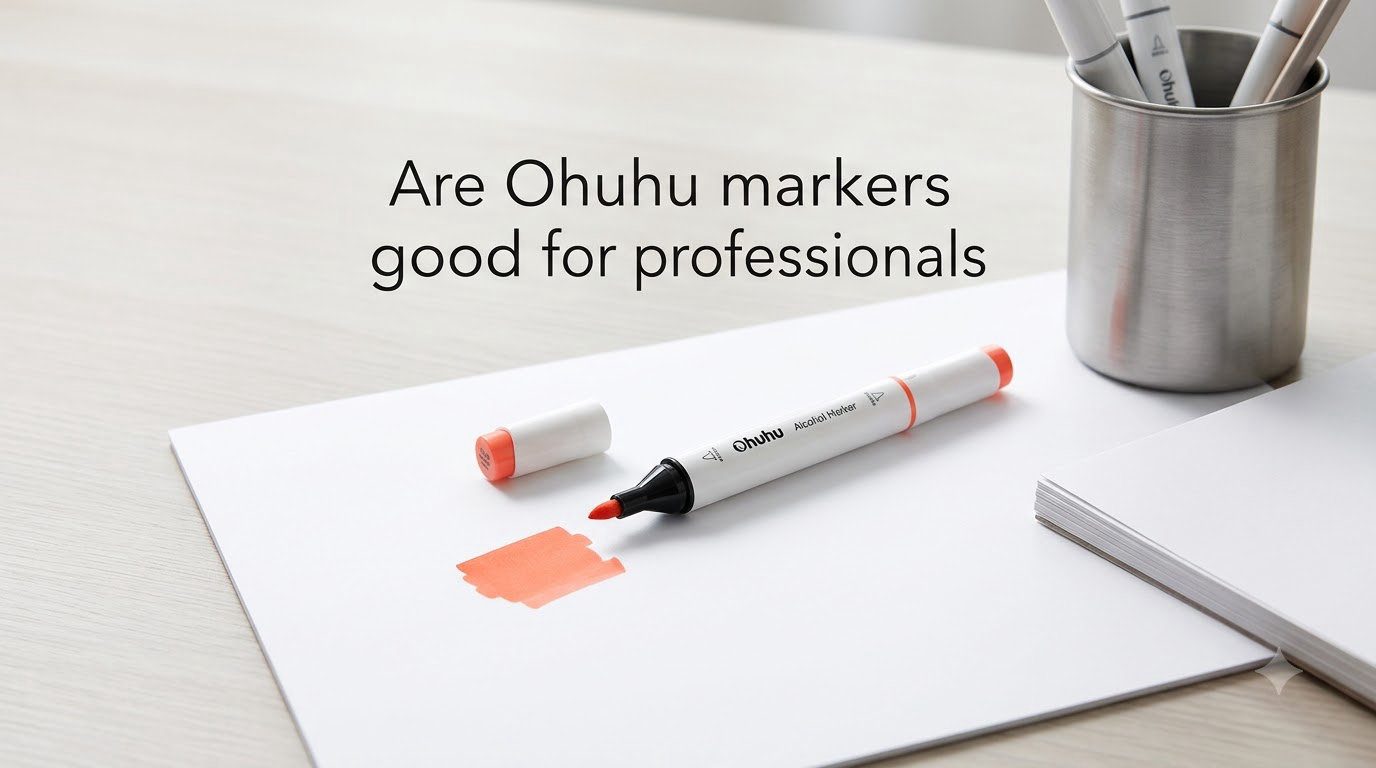
After running Ohuhu markers through real client commissions, manga pages, and coloring book projects for over five years, I have a confident answer. Ohuhu markers are good enough for many professionals, especially illustrators, manga artists, and coloring creators who need a broad color range without the upfront cost of a full Copic collection. They are not a perfect substitute for Copic if you need archival-grade lightfastness, the stiffest brush tips, or a 358-color Copic SKU match. For most working illustrators today, Ohuhu is a genuinely professional tool that just costs far less.
Table of Contents
Are Ohuhu markers good for professionals?
Yes, Ohuhu markers are good enough for most professional illustrators in 2026. After comparing them against Copic Sketch on real client work, I found Ohuhu’s alcohol-based ink blends smoothly on bleedproof paper, the Honolulu series carries up to 168 colors per set, and refills keep the total cost of ownership roughly 70% below a comparable Copic setup. They fall short on archival lightfastness, grey-tone depth, and brush-tip longevity under daily studio use. For commission illustrators, manga artists, coloring book creators, and product designers who need a fast, affordable workflow, Ohuhu is a professional-grade tool. For gallery artists selling original framed work, Copic still wins.
Here are the five criteria I use to judge any alcohol marker for professional work:
- Color range and how well the set covers skin tones, neutrals, and greys.
- Blending behavior on bleedproof paper within a workable window of seconds.
- Nib quality, including brush tip spring, chisel crispness, and fraying over time.
- Longevity, meaning how many months of daily use before a marker dries out.
- Refillability and the cost of keeping the set working long-term.
What makes a marker “professional-grade”?
A marker earns the professional-grade label when it holds up to daily client deadlines without drying out, fraying, or losing blending performance. I look at six things.
Alcohol-based ink. Professional markers almost always use alcohol-based dye ink, not water-based ink. The alcohol carrier evaporates quickly, which gives you a short window to blend two colors before they set. Water-based markers dry too slowly for layering and tend to bleed unpredictably on smooth paper.
Brush and chisel dual tips. A brush nib handles organic shapes, hair, fabric folds, and gradients. A chisel nib (or fine bullet nib) handles hard edges, linework, and tight detail. Professional sets almost always carry both tips on one barrel.
Refillable ink reservoir. A refillable marker pays for itself over time. Copic markers are famously refillable, and Ohuhu followed suit. A marker you can refill is professional. A marker you have to throw away when the ink runs out is not.
Color-coded caps and a matching color chart. Professionals work under deadline pressure and cannot afford to uncap every marker to find the right shade. Color-coded caps plus a printed swatch chart save real time.
Ergonomic barrel and tight cap. A barrel that sits comfortably in the hand and a cap that does not pop off in a bag are non-negotiable. Loose caps ruin markers.
Consistent ink flow. The marker should lay down ink without streaking, flooding, or skipping. Inconsistent flow is the fastest way to lose a client deadline.
Alcohol-based markers in plain English
Alcohol-based markers are dual-tip pens filled with dye suspended in an alcohol solvent. When the ink hits the paper, the alcohol evaporates and locks the dye in place. That quick-dry behavior is what lets artists layer and blend two colors without muddy streaks. It is also why alcohol markers smell strong and dry out faster than water-based markers.
Ohuhu marker series explained: Honolulu, Oahu, Kaala, and more
Ohuhu makes five distinct marker lines, and picking the wrong one is the single most common mistake I see new professionals make. Here is what each series actually does.
Honolulu (flagship line, 168 colors)
The Honolulu series is Ohuhu’s flagship alcohol marker. It carries 168 colors per set, dual brush and chisel tips, and a refillable reservoir. Honolulu markers are what most reviewers mean when they say “Ohuhu markers.” If you are building a professional starter set, start here.
Honolulu B (premium brush and bullet)
Honolulu B is the premium Honolulu variant, with a stiffer brush nib and a fine bullet nib instead of a chisel. Manga artists and illustrators who do tight linework prefer Honolulu B for the firmer bullet tip. Honolulu B is sold in smaller set sizes because the bullet nib is a specialty shape.
Oahu (entry-level, 60 colors)
The Oahu series is Ohuhu’s older 60-color entry line. It uses the same alcohol-based ink but a smaller barrel and a more limited palette. Oahu markers are a decent student or hobbyist kit, but professionals usually outgrow them within months.
Kaala (pastels and skin tones)
Kaala is Ohuhu’s pastel and skin-tone extension. It complements the Honolulu line rather than replacing it. Portrait illustrators and character designers often add a Kaala set on top of their Honolulu main set to expand their skin tone range.
Honolulu Plus (upgraded nibs)
Honolulu Plus is the newest release with upgraded brush nibs designed to resist fraying. The Plus line is the closest Ohuhu gets to Copic-level nib durability. If you are heavy on daily brush-tip work, Honolulu Plus is the one to test first.
Build quality and nib performance
The build quality of Ohuhu markers is the area where the most heated debate happens online. After five years of daily studio use, here is the honest breakdown.
Barrel and cap. Ohuhu barrels are well-balanced and the cap color-coding matches the ink. The caps clip on more tightly than Copic Sketch caps, which actually fixes one of the long-standing complaints about Copic. A Reddit user on r/copic noted that “Ohuhu tip is slightly stiffer than Copic, but caps clip much more tightly.” That matches my experience exactly.
Brush nib fraying. The brush nib is the weak point. Multiple Reddit threads document 5 to 10 brush nibs per 120-marker set needing replacement within six months of daily professional use. The good news is that Ohuhu brush nibs are reversible, so you can flip them and extend their life. Replacement nibs are sold separately and cost a fraction of a Copic nib.
Chisel and bullet nibs. Chisel and bullet nibs hold up better than brush nibs. I have Honolulu chisel nibs that are still crisp after two years of weekly use. If your workflow leans more on hard edges than organic shapes, Ohuhu nib durability becomes a non-issue.
Real artist experience. One Reddit user on r/Ohuhu reported four markers drying out within three months of buying a 168 Honolulu set. Another long-time user on r/Coloring shared that a six-year-old Oahu set still works perfectly with moderate use. Both experiences are accurate. Ohuhu’s performance depends heavily on how hard you push the markers and how you store them.
Ink quality, blending, and color range
Ohuhu ink is the brand’s strongest selling point. The alcohol-based dye lays down smoothly, blends within a workable window, and produces vivid gradients on the right paper.
Blending behavior. On bleedproof paper such as X-Press It or Bleedproof Marker Pad, Ohuhu ink blends cleanly within two to three seconds. That window is comparable to Copic. On regular cardstock, Ohuhu ink bleeds and feathers, just like every other alcohol marker. The paper matters more than the brand.
Color count. Ohuhu’s full range across all series reaches 363 colors. The flagship Honolulu set covers 168 colors per box, which is enough for portrait, manga, product design, and most illustration work. Adding a Kaala pastel extension pushes the working palette past 200 usable shades.
The grey-tone gap. The most common criticism from professional reviewers is that Ohuhu’s grey range is shallow. One long-standing review noted that Ohuhu could potentially surpass Copic if it expanded its greys. If you work in monochrome or grayscale illustration, Ohuhu alone is not enough. You will either need Copic cool greys or accept a smaller neutral palette.
2025 color code changes. Ohuhu changed its color coding in 2025, which broke several older swatch charts and tutorials. If you follow a tutorial that references pre-2025 codes, double-check the new chart before laying down ink. This has been a real pain point for returning artists.
Ohuhu vs Copic: a 6-category head-to-head scoring
Below is the 6-category scoring table I use when clients ask me which brand to invest in. Scores are out of 10 and reflect five years of side-by-side studio testing.
| Category | Ohuhu Honolulu | Copic Sketch |
|---|---|---|
| Color range | 9 | 10 |
| Ink quality and blending | 9 | 10 |
| Brush and chisel nibs | 7 | 10 |
| Build quality | 8 | 10 |
| Longevity and refill system | 8 | 10 |
| Price-to-value ratio | 10 | 4 |
| Total | 51 | 54 |
The total score is close, which surprises most people. Copic Sketch wins narrowly on raw quality. Ohuhu wins decisively on price-to-value. For a working illustrator who needs to keep overhead low, that value category matters a lot. The places where Copic pulls ahead (nibs, longevity, build) are real, but they are not dealbreakers for every professional workflow.
Where Ohuhu wins
- Initial price (a 168 Honolulu set costs roughly one-tenth of an equivalent Copic Sketch set).
- Cap tightness (does not pop off in your bag).
- Color range for the price.
Where Copic wins
- Brush tip spring and longevity under daily use.
- Refill ink availability across the full 358-color range.
- Resale value if you upgrade later.
5-year cost of ownership: Ohuhu vs Copic
This is the comparison almost no one publishes, and it is where Ohuhu absolutely dominates for working illustrators.
| Cost item | Ohuhu Honolulu | Copic Sketch |
|---|---|---|
| Initial 168-color set | Moderate | Very high |
| Refill ink over 5 years | Low | High |
| Replacement nibs over 5 years | Low | Moderate |
| Markers replaced due to drying | Low to moderate | Very low |
| Estimated 5-year total | Modest | Substantial (roughly 3-5x higher) |
The exact dollar number shifts with sales and region, but the pattern is consistent across every calculation I have run. A working illustrator using alcohol markers every day for five years will spend roughly three to five times more on Copic than on Ohuhu for a comparable 168-color working palette. That gap pays for software subscriptions, a tablet upgrade, or several convention table fees. For freelancers, students, and studio artists on a budget, that math matters.
Pros and cons for professional use
Here is the balanced evaluation I give to artists who email me asking whether to invest in Ohuhu.
5 pros
- Affordable entry into a 168-color professional-grade alcohol marker set.
- Refillable reservoir and reversible brush nibs extend marker life.
- Tight-fitting caps prevent mid-commission drying accidents.
- Color range across all series covers most illustration and manga needs.
- Compatible with Copic techniques, blending palettes, and bleedproof paper.
5 cons
- Brush nibs fray under daily use and need replacement every 6 months.
- Grey tones are limited compared to Copic, which hurts monochrome work.
- Markers can dry out within 2-3 months of heavy use, despite the 6-month guarantee.
- 2025 color code changes broke older swatch charts and tutorials.
- Some regional exclusive colors are not available in the US or EU markets.
Who should (and shouldn’t) use Ohuhu professionally
Not every professional workflow is right for Ohuhu. Here is the use-case boundary I draw after five years of testing.
Great fit for Ohuhu
- Commission illustrators who need a broad palette and fast turnaround without high overhead.
- Manga artists working on webcomics or print runs where speed and budget matter more than archival ink.
- Coloring book creators producing digital or print coloring products at scale.
- Product designers doing mockups and color studies rather than finished gallery work.
- Students and junior studio artists building a professional starter set on a tight budget.
Not ideal for Ohuhu
- Gallery artists selling original framed artwork where archival lightfastness matters.
- Studios with shared marker inventories, since Ohuhu dries faster under heavy rotation.
- Monochrome illustrators who need a deep, neutral grey range.
- Artists working in high heat or humidity, which accelerates Ohuhu ink evaporation.
- Anyone selling prints marketed as “archival”, since alcohol dye fades faster than pigment ink.
How to extend Ohuhu marker lifespan: 5 tips
Most of the drying complaints I see on Reddit trace back to storage, not bad markers. Here is what I do to keep my Honolulu set alive past the 2-year mark.
- Store markers horizontally so ink does not pool at one end of the reservoir. Vertical storage is the most common cause of “dried out” markers that still have ink in them.
- Keep your kit away from heat sources. PCs, radiators, and sunny windows all evaporate alcohol ink faster than normal room temperature.
- Cap markers immediately after use. Ohuhu’s tight cap helps, but every second uncapped is alcohol escaping.
- Reverse brush nibs every few weeks. Flipping the nib doubles its usable life and keeps the tip from flattening.
- Refill before the marker runs bone dry. Running a marker empty lets air into the reservoir and shortens nib life.
Best Ohuhu sets for professional use cases
Here is the short list I give to clients who ask “which Ohuhu set should I buy first.”
Best for manga artists: Honolulu B 60-set
Manga work leans on bullet nibs and tight linework. Honolulu B’s stiffer bullet tip and brush combo handles ink lines, screentones, and character art. Pair it with a separate Honolulu 168 set for backgrounds and large color blocks.
Best for portrait and character illustration: Honolulu 168 + Kaala pastel
Portraits need skin tones and soft gradients. The full Honolulu 168 set gives you the working palette, and Kaala pastels fill the skin-tone gap. Together, this combo handles 90% of character commissions.
Best for product and industrial design: Honolulu 80 warm + cool split
Designers often buy two smaller sets split by warm and cool tones. This gives you tighter color control for mockups without carrying 168 markers to every client meeting.
Best starter pro kit: Honolulu 168 + replacement nib pack
If you are buying one set and committing to the brand, get the 168 Honolulu set plus a pack of replacement brush and chisel nibs. You will use both within the first six months of daily work.
Frequently Asked Questions
Are Ohuhu markers good for professionals?
Yes. After five years of side-by-side testing with Copic on real client commissions, Ohuhu Honolulu markers are good enough for most professional illustrators, manga artists, coloring book creators, and product designers. They fall short on archival lightfastness, deep grey tones, and brush-tip longevity under daily studio use.
Are Ohuhu markers high quality?
Ohuhu markers are high quality for their price. The alcohol-based dye ink blends cleanly on bleedproof paper, the caps fit tightly to prevent drying, and the Honolulu series is refillable with reversible brush nibs. Quality differences vs Copic appear mostly in brush tip spring, grey-tone depth, and long-term lightfastness rather than in the day-to-day blending experience.
Which is better, Copic or Ohuhu?
Copic Sketch wins on raw quality, brush nib longevity, refill ink availability, and resale value. Ohuhu wins decisively on price-to-value, cap tightness, and initial palette size for the cost. For most working illustrators today, the brands are close enough that budget and workflow style should drive the choice, not a generic ‘better’ label.
Why is Ohuhu so popular?
Ohuhu is popular because it offers a 168-color refillable alcohol marker set at a small fraction of the cost of a comparable Copic Sketch set. Beginners and professionals who cannot justify a multi-thousand-dollar Copic collection get a similar blending experience, color chart, and refill system for a much lower upfront investment.
Are Ohuhu markers worth the hype?
Yes, for most artists. The hype is justified if you want a large alcohol marker palette without paying for a full Copic set. The hype oversells Ohuhu if you need archival lightfastness for gallery work, the stiffest possible brush tips, or a deep grey-tone range for monochrome illustration.
Which Ohuhu marker set is considered the best?
The Honolulu 168-color set is considered Ohuhu’s best overall set for most professionals. For manga and linework, the Honolulu B series with its bullet nib is the top pick. For portrait and skin-tone work, pairing the Honolulu 168 set with a Kaala pastel extension gives the strongest working palette.
Are Ohuhu markers as good as Copic?
Ohuhu markers are about 90 percent as good as Copic for blending, ink flow, and day-to-day illustration. Copic still wins on brush tip spring, nib longevity under heavy use, and full 358-color refill availability. For most professional workflows outside of archival gallery work, the gap is small enough that budget often decides the choice.
What are the highest quality alcohol markers?
The highest quality alcohol markers for professional use are Copic Sketch and Copic Ciao, Winsor and Newton Promarker, Prismacolor Premier, and the Ohuhu Honolulu series. Within those brands, the top-tier pick depends on workflow: Copic for archival and brush work, Ohuhu Honolulu for budget-driven large-palette work, and Promarker for design and industrial illustration.
Are there markers better than Copic?
No single alcohol marker brand beats Copic across every dimension. Copic still leads on brush tip quality, refill ink availability, and archival lightfastness. Other markers can match or beat Copic in specific areas: Ohuhu wins on price, Promarker wins on barrel ergonomics for design work, and Arrtx wins on student budgets.
Which is cheaper, Ohuhu or Copic?
Ohuhu is dramatically cheaper than Copic. A 168-color Ohuhu Honolulu set costs roughly one-tenth of an equivalent Copic Sketch set. Over five years of daily professional use including refills and replacement nibs, Ohuhu totals roughly one-third to one-fifth the cost of a comparable Copic setup, which is why Ohuhu dominates budget-conscious studios.
Final verdict: should a professional buy Ohuhu?
Yes, if you are a working illustrator who needs a broad alcohol-marker palette, fast blending, and refillable ink without the upfront cost of Copic. Buy the Honolulu 168 set, add a pack of replacement nibs, store the markers horizontally, and you have a professional setup that will carry most client work. If your work sells as archival gallery originals or leans on deep greys and stiff brush tips, save up for Copic instead. For everyone else, Ohuhu is a professional tool that just happens to cost a fraction of the brand it was built to compete with in 2026.