
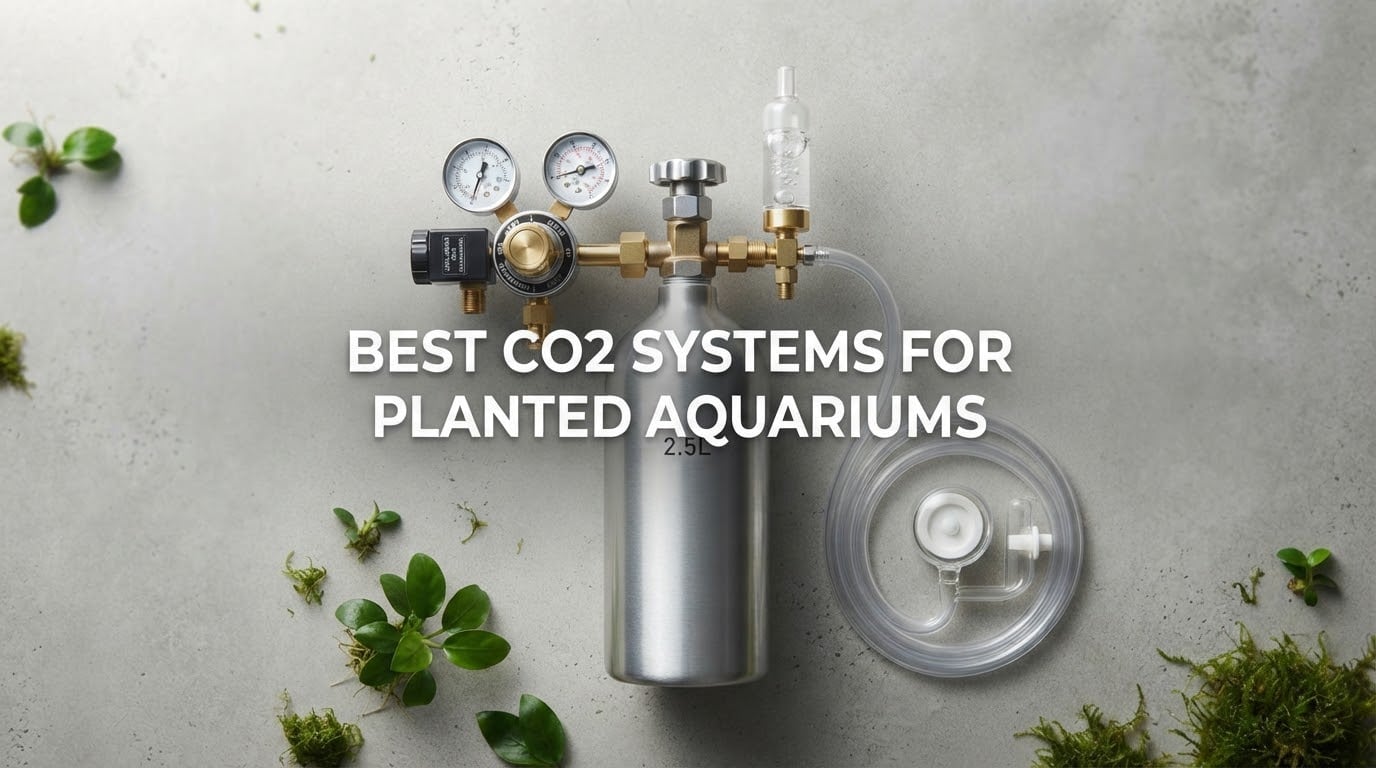
Every serious planted aquarium runs on four parts: a pressurized CO2 source, a regulator with an electric solenoid, a diffuser that dissolves the gas, and something to monitor the result. Most of the buying mistakes I see come from assembling those four pieces separately and ending up with mismatched hose, a missing check valve, or a solenoid nobody has tested under a timer.
So this roundup evaluates complete systems rather than loose parts. We compared 12 aquarium CO2 systems across three tiers: regulators for standard CGA320 cylinders, pre-built citric acid generator kits, and slow-release kits for beginners who would rather not handle compressed gas at all. Each entry covers what is in the box, what is not in the box, and the tank size it actually suits.
The short answer: the best CO2 systems for planted aquariums are the FZONE CGA320 regulator for a single standard tank, the FZONE Pro Series dual stage model when you run two tanks or anything above 20 gallons, and a pre-built generator kit if your priority is the lowest running cost. The full table, the reasoning, and the safety rules are all below.
Table of Contents
Top 3 CO2 Systems for Planted Aquariums (October 2026)
These three carry the most weight in this list because they combine build quality, documented pressure control, and a review base large enough to trust. Every one of them uses a 12V DC solenoid that can run off a timer, which is the single most important safety feature in this category.
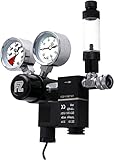
FZONE CGA320 CO2 Regulator
- 12V DC split-type solenoid
- Fine tuning to 1 bubble per 3 seconds
- Bubble counter with integrated check valve
- Installation tools included
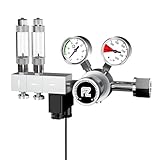
FZONE Pro Series Dual Stage
- Dual stage with 0-65 PSI output
- Two independent manifold blocks
- Safety valve above 100 PSI
- Fits CGA320 cylinders

Hygger Dual Gauge CO2 Regulator
- Dual gauges with marked safe range
- 12V DC solenoid for timer use
- Acrylic bubble counter with check valve
- Two-year warranty
All 12 CO2 Systems Compared in 2026
The table below is the fastest way to match a system to a tank. Regulators need a CGA320 cylinder, which is the standard thread on North American fire extinguishers. Generator kits run a citric acid and baking soda reaction inside their own bottle. The slow-release kit generates gas without pressure at all.
| Product | Specs | Action |
|---|---|---|
| FZONE CGA320 CO2 Regulator with Bubble Counter and Check Valve |
|
Check Latest Price |
| FZONE Pro Series Dual Stage CO2 Regulator |
|
Check Latest Price |
| Hygger CO2 Regulator with Dual Pressure Gauges |
|
Check Latest Price |
 Fzone 2.5 L Aquarium CO2 Generator System Kit Fzone 2.5 L Aquarium CO2 Generator System Kit |
|
Check Latest Price |
 MagTool 2.5-5L DIY Aquarium CO2 Generator Kit MagTool 2.5-5L DIY Aquarium CO2 Generator Kit |
|
Check Latest Price |
 Clscea G700S 4L CO2 Generator with Solenoid Valve Clscea G700S 4L CO2 Generator with Solenoid Valve |
|
Check Latest Price |
 ZRDR 2L Aquarium CO2 System with Pressure Gauge ZRDR 2L Aquarium CO2 System with Pressure Gauge |
|
Check Latest Price |
 DaToo CO2 Regulator with Cold-Touch Solenoid DaToo CO2 Regulator with Cold-Touch Solenoid |
|
Check Latest Price |
 HYQO DIY CO2 Generator System Kit with Pressure Gauge HYQO DIY CO2 Generator System Kit with Pressure Gauge |
|
Check Latest Price |
 Clscea G200 Two-Bottle DIY CO2 Generator Kit Clscea G200 Two-Bottle DIY CO2 Generator Kit |
|
Check Latest Price |
 Yosoo Aquarium CO2 Generator Kit with Gauge Yosoo Aquarium CO2 Generator Kit with Gauge |
|
Check Latest Price |
 Aquario Neo Slow Release CO2 Kit Aquario Neo Slow Release CO2 Kit |
|
Check Latest Price |
1. FZONE CGA320 CO2 Regulator – Best Overall for a Single Tank
FZONE Aquarium CO2 Regulator for CGA320 Side Open CO2 Cylinder
CGA320 fit
12V DC split-type solenoid
1 bubble per 3 seconds
Bubble counter with check valve
Pros
- 12V DC split-type solenoid is stable and safe to touch
- Fine tuning down to one bubble every three seconds
- Bubble counter with integrated check valve blocks water backflow
- Installation tools included
- One-year warranty
Cons
- Fine tuning knob is sensitive and drifts with small adjustments
- Bubble counter water evaporates and needs topping up
This is the regulator I recommend first for anyone running a single 20 to 40 gallon tank on a standard cylinder. It carries 4.2 stars across 1327 reviews, which is the largest review base of anything in this roundup, and the specification sheet covers the three things that actually matter: a DC solenoid, a fine needle valve, and a check valve in the bubble counter.
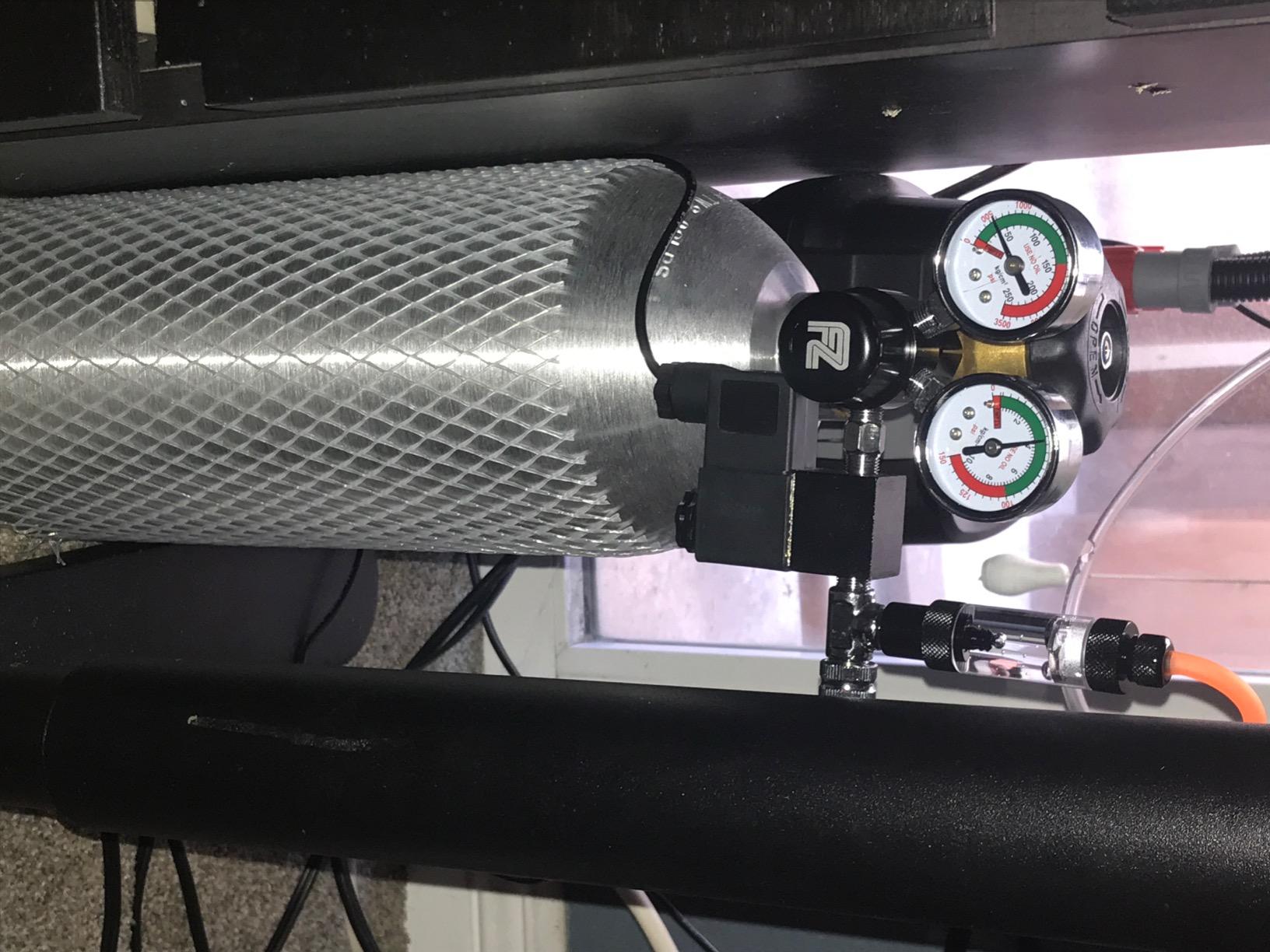
The split-type 12V DC solenoid is the detail to notice here. AC solenoids on cheap regulators buzz, warm up, and have a higher failure rate. A DC solenoid runs cool enough to touch, pairs directly with a timer or smart plug, and is the part that fails closed when power is cut.
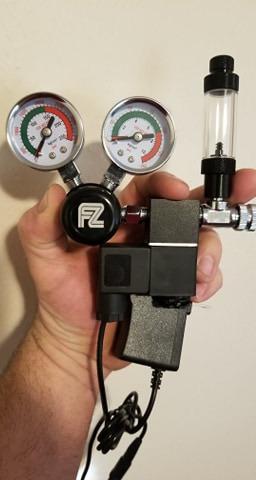
Flow control goes down to one bubble every three seconds, which is slow enough to hold a stable rate in small tanks where larger increments swing the dissolved CO2 hard. The bubble counter ships with an integrated check valve, so a power failure or an unattended weekend cannot pull tank water back into the regulator.
What is not in the box matters as much as what is. You still need a CGA320 cylinder, a diffuser, CO2-resistant tubing, a timer, and a drop checker. None of those are included, and the only tool supplied is for the fitting itself.
What to check before you buy a single-tank regulator
Check that it fits CGA320, the thread used on North American fire extinguishers. Paintball cylinders and European Type 30 fittings will not thread on, and a paintball tank needs its own high pressure stage and adapter rather than a standard aquarium regulator.
Check that a needle valve and bubble counter are included, because those two parts are where budget listings quietly cut corners. And check the solenoid type, because a DC model is the difference between a setup you can put on a timer and one you cannot.
Where it falls short
The fine tuning knob is touchy. Owners report that the bubble rate shifts with very small movements, so expect to fine tune again every time you top up a cylinder or move the diffuser.
The bubble counter water evaporates over a couple of weeks, and a drop in that column is a common reason people think their CO2 has failed. A small bottle of dechlorinated water fixes it in a few seconds.
2. FZONE Pro Series Dual Stage Regulator – Premium Pick for Serious Setups
FZONE Pro Dual Stage Aquarium CO2 Regulator CGA320 for Aquarium Plant Tanks
Dual stage
0-65 PSI adjustable output
Two manifold blocks
Safety valve above 100 PSI
Pros
- Dual stage keeps output stable as the cylinder drains
- Two independent manifold blocks can serve two aquariums
- Output adjustable across 0-65 PSI
- Built-in safety valve adds protection
- Quiet 12V DC solenoid
Cons
- Integrated needle valve is sensitive to small turns
- Bubble counter water needs regular topping up
- Higher cost than entry regulators
Forum discussion in the hobby is near-unanimous on one point: go dual stage. The logic is that a single stage regulator lets output pressure drift as the cylinder depletes, so the same setting delivers less gas next week than it did last week, and an end-of-tank dump can push a large slug of CO2 into the water in seconds. A dual stage regulator isolates the working pressure from the falling tank pressure.
This model is the version with that design, and it is rated at 4.3 stars from 662 reviews. Output pressure is adjustable from 0 to 65 PSI, so you can set a working pressure near 30 to 40 PSI and it will stay there as the cylinder drops below full.
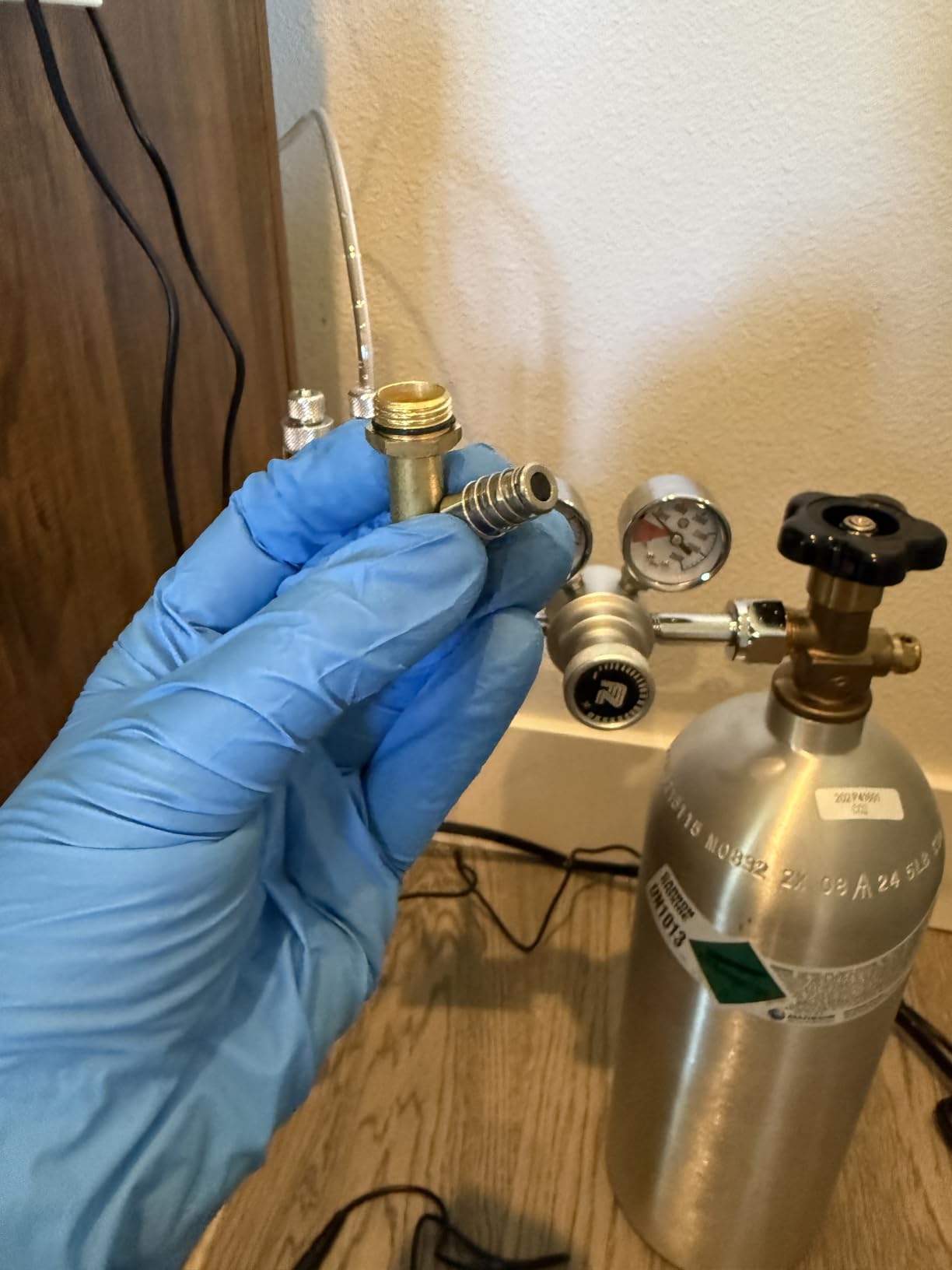
The two independent manifold blocks are the feature that separates it from a standard dual stage unit. Each block has its own high precision needle valve, so one regulator can feed a display tank and a quarantine or fry tank on separate schedules, or run two aquariums on one cylinder.
A built-in safety valve releases pressure above 100 PSI. That is a backup rather than a control, but it is one more reason this regulator holds its rating in long-term setups where hobbyists report three years of continuous daily use.
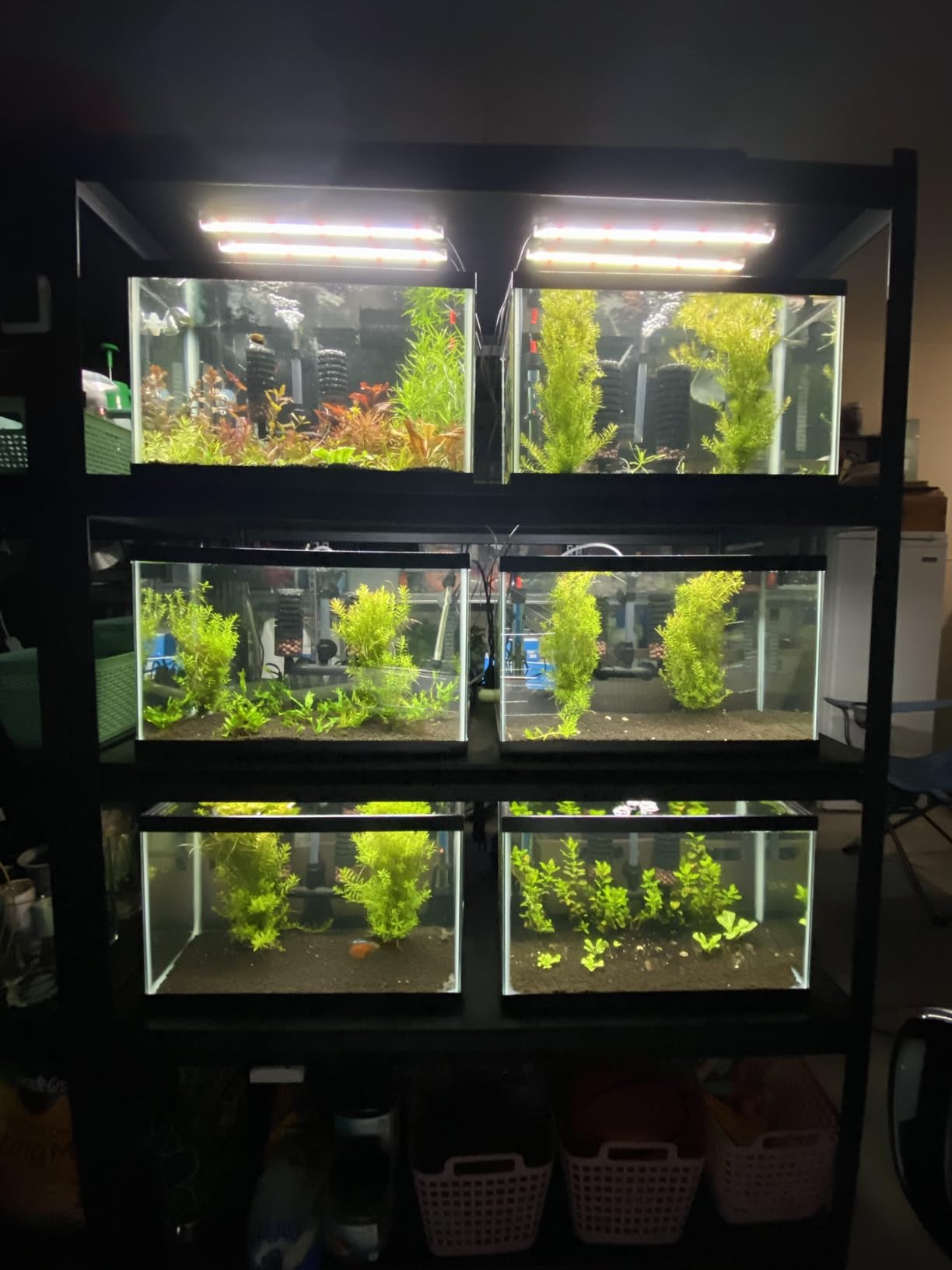
Why the second stage matters for tanks above 20 gallons
Drift is the quiet problem. If your bubble rate was tuned to 2 bubbles per second at a full cylinder and the pressure falls, the same setting produces less CO2 and your plants slow down without any obvious fault. A second stage decouples those two things.
The failure case is the loud one. If the needle valve or a fitting fails open with the solenoid closed, gas continues into the tank. A dual stage unit limits how much pressure that leak can push through, which is why the community treats it as a safety requirement rather than a feature upgrade.
Where it falls short
The integrated needle valve is still sensitive, and the bubble counter still needs water. Neither is a dealbreaker, but both mean you will re-tune after cylinder swaps.
It costs more than an entry regulator, and for a single small nano tank that cost is not justified. This one earns its price when you are running a larger tank, a sump, or a second aquarium off the same cylinder.
3. Hygger Dual Gauge CO2 Regulator – Best Value on Gauges and Warranty
Hygger CO2 Aquarium Regulator with Dual Pressure Gauges, 12V DC Solenoid Valve, Bubble Counter & Check Valve – Precise Display for Aquatic Plant CO2 System
Dual gauges
12V DC solenoid
Acrylic bubble counter with check valve
Two-year warranty
Pros
- Dual gauges with clear scales and a green-marked safe range
- Hard aluminum alloy body resists rust
- Thickened acrylic bubble counter with integrated check valve
- Works with a timed socket
- Two-year warranty with quick replacement service
Cons
- No low-pressure side adjustment despite the dual gauge display
- Needle adjustment is very sensitive at first
- Bubble counter can need repeated disassembly
This is the highest rated regulator in the group at 4.5 stars, and the review base is smaller at 69. That combination is worth understanding: the rating says owners are happy, the count says the sample is thin, so treat it as a well-liked recent release rather than a proven long-term workhorse.
What earns the rating is legibility. The dual dials have clear scales and a green-marked safe range, so you can read cylinder pressure and output pressure at a glance and confirm at a glance that the output side is holding where you set it.
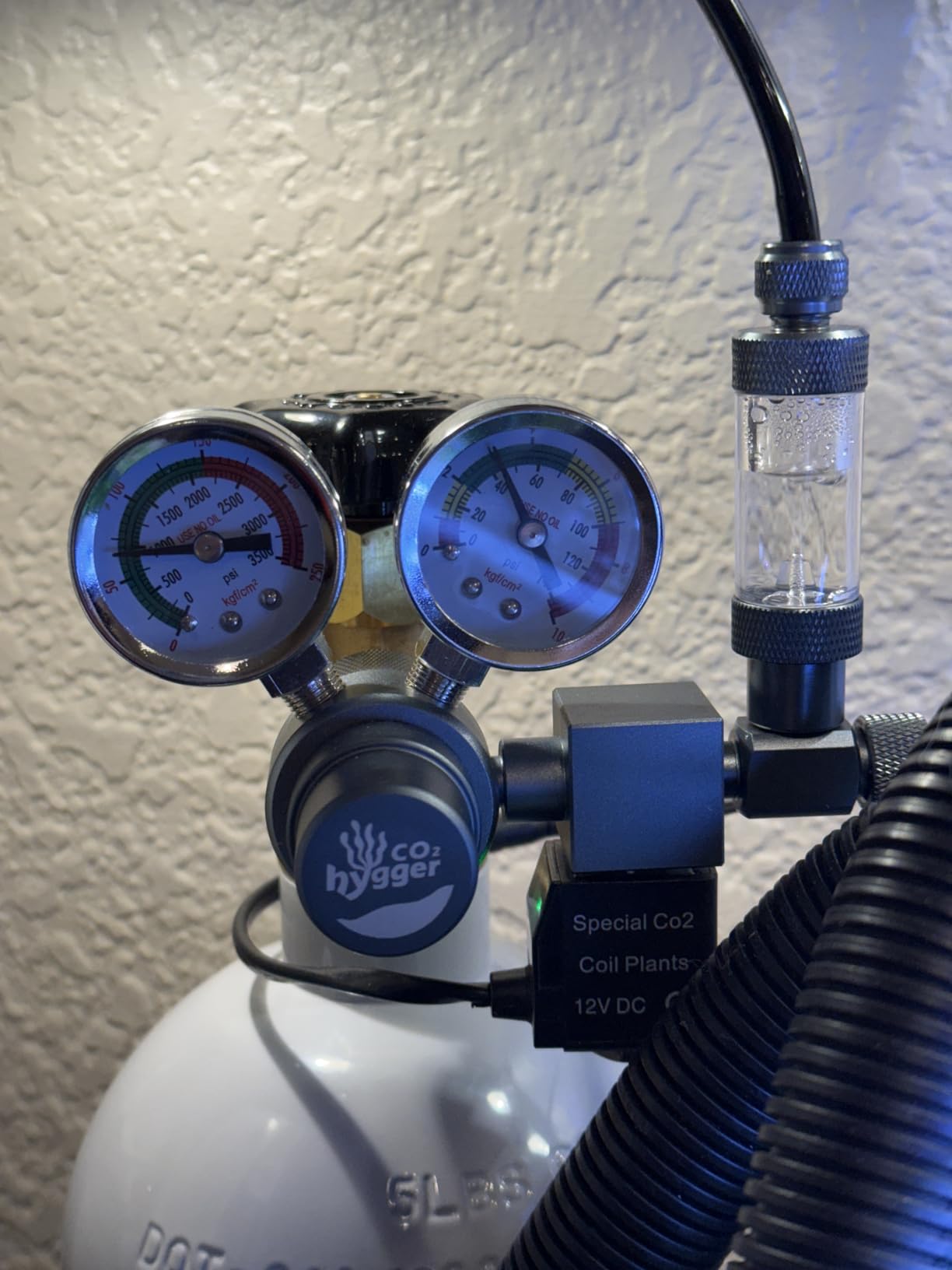
The 12V DC solenoid pairs with a timed socket for automatic switching, and the thickened acrylic bubble counter has an integrated check valve that keeps water out of the instrument. The body is a hard aluminum alloy that resists rust, which matters in a humid cabinet.
Warranty length is a reasonable proxy for build quality in this category, and this one carries two years with a two-year period that is longer than most of the regulators here. Support is reported as quick to send replacements when a unit arrives faulty.
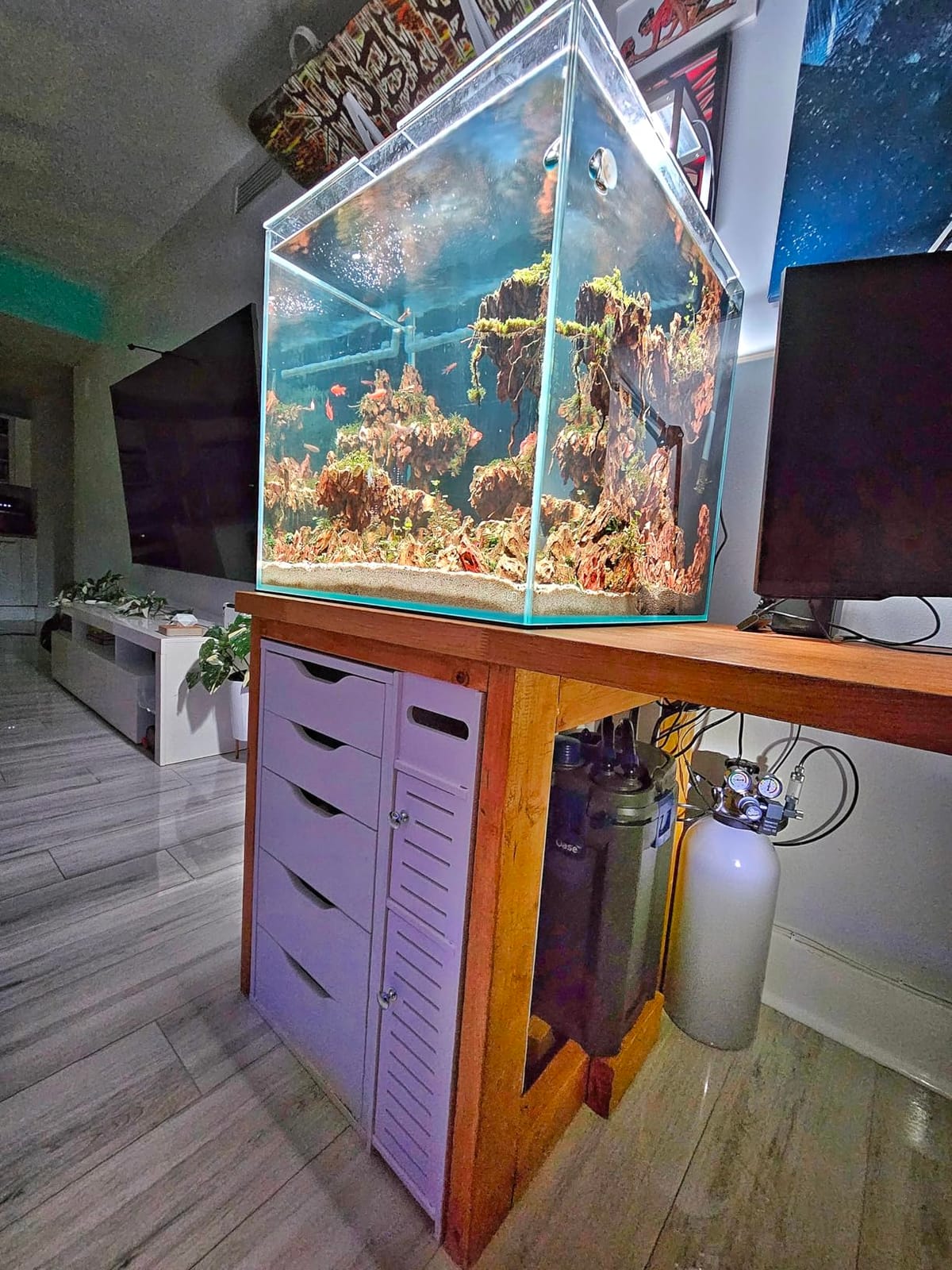
What the dual gauges are actually for
Two dials only help if you understand what each one measures. The high side shows what is left in the cylinder. The low side shows the working pressure your diffuser and tubing see, and that is the number that should not move when the cylinder depletes.
Watch the low side for an hour after you set it. If it climbs while the needle is closed, something downstream is blocked, usually a gunked ceramic diffuser or a kinked line.
Where it falls short
The low-pressure side has no dedicated adjustment, so you set output with the needle valve rather than by turning a second regulator dial. Some buyers expect a true two-stage feel and are disappointed by that.
It is a CGA320 fitting only and will not mate with Australian Type 30 cylinders, and the solenoid needs periodic cleaning to keep sealing reliably. Owners also report the bubble counter can need repeated disassembly before it seats correctly.
4. FZONE 2.5 L CO2 Generator System – Best Complete DIY Kit
Fzone 2.5 L Aquarium CO2 System Generator Kit for Aquarium Plants Tanks
1.5mm SUS304 bottle
Rated to 80kg/cm2
About one month per charge
Automatic safety valve
Pros
- Thick SUS304 stainless bottle builds high pressure and holds for weeks
- Kit includes bottle regulator needle valve bubble counter and safety valve
- No leaks at the fittings and the solenoid runs cool
- 12V DC solenoid pairs with a timer
- Refilling is quick compared with cylinder swaps
Cons
- Needle valve is sensitive and flow jumps when adjusted
- Included diffuser is weak and can leak gas at the edge
- 2.5L runs down quickly on tanks above roughly 30 gallons
This kit trades the cylinder for chemistry. A 1.5mm SUS304 stainless bottle reacts citric acid powder with baking soda to produce CO2, and the 12V DC solenoid still runs from a timer, so the safety story is the same as a pressurized system.
At 4.2 stars across 1001 reviews, it is the most reviewed generator kit in this roundup. The bottle is roughly 25 percent thicker than competing designs and rated to 80kg/cm2 internal pressure, and owners report steady pressure for weeks between fills.

Running cost is the real argument here. A charge of 300 to 400g of raw material produces about a month of gas at one bubble per second running eight hours a day, and the powders are cheap to buy in bulk. No cylinder swaps, no refills at a welding shop, no carrying a steel bottle down the stairs.
The kit is genuinely complete. You get the bottle, regulator, precision needle valve, bubble counter with a built-in check valve, automatic safety valve, and a 12V DC solenoid. The powders and a decent funnel are the only things you buy separately.
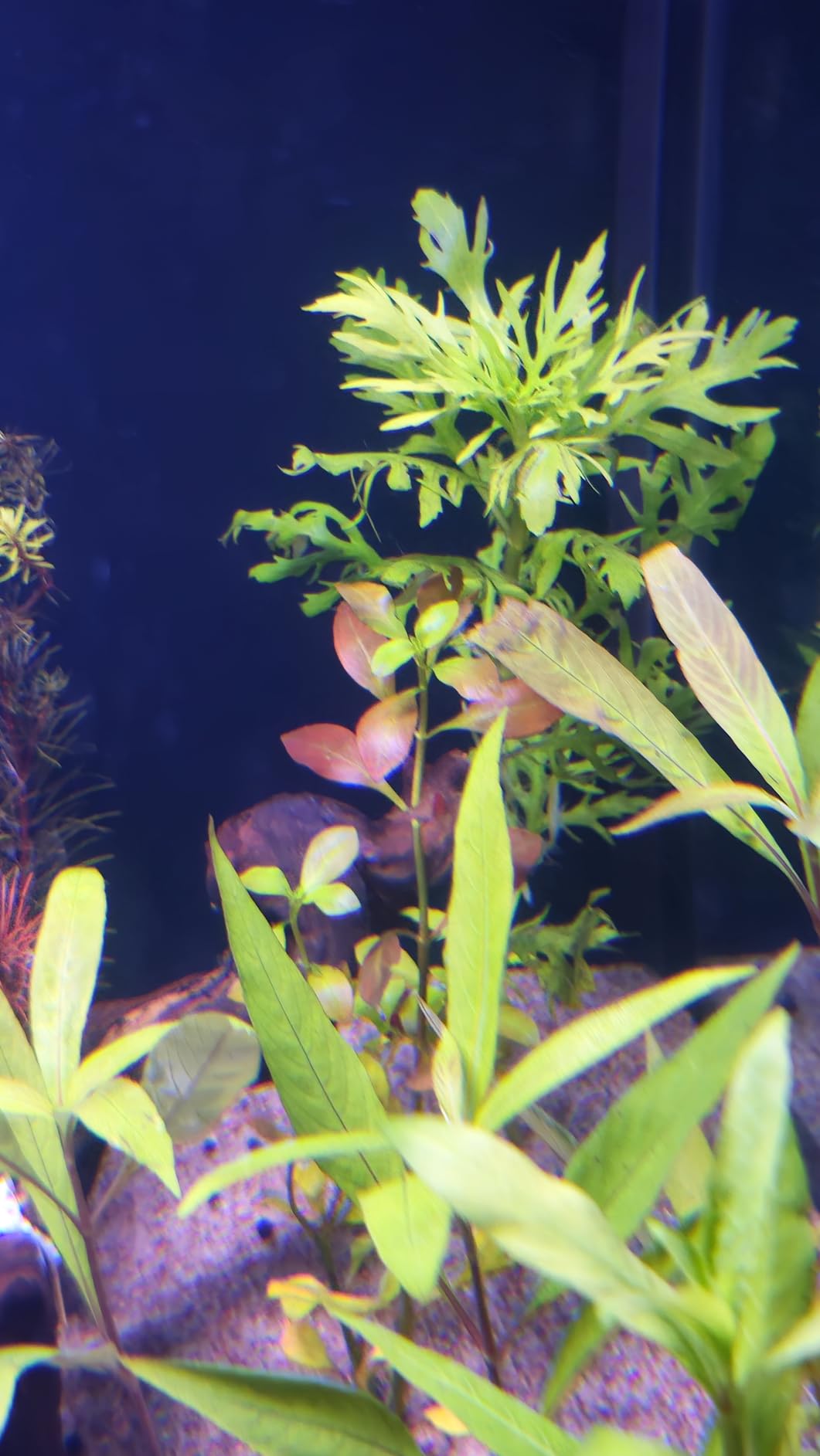
Which tank size this kit actually suits
Size by reaction time, not tank volume alone. A 2.5L bottle at one bubble per second for eight hours daily produces roughly a month of CO2, so anything up to about 30 gallons works comfortably on a single charge.
Above roughly 30 gallons, or if you want more than one bubble per second, you refill far more often and the convenience argument disappears. Move up to a 4L or 5L bottle at that point rather than running this one hard.
Where it falls short
The included diffuser is the weak link. Owners report gas escaping from the edge of the plate, so most owners replace it early with a ceramic or glass diffuser sized to their tank.
The needle valve is sensitive and the flow jumps when adjusted, and filling requires tilting the bottle to 45 degrees while fitting the lid. The supplied funnel base is also too narrow to be useful for dry powder, so bring your own wide funnel.
5. MagTool 2.5-5 L CO2 Generator Kit – Best Accessory Bundle
MagTool Upgraded 5L DIY Aquarium CO2 Generator Kit, Stainless Steel Bottle
Food-grade 304 stainless bottle
Integrated solenoid and bubble counter
Refillable injection port
Pros
- Heavily built 304 stainless bottle with a polished finish
- Integrated solenoid and bubble counter cuts the number of leak points
- Dual safety system with manual shut-off and automatic relief
- Everything needed in one box
- Responsive support that sends replacements quickly
Cons
- Unit is physically large and tight under some tank cabinets
- Filling requires tilting the bottle at 45 degrees
- Condensation forms outside and needs a tray underneath
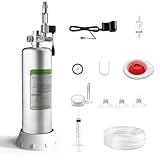
Where the previous kit cuts corners on the diffuser, this one includes everything. The box holds the SUS304 stainless bottle, DC mini solenoid, regulator, precision needle valve, bubble counter, diffuser, CO2-graded tubing, funnel, measuring cup, check valve, U-connector, suction cups, syringe, ceramic disc, sealing rings and a power adapter.
It sits at 4.2 stars from 307 reviews, and the standout feature is the integrated solenoid and bubble counter. Combining those two removes several threaded connections, and fewer joints mean fewer leak points over a long ownership period.
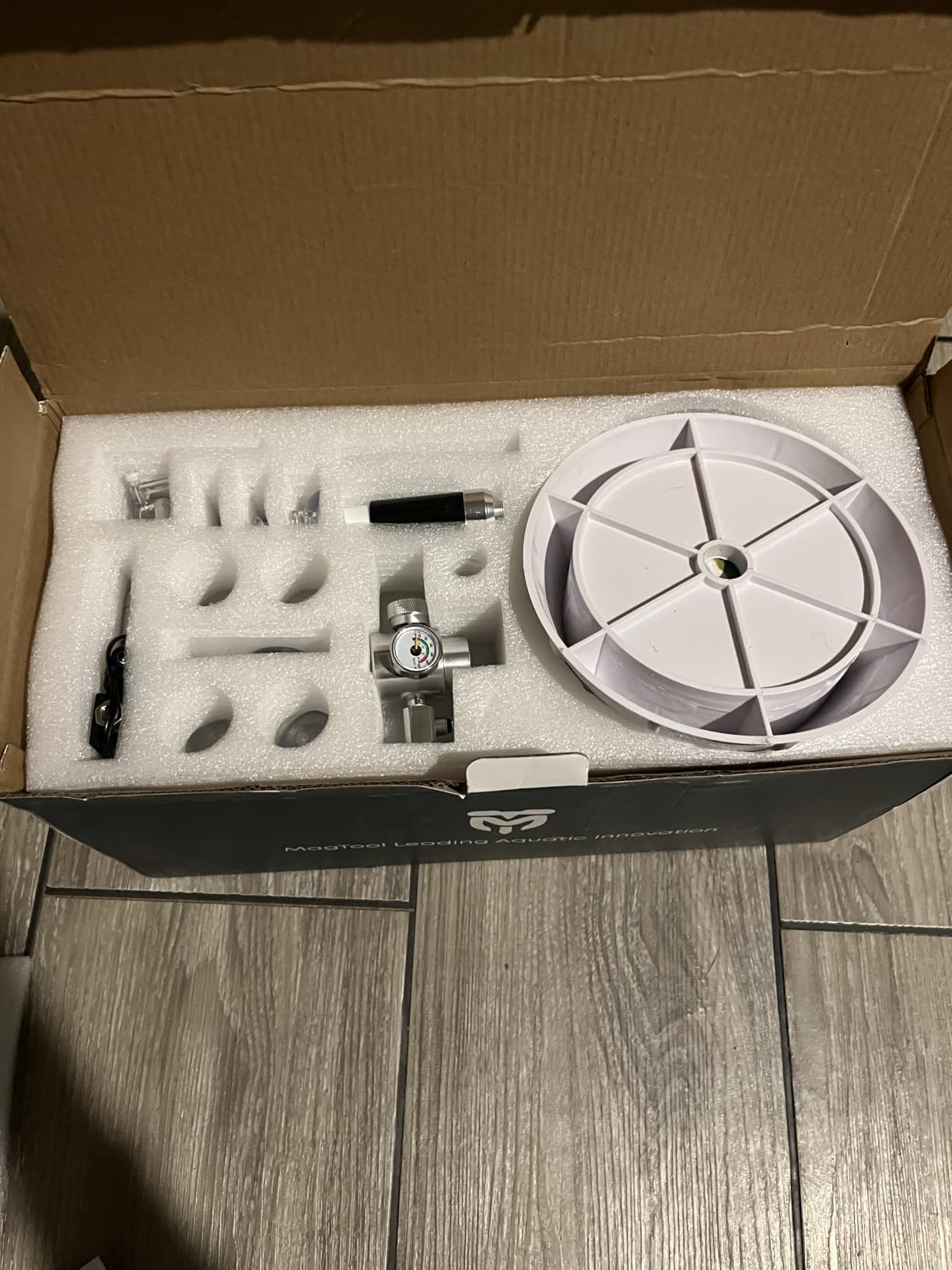
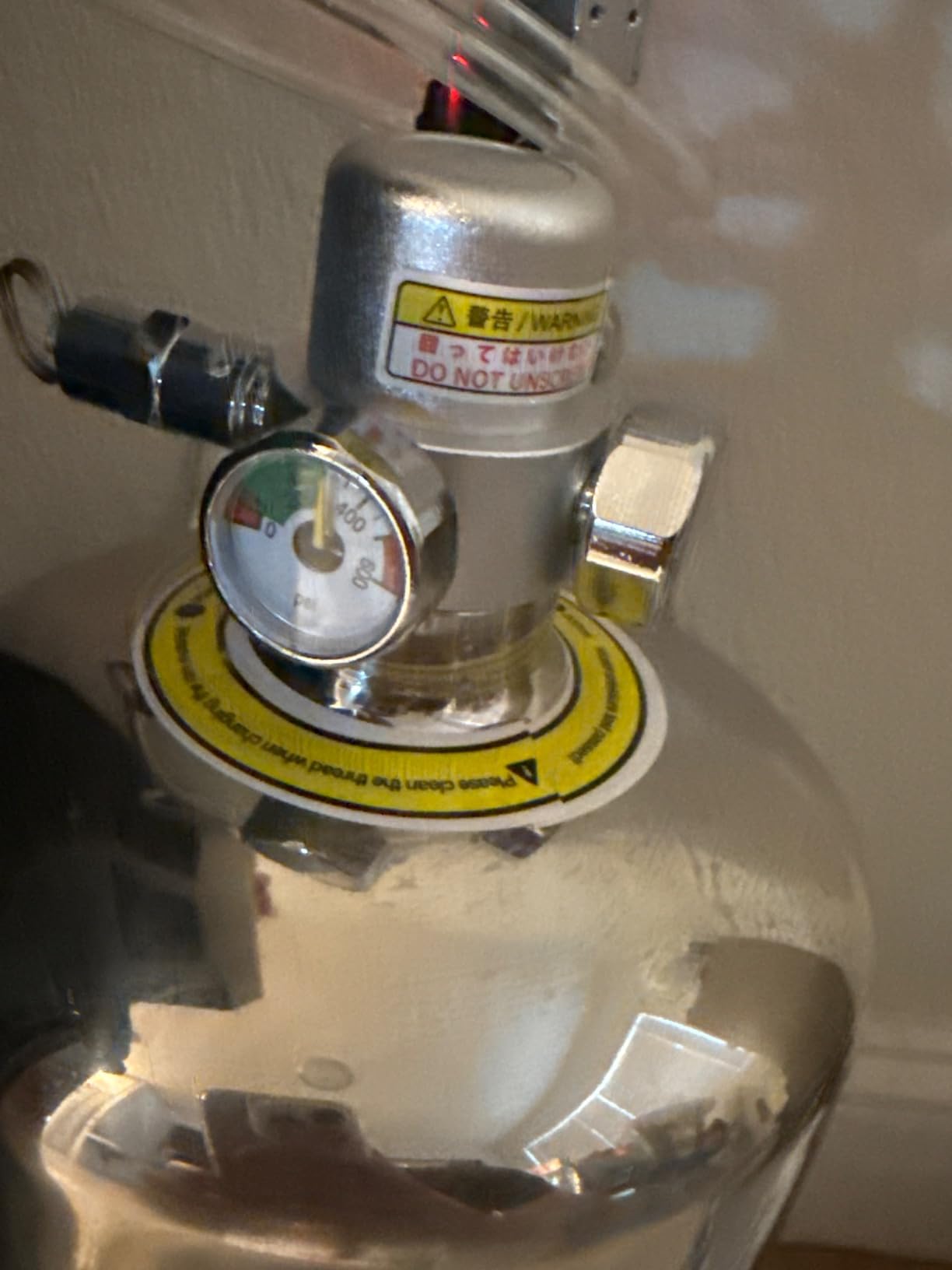
The bottle is food-grade 304 stainless steel described as roughly 50 percent thicker than the previous version, with external threading that keeps residue from seizing the cap. A 2.5L bottle holds 200 to 300g of material and a 5L holds 600 to 800g.
Two safety devices work together. A manual shut-off valve lets you stop gas instantly by hand, and an automatic pressure relief valve vents if internal pressure climbs too far. The refill port also allows topping fluid up without disassembling the unit.
Why fewer connections matter over time
Leaks in a DIY generator almost always start at a threaded joint that was slightly loose during assembly and then vibrated loose. Each threaded path is a potential leak point, and owners of simpler kits report that replacing a leaking solenoid is the most common repair.
Consolidating the solenoid and bubble counter into one block means the parts that usually fail as a pair get replaced as a unit. The accessory program also sells those parts individually with a one-year warranty on key components.
Where it falls short
Size is the first thing to check. The 4L version weighs 3.26 kg and owners report it barely fits under some tank cabinets, so measure the height of your stand before ordering.
Condensation forms on the outside during a reaction and needs a tray or towel underneath, and the included funnel is a poor fit for dry powders. Some owners also report solenoids that need servicing and regulators that stop producing after a short period.
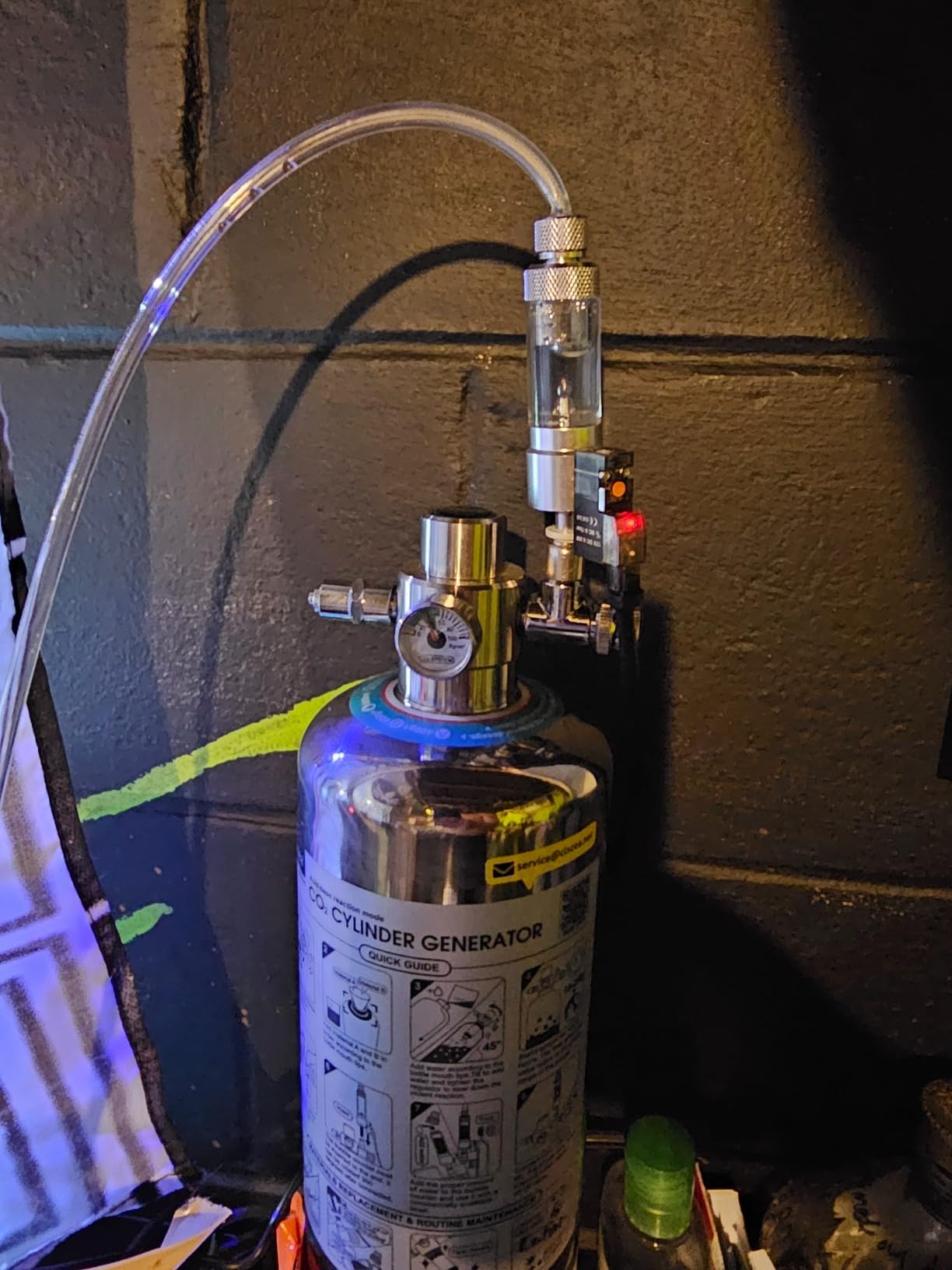
6. Clscea G700S 4 L CO2 Generator – Best Runtime Between Refills
Clscea Aquarium CO2 Generator Double Runtime with Solenoid Valve 4L, G700S
4L equivalent gas capacity
Triple stainless filter
Self-cleaning bubble counter
John Guest fittings
Pros
- About two months of runtime per fill at moderate bubble rates
- Triple stainless filter and self-cleaning bubble counter reduce clogging
- Built parts that survived a three-foot drop onto concrete
- Quick-connect fittings make tubing changes tool-free
- Individual parts sold for repair
Cons
- Needle valve is sensitive and drifts when touched
- Solenoid can clog after a refill and may need replacement
- Instructions have poor grammar and are hard to follow
This one exists to solve the single complaint every DIY kit generates, which is how often you refill. A 2.4L volume gives roughly 4L equivalent gas capacity, and owners commonly report two months or more per charge at moderate bubble rates. It carries 4.2 stars from 270 reviews.
The clogging story is handled unusually well for this category. A triple-layer stainless steel filter element traps debris before it reaches the solenoid, and the bubble counter flushes its own valve pathways when you top up the water.
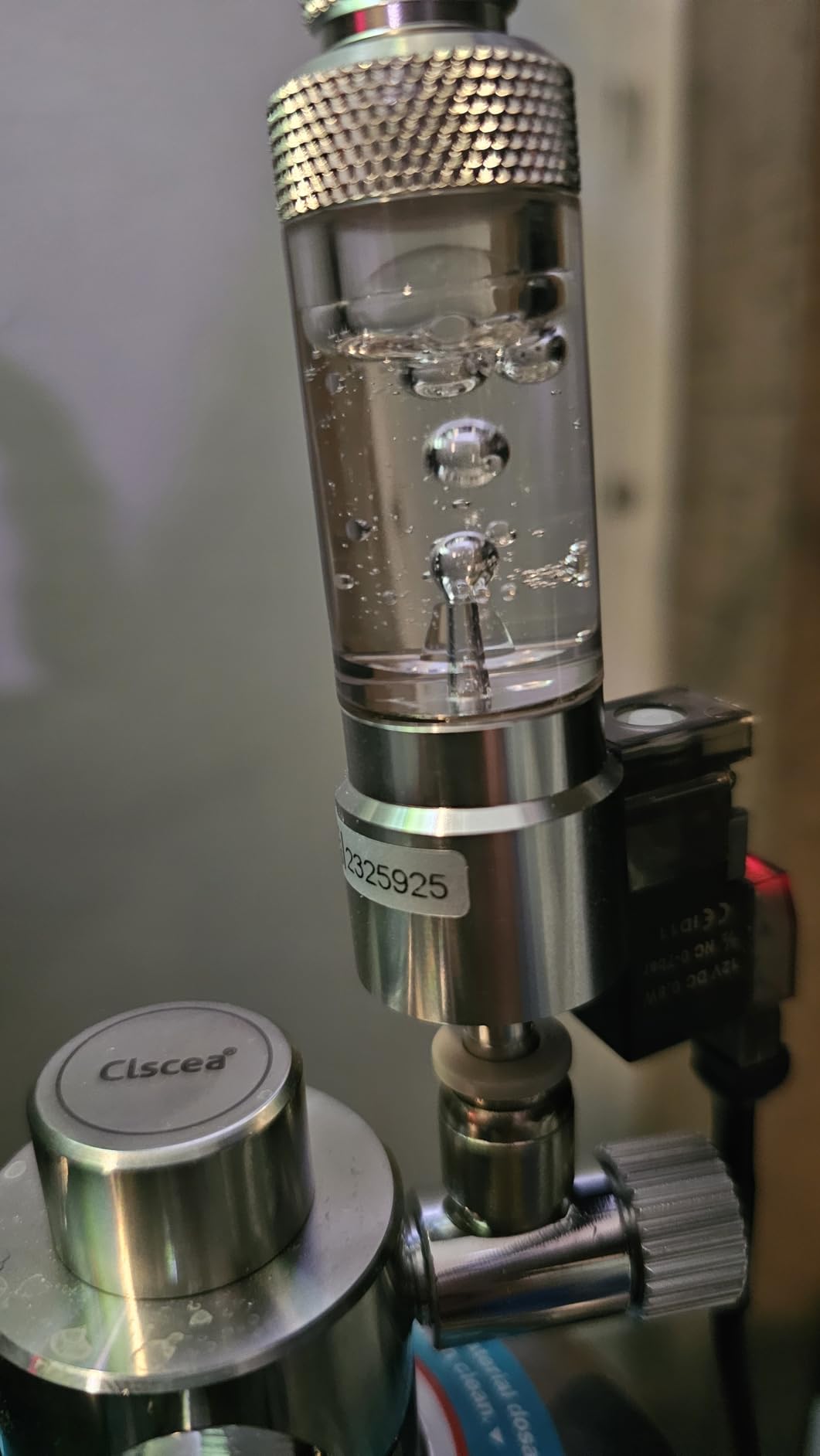
Fittings are John Guest quick-connect, so tubing changes need no tools at all. That matters more than it sounds, because a standard DIY rig is rebuilt every few weeks as you wash tubing and swap a kinked line.
There is also a dedicated ice tray for the fill process, which chills the solution before it goes in. Lower starting temperature means less violent gas evolution and fewer shocks to the solenoid during the first minutes of a reaction.
When longest runtime changes the maths
Runtime is really a maintenance-frequency decision. If your tank runs at one bubble per second for eight hours, a 4L equivalent charge means you are checking and topping up roughly six times a year instead of twelve, and each of those sessions takes about ten minutes.
Over a year that is the difference between an afternoon of tinkering and an evening. For anyone who has abandoned a DIY kit because refilling became a chore, that is the deciding factor.
Where it falls short
The needle valve is very sensitive and drifts when touched, so expect to re-tune after every refill. The solenoid can clog after a refill and may need replacing, and some parts feel fragile, particularly the glass bubble counter.
Baking soda crystallizes at the end of a charge and needs hot water to clear, and the instructions have poor grammar and are hard to follow. The glass bubble counter is a fragile part on a system that takes a lot of handling.
7. ZRDR 2 L CO2 System – Best Fit for Small Tanks
ZRDR 2L Aquarium Co2 System with Pressure Gauge for Aquarium Plants
304 stainless steel bottle
Relief valve above 30kg
12V waterproof solenoid
Fine bubble atomizer
Pros
- Stainless steel bottle feels sturdier than plastic bottle setups
- All accessories included so nothing extra needs buying
- Fine bubble output from the included atomizer
- Knob allows easy tuning from high to low rates
- Good value next to prefilled systems
Cons
- Instruction sheet print is very small and hard to read
- Some units arrive with missing parts or mismatched threads
- Solenoid runs warm to the touch during operation
The ZRDR 2L is the most compact complete stainless system here, and at 4.0 stars from 487 reviews it carries the lowest average rating in this group. That is a fair trade, because you get a metal bottle, a solenoid, and a fine atomizer in one small package for tanks that are too small to justify a cylinder.
The bottle is 304 stainless steel rather than a plastic bottle generator, and it has an automatic pressure relief valve that vents above 30kg alongside a 12V waterproof solenoid. That pairing is what allows it to run on a timer like a pressurized system.
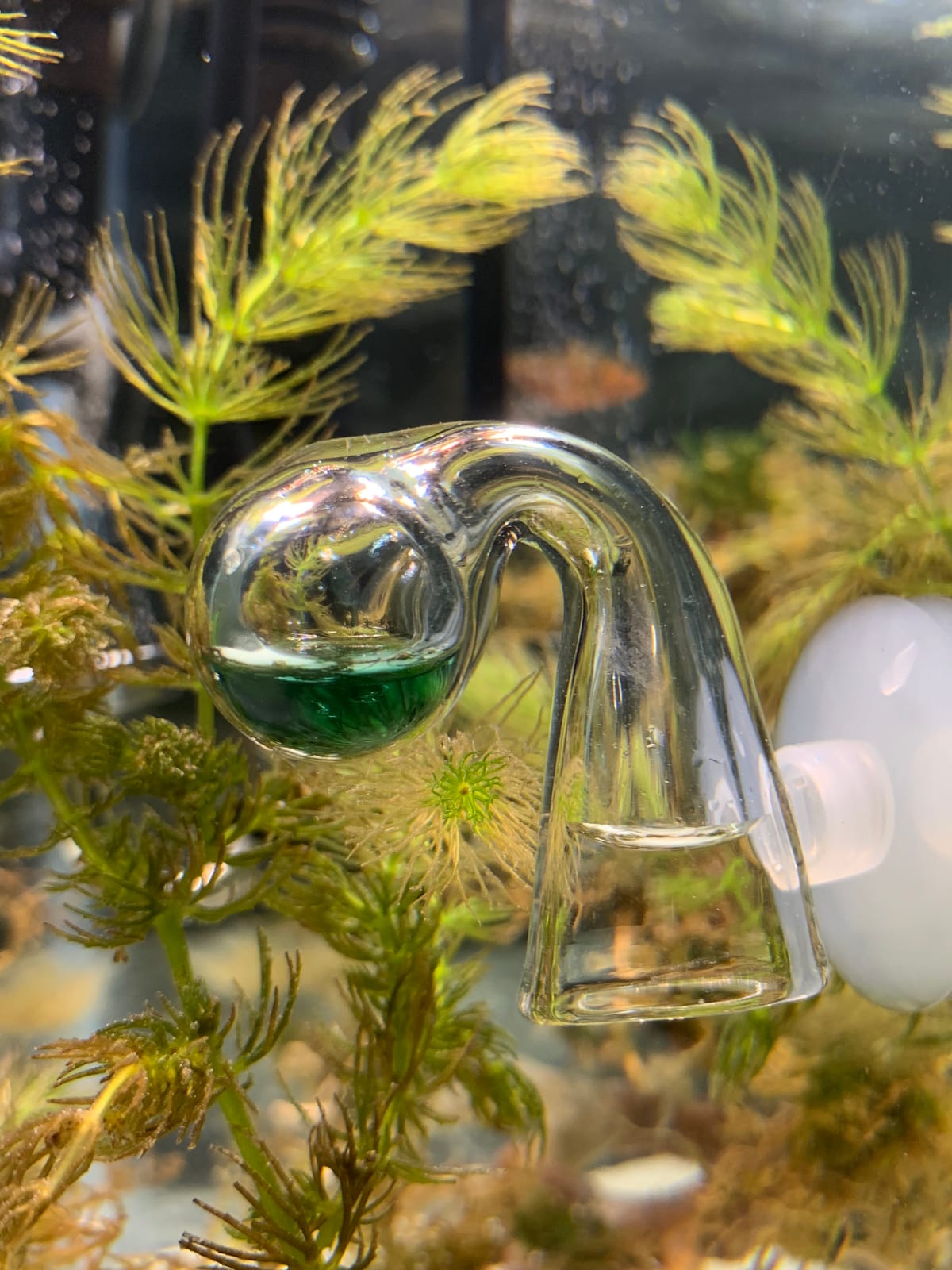
The accessory list is long for the size: pressure reducing valve, filter, bubble counter, check valve, atomizer, U-shaped tube, base, 1.5m of air tube, funnel, wrench, spare seals and a spare atomizer piece. There is very little left to buy beyond the citric acid and baking soda.
Owners like the fine bubble output from the included atomizer. The spec notes that larger bubbles in the first days usually clear within about three days as the solution settles, so give it a week before judging it.
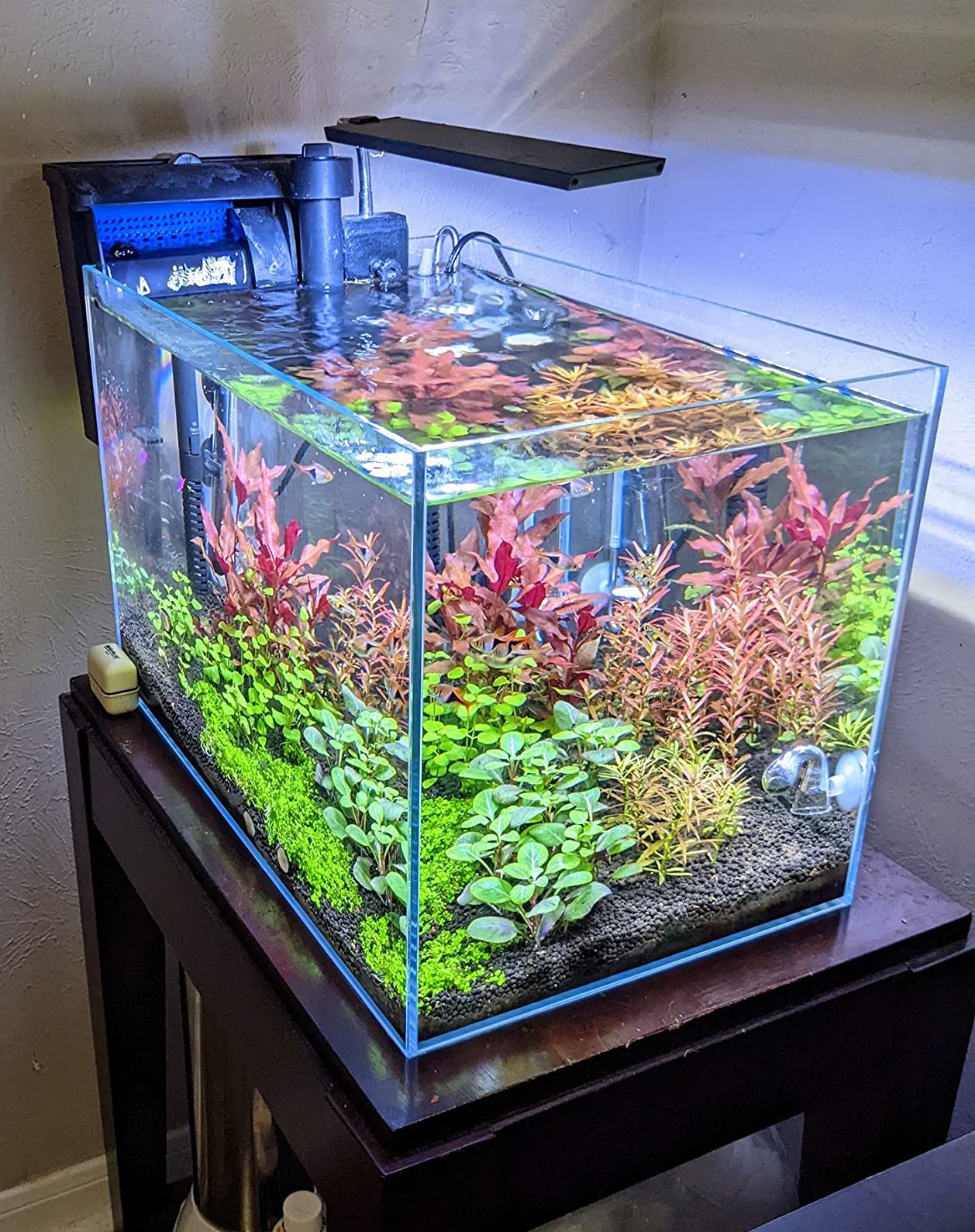
Whether 2L is enough for a small tank
For a 10 to 20 gallon tank running at one bubble per second, a 2L bottle needs refilling roughly every two weeks. That is the honest number, and it is fine for nano and small display tanks where you are already doing weekly maintenance.
Below about 10 gallons, the small footprint and quiet solenoid make it a strong fit, and the included atomizer removes the need to source a separate diffuser. Above 20 gallons, the refill cadence is what will push you toward a larger bottle or a cylinder.
Where it falls short
Build consistency is the weak point. Some units arrive with missing parts or threads that do not mate, and the pressure gauge can read inaccurately or show nothing at first before it settles.
The printed instruction sheet is very small and hard to read, the bubble counter and check valve can leak at the threaded base, and the solenoid runs warm to the touch during operation. Warm solenoids are the leading cause of eventual seal failure in this category.
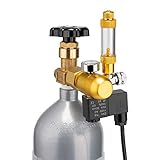
8. DaToo CO2 Regulator with Cold-Touch Solenoid – Best for Warm Cupboards
DaToo Aquarium CO2 Regulator with Bubble Counter Solenoid Check Valve Adjustable for Standard US Planted Tank CO2
CGA320 fit
Aluminum body with stainless diaphragm
Pressure-reducing valve
Cold-touch solenoid
Pros
- Accurate and stable output across cylinder pressure ranges
- Pressure-reducing valve makes flow adjustment straightforward
- Aluminum body and stainless steel diaphragm built for longevity
- Cold-touch solenoid runs cooler and extends service life
- Works with common high-density tubing
Cons
- Lowest average rating in the group at 4.0 stars
- Small review base next to the larger regulator brands
- Some buyers report the needle adjustment is touchy
Heat is what kills aquarium solenoids. A cabinet in a warm room, next to a heater, holding a compressor and lighting drivers, is a hostile environment, and this regulator is built around staying cool. It uses a cold-touch professional grade solenoid designed to extend service life in exactly those conditions.
It comes in dual gauge and single gauge variants, rated at LP 150 PSI and HP 2000 PSI, with a pressure-reducing valve for continuous stable output. The body is high purity aluminum with a stainless steel diaphragm, and it carries a one-year warranty.
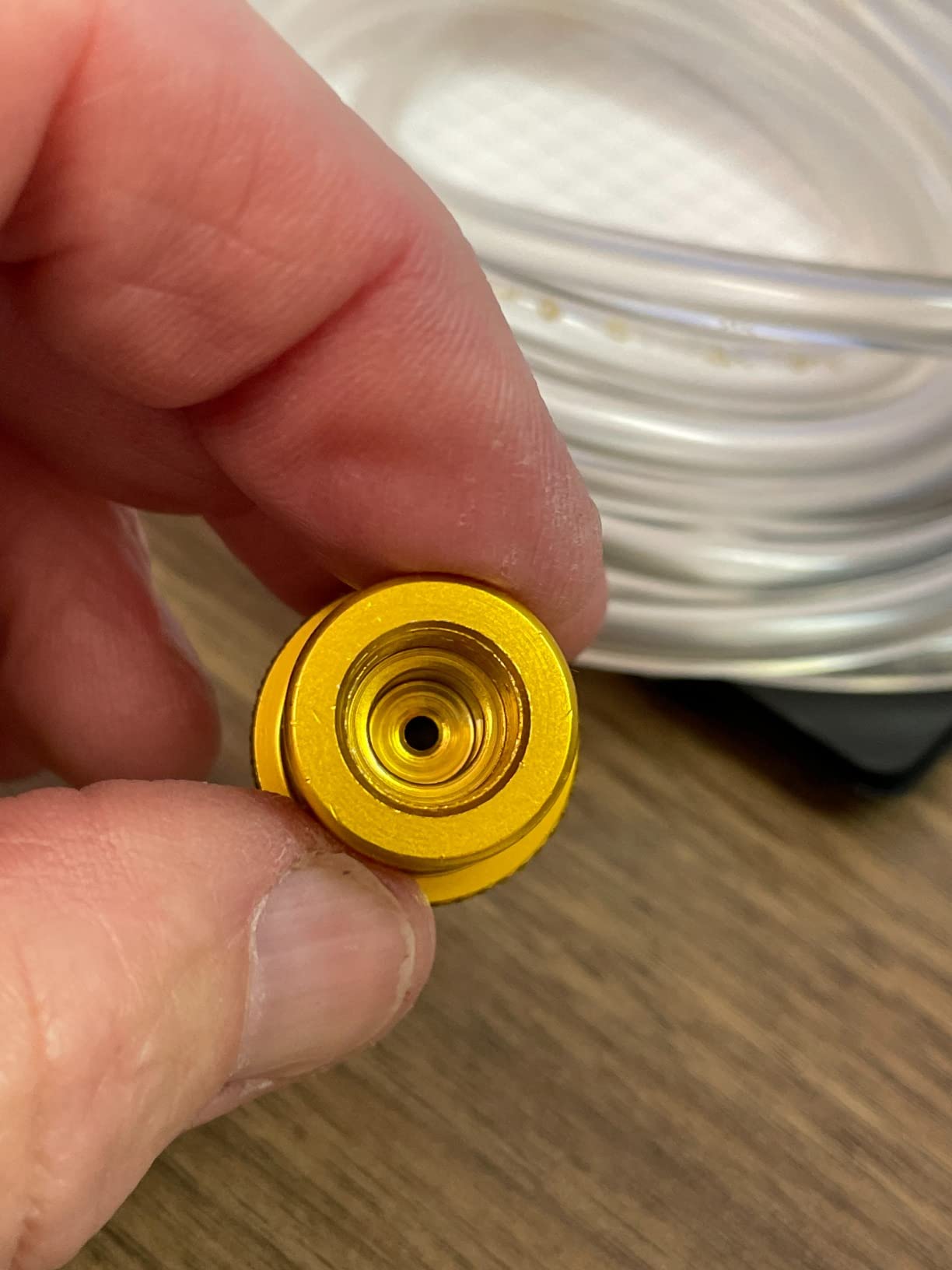
For a standard CGA320 cylinder this is a straightforward single-tank regulator that works with most high-density tubing brands, so it will pair with the ceramic or glass diffuser you already own without adapters.
At 4.0 stars from 71 reviews, the rating is the lowest average here and the review base is one of the smallest, so the honest read is that it performs adequately rather than impressively.
When a cold-touch solenoid is the deciding spec
If your tank cabinet sits in a room that stays warm, or you run a heater that pushes heat into the stand, solenoid temperature is a real failure risk. A solenoid that stays cool to the touch under load keeps its seal and keeps drawing current predictably.
The stainless steel diaphragm adds to that, because diaphragms take the cycling stress rather than the body. It is a sensible upgrade over a plastic-bodied regulator if your setup runs warm year-round.
Where it falls short
The 4.0 average is the lowest in this roundup and the 71-review base is thin, so there is less long-term data behind it than the FZONE models. Some buyers also report the needle adjustment is touchy.
There is no documented second manifold, so this is a one-tank regulator. If you plan to grow into a second aquarium, the FZONE Pro Series is the better long-term buy.
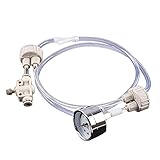
9. HYQO DIY CO2 Generator Kit – Most Versatile for First-Time Builders
DIY CO2 Generator System Kit with Pressure Gauge Air Flow Adjustment Valve – Pressurized CO2 Kit for Aquarium Plants Tube Valve for Bottle – CO2 Regulator Aquarium for CO2 Diffuser – Grow System
ABS housing with locking device
Metal adjustment valve
Built-in pressure gauge
Pros
- Low cost entry into DIY CO2 generation
- Pressure gauge makes internal pressure easy to read
- Metal gas adjustment valve gives usable flow control
- Locking pipe device helps keep fittings tight
Cons
- Limited pressure output compared with stainless systems
- Assembly instructions are terse and easy to misread
- Parts must be installed in the correct direction
This is one of the most approachable ways to find out whether you actually enjoy running CO2. At 4.2 stars across 1022 reviews it has the second-highest review count in this roundup, and the design has been on sale since 2012, which is why so many people have tried it.
The kit uses standard carbonated beverage bottles, and the caps carry an ABS engineering plastic housing with a locking pipe device intended to stop fittings loosening or deforming. A built-in pressure gauge and simple pressure relief sit in the same cap.
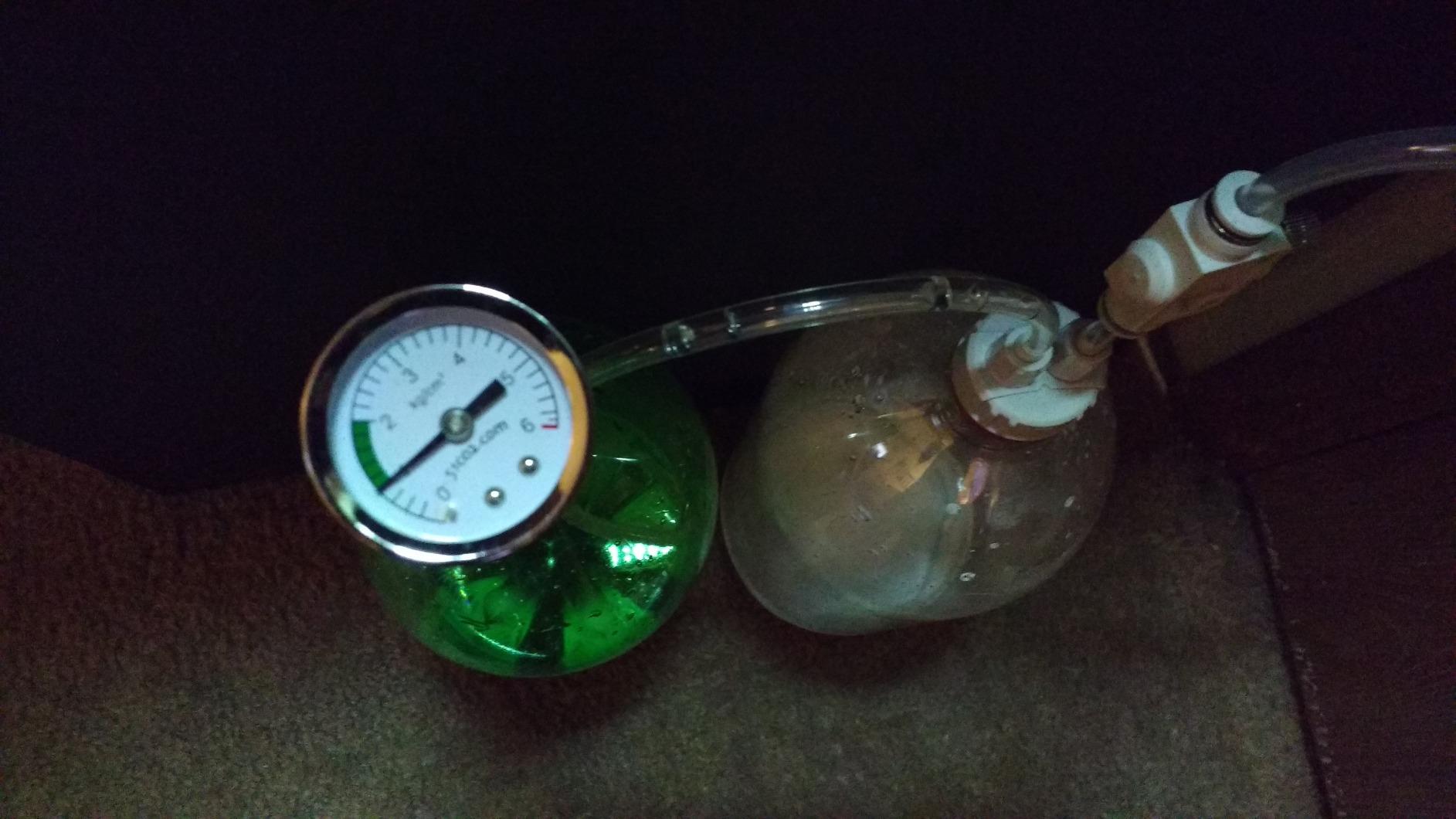
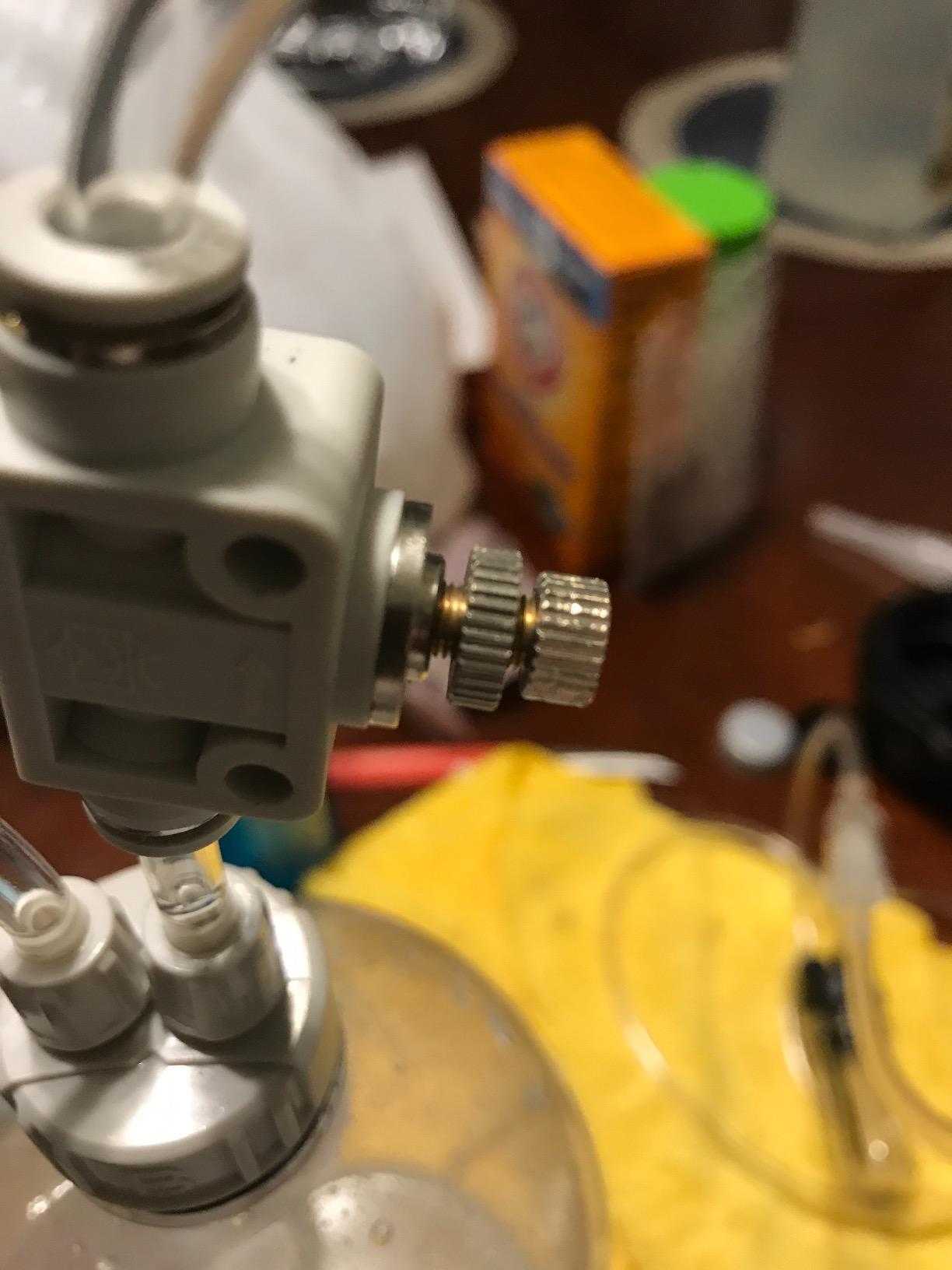
Flow control comes from a professional metal gas adjustment valve rather than a cheap plastic needle, and that is the reason it can drive a normal diffuser at all. The output is modest, but it is real gas at usable pressure.
Everything else you need is straightforward: citric acid, baking soda, water, two bottles and a diffuser. The bottles are the only unusual purchase, and any 2L soda bottle works.
What you give up compared with a stainless kit
Pressure is the trade. Plastic bottle-cap systems cannot build the same working pressure as a stainless bottle, so the bubble rate takes more adjusting as the reaction progresses and you will spend more time fine tuning than with the 2.5L or 4L kits.
That pressure ceiling also means it will not drive high-backpressure diffusers well. A simple ceramic puck or glass diffuser is the right pairing, and a reactor or atomizer is not.
Where it falls short
Assembly is the hardest part, and the fault is usually orientation rather than quality. The check valve and the fine-tuning valve must go in the correct direction, and a reversed part causes the reaction to behave abnormally rather than fail cleanly.
The instructions are terse and easy to misread, and the output is limited compared with stainless systems. Treat this as a 10 to 20 gallon solution or a learning project, not a long-term high-tech setup.
10. Clscea G200 Two-Bottle CO2 Kit – Best for Two-Bottle Builds
Clscea Aquarium DIY CO2 Generator System Kit, G200
Two-bottle citric acid system
Quick reaction test tube
Acid absorbing ball
Pressure relief valve
Pros
- Very low cost for a complete DIY CO2 kit
- Includes most accessories so only bottles and powders are extra
- Quick reaction test tube speeds up startup
- Pressure relief valve adds a safety margin
- ABS caps resist deformation and wear
Cons
- Requires two carbonated beverage bottles sourced separately
- Check valve and CO2 diffuser are not included
- Only usable with carbonated beverage bottles
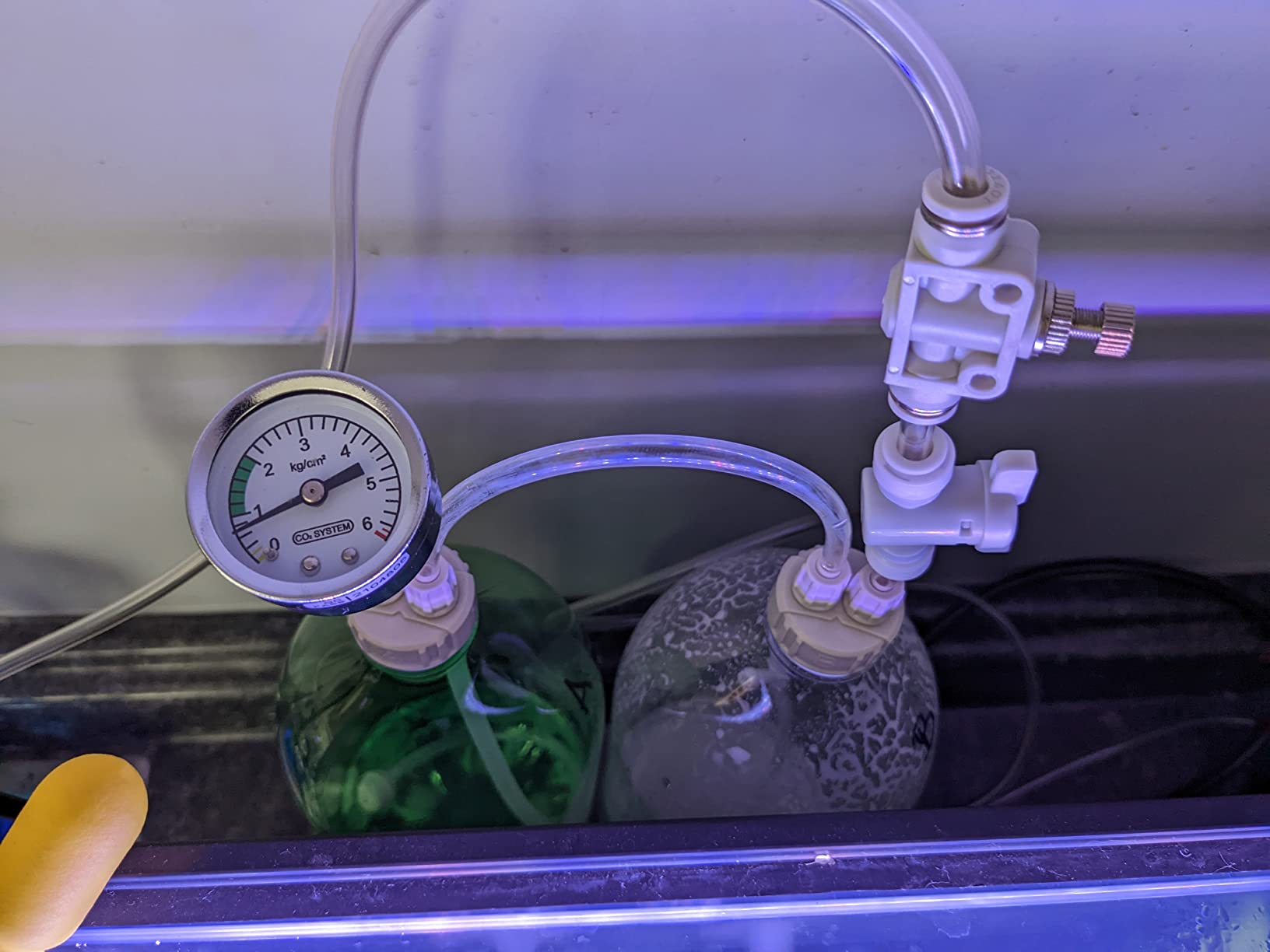
The G200 runs two carbonated beverage bottles through two caps and a connecting line, doubling the reaction capacity of a single-bottle kit at the lowest cost of anything here. It holds 4.2 stars from 171 reviews.
Two design choices make it easier to live with than its price suggests. The quick reaction test tube gives you a small burst of CO2 on day one instead of waiting for the bottles to spin up, and the acid absorbing ball controls how fast the citric acid is consumed, which is the difference between a steady output and one that dies early.
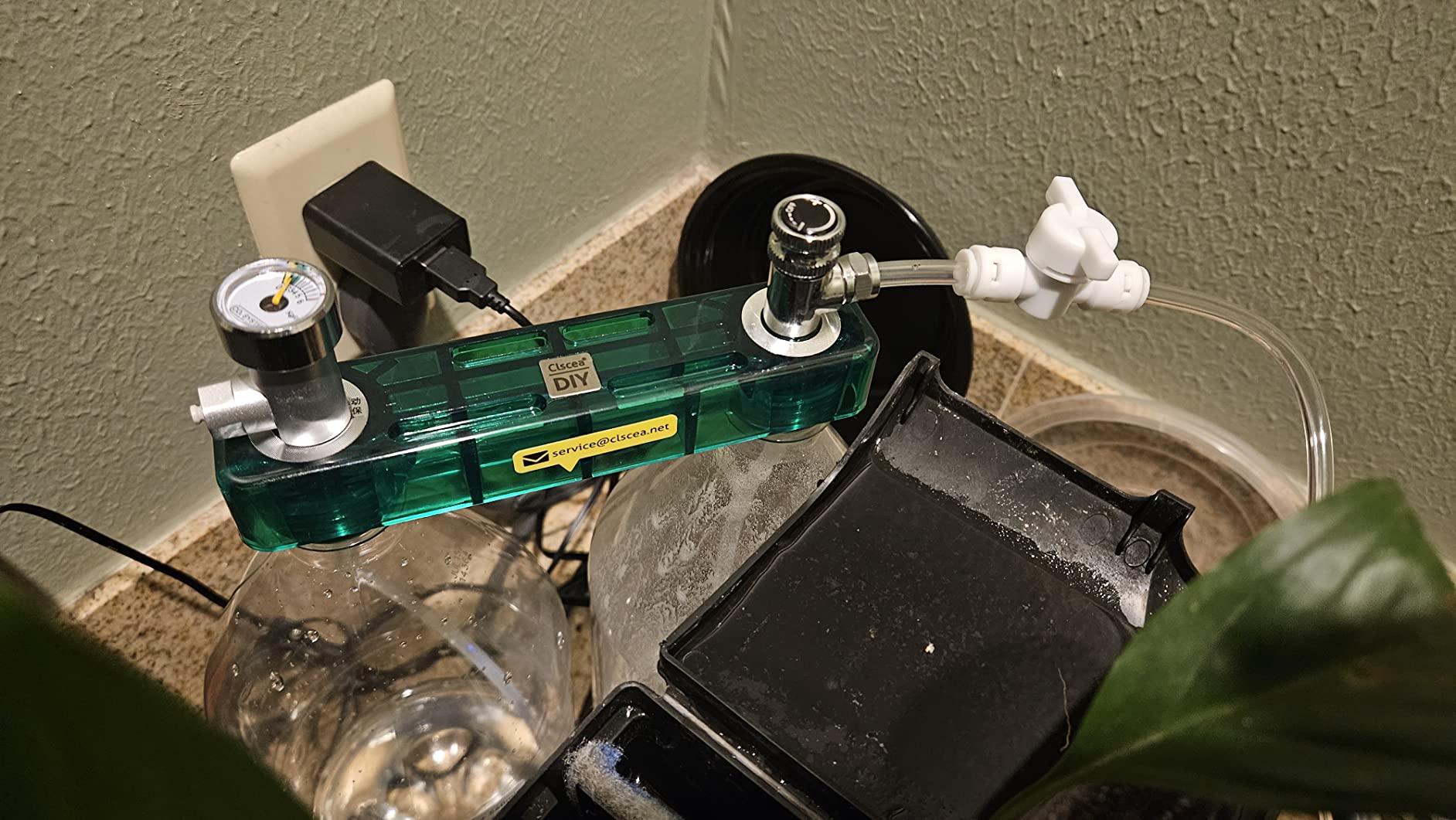
A simple pressure relief valve sits beneath the pressure gauge, and pressure- and hydrolysis-resistant tubing links the two caps. The caps themselves are ABS engineering plastic with a stable structural design.
Daily switching is handled by the on-off valve, and the needle valve only sets the output volume. That division is worth understanding before you wire it to a timer.
What you need to add before it will run
Two carbonated beverage bottles, baking soda, citric acid, a check valve and a CO2 diffuser are all required and none of the last three are included. The check valve is not optional, because without it water from the diffuser can travel back into the reaction.
A small ceramic diffuser suits this system better than an inline atomizer, since the operating pressure is modest. Budget for a separate check valve and diffuser when you compare the total cost against a single-bottle kit.
Where it falls short
Gas output is modest and refills are frequent, and the bottle-only format rules out any container other than a standard carbonated beverage bottle. The ABS caps are also the weakest structural link compared with a stainless bottle.
It makes sense as a nano tank solution or a first experiment with dosing. Beyond about 15 gallons you will be refilling often enough that a larger stainless kit is the better use of your time.
11. Yosoo Budget CO2 Generator Kit – Best Low-Cost Trial System
Aquarium CO2 Generator Kit with Gauge, Needle Valve DIY
Bottle cap design
Built-in pressure gauge
Needle valve
Manual operation
Pros
- Low cost way to try CO2 in a planted tank
- Pressure gauge shows internal pressure clearly
- Charges up quickly and the needle valve can be tuned
- Tubing can be replaced when it ages
- Cheap to run with bulk citric acid and baking soda
Cons
- Needle valve can stop opening after about a month
- Output valve may stop sealing and leak gas continuously
- Mixture separates and needs shaking several times a day
The Yosoo is the simplest kit in this roundup: bottle caps, a pressure gauge, a needle valve, and no electrical parts at all. It is manual operation only, so there is no solenoid and nothing to plug into a timer. That single fact changes how you must run it, and we cover it in the safety section below.
At 4.1 stars from 166 reviews, the cons are consistent across owners: valves that stop sealing, tubing that cracks, and a mixture that separates.
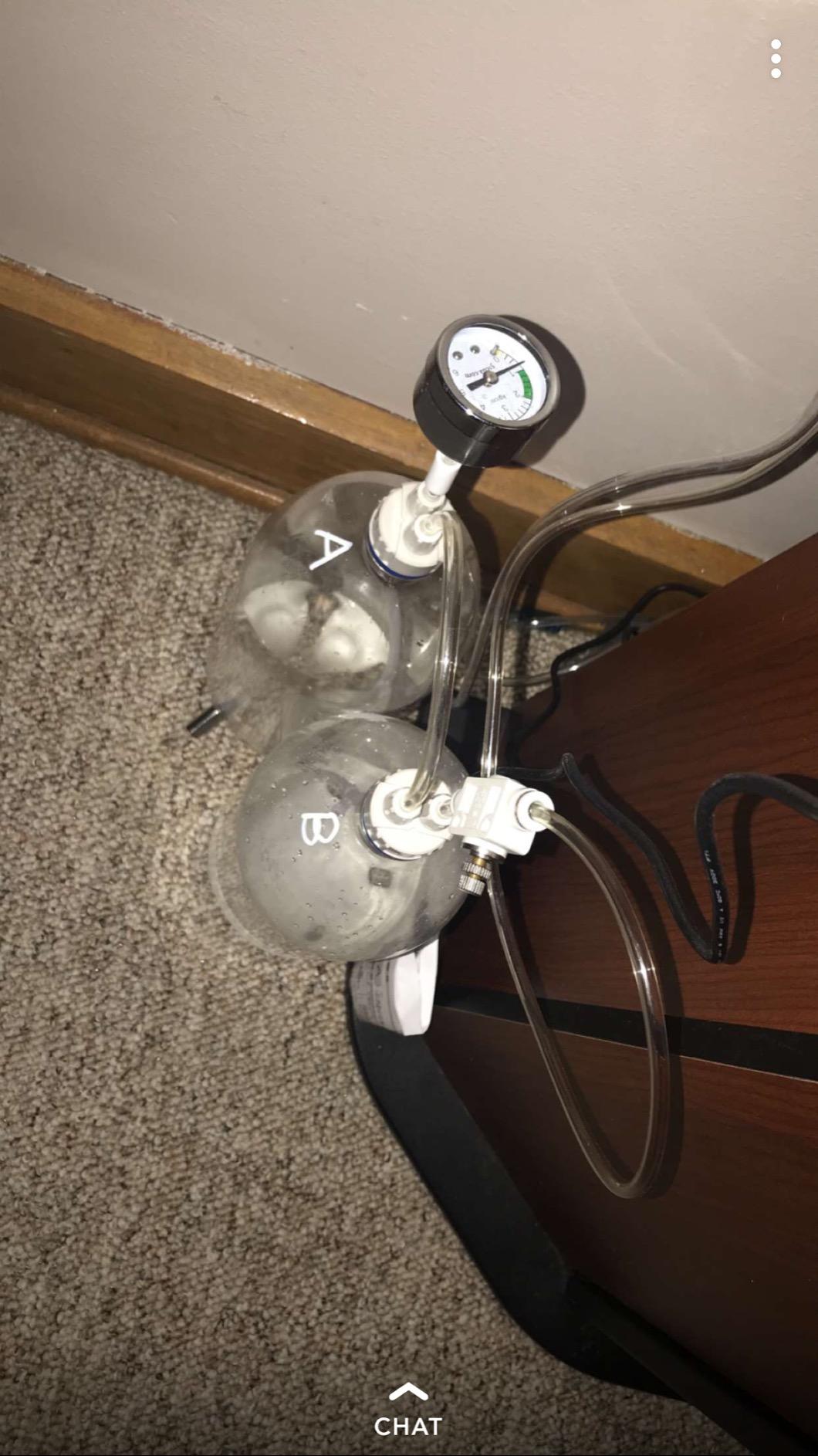
What it does well is start-up. The gauge reads internal pressure clearly, the charge builds quickly, and the needle valve can be tuned. Running cost is a few cents a month with bulk citric acid and baking soda.
It also ages gracefully in one respect, because the tubing between caps and gauge can be replaced when it hardens, which is the failure most owners report first.
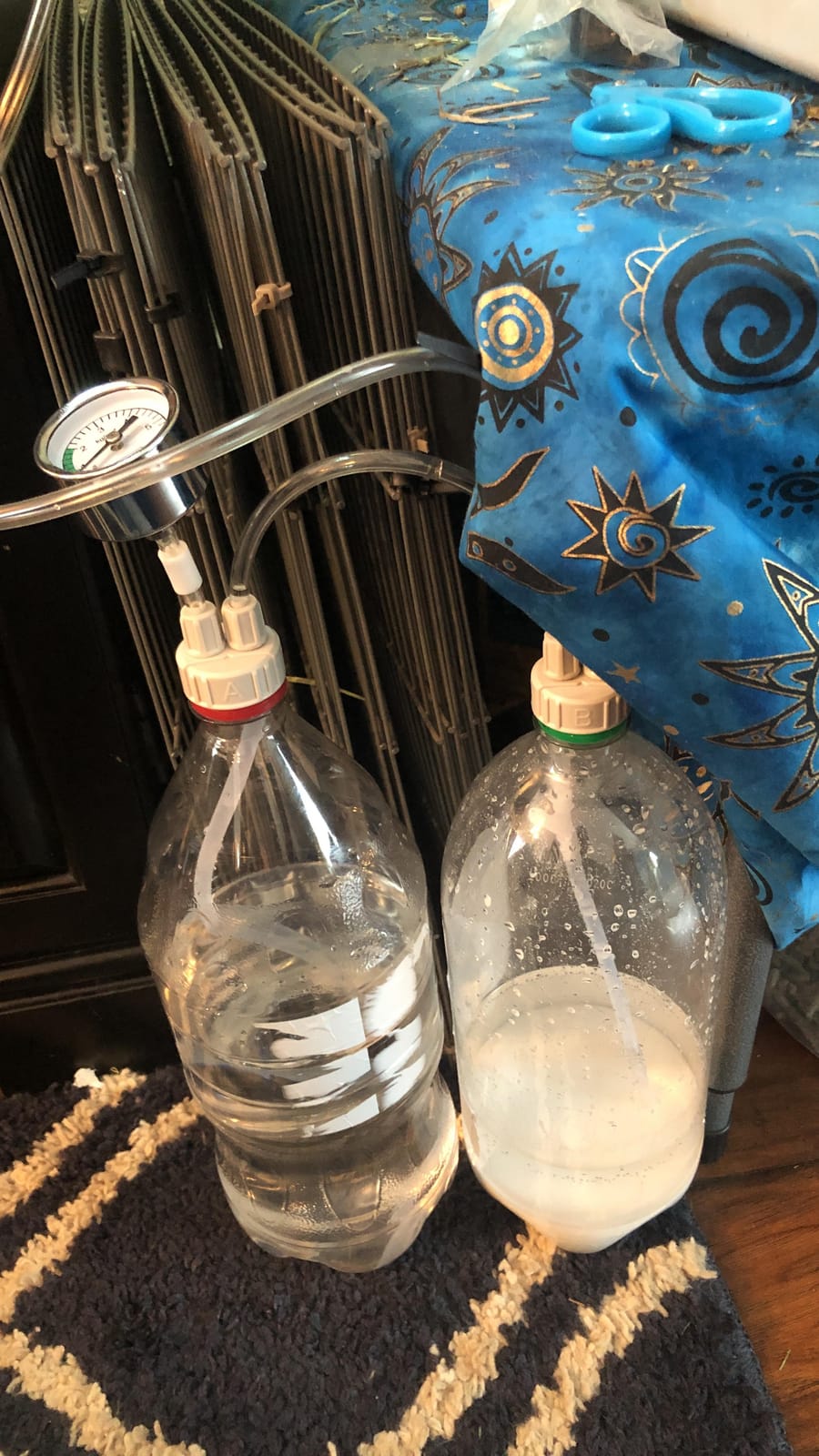
What a manual system means for your routine
Without a solenoid, gas flows whenever the valve is open. You turn it on when the lights go on and off when they go off, every day, without exception. Miss the evening switch-off and CO2 accumulates in a dark tank where plants are respiring and producing no oxygen.
That is exactly the failure the hobby treats as the primary fish-kill mechanism. This kit works, but it demands a habit, and the habit is the fragile part.
Where it falls short
Reliability is the issue. The needle valve can stop opening after about a month, the output valve can stop sealing and leak gas continuously, and the tubing near the gauge can crack.
The mixture separates and needs shaking several times a day to hold pressure, and the output is not strong enough to drive many standard diffusers. Pick a simple ceramic diffuser and plan on constant attention.
12. Aquario Neo Slow Release CO2 Kit – Best for Gas-Free Beginners
Aquario Neo CO2 – DIY CO2 Kit (Kit) for Freshwater Aquariums, Terrariums, Paludariums – Slow Release CO2 Kit for Aquatic Plants
Yeast and gel slow release
Includes diffuser and tubing
Compact footprint
24 hour set period
Pros
- Very easy to set up and maintain
- Small footprint suits nano and desktop tanks
- Visible pearling and better plant colour within a couple of weeks
- Safer alternative to a compressed gas setup
- Good first step for beginners intimidated by full systems
Cons
- Included diffuser can arrive faulty and leak from the sides
- Requires a full 24 hour set period before use
- Output tapers off after roughly two to three weeks
The Aquario Neo generates CO2 slowly from yeast and a gel, with no pressure, no cylinder, and no electricity. That makes it the least intimidating way to add CO2 to a tank, and at 4.2 stars from 138 reviews the owner feedback is consistently positive about results.
Owners report visible pearling and better plant colour and growth within a couple of weeks, and the 3.15 by 3.15 by 7.87 inch footprint fits a nano or desktop tank without rearranging the cabinet.
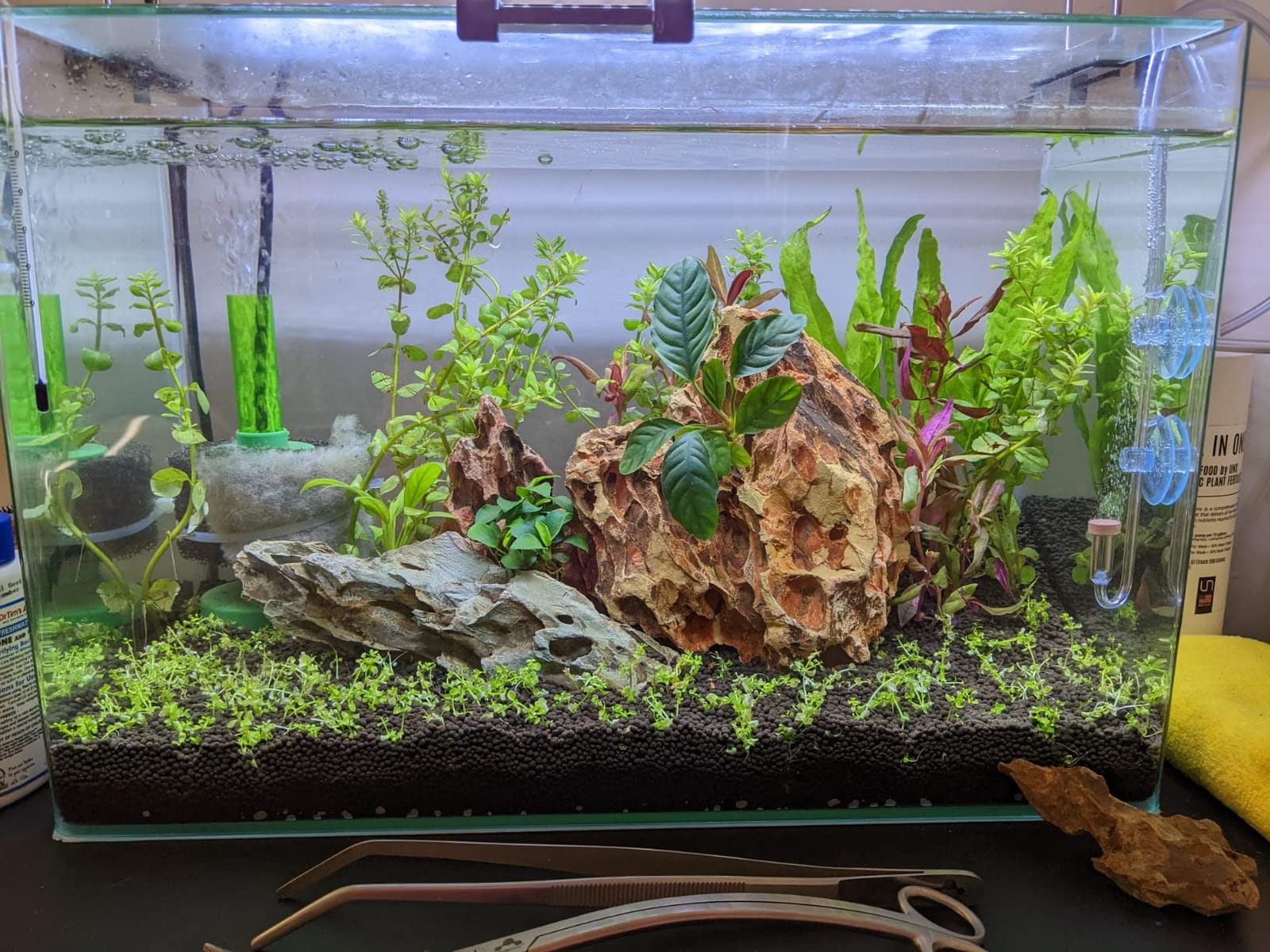
Diffuser, tubing and refill material are all included, which is unusual in this category and removes the most common buyer error. It also works for terrariums and paludariums if that is your setup.
One instruction is not optional: let it set for the full 24 hours before use. Skipping that period causes the gel to form badly and the output to underperform, and water temperature affects gel creation and mixing.
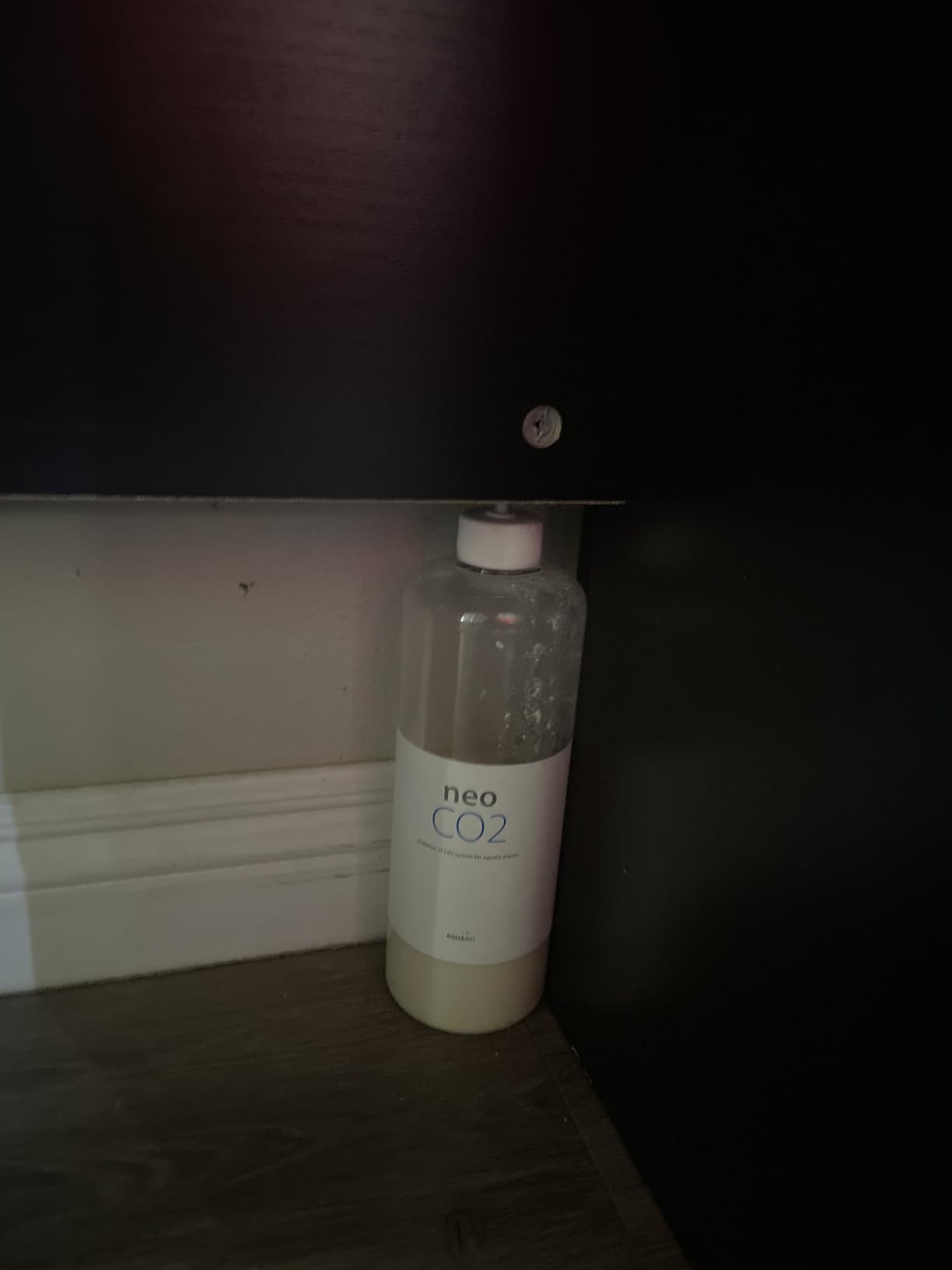
Where slow release fits in a real setup
This is a nano and small tank solution. Output tapers off after roughly two to three weeks, and a refill pack restores it. It suits a 5 to 15 gallon tank where diffusion rate matters less than having any CO2 at all.
There is a safety trade worth naming. Because it cannot be switched off, levels can keep rising in the dark when plants are respiring. Keep the tank well aerated and monitor it closely rather than treating it as set-and-forget.
Where it falls short
The included diffuser is the most common failure point, arriving faulty or blocked and leaking from the sides, and it needs soaking for 24 hours in dechlorinated water before first use. Some units also leak around the lid after tightening.
Refill packs add a recurring cost that over time exceeds cylinder CO2, and the 24 hour set period is easy to forget. If your tank is 20 gallons or larger, choose a kit with a solenoid and a timer.
How to Choose a CO2 System for Your Tank Size
Pick by tank volume first, then by how much attention you want the system to need. Everything else is detail. The three tiers in this roundup map cleanly onto those two variables, and no tier is better than another, they just suit different people.
Nano and small tanks under about 20 gallons are served by paintball cylinders, slow-release kits, or a 2L generator. A nano tank has very little water to buffer a mistake, so a system you can shut off precisely matters more than raw pressure. The Aquario Neo and the ZRDR 2L are the sensible picks here.
Between 20 and 40 gallons you are at the point where a dual stage regulator earns its cost. This is the range where an end-of-tank dump can push meaningful CO2 into the water quickly, and where cylinder pressure drift starts to matter. The FZONE CGA320 regulator handles the lower end of this range, and the FZONE Pro Series handles the upper end and anything with a second tank.
Anything from 40 to 125 gallons, or any tank with a sump and canister filter, wants a dual stage regulator plus an inline atomizer sized to your hose diameter. Above 40 gallons the diffusion rate becomes the limiting factor rather than gas supply, so the diffuser choice moves from nice-to-have to the single most important part of the system.
How a dual stage regulator differs from a single stage
A single stage regulator reduces cylinder pressure in one step. As the cylinder empties, input pressure falls and output pressure falls with it, so the same needle setting delivers less gas over time and the dissolved CO2 in the tank drops without any obvious fault.
A dual stage regulator reduces pressure twice, in two separate chambers, so the working pressure your diffuser sees stays steady from a full cylinder down to nearly empty. It also limits how much pressure a failed-open valve can push into the tank. That is why it is treated as a safety requirement above 20 gallons rather than an upgrade.
Diffuser, inline atomizer, or reactor
A ceramic or glass diffuser sits in the tank and produces visible bubbles. It is cheap, simple, and needs no plumbing, but bubbles are large and much of the gas is wasted rising to the surface. Cleaning is the recurring cost, and a clogged membrane also drops your working pressure.
An inline atomizer sits in the canister hose and turns gas into a fine mist, so dissolution is close to complete with no visible bubbles in the display tank. It must be matched to your hose diameter, and it needs a canister filter or a sump. Most aquascapers running a planted tank end up here within a year.
A reactor forces gas and water into a pressurized grid, dissolving the CO2 before either enters the tank. It is the most efficient option and the least visible, and it costs the most. The honest trade is efficiency against complexity, since a reactor is the harder of the two to plumb and to service.
For placement, an inline atomizer goes on the outflow side of the canister so CO2-rich water is pushed into the display tank rather than returned to the sump. If you use an in-tank diffuser, place it near the filter outlet on the opposite side of the tank so circulation carries the gas across the whole volume.
Sizing math, briefly
Set a working pressure of 30 to 40 PSI with a high-backpressure diffuser, or 10 to 20 PSI with an inline atomizer that does not need much backpressure. Higher pressure is not better; it just makes the needle valve harder to control.
One bubble per second is the usual starting point for a 20 to 30 gallon tank, two bubbles per second for 40 to 55 gallons, and three or more for 75 gallons and up. Use a drop checker to confirm rather than trusting bubble rate alone, and aim for 20 to 35 ppm.
What is not included, in every tier
A complete CO2 setup needs a timer, a drop checker with solution, CO2-resistant tubing, a check valve, and a way to secure the cylinder or generator upright. Kits that list a diffuser usually do not include the check valve, and pressure gauges are often the only monitoring you get.
Also budget for replacement consumables. Drop checker solution, tubing, bubble counter water, membranes and seals all need replacing, and a system whose parts are hard to source becomes an expensive problem later.
CO2 Safety: Timers, Overnight Dosing and Shrimp
Never run CO2 overnight. A plant tank at night has no photosynthesis, so plants respire and consume oxygen while the injected CO2 keeps dissolving. pH drops, dissolved oxygen falls, and the combination is the mechanism behind most CO2-related livestock deaths. Every system in this roundup with a solenoid should run on a timer set to open one to two hours before lights on and close one hour before lights off.
A solenoid must fail closed, meaning it stops gas flow when power is cut. A DC solenoid on a quality timer is the cheapest insurance in this category, and it is why the manual systems in this list rank where they do.
Shrimp and sensitive fish are the first to suffer. Cherry shrimp and other dwarf species show distress at dissolved CO2 levels well below what a drop checker shows as a safe reading, and bettas in shallow tanks are vulnerable too. If invert livestock is your main inhabitants, skip pressurized CO2 and use liquid carbon or nothing at all.
Secure the cylinder or generator upright and ventilate the cabinet. An unsecured cylinder is the most dangerous object in a planted tank room, and a cabinet with no ventilation lets gas accumulate. Keep regulators out of standing water.
If you think you have over-dosed the tank
Switch the timer off, turn the gas off at the cylinder valve, and start a large water change immediately. That is the fastest way to strip CO2, and 50 percent is a better first move than a token 10 percent change.
Add surface agitation and an air stone if you have one, because a stopped filter and a still tank are the worst combination for oxygen. Aerating water that is already high in CO2 also strips the gas faster.
Watch your livestock closely for several hours after. Gasping at the surface, fish hiding and not feeding are signs to keep changing water rather than waiting for them to pass.
Troubleshooting Common CO2 System Problems
Almost every CO2 problem shows up as one of five symptoms, and each has a small number of causes. Work through them in order rather than changing two components at once, because you will not know which change fixed it.
Drop checker stays yellow or never reaches green. Start at the source. Check the cylinder pressure on the high gauge, then confirm the needle valve is actually open and the timer is powered. Next, watch the bubble counter for movement. No bubbles means gas is not reaching the diffuser, and the cause is a closed valve, a spent cylinder, a tripped timer, or a solenoid that has failed closed.
Bubbles flow but the drop checker stays yellow. The gas is arriving but not dissolving. Either the rate is too low, in which case turn the needle valve up, or something downstream is blocking flow, in which case the working pressure will read high. A gunked ceramic diffuser is the usual culprit, and soaking it in a degreaser or a mild bleach solution clears it.
Bubbling is heavier than you set it to. Pressure drift or a loose fitting. Check the low gauge against the high gauge: if output climbs as the cylinder empties, you are on a single stage regulator. Tighten every threaded joint and check that the hose is not kinked or crushed behind the cabinet.
Pressure drops faster than the gas is being used. Almost always a leak. Start at the bubble counter base and the check valve threads, which are the most common points, then work along the tubing with soapy water. Condensation on a bottle outside the reaction period is a second signal, since it means water is getting back past a seal.
Cloudy green water after a plant change. Usually not a CO2 fault. It is a bacterial bloom feeding on the extra nutrients released when a plant melts after a trim or a replant. Reduce feeding, keep the filter running, and do a 30 to 50 percent water change. Back off on liquid fertilizer at the same time, and leave the CO2 dosing alone unless your drop checker has also shifted colour.
Frequently Asked Questions
What is the best CO2 kit for planted aquariums?
The FZONE CGA320 regulator with bubble counter and check valve is the best all-round choice for a single 20 to 40 gallon tank, rated 4.2 stars from 1327 reviews. It includes a 12V DC solenoid that runs on a timer, a needle valve that fine-tunes to one bubble every three seconds, and an integrated check valve that blocks water backflow. You still need a CGA320 cylinder, a diffuser, tubing and a drop checker.
Is a CO2 system necessary for a planted aquarium?
No, not for every planted tank. A tank without injection holds roughly 3 ppm of dissolved CO2 while natural habitats can reach 50 ppm, and that gap is the main limit on growth. If you run a low-light setup with Anubias, Java Fern, Cryptocoryne or Dwarf Sagittaria, liquid carbon is safer and sufficient. You do want CO2 for a high light tank over 50 PAR, for carpeting and stem plants, and for red stem plant colour.
What is the difference between an inline CO2 diffuser and a reactor for planted tanks?
An inline atomizer sits in the canister hose and turns CO2 into a fine mist, so dissolution is nearly complete with no visible bubbles, and it needs a hose diameter match. A reactor forces gas and water into a pressurized grid, dissolving CO2 before either enters the tank, which is the most efficient and least visible option but also the most complex to plumb and service.
What are common CO2 diffuser problems?
The most common issues are a clogged ceramic membrane that reduces working pressure, a drop checker that stays yellow, and a bubble rate that drifts as the cylinder empties. A clogged diffuser is fixed by soaking it in a degreaser or mild bleach solution. Yellow readings with bubbles present mean the rate is too low or something downstream is blocked. Heavy bubbling with rising output pressure points to single stage drift or a loose fitting.
Do I need a dual stage CO2 regulator?
Yes for any tank over 20 gallons. A single stage regulator lets output pressure fall as the cylinder empties, so the same setting delivers less gas over time, and it gives a failed-open valve more pressure to push into the tank. A dual stage unit keeps working pressure steady and limits an end-of-tank dump. The FZONE Pro Series in this roundup goes to 0-65 PSI with two independent manifold blocks.
The Best CO2 System for Your Planted Aquarium
If you are running one standard CGA320 cylinder on a single tank between 20 and 40 gallons, start with the FZONE CGA320 regulator we named as the best overall. Its 12V DC solenoid, integrated check valve and large review base cover everything that actually protects livestock, and the only parts you need to add are a cylinder, a diffuser, a timer and a drop checker.
Move to the FZONE Pro Series dual stage unit if you are above 20 gallons, running a sump, or planning a second aquarium, because the second stage is what keeps your dissolved CO2 stable as the cylinder depletes and what limits an end-of-tank dump. Pick the Hygger dual gauge model if you want the clearest readouts and a two-year warranty at a lower outlay.
For a nano tank or a very low budget, the pre-built generator kits here run a few cents a month in powders and avoid cylinder swaps entirely, with the FZONE 2.5L as the best-balanced option and the Clscea G700S if refill frequency is what bothers you most. And if invert livestock share the tank, skip pressurized CO2 altogether.
Whichever you choose, put it on a timer today, not tomorrow. Every other decision on this page is an optimization, and the timer is the safety requirement.