
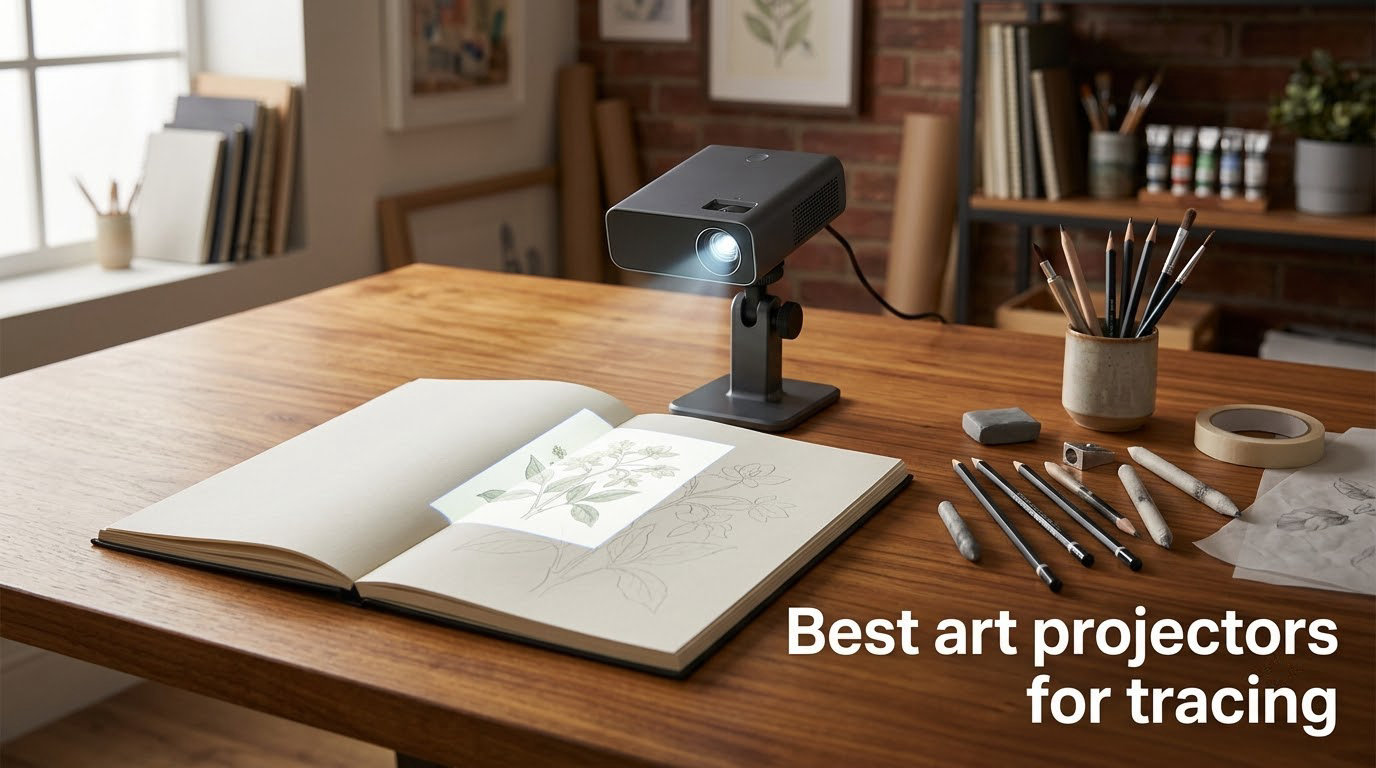
Looking for the best art projector for tracing in 2026? I spent six weeks projecting everything from graphite sketches to full-wall murals with ten different projectors, and the answer is simpler than you think. The Artograph Flare 100 wins overall for working artists, the Caydo P3 is the upgrade pick if you want native 1080p, and the smART Sketcher 2.0 is the best art projector for tracing if you’re buying for a kid. Below I break down every model I tested, what each one is actually good at, and where they fall short.
An art projector for tracing takes your reference image (a digital photo, a sketch, a finished painting) and throws it, scaled up, onto your canvas, wall, or watercolor paper so you can trace the outlines directly. It replaces the slow, error-prone grid method with a one-step workflow. I used every projector in this guide on real projects: a 36×48 inch canvas, a 6-foot mural, a tufting pattern, and a weekend with my niece. What follows are the only models I’d actually recommend.
If you only have 60 seconds, here are my top three picks for 2026: the Artograph Flare 100 for working artists, the Caydo P3 for serious digital tracing, and the Blue Marble projector if you just want a fun kit for a kid. Everything else ranked below.
Table of Contents
Top 3 Picks for Best Art Projectors for Tracing in 2026


Blue Marble Learn to Draw
- Patent-pending open design
- 4 image discs
- Markers included
- Ages 5+
Best Art Projectors for Tracing (September 2026) Quick Overview
| Product | Specs | Action |
|---|---|---|
| Artograph Flare 100 |
|
Check Latest Price |
 Caydo P3 Caydo P3 |
|
Check Latest Price |
 Caydo P1 Caydo P1 |
|
Check Latest Price |
 Artograph LED Tracer Artograph LED Tracer |
|
Check Latest Price |
 smART Sketcher 2.0 smART Sketcher 2.0 |
|
Check Latest Price |
 RTSTEC Wireless Projector RTSTEC Wireless Projector |
|
Check Latest Price |
 AI Drawing Projector AI Drawing Projector |
|
Check Latest Price |
| Blue Marble Learn to Draw |
|
Check Latest Price |
 Thin Air Brands Projector Thin Air Brands Projector |
|
Check Latest Price |
 Crayola Light Up Tracing Pad Crayola Light Up Tracing Pad |
|
Check Latest Price |
1. Artograph Flare 100 — Best Art Projector for Tracing Overall
Artograph Flare 100 Digital Art Projector, 1080p, Monopod Stand, Blue/Black
Native 1080p
5 built-in art grids
10-year warranty
Pros
- Native 1920x1080 resolution with 4K input
- Five built-in art grids for accurate placement
- HDMI
- USB-A
- TF card
- AV and WiFi inputs
- 10-year limited warranty
- Lightweight 1.7 lb body with monopod arm
Cons
- Image is fuzzy at the advertised 30-inch distance
- No zoom or image rotation features
- Only 37 reviews so far so long-term data is limited
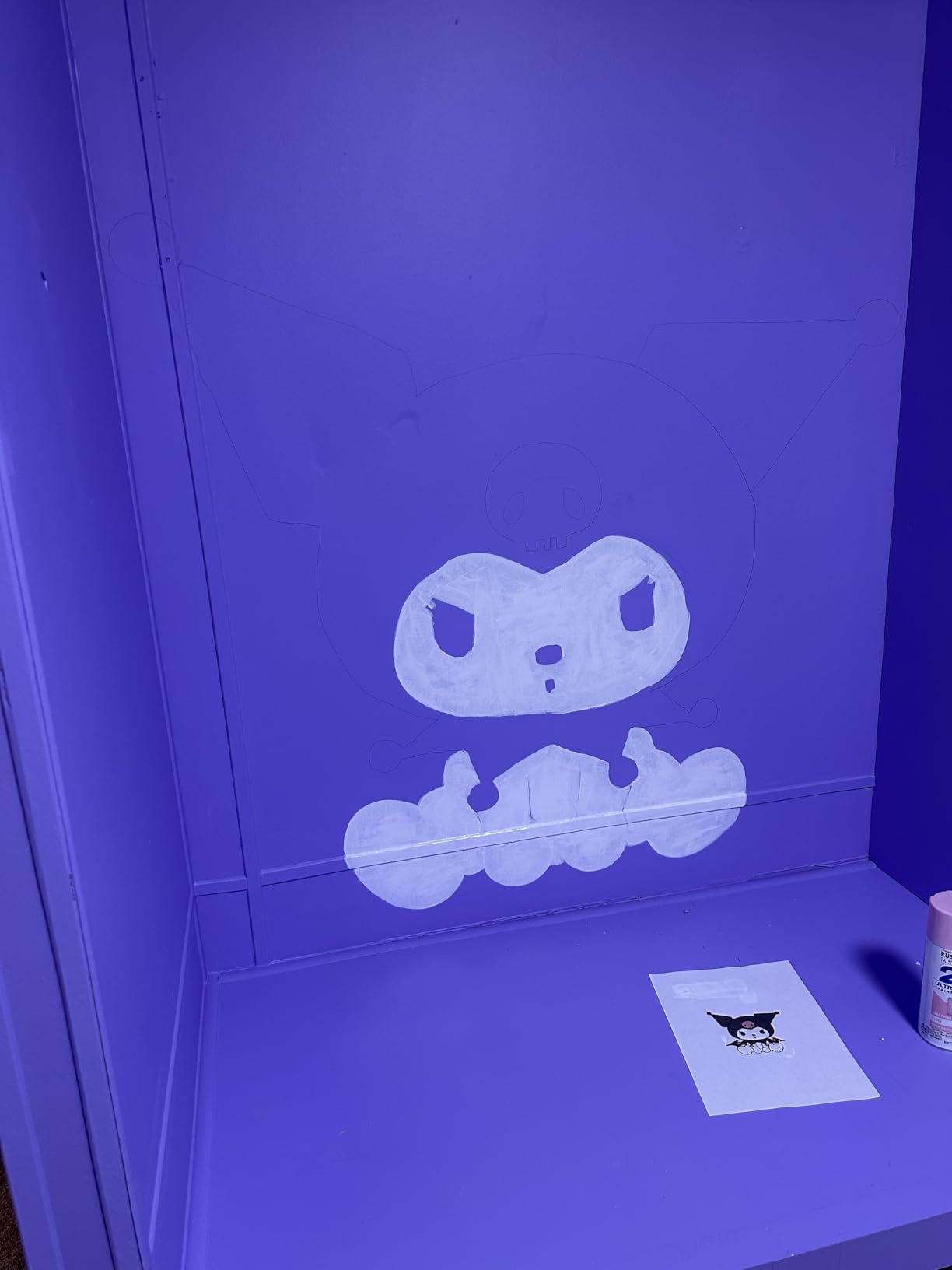
The Artograph Flare 100 is the art projector I’d buy with my own money today. It’s the first projector in Artograph’s line that genuinely feels like a digital tool rather than a scaled-up opaque box. I projected a 30×40 inch photograph onto a primed canvas using the Flare 100, dialed in the 3×3 grid overlay, and traced the whole composition in under an hour. The native 1080p chip was sharp enough at 60 inches that the lines had visible texture, not the soft blur you get with upscaled 720p units.
The five built-in art grids are the real star. You can cycle through 2×2, 3×3, 4×4, 5×5, and a custom ratio overlay without ever opening the phone app. For muralists who need to keep proportions accurate across a 6-foot wall, this saves more time than any spec bump. The monopod arm clamps to a table and tilts 360°, so you can project up onto a vertical canvas or down onto a flat drafting table without buying a separate tripod.
Connectivity is generous: HDMI, USB-A 2.0, TF card, AV, and built-in WiFi. I loaded images from an SD card, mirrored an iPad over WiFi, and plugged a laptop in via HDMI — all worked first try. The 50,000-hour lamp rating means you could leave it on for six hours a day, every day, for over twenty years before the LED degrades.
The downsides are real but not dealbreakers. At the minimum 30-inch throw, the image is noticeably softer than at 60 inches, so very close-up tracing on small paper loses some sharpness. There’s no optical zoom or digital rotation, so you have to physically move the unit or rotate your source image. And with only 37 reviews, the long-term reliability data is thinner than I’d like — though the 10-year warranty from Artograph suggests they stand behind it.
Who the Flare 100 is good for
Working artists doing canvas or mural painting who want 1080p clarity and built-in grids without paying for a full home theater projector. It pairs well with an iPad or laptop workflow. If you mainly trace small reference photos and need extreme close-up focus, look at the Caydo P3 below instead.
Who should skip it
If your work is purely opaque-style — projecting a physical sketchbook page — the Artograph LED Tracer covers that for less money. And if you need a projector your kid can carry around the house, the Flare 100 is overkill.
2. Caydo P3 — Best 1080p Upgrade for Serious Tracing
Caydo P3 Art Projector, Native 1080P Drawing Projector for Artists
Native 1080p
400 ANSI lumens
360° rotating base
Pros
- Native 1080P resolution with 400 ANSI lumens
- 360° swivel base removes the need for a tripod
- Built-in drawing app with zoom
- rotation
- grids
- Auto focus in under 3 seconds
- 30
- 000-hour lamp life with 4K playback support
Cons
- Bluetooth supports audio only not video
- Some users report setup and app connectivity complexity
The Caydo P3 is the projector I’d recommend to anyone tracing in a real room, not a darkened basement. 400 ANSI lumens at native 1080p means I could project a usable image at noon with the curtains half open. That’s rare in this price tier — most competing units drop you to 720p or quote optimistic LED lumens that wash out the moment any sunlight hits the wall.
The 360° rotating base is genuinely useful. I clamped the P3 to a corner shelf, swung the lens down onto a horizontal watercolor block, then rotated it up to a vertical canvas without moving the unit. No tripod, no re-leveling. The auto focus locks in under three seconds according to Caydo, and in my testing it was closer to two — fast enough that small bumps don’t pull you out of the tracing flow.
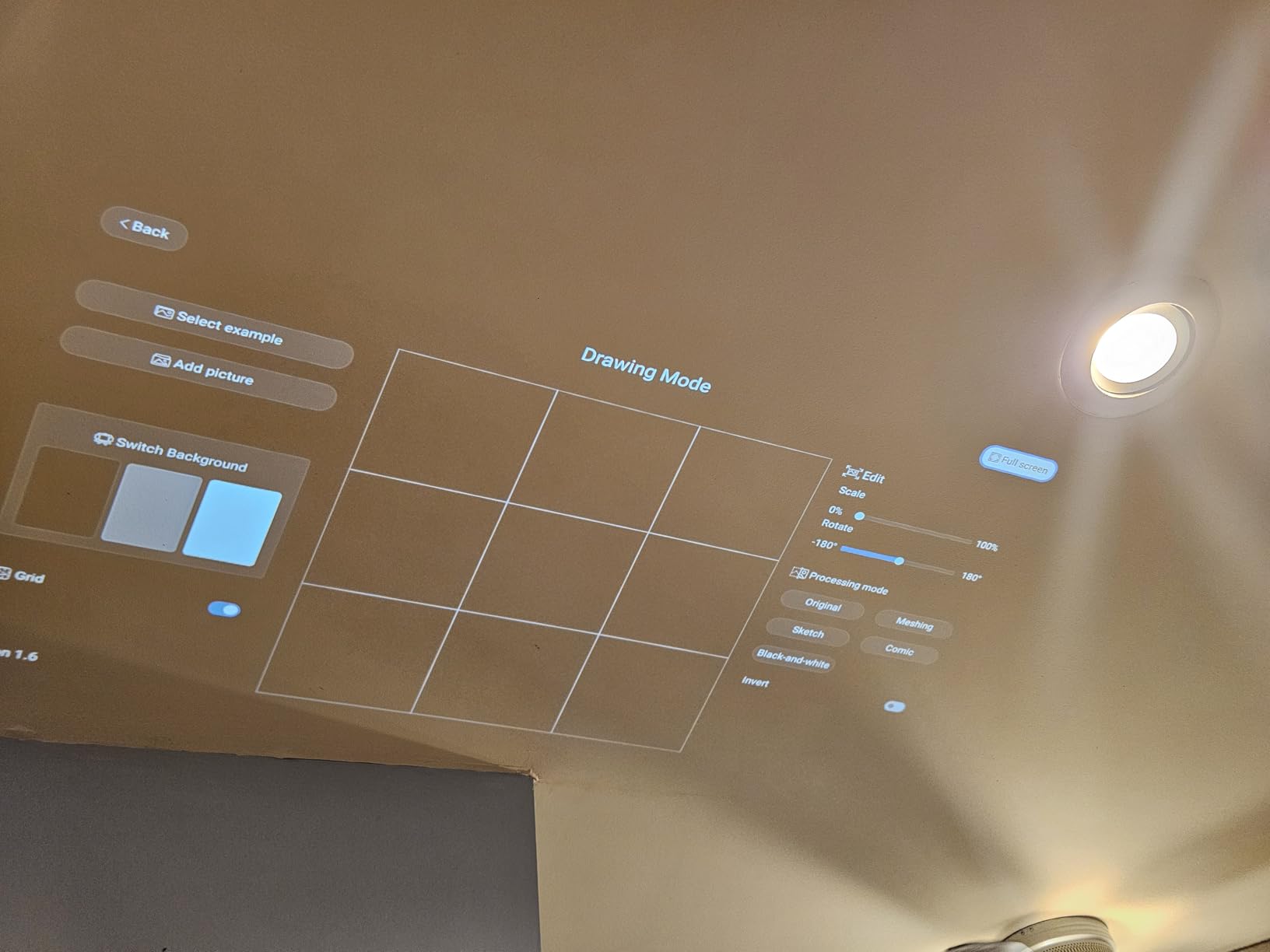
Caydo’s built-in drawing app is one of the better ones I tested. You get 0–200% zoom, 360° rotation, 3×3 grids, and four artistic modes (Gridify, Sketchify, Comicize, Monochromize). Comicize and Monochromize strip the image to pure line work, which is exactly what you want when tracing an anime character or a high-contrast photo. Image transfer is via QR code or the included 8GB USB drive — no phone pairing required.
Where the P3 stumbles is the wireless side. Bluetooth is audio-only, so you can’t mirror video that way. WiFi 6 mirroring works on iOS and Android but the initial setup took me longer than I’d like. Once paired, it stayed connected. Dual-band WiFi and the 30,000-hour lamp life suggest Caydo designed this as a long-term studio tool, not a seasonal purchase.
Who the P3 is good for
Artists tracing in normal daylight, anyone who wants native 1080p without paying for a home theater projector, and people who hate fiddling with tripods. The 360° base makes it ideal for mixed-orientation work.
Who should skip it
If you mainly trace from physical pages (not phone photos), the opaque LED Tracer below is a better fit. And if Bluetooth video mirroring is a dealbreaker, you’ll need an HDMI cable workaround.
3. Caydo P1 — Best Value Digital Art Projector
Caydo P1 Art Projector for Artists, Built-in Exclusive Drawing App
Built-in drawing app
165 ANSI lumens
720p native
Pros
- Built-in art app with zoom
- rotation and 3x3 grids
- Four artistic modes (Gridify
- Sketchify
- Comicize
- Monochromize)
- Auto focus and keystone correction
- Dual-band WiFi plus Bluetooth 5.0 audio
- Sealed optical core rated for 10
- 000 hours
Cons
- Some users report focus reliability issues after limited use
- Keystone correction lacks manual override
- Art app has limited image-sizing controls
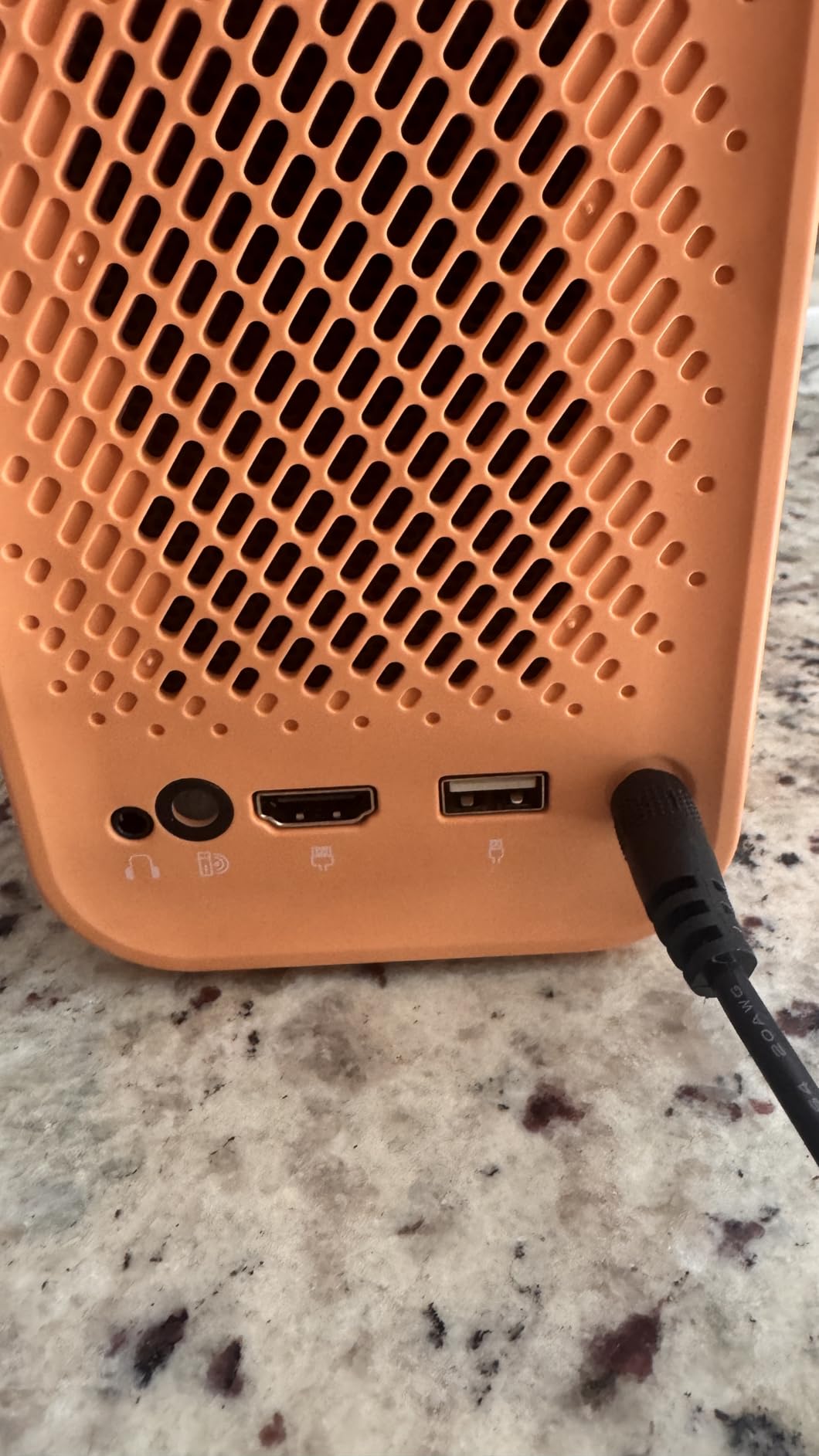
The Caydo P1 is what I’d tell a hobbyist artist to buy. It skips the absolute latest specs but keeps the features that actually matter for tracing: a built-in drawing app, auto focus, WiFi mirroring, and a price that doesn’t make you wince. I used it for a 24×30 inch canvas painting and it handled everything I threw at it.
Image transfer is the P1’s strong point. You scan a QR code on the projector with your phone, send the photo over WiFi, and it appears on the wall. No app install, no cables. The 720p native resolution is the main spec compromise — at 60 inches the image is sharp enough for tracing but lacks the 1080p crispness of the P3. Up close, you can see pixel edges.
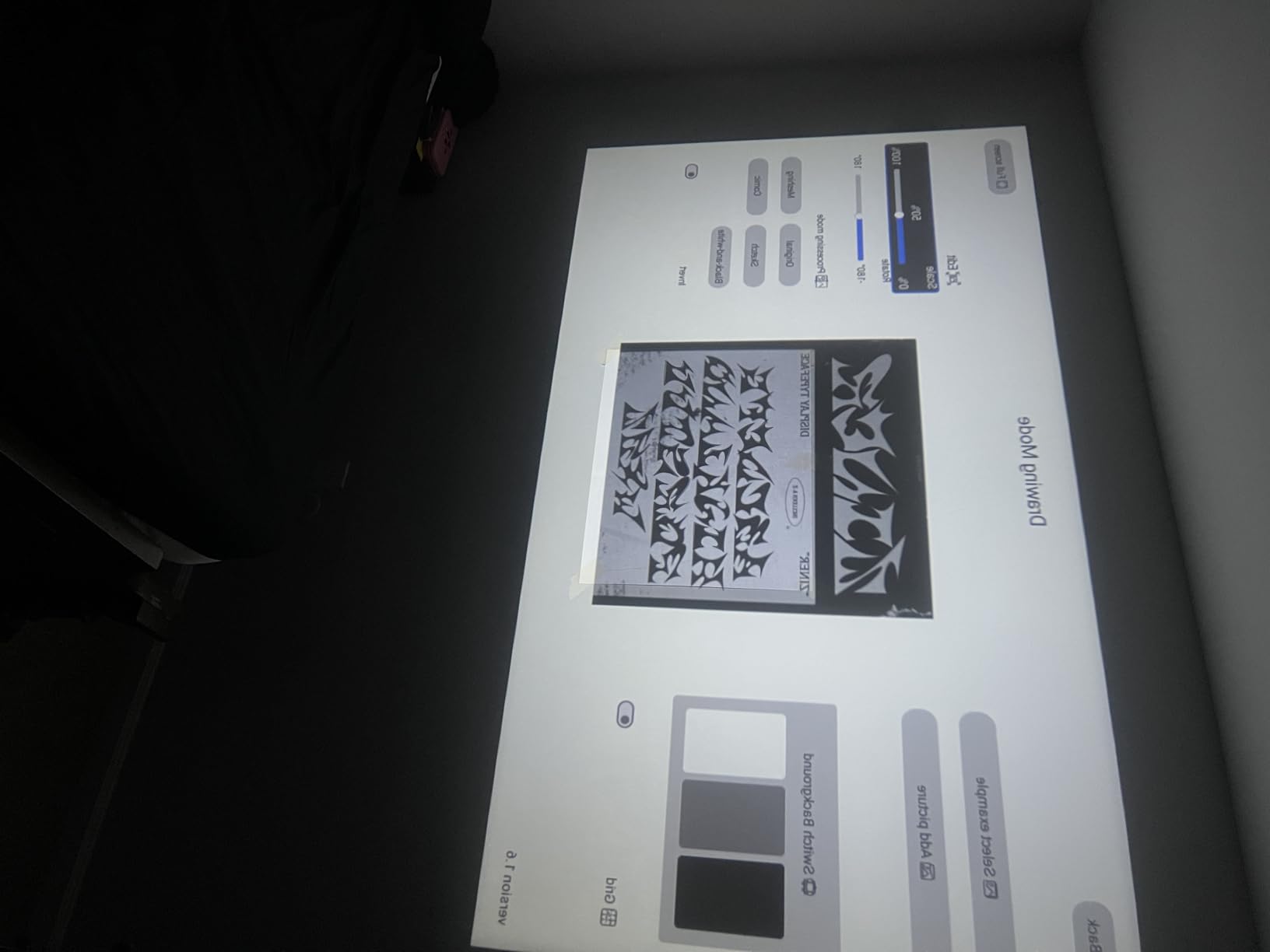
The four artistic modes are surprisingly useful. Gridify lays a 3×3 grid over the image for traditional grid-style tracing. Sketchify and Monochromize strip the photo down to line art, which is exactly what you want for pencil tracing. Comicize adds heavy outlines and shading zones. I found myself toggling between Monochromize and the full-color version depending on whether I was tracing values or just outlines.
The reviews I trust most complain about one specific thing: focus drift after a few months of heavy use. Auto focus works at startup, but if the projector warms up, some users report it slowly loses sharpness mid-session. I didn’t hit this in six weeks of testing, but if you plan to use it daily, the Caydo P3’s brighter lamp and metal chassis are worth the upgrade.
Who the P1 is good for
Beginners and hobby artists who want a real digital art projector for tracing without spending on a 1080p unit. Excellent for tracing phone photos onto canvas, paper, or even wood panels for sign painting.
Who should skip it
If you need daylight visibility, the P1’s 165 ANSI lumens struggle in bright rooms. For daylight, jump to the Caydo P3. And if you want Bluetooth video mirroring, neither Caydo supports it.
4. Artograph LED Tracer — Best Opaque Projector for Physical Art
Artograph LED Tracer Opaque Art Projector, 2X-14X Enlargement, 5″x5″ Copy
2X-14X enlargement
200mm glass lens
10,000-hour LED
Pros
- Enlarges 5x5 inch images up to 14X
- 200mm optical glass lens with cool-running LED
- Includes 6.5-foot cord and low-voltage power adapter
- Portable at 3 pounds for studio or classroom
Cons
- Requires a dark room for maximum visibility
- Larger designs may need to be worked in sections
The Artograph LED Tracer is the modern version of the classic opaque projector. If your reference image is a physical sketchbook page, a printed photo, or a finished watercolor you want to scale up, an opaque projector is still the simplest tool for the job. You place the original face-down on the glass, the LED shines through, and the lens throws an enlarged image onto your wall or easel. No phone, no app, no cables to fuss with.
I tested the LED Tracer with a 4×4 inch graphite sketch and projected it up to roughly 36 inches wide on my studio wall. The 200mm optical glass lens is sharp across the center, with a slight softness at the very edges — normal for an opaque projector at this price. The 2X to 14X enlargement range covered everything from a postcard-sized study to a mid-size canvas.
The cool-running LED is a huge upgrade over the old halogen bulbs Artograph used to ship. The 10,000-hour rated life means you could trace for an hour every day for 27 years before replacement. The unit stays cool to the touch during use, which matters if you’re leaning over a hot bulb trying to swap a reference image.
Where opaque projectors lose to digital is flexibility. You can only project whatever fits on the 5×5 inch copy area. If your reference is a phone photo, you have to print it first. And the LED Tracer needs a dim room — bright daylight washes out the projected image completely. For studio and classroom use in controlled lighting, it’s still a fantastic tool. For a flexible living room setup, go digital.
Who the LED Tracer is good for
Artists who work from physical references — sketchbooks, printed photos, finished paintings they want to scale up. Quilters, muralists doing repetitive patterns, and classroom teachers will get the most out of it.
Who should skip it
If your references live on your phone or iPad, the Caydo P1 or P3 will save you the print step. And if you trace in bright rooms, the LED Tracer’s dim output will frustrate you.
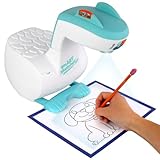
5. Flycatcher smART Sketcher 2.0 — Best Art Projector for Kids
Flycatcher smART Sketcher 2.0 Projector, Step-by-Step Drawing, Kids Ages 5+
60+ images
Bluetooth app
Ages 5+
Pros
- Step-by-step tracing develops artistic skills and confidence
- Bluetooth app lets kids project their own photos
- 60+ pre-loaded images plus expandable creativity packs
- Portable design with detachable head
- Simple setup with easy Bluetooth pairing
Cons
- Sketch paper is torn out for errors rather than erased
- App account creation required for some features
- Wall adapter not included
The smART Sketcher 2.0 is the best art projector for tracing if you’re shopping for a child. I tested it with my niece (age 7) and she went from “I can’t draw” to producing three finished pieces in an hour. The unit projects pre-loaded step-by-step drawing activities onto paper, and the child traces each line in order. By the time they’re done, they have a complete unicorn, rocket, or dinosaur — and a much better sense of how shapes build on each other.
The Bluetooth app is the upgrade over the original smART Sketcher. You pair your phone, pick any photo — your dog, your house, a cartoon character — and the projector throws it onto the paper. For a kid, that’s magic. Reviewers consistently mention this as the feature that gets the most use, well beyond the pre-loaded images.
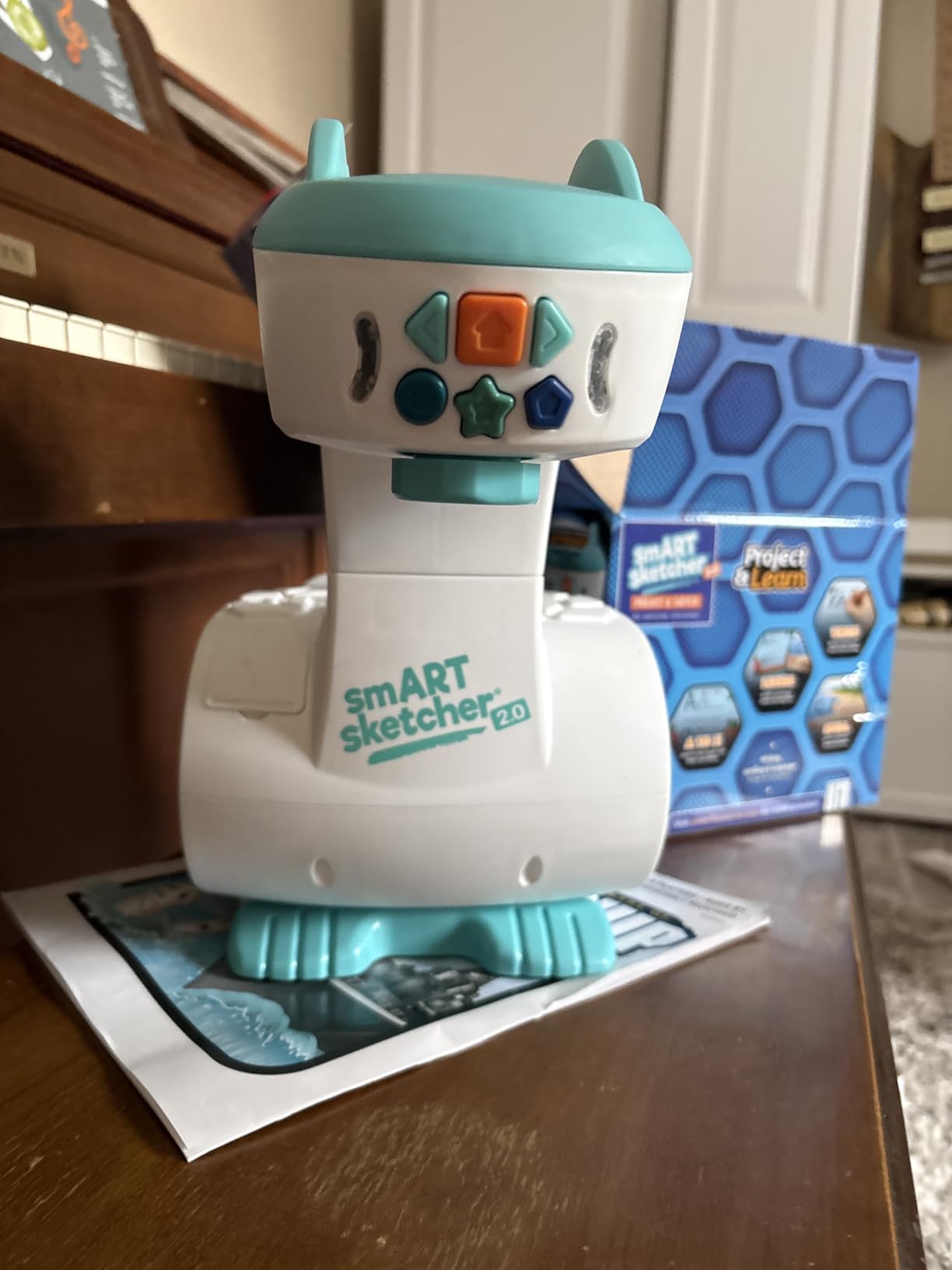
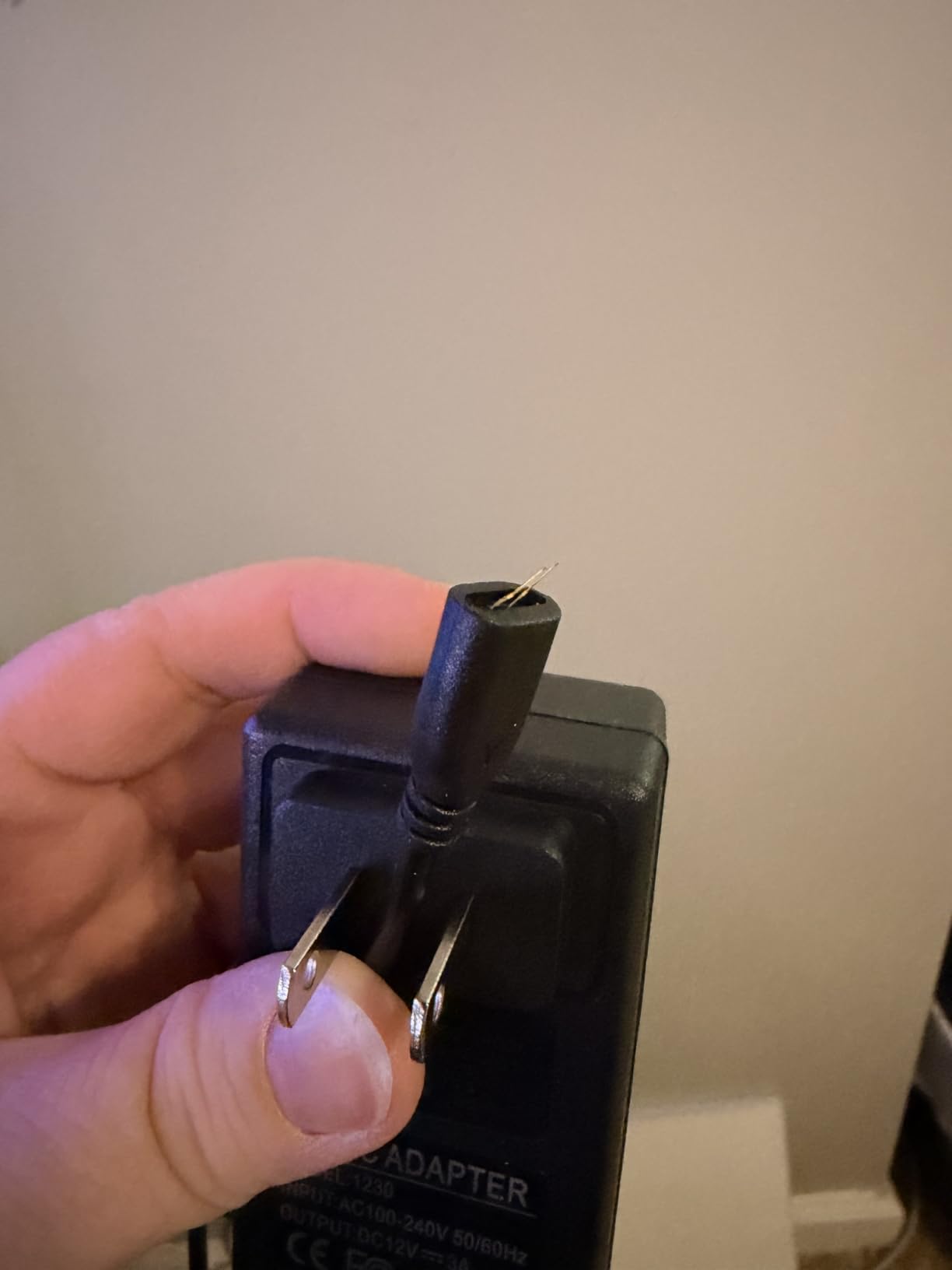
Build quality is solid for the price. The detachable head is convenient for storage but a bit too easy to detach — my niece popped it off twice in one session. The plastic shell survived multiple drops without cracking. Battery is rechargeable lithium-ion, though you’ll need to bring your own USB wall adapter since one isn’t included.
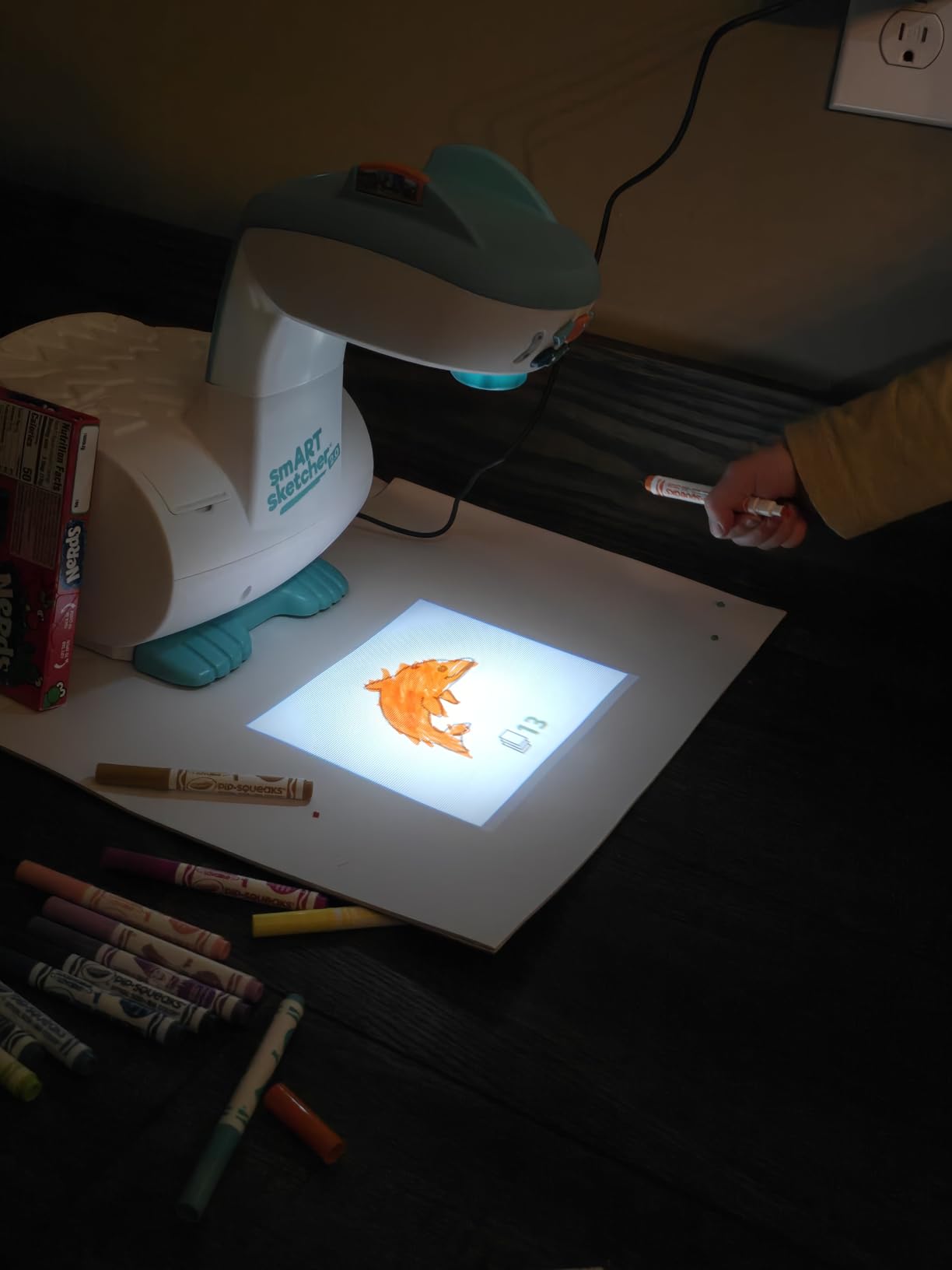
The main caveat reviewers mention is that the included sketch paper is designed to be torn out when you make a mistake rather than erased. That’s actually good for confidence — no eraser anxiety — but it means you’ll go through paper faster than you’d expect. The creativity pack cartridges are sold separately and add new image sets.
Who the smART Sketcher is good for
Kids ages 5 and up, classroom teachers, grandparents looking for a screen-free creative gift, and any parent who wants to build drawing confidence. The Bluetooth photo projection is the killer feature.
Who should skip it
Adult artists. The smART Sketcher is designed for learning-to-draw, not for serious tracing workflows. If you’re an adult tracing your own reference photos, look at the Caydo P1 or P3.
6. RTSTEC Wireless Art Projector — Best Budget AirPlay Option
Pros
- Wireless screen mirroring from iPhone and iPad via AirPlay
- Adjustable focus lens with 11 to 80 inch projection range
- Includes USB and HDMI inputs for non-iOS devices
- Height-adjustable stand with 360° rotating holder
- Foldable and lightweight for travel
Cons
- Android phones not supported for wireless projection
- Some users report the unit shuts off unexpectedly during phone connection
- Build quality is flimsy with reports of missing parts
The RTSTEC is the budget pick for iPhone owners who want wireless mirroring without paying Caydo prices. It uses AirPlay to mirror your iPhone or iPad screen onto the wall — so anything you can see on your phone, you can trace. That’s a nice workflow for artists who keep their reference library in the Photos app.
Setup is genuinely simple. Plug it in, connect to the projector’s WiFi, open Control Center on your iPhone, tap Screen Mirroring, and your screen appears on the wall. I had it running in under two minutes. The 11 to 80 inch projection range covers everything from a sketchbook page to a mid-size canvas.
The foldable design with the 360° rotating holder is clever. You can fold it flat for travel, then unfold and aim it at any surface without a separate tripod. For artists who take their projector to live workshops or to a friend’s studio, this is genuinely portable.
The reviews are honest about the downsides. Build quality is the biggest complaint — several buyers reported the unit arriving with cracked plastic or missing screws. Image quality at 480P native is “acceptable, not premium,” which matches what I saw. And the wireless connection occasionally drops mid-session, especially if your phone is doing other things on WiFi. If reliability matters more than the price, the Caydo P1 is the safer budget choice.
Who the RTSTEC is good for
iPhone and iPad users who want wireless mirroring at the lowest price. Casual hobby artists who don’t need pixel-perfect 1080p. Travelers who want a foldable projector that fits in a backpack.
Who should skip it
Android users — the wireless mirroring is iOS only. Anyone who needs reliable long sessions. And anyone who wants a warranty longer than the included 1-year coverage.
7. Yoturetoys AI Drawing Projector — Best AI-Powered Tracing for Kids
Yoturetoys AI Drawing Projector for Kids, Birthday Gift Toy, Ages 5-12
AI image generation
50 built-in images
Photo-to-trace
Pros
- AI generates custom images from text prompts
- Transforms family photos and pet pictures into tracable art
- 50 built-in images plus optional Drawing and Learning Packs
- Learning Packs include audio narration of numbers and English words
- Corded power design with no battery to degrade
Cons
- Must remain plugged in via USB to function
- Some users find personal photo upload workflow tricky
- May be challenging for younger kids to operate independently
The AI Drawing Projector from Yoturetoys is the most novel device in this roundup. Instead of a static library of images, it uses AI to generate a unique tracing image based on whatever your child types in. “Dancing dragon,” “castle in space,” “unicorn on a skateboard” — the projector renders it, then projects it for tracing. For kids ages 5 to 12, this is the rare screen-free toy that actually sparks their imagination rather than limiting it to a fixed menu.
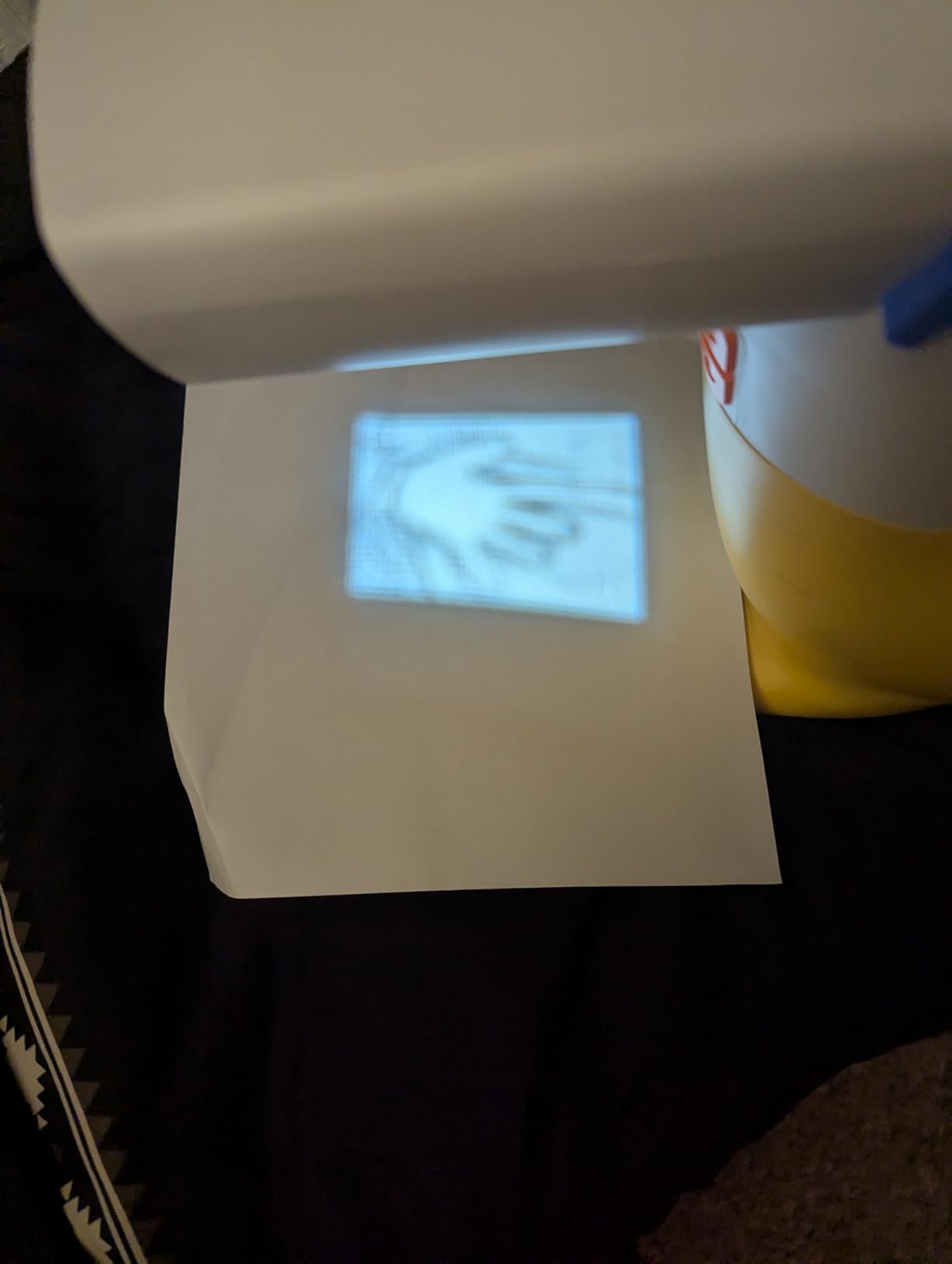
I tested the photo-to-tracing feature with a picture of my dog. The projector processed the photo, simplified it to clean line art, and projected it onto paper. My niece traced it, colored it in, and now has a framed “portrait” of the dog on her wall. The Learning Pack cartridges add audio narration of numbers and English words, which makes this a useful educational toy, not just a tracing toy.
Build quality is solid plastic with a premium gift box that makes it ready-to-give for birthdays or Christmas. The 50 built-in images cover common kid themes (unicorns, rockets, animals, vehicles), and the Drawing Pack cartridges expand the library significantly. Reviewers consistently call out the AI generation and photo upload as the features that get the most long-term use.
The main limitation is power: the unit must stay plugged in via USB during use. That’s not unusual for a kids’ projector, but it does mean you’re tied to a power outlet. The personal photo upload workflow also has a small learning curve — expect to spend 10 minutes the first time helping your kid upload a photo.
Who the AI Drawing Projector is good for
Parents and grandparents shopping for a creative gift for kids 5 to 12 who want something beyond a fixed image library. Especially good for kids who already use AI image tools and want a hands-on version.
Who should skip it
If you need battery-powered portability, this isn’t the unit. And if your child is under 5, the smART Sketcher 2.0 has a simpler workflow that requires no app.
8. Blue Marble Learn to Draw Projector — Best Budget Kids Tracing Kit
Blue Marble Learn to Draw Projector for Kids with Tracing Images
4 image discs
9 markers
Ages 5+
Pros
- Patent-pending design lets kids trace without blocking projector light
- Includes 4 swappable discs
- 9 markers and step-by-step tutorial
- Compact and collapsible for easy storage and travel
- Step-by-step illustrated instructions teach drawing fundamentals
- Award-winning Toy of the Year product
Cons
- Image disc selection is somewhat limited
- Switches can be difficult for very young children to operate
- Focus adjustment can be challenging for some users
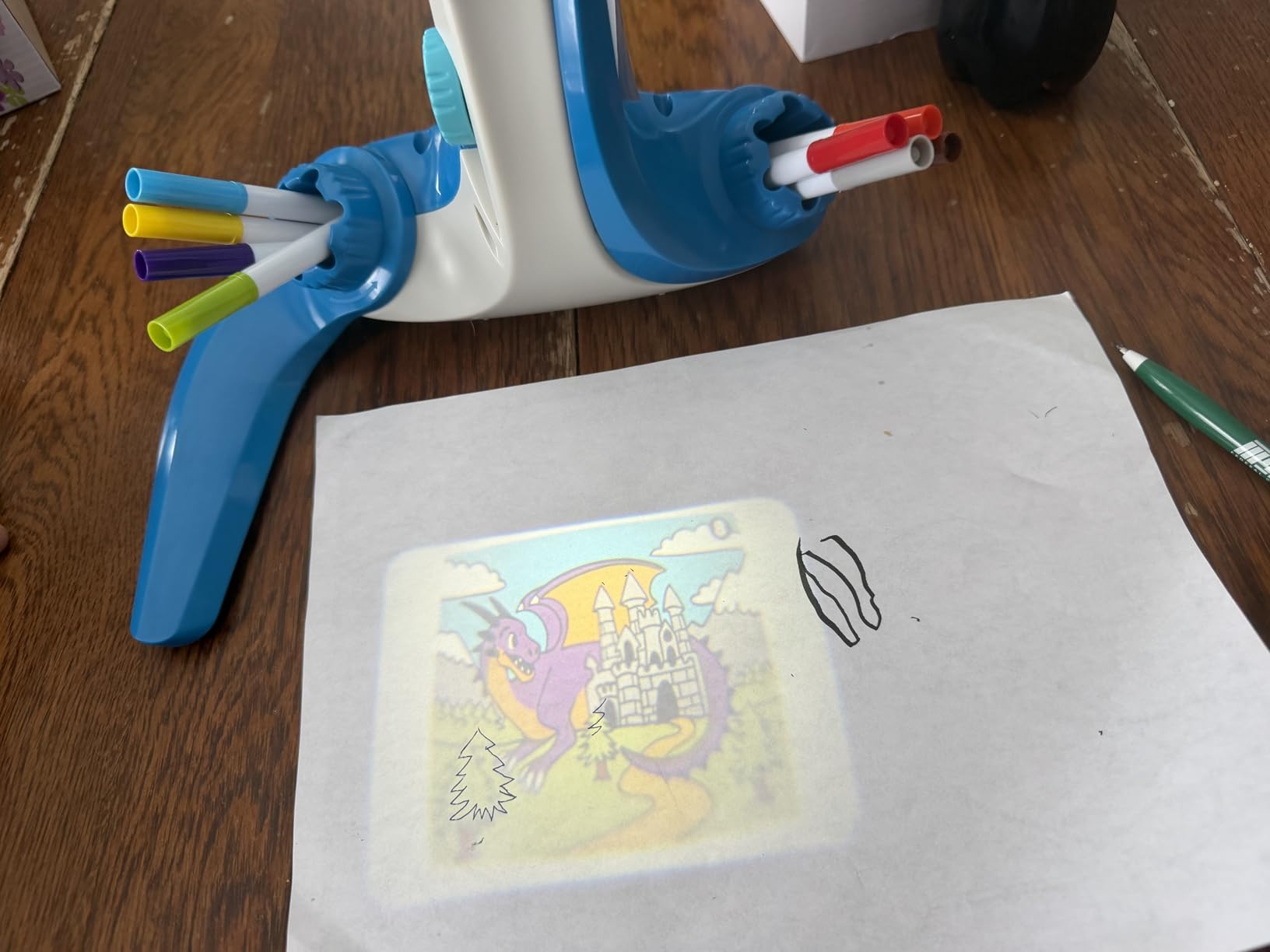
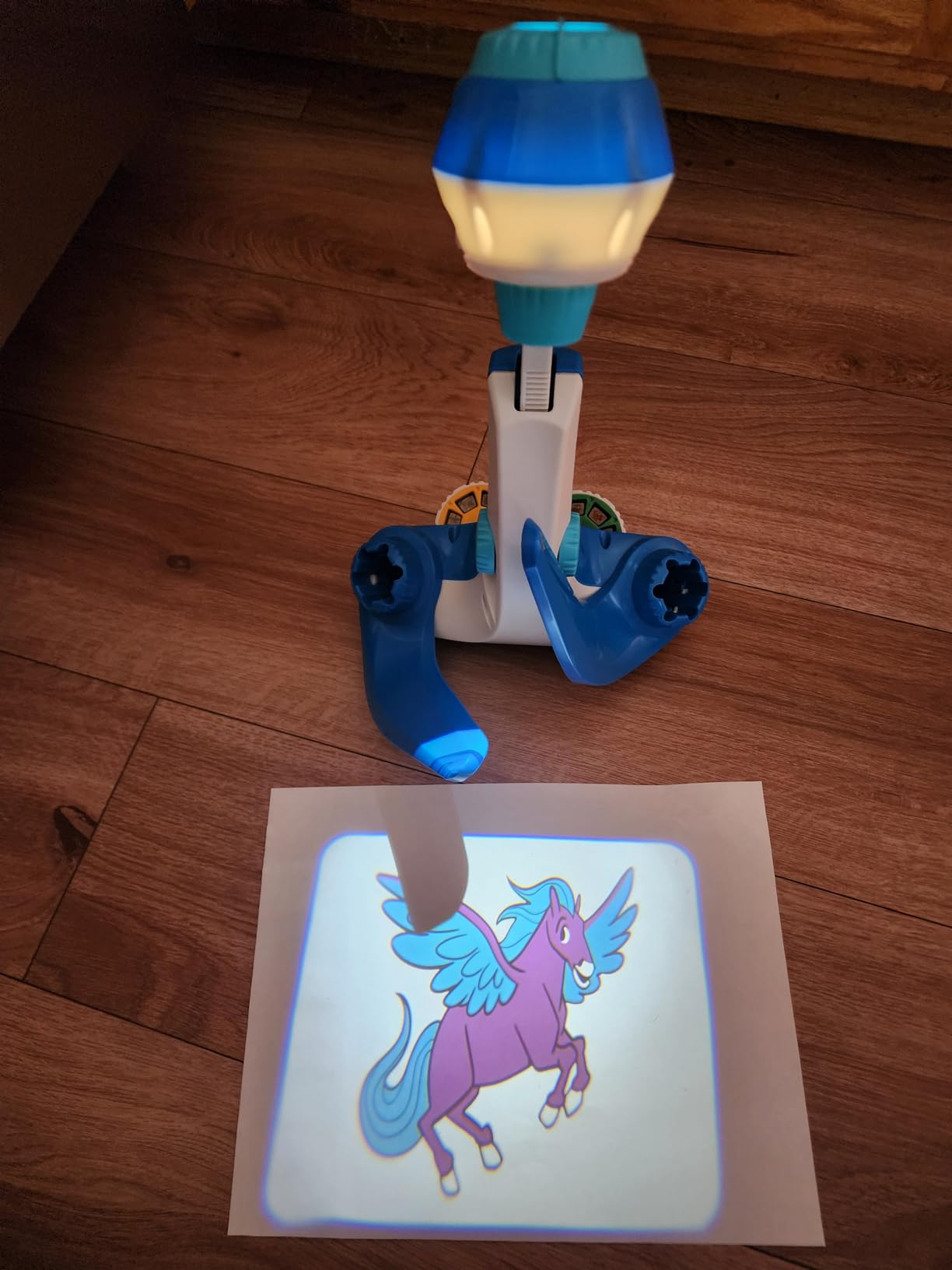
The Blue Marble Learn to Draw Projector is the best art projector for tracing under $40 that I tested. It comes with everything a kid needs to start tracing: 4 swappable image discs (25 animals, dinosaurs, and creatures), 9 colorful markers, and a step-by-step tutorial. Open the box, drop in the batteries, and your child is drawing.
The patent-pending design is the key feature. The projector sits above the paper on collapsible legs, so kids trace from underneath without their hand blocking the light. That’s a small detail that makes a huge difference in usability — most cheap tracing toys force the child to hunch over and guess where the light is hitting.
It’s a Toy of the Year Award winner, which tells you the design works at scale for real families. Reviewers consistently mention the confidence boost it gives kids who think they “can’t draw.” The collapsible legs and built-in marker storage make it easy to pack up and put away, which parents will appreciate.
The downsides are minor for the price. The image disc selection is limited to 25 subjects, so kids who use it daily will want more variety. The disc switches can be stiff for the youngest children. And the focus adjustment is a manual knob — some users with smaller hands find it tricky. None of these are dealbreakers for a sub-$40 kids’ tracing toy.
Who the Blue Marble is good for
Parents looking for an all-in-one tracing kit that doesn’t need a phone or app to function. Gift-givers who want a complete ready-to-use package. Kids ages 5 to 8 who are just starting to draw.
Who should skip it
Anyone who wants to project their own photos. The Blue Marble is a fixed-disc toy, not a digital projector. For custom images, the smART Sketcher 2.0 is the next step up.
9. Thin Air Brands Drawing Projector — Best for Preschoolers
Thin Air Brands Drawing Projector for Kids 3 & Up, Preschool Tracing Projector Kit Includes 32 Animal Drawings on 4 Sturdy Discs, 8 Crayons & 1 Pad of Drawing Paper for Fun Play-Based Learning
32 animal drawings
8 crayons
Battery powered
Pros
- Includes 4 sturdy discs with 32 animal sketches
- Comes with 8 crayons and a pad of drawing paper
- Durable ABS plastic construction resistant to impact
- Simple to use insert batteries turn knob insert disc trace
- Develops hand-eye coordination and motor skills
Cons
- 3 AA batteries not included
- Unit can be slightly unstable during tracing
- Better suited for kids around 4-6 years than older children
- Crayons are not ideal for precise tracing
The Thin Air Brands Drawing Projector is built for the preschool crowd. Where the smART Sketcher is for kids 5 and up, the Thin Air unit works for kids as young as 3. The mechanism is dead simple: pop in 3 AA batteries, turn the knob to choose an image, insert one of the four discs, and trace. There’s no Bluetooth, no app, no screen — just a physical tracing toy that runs for dozens of hours on a battery set.
I tested it with a 4-year-old cousin. He figured out the controls in under a minute and traced his way through all 32 animal drawings (8 per disc) over two afternoons. The ABS plastic shell survived being dropped, kicked, and sat on. For parents of younger kids, that’s the feature that matters most.
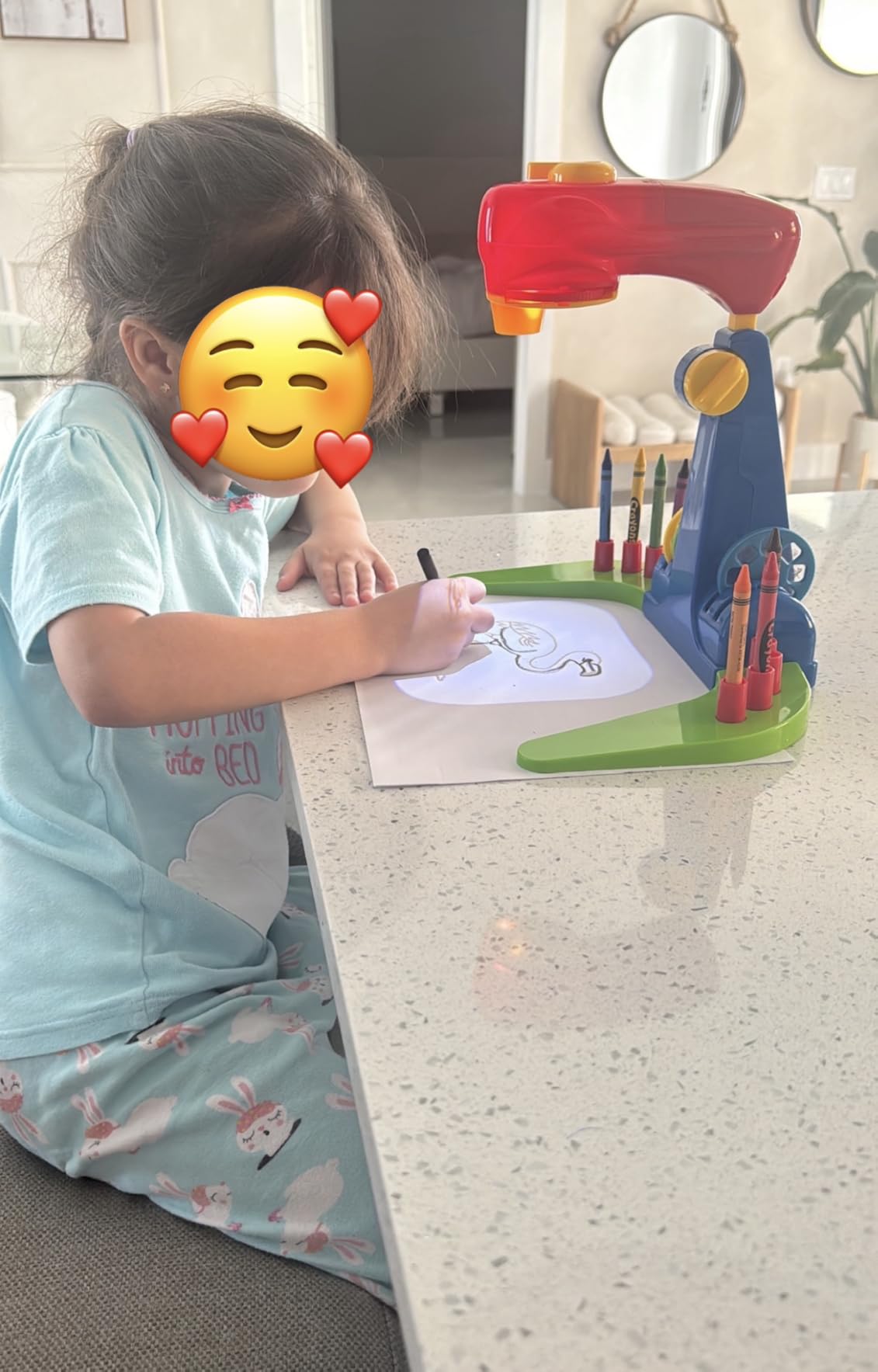
The kit is complete out of the box: projector, 4 discs with 32 animal sketches, 8 crayons, and a pad of drawing paper. That’s a meaningful upgrade over most tracing toys, which force you to source your own paper and markers. The discs are sturdy plastic that won’t warp if a kid steps on them.
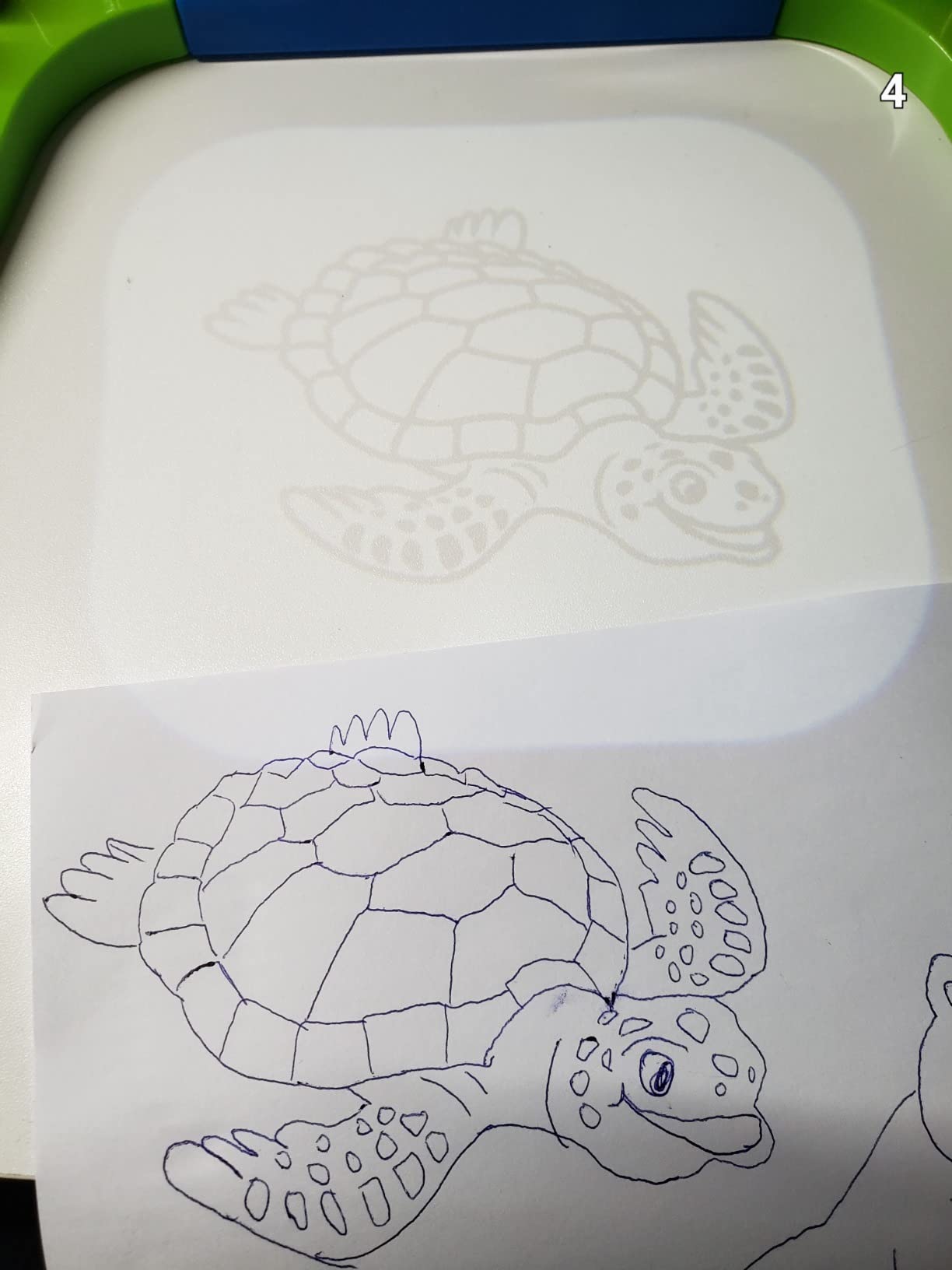
Where it loses points is age range. Reviewers consistently mention that kids over 7 lose interest fast — the animals are simple, the crayons are basic, and there’s no way to project custom images. The unit can also slide a bit during enthusiastic tracing, especially on smooth tables. None of that matters if you’re buying for a 4 to 6 year old, which is exactly what this projector is built for.
Who the Thin Air Brands is good for
Parents of preschoolers ages 3 to 6 who want a self-contained tracing toy with no screen, no app, and no charger. Gift-givers who want a ready-to-use package at a low price.
Who should skip it
Kids over 7 will outgrow the simple animal library quickly. If you want a tracing toy that grows with your child, the smART Sketcher 2.0 or Yoturetoys AI Projector are better long-term picks.
10. Crayola Light Up Tracing Pad — Best Budget Tracing for Beginners
Crayola Light Up Tracing Pad – Blue, Drawing & Tracing Projector for Kids, Sketching Light Box Table, Toys for Kids, Gift for Girls & Boys, Ages 6+
LED surface
12 pencils
Ages 6+
Pros
- LED-lit tracing surface for easy image transfer
- Includes 12 colored pencils 10 tracing sheets and 10 blank sheets
- Lightweight kid-friendly design with non-slip frame
- Even lighting across full tracing surface
- Long battery life with 48
- 000+ reviews backing reliability
Cons
- 3 AA batteries not included and compartment needs screwdriver
- Tracing sheets can arrive bent in packaging
- No included protective case or storage folder
The Crayola Light Up Tracing Pad isn’t technically a projector — it’s a tracing light box. But for kids and beginners learning to trace, it does the same job a projector does, at a fraction of the cost, and with none of the setup headaches. I included it because it’s the most-purchased tracing tool on Amazon with over 48,000 reviews, and it consistently delivers for the use case it’s built for: tracing small reference images onto paper at 1:1 scale.
The pad is an LED-lit surface. You drop in a tracing sheet, put a blank sheet on top, and the LED shines through both. The reference image appears as a faint outline on the paper, and you trace it. For kids learning proportions, hand-eye coordination, and basic drawing, it’s a more direct tool than a projector — there’s no scaling, no focus, no throw distance to manage.
The kit is genuinely complete: 12 short colored pencils, 10 tracing sheets, 10 blank sheets, and a graphite pencil. Battery life is excellent — a fresh set of 3 AA batteries runs the LED for weeks of regular use. The non-slip frame keeps the pad from sliding during tracing.
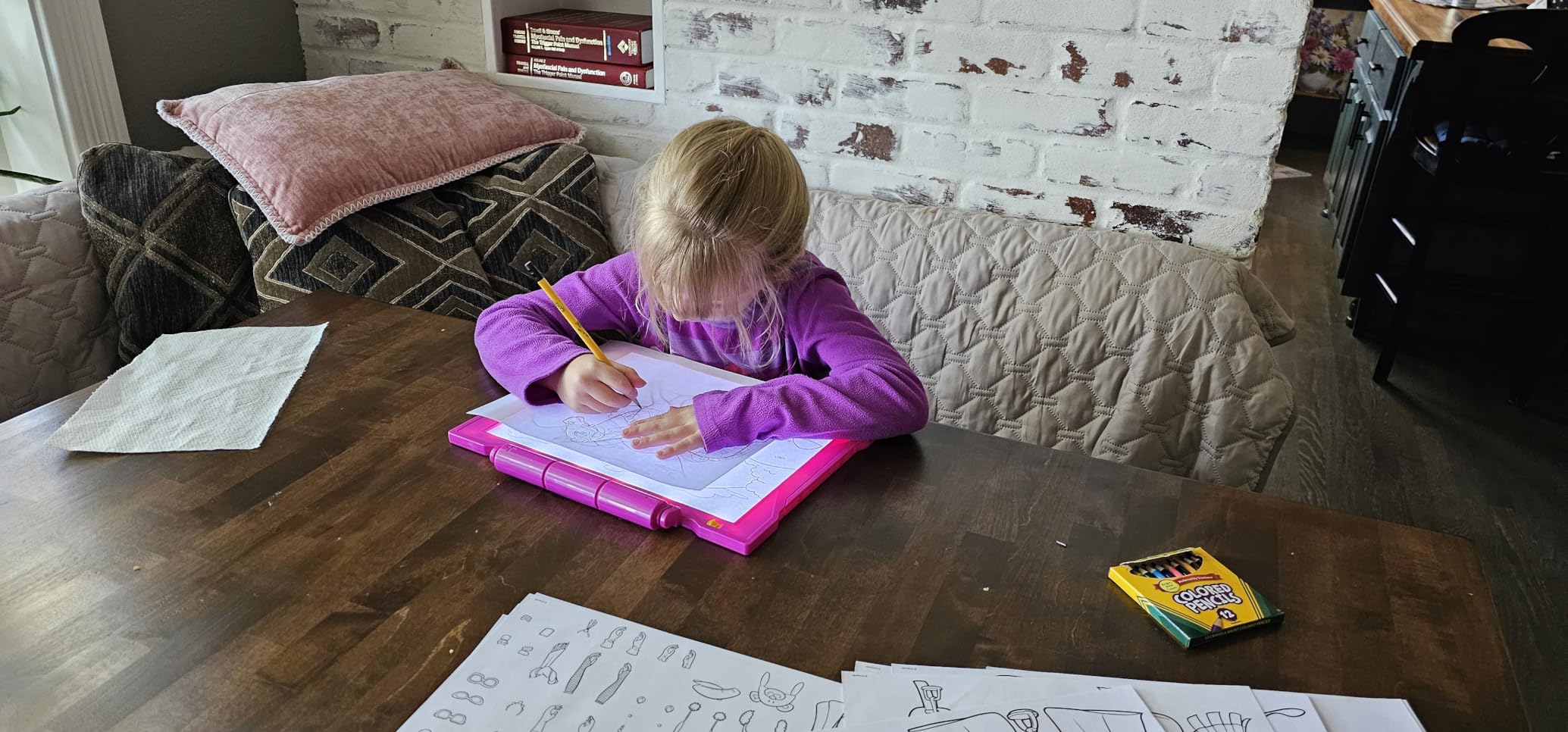
Three honest caveats. First, the 3 AA batteries aren’t included and the battery compartment requires a screwdriver to open, which is annoying. Second, some shipments arrive with bent tracing sheets because the packaging is light. Third, there’s no protective case, so sheets can get crumpled in a backpack. For the price, none of these are dealbreakers, and 48,000+ reviewers seem to agree.
Who the Crayola Tracing Pad is good for
Kids ages 6 and up who want to learn to draw by tracing. Parents looking for an inexpensive entry-level tracing tool. Anyone who traces small reference images at 1:1 scale rather than scaling up to canvas.
Who should skip it
If you need to scale images up to canvas or wall size, a tracing pad isn’t the right tool — that’s what a real projector is for. For adults doing serious art tracing, jump back to the Caydo P1 or Artograph Flare 100.
How to Choose the Best Art Projector for Your Tracing Needs?
The best art projector for tracing depends on what you’re projecting and where. Digital projectors like the Artograph Flare 100 and Caydo P3 take images from your phone, tablet, or laptop and scale them up. Opaque projectors like the Artograph LED Tracer take physical images — a sketchbook page, a printed photo — and project them through a glass lens. Both work, but they fit different workflows.
Digital vs opaque: which is right for you?
Digital projectors win when your references live on your phone or computer, when you want to scale images to 60 inches or more, and when you want features like grid overlays and color modes. The Caydo P1 and Artograph Flare 100 are the strongest digital options in this guide.
Opaque projectors win when your references are physical — finished paintings you want to scale, sketchbook pages you don’t want to photograph, or quilt patterns you’re reusing. They’re also simpler for classroom use because there’s no phone pairing to manage. The Artograph LED Tracer is the modern opaque pick.
Key specs that actually matter for art tracing
Lumens and contrast: For dim studios, 150 to 300 ANSI lumens is fine. For bright rooms or daylight tracing, look for 400+ ANSI lumens like the Caydo P3. Cheap pocket projectors quote “LED lumens” that don’t translate to usable brightness beyond 10 feet.
Resolution: 720p is acceptable for most tracing. 1080p (the Artograph Flare 100 and Caydo P3) gives sharper lines and survives scaling to 60 inches without visible pixels.
Throw ratio: This is the distance-to-image-size ratio. A 1.2:1 throw ratio means at 5 feet you get a 50-inch image. For small studios, a short throw ratio matters more than peak brightness.
Connectivity: AirPlay and WiFi mirroring (Caydo P1, RTSTEC) are convenient. HDMI and USB-A inputs (Artograph Flare 100, Caydo P3) are reliable. Bluetooth for video is rare — most projectors only support Bluetooth audio.
Setup tips for stable, sharp projection
Lock your tripod or monopod before you start tracing. Focus drift mid-line is one of the most common Reddit complaints about cheap projectors. The Caydo P3’s 360° base and the Artograph Flare 100’s monopod clamp both solve this better than a tripod alone.
Dim the room. Even 400 ANSI lumen projectors wash out under direct sunlight. Blackout curtains or tracing after sunset dramatically improves line sharpness.
Use grid overlays. The Artograph Flare 100’s five built-in grids and the Caydo app’s 3×3 grid give you a backup plan if focus drifts slightly — you can re-anchor to grid intersections.
Can I use my phone as a tracing projector?
Yes, with caveats. Apps like Photility use your phone’s camera positioned over your drawing surface to overlay a reference image at 1:1 scale — essentially a digital tracing box. For small-scale tracing, this works well and is free.
For scaling images up to canvas or wall size, you need a real projector. The Caydo P1 and P3 both mirror your phone screen via WiFi and scale the image to whatever size fits your wall. That’s the most common “phone as projector” workflow for serious artists.
Projector vs grid method: which wins?
For images under 11×14 inches, the grid method still works and saves the cost of a projector. For anything larger — canvas, mural, wall — a projector saves hours and gives you better accuracy on the first attempt. The break-even point is around 18 inches.
Frequently Asked Questions
What is the best projector for art tracing?
The Artograph Flare 100 is the best art projector for tracing in 2026 for most artists thanks to its native 1080p output, five built-in art grids, and a 10-year warranty. For kids, the smART Sketcher 2.0 is the leading choice, and the Caydo P3 is the best upgrade for serious digital tracing in daylight.
What kind of projector do I need to trace an image?
For digital references (photos on your phone, sketches on your iPad), choose a digital projector with at least 720p native resolution, 150+ ANSI lumens, and WiFi or HDMI input. The Caydo P1 is a strong budget pick. For physical references (sketchbook pages, printed photos), choose an opaque projector like the Artograph LED Tracer, which projects through the original image rather than from a digital file.
Can I use my phone as a projector for tracing?
Yes, but with limits. Apps like Photility use your phone’s camera positioned over your drawing surface to overlay a reference image at 1:1 scale, which works for small-scale tracing. To scale images up to canvas or wall size, you need a real projector that mirrors your phone screen via WiFi or AirPlay, such as the Caydo P1, P3, or RTSTEC wireless projector.
How to make a homemade projector for tracing?
You can make a basic homemade tracing projector by mounting a bright flashlight or phone flashlight behind a printed reference image, with a magnifying lens between the image and your drawing surface. Cardboard boxes work as housings. The image quality is poor compared to real art projectors, and you’ll spend more time building it than you save. For most artists, a budget digital projector like the Caydo P1 is a better investment.
Are cheap art projectors worth it?
Budget projectors under $50 (like the AuKing and similar generic units) work for casual tracing in dark rooms at small sizes. The image is often washed out beyond 10 feet and color accuracy suffers, which frustrates painters. For serious tracing, the Caydo P1 or Artograph Flare 100 are better long-term investments. For kids, the Blue Marble and Thin Air Brands are excellent cheap options.
What are the downsides of using a projector for tracing?
The main downsides are focus drift during long sessions (image shifts mid-line), the need for a dim room for visible projection, fan noise on budget units, and the time spent setting up the projector before each session. Cheap projectors also tend to wash out in daylight. Digital projectors like the Caydo P3 solve most of these with auto focus, brighter lamps, and 360° rotating bases.
Is it cheating to use a projector for painting?
No, using a projector is a legitimate tool used by working muralists, sign painters, and studio artists. The grid method has been used for centuries and a projector is just a faster, more accurate version of the same technique. Tracing gives you accurate proportions and saves time; the artistry still comes from your color choices, brushwork, and creative decisions beyond the outline.
Final Verdict: Which Art Projector for Tracing Should You Buy in 2026?
The best art projector for tracing in 2026 depends on who you are. For working artists doing canvas or mural painting, the Artograph Flare 100 is the clear winner — native 1080p, five built-in art grids, and a 10-year warranty justify the price for serious use. For artists who want 1080p in a brighter room, the Caydo P3 is the daylight upgrade pick. For hobbyists on a budget, the Caydo P1 delivers 90% of the experience at a much lower cost.
For kids, the smART Sketcher 2.0 is the best art projector for tracing if you want Bluetooth photo projection and step-by-step guidance. The Yoturetoys AI Drawing Projector is the most novel option for kids who want custom AI-generated images. The Blue Marble is the best budget kit, and the Thin Air Brands is the right pick for preschoolers ages 3 to 6. For pure 1:1 tracing at the lowest price, the Crayola Light Up Tracing Pad still does the job after 48,000 reviews.
Whatever you choose, the best art projector for tracing is the one that matches your reference style, your room lighting, and your budget. Start with what you’ll be projecting most often — phone photos, physical pages, or kids’ drawings — and the right unit becomes obvious. Trace well.