
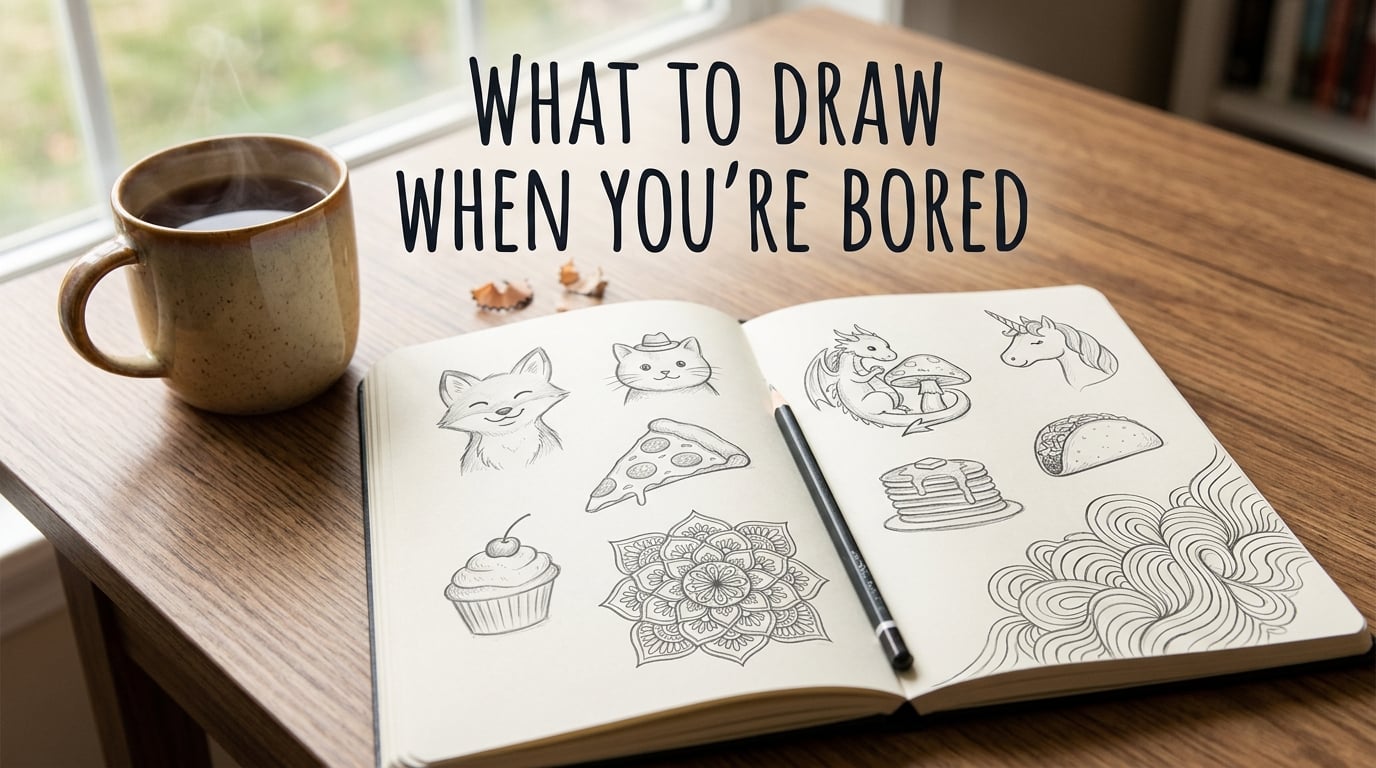
Last Tuesday, I sat at my desk with a fresh cup of coffee and absolutely nothing to do. My sketchbook was open, my pencil was sharpened, and my brain was completely empty. If you’ve ever stared at a blank page waiting for inspiration to strike, you already know what what to draw when you’re bored really means: you don’t need a grand idea, you just need a place to start.
After that afternoon, I started collecting every prompt that pulled me out of that stuck feeling. This guide is the result. It’s built for the moment your brain says “I have nothing to draw” and you need a fast, low-pressure answer. Whether you’re a total beginner, a hobby artist with a stubborn case of artist block, a teen looking for a screen-free activity, or just bored at your kitchen table, you’ll find a starting point here. Expect simple things to draw, weird prompts, and a few techniques that train your eye while they cure the boredom.
I’ve grouped ideas by theme, by time budget, and by mood, plus included drawing games for friends and a few technique exercises that double as warmups. Pick one and start.
Table of Contents
Quick Picks: 10 Things to Draw Right Now
When the blank page is staring back, scan this list and pick the first idea that sparks something. Each prompt is one short line you can start in under a minute.
1. Draw your morning mug. Coffee cup, tea tumbler, or water glass: the object in your hand right now is a perfect three-minute sketch.
2. Mash two animals together. Owl-bear, frog-cat, fish-bird. Combine the head of one with the body of another and let the absurdity do the work.
3. Fill a page with tiny doodles. Pick a small grid and fill each square with a different 1 cm doodle. Hearts, stars, leaves, faces.
4. Draw your favorite snack from memory. No reference photo. The goal is to surprise yourself with what you remember.
5. Sketch one object from five angles. Pick a pen, your phone, or a houseplant. Draw it from above, below, the side, and two angles you make up.
6. Try a blind contour drawing. Pick your hand. Don’t look at the paper. Slow line, one continuous trace. It’s harder and more fun than it sounds.
7. Redraw an old sketch from a year ago. Compare what you draw now to what you drew then. The progress will surprise you.
8. Draw a character peeking through a hole. A face poking out of a keyhole, a crack in a wall, a coffee mug rim. It’s a story in one frame.
9. Make a random blob, then find a creature in it. Scribble a shape, rotate the page, and turn the first shape you see into an animal or face.
10. Draw your living room from a weird angle. Pretend the floor is the ceiling. Pretend you’re a mouse. Pretend you’re an ant on the rug.
Easy Drawing Ideas by Theme
Once the quick picks run out, theme-based prompts give you a wider net to cast. I rotate through these categories whenever I need ideas to draw and my sketchbook is begging for new material.
Cute Animals
Cute animals are the classic boredom drawing because simple shapes (a circle, two triangles, a curve) already read as a creature. Try a sleepy cat curled into a comma, a wide-eyed frog on a lily pad, or a round baby chick with tiny wings.
Other easy wins in this category: hamster with full cheeks, seal balancing a ball, piglet in a puddle, hedgehog curled into a spiky half-moon, fox with a fluffy tail, and a kawaii-style bunny with dot eyes.
Food and Drinks
Food is forgiving because most viewers recognize it from the silhouette alone. Draw a slice of watermelon with seeds dotted in, a stack of pancakes dripping syrup, or a slice of pizza with stretchy cheese.
More food ideas: a coffee cup with steam swirls, a donut with sprinkles, a bowl of ramen with chopsticks, a single strawberry with leaf detail, an avocado cut in half with the pit, and a glass of lemonade with ice cubes.
Fantasy Creatures
Fantasy creatures give you permission to invent. A dragon curled around a tower, a unicorn mid-gallop with a flowing mane, a phoenix rising from open flames, or a tiny house-elf peeking out of a teacup.
Other ideas: a mermaid with a fishtail curling around a rock, a griffin perched on a castle wall, a baby kraken hugging a ship, a forest spirit with antlers made of branches, or a winged cat guarding a treasure chest.
Everyday Objects
Everyday objects are quietly powerful. They sharpen your observation without any pressure. Draw your house keys, a pair of headphones, a stack of books, or a potted plant on your windowsill.
More ideas: a pair of sneakers side by side, a wristwatch with a leather strap, a single candle with a flickering flame, a window with raindrops, a lightbulb glowing, and a jar of pencils tipping over.
Nature and Plants
Plants make great sketchbook subjects because every leaf is a tiny drawing exercise. Try a single leaf in detail, a fern uncurling, a cactus in a clay pot, or a flower with visible petals and stem.
More nature ideas: a pinecone on a table, a shell on the beach, a single tree from your childhood, a mushroom with a spotted cap, a bonsai in profile, or a flower bouquet with three varieties tied together.
People and Faces
Faces are the most-asked-for subject across drawing forums, including Reddit’s r/learntodraw and r/sketches, where artists say eyes and faces are their go-to when bored. Draw a single eye in detail, a profile silhouette, a laughing face with one line of teeth showing, or a person yawning.
More ideas: hands in different poses (peace sign, holding a cup, making a fist), a person reading a book, a self-portrait from a mirror, a friend’s face from memory, or a child blowing dandelion seeds.
5-Minute vs 30-Minute vs Hour-Long Ideas
Time changes everything about a drawing prompt. A 5-minute idea is more like a doodle; an hour-long idea becomes a small finished piece. Match your prompt to the time you actually have.
5-Minute Drawing Ideas
These are warm-up sketches, single shapes, and tiny pages. Draw a single leaf with veins, a paperclip, a single star, a smiley face, a coffee mug with steam, your initial in a fancy font, a tiny house with one window, or three quick gesture poses of your hand.
Use this slot when you have 5 minutes between meetings or before bed. The point isn’t the result; it’s keeping your drawing habit alive.
30-Minute Drawing Ideas
Half an hour lets you add shading, color, or background. Draw a full mug with steam curling into a face, a frog sitting on a leaf with water droplets, a small house with a tree in front, a fantasy creature in a simple environment, or a portrait from a photo.
This is the sweet spot for daily practice. You have time to make mistakes, recover, and learn one new thing.
Hour-Long Drawing Ideas
An hour opens up scene, story, and detail. Draw your kitchen in two-point perspective, a dragon perched on a cliff with a stormy sky behind it, a forest with overlapping trees and depth, a still life of three objects with cast shadows, or a character portrait with full shading.
Treat this like a tiny finished piece. Pick a reference, plan the composition, and finish it.
Drawing Exercises and Techniques
When subject ideas stop sparking anything, switch from what to draw to how to draw. Technique exercises make the boring part fun again.
Zen Doodle and Zentangle
A zen doodle (also called a zentangle) is a small abstract drawing built from repeating patterns. Start with a tiny square on your page, then fill it with swirls, dots, lines, and curves. Each square is one pattern; the whole page becomes a quilt. There’s no wrong answer, which is exactly why it works when you’re bored.
Blind Contour Drawing
Blind contour is when you draw a subject without looking at the paper. Pick your shoe, your hand, or a piece of fruit. Plant your eyes on the object and let the pencil follow your gaze in one slow line. The result is messy, wobbly, and surprisingly expressive. Do five of them in a row.
Continuous Line Drawing
Continuous line is similar to blind contour, but you can look at the paper. The rule is simple: the pencil never leaves the page until the drawing is done. One shape flows into the next, which makes every face and every object look alive. Try a self-portrait, a vase, or a friend’s profile.
Gesture Drawing
Gesture drawing is a 30-second to 2-minute sketch of a person, animal, or figure that captures movement and pose instead of detail. It’s a classic warmup used in art classes for a reason: it forces you to draw fast and let go of perfection.
Drawing Games When You’re Bored with Friends
Boredom hits harder in groups. These games turn drawing into a shared activity that anyone can play.
Pictionary Twist
Use the standard Pictionary rules, but allow mashup prompts like “a robot having a picnic” or “an octopus riding a bicycle.” The sillier the prompt, the faster the laughter.
Exquisite Corpse
Each person draws a section of a body on a folded piece of paper, then unfolds to reveal a creature that no one could have drawn alone. Surrealists invented this in the 1920s, and it still beats blank-page boredom every time.
Doodle Battles
Set a timer for 3 minutes. Everyone draws the same prompt at the same time. Compare results. Or invert it: each person writes a noun, swaps papers, and draws whatever noun they receive.
Constraint Round
Pick a wild constraint together. No erasers. Only straight lines. Only your non-dominant hand. Every constraint forces creative decisions your brain wouldn’t make on its own, which is the whole point when you’re stuck.
Tips to Beat the Blank Page
After running through hundreds of prompts, I’ve found the same handful of moves work every time. Use them when nothing else does.
Keep a running list in your phone. The moment an idea shows up, write it down. Future-you will thank present-you on the slow afternoons.
Use a prompt generator. Tools like the Sketch-a-Day app or any online random drawing idea wheel will hand you a fresh prompt when your brain refuses to. Use it as a starting point, then take the idea somewhere personal.
Draw to music. Play a song you’ve never heard, close your eyes for 30 seconds, then let your pencil follow the rhythm. It sounds strange, but forum artists on Reddit’s r/ArtistLounge swear by it.
Lower the stakes. Throw out your eraser for an afternoon. Use cheap paper. Tell yourself the page is throwaway. The moment you remove the pressure, the ideas start flowing.
Redraw old work. Many artists on r/sketches say redrawing a piece from a year ago is more motivating than starting fresh. You see your growth instantly, and your brain gets a known subject to play with.
Frequently Asked Questions
What do I draw if I’m bored?
Start with whatever is closest to you: your coffee cup, your hand, your phone, a houseplant. Boredom drawing works best when the subject is already in your line of sight. Once you start, your brain relaxes and the next idea usually appears on its own.
What can I draw in 5 minutes?
A single object from observation: a leaf, a key, a paperclip, a star, your initial in a fancy font, a tiny house, or three quick hand poses. Five-minute sketches are warmups, not finished pieces, so keep them loose and move on.
What should a 12 year old draw when bored?
Cute animals (frogs, cats, hamsters), favorite snacks (pizza, donuts, ice cream), simple fantasy creatures (unicorns, baby dragons), or video game characters they like. Stick to subjects that don’t need perfect anatomy, and let them use reference photos from their phone.
Is drawing good for ADHD?
Yes. Drawing is a screen-free, low-pressure activity that gives the brain something to focus on without requiring a finished result. It can support attention, mood regulation, and a daily habit. Sketchbooks, doodle pages, and short 5-minute prompts work especially well because they remove the stress of a ‘good’ drawing.
What is the 70/30 rule in drawing?
The 70/30 rule is a practice guideline: spend about 70 percent of your drawing time on what you already know, and 30 percent on something new or uncomfortable. The 70 percent keeps you confident and consistent; the 30 percent pushes your skills forward so boredom and artist block stay away.
What are some creative drawing ideas when I’m bored?
Mash two animals together, draw a character peeking through a hole, sketch your living room from a weird angle, fill a page with tiny doodles, redraw an old sketch, or turn a random blob into a creature. Creative prompts usually combine two things you’ve already drawn in a new way, which is why mashups and constraint rounds feel so fresh.
Final Thoughts
The best answer to what to draw when you’re bored is rarely a single subject. It’s a starting habit. Pick a prompt, set a five-minute timer, and let your hand surprise you.
If you’ve tried this list and still hit a wall, come back tomorrow. The blank page isn’t going anywhere, and neither is your sketchbook. Whatever you draw today is one more page closer to the artist you’re building, one quiet drawing at a time.