
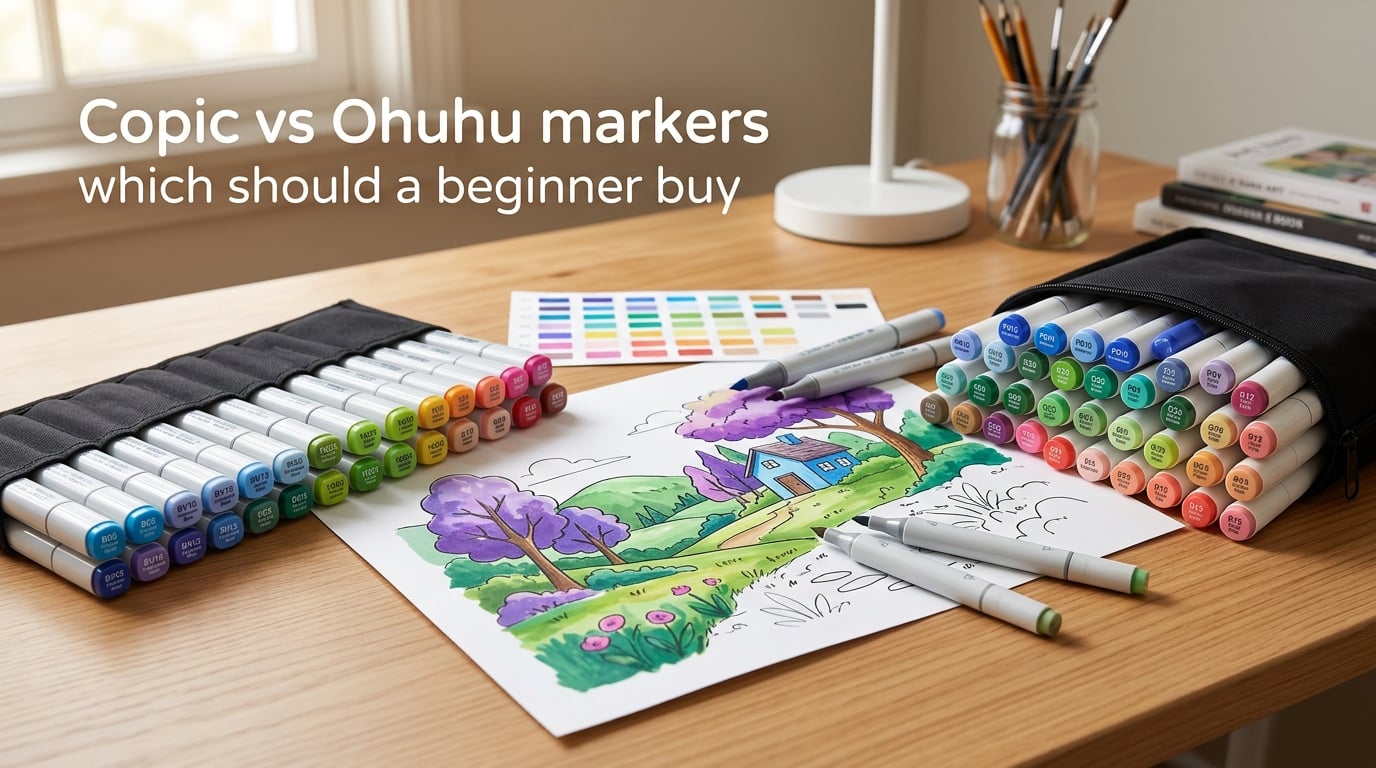
If you’re just getting into alcohol markers, you’ve probably stumbled onto the same debate every beginner faces: Copic or Ohuhu? I remember standing in that exact spot a few years ago, wallet in hand, completely torn between a 24-set of Copics that cost more than my groceries and a massive Ohuhu collection for a fraction of the price.
Here’s the honest truth — there’s no single winner. The right choice depends entirely on your budget, how serious you are about art, and what you plan to create. After testing both brands extensively and spending way too many hours on Reddit’s r/copic and r/Ohuhu communities, I’m going to break down everything you need to know before you buy your first set.
This guide covers ink quality, blending performance, nib types, color range, long-term costs, and a beginner buying strategy that’ll save you money and frustration. Whether you’re coloring adult books, learning illustration, or just curious about what makes these markers so addictive, you’ll walk away knowing exactly which brand fits your needs. Let’s settle the Copic vs Ohuhu markers debate once and for all.
Table of Contents
Quick Verdict: Copic vs Ohuhu for Beginners
For most beginners, Ohuhu markers are the smarter first purchase. They cost significantly less, offer a generous color range, and let you develop your blending techniques without the anxiety of ruining an expensive marker. Once you’ve built foundational skills and know you love the medium, investing in individual Copic markers makes a lot more sense.
Choose Copic if: You’re already committed to art as a career or serious hobby, you need archival-quality ink that won’t fade, or you specifically want the refillable system for long-term savings. Professional illustrators and manga artists often justify the cost because Copic’s consistency and lightfastness are unmatched.
Choose Ohuhu if: You’re exploring alcohol markers for the first time, you want lots of colors without spending hundreds of dollars, or you primarily work on coloring books and hobby projects. Ohuhu’s Honolulu and Oahu lines give you solid performance at beginner-friendly pricing.
The sweet spot many experienced artists recommend? Start with Ohuhu to learn, then gradually replace your most-used colors with individual Copics. That way you get the best of both worlds without blowing your budget upfront. This mixed-brand approach is exactly what Reddit’s artist communities have been recommending for years, and after testing both brands side by side, I agree completely.
What Are Alcohol Markers and Why Brand Matters
Before diving into the comparison, let’s make sure we’re on the same page about what alcohol markers actually are. Unlike water-based markers you used in school, alcohol markers use a dye dissolved in alcohol solvent. This creates vibrant, fast-drying colors that blend smoothly into each other — something water-based markers simply can’t do.
The alcohol solvent evaporates quickly, leaving behind pure pigment on your paper. This is why alcohol markers feel “juicy” when fresh and why they can bleed through regular paper. You need marker paper or a thick sketchbook to get the best results from either brand.
Why does brand matter so much? Because not all alcohol markers are created equal. The quality of the ink formulation, the nib design, the barrel construction, and whether the marker is refillable all vary wildly between brands. These differences directly affect how your art looks and how much you’ll spend over time.
Dual-tip markers — featuring a brush tip on one end and a chisel tip on the other — are standard for both Copic and Ohuhu. The brush tip handles detail work and blending, while the chisel covers large areas quickly. Some Copic models also include a super brush tip that mimics a paintbrush, which many artists prefer for its flexibility. Understanding these basics helps you evaluate what each brand actually offers beyond the marketing hype.
Copic Markers: The Professional Standard
Copic has been the gold standard in alcohol markers since the 1980s. Made by Too Corporation in Japan, these markers were designed from the ground up for professional illustrators, architects, and designers. Every aspect of a Copic marker — from the ink formulation to the nib replacement system — reflects decades of refinement and real-world testing by demanding professionals.
What makes Copic special starts with the ink. Copic’s alcohol-based ink is exceptionally smooth, with consistent color density from the first stroke to the last. The colors are more transparent than Ohuhu’s, which means they layer beautifully. You can build up gradual tones without the muddy buildup that plagues cheaper markers. This transparency is what gives Copic artwork that distinctive luminous quality that’s hard to replicate with other brands.
The refillable design is Copic’s biggest financial advantage for serious users. Each marker can be refilled with Copic Various Ink (sold separately), and a single bottle provides roughly 12 refills. The nibs are also replaceable — if your brush tip gets worn or damaged, you swap it out instead of buying a new marker. Over years of use, this dramatically reduces the per-color cost and means your favorite markers can last essentially forever with proper maintenance.
Copic offers four main marker lines: the Sketch (oval barrel, dual-tip with super brush), the Ciao (round barrel, slightly cheaper with a standard brush tip), the Classic (square barrel, dual broad tips), and the Wide (large chisel tip only). The Sketch is by far the most popular for its ergonomic shape and versatile super brush tip. The Ciao is a solid entry point if you want Copic quality at a slightly lower price, though it holds less ink than the Sketch.
The color range tops out at 358 colors — the largest palette available from any alcohol marker brand. Each color has a specific alphanumeric code (like BG05 for a specific blue-green), and Copic provides color charts and blending guides to help you navigate the system. This organized naming convention makes it much easier to find compatible blending colors and build your collection strategically over time.
Ohuhu Markers: The Affordable Alternative
Ohuhu burst onto the marker scene as a budget-friendly alternative that actually performs. Available primarily through Amazon, Ohuhu markers have exploded in popularity among hobbyists, coloring book enthusiasts, and beginner artists who want to experiment without a massive financial commitment. The brand’s rapid growth comes down to one thing: delivering surprisingly good quality at prices that make Copic owners weep.
The Honolulu line is Ohuhu’s flagship, featuring dual tips with a brush and chisel configuration similar to Copic Sketch markers. The Oahu line offers a brush and fine tip combination instead, which appeals to artists who prefer precision over coverage. Both use alcohol-based ink that produces vibrant, saturated colors at a fraction of Copic’s pricing.
One thing that surprised me during testing: Ohuhu’s ink flow is generous. These markers are “juicy,” as forum users describe them. That generous flow makes blending easier for beginners who haven’t mastered pressure control yet. The trade-off is slightly more bleed-through on thinner papers, so you’ll want to use marker paper or a backing sheet. Some users also report that the ink can feel slightly wetter than Copic, which requires adjusting your technique slightly.
Ohuhu’s color range varies by set, but their largest collections include up to 320 colors — remarkably close to Copic’s 358. The naming system isn’t as standardized as Copic’s alphanumeric codes, which can make color matching and replacement trickier. However, Ohuhu has been improving their color labeling and now includes color charts with most sets. For beginners who are building their collection from scratch, the exact naming convention matters less than having access to a wide range of usable colors.
Forum users on Reddit consistently note that Ohuhu brush tips are stiffer than Copic’s super brush tips. This isn’t necessarily a bad thing for beginners — a stiffer tip gives more control when you’re still developing your hand pressure and blending technique. However, experienced artists who prefer a flexible, paintbrush-like feel often find Ohuhu’s tips limiting for advanced blending techniques. The stiff tip also means you’ll press harder to achieve the same line variation, which can tire your hand during long sessions.
Head-to-Head: Copic vs Ohuhu Comparison
Let’s break down the Copic vs Ohuhu markers comparison across the categories that matter most to beginners. I’ve rated each brand out of 10 for every category based on hands-on testing and community feedback from forums and artist groups.
Ink Quality and Blending
Copic: 9/10 | Ohuhu: 7/10
Copic’s ink is noticeably smoother and more transparent. This transparency allows you to layer colors without creating muddy tones — you can see the paper white showing through, which creates luminous, watercolor-like effects. Ohuhu’s ink is more opaque, meaning it covers the paper more completely in a single pass. Beginners often prefer this because it’s more forgiving, but it limits advanced layering techniques where you want subtle gradations.
Blending is where Copic truly shines. The ink stays workable slightly longer, giving you more time to feather and merge colors before it sets permanently. Ohuhu blends well too, but you need to work faster. On the bright side, Reddit users report that Ohuhu and Copic markers blend with each other surprisingly well, so mixing brands in a single project is absolutely possible. This compatibility is a huge bonus for artists building a mixed collection.
Nib and Tip Quality
Copic: 9/10 | Ohuhu: 7/10
Copic’s super brush tip is the industry benchmark. It responds to pressure like a real paintbrush, going from hairline strokes to broad sweeps with a single tool. The chisel tip is equally refined, with clean edges for filling large areas without streaking. Both tips are replaceable, which means a Copic marker can last indefinitely with proper maintenance. You can even swap between nib types on some models.
Ohuhu’s brush tip is firmer and less responsive to pressure changes. You can still create varied line widths, but the range is narrower and requires more intentional pressure. The chisel tip performs well for coverage tasks and is comparable to Copic’s chisel. The main limitation is that Ohuhu nibs are not officially replaceable — when the tip wears out, the marker’s useful life is essentially over. This is a significant factor for markers you’ll use daily.
Color Range
Copic: 10/10 | Ohuhu: 8/10
Copic’s 358-color system is the most comprehensive in the market, with an intuitive alphanumeric naming convention that helps you find compatible blending colors. Each code tells you the color family and saturation level, making it easy to predict how colors will interact. Ohuhu offers up to 320 colors in their largest sets, which is remarkably close. However, Copic’s system is more organized, with clear color families and documented blending combinations. Ohuhu’s color naming is less standardized, which can confuse beginners trying to match specific shades or rebuild a lost color.
Build Quality and Ergonomics
Copic: 8/10 | Ohuhu: 7/10
Copic markers feel solid and well-constructed. The oval barrel of the Sketch model fits comfortably in hand during long coloring sessions. However, forum users frequently mention that Copic caps can crack over time, especially with heavy daily use. This leads to premature marker death if the ink dries out. Ohuhu’s caps clip on more tightly, which is a genuine practical advantage — your markers stay sealed and fresh longer. The barrel plastic on Ohuhu markers feels slightly cheaper, but functionally it holds up well to regular use.
Price and Value
Copic: 5/10 | Ohuhu: 10/10
This is where the comparison gets stark. A 24-set of Copic Sketch markers costs many times more than a comparable Ohuhu set. Individual Copic markers cost several dollars each. Ohuhu sets of 48, 72, or even 120 colors often cost less than a 24-pack of Copics. For beginners exploring the medium, this price difference is the single biggest factor in the decision. You can literally buy an entire Ohuhu collection for what a small Copic starter set costs.
Long-Term Cost Analysis: The 5-Year Breakdown
Here’s something most comparison articles skip: the long-term math. On the surface, Copic markers seem prohibitively expensive. But when you factor in refills, the equation changes significantly — at least for your most-used colors.
Let’s say you use a specific color heavily for five years. With Ohuhu, you’d likely need to repurchase that marker 3-5 times as the ink runs out. With Copic, you’d buy the marker once plus 2-3 bottles of Various Ink refills. Over time, the per-use cost of Copic markers drops substantially. A bottle of Various Ink provides roughly 12 refills, which means a single bottle can keep a marker running for years of regular use.
However, here’s the catch most beginners overlook: you won’t use every color equally. Many colors in a large set might get used only occasionally. For those rarely-used shades, the Ohuhu approach of repurchasing a cheap marker every year or two makes more financial sense. The refill system only saves money on your most-used 10-20 colors. Everything else is cheaper to replace outright.
The smart strategy? Buy Ohuhu for breadth — lots of colors to experiment with, discover your favorites, and develop your style. Then buy individual Copic markers for your most-used 10-20 colors that need the quality and refillability. This gives you the variety of Ohuhu’s large sets with Copic’s quality and long-term economics where it actually counts. Reddit’s artist communities have been recommending this mixed-brand approach for years, and it’s genuinely the most practical path for beginners who plan to stick with the hobby.
Breaking Down the Numbers
Over five years of active use, here’s roughly what each approach costs. Starting with a medium Ohuhu set and replacing exhausted markers as needed will cost significantly less than building even a small Copic collection from scratch. But if you narrow your heavy-use colors to about 15 shades and buy those in Copic with refills, you’ll spend less over five years than you would replacing those same 15 colors repeatedly in Ohuhu. The crossover point typically happens around year 2-3 for heavy users.
Which Should a Beginner Buy? My Recommendation
After comparing Copic vs Ohuhu markers across every category, here’s my honest buying advice for beginners at different commitment levels. Your situation matters more than any brand loyalty or online debate.
If You’re Exploring the Hobby
Grab an Ohuhu Honolulu set of 48 or 72 colors. This gives you enough variety to experiment with blending, learn color theory basics, and figure out whether alcohol markers are your thing — all without a major investment. Use them on marker paper or Bristol board to get the best experience. Don’t stress about getting the “perfect” set. Your first markers are for learning, not for creating gallery pieces.
If You’re Committed to Improving
Start with a medium Ohuhu set (72-120 colors) and invest in 5-10 individual Copic Sketch markers in colors you use most. Basic blending grays (N0, N2, N4), a warm skin tone set, and your favorite accent colors are good starting points. This mixed approach lets you practice with affordable markers while building a core collection of professional-grade tools. Over time, you’ll naturally discover which colors you reach for most — those become your Copic upgrades.
If You’re Going Professional
Invest in a Copic Sketch starter set of 24-36 colors focused on your specific illustration style, then expand from there. The refillable system, lightfast ink, and replaceable nibs make Copic markers genuinely cost-effective at the professional level. Supplement with Ohuhu for colors you need occasionally but won’t use daily. Professional manga artists and illustrators who produce client work need the archival quality and consistency that only Copic delivers reliably.
Paper matters just as much as the markers themselves. Invest in a dedicated marker pad — Canson XL Marker, Bienfang Graphics 360, or even Copic’s own marker paper all perform well. Regular sketchbook paper will bleed, feather, and waste your expensive ink regardless of which brand you choose. Good paper makes both Copic and Ohuhu perform significantly better.
Common Mistakes Beginners Make with Alcohol Markers
Regardless of which brand you choose, avoid these beginner pitfalls that waste ink and ruin artwork. I made most of these mistakes myself, so learn from my experience instead of the hard way.
Using regular paper. This is the number one mistake. Alcohol markers bleed through thin paper like water through a sieve. Always use marker paper, Bristol board, or at minimum a heavy mixed-media paper. Place a backing sheet underneath to protect the page below. Your markers will also perform noticeably better on proper paper — the ink pools and blends as intended rather than feathering into the fibers.
Overworking the blending. Alcohol markers dry fast. If you keep going back over an area trying to blend, you’ll pill the paper fibers and create a muddy mess. Apply your colors quickly and use a colorless blender or lighter shade to smooth transitions while the ink is still wet. Work in small sections and commit to each stroke — hesitation shows in the final result.
Storing markers horizontally. Store alcohol markers vertically with the caps facing up. This prevents ink from pooling in the caps and keeps the nibs from oversaturating. Both Copic and Ohuhu markers benefit from proper storage orientation. Horizontal storage can also cause uneven ink distribution, making one end of the marker work differently than the other.
Ignoring cap tightness. An improperly sealed marker can dry out within weeks — a costly mistake with Copic markers. Forum users report that Ohuhu caps tend to clip on more securely, while Copic caps sometimes crack with repeated use. Always check that caps click firmly into place after each use. If you hear a crack when capping a Copic marker, inspect it carefully and consider replacing the cap.
Buying too many colors at once. It’s tempting to grab the biggest set available, but having 120 colors when you’re still learning basic blending is overwhelming. Start with a smaller set, master your color mixing, and expand strategically. You’ll save money and actually learn faster with fewer choices.
Frequently Asked Questions
Should I get Copic or Ohuhu markers?
For most beginners, Ohuhu markers are the better starting point. They cost significantly less, offer a wide color range, and let you learn alcohol marker techniques without a large financial commitment. Once you develop your skills and identify your most-used colors, you can upgrade specific shades to Copic markers for their superior blending and refillable design.
Are Ohuhu markers better than Copics?
Ohuhu markers are not better than Copics overall, but they offer better value for beginners and hobbyists. Copics outperform Ohuhu in ink quality, blending smoothness, nib responsiveness, and long-term durability thanks to refills. Ohuhu wins on initial cost and color variety per dollar spent.
Why is Ohuhu so popular?
Ohuhu is popular because it offers alcohol markers that genuinely work at a fraction of Copic pricing. Beginners can get a 72-color set for less than the cost of 24 Copic markers. The quality is good enough for hobby use, coloring books, and learning techniques, making it the go-to recommendation for newcomers to alcohol markers.
Can you mix Copic and Ohuhu markers?
Yes, you can absolutely mix Copic and Ohuhu markers in the same project. Both use alcohol-based ink that’s chemically compatible. Many artists on Reddit report successfully blending colors across both brands. Just be aware that the ink flow and opacity differ slightly, so transitions between brands may require a bit of extra blending work.
Which Ohuhu set is best for beginners?
The Ohuhu Honolulu 48-color dual-tip set is the best starting point for most beginners. It provides enough color variety to practice blending and color theory without overwhelming you with options. If your budget allows, the 72-color set offers better per-marker value and more shades to experiment with.
Do Ohuhu markers have refills?
Some Ohuhu markers have refill options available, but the selection is not as comprehensive as Copic’s refill system. Copic offers Various Ink refills for all 358 colors with precise formulations. Ohuhu’s refill availability varies by color and product line, which is one reason the brand is better suited as an entry point rather than a long-term professional solution.
Final Thoughts on Copic vs Ohuhu Markers
The Copic vs Ohuhu markers debate doesn’t have a universal winner — it has the right choice for your situation. If you’re a beginner who wants to explore alcohol markers without a huge upfront cost, Ohuhu is the clear winner. If you’re an experienced artist ready to invest in professional tools that last years through refills, Copic earns its premium pricing.
My advice? Don’t overthink it. Grab an affordable Ohuhu set, start practicing your blending, and have fun with it. You can always upgrade individual colors to Copic markers later as your skills and preferences develop. The most important thing is that you’re creating art — not which brand is on your marker barrel. Both brands will help you grow as an artist, and the mixed-brand strategy gives you the best of both worlds.