
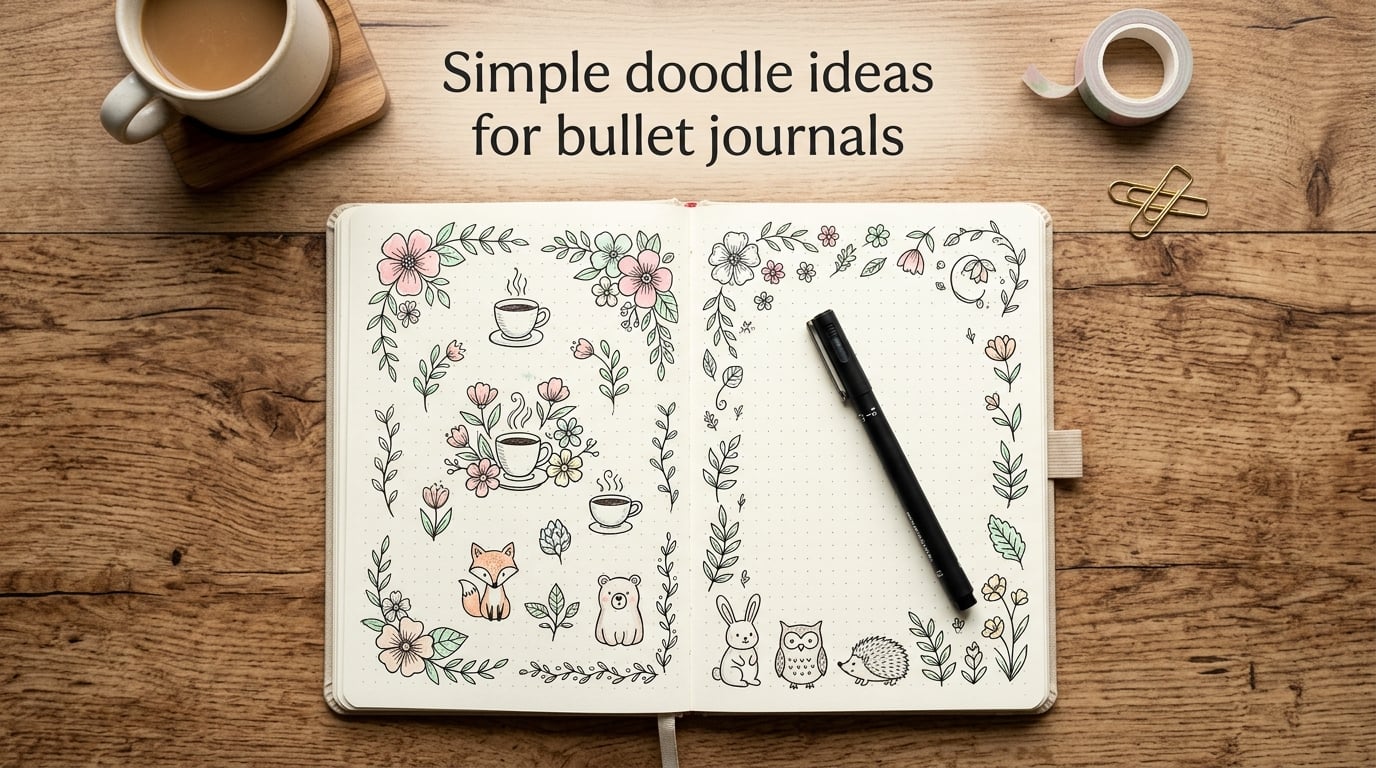
Simple doodle ideas for bullet journals are one of the easiest ways to make your planner pages feel personal and fun — and you do not need any artistic talent to get started. If you have ever stared at a blank page wondering what to draw, or told yourself “I can’t draw,” this guide is for you. We will walk you through over 50 beginner-friendly doodle ideas organized by category, step-by-step tutorials for your first three doodles, and a 30-day challenge to help you build a daily practice.
The secret most experienced bullet journal artists know is that every doodle — no matter how complex it looks — breaks down into a handful of basic shapes: circles, triangles, squares, and lines. Once you learn this shapes framework, you can draw almost anything. This guide will show you exactly how.
Table of Contents
What Supplies Do You Need to Start Doodling?
You do not need expensive art supplies to start adding doodles to your bullet journal. Here is a minimal starter kit:
- A fineliner pen — Sakura Pigma Micron pens (size 05 or 08) are the most popular choice among bullet journal doodlers for their consistent ink flow and archival quality.
- A pencil and eraser — A standard HB mechanical pencil works perfectly for sketching your doodles before inking them.
- Your bullet journal — Any dot grid or lined notebook will do. The paper weight matters more than the brand; look for 120 gsm or higher to prevent bleed-through.
- Optional: a small set of brush pens — Tombow Dual Brush Pens are popular for adding color, but black-and-white doodles look just as charming.
That is genuinely all you need. Many prolific bullet journal doodlers use nothing more than a single black fineliner and their journal.
The Shapes Framework: How Any Doodle Is Just Basic Shapes
This is the single most important concept for beginners, and it is the breakthrough that experienced doodlers say changed everything for them. Every drawing — a flower, a coffee cup, a cat — can be deconstructed into four basic shapes:
- Circles — flower centers, animal heads, coffee cup tops, suns
- Triangles — leaves, pizza slices, tree tops, cat ears
- Squares and rectangles — books, gift boxes, coffee mugs, windows
- Lines — stems, whiskers, banner tails, borders
When you look at a doodle and think “I could never draw that,” try this: break it into shapes first. A mushroom? That is an oval on top of a rectangle. A coffee cup? A trapezoid with a half-circle handle and an oval on top. Once you start seeing shapes, drawing becomes a process of assembling pieces rather than creating something from nothing.
This shapes-first approach is what separates bullet journal doodling from traditional art. You are not learning to draw from scratch — you are learning to combine shapes you already know how to draw.
Warm-Up Exercises to Get Your Hand Moving
Before you jump into doodling your bullet journal pages, spend two to three minutes warming up your hand. This loosens your wrist and helps you draw smoother lines.
Line practice: Draw a row of straight lines, then wavy lines, then zigzag lines across a scrap page. Focus on fluid motion rather than perfection.
Shape practice: Fill a small area with circles, then triangles, then squares. They do not need to be uniform — variation actually makes your doodles look more organic and hand-drawn.
Spirals and loops: Draw loose spirals and figure-eights. This exercise is especially helpful before drawing floral doodles that use curved petal shapes.
These warm-ups take less time than scrolling Pinterest for inspiration, and they will make your actual doodles look noticeably better.
50+ Simple Doodle Ideas for Bullet Journals
Here is a comprehensive collection of easy doodle ideas organized by category. Each category contains four to six beginner-friendly subjects you can start drawing today.
Flower Doodles
Flowers are the most popular bullet journal doodle category for a reason: they are simple, forgiving, and look beautiful even when imperfect.
- Simple daisy — A circle center with five to eight oval petals around it
- Tulip — A U-shape with two curved lines meeting at a point on top, plus a stem
- Sunflower — A larger circle with a grid pattern inside, surrounded by long oval petals
- Rose — A spiral starting from the center, with curved lines wrapping around it to form petals
- Lavender sprig — A long stem with small oval buds clustered along the top two-thirds
- Wildflower bouquet — Three to five different simple flowers grouped together with a ribbon at the base
Leaf and Plant Doodles
Leaves and plants pair beautifully with floral doodles and are some of the easiest subjects to draw because of their organic, forgiving shapes.
- Simple leaf — A pointed oval with a center line for the vein (start here — it is the foundation for every other leaf)
- Eucalyptus branch — A curved stem with small round leaves alternating along each side
- Monstera leaf — A large leaf shape with characteristic holes cut into it
- Cactus — A rounded rectangle with small dots for spines and optional arms
- Succulent — Layered teardrop shapes arranged in a rosette pattern
- Mushroom — A half-circle or oval cap on top of a short rectangular stem, with small dots on the cap
Animal Doodles
Animal doodles seem intimidating until you realize most cute animal drawings use the same simple shapes with small details added for character.
- Cat face — A circle with two triangle ears, three dots for eyes and nose, and curved whiskers
- Bunny — An oval body with two long oval ears and a small round tail
- Bee — An oval body with three stripes, two small wings, and antennae
- Whale — A curved oval body with a tail fin, small eye, and a water spout on top
- Owl — A rounded body with two large circle eyes, a small beak, and feathered chest lines
- Sloth — A round face with curved eyes, a small nose, and long arms hanging from a branch
Food and Drink Doodles
Food doodles are favorites among bullet journalers because they are recognizable even when drawn very simply. These work especially well in meal planning spreads.
- Coffee cup — A trapezoid mug with a half-circle handle and a small heart or swirl in the foam
- Ice cream cone — A triangle cone with two or three circle scoops stacked on top
- Donut — A circle with a smaller circle cut out, decorated with icing drizzle and sprinkles
- Pizza slice — A triangle with a curved crust edge and small circles for toppings
- Bubble tea — A rounded cup with a dome lid, a straw, and small circles at the bottom for boba pearls
- Avocado — A pear shape with a large circle pit in the center
Weather Doodles
Weather doodles are perfect for mood trackers and daily spread decorations. They are some of the simplest shapes you can draw.
- Sun — A circle with radiating lines or triangular rays around it
- Cloud — Three to four overlapping circles forming a cloud shape
- Rain cloud — A cloud with vertical lines or small drops falling beneath it
- Rainbow — Three to four concentric half-circles in decreasing sizes
- Snowflake — A vertical line with angled branches, repeated in a star pattern
- Lightning bolt — A zigzag line that narrows at the bottom
Heart and Love Doodles
Hearts are the most universally recognized doodle shape, and there are more variations than you might think.
- Classic heart — Two half-circles meeting at a point at the bottom
- Heart with arrow — A heart shape with a diagonal line passing through it
- Outlined heart with pattern — A heart outline filled with stripes, dots, or a tiny floral pattern
- Heart chain — Connected hearts in a row, great for borders
- Winged heart — A heart with two small curved wings on top
Cute Face Doodles
Cute kawaii-style faces add personality to any bullet journal page and are surprisingly easy to draw with just a few dots and curves.
- Happy face — A circle with two dots for eyes and a small curved smile
- Starry eyes — A circle face with star-shaped eyes and blushing cheeks (small ovals)
- Sleepy face — A circle with curved closed-eye lines and a small open mouth
- Heart eyes — A circle with heart-shaped eyes and a wide smile
- Surprised face — A circle with wide dot eyes, raised eyebrows, and an “O” mouth
Banner and Border Doodles
Banners and borders frame your bullet journal text and make headers look polished without requiring calligraphy skills.
- Ribbon banner — A rectangle with folded ends that create a 3D ribbon effect
- Washi tape strip — A rectangle with a torn or scalloped edge, optionally filled with a simple pattern
- Scalloped border — A row of connected half-circles along the edge of a box or page
- Vine border — A wavy line with small leaves alternating along its length
- Dot trail border — A line of evenly spaced dots that can curve around any shape
- Flag banner — Pennant triangles hanging from a horizontal line
Seasonal and Holiday Doodles
Seasonal doodles let you theme your monthly spreads. These change throughout the year and keep your journal feeling fresh.
- Spring: Cherry blossom branch, rain boots, umbrella, baby chick
- Summer: Sunglasses, watermelon slice, popsicle, beach ball, flip-flops
- Fall: Acorn, pumpkin, apple, falling leaves, hot cocoa mug
- Winter: Snowman, mittens, Christmas tree, ornament, candy cane
Simple Object Doodles
Everyday objects make great doodle subjects because you can look at the real thing for reference while you draw.
- Book — A rectangle with a curved spine and a few lines for pages
- Camera — A rounded rectangle with a circle lens and a small viewfinder on top
- Light bulb — A circle on top of a small rectangle base, with a filament squiggle inside
- Star — A five-pointed star drawn with five straight lines
- Key — A circle head with a rectangular shaft and small teeth at the end
- Pencil — A long rectangle with a triangular tip and a small eraser rectangle at the top
Step-by-Step Doodle Tutorials for Beginners
These three tutorials walk you through drawing some of the most popular bullet journal doodles. Follow each step in order, and remember: sketch lightly in pencil first, then go over your lines with a fineliner.
How to Draw a Simple Leaf
Step 1: Draw a slightly curved vertical line — this is your stem and center vein.
Step 2: Starting near the top of the line, draw a curved line going out to the left and back to meet the stem about halfway down. This creates one half of the leaf.
Step 3: Mirror the same curved line on the right side to complete the leaf shape.
Step 4: Add small diagonal lines branching off the center vein for detail. Erase your pencil guidelines, and you have a finished leaf.
This leaf is the foundation for dozens of variations — elongate it for a eucalyptus leaf, round it for a bay leaf, or add a serrated edge for a holly leaf.
How to Draw a Simple Flower
Step 1: Draw a small circle in the center of where you want your flower — this is the pistil.
Step 2: Around the circle, draw five oval shapes radiating outward. Space them evenly but do not worry about perfection; slight variation looks more natural.
Step 3: Draw a long curved line extending down from the flower for the stem.
Step 4: Add two small leaves on the stem using the leaf technique from above.
Step 5: Add tiny details inside the center circle — a few dots or a small spiral pattern gives the flower dimension.
How to Draw a Coffee Cup
Step 1: Draw a trapezoid shape — wider at the top, narrower at the bottom. This is the cup body.
Step 2: On the right side, draw a “C” shape extending outward — this is the handle.
Step 3: Draw an oval across the top of the trapezoid to represent the opening of the cup.
Step 4: Inside the oval, draw a small heart or a swirl to represent latte art or foam.
Step 5: Add a small rectangular saucer beneath the cup, and optionally draw steam lines rising from the top — two or three wavy vertical lines.
Once you have mastered this basic coffee cup, try varying the shape: taller and thinner for a to-go cup, rounder for a tea cup, or wider for a bowl.
Where to Put Doodles in Your Bullet Journal Spreads
One question beginners ask often is where doodles actually go in a spread. Here are the most common placements:
- Page headers and titles — Add a small doodle next to your monthly or weekly header to give it personality
- Margins and corners — Small doodles in empty corners prevent blank space from looking unfinished
- Inside tracker boxes — Replace checkmarks in habit trackers with tiny themed doodles
- Section dividers — A vine or banner doodle can visually separate different sections of a spread
- Around text blocks — Small leaves or flowers framing your to-do lists add charm without cluttering functional space
- Full-page backgrounds — For decorative spreads, fill the entire background with a repeating doodle pattern
The key principle is that doodles should enhance readability, not compete with it. Keep functional areas clean and use doodles in decorative space.
30-Day Doodle Challenge to Build Your Skills
A daily doodle practice is the fastest way to improve. This 30-day challenge gives you one small prompt per day. Each doodle should take five to ten minutes.
- Day 1–5: Your favorite flower, a simple leaf, a coffee cup, a cloud, a heart
- Day 6–10: A cat face, a star, a book, a candle, a cactus
- Day 11–15: A mushroom, a donut, a sun, a bee, a banner
- Day 16–20: A pumpkin, a pair of sunglasses, a watermelon slice, a camera, a key
- Day 21–25: A snowman, a gift box, a rainbow, a moon, a music note
- Day 26–30: A whale, a succulent, an ice cream cone, a light bulb, a mini bouquet combining your favorites
By day 30, you will have a collection of 30 doodles and noticeably more confidence. Many bullet journalers who complete this challenge say they stopped needing references for their most-used doodles by the third week.
Common Beginner Mistakes to Avoid
These are the pitfalls that trip up most new bullet journal doodlers. Knowing about them in advance will save you frustration.
Comparing yourself to Instagram. The polished spreads you see online are created by people who have been doodling for months or years. Their day-one doodles looked just like yours. Focus on your own progress, not someone else’s highlight reel.
Starting with complex illustrations. If your first attempt is a detailed portrait, you will get discouraged. Start with the simplest shapes in each category and build up gradually.
Using the wrong paper. Thin paper causes ink to bleed through, which ruins the page underneath and kills motivation. Use a journal with at least 120 gsm paper.
Pressing too hard. Heavy pressure creates harsh lines and makes it hard to erase pencil guidelines. Use a light touch, especially when sketching the initial outline.
Not practicing warm-ups. Skipping hand warm-ups is like stretching before exercise — your lines will be shakier and your shapes less fluid. Two minutes of circles and lines makes a visible difference.
Doodling for Focus and Mindfulness
Beyond making your bullet journal look appealing, doodling has genuine cognitive benefits. Research suggests that doodling while listening can improve information retention by up to 29 percent. The repetitive, low-stakes motion of drawing simple shapes keeps your hands busy and your mind engaged without requiring the kind of focus that pulls attention away from other tasks.
Many people with ADHD report that daily doodling helps them stay consistent with bullet journaling because it turns a purely functional system into something they look forward to opening each day. The five-minute daily practice is short enough to feel manageable, and the visual progress of filling a page with doodles provides the kind of immediate reward that supports habit formation.
If you have ever felt restless during meetings, lectures, or quiet work sessions, keeping a small doodle page in the margin of your journal is a productive outlet that is far less distracting than scrolling your phone.
Frequently Asked Questions
How can a beginner start bullet journaling?
Start with the basics: get a dot grid notebook and a fineliner pen. Learn the core bullet journal signifiers (bullet points for tasks, dashes for notes, circles for events) and create a simple monthly spread. Add doodles gradually — begin with basic shapes like flowers and leaves, and use the shapes framework to build complexity over time.
Is bullet journaling good for ADHD?
Many people with ADHD find bullet journaling helpful because it combines task management with creative expression. The rapid logging system captures thoughts quickly, while doodling provides a calming, focused activity. The key is keeping it simple — avoid elaborate setups that feel like chores, and focus on the parts you enjoy.
Is doodling an ADHD thing?
Doodling is common among people with ADHD, but it is not exclusive to ADHD. Anyone can benefit from doodling as a focus aid. Research shows that doodling during passive activities (listening, waiting) helps maintain arousal levels and prevents the mind from completely disengaging. For people with ADHD, it can be a particularly effective self-regulation tool.
What are common mistakes to avoid when bullet journaling?
The biggest mistakes are overcomplicating your system before mastering the basics, comparing your spreads to social media, using low-quality paper that causes ink bleed, and giving up too early. Start simple, focus on function over aesthetics, and give yourself permission to make messy pages. Consistency matters far more than perfection.
Do you need to be good at art to bullet journal?
Absolutely not. Bullet journaling is about organization and personal expression, not artistic skill. The doodles in this guide are designed for complete beginners who have never drawn before. Every doodle breaks down into basic shapes — circles, triangles, squares, and lines — that anyone can draw. Your skills will improve naturally with practice.
What pens are best for bullet journal doodles?
A Sakura Pigma Micron fineliner in size 05 or 08 is the most recommended pen for bullet journal doodles. It produces clean, consistent lines and the archival ink does not bleed through quality paper. For adding color, Tombow Dual Brush Pens are popular but optional — many beautiful bullet journals use only black ink.
How do I draw simple flowers for a bullet journal?
Start with a small circle for the center, then draw five oval petals around it. Add a curved stem line below and two small leaves on the stem. For a rose, begin with a tight spiral and add curved lines around it to form petals. Practice the basic daisy first — it is the simplest flower doodle and builds confidence for more complex varieties.
Where should I put doodles in my bullet journal?
Common placements include next to page headers, in empty margins and corners, inside habit or mood tracker boxes, as section dividers between tasks, and around text blocks as decorative framing. The key rule is that doodles should enhance readability — keep functional areas clean and use doodles in decorative or empty space.
Start Doodling Today
Simple doodle ideas for bullet journals are everywhere once you know how to look at the world through the shapes framework. Flowers are circles and ovals. Animals are circles with triangles. Coffee cups are trapezoids with handles. Every doodle in this guide breaks down into shapes you can already draw.
Pick three doodles from the categories above — a flower, a leaf, and a coffee cup are great starting points — and try the step-by-step tutorials. Then commit to the 30-day challenge. In one month, you will have a collection of doodles you are proud of, and your bullet journal will be a place you genuinely enjoy opening every day.
The hardest part is not learning to draw. It is giving yourself permission to be a beginner. Start today, start imperfect, and trust that the practice will take care of the rest.