
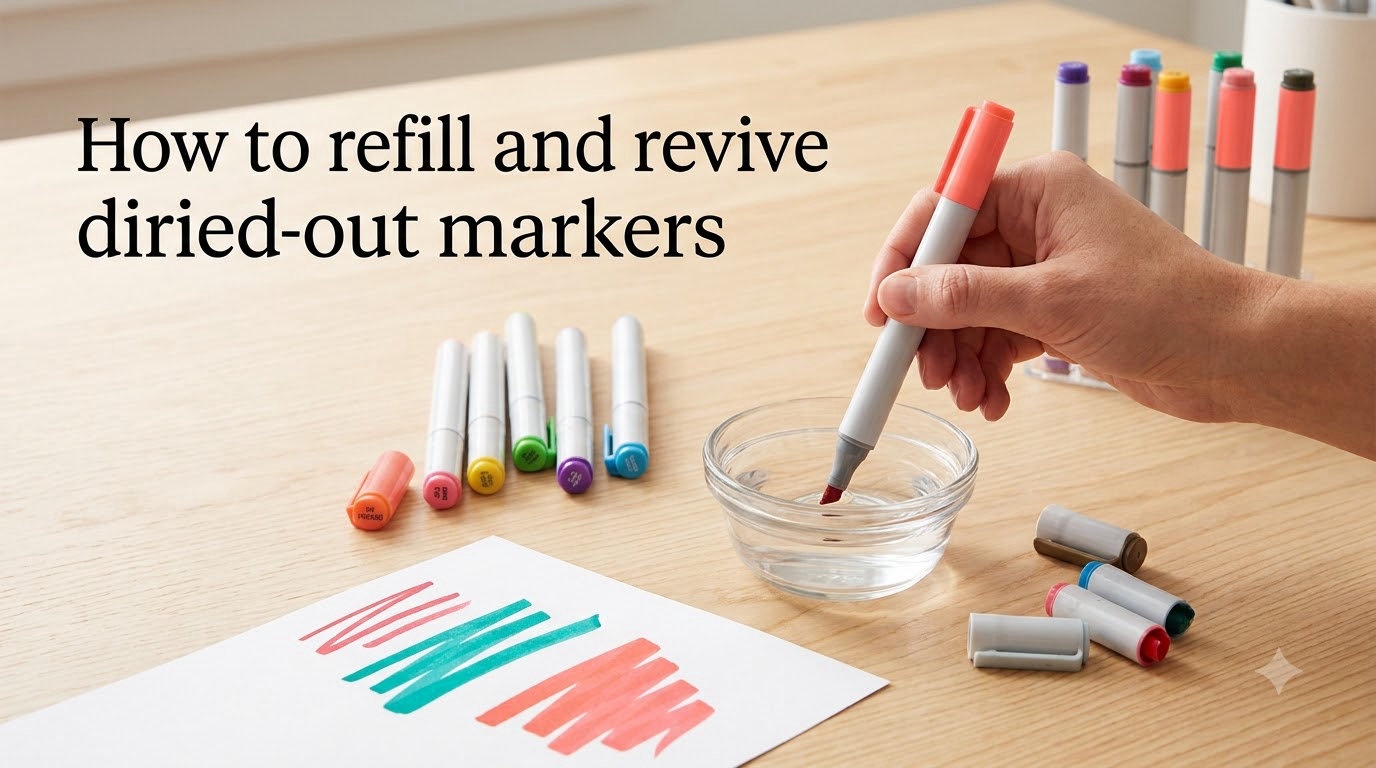
Learning how to refill and revive dried out markers saves real money and rescues the ones you actually like. I’ve been rescuing dead Sharpies, dried-out Crayola sets, and expensive Copic art markers for years, and most can come back to life in under an hour with stuff you already have at home. This guide walks through exactly what to do, separated by marker type, plus a clear test for when to give up and replace a marker instead.
If you only have 60 seconds, skip to the Quick Answer below. Everyone else, scroll on for the science, the marker-type diagnosis, and the four revival methods that actually work.
Table of Contents
Quick Answer: How to Refill and Revive Dried Out Markers
Most dried-out markers can be revived with one of three household solvents. Match the solvent to your marker type:
- Dry-erase markers: Pour 91% isopropyl alcohol into the barrel until the felt core is submerged, recap, and wait 10 minutes. Test on a whiteboard before you throw the marker out.
- Permanent and alcohol-based markers (Sharpie, Copic, Prismacolor): Soak the nib in 90-99% isopropyl alcohol for 15-30 minutes, replace the cap tightly, and let it rest tip-down overnight so capillary action pulls solvent back into the ink reservoir.
- Water-based markers (Crayola, highlighters, washable markers): Soak the nib in warm distilled water for 15 minutes, then recap and store tip-down for 2-4 hours. For stubborn cases, swap distilled water for a 50/50 mix of warm water and 90% isopropyl alcohol.
- Refilling (not reviving): Refillable art markers like Copic, Chartpak, and some Sharpie Industrial models accept manufacturer refill ink, dropped straight into the barrel via the nib or a refill port.
Mark in your calendar that prevention is the real win. Store markers horizontally, keep caps on, and a damp sponge in the storage bin keeps humidity high enough that markers stay fluid for years.
Why Markers Dry Out: The Science in 60 Seconds
Every marker has three parts: a plastic barrel, a porous felt or fiber nib (the writing tip), and an inner reservoir that holds the ink. The ink itself is a mix of pigment or dye and a solvent, which keeps it liquid and flowing.
Capillary action is the force that pulls ink from the reservoir up into the nib and onto the page. When the cap is off, or the cap seal is broken, the solvent slowly evaporates. Once the solvent is gone, the pigment or dye dries and clogs the pores of the nib.
Reviving a dried-out marker works because we reintroduce the missing solvent. The solvent dissolves the dried pigment and capillary action carries the reconstituted ink back to the tip. Refilling, on the other hand, means adding fresh ink into a refillable barrel, which only works on markers engineered with a refill port.
Identify Your Marker Type Before You Try Anything
Using the wrong solvent is the #1 reason revival attempts fail. Water won’t dissolve an alcohol-based pigment, and alcohol can ruin a water-based dye marker. Take ten seconds to identify what you’re working with.
The easiest test: look at the label. Most markers list their base. Sharpie Permanent is alcohol-based. Crayola Washable is water-based. Expo and most whiteboard markers are alcohol-based with a specialty dry-erase ink. Copic and Prismacolor Premier are alcohol-based artist-grade markers with refillable barrels.
If you can’t read the label, smell the marker tip. Alcohol-based markers have a strong solvent smell. Water-based markers smell faintly sweet or like nothing at all.
| Marker Type | Solvent | Revival Method | Refillable? |
|---|---|---|---|
| Dry-erase (Expo, BIC) | Isopropyl alcohol | Alcohol soak | No (but ink is replaceable) |
| Permanent Sharpie, alcohol-based | Isopropyl alcohol | Alcohol soak, tip-down | Sharpie Industrial only |
| Copic, Prismacolor, Chartpak | Alcohol (proprietary) | Manufacturer refill ink | Yes |
| Crayola, washable markers | Distilled water | Water soak, 2-4 hr rest | No |
| Highlighters (most brands) | Water | Warm water soak | No |
| Paint markers (acrylic, oil-based) | Depends on paint base | Often not salvageable | Rare |
Should You Revive or Replace? A Quick Diagnostic
Not every dried-out marker is worth saving. Before you spend 30 minutes reviving a marker, run through this three-question check:
- Has the cap been off for more than a year? If yes, the pigment is likely fully crystallized in the nib. Soaking will help, but flow may never be as smooth as new.
- Is the nib frayed, bent, or moldy? Replace it. A damaged nib will never write evenly, no matter how much solvent you add.
- Is the marker cheap and easy to replace? A 12-pack of Crayola markers costs less than the rubbing alcohol you’d use to revive all 12. Replace and recycle.
Revive when the marker is expensive (Copic, Prismacolor, Sharpie Industrial), you only need one more session of use, or the marker is discontinued and hard to find. Replace when the nib is damaged, the marker has been dry for over a year, or the cost of supplies exceeds a replacement.
Method 1: Revive Dried-Out Dry-Erase Markers
Dry-erase markers are some of the easiest to bring back because their ink is alcohol-based and the nib is a forgiving felt cylinder. You’ll need 91% isopropyl alcohol, paper towels, and about 10 minutes.
Step 1. Remove the cap and set the nib aside. Pour rubbing alcohol into the marker barrel until the felt core is fully submerged, usually about 1/4 inch of liquid at the bottom.
Step 2. Reassemble the nib and cap. Press the cap on firmly. A loose cap is what dried the marker out in the first place.
Step 3. Wait 10 minutes. Lay the marker tip-down on a paper towel so gravity helps pull the alcohol into the nib.
Step 4. Uncap and scribble on a whiteboard or scrap paper. If the line is faint, recap and wait another 15 minutes. If the line is strong, you’re done.
For a dry-erase marker that’s been dead for months, repeat the soak once and let it sit overnight. I’ve revived Expo markers that had been sitting in a supply closet for over a year with this method.
One teacher on r/DryEraseMarkers reported opening a brand-new pack of dried markers that had been stored properly. The rubbing-alcohol soak brought all of them back. The cap seal wasn’t the issue, just slow evaporation in dry storage conditions.
Method 2: Revive Dried-Out Permanent and Alcohol-Based Markers
Permanent markers like Sharpie and art markers like Copic respond best to 90-99% isopropyl alcohol. Skip the 70% stuff, it’s too watered down to dissolve dried pigment effectively.
Step 1. Pour 90% or higher isopropyl alcohol into a small cup, just deep enough to submerge the nib. A shot glass works perfectly.
Step 2. Stand the marker nib-down in the alcohol. Let it soak for 15-30 minutes. The nib will absorb alcohol and turn darker as dried pigment dissolves.
Step 3. Remove the marker, recap it tightly, and store it tip-down overnight. Gravity and capillary action will pull the alcohol deep into the reservoir.
Step 4. The next morning, uncap and test on scrap paper. If the line is still weak, soak the nib again for another 30 minutes and repeat the rest period.
For Sharpie markers, an old wikiHow reader named Misty Walker Chase shared a tip that helped her family: “I have 3 autistic children who used to go through a pack of markers a day because they leave the tops off. Used to throw them away but now we save a lot of money.” Her routine is the same one above, repeated every time a cap gets lost.
For Sharpies, never use acetone or nail polish remover. The solvent will dissolve the plastic barrel.
Method 3: Revive Water-Based Markers (Highlighters and Crayola)
Water-based markers need water, not alcohol. Distilled water is the right choice because tap water contains minerals that can clog the nib over time.
Step 1. Warm a small cup of distilled water. Warm, not hot, you want it slightly above room temperature so the water moves faster through the nib pores.
Step 2. Soak the nib in the warm water for 15 minutes. For Crayola markers with a hard plastic nib holder, you can also submerge just the nib end.
Step 3. Remove, recap tightly, and lay the marker tip-down on a paper towel. Let it rest 2-4 hours so capillary action pulls water into the reservoir.
Step 4. Test on scrap paper. If the line is uneven or pale, repeat the soak once.
For stubborn highlighters and Crayola markers, swap distilled water for a 50/50 mix of warm water and 90% isopropyl alcohol. Marcus Chen, who tested three revival methods on 12 dried highlighters, found that the 50/50 blend delivered the smoothest, most consistent lines. The water rehydrates the dye, and the alcohol helps break down any pigment residue on the nib surface.
Batch revival tip for classrooms: Soak 20 markers at once by laying them tip-down in a shallow baking dish filled with 1/4 inch of warm distilled water. Cover with plastic wrap to slow evaporation, wait 30 minutes, then stand them upright in a cup for 2 hours. One teacher reported reviving a full classroom set in a single afternoon this way.
Method 4: Refill a Marker (Not Just Revive It)
Refilling is different from reviving. When you refill, you add new ink to a refillable barrel. When you revive, you rehydrate dried ink that’s still in the marker. Refilling only works on markers engineered with a refill system, which is mostly artist-grade brands.
For Copic markers: Copic sells 12 mL refill bottles in every color they make. The refill process takes about 30 seconds. Pull the nib straight out with needle-nose pliers, drip 1-2 mL of refill ink directly into the barrel, replace the nib, and let the marker rest nib-down for 5 minutes. The marker is ready to use.
For Chartpak and Prismacolor Premier: These use a similar nib-pull system. Pull the nib, drop in 1-2 mL of the manufacturer’s refill ink, and reassemble.
DIY refill for non-refillable markers (Sharpie, Crayola): Not officially supported, and we don’t recommend it. Generic India ink or drawing ink rarely matches the original marker’s chemistry. Pigment particles can clog the nib, and water-based ink in an alcohol-based marker will separate. If the marker is cheap, replace it. If it’s a discontinued color, search for a Copic or Prismacolor equivalent and buy the refillable version.
One important safety note: never mix ink types. Dropping water-based ink into an alcohol-based marker will damage the nib and the barrel lining.
Common Mistakes That Ruin Marker Revival
Most revival failures come from these five mistakes:
- Using the wrong solvent. Water in an alcohol marker, or alcohol in a water marker, won’t dissolve the dried pigment and may damage the nib.
- Soaking too long. Leaving a marker submerged in alcohol for hours can dissolve the glue that holds the nib in place. Stick to 15-30 minute soaks.
- Not recapping tightly. A loose cap lets solvent evaporate as fast as you add it. Press the cap until you hear the click.
- Storing the marker tip-up after reviving. Gravity works against capillary action. Always store freshly revived markers tip-down for at least 2 hours.
- Forcing a damaged nib. If the nib is bent, frayed, or moldy, no amount of soaking will fix it. Replace the marker.
How to Store Markers So They Don’t Dry Out Again
Prevention is faster than revival. These seven storage habits keep markers fluid for years:
- Cap every marker every time. A 5-second habit that adds months of life.
- Store markers horizontally. Vertical storage pulls solvent to one end of the reservoir. Horizontal storage keeps the nib and the reservoir evenly saturated.
- Add a damp sponge to the storage bin. The sponge keeps humidity around 60-70%, which slows evaporation dramatically. One teacher reported her highlighters lasting 3 years this way.
- Keep markers out of direct sunlight. Heat and UV both break down ink and accelerate solvent loss.
- Avoid extreme temperatures. Don’t store markers in a hot car or freezing garage. Both destroy the nib.
- Use a marker holder or tray. A simple slotted tray keeps caps from going missing.
- Buy refillable markers for expensive colors. A single Copic marker with refill bottles lasts years and pays for itself.
Frequently Asked Questions
How do you revive a dried out marker?
Match the solvent to your marker type. For dry-erase and alcohol-based markers (Sharpie, Copic), soak the nib in 90% isopropyl alcohol for 15-30 minutes, then rest tip-down for 2-4 hours. For water-based markers (Crayola, highlighters), soak in warm distilled water for 15 minutes, then rest tip-down for 2-4 hours.
Can dried out markers be revived?
Yes, most dried-out markers can be revived if the nib is intact and the marker has not been dry for more than a year. Capillary action will pull solvent back into the reservoir and dissolve dried pigment. Markers with frayed, bent, or moldy nibs cannot be revived.
How do you fix a dried out Sharpie?
Soak the Sharpie nib in 90% or higher isopropyl alcohol for 15-30 minutes. Recap tightly and store tip-down overnight. Test on scrap paper the next morning. Repeat the soak once if the line is still weak. Never use acetone or nail polish remover, which dissolves the plastic barrel.
How to revive a highlighter that has dried out?
Soak the highlighter nib in warm distilled water for 15 minutes. Recap and rest tip-down for 2-4 hours. For stubborn cases, swap the water for a 50/50 mix of warm distilled water and 90% isopropyl alcohol. Highlighters respond well to batch revival in a shallow dish of warm water.
How do you fix a dried out Crayola marker?
Soak the Crayola nib in warm distilled water for 15 minutes, then recap and rest tip-down for 2-4 hours. Crayola markers are water-based, so never use alcohol, which can damage the nib adhesive. For very stubborn cases, soak twice with a 30-minute rest between soaks.
How to refill a Copic marker?
Pull the Copic nib out with needle-nose pliers. Drip 1-2 mL of Copic 12 mL refill ink (matching color) directly into the barrel. Replace the nib and let the marker rest nib-down for 5 minutes. The marker is ready to use. Each refill bottle fills a marker about 12-14 times.
Does soaking a marker in alcohol work?
Soaking works for alcohol-based markers (Sharpie, Copic, Expo dry-erase) because alcohol dissolves dried alcohol-based pigment. It does not work for water-based markers like Crayola or most highlighters, where alcohol can damage the nib adhesive and leave the pigment stranded.
Final Thoughts
Knowing how to refill and revive dried out markers turns a frustrating dead-marker pile into a working set again, often in under an hour. The key is matching the solvent to your marker type and giving capillary action enough time to work. Refilling extends the savings even further on artist-grade markers like Copic and Prismacolor, where a single refill bottle fills a marker a dozen times.
Pick up your dried markers, grab a bottle of isopropyl alcohol or some distilled water, and run through the method that matches your marker type. You’ll be surprised how many come back. Once you’ve revived them, store them horizontally with the caps on, and they’ll be ready the next time you reach for them.