
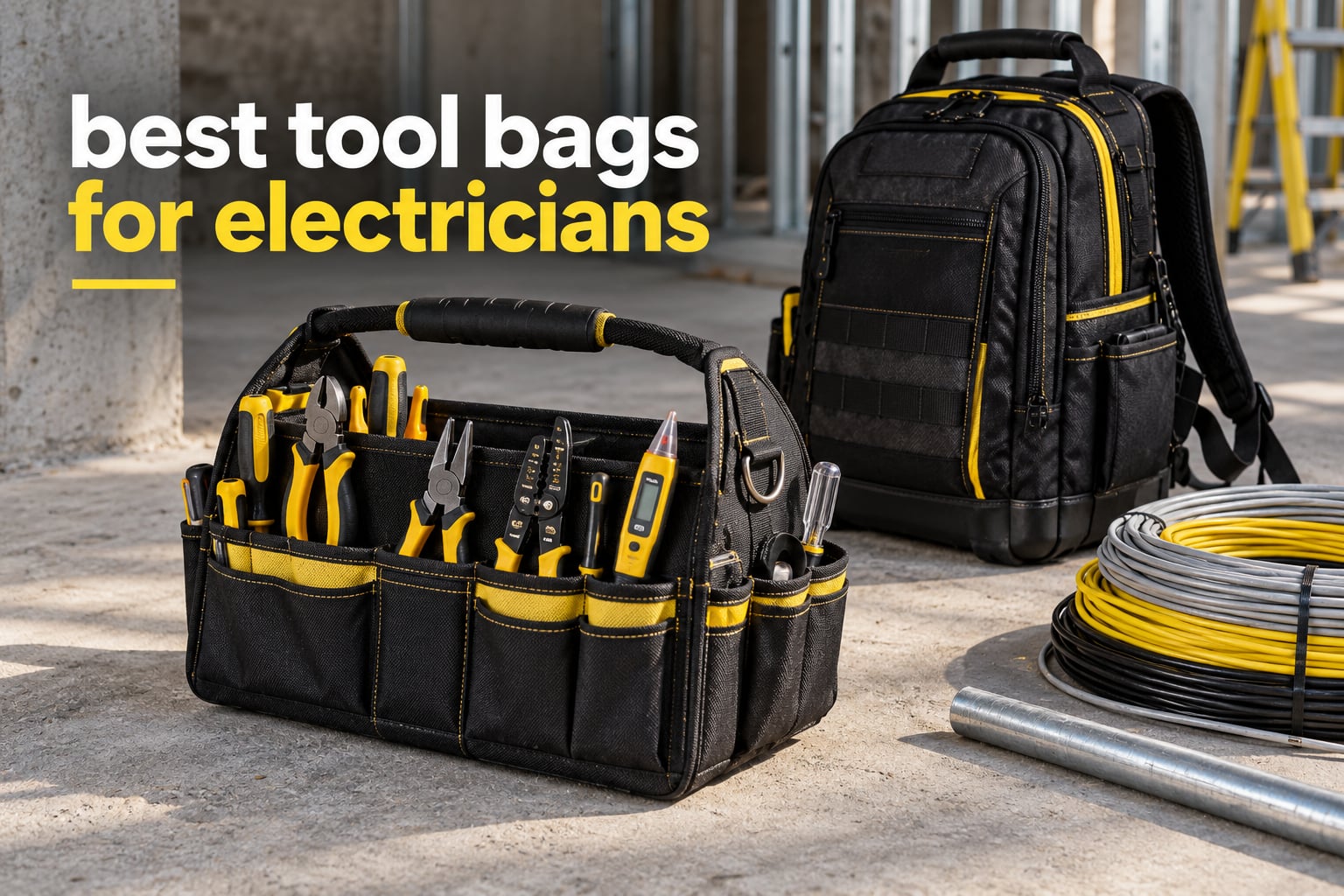
Ask any electrician what ruins a good week, and the answer is rarely the job itself. It is the tool bag. A pocket that sags under a pair of channel pliers, a tote that tips over on a gravel drive, or 30 pounds of tools riding on a shoulder strap while you climb an extension ladder — those are the problems that add an hour a day and never show up on a job report. I went through twelve of the most-reviewed bags sold today, checked every specification against the listing, and read what owners say after years of daily use rather than after a week.
This roundup covers the best tool bags for electricians in 2026, from open-top carriers that stay upright on wet ground to backpacks with molded bases and hi-vis interiors. Every bag here carries a hard pocket count, a stated empty weight, and a stated material, because those three numbers decide whether a bag works for your kind of day. Where a listing has a weakness, I say so — an empty weight of nine pounds is a real cost on a ladder no matter how good the rest of the bag is.
The forums agree on one thing. In r/electricians threads about tool bags, the recurring line is that the devil is in the details, because what matters is not the number of pockets but which slots they are and whether they hold their shape under load. Owners also repeat a second truth: layout beats branding. A bag you can assign a tool to is worth more than a bag with twice the pockets and no system.
Table of Contents
Top 3 Tool Bags for Electricians (October 2026)

Klein 55421BP-14 Backpack
- 39 interior pockets
- Hard molded base and front pocket
- 6 lb empty
All 12 Bags Compared Side by Side in 2026
| Product | Specs | Action |
|---|---|---|
| Klein Tools 55421BP-14 Backpack |
|
Check Latest Price |
 Veto Pro Pac Tech Pac Backpack Veto Pro Pac Tech Pac Backpack |
|
Check Latest Price |
 Klein Tools 55485 Tool Master Klein Tools 55485 Tool Master |
|
Check Latest Price |
 Klein Tools 5541610-14 Shoulder Bag Klein Tools 5541610-14 Shoulder Bag |
|
Check Latest Price |
 CLC Work Gear 1530 Open Carrier CLC Work Gear 1530 Open Carrier |
|
Check Latest Price |
 CLC 1132 75-Pocket Backpack CLC 1132 75-Pocket Backpack |
|
Check Latest Price |
 DEWALT DWST560102 Backpack DEWALT DWST560102 Backpack |
|
Check Latest Price |
 Veto Pro Pac TP-XXL Tote Veto Pro Pac TP-XXL Tote |
|
Check Latest Price |
 Occidental Leather 5589 Case Occidental Leather 5589 Case |
|
Check Latest Price |
 Veto Pro Pac Tech OT-MC Tote Veto Pro Pac Tech OT-MC Tote |
|
Check Latest Price |
 DEWALT DWST560105 Tote DEWALT DWST560105 Tote |
|
Check Latest Price |
 Kowsinde 16 Inch Open Tote Kowsinde 16 Inch Open Tote |
|
Check Latest Price |
1. Klein Tools 55421BP-14 Backpack: The Most Proven Pick
Klein Tools 55421BP-14 Tool Backpack, 39 Pockets, Black/Orange/Gray
39 interior pockets
6 lb empty
14.5 x 7.25 x 20 inch
Molded bottom
Pros
- 39 interior pockets plus a large opening for power tools
- Hard molded front pocket protects safety glasses
- Fully molded bottom protects contents from the elements
- Small zipper pouch for small parts and tools
- Interior pockets double as screwdriver or wrench organizers
Cons
- Some smaller exterior pockets are shallow
- Backpack format means contents get dug through rather than seen
This is the bag I keep coming back to, and it earned the top slot on evidence rather than hype: a 4.7 average across more than five thousand reviews is the largest installed base of any bag in this roundup. Owners describe years of daily carry, and the 84 percent five-star share in the rating distribution tells you the complaints are about pocket depth rather than failure. The molded bottom is the part that quietly saves you the most time, because you can set the bag on wet concrete or a job trailer floor without thinking about it.
The large opening at the top is genuinely unusual for a 39-pocket backpack. Most forty-pocket designs are a solid wall of sleeves you read like a spreadsheet. This one opens into a cavity where a driver or a small saw can sit, with the interior pockets ringing the walls around it. I found that pairing a full complement of screwdrivers in the interior sleeves with power tools in the main bay keeps both categories visible.
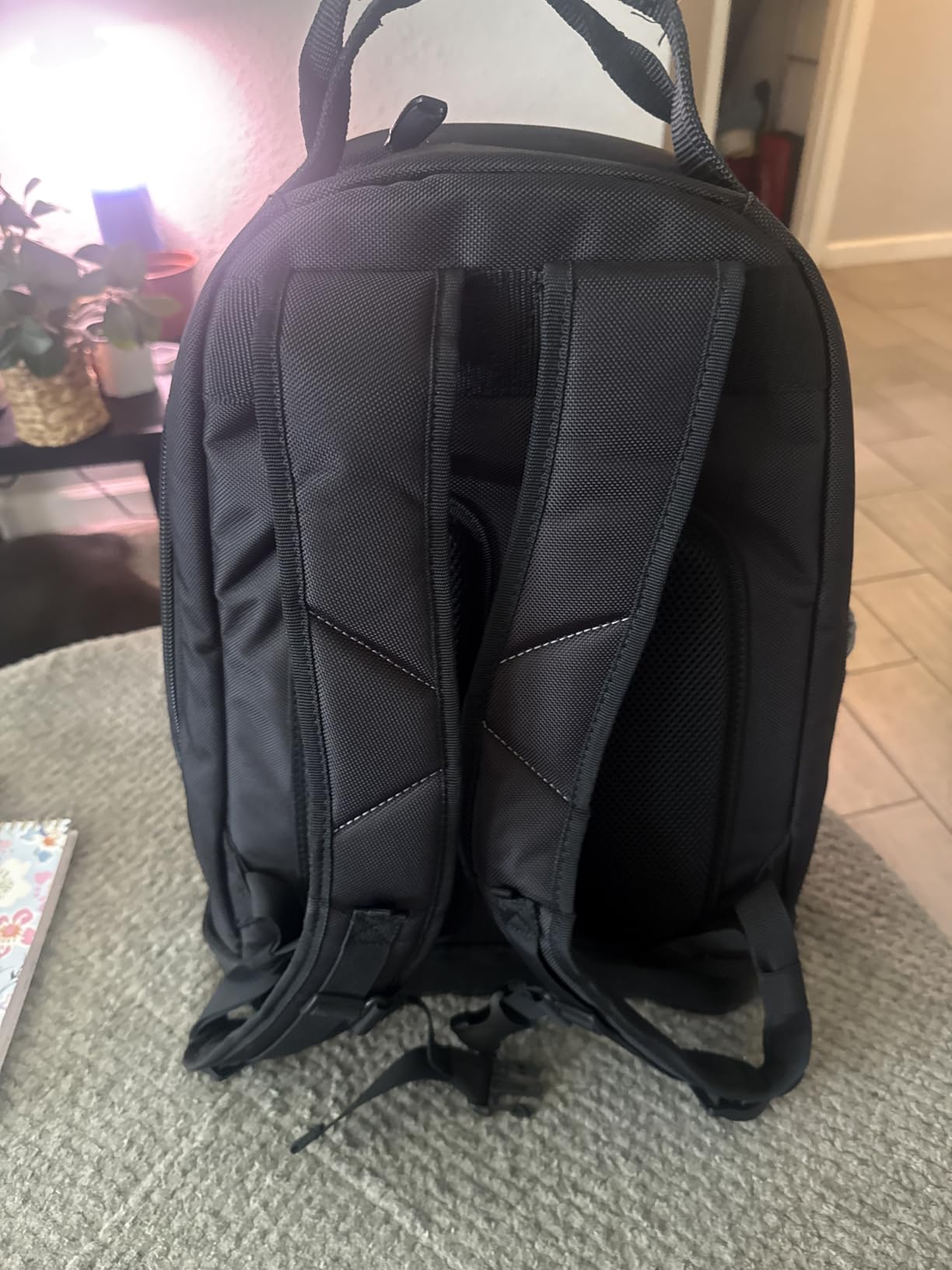
Material is listed as polyester with a fully molded bottom, and the stitching holds up at the stress points where cheaper bags fail first. The listing recommends a maximum of 5 kg, which is a sensible guide for a day of hand tools plus a couple of cordless batteries. The hard molded front pocket is the detail I did not expect to care about, and it does exactly what it says: safety glasses sit in a rigid cavity instead of being crushed by a box of wire connectors.
The honest drawback is access speed. On an open-top carrier you look down and grab; here you open a flap and dig, which adds a few seconds every time. If you are running a service call where you need a voltage tester in your hand while the panel is live, that friction repeats all day. The smaller exterior sleeves are also shallow, so they take drivers and probes but not large pliers handles.
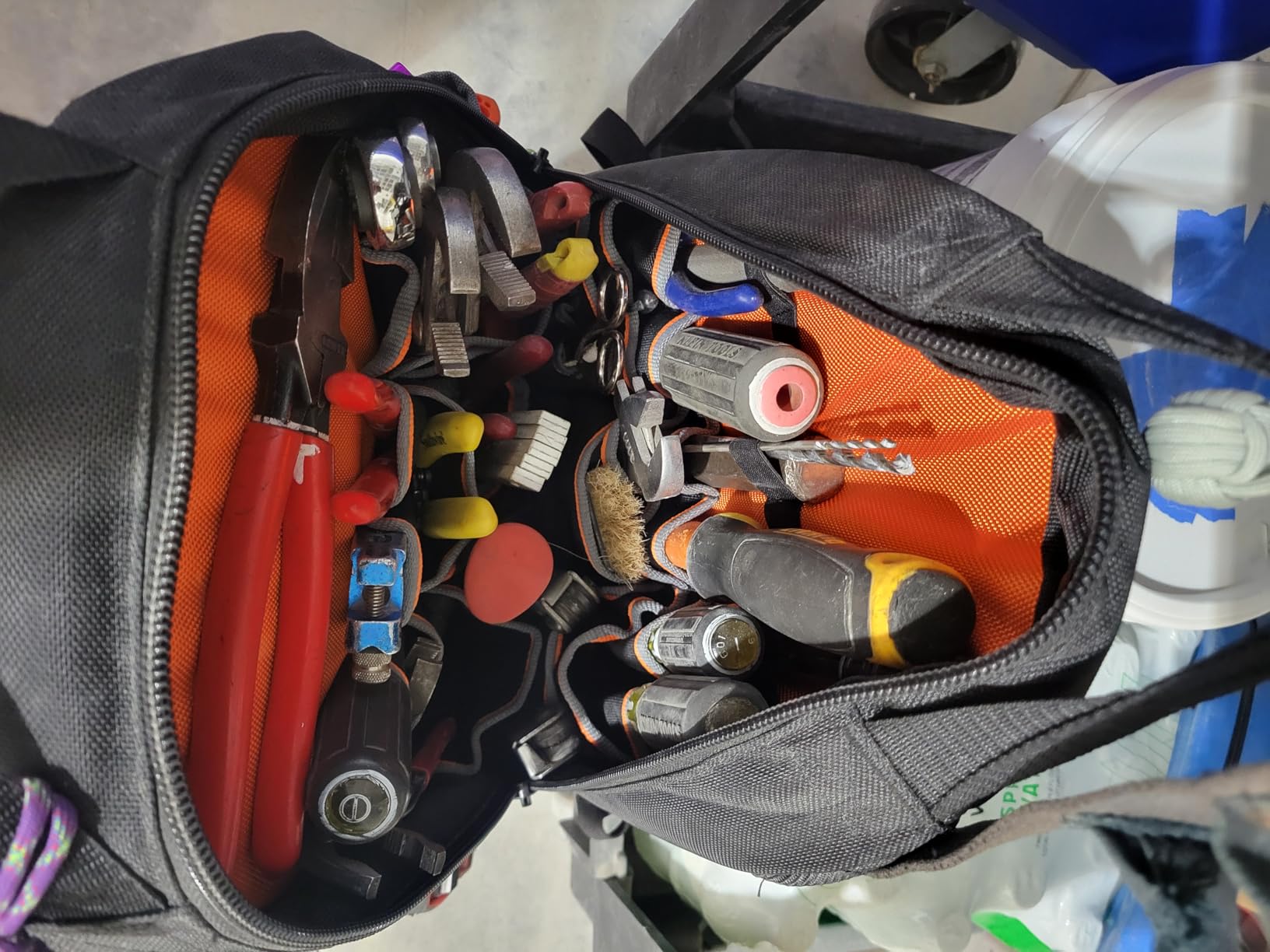
Who this backpack suits
Residential and light commercial service, plus any apprentice who wants to grow into a professional bag rather than outgrow it in a year. The 5 kg guidance and the 6 lb empty weight make it comfortable for a full day of hand tools, and the pocket count gives you room to add a tester, a clamp meter and a coil of wire without reorganizing everything every morning.
Where it falls short
Overhead and ladder work is where the backpack format works against you, since a closed bag loaded with forty pounds of tools swings into your legs on every rung. It is also a mid-size bag rather than a full truck carrier, so a commercial rough-in electrician carrying a full hand-tool inventory will need something larger or a second bag. If your day is mostly on a roof or in a ladder clip, read the open-top sections instead.
2. Veto Pro Pac Tech Pac: The Premium Benchmark
Veto Pro Pac Tech Pac Tool Backpack – Heavy-Duty Weatherproof Tool Bag with 46 Pockets, Waterproof Molded Base & Ergonomic Padded Straps & EVA Back Padding for Technicians and Contractors
46 pockets
25 liter capacity
9 lb empty
3mm molded base
Pros
- 46 interior and exterior pockets in a range of sizes
- Two storage bays with four storage platforms
- Dedicated manifold gauge and hose pocket
- 3mm injection-molded polypropylene base
- Industrial double nylon stitching with oversized zipper tabs
Cons
- Bulky and heavy at 9 pounds when empty
- Top price point among the backpacks here
Veto is the most repeatedly recommended brand across the electrician forums, and owners who have one defend the cost rather than arguing about it. The Tech Pac is the reason that reputation exists: 46 pockets, two full storage bays, four platforms, and a 3mm injection-molded polypropylene base that is genuinely waterproof rather than water-resistant. The rating distribution is the strongest in this roundup, with 91 percent five-star.
The features that matter in the field are specific rather than generic. There is a dedicated manifold gauge and hose pocket, which is HVAC work, but the same discipline shows up in the internal aluminum hang hook and the 7 by 10 inch tablet or laptop pocket. Electricians pulling EV chargers or working in data centers can carry a tablet in the bag without a separate sleeve, and the double-stitched heavy-duty coil zippers with oversized tabs can be operated with cold or gloved hands.
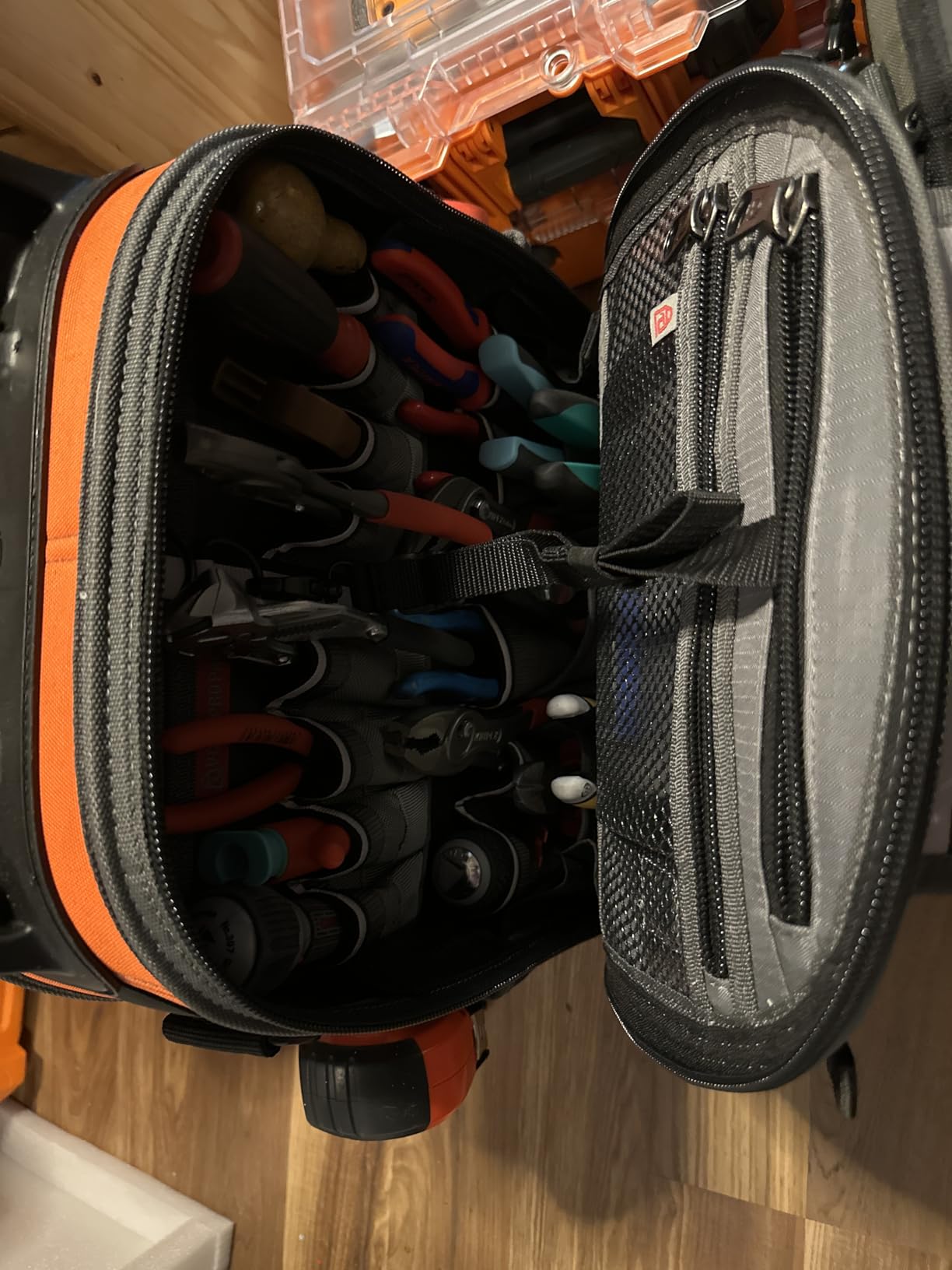
Build details are where the money goes. Four large and five small powder-coated steel D-rings give you clip points for a wire stripper pouch or a clamp meter, and the stainless steel tape clip holder is mounted on the outside where a tape measure actually lives. The maximum weight recommendation of 23 kg tells you the structure is designed to be loaded well past what an electrician carries on a shoulder strap.
The drawback is the one the forums raise constantly: nine pounds empty. That is three pounds more than the Klein in slot one before a single tool goes in, and you feel all of it while climbing. There is also a real learning curve in assigning 46 pockets to a fixed tool list, and bags with this much organization tend to punish owners who carry a mixed trade kit.
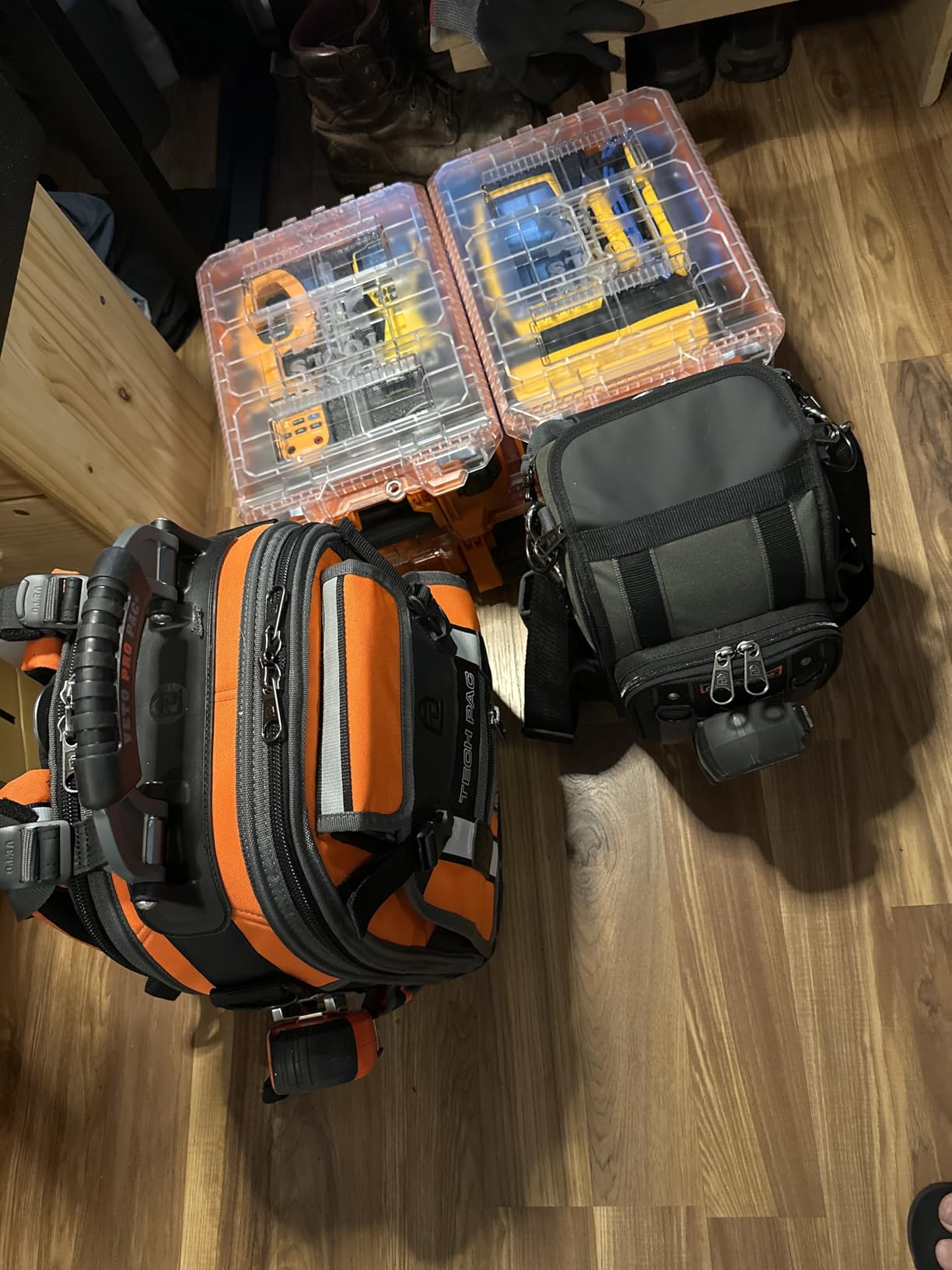
Who should buy it
Service technicians and electricians who work a full truck or van out of a single bag, and anyone who regularly carries a tablet or laptop to the jobsite. The molded base and the 25 liter capacity make it the best choice here for multi-day or out-of-truck work where tools stay in the bag overnight, and the five-year limited warranty is the longest stated warranty in the roundup.
Where it falls short
Ladder and overhead work, plain and simple. Nine pounds empty becomes a meaningful load on a rung, and the dimensions at 21.5 inches tall mean the bag reaches further into your back than shorter models. Apprentices and students carrying a lighter hand-tool set will not fill 46 pockets, and they will carry the weight for nothing.
3. Klein Tools 55485 Tool Master: Built for Crew Loads
Klein Tools 55485 Tool Bag Backpack, 48 Pockets, Black/Orange/Gray
48 pockets
13.2 lb empty
1680d ballistic weave
Molded waterproof bottom
Pros
- 48 total pockets for wide tool organization
- Removable tool caddy with handles and a D-ring
- Aircraft cable reinforced handle and lockable zipper pulls
- Water-resistant 1680d ballistic weave with molded bottom
- Heavy-duty metal hook hangs the bag open
Cons
- Listed maximum weight recommendation of 3 kg is low for the empty weight
- Heaviest bag here when empty
This is the bag to look at when one person carries the kit for a crew or a two-person job. The 48 pockets plus the removable caddy let you split the load, hand the caddy to an apprentice, and still know where every tool lives. Owners consistently single out the removable caddy with its carrying handles and hanging D-ring as the feature that makes the bag work as a shared load rather than a single-person carry.
The construction is the most rugged in the roundup on paper: water-resistant 1680d ballistic weave, a molded waterproof bottom, an aircraft cable reinforced handle, and heavy-duty zipper pulls that lock. The metal hook lets you hang the bag from a ladder, a truck rail, or a gang box so the bag hangs open with tools facing you.
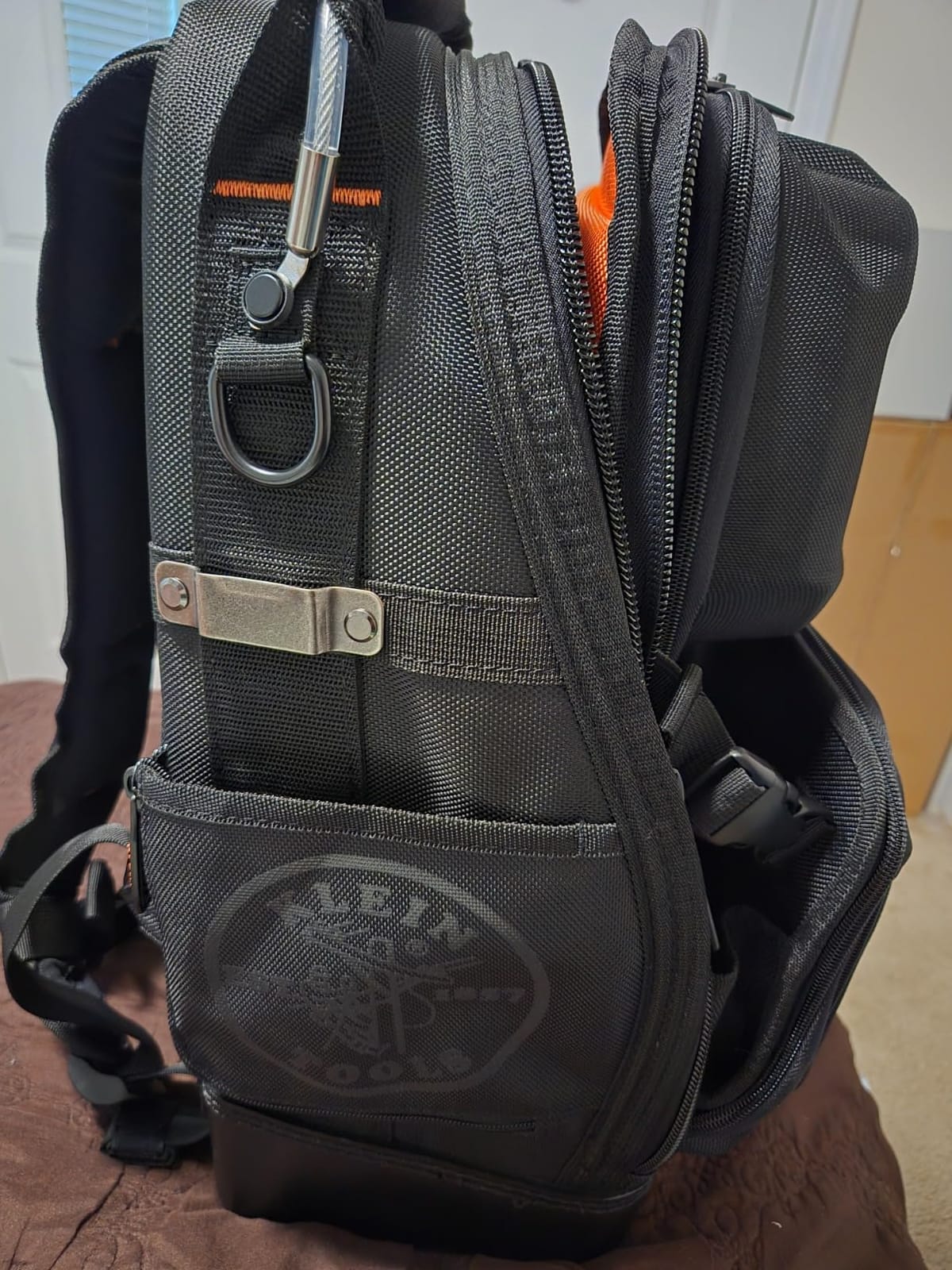
At 13.2 pounds empty, this is the heaviest bag on the list, and it is the one number that changes the recommendation. The listing rates it for a 3 kg maximum recommended load, which is conservative against an empty weight already above six kilograms, so treat the published figure as a floor rather than a ceiling. In practice that means it is a pack for a fixed worksite where you set the bag down, not for overhead work or long walks from the truck.
The one-year manufacturer warranty is the shortest stated coverage among the fabric bags here. If you buy it, the mold and hardware will outlast the paperwork, but the paperwork matters if a strap or a zipper pull fails in year two.
Who should buy it
Foremen, service managers, and electricians working commercial new construction where the tool set is large, shared, or needs to move between a truck and a gang box several times a day. The removable caddy and the hanging hook are built for exactly that handoff, and the 48-pocket count means fewer arguments about who put what where.
Where it falls short
Anyone doing overhead or ladder-first work, and anyone who cares about shoulder comfort over a long day. Thirteen pounds empty is the point where a good shoulder strap stops mattering. It is also overkill for a service electrician working out of a van with fifteen hand tools, and it will not fit comfortably in a small service panel or an attic crawl space.
4. Klein Tools 5541610-14: Best Value Shoulder Carry
Klein Tools 5541610-14 Tool Bag with Shoulder Strap Has 40 Pockets for Tool Storage and Orange Interior
40 pockets
6 lb empty
12.4 x 12.2 x 10 inch
1680d weave
Pros
- 40 pockets for maximum storage in a shoulder-strap carry
- Orange interior makes tools faster to locate
- Fully molded bottom for stability and element protection
- Large zipper pocket for small parts and tools
- 1680d ballistic weave for durability
Cons
- Shoulder-strap carry is not hands-free like a backpack
- Square footprint is bulky for trunk storage
This is the bag I would hand an apprentice who is ready to buy one real tool bag. It carries a 4.8 average across more than two thousand reviews with 87 percent five-star, which puts its satisfaction rate above bags costing far more, and it does so with a feature most people underestimate: the orange interior.
Visibility is the whole point of that lining. In a canvas-dark bag with a black interior, finding a small screw or a wire nut means dumping the bag or using a flashlight. Against a bright orange interior, a dark tool silhouette is obvious from a foot away. On dim new-construction sites with the power off, that difference removes dozens of small fumbles a day.
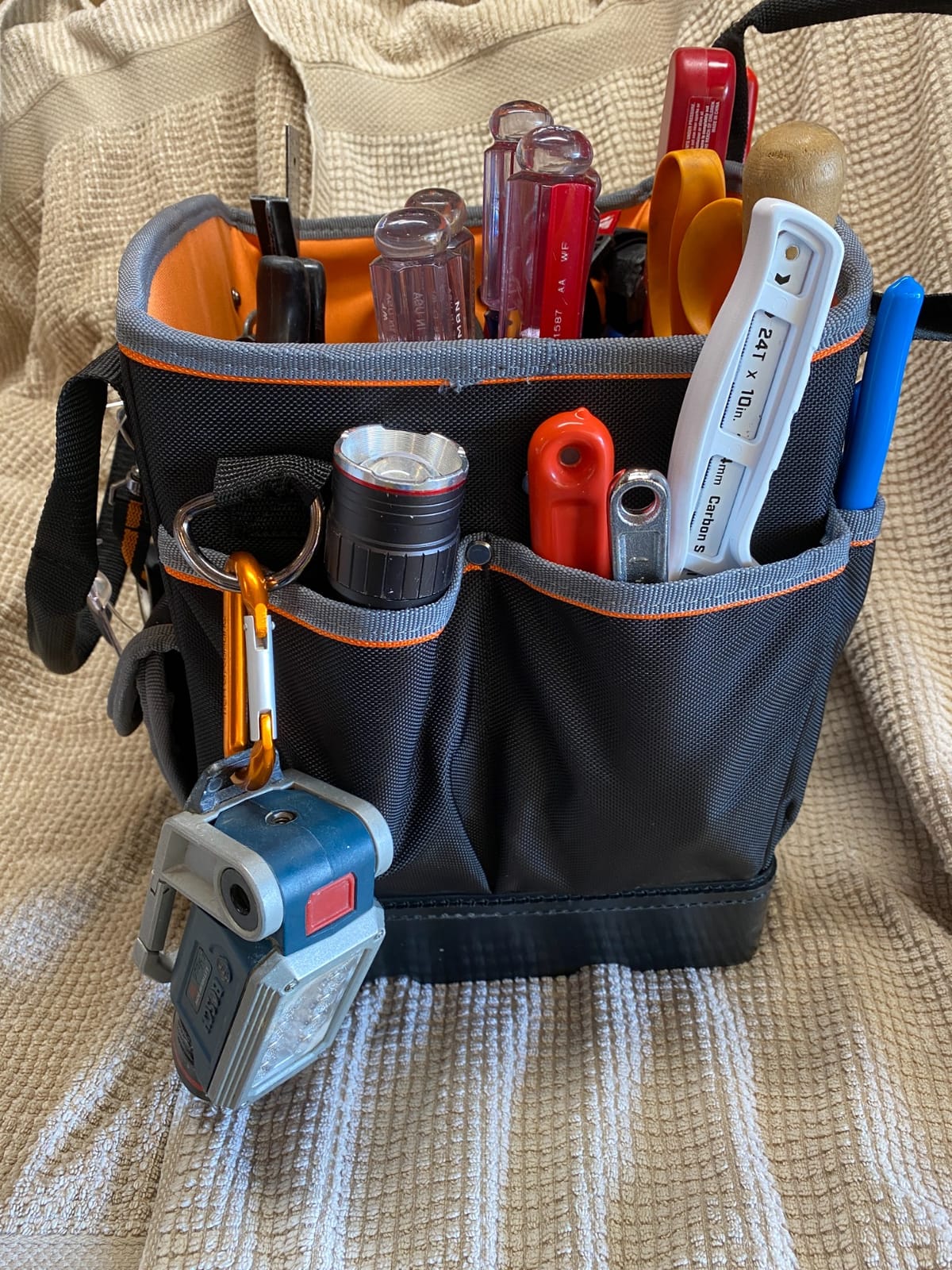
Underneath it is the same 1680d ballistic weave and a fully molded bottom that keep the bag stable when you set it on wet ground. Forty pockets in a 12.4 by 12.2 by 10 inch footprint means a deep, boxy shape rather than a tall thin one, which is good for standing upright and bad for stowing. The large zippered front compartment is the place for wire nuts, connectors, or a phone so they do not migrate to the bottom of the bag.
The trade-off is the carry system. A single padded shoulder strap means one shoulder takes the entire load, and it does not free your hands the way a two-strap backpack does. For a technician who works with both hands overhead or needs to climb, that difference is not cosmetic. It is also the one bag here I would call a truck-and-site bag rather than a walking bag.
Who should buy it
Service electricians and maintenance technicians who drive to a site, set the bag down, and work. It also makes a strong second bag for an apprentice who is still building a kit, since it holds a full hand-tool set in a footprint that fits behind a seat or in a service van cargo area. Water-repellent fabric plus a molded bottom handles the wet-residential work most service calls turn into.
Where it falls short
Ladder and ladder-adjacent work, for the same one-shoulder reason. You also feel the square shape more than you expect when loading a trunk, because the corners do not nest the way a tapered tote does. And with only a one-year manufacturer warranty, it is a bag you will likely replace sooner than the CLC carriers below.
5. CLC Work Gear 1530: The Best Open-Top Electrical Carrier
CLC WORK GEAR 1530 Electrical and Maintenance Tool Carrier, 43 Pocket, Black
43 pockets
3 lb empty
20 x 9 x 15 inch
Polyester open top
Pros
- Box-shaped open-top design prevents tipping and keeps tools visible
- 43 pockets of varying sizes with two window pockets
- Includes a 7 by 5.5 inch multi-compartment parts tray
- Lightweight at 3 pounds with a rigid bar carry handle
Cons
- Included shoulder strap clips are cheap spring clips
- Listed as not water resistant for wet-weather open storage
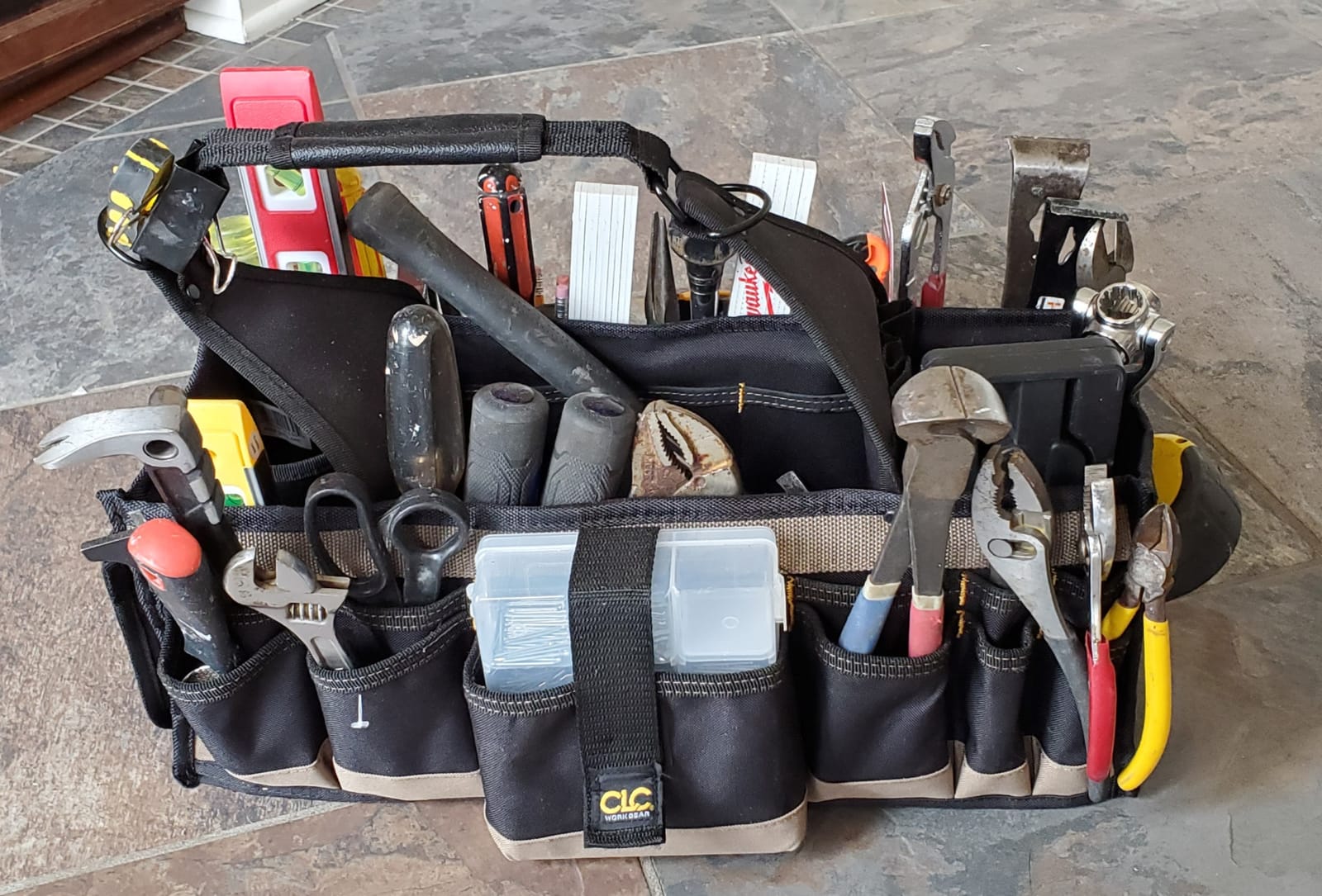
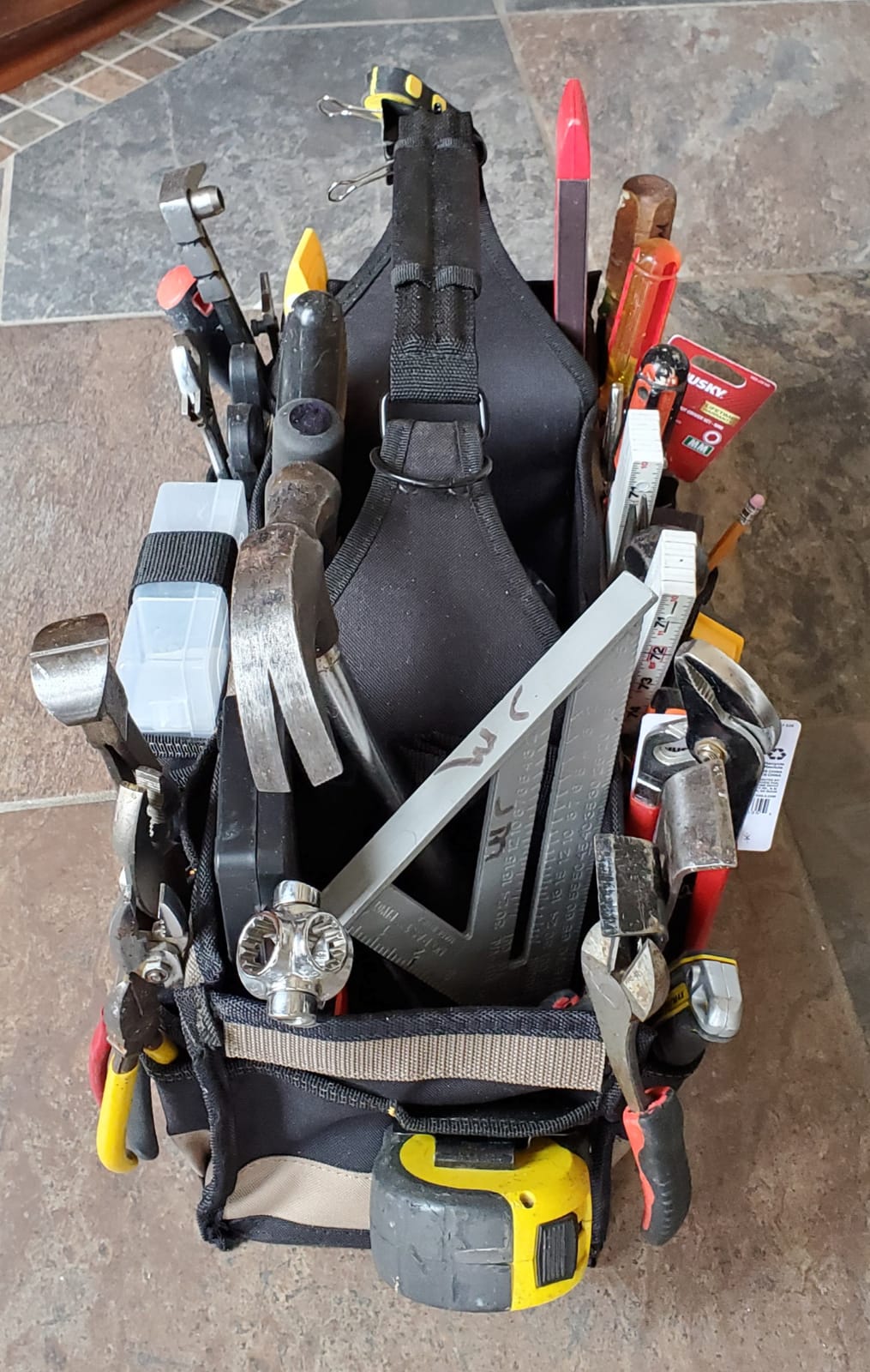
The CLC 1530 is a 20-inch open-top carrier built specifically for electrical work, and at three pounds empty it is the lightest substantial bag in this roundup. The box shape is the feature. It will not tip when you pull a tool out, which sounds minor until you have chased a pair of pliers across a gravel drive twice a week. Open top also means every tool is visible without unpacking anything.
The pocket list reads like a specification written by an electrician: slots for drill bits and tips, a cell phone pocket, a dedicated pocket for an electrical tester, and an electrical tape strap. Two window pockets, one removable and one fixed, let you see into compartments that would otherwise be blind. The included 7 by 5.5 inch multi-compartment plastic tray is sized for wire nuts and small hardware, which is exactly what ends up loose in a bag.
This is also the only bag here with a limited lifetime warranty from a named manufacturer, which says something about the stress points. The 20 by 9 by 15 inch footprint is long and shallow rather than tall, so it sits under a bench or a truck shelf instead of towering over everything else in the cargo area.
Two honest weaknesses. The supplied shoulder strap uses cheap spring clips rather than swiveling pin clips, and several owners have replaced it with a luggage strap, so budget for that if you plan to sling it. The bag is also listed as not water resistant, which for an open-top carrier is a genuine limitation — rain gets in from above by design, and the poly fabric will hold water in the base if it sits wet.
Who should buy it
Low-voltage and data work, appliance and HVAC repair, and commercial electricians who carry a defined inventory and want to see all of it at once. The three-pound empty weight makes it the easiest bag here to move in and out of a service van, and the shallow long profile means you can lay it flat on a floor and photograph a panel with everything in frame.
Where it falls short
Wet-weather outdoor work, since an open top and a non-water-resistant body is the wrong combination for a rainy rough-in. It is also the least protective against drops: with no molded base, a fall onto a steel kick plate is felt by the tools inside. And owners report the handle steel bars working through the fabric ends after several years of heavy loading, which is worth checking annually.
6. CLC 1132 75-Pocket Backpack: Maximum Pocket Count
Custom Leathercraft1132 75-Pocket Tool Backpack
75 pockets and loops
5 lb empty
13 x 9 x 17.5 inch
Soft polyester shell
Pros
- 75 pockets sleeves and loops plus 6 zippered compartments
- Adjustable padded shoulder straps and padded handles
- Interior panels hold a wrench set drill bits pliers and testers
- Includes a 7 by 5.5 inch plastic parts tray
- Durable ballistic polyester construction
Cons
- Listed as not water resistant with a soft shell
- Black interior makes small items hard to find in dim spaces
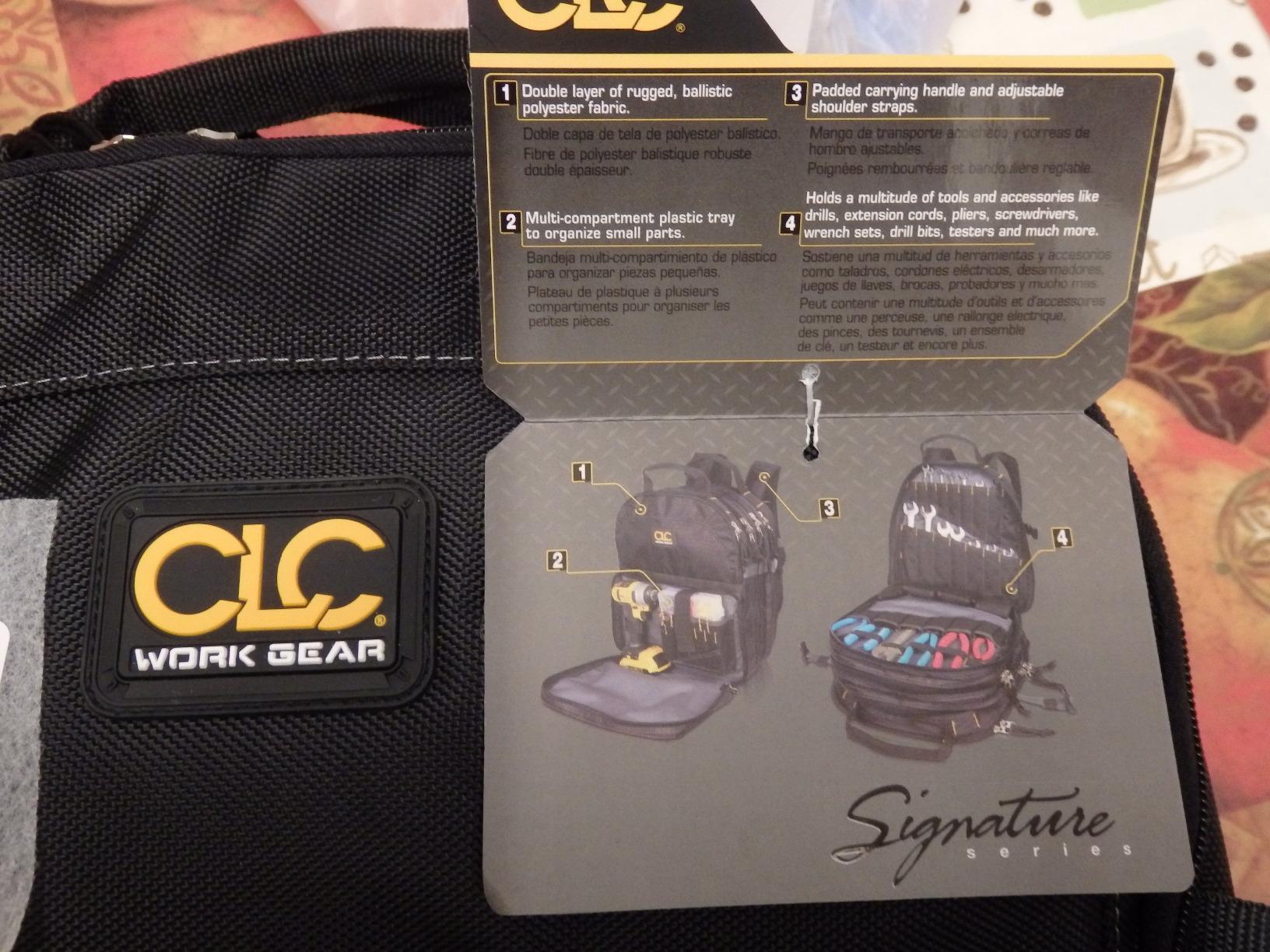
No other bag in this roundup comes close to 75 pockets, sleeves, and loops, and the owner reviews explain why that number matters for some people and not others. When your kit includes a wrench set, a cordless drill, drill bits, screwdrivers, pliers, and testers, you can give each category a dedicated panel instead of rearranging the bag every morning. Six zippered compartments hold the small stuff that would otherwise migrate.
Carry is handled with adjustable padded shoulder straps and padded handles, which at five pounds empty makes this a lighter full-size backpack than several smaller ones here. The included plastic tray gives wire nuts and fittings a home, and the soft shell means the bag conforms to your back rather than standing away from it.
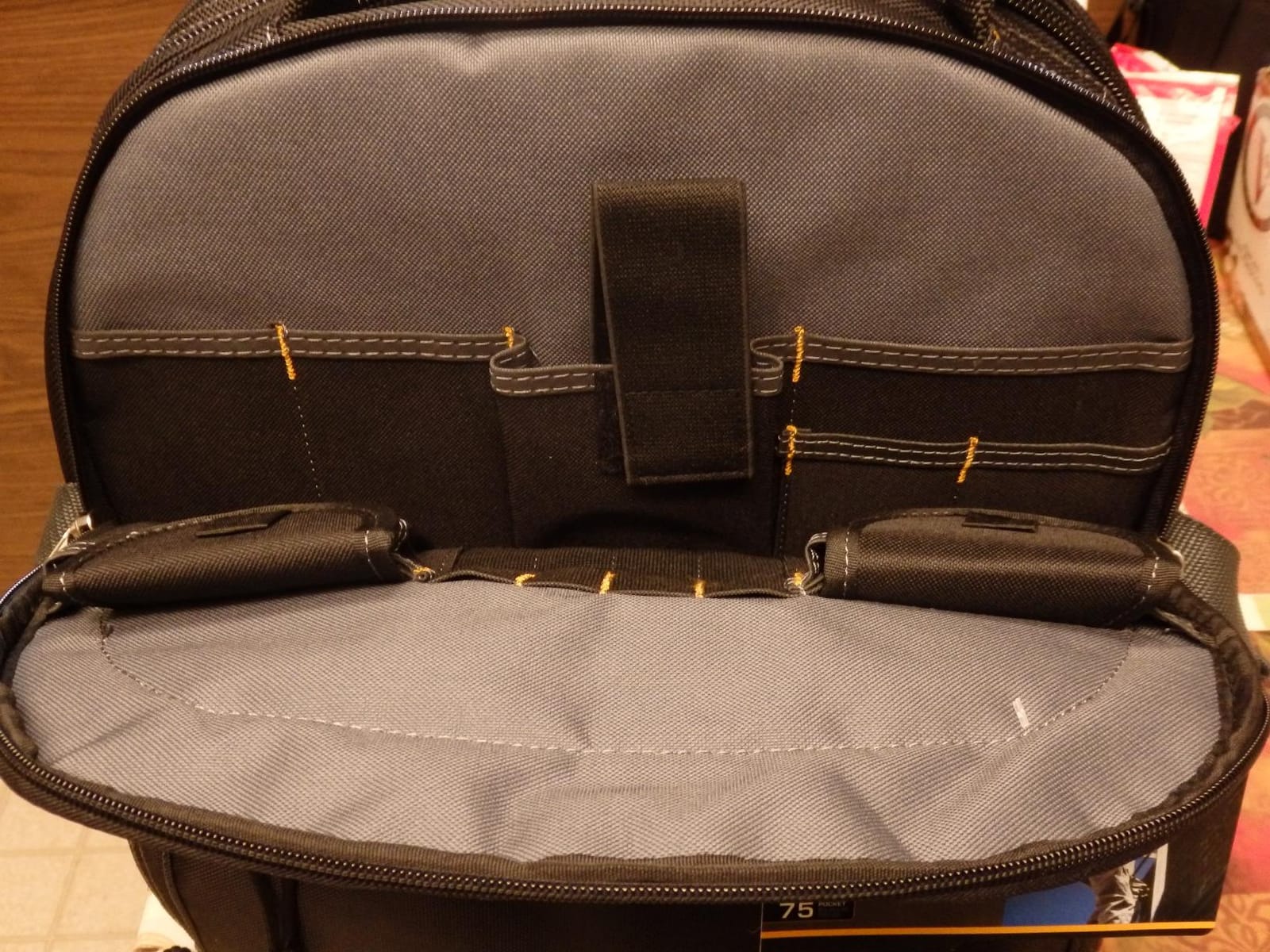
The honest catch is that 75 is a number, not a system. If you do not assign tools to slots on day one, you will have a soft bag full of overlapping loops and no way to find a specific driver in under a minute. The people who love this bag are the people who already work that way. The people who rate it lower are the ones who wanted fewer, larger compartments.
It is also listed as not water resistant with a soft shell, so there is no molded base protecting the bottom third. Owners note the black interior makes small items hard to locate without a light, and the 4.6 average with a three percent one-star share is the lowest rating here, with the complaints concentrated in visibility rather than durability.
Who should buy it
Multi-trade generalists and commercial electricians who carry both electrical hand tools and a drill, a saw, or spare batteries. The soft shell and padded straps also make it the most comfortable of the full-size backpacks here for a technician who walks a site all day rather than working from one spot.
Where it falls short
Anyone working outdoors in rain or setting the bag down on rough ground, since there is no waterproof base. It is also too much bag for a residential service call where you carry fifteen hand tools, and the black interior works against you in unpowered buildings and panels. If you want the pocket count, a bright interior is worth paying a little more for.
7. DEWALT DWST560102: Best for Hybrid and Mobile Work
DEWALT Tool Backpack, Tool Storage and Organization, Durable and Water Resistant (DWST560102)
43 pockets
IP54 compartment
Hi-vis interior
Laptop compartment
Pros
- IP54 water-resistant compartment and waterproof base
- 1680 denier fabric with dirt-repellant tarpaulin
- 43 pockets with a separate drill and battery compartment
- Hi-vis yellow internal fabric makes tools easy to see
- Backstrap hangs on a telescopic handle for hands-free maneuvering
Cons
- No wheels despite roughly 5 kg empty weight
- Bulky footprint for a 43-pocket bag
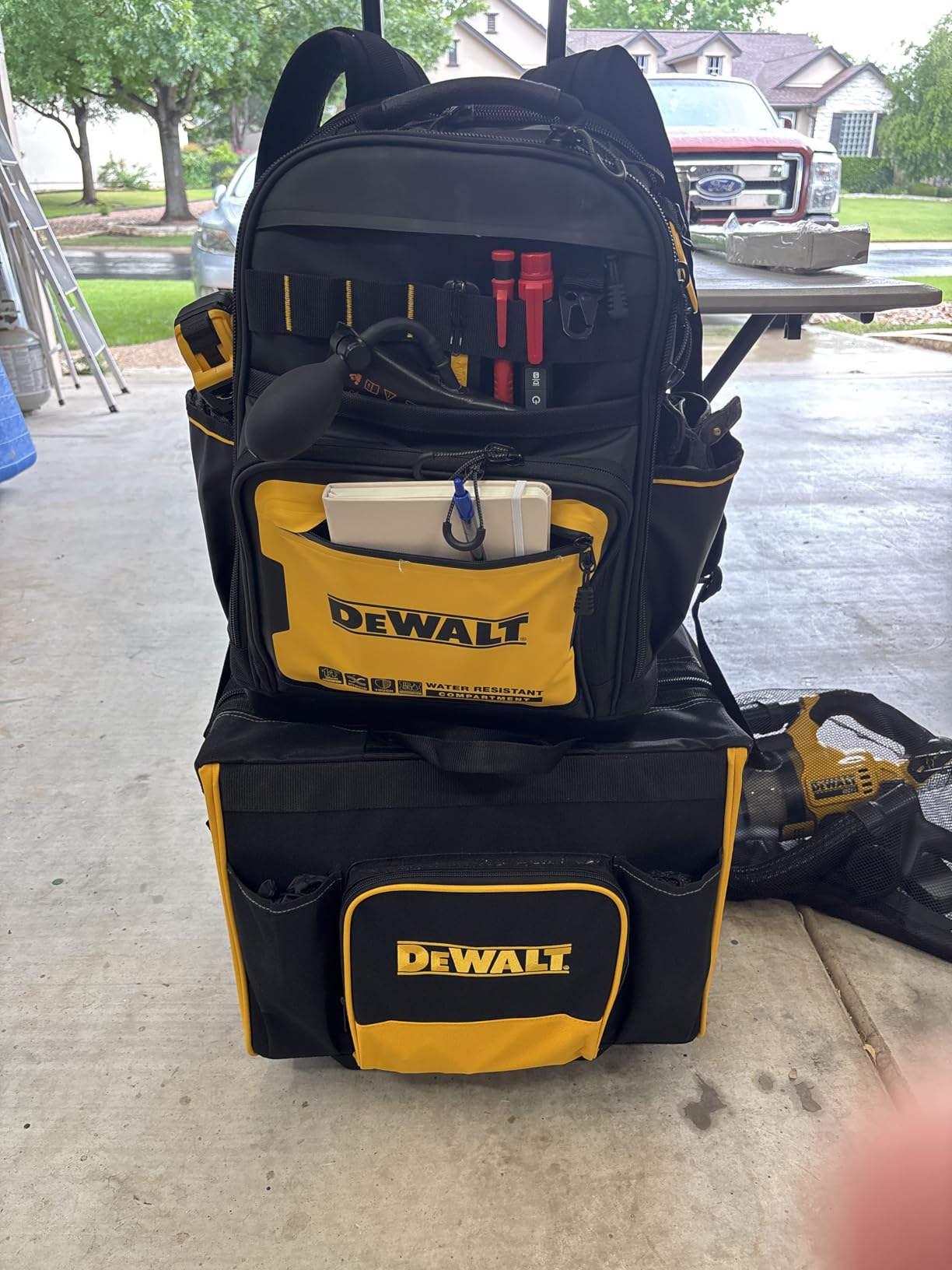
This is the strongest all-round bag here for a hybrid schedule — EV charger installs, data centers, solar, and any job where the site has paperwork as well as tools. It carries a 4.8 average across more than 1,200 reviews with 87 percent five-star, and it is one of only three bags in the roundup with a stated IP54 water-resistant compartment sitting on top of a waterproof base.
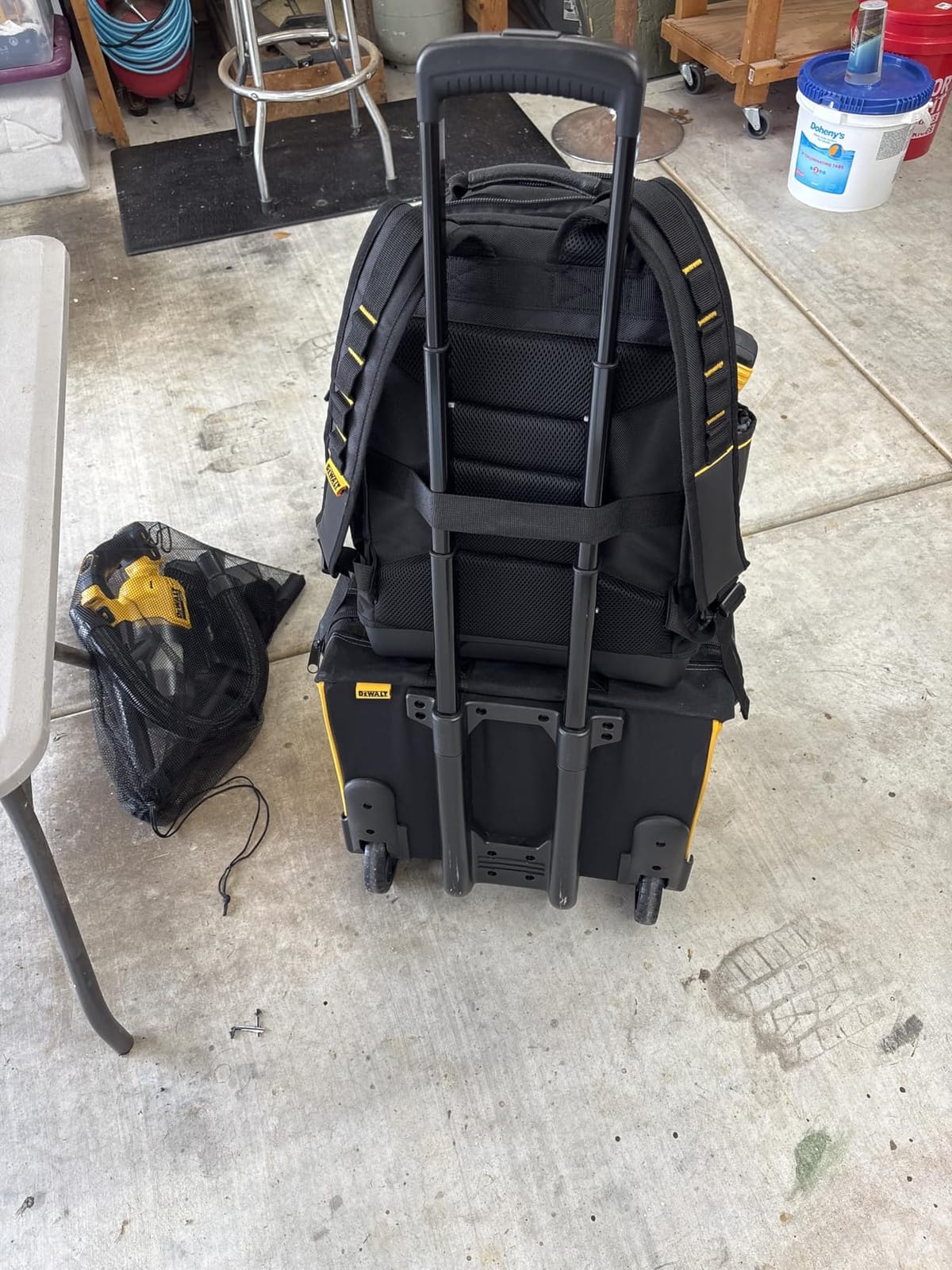
Two features separate it from the generic backpack. The separate laptop compartment protects a tablet or laptop up to 15 inches, which means you do not need a second bag for the walk from the truck to the equipment room. And the backstrap hangs on a telescopic handle, so you can roll a jobsite cart or a folded cart and wear the bag rather than carry it while pushing.
The fold-down main pocket is the detail owners mention most after the yellow interior. It stays open while you work instead of springing shut, so you can see the whole contents laid out. The hi-vis yellow internal fabric does for low light what the Klein orange interior does for general visibility, and the U-shaped zipper pull is shaped to be grabbed with gloves on, which is a small design decision with a real daily effect.
There is also a designated bottle pocket and a long-tool section for a meter lead or a coil, plus a quick-close pull and a padded ergonomic back support system. The drawback is straightforward: at roughly 5 kg empty with 43 pockets, this is a heavy bag with no wheels. The listed maximum recommendation of 55.1 pounds is generous, but the bag itself is not going up stairs on casters.
Who should buy it
Electricians who carry a tablet or laptop to work and who split time between indoor mechanical rooms and outdoor installations. It suits anyone working to a schedule where the bag travels between sites rather than living in a truck, and the IP54 compartment and waterproof base handle the drippy commercial mechanical rooms where neutral wire gets pulled.
Where it falls short
Anyone on a ladder all day, because the bulk and the weight both work against you on a rung. It is also wider than it needs to be for a 43-pocket bag, which matters if you are trying to fit it into a service van or a panel room. And if you plan to move it across a site on your own, plan on carrying it rather than rolling it.
8. Veto Pro Pac TP-XXL: The Modular Open Tote
Veto Pro Pac TP-XXL (Original)
47 pockets
5.5 lb empty
14.96 x 15 x 5.91 inch
V-SWAP panels
Pros
- 47 available pockets in a wide tote footprint
- V-SWAP removable tool pocket panel system for reconfiguration
- Rear tablet pocket and two padded meter pockets
- Hang-up hook accessible whether the bag is open or closed
- Over-molded rubber grip with a padded shoulder strap
Cons
- Water repellent rather than fully waterproof with no molded base
- Wide footprint takes up a lot of vehicle or cart space
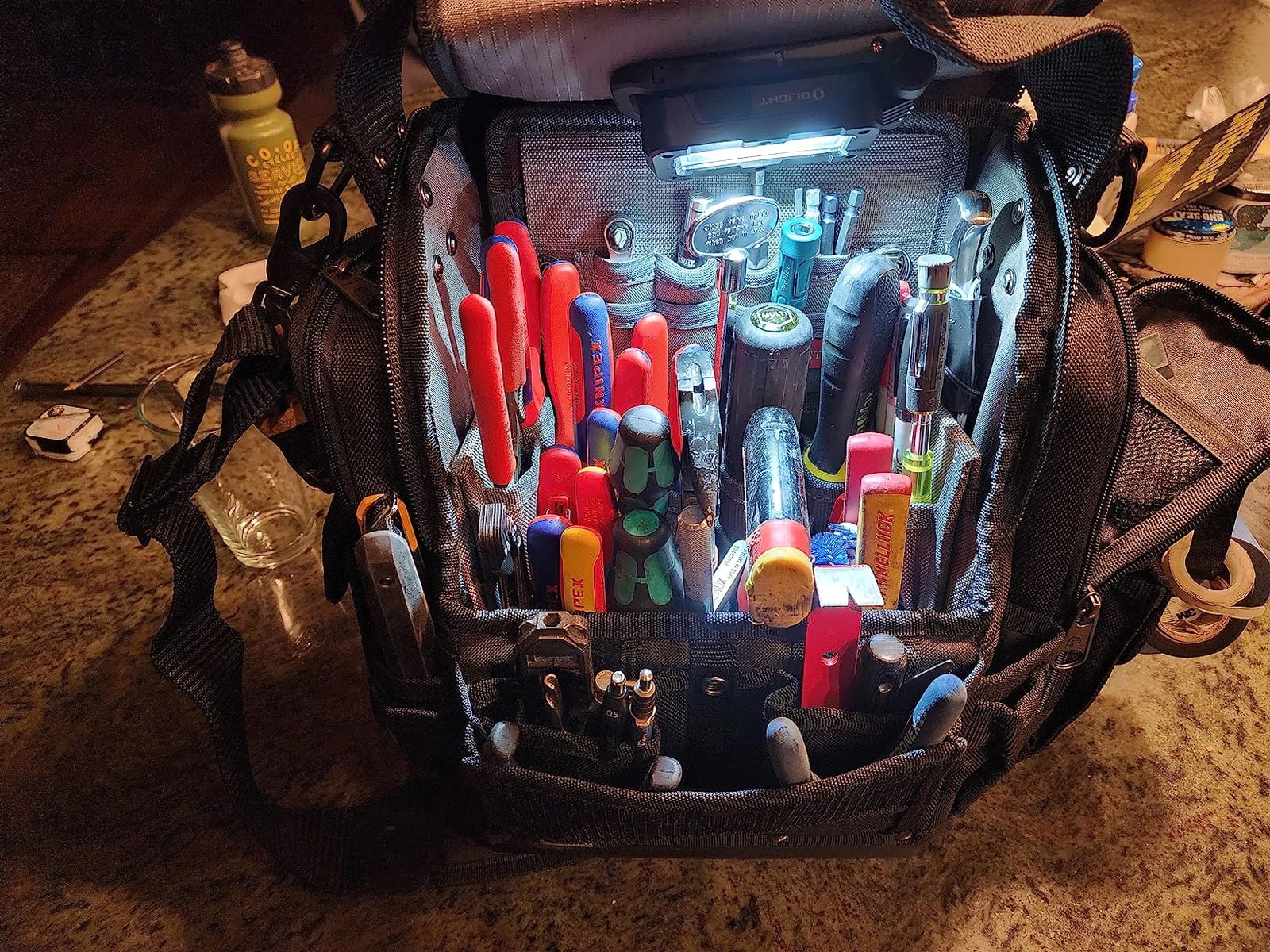
The TP-XXL is the one bag here you can reconfigure instead of relearning. The V-SWAP removable panel system lets you pull a panel of pockets out and move it, which means the same bag can be set up for a residential call in the morning and reconfigured for panel work in the afternoon. Owners name that system as the reason they bought the bag, and the 91 percent five-star share reflects it.
At 47 pockets with two padded meter pockets and a rear tablet pocket, it covers a hybrid schedule without a second bag. The hang-up hook works whether the bag is zipped or open, so you can suspend it from a truck rail or a ladder without unpacking. The over-molded rubber grip is a small thing that matters when the tote is heavy and wet.
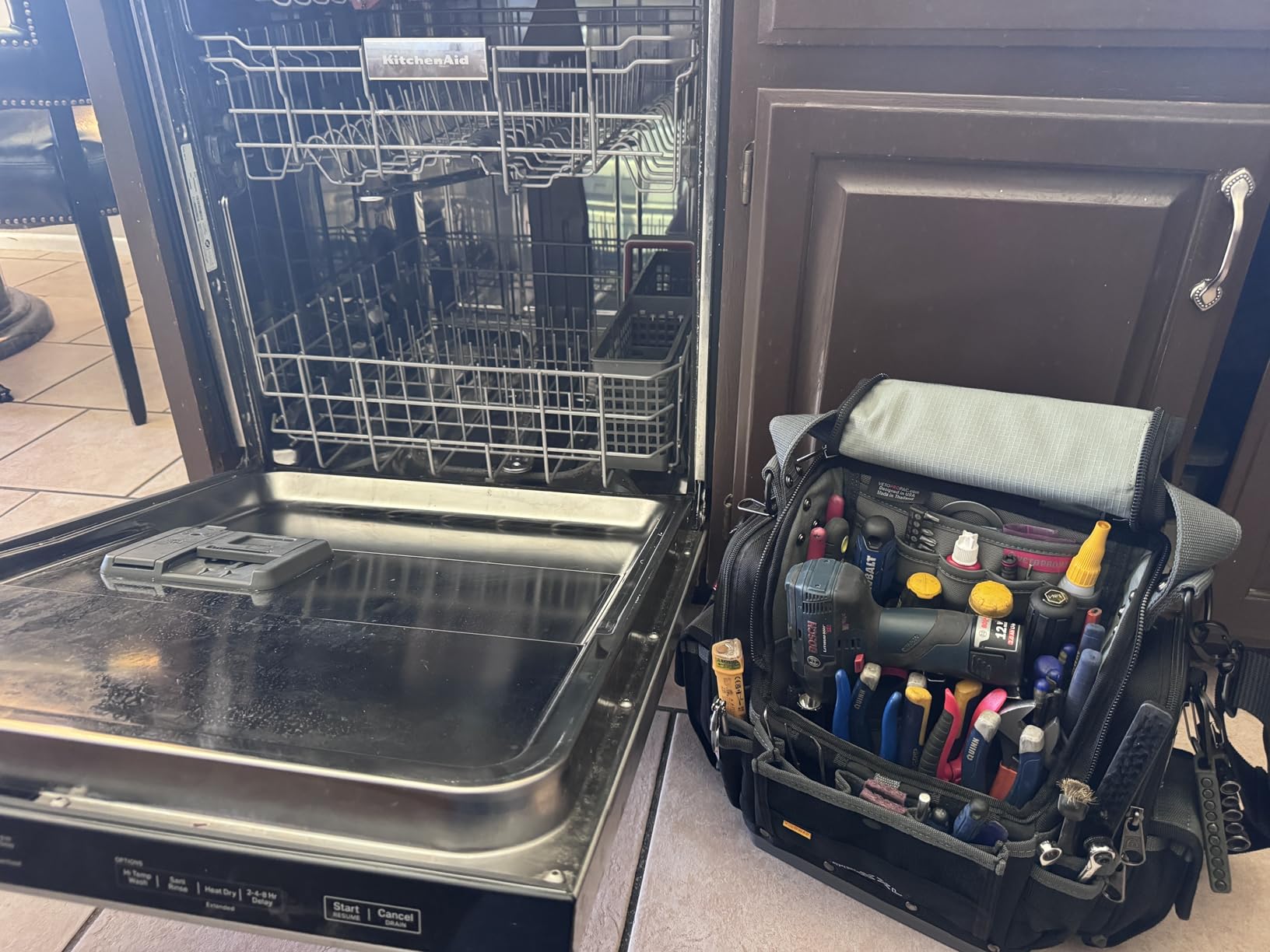
The dimensions explain how this is used: 14.96 by 15 inches and just under 6 inches tall, which is a shallow, wide tote that lies flat and shows you everything. Listed capacity is 12 liters, which is honest for a tote rather than a pack, and the 30-pound maximum recommended weight gives you room for a drill and batteries on top of the hand tools.
Two limitations. It is water repellent rather than fully waterproof, and unlike the Tech Pac there is no molded base here, so the bottom of the bag is fabric. And at nearly 15 inches square it eats a large footprint in a service van or on a jobsite cart, which is the trade for the flat-open visibility.
Who should buy it
Electricians who move between job types and want their bag layout to move with them, plus commercial techs who meter as well as terminate and want padded protection for a multimeter. At 5.5 pounds empty it is lighter than the other Veto bags here, and the flat footprint makes it the easiest to photograph a panel with for documentation.
Where it falls short
Rain. Without a molded base, a tote that sits outside through a shower will have a damp bottom section, and the V-SWAP panels take longer to dry than a solid molded floor. It is also too wide for a small service van cargo bay and too shallow for anyone who wants to stand tools upright rather than lay them flat.
9. Occidental Leather 5589: The Belt-Worn Leather Case
Occidental Leather Electrician’s Tool Case – Right Hand – 25 Pockets & Tool Holders – Made in USA
25 leather pockets and holders
1.9 lb empty
Made in USA
Leather with buckle closure
Pros
- 25 leather pockets and holders sized for pliers strippers and screwdrivers
- Heavy-duty electrical tape chain and metal utility clip included
- Reinforced stitching and durable leather built for daily commercial use
- Belt-worn form keeps tools at hand and hands free
- A mirrored version is available for the opposite hand
Cons
- Requires a separate belt and is not a standalone carry bag
- Heavier and bulkier in profile than fabric equivalents
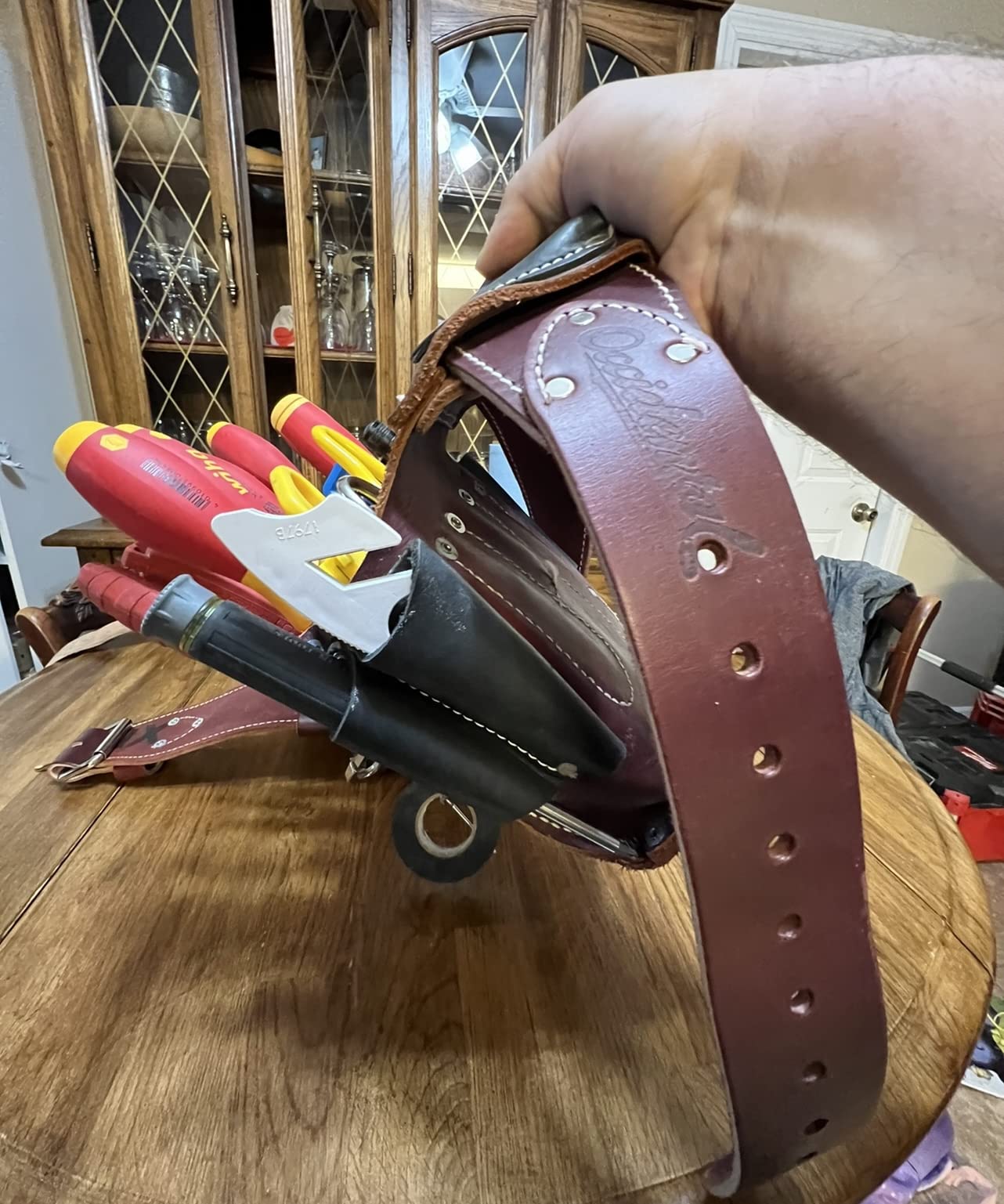
This is the only true belt-worn case in the roundup, and it answers a different question than the other eleven. A pouch like this does not carry a job; it carries the tools you need while your hands are occupied on a panel, a ladder, or a pull. At 1.9 pounds empty it is the lightest thing on this list by a wide margin, and it stays cool and comfortable because it never leaves your hip.
The 25 pockets and holders are cut for the electrician’s specific tool set rather than generic slots, and the heavy-duty electrical tape chain plus the metal utility clip are the two details that separate it from a fabric equivalent. Tape on a belt pouch is a daily-use item that generic pouches never accommodate properly, and the reinforced stitching throughout is the part that decides whether this bag survives commercial work.
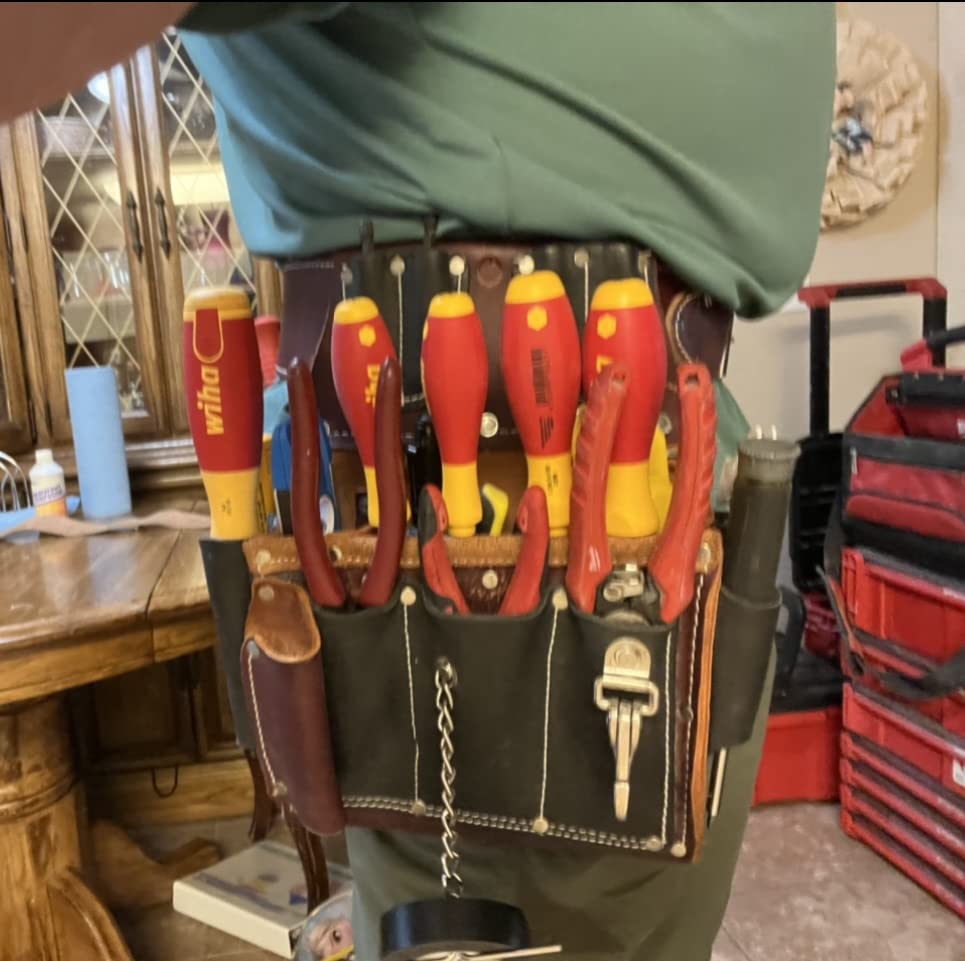
It is made in the USA, and Occidental has been building tool belts under that name since 1980, which explains why the leather is thick enough to hold a shape for years rather than a season. Handedness is a genuine design choice here, and a mirrored version is offered, so confirm which one you want before you commit to a pouch that has to be returned to change.
The limitation is structural: it is a belt-worn pouch, not a bag. You need a separate belt, and it holds a working set rather than an inventory. Leather is also heavier and bulkier at the hip than fabric, and it will need conditioning over time to keep from stiffening where it folds when you sit down.
Who should buy it
Journeyman and commercial electricians who already own a belt and want a purpose-built case for pliers, strippers, screwdrivers, and a meter. It is the natural companion to one of the backpacks or totes above rather than a replacement for one, and it is the right answer for anyone whose hands are on a panel or a pull for most of the day.
Where it falls short
Apprentices who do not own a belt yet, since the total cost of belt plus pouch is higher than a complete fabric bag, and anyone who needs to carry a drill, a crimper, or spare batteries. It is also not a weather solution — leather in a wet crawl space or attic is a poor pairing no matter how good the stitching is.
10. Veto Pro Pac Tech OT-MC: Best Open Tote for Low Weight
Veto Pro Pac Tech OT-MC Open Top Tool Bag | 28 pockets | Waterproof Base | Ergonomic Grip & Shoulder Strap | Easy Access Tool Pouch
28 pockets
6 lb empty
Waterproof 3mm base
10.5 liter open top
Pros
- Open top stands up on its own for unobstructed tool visibility
- 28 interior and exterior pockets plus a central plastic insert tray
- Waterproof 3mm polypropylene base
- Outside-mounted stainless steel tape clip and extra wide padded shoulder strap
- Compact size forces tool paring down and keeps carried weight low
Cons
- A few inches short lengthwise for anyone who wants to carry more
- Included strap lacks a clip for attaching to the bag side
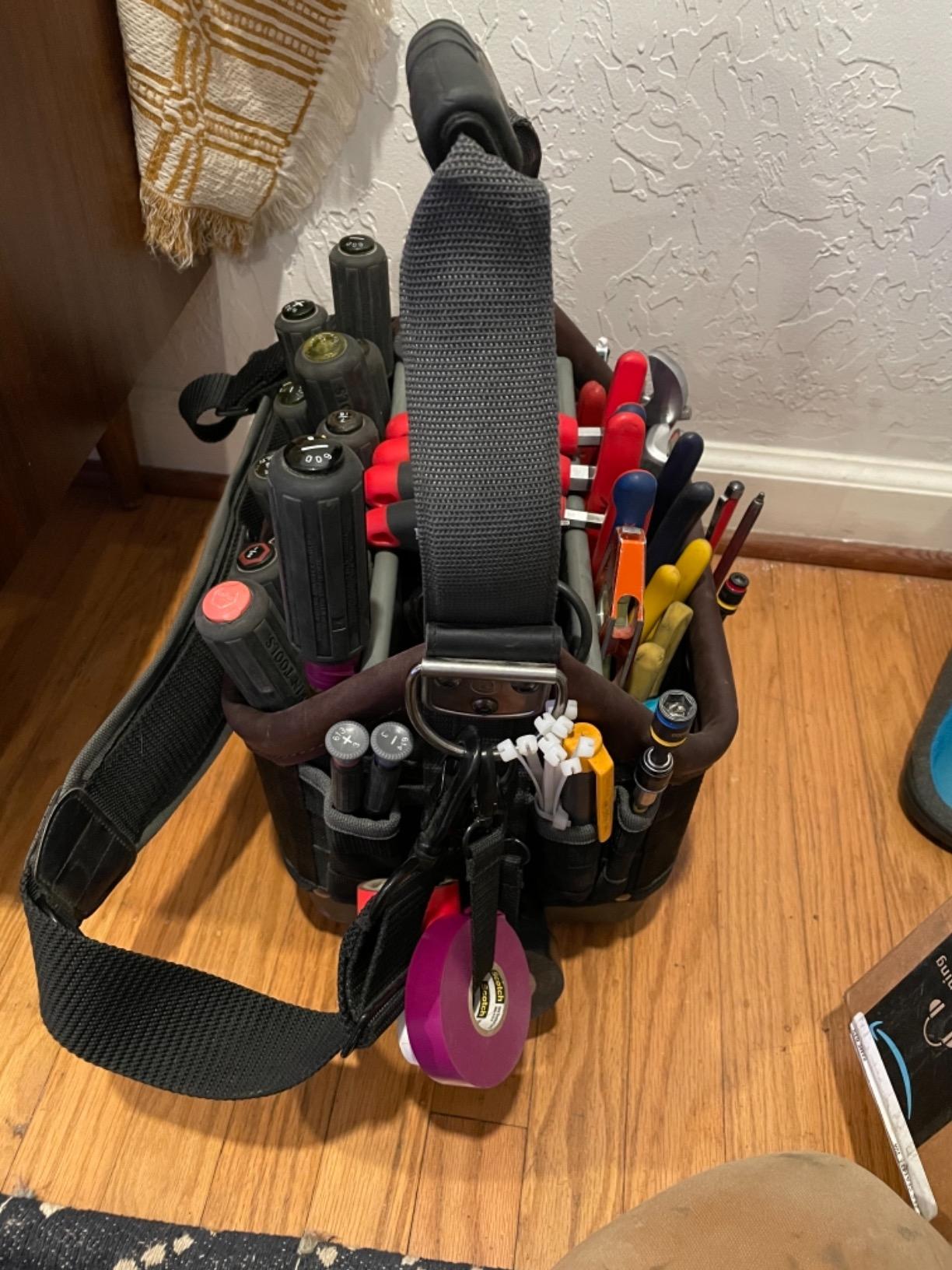
Compact size is the deliberate feature here, not a compromise. At 10.5 liters with 28 pockets, this tote forces you to pare your kit down to the tools you actually use, which is exactly the discipline that keeps a shoulder strap light. Commercial and industrial electricians report using it daily for years with barely any wear, and the 4.8 average with 87 percent five-star reflects that.
The open top stands up on its own, so you see every tool without opening anything, and the waterproof 3mm polypropylene base means you can set it in standing water, mud, or a wet slab without protecting it first. The hard-plastic-lined pockets resist tool snagging, which matters when you are reaching in with gloves on and do not want a screwdriver nose catching on fabric.
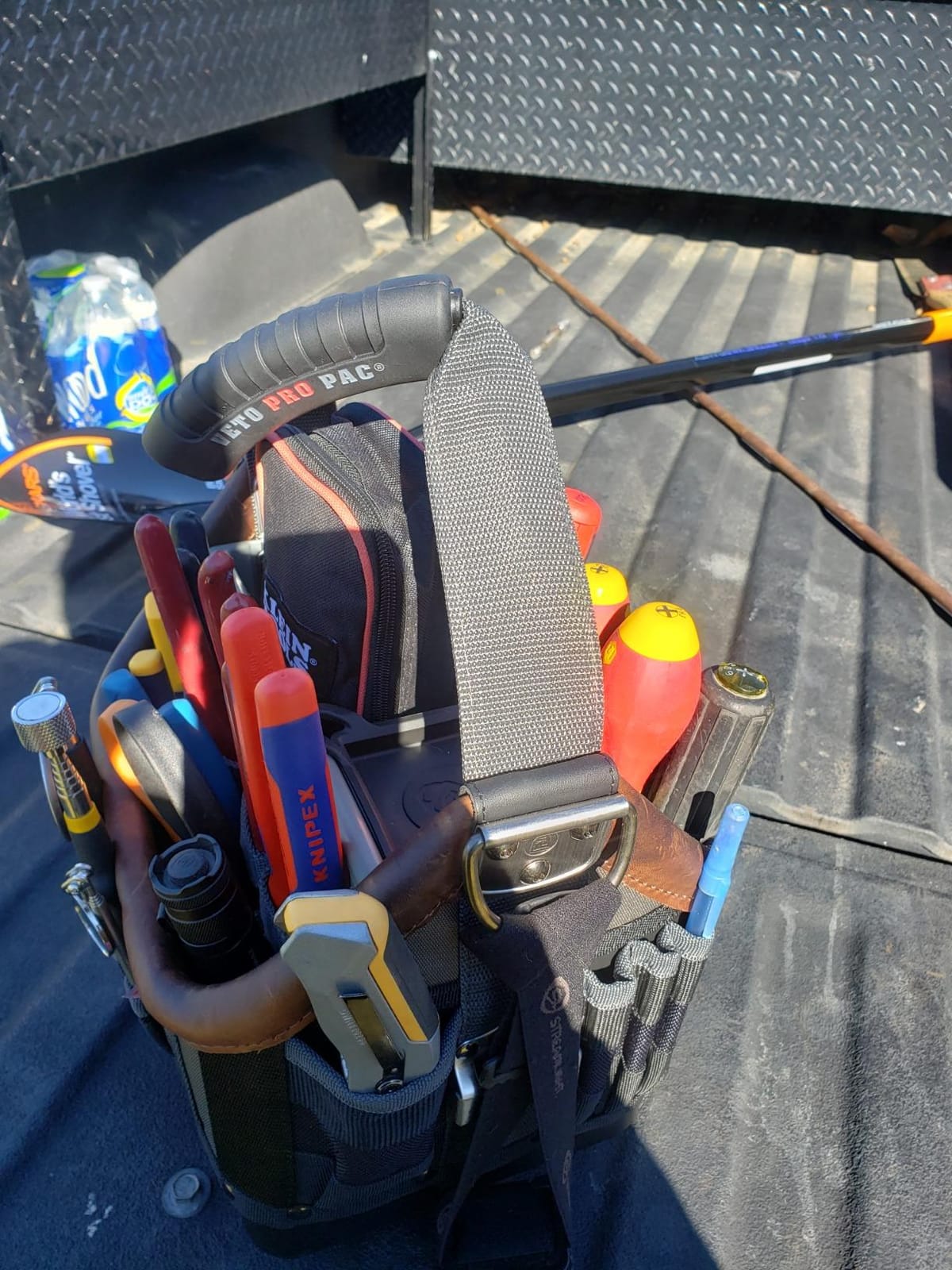
The extra wide padded shoulder strap is spread across more of the shoulder than a narrow strap, which is the difference between a comfortable carry and a painful one. The outside-mounted stainless steel tape clip is where a tape measure actually belongs rather than loose at the bottom. A central plastic insert tray keeps the small hardware separated from the hand tools.
Two complaints recur. The 12 by 12 by 20 inch body is a few inches short lengthwise for anyone who wants to carry a fuller set, and the supplied shoulder strap has no clip to attach it to the side of the bag, so a few owners swap in a strap that does. At 6 pounds empty it is still a real shoulder load on a ladder, even with the wide strap.
Who should buy it
Electricians who carry a tight, curated hand-tool set and want maximum visibility per pound. The self-standing open top and the waterproof base make it the strongest choice here for wet rough-in work, and the compact footprint fits a service van or a gang box where a 47-pocket tote will not.
Where it falls short
Anyone whose kit has outgrown 28 pockets — a technician who also carries a drill and batteries will feel the length limit. It is a shoulder-strap carry rather than a two-strap backpack, so for sustained overhead work the wide strap helps but does not solve the swing-into-your-legs problem on a ladder.
11. DEWALT DWST560105: Compact Tote for Apprentices
DEWALT Tool Bag, Electrician Tote, Tool Storage and Organization, Durable and Water Resistant, 11 Inch (DWST560105)
34 pockets
5 lb empty
10 x 9 x 15 inch
IP54 with plastic feet
Pros
- IP54 water-resistant main compartment with injected plastic feet
- Durable 1680 denier fabric with dirt-repellant tarpaulin
- 34 pockets for organized tool access
- Zippered front compartment for securing valuables
- Hi-vis yellow internal fabric improves tool visibility
Cons
- Open tote format with no lid to keep tools in on rough terrain
- Smallest capacity here at 11 inches tall
This is the smallest serious electrician tote in the roundup, and it is aimed at the person carrying a defined hand-tool set rather than a full truck inventory. At 10 by 9 by 15 inches it fits behind a seat or on a service cart, and at 5 pounds empty it moves easily in and out of a van. It holds a 4.7 average with 87 percent five-star ratings among its reviews.
The build is not a step down. It uses the same 1680 denier fabric with dirt-repellant tarpaulin as the larger DEWALT backpack, an IP54 water-resistant main compartment, and injected plastic feet that hold the base off wet ground. The hi-vis yellow interior makes tools visible at a glance, and 34 pockets plus a zippered front compartment for valuables is more layout than most totes this size offer.
What makes it work is the ratio of pockets to volume. There are enough slots for a residential service set — pliers, strippers, a tester, wire nuts, a roll of tape — without the bulk of a 43 or 75-pocket bag. For an apprentice or a maintenance technician who works out of a cart and pulls a specific kit, that economy is the feature.
The drawback is structural. There is no lid or closure, so on rough or sloped ground an open tote can shed tools, and there is no molded base, only injected feet that raise the corners. It is also the smallest capacity here at 11 inches tall, so anyone carrying a drill and batteries will run out of room before they run out of tools.
Who should buy it
Apprentices, students in a trades program, and residential service technicians who carry one curated kit and work out of a van or a cart. The IP54 compartment and plastic feet make it practical for damp basement and garage work, and the bright lining solves the visibility problem at a size most totes cannot afford the material for.
Where it falls short
Commercial rough-in and anything with a drill, a saw, or spare batteries in the mix. The open top also means you should not leave it on a sloped truck bed overnight, and with a stated warranty that is simply listed as warranty rather than a period, it is the least documented of the group.
12. Kowsinde 16 Inch Open Tote: The Budget Pick
Kowsinde 16 Inch Tool Bag, Electrician Tool Bag, Open Top Tool Bags, 26 Pockets Can Hold Many Tools, Steel Handle and Removable Shoulder Strap
26 pockets
5 lb empty
16 x 8.6 x 10.6 inch
Waterproof molded base
Pros
- 26 interior and exterior pockets in a 16 inch open-top format
- Wear-resistant waterproof molded base keeps tools dry and clean
- Steel handle with extra foam padding plus a removable adjustable shoulder strap
- 600D and 1680D Oxford cloth with fine stitching
- Folds flat for storage in a van or trunk
Cons
- Budget construction with lighter hardware than the premium brands
- Open top means tools can be knocked loose if the bag tips
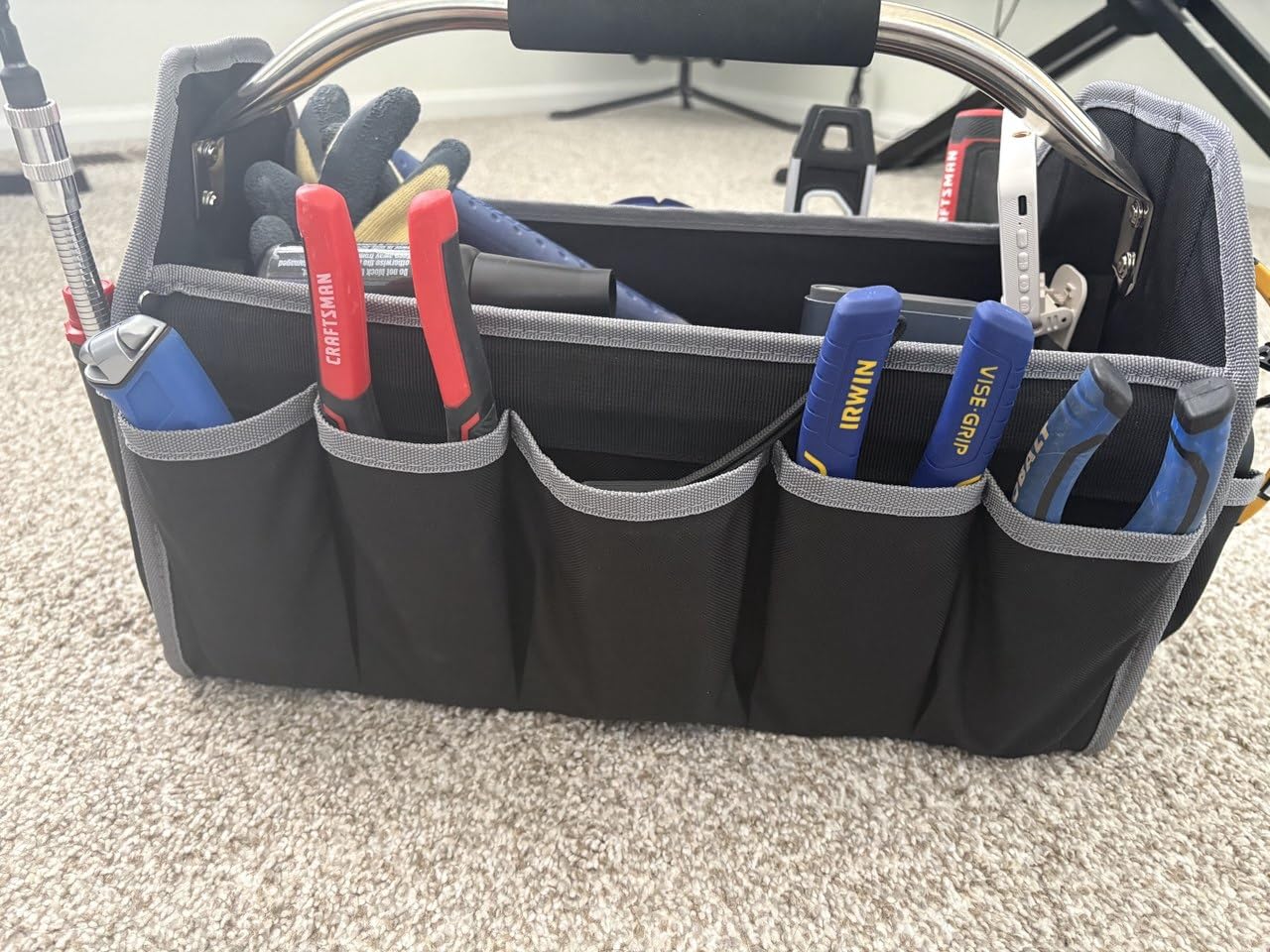
This is the bag to buy if you are starting out, in school, or doing occasional work rather than daily commercial service. It carries a 4.7 average across 611 reviews with 83 percent five-star, which is a strong showing for a budget open tote, and the hardware choices reflect the price tier honestly.
The 26-pocket layout in a 16-inch open-top format covers the common electrician set — screwdrivers, wrenches, a drill, tape measures, pliers — and the waterproof molded base is a genuinely useful feature at this level, since many bags in this price range are fabric only. The foam-padded steel handle and a removable adjustable shoulder strap are both included rather than optional, and the foldable design means it lives in a trunk between jobs instead of living there.
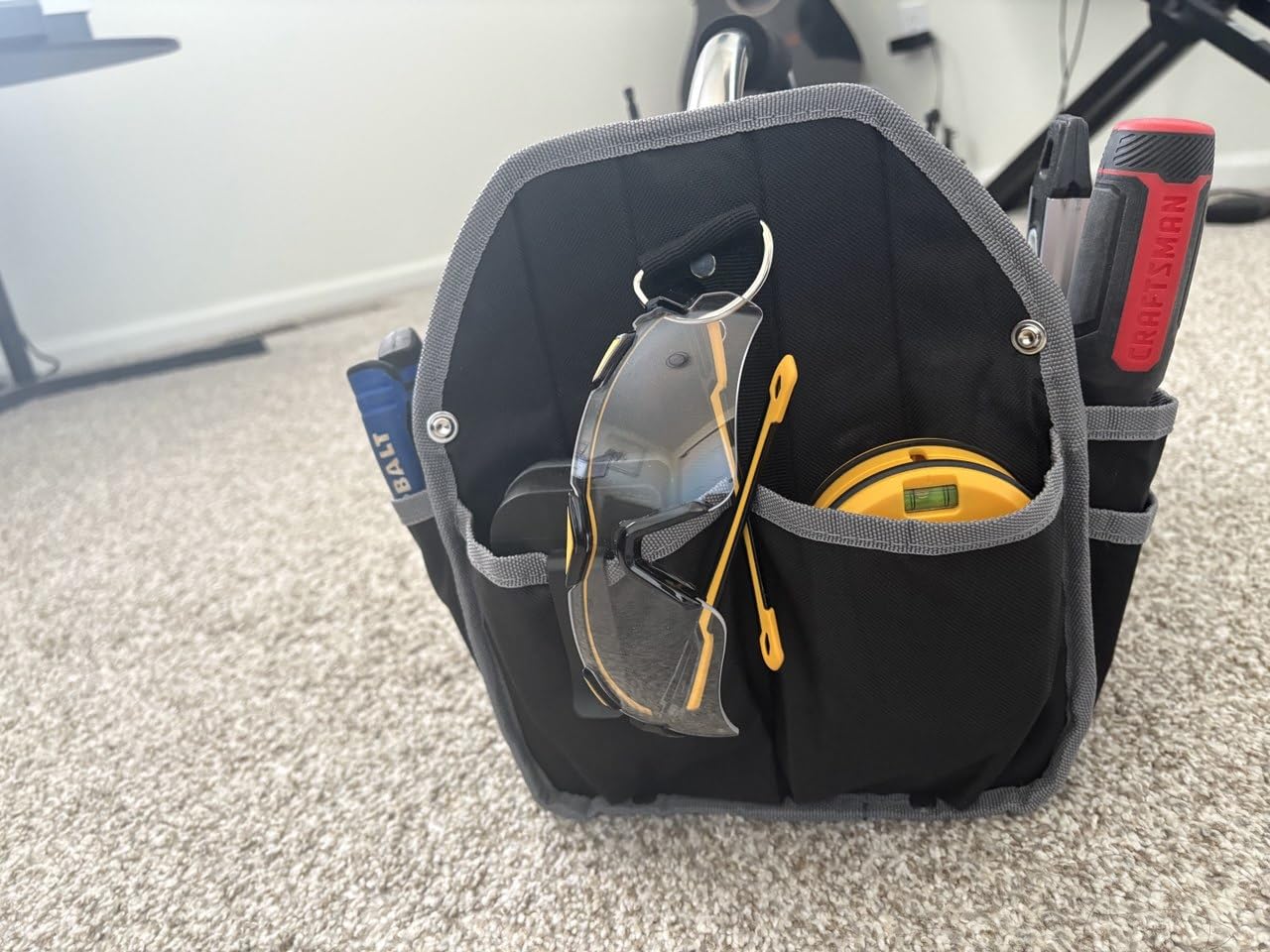
Material is listed as 1680D Oxford cloth with stainless steel and metal hardware, and the fine stitching is what keeps the pocket corners from separating. The listed maximum recommended weight of 44 pounds is well beyond what a 26-pocket tote should hold, so treat it as a durability indicator rather than a load target. Both grey and orange variants exist if you want visibility on a job trailer.
The honest limits are hardware weight and the open top. Reviewers describe it as good value for apprentices, students, and occasional users rather than heavy daily commercial duty, and the lighter hardware is where a budget bag eventually gives out. With no lid, a tip or a knock on rough ground sends tools across the site, which is an accepted trade for visibility at this level.
Who should buy it
Apprentices, trade students, facilities maintenance staff, and anyone doing weekend or occasional work who still wants a molded waterproof base and a real pocket count. It folds flat, so a single bag can serve several vehicles, and the shoulder strap lets you carry it hands-free for short distances.
Where it falls short
Daily commercial service and anything involving ladders, where the open top and the lighter hardware are both liabilities. If you are buying once and expect to keep the bag for years of daily carry, step up to a fabric bag with a stated warranty and a double-stitched base rather than saving the difference here.
Electrician Tool Bag Types Explained
There are five bag styles that cover almost all electrical work, and the right one depends less on the job title than on where your hands and body are. A ladder puts one hand on a rung and one on a tool, which rules out anything that requires a hand to carry. A van parked 60 feet from the panel rewards a different bag entirely from a rooftop disconnect.
Backpack: Two padded straps, hands-free, the only style that works on a ladder or in an attic without holding something. The trade is access speed, since you open a flap and dig rather than looking down into an open bag.
Open-top tote or carrier: Wide and shallow so it stands up and shows every tool. Best when you set the bag down at a fixed spot, and the reason most owners prefer open top over closed top.
Belt and pouch: Keeps tools at the hip while both hands are working on a panel. It carries a working set, not an inventory, and it needs a belt.
Shoulder-strap tote: One strap, more capacity than a pouch, easy to carry between a truck and a site. Loads one shoulder, so it is a short-distance carry.
Rolling bag: Worth it once you are moving more than about 40 pounds across a site. None of the twelve here have wheels, and the DEWALT back strap that hangs on a telescopic handle is the workaround most owners use instead.
How to Choose a Tool Bag for Electrical Work
Match the bag to where you actually work
Start with your worst day, not your average day. If the worst day involves a ladder or a lift, buy a backpack and accept slower access. If the worst day involves a crawlspace, a panel room, or a van cargo bay, buy an open-top tote with a narrow footprint. If your worst day is a full crew on new construction, buy the bag with a removable caddy so the load can be split.
Empty weight matters more than pocket count
The empty weights in this roundup range from 1.9 pounds for the belt pouch to 13.2 pounds for the Klein Tool Master, with several full-size backpacks between six and nine pounds. That is the number you carry before any tools, and it is why a bag with fewer pockets can be the better bag. Add roughly the weight of your typical hand-tool kit and ask whether you want that number on a shoulder strap for eight hours.
Molded base or soft shell
A molded base is the single most useful durability feature in this category. Bags with one — the Klein 55421BP-14, the Klein 55485, the Klein 5541610-14, the Veto Tech Pac, the Veto Tech OT-MC, the DEWALT DWST560102, and the Kowsinde tote — can be dropped off concrete, set in standing water, and opened without protecting the contents first. Soft-shell bags like the CLC 1530 and the CLC 1132 feel the impact of a fall through to the tools inside.
Pocket layout beats pocket count
The forum consensus is right on this, and the specs in this roundup show it. A 28-pocket bag with lined pockets sized for pliers and a tape clip will serve you better than a 75-pocket bag with generic loops and a black interior. What you want is a range of sizes, vertical slots that resist sag, and an interior that is not black.
Denier, stitching and hardware
Fabric weight is stated as denier, abbreviated D. The bags here specify 1680D Oxford cloth or 1680 denier fabric with a dirt-repellant tarpaulin, plus one at 600D, which is a lighter weave. Above the fabric, look at the stitching: industrial double nylon stitching and reinforced stress points are what separate a bag that lasts from one that splits at a pocket corner in season two.
Budget, mid and premium tiers
At the budget tier you get a molded base, a real pocket count, and a shoulder strap included, with lighter hardware as the trade. The mid tier adds 1680 denier fabric with a tarpaulin finish, brighter interiors, and better warranty terms. The premium tier adds waterproof molded bases, tablet sleeves, D-rings, lockable zippers, and warranties measured in years — with the heaviest empty weights attached.
One bag or several smaller bags
The most-asked question in the forums, and the honest answer is that the answer depends on your van. A single large bag means one trip to the truck. Several smaller pouches mean faster access to a working set but a second trip for anything else. The practical compromise most experienced electricians settle on is one open-top tote for the site plus one belt pouch for the tools in hand, which is exactly how the Occidental 5589 and the open totes above divide the work.
Frequently Asked Questions
What are the different types of tool bags?
The main types are backpacks, open-top totes and carriers, shoulder-strap totes, belt-worn pouches, and rolling bags. Backpacks carry on two straps and leave both hands free, which makes them the right choice for ladder and overhead work. Open-top totes and carriers stand up and show every tool without unpacking, which suits a van-based or fixed-site workflow. Belt pouches keep a working set at the hip and need a separate belt.
What main tools do electricians use?
Most electricians carry pliers, cable cutters, wire strippers, screwdrivers and nut drivers, a voltage tester or non-contact detector, a clamp meter and multimeter, a tape measure, wire connectors and cable ties, a flashlight, and a marker or label kit. On service calls they add a compact tool pouch, and on new construction they add a drill, bits, a wire stapler, and a conduit cutter. Bag choice should follow that list rather than the reverse.
Which tool backpack is better, DeWalt or Milwaukee?
Among the bags in this roundup, the DEWALT DWST560102 stands out for its IP54 water-resistant compartment, waterproof base, hi-vis yellow interior, and a separate laptop compartment for tablets, which suits hybrid EV charger and data center work. Its drawback is roughly 5 kg of empty weight with no wheels. The strongest alternative on the market generally favors more pockets and brighter interiors, so match the bag to whether you carry a device to the jobsite.
What is the best electrician tool belt?
For a belt-worn case, the Occidental Leather 5589 is the pick in this roundup, with 25 dedicated leather pockets and holders, a heavy-duty electrical tape chain, reinforced stitching, and made-in-USA construction. It weighs 1.9 pounds and keeps a working set at the hip. It is a complement to a larger bag rather than a replacement, it requires a separate belt, and a mirrored version is offered for the opposite hand.
Is a backpack better than a tote for electricians?
A backpack is better when you work on ladders, in attics, or anywhere both hands must stay free, because it keeps the load close to your center and stops the bag swinging into your legs. An open-top tote is better when you set the bag down at a fixed spot and want to see every tool without opening anything. Many electricians carry one of each: an open tote in the van and a belt pouch on the hip.
How much should I spend on an electrician tool bag?
At the budget tier you get a molded waterproof base, a real pocket count, and a shoulder strap, with lighter hardware as the trade. The mid tier adds 1680 denier fabric with a tarpaulin finish, brighter interiors for low light, and stated warranty terms. The premium tier adds injection-molded bases, tablet sleeves, D-rings, lockable zippers, and multi-year warranties, along with the heaviest empty weights in the category.
Which Tool Bag Fits Which Electrician in 2026
The Klein Tools 55421BP-14 is the best tool bag for electricians in 2026 for most people, because it combines the largest review base in the category with a molded base, 39 pockets, and a six-pound empty weight that stays manageable on a shoulder. If your day is mostly overhead or on a ladder, the Veto Pro Pac Tech Pac is the better answer despite its nine-pound frame, because 46 assigned pockets and a waterproof base mean nothing gets left behind.
Buy the Veto Tech OT-MC if you want an open top and a light carried weight. Buy the DEWALT DWST560102 if you carry a tablet between sites. Buy the CLC 1530 if visibility in a van beats weather protection. Add the Occidental Leather 5589 to any of them as the pouch for the tools in your hands. Start with the Kowsinde tote if you are an apprentice, then move up once your kit tells you what you are missing — and when you do, assign every tool a slot before the first job.